

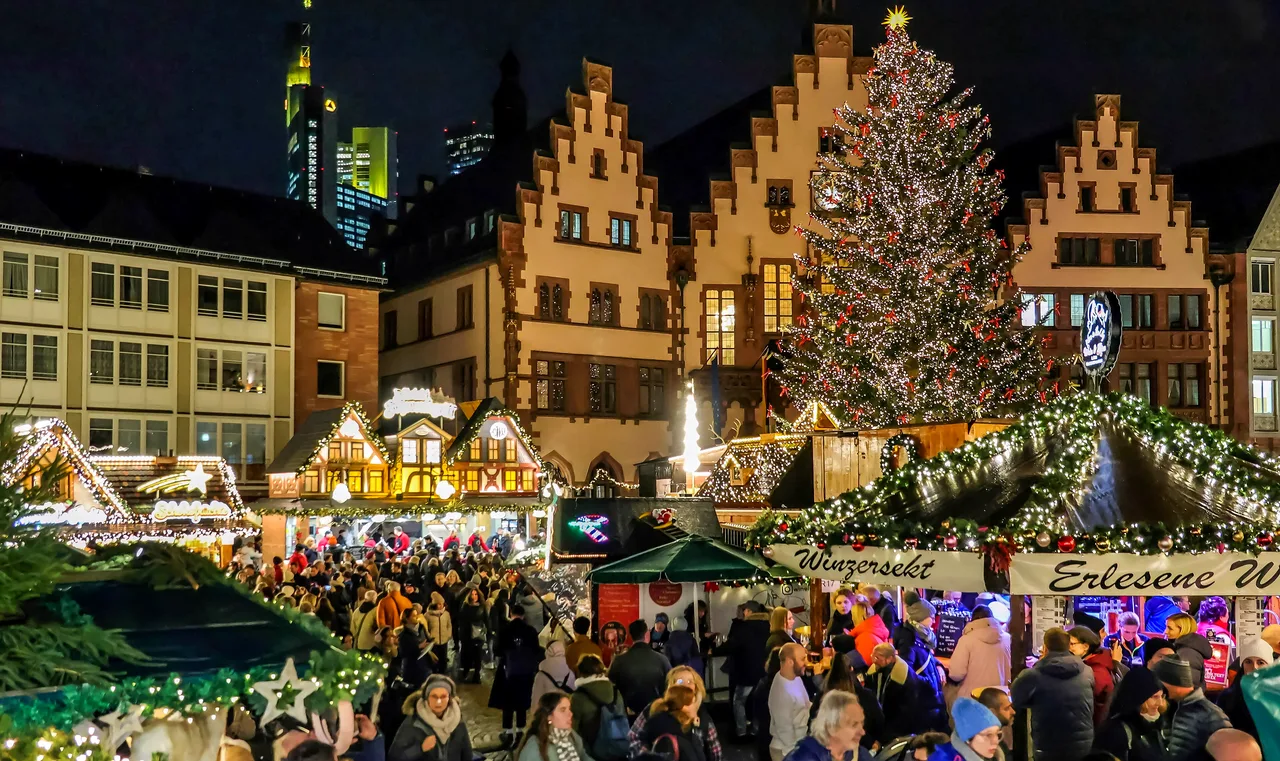
Frankfurt am Main, with around 770,000 inhabitants, is Germany’s fifth-largest city and the largest city in the state of Hesse (the state capital is Wiesbaden). Its skyline on the Main has earned it the nickname “Mainhattan”; with the European Central Bank, the Frankfurt Stock Exchange and the headquarters of major banks, it is one of Europe’s financial capitals. But Frankfurt’s story is far older than its towers: for centuries the kings of the Holy Roman Empire were elected here, and from 1562 to 1792 emperors were crowned in the Kaiserdom. In 1848 Germany’s first elected national assembly met in the Paulskirche, and Johann Wolfgang von Goethe was born in the city in 1749. The old town, largely destroyed in the Second World War, has been brought back to life with the half-timbered houses on the Römerberg and the Neue Altstadt project completed in 2018. From late November to Christmas the Frankfurt Christmas Market, stretching from the Römerberg to the banks of the Main, fills the historic heart of the city with light and more than 230 stalls; Bethmännchen biscuits and hot apple wine (heißer Apfelwein) are the season’s very Frankfurt flavours.
Content update: 28 October 2026 · Market dates checked on the official visitfrankfurt.travel page (Tourismus+Congress GmbH Frankfurt)
At a glance
- Country / state
- Germany, state of Hesse (largest city; the capital is Wiesbaden)
- Population
- About 770,000; Germany’s fifth-largest city, centre of the Rhine-Main region
- Language
- German; English is very widely used in business and tourism
- Currency
- Euro (EUR)
- Time zone
- Central European Time (CET, UTC+1); UTC+2 in summer. In winter 2 hours behind Türkiye
- River
- Main; the old town is on the north bank, Sachsenhausen and the Museumsufer on the south bank
- Landmarks
- Römer, Kaiserdom, Paulskirche, Eiserner Steg, Alte Oper, the skyscraper skyline
- Christmas markets
- The Frankfurt Christmas Market spread over the Römerberg, Paulsplatz, Hauptwache, Roßmarkt, Friedrich-Stoltze-Platz and Mainkai; the Künstlerweihnachtsmarkt in the Paulskirche. 2026 dates below
- UNESCO
- None in the city; nearby the Upper Middle Rhine Valley, Darmstadt’s Mathildenhöhe and the ShUM sites including Mainz
- Airport
- Frankfurt Airport (FRA), about 12 km south-west of the centre; about 15 minutes to the Hauptbahnhof by S-Bahn
- Electricity
- 230 V, 50 Hz; type F/C sockets, the same as in Türkiye
- Emergency numbers
- 112 (ambulance and fire), 110 (police)
Frankfurt in pictures
The skyline at night across the Main, the Eiserner Steg footbridge and the night lights of the half-timbered Ostzeile houses on the Römerberg: Frankfurt in three frames.


Frankfurt Christmas market 2026
The Frankfurt Christmas Market (Frankfurter Weihnachtsmarkt), with roots going back to the medieval “Christkindchesmarkt”, is one of Germany’s oldest and largest Christmas markets. According to the official tourism website it runs “like a glowing ribbon” through the city centre: from the WeihnachtsRoßmarkt to the Hauptwache, from the Friedrich-Stoltze-Platz with its “Rosa Weihnacht” section to the Paulsplatz, and on down to the Römerberg and the Mainkai with its children’s section, more than 230 lavishly decorated stalls line up. The giant Christmas tree in the middle of the Römerberg is the market’s symbol: the 2026 tree, named “Nikolaus”, is a spruce about 50 years old and 27 metres tall from Wald-Königsleiten in Austria’s Pinzgau region. The opening takes place on 23 November 2026 on the Römerberg stage: at 17:05 the carillon (Glockenspiel) of the Alte Nikolaikirche, at 17:10 the opening speech by Lord Mayor Mike Josef, framed by a Christmas concert by Oper Frankfurt. On the opening evening and then every Wednesday and Saturday at 18:00, tower brass players (Turmbläser) play Christmas music from the roof gallery of the Alte Nikolaikirche. The dates below were checked against the official source on 28 October 2026.


| Market / event | Location | 2026 dates | Note |
|---|---|---|---|
| Frankfurt Christmas Market (Frankfurter Weihnachtsmarkt) | Römerberg, Paulsplatz, Hauptwache, Roßmarkt, Friedrich-Stoltze-Platz, Mainkai | 23 November–22 December 2026 | According to the official page Monday–Saturday 10:00–21:00, Sunday 11:00–21:00; more than 230 stalls. Free entry |
| Children’s Christmas Market (Kinder-Weihnachtsmarkt) | Mainkai, east of the Eiserner Steg | Together with the main market | According to the official page, theatre and storytelling on an illuminated “Christmas ship” on the Main, a craft workshop, a carousel and a Ferris wheel |
| 104th Künstlerweihnachtsmarkt | Paulskirche | 24 November–20 December 2026 | Christmas exhibition of Frankfurt artists; daily 12:00–20:00 (until 18:00 on 20 December), free entry |
| Künstlerweihnachtsmarkt · Römer exhibition | Römerhalle and Schwanenhalle in the Römer | 4–21 December 2026 | Daily 12:00–20:00 (until 18:00 on 21 December), free entry |
| Frankfurt city bells (Frankfurter Stadtgeläut) | Kaiserdom, Paulskirche, Katharinenkirche and other old-town churches | 28 November 16:30–17:00 and 24 December 17:00–17:30 | According to the official programme the bells of ten churches ring together; the Römerberg and the cathedral area are the best places to listen |
| St Nicholas visit and steam train | Römerberg stage; Eiserner Steg | 6 December 17:10; 12–13 December | According to the official programme St Nicholas appears on stage on 6 December; Historische Eisenbahn Frankfurt runs Christmas trips on the harbour railway on 12–13 December (start and finish at the Eiserner Steg) |
What to taste at the market
Bethmännchen
Frankfurt’s signature Christmas biscuit: small marzipan balls topped with three almond halves. According to the official page they are a must during Advent.
Brenten
A traditional Frankfurt sweet made of almond paste and pressed into patterned moulds.
Heißer Apfelwein
Frankfurt apple wine heated with cinnamon and cloves, the local drink for cold winter evenings. There is also alcohol-free children’s punch (Kinderpunsch).
Quetschemännchen
Little figures made of prunes and dried fruit joined with wire; according to the official page they represent a chimney sweep or musician believed to bring good luck, and are bought as souvenirs.
Glühwein
Spiced mulled wine; drinks usually come in souvenir mugs with a deposit.
Gebrannte Mandeln and Lebkuchen
Sugar-roasted almonds and honey-and-spice Christmas biscuits.
Tips for the Frankfurt Christmas market
- The market runs north to south like a line: a walk from the Hauptwache via the Paulsplatz and Römerberg down to the Mainkai lets you see every section in one go.
- The Römerberg is very crowded on weekend evenings; weekday mornings are more relaxed.
- To hear the Turmbläser, be at the southern end of the Römerberg in front of the Alte Nikolaikirche at 18:00 on a Wednesday or Saturday.
- The artists’ market in the Paulskirche opens at 12:00; spend the morning at the cathedral and the Römer.
- A deposit is charged for mugs; keep the mug as a souvenir or return it.
- The market closes on 22 December; there is no market on Christmas Eve (24 December), but the city bells ring at 17:00.
- Come by public transport: the Hauptwache and Dom/Römer U-Bahn stations are right in the market.
- Programme and hours can change; check visitfrankfurt.travel again before you go.
Check before you go: visitfrankfurt.travel · Frankfurter Weihnachtsmarkt (official) ↗
Dates and times were checked on 28 October 2026 on the official “Frankfurter Weihnachtsmarkt” page at visitfrankfurt.travel; the official page states that the programme is continually updated. Organisers may change the programme; check the official page again before you go.
When to go
Frankfurt can be visited in any season. May to September is ideal for the Main riverbank and apple wine gardens; late November to 22 December is Christmas market season. During major trade fair (Messe) weeks demand for accommodation rises sharply.
| Month | City walks | Christmas market | Riverbank and gardens | Crowds |
|---|---|---|---|---|
| January | Challenging | Partly open | Challenging | Quiet |
| February | Challenging | No market | Challenging | Moderate |
| March | Good | No market | Good | Moderate |
| April | Very good | No market | Very good | Moderate |
| May | Very good | No market | Very good | Moderate |
| June | Very good | No market | Very good | Moderate |
| July | Very good | No market | Very good | Moderate |
| August | Very good | No market | Very good | Moderate |
| September | Very good | No market | Very good | Moderate |
| October | Good | No market | Good | Busy |
| November | Good | Market season | Challenging | Moderate |
| December | Good | Market season | Challenging | Busy |
- Frankfurt’s winters are milder than in the Alpine region but damp and grey; bring a raincoat, an umbrella and comfortable walking shoes.
- Frankfurt is one of the world’s major trade fair cities; during big fairs such as the Book Fair (Buchmesse) in October hotel demand rises sharply. Check the fair calendar on Messe Frankfurt’s official website.
- The Christmas market closes on 22 December; there is no Christmas market atmosphere in Frankfurt between Christmas and New Year.
- The Palmengarten glasshouses are open in winter too; outdoor areas and boat trips vary by season.
- 25–26 December and 1 January are public holidays; shops are closed and museum hours may change.
Visas and entry (Turkish citizens)
Turkish citizens holding ordinary (burgundy) passports need a Schengen visa for tourist entry to Germany. Different rules apply to special, service and diplomatic passports; check the current situation on the website of the Turkish Ministry of Foreign Affairs.
Under Schengen rules you apply to the country of your main destination. If your trip is mainly to Frankfurt and Germany, you apply to the German missions in Türkiye; the application channel, appointment system and required documents are published on tuerkei.diplo.de.
If you plan to continue from Frankfurt to cities in neighbouring countries such as Strasbourg (France), be clear about where you will stay longest; a valid Schengen visa allows travel within the area, but checks may take place at internal borders from time to time, so carry your passport.
Under the Entry/Exit System (EES), being phased in at the EU’s external borders, your biometric data (fingerprints and facial image) may be recorded on first entry. Details are on the official EU page.
Visa fees, processing times and document lists can change. No fees are given on this page; rely only on official sources before applying.
Check before you go: T.C. Dışişleri Bakanlığı · Türk vatandaşlarının tabi olduğu vize uygulamaları ↗ · tuerkei.diplo.de ↗ · EES · europa.eu ↗ · Rota Atlası visa guide (TR)
Travel medical insurance
Check the official visa and entry sources above first: they state whether travel medical insurance is required and the minimum cover. Compare any policy’s cover amount, validity dates and countries covered with the official requirement.
Rota Atlası does not currently offer an insurance partnership; there are no paid links in this section. Last updated: 1 November 2026
Getting to Frankfurt
- By air: Frankfurt Airport (FRA) is Germany’s largest airport, about 12 km south-west of the city centre. S-Bahn lines S8 and S9 reach the Hauptbahnhof in about 15 minutes. Connections from Türkiye vary by season; check current flights only on the official websites of airlines and the airport.
- Note: “Frankfurt-Hahn” airport is not in Frankfurt but about 120 km west of the city in the Hunsrück region; check the airport code when booking.
- By train: Frankfurt Hauptbahnhof is one of Germany’s busiest stations, with direct ICE services to Cologne, Munich, Berlin, Hamburg and neighbouring countries. The airport’s long-distance station (Fernbahnhof) is also on the ICE network. Times and tickets on bahn.de.
- By coach: long-distance coaches stop close to the south side of the Hauptbahnhof; check current stops on the coach companies’ official websites.
- By car: central Frankfurt is a low-emission zone (Umweltzone); a green emissions sticker (Umweltplakette) is required to enter. Parking in the centre is limited; use Park+Ride sites.
- From the Hauptbahnhof the Römerberg is about 20 minutes on foot or a few stops by U-Bahn (Dom/Römer).
Getting around

On foot
The old town, Römerberg, cathedral, Paulskirche, Hauptwache and the Main riverbank are within walking distance; cross to the Museumsufer on the Eiserner Steg or Holbeinsteg.
U-Bahn, S-Bahn and tram
The RMV (Rhein-Main-Verkehrsverbund) network links the city, the airport and neighbouring cities such as Mainz, Wiesbaden and Darmstadt. Current lines and fares on rmv.de.
Tickets
Tickets are sold from machines and in the official RMV app; day tickets are available. Buy your ticket before boarding. The Frankfurt Card, offered by the city’s tourism organisation, includes public transport and discounts; details on visitfrankfurt.travel.
Main boats
Sightseeing boats on the Main leave from around the Eiserner Steg; winter timetables may be limited, so check the official websites.
Bike
There are flat, pleasant cycle paths along the Main; do not walk on cycle lanes.
Taxi
Taxis are found at ranks or ordered by phone; there are taxi ranks at the Hauptbahnhof and the airport.
Places to visit
Frankfurt’s sights extend from the historic core on the north bank of the Main (Römerberg, cathedral, Paulskirche) to the shopping district (Hauptwache, Zeil), the museum strip on the south bank and the apple wine neighbourhoods. The twelve sections below cover the city and the most important day trips.
The historic heart
Römer and Römerberg

The Römerberg is Frankfurt’s most famous square and the heart of the Christmas market. On its west side the stepped-gabled Römer has been the city’s town hall since 1405; inside, the Imperial Hall (Kaisersaal) is where coronation banquets were held, its walls lined with portraits of the Holy Roman emperors. The half-timbered Ostzeile (Samstagsberg) houses on the east side of the square were destroyed in the war and faithfully rebuilt in the 1980s. The roof gallery of the Alte Nikolaikirche at the southern end is the stage of the Turmbläser at Christmas. The Fountain of Justice (Gerechtigkeitsbrunnen) stands in the middle of the square.
Must-see
- The Römer façade and the Kaisersaal
- The half-timbered Ostzeile houses
- Alte Nikolaikirche
- The Fountain of Justice
- The giant Christmas tree in season
Tips
- Kaisersaal opening hours may change because of official events; check the city website.
- The square is very crowded on market evenings; take photos in the morning.
- The Römerhalle and Schwanenhalle in the Römer host the Künstlerweihnachtsmarkt exhibition in December.

The coronation cathedral
Kaiserdom St. Bartholomäus and the Neue Altstadt

With its Gothic tower, the Kaiserdom St. Bartholomäus dominates the old-town skyline. It is called a “Dom” although it was never a bishop’s seat because of its role in imperial history: the Golden Bull of 1356 made Frankfurt the place of royal elections, and from 1562 to 1792 emperors were crowned in this church. The Dom-Römer area between the cathedral and the Römer has been recreated by the Neue Altstadt project, completed in 2018, which revived the narrow lanes of the old town lost in the war; the route of the historic coronation processions (Krönungsweg) passes through it.
Must-see
- The cathedral interior and the election chapel
- The cathedral tower (when open) and city view
- The rebuilt houses and Hühnermarkt of the Neue Altstadt
- The Krönungsweg (coronation route)
Tips
- Tower and cathedral museum hours vary by season; check dom-frankfurt.de.
- The cathedral is a place of worship; do not walk around during services.
- All nine bells of the cathedral ring during the city bells on 28 November and 24 December.

Cradle of democracy
Paulskirche and Paulsplatz

The oval Paulskirche is where Germany’s first freely elected national assembly met in 1848–1849, which is why it is regarded as a symbol of German democracy. Burnt out in the war, it reopened in 1948 for the assembly’s centenary; today it is a place of remembrance and ceremonies, hosting events such as the Peace Prize of the German Book Trade. The Paulsplatz in front of it is one of the best-loved sections of the Christmas market, and during Advent the Künstlerweihnachtsmarkt exhibition of Frankfurt artists opens inside the Paulskirche.
Must-see
- The exhibition on the 1848 national assembly
- The Christmas market on the Paulsplatz
- The Künstlerweihnachtsmarkt (24 November–20 December)
Tips
- Opening hours may change because of events and renovation work; check paulskirche.de.
- The artists’ market opens daily at 12:00 and entry is free.
- The Römerberg is only a few minutes’ walk away.
City centre
Hauptwache, Katharinenkirche and Zeil

The Hauptwache is a Baroque building constructed in 1730 as the city’s guardhouse; today it is a café, and the square named after it is one of Frankfurt’s most important public transport hubs. Right next to it is the Katharinenkirche, where Goethe was baptised. Running east from the Hauptwache, the Zeil is one of Germany’s busiest shopping streets; the glass-fronted MyZeil shopping centre is its modern landmark. During Advent the Hauptwache and Roßmarkt form the northern section of the Christmas market.
Must-see
- The Baroque Hauptwache
- Katharinenkirche
- The Zeil and MyZeil
- The Christmas market at the Hauptwache and Roßmarkt
Tips
- The Zeil is very crowded on Saturdays.
- Shops are closed on Sundays.
- From the Hauptwache you can follow the market line on foot to the Paulsplatz and Römerberg.

Local flavours
Kleinmarkthalle

Opened in 1954, the Kleinmarkthalle is Frankfurt’s covered food market. With stalls selling fruit and vegetables, cheese, meat products, spices and flowers, the hall is where locals do their everyday shopping; ready-packed mixes of the seven herbs for Grüne Soße, local sausages and Hessian products are easy to find here. The upper gallery is a good spot to watch the bustle of the stalls from above.
Must-see
- Grüne Soße herbs
- Local sausage and cheese stalls
- The view of the hall from the upper gallery
Tips
- The market is closed on Sundays and public holidays; check the hours on its official website.
- It is very crowded at Saturday lunchtime.
- The Hauptwache and the cathedral are a few minutes’ walk away.
Literature
Goethe House and German Romantic Museum

Johann Wolfgang von Goethe was born on 28 August 1749 in this house on the Großer Hirschgraben and spent his youth here; he also wrote “The Sorrows of Young Werther” in this house. The house was destroyed in the Second World War, but because its furnishings had been put into safekeeping it was faithfully rebuilt and refurnished after the war. Run by the Freies Deutsches Hochstift, it stands next to the German Romantic Museum (Deutsches Romantik-Museum), opened in 2021.
Must-see
- The period rooms of Goethe’s birthplace
- The puppet theatre and astronomical clock
- The German Romantic Museum
Tips
- Check opening hours and combined tickets on frankfurter-goethe-haus.de.
- The house has narrow stairs, so progress is slow at busy times.
- It is very close to the Hauptwache.
Culture and greenery
Alte Oper and Palmengarten

The Alte Oper on Opernplatz opened as an opera house in 1880; destroyed in the Second World War, it remained a ruin for many years and reopened as a concert hall in 1981. Its neo-Renaissance façade faces one of the city’s most elegant squares. To the north-west, the Palmengarten is a large botanical garden founded in 1871; the Tropicarium and other glasshouses offer a warm escape in winter too. The nearby Senckenberg Natural History Museum is known for its dinosaur skeletons.
Must-see
- The Alte Oper façade and Opernplatz
- The Palmengarten glasshouses
- Senckenberg Natural History Museum
Tips
- The inside of the Alte Oper can only be seen with a concert ticket or on a guided tour; check the programme on the official website.
- Palmengarten hours vary by season; check palmengarten.de.
- The Palmengarten is a few U-Bahn stops from the Alte Oper.

The museum strip
Museumsufer, Städel and Sachsenhausen

The Museumsufer on the south bank of the Main is a cultural strip of many museums lined up along the river. The most famous is the Städel Museum, founded in 1815 through the bequest of Johann Friedrich Städel, which shows European art from about 700 years. The Liebieghaus sculpture collection, the German Film Museum and the Museum of Applied Arts are on the same bank. Behind the museums, Sachsenhausen, especially the lanes of Alt-Sachsenhausen, is known for its traditional apple wine taverns.
Must-see
- Städel Museum
- Liebieghaus
- German Film Museum
- The lanes of Alt-Sachsenhausen
Tips
- Most museums are closed on Mondays; check hours on museumsufer.de and the museums’ websites.
- There may be ticket options covering several Museumsufer museums; compare on the official website.
- Walk across from the old town on the Eiserner Steg or Holbeinsteg.

Skyline
Main bridges, skyline and the European Central Bank

Frankfurt’s “Mainhattan” skyline is best seen from the bridges over the Main. The Eiserner Steg, opened in 1869, is the city’s iconic footbridge; the Holbeinsteg leading to the Städel is a modern footbridge with the towers as its backdrop. Among the bank towers, the Main Tower has a public viewing terrace. To the east, in the Ostend, the twin-tower building joined to the former Großmarkthalle (wholesale market hall) is the headquarters of the European Central Bank (EZB/ECB).
Must-see
- The skyline view from the Eiserner Steg
- The Holbeinsteg
- The Main Tower viewing terrace
- The European Central Bank building in the Ostend
Tips
- The Main Tower terrace may close in bad weather; check the hours on its official website.
- Sunset and the “blue hour” are best for skyline photos.
- A walk along the Main can be combined with the Museumsufer.

Neighbourhood life
Bornheim and Berger Straße

Bornheim is a lively district in the north-east; its main street, the Berger Straße, with small shops, cafés and traditional apple wine taverns, offers a Frankfurt away from the tourist crowds. Locals jokingly call the district “das lustige Dorf” (the merry village). The upper Berger Straße, where the old village fabric survives, is ideal for watching local life in the evening.
Must-see
- Berger Straße
- The half-timbered houses of old Bornheim
- Traditional apple wine taverns
Tips
- Reached quickly from the centre on U-Bahn line U4.
- Respect residents’ everyday life as you walk along the Berger Straße.
- It is livelier in the evening.
The old town in the west
Höchst: old town, Höchster Schloss and Justinuskirche

Some 8 km west of the Hauptwache, where the Nidda flows into the Main, Höchst is unlike most Frankfurt districts: it is an old town with a history of its own, holding town rights from 1355 and joining Frankfurt only in 1928. Ruled by the archbishops of Mainz, the town grew up around a customs castle on the Main. Of the Höchster Schloss that replaced it, the keep of the 14th-century customs castle survives; it was given a baroque cap in 1681, and its silhouette is instantly recognisable from the riverbank. The neighbouring Neues Schloss was built at the end of the 16th century, and since 1957 the castle grounds have been the centre of the annual Höchster Schlossfest. The old town’s most precious building is the Carolingian Justinuskirche, much of it dating from the 9th century and regarded as Frankfurt’s oldest building. Most of the half-timbered houses in the narrow lanes were built after the great fire of 1586, and the old town has been a protected monument since 1972. In the Neustadt, founded in 1768, rises the baroque Bolongaropalast, built from 1772 for the Bolongaro brothers, snuff merchants from Stresa, with a terraced garden above the mouth of the Nidda. Höchst also gave its name to the Höchster Porzellanmanufaktur, founded in 1746 as Germany’s second-oldest porcelain manufactory, and to the Hoechst chemical company founded in 1863. Justinuskirche (official) →
Must-see
- The baroque-capped tower of the Höchster Schloss and the Main riverbank
- The Carolingian Justinuskirche and its garden
- Old-town lanes lined with half-timbered houses built after the 1586 fire
- The Bolongaropalast and its baroque garden above the Nidda
Tips
- Höchst is a short S-Bahn ride from the city centre; check lines and times at rmv.de. The old town is within walking distance of the station.
- Opening hours of the Justinuskirche are limited and vary by season; check the official site before you go.
- The promenade along the Main is the best viewpoint for seeing the castle and the church together.

Day trips
Mainz, Wiesbaden, Rüdesheim, Heidelberg and Darmstadt

As the transport hub of the Rhine-Main region, Frankfurt is ideal for day trips. Mainz on the Rhine is known for its cathedral, more than a thousand years old, and the Gutenberg Museum; the city’s medieval Jewish heritage is on the UNESCO list as part of the ShUM sites. Wiesbaden, the capital of Hesse, is famous for its thermal springs and Kurhaus. Rüdesheim am Rhein, with its Drosselgasse, is at the gateway to the UNESCO-listed Upper Middle Rhine Valley. Heidelberg on the Neckar, with its castle and Old Bridge, is one of Germany’s most romantic cities. Darmstadt’s Mathildenhöhe artists’ colony and Wedding Tower were added to the UNESCO list in 2021. Most of these cities have their own Advent markets; check dates on their official websites. UNESCO listing ↗ Mainz guide →
Must-see
- Mainz Cathedral and the Gutenberg Museum
- Wiesbaden Kurhaus
- Rüdesheim’s Drosselgasse and Rhine views
- Heidelberg Castle and the Old Bridge
- Darmstadt Mathildenhöhe
Tips
- Mainz and Wiesbaden are about 30–45 minutes by S-Bahn, Darmstadt about 20–30 minutes, Heidelberg and Rüdesheim about 1–1.5 hours; check times on bahn.de and rmv.de.
- Rhine boats run a limited service in winter; check timetables on the official websites.
- Christmas market dates in neighbouring cities change every year; rely only on official sources.


1, 2 and 3-day itineraries + Christmas day
The itineraries below are planned on foot and by public transport. Check museum, tower and boat hours and closing days on the official websites before you go.
1 day: Old town and riverbank
- In the morning see the Römer and the Ostzeile houses on the Römerberg, then walk through the lanes of the Neue Altstadt to the Kaiserdom.
- Visit the Paulskirche and browse local produce in the Kleinmarkthalle.
- In the afternoon tour the Goethe House and pass through the Hauptwache and the Zeil.
- At sunset watch the skyline from the Eiserner Steg and cross to Sachsenhausen.
- End the evening with local Hessian specialities.
2 days: Museums and skyline
- In addition to day 1, visit the Städel Museum in the morning.
- Continue along the Museumsufer with the Liebieghaus or the Film Museum.
- In the afternoon look out over the city from the Main Tower terrace and walk to the Alte Oper.
- In the evening explore neighbourhood life on the Berger Straße in Bornheim.
3 days: The Rhine-Main region
- On the third day go to Mainz to see the cathedral and the Gutenberg Museum.
- Alternatively explore the castle and Old Bridge in Heidelberg.
- For a shorter programme choose Darmstadt’s Mathildenhöhe or the Wiesbaden Kurhaus.
- Back in Frankfurt in the evening, add the Palmengarten glasshouses or a concert.
Christmas market day (23 November–22 December 2026)
- Start at the Roßmarkt and Hauptwache sections as the market opens at 10:00.
- Walk to the Paulsplatz; after 12:00 visit the Künstlerweihnachtsmarkt exhibition in the Paulskirche.
- See the giant Christmas tree on the Römerberg and taste Bethmännchen and Brenten; in December also look in on the artists’ exhibition in the Römer.
- Go down to the Mainkai to see the children’s market and the illuminated Christmas ship on the Main.
- If it is a Wednesday or Saturday, listen to the Turmbläser on the Römerberg at 18:00 and end the day with hot apple wine.
Frankfurt and Hessian food
Frankfurt’s cuisine consists of simple, hearty Hessian dishes, with apple wine culture at its centre. Below are local specialities to try, not restaurant recommendations.


Grüne Soße
Frankfurt’s signature dish: a cold green sauce made from seven fresh herbs (borage, chervil, cress, parsley, salad burnet, sorrel and chives), served with boiled eggs and potatoes.
Handkäs mit Musik
A small round sour-milk cheese served in a vinegar-and-onion marinade; traditionally eaten with apple wine.
Frankfurter Würstchen
The thin sausages that bear the city’s name, heated in water; traditionally served with mustard and bread.
Apfelwein (Ebbelwoi)
Frankfurt’s local drink, a tart apple wine, poured from a grey-blue stoneware jug called a “Bembel” into diamond-patterned “Geripptes” glasses.
Frankfurter Kranz
A ring-shaped cake covered in buttercream and caramelised nut brittle.
Rippchen mit Kraut
Cured pork served with sauerkraut, a classic of the apple wine taverns.
- Pork is common in German cuisine; if you are looking for halal or pork-free options, ask about the menu.
- Sitting at long shared tables is normal in traditional apple wine taverns; if there is a free seat, ask and sit down.
- Tap water is drinkable.
- Supermarkets are closed on Sundays and public holidays; some shops at the Hauptbahnhof and the airport may be an exception.
Culture and etiquette

- In Germany people usually greet each other with “Hallo” or “Guten Tag”; in Hesse you will often hear “Gude” too.
- Punctuality matters; be on time for guided tours and appointments.
- Keep quiet in churches and cathedrals and do not walk around during services.
- In restaurants it is common to round up the bill or leave a small tip; the tip is stated when paying.
- Quiet hours are observed on Sundays.
- There is a deposit (Pfand) system on plastic and glass bottles; you can return them to machines in supermarkets.
- Cycle paths are red or marked lanes; pedestrians should not walk on them.
- Using Nazi symbols or giving the Hitler salute is a crime in Germany.
Safety and health
- Frankfurt is generally a safe city; watch out for pickpockets in the Christmas market crowds, on the Zeil and on public transport.
- Take care in the Bahnhofsviertel around the Hauptbahnhof, especially at night, and keep valuables out of sight.
- There may be security measures and bag checks at Christmas markets; follow staff instructions.
- Pavements can be wet and slippery in winter; wear comfortable, non-slip shoes.
- Be careful of currents and cold water along the Main; do not go into the river.
- In an emergency call 112 (ambulance and fire) or 110 (police). Travel health insurance is mandatory for a Schengen visa.
- Check official travel advice (e.g. the Turkish Ministry of Foreign Affairs or GOV.UK) before you go.
What your budget depends on
This guide gives no prices, because they change quickly with season and year. In Frankfurt your budget depends mostly on these factors:
Trade fair calendar
During major trade fair (Messe) weeks hotel demand and prices in Frankfurt rise noticeably; choose your dates with the Messe Frankfurt calendar in mind.
Where you stay
The old town and riverbank are practical but in demand; districts on S-Bahn and U-Bahn lines and neighbouring cities can be alternatives.
Frankfurt Card
The Frankfurt Card, covering public transport and museum discounts, can be good value for a busy programme; check what it includes on visitfrankfurt.travel.
Museums
There may be combined ticket options for the Museumsufer museums; compare on the official websites.
Food and drink
Market stalls, the Kleinmarkthalle and traditional apple wine taverns offer options for different budgets.
Day trips
Mainz, Wiesbaden and Darmstadt in the RMV area are easy to reach by public transport; compare train options for Heidelberg and Rüdesheim on bahn.de.
Practical information
- Money: the euro is used; card payment is common, but small stalls may need cash.
- Language: English is widespread at tourist sites and in business; a few German words (Danke, Bitte) help.
- Opening hours: shops close on Sundays; many places close early on the afternoon of 24 December, and 25–26 December are public holidays.
- Internet: there are free Wi-Fi hotspots in the city; check roaming charges in advance for non-EU SIM cards.
- Tourist information: there is an official tourist information office on the Römerberg; up-to-date information on visitfrankfurt.travel.
- Accessibility: the centre is largely flat; many U-Bahn and S-Bahn stations have lifts.
- Weather: in winter it gets dark around 16:30; the Christmas lights are at their best after that.
- Photography: the Eiserner Steg and Holbeinsteg are the best spots for the skyline, the Römerberg and the cathedral tower for the old town.
Frequently asked questions
When does the 2026 Frankfurt Christmas market open?
According to the official tourism website (visitfrankfurt.travel), the Frankfurt Christmas Market runs from 23 November to 22 December 2026; hours are announced as Monday–Saturday 10:00–21:00 and Sunday 11:00–21:00. Check the official page before you go.
Where is the Christmas market held?
On the Römerberg, Paulsplatz, Hauptwache, Roßmarkt, Friedrich-Stoltze-Platz and Mainkai; these areas are within walking distance of each other.
Is there an entrance fee for the Christmas market?
No, the market is in the open air and entry is free; according to the official page the artists’ exhibitions in the Paulskirche and the Römer are free too.
What should I eat at the Frankfurt Christmas market?
Bethmännchen, Brenten, hot apple wine (heißer Apfelwein) and Glühwein; Quetschemännchen figures make good souvenirs.
Do Turkish citizens need a visa for Frankfurt?
Turkish citizens with ordinary passports need a Schengen visa. The application channel and documents are published on Germany’s official website tuerkei.diplo.de.
How do I get from the airport to the city centre?
S-Bahn lines S8 and S9 reach the Hauptbahnhof in about 15 minutes; current timetables on rmv.de.
How many days should I spend in Frankfurt?
One full day is enough for the old town and riverbank; two days with museums, and three are ideal with a day trip such as Mainz or Heidelberg.
Is the market open on Christmas Eve?
No; according to the official page the market closes on 22 December. On 24 December the city bells ring from 17:00 to 17:30.
When do the Turmbläser play?
According to the official programme, on the opening day (23 November) and then every Wednesday and Saturday at 18:00 from the roof gallery of the Alte Nikolaikirche.
Is Frankfurt-Hahn airport in Frankfurt?
No, Frankfurt-Hahn is about 120 km west of the city; Frankfurt Airport’s code is FRA.
Where to stay
Stay close to the areas where you will spend most time. The areas below are covered in detail in this guide; check public transport links in the getting-around section.
- The historic heartRömer and Römerberg
- The coronation cathedralKaiserdom St. Bartholomäus and the Neue Altstadt
- Cradle of democracyPaulskirche and Paulsplatz
- City centreHauptwache, Katharinenkirche and Zeil
- Local flavoursKleinmarkthalle
- LiteratureGoethe House and German Romantic Museum
- Culture and greeneryAlte Oper and Palmengarten
- The museum stripMuseumsufer, Städel and Sachsenhausen
- SkylineMain bridges, skyline and the European Central Bank
- Neighbourhood lifeBornheim and Berger Straße
- The old town in the westHöchst: old town, Höchster Schloss and Justinuskirche
Search hotels in these areas (Hotellook) ↗ (affiliate link)Search on Booking.com ↗
Where to stay in Frankfurt → · 3 days in Frankfurt: ready-made itinerary →
Affiliate disclosure: Hotellook, Aviasales, Klook, Airalo, Tiqets and DiscoverCars links are affiliate links; Rota Atlası may earn a commission on bookings made through them, at no extra cost to you. Official and in-guide links are not paid. Last updated: 1 November 2026 · Privacy and affiliates
Transport and connectivity
- Airport transferOptions from the airport to the city are in this guide’s getting there section.
- Mobile data (eSIM)Airalo eSIM ↗ (affiliate link)
- TrainsOfficial rail website ↗
- Car hireYou rarely need a car within the city; see getting around first. Compare car hire on DiscoverCars ↗ (affiliate link)
Affiliate disclosure: Hotellook, Aviasales, Klook, Airalo, Tiqets and DiscoverCars links are affiliate links; Rota Atlası may earn a commission on bookings made through them, at no extra cost to you. Official and in-guide links are not paid. Last updated: 1 November 2026 · Privacy and affiliates
Search flights (affiliate link)
Search flights from any airport in any country. Results open on Aviasales in a new tab, where you book.
This form is an affiliate link: Rota Atlası may earn a commission on bookings made via Aviasales (Travelpayouts), at no extra cost to you. Check price, baggage and terms on the booking site. Airport data: OurAirports (public domain).
Flights, hotels and tours
Find tours and tickets
- Römerberg and the Frankfurt Christmas Market
GetYourGuide ↗ · Klook ↗ (affiliate link) - Kaiserdom St. Bartholomäus
GetYourGuide ↗ · Klook ↗ (affiliate link) - Paulskirche
GetYourGuide ↗ · Klook ↗ (affiliate link) - Mainkai and Eiserner Steg
GetYourGuide ↗ · Klook ↗ (affiliate link)
Hotellook, Aviasales, Klook, Airalo and Tiqets links in this box are affiliate links (Travelpayouts): Rota Atlası may earn a commission on bookings made through them, at no extra cost to you. GetYourGuide links currently carry no affiliate code. Check prices and terms with the provider. Last updated: 1 November 2026 · Privacy and affiliates
Sources
- T.C. Dışişleri Bakanlığı · Türk vatandaşlarının tabi olduğu vize uygulamaları ↗
- Auswärtiges Amt · Deutsche Vertretungen in der Türkei (Visa) ↗
- European Union · Entry/Exit System (EES) ↗
- Tourismus+Congress GmbH Frankfurt · visitfrankfurt.travel (official) ↗
- Kaiserdom St. Bartholomäus (official) ↗
- Städel Museum (official) ↗
- Museumsufer Frankfurt (official) ↗
- Frankfurter Goethe-Haus · Freies Deutsches Hochstift (official) ↗
- Palmengarten Frankfurt (official) ↗
- Paulskirche Frankfurt (official) ↗
- RMV · Rhein-Main-Verkehrsverbund ↗
- Frankfurt Airport ↗
- Deutsche Bahn ↗
- GOV.UK · Foreign travel advice · Germany ↗
- UNESCO World Heritage Centre · Upper Middle Rhine Valley ↗
- UNESCO World Heritage Centre · Mathildenhöhe Darmstadt ↗
- UNESCO World Heritage Centre · ShUM Sites of Speyer, Worms and Mainz ↗
- visitfrankfurt.travel · Frankfurter Weihnachtsmarkt (official) ↗
This page is for information only. Dates, hours, entry rules and transport details can change; check the official sources above before you travel. No prices, flights, hotels or restaurant recommendations have been invented in this guide.
Photo credits
The photos on this page come from Wikimedia Commons and are used with the stated authors and licences (CC BY, CC BY-SA, CC0 or public domain). All sources page
- The Frankfurt Christmas market on the Römerberg with the Alte Nikolaikirche behind, at night — Dr. Thomas Liptak · CC BY-SA 4.0 · Wikimedia Commons
- The great Christmas tree and market on the Römerberg — Thomas Wolf (Der Wolf im Wald) · CC BY-SA 3.0 · Wikimedia Commons
- Christmas market stalls on Paulsplatz — Dr. Thomas Liptak · CC BY-SA 4.0 · Wikimedia Commons
- The Christmas market around the Hauptwache — Jorge Franganillo · CC BY 4.0 · Wikimedia Commons
- The Christmas market between the Hauptwache and the Roßmarkt — Chabe01 · CC BY-SA 4.0 · Wikimedia Commons
- A sweets and biscuit stall at the Frankfurt Christmas market — Dr. Thomas Liptak · CC BY-SA 4.0 · Wikimedia Commons
- Illuminated stalls at the Frankfurt Christmas market at night — Dr. Thomas Liptak · CC BY-SA 4.0 · Wikimedia Commons
- The Frankfurt skyline at night across the Main — Nicolas Scheuer · CC BY-SA 2.5 · Wikimedia Commons
- The Eiserner Steg footbridge over the Main — DXR · CC BY-SA 4.0 · Wikimedia Commons
- The half-timbered Ostzeile houses on the Römerberg at night — Pedelecs · CC BY-SA 3.0 · Wikimedia Commons
- The stepped gables of the Römer, Frankfurt’s town hall — Thomas Wolf, www.foto-tw.de · CC BY-SA 3.0 de · Wikimedia Commons
- The Ostzeile houses and Alte Nikolaikirche on the Römerberg — Dr. Thomas Liptak · CC BY-SA 4.0 · Wikimedia Commons
- The tower of the Kaiserdom St. Bartholomäus seen from the Main — Norbert Nagel · CC BY-SA 3.0 · Wikimedia Commons
- Aerial view of the Neue Altstadt and the cathedral quarter — Dr. Thomas Liptak · CC BY-SA 4.0 · Wikimedia Commons
- The Paulskirche, seat of the 1848 National Assembly — Leonhard Lenz · CC0 · Wikimedia Commons
- The Baroque Hauptwache building — Norbert Nagel · CC BY-SA 3.0 · Wikimedia Commons
- The Zeil shopping street and MyZeil — Ermell · CC BY-SA 4.0 · Wikimedia Commons
- The Alte Oper on Opernplatz — Thomas Wolf, www.foto-tw.de · CC BY-SA 3.0 de · Wikimedia Commons
- The Tropicarium glasshouses in the Palmengarten — Dr. Thomas Liptak · CC BY-SA 4.0 · Wikimedia Commons
- The Holbeinsteg bridge over the Main with the skyline — Norbert Nagel · CC BY-SA 3.0 · Wikimedia Commons
- The European Central Bank building in the Ostend — Michielverbeek · CC BY-SA 4.0 · Wikimedia Commons
- The Städel Museum on the Museumsufer — Simsalabimbam · CC BY-SA 3.0 · Wikimedia Commons
- The Museumsufer on the south bank of the Main — Eiserner-steg-2010-ffm-011.jpg: Dontworry derivative work: Dontworry · CC BY-SA 3.0 · Wikimedia Commons
- The Großer Hirschgraben with the Goethe House and the German Romantic Museum — Thaler Tamas · CC BY-SA 4.0 · Wikimedia Commons
- Stalls inside the Kleinmarkthalle — EvaK · CC BY-SA 2.5 · Wikimedia Commons
- Berger Straße in Bornheim — Karsten Ratzke · CC0 · Wikimedia Commons
- Mainz Cathedral — Olaf Kosinsky · CC BY-SA 3.0 de · Wikimedia Commons
- The Kurhaus in Wiesbaden — Berthold Werner · CC BY-SA 3.0 · Wikimedia Commons
- The Drosselgasse in Rüdesheim — Hiroki Ogawa · CC BY 3.0 · Wikimedia Commons
- Heidelberg on the Neckar with a passenger boat — Stephan van Helden · CC BY-SA 4.0 · Wikimedia Commons
- The Wedding Tower on the Mathildenhöhe in Darmstadt — Thomas Wolf, www.foto-tw.de · CC BY-SA 3.0 de · Wikimedia Commons
- Frankfurt green sauce (Grüne Soße) with boiled eggs and potatoes — Benreis · CC BY 3.0 · Wikimedia Commons
- Apfelwein in a Bembel jug with a ribbed Geripptes glass — Dr. Thomas Liptak · CC BY-SA 4.0 · Wikimedia Commons
- “Handkäs mit Musik” cheese with onions — Benreis · CC BY 3.0 · Wikimedia Commons
- Frankfurter Würstchen sausages with mustard — WordRidden / Jessica Spengler · CC BY 2.0 · Wikimedia Commons
- An S-Bahn train in Frankfurt — Clic · CC BY-SA 4.0 · Wikimedia Commons
- The Samstagsberg houses of the Ostzeile on the Römerberg — Dietmar Rabich · CC BY-SA 4.0 · Wikimedia Commons
Mainz → · Heidelberg → · Rüdesheim → · Cologne → · Würzburg → · Christmas markets