

Cologne (Köln) sits on the Rhine and, with a little over a million inhabitants, is the largest city in North Rhine-Westphalia and the fourth largest in Germany. Its roots go back to the Roman colony Colonia Claudia Ara Agrippinensium, founded in the 1st century AD; the city’s name comes from the word “colonia”. In the Middle Ages Cologne was one of Europe’s largest and wealthiest cities, and it is famous for Cologne Cathedral, begun in 1248, completed in 1880 and listed as a UNESCO World Heritage Site. Largely destroyed in the Second World War, the city was rebuilt; today Roman remains, twelve great Romanesque churches, world-class museums and lively neighbourhoods sit side by side. Cologne’s identity is shaped by Kölsch beer, the Carnival known as the “fifth season” and its relaxed, talkative people. From mid-November to late December the centre fills with Christmas markets within walking distance of each other. This guide brings together the markets, the main sights, transport, itineraries, food and official sources on one page.
Content updated: 28 October 2026 · Market dates checked on the markets’ official websites
At a glance
- Country / state
- Germany, North Rhine-Westphalia
- Population
- Just over one million; Germany’s fourth-largest city
- Language
- German; the local Kölsch dialect is common, English is widely used in tourism
- Currency
- Euro (EUR)
- Time zone
- Central European Time (CET, UTC+1); UTC+2 in summer. In winter 2 hours behind Türkiye
- River
- Rhine; the old town is on the west (left) bank, Deutz on the east (right) bank
- Landmarks
- Cologne Cathedral, Hohenzollern Bridge, Great St. Martin, Alter Markt, Kranhäuser
- Christmas markets
- Cathedral, Alter Markt/Heumarkt, Neumarkt, Rheinauhafen and more; from mid-November in 2026
- UNESCO
- Cologne Cathedral; nearby the Brühl palaces and Aachen Cathedral
- Airport
- Cologne Bonn Airport (CGN); linked to the main station by S-Bahn and regional trains
- Electricity
- 230 V, 50 Hz; type F/C sockets
- Emergency numbers
- 112 (ambulance, fire), 110 (police)
Cologne in pictures
The cathedral and Hohenzollern Bridge from across the Rhine, Great St. Martin above the old-town houses and the cathedral’s soaring Gothic nave: three views of Cologne.


Cologne Christmas markets 2026
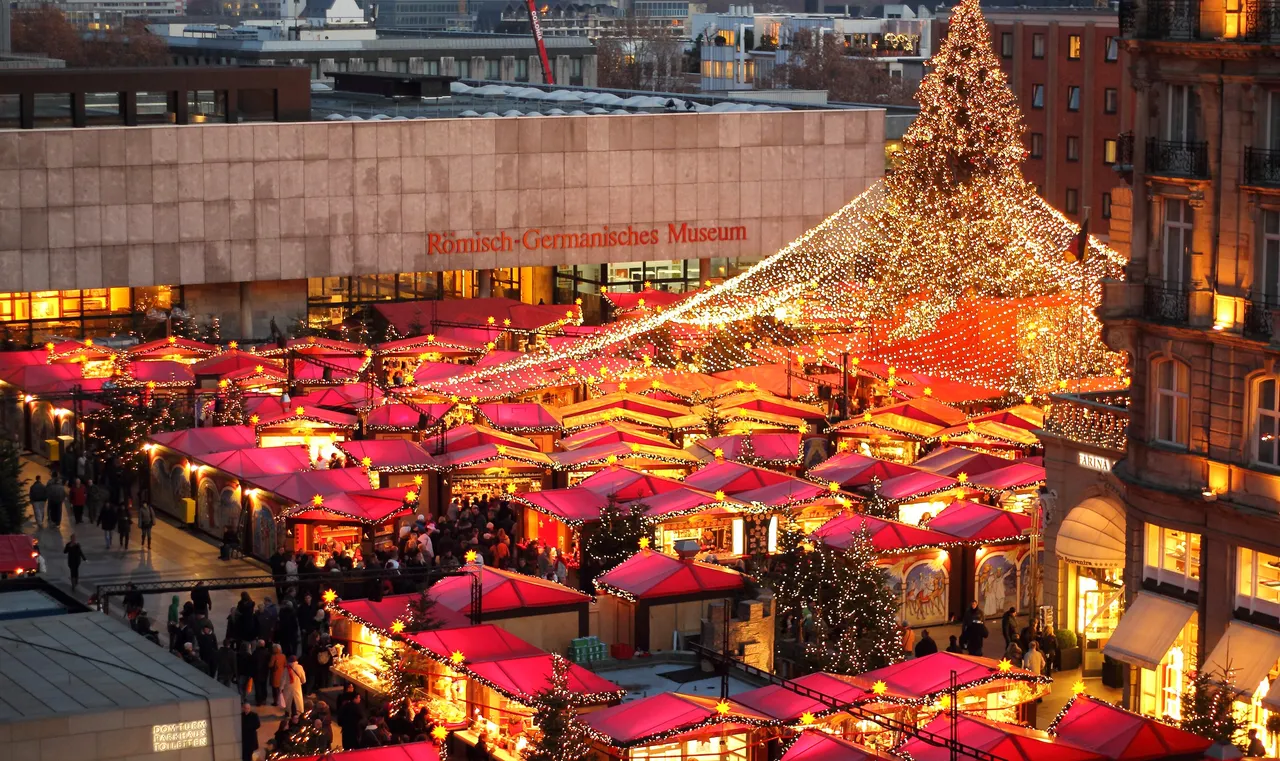
Cologne’s Christmas markets are spread across squares close to one another, so you can walk between several of them in a single evening. Right next to the main station, on Roncalliplatz at the foot of Cologne Cathedral, the “Markt der Herzen” is the city’s best-known market, thanks to its setting in front of the cathedral facade and its canopy of star lights above the stalls. In the old town, Heinzels Wintermärchen on the Alter Markt and Heumarkt is dedicated to the helpful house gnomes (Heinzelmännchen) of Cologne legend; the Heumarkt has an ice rink. The Markt der Engel on Neumarkt is known for its white tents and angel theme, and the Hafen-Weihnachtsmarkt in the Rheinauhafen for its wooden huts on the Rhine beside the Chocolate Museum. The dates below come from the official websites; hours and special days may change.


| Market | Location | 2026 dates | Note |
|---|---|---|---|
| Weihnachtsmarkt am Kölner Dom “Markt der Herzen” | Roncalliplatz, south side of the cathedral | 16 November–23 December 2026 | Closed on 22 November. Official hours Sun–Wed 11:00–21:00, Thu–Fri 11:00–22:00, Sat 10:00–22:00; more than 120 stalls |
| Heinzels Wintermärchen (Alter Markt) | Alter Markt, in front of the historic town hall | 23 November–23 December 2026 | Officially daily 11:00–22:00 |
| Heinzels Wintermärchen (Heumarkt, ice rink) | Heumarkt | 23 November 2026–10 January 2027 | Closed 24–25 December; daily 11:00–22:00, from 31 December 11:00–21:00; ice rink |
| Markt der Engel | Neumarkt | 16 November–23 December 2026 | Closed on 22 November. Sun–Thu 11:00–21:00, Fri–Sat 11:00–22:00 |
| Hafen-Weihnachtsmarkt | Rheinauhafen, next to the Chocolate Museum | 13 November 2026–3 January 2027 | About 70 wooden huts according to the official website; check holiday hours |
What to taste at the market
Reibekuchen
Crispy grated-potato pancakes eaten with apple sauce or on bread; the signature smell of Cologne’s markets.
Glühwein and Kinderpunsch
Spiced mulled wine; the alcohol-free fruit Kinderpunsch is available at every market. Each market has its own mugs, usually with a deposit.
Gebrannte Mandeln
Sugar-roasted almonds, the classic Christmas market snack.
Gingerbread hearts
Ribboned Lebkuchen hearts decorated with sugar-icing messages, mostly bought as gifts.
Printen
The hard, spiced Christmas biscuit from neighbouring Aachen, often found in Cologne too.
Hot chestnuts and waffles
Classic hand-held snacks for cold evenings; waffles with chocolate or icing sugar are common.
Tips for Cologne’s Christmas markets
- The markets line up from the cathedral to the Alter Markt and Heumarkt and on along the Rhine to the Rheinauhafen; you can walk the whole route in about 30–40 minutes.
- Friday and Saturday evenings are very crowded, especially at the cathedral; weekday afternoons are more relaxed.
- Mugs carry a deposit; return the mug to get it back or keep it as a souvenir. Every market has a different mug.
- The cathedral market and the Markt der Engel are closed on 22 November 2026 (Totensonntag, a day of remembrance in Germany).
- If you want to use the Heumarkt ice rink, bring thick gloves; equipment and session details are on the official website.
- Some small stalls may accept cash only; carry some euros.
- Keep your bag in front of you in the crowds; there may be security staff and bag checks at the markets.
- Look for accommodation early; demand is high on December weekends and during major trade fairs.
Check before you go: Weihnachtsmarkt am Kölner Dom (official) ↗ · Heinzels Wintermärchen (official) ↗ · Markt der Engel (official) ↗ · Hafen-Weihnachtsmarkt am Schokoladenmuseum (official) ↗
Dates and hours were checked on 28 October 2026 on the markets’ official websites (koelnerweihnachtsmarkt.com, heinzels-wintermaerchen.de, markt-der-engel.de, hafen-weihnachtsmarkt.de). The 2026 dates of other markets such as the Nikolausdorf on Rudolfplatz could not be verified and are therefore not given. Organisers may change the programme; check the official websites again before you go.
When to go
Cologne can be visited all year; the Christmas market season (mid-November to late December) is the most atmospheric time, while Carnival (especially the street carnival days in February) is the city’s busiest and most colourful period. Spring and autumn are the most comfortable months for walks along the Rhine. The table below is a general guide.
| Month | City walks | Christmas markets | Rhine and day trips | Crowds |
|---|---|---|---|---|
| January | Challenging | Partly open | Challenging | Quiet |
| February | Challenging | No markets | Challenging | Moderate |
| March | Good | No markets | Good | Quiet |
| April | Very good | No markets | Very good | Moderate |
| May | Very good | No markets | Very good | Moderate |
| June | Very good | No markets | Very good | Moderate |
| July | Very good | No markets | Very good | Busy |
| August | Very good | No markets | Very good | Busy |
| September | Very good | No markets | Very good | Moderate |
| October | Very good | No markets | Good | Moderate |
| November | Good | Market season | Challenging | Busy |
| December | Good | Market season | Challenging | Busy |
- Cologne’s winters are relatively mild but damp and windy; temperatures are often between 0 and 5 °C. Dress in layers and bring a waterproof jacket.
- Most markets close on 23 December; on the afternoon of 24 December and on 25–26 December many shops are closed. The Heumarkt and Rheinauhafen markets stay open after New Year.
- The Carnival season opens every year on 11 November at 11:11; the main street carnival runs from Weiberfastnacht to Rosenmontag in February or March, with dates changing each year.
- Major trade fairs at Koelnmesse can push up demand for accommodation; check the fair calendar in advance.
- April to October is best for the Rhine promenade, the cable car, river cruises and gardens; in summer the riverside lawns get busy.
Visas and entry (Turkish citizens)
Turkish citizens holding ordinary (burgundy) passports need a Schengen visa for tourist entry to Germany. Different rules apply to special, service and diplomatic passports; check the current situation on the website of the Turkish Ministry of Foreign Affairs.
Under Schengen rules you apply to the country of your main destination. If your trip is mainly to Cologne and Germany, you apply to the German missions in Türkiye; the application channel, appointment system and required documents are published on tuerkei.diplo.de.
If you will also visit neighbouring countries such as the Netherlands, Belgium or France on the same trip, be clear about where you will stay longest; a valid Schengen visa allows travel within the area, but countries may temporarily reintroduce internal border checks.
Under the Entry/Exit System (EES), being phased in at the EU’s external borders, your biometric data (fingerprints and facial image) may be recorded on first entry. Details are on the official EU page.
Visa fees, processing times and document lists can change. No fees are given on this page; rely only on official sources before applying.
Check before you go: T.C. Dışişleri Bakanlığı · Türk vatandaşlarının tabi olduğu vize uygulamaları ↗ · tuerkei.diplo.de ↗ · EES · europa.eu ↗ · Rota Atlası visa guide (TR)
Travel medical insurance
Check the official visa and entry sources above first: they state whether travel medical insurance is required and the minimum cover. Compare any policy’s cover amount, validity dates and countries covered with the official requirement.
Rota Atlası does not currently offer an insurance partnership; there are no paid links in this section. Last updated: 1 November 2026
Getting to Cologne
- By air: Cologne Bonn Airport (CGN) is about 15 km south-east of the city centre. From the station beneath the terminal, S-Bahn and regional trains reach Köln Hauptbahnhof in about 15–20 minutes. Depending on the season there may be direct flights from Türkiye; check current schedules on the airport website or in the search box below.
- Via Düsseldorf or Frankfurt: from Düsseldorf Airport the train to Cologne takes about 30–45 minutes, from Frankfurt Airport about 1 hour by ICE; current times are on bahn.de.
- By train: Köln Hauptbahnhof is right next to the cathedral and is one of Germany’s busiest stations, with ICE trains to Frankfurt, Berlin, Hamburg and Munich and international high-speed services towards Brussels, Amsterdam and Paris.
- Köln Messe/Deutz station on the east bank serves the trade fair grounds and Deutz; some long-distance trains stop only here, so check which station is on your ticket.
- By coach: long-distance coaches stop at the airport or designated stops in the city; they are usually slower than the train.
- By car: the city is ringed by motorways (Kölner Autobahnring). A low-emission zone (Umweltzone) applies in the centre and parking is difficult; park-and-ride (P+R) sites are a practical option.
Getting around

On foot
The old town, cathedral, Alter Markt, Heumarkt and the Rhine are very close together; the cathedral is a few steps from the main station, and the walk along the Rhine to the Rheinauhafen takes about 20–25 minutes.
Tram and U-Bahn (Stadtbahn)
KVB’s Stadtbahn lines run underground in the centre and on the surface further out. Neumarkt, Rudolfplatz and Ebertplatz are major interchanges.
Tickets
Public transport uses the VRS fare system, with single tickets, day tickets and group options; buy from machines or the official app. Fares can change; check the KVB website.
S-Bahn and regional trains
S-Bahn and regional trains run to the airport, Bonn, Brühl, Düsseldorf and Aachen; ideal for day trips.
Cologne cable car (Seilbahn)
It crosses the Rhine between the Zoo and the Rheinpark. It runs seasonally and may be closed in winter; check its current status on the official website.
Bike, river boat and taxi
There are cycle paths along the Rhine and, in season, sightseeing boats on the river. Taxi ranks are found at the station and on main squares.
Places to visit
Most of Cologne’s highlights are in the old town on the west bank of the Rhine, within walking distance. Below you will find twelve sections, from the cathedral to the Romanesque churches, from museums to neighbourhoods and day trips.
The city’s symbol
Cologne Cathedral

Cologne Cathedral is one of Europe’s largest Gothic cathedrals. Begun in 1248, it remained unfinished for centuries and was only completed in 1880; its two towers, about 157 metres high, can be seen from all over the city. The cathedral houses the gilded Shrine of the Three Kings (Dreikönigenschrein), which made it a major medieval pilgrimage centre. The Gerhard Richter window in the south transept, installed in 2007, casts coloured light onto the stone floor on sunny days with its abstract pattern of thousands of coloured squares. You can climb the south tower by a narrow staircase, and the treasury can be visited separately. UNESCO listing ↗
Must-see
- The Shrine of the Three Kings and the high choir
- The Gerhard Richter window and the medieval stained glass
- Climbing the south tower for views of the Rhine
- The cathedral treasury (Domschatzkammer) and the west front sculptures
Tips
- The cathedral is a place of worship; visits may be restricted during services, so be quiet and follow the photography rules.
- The tower staircase is long and narrow; wear comfortable shoes. Tower and treasury hours are published on koelner-dom.de.
- The cathedral and the square in front get very crowded during the Christmas season; go early in the morning.


Heart of the old town
Old Town, Great St. Martin and the Alter Markt

South of the cathedral, the old town slopes down towards the Rhine with narrow lanes, colourful narrow-fronted houses and traditional brewery taverns. Great St. Martin, rising by the river, is one of the city’s twelve great Romanesque churches and its square tower is a symbol of the old-town skyline. The Alter Markt and the adjoining Heumarkt host Heinzels Wintermärchen at Christmas. The historic town hall is one of Germany’s oldest; in front of it the MiQua archaeological zone and museum, showing Roman and medieval remains, is under construction.
Must-see
- Great St. Martin and the Fischmarkt houses on the Rhine
- The Alter Markt and the historic town hall tower
- The Heinzelmännchenbrunnen (gnome fountain)
- The Rhine promenade (Rheinufer)
Tips
- Old-town lanes get busy in the evenings, especially at weekends.
- Excavation and building works around the town hall may change some walkways.
- The benches on the Rhine bank are ideal for watching the sunset towards Deutz.

Over the Rhine
Hohenzollern Bridge and the love locks

The Hohenzollern Bridge, which runs from just behind the cathedral to Deutz on the opposite bank, is one of Germany’s busiest railway bridges. Footpaths run on both sides, and tens of thousands of “love locks” left by couples hang on the railings. The view from the bridge over the cathedral, the old town and the Rhine, especially in the evening light, is one of the most photographed in Cologne.
Must-see
- Walking across the bridge to Deutz
- The love locks on the railings
- The equestrian statues at the Deutz end of the bridge
- The cathedral at night from the Deutz bank
Tips
- Trains cross constantly; it can be loud.
- There is a cycle lane next to the footpath; do not stop in it.
- For the best photo, cross to the Deutz side and look back.

Art and Roman heritage
Museum Ludwig, Römisch-Germanisches Museum and the museum quarter

Museum Ludwig, right next to the cathedral, is dedicated to 20th- and 21st-century art; with its Pop Art, Russian avant-garde and Picasso collections it is one of Europe’s major modern art museums. The Philharmonie concert hall is in the same building. The Römisch-Germanisches Museum displays finds from Roman Cologne, including the famous Dionysus mosaic. The museum’s main building is closed for long-term renovation and a selection is shown at a temporary venue; check the current situation on the official museum website. The nearby Wallraf-Richartz-Museum shows European painting from the Middle Ages to the 19th century, and Kolumba the archdiocese’s art collection.
Must-see
- The Pop Art and Picasso collections at Museum Ludwig
- Roman Cologne and the Dionysus mosaic (check where it is currently shown)
- The medieval Cologne School at the Wallraf-Richartz-Museum
- Kolumba, built over the ruins of a church
Tips
- Most museums close on Mondays; check hours on museen.koeln.
- On winter days, a good balance is museums in the afternoon and Christmas markets in the evening.
- During Philharmonie concerts a quiet rule may apply on the square above.

Modern harbour
Rheinauhafen, Chocolate Museum and the Kranhäuser

South of the old town, a former harbour has been turned into a modern district. On this peninsula along the Rhine, three Kranhaus buildings shaped like upturned harbour cranes are a symbol of contemporary Cologne. At the tip of the peninsula the Imhoff Chocolate Museum tells the history of cocoa and chocolate-making; its chocolate fountain is the best-known stop. The German Sport and Olympic Museum is right next door. At Christmas the Hafen-Weihnachtsmarkt is set up around the Chocolate Museum.
Must-see
- The Imhoff Chocolate Museum and its chocolate fountain
- The Kranhaus buildings and the harbour promenade
- Views of the old town and cathedral from the Rhine bank
- The Hafen-Weihnachtsmarkt at Christmas
Tips
- The Chocolate Museum is very busy at weekends and holidays; go early.
- You can walk here from the cathedral along the Rhine.
- The peninsula is cold on windy days; dress warmly.

Twelve Romanesque churches
St. Gereon, St. Kunibert and the Romanesque churches

With twelve great Romanesque churches from the Middle Ages, Cologne is unique in Europe. Badly damaged in the war, the churches were restored over decades. St. Gereon, with its decagonal dome, is an outstanding example of medieval architecture. St. Kunibert near the Rhine is the last of the city’s Romanesque churches to be completed and is known for its old stained glass. St. Maria im Kapitol, St. Aposteln, St. Pantaleon and St. Severin are other key stops on the tour.
Must-see
- The decagonal dome of St. Gereon
- The medieval stained glass of St. Kunibert
- The wooden doors of St. Maria im Kapitol
- The trefoil east end of St. Aposteln on Neumarkt
Tips
- Churches are places of worship; avoid sightseeing during services.
- Opening hours vary from church to church; some close at lunchtime.
- Neumarkt is a good starting point for a walk combining several churches.

Neighbourhood life
Belgian Quarter and Ehrenfeld

West of the old town, just outside the Ring boulevard, the Belgian Quarter (Belgisches Viertel) takes its street names from Belgian cities. With 19th-century apartment blocks, independent design shops and cafés it is one of Cologne’s favourite neighbourhoods. Further west, Ehrenfeld shows the city’s creative side with former industrial buildings, street art and cultural venues. Ehrenfeld is also home to the DITIB Central Mosque, one of Germany’s largest mosques.
Must-see
- Brüsseler Platz and the surrounding streets
- The independent shops of the Belgian Quarter
- Street art in Ehrenfeld
- The modern architecture of the DITIB Central Mosque
Tips
- The neighbourhoods are easily explored on foot from Rudolfplatz or Friesenplatz.
- When visiting the mosque, mind prayer times and dress codes.
- Brüsseler Platz can be busy in the evenings; keep the noise down out of respect for residents.
The other bank
Deutz, Rheinpark and the KölnTriangle

Deutz, on the east bank of the Rhine, offers the best view of the old town. The observation deck at the top of the KölnTriangle building at the Deutz end of the Hohenzollern Bridge gives a wide view of the cathedral and the city. To the north stretches the Rheinpark, a large riverside park; the Koelnmesse trade fair grounds are also on this side.
Must-see
- The KölnTriangle observation deck
- The cathedral and Hohenzollern Bridge from the Deutz bank
- A riverside walk in the Rheinpark
- Crossing the Rhine by cable car in season
Tips
- Observation deck hours may vary with the weather and season.
- During trade fairs Deutz and its trains are crowded.
- For evening photos be on the riverbank shortly after sunset.
Green Cologne
Flora and Botanical Garden

In the north, right next to the zoo, the Flora is a historic 19th-century garden whose flower beds, ponds and central garden palace make for a peaceful break. The adjoining Botanical Garden can be visited all year thanks to its glasshouses. Cologne Zoo is right next door, and in season the cable car crosses the Rhine from here.
Must-see
- The Flora’s flower beds and garden palace
- The Botanical Garden glasshouses
- Cologne Zoo
- Crossing the Rhine by Seilbahn in season
Tips
- Take the Stadtbahn to the Zoo/Flora stop.
- Outdoor areas are sparse in winter; the glasshouses are a good option on a cold day.
- Check garden and zoo hours on the official websites.
Medieval walls
City gates: Eigelsteintorburg, Hahnentorburg and Severinstorburg

Most of the medieval walls that once enclosed Cologne were demolished in the 19th century to make way for the Ring boulevard, but several monumental gates survive. The best known are the Eigelsteintorburg in the north, the Hahnentorburg on Rudolfplatz in the west and the Severinstorburg in the south. The Eigelstein and Severinsviertel neighbourhoods around them show Cologne’s local, traditional side.
Must-see
- The Eigelsteintorburg and the Eigelstein neighbourhood
- The Hahnentorburg on Rudolfplatz
- The Severinstorburg in the Südstadt
- A walk along the Ring boulevard
Tips
- The gates can be seen freely from outside; their interiors are usually not open to visitors.
- The Severinsviertel can be combined with a visit to the Rheinauhafen.
- During Carnival the areas around the Severinstorburg and Hahnentorburg are major party hubs.
Day trips
The Brühl palaces and Aachen

Cologne is a good base for the Rhineland’s UNESCO sites. In Brühl to the south, Augustusburg, the Baroque summer residence of the prince-archbishops of Cologne, and the Falkenlust hunting lodge are on the UNESCO World Heritage List; they are a short train ride from Cologne and the palace can be visited seasonally. To the west, Aachen is known for its cathedral, the palace chapel of Charlemagne and Germany’s first UNESCO site, its thermal baths and its Christmas market; it is reached by regional or high-speed train. Current connections are on bahn.de. UNESCO listing ↗ Aachen guide →
Must-see
- The Baroque staircase and gardens of Augustusburg Palace
- The Falkenlust hunting lodge
- Aachen Cathedral and its treasury
- Aachen’s Christmas market and Printen biscuits (check dates)
Tips
- The Brühl palaces may be closed in winter; check seasons and tour times on the official website.
- Set off early for Aachen to see the cathedral before the crowds.
- Bonn and Düsseldorf are also easy to reach by train from Cologne.

Bergisches Land
Altenberg Cathedral: the “Bergisch Cathedral” in the Dhünn valley

About 20 km north-east of Cologne, at Altenberg in the municipality of Odenthal, a Gothic church almost as old as Cologne Cathedral stands in the wooded valley of the river Dhünn. Cistercian monks arrived here in 1133 and founded an abbey; the foundation stone of today’s church was laid on 3 March 1259 by Count Adolf IV of Berg in the presence of Archbishop Konrad von Hochstaden of Cologne. The choir was consecrated in 1287 and the whole church on 3 July 1379. The name “Dom” does not refer to a bishop’s cathedral but to the building’s cathedral-like size. In keeping with the order’s rule of simplicity there are no monumental towers, just a small roof turret, and the oldest windows inside are colourless, patterned grisaille glass. By contrast, the 144-square-metre west window, completed around 1400, is the largest Gothic stained-glass window north of the Alps and depicts the Heavenly Jerusalem. Until 1511 the church was the burial place of the counts and dukes of Berg. The abbey was dissolved during secularisation in 1803; an explosion and fire in a chemical works set up in its buildings caused heavy damage in 1815. After a restoration backed by the Prussian state, the church has been shared since 1857 by the Catholic and Protestant congregations as a simultaneous church. The last major restoration was completed in summer 2005, when the renovated west window was reinstalled. Altenberger Dom (official) →
Must-see
- The west window of around 1400, the largest Gothic stained glass north of the Alps
- The colourless, patterned grisaille windows around the choir
- Tombs of the counts and dukes of Berg
- Woodland walks along the Dhünn valley
Tips
- For bus connections from Cologne to Altenberg, check the current VRS timetable (vrs.de); by car it is roughly half an hour.
- The church is an active place of worship; visits may be restricted during services and concerts, so check opening times on the official site.
- The west window looks its most impressive in the afternoon, when the sun shines in from the west.

1, 2 and 3-day itineraries + Christmas day
The itineraries below are planned around walking distances. Check museum, cathedral tower and cable car hours, and during the Christmas season market hours, on the official websites.
1 day: Cathedral and old town
- In the morning visit Cologne Cathedral and the Shrine of the Three Kings; if you are fit, climb the south tower.
- From Roncalliplatz pass the Römisch-Germanisches Museum and Museum Ludwig and go down to the Rhine.
- After Great St. Martin and the Fischmarkt houses, take a lunch break around the Alter Markt and the historic town hall.
- In the afternoon walk along the Rhine to the Rheinauhafen to see the Chocolate Museum and the Kranhaus buildings.
- In the evening cross the Hohenzollern Bridge to Deutz to see the cathedral at night, then have dinner at a brewery tavern in the old town.
2 days: Museums and Romanesque churches
- Follow the day 1 itinerary.
- On the morning of day 2 visit Museum Ludwig or the Wallraf-Richartz-Museum.
- In the afternoon start at Neumarkt and visit Romanesque churches such as St. Aposteln, St. Gereon and St. Maria im Kapitol.
- In the late afternoon stroll through the Belgian Quarter and stop at a café.
3 days: Neighbourhoods and a day trip
- Follow the first two days’ itineraries.
- On day 3 take an early train to Aachen: the cathedral, the treasury and the old town.
- Alternatively visit Augustusburg Palace in Brühl (in season) or combine the Flora, the Botanical Garden and the Zoo.
- Back in Cologne in the evening, watch the city lights from the KölnTriangle observation deck (if open).
Christmas market day (late November–23 December 2026)
- Arrive at the Markt der Herzen in front of the cathedral around 11:00 as it opens and browse the stalls before the crowds.
- Around midday warm up inside the cathedral, then walk along Hohe Straße to the Markt der Engel on Neumarkt.
- In the afternoon return to the old town for Heinzels Wintermärchen on the Alter Markt and Heumarkt and its ice rink.
- Towards sunset walk along the Rhine to the Hafen-Weihnachtsmarkt in the Rheinauhafen.
- In the evening return to the cathedral and finish the day under the starry canopy with Glühwein or Kinderpunsch.
Cologne and Rhineland food
Cologne and Rhineland cooking is simple and hearty: potato pancakes, sweet-and-sour braised meat, black pudding and the bread-based snacks of the brewery taverns. The city’s own beer, Kölsch, is served in tall, slim “Stange” glasses. If you do not eat pork, menus may offer vegetable, fish or beef options; don’t hesitate to ask about ingredients.


Reibekuchen
Crispy grated-potato pancakes eaten with apple sauce, sugar-beet syrup or rye bread.
Halve Hahn
Though the name means “half a chicken”, it is a tavern snack of a rye roll, a thick slice of Gouda, mustard and onion.
Rheinischer Sauerbraten
Meat marinated for days in vinegar and spices and cooked in a sweet-and-sour sauce thickened with raisins and gingerbread; traditionally made with beef or horse meat, so ask about it on the menu.
Himmel un Ääd
“Heaven and earth”: a local dish of apple (heaven) and potato (earth) mash served with fried onions and black pudding.
Kölsch
Cologne’s own pale, top-fermented beer; in brewery taverns the waiters (Köbes) keep replacing your empty glass until you put your beer mat on top.
Alcohol-free options
Kinderpunsch, apple spritzers (Apfelschorle) and hot chocolate are common; taverns also serve alcohol-free beer.
- Pork features heavily in restaurants; if you are looking for halal or pork-free options, ask about the menu. Turkish and Middle Eastern food is also widespread in the city.
- Service is included in prices in Germany; leaving a small tip when satisfied is common.
- In brewery taverns, place your beer mat on your glass if you do not want another.
- At Christmas and during Carnival it can be hard to get an evening table at popular taverns.
Culture and etiquette

- Cologne people are known as chatty and relaxed; the Carnival cry “Alaaf!” is heard during the season, while “Hallo” and “Guten Tag” are used in everyday life.
- Carnival is Cologne’s most important tradition; costumes are common on street carnival days, and crowds and alcohol consumption are high.
- The joking, blunt manner of the Köbes waiters in brewery taverns is part of the tradition; don’t take it as rudeness.
- Punctuality matters; arrive on time for guided tours and reservations.
- Shops are generally closed on Sundays and public holidays.
- Churches are places of worship; avoid sightseeing during services and keep quiet.
- Cycle paths are not for pedestrians; do not walk in marked cycle lanes.
- Waste is sorted; most bottles and cans carry a deposit (Pfand).
Safety and health
- Cologne is generally safe, but be wary of pickpockets around the main station, in front of the cathedral and in Christmas market crowds.
- There may be security measures and bag checks at Christmas markets; follow staff instructions.
- On Carnival days crowds and alcohol consumption are very high; carry few valuables and agree on a meeting point.
- In an emergency call 112 (ambulance, fire) or 110 (police).
- Travel health insurance is mandatory for a Schengen visa; check your policy’s coverage.
- Wet stones on the Rhine bank and winter ice can be slippery; swimming in the river is dangerous and not recommended.
- Check official travel advice (e.g. the Turkish Ministry of Foreign Affairs or GOV.UK) before you go.
What your budget depends on
No prices are given in this guide, because accommodation, transport and event costs change quickly with the season. The main factors that determine your budget are:
Travel dates
The Christmas market season, Carnival and major trade fair weeks noticeably increase demand for accommodation; January–March (except Carnival) is usually quieter.
Where you stay
Staying around the cathedral and old town makes walking easy; Deutz, Ehrenfeld or areas along a Stadtbahn line can be alternatives.
How you travel
A direct flight to Cologne Bonn or a combination via Düsseldorf or Frankfurt plus train changes cost and time. Booking train tickets early can pay off.
Museums and tours
Entry to the cathedral is free; the tower, treasury and museums charge separately. Check city card options on the official tourism website.
Food and drink
Christmas market snacks, brewery taverns and cafés suit different budgets; remember the mug deposit.
Day trips
Regional train or day tickets to Aachen, Brühl or Bonn are an extra cost.
Practical information
- Money: the euro is used; card payment is increasingly common, but small stalls and some taverns may need cash.
- Language: English is spoken at tourist sites; a few German words (Danke, Bitte, Entschuldigung) help.
- Opening hours: shops close on Sundays; many places close early on the afternoon of 24 December, and 25–26 December are public holidays.
- Internet: there are free Wi-Fi hotspots in the city; check roaming charges in advance for non-EU SIM cards.
- Tourist information: the official tourist office opposite the cathedral and koelntourismus.de provide up-to-date information.
- Accessibility: the old town is mostly flat, but the cathedral tower can only be climbed by stairs. Most Stadtbahn stops have lifts.
- Weather: in winter it gets dark around 16:30; the Christmas market lights are at their best after that.
- Photography: the best viewpoint for the cathedral and Hohenzollern Bridge is the Deutz bank.
Frequently asked questions
When do Cologne’s Christmas markets open in 2026?
According to the official websites the Hafen-Weihnachtsmarkt opens on 13 November, the cathedral market and the Markt der Engel on 16 November, and Heinzels Wintermärchen on 23 November 2026. Check the dates on the official websites before you go.
What are the opening hours of the market at Cologne Cathedral?
The official website lists Sun–Wed 11:00–21:00, Thu–Fri 11:00–22:00 and Sat 10:00–22:00; the market is closed on 22 November and ends on 23 December.
Are any markets open after New Year?
Yes. According to the official websites, Heinzels Wintermärchen on the Heumarkt runs until 10 January 2027 and the Hafen-Weihnachtsmarkt in the Rheinauhafen until 3 January 2027 (closed on some holidays).
Is there an entrance fee for the Christmas markets?
The markets are held on open squares and generally need no ticket to browse; food, drink, ice skating and goods are paid for separately.
How many days do I need in Cologne?
You can see the cathedral and old town in one day; 2–3 days are ideal for museums, Romanesque churches and a day trip to Aachen or Brühl.
How do I get from the airport to the city centre?
From the station beneath Cologne Bonn Airport, S-Bahn and regional trains reach Köln Hauptbahnhof in about 15–20 minutes. Ticket options are on the KVB/VRS websites.
Do Turkish citizens need a visa for Cologne?
Holders of ordinary passports need a Schengen visa. For the application channel and documents check tuerkei.diplo.de and the Turkish Ministry of Foreign Affairs.
Is there an entrance fee for Cologne Cathedral?
Entry to the cathedral is free outside service times; the tower and treasury charge separately. Current hours are on koelner-dom.de.
What should I eat and drink in Cologne?
Reibekuchen, Halve Hahn, Himmel un Ääd and Kölsch beer are the best-known specialities. Ask about pork-free options if needed.
Can I combine Cologne’s markets with other cities?
Yes. Aachen and Düsseldorf are a short train ride away, and Frankfurt is about 1 hour by ICE. For cities such as Dresden and Nuremberg see Rota Atlası’s other Christmas guides.
Where to stay
Stay close to the areas where you will spend most time. The areas below are covered in detail in this guide; check public transport links in the getting-around section.
- The city’s symbolCologne Cathedral
- Heart of the old townOld Town, Great St. Martin and the Alter Markt
- Over the RhineHohenzollern Bridge and the love locks
- Art and Roman heritageMuseum Ludwig, Römisch-Germanisches Museum and the museum quarter
- Modern harbourRheinauhafen, Chocolate Museum and the Kranhäuser
- Twelve Romanesque churchesSt. Gereon, St. Kunibert and the Romanesque churches
- Neighbourhood lifeBelgian Quarter and Ehrenfeld
- The other bankDeutz, Rheinpark and the KölnTriangle
- Green CologneFlora and Botanical Garden
- Medieval wallsCity gates: Eigelsteintorburg, Hahnentorburg and Severinstorburg
- Bergisches LandAltenberg Cathedral: the “Bergisch Cathedral” in the Dhünn valley
Search hotels in these areas (Hotellook) ↗ (affiliate link)Search on Booking.com ↗
Where to stay in Cologne → · 3 days in Cologne: ready-made itinerary →
Affiliate disclosure: Hotellook, Aviasales, Klook, Airalo, Tiqets and DiscoverCars links are affiliate links; Rota Atlası may earn a commission on bookings made through them, at no extra cost to you. Official and in-guide links are not paid. Last updated: 1 November 2026 · Privacy and affiliates
Transport and connectivity
- Airport transferOptions from the airport to the city are in this guide’s getting there section.
- Mobile data (eSIM)Airalo eSIM ↗ (affiliate link)
- TrainsOfficial rail website ↗
- Car hireYou rarely need a car within the city; see getting around first. Compare car hire on DiscoverCars ↗ (affiliate link)
Affiliate disclosure: Hotellook, Aviasales, Klook, Airalo, Tiqets and DiscoverCars links are affiliate links; Rota Atlası may earn a commission on bookings made through them, at no extra cost to you. Official and in-guide links are not paid. Last updated: 1 November 2026 · Privacy and affiliates
Search flights (affiliate link)
Search flights from any airport in any country. Results open on Aviasales in a new tab, where you book.
This form is an affiliate link: Rota Atlası may earn a commission on bookings made via Aviasales (Travelpayouts), at no extra cost to you. Check price, baggage and terms on the booking site. Airport data: OurAirports (public domain).
Flights, hotels and tours
Find tours and tickets
- Christmas Market at Cologne Cathedral
GetYourGuide ↗ · Klook ↗ (affiliate link) - Cologne Cathedral (Kölner Dom)
GetYourGuide ↗ · Klook ↗ (affiliate link) - Hohenzollern Bridge
GetYourGuide ↗ · Klook ↗ (affiliate link) - Old Town and Great St. Martin
GetYourGuide ↗ · Klook ↗ (affiliate link)
Hotellook, Aviasales, Klook, Airalo and Tiqets links in this box are affiliate links (Travelpayouts): Rota Atlası may earn a commission on bookings made through them, at no extra cost to you. GetYourGuide links currently carry no affiliate code. Check prices and terms with the provider. Last updated: 1 November 2026 · Privacy and affiliates
Sources
- T.C. Dışişleri Bakanlığı · Türk vatandaşlarının tabi olduğu vize uygulamaları ↗
- Auswärtiges Amt · Deutsche Vertretungen in der Türkei (Visa) ↗
- European Union · Entry/Exit System (EES) ↗
- KölnTourismus (official) ↗
- Hohe Domkirche Köln · Kölner Dom (official) ↗
- Museen der Stadt Köln (official) ↗
- KVB · Kölner Verkehrs-Betriebe ↗
- Köln Bonn Airport ↗
- Deutsche Bahn ↗
- GOV.UK · Foreign travel advice · Germany ↗
- UNESCO World Heritage Centre · Cologne Cathedral ↗
- UNESCO World Heritage Centre · Castles of Augustusburg and Falkenlust at Brühl ↗
- UNESCO World Heritage Centre · Aachen Cathedral ↗
- Weihnachtsmarkt am Kölner Dom (official) ↗
- Heinzels Wintermärchen (official) ↗
- Markt der Engel (official) ↗
- Hafen-Weihnachtsmarkt am Schokoladenmuseum (official) ↗
This page is for information only. Dates, hours, entry rules and transport details can change; check the official sources above before you travel. No prices, flights, hotels or restaurant recommendations have been invented in this guide.
Photo credits
The photos on this page come from Wikimedia Commons and are used with the stated authors and licences (CC BY, CC BY-SA, CC0 or public domain). All sources page
- The illuminated Christmas market on Roncalliplatz at the foot of Cologne Cathedral — Superbass · CC BY-SA 3.0 · Wikimedia Commons
- The canopy of star lights over the Christmas market in front of Cologne Cathedral — Franz Gerd Frank · CC BY-SA 4.0 · Wikimedia Commons
- Decorated stalls of the Heinzels Wintermärchen market on the Alter Markt — Corradox · CC BY-SA 4.0 · Wikimedia Commons
- The ice rink and lights of Heinzels Wintermärchen on the Heumarkt — Corradox · CC BY-SA 4.0 · Wikimedia Commons
- White tents and angel figures at the Markt der Engel on Neumarkt — Superbass · CC BY-SA 4.0 · Wikimedia Commons
- Aerial view of the Alter Markt, its Christmas market and the old-town roofs — Raimond Spekking · CC BY-SA 4.0 · Wikimedia Commons
- A stall lined with Santa Claus figures at the Roncalliplatz Christmas market — -wuppertaler · CC BY-SA 4.0 · Wikimedia Commons
- Panorama of Cologne Cathedral and the Hohenzollern Bridge across the Rhine — Heimathirsch · CC BY-SA 3.0 · Wikimedia Commons
- The tower of Great St. Martin rising above old-town houses on the Rhine bank — Yair-haklai · CC BY-SA 4.0 · Wikimedia Commons
- The soaring Gothic nave and stained glass of Cologne Cathedral — Palickap · CC BY 4.0 · Wikimedia Commons
- The Zoo station of the Cologne cable car crossing the Rhine — Raimond Spekking · CC BY-SA 4.0 · Wikimedia Commons
- Crispy potato pancakes (Reibekuchen) served with apple sauce — Martin van Baal · CC BY-SA 4.0 · Wikimedia Commons
- Halve Hahn: rye roll with a thick slice of Gouda and mustard — Superbass · CC BY-SA 3.0 · Wikimedia Commons
- Rhenish Sauerbraten served with potato dumplings — Jameres · Public domain · Wikimedia Commons
- The facade of the traditional Früh brewery tavern near Cologne Cathedral — Raimond Spekking · CC BY-SA 4.0 · Wikimedia Commons
- A Cologne Carnival procession in Trankgasse — Raimond Spekking · CC BY-SA 4.0 · Wikimedia Commons
- The twin-towered west front of Cologne Cathedral — Elisabeth Schittenhelm · CC BY-SA 4.0 · Wikimedia Commons
- The golden Shrine of the Three Kings in Cologne Cathedral — Welleschik · CC BY-SA 3.0 · Wikimedia Commons
- Coloured light from Gerhard Richter’s cathedral window on the stone floor — Geolina163 · CC BY-SA 3.0 de · Wikimedia Commons
- Aerial view of Great St. Martin Church and the old town on the Rhine — Raimond Spekking · CC BY-SA 4.0 · Wikimedia Commons
- The Alter Markt square and the tower of the historic town hall — Raimond Spekking · CC BY-SA 4.0 · Wikimedia Commons
- The Hohenzollern railway bridge over the Rhine with the cathedral — Thomas Wolf (Der Wolf im Wald) · CC BY-SA 3.0 · Wikimedia Commons
- Love padlocks on the railings of the Hohenzollern Bridge — ctvoigt · CC BY-SA 3.0 · Wikimedia Commons
- Museum Ludwig and the Philharmonie on a snowy winter night — Raimond Spekking · CC BY-SA 4.0 · Wikimedia Commons
- The Roman Dionysus mosaic at the Römisch-Germanisches Museum — Anja Wegner · Public domain · Wikimedia Commons
- The Imhoff Chocolate Museum building in the Rheinauhafen — Raimond Spekking · CC BY-SA 4.0 · Wikimedia Commons
- The crane-shaped Kranhaus buildings in the Rheinauhafen with the cathedral beyond — Superbass · CC BY-SA 4.0 · Wikimedia Commons
- The decagonal dome of the Basilica of St. Gereon — T meltzer · CC BY-SA 4.0 · Wikimedia Commons
- The Romanesque church of St. Kunibert near the Rhine — Nils Thorben · CC BY-SA 3.0 · Wikimedia Commons
- Aerial view of the streets of the Belgian Quarter — Maximilian Schönherr · CC BY-SA 4.0 · Wikimedia Commons
- The Deutz riverbank and the KölnTriangle tower from the Hohenzollern Bridge — -wuppertaler · CC BY 4.0 · Wikimedia Commons
- Flower beds and the historic garden palace of Cologne’s Flora — Ladislaus Hoffner · CC BY-SA 4.0 · Wikimedia Commons
- The medieval Eigelstein city gate — HOWI - Horsch, Willy · CC BY 3.0 · Wikimedia Commons
- The Baroque Augustusburg Palace and garden in Brühl — CEphoto, Uwe Aranas · CC BY-SA 3.0 · Wikimedia Commons
- Exterior of Aachen Cathedral with its Gothic choir — CEphoto, Uwe Aranas · CC BY-SA 3.0 · Wikimedia Commons
Monschau → · Valkenburg → · Aachen → · Frankfurt → · Dresden → · Prague → · Nuremberg → · Christmas markets