

Mainz is the capital of the German state of Rhineland-Palatinate and lies on the left bank of the Rhine, exactly opposite the point where the Main flows into it. The Romans founded a legionary camp called Mogontiacum here more than 2,000 years ago, and for centuries the archbishops of Mainz were among the most powerful princes of the Holy Roman Empire. Around 1450 Johannes Gutenberg, a son of the city, developed printing with movable metal type here, an invention that changed the world. Today Mainz is a lively university and media city with about 220,000 inhabitants, known for its wine, its carnival (Fastnacht) and its relaxed Rhineland character. The Romanesque Cathedral of St. Martin, over a thousand years old, dominates the old town with its red sandstone towers; around it lie half-timbered lanes, Baroque churches and the Rhine promenade. In Advent the cathedral squares host one of the best-known Christmas markets in the Rhine-Main area. This guide brings together the markets, sights, day trips, food and practical information based on official sources.
Content update: 29 October 2026 · Market dates and hours checked on the official websites of the City of Mainz (mainz.de) and mainzplus CITY MARKETING (mainz-tourismus.com)
Mainz at a Glance
- Country
- Germany · capital of Rhineland-Palatinate
- Population
- About 220,000
- Language
- German; English widely spoken in tourism
- Currency
- Euro (EUR)
- Time zone
- Central European Time (CET, UTC+1)
- Highlights
- Cathedral, Gutenberg Museum, St. Stephan, old town, Rhine
- Nearest major airport
- Frankfurt (FRA), direct S-Bahn and regional trains
- Christmas market
- 26 November – 23 December 2026
Mainz in Pictures
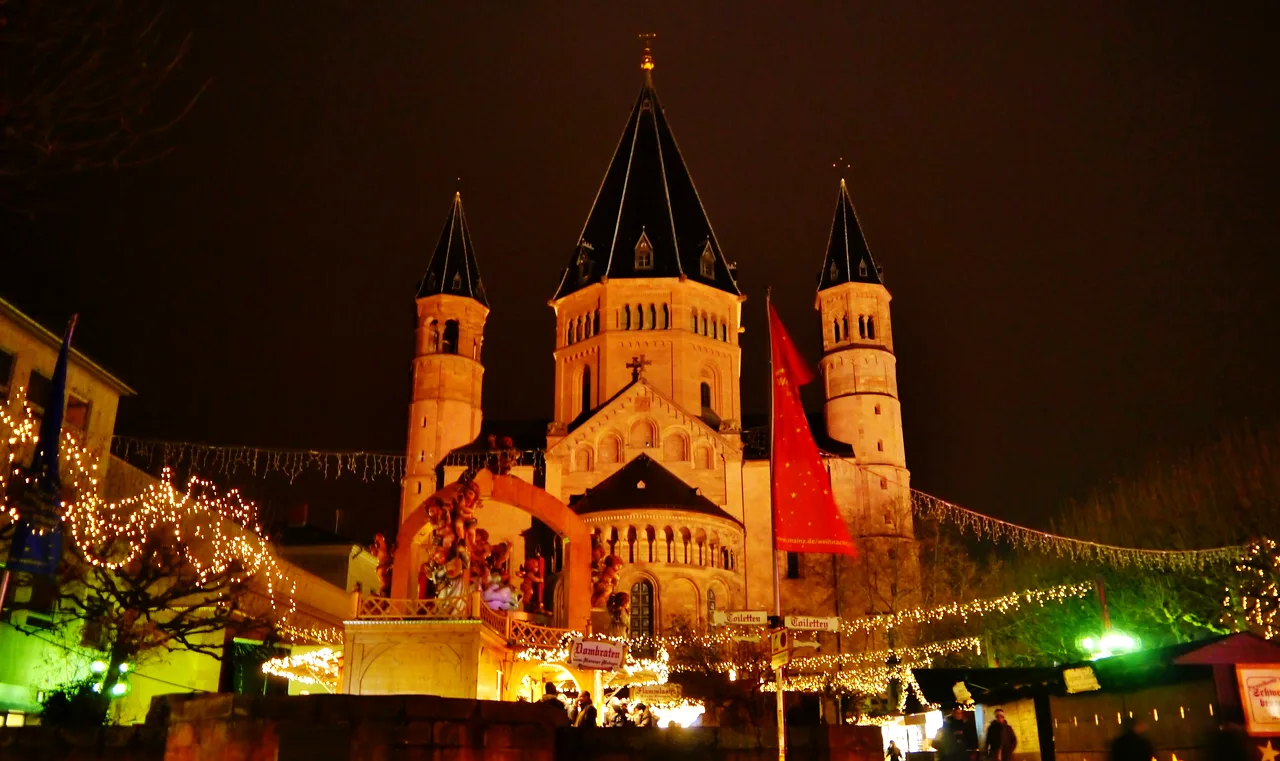
The Rhine riverfront, the half-timbered houses of the Kirschgarten and the cathedral above the Christmas market at night: Mainz in three pictures.


Mainz Christmas Markets 2026
The Mainz Christmas market has a long history: according to the City of Mainz a “Nikolose Markt” was already held here in 1788, and since 1975 it has been known as the Historic Christmas Market. Its stalls fill the Markt, the Höfchen and the Liebfrauenplatz right in front of the cathedral, framed by the colourful Renaissance façades of the market houses. The symbol of the market is the richly decorated, eleven-metre Christmas pyramid that has stood here since 2003; nearby, life-size nativity figures are displayed by the Gotthard Chapel, and two historic carousels delight children. Mainz markets itself as a “Christmas city”: under the name WinterZeit, smaller markets on Schillerplatz, Bahnhofsplatz and in the Hopfengarten, as well as a winter market with curling (Eisstockschießen) in the courtyard of the Electoral Palace, extend the festive season across the city centre. Cathedral concerts, the fairy-tale performance at the Staatstheater and Christmas-card printing in the print shop of the Gutenberg Museum round out the programme.


| Event | Location | 2026 dates | Note |
|---|---|---|---|
| Historic Christmas Market | Domplätze (Markt, Höfchen, Liebfrauenplatz) | 26 November – 23 December 2026 | Sun–Thu 11:00–20:30, Fri–Sat 11:00–21:00; 23 Dec until 19:00; free entry. |
| WinterZeit on Schillerplatz | Schillerplatz | 26 November – 23 December and 27–30 December 2026 | Same hours as the cathedral market according to the official website. |
| WinterZeit at Bahnhofsplatz | Bahnhofsplatz, in front of the main station | 26 November – 23 December and 27–30 December 2026 | Daily 11:00–22:00. |
| WinterZeit in the Hopfengarten | Hopfengarten, old town | 26 November – 23 December 2026 | Sun–Thu 13:00–20:30, Fri–Sat 13:00–21:00. |
| Winter market in the Palace courtyard | Kurfürstliches Schloss, inner courtyard | 26 November – 23 December and 27–30 December 2026 | From 13:00; Eisstockschießen (German curling) lanes. |
| Neuwintermarkt | Neubrunnenplatz | 26 November – 23 December and 27–30 December 2026 | Opens at 11:00; check closing times on the official website. |
What to try
Glühwein
Mulled wine, often from Rheinhessen grapes; contains alcohol.
Kinderpunsch
Alcohol-free hot fruit punch for children and non-drinkers.
Gebrannte Mandeln
Sugar-roasted almonds; their scent fills the cathedral squares.
Reibekuchen
Crispy potato fritters, often served with apple sauce.
Lebkuchen
Gingerbread hearts and biscuits, a German Christmas classic.
Spekulatius
Spiced shortcrust biscuits pressed in wooden moulds.
Christstollen
Fruit-and-nut Christmas bread dusted with icing sugar.
Bratwurst
Grilled sausage, usually pork; ask at the stall about alternatives.
Tips for the Mainz Christmas markets
- The cathedral market is quietest on weekday mornings and liveliest on Friday and Saturday evenings.
- On 23 December the cathedral market closes at 19:00; after Christmas only some WinterZeit markets reopen (27–30 December).
- Mugs usually carry a deposit (Pfand); return the mug or keep it as a souvenir.
- Combine the market with a visit inside the cathedral; check service times before entering.
- According to the official website, GlühWeinWalk tickets are sold at the mainz STORE, Markt 17.
- The Gutenberg Museum print shop traditionally offers Christmas-card printing; check dates on the museum website.
- The markets are a short walk from the main station; on Advent weekends public transport is easier than driving.
Check before you go: Landeshauptstadt Mainz · Mainzer Weihnachtsmarkt 2026 (official) ↗ · Weihnachtsstadt Mainz · Märkte und Öffnungszeiten (official) ↗
Dates, hours and details were checked on 29 October 2026 on the official websites of the City of Mainz (mainz.de) and mainzplus CITY MARKETING (mainz-tourismus.com). Programmes and hours may change; check the official pages before your visit.
When to Go
Mainz lies in one of the warmest and driest parts of Germany, sheltered by the surrounding hills. Spring and early autumn are ideal for walks along the Rhine and wine excursions into Rheinhessen and the Rheingau; the grape harvest takes place from September to October. Summer is warm and brings open-air events such as the Johannisnacht in June in honour of Gutenberg. Winter is cool and damp but rarely very cold; in Advent the Christmas markets turn the city into a festive destination. The carnival season culminates on Rose Monday (Rosenmontag), which falls on 8 February in 2027 – the city is then extremely busy.
| Month | Sightseeing | Christmas market | Outdoors | Crowds |
|---|---|---|---|---|
| January | Good | None | Difficult | Moderate |
| February | Good | None | Difficult | Busy |
| March | Good | None | Good | Quiet |
| April | Very good | None | Good | Moderate |
| May | Very good | None | Very good | Moderate |
| June | Very good | None | Very good | Moderate |
| July | Very good | None | Very good | Moderate |
| August | Very good | None | Very good | Moderate |
| September | Very good | None | Very good | Moderate |
| October | Very good | None | Good | Moderate |
| November | Good | Partly | Difficult | Moderate |
| December | Good | Market season | Difficult | Busy |
- In December temperatures are usually between 0 and 6 °C; fog and drizzle are common near the river.
- Christmas markets 26 November – 23 December 2026; some WinterZeit markets also 27–30 December.
- The street carnival peaks from Weiberfastnacht to Rose Monday (8 February 2027); accommodation fills up early.
- The wine harvest in Rheinhessen and the Rheingau runs roughly from September to October.
Visa and Entry (Turkish citizens)
Turkish citizens holding an ordinary (burgundy) passport need a Schengen visa for tourist travel to Germany. Rules differ for special, service and diplomatic passports; check the current situation on the website of the Turkish Ministry of Foreign Affairs.
You apply to the mission of your main destination. If your main destination is Germany, the official website of the German missions in Türkiye (tuerkei.diplo.de) explains how and where to apply, including the role of the external service provider.
If you combine Mainz with France, the Netherlands or other Schengen countries, apply to the country where you will stay longest, or to the country of first entry if the stays are equal.
Under the EU Entry/Exit System (EES), which is being introduced in stages, your biometric data (facial image and fingerprints) may be recorded on first entry; allow extra time at the airport.
Visa fees, appointment waiting times and required documents may change; this guide does not state fees. Use the current lists on the official pages before applying.
Travel medical insurance, accommodation and return documents are part of the application; details are in the official sources.
Check before you go: T.C. Dışişleri Bakanlığı · Türk vatandaşlarının tabi olduğu vize uygulamaları ↗ · tuerkei.diplo.de ↗ · EES · europa.eu ↗ · Rota Atlası visa guide (TR)
Travel medical insurance
Check the official visa and entry sources above first: they state whether travel medical insurance is required and the minimum cover. Compare any policy’s cover amount, validity dates and countries covered with the official requirement.
Rota Atlası does not currently offer an insurance partnership; there are no paid links in this section. Last updated: 1 November 2026
Getting to Mainz
- By air: The nearest major airport is Frankfurt Airport (FRA), on the opposite side of the Rhine-Main area. S-Bahn line S8 and regional trains run directly from the airport’s regional station to Mainz Hauptbahnhof. Check current flights from Türkiye only on airline and airport websites; this guide does not recommend flights.
- By train: Mainz Hauptbahnhof is on the left-bank Rhine line and has frequent long-distance and regional connections to Frankfurt, Wiesbaden, Koblenz, Cologne, Mannheim and Worms. Check current times with Deutsche Bahn and RMV.
- From Frankfurt city: S-Bahn and regional trains link Frankfurt Hauptbahnhof and Mainz many times an hour; the Mainz–Frankfurt trip is easy as a day trip in either direction.
- By car: Mainz is on the A60/A63/A643 motorway ring. The old town is largely pedestrianised; use the city car parks or park-and-ride. Germany requires winter tyres in winter conditions.
- By boat: In the season (roughly spring to autumn) river cruise and excursion boats connect Mainz with the Rheingau and the Middle Rhine; in winter there are few or no sailings.
Getting Around

On foot
The cathedral, Markt, Gutenberg Museum site, Kirschgarten, Augustinerstraße and Rhine riverfront are all within walking distance.
Tram and bus
Mainzer Mobilität runs trams and buses; the Mainzelbahn tram links the Hauptbahnhof with the university and Lerchenberg.
S-Bahn
The S-Bahn connects Mainz Hauptbahnhof, Mainz Römisches Theater station, Mainz-Kastel and Wiesbaden.
Tickets
Mainz belongs to the RMV and RNN transport associations; tickets are sold in the apps and at machines. Check the zone before travelling to Frankfurt or the airport.
Bicycle
The Rhine riverfront has long, flat cycle paths; a public bike-sharing system is also available; see Mainzer Mobilität.
Boat
Excursion boats depart from the Rhine riverfront in the season.
Things to See
The historic centre of Mainz is compact and lies on the left bank of the Rhine. At its heart stand the cathedral and the Markt; to the south stretch the half-timbered lanes of the old town around the Kirschgarten and Augustinerstraße, with St. Stephan on the hill above. To the north, along the Rhine, follow the Electoral Palace, the Landesmuseum and the Christuskirche on the Kaiserstraße; to the south-east the Citadel and the Roman theatre recall the city’s Roman past. Across the Theodor Heuss Bridge lies Mainz-Kastel, and beyond the city the vineyards of Rheinhessen and the Rheingau begin.
A thousand years of history
Mainz Cathedral (Dom St. Martin) and the Cathedral Squares

Construction of the Cathedral of St. Martin began in 975 under Archbishop Willigis; it is one of the three great imperial cathedrals on the Rhine, together with Worms and Speyer. Fires and rebuildings over the centuries added Gothic and Baroque elements to the Romanesque basilica, which is built of red sandstone and has towers at both ends. Inside you see monumental tombs of the archbishops, the western choir and the Gothic cloister. The cathedral museum (Dommuseum) displays the cathedral treasure. In front of the cathedral, the Markt with its Renaissance fountain and the Höfchen form the heart of the old town. Mainz Tourism: Dom St. Martin →
Don’t miss
- The double-choir basilica with its eastern and western choirs
- Archbishops’ funerary monuments along the pillars
- The Gothic cloister and the cathedral museum
- The Marktbrunnen, one of the finest Renaissance fountains in Germany
- The colourful market houses on the Markt
Tips
- The cathedral is a place of worship; do not sightsee during services.
- The weekly market on the cathedral squares is a local experience; check market days on mainz.de.
- In Advent the Christmas market fills the squares around the cathedral.


Half-timbered lanes
Old Town: Kirschgarten, Augustinerstraße and the Holzturm

The Mainz old town survived the bombing of the Second World War better than most of the city centre. The Kirschgarten, with its colourful half-timbered houses and the Marienbrunnen, is the most photographed corner. From here the lively Augustinerstraße runs south with shops, wine taverns and the Augustinerkirche, whose Baroque interior is among the most beautiful in the city. Towards the Rhine stands the Holzturm, a 15th-century tower that was once part of the city wall; nearby, Fischtorplatz reminds us that the fish market was once held here. Mainz Tourism: Old Town →
Don’t miss
- Kirschgarten and the Marienbrunnen
- Augustinerstraße and the Augustinerkirche
- The Holzturm and the Eisenturm on the Rhine
- The lanes around Leichhof with a view of the cathedral
- Wine taverns (Weinstuben) in the old town
Tips
- The old town is best explored on foot; cobblestones can be slippery in winter.
- Many wine taverns open only in the evening; check opening hours locally.
- From the Leichhof you get one of the best views of the cathedral towers.


The city of printing
Gutenberg Museum and the Gutenberg Legacy

Johannes Gutenberg was born in Mainz around 1400 and developed printing with movable metal type here around the middle of the 15th century. The Gutenberg Museum on Liebfrauenplatz is one of the oldest museums of printing in the world; its collection includes copies of the Gutenberg Bible. The historic building is currently being modernised and a new building is planned. According to the museum’s official website, the permanent exhibition “Gutenberg-Museum MOVED” and the print shop (Druckladen) are at Reichklarastraße 1 during the works. The museum will be closed from 23 to 27 November 2026 for urgent maintenance. Gutenberg Museum (official) →
Don’t miss
- The “Gutenberg-Museum MOVED” exhibition
- The Druckladen print shop, where you can try printing
- The Gutenberg monument on Gutenbergplatz
- The Liebfrauenplatz with the museum’s historic and modern façades
Tips
- Check opening hours and the temporary location on the official website before you go.
- The museum is closed 23–27 November 2026.
- Workshops in the print shop may need advance booking.
Blue light
St. Stephan and the Chagall Windows

The Gothic hall church of St. Stephan stands on the highest point of the old town. It is famous for its stained-glass windows by Marc Chagall: between 1978 and 1985 the artist created nine windows in deep blue tones, conceived as a sign of Jewish-Christian reconciliation and German-French friendship. After Chagall’s death his collaborator Charles Marq continued the glazing of the church in the same spirit. The late Gothic cloister offers a quiet place to pause. Mainz Tourism: St. Stephan →
Don’t miss
- The nine Chagall windows in the choir and transept
- The light effect on a sunny morning
- The late Gothic cloister
- The view from the Stephansberg over the old town
Tips
- The church is a place of worship; keep quiet and respect services.
- Light is best in the morning or on bright days.
- The climb from the old town is short but steep.
Baroque and domes
St. Ignaz, St. Peter and the Christuskirche

Beyond the cathedral, Mainz has several remarkable churches. St. Ignaz in the southern old town marks the transition from late Baroque to Classicism; in front of it stands a stone Crucifixion group by the sculptor Hans Backoffen. St. Peter in the northern centre is one of the finest Rococo churches on the Rhine, with ceiling paintings and twin towers. The Protestant Christuskirche on the Kaiserstraße, with its large dome, was built in the early 20th century and rebuilt after war damage.
Don’t miss
- The Crucifixion group in front of St. Ignaz
- The Rococo ceiling of St. Peter
- The dome of the Christuskirche on the Kaiserstraße
- The walk along the Kaiserstraße to the Rhine
Tips
- Opening times of the churches vary; check locally.
- The Christuskirche often hosts concerts.


Prince-bishops on the Rhine
Electoral Palace, Landesmuseum and the Rhine Riverfront

The Electoral Palace (Kurfürstliches Schloss), the former residence of the archbishop-electors, is one of the most important Renaissance buildings on the Upper Rhine. Today it is used for events, and in Advent its courtyard hosts a winter market. Next door, the Landesmuseum Mainz shows collections from the Roman period to the 20th century in the former electoral stables. Along the Rhine riverfront a promenade stretches past the Rheingoldhalle and the Fischtor; on clear days you can see across to the Taunus. Landesmuseum Mainz (official) →
Don’t miss
- The Renaissance façade of the Electoral Palace
- The Landesmuseum’s Roman and medieval collections
- A walk along the Rhine promenade at sunset
- The Deutschhaus (state parliament) and the Zeughaus next to it
Tips
- In winter the riverfront is windy; dress warmly.
- Check the museum’s current exhibitions and closing days on its website.

Mogontiacum
Roman Mainz: Theatre, Isis Sanctuary and Drususstein

As Mogontiacum, Mainz was one of the most important Roman military and administrative centres on the Rhine. The remains of the Roman stage theatre, among the largest north of the Alps, lie next to the Mainz Römisches Theater railway station. The sanctuary of Isis and Mater Magna, discovered during construction of a shopping centre, can be visited underground in a modern presentation. In the Citadel stands the Drususstein, a monument erected for the Roman general Drusus, who died in 9 BC.
Don’t miss
- The excavations of the Roman theatre
- The underground Isis and Mater Magna sanctuary
- The Drususstein in the Citadel
- Roman finds in the Landesmuseum
Tips
- Check opening hours of the Isis sanctuary in advance.
- The theatre is right next to the S-Bahn station Mainz Römisches Theater.


Magenza: Jewish heritage
ShUM heritage: the Old Jewish Cemetery (Judensand) and the New Synagogue

Known in the Middle Ages as Magenza, the Jewish community of Mainz was, with Speyer and Worms, one of the centres of Ashkenazi Judaism; the name ShUM comes from the Hebrew initials of the three cities. The Mainz component of the “ShUM Sites of Speyer, Worms and Mainz”, inscribed on the UNESCO World Heritage List in 2021, is the Old Jewish Cemetery known as Judensand, whose oldest gravestones date back to the 11th century. In the Neustadt, on the site of the main synagogue destroyed in 1938, the New Synagogue opened in 2010; designed by architect Manuel Herz, its angular building with a dark ceramic façade is a striking example of contemporary architecture. UNESCO listing ↗
Don’t miss
- Judensand: the UNESCO-listed Old Jewish Cemetery
- The exterior of the New Synagogue in the Neustadt
- Column fragments surviving from the former main synagogue
- A combined trip with the other ShUM sites in Speyer or Worms
Tips
- Access to the cemetery and the synagogue is limited; see schumstaedte.de and Mainz tourism pages for guided tours and visiting options.
- The synagogue is an active place of worship; there may be security checks, so carry ID.
- At Jewish cemeteries men may be asked to cover their heads; follow local rules.

Fortress on the Jakobsberg
Mainz Citadel

The Citadel on the Jakobsberg was built in the 17th century as part of the fortifications of Mainz. Its bastions, moats and the Kommandantenhaus have survived, and today the grounds house offices, a museum area and green spaces. From the walls you look over the old town towards the cathedral. Guided tours explain the history of the fortress city. Mainz Citadel (official) →
Don’t miss
- The bastions and moats
- The Kommandantenhaus
- The Drususstein
- The view over the old town
Tips
- The grounds are hilly; wear comfortable shoes.
- Guided tour dates are on the official website.
Across the river
Theodor Heuss Bridge and Mainz-Kastel

The Theodor Heuss Bridge links Mainz with Mainz-Kastel on the right bank of the Rhine. Kastel has been part of the city of Wiesbaden since 1945, so the bridge also crosses a state border, between Rhineland-Palatinate and Hesse. From the bridge you get a classic panorama of the Mainz riverfront with the cathedral. In Kastel, the Reduit, a 19th-century fortification on the river, is used for culture and events. Wiesbaden, the Hessian state capital and a spa town, is only a short bus or S-Bahn ride away.
Don’t miss
- The walk across the bridge with the cathedral view
- The Reduit in Kastel
- The riverside path on the Kastel side
- A short trip to Wiesbaden
Tips
- The bridge is windy in winter.
- Buses and the S-Bahn connect Mainz and Wiesbaden frequently.

Germany’s largest wine region
Rheinhessen Vineyards

South and west of Mainz begins Rheinhessen, Germany’s largest wine-growing region. Rolling hills, wine villages and vineyard paths make it an easy excursion from the city. Typical grape varieties include Riesling, Silvaner and Müller-Thurgau. Many wineries offer tastings by appointment, and in late summer and autumn wine festivals take place in the villages. Mainz itself is a member of the Great Wine Capitals network.
Don’t miss
- A walk through the vineyards
- A wine village such as Nierstein or Bodenheim
- The Rhine terraces (Roter Hang) near Nierstein
- Regional wine festivals in season
Tips
- Visit wineries only after checking their opening hours or booking.
- If you drink wine, use public transport.
- This guide does not recommend specific wineries.
Castles and wine on the right bank
Rheingau: Eltville and Rüdesheim

On the opposite bank of the Rhine, the Rheingau stretches from Wiesbaden to Rüdesheim. Eltville, the “town of wine, sparkling wine and roses”, is known for its Electoral Castle on the riverbank. Further along are the former Cistercian monastery of Eberbach and Rüdesheim with its famous Drosselgasse, the Niederwald Monument and the entrance to the UNESCO-listed Upper Middle Rhine Valley. Trains run along the right bank from Wiesbaden. Rota Atlası Rüdesheim guide →
Don’t miss
- The Electoral Castle in Eltville
- Kloster Eberbach
- Rüdesheim and the Niederwald Monument
- Riesling vineyards above the Rhine
Tips
- Rüdesheim also has a Christmas market; see our Rüdesheim guide for dates.
- Boat services on the Rhine are seasonal.
1–3 Day Itineraries, a Market Day + 5-Day Rhine Route
The itineraries keep walking distances short and take short winter days into account. Day 1: the cathedral, Markt and old town; day 2: Gutenberg, St. Stephan and Roman Mainz; day 3: Rheingau or Rheinhessen. The market day combines the cathedral squares, Schillerplatz and the Palace courtyard; the 5-day route links Mainz with Frankfurt, Wiesbaden, the Rhine and the ShUM cities.
Day 1: Cathedral, Markt and old town
- Morning in the cathedral and cloister, then the Dommuseum.
- Markt, Marktbrunnen and the Höfchen.
- Lunch break in the old town.
- Afternoon walk through the Kirschgarten and Augustinerstraße.
- Evening on the Rhine promenade and a wine tavern.
Day 2: Gutenberg, Chagall and Roman Mainz
- Morning at the Gutenberg Museum’s temporary exhibition and print shop.
- Climb to St. Stephan for the Chagall windows.
- Roman theatre and Citadel with the Drususstein.
- Isis sanctuary in the city centre.
- Evening walk past St. Peter and the Christuskirche.
Day 3: Rheingau or Rheinhessen
- Train along the right bank to Eltville.
- Walk to the Electoral Castle and the riverside.
- Continue to Rüdesheim and the Niederwald Monument.
- Alternative: vineyard walk in Rheinhessen.
- Return to Mainz in the evening.
Christmas market day
- Late morning at the Historic Christmas Market on the cathedral squares.
- Visit the cathedral and the nativity figures by the Gotthard Chapel.
- Afternoon at WinterZeit on Schillerplatz.
- Dusk in the Palace courtyard with Eisstockschießen.
- Evening back at the Christmas pyramid for the lights.
5 days: Mainz and the Rhine-Main area
- Day 1–2: Mainz as above.
- Day 3: Frankfurt: old town, Römerberg and the Main.
- Day 4: Wiesbaden and the Rheingau to Rüdesheim.
- Day 5: Worms and Speyer, the ShUM sites and cathedrals.
- Return via Frankfurt Airport.
Mainz and Rheinhessen Cuisine
Mainz and Rheinhessen cuisine is simple, hearty and closely linked to wine. These are traditional dishes and products, not restaurant recommendations.

Spundekäs
A spread of cream cheese and quark with onion and paprika, eaten with pretzels – the classic wine-tavern snack.
Handkäs mit Musik
A tangy sour-milk cheese marinated with onions, vinegar and oil.
Weck, Worscht un Woi
Bread roll, sausage and wine – the unofficial motto of the Mainz carnival.
Fleischwurst
A mild pork sausage, often served warm.
Rheinhessen wine
Riesling, Silvaner and other white wines from Germany’s largest wine region.
Federweißer
Partly fermented new wine, sold in autumn.
Zwiebelkuchen
Onion tart, often eaten with Federweißer in autumn.
Apple strudel and cakes
Afternoon cake in a café is a local tradition.
- Pork is common in German cuisine; ask about ingredients.
- Spundekäs and Handkäs are vegetarian; still ask about the ingredients.
- Most shops are closed on Sundays; restaurants and cafés are open.
- Service is included in the price, but rounding up or tipping about 5–10% is common.
Culture and Etiquette

- Greet with “Guten Tag” and thank with “Danke”; in Mainz you may also hear “Ei Gude!”.
- Churches are places of worship; do not sightsee during services.
- Fastnacht is taken seriously: on carnival days the city is full of costumed people and processions.
- Validate or buy tickets before boarding; inspections are frequent.
- Most shops are closed on Sundays and public holidays.
- Wine is served in a “Schoppen” glass in many taverns; drink responsibly.
Safety and Health
- Mainz is a safe city; watch your valuables in crowded markets and on carnival days.
- In winter streets can be icy; wear non-slip shoes.
- Watch out for cycle paths and trams.
- In an emergency call 112; the police number in Germany is 110.
- Make sure your travel medical insurance is valid in Germany.
- Keep a copy of your passport and visa separately.
What Your Budget Depends On
This guide does not give prices; prices change with season and year. Your budget depends on these factors:
Travel dates
Advent weekends, carnival and trade fairs in Frankfurt bring the most visitors.
Accommodation
There are options in the old town, near the Hauptbahnhof and in Wiesbaden or Frankfurt.
Transport
S-Bahn, regional trains, trams and buses; airport transfers by train.
Sights
Museums, guided tours and church museums each have their own admission.
Day trips
Train tickets to the Rheingau, Frankfurt or Worms, and seasonal boat trips.
Food and drink
Market snacks, wine taverns and cafés differ a lot.
Practical Information
- Money: Euro (EUR); cards are common, keep cash for small stalls.
- Language: German; English widely spoken in tourism.
- Electricity: 230 V, types C/F.
- Time: CET (UTC+1) in winter, 2 hours behind Türkiye.
- Shops: Open weekdays and Saturdays, mostly closed on Sundays.
- Holidays: 25 and 26 December are public holidays; shops are closed.
- Tap water: Drinkable.
- Emergency: 112.
Frequently Asked Questions
When is the Mainz Christmas market 2026?
According to the City of Mainz, from 26 November to 23 December 2026. The Historic Christmas Market on the cathedral squares opens Sun–Thu 11:00–20:30 and Fri–Sat 11:00–21:00; on 23 December until 19:00.
Is entry to the Mainz Christmas market free?
Yes, entry to the markets is free; food, drinks and activities are paid.
Are any markets open after Christmas?
According to the official website, WinterZeit on Schillerplatz, Bahnhofsplatz, the Palace courtyard and the Neuwintermarkt reopen from 27 to 30 December 2026.
Is the Gutenberg Museum open?
The historic building is being modernised; the exhibition “Gutenberg-Museum MOVED” is at Reichklarastraße 1. The museum is closed 23–27 November 2026. Check the official website.
Where can I see the Chagall windows?
In St. Stephan’s Church on the Stephansberg in the old town.
How do I get from Frankfurt Airport to Mainz?
S-Bahn line S8 and regional trains run directly from the airport’s regional station to Mainz Hauptbahnhof. Check current times with RMV or Deutsche Bahn.
Do Turkish citizens need a visa for Mainz?
Holders of ordinary passports need a Schengen visa. Check the current rules with the Turkish Ministry of Foreign Affairs and the German missions in Türkiye.
How many days do I need in Mainz?
Two days for the main sights; three days with a trip to the Rheingau or Rheinhessen.
Can I combine Mainz with Frankfurt?
Yes, the two cities are close and connected by frequent trains; many visitors stay in one and visit the other as a day trip.
When is the Mainz carnival?
The season opens on 11 November at 11:11; the street carnival culminates on Rose Monday, 8 February 2027.
Where to stay
Stay close to the areas where you will spend most time. The areas below are covered in detail in this guide; check public transport links in the getting-around section.
- A thousand years of historyMainz Cathedral (Dom St. Martin) and the Cathedral Squares
- Half-timbered lanesOld Town: Kirschgarten, Augustinerstraße and the Holzturm
- The city of printingGutenberg Museum and the Gutenberg Legacy
- Blue lightSt. Stephan and the Chagall Windows
- Baroque and domesSt. Ignaz, St. Peter and the Christuskirche
- Prince-bishops on the RhineElectoral Palace, Landesmuseum and the Rhine Riverfront
- MogontiacumRoman Mainz: Theatre, Isis Sanctuary and Drususstein
- Magenza: Jewish heritageShUM heritage: the Old Jewish Cemetery (Judensand) and the New Synagogue
- Fortress on the JakobsbergMainz Citadel
- Across the riverTheodor Heuss Bridge and Mainz-Kastel
- Germany’s largest wine regionRheinhessen Vineyards
- Castles and wine on the right bankRheingau: Eltville and Rüdesheim
Search hotels in these areas (Hotellook) ↗ (affiliate link)Search on Booking.com ↗
Affiliate disclosure: Hotellook, Aviasales, Klook, Airalo, Tiqets and DiscoverCars links are affiliate links; Rota Atlası may earn a commission on bookings made through them, at no extra cost to you. Official and in-guide links are not paid. Last updated: 1 November 2026 · Privacy and affiliates
Transport and connectivity
- Airport transferOptions from the airport to the city are in this guide’s getting there section.
- Mobile data (eSIM)Airalo eSIM ↗ (affiliate link)
- TrainsOfficial rail website ↗
- Car hireYou rarely need a car within the city; see getting around first. Compare car hire on DiscoverCars ↗ (affiliate link)
Affiliate disclosure: Hotellook, Aviasales, Klook, Airalo, Tiqets and DiscoverCars links are affiliate links; Rota Atlası may earn a commission on bookings made through them, at no extra cost to you. Official and in-guide links are not paid. Last updated: 1 November 2026 · Privacy and affiliates
Search flights (affiliate link)
Search flights from any airport in any country. Results open on Aviasales in a new tab, where you book.
This form is an affiliate link: Rota Atlası may earn a commission on bookings made via Aviasales (Travelpayouts), at no extra cost to you. Check price, baggage and terms on the booking site. Airport data: OurAirports (public domain).
Flights, hotels and tours
Find tours and tickets
- Historic Mainz Christmas Market
GetYourGuide ↗ · Klook ↗ (affiliate link) - Dom St. Martin (Mainz Cathedral)
GetYourGuide ↗ · Klook ↗ (affiliate link) - St Stephan and the Chagall windows
GetYourGuide ↗ · Klook ↗ (affiliate link) - Old town and Rhine riverfront
GetYourGuide ↗ · Klook ↗ (affiliate link)
Hotellook, Aviasales, Klook, Airalo and Tiqets links in this box are affiliate links (Travelpayouts): Rota Atlası may earn a commission on bookings made through them, at no extra cost to you. GetYourGuide links currently carry no affiliate code. Check prices and terms with the provider. Last updated: 1 November 2026 · Privacy and affiliates
Sources
- T.C. Dışişleri Bakanlığı · Türk vatandaşlarının tabi olduğu vize uygulamaları ↗
- Auswärtiges Amt · Deutsche Vertretungen in der Türkei (Visa) ↗
- European Union · Entry/Exit System (EES) ↗
- Landeshauptstadt Mainz · Mainzer Weihnachtsmarkt 2026 (official) ↗
- Weihnachtsstadt Mainz · Märkte und Öffnungszeiten (official) ↗
- Weihnachtsstadt Mainz (official) ↗
- Mainz Tourismus · Altstadt (official) ↗
- Mainz Tourismus · Dom St. Martin (official) ↗
- Mainz Tourismus · St. Stephan, Chagall-Fenster (official) ↗
- Mainz Tourismus · Gutenberg-Museum (official) ↗
- Gutenberg-Museum Mainz (official) ↗
- Landesmuseum Mainz (official) ↗
- Zitadelle Mainz (official) ↗
- UNESCO World Heritage Centre · ShUM Sites of Speyer, Worms and Mainz ↗
- Mainzer Mobilität · public transport (official) ↗
- RMV · Rhein-Main-Verkehrsverbund (official) ↗
- Deutsche Bahn (official) ↗
- Frankfurt Airport (official) ↗
- Germany.travel (official tourism portal of Germany) ↗
- GOV.UK · Foreign travel advice · Germany ↗
This page is for information only. Dates, hours, entry rules and transport information can change; check the official sources above before travelling. No prices, flights, hotels or restaurants have been invented in this guide.
Photo credits
The photos on this page come from Wikimedia Commons and are used under the stated authors and licences (CC BY, CC BY-SA, CC0 or public domain). Full list of sources
- Mainz Cathedral (Dom St. Martin) seen over the Markt square — José Luiz · CC BY-SA 4.0 · Wikimedia Commons
- The illuminated Christmas pyramid at the Mainz Christmas market by night — UNTERMVIERENBERGE-2 · CC0 · Wikimedia Commons
- The Mainz Christmas pyramid in front of the cathedral — UNTERMVIERENBERGE-2 · CC0 · Wikimedia Commons
- The Christmas market at night with Mainz Cathedral behind — Zairon · CC BY-SA 4.0 · Wikimedia Commons
- Interior of Mainz Cathedral with organ and west choir — Jorge Láscar from Melbourne, Australia · CC BY 2.0 · Wikimedia Commons
- The Gothic cloister courtyard of Mainz Cathedral — Flocci Nivis · CC BY 4.0 · Wikimedia Commons
- The top of the Renaissance Marktbrunnen fountain on the Markt — Photo: Andreas Praefcke · CC BY 4.0 · Wikimedia Commons
- Colourful half-timbered houses at Kirschgarten — qwesy qwesy · CC BY 3.0 · Wikimedia Commons
- Augustinerstraße in Mainz old town — Wikimedia-User Jivee Blau · CC BY-SA 3.0 · Wikimedia Commons
- Gothic window tracery in St. Stephan’s Church — Flocci Nivis · CC BY 4.0 · Wikimedia Commons
- The glass façade of the Gutenberg Museum on Liebfrauenplatz — Carl Ha · CC BY-SA 4.0 · Wikimedia Commons
- The Electoral Palace seen from the Rhine with the cathedral behind — Florian Bieser from Mainz-Mombach · CC0 · Wikimedia Commons
- The Rhine riverfront at Mainz — Oliver Abels · CC BY-SA 4.0 · Wikimedia Commons
- The Theodor Heuss Bridge linking Mainz and Mainz-Kastel — imehling · CC BY-SA 3.0 · Wikimedia Commons
- The Kommandantenhaus in the Mainz Citadel — User:Matthias Süßen · CC BY-SA 3.0 · Wikimedia Commons
- The Roman Drususstein monument in the Citadel — Carole Raddato from FRANKFURT, Germany · CC BY-SA 2.0 · Wikimedia Commons
- Excavations of the Roman theatre in Mainz — Flocci Nivis · CC BY 4.0 · Wikimedia Commons
- Underground remains of the Isis and Mater Magna sanctuary — Optimi4 · CC BY-SA 4.0 · Wikimedia Commons
- Detail of the Fastnachtsbrunnen carnival fountain on Schillerplatz — qwesy qwesy · CC BY 3.0 · Wikimedia Commons
- The Baroque interior of St. Ignaz — Zairon · CC BY-SA 3.0 · Wikimedia Commons
- The towers of St. Peter’s Church in Mainz — Flocci Nivis · CC BY 4.0 · Wikimedia Commons
- The dome of the Christuskirche in Mainz — Dr.Xos · CC BY-SA 4.0 · Wikimedia Commons
- The façade of the Landesmuseum Mainz — Berthold Werner · CC BY-SA 3.0 · Wikimedia Commons
- The Reduit fortification in Mainz-Kastel — Flocci Nivis · CC BY 4.0 · Wikimedia Commons
- Vineyards at Saulheim in Rheinhessen — Dguendel · CC BY 4.0 · Wikimedia Commons
- The Electoral Castle at Eltville in the Rheingau — DXR · CC BY-SA 4.0 · Wikimedia Commons
- The façade of Mainz Hauptbahnhof — Clic · CC BY-SA 4.0 · Wikimedia Commons
- Tree-lined Fischtorplatz — Nixnubix · CC BY-SA 3.0 · Wikimedia Commons
- The medieval Holzturm tower — Jorge Franganillo · CC BY 4.0 · Wikimedia Commons
- Spundekäs cheese spread served with wine — Gerda Arendt · CC BY-SA 4.0 · Wikimedia Commons
Rüdesheim → · Frankfurt → · Heidelberg → · Cologne → · Trier → · Christmas markets