

Bratislava is the capital of Slovakia and its largest city, with roughly 475,000 inhabitants. It lies on the Danube at the foot of the Little Carpathians and is the only capital in the world that borders two other countries: Austria and Hungary. For centuries the city was known as Pressburg in German and Pozsony in Hungarian; between 1563 and 1830 Hungarian kings and queens were crowned in St Martin’s Cathedral. The Old Town (Staré Mesto) is compact and largely pedestrianised: narrow streets, Baroque palaces, Michael’s Gate and bronze street statues lie within a few minutes of each other. Above it rises the square, four-towered castle, and across the river stand the modern Most SNP bridge and the housing estates of Petržalka. Vienna is only about an hour away, which makes Bratislava easy to combine with other Danube cities. In winter the squares of the Old Town fill with the stalls of the Christmas market. This guide brings together the Christmas market, the districts, day trips, food and practical information, based on official sources.
Content update: 29 October 2026 · Christmas dates checked on the official website of Bratislavské Vianoce (BKIS)
Bratislava at a Glance
- Country
- Slovakia · capital city
- Population
- About 475,000
- Language
- Slovak; English common in tourism, German understood
- Currency
- Euro (EUR); cards widely accepted, keep some cash for stalls
- Time zone
- Central European Time (CET, UTC+1)
- Highlights
- The Old Town, the castle, the Danube banks
- Must-see
- St Martin’s Cathedral, Michael’s Gate, Primate’s Palace, Blue Church
- UNESCO
- Roman Gerulata, part of the Danube Limes (2021)
- Christmas
- Main Christmas Market 26 November 2026–3 January 2027
- Transport
- Bratislava hlavná stanica; city bus from the airport
- Electricity
- 230 V, type C/E sockets
- Emergency
- 112 (general emergency)
Bratislava in Pictures
The castle above the Danube with river boats, the castle hill seen from the water and the Baroque tower of Michael’s Gate: Bratislava in three frames.


Bratislava Christmas Market 2026
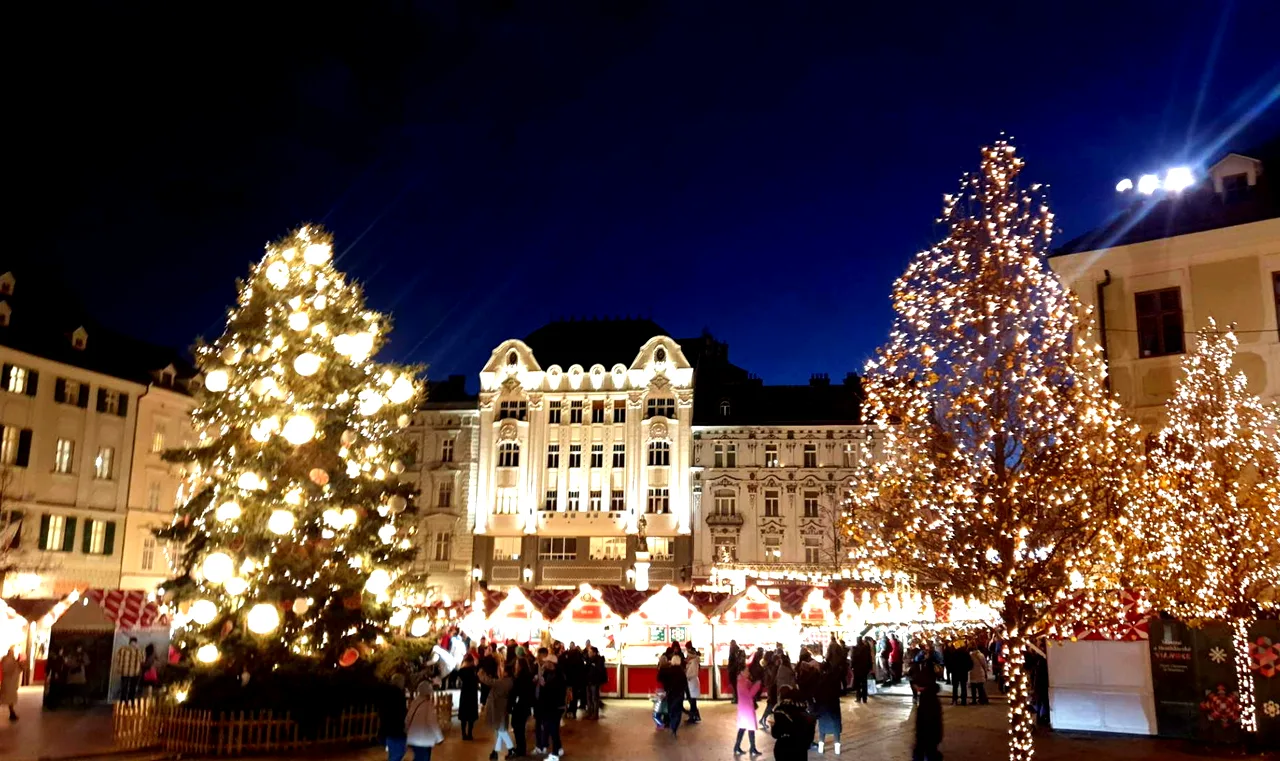
Bratislava’s Christmas markets are organised by the city’s culture and information centre BKIS under the name Bratislavské Vianoce. According to the official website, the Main Christmas Market (Hlavný vianočný trh) opens on 26 November 2026 and runs until 3 January 2027; it is open daily from 10:00 to 22:00. The stalls spread over Hlavné námestie (Main Square) in front of the Old Town Hall and into the surrounding Old Town; the city’s Christmas tree on Hlavné námestie is lit on 27 November. On Primaciálne námestie, in front of the Primate’s Palace, a Christmas Forest of trees and lights creates a quieter corner. Stalls sell crafts, ceramics, wooden toys, honey and candles, and above all local food and hot drinks. Drinks are usually served in deposit cups, which you return to get your deposit back. The market is also open on 26 December; the status on 24 and 25 December was not clearly stated at the time of checking, so check the official page. Entry is free.


| Event | Location | 2026 dates | Note |
|---|---|---|---|
| Main Christmas Market (Hlavný vianočný trh) | Hlavné námestie and the Old Town | 26 November 2026–3 January 2027 | Daily 10:00–22:00; free entry; check 24–25 December on the official page. |
| Lighting of the city Christmas tree | Hlavné námestie | 27 November 2026 | The official programme gives the time; check before you go. |
| Christmas Forest | Primaciálne námestie, in front of the Primate’s Palace | During the market | A lit forest of Christmas trees; a calmer corner of the market. |
| 26 December | Main Christmas Market | 26 December 2026 | According to the official information the market is open; check hours. |
| New Year’s Eve | Old Town | 31 December 2026 | Programme and hours may differ; check the official page. |
| Last day of the market | Hlavné námestie | 3 January 2027 | Check closing times on the official website. |
What to try
Lokše
Thin potato pancakes, savoury with goose fat or liver pâté or sweet with poppy seeds or jam.
Varené víno
Mulled wine, often from Slovak wine regions; contains alcohol.
Medovina
Honey wine (mead), served hot; contains alcohol.
Hot punch and tea
Alcohol-free versions for children and non-drinkers; ask at the stall.
Cigánska pečienka
Grilled meat in a bread roll with mustard and onion; usually pork, ask about ingredients.
Kapustnica
Sauerkraut soup, the classic of the Slovak Christmas table; often with sausage and mushrooms.
Bratislavské rožky
Crescent-shaped pastries with poppy-seed or walnut filling.
Tips for the Bratislava Christmas market
- The market is spread over several squares; start on Hlavné námestie and walk on to Primaciálne námestie and the Christmas Forest.
- Evenings and weekends are busy; late mornings are calmer.
- Drinks come in deposit cups; return the cup to get your deposit back or keep it as a souvenir.
- Most stalls take cards; still carry some cash in euro.
- The Old Town is small; combine the market with Michael’s Gate and St Martin’s Cathedral.
- Cobblestones can be icy; wear non-slip shoes.
- Keep your bag in front of you in crowds.
- Check the status on 24 and 25 December on the official page before you plan these days.
Check before you go: Bratislavské Vianoce · Main Christmas Market 2026 (official) ↗ · Visit Bratislava · Advent and Christmas (official) ↗
Dates and hours were checked on 29 October 2026 on the official website of Bratislavské Vianoce (bratislavskevianoce.sk), organised by BKIS. Programme and hours may change; check the official pages before your visit.
When to Go
Bratislava has a continental climate with warm summers and cold winters. April to October is the best time for the Danube banks, Devín and the vineyards of the Little Carpathians. From late November to early January the Christmas market fills the Old Town. January and February are cold and quiet, and fog is common by the river. Spring and early autumn combine pleasant weather with fewer crowds; September is grape-harvest time in the nearby wine villages.
| Month | Sightseeing | Christmas market | Outdoors | Crowds |
|---|---|---|---|---|
| January | Good | Partly | Difficult | Quiet |
| February | Good | None | Difficult | Quiet |
| March | Good | None | Good | Quiet |
| April | Very good | None | Good | Moderate |
| May | Very good | None | Very good | Moderate |
| June | Very good | None | Very good | Moderate |
| July | Very good | None | Very good | Busy |
| August | Very good | None | Very good | Busy |
| September | Very good | None | Very good | Moderate |
| October | Very good | None | Good | Moderate |
| November | Good | Market season | Difficult | Moderate |
| December | Good | Market season | Difficult | Busy |
- December days are usually between -2 and 5 °C; snow and fog are possible.
- Main Christmas Market 26 November 2026–3 January 2027, daily 10:00–22:00.
- Devín Castle and river boats are seasonal; check winter opening.
- The castle exhibitions, the City Museum and churches are open all year with changing hours.
- Summer weekends and Vienna day-trippers make the Old Town busy at midday.
- Winter days are short; sunset in December is around 16:00.
Visa and Entry (Turkish citizens)
Turkish citizens holding ordinary (burgundy) passports need a Schengen visa for tourist travel to Slovakia. Special, service and diplomatic passports follow different rules; check the current status on the website of the Turkish Ministry of Foreign Affairs.
Apply to the consulate of your main destination. If Slovakia is your main destination, the official Schengen visa pages of the Slovak Embassy in Ankara and the Slovak Consulate General in Istanbul (mzv.sk) explain where to apply; according to the Consulate General, applications in Türkiye are submitted through BLS International, its official partner, in Istanbul, Izmir, Ankara or Antalya depending on your province of residence.
If your trip also includes Austria or Hungary, apply to the country where you will stay longest; if the stays are equal, to the country you enter first.
Under the EU Entry/Exit System (EES), which is being introduced in stages, your biometric data (facial image and fingerprints) may be recorded on first entry; allow extra time at the airport.
Visa fees, appointment waiting times and required documents may change; this guide does not state fees. Use the current lists on the official pages before applying.
Travel medical insurance, accommodation and return documents are part of the application; details are on the official sources.
Check before you go: T.C. Dışişleri Bakanlığı · Türk vatandaşlarının tabi olduğu vize uygulamaları ↗ · mzv.sk · Ankara / İstanbul ↗ · EES · europa.eu ↗ · Rota Atlası visa guide (TR)
Travel medical insurance
Check the official visa and entry sources above first: they state whether travel medical insurance is required and the minimum cover. Compare any policy’s cover amount, validity dates and countries covered with the official requirement.
Rota Atlası does not currently offer an insurance partnership; there are no paid links in this section. Last updated: 1 November 2026
Getting to Bratislava
- By air: Bratislava has M. R. Štefánik Airport (BTS), north-east of the city; many travellers also use Vienna International Airport (VIE), about 50 km to the west. Check current flights from Türkiye only on airline and airport websites; this guide does not recommend flights.
- From the airport: a DPB city bus links Bratislava Airport with the main railway station; taxis and ride-hailing apps are also available. Current routes and timetables are on the official websites of the airport (bts.aero) and DPB (dpb.sk).
- From Vienna: regional trains run between Vienna and Bratislava (hlavná stanica or Petržalka), and long-distance buses connect Vienna Airport with Bratislava. Check current services on the rail and bus operators’ websites.
- By train: Bratislava hlavná stanica links to Žilina, Košice, Budapest, Prague and Vienna; check current services on zssk.sk.
- By river: in the warmer months boats run on the Danube between Vienna and Bratislava; this is seasonal, check operators’ websites.
Getting Around

On foot
The Old Town, St Martin’s Cathedral, the castle and the Danube banks are within walking distance.
Tram and bus
DPB’s trams, trolleybuses and buses reach the station, Petržalka, Kamzík and Devín; buy tickets from machines or the app and validate them.
Bus to Devín
A city bus runs from the Most SNP area towards Devín; check the line and timetable on dpb.sk.
Regional train
Trains to Modra and the wine towns of the Little Carpathians leave from the main station; some places are better reached by regional bus.
Taxi
Licensed taxis and ride-hailing apps are common; agree on the app price or use the meter.
Car
The Old Town is largely pedestrianised and parking is limited; use car parks.
Things to See
Bratislava’s Old Town (Staré Mesto) lies on the north bank of the Danube, between the castle hill to the west and the modern riverside to the east. At its centre are Hlavné námestie, the Old Town Hall and the Primate’s Palace; to the north stands Michael’s Gate, to the south-west St Martin’s Cathedral right below the castle. The Danube promenade leads east towards Eurovea, and Most SNP crosses to Petržalka and the park Sad Janka Kráľa. North of the centre lie the presidential palace and the hills of Slavín and Kamzík. Devín, Gerulata and Danubiana are on the city’s edges, and Modra in the Little Carpathians is a classic half-day trip.
Heart of the city
Hlavné námestie, the Old Town Hall and Čumil

Hlavné námestie (Main Square) is the heart of the Old Town and the main stage of the Christmas market. On its eastern side stands the Old Town Hall (Stará radnica), a complex of houses joined together from the Middle Ages onwards; its tower and colourful roof tiles are a symbol of the city, and it houses the Bratislava City Museum, one of the oldest museums in Slovakia. The Roland Fountain (Maximilian Fountain) in the middle of the square dates from the 16th century. The surrounding streets are full of cafés, Baroque palaces and bronze statues; the best-known is Čumil, a worker peering out of a manhole at the corner of Panská and Rybárska brána, installed in 1997. A short walk away is the gilded statue of a Napoleonic soldier leaning on a bench and the hat-raising figure of Schöne Náci.
Don’t miss
- The Old Town Hall and its tower
- The Roland Fountain
- Čumil at Panská street
- The bronze statues around the square
- The courtyard of the Old Town Hall
Tips
- Check the City Museum’s hours on the official website.
- The square is very busy during the Christmas market in the evenings.
- Watch your step around Čumil; the statue is at ground level.


The last medieval gate
Michael’s Gate, Michalská and Františkánske námestie
Michael’s Gate (Michalská brána) is the only preserved gate of Bratislava’s medieval fortifications. Its tower, rebuilt in Baroque style in the 18th century and topped by a statue of St Michael, houses an exhibition of historic arms and offers a view over the Old Town rooftops. From the gate, Michalská and Ventúrska streets run south as the Old Town’s main axis, lined with palaces, shops and cafés. Close by, Františkánske námestie with the Franciscan Church, one of the oldest churches in the city, and the Jesuit Church, built as a Protestant church in the 17th century, form a quiet square next to Hlavné námestie.
Don’t miss
- The view from Michael’s Gate tower
- The arms exhibition in the tower
- Michalská and Ventúrska streets
- The Franciscan Church
- The Jesuit Church
Tips
- The tower stairs are narrow; check opening hours.
- Look for the plaque under the gate marking distances to other capitals.
- The streets are at their prettiest in the evening light.

Coronation church
St Martin’s Cathedral

St Martin’s Cathedral (Dóm svätého Martina) is a Gothic church at the western edge of the Old Town, right below the castle hill. Between 1563 and 1830 it was the coronation church of the Kingdom of Hungary: kings and queens, including Maria Theresa, were crowned here. A gilded replica of the Hungarian crown sits on top of its tall tower. Inside, a Baroque sculpture of St Martin and the crypts are of interest. The cathedral stands next to the busy road leading to Most SNP, a reminder of the city’s post-war transformation; part of the old Jewish quarter was demolished for it.
Don’t miss
- The crown on the tower
- The Gothic nave
- The statue of St Martin
- The coronation plaques along the Old Town streets
Tips
- The cathedral is a place of worship; check visiting hours outside services.
- Brass crowns set in the pavement mark the coronation route through the Old Town.
- From here a steep path leads up to the castle.
Four towers above the Danube
Bratislava Castle

Bratislava Castle (Bratislavský hrad) stands on a rocky hill above the Danube and, with its rectangular plan and four corner towers, is the city’s most recognisable landmark. The site was settled long before the Middle Ages; the present form goes back to rebuilding in the 15th to 18th centuries, when it was a royal residence. After a fire in 1811 the castle stood in ruins for more than a century before being rebuilt in the second half of the 20th century. Today it houses exhibitions of the Slovak National Museum and is the seat of representative events of the Slovak Parliament, which stands next to it. The Baroque gardens and the terraces offer views over the Old Town, the Danube and, on clear days, Austria and Hungary.
Don’t miss
- The views from the castle terraces
- The Baroque gardens
- Exhibitions of the Slovak National Museum
- The Crown Tower
Tips
- The castle grounds are free; exhibitions are ticketed, check hours.
- The steep paths can be icy in winter.
- Come at sunset for the light over the Danube.
Palaces of power
The Primate’s Palace and Grassalkovich Palace

The neoclassical Primate’s Palace (Primaciálny palác) was built in the late 18th century for the Archbishop of Esztergom and is today the seat of the Mayor of Bratislava. In its Hall of Mirrors the Peace of Pressburg was signed in 1805 after the Battle of Austerlitz. The palace is also known for a series of 17th-century English tapestries discovered during renovation. The square in front of it, Primaciálne námestie, is home to the Christmas Forest in winter. North of the Old Town, the Rococo Grassalkovich Palace is the seat of the President of the Slovak Republic; its French garden is a public park, and the changing of the guard takes place in front of the palace.
Don’t miss
- The Hall of Mirrors
- The English tapestries
- The Christmas Forest on Primaciálne námestie
- Grassalkovich Palace and its garden
Tips
- Check the Primate’s Palace visiting hours; parts may be closed for official events.
- The presidential garden has seasonal opening hours.
- Combine with Hodžovo námestie and the walk back to Michael’s Gate.

Art Nouveau in blue
The Blue Church and the Eastern Old Town

The Church of St Elizabeth, known to everyone as the Blue Church (Modrý kostolík), is an Art Nouveau gem designed by the Hungarian architect Ödön Lechner and consecrated in 1913. Its façade, roof and even interior are in shades of blue, with glazed ceramics and rounded forms. It stands in a quiet residential street east of the Old Town, a short walk from Hviezdoslavovo námestie. The surrounding streets have more Secession buildings, including a school by the same architect.
Don’t miss
- The blue façade and roof
- The ceramic details
- The interior during opening hours
- The neighbouring Secession school
Tips
- The interior is open only at certain times; respect services.
- Mornings offer the best light for photos.
- It is a 10–15 minute walk from Hlavné námestie.
The city on the river
The Danube Banks, Most SNP and Eurovea

The Danube is Bratislava’s great open space. Most SNP (Bridge of the Slovak National Uprising), opened in 1972, is a cable-stayed bridge with a single pylon topped by a saucer-shaped structure known as the UFO, with an observation deck and restaurant about 95 metres above the river. Downstream, the riverside promenade leads past the Slovak National Gallery to the modern Eurovea district with its riverside park and shops. On the opposite bank lies Petržalka, Slovakia’s largest housing estate. The trams of Bratislava run along the river and across the bridges; the Old Bridge (Starý most) was rebuilt for trams, pedestrians and cyclists.
Don’t miss
- The view from the UFO on Most SNP
- The Danube promenade
- Eurovea’s riverside park
- The Old Bridge for pedestrians and trams
Tips
- The UFO observation deck is ticketed; check hours.
- The riverside can be windy and foggy in winter.
- The promenade is lovely in the evening with the castle lit up.


A historic park
Sad Janka Kráľa and Petržalka

Sad Janka Kráľa, on the right bank of the Danube in Petržalka, is regarded as one of the oldest public parks in Central Europe; it was laid out in the 1770s. With old trees, paths and a Gothic church tower moved here from the Franciscan Church, it is a calm place right opposite the Old Town. Further south, on a peninsula in the Danube near Čunovo, the Danubiana Meulensteen Art Museum shows contemporary art in a striking modern building surrounded by water and a sculpture park.
Don’t miss
- The old trees of Sad Janka Kráľa
- The relocated Gothic tower
- Views back to the Old Town
- Danubiana’s sculpture park
Tips
- The park is reached on foot over the Old Bridge or Most SNP.
- Danubiana is outside the city; check transport and opening hours on its official website.
- Winter hours at Danubiana are shorter.

Hills above the city
Slavín, Horský park and Kamzík

North of the castle, the hill of Slavín is crowned by a war memorial and cemetery for Soviet soldiers who died in the liberation of the city in 1945; it was completed in 1960. The surrounding villa district and the viewpoint over the city and the Danube make it a quiet walk. Further north, the forest of Horský park and the Bratislava Forest Park (Bratislavský lesopark) lead up to Kamzík hill and its TV tower, which has a viewing area and restaurant. From here walking trails lead into the Little Carpathians.
Don’t miss
- The Slavín memorial and viewpoint
- The villa streets around Slavín
- Horský park
- The Kamzík TV tower
Tips
- Slavín is a steep climb; buses get you close.
- Kamzík is reached by bus and a walk through the woods; check the tower’s hours.
- Paths can be muddy or icy in winter.

Where two rivers meet
Devín Castle

The ruins of Devín Castle stand on a cliff above the confluence of the Morava and the Danube, about 10 km west of the centre, on the border with Austria. The site has been settled since prehistoric times; it was important in the Great Moravian period and later became a border castle of the Kingdom of Hungary. In 1809 Napoleon’s troops blew up the castle, and the ruins became a national symbol for Slovaks in the 19th century. The small Maiden Tower on a rock above the river, the remains of the walls and the exhibitions of the City Museum are part of a visit. Along the river, a memorial recalls people who died trying to cross the Iron Curtain here.
Don’t miss
- The view of the Morava–Danube confluence
- The Maiden Tower
- The castle exhibitions
- The Iron Curtain memorial
Tips
- The castle is a seasonal attraction; check winter opening on the City Museum’s website.
- Reached by city bus from the Most SNP area; check the timetable.
- The rocks and paths can be slippery; wear sturdy shoes.

A Roman frontier fort
Gerulata (Rusovce)

In Rusovce, south of the city, lie the remains of Gerulata, a Roman military camp on the Danube frontier (limes) of the province of Pannonia. Since 2021 it has been part of the UNESCO World Heritage site “Frontiers of the Roman Empire – The Danube Limes (Western Segment)”. A small museum and open-air area show the foundations of the fort and finds from the Roman period. It is a short trip that adds two thousand years of history to a visit to Bratislava. UNESCO listing ↗
Don’t miss
- The foundations of the Roman fort
- Finds in the small museum
- The Danube Limes context
Tips
- Gerulata is usually open seasonally; check opening times on the City Museum’s website.
- Reached by city bus; combine with Danubiana or Čunovo.
- Little shade in summer; take water.
Wine and ceramics
Modra and the Little Carpathians

North-east of Bratislava, the Little Carpathians (Malé Karpaty) are lined with wine towns such as Svätý Jur, Pezinok and Modra. Modra is known for Slovak majolica ceramics, with blue-and-yellow painted pottery, and for its vineyards; the poet Ľudovít Štúr spent his last years here. In autumn, open-cellar days are held in the villages of the wine route, and in winter the region is quieter. It is an easy half-day or day trip from the capital.
Don’t miss
- Modra’s ceramics workshops
- The town square and churches
- The vineyards of the Little Carpathians
- Wine villages such as Pezinok and Svätý Jur
Tips
- Regional buses and trains run from Bratislava; check current services.
- Check the opening of ceramics workshops and cellars in advance.
- If you taste wine, do not drive.
1–3 Day Itineraries, a Christmas Day + 5-Day Danube Capitals Route
The itineraries keep walking distances short and take short winter days into account. Day one covers the Old Town, St Martin’s Cathedral and the castle, day two the Danube, the Blue Church and the hills, and day three Devín or Modra. The Christmas day is planned around the market, and the 5-day route combines Bratislava with Vienna and Budapest. Check hours on official websites in advance.
Day 1: The Old Town, the cathedral and the castle
- In the morning go up Michael’s Gate tower and walk down Michalská.
- See Hlavné námestie, the Old Town Hall and Čumil.
- Visit the Primate’s Palace and its Hall of Mirrors.
- Visit St Martin’s Cathedral and follow the coronation crowns.
- Climb to the castle and watch the sunset over the Danube.
Day 2: The Danube, the Blue Church and the hills
- In the morning visit the Blue Church.
- Walk along the Danube promenade to Eurovea.
- Cross Most SNP or the Old Bridge to Sad Janka Kráľa.
- In the afternoon go up to the UFO observation deck.
- In the evening return to the Old Town; in season, the Christmas market.
Day 3: Devín or Modra
- Option A: take the bus to Devín Castle, see the confluence and walk by the river.
- Option B: travel to Modra, visit ceramics workshops and the wine route.
- In the evening return to Bratislava for a walk past Slavín or Grassalkovich Palace.
A Christmas day
- In the late morning browse the stalls on Hlavné námestie.
- Walk to the Christmas Forest on Primaciálne námestie.
- Try lokše and kapustnica at the stalls.
- At dusk see the lit streets around Michael’s Gate and the Old Town Hall.
- In the evening look up at the castle lit above the Old Town.
5-day Danube capitals route
- Days 1–2: Bratislava Old Town, the castle, the Danube and Devín.
- Day 3: Take the train to Vienna; the Ringstrasse and a Christmas market.
- Days 4–5: Continue to Budapest by train; the Danube banks and the Parliament.
Food of Bratislava and Slovakia
Bratislava’s cuisine combines Slovak country dishes with Austrian and Hungarian influences. These are traditional dishes and products, not restaurant recommendations.


Bryndzové halušky
Small potato dumplings with bryndza sheep’s cheese, often topped with bacon; the national dish.
Kapustnica
Sauerkraut soup, a fixture of the Christmas table, often with sausage and mushrooms.
Lokše
Thin potato pancakes, savoury or sweet; a market favourite.
Bratislavské rožky
Crescent pastries filled with poppy seeds or walnuts, a protected regional speciality.
Pirohy
Half-moon dumplings filled with bryndza, potato or jam.
Segedínsky guláš
Pork and sauerkraut stew with cream; ask about ingredients.
Wine of the Little Carpathians
Grüner Veltliner, Riesling and other whites from the wine towns north-east of the city.
Kofola
A Czechoslovak herbal cola, popular non-alcoholic choice.
- Pork and bacon are common in Slovak cuisine; ask about ingredients.
- Halušky without bacon, pirohy with bryndza or potato and lokše with sweet fillings can be vegetarian; still ask.
- On Christmas Eve, carp and kapustnica are traditional at home.
- Service is not always included; about 10% is a common tip if you are happy with the service.
Culture and Etiquette

- Greeting with “Dobrý deň” and thanking with “Ďakujem” is appreciated.
- Churches are still places of worship; do not walk around during Mass and keep quiet.
- 24 December (Štedrý deň) is the main family day; many shops close early.
- Validate your ticket on trams and buses; inspections are common.
- Slovakia and Czechia were one country until 1993; do not call Slovaks “Czechs”.
- Theatre and opera in the historic Slovak National Theatre building are part of the city’s cultural life; dress smartly.
- Toasting with “Na zdravie” is common.
- In restaurants you usually ask for the bill.
- Do not climb on the bronze statues for photos.
- A few Slovak words are always warmly received.
Safety and Health
- Bratislava is generally safe; watch for pickpockets at the busy market and in nightlife areas.
- In nightlife areas keep your drink in sight and check the bill before paying.
- Use licensed taxis or apps, especially at night.
- Cobblestones and castle paths can be icy in winter; wear sturdy shoes.
- Call 112 in an emergency.
- Make sure your travel medical insurance covers the Schengen area.
- Pharmacies (lekáreň) are common; a duty pharmacy list is posted on their doors.
What Your Budget Depends On
This guide does not give prices; prices change with season and year. Your budget depends on these factors:
Travel dates
Christmas market weekends, New Year and summer increase demand for accommodation.
Accommodation
The Old Town is the most central; Petržalka and districts near the station offer more choice.
Transport
Public transport tickets, the airport bus and day trips to Devín or Modra.
Museums and sights
The castle exhibitions, the Primate’s Palace, Michael’s Gate, the UFO and Devín are ticketed separately.
Food and drink
There is a big difference between market snacks and restaurants.
Day trips
Vienna, Danubiana and the wine towns need extra transport and tickets.
Free experiences
The Christmas market, the Old Town, the castle grounds, the Danube promenade and Sad Janka Kráľa are free.
Practical Information
- Money: euro (EUR); cards very common, keep some cash.
- Language: Slovak; English is widely spoken by young people and in tourism; German is understood.
- Sockets: 230 V, type C/E.
- Time: CET (UTC+1) in winter, 2 hours behind Türkiye.
- Shops: large shopping centres open daily; small shops may close early on Saturdays and on Sundays.
- Holidays: 24–26 December, 1 January and 6 January are public holidays; hours change.
- Weather: cold in December, around -2 to 5 °C.
- Daylight: sunset around 16:00 in December.
- Water: tap water is drinkable.
- Emergency: 112.
Frequently Asked Questions
When is the Bratislava Christmas market in 2026?
According to the official Bratislavské Vianoce website, the Main Christmas Market runs from 26 November 2026 to 3 January 2027 on Hlavné námestie and in the Old Town.
What are the opening hours?
Daily 10:00–22:00. The status on 24 and 25 December was not clearly stated at the time of checking; check the official page.
Is entry free?
Yes, entry to the market is free.
When is the Christmas tree lit?
The city Christmas tree on Hlavné námestie is lit on 27 November 2026.
Who is Čumil?
A bronze statue of a worker peering out of a manhole in the Old Town, installed in 1997 and one of the city’s best-known photo spots.
How do I get from the airport to the city?
A DPB city bus connects Bratislava Airport with the main station; taxis and apps are also available. From Vienna Airport, buses and trains run to Bratislava.
Do Turkish citizens need a visa?
Holders of ordinary passports need a Schengen visa. If Slovakia is your main destination, see the official mzv.sk pages of the Slovak Embassy in Ankara and the Consulate General in Istanbul.
Is Devín Castle open in winter?
Devín is a seasonal attraction; check winter opening on the official website before you go.
How many days do I need?
One day for the Old Town and the castle, two with the Danube and the hills, three with Devín or Modra.
Can I combine it with Vienna and Budapest?
Yes, trains link Bratislava with both cities; check current services on the rail operators’ websites.
Where to stay
Stay close to the areas where you will spend most time. The areas below are covered in detail in this guide; check public transport links in the getting-around section.
- Heart of the cityHlavné námestie, the Old Town Hall and Čumil
- The last medieval gateMichael’s Gate, Michalská and Františkánske námestie
- Coronation churchSt Martin’s Cathedral
- Four towers above the DanubeBratislava Castle
- Palaces of powerThe Primate’s Palace and Grassalkovich Palace
- Art Nouveau in blueThe Blue Church and the Eastern Old Town
- The city on the riverThe Danube Banks, Most SNP and Eurovea
- A historic parkSad Janka Kráľa and Petržalka
- Hills above the citySlavín, Horský park and Kamzík
- Where two rivers meetDevín Castle
- A Roman frontier fortGerulata (Rusovce)
- Wine and ceramicsModra and the Little Carpathians
Search hotels in these areas (Hotellook) ↗ (affiliate link)Search on Booking.com ↗
Affiliate disclosure: Hotellook, Aviasales, Klook, Airalo, Tiqets and DiscoverCars links are affiliate links; Rota Atlası may earn a commission on bookings made through them, at no extra cost to you. Official and in-guide links are not paid. Last updated: 1 November 2026 · Privacy and affiliates
Transport and connectivity
- Airport transferOptions from the airport to the city are in this guide’s getting there section.
- Mobile data (eSIM)Airalo eSIM ↗ (affiliate link)
- Car hireYou rarely need a car within the city; see getting around first. Compare car hire on DiscoverCars ↗ (affiliate link)
Affiliate disclosure: Hotellook, Aviasales, Klook, Airalo, Tiqets and DiscoverCars links are affiliate links; Rota Atlası may earn a commission on bookings made through them, at no extra cost to you. Official and in-guide links are not paid. Last updated: 1 November 2026 · Privacy and affiliates
Search flights (affiliate link)
Search flights from any airport in any country. Results open on Aviasales in a new tab, where you book.
This form is an affiliate link: Rota Atlası may earn a commission on bookings made via Aviasales (Travelpayouts), at no extra cost to you. Check price, baggage and terms on the booking site. Airport data: OurAirports (public domain).
Flights, hotels and tours
Find tours and tickets
- Bratislava Main Christmas Market
GetYourGuide ↗ · Klook ↗ (affiliate link) - Bratislava Castle
GetYourGuide ↗ · Klook ↗ (affiliate link) - St Martin’s Cathedral
GetYourGuide ↗ · Klook ↗ (affiliate link) - Michael’s Gate and the Blue Church
GetYourGuide ↗ · Klook ↗ (affiliate link)
Hotellook, Aviasales, Klook, Airalo and Tiqets links in this box are affiliate links (Travelpayouts): Rota Atlası may earn a commission on bookings made through them, at no extra cost to you. GetYourGuide links currently carry no affiliate code. Check prices and terms with the provider. Last updated: 1 November 2026 · Privacy and affiliates
Sources
- T.C. Dışişleri Bakanlığı · Türk vatandaşlarının tabi olduğu vize uygulamaları ↗
- Embassy of the Slovak Republic in Ankara · Schengen visa (mzv.sk, official) ↗
- Consulate General of the Slovak Republic in Istanbul · Applying in Türkiye (mzv.sk, official) ↗
- European Union · Entry/Exit System (EES) ↗
- Visit Bratislava · visitbratislava.com (official city tourism) ↗
- Bratislavské Vianoce · Hlavný vianočný trh 2026 (official) ↗
- BKIS · Bratislavské kultúrne a informačné stredisko (official organiser) ↗
- Slovakia.travel (official tourism portal of Slovakia) ↗
- UNESCO World Heritage Centre · Frontiers of the Roman Empire – The Danube Limes (Gerulata) ↗
- Letisko M. R. Štefánika · Bratislava Airport (official) ↗
- DPB · Dopravný podnik Bratislava, public transport (official) ↗
- ZSSK · Slovak railways (official) ↗
- GOV.UK · Foreign travel advice · Slovakia ↗
- Bratislavské Vianoce · Main Christmas Market 2026 (official) ↗
- Visit Bratislava · Advent and Christmas (official) ↗
This page is for information only. Dates, hours, entry rules and transport information can change; check the official sources above before travelling. No prices, flights, hotels or restaurants have been invented in this guide.
Photo credits
The photos on this page come from Wikimedia Commons and are used under the stated authors and licences (CC BY, CC BY-SA, CC0 or public domain). Full list of sources
- Bratislava Christmas market in the evening with lights and crowds — Doko · CC BY 4.0 · Wikimedia Commons
- Lit Christmas trees and market stalls on Hlavné námestie, Bratislava — Nelliette · CC BY-SA 2.0 · Wikimedia Commons
- Illuminated stalls at the Bratislava Christmas market — Doko · CC BY 4.0 · Wikimedia Commons
- Kostolná street in Bratislava during the Christmas markets — Henrich Hipca · CC BY-SA 4.0 · Wikimedia Commons
- Christmas decorations in Bratislava Old Town — Doko · CC BY-SA 4.0 · Wikimedia Commons
- Lit Christmas trees at night in Bratislava — Doko · CC BY-SA 4.0 · Wikimedia Commons
- Bratislava Castle above the Danube — Ingo Mehling · CC BY-SA 4.0 · Wikimedia Commons
- Bratislava Castle and St Martin’s Cathedral — Uoaei1 · CC BY-SA 4.0 · Wikimedia Commons
- Bratislava Danube view with river ships and the castle — No machine-readable author provided. Kafka~commonswiki assumed (based on copyright claims). · Public domain · Wikimedia Commons
- Michael’s Gate tower in Bratislava — Fred Romero from Paris, France · CC BY 2.0 · Wikimedia Commons
- St Martin’s Cathedral seen from the Danube — Ingo Mehling · CC BY-SA 4.0 · Wikimedia Commons
- Primate’s Palace in Bratislava — Valerio2468 · CC BY-SA 4.0 · Wikimedia Commons
- Old Town Hall on Hlavné námestie — Felix König · CC BY 3.0 · Wikimedia Commons
- Blue Church (St Elizabeth’s) in Bratislava — Thomas Ledl · CC BY-SA 4.0 · Wikimedia Commons
- Most SNP bridge with its UFO over the Danube — Pudelek (Marcin Szala) · CC BY-SA 3.0 · Wikimedia Commons
- Devín Castle and the Morava–Danube confluence — Uoaei1 · CC BY-SA 4.0 · Wikimedia Commons
- Devín Castle ruins above the Danube — Jakub Hałun · CC BY-SA 4.0 · Wikimedia Commons
- Slavín memorial in Bratislava — Kiwiev · CC0 · Wikimedia Commons
- Eurovea Danube promenade in Bratislava — Flower of life · Public domain · Wikimedia Commons
- Čumil statue peering out of a manhole — Bybbisch94 · CC BY 4.0 · Wikimedia Commons
- Historic building of the Slovak National Theatre — Slyronit · CC BY-SA 4.0 · Wikimedia Commons
- Grassalkovich Palace, seat of the Slovak President — Uoaei1 · CC BY-SA 4.0 · Wikimedia Commons
- Kamzík TV tower on the hill — VargaA · CC BY-SA 4.0 · Wikimedia Commons
- Old trees in Sad Janka Kráľa park — Wizzard · Public domain · Wikimedia Commons
- Remains of the Roman camp Gerulata in Rusovce — Kawon Kez Sel · CC0 · Wikimedia Commons
- Danubiana Meulensteen Art Museum and sculptures — Lenislava · CC BY-SA 4.0 · Wikimedia Commons
- Bratislava hlavná stanica main railway station — Slyronit · CC BY-SA 4.0 · Wikimedia Commons
- Red tram in Bratislava — Marc Ryckaert (MJJR) · CC BY 3.0 · Wikimedia Commons
- Bryndzové halušky with bacon — Gregory finster · CC0 · Wikimedia Commons
- Bratislavské rožky crescent pastries — Bratislavská župa · CC BY 2.0 · Wikimedia Commons
- Pedestrian street in Bratislava Old Town — Slyronit · CC BY-SA 4.0 · Wikimedia Commons
- Jesuit Church in Bratislava — Steven Lek · CC BY-SA 4.0 · Wikimedia Commons
- Lutheran churches in Modra — feťour · Public domain · Wikimedia Commons
Vienna → · Budapest → · Prague → · Kraków → · Graz → · Christmas markets