

Vienna is the capital and largest city of Austria, set on the Danube between the eastern foothills of the Alps and the Pannonian plain. For centuries the seat of the Habsburg dynasty, the city owes its imperial palaces, the grand 19th-century buildings lining the Ringstrasse and its world-class museums to that legacy. Associated with Mozart, Haydn, Beethoven, Schubert and the Strauss family, Vienna remains one of the capitals of classical music, with famous opera houses and concert halls. Its historic centre is a UNESCO World Heritage Site, and Schönbrunn Palace and its gardens form a separate World Heritage property. Coffee-house culture, the wine taverns known as Heuriger and a cuisine running from Wiener Schnitzel to Sachertorte shape everyday life. From mid-November to Christmas, and in some places until early January, Vienna’s squares fill with Christmas markets: the Christkindlmarkt in front of City Hall, the forecourt of Schönbrunn Palace, the narrow lanes of Spittelberg and many more. This guide brings together the markets, the highlights, transport, itineraries, food and official sources on a single page.
Content updated: 28 October 2026 · Market dates checked on official websites
At a glance
- Country
- Austria (capital; also a federal state)
- Population
- About 2 million
- Language
- German (Austrian German); English widely spoken in tourism
- Currency
- Euro (EUR)
- Time zone
- Central European Time (CET, UTC+1); UTC+2 in summer. Two hours behind Türkiye in winter
- River
- Danube; the Danube Canal (Donaukanal) runs close to the centre
- Landmarks
- St. Stephen’s Cathedral, Hofburg, Schönbrunn, Belvedere, State Opera, Giant Ferris Wheel
- Christmas markets
- Rathausplatz 13 November–26 December 2026; Schönbrunn 6 November 2026–6 January 2027; details below
- UNESCO
- Historic centre (on the List of World Heritage in Danger since 2017), Schönbrunn Palace and Gardens; the Wachau nearby
- Airport
- Vienna International Airport (VIE), Schwechat; rail link to the centre
- Electricity
- 230 V, 50 Hz; type F/C plugs
- Emergency numbers
- 112 (general), 144 (ambulance), 133 (police)
Vienna in pictures
The city from the patterned roof of St. Stephen’s, the Hofburg from Heldenplatz and the Belvedere at dusk: three imperial views of Vienna.


Vienna Christmas markets 2026
Vienna’s Christmas markets (Christkindlmarkt or Weihnachtsmarkt) open in mid-November and spread across almost every district. The largest is the Wiener Christkindlmarkt in front of City Hall (Rathaus): the trees of Rathauspark are hung with lights and the Wiener Eistraum ice rink is set up on the same site. The market in the forecourt of Schönbrunn Palace stands out for crafts and concerts, Spittelberg’s Biedermeier lanes for art and design, and the market in front of Karlskirche for its arts focus. People drink Punsch and Glühwein and eat roasted chestnuts (Maroni) and sweets; mugs usually carry a deposit. The dates below come from official and public-sector sources.


| Market | Location | 2026 dates | Note |
|---|---|---|---|
| Wiener Christkindlmarkt | Rathausplatz (in front of City Hall), 1st district | 13 November–26 December 2026 | Official site: daily 10:00–22:00; 24 December 10:00–18:30 |
| Wiener Eistraum (ice skating at the Christkindlmarkt) | Rathausplatz and Rathauspark | 13 November 2026–6 January 2027 | Official site: daily 10:00–22:00; 24 December 10:00–18:30, closed 31 December |
| Schönbrunn Palace Christmas market | Forecourt (Ehrenhof) of Schönbrunn Palace, 13th district | 6 November 2026–6 January 2027 | 6 November–23 December 10:00–21:00; 24 December 10:00–16:00; 25 December–6 January 10:00–19:00; free entry |
| Spittelberg Christmas market | Spittelberg lanes, 7th district | 13 November–23 December 2026 | Weekdays 14:00–21:30, weekends 11:00–21:30; run as an eco-event |
| Am Hof Christmas market | Am Hof square, 1st district | 13 November–23 December 2026 | Mon–Thu 11:00–21:00, Fri–Sun and 8 December 10:00–21:00; free entry |
| Altwiener Christkindlmarkt | Freyung, 1st district | 14 November–23 December 2026 | Traditional crafts; check hours with the official source |
| Stephansplatz Christmas market | Around St. Stephen’s Cathedral, 1st district | 6 November–26 December 2026 | A small, central market at the foot of the cathedral |
| Karlsplatz Christmas market (Art Advent) | In front of Karlskirche, 4th district | 13 November–23 December 2026 | Arts and crafts focus; straw area for children |
| Maria-Theresien-Platz Christmas village | Between the Kunsthistorisches and Naturhistorisches Museum | 20 November–26 December 2026 | Between the museums, close to the MuseumsQuartier |
| Belvedere Christmas village | In front of the Upper Belvedere, 3rd district | 20 November–31 December 2026 | With views of the baroque palace and pond |
What to try
Punsch
A hot drink of fruit juice, spices and usually alcohol; Kinderpunsch is alcohol-free. The signature drink of Vienna’s markets.
Glühwein
Spiced mulled wine; a deposit on the mug (Häferlpfand) is common.
Maroni
Chestnuts roasted over embers, also sold on street corners in winter.
Bratkartoffeln and Langos
Fried potatoes and garlicky fried dough, the filling snacks of the markets.
Lebkuchen hearts and Vanillekipferl
Decorated gingerbread and vanilla crescent biscuits, classics of an Austrian Christmas.
Kaiserschmarrn
Shredded pancake dusted with icing sugar, made fresh at some markets.
Tips for Vienna’s Christmas markets
- Rathausplatz is very crowded in the evenings and at weekends; weekday mornings are calmer.
- Schönbrunn is one of the few markets that stays open after Christmas; hours are shorter from 25 December to 6 January.
- Mugs carry a deposit; return them for a refund or keep them as a souvenir. Each market has its own design.
- Spittelberg only opens in the afternoon on weekdays, so don’t go in the morning.
- Combine several markets in one evening: Rathausplatz → Maria-Theresien-Platz → Spittelberg are within walking distance.
- U-Bahn and trams run close to every market; a day or multi-day public transport ticket is convenient.
- Some small stalls may ask for cash, so carry a few euros.
- Bring a hat, gloves and thick-soled shoes against the cold.
Check before you go: Wiener Christkindlmarkt Rathausplatz (official) ↗ · Weihnachtsmarkt Schloss Schönbrunn (official) ↗ · wien.info · Viennese Christmas Market on Rathausplatz ↗ · Stadt Wien · Weihnachtsmarkt am Spittelberg ↗ · Weihnachtsmarkt Am Hof (official) ↗
Dates were checked on 28 October 2026 via christkindlmarkt.at, schoenbrunn.at / weihnachtsmarkt-schoenbrunn.at, wien.gv.at, wien.info and weihnachtsmarkt-hof.at. Organisers may change the programme; check the official websites again before you travel.
When to go
Vienna can be visited in every season. Mid-November to late December is Christmas market time; January–February brings the ball season and quiet museum days, while April–June and September–October are best for parks, gardens and trips to the Wachau. The table below is a general guide.
| Month | City walks | Christmas market | Gardens, Danube and day trips | Crowds |
|---|---|---|---|---|
| January | Challenging | Schönbrunn and Eistraum to 6 Jan | Challenging | Quiet |
| February | Challenging | No market | Challenging | Quiet |
| March | Good | No market | Good | Quiet |
| April | Very good | No market | Very good | Moderate |
| May | Very good | No market | Very good | Moderate |
| June | Very good | No market | Very good | Moderate |
| July | Good | No market | Very good | Busy |
| August | Good | No market | Very good | Busy |
| September | Very good | No market | Very good | Moderate |
| October | Very good | No market | Good | Moderate |
| November | Good | Market season | Challenging | Moderate |
| December | Good | Market season | Challenging | Busy |
- Winter temperatures often hover around 0 °C and feel colder on windy days.
- The Rathausplatz market closes on 26 December and many smaller markets on 23 December; the Schönbrunn market and Eistraum stay open until 6 January 2027.
- Many places close early on the afternoon of 24 December; 25–26 December are public holidays in Austria.
- New Year’s Eve brings huge crowds to the centre; tickets for the Vienna Philharmonic’s New Year’s Concert on 1 January sell out far in advance.
- On hot summer days the Danube Island (Donauinsel) and Heuriger gardens are popular for cooling off.
Visas and entry (Turkish citizens)
Turkish citizens holding an ordinary (burgundy) passport need a Schengen visa for tourist travel to Austria. Rules differ for special, service and diplomatic passports; check the current position with the Turkish Ministry of Foreign Affairs.
According to the Austrian Foreign Ministry (BMEIA), visa applications from Türkiye are decided by the Austrian Consulate General in Istanbul and are submitted through VFS Global application centres in several Turkish cities. Check bmeia.gv.at for the current procedure and document list.
Under Schengen rules you apply to the country of your main stay. If the same trip includes Nuremberg or Bratislava, base the application on the country where you will spend the longest.
Under the EU Entry/Exit System (EES), being phased in at the external borders, your fingerprints and facial image may be recorded on first entry. Details are on the official EU page.
Visa fees, processing times and document lists can change. No fees are given on this page; rely only on official sources before applying.
Check before you go: T.C. Dışişleri Bakanlığı · Türk vatandaşlarının tabi olduğu vize uygulamaları ↗ · bmeia.gv.at · GK Istanbul ↗ · EES · europa.eu ↗ · Rota Atlası visa guide (TR)
Travel medical insurance
Check the official visa and entry sources above first: they state whether travel medical insurance is required and the minimum cover. Compare any policy’s cover amount, validity dates and countries covered with the official requirement.
Rota Atlası does not currently offer an insurance partnership; there are no paid links in this section. Last updated: 1 November 2026
Getting to Vienna
- By air: Vienna International Airport (VIE) is at Schwechat, south-east of the city. The City Airport Train (CAT) reaches Wien Mitte in about 16 minutes, the S7 S-Bahn takes longer, and ÖBB Railjet trains run to Wien Hauptbahnhof. There are direct flights from Türkiye to Vienna; check current schedules on the airport website or in the search box below.
- By train: Wien Hauptbahnhof connects to Munich, Salzburg, Nuremberg, Prague, Budapest and Bratislava. Direct trains from Nuremberg take about 4–5 hours; current times are on oebb.at.
- From Bratislava: about an hour by train; seasonal catamarans also run on the Danube.
- By coach: long-distance coaches stop around Wien Hauptbahnhof and at the Erdberg bus terminal.
- By car: parking in the centre is limited and paid; park-and-ride (P+R) sites and public transport are more practical. A vignette is required on Austrian motorways.
Getting around

U-Bahn
Lines U1, U2, U3, U4 and U6 link the city quickly; stops such as Stephansplatz, Karlsplatz and Schönbrunn are close to the sights. The new U5 line is under construction.
Tram
Trams circling the Ringstrasse (e.g. lines 1 and 2) are handy for seeing palaces and museums; line D runs to the Belvedere.
Tickets
Public transport is run by Wiener Linien. There are single tickets, 24/48/72-hour tickets and weekly options, sold at machines and in the official app. Prices change, so check wienerlinien.at.
On foot
The 1st district inside the Ringstrasse is easy to explore on foot; St. Stephen’s to the Hofburg is about a 10-minute walk.
Bicycle
Cycle lanes are widespread and bike-share schemes are available. Watch for ice in winter.
Taxi and Fiaker
Taxis and ride-hailing are available; a horse-drawn Fiaker ride through the historic centre is a traditional experience.
Places to visit
Vienna’s highlights are concentrated in the historic centre (1st district), around the Ringstrasse and in the palaces and parks a little further out. Below are twelve sections, from the cathedral to the palaces, from museums to wine villages and day trips.
Heart of the city
St. Stephen’s Cathedral, Graben and Kärntner Strasse

Gothic St. Stephen’s Cathedral is the symbol of Vienna; its roof patterned with coloured tiles and its south tower of about 136 metres are visible from all over the city. The south tower is climbed by stairs, while a lift in the north tower takes you up to the Pummerin bell and roof views. Graben and Kärntner Strasse, pedestrian streets branching off the cathedral square, are lined with shops; the baroque Plague Column (Pestsäule) rises in the middle of Graben. The historic centre is a UNESCO World Heritage Site. UNESCO listing ↗
Don’t miss
- The cathedral interior and catacombs tour
- Climbing the south tower or the roof view from the north tower
- The Plague Column on Graben
- The walk along Kohlmarkt to the Hofburg
Tips
- The cathedral is a place of worship; some areas may be closed during services.
- Tower and catacomb tours are ticketed separately; check times on the official website.
- A small market is set up on Stephansplatz at Christmas.

Habsburg palace
Hofburg, Heldenplatz and the Ringstrasse

The Hofburg was the winter residence of the Habsburg rulers for centuries and is today a vast complex that also houses the office of the Austrian Federal President. It contains the Imperial Apartments, the Sisi Museum, the Silver Collection, the Spanish Riding School and the baroque State Hall (Prunksaal) of the Austrian National Library. From Heldenplatz in front of the Hofburg you reach the Ringstrasse, the boulevard laid out in the 19th century on the line of the old walls, lined by Parliament, City Hall, the Burgtheater, the University and the State Opera.
Don’t miss
- The Imperial Apartments and Sisi Museum
- The State Hall of the National Library
- Heldenplatz and the Volksgarten
- Parliament and City Hall on the Ringstrasse
Tips
- A tram ride around the Ringstrasse gives a quick overview.
- Research tickets for Spanish Riding School performances in advance.
- The State Opera offers guided tours and standing places; check current details on the official website.

Museum district
Kunsthistorisches Museum, Maria-Theresien-Platz and MuseumsQuartier

Across the Ringstrasse, two grand twin museum buildings frame Maria-Theresien-Platz: the Kunsthistorisches Museum (Museum of Art History) and the Naturhistorisches Museum (Natural History Museum). With works by Bruegel, Rubens, Velázquez and Raphael from the Habsburg collections, the Kunsthistorisches Museum ranks among the world’s leading museums. Directly behind it, the MuseumsQuartier brings together contemporary institutions such as the Leopold Museum, mumok and Kunsthalle; its courtyards are decorated with Christmas lights in winter.
Don’t miss
- The Bruegel room and the café under the dome at the Kunsthistorisches Museum
- The Maria Theresa monument and the Christmas village
- Egon Schiele and Klimt at the Leopold Museum
- Winter events in the MuseumsQuartier courtyard
Tips
- Allow half a day for the big museums.
- Some museums close on certain days; check hours on the official websites.
- On cold days combine a museum visit with an evening at the markets.


Summer palace
Schönbrunn Palace, gardens and the Gloriette

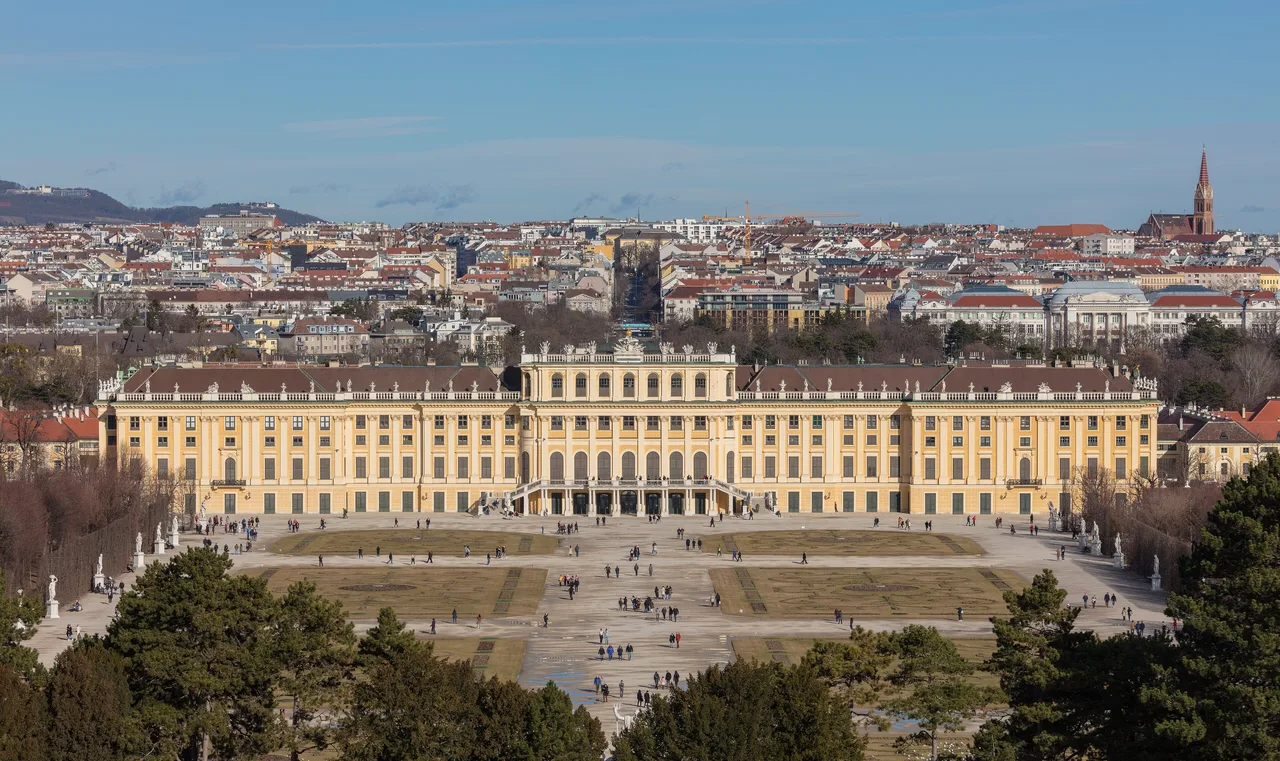
Schönbrunn was the Habsburgs’ summer palace and is a UNESCO World Heritage Site. Tours of the baroque palace take you through the Imperial Apartments; behind it the vast gardens, flower beds, the Neptune Fountain and the Gloriette on the hill make it one of Vienna’s favourite places for a walk. The grounds also contain Tiergarten Schönbrunn, founded in 1752 and regarded as the oldest zoo still in operation. From early November to early January a free-entry Christmas market fills the palace forecourt. UNESCO listing ↗
Don’t miss
- The Imperial Apartments (Imperial or Grand Tour)
- The walk up to the Gloriette and the city view
- The Neptune Fountain and the garden axes
- The forecourt market at Christmas
Tips
- Take the U4 to Schönbrunn or Hietzing.
- Palace tours use timed tickets; buy ahead on busy days.
- The gardens are generally free; some special gardens and buildings are ticketed separately.

Baroque and Jugendstil
Belvedere, Karlskirche, Secession and Naschmarkt

The Belvedere consists of two baroque palaces built for Prince Eugene of Savoy; the Upper Belvedere displays Austrian art, including Gustav Klimt’s The Kiss. Karlskirche on Karlsplatz, with its green dome and two triumphal columns, is one of the most striking works of Viennese baroque. Nearby, the Secession building with its gilded-leaf dome and Klimt’s Beethoven Frieze is the emblem of Viennese Jugendstil. Starting right next to the Secession, the Naschmarkt is the city’s most famous market for fruit, spices and street food.
Don’t miss
- Klimt’s The Kiss in the Upper Belvedere
- Karlskirche and the pool in front of it
- The Beethoven Frieze in the Secession
- Naschmarkt stalls and the Saturday flea market
Tips
- Tram D runs to the Belvedere.
- The Christmas market in front of Karlskirche opens in mid-November.
- The Naschmarkt is closed on Sundays.


Ferris wheel and colourful façades
Prater, Giant Ferris Wheel and Hundertwasserhaus

The Prater in Leopoldstadt is a large park that was once an imperial hunting ground; at its entrance, the Wurstelprater amusement park is home to the historic Giant Ferris Wheel (Riesenrad) dating from 1897. The Hauptallee invites long walks. Across the Danube Canal in the 3rd district, the Hundertwasserhaus is a colourful, undulating, plant-covered apartment building designed by the artist Friedensreich Hundertwasser; it cannot be visited inside but can be seen from the street. The nearby Kunst Haus Wien shows his work.
Don’t miss
- The city view from the Giant Ferris Wheel
- A walk along the Prater Hauptallee
- The Hundertwasserhaus façade
- The Kunst Haus Wien museum
Tips
- Walk to the Ferris Wheel from Praterstern (U1/U2).
- The Hundertwasserhaus is residential; respect the residents’ privacy.
- Winter opening hours of the amusement park attractions vary.
Wine villages
Grinzing, Heuriger and Vienna’s vineyards

Vienna is one of the few capitals that produces a significant amount of wine within its city limits. In wine villages such as Grinzing, Sievering and Nussdorf in the north and Stammersdorf across the Danube, taverns called Heuriger serve the producer’s own wine with simple food. A pine branch (Buschen) hung over the door means the tavern is open. Viennese Heuriger culture is on Austria’s national inventory of intangible cultural heritage. Hiking trails wind through the vineyards, and the Kahlenberg offers views over the city.
Don’t miss
- The historic lanes of Grinzing
- Local wine or grape juice in a Heuriger garden
- A walk through the vineyards (Wiener Weinwanderweg)
- The view of Vienna and the Danube from the Kahlenberg
Tips
- Grinzing is reached by tram and bus; current lines on wienerlinien.at.
- Heuriger opening days vary; many open on a limited basis in winter.
- Fresh grape juice (Traubensaft) is widely available for those who don’t drink alcohol.

Above the city
Kahlenberg, Leopoldsberg and the Vienna Woods (Wienerwald)

In the north-west of Vienna the city ends at the first hills of the Vienna Woods (Wienerwald). Kahlenberg, at about 484 metres, and neighbouring Leopoldsberg offer the widest views over the city, the Danube and the vineyards. Kahlenberg is also linked with the battle that ended the Siege of Vienna in 1683; the small St. Joseph’s Church on the summit is associated with that history. The Wienerwald is a large forest and vineyard landscape recognised by UNESCO as a biosphere reserve. It combines easily with the Heurigen of Grinzing and Nussdorf in half a day.
Don’t miss
- City and Danube views from the Kahlenberg viewing terrace
- A walk around the church and castle remains on Leopoldsberg
- City Hiking Trail 1 (Stadtwanderweg 1) starting in Nussdorf
- Walking down through the vineyards to Grinzing or Nussdorf
Tips
- Bus 38A from Heiligenstadt (U4) goes up to Kahlenberg; check current routes and times on wienerlinien.at.
- Wear comfortable shoes for walking; in winter the paths can be muddy or icy.
- Morning and sunset are the best times for the view.

The modern riverside
Donauinsel, Danube Tower and UNO City

North-east of the historic centre, the Danube shows Vienna’s modern face. The roughly 21 km long Donauinsel, created between the Danube and the New Danube (Neue Donau) for flood protection, is now a place for cycling, walking and, in summer, swimming; the free Donauinselfest is held here every summer. The 252-metre Danube Tower (Donauturm) in Donaupark has a viewing terrace at 150 metres and a restaurant at 170 metres with 360-degree views. Next to it, the Vienna International Centre (UNO City) houses the United Nations Office at Vienna and the International Atomic Energy Agency (IAEA); with the surrounding Donau City high-rises it forms the city’s business district. To the east, the Old Danube (Alte Donau), a former river arm, is used for boating and swimming in summer.
Don’t miss
- City views from the Danube Tower terrace
- Cycling or walking on the Donauinsel
- The Vienna International Centre and the Donau City high-rises
- Swimming and boating areas along the Old Danube in summer
Tips
- The U1 metro stations Donauinsel and Kaisermühlen VIC make the area easy to reach.
- Check donauturm.at for Danube Tower opening times and tickets.
- Visits to the Vienna International Centre are by guided tour only and require valid ID; details on unvienna.org.

Honorary graves of the famous
Zentralfriedhof (Central Cemetery) and St. Charles Borromeo Church

The Zentralfriedhof in the Simmering district opened in 1874 and is one of the largest cemeteries in Europe. From the main gate (Tor 2) you reach the honorary graves (Ehrengräber), where composers such as Beethoven, Schubert, Brahms and Johann Strauss II are buried and a memorial to Mozart stands. At the end of the avenue, the Art Nouveau St. Charles Borromeo Church, designed by Max Hegele, is the cemetery’s landmark. With its tree-lined paths, sections for different faiths and wide green spaces, the cemetery is a quiet place for a walk; it also contains a funeral museum (Bestattungsmuseum) about Vienna’s culture of mourning.
Don’t miss
- The composers’ graves in the honorary section
- The Art Nouveau St. Charles Borromeo Church
- The main gate (Tor 2) designed by Max Hegele
- The funeral museum (Bestattungsmuseum)
Tips
- Reach the cemetery by tram (e.g. lines 11 and 71) or the Zentralfriedhof S-Bahn stop; current lines on wienerlinien.at.
- This is a working cemetery; keep quiet and respect funerals.
- Opening hours change with the season; check friedhoefewien.at.

Day trip
Wachau Valley: Melk and Dürnstein

West of Vienna, between Melk and Krems, the Danube forms the Wachau Valley, a UNESCO World Heritage Site of terraced vineyards, apricot orchards, abbeys and small towns. The baroque Melk Abbey on its hilltop, with its library and church, is the valley’s emblem. Dürnstein is known for the blue-and-white tower of its abbey and the castle ruin where Richard the Lionheart is said to have been held captive. From Vienna take the train to Melk or Krems; seasonal river boats link the two towns. UNESCO listing ↗
Don’t miss
- The library and baroque church of Melk Abbey
- Dürnstein’s abbey with its blue tower
- The walk up to the castle ruin and Danube views
- Wachau wines and apricot products among the vineyards
Tips
- River boats generally run from spring to autumn; take the train for a winter visit.
- Current train connections to Melk are on oebb.at.
- Some small businesses may be closed in winter.

Neighbouring capital
Bratislava

Bratislava, the capital of Slovakia, lies only about 60 km from Vienna, making the two among the closest capitals in Europe. It has a small, walkable old town with the castle on the hill, the Main Square, the Old Town Hall and narrow lanes. At Christmas its own market is set up around the Main Square (Hlavné námestie). The train takes about an hour, and seasonal catamarans run along the Danube. Bratislava guide →
Don’t miss
- Bratislava Castle and Danube views
- The Main Square and Old Town Hall
- St. Martin’s Cathedral
- The old-town market at Christmas
Tips
- Slovakia is also in the Schengen area and uses the euro.
- Check train times on the ÖBB and Slovak railways websites.
- For market dates, see Bratislava’s official sources.
1, 2 and 3-day itineraries + Christmas day
The itineraries below are based on public transport and walking distances. Check palace, museum and Christmas market hours on the official websites.
1 day: Imperial Vienna
- In the morning visit St. Stephen’s Cathedral and climb the tower or see the roof view from the north tower.
- Walk along Graben and Kohlmarkt to the Hofburg: the Imperial Apartments and Sisi Museum or the State Hall.
- After lunch head from Heldenplatz to the Ringstrasse and see Parliament, City Hall and the Opera by tram.
- In the afternoon, the Kunsthistorisches Museum or the Albertina.
- In the evening, the market on Rathausplatz (in season) or a night walk around the Opera.
2 days: Palaces and art
- Follow the day 1 itinerary.
- On the morning of day 2 take the U4 to Schönbrunn: palace tour, gardens and the Gloriette.
- In the afternoon see Klimt’s The Kiss at the Belvedere, then Karlskirche and the Secession.
- In the late afternoon, the Naschmarkt and a Sachertorte or Apfelstrudel break in a coffee house.
3 days: Prater, wine villages or the Wachau
- Follow the first two days.
- On the morning of day 3, the Hundertwasserhaus and Kunst Haus Wien, then the Prater and the Giant Ferris Wheel around midday.
- In the afternoon go to Grinzing, walk through the vineyards and have dinner at a Heuriger.
- Alternative: spend the whole day on a train trip to the Wachau (Melk and Dürnstein) or to Bratislava.
Christmas market day (widest choice 13 November–23 December 2026)
- Start at 10:00 with the market in the forecourt of Schönbrunn Palace (free entry), followed by a short walk in the gardens.
- Around midday take the U4 to Karlsplatz and browse the art market in front of Karlskirche.
- In the afternoon, the Stephansplatz and Am Hof markets, then the Altwiener Christkindlmarkt on the Freyung.
- In the late afternoon see the crafts in the lit-up lanes of Spittelberg, then walk to the Maria-Theresien-Platz Christmas village.
- Finish the evening at the Wiener Christkindlmarkt and Eistraum on Rathausplatz, warming up with Punsch or Kinderpunsch.
Viennese cuisine and coffee houses
Viennese cuisine (Wiener Küche) is one of the few cuisines named after a city, blending influences from across the former Habsburg Empire. Coffee houses, pastry shops and Heuriger taverns are an essential part of the city’s food culture. If you don’t eat pork, note that Wiener Schnitzel is traditionally made from veal, but some places serve a pork “Schnitzel Wiener Art”; ask about ingredients.


Wiener Schnitzel
Traditionally made from veal pounded thin, breaded and fried; served with lemon and potato salad.
Tafelspitz
Boiled beef served with its broth, apple-horseradish sauce and fried potatoes, a classic Viennese dish.
Sachertorte
The famous chocolate-glazed cake with apricot jam, usually served with whipped cream (Schlagobers).
Apfelstrudel
Paper-thin pastry filled with apple, cinnamon and raisins, a coffee-house classic.
Viennese coffee
Varieties such as the Melange (frothy milk coffee), Einspänner and Verlängerter; coffee comes with a glass of water.
Würstelstand
Street sausage stands offering varieties such as Käsekrainer. Ask about pork-free options.
- Nobody rushes in a coffee house; lingering over a single coffee is part of the tradition.
- Service is included in the bill; rounding up or leaving a small tip is customary if you are satisfied.
- Popular coffee houses and restaurants can have queues at Christmas; try early or late hours.
- Most supermarkets close on Sundays; shops in railway stations are the exception.
Culture and etiquette

- In Austria people greet each other with “Grüß Gott” or “Servus”; titles matter in formal settings.
- Classical music is part of the city’s identity; smart-casual dress suits concerts and the opera.
- Viennese coffee-house culture (Wiener Kaffeehauskultur) is on Austria’s national inventory of intangible cultural heritage.
- Shops close on Sundays and public holidays, and quiet is respected.
- Tickets may be checked on public transport; riding without a valid ticket incurs a fine.
- Avoid sightseeing in churches during services.
- Don’t walk on cycle lanes, and obey red lights at pedestrian crossings.
- Before Christmas, Nikolaus and Krampus traditions can be seen on 5–6 December.
Safety and health
- Vienna is generally a very safe city; watch out for pickpockets at crowded Christmas markets and on public transport.
- There may be security measures at the markets; follow staff instructions.
- Pavements can be icy in winter; wear non-slip shoes.
- In an emergency call 112 (general), 144 (ambulance) or 133 (police).
- Travel health insurance is mandatory for a Schengen visa.
- Punsch and Glühwein contain alcohol; some mugs can be hot, so take care with children.
- Check official travel advice before you go.
What drives the budget
This guide gives no prices, because accommodation, transport and admission costs change with the season. The main factors that shape your budget are:
Travel dates
December weekends, New Year and major congress periods push up accommodation demand; January–March is usually quieter.
Where you stay
The 1st district is walkable; the 2nd, 3rd, 6th and 7th districts are well-connected alternatives.
Transport
Direct or connecting flights and the choice of airport train (CAT or S-Bahn/Railjet) affect costs.
Museums and palaces
Palaces and museums charge separately; check city cards and combined tickets on the official tourism website.
Concerts and opera
Ticket categories vary widely; standing places and last-minute options are announced on the official websites.
Food and drink
Coffee houses, Würstelstand stands, the Naschmarkt and restaurants suit different budgets; remember the mug deposit at markets.
Practical information
- Money: the euro is used; card payment is common, but small stalls may need cash.
- Language: English is spoken at tourist sites.
- Opening hours: shops close on Sundays; 8 December (Immaculate Conception) is a public holiday, but many shops open. Places close early on the afternoon of 24 December, and 25–26 December are holidays.
- Internet: there are free Wi-Fi hotspots; with a non-EU SIM, check roaming charges.
- Tourist information: Tourist Info Wien on Albertinaplatz and wien.info provide current information.
- Accessibility: most U-Bahn stations have lifts; access to historic buildings varies.
- Water: Vienna’s tap water comes from the Alps and is drinkable.
- Weather: in winter it starts getting dark around 16:00.
Frequently asked questions
When do Vienna’s Christmas markets open in 2026?
According to the official websites, the Wiener Christkindlmarkt on Rathausplatz runs from 13 November to 26 December 2026 and the Schönbrunn Palace Christmas market from 6 November 2026 to 6 January 2027. Most other markets open in mid-November.
What are the opening hours of the Rathausplatz market?
The official website gives daily 10:00–22:00 and 10:00–18:30 on 24 December. Check christkindlmarkt.at before you go.
Is there an entry fee for the Schönbrunn Christmas market?
No. According to official information, entry to the Schönbrunn Palace Christmas market is free; palace tours are ticketed separately.
Are any markets open after Christmas?
Yes. The Schönbrunn market and the Wiener Eistraum stay open until 6 January 2027, and the Belvedere Christmas village until 31 December. Check hours on the official websites.
How do I get from the airport to the city centre?
The City Airport Train (CAT) reaches Wien Mitte in about 16 minutes; the S7 S-Bahn and ÖBB Railjet trains are alternatives.
Where do Turkish citizens apply for an Austrian visa?
Ordinary passport holders need a Schengen visa. According to the BMEIA, applications are decided by the Austrian Consulate General in Istanbul and submitted through VFS Global centres. Check bmeia.gv.at for current information.
How many days do I need in Vienna?
You can see the main sights in 2–3 days; add a day for a trip to the Wachau or Bratislava.
What should I eat in Vienna?
Wiener Schnitzel, Tafelspitz, Sachertorte and Apfelstrudel, plus a Melange in a coffee house.
Can I combine Vienna with the Nuremberg or Strasbourg Christmas markets?
Yes. Direct trains link Vienna and Nuremberg (about 4–5 hours). The Nuremberg and Strasbourg markets open on 27 November 2026.
Is Vienna good for families?
Yes. Schönbrunn Zoo, the Prater, the Natural History Museum and the children’s areas at the Christmas markets suit families well.
Where to stay
Stay close to the areas where you will spend most time. The areas below are covered in detail in this guide; check public transport links in the getting-around section.
- Heart of the citySt. Stephen’s Cathedral, Graben and Kärntner Strasse
- Habsburg palaceHofburg, Heldenplatz and the Ringstrasse
- Museum districtKunsthistorisches Museum, Maria-Theresien-Platz and MuseumsQuartier
- Summer palaceSchönbrunn Palace, gardens and the Gloriette
- Baroque and JugendstilBelvedere, Karlskirche, Secession and Naschmarkt
- Ferris wheel and colourful façadesPrater, Giant Ferris Wheel and Hundertwasserhaus
- Wine villagesGrinzing, Heuriger and Vienna’s vineyards
- Above the cityKahlenberg, Leopoldsberg and the Vienna Woods (Wienerwald)
- The modern riversideDonauinsel, Danube Tower and UNO City
- Honorary graves of the famousZentralfriedhof (Central Cemetery) and St. Charles Borromeo Church
- Neighbouring capitalBratislava
Search hotels in these areas (Hotellook) ↗ (affiliate link)Search on Booking.com ↗
Where to stay in Vienna → · 3 days in Vienna: ready-made itinerary →
Affiliate disclosure: Hotellook, Aviasales, Klook, Airalo, Tiqets and DiscoverCars links are affiliate links; Rota Atlası may earn a commission on bookings made through them, at no extra cost to you. Official and in-guide links are not paid. Last updated: 1 November 2026 · Privacy and affiliates
Transport and connectivity
- Airport transferOptions from the airport to the city are in this guide’s getting there section.
- Mobile data (eSIM)Airalo eSIM ↗ (affiliate link)
- TrainsOfficial rail website ↗
- Car hireYou rarely need a car within the city; see getting around first. Compare car hire on DiscoverCars ↗ (affiliate link)
Affiliate disclosure: Hotellook, Aviasales, Klook, Airalo, Tiqets and DiscoverCars links are affiliate links; Rota Atlası may earn a commission on bookings made through them, at no extra cost to you. Official and in-guide links are not paid. Last updated: 1 November 2026 · Privacy and affiliates
Search flights (affiliate link)
Search flights from any airport in any country. Results open on Aviasales in a new tab, where you book.
This form is an affiliate link: Rota Atlası may earn a commission on bookings made via Aviasales (Travelpayouts), at no extra cost to you. Check price, baggage and terms on the booking site. Airport data: OurAirports (public domain).
Flights, hotels and tours
Find tours and tickets
- St Stephen’s Cathedral
GetYourGuide ↗ · Klook ↗ (affiliate link) - Hofburg
GetYourGuide ↗ · Klook ↗ (affiliate link) - Schönbrunn Palace
GetYourGuide ↗ · Klook ↗ (affiliate link) - Belvedere
GetYourGuide ↗ · Klook ↗ (affiliate link)
Hotellook, Aviasales, Klook, Airalo and Tiqets links in this box are affiliate links (Travelpayouts): Rota Atlası may earn a commission on bookings made through them, at no extra cost to you. GetYourGuide links currently carry no affiliate code. Check prices and terms with the provider. Last updated: 1 November 2026 · Privacy and affiliates
Sources
- T.C. Dışişleri Bakanlığı · Türk vatandaşlarının tabi olduğu vize uygulamaları ↗
- BMEIA · Österreichisches Generalkonsulat Istanbul · Visaantrag ↗
- European Union · Entry/Exit System (EES) ↗
- WienTourismus · wien.info (official) ↗
- Schloss Schönbrunn (official) ↗
- Wiener Linien (official) ↗
- Vienna International Airport ↗
- ÖBB · Österreichische Bundesbahnen ↗
- GOV.UK · Foreign travel advice · Austria ↗
- UNESCO World Heritage Centre · Historic Centre of Vienna ↗
- UNESCO World Heritage Centre · Palace and Gardens of Schönbrunn ↗
- UNESCO World Heritage Centre · Wachau Cultural Landscape ↗
- Wiener Christkindlmarkt Rathausplatz (official) ↗
- Weihnachtsmarkt Schloss Schönbrunn (official) ↗
- wien.info · Viennese Christmas Market on Rathausplatz ↗
- Stadt Wien · Weihnachtsmarkt am Spittelberg ↗
- Weihnachtsmarkt Am Hof (official) ↗
This page is for information only. Dates, opening hours, entry rules and transport details can change; check the official sources above before you travel. No prices, flights, hotels or restaurant recommendations have been invented in this guide.
Photo credits
The photos on this page come from Wikimedia Commons and are used under the stated authors and licences (CC BY, CC BY-SA, CC0 or public domain). Page with all sources
- Christkindlmarkt stalls in front of Vienna City Hall (Rathaus) — Böhringer Friedrich · CC BY-SA 3.0 at · Wikimedia Commons
- Golden Christmas tree ornaments at the Rathausplatz market — Böhringer Friedrich · CC BY-SA 3.0 at · Wikimedia Commons
- The Christmas market and crowds in front of Schönbrunn Palace — Funke · CC BY-SA 4.0 · Wikimedia Commons
- A stall selling colourful glasswork at the Spittelberg Christmas market — Geolina163 · CC BY-SA 4.0 · Wikimedia Commons
- The Christmas market in front of the Karlskirche at night — Böhringer Friedrich · CC BY-SA 3.0 at · Wikimedia Commons
- The Christmas market on Maria-Theresien-Platz in front of the museums — Geolina163 · CC BY-SA 4.0 · Wikimedia Commons
- The entrance to the Altwiener Christkindlmarkt on the Freyung — Palickap · CC BY-SA 4.0 · Wikimedia Commons
- The Wiener Eistraum ice rink on Rathausplatz — Haeferl · CC BY-SA 3.0 · Wikimedia Commons
- The Gothic St. Stephen’s Cathedral and its south tower — Herbert Heim · CC BY-SA 4.0 · Wikimedia Commons
- St. Stephen’s patterned roof and the view over Vienna from the tower — Dietmar Rabich · CC BY-SA 4.0 · Wikimedia Commons
- The Graben and its Plague Column (Pestsäule) — Falk2 · CC BY-SA 4.0 · Wikimedia Commons
- The Hofburg seen from Heldenplatz with a fiaker carriage — Gerd Eichmann · CC BY-SA 4.0 · Wikimedia Commons
- The baroque State Hall (Prunksaal) of the Austrian National Library — BMSTe · CC BY-SA 4.0 · Wikimedia Commons
- The Vienna State Opera (Staatsoper) at dawn — Moahim · CC BY-SA 4.0 · Wikimedia Commons
- The Austrian Parliament building lit up in the evening — Thomas Wolf, www.foto-tw.de · CC BY-SA 3.0 de · Wikimedia Commons
- The dome of the Kunsthistorisches Museum at sunset — Dietmar Rabich · CC BY-SA 4.0 · Wikimedia Commons
- The MuseumsQuartier lit up in the run-up to Christmas — Hubertl · CC BY-SA 4.0 · Wikimedia Commons
- Schönbrunn Palace and gardens seen from the Gloriette hill — Thomas Wolf, www.foto-tw.de · CC BY-SA 3.0 de · Wikimedia Commons
- The Gloriette in the Schönbrunn gardens reflected in the pond — David Monniaux · CC BY-SA 3.0 · Wikimedia Commons
- The Upper Belvedere and its pool at dusk — Diego Delso · CC BY-SA 4.0 · Wikimedia Commons
- The Karlskirche and the pond in front of it in the evening — Moahim · CC BY-SA 4.0 · Wikimedia Commons
- The Secession building with its golden leaf dome — C.Stadler/Bwag · CC BY-SA 4.0 · Wikimedia Commons
- Fruit and mushroom stall at the Naschmarkt — Dietmar Rabich · CC BY-SA 4.0 · Wikimedia Commons
- The historic Riesenrad Ferris wheel in the Prater — Dietmar Rabich · CC BY-SA 4.0 · Wikimedia Commons
- The colourful, uneven facade of the Hundertwasserhaus — Dietmar Rabich · CC BY-SA 4.0 · Wikimedia Commons
- A yellow-fronted Heuriger in Vienna’s wine-village area — Geolina163 · CC BY-SA 4.0 · Wikimedia Commons
- Vineyards above Grinzing — Geolina163 · CC BY-SA 4.0 · Wikimedia Commons
- Melk Abbey (Stift Melk) above the Danube — Uoaei1 · CC BY-SA 4.0 · Wikimedia Commons
- Dürnstein Abbey with its blue tower and the Danube in the Wachau — Jakub Hałun · CC BY-SA 4.0 · Wikimedia Commons
- Bratislava’s Main Square and Old Town Hall — Pudelek (Marcin Szala) · CC BY-SA 3.0 · Wikimedia Commons
- The interior of a historic Viennese coffee house — Jason Wu from Taiwan · CC BY 2.0 · Wikimedia Commons
- A slice of Sachertorte served with whipped cream — Rizka · CC BY-SA 4.0 · Wikimedia Commons
- Wiener Schnitzel served with lemon — Burkhard Mücke · CC BY-SA 4.0 · Wikimedia Commons
- A slice of Apfelstrudel dusted with icing sugar — Geolina163 · CC BY-SA 4.0 · Wikimedia Commons
Passau → · Sibiu → · Salzburg → · Bratislava → · Budapest → · Nuremberg → · Strasbourg → · Christmas markets