

Kraków is a city of about 800,000 people on the Vistula River in southern Poland and was for centuries the capital of the Polish kings. Its historic centre, largely spared destruction in the Second World War, was among the first sites inscribed on UNESCO’s World Heritage List in 1978. At its heart lies Rynek Główny (the Main Market Square), laid out in 1257 with sides of roughly 200 metres (krakow.travel). The Renaissance Cloth Hall (Sukiennice) stands in the middle and St Mary’s Basilica, with its two unequal towers, at one corner; every hour a trumpet melody called the hejnał is played from the basilica’s tower. To the south, the royal castle and cathedral crown Wawel Hill, with the former Jewish quarter of Kazimierz beyond and Podgórze across the river. In winter, wooden stalls fill the square from late November, and in early December makers bring their glittering nativity scenes, the szopki, to the square for the annual contest. This guide brings together the Christmas market, the szopka tradition, the districts, day trips, food and practical information, based on official sources.
Content update: 29 October 2026 · Christmas dates checked on krakow.travel and Muzeum Krakowa
Kraków at a Glance
- Country
- Poland · Lesser Poland (Małopolska) region
- Population
- About 800,000
- Language
- Polish; English widely used in tourism
- Currency
- Polish złoty (PLN); cards widely accepted, keep some cash for stalls
- Time zone
- Central European Time (CET, UTC+1)
- Highlights
- Rynek Główny, Wawel, Kazimierz, the Vistula boulevards
- Must-see
- Cloth Hall, St Mary’s Basilica and the Veit Stoss altar, Wawel Castle and Cathedral
- UNESCO
- Historic centre (1978); Wieliczka Salt Mine and Auschwitz-Birkenau nearby
- Christmas
- Christmas market on Rynek Główny 27 November 2026–6 January 2027; szopka contest 3 December
- Transport
- Kraków Główny station; airport about 20 minutes by train
- Electricity
- 230 V, type C/E sockets
- Emergency
- 112 (general emergency)
Kraków in Pictures
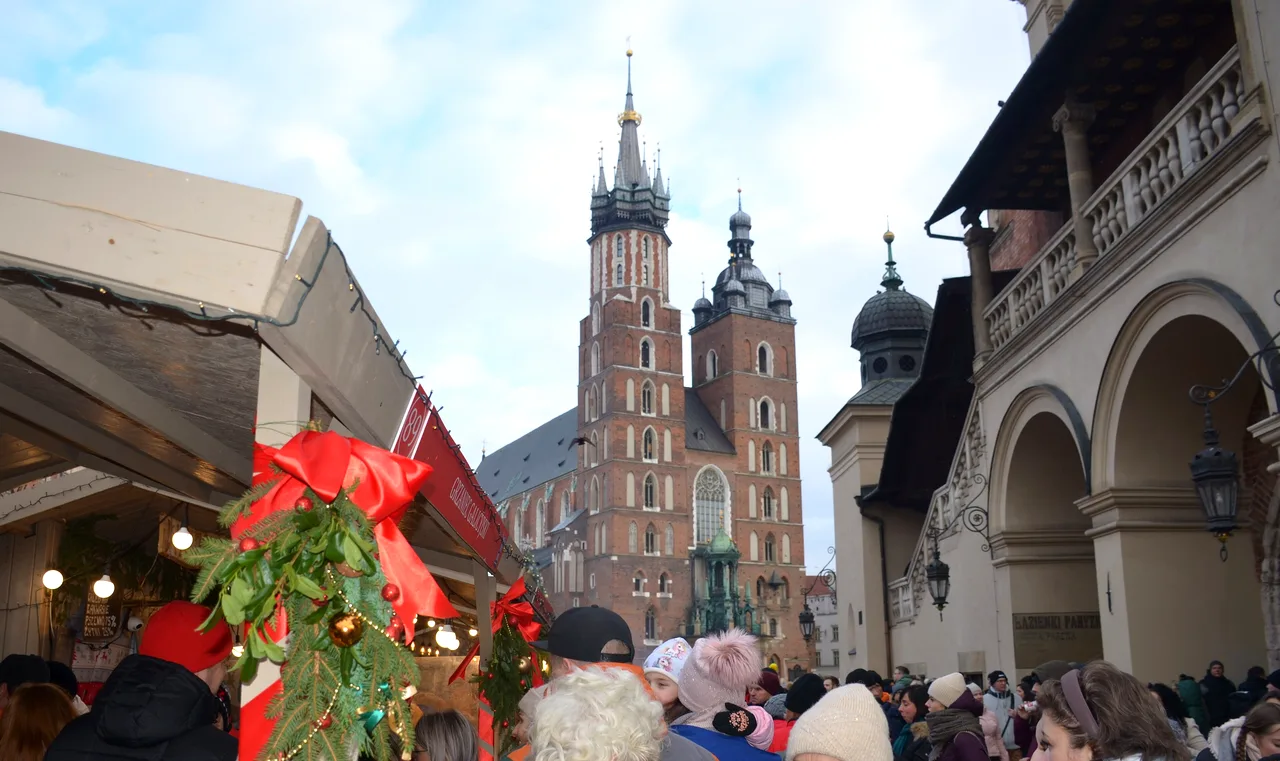
St Mary’s Basilica and the Mickiewicz Monument, Wawel across the Vistula at dawn and the Cloth Hall in the middle of the square: Kraków in three frames.


Kraków Christmas Market and Szopka Tradition 2026
Kraków’s Christmas market (Targi Bożonarodzeniowe) is set up on Rynek Główny between the Cloth Hall and St Mary’s Basilica, around wooden stalls and a giant Christmas tree. Stalls sell handmade decorations, Advent wreaths, wooden toys, ceramics and woollens alongside oscypek, grilled sausage, pierogi and hot drinks, and the square’s stage hosts regional music and dance. According to the city’s official tourism portal the 2026 market opens on 27 November and runs until 6 January 2027; the organiser ARTIM’s announcements may give the closing day as 3 or 6 January, so check the final days. The second tradition that makes a Kraków winter unique is the szopka krakowska: nativity scenes that echo the city’s towered churches, decorated with colourful foil and lights. Szopka-making was inscribed on UNESCO’s Representative List of the Intangible Cultural Heritage of Humanity in 2018. According to Muzeum Krakowa, for the 84th Szopka Contest makers bring their scenes to the Adam Mickiewicz Monument between 10:00 and 12:00 on 3 December 2026, followed by a parade at 12:00; selected works are exhibited at Pałac Krzysztofory, Rynek Główny 35, from 9 December 2026 to 28 February 2027. Entry to the square is free.


| Event | Location | 2026 dates | Note |
|---|---|---|---|
| Kraków Christmas Market | Rynek Główny (Main Market Square) | 27 November 2026–6 January 2027 | The closing day may be announced as 3 or 6 January; check hours on official pages; free entry. |
| 84th Kraków Szopka Contest | Adam Mickiewicz Monument, Rynek Główny | 3 December 2026 | Scenes are set out around the monument 10:00–12:00; parade at 12:00 (muzeumkrakowa.pl). |
| Szopka exhibition | Pałac Krzysztofory, Rynek Główny 35 | 9 December 2026–28 February 2027 | Tuesday–Sunday 10:00–18:00; tickets and details from Muzeum Krakowa. |
| Szopka results | Muzeum Krakowa | 6 and 13 December 2026 | Days on which contest results and awards are announced; check the official page. |
| Christmas tree on the Rynek | Rynek Główny | During the market | The square’s Christmas tree and lights; dates are announced on the official portal. |
| New Year’s Eve | Rynek Główny and city centre | 31 December 2026 | The programme changes each year; check krakow.travel. |
What to try
Grzaniec galicyjski
Spiced mulled wine; contains alcohol.
Hot fruit punch
Alcohol-free hot drink for children and non-drinkers; ask at the stall.
Oscypek
Smoked sheep’s cheese from the Tatras, often grilled and served with cranberry jam.
Kiełbasa z grilla
Fire-grilled Polish sausage; usually pork, ask about ingredients.
Pierogi
Dumplings filled with potato and cheese, cabbage and mushroom, or meat.
Pierniki
Spiced gingerbread and decorated hearts, sold as gifts.
Tips for the Kraków Christmas market
- Weekend evenings on the square are very busy; weekday mornings are calmer.
- Stand in front of St Mary’s Basilica at dusk and listen for the hourly hejnał.
- To see the szopki on 3 December, head to the Mickiewicz Monument before noon.
- From 9 December the szopka exhibition is on at Pałac Krzysztofory.
- Most stalls take cards; still carry some złoty.
- Cobblestones can be icy; wear non-slip shoes.
- Carry your bag in front of you in crowds.
- Hot drinks are sometimes served in deposit mugs; return the mug to get the deposit back.
Check before you go: krakow.travel · Christmas market and events (official) ↗ · Muzeum Krakowa · 84th Kraków Szopka Contest 2026 (official) ↗
Dates were checked on 29 October 2026 via Kraków’s official tourism sources (krakow.travel, turystykakrakow.pl) and muzeumkrakowa.pl. Daily opening hours and the closing day of the market may differ between sources; check the official pages before your visit.
When to Go
Kraków has a continental climate with mild summers and cold winters. May to September is the most comfortable time for walking, the Vistula boulevards and day trips, although July and August are the busiest months. Between late November and early January the Christmas market and the szopka tradition bring the city to life. January and February are cold and quiet, and the snow season begins in the Tatras. Spring and autumn offer a good balance of mild weather and fewer crowds.
| Month | Sightseeing | Christmas market | Outdoors | Crowds |
|---|---|---|---|---|
| January | Good | Partly | Difficult | Quiet |
| February | Good | None | Difficult | Quiet |
| March | Good | None | Good | Moderate |
| April | Very good | None | Good | Moderate |
| May | Very good | None | Very good | Moderate |
| June | Very good | None | Very good | Busy |
| July | Very good | None | Very good | Busy |
| August | Very good | None | Very good | Busy |
| September | Very good | None | Very good | Moderate |
| October | Very good | None | Good | Moderate |
| November | Good | Market season | Difficult | Moderate |
| December | Good | Market season | Difficult | Busy |
- December days are usually between -3 and 3 °C; snow is possible.
- Christmas market 27 November 2026–6 January 2027 (check the closing day).
- Szopka contest 3 December 2026; exhibition 9 December 2026–28 February 2027.
- Wieliczka and Auschwitz-Birkenau are open all year; winter hours are shorter.
- July and August are the busiest months.
- Winter fog and air pollution can reduce visibility on some days.
Visa and Entry (Turkish citizens)
Turkish citizens holding ordinary (burgundy) passports need a Schengen visa for tourist travel to Poland. Special, service and diplomatic passports follow different rules; check the current status on the website of the Turkish Ministry of Foreign Affairs.
Apply to the consulate of your main destination. If Poland is your main destination, the official visa page of the Embassy of Poland in Ankara (gov.pl/web/turcja/wizy) gives up-to-date information on type C (short-stay Schengen) and type D (national) visa applications.
If your trip also includes Germany, Czechia or another Schengen country, apply to the country where you will stay longest; if the stays are equal, to the country you enter first.
Under the EU Entry/Exit System (EES), which is being introduced in stages, your biometric data (facial image and fingerprints) may be recorded on first entry; allow extra time at the airport.
Visa fees, appointment waiting times and required documents may change; this guide does not state fees. Use the current lists on the official pages before applying.
Travel medical insurance, accommodation and return documents are part of the application; details are on the official sources.
Check before you go: T.C. Dışişleri Bakanlığı · Türk vatandaşlarının tabi olduğu vize uygulamaları ↗ · gov.pl/web/turcja ↗ · EES · europa.eu ↗ · Rota Atlası visa guide (TR)
Travel medical insurance
Check the official visa and entry sources above first: they state whether travel medical insurance is required and the minimum cover. Compare any policy’s cover amount, validity dates and countries covered with the official requirement.
Rota Atlası does not currently offer an insurance partnership; there are no paid links in this section. Last updated: 1 November 2026
Getting to Kraków
- By air: Kraków’s airport is Kraków John Paul II International Airport (KRK, Balice), west of the city. Check current flights from Türkiye only on airline and airport websites; this guide does not recommend flights.
- From the airport: the airport train reaches Kraków Główny station in the city centre in about 20 minutes (krakow.travel); buses and taxis also run. Current timetables are on the airport’s official website.
- By train: Kraków Główny connects to Warsaw (about 2.5 hours by Intercity), Wrocław, Gdańsk and Katowice, with links towards Prague and Vienna. Check current services and journey times on intercity.pl.
- By bus: long-distance buses leave from the bus station next to the train station, with frequent services to Zakopane, Wieliczka and Oświęcim.
Getting Around

On foot
The Old Town, Wawel and Kazimierz are within walking distance; the Rynek to Wawel is about 15 minutes.
Tram and bus
MPK Kraków’s tram and bus network covers the whole city; buy tickets from machines or the app and validate them on board.
Regional train
Wieliczka and the airport are linked by regional trains from Kraków Główny.
Bicycle
Cycle paths run along the Vistula; watch for ice in winter.
Taxi
Licensed taxis and ride-hailing apps are common; ask the fare before you get in.
Car
The Old Town is largely closed to traffic; leave your car outside the centre or in car parks.
Things to See
Kraków’s historic centre is a ring encircled by the Planty park, laid out where the old walls once stood. In the middle are Rynek Główny and the Cloth Hall, to the north the Barbican and St Florian’s Gate, and to the south Wawel Hill, reached via quiet Kanonicza Street. South-east of Wawel lies Kazimierz, across the Vistula Podgórze and Schindler’s Factory, and to the east the socialist-era district of Nowa Huta. Wieliczka, Auschwitz-Birkenau and the Tatra Mountains are classic day trips.
Heart of the city
Rynek Główny, the Cloth Hall and the Town Hall Tower

Rynek Główny was laid out when Kraków received its town charter in 1257 and, as a huge square with sides of about 200 metres, ranks among the largest medieval squares in Europe (krakow.travel). The Cloth Hall (Sukiennice) in its centre was the hub of the medieval cloth trade and took on its Renaissance look in the 16th century. Stalls still line its ground floor, while the upper floor houses the National Museum’s gallery of 19th-century Polish art. The nearby Town Hall Tower is all that remains of the demolished old town hall. Historic houses with ornate façades, the small Church of St Adalbert and the Adam Mickiewicz Monument complete the square, which is also home to the Christmas market. UNESCO listing ↗
Don’t miss
- The arcaded stalls of the Cloth Hall
- Town Hall Tower
- Historic houses around the square
- Adam Mickiewicz Monument
- The Christmas market and tree
Tips
- See the square by day and by night; the evening lights are beautiful.
- Check the opening hours of the Cloth Hall gallery and the tower on the official websites.
- Cafés on the square can be expensive; look at the menu first.

A trumpet from the tower
St Mary’s Basilica and the Veit Stoss Altar

St Mary’s Basilica, at the north-east corner of the Rynek, is a symbol of Kraków with its two unequal towers. Every hour the hejnał mariacki trumpet call is played in four directions from the taller, 81-metre tower and, by tradition, breaks off mid-melody (krakow.travel). Inside, the carved wooden altar made by the Nuremberg master Veit Stoss (Wit Stwosz) between 1477 and 1489, about 13 × 11 metres, is regarded as one of the largest Gothic altarpieces in Europe. A blue vault painted with stars and colourful wall paintings complete the interior.
Don’t miss
- Veit Stoss’s Gothic altar
- The hourly hejnał
- The star-painted blue vault
- The tower climb in season
Tips
- Visitor entry and opening hours vary with services; check mariacki.com.
- Find out when the altar wings are opened on the official website.
- Keep quiet inside and do not walk around during Mass.
The Royal Route
The Barbican, St Florian’s Gate and the Planty

The Royal Route, followed by coronation processions, starts at the Barbican and leads via Floriańska Street, the Rynek and Grodzka Street to Wawel. The round Gothic Barbican, built at the end of the 15th century, is one of the few surviving defensive structures of its kind in Europe. Just behind it, St Florian’s Gate and the remains of the walls form the northern entrance to the Old Town. Most of the walls were demolished in the 19th century and replaced by the Planty park, which encircles the Old Town like a green ring.
Don’t miss
- The Gothic Barbican
- St Florian’s Gate and the remaining walls
- Floriańska Street
- A walk around the Planty
Tips
- The Barbican opens seasonally; check hours with Muzeum Krakowa.
- Walking the Planty is a lovely way to circle the Old Town in about an hour.
- Floriańska Street is busy in the evenings.

Hill of kings
Wawel Castle, Cathedral and Kanonicza Street

Wawel Hill on the banks of the Vistula was the residence of Polish kings for centuries. The Royal Castle’s arcaded Renaissance courtyard is considered one of the finest Renaissance spaces in Central Europe, and the castle houses separately ticketed exhibitions such as the Royal Private Apartments, the State Rooms and the Treasury (wawel.krakow.pl). Next door, Wawel Cathedral is where Polish kings were crowned and buried; it contains the gilded-dome Sigismund Chapel and the famous Sigismund Bell. The hill is reached from the Rynek along quiet Kanonicza Street, lined with clergy houses.
Don’t miss
- The arcaded Renaissance courtyard
- The cathedral and Sigismund Chapel
- The royal apartments and Treasury
- Kanonicza Street
- Vistula views from the ramparts
Tips
- Exhibitions are ticketed separately and daily visitor numbers may be limited; check wawel.krakow.pl in advance.
- Cathedral visiting hours vary with services.
- Entry to the hill’s courtyard is usually free; winter hours are shorter.


By the river
The Vistula Boulevards and the Dragon’s Den

The boulevards along the Vistula below Wawel Hill are among Kraków’s favourite walks. The view from the riverbank up to the hill and castle is especially striking at sunrise and sunset. Legend says a dragon lived in the cave beneath Wawel; the dragon statue on the river side of the hill tells the tale. Along the bank you can walk to Kazimierz and to Podgórze on the opposite side of the river.
Don’t miss
- River views of Wawel
- The dragon statue
- The riverside walk to Kazimierz
- Bridges at sunset
Tips
- The Dragon’s Den (Smocza Jama) is open only seasonally; check wawel.krakow.pl.
- In winter the banks can be windy and icy.
- Do not walk on the riverside cycle path.
Memory and life
Kazimierz: the Former Jewish Quarter

Kazimierz was founded in the 14th century by King Casimir III as a separate town and for centuries was home to Kraków’s Jews. Several historic synagogues stand around broad Szeroka Street; the oldest, the Old Synagogue, is now a branch of Muzeum Krakowa. The Remuh Synagogue and its cemetery are still in use. During the Holocaust the district’s Jewish population was annihilated; today Kazimierz is both a place of remembrance and, with its cafés, galleries and Plac Nowy with its round former market hall, one of the liveliest parts of the city.
Don’t miss
- Szeroka Street
- The Old Synagogue
- The Remuh Synagogue and cemetery
- Plac Nowy
- The churches of Catholic Kazimierz
Tips
- Synagogue opening hours change on Saturdays and Jewish holidays.
- Be quiet and respectful in cemeteries and places of worship.
- The district is lively at night; respect residents’ peace.


Across the river
Podgórze and Schindler’s Factory

During the Second World War the Kraków Ghetto was established in Podgórze, on the right bank of the Vistula. Today the memorial of empty chairs on Plac Bohaterów Getta recalls this period. Nearby, Oskar Schindler’s former enamel factory houses Muzeum Krakowa’s exhibition “Kraków under Nazi Occupation 1939–1945”, which tells the story of the war years through testimonies, documents and reconstructed spaces.
Don’t miss
- The permanent exhibition at Schindler’s Factory
- The Plac Bohaterów Getta memorial
- Remains of the ghetto wall
- The footbridge to Kazimierz
Tips
- Daily visitor numbers at the factory museum may be limited; check tickets on muzeumkrakowa.pl in advance.
- The exhibition is intense; allow at least two hours.
- You can walk over from Kazimierz via the footbridge.
A socialist utopia
Nowa Huta

Nowa Huta was built from 1949 as an “ideal socialist city” for the workers of a vast steelworks. With broad avenues fanning out from Central Square, socialist-realist buildings and green courtyards, it shows an approach to urban planning completely different from old Kraków. The district is also known for the modern Arka Pana (Lord’s Ark) church, built through the residents’ determination. It is easy to reach by tram from the Old Town.
Don’t miss
- Central Square and the broad avenues
- Socialist-realist architecture
- Arka Pana church
- The steelworks administration buildings
Tips
- The tram from the Old Town takes about half an hour; check current lines on mpk.krakow.pl.
- A walk explaining the district’s history helps you understand it better.
- Mind Mass times when visiting the church.

Hills with a view
Kościuszko Mound and Tyniec Abbey

Kościuszko Mound, west of Kraków, was raised by hand between 1820 and 1823 in memory of the national hero Tadeusz Kościuszko; from the top you can see the city and, on clear days, the Tatra Mountains. A 19th-century Austrian fort surrounds the mound. Further south-west, the Benedictine Tyniec Abbey stands on a limestone cliff above the Vistula; it is one of the oldest monasteries in Poland and pairs well with a riverside walk.
Don’t miss
- City views from the top of the mound
- The fort and surrounding park
- Tyniec Abbey
- A walk along the Vistula
Tips
- Check opening hours for the mound and abbey on their official websites.
- The path up can be slippery in winter.
- Tyniec can be reached by bus or bicycle.

A cathedral underground
Wieliczka Salt Mine

Wieliczka Salt Mine, south-east of Kraków, was worked for centuries and in 1978 became one of the first sites on UNESCO’s World Heritage List; today it is listed together with the Bochnia mine. Visitors descend by stairs and walk through galleries, underground lakes and sculptures carved from salt by miners. The most famous space is the Chapel of St Kinga, whose walls, chandeliers and reliefs are made entirely of salt. UNESCO listing ↗
Don’t miss
- The Chapel of St Kinga
- Salt-carved sculptures
- Underground lakes
- The Miners’ Route
Tips
- Visits are by guided tour; check tickets and tour languages in advance on wieliczka-saltmine.com.
- The temperature underground is cool all year; bring a jumper.
- There are many stairs; people with limited mobility should check accessibility information on the official site.
Remembrance
Auschwitz-Birkenau Memorial and Museum

Auschwitz-Birkenau, in the town of Oświęcim about 60–70 kilometres west of Kraków, was the largest concentration and extermination camp established by Nazi Germany; more than a million people, the great majority of them Jews, were murdered here. The site, now a memorial and museum, was inscribed on the UNESCO World Heritage List in 1979. A visit covers the exhibitions at Auschwitz I and the vast grounds of Birkenau, where the International Monument stands. UNESCO listing ↗
Don’t miss
- The exhibitions at Auschwitz I
- Birkenau and the International Monument
- An educational guided visit
Tips
- Advance booking on the official auschwitz.org website is required; daily rules and guided options are listed there.
- This is a place of remembrance: be quiet, dress respectfully and follow the rules.
- It is an emotionally heavy visit; keep the rest of the day light.
Winter in the mountains
Zakopane and the Tatra Mountains

South of Kraków, on the border with Slovakia, the Tatras are Poland’s highest mountains. Zakopane at their foot is a mountain town known for its distinctive wooden architecture, highland culture and oscypek cheese. Winter brings skiing and snow walks and summer brings hiking; the cable car to Kasprowy Wierch and the funicular to Gubałówka offer mountain views on clear days.
Don’t miss
- Zakopane’s wooden houses
- Krupówki street
- The view from Gubałówka
- Tatra views from Kasprowy Wierch
Tips
- Reached by bus and train; the journey can take a few hours depending on weather and traffic.
- Mountain weather changes quickly; go with proper winter clothing and footwear.
- Check winter status of the cable car and trails on official websites.
1–3 Day Itineraries, a Christmas Day + 5-Day Southern Poland Route
The itineraries keep walking distances short and take short winter days into account. Day one covers the Old Town and Wawel, day two Kazimierz, Podgórze and Wieliczka, and day three Auschwitz-Birkenau. The Christmas day is planned around the market and the szopka tradition, and the 5-day route combines Kraków with southern Poland. Check opening hours and booking requirements on official websites in advance.
Day 1: Old Town and Wawel
- Start in the morning at the Barbican and St Florian’s Gate and walk down Floriańska Street to the Rynek.
- See the Cloth Hall and visit the Veit Stoss altar in St Mary’s Basilica.
- Listen for the hourly hejnał.
- In the afternoon walk up to Wawel via Kanonicza Street; see the courtyard and cathedral.
- Walk along the Vistula at sunset.
Day 2: Kazimierz, Podgórze and Wieliczka
- In the morning explore Szeroka Street and the synagogues in Kazimierz.
- Cross the footbridge to Podgórze and visit the Schindler’s Factory museum (tickets in advance).
- In the afternoon take the train to Wieliczka Salt Mine.
- Return in the evening to the lively streets around Plac Nowy in Kazimierz.
Day 3: Auschwitz-Birkenau
- Leave early by bus or train for Oświęcim.
- See Auschwitz I and Birkenau on your pre-booked visit.
- Return to Kraków in the afternoon and end the day with a quiet walk in the Planty.
A Christmas day
- In the morning browse the stalls at the Christmas market on Rynek Główny.
- Pass under the arches of the Cloth Hall and enter St Mary’s Basilica.
- If you are there on 3 December, see the szopki at the Mickiewicz Monument between 10:00 and 12:00 and watch the 12:00 parade.
- After 9 December visit the szopka exhibition at Pałac Krzysztofory.
- At dusk listen to the hejnał over the lit square and try the market’s hot drinks.
5-day southern Poland route
- Days 1–2: Kraków Old Town, Wawel and Kazimierz.
- Day 3: Wieliczka Salt Mine and Nowa Huta.
- Day 4: Auschwitz-Birkenau.
- Day 5: Zakopane and the Tatras; or continue by train to Wrocław.
Food of Kraków and Lesser Poland
Kraków’s cuisine combines the hearty country dishes of Lesser Poland with Galician and Jewish influences. These are traditional dishes and products, not restaurant recommendations.


Pierogi
Dumplings filled with potato and cheese (ruskie), cabbage and mushroom, or meat; boiled or fried.
Obwarzanek krakowski
Kraków’s ring-shaped bread with poppy seeds, sesame or salt; it has EU protected status and is sold at street stalls.
Oscypek
Smoked sheep’s cheese from the Tatra highlands; an EU protected product.
Żurek
Sour rye soup, often with egg and sausage, sometimes served in a bread bowl.
Bigos
“Hunter’s stew” of sauerkraut, meat and mushrooms; it may contain pork.
Zapiekanka
Street snack of a long bread baked with mushrooms and cheese, closely linked with Plac Nowy.
Barszcz czerwony
Beetroot soup, served on Christmas Eve with small mushroom dumplings called uszka.
Sernik
Kraków-style cheesecake, one of Poland’s classic desserts.
- Pork is common in Polish cuisine; ask about ingredients.
- Pierogi ruskie, mushroom-and-cabbage pierogi and zapiekanka are vegetarian options; still ask about ingredients.
- On Christmas Eve (Wigilia) meat is traditionally not eaten at home; fish and mushroom dishes take centre stage.
- Service is not always included; about 10% is a common tip if you are happy with the service.
Culture and Etiquette

- Greeting with “Dzień dobry” (good day) and saying thank you with “Dziękuję” is appreciated.
- Churches are still places of worship; do not walk around during Mass, keep quiet and cover your shoulders.
- Auschwitz-Birkenau, the cemeteries of Kazimierz and the ghetto memorials are places of remembrance; behave respectfully and avoid inappropriate photos.
- 24 and 25 December are family days; many shops and restaurants are closed or open shorter hours.
- Remember to validate your ticket on public transport; inspections take place.
- Drinking alcohol in public places is generally prohibited.
- Giving up your seat to older people and pregnant women on public transport is expected.
- In restaurants you usually ask for the bill.
- Before taking a horse-drawn carriage on the square, ask about the terms and duration.
- Knowing a few Polish words is always warmly received.
Safety and Health
- Kraków is generally safe; watch for pickpockets on the busy square, on trams and in nightlife areas.
- In nightlife areas keep your drink in sight and check the bill.
- Pavements can be icy in winter; wear sturdy shoes.
- Air pollution can rise on some winter days; people with respiratory conditions should follow air quality alerts.
- Call 112 in an emergency.
- Make sure your travel medical insurance covers the Schengen area.
- Pharmacies (apteka) are common; the duty pharmacy list is posted on their doors.
What Your Budget Depends On
This guide does not give prices; prices change with season and year. Your budget depends on these factors:
Travel dates
Christmas market weekends, New Year and summer increase demand for accommodation.
Accommodation
The Old Town and Kazimierz are central; districts further out offer more choice.
Transport
Public transport tickets, the airport train and train or bus tickets for day trips.
Museums and sights
Wawel exhibitions, Wieliczka and Schindler’s Factory are ticketed separately; some museums have a free day each week.
Food and drink
There is a big difference between market snacks, street food and restaurants.
Day trips
Wieliczka, Auschwitz-Birkenau and Zakopane need extra transport and tickets.
Free experiences
The Christmas market, the Rynek and hejnał, the Planty, the Vistula boulevards, the streets of Kazimierz and the Wawel courtyard are free.
Practical Information
- Money: Polish złoty (PLN); cards very common, keep some cash.
- Exchange: compare rates at exchange offices (kantor); airport rates are usually worse.
- Language: Polish; young people and the tourism sector speak English.
- Sockets: 230 V, type C/E.
- Time: CET (UTC+1) in winter, 2 hours behind Türkiye.
- Shops: most shops in Poland are closed on Sundays; small convenience stores and market stalls are exceptions.
- Holidays: hours change on 24–26 December and 1 January; 6 January (Epiphany) is a public holiday.
- Weather: cold in December, around -3 to 3 °C; snow and fog possible.
- Daylight: sunset around 15:30 in December.
- Emergency: 112.
Frequently Asked Questions
When is the Kraków Christmas market in 2026?
According to the city’s official tourism sources, from 27 November 2026 to 6 January 2027 on Rynek Główny. The organiser may announce the closing day as 3 or 6 January, so check the last day.
Is entry to the market free?
Yes, entry to the market on Rynek Główny is free.
What is a szopka and when can I see one?
Szopki are colourful nativity scenes that echo Kraków’s churches. For the 84th contest the scenes are brought to the Mickiewicz Monument on 3 December 2026; the exhibition runs at Pałac Krzysztofory from 9 December 2026 to 28 February 2027.
What is the hejnał?
A trumpet melody played every hour from the tower of St Mary’s Basilica that breaks off mid-tune.
Should I book Wieliczka and Auschwitz in advance?
Yes. Wieliczka is visited on guided tours, and Auschwitz-Birkenau requires booking on the official website; check current rules there.
How do I get from the airport to the city?
The airport train reaches Kraków Główny in about 20 minutes; buses and taxis also run.
Do Turkish citizens need a visa?
Holders of ordinary passports need a Schengen visa. If Poland is your main destination, see gov.pl/web/turcja/wizy.
Can I pay in euros?
The official currency is the złoty; some places accept euros but rates may be poor. Use a card or złoty.
How many days do I need?
One day for the Old Town and Wawel, two with Kazimierz and Wieliczka, three with Auschwitz-Birkenau; five for southern Poland.
Are shops open on Sundays?
Most shops in Poland are closed on Sundays; Christmas market stalls, restaurants and museums are usually open.
Where to stay
Stay close to the areas where you will spend most time. The areas below are covered in detail in this guide; check public transport links in the getting-around section.
- Heart of the cityRynek Główny, the Cloth Hall and the Town Hall Tower
- A trumpet from the towerSt Mary’s Basilica and the Veit Stoss Altar
- The Royal RouteThe Barbican, St Florian’s Gate and the Planty
- Hill of kingsWawel Castle, Cathedral and Kanonicza Street
- By the riverThe Vistula Boulevards and the Dragon’s Den
- Memory and lifeKazimierz: the Former Jewish Quarter
- Across the riverPodgórze and Schindler’s Factory
- A socialist utopiaNowa Huta
- Hills with a viewKościuszko Mound and Tyniec Abbey
- A cathedral undergroundWieliczka Salt Mine
- RemembranceAuschwitz-Birkenau Memorial and Museum
- Winter in the mountainsZakopane and the Tatra Mountains
Search hotels in these areas (Hotellook) ↗ (affiliate link)Search on Booking.com ↗
Where to stay in Kraków → · 3 days in Kraków: ready-made itinerary →
Affiliate disclosure: Hotellook, Aviasales, Klook, Airalo, Tiqets and DiscoverCars links are affiliate links; Rota Atlası may earn a commission on bookings made through them, at no extra cost to you. Official and in-guide links are not paid. Last updated: 1 November 2026 · Privacy and affiliates
Transport and connectivity
- Airport transferOptions from the airport to the city are in this guide’s getting there section.
- Mobile data (eSIM)Airalo eSIM ↗ (affiliate link)
- TrainsOfficial rail website ↗
- Car hireYou rarely need a car within the city; see getting around first. Compare car hire on DiscoverCars ↗ (affiliate link)
Affiliate disclosure: Hotellook, Aviasales, Klook, Airalo, Tiqets and DiscoverCars links are affiliate links; Rota Atlası may earn a commission on bookings made through them, at no extra cost to you. Official and in-guide links are not paid. Last updated: 1 November 2026 · Privacy and affiliates
Search flights (affiliate link)
Search flights from any airport in any country. Results open on Aviasales in a new tab, where you book.
This form is an affiliate link: Rota Atlası may earn a commission on bookings made via Aviasales (Travelpayouts), at no extra cost to you. Check price, baggage and terms on the booking site. Airport data: OurAirports (public domain).
Flights, hotels and tours
Find tours and tickets
- Kraków Christmas Market (Rynek Główny)
GetYourGuide ↗ · Klook ↗ (affiliate link) - St Mary’s Basilica
GetYourGuide ↗ · Klook ↗ (affiliate link) - Wawel Hill
GetYourGuide ↗ · Klook ↗ (affiliate link) - Kazimierz
GetYourGuide ↗ · Klook ↗ (affiliate link)
Hotellook, Aviasales, Klook, Airalo and Tiqets links in this box are affiliate links (Travelpayouts): Rota Atlası may earn a commission on bookings made through them, at no extra cost to you. GetYourGuide links currently carry no affiliate code. Check prices and terms with the provider. Last updated: 1 November 2026 · Privacy and affiliates
Sources
- T.C. Dışişleri Bakanlığı · Türk vatandaşlarının tabi olduğu vize uygulamaları ↗
- Ambasada RP w Ankarze · Wizy (gov.pl, official) ↗
- European Union · Entry/Exit System (EES) ↗
- Kraków · krakow.travel (official city tourism portal) ↗
- Muzeum Krakowa · Konkurs Szopek Krakowskich 2026 (official) ↗
- Zamek Królewski na Wawelu · Wawel Royal Castle (official) ↗
- Bazylika Mariacka · St Mary’s Basilica (official) ↗
- Muzeum Krakowa (official) ↗
- Kopalnia Soli „Wieliczka” · Wieliczka Salt Mine (official) ↗
- Memorial and Museum Auschwitz-Birkenau (official) ↗
- UNESCO World Heritage Centre · Historic Centre of Kraków ↗
- UNESCO World Heritage Centre · Wieliczka and Bochnia Royal Salt Mines ↗
- UNESCO World Heritage Centre · Auschwitz Birkenau ↗
- Kraków Airport (official) ↗
- MPK Kraków · public transport (official) ↗
- PKP Intercity · Polish railways ↗
- GOV.UK · Foreign travel advice · Poland ↗
- krakow.travel · Christmas market and events (official) ↗
- Muzeum Krakowa · 84th Kraków Szopka Contest 2026 (official) ↗
This page is for information only. Dates, hours, entry rules and transport information can change; check the official sources above before travelling. No prices, flights, hotels or restaurants have been invented in this guide.
Photo credits
The photos on this page come from Wikimedia Commons and are used under the stated authors and licences (CC BY, CC BY-SA, CC0 or public domain). Full list of sources
- St Mary’s Basilica and the Main Market Square lit for Christmas at night, Kraków — Аимаина хикари · CC0 · Wikimedia Commons
- Christmas market stalls on the Main Market Square in Kraków — Aktron · CC BY-SA 3.0 · Wikimedia Commons
- Wooden stalls and visitors at the Kraków Christmas market — Silar · CC BY-SA 3.0 · Wikimedia Commons
- Advent wreaths for sale at the Kraków Christmas market — Silar · CC BY-SA 3.0 · Wikimedia Commons
- Musicians in traditional dress at the Kraków Christmas market — Silar · CC BY-SA 3.0 · Wikimedia Commons
- A bread and regional food stall at the Kraków Christmas market — Silar · CC BY-SA 3.0 · Wikimedia Commons
- A grill and hot food stall at the Kraków Christmas market — Silar · CC BY-SA 3.0 · Wikimedia Commons
- A wooden stall with a lit star in Kraków at Christmas time — Andrzej Harassek · CC BY-SA 3.0 · Wikimedia Commons
- The Main Market Square on a foggy winter night — Andrzej Otrębski · CC BY-SA 4.0 · Wikimedia Commons
- A colourful Kraków szopka (nativity crib) on display at the Ethnographic Museum in Warsaw — Marta Malina Moraczewska · CC BY-SA 4.0 · Wikimedia Commons
- Historic houses on the Main Market Square — Fred Romero from Paris, France · CC BY 2.0 · Wikimedia Commons
- The Renaissance Cloth Hall (Sukiennice) in the middle of the Main Market Square — Jakub Hałun · CC BY-SA 4.0 · Wikimedia Commons
- The Town Hall Tower on the Main Market Square — Ingo Mehling · CC BY-SA 4.0 · Wikimedia Commons
- St Mary’s Basilica and the Adam Mickiewicz Monument — Ввласенко · CC BY-SA 3.0 · Wikimedia Commons
- Veit Stoss’s carved wooden altarpiece in St Mary’s Basilica — Gerd Eichmann · CC BY 4.0 · Wikimedia Commons
- Wawel Castle and Cathedral at dawn across the Vistula — Paul Colin Hennig firstdorsal.eu · CC BY-SA 4.0 · Wikimedia Commons
- The towers and chapels of Wawel Cathedral — Marcin Konsek · CC BY-SA 4.0 · Wikimedia Commons
- The arcaded Renaissance courtyard of Wawel Castle — Lloyd Tudor · CC BY-SA 4.0 · Wikimedia Commons
- Szeroka Street in the Kazimierz district — Igor123121 · CC BY-SA 4.0 · Wikimedia Commons
- The Old Synagogue in Kazimierz — Steven Lek · CC BY-SA 4.0 · Wikimedia Commons
- Plac Nowy and its round former market hall in Kazimierz — Zygmunt Put Zetpe0202 · CC BY-SA 4.0 · Wikimedia Commons
- The Gothic Barbican north of the Old Town — Jakub Hałun · CC BY-SA 4.0 · Wikimedia Commons
- The Planty park ring around the Old Town — Igor123121 · CC BY-SA 4.0 · Wikimedia Commons
- Historic Kanonicza Street leading up to Wawel — Mateusz Giełczyński · CC BY-SA 4.0 · Wikimedia Commons
- Oskar Schindler’s former enamel factory, now a museum — Steven Lek · CC BY-SA 4.0 · Wikimedia Commons
- Aerial view of the Central Square in Nowa Huta — Piotr Tomaszewski-Guillon / dronographyapplied.com · CC BY-SA 4.0 · Wikimedia Commons
- St Kinga’s Chapel carved from salt in the Wieliczka Salt Mine — Dennis G. Jarvis · CC BY-SA 2.0 · Wikimedia Commons
- Aerial view of the Kościuszko Mound — Pawelsuder · CC BY-SA 4.0 · Wikimedia Commons
- Tyniec Abbey on its rock above the Vistula on a snowy day — Jakub Hałun · CC BY 4.0 · Wikimedia Commons
- The International Monument at Auschwitz II-Birkenau — Jorge Láscar from Australia · CC BY 2.0 · Wikimedia Commons
- The Tatra Mountains in winter at Kasprowy Wierch — Radek Kucharski · CC BY 4.0 · Wikimedia Commons
- A plate of pierogi ruskie (potato and cheese dumplings) — Maksym Kozlenko · CC BY-SA 4.0 · Wikimedia Commons
- Kraków obwarzanek rings with poppy seeds, sesame and salt — Chris Brown · CC BY 2.0 · Wikimedia Commons
- Grilled oscypek, the smoked sheep’s cheese of the Tatras — Аимаина хикари · CC0 · Wikimedia Commons
- Kraków Główny railway station — Pymouss · CC BY-SA 4.0 · Wikimedia Commons
- A special event tram in Kraków — Piotrus · CC BY-SA 3.0 · Wikimedia Commons
- The Czerwieński Boulevard on the Vistula below Wawel — Igor123121 · CC BY-SA 4.0 · Wikimedia Commons
- The Christmas market and crowds in front of St Mary’s Basilica — Silar · CC BY-SA 3.0 · Wikimedia Commons
- Horse carriages decorated with pine garlands in front of the Cloth Hall — Аимаина хикари · CC0 · Wikimedia Commons
Warsaw → · Wrocław → · Gdańsk → · Prague → · Vienna → · Budapest → · Christmas markets