

Graz, the capital of the federal state of Styria in south-eastern Austria, is the country’s second-largest city and one of its great university towns. It lies on both banks of the River Mur, where the Alps open out towards the Pannonian plain, and its old town is crowned by the Schlossberg, a wooded hill with the Clock Tower (Uhrturm) that has been the symbol of the city for centuries. For a long time Graz was a residence of the Habsburgs and a fortress on the south-eastern frontier of the Holy Roman Empire; Emperor Frederick III and later Archduke Charles II and Ferdinand II left a cathedral, a castle with a famous double spiral staircase and a Mannerist mausoleum. The Renaissance Landhaus with its arcaded courtyard, built by masters from northern Italy, and the Landeszeughaus, the largest historic armoury in the world, recall the age of the Ottoman wars. UNESCO listed the historic centre in 1999 and added Schloss Eggenberg in 2010. Graz is also a modern city: as European Capital of Culture in 2003 it received the Kunsthaus, nicknamed the “Friendly Alien”, and the Murinsel floating in the river, and it has been a UNESCO City of Design since 2011. In Advent the official tourism board counts 16 Advent markets in the city centre, all within walking distance, from the Christkindlmarkt in front of the Town Hall to the oldest market in the Franciscan quarter and the Styrian market in the casemates on the Schlossberg; in the Landhaushof a life-size nativity scene is carved from ice. This guide brings together the markets, the main sights, the museums, Styrian food and day trips, with official sources throughout.
Content update: 28 October 2026 · Advent dates checked against the official Graz Tourismus Advent pages
Graz at a Glance
- Country
- Austria · capital of Styria (Steiermark)
- Population
- Around 300,000 inhabitants; Austria’s second-largest city
- Language
- German (with an Austrian and Styrian accent); English is widely understood in tourism
- Currency
- Euro (EUR); cards are widely accepted, but carry some cash for market stalls
- Time zone
- Central European Time (CET, UTC+1); two hours behind Türkiye in winter
- UNESCO
- City of Graz – Historic Centre and Schloss Eggenberg (1999, extended 2010)
- Landmarks
- Clock Tower and Schlossberg, Hauptplatz, Landhaus, Landeszeughaus, Cathedral and Mausoleum, Kunsthaus, Murinsel, Schloss Eggenberg
- Nearby
- Mariazell, Riegersburg and the Styrian Volcano Land, the Austrian Open-Air Museum at Stübing, Vienna, Ljubljana, Maribor
- Christmas
- 16 Advent markets from 20 November to 24 December 2026; Ice Nativity Scene until 6 January 2027
- Airport
- Graz Airport (GRZ), south of the city; Vienna Airport (VIE) is the main long-haul gateway
- Electricity
- 230 V, European type C/F sockets; Turkish plugs fit
- Emergency
- 112 (European emergency number), 133 (police), 144 (ambulance)
Graz in Pictures
The roofs of the old town from the Schlossberg, the Clock Tower and the Hauptplatz with the Town Hall: Graz in three frames.


Graz Advent Markets 2026
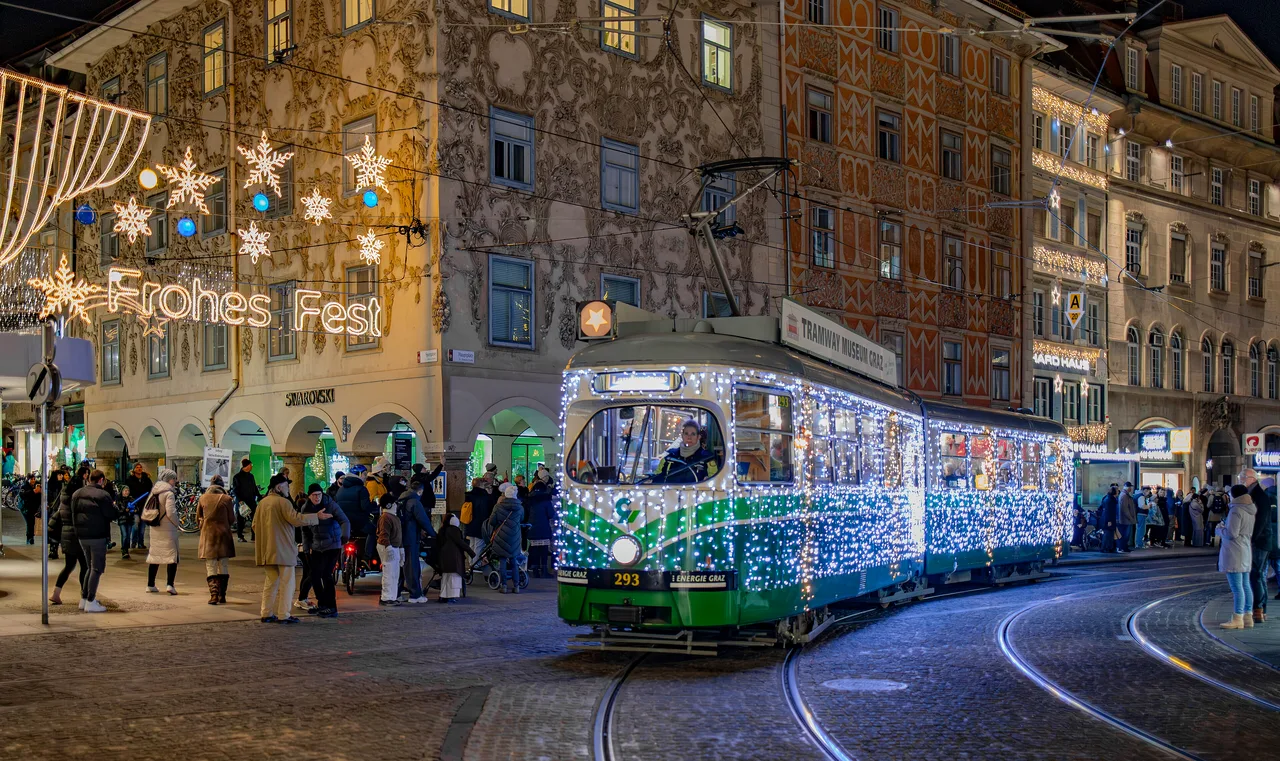
Graz does not have one big Christmas market but a chain of small ones, and that is its charm. The official tourism board lists 16 Advent markets in the city centre, and because they are only a few steps apart you can walk from one to the next in an afternoon. The heart of it all is the Christkindlmarkt in front of the Town Hall on the Hauptplatz, where the huts stand around a Christmas tree lit with more than 25,000 lights and an avenue of lights leads across the square; a children’s carousel turns and the Advent train starts here. A few lanes away, the Christkindlmarkt in the Franciscan quarter is the oldest market in the city, with rural traditions, crafts and products from the Styrian GenussRegionen (regional food areas). On Advent weekends the “Aufsteirern” Christmas market fills the casemates on top of the Schlossberg with Styrian food and crafts, and from the top you look down on the lights of the city. Further markets are held at the Eisernes Tor, on the Mehlplatz, the Glockenspielplatz, the Karmeliterplatz, the Freiheitsplatz, the Südtiroler Platz across the river, the Mariahilferplatz and the Nikolaiplatz in Gries, while the crafts market on the Färberplatz, starting on 27 November, is the place for handmade gifts. Children head to the Kinder-Advent in the Kleine Neutorgasse with its carousel and small Ferris wheel. Graz’s most unusual Christmas sight is the Ice Nativity Scene in the Renaissance courtyard of the Landhaus: around 35 tonnes of ice are carved into life-size figures. The Grazer Winterwelt offers an ice rink of around 3,000 square metres, a decorated vintage tram – the Advent-Bim – runs through the city for a voluntary donation, and the Büro für Weihnachtslieder in the Sporgasse helps visitors find Christmas songs and sheet music.


| Event | Location | 2026 dates | Note |
|---|---|---|---|
| Christkindlmarkt vor dem Rathaus | Hauptplatz, in front of the Town Hall | 20 November–24 December 2026 | Christmas tree with more than 25,000 lights; stalls 11:00–20:00, food and drink until 22:00. |
| Christkindlmarkt im Franziskanerviertel | Franciscan quarter by the Mur | 20 November–24 December 2026 | The oldest market in Graz; Styrian crafts and regional produce. |
| “Aufsteirern” Weihnachtsmarkt | Casemates on the Schlossberg | 20 November–20 December 2026 | Mainly on weekends; Styrian food and crafts above the city. |
| Advent am Eisernen Tor | Eisernes Tor | 20 November–23 December 2026 | Crafts and regional delicacies. |
| Adventmarkt am Glockenspielplatz | Glockenspielplatz | 20 November–24 December 2026 | Under the Glockenspiel with its dancing figures. |
| Adventmarkt am Mehlplatz | Mehlplatz | See the official page | One of the markets open on 24 December. |
| Kunsthandwerksmarkt am Färberplatz | Färberplatz | From 27 November 2026 | Handmade pieces in clay, fabric, metal, glass and wood, with workshops. |
| Kinder-Advent Kleine Neutorgasse | Kleine Neutorgasse | 20 November–24 December 2026 | Carousel and small Ferris wheel for children. |
| Weihnacht am Karmeliterplatz | Karmeliterplatz | 20 November–23 December 2026 | Below the Schlossberg near the Pfauengarten. |
| Gutes aus aller Welt | Freiheitsplatz | 20 November–24 December 2026 | Products from around the world. |
| Christkindlmarkt am Südtiroler Platz | Südtiroler Platz, by the Kunsthaus | 20 November–23 December 2026 | On the right bank of the Mur. |
| Winter Wonderlend | Mariahilferplatz | 20 November–23 December 2026 | In the Lend district. |
| Grieskindlmarkt | Nikolaiplatz, Gries | 20 November–20 December 2026 | Regional and fairly produced gift ideas. |
| Grazer Winterwelt | Ice rink in the city | 13 November 2026–31 January 2027 | Around 3,000 m² of ice and a winter food area. |
| Eiskrippe im Landhaushof | Landhaushof, Herrengasse 16 | 28 November 2026–6 January 2027 | Life-size nativity of about 35 tonnes of ice; courtyard open 8:00–21:00, free. |
What to try
Glühwein and Punsch
Hot spiced wine and fruit punch – alcoholic; most stalls also offer alcohol-free Kinderpunsch or hot apple juice.
Maroni
Roasted sweet chestnuts, sold hot in paper bags at street stands all winter.
Lebkuchen
Spiced honey gingerbread; the Mariazell Lebkuchen from the Styrian pilgrimage town is especially well known.
Kletzenbrot
A dark Christmas loaf full of dried pears, figs, nuts and raisins.
Bratapfel
Baked apple with nuts, raisins and vanilla sauce.
Kernöl specialities
Styrian pumpkin seed oil and roasted pumpkin seeds appear even at the Christmas stalls; a good edible souvenir.
Graz Advent market tips
- In December it gets dark around 16:30; plan the Landeszeughaus, the Cathedral and Schloss Eggenberg for daylight and the markets for the evening.
- Walk the old town in a loop: Hauptplatz → Franciscan quarter → Murinsel → Südtiroler Platz → back via the Landhaushof and the Glockenspielplatz.
- Take the Schlossbergbahn or the lift up the Schlossberg at dusk to see the lights from above; the “Aufsteirern” market is mainly on weekends.
- According to the official page, the Altstadtbim tram is free between the Hauptplatz and Jakominiplatz, and on Advent Saturdays certain lines in zone 101 and the Schlossbergbahn are free too; check the details before you go.
- The Ice Nativity Scene is free and the courtyard is open until 21:00 – it is at its most beautiful after dark.
- Glühwein mugs usually carry a deposit (Pfand); return the mug or keep it as a souvenir.
- Many stalls take cards, but small cash is useful for chestnuts and drinks.
- Hours on 24 December differ; according to the official page the markets at the Hauptplatz, in the Franciscan quarter, Kleine Neutorgasse, Freiheitsplatz, Glockenspielplatz and Mehlplatz open on that day.
Check before you go: Graz Tourismus · Adventmärkte 2026 (official) ↗ · Holding Graz · Advent in Graz (official) ↗
Dates were checked on 28 October 2026 against the official “Adventmärkte” page of Graz Tourismus and the Advent page of Holding Graz. Daily opening hours are given only where the official page publishes them; opening hours of the individual markets differ, so check the official pages again before you visit.
When to Go
Graz has a mild, sunny climate by Austrian standards – the city is often called the “Garden City” and the south of Styria has a touch of the Mediterranean. Spring and autumn are ideal for walking: the Schlossberg is green, the café gardens are open and in autumn the wine roads of southern Styria are at their best. Summer can be hot, but evenings by the Mur are pleasant. From the end of November to Christmas the Advent markets fill the old town. January and February are cold and grey and the city is quiet; fog can sit in the Mur valley.
| Month | City sightseeing | Advent markets | Day trips and outdoors | Crowds |
|---|---|---|---|---|
| January | Difficult | None | Difficult | Quiet |
| February | Difficult | None | Difficult | Quiet |
| March | Good | None | Good | Quiet |
| April | Very good | None | Very good | Moderate |
| May | Very good | None | Very good | Moderate |
| June | Very good | None | Very good | Moderate |
| July | Very good | None | Very good | Moderate |
| August | Very good | None | Very good | Moderate |
| September | Very good | None | Very good | Moderate |
| October | Very good | None | Very good | Moderate |
| November | Good | Market season | Good | Moderate |
| December | Good | Market season | Difficult | Busy |
- Winters are cold, usually around or just below freezing; snow is possible but not guaranteed in the city.
- In December the sun rises around 7:30 and sets around 16:15; plan sightseeing for the daylight hours.
- Most Advent markets run from 20 November to 23 or 24 December 2026; the Ice Nativity Scene stays until 6 January 2027.
- Autumn (September–October) is the season of the wine roads and the pumpkin harvest in southern Styria.
- Many museums of the Universalmuseum Joanneum close on Mondays and have winter hours; check the official websites.
- On Advent weekends hotels in the centre fill quickly; book early.
Visa and Entry (Turkish citizens)
Turkish citizens holding an ordinary (burgundy) passport need a Schengen visa for tourist travel to Austria. Different rules apply to special, service and diplomatic passports; check the current situation with the Turkish Ministry of Foreign Affairs.
Apply to the mission of your main destination. If Austria is your main destination, information on the application is published by the Austrian Consulate General in Istanbul on the BMEIA website (bmeia.gv.at); check there which office is responsible for your place of residence and how appointments are made.
If you combine Graz with Ljubljana (Slovenia) or Zagreb (Croatia), apply to the country where you will stay longest; if stays are equal, the country of first entry applies. Checks may take place at internal borders; carry your passport.
Under the EU Entry/Exit System (EES), being phased in, your biometric data (facial image and fingerprints) may be taken on first entry; allow extra time at the border.
Visa fees, appointment waiting times and required documents can change; this guide gives no fees. Use the current list on the official sites before applying.
Travel medical insurance and accommodation and return details are part of the application; see the official sources for details.
Check before you go: T.C. Dışişleri Bakanlığı · Türk vatandaşlarının tabi olduğu vize uygulamaları ↗ · bmeia.gv.at · GK Istanbul ↗ · EES · europa.eu ↗ · Rota Atlası visa guide (TR)
Travel medical insurance
Check the official visa and entry sources above first: they state whether travel medical insurance is required and the minimum cover. Compare any policy’s cover amount, validity dates and countries covered with the official requirement.
Rota Atlası does not currently offer an insurance partnership; there are no paid links in this section. Last updated: 1 November 2026
Getting to Graz
- By air: Graz Airport (GRZ) lies a few kilometres south of the city; trains of the S-Bahn Steiermark and buses link it with Graz Hauptbahnhof and the centre. Vienna Airport (VIE) is the main long-haul gateway. Check current flights from Türkiye only on airline and airport websites.
- By train from Vienna: ÖBB trains link Wien Hauptbahnhof with Graz Hauptbahnhof; direct trains also run from Vienna Airport. Check timetables and fares on oebb.at.
- By train from the south: the Koralm Railway links Graz with Klagenfurt; there are also connections towards Maribor and Ljubljana. Check current connections on oebb.at.
- From the station to the old town: Graz Hauptbahnhof is west of the Mur; trams take you to the Hauptplatz in a few minutes.
Getting Around

On foot
The old town on the left bank of the Mur is compact; most sights and all Advent markets are within walking distance.
Tram
Holding Graz Linien runs a dense tram network; the Hauptplatz and Jakominiplatz are the main hubs. Check tickets and the free Altstadtbim section on holding-graz.at.
Schlossbergbahn and lift
A historic funicular from the Kaiser-Franz-Josef-Kai and a glass lift inside the rock climb the Schlossberg; you can also walk up the steps.
Bike
Graz is a cycling city with many bike lanes; cobblestones in the old town make walking easier in crowds.
Bus to Eggenberg
Schloss Eggenberg is in the west of the city and easy to reach by tram from the centre.
Day trips
Mariazell, Riegersburg, Stübing and the wine roads of southern Styria are reachable by train, bus or car; check steiermark.com.
Things to See
Graz’s historic centre lies on the left (east) bank of the Mur between the Schlossberg in the north and the Jakominiplatz in the south: the Hauptplatz, the Herrengasse with the Landhaus and the armoury, the Cathedral quarter with the Burg and the Mausoleum, and the Stadtpark on the old ramparts. Across the river, the Lend and Gries districts with the Kunsthaus and the Mariahilferkirche are younger and more alternative. Schloss Eggenberg lies in the west of the city.
Symbol of the city
The Schlossberg and the Clock Tower (Uhrturm)

The Schlossberg, a dolomite hill about 120 metres above the old town, carried one of the strongest fortresses of the Habsburg lands for centuries. In 1809, after Napoleon’s victory, it had to be demolished under the peace terms; the citizens of Graz paid a ransom to save the Clock Tower and the bell tower (Glockenturm) with its bell known as the “Liesl”. The Clock Tower has stood here in its present form since the 16th century and has a curiosity: the large hand shows the hours and the small hand the minutes, because originally there was only an hour hand that had to be visible from far away. Today the hill is a park with paths, viewpoints, the Kasematten open-air stage, the old Türkenbrunnen well and the Chinese pavilion. UNESCO listing ↗
Don’t miss
- The Clock Tower and its reversed hands
- The view over the red roofs of the old town
- The bell tower with the “Liesl”
- The Kasematten and the “Aufsteirern” market in Advent
Tips
- Walk up the steps from the Schlossbergplatz and take the funicular down, or the other way round.
- The paths are slippery in frost; wear good shoes.
- Sunset and the first lights of Advent are the best time for photos.

Up the hill
Schlossbergbahn, Schlossberg lift and the city panorama

The Schlossbergbahn, a funicular opened in 1894, climbs from the Kaiser-Franz-Josef-Kai to the top of the Schlossberg in a few minutes. On the other side of the hill a glass lift runs inside the rock from the Schlossbergplatz; next to it, the steps of the Kriegssteig zigzag up the cliff. At the top, cafés and terraces look out over the whole of Graz: the roofs of the old town, the Mur and its bridges, the Kunsthaus and, on clear days, the hills of central Styria. Inside the hill, tunnels dug during the Second World War now house a shelter-turned-event space and the Schlossbergrutsche, a long underground slide.
Don’t miss
- A ride on the historic funicular
- The panorama from the terraces at the top
- The glass lift inside the rock
- The Kriegssteig steps cut into the cliff
Tips
- According to the official Advent page, the Schlossbergbahn is free on Advent Saturdays; check before you go.
- Tickets for public transport in zone 101 are also valid on the funicular; see holding-graz.at.
- The panorama is at its best on clear, cold winter days.

Heart of the old town
Hauptplatz, Town Hall and Herrengasse

The Hauptplatz has been the market square of Graz since the Middle Ages. The Town Hall that closes its southern side was rebuilt in the late 19th century in a grand historicist style; in front of it stands the fountain dedicated to Archduke John, the much-loved Habsburg who founded the Joanneum museum, with figures representing the four main rivers of Styria at that time. Around the square, merchants’ houses with painted and stuccoed façades line the way to the Sporgasse and the Herrengasse. The Herrengasse, the main shopping street, leads south to the Eisernes Tor; its showpiece is the Gemaltes Haus (Painted House), whose façade is covered with Baroque frescoes. In Advent the Christkindlmarkt in front of the Town Hall is the centre of the city’s Christmas.
Don’t miss
- The Town Hall and the Archduke John fountain
- The Gemaltes Haus on the Herrengasse
- The Christkindlmarkt and the big Christmas tree
- The Eisernes Tor and its Advent market
Tips
- The Hauptplatz is the main tram hub; the Altstadtbim section to the Jakominiplatz is free according to Holding Graz.
- Look up: many façades have stucco, frescoes and old shop signs.
- In Advent the square is busiest in the early evening and on weekends.
Renaissance from northern Italy
The Landhaus and the Landhaushof

The Landhaus on the Herrengasse is the seat of the Styrian state parliament and one of the finest Renaissance buildings north of the Alps. It was built in the 16th century by the architect Domenico dell’Allio from northern Italy, and its courtyard is surrounded by three storeys of arcades that feel almost Italian. A Renaissance well with a bronze canopy stands in the courtyard. In summer the Landhaushof is a venue for concerts and theatre; in Advent it becomes the home of the Ice Nativity Scene, a life-size nativity carved from around 35 tonnes of ice by artists every year. UNESCO listing ↗
Don’t miss
- The three-storey arcaded courtyard
- The Renaissance well with its bronze canopy
- The Ice Nativity Scene in Advent
- The façade of the Landhaus on the Herrengasse
Tips
- The courtyard is free; in Advent it is open daily from 8:00 to 21:00 according to the official Advent page.
- The tourist information of Graz Tourismus is in the same building at Herrengasse 16.
- Combine with the Landeszeughaus next door.

Museum
The Landeszeughaus (Styrian Armoury)

Next to the Landhaus stands the Landeszeughaus, the largest historic armoury in the world that has kept its original stock. It was built in the 1640s when Styria was a frontier province against the Ottoman Empire, and the estates of Styria stored weapons here to equip thousands of soldiers at short notice. On four floors, rows of suits of armour, helmets, halberds, swords, muskets and pistols – some 32,000 objects according to the Universalmuseum Joanneum – are still displayed much as they were stored centuries ago. It is an impressive and somewhat sobering place that explains the history of the Ottoman wars from the Habsburg side.
Don’t miss
- The armour halls on four floors
- The rows of muskets and pistols
- The building’s Renaissance portal on the Herrengasse
- The explanations on the wars of the 16th and 17th centuries
Tips
- Check opening hours, winter closing and guided tours on museum-joanneum.at.
- Allow one to two hours; the halls are narrow and can be busy.
- A Joanneum ticket may cover several museums; check current offers.
Habsburg Graz
Cathedral, Mausoleum of Ferdinand II and the Burg

The Cathedral quarter at the eastern edge of the old town was the Habsburg “Stadtkrone” (city crown). Graz Cathedral was built in the 15th century as a court church for Emperor Frederick III, whose motto A.E.I.O.U. can be found on the building; on its outer wall the fresco known as the Gottesplagenbild (Divine Plagues) of 1485 shows the locusts, the plague and the Ottoman raids that struck Graz in 1480. Next door, the Mausoleum of Emperor Ferdinand II, begun in the early 17th century by Giovanni Pietro de Pomis, with St. Catherine’s Church and its domes, is one of the main works of Mannerism in Austria. Behind it, the Grazer Burg, today the seat of the Styrian government, keeps a Gothic double spiral staircase from 1499 whose two flights separate and meet again – a masterpiece of stonemasonry. UNESCO listing ↗
Don’t miss
- The Gottesplagenbild fresco on the Cathedral wall
- The Baroque interior of the Cathedral
- The Mausoleum of Ferdinand II
- The double spiral staircase in the Burg
Tips
- The double spiral staircase is in a courtyard of the Burg and can usually be visited free of charge during the day.
- Check Mausoleum opening hours locally; they are limited in winter.
- The Burggarten and the Stadtpark are right behind the Burg.


Green Graz
Stadtpark, Burggarten and the Graz Opera

When the city walls were demolished in the 19th century, the citizens of Graz turned the former glacis into the Stadtpark, a landscape park between the old town and the university district. Avenues of old trees, the Emperor Franz Joseph fountain and small pavilions make it the city’s favourite place for a walk; the Burggarten next to the Burg is quieter, with a glasshouse. On the southern edge of the park, the Graz Opera, built in 1899 by the Viennese theatre architects Fellner & Helmer, is Austria’s second-largest opera house and has a richly decorated neo-Baroque interior. Advent and New Year are a season of concerts, operettas and ballet.
Don’t miss
- A walk along the avenues of the Stadtpark
- The Burggarten and its glasshouse
- A performance at the Graz Opera
- The Light Sword (Lichtschwert) sculpture in front of the Opera
Tips
- Check the programme and tickets on the official Oper Graz website.
- The Stadtpark is a calm alternative when the markets are crowded.
- From the Stadtpark it is a short walk up to the Schlossberg via the Paulustor.

Old lanes
Sporgasse, Glockenspielplatz and the Mehlplatz

The Sporgasse, one of the oldest streets in Graz, climbs from the Hauptplatz along the foot of the Schlossberg; it was the main road to the north in the Middle Ages and is still lined with small shops, old pharmacies and Renaissance courtyards. South of it, the tangle of lanes known as the “Bermuda Triangle” – around the Färberplatz, the Mehlplatz and the Glockenspielplatz – is the city’s nightlife area. On the Glockenspielplatz, three times a day, the windows of a house open and a pair of figures in traditional costume dance to the chimes of the Glockenspiel, installed in the early 20th century. In Advent several markets are hidden in these squares, and the Büro für Weihnachtslieder in the Sporgasse helps visitors with Christmas songs.
Don’t miss
- The Sporgasse and its courtyards
- The dancing figures of the Glockenspiel
- The Mehlplatz and the Färberplatz
- The crafts market on the Färberplatz in Advent
Tips
- The Glockenspiel plays at set times; check them locally or with the tourist information.
- The area is lively at night; keep an eye on your belongings.
- The Sporgasse is steep and cobbled.
The Friendly Alien
Kunsthaus Graz and the Lend district

On the right bank of the Mur, the Kunsthaus Graz looks like a giant blue bubble that has landed among the old roofs. It was designed by the British architects Peter Cook and Colin Fournier for Graz’s year as European Capital of Culture in 2003, and the people of Graz quickly called it the “Friendly Alien”. Its skin of acrylic glass panels has nozzle-like openings facing the Schlossberg, and at night the BIX media façade turns it into a screen of light. The Kunsthaus belongs to the Universalmuseum Joanneum and shows contemporary art in changing exhibitions. Around it, the Lend district with the Mariahilferstraße and the Lendplatz has small shops, studios and cafés.
Don’t miss
- The “Friendly Alien” from the Schlossberg and from the Mur
- The changing contemporary art exhibitions
- The Needle viewing platform with a view of the old town
- A walk through Lend and the Lendplatz
Tips
- Check exhibitions and opening days on museum-joanneum.at.
- The Südtiroler Platz Advent market is right in front of the building.
- The Murinsel is a few steps away.
Across the river
Murinsel, Mariahilferkirche and the Franciscan quarter

The Murinsel, also built for 2003, is an artificial island of steel and glass anchored in the middle of the Mur and reached by footbridges from both banks. Designed by the New York artist Vito Acconci, it has the shape of a half-open shell and contains a café and a small amphitheatre. A short walk upstream, the twin towers of the Mariahilferkirche, a pilgrimage church and Minorite monastery, rise above the right bank. Across the Hauptbrücke on the old-town side, the Franciscan Church and the lanes around it form the Franciscan quarter, with small food shops, a market atmosphere and, in Advent, the oldest Christmas market in Graz.
Don’t miss
- Crossing the Murinsel
- The Mariahilferkirche on the Mariahilferplatz
- The Franciscan Church and its quarter
- The view of the Schlossberg from the Hauptbrücke
Tips
- The Mur path along the river is pleasant for walking in daylight.
- The Franciscan quarter has many small food shops; ideal for a snack.
- In Advent combine the Franciscan quarter market and the Winter Wonderlend on the Mariahilferplatz.


UNESCO Baroque palace
Schloss Eggenberg

Schloss Eggenberg in the west of Graz is the most important Baroque palace complex in Styria. It was built from 1625 for Hans Ulrich von Eggenberg, governor of Inner Austria and adviser to Emperor Ferdinand II, and its architecture is a programme based on the calendar and the cosmos, with numbers of towers, rooms and windows symbolising the year. The 24 state rooms of the piano nobile, with the Planetary Hall, have kept their Baroque decoration. The palace houses several collections of the Universalmuseum Joanneum, including the Old Gallery, the coin cabinet and the archaeology museum, and its landscape park is home to free-roaming peacocks. UNESCO added it to the World Heritage site of Graz in 2010. UNESCO listing ↗
Don’t miss
- The state rooms and the Planetary Hall
- The Old Gallery and the coin cabinet
- The peacocks in the palace park
- The Planetengarten and the historic park
Tips
- The state rooms can only be seen on guided tours and are often closed in winter; check museum-joanneum.at.
- The park is open all year; peacocks are easiest to spot in the morning.
- Take the tram from the centre; the walk from the stop is short.

Styria
Day trips: Mariazell and the Riegersburg

Mariazell, in the mountains of northern Styria, is the most important pilgrimage site in Austria and central Europe: its basilica with three towers and the Gnadenkapelle has drawn pilgrims for more than 800 years, and in Advent the small town holds a well-known Advent market; Mariazell Lebkuchen is a local speciality. To the south-east of Graz, the Riegersburg rises on a rock of volcanic basalt above the hills of the Styrian Volcano Land; the castle was never taken and is now a museum with exhibitions on its history and on witch trials. Closer to the city, the Austrian Open-Air Museum at Stübing shows farmhouses from all over Austria and also has an Advent market according to Graz Tourismus.
Don’t miss
- The basilica and Gnadenkapelle of Mariazell
- Mariazell Lebkuchen
- The Riegersburg on its volcanic rock
- The Austrian Open-Air Museum in Stübing
Tips
- Public transport to Mariazell takes time; check connections and seasonal opening hours on steiermark.com.
- The Riegersburg has seasonal opening times and is often closed in winter; check before going.
- A car makes combining several places in a day much easier.

1–3 Day Itineraries, Christmas Day + 7-Day Austria and Styria Route
The itineraries keep walking short and take the short winter days into account. One day covers the old town and the Schlossberg, two days add the museums and the right bank of the Mur, and three days add Schloss Eggenberg or a trip into Styria. The 7-day route links Graz with Vienna and Salzburg. Check museum and attraction hours on official websites in advance.
Day 1: Old town and Schlossberg
- Start at the Hauptplatz and the Town Hall in the morning.
- Walk along the Herrengasse to the Landhaus courtyard and visit the Landeszeughaus.
- See the Cathedral, the Mausoleum and the double spiral staircase in the Burg.
- In the afternoon climb the Schlossberg by the steps or the lift and see the Clock Tower.
- Take the funicular down and spend the evening in the lanes around the Glockenspielplatz.
Day 2: Across the Mur
- Cross the Hauptbrücke and visit the Kunsthaus Graz.
- Walk over the Murinsel and along the river to the Mariahilferkirche.
- Explore the Lend district and the Lendplatz.
- Return to the Franciscan quarter for a late lunch.
- In the evening walk through the Stadtpark to the Opera for a performance.
Day 3: Eggenberg or Styria
- Take the tram to Schloss Eggenberg and see the park and the collections (state rooms on guided tours only).
- Alternatively, spend the day in Mariazell or at the Riegersburg (check seasonal opening).
- Or visit the Austrian Open-Air Museum at Stübing.
- Return to Graz in the late afternoon.
- End with dinner and a last look at the lit Clock Tower.
Advent day (20 November–24 December 2026)
- In daylight visit the Landeszeughaus and the Cathedral.
- Walk to the Franciscan quarter market, the oldest in Graz.
- At dusk see the Ice Nativity Scene in the Landhaushof (from 28 November).
- Go up the Schlossberg to see the lights and, on weekends, visit the “Aufsteirern” market in the casemates.
- Finish at the Christkindlmarkt in front of the Town Hall under the big Christmas tree.
7 days: Austria
- Days 1–3: Graz – old town, Schlossberg, museums and Eggenberg.
- Day 4: Day trip into Styria – Mariazell or the Volcano Land.
- Day 5: Train to Vienna – the Christmas market at the Rathaus and the Ring.
- Day 6: Vienna – Schönbrunn and the Spittelberg market.
- Day 7: Train to Salzburg or depart from Vienna Airport.
Graz and Styrian Food
Styria calls itself the “green heart of Austria”, and Graz styles itself the GenussHauptstadt (capital of good food). Its cuisine is rooted in the farms and vineyards of the region. Below are regional specialities, not restaurant recommendations.

Steirisches Kürbiskernöl
Dark green pumpkin seed oil with a protected geographical indication; on salads, soups and even vanilla ice cream.
Steirisches Backhendl
Breaded fried chicken, a Styrian classic, often served with potato and lamb’s lettuce salad with pumpkin seed oil.
Käferbohnensalat
Salad of large runner beans with onions and pumpkin seed oil.
Steirisches Wurzelfleisch
Boiled pork with root vegetables and horseradish; contains pork.
Sterz
A simple dish of buckwheat or maize flour, once the food of farmers.
Schilcher
A pink, tart wine from western Styria; there are alcohol-free fruit juices too.
Maroni and Bratapfel
Roasted chestnuts and baked apples, the sweet smells of winter.
Krapfen and strudel
Doughnuts, apple strudel and curd strudel from Austrian cafés.
- Many traditional dishes contain pork or lard; ask about ingredients.
- Pumpkin seed oil stains – handle bottles carefully in your luggage.
- Tap water is excellent; ask for “Leitungswasser”.
- Service is included in prices; rounding up by about 5–10 percent is customary in restaurants.
Culture and Etiquette

- “Grüß Gott” or “Servus” are typical Austrian greetings; “Guten Tag” is fine too.
- Use titles and surnames in formal situations until offered first names.
- Don’t walk around churches during services and avoid flash photography.
- Queues are respected at bakeries, stalls and tram stops.
- Cash is still used for small amounts at stalls, although cards are widespread.
- Cyclists use marked bike lanes; don’t walk in them.
- Sunday is a day of rest; most shops are closed.
- Coffee-house culture is unhurried; you can sit for a long time with one coffee.
- Punctuality is expected for guided tours and appointments.
- Ask before photographing people, especially at markets.
Safety and Health
- Graz is generally safe; watch your valuables in Advent crowds and on trams.
- Cobblestones and steps on the Schlossberg are slippery when wet or icy; wear non-slip shoes.
- Look out for trams and cyclists in the old town.
- Winter fog and frost can make roads slippery if you drive into Styria.
- In an emergency call 112; police 133, ambulance 144.
- Make sure your travel medical insurance covers the Schengen area.
- Pharmacies (Apotheke) post the address of the emergency pharmacy on duty.
What Your Budget Depends On
This guide does not give prices; prices change with season and year. Your budget depends on these factors:
Dates
Advent weekends and big events increase hotel demand.
Where you stay
The old town is the most convenient; Lend, Gries and the area around the station are alternatives.
Transport
Trams and buses are inexpensive; the Altstadtbim section is free according to Holding Graz.
Museums
The Joanneum museums charge separately; some tickets cover several museums.
Food and drink
Market snacks and bakeries are budget options; sit-down meals vary widely.
Day trips
Trips into Styria or to Vienna add rail or car costs.
Free experiences
The Advent markets (free entry), the Ice Nativity Scene, the Schlossberg on foot, the Landhaus courtyard and the Murinsel cost nothing.
Practical Information
- Money: the euro is used; cards are widely accepted, but carry some cash.
- Language: German; English is understood in tourism.
- Plugs: 230 V, European type C/F.
- Time: two hours behind Türkiye in winter (CET, UTC+1).
- Opening hours: many museums close on Mondays; check before you go.
- Shops: closed on Sundays; Advent markets are open.
- Holidays: 8 December is a public holiday in Austria; hours change on 24–26 and 31 December and 1 and 6 January.
- Weather: in December temperatures hover around freezing.
- Daylight: in December the sun sets around 16:15.
- Emergency: 112; police 133, ambulance 144.
Frequently Asked Questions
When are the Graz Advent markets in 2026?
According to Graz Tourismus, 16 Advent markets open in the city centre between 20 November and 24 December 2026; dates differ by market.
What are the opening hours of the Christkindlmarkt on the Hauptplatz?
According to the official page, sales stalls are regularly open from 11:00 to 20:00 and food and drink stalls until 22:00.
When can I see the Ice Nativity Scene?
From 28 November 2026 to 6 January 2027 in the Landhaushof, Herrengasse 16; the courtyard is open daily from 8:00 to 21:00 and entry is free.
Is entry to the markets free?
Yes; food, drinks and rides are paid.
Do Turkish citizens need a visa?
Ordinary passport holders need a Schengen visa. If Austria is the main destination, see the Austrian Consulate General Istanbul on bmeia.gv.at.
How do I get from Vienna to Graz?
By ÖBB train from Vienna Hauptbahnhof or Vienna Airport; check oebb.at.
How many days are enough?
One day for the old town and Schlossberg, two for the museums and the Mur, three to add Eggenberg or a day trip.
Is public transport free in Advent?
The Altstadtbim section is free; on Advent Saturdays certain lines and the Schlossbergbahn are free according to the official page.
Can I visit the Eggenberg state rooms in winter?
The state rooms are shown on guided tours and have seasonal opening; check museum-joanneum.at.
What should I bring home from Graz?
Styrian pumpkin seed oil, pumpkin seeds, Mariazell Lebkuchen or crafts from the Advent markets.
Where to stay
Stay close to the areas where you will spend most time. The areas below are covered in detail in this guide; check public transport links in the getting-around section.
- Symbol of the cityThe Schlossberg and the Clock Tower (Uhrturm)
- Up the hillSchlossbergbahn, Schlossberg lift and the city panorama
- Heart of the old townHauptplatz, Town Hall and Herrengasse
- Renaissance from northern ItalyThe Landhaus and the Landhaushof
- MuseumThe Landeszeughaus (Styrian Armoury)
- Habsburg GrazCathedral, Mausoleum of Ferdinand II and the Burg
- Green GrazStadtpark, Burggarten and the Graz Opera
- Old lanesSporgasse, Glockenspielplatz and the Mehlplatz
- The Friendly AlienKunsthaus Graz and the Lend district
- Across the riverMurinsel, Mariahilferkirche and the Franciscan quarter
- UNESCO Baroque palaceSchloss Eggenberg
Search hotels in these areas (Hotellook) ↗ (affiliate link)Search on Booking.com ↗
Affiliate disclosure: Hotellook, Aviasales, Klook, Airalo, Tiqets and DiscoverCars links are affiliate links; Rota Atlası may earn a commission on bookings made through them, at no extra cost to you. Official and in-guide links are not paid. Last updated: 1 November 2026 · Privacy and affiliates
Transport and connectivity
- Airport transferOptions from the airport to the city are in this guide’s getting there section.
- Mobile data (eSIM)Airalo eSIM ↗ (affiliate link)
- TrainsOfficial rail website ↗
- Car hireYou rarely need a car within the city; see getting around first. Compare car hire on DiscoverCars ↗ (affiliate link)
Affiliate disclosure: Hotellook, Aviasales, Klook, Airalo, Tiqets and DiscoverCars links are affiliate links; Rota Atlası may earn a commission on bookings made through them, at no extra cost to you. Official and in-guide links are not paid. Last updated: 1 November 2026 · Privacy and affiliates
Search flights (affiliate link)
Search flights from any airport in any country. Results open on Aviasales in a new tab, where you book.
This form is an affiliate link: Rota Atlası may earn a commission on bookings made via Aviasales (Travelpayouts), at no extra cost to you. Check price, baggage and terms on the booking site. Airport data: OurAirports (public domain).
Flights, hotels and tours
Find tours and tickets
- Christkindlmarkt am Hauptplatz
GetYourGuide ↗ · Klook ↗ (affiliate link) - Franziskanerviertel
GetYourGuide ↗ · Klook ↗ (affiliate link) - Glockenspielplatz
GetYourGuide ↗ · Klook ↗ (affiliate link) - Mehlplatz and Joanneumsviertel
GetYourGuide ↗ · Klook ↗ (affiliate link)
Hotellook, Aviasales, Klook, Airalo and Tiqets links in this box are affiliate links (Travelpayouts): Rota Atlası may earn a commission on bookings made through them, at no extra cost to you. GetYourGuide links currently carry no affiliate code. Check prices and terms with the provider. Last updated: 1 November 2026 · Privacy and affiliates
Sources
- T.C. Dışişleri Bakanlığı · Türk vatandaşlarının tabi olduğu vize uygulamaları ↗
- BMEIA · Österreichisches Generalkonsulat Istanbul · Einreise und Aufenthalt (Visum) ↗
- European Union · Entry/Exit System (EES) ↗
- Graz Tourismus · graztourismus.at (official) ↗
- Stadt Graz · graz.at (official) ↗
- Holding Graz · Advent in Graz (official) ↗
- Holding Graz Linien · öffentlicher Verkehr (official) ↗
- Universalmuseum Joanneum (official) ↗
- Steiermark Tourismus · steiermark.com (official) ↗
- Flughafen Graz (official) ↗
- ÖBB · Österreichische Bundesbahnen ↗
- GOV.UK · Foreign travel advice · Austria ↗
- UNESCO World Heritage Centre · City of Graz – Historic Centre and Schloss Eggenberg ↗
- Graz Tourismus · Adventmärkte 2026 (official) ↗
- Holding Graz · Advent in Graz (official) ↗
This page is for information only. Dates, hours, entry rules and transport information can change; check the official sources above before travelling. No prices, flights, hotels or restaurants have been invented in this guide.
Photo credits
The photos on this page come from Wikimedia Commons and are used under the stated authors and licences (CC BY, CC BY-SA, CC0 or public domain). Full list of sources
- The Hauptplatz and Town Hall in Graz in the evening light — Babure · CC BY-SA 3.0 · Wikimedia Commons
- The ice nativity scene (Eiskrippe) in the Landhaus courtyard in Graz — Blumele · CC0 · Wikimedia Commons
- Figures carved from ice at the Graz Eiskrippe — Clemens Stockner · CC BY-SA 3.0 · Wikimedia Commons
- The Graz Eiskrippe lit in colour in the evening — Clemens Stockner · CC BY-SA 3.0 · Wikimedia Commons
- Ice sculptures and Renaissance arcades in the Graz Landhaus courtyard — Nxr-at · CC BY-SA 4.0 · Wikimedia Commons
- Snowy roofs of Graz seen from the Schlossberg on a winter night — Marion Schneider & Christoph Aistleitner · Public domain · Wikimedia Commons
- The Clock Tower (Uhrturm), symbol of Graz, on the Schlossberg — Manfred Werner - Tsui · CC BY-SA 3.0 · Wikimedia Commons
- A close view of the Clock Tower’s large dial and wooden gallery — Anna Saini · CC BY-SA 4.0 · Wikimedia Commons
- The green Schlossberg hill and Clock Tower above red-tiled roofs — Ralf Roletschek · CC BY-SA 3.0 at · Wikimedia Commons
- The tiled roofs of the Graz Innere Stadt seen from the Schlossberg — Ewald Ehtreiber · CC BY-SA 4.0 · Wikimedia Commons
- The Hauptplatz and the neo-Renaissance Town Hall in Graz — Palickap · CC BY-SA 4.0 · Wikimedia Commons
- The Hauptplatz and Town Hall façade in Graz by day — Leonhard Lenz · CC0 · Wikimedia Commons
- Rows of historic armour in the Landeszeughaus armoury — Tudoi61 · CC BY-SA 4.0 · Wikimedia Commons
- The Gothic façade of Graz Cathedral — Pedro J Pacheco · CC BY-SA 3.0 at · Wikimedia Commons
- The central nave and Baroque altar of Graz Cathedral — Isiwal · CC BY-SA 4.0 · Wikimedia Commons
- The Mausoleum of Emperor Ferdinand II and the domes of St. Catherine’s — gugganij · CC BY-SA 3.0 · Wikimedia Commons
- The Gothic double spiral staircase in the Grazer Burg — PicturePrince · CC BY-SA 4.0 · Wikimedia Commons
- The biomorphic Kunsthaus Graz building by the Mur — Isiwal · CC BY-SA 4.0 · Wikimedia Commons
- The footbridge leading to the Murinsel on the River Mur — Isiwal · CC BY-SA 4.0 · Wikimedia Commons
- The Murinsel, a steel-and-glass structure floating on the Mur — Savh (mobile) · CC0 · Wikimedia Commons
- Schloss Eggenberg palace and its grounds — Zairon · CC BY-SA 3.0 · Wikimedia Commons
- A peacock in the park of Schloss Eggenberg — Florian Glawogger · CC BY-SA 2.0 · Wikimedia Commons
- A view from the Eisernes Tor into the Herrengasse shopping street — Isiwal · CC BY-SA 4.0 · Wikimedia Commons
- The Renaissance façade of the Landhaus on Herrengasse — Matthias Süßen · CC BY-SA 4.0 · Wikimedia Commons
- The three-storey Renaissance arcaded courtyard of the Landhaushof — Uoaei1 · CC BY-SA 3.0 at · Wikimedia Commons
- The narrow, sloping Sporgasse below the Schlossberg — Leonhard Lenz · CC0 · Wikimedia Commons
- The Mariahilferkirche on the west bank of the Mur — Manfred Werner - Tsui · CC BY-SA 3.0 · Wikimedia Commons
- The Hauptbrücke and the Franciscan church by the Mur — Manfred Werner - Tsui · CC BY-SA 3.0 · Wikimedia Commons
- The tree-lined Montclair-Allee in the Graz Stadtpark — Funke · CC BY-SA 3.0 at · Wikimedia Commons
- The façade of the Graz Opera House — Pedro J Pacheco · CC BY-SA 3.0 at · Wikimedia Commons
- The Schlossbergbahn funicular climbing the Schlossberg — Oleksandr Dede · CC BY-SA 4.0 · Wikimedia Commons
- A modern Graz tram on the Hauptplatz — Q-Dot Images · CC0 · Wikimedia Commons
- Pumpkin soup with dark green Styrian pumpkin seed oil — Wald1siedel · CC BY-SA 4.0 · Wikimedia Commons
- The historic Glockenspiel house on the Glockenspielplatz — TheRunnerUp · CC BY-SA 4.0 · Wikimedia Commons
- The three-towered façade of Mariazell Basilica — Uoaei1 · CC BY-SA 4.0 · Wikimedia Commons
- Riegersburg castle on its volcanic rock — C.Stadler/Bwag · CC BY-SA 4.0 · Wikimedia Commons
- A panorama of Graz from the Schlossberg — Manfred Werner - Tsui · CC BY-SA 3.0 · Wikimedia Commons
Vienna → · Salzburg → · Zagreb → · Budapest → · Innsbruck → · Christmas markets