

Esslingen am Neckar is a town of about 95,000 people in Baden-Württemberg, on the Neckar river some 15 kilometres east of Stuttgart. A wealthy Free Imperial City in the Middle Ages, Esslingen grew rich on wine and trade. Its old town came through the Second World War largely undamaged, so today, with more than two hundred half-timbered houses, Gothic churches, medieval bridges and towers, it is one of the best-preserved historic town centres in southern Germany. The castle walls rising through the vineyards above the town, “Little Venice” wrapped in arms of the Neckar and the astronomical clock on the 15th-century Old Town Hall are Esslingen’s emblems. In winter, though, the town is famous above all for its Christmas market combined with a medieval market: craftspeople in historic costume, knights, jugglers and food cooked over open fires turn the old town squares into a medieval stage for four weeks. This guide brings together the market, the old town, the castle and vineyards, Swabian food and practical tips for trips to Stuttgart and Ludwigsburg, based on official sources.
Content update: 29 October 2026 · Christmas dates checked against the official esslingen-info.com page
Esslingen at a Glance
- Country
- Germany · Baden-Württemberg (Stuttgart region)
- Population
- About 95,000
- Language
- German (Swabian dialect); English widely understood
- Currency
- Euro (EUR); cards widely accepted, carry some cash for stalls
- Time zone
- Central European Time (CET, UTC+1)
- Highlights
- Medieval and Christmas Market, half-timbered houses, vineyards in town
- Must-sees
- Old Town Hall, St. Dionys, Frauenkirche, Hafenmarkt, Castle, Innere Brücke, Little Venice
- Nearby
- Stuttgart, Ludwigsburg, Neckar valley
- Christmas
- Medieval and Christmas Market 24 November–22 December 2026
- Airport
- Stuttgart Airport (STR), south-west of the town
- Electricity
- 230 V, type C/F sockets
- Emergency
- 112 (ambulance, fire), 110 (police)
Esslingen in Pictures
The old town on the Neckar with its churches, castle and half-timbered roofs, the Old Town Hall gable with its astronomical clock and the Innere Brücke over the canal: Esslingen in three frames.


Esslingen Medieval and Christmas Market 2026
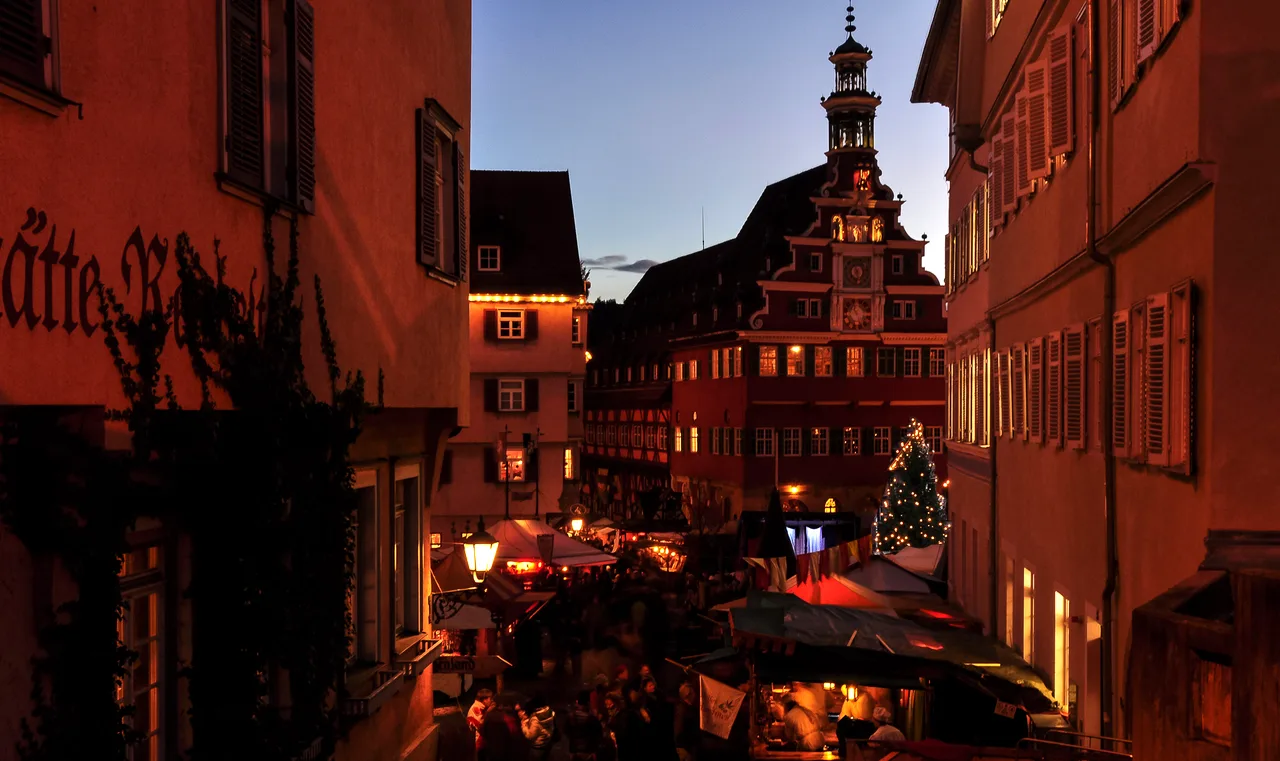
Esslingen’s Christmas market is a pairing unique in Germany: a classic Christmas market on the Marktplatz joined by a medieval market spreading across Rathausplatz and Hafenmarkt. In the medieval section, craftspeople in historic costume demonstrate old trades such as blacksmithing, glassblowing, candle making and rope making; jugglers, fire shows, musicians and knights perform on stages. Stalls with campfire bread, roasted meats and mead create a smoky medieval atmosphere. The Christmas section on the Marktplatz, in front of the towers of St. Dionys and the half-timbered Kielmeyer house, offers a more classic Advent mood with a wooden pyramid, lights and handmade decorations. The official page announces about 180 stalls and some 500 programme items; there are stages on Rathausplatz and Hafenmarkt, the children’s “Zwergenland” on Kleiner Markt and a free fairy-tale tent. On Advent weekends a separate Advent market with more than thirty craftspeople is held on Ritterstraße. Entry to the market is free.


| Event | Location | 2026 dates | Note |
|---|---|---|---|
| Medieval market | Rathausplatz and Hafenmarkt | 24 November–22 December 2026 | Historic crafts, knights, jugglers, food from the fire; stages on Rathausplatz and Hafenmarkt. |
| Christmas market | Marktplatz (in front of St. Dionys and the Kielmeyer house) | 24 November–22 December 2026 | Wooden pyramid, lights and handmade decorations. Daily 11:00–20:30, Fri–Sat until 21:30. |
| Zwergenland | Kleiner Markt | 24 November–22 December 2026 | Children’s area and stage; free fairy-tale tent. |
| Official opening | Esslingen old town | 24 November 2026 | Opening at 17:00; stalls start selling at 16:00. |
| Ritterstraße Advent market | Ritterstraße | Advent weekends | More than thirty craftspeople; check dates on the official page. |
What to try
Glühwein
Spiced hot wine; contains alcohol.
Kinderpunsch
Spiced hot fruit punch for children and non-drinkers.
Stockbrot
Dough wrapped round a stick and baked over the fire; a symbol of the medieval market.
Met
Mead (honey wine); common at medieval markets, contains alcohol.
Gebrannte Mandeln
Warm sugar-roasted almonds.
Schupfnudeln
Swabian potato noodles pan-fried with sauerkraut; a frequent market dish.
Tips for the Esslingen Medieval and Christmas Market
- The market closes on 22 December; keep that in mind if you travel close to Christmas.
- Weekend evenings, especially Advent Saturdays, are very busy; weekday afternoons are calmer.
- From Stuttgart the S1 S-Bahn and regional trains take about 15 minutes; come by train rather than by car.
- The walk from Esslingen station to the old town takes about 5–10 minutes.
- The stage programme changes daily; check it on esslingen-info.com in advance.
- A deposit is usually charged on hot-drink mugs; Esslingen’s mugs are popular with collectors.
- There are open fires and smoke in the medieval section; keep a close eye on children.
- Dress warmly; evenings in the Neckar valley can be damp and cold.
Check before you go: Esslingen · Mittelaltermarkt & Weihnachtsmarkt 2026 (official) ↗ · VVS · S-Bahn and tickets (official) ↗
Dates and hours were checked against the esslingen-info.com “Mittelaltermarkt & Weihnachtsmarkt” page on 29 October 2026. Individual stalls and programmes may keep different hours; check the official page before your visit.
When to Go
Esslingen enjoys the mild climate of the Neckar valley, with warm summers and cool winters. Spring and autumn are ideal for the vineyards and the castle walk; the grape harvest in September and October keeps the town’s wine tradition alive. From late November to 22 December the Medieval and Christmas Market fills the old town. January and February are quiet and combine well with Stuttgart’s museums.
| Month | Sightseeing | Christmas market | Vineyards and Neckar | Crowds |
|---|---|---|---|---|
| January | Difficult | None | Difficult | Moderate |
| February | Difficult | None | Difficult | Moderate |
| March | Good | None | Difficult | Moderate |
| April | Very good | None | Good | Moderate |
| May | Very good | None | Very good | Moderate |
| June | Very good | None | Very good | Moderate |
| July | Very good | None | Very good | Moderate |
| August | Very good | None | Very good | Moderate |
| September | Very good | None | Very good | Moderate |
| October | Very good | None | Very good | Moderate |
| November | Good | Market season | Difficult | Busy |
| December | Good | Market season | Difficult | Busy |
- Winters are cool; December is usually around 0–6 °C.
- The Medieval and Christmas Market runs 24 November–22 December 2026.
- May–October is ideal for vineyard walks and the Neckar banks.
- Autumn is grape-harvest season.
- Advent weekends are the busiest time.
- Some museums are closed on Mondays.
Visa and Entry (Turkish citizens)
Turkish citizens holding an ordinary (burgundy) passport need a Schengen visa for tourist travel to Germany. Special, service and diplomatic passports follow different rules; check the current status on the Turkish Ministry of Foreign Affairs website.
Apply to the representation of your main destination. If Germany is your main destination, applications go through the German missions in Türkiye; current information on the process is at tuerkei.diplo.de.
If you combine Esslingen with France or Switzerland, apply to the country where you will stay longest, or, if the stays are equal, to the country of first entry.
Under the EU Entry/Exit System (EES), being rolled out in stages, your biometric data (facial image and fingerprints) may be recorded at first entry; allow extra time at the border.
Visa fees, appointment waiting times and required documents may change; this guide does not state fees. Use the current lists on the official pages before applying.
Travel medical insurance and accommodation and return documents are part of the application; details are in the official sources.
Check before you go: T.C. Dışişleri Bakanlığı · Türk vatandaşlarının tabi olduğu vize uygulamaları ↗ · tuerkei.diplo.de ↗ · EES · europa.eu ↗ · Rota Atlası visa guide (TR)
Travel medical insurance
Check the official visa and entry sources above first: they state whether travel medical insurance is required and the minimum cover. Compare any policy’s cover amount, validity dates and countries covered with the official requirement.
Rota Atlası does not currently offer an insurance partnership; there are no paid links in this section. Last updated: 1 November 2026
Getting to Esslingen
- By air: The nearest airport is Stuttgart Airport (STR). Check current flights from Türkiye only on airline and airport websites.
- From the airport: Take the S-Bahn from Stuttgart Airport to Stuttgart Hauptbahnhof and change for Esslingen; there are also bus connections from the airport to Esslingen. Check current lines and timetables at vvs.de.
- By train: From Stuttgart Hauptbahnhof the S1 S-Bahn and regional trains reach Esslingen (Neckar) station in about 15 minutes. Use bahn.de for long-distance connections.
- From the station to the old town: Esslingen station lies just south of the old town; the Marktplatz is about a 5–10 minute walk.
Getting Around

On foot
The old town is small; Marktplatz, Rathausplatz, Hafenmarkt and the bridges are a few minutes apart.
Bus
City buses and trolleybuses are part of the VVS fare network; check tickets at vvs.de.
S-Bahn
Line S1 links Esslingen with Stuttgart, Plochingen and the Stuttgart area.
Castle path
The Burgstaffel steps climb from the old town through the vineyards to the castle; steep with many steps.
Bike
The Neckar cycle path runs to Stuttgart and along the valley.
Day trips
Stuttgart and Ludwigsburg are easy to reach by train.
Things to See
Esslingen’s old town is a compact centre squeezed between the main arm of the Neckar and the town canals. Its heart is the Marktplatz with St. Dionys; right next to it are Rathausplatz and the Old Town Hall, to the north Hafenmarkt and the Gelbes Haus, and higher up the Frauenkirche and the path through the vineyards to the castle. To the south lie the canals, the Innere Brücke and “Little Venice”, and beyond them the station and the Pliensau bridge.
Heart of the market
Marktplatz and the Kielmeyer house

Esslingen’s Marktplatz is a broad square ringed by half-timbered houses in the shadow of the twin towers of St. Dionys. The grand half-timbered Kielmeyer house on one corner is among the town’s most photographed buildings. A weekly market is held here on set weekdays; in Advent the Marktplatz section of the Christmas market moves in with a wooden pyramid and lights. Just north of the square are the historic cellars of Kessler Sekt; founded in 1826, Kessler is known as Germany’s oldest sparkling-wine producer.
Don’t miss
- Half-timbered façade of the Kielmeyer house
- Towers of St. Dionys
- Wooden pyramid in Advent
- Historic Kessler Sekt building
Tips
- Check weekly market days at esslingen.de.
- For Kessler cellar tours see its official website; tastings may include alcohol.
- The square is very photogenic in the evening lights.

House of the clock and bells
Old Town Hall and Rathausplatz

The Old Town Hall on Rathausplatz was built in the early 15th century (around 1420) as a trading and tax house; with its half-timbered structure on the south side, it is one of Germany’s important medieval half-timbered buildings. In 1586–1589 Heinrich Schickhardt added a magnificent Renaissance gable façade to the north side. The astronomical clock and glockenspiel on this façade play at set times of day. The Baroque Palm’sches Palais opposite is today the New Town Hall.
Don’t miss
- Schickhardt’s Renaissance gable
- Astronomical clock and glockenspiel
- Half-timbering on the south side
- New Town Hall (Palm’sches Palais)
Tips
- Ask the tourist office when the glockenspiel plays.
- In Advent Rathausplatz is the main stage of the medieval market.
- The tourist information (Esslinger Stadtmarketing & Tourismus) is in the old town; check its address at esslingen-info.com.

Twin towers with a bridge
St. Dionys Church

St. Dionys, the town’s main church, was built in the 13th and 14th centuries; its two towers are linked by a wooden bridge and form the emblem of Esslingen’s skyline. Excavations beneath the church uncovered traces of earlier church buildings going back to the 8th century; these remains can be seen in a museum below the church. Inside, the Gothic stained glass and the font stand out.
Don’t miss
- Twin towers with their bridge
- Gothic stained glass
- Archaeological museum under the church
- View of the towers from the Marktplatz
Tips
- Check the excavation museum’s hours at esslingen.de/museen.
- Do not walk around during services.
- The best view of the towers is looking down from the Burgstaffel.
A Gothic jewel
Frauenkirche

Above the old town, at the start of the path up to the castle, the Frauenkirche was begun in the 14th century as one of the first Gothic hall churches in Swabia; its elegant openwork tower was completed in the 15th century. The Last Judgement portal on the south side, with detailed stone reliefs of Christ and the resurrection, is a fine example of medieval sculpture.
Don’t miss
- Openwork Gothic tower
- Reliefs of the Last Judgement portal
- Gothic interior
- Old town view from in front of the church
Tips
- The church is usually open during the day; this may change.
- From the Frauenkirche you can climb the Burgstaffel steps to the castle.
- Wait for the afternoon light to see the portal well.
Row houses from the Middle Ages
Hafenmarkt and the Gelbes Haus

Hafenmarkt is one of the oldest corners of the old town. The half-timbered row houses at numbers 8–10 date from 1328–1331 and count among the oldest half-timbered row houses in Germany. Above the square, the yellow-painted Gelbes Haus is a residential tower of 13th-century origin and now houses the Esslingen City Museum. In Advent Hafenmarkt becomes one of the stages of the medieval market.
Don’t miss
- Row houses at Hafenmarkt 8–10
- Gelbes Haus and the City Museum
- Medieval stage in Advent
- The narrow lanes around
Tips
- Check museum hours at esslingen.de/museen.
- Come by day to see the half-timber details.
- The square is a few minutes from Rathausplatz.

Walls among the vines
Castle, Dicker Turm and Hochwacht

Esslingen’s “castle” is not a palace but part of the 13th-century fortifications that climbed the hill north of the town. Its most striking part is the round Dicker Turm, built in the 16th century. From the Hochwacht watchtower at the top end of the walls and from the wall walk there are panoramic views over the old town roofs, the churches and the Neckar valley. The stepped Burgstaffel climbs from the old town through the vineyards to the castle.
Don’t miss
- Dicker Turm
- Walk along the walls
- View from the Hochwacht
- Burgstaffel steps
Tips
- The steps are steep and can be slippery in winter; wear good shoes.
- The old town view is lovely at sunset.
- Check events and opening times at the Dicker Turm on official pages.

Wine inside the town
Town vineyards and Neckarhalde

Esslingen is one of the rare German towns with vineyards on the slopes right above its old town. The terraced vineyards running from around the castle and along the Neckarhalde, together with the Neckarhaldentor gate and Villa Hengstenberg, form a postcard view. Winegrowing has been a source of the town’s wealth since the Middle Ages. The vineyard paths offer lovely walks, especially in spring and autumn.
Don’t miss
- Terraced vineyards
- Neckarhaldentor
- Town view from the vineyards
- Autumn colours in the vines
Tips
- The vineyards are private property; walk only on marked paths.
- Paths can be muddy in winter.
- Wine tasting involves alcohol; look up local wine taverns on the official tourism site.

Canals and bridges
Innere Brücke and Little Venice

The Innere Brücke, which links the old town across the arms of the Neckar, dates from around 1286 and is known as one of Germany’s oldest stone bridges. Houses and the small Nikolaus Chapel stand on it. The old houses and gardens reaching down to the water along the canals around the bridge have earned the area the name “Little Venice” (Klein Venedig). A walk along the canal offers one of the calmest moments in the old town.
Don’t miss
- Houses on the Innere Brücke
- Nikolaus Chapel
- Little Venice canals
- Walk along the canal
Tips
- The bridge lies on the way between the old town and the station.
- Waterside paths can be slippery in winter.
- The best photos are taken in morning light.

Guardians of the town
Medieval gates: Schelztor, Wolfstor and Pliensauturm

Several gates and towers of Esslingen’s medieval walls survive. The Wolfstor is the town’s oldest gate and is known for its Staufer-era lion reliefs. The Schelztor tower rises at the western end of the old town. The Pliensauturm, at the head of the Pliensaubrücke over the main arm of the Neckar, is the tower gate that greets visitors arriving from the station.
Don’t miss
- Lion reliefs of the Wolfstor
- Schelztor tower
- Pliensauturm
- Walk along the line of the walls
Tips
- Most gates are seen from outside; interiors are usually closed.
- The Pliensauturm lies on your way from the station to the old town.
- Combine the walk with the Innere Brücke.

More than two hundred half-timbered houses
Half-timbered lanes

Because Esslingen’s old town was largely spared in the war, its density of half-timbered houses is rare in southern Germany. The narrow lanes between the Marktplatz, Hafenmarkt and Frauenkirche are full of half-timbered façades from different periods, carved beams and colourful shutters. Wandering these lanes without a plan is one of the best things to do in Esslingen.
Don’t miss
- Lanes around the Marktplatz
- Carved beams
- The path up to the Frauenkirche
- Façades in the evening lights
Tips
- Most houses are private homes; keep the noise down.
- Look into guided town tours at esslingen-info.com.
- Wear comfortable shoes; the cobbles are uneven.
Industrial wealth and art
Villa Merkel

Villa Merkel near the Neckar canal was built in 1873–1874 by architect Otto Tafel for the industrialist Oskar Merkel. A symbol of Esslingen’s 19th-century industrial wealth, the villa is now the town’s contemporary art gallery with changing exhibitions. The park around it is a quiet break near the station.
Don’t miss
- The villa’s historic façade
- Contemporary art exhibitions
- Villa park
- Neckar canal banks
Tips
- Check exhibitions and hours at villa-merkel.de.
- It is a few minutes’ walk from the station.
- It may be closed between exhibitions.
The state capital, 15 minutes away
Day trip: Stuttgart

Stuttgart, the capital of Baden-Württemberg, is about 15 minutes from Esslingen by S-Bahn. Schlossplatz and the New Palace, the museums, Königstraße and Stuttgart’s large Christmas market combine easily with a visit to Esslingen. See our Stuttgart guide for details. Stuttgart guide →
Don’t miss
- Schlossplatz and the New Palace
- Stuttgart Christmas market
- The city’s museums
- Königstraße
Tips
- Take line S1 to Stuttgart Hauptbahnhof.
- Check VVS day tickets at vvs.de.
- Our Stuttgart guide lists the Christmas market dates.
The Versailles of Swabia
Day trip: Ludwigsburg

Ludwigsburg, north of Stuttgart, has one of Germany’s largest Baroque palaces and Baroque gardens. Its Baroque Christmas market on the Baroque market square in Advent is also famous. It is reached from Esslingen by train via Stuttgart. Ludwigsburg guide →
Don’t miss
- Ludwigsburg Palace
- Baroque gardens
- Baroque market square
- Baroque Christmas market
Tips
- The palace is visited on guided tours; check times on its official website.
- Reach it from Stuttgart by S-Bahn.
- See our Ludwigsburg guide for details.
1–3 Day Routes, a Christmas Day + 7-Day Swabia Route
The routes keep distances short and allow for short winter days. Esslingen’s old town is easily seen in one day; day two suits the castle, vineyards and museums, and day three Stuttgart or Ludwigsburg. The 7-day route combines Esslingen with other towns in Swabia. Check opening times on official websites in advance.
Day 1: Old town
- In the morning see the Kielmeyer house and St. Dionys on the Marktplatz.
- Look at the Old Town Hall façade with its astronomical clock.
- Find the medieval row houses on Hafenmarkt.
- Visit the City Museum in the Gelbes Haus.
- In the evening walk the Innere Brücke and the Little Venice canals.
Day 2: Castle, vineyards and gates
- Study the portal of the Frauenkirche.
- Climb the Burgstaffel steps to the castle.
- Walk the wall to the Hochwacht and enjoy the view.
- Descend through the vineyards to the Neckarhalde.
- In the afternoon see the Wolfstor, Schelztor and Villa Merkel.
Day 3: Stuttgart or Ludwigsburg
- Take the S1 to Stuttgart.
- See Schlossplatz and the New Palace.
- Choose a museum.
- Alternatively, visit Ludwigsburg Palace.
- Return to Esslingen in the evening.
A Christmas day
- Start at 11:00 at the Christmas market on the Marktplatz.
- Watch the craftspeople at the medieval market on Rathausplatz.
- Check the programme on the Hafenmarkt stage.
- Try campfire bread or Schupfnudeln.
- At sunset climb to the castle to see the old town lit up.
- End the day with the lights in front of St. Dionys.
7-day Swabia route
- Days 1–2: Esslingen old town, castle and vineyards.
- Day 3: Stuttgart.
- Day 4: Ludwigsburg Palace.
- Day 5: Transfer to Heidelberg.
- Day 6: Heidelberg Castle and Old Bridge.
- Day 7: Return from Stuttgart.
Esslingen and Swabian Cuisine
Esslingen sits at the heart of Swabian cooking: filled pasta pockets, handmade noodles, lentils and onion-topped meats. The town’s wine tradition is part of this cuisine too. These are traditional dishes, not restaurant recommendations.


Maultaschen
Large pasta pockets filled with meat, spinach and bread; served in broth or pan-fried. Usually contain pork.
Käsespätzle
Handmade egg noodles with cheese, topped with fried onions.
Linsen mit Spätzle
Lentils with Spätzle; traditionally served with sausages.
Zwiebelrostbraten
Roast beef with fried onions, served with Spätzle.
Schupfnudeln
Pan-fried potato noodles, often with sauerkraut.
Brezel
Swabian-style pretzel with thin arms and a thick belly.
Trollinger
The region’s well-known red grape variety; the wine contains alcohol.
Kessler Sekt
Sparkling wine made in Esslingen since 1826; contains alcohol.
- Maultaschen and sausage dishes usually contain pork; ask about ingredients.
- Käsespätzle and lentils can be vegetarian options; ask about the sides.
- At bakeries the Brezel is part of breakfast.
- Service is included; rounding up 5–10 per cent is common.
Culture and Etiquette

- “Grüß Gott” is a common greeting in Swabia; “Guten Tag” is also used.
- Use the formal “Sie” in formal situations.
- Swabians are known as thrifty and punctual; be on time for appointments.
- Do not walk around churches during services or use flash.
- Sunday is a day of rest; most shops are closed.
- Interaction with costumed performers at the medieval market is welcome; ask before taking photos.
- Most half-timbered houses are private homes; don’t crowd doorsteps.
- Separate your rubbish; return deposit bottles.
- People queue at bakeries, stalls and stops.
- In the vineyards walk only on marked paths.
Safety and Health
- Esslingen is generally safe; watch your valuables in the crowded market.
- There are open fires at the medieval market; keep children and clothing away from flames.
- Castle steps and cobbles can be slippery in winter.
- Take care along the canal; some stretches have no railings.
- In an emergency call 112, police 110.
- Make sure your travel medical insurance covers the Schengen area.
- Pharmacies post the address of the nearest on-duty pharmacy.
What Your Budget Depends On
This guide does not give prices; prices change with season and year. Your budget depends on these factors:
Travel dates
Advent weekends raise hotel demand in Esslingen and Stuttgart.
Accommodation
Staying in Esslingen or in Stuttgart offers different options.
Transport
The old town is walkable; S-Bahn and VVS tickets are a separate cost.
Sights and museums
Museums and guided tours are charged separately.
Food and drink
Market snacks and restaurants differ widely.
Day trips
Trips to Stuttgart, Ludwigsburg and Heidelberg are an extra cost.
Free experiences
The Medieval and Christmas Market (free entry), the fairy-tale tent, the old town, the castle path and the vineyards are free.
Practical Information
- Money: euro; cards common, carry some cash.
- Language: German; English widely understood.
- Sockets: 230 V, type C/F.
- Time: CET (UTC+1) in winter.
- Opening hours: some museums are closed on Mondays.
- Shops: closed on Sundays; the Christmas market is open.
- Holidays: hours change on 24–26 and 31 December and 1 January.
- Weather: cool in December, about 0–6 °C.
- Daylight: sunset around 16:30 in December.
- Emergency: 112; police 110.
Frequently Asked Questions
When is the Esslingen Medieval and Christmas Market 2026?
According to esslingen-info.com, 24 November–22 December 2026.
What are the opening hours?
Daily 11:00–20:30, Fridays and Saturdays until 21:30; on opening day, 24 November, sales start at 16:00.
What makes the market different?
A classic Christmas market combined with a medieval market: costumed craftspeople, shows and food from the fire.
Is entry free?
Yes; food, drinks and gifts cost extra. The fairy-tale tent is free too.
How do I get there from Stuttgart?
By S1 S-Bahn or regional train in about 15 minutes.
Do Turkish citizens need a visa?
Holders of ordinary passports need a Schengen visa. If Germany is the main destination, see tuerkei.diplo.de.
What is the nearest airport?
Stuttgart Airport (STR).
Should I stay in Esslingen or Stuttgart?
Esslingen offers a calm old-town experience, Stuttgart more options; the train between them is short.
How many days are enough?
One day for the old town and market, two with the castle and vineyards, three with Stuttgart.
Which day trips can I take from Esslingen?
Stuttgart, Ludwigsburg and Heidelberg.
Where to stay
Stay close to the areas where you will spend most time. The areas below are covered in detail in this guide; check public transport links in the getting-around section.
- Heart of the marketMarktplatz and the Kielmeyer house
- House of the clock and bellsOld Town Hall and Rathausplatz
- Twin towers with a bridgeSt. Dionys Church
- A Gothic jewelFrauenkirche
- Row houses from the Middle AgesHafenmarkt and the Gelbes Haus
- Walls among the vinesCastle, Dicker Turm and Hochwacht
- Wine inside the townTown vineyards and Neckarhalde
- Canals and bridgesInnere Brücke and Little Venice
- Guardians of the townMedieval gates: Schelztor, Wolfstor and Pliensauturm
- More than two hundred half-timbered housesHalf-timbered lanes
- Industrial wealth and artVilla Merkel
- The state capital, 15 minutes awayDay trip: Stuttgart
- The Versailles of SwabiaDay trip: Ludwigsburg
Search hotels in these areas (Hotellook) ↗ (affiliate link)Search on Booking.com ↗
Affiliate disclosure: Hotellook, Aviasales, Klook, Airalo, Tiqets and DiscoverCars links are affiliate links; Rota Atlası may earn a commission on bookings made through them, at no extra cost to you. Official and in-guide links are not paid. Last updated: 1 November 2026 · Privacy and affiliates
Transport and connectivity
- Airport transferOptions from the airport to the city are in this guide’s getting there section.
- Mobile data (eSIM)Airalo eSIM ↗ (affiliate link)
- TrainsOfficial rail website ↗
- Car hireYou rarely need a car within the city; see getting around first. Compare car hire on DiscoverCars ↗ (affiliate link)
Affiliate disclosure: Hotellook, Aviasales, Klook, Airalo, Tiqets and DiscoverCars links are affiliate links; Rota Atlası may earn a commission on bookings made through them, at no extra cost to you. Official and in-guide links are not paid. Last updated: 1 November 2026 · Privacy and affiliates
Search flights (affiliate link)
Search flights from any airport in any country. Results open on Aviasales in a new tab, where you book.
This form is an affiliate link: Rota Atlası may earn a commission on bookings made via Aviasales (Travelpayouts), at no extra cost to you. Check price, baggage and terms on the booking site. Airport data: OurAirports (public domain).
Flights, hotels and tours
Find tours and tickets
- Esslingen Medieval and Christmas Market
GetYourGuide ↗ · Klook ↗ (affiliate link) - Old Town Hall (Altes Rathaus)
GetYourGuide ↗ · Klook ↗ (affiliate link) - Esslinger Burg
GetYourGuide ↗ · Klook ↗ (affiliate link) - Innere Brücke
GetYourGuide ↗ · Klook ↗ (affiliate link)
Hotellook, Aviasales, Klook, Airalo and Tiqets links in this box are affiliate links (Travelpayouts): Rota Atlası may earn a commission on bookings made through them, at no extra cost to you. GetYourGuide links currently carry no affiliate code. Check prices and terms with the provider. Last updated: 1 November 2026 · Privacy and affiliates
Sources
- T.C. Dışişleri Bakanlığı · Türk vatandaşlarının tabi olduğu vize uygulamaları ↗
- Auswärtiges Amt · Deutsche Vertretungen in der Türkei (Visa) ↗
- European Union · Entry/Exit System (EES) ↗
- Esslingen Stadtmarketing & Tourismus · esslingen-info.com (official) ↗
- Esslingen · Altstadt highlights (official) ↗
- Stadt Esslingen am Neckar · esslingen.de (official) ↗
- Stadt Esslingen · Städtische Museen (official) ↗
- Villa Merkel · Galerien der Stadt Esslingen (official) ↗
- VVS · Verkehrs- und Tarifverbund Stuttgart (official) ↗
- Stuttgart Airport (official) ↗
- Deutsche Bahn ↗
- GOV.UK · Foreign travel advice · Germany ↗
- Esslingen · Mittelaltermarkt & Weihnachtsmarkt 2026 (official) ↗
- VVS · S-Bahn and tickets (official) ↗
This page is for information only. Dates, hours, entry rules and transport information can change; check the official sources above before travelling. No prices, flights, hotels or restaurants have been invented in this guide.
Photo credits
The photos on this page come from Wikimedia Commons and are used under the stated authors and licences (CC BY, CC BY-SA, CC0 or public domain). Full list of sources
- Esslingen Marktplatz and St. Dionys — Szczecinolog · CC BY-SA 4.0 · Wikimedia Commons
- The half-timbered Kielmeyer house on the Marktplatz — Laserlicht · CC BY-SA 4.0 · Wikimedia Commons
- North gable of the Old Town Hall with its astronomical clock — Roman Eisele · CC BY-SA 4.0 · Wikimedia Commons
- The Old Town Hall on Rathausplatz — Flocci Nivis · CC BY 4.0 · Wikimedia Commons
- Half-timbered south side of the Old Town Hall — Matthias Nonnenmacher · CC0 · Wikimedia Commons
- A historic half-timbered house on the Hafenmarkt — Andrzej Otrębski · CC BY-SA 4.0 · Wikimedia Commons
- The Gelbes Haus, home of the city museum — Xocolatl · CC0 · Wikimedia Commons
- The twin-towered church of St. Dionys — Gerd Eichmann · CC BY 4.0 · Wikimedia Commons
- Tympanum of the Last Judgement portal of the Frauenkirche — Roman Eisele · CC BY-SA 4.0 · Wikimedia Commons
- Dicker Turm and powder tower at Esslingen castle — Xocolatl · Public domain · Wikimedia Commons
- View from the castle to the Old and New Town Halls — R.kaelcke · CC BY-SA 4.0 · Wikimedia Commons
- Esslingen and its vineyards in December — Dirk Ingo Franke · CC0 · Wikimedia Commons
- The Innere Brücke over the Neckar canal — Roman Eisele · CC BY-SA 4.0 · Wikimedia Commons
- Houses on the Innere Brücke — qwesy qwesy · CC BY 3.0 · Wikimedia Commons
- The medieval Schelztor tower — Szczecinolog · CC BY-SA 4.0 · Wikimedia Commons
- Walkway from the station towards the Pliensauturm — Zwiegel · CC BY-SA 3.0 · Wikimedia Commons
- The Villa Merkel gallery — Roman Eisele · CC BY-SA 4.0 · Wikimedia Commons
- Half-timbered façades in Esslingen old town — GFreihalter · CC BY-SA 4.0 · Wikimedia Commons
- Esslingen vineyards with Villa Hengstenberg and Neckarhaldentor — Kreuzschnabel · CC BY-SA 3.0 · Wikimedia Commons
- Stuttgart’s Schlossplatz and New Palace — Julian Herzog (Website) · CC BY 4.0 · Wikimedia Commons
- The central courtyard of Ludwigsburg Palace — Llez · CC BY-SA 3.0 · Wikimedia Commons
- A Stuttgart S-Bahn train at Esslingen-Zell — Giftzwerg 88 · CC BY-SA 3.0 · Wikimedia Commons
- Maultaschen pasta pockets with meat filling — Dr. Bernd Gross · CC BY-SA 3.0 · Wikimedia Commons
- Käsespätzle with fried onions — Takeaway · CC BY-SA 4.0 · Wikimedia Commons
- Esslingen Medieval and Christmas Market with the Old Town Hall — qwesy qwesy · CC BY 3.0 · Wikimedia Commons
- The Christmas market with a view of the Kielmeyer house — qwesy qwesy · CC BY 3.0 · Wikimedia Commons
- Wooden pyramid and the Kielmeyer house at the Christmas market — qwesy qwesy · CC BY 3.0 · Wikimedia Commons
- Esslingen Christmas market in the evening — R.kaelcke · CC BY-SA 4.0 · Wikimedia Commons
- Illuminated stalls and half-timbered houses — R.kaelcke · CC BY-SA 4.0 · Wikimedia Commons
- Market bustle in front of the Kielmeyer house — R.kaelcke · CC BY-SA 4.0 · Wikimedia Commons
- Stick bread over the fire at the medieval market — Daderot · CC0 · Wikimedia Commons
- A food stand at the medieval market — Daderot · CC0 · Wikimedia Commons
- The Christmas market and the towers of St. Dionys — qwesy qwesy · CC BY 3.0 · Wikimedia Commons
- The Christmas market and the New Town Hall — qwesy qwesy · CC BY 3.0 · Wikimedia Commons
- Esslingen panorama with churches, Kielmeyer house and castle — MoritzEt · CC BY-SA 4.0 · Wikimedia Commons
- The Canzley canal bank, “Little Venice” — sarang · Public domain · Wikimedia Commons
- View from the Christmas market up to the Hochwacht — qwesy qwesy · CC BY 3.0 · Wikimedia Commons
Ulm → · Stuttgart → · Ludwigsburg → · Heidelberg → · Augsburg → · Munich → · Christmas markets