

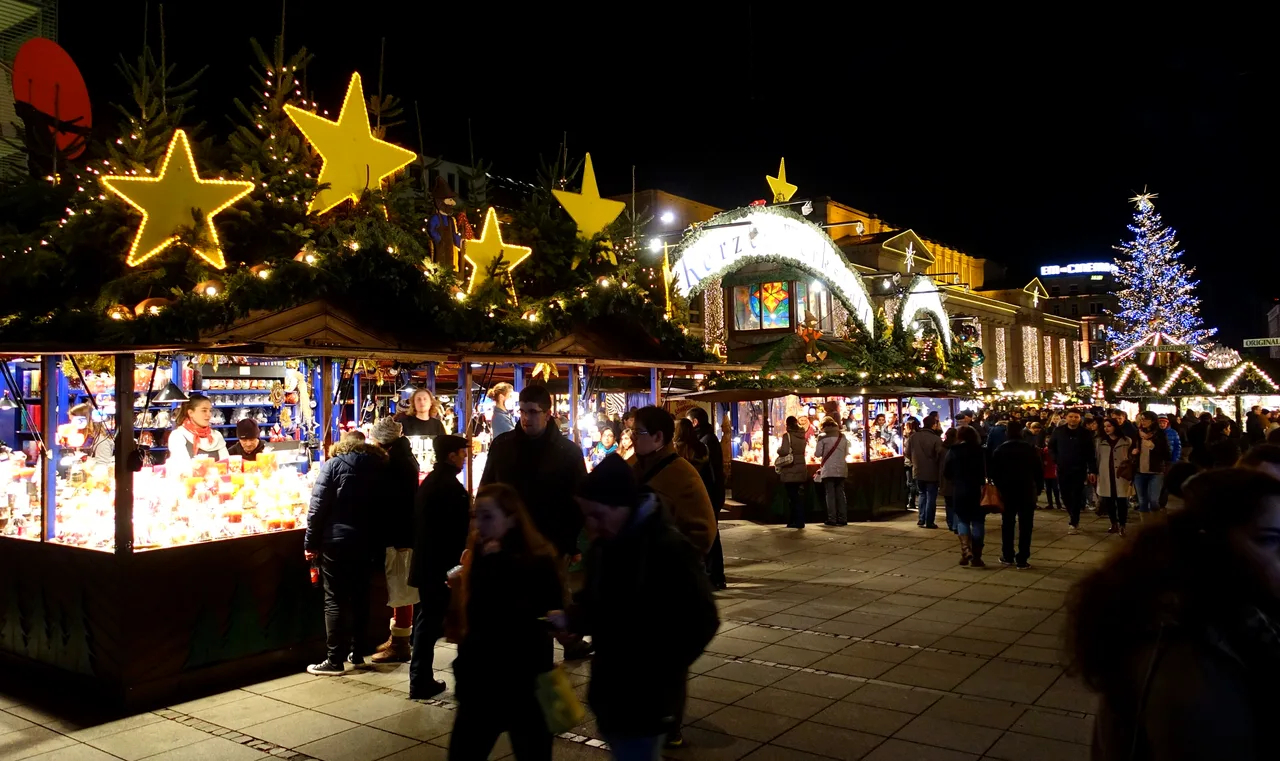
Stuttgart is the capital of Baden-Württemberg in south-western Germany and, with around 630,000 inhabitants, its largest city. It sits in a valley basin opening onto the Neckar, ringed by vine-covered hills, and is one of the few German cities with vineyards inside its city limits. Its name comes from a horse stud farm (Stutengarten) believed to have been founded in the 10th century, and the black horse on the city’s coat of arms still recalls it. Once the seat of the counts, dukes and kings of Württemberg, Stuttgart is today known as the car city where Mercedes-Benz and Porsche were born, and for its museums, opera and modern architecture. In Advent the old centre fills with one of Europe’s largest and oldest Christmas markets, spreading from Schlossplatz to Marktplatz, where the roofs of the stalls are decorated with illuminated figures, fir branches and miniature scenes.
Content update: 28 October 2026 · Christmas market dates checked against the official stuttgarter-weihnachtsmarkt.de (in.Stuttgart)
Stuttgart at a Glance
- Country / State
- Germany · capital of Baden-Württemberg
- Population
- About 630,000; the state’s largest city
- Language
- German (Swabian dialect); English widely spoken
- Currency
- Euro (EUR); cards common, cash useful at small stalls
- Time zone
- Central European Time (CET, UTC+1); 2 hours behind Türkiye in winter
- Known for
- Car museums, vineyards inside the city, opera and ballet, modern architecture, mineral springs
- Landmarks
- Schlossplatz, Neues Schloss, Altes Schloss, Stiftskirche, TV tower, Mercedes-Benz and Porsche museums
- Nearby
- Ludwigsburg, Esslingen, Bebenhausen, Tübingen, Maulbronn
- Christmas
- Stuttgarter Weihnachtsmarkt 25 Nov–23 Dec 2026; Ferris wheel 18 Nov 2026–6 Jan 2027
- Airport
- Stuttgart Airport (STR); about half an hour to the centre by S-Bahn
- Power
- 230 V, European (C/F) sockets; Turkish plugs fit
- Emergency
- 112 (ambulance/fire), 110 (police)
Stuttgart in Photos
The valley city seen from the hills at night, Schlossplatz and the Jubilee Column from the Christmas market, and Königstraße in winter: Stuttgart in three frames.


Stuttgart Christmas Market 2026
The Stuttgart Christmas Market (Stuttgarter Weihnachtsmarkt) is presented as one of Europe’s largest and oldest Christmas markets; it is first recorded in 1692. According to the official site, in 2026 it runs from 25 November to 23 December with hundreds of stalls spread across Schlossplatz, Schillerplatz, Karlsplatz, Marktplatz and the surrounding streets. What makes it unique are the stall roofs: vendors decorate them with illuminated figures, fir branches, miniature villages and fairy-tale scenes, and every year there is a contest for the most beautiful roof. In the Kinder-Märchenland on Schlossplatz children find a miniature steam train, a small Ferris wheel, a carousel and gingerbread decorating. A 58-metre Ferris wheel stands in the forecourt of the Neues Schloss. On Friday to Sunday evenings the Turmbläser brass players perform carols from the Stiftskirche tower, and concerts take place in the Renaissance courtyard of the Altes Schloss and in the Stiftskirche. The market has run on green electricity since 2014 and is organised by the city’s events company in.Stuttgart. The details below were checked against official sources on 28 October 2026.


| Market / Area | Location | 2026 dates | Note |
|---|---|---|---|
| Stuttgarter Weihnachtsmarkt | Schlossplatz, Schillerplatz, Karlsplatz, Marktplatz | 25 November–23 December 2026 | The huge market famous for its decorated stall roofs. Published hours: Sun–Thu 11:00–21:00, Fri–Sat 11:00–22:00. On 25 November stalls open at 17:00, ceremony at 18:00 in the Altes Schloss courtyard. |
| Kinder-Märchenland | Schlossplatz | During the market | Miniature steam train, small Ferris wheel, carousel and cookie decorating. |
| Ferris wheel (Riesenrad) | Forecourt (Ehrenhof) of the Neues Schloss | 18 November 2026–6 January 2027 | 58 metres high; a bird’s-eye view of the centre. |
| Turmbläser and concerts | Stiftskirche tower, Altes Schloss courtyard | During the market (Turmbläser Fri–Sun evenings) | Carols from the tower; concert programme on the official site. |
| Ludwigsburg Baroque Christmas Market | Ludwigsburg, Marktplatz | Check the official site | Baroque arches and illuminated angel figures; about 15–20 minutes by S-Bahn. |
| Esslingen Medieval and Christmas Market | Esslingen am Neckar, old town | Check the official site | Medieval-themed stalls and shows; a short S-Bahn or regional train ride. |
What to try
Glühwein
Spiced mulled wine, some made from Stuttgart’s own vineyards. Alcohol-free Kinderpunsch is available too.
Schupfnudeln
Potato finger noodles fried with sauerkraut, the hot classic of Swabian markets.
Maultaschen
The market version of Swabia’s filled pasta pockets; the filling usually contains pork.
Roasted almonds
Hot sugar-roasted almonds (gebrannte Mandeln).
Springerle
Traditional Swabian aniseed Christmas biscuit with an embossed pattern.
Bratwurst and Rote Wurst
Grilled sausages in a roll; most contain pork, so ask.
Stuttgart Christmas market tips
- The stall roofs look their best when lit in the evening; stroll calmly by day and do a light tour after dark.
- Be near the Stiftskirche on Friday–Sunday evenings to hear the Turmbläser; check times on the official site.
- Weekends and evenings are very crowded; weekday lunchtimes are calmer.
- A deposit is charged on Glühwein mugs and refunded when you return them.
- Cards are increasingly accepted, but carry some euro cash for small stalls.
- Check the programme in advance for concerts in the Altes Schloss courtyard and the Stiftskirche.
- The Ludwigsburg or Esslingen markets fit into half a day; check their dates on their official sites.
- In December it gets dark around 16:30; plan museums for the morning and the market for the evening.
Check before you go: Stuttgarter Weihnachtsmarkt · stuttgarter-weihnachtsmarkt.de (official, in.Stuttgart) ↗ · Stuttgart-Marketing · stuttgart-tourist.de (official) ↗ · Landeshauptstadt Stuttgart · stuttgart.de ↗
Dates were checked on 28 October 2026 on the official stuttgarter-weihnachtsmarkt.de (in.Stuttgart) and stuttgart-tourist.de. The Ludwigsburg and Esslingen markets have different organisers; this guide does not give their dates. Re-check opening hours on the official sites before travelling.
When to Go
Stuttgart can be visited all year. May to September is best for parks, vineyard walks and terrace views; the Frühlingsfest in spring and the Cannstatter Volksfest (Wasen) in late September–early October liven up the city. From late November to late December the Christmas market fills the centre. January and February are quiet and cool, ideal for museums.
| Month | Sightseeing | Christmas market | Vineyards and parks | Crowds |
|---|---|---|---|---|
| January | Hard | No market | Hard | Quiet |
| February | Hard | No market | Hard | Quiet |
| March | Good | No market | Good | Moderate |
| April | Very good | No market | Very good | Moderate |
| May | Very good | No market | Very good | Busy |
| June | Very good | No market | Very good | Busy |
| July | Very good | No market | Very good | Busy |
| August | Very good | No market | Very good | Busy |
| September | Very good | No market | Very good | Moderate |
| October | Very good | No market | Very good | Moderate |
| November | Good | Market season | Good | Moderate |
| December | Good | Market season | Hard | Busy |
- In December Stuttgart is usually 0–6 °C; fog and damp are common in the valley, snow occasional.
- The Christmas market runs 25 November–23 December 2026; the Ferris wheel turns from 18 November to 6 January 2027.
- Most museums close on Mondays; check opening days on the official sites.
- Accommodation demand rises during the Cannstatter Volksfest and major trade fairs.
- It gets dark around 16:30 in December; plan viewpoints before noon.
- Because of the Stuttgart 21 rail project, construction and route changes may occur around the main station.
Visa and Entry (Turkish citizens)
Turkish citizens holding an ordinary (burgundy) passport need a Schengen visa for tourist travel to Germany. Different rules apply to special, service and diplomatic passports; check the current situation with the Turkish Ministry of Foreign Affairs.
Apply to the mission of your main destination. If Germany is your main destination, the German missions in Türkiye are responsible; current information is at tuerkei.diplo.de.
If you combine Stuttgart with Zurich or Basel (Switzerland) or Strasbourg (France), apply to the country where you will stay longest. Checks may take place at internal borders; carry your passport.
Under the EU Entry/Exit System (EES), being phased in, your biometric data (facial image and fingerprints) may be taken on first entry; allow extra time at the border.
Visa fees, appointment waiting times and required documents can change; this guide gives no fees. Use the current list on the official sites before applying.
Travel medical insurance and accommodation and return details are part of the application; see the official sources for details.
Check before you go: T.C. Dışişleri Bakanlığı · Türk vatandaşlarının tabi olduğu vize uygulamaları ↗ · tuerkei.diplo.de ↗ · EES · europa.eu ↗ · Rota Atlası visa guide (TR)
Travel medical insurance
Check the official visa and entry sources above first: they state whether travel medical insurance is required and the minimum cover. Compare any policy’s cover amount, validity dates and countries covered with the official requirement.
Rota Atlası does not currently offer an insurance partnership; there are no paid links in this section. Last updated: 1 November 2026
Getting to Stuttgart
- By air: Stuttgart Airport (STR) lies south of the city on the Filder plain; S-Bahn lines S2 and S3 reach Stuttgart Hauptbahnhof in about half an hour. Direct flights from Türkiye vary by season and airline; check current flights only on the official airline and airport sites.
- By train: Stuttgart Hauptbahnhof is a major ICE and IC hub with connections to Frankfurt, Munich, Mannheim, Karlsruhe and Zurich. Timetables and tickets are on bahn.de.
- Construction note: the main station is being rebuilt under the Stuttgart 21 project; platform access and walkways may change, so allow extra time.
- Long-distance bus: coaches mostly arrive at the bus terminal (SAB) next to the airport; check operators and times through official channels.
- By road: the A8 and A81 motorways serve the city. Stuttgart has a low-emission zone (Umweltzone); parking in the centre is limited and paid, so use P+R.
Getting Around

On foot
Schlossplatz, Altes Schloss, Schillerplatz, Marktplatz and the Christmas market are a few minutes’ walk apart; Königstraße runs from the Hauptbahnhof to the centre.
Stadtbahn and bus
SSB’s Stadtbahn (U) lines and buses run frequently across the city; tickets follow the VVS tariff. Current information is at vvs.de.
S-Bahn
S-Bahn lines link the airport, Ludwigsburg, Esslingen and Bad Cannstatt with the centre.
Zacke and funicular
The “Zacke” rack railway from Marienplatz up to Degerloch is a city icon; a small funicular (Standseilbahn) also climbs from Südheim to the Waldfriedhof.
Tickets
Use ticket machines and the VVS/SSB apps; check day tickets and tourist cards such as the StuttCard on the official sites.
Bikes and e-scooters
The city is hilly, so e-bikes are more practical; roads can be wet in winter.
What to See
Stuttgart’s sights cluster in the valley-floor centre around Schlossplatz: palaces, churches, squares and the museum axis known as the Kulturmeile. Then come destinations on the hills such as the car museums, Wilhelma and Weissenhof; the last sections cover easy trips to Ludwigsburg, Esslingen and Bebenhausen.
Centre
Schlossplatz, Neues Schloss and Kunstmuseum

The city’s great living room is Schlossplatz, with its lawns, fountains and the Jubiläumssäule (Jubilee Column) at its centre: Stuttgart’s meeting point. It is dominated by the Baroque Neues Schloss (New Palace), built in the second half of the 18th century as the palace of Württemberg’s dukes and kings; destroyed in the Second World War and rebuilt, it now houses state ministries. On Kleiner Schlossplatz at the edge of the square, the glass-cube Kunstmuseum Stuttgart, opened in 2005, shows modern and contemporary art, with Otto Dix as a highlight. Königstraße, the main shopping street, runs past the square from the Hauptbahnhof.
Don’t miss
- The Jubilee Column and palace façade
- The Kunstmuseum glass cube and Otto Dix collection
- A walk along Königstraße
- Kinder-Märchenland and the Ferris wheel in Advent
Tips
- The Kunstmuseum’s top-floor terrace looks over the square.
- Königstraße is very busy on Saturdays.
- Check museum opening hours on the official site.

Palace
Altes Schloss and Schillerplatz

Right next to the Neues Schloss stands the Altes Schloss (Old Castle), one of the city’s oldest buildings. Its origins go back to a 10th-century moated castle; in the 16th century the dukes of Württemberg turned it into a Renaissance palace, and its courtyard, ringed by three storeys of arcades, is considered one of Germany’s finest Renaissance courtyards. Today it houses the Landesmuseum Württemberg, with rich collections including the Württemberg crown jewels. In Advent the courtyard hosts the Christmas market opening ceremony and concerts. On neighbouring Schillerplatz stand the statue of the poet Friedrich Schiller, the former granary Fruchtkasten and historic buildings such as the Prinzenbau.
Don’t miss
- The Renaissance courtyard of the Altes Schloss
- Landesmuseum Württemberg
- Schiller statue and Fruchtkasten
- Courtyard concerts in Advent
Tips
- The museum may be closed on Mondays; check the official site.
- The courtyard is a good break from the market crowds.
- Schillerplatz is one of the market’s most atmospheric corners.

Church
Stiftskirche, Marktplatz and Markthalle

Beside Schillerplatz, the Stiftskirche is Stuttgart’s main Protestant church, easy to spot on the skyline thanks to its two dissimilar towers. The Gothic church was rebuilt after heavy war damage; inside, the row of statues of the counts of Württemberg stands out. In Advent the Turmbläser play carols from the tower on Friday to Sunday evenings. A few steps away on Marktplatz is the town hall (Rathaus) with its clock tower, rebuilt after the war; the square is one of the market’s hubs. The nearby Art Nouveau (Jugendstil) Markthalle, opened in 1914, is a covered market worth seeing for its local and international food stalls.
Don’t miss
- The Stiftskirche’s two towers and the counts’ statues
- Turmbläser (Advent, Fri–Sun evenings)
- Rathaus and Marktplatz
- The Jugendstil Markthalle
Tips
- Visits are limited during services.
- The Markthalle is closed on Sundays.
- Check Turmbläser times on the official site.

Museums
Kulturmeile: Staatsgalerie, State Opera and Stadtbibliothek

Running along Konrad-Adenauer-Straße, the Kulturmeile (Culture Mile) gathers Stuttgart’s main cultural institutions. The Staatsgalerie, with its 19th-century old building and the postmodern new building designed by British architect James Stirling and opened in 1984, is one of Germany’s leading art museums, with a collection from the Middle Ages to contemporary art. On the shore of the nearby Eckensee lake, the Staatstheater’s opera house is home to the internationally renowned Stuttgart Opera and Stuttgart Ballet. A little further north, in the Europaviertel, the Stadtbibliothek (city library), opened in 2011, draws architecture lovers with its pure-white cube interior and roof terrace.
Don’t miss
- Stirling’s Neue Staatsgalerie building
- The opera house on the Eckensee
- The white interior and roof terrace of the Stadtbibliothek
Tips
- Opera and ballet tickets for Advent sell out early; buy on the official site.
- The Stadtbibliothek is free to visit; check opening hours.
- The Staatsgalerie may be closed on Mondays.

Quarter
Bohnenviertel

South-east of the centre, the Bohnenviertel (Bean Quarter) is one of the few old districts largely spared in the war. It is said to take its name from the beans that poor craftsmen and wine-growing families once grew in front of their houses. Today its narrow lanes, restored old houses, wine taverns (Weinstuben), galleries and small shops make it one of the city’s most intimate corners. In Advent its lit shop windows and quiet streets offer a good break after the crowds of the big market.
Don’t miss
- Old lanes and restored houses
- Traditional Weinstuben
- Galleries and design shops
Tips
- You may need to book a Weinstube for dinner.
- Shops are closed on Sundays.
- A 10-minute walk from the centre.
Museum
Mercedes-Benz Museum

The Mercedes-Benz Museum in Untertürkheim, opened in 2006 in a futuristic double-helix building, is one of Stuttgart’s most visited museums. Visitors take a lift to the top floor and descend along spiral ramps, following the history of the automobile from its invention to today in chronological order; historic cars, racing cars and trucks are on display. The museum tells the legacy of Carl Benz and Gottlieb Daimler together with Stuttgart’s identity as a car city.
Don’t miss
- The spiral descent
- Historic and racing car collection
- The double-helix architecture
Tips
- Walking distance from the Neckarpark S-Bahn stop.
- May be closed on Mondays; check the official site.
- Allow at least 2–3 hours.
Museum
Porsche Museum

In Zuffenhausen to the north, opposite the Porsche factory, the Porsche Museum opened in 2009 in a white monolith that seems to float in the air. Inside are the legendary 356 and 911 models, race-winning cars and the brand’s history. Porscheplatz in front of the museum is right by the S-Bahn stop, and the museum can be combined with the Mercedes-Benz Museum on the same day.
Don’t miss
- The floating white monolith
- 356 and 911 models
- Racing car exhibition
Tips
- S-Bahn to Neuwirtshaus (Porscheplatz).
- May be closed on Mondays; check the official site.
- Two car museums in one day can be tiring; take a break between them.
Park
Wilhelma and Rosenstein Palace

Near Bad Cannstatt, the Wilhelma is a palace garden built in Moorish style for King Wilhelm I in the 19th century; today it is one of Europe’s leading zoological and botanical gardens. Historic glasshouses, Moorish pavilions and thousands of animal species share the grounds, and in winter the glasshouses offer a warm refuge. Next door, on the hill of Rosenstein Park, stands the classicist Rosenstein Palace, built for the same king in the early 19th century; it now houses part of the Natural History Museum.
Don’t miss
- Wilhelma’s Moorish buildings and glasshouses
- Natural history exhibitions in Rosenstein Palace
- A walk in Rosenstein Park
Tips
- Winter opening hours are shorter; check the official site.
- The Wilhelma is large; allow half a day.
- Take the Stadtbahn to the Wilhelma stop.

Architecture
Weissenhof Estate and Killesberg

On the Killesberg hill to the north, the Weissenhofsiedlung (Weissenhof Estate) is a modernist housing estate built in 1927 for a Deutscher Werkbund exhibition, led by Mies van der Rohe and designed by architects including Le Corbusier, Walter Gropius and Hans Scharoun. Le Corbusier’s two houses here have been on the UNESCO World Heritage List since 2016 as part of “The Architectural Work of Le Corbusier”; one of them houses the Weissenhofmuseum. Nearby Killesberg Park is a garden park laid out over former quarries; its cable-stayed observation tower offers views of the city and vineyards. UNESCO listing ↗
Don’t miss
- Le Corbusier houses and Weissenhofmuseum
- The 1927 modernist homes
- Killesberg observation tower
Tips
- Most houses are private homes; visit only the museum section.
- The museum may be closed on Mondays.
- The observation tower may close in icy weather.

Views
TV Tower, Grabkapelle and vineyards

The 217-metre Stuttgart Fernsehturm in Degerloch, completed in 1956, was the world’s first reinforced-concrete television tower and became a model for similar towers worldwide; from its viewing platform you see the valley city, the Swabian Jura and, on clear days, the Alps. East of the city, on the vine-covered Württemberg hill, the Grabkapelle (burial chapel) is a classicist memorial built between 1820 and 1824 by King Wilhelm I for his wife Queen Katharina, who died young. Stuttgart has hundreds of hectares of vineyards within its city limits; the terraced slopes along the Neckar in Bad Cannstatt grow local wines such as Trollinger.
Don’t miss
- The TV tower viewing platform
- Grabkapelle and vineyard views
- Terraced vineyards along the Neckar
Tips
- Check tower opening hours and the weather.
- The Grabkapelle may be closed in winter; check season dates on the official site.
- Vineyard paths are slippery after rain.


Day trip
Ludwigsburg

A short S-Bahn ride north of Stuttgart, Ludwigsburg is a Baroque residence town founded in the early 18th century by Duke Eberhard Ludwig. Ludwigsburg Residential Palace is one of Germany’s largest Baroque palaces; its hundreds of rooms, courtyards and gardens can be visited on guided tours. In Advent the town’s Baroque Marktplatz hosts the Baroque Christmas Market, known for its illuminated arches and angel figures; check dates and hours on the official site.
Don’t miss
- Guided tour of the Residential Palace
- The Baroque Marktplatz
- The Baroque Christmas Market in Advent
Tips
- Palace tours are guided; check times on the official site.
- The palace gardens follow a different winter schedule.
- S-Bahn times are on vvs.de.

Day trip
Esslingen and Bebenhausen

On the Neckar just south-east of Stuttgart, Esslingen am Neckar is a well-preserved medieval town with half-timbered houses, an old town hall and castle walls on the hill. In Advent its Medieval and Christmas Market in the old town, with costumed vendors and craft demonstrations, offers a different atmosphere from Stuttgart’s big market; check dates and hours on the official site. To the south, near Tübingen, Bebenhausen Abbey, founded in the late 12th century, is considered one of the best-preserved Cistercian monasteries; beside it stands a hunting palace of the kings of Württemberg.
Don’t miss
- Esslingen old town and Medieval Christmas Market
- Bebenhausen cloister
- Combine with Tübingen old town
Tips
- Esslingen is a short S-Bahn ride away.
- Reach Bebenhausen by bus via Tübingen; check times.
- Abbey opening hours may be shorter in winter.

1, 2, 3-Day Itineraries + Christmas Day
The itineraries are planned for walking and public transport. One day is enough for the centre and the Christmas market, two days for the car museums and viewpoints, three for a trip to Ludwigsburg or Esslingen. Most museums close on Mondays; check hours on the official sites in advance.
1 day: Centre and palaces
- In the morning walk from the Hauptbahnhof along Königstraße to Schlossplatz.
- Visit the Altes Schloss courtyard and the Landesmuseum Württemberg.
- See Schillerplatz and the Stiftskirche, then take a break at the Markthalle.
- In the afternoon visit the Staatsgalerie or the Kunstmuseum.
- Have dinner at a Weinstube in the Bohnenviertel.
2 days: Cars and views
- Follow the day 1 route.
- On day 2 visit the Mercedes-Benz Museum in the morning.
- In the afternoon go on to the Porsche Museum or visit the Wilhelma.
- Stop at the Weissenhof Estate and Killesberg.
- Watch the city from the TV tower at sunset.
3 days: Ludwigsburg or Esslingen
- Follow the first two days.
- On day 3 take the S-Bahn to Ludwigsburg and tour the Residential Palace.
- In Advent, browse the Baroque Christmas Market.
- Alternatively, see Esslingen’s old town and its market.
- Return to Stuttgart in the evening.
Christmas market day (25 November–23 December 2026)
- In the morning visit the Altes Schloss and Landesmuseum; the market opens at 11:00.
- Around lunchtime admire the stall roofs on Schillerplatz and Marktplatz while it is calm.
- In the afternoon visit the Kinder-Märchenland and the Ferris wheel on Schlossplatz.
- At dusk listen to the Turmbläser near the Stiftskirche (Fri–Sun).
- End the day among the lit roofs with Glühwein and Schupfnudeln.
Swabian Food
Swabian cooking is hearty and simple, built around pasta, lentils and meat dishes. Stuttgart’s own vineyards feed the city’s Weinstube culture. Below are regional dishes, not restaurant recommendations.


Maultaschen
Large pasta pockets filled with meat, spinach and bread; served in broth or pan-fried. The filling usually contains pork.
Käsespätzle
Fresh egg noodles (Spätzle) with cheese and fried onions, the symbol of Swabia.
Zwiebelrostbraten
Beef sirloin with fried onions, usually with Spätzle.
Linsen mit Spätzle
The Swabian classic of lentils, Spätzle and thin sausages (Saitenwürstle); the sausages may contain pork.
Schupfnudeln
Potato finger noodles, usually with sauerkraut.
Brezel
The Swabian pretzel with thin arms and a thick belly.
Trollinger
The light red wine of Stuttgart’s vineyards.
Springerle
Embossed aniseed Christmas biscuit.
- Many regional dishes contain pork or bacon; ask about ingredients.
- Käsespätzle is a good vegetarian option; still ask about the fat used.
- Tap water is drinkable; Bad Cannstatt’s mineral springs are also famous.
- Service is included in prices; tipping is optional, usually by rounding up.
Culture and Etiquette

- Greet with “Guten Tag” or the regionally common “Grüß Gott”; saying hello when entering a shop is polite.
- Quiet is expected on Sundays and after 22:00; shops are closed on Sundays.
- Be quiet in churches and don’t walk around during services.
- Recycling is taken seriously; there is a deposit (Pfand) system for bottles and cans.
- Swabians are known for thrift and hard work; punctuality matters.
- On public transport let people get off first; stand on the right on escalators.
- Don’t walk on cycle lanes.
- Dress is relaxed at the opera and theatre, but many dress up.
- Most Weissenhof houses are private homes; respect residents’ privacy.
- Respect people’s privacy when taking photos.
Safety and Health
- Stuttgart is generally safe; watch your valuables in Christmas market crowds and on public transport.
- Walkways around the Hauptbahnhof and construction sites may change; follow the signs.
- Take care in nightlife areas late at night.
- In winter pavements and vineyard paths can be slippery; wear non-slip shoes.
- Take care around Stadtbahn and tram tracks.
- In an emergency call 112, police 110. Travel medical insurance is mandatory for a Schengen visa.
- Check official travel advice (e.g. the Turkish Ministry of Foreign Affairs or GOV.UK) before travelling.
What Drives Your Budget
This guide gives no prices; prices vary by season and year. These factors shape your budget:
Dates
Trade fairs, the Cannstatter Volksfest and Advent weekends push up accommodation demand.
Where you stay
Staying central saves time on foot; districts on S-Bahn lines are practical alternatives.
Transport
VVS zones, day tickets and tourist cards affect costs.
Museums
The car museums, Staatsgalerie and Wilhelma charge separately; check cards and combined offers.
Food and drink
Bakeries, the Markthalle and market stalls are budget options; restaurants cost more.
Day trips
Trips to Ludwigsburg, Esslingen or Tübingen add transport costs.
Free experiences
The Christmas market, Schlossplatz, Bohnenviertel, Stadtbibliothek and vineyard walks are free.
Practical Information
- Money: the euro is used; cards are common but carry cash for small stalls.
- Language: German is spoken, with Swabian as the local dialect; English is common at tourist sites.
- Power: 230 V, European (C/F) sockets; Turkish plugs fit.
- Opening hours: shops close on Sundays; most close early on the afternoon of 24 December, and 25–26 December are public holidays. Most museums close on Mondays.
- Mobile data: EU roaming rules do not apply to Turkish lines; check your operator’s travel packages.
- Tourist office: Stuttgart-Marketing’s i-Punkt information point is in the centre; current information at stuttgart-tourist.de.
- Accessibility: the centre is flat; use public transport for hilltop sights.
- Photography: Schlossplatz, the Altes Schloss courtyard, the TV tower, Killesberg tower and the Grabkapelle are the best spots.
- UNESCO: Le Corbusier’s Weissenhof houses (1321) are World Heritage; nearby Maulbronn Monastery (546) is also listed.
- Low-emission zone: if driving, check the Umweltzone rules.
Frequently Asked Questions
When is the Stuttgart Christmas Market 2026?
According to the official site, 25 November–23 December 2026; Sun–Thu 11:00–21:00, Fri–Sat 11:00–22:00. On opening day stalls open at 17:00.
Where is the market held?
On Schlossplatz, Schillerplatz, Karlsplatz and Marktplatz and the surrounding streets.
What is the market best known for?
Its stall roofs decorated with illuminated figures, fir branches and miniature scenes; a contest for the most beautiful roof is held every year.
How long is the Ferris wheel open?
The 58-metre Ferris wheel in the forecourt of the Neues Schloss turns from 18 November 2026 to 6 January 2027.
Is there an entrance fee?
Entry to the Christmas market is free; food, drinks and rides are paid.
How many days should I spend in Stuttgart?
One day for the centre and Christmas market, two for the car museums, three with a trip to Ludwigsburg or Esslingen.
How do I get from the airport to the city?
S-Bahn lines S2 and S3 reach the Hauptbahnhof in about half an hour. Times are on vvs.de and bahn.de.
Do Turkish citizens need a visa?
Ordinary passport holders need a Schengen visa. If Germany is the main destination, apply to the German missions in Türkiye; current information is at tuerkei.diplo.de.
Are the car museums open on Mondays?
They are usually closed on Mondays; check current opening days on the official sites.
What is the weather like in winter?
In December it is usually 0–6 °C; fog is common in the valley and snow occasional. Wear waterproof layers.
Where to stay
Stay close to the areas where you will spend most time. The areas below are covered in detail in this guide; check public transport links in the getting-around section.
- CentreSchlossplatz, Neues Schloss and Kunstmuseum
- PalaceAltes Schloss and Schillerplatz
- ChurchStiftskirche, Marktplatz and Markthalle
- MuseumsKulturmeile: Staatsgalerie, State Opera and Stadtbibliothek
- QuarterBohnenviertel
- MuseumMercedes-Benz Museum
- MuseumPorsche Museum
- ParkWilhelma and Rosenstein Palace
- ArchitectureWeissenhof Estate and Killesberg
- ViewsTV Tower, Grabkapelle and vineyards
Search hotels in these areas (Hotellook) ↗ (affiliate link)Search on Booking.com ↗
Affiliate disclosure: Hotellook, Aviasales, Klook, Airalo, Tiqets and DiscoverCars links are affiliate links; Rota Atlası may earn a commission on bookings made through them, at no extra cost to you. Official and in-guide links are not paid. Last updated: 1 November 2026 · Privacy and affiliates
Transport and connectivity
- Airport transferOptions from the airport to the city are in this guide’s getting there section.
- Mobile data (eSIM)Airalo eSIM ↗ (affiliate link)
- TrainsOfficial rail website ↗
- Car hireYou rarely need a car within the city; see getting around first. Compare car hire on DiscoverCars ↗ (affiliate link)
Affiliate disclosure: Hotellook, Aviasales, Klook, Airalo, Tiqets and DiscoverCars links are affiliate links; Rota Atlası may earn a commission on bookings made through them, at no extra cost to you. Official and in-guide links are not paid. Last updated: 1 November 2026 · Privacy and affiliates
Search flights (affiliate link)
Search flights from any airport in any country. Results open on Aviasales in a new tab, where you book.
This form is an affiliate link: Rota Atlası may earn a commission on bookings made via Aviasales (Travelpayouts), at no extra cost to you. Check price, baggage and terms on the booking site. Airport data: OurAirports (public domain).
Flights, hotels and tours
Find tours and tickets
- Stuttgart Christmas Market
GetYourGuide ↗ · Klook ↗ (affiliate link) - Schlossplatz and Neues Schloss
GetYourGuide ↗ · Klook ↗ (affiliate link) - Altes Schloss
GetYourGuide ↗ · Klook ↗ (affiliate link) - Stiftskirche
GetYourGuide ↗ · Klook ↗ (affiliate link)
Hotellook, Aviasales, Klook, Airalo and Tiqets links in this box are affiliate links (Travelpayouts): Rota Atlası may earn a commission on bookings made through them, at no extra cost to you. GetYourGuide links currently carry no affiliate code. Check prices and terms with the provider. Last updated: 1 November 2026 · Privacy and affiliates
Sources
- T.C. Dışişleri Bakanlığı · Türk vatandaşlarının tabi olduğu vize uygulamaları ↗
- Auswärtiges Amt · Deutsche Vertretungen in der Türkei (Visa) ↗
- European Union · Entry/Exit System (EES) ↗
- Stuttgarter Weihnachtsmarkt · stuttgarter-weihnachtsmarkt.de (official) ↗
- Stuttgart-Marketing · stuttgart-tourist.de (official) ↗
- Landeshauptstadt Stuttgart · stuttgart.de (official) ↗
- Landesmuseum Württemberg (official) ↗
- Staatsgalerie Stuttgart (official) ↗
- Kunstmuseum Stuttgart (official) ↗
- Mercedes-Benz Museum (official) ↗
- Mercedes-Benz Museum · stuttgart-tourist.de ↗
- Porsche Museum · stuttgart-tourist.de ↗
- Wilhelma · Zoologisch-Botanischer Garten (official) ↗
- Weissenhofmuseum im Haus Le Corbusier (official) ↗
- Fernsehturm Stuttgart (official) ↗
- Grabkapelle auf dem Württemberg (official) ↗
- Residenzschloss Ludwigsburg (official) ↗
- Kloster und Schloss Bebenhausen (official) ↗
- VVS · Verkehrs- und Tarifverbund Stuttgart ↗
- SSB · Stuttgarter Straßenbahnen ↗
- Stuttgart Airport ↗
- Deutsche Bahn ↗
- GOV.UK · Foreign travel advice · Germany ↗
- UNESCO World Heritage Centre · The Architectural Work of Le Corbusier ↗
- UNESCO World Heritage Centre · Maulbronn Monastery Complex ↗
- Stuttgarter Weihnachtsmarkt · stuttgarter-weihnachtsmarkt.de (official, in.Stuttgart) ↗
- Stuttgart-Marketing · stuttgart-tourist.de (official) ↗
- Landeshauptstadt Stuttgart · stuttgart.de ↗
This page is for information only. Dates, opening hours, entry rules and transport details can change; check the official sources above before travelling. No prices, flights, hotels or restaurants have been invented in this guide.
Photo credits
Photos on this page are from Wikimedia Commons and are used under the stated authors and licences (CC BY, CC BY-SA, CC0 or public domain). Full list of sources
- Star-decorated stall roofs at the Stuttgart Christmas market in the evening — Daderot · CC0 · Wikimedia Commons
- The Christmas market on Schillerplatz in the evening — qwesy qwesy · CC BY 3.0 · Wikimedia Commons
- The Christmas market and crowds in front of the Stiftskirche — WolfHD · CC BY-SA 3.0 · Wikimedia Commons
- A decorated stall roof at the Stuttgart Christmas market — Jorge Franganillo · CC BY 2.0 · Wikimedia Commons
- The illuminated Ferris wheel on Schlossplatz at night — Ideophagous · CC BY-SA 4.0 · Wikimedia Commons
- A Christmas concert in the courtyard of the Altes Schloss during Advent — Baden de · CC BY 3.0 · Wikimedia Commons
- Baubles on a children’s carousel at the Christmas market — Reinhold Möller Ermell · CC BY-SA 4.0 · Wikimedia Commons
- Night view over the Stuttgart valley basin from a hillside — Paul Colin Hennig firstdorsal.eu · CC BY-SA 4.0 · Wikimedia Commons
- Schlossplatz and the Jubilee Column at night from the Christmas market — Medea7 · CC BY-SA 3.0 · Wikimedia Commons
- Königstrasse in winter seen from the station tower — Marek Śliwecki · CC BY-SA 3.0 · Wikimedia Commons
- The Neues Schloss, Schlossplatz fountains and Jubilee Column — Julian Herzog (Website) · CC BY 4.0 · Wikimedia Commons
- The Renaissance courtyard of the Altes Schloss — Baden de · CC BY 3.0 · Wikimedia Commons
- Schillerplatz with the Schiller monument and Fruchtkasten — Dguendel · CC BY 3.0 · Wikimedia Commons
- The Gothic façade of the Stiftskirche, Stuttgart — Flocci Nivis · CC BY 4.0 · Wikimedia Commons
- Stuttgart town hall and clock tower on the Marktplatz — MargitSimon · CC BY-SA 4.0 · Wikimedia Commons
- The colourful glass façade of the Neue Staatsgalerie — Immanuel Giel · CC BY-SA 4.0 · Wikimedia Commons
- The glass cube of the Kunstmuseum Stuttgart on Kleiner Schlossplatz — Julian Herzog (Website) · CC BY 4.0 · Wikimedia Commons
- The cube-shaped building of the Stuttgart City Library — Pjt56 · CC BY-SA 4.0 · Wikimedia Commons
- Old houses and a lane in the Bohnenviertel — qwesy qwesy · CC BY 3.0 · Wikimedia Commons
- The Mercedes-Benz Museum at the blue hour — Julian Herzog (Website) · CC BY 4.0 · Wikimedia Commons
- The Porsche Museum building in Zuffenhausen — Ank Kumar · CC BY-SA 4.0 · Wikimedia Commons
- The Moorish-style Maurisches Landhaus and garden at the Wilhelma — Quartl · CC BY-SA 3.0 · Wikimedia Commons
- The domed interior of Schloss Rosenstein — Flocci Nivis · CC BY 4.0 · Wikimedia Commons
- A modernist house in the Weissenhof Estate — Martin Hahn · CC0 · Wikimedia Commons
- The Killesberg observation tower at sunset — CatalpaSpirit · CC BY-SA 4.0 · Wikimedia Commons
- The Grabkapelle mausoleum on the Württemberg hill — Julian Herzog (Website) · CC BY 4.0 · Wikimedia Commons
- The Stuttgart TV Tower (Fernsehturm) — Alexis88bg · CC BY-SA 4.0 · Wikimedia Commons
- Terraced vineyards above the Neckar at Bad Cannstatt — Gerd Eichmann · CC BY 4.0 · Wikimedia Commons
- The courtyard of Ludwigsburg Residential Palace — Ermell · CC BY-SA 4.0 · Wikimedia Commons
- Illuminated arches at the Ludwigsburg Baroque Christmas market — Vux · CC BY-SA 4.0 · Wikimedia Commons
- Stalls at the Esslingen medieval and Christmas market — Daderot · CC0 · Wikimedia Commons
- Bebenhausen Abbey near Tübingen — Berthold Werner · CC BY-SA 4.0 · Wikimedia Commons
- Stuttgart’s rack railway, the “Zacke” — Frank Nowotny · CC BY-SA 4.0 · Wikimedia Commons
- Swabian Maultaschen filled with meat and spinach — Tamorlan · CC BY 3.0 · Wikimedia Commons
- Käsespätzle with fried onions — Dktue · CC0 · Wikimedia Commons
- Zwiebelrostbraten served with Spätzle — de:Benutzer:Kassander der Minoer · CC BY-SA 3.0 · Wikimedia Commons
- Linsen mit Spätzle und Saitenwürstle, a Swabian classic — K. Jähne, cooking by B. Gross, Merops image editing · CC BY-SA 3.0 · Wikimedia Commons
- The Staatstheater Stuttgart opera house beyond the Eckensee lake — Mike is Michi · CC BY-SA 4.0 · Wikimedia Commons
Ulm → · Konstanz → · Heidelberg → · Gengenbach → · Freiburg → · Nuremberg → · Munich → · Christmas markets