

Munich, on the River Isar, is the capital of the state of Bavaria and, with around 1.5 million inhabitants, Germany’s third-largest city after Berlin and Hamburg. The city is traditionally dated to 1158 and Henry the Lion (Heinrich der Löwe); its name goes back to the monks (Mönche) of the area, and its emblem, the “Münchner Kindl”, is a child in a monk’s habit. The Wittelsbach dynasty, which ruled Bavaria from 1180 to 1918, filled Munich with palaces, churches and world-class art collections. The historic centre was heavily damaged in the Second World War and largely rebuilt faithfully. Today Munich is known for the New Town Hall and Glockenspiel on Marienplatz, the onion-domed Frauenkirche, the Residenz palace, the Pinakothek museums, the Englischer Garten, the Olympiapark from the 1972 Games and its beer-garden culture. From late November until Christmas, the Christkindlmarkt around Marienplatz, a tradition with medieval roots, shows the city’s winter face, while the nearby Alps and King Ludwig II’s UNESCO-listed palaces make Munich an ideal base for the region.
Content update: 28 October 2026 · Market dates checked on muenchen.de and the markets’ official websites
At a glance
- Country / state
- Germany, Bavaria (state capital)
- Population
- About 1.5 million; Germany’s third-largest city
- Language
- German; Bavarian dialect is heard in daily life, English is widely used in tourism
- Currency
- Euro (EUR)
- Time zone
- Central European Time (CET, UTC+1); UTC+2 in summer. In winter 2 hours behind Türkiye
- River
- Isar; the historic centre is on the west bank, Haidhausen and the Maximilianeum on the east bank
- Landmarks
- Frauenkirche, New Town Hall and Glockenspiel, Alter Peter, Residenz, Chinese Tower, Olympiaturm
- Christmas markets
- Marienplatz Christkindlmarkt and Kripperlmarkt, Tollwood, Chinese Tower, Residenz Christmas village, Wittelsbacherplatz medieval market; 2026 dates below
- UNESCO
- The Palaces of King Ludwig II: Neuschwanstein, Linderhof, Schachen and Herrenchiemsee (within day-trip range)
- Airport
- Munich Airport (MUC), about 30 km north-east of the centre; connected by S-Bahn lines S1 and S8
- Electricity
- 230 V, 50 Hz; type F/C sockets, the same as in Türkiye
- Emergency numbers
- 112 (ambulance, fire), 110 (police)
Munich in pictures
The onion domes of the Frauenkirche from the Peterskirche tower, the New Town Hall lit up on a November evening and the snowy Hofgarten: Munich in three frames.


Munich Christmas markets 2026
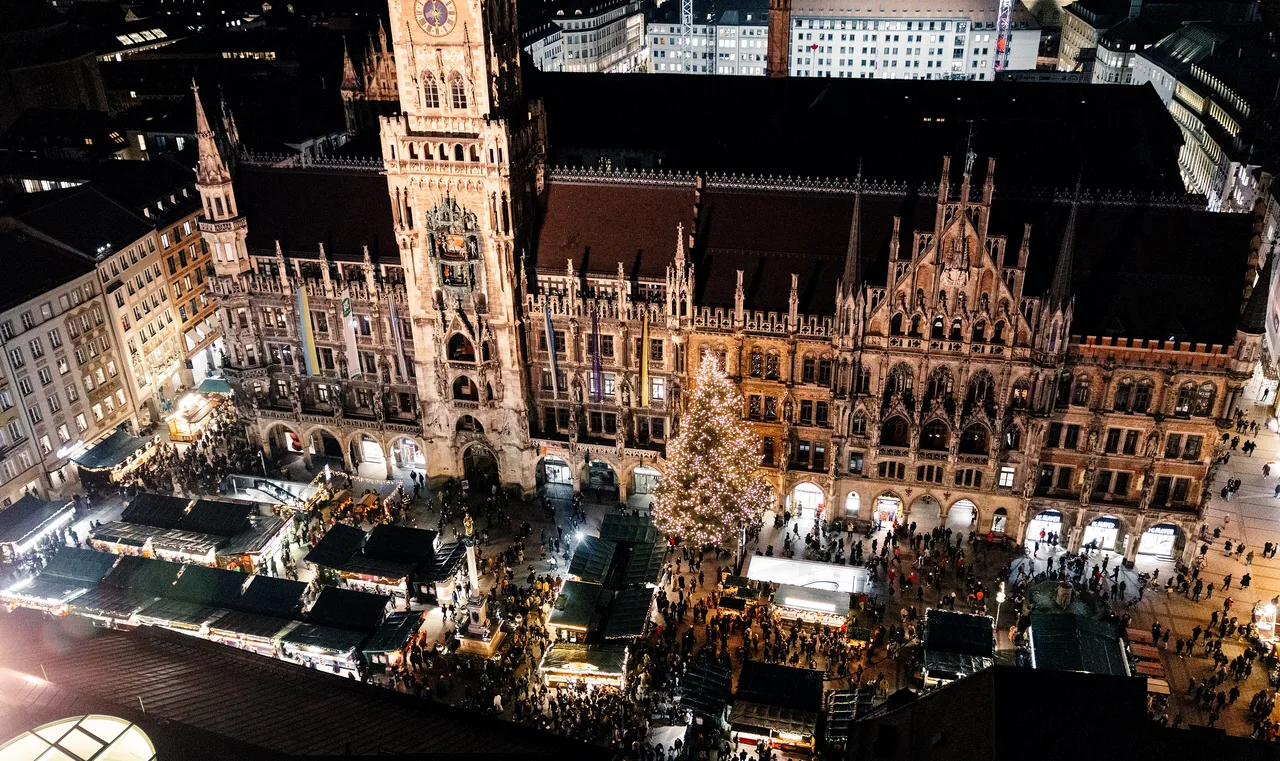
Munich’s main Christmas market, the Münchner Christkindlmarkt, starts in front of the New Town Hall on Marienplatz and spreads into the surrounding streets and the Rindermarkt. Organised by the City of Munich (Referat für Arbeit und Wirtschaft), it has more than 130 stalls according to the official page; a giant Christmas tree stands in front of the town hall, and the Kripperlmarkt on the Rindermarkt is a world of its own with nativity (Krippe) figures and accessories. Beyond the Christkindlmarkt, Munich has many winter markets with different characters: the Tollwood winter festival on the Theresienwiese combines art, music and organic food stalls; the Chinese Tower market in the Englischer Garten is small and intimate among the trees; the Kaiserhof courtyard of the Residenz becomes a Christmas village; and the medieval market on Wittelsbacherplatz stands out with traditional crafts and costumed traders. The dates below were checked against official sources on 28 October 2026.


| Market | Location | 2026 dates | Note |
|---|---|---|---|
| Münchner Christkindlmarkt | Marienplatz and surroundings, Rindermarkt | 20 November–24 December 2026 | Closed on 22 November. Official hours Mon–Sat 10:00–21:00, Sun 10:00–20:00, 24 December 10:00–14:00; more than 130 stalls. Krampuslauf parade on 13 December, 15:00–17:00 |
| Kripperlmarkt | Rindermarkt (part of the Christkindlmarkt) | 20 November–24 December 2026 | Nativity figures, stables and accessories; same dates as the Christkindlmarkt |
| Mittelaltermarkt (medieval market) | Wittelsbacherplatz | 20 November–23 December 2026 | Closed on 22 November; official hours daily 11:00–21:00. Costumed traders and traditional crafts |
| Tollwood Winterfestival | Theresienwiese (U4/U5 Theresienwiese) | 24 November–23 December 2026 | Free entry; art, music and world food in tents. Separate New Year’s Eve event on 31 December; details on tollwood.de |
| Weihnachtsmarkt am Chinesischen Turm | Englischer Garten, Chinese Tower | 19 November–23 December 2026 | Open Wednesday–Sunday; a small, family-friendly market among the trees. Hours on the official website |
| Weihnachtsdorf im Kaiserhof der Residenz | Residenz, Kaiserhof courtyard | 16 November–22 December 2026 | According to the muenchen.de listing; a fairy-tale Christmas village. Check hours with official sources |
| Münchner Eiszauber | Karlsplatz (Stachus) | 13 November 2026–10 January 2027 | Ice rink according to the muenchen.de listing; also open after Christmas |
What to taste at the market
Glühwein and Kinderpunsch
Spiced mulled wine and an alcohol-free fruit punch for children; drinks usually come in mugs with a deposit that is refunded when you return the mug.
Feuerzangenbowle
A showy winter drink in which a rum-soaked sugar cone is set alight and drips into hot wine; some markets prepare it in large cauldrons.
Lebkuchen
Traditional honey-and-spice Christmas biscuits; decorated heart-shaped ones are also sold as gifts.
Gebrannte Mandeln
Warm sugar-roasted almonds whose scent fills every corner of the market.
Bratwurstsemmel
A grilled sausage in a round bread roll (Semmel) with mustard, the classic snack on the go.
Schmalznudel and Dampfnudel
A fried dough pastry and a Bavarian steamed dumpling served with vanilla sauce.
Tips for Munich’s Christmas markets
- The heart of the Christkindlmarkt is Marienplatz; from there you can walk towards Kaufingerstraße, to the Kripperlmarkt on the Rindermarkt and on to the Residenz and Wittelsbacherplatz to see several markets in one evening.
- Marienplatz is very crowded on weekend evenings; choose weekday mornings for a more relaxed visit.
- The Krampuslauf (13 December 2026, 15:00–17:00) is a parade of masked Krampus figures from Alpine tradition; it can frighten small children, and you should arrive early for a good spot.
- Go to Tollwood by public transport; the Theresienwiese has its own station on lines U4/U5.
- The Chinese Tower market is only open Wednesday to Sunday; check the day and hours on the official website before you go.
- A deposit is charged for mugs; you can keep the mug as a souvenir or return it.
- Cash is still common at small stalls; carry some coins.
- On 24 December the Christkindlmarkt closes at 14:00; 25–26 December are public holidays and many shops are closed.
Check before you go: muenchen.de · Münchner Christkindlmarkt am Marienplatz (official) ↗ · muenchen.de · Weihnachtsmärkte und Christkindlmärkte 2026 ↗ · Tollwood Winterfestival (official) ↗ · Mittelaltermarkt am Wittelsbacherplatz (official) ↗ · Weihnachtsmarkt am Chinesischen Turm (official) ↗
Dates and hours were checked on 28 October 2026 on muenchen.de (City of Munich), tollwood.de, mittelaltermarkt-muenchen.de and weihnachtsmarkt-chinaturm.de. The dates for the Residenz Christmas village and the Eiszauber are based on muenchen.de’s 2026 Christmas market listing. Organisers may change their programmes; check the official websites again before you go.
When to go
Munich can be visited in any season, but the experience changes a lot. Spring and summer are ideal for beer gardens, the Englischer Garten and day trips to Alpine lakes; late November and December belong to the Christmas markets. During the Oktoberfest, from mid-September to early October, the city is at its busiest.
| Month | City walks | Christmas markets | Alps and day trips | Crowds |
|---|---|---|---|---|
| January | Challenging | Partly open | Challenging | Quiet |
| February | Challenging | No markets | Challenging | Quiet |
| March | Good | No markets | Good | Moderate |
| April | Very good | No markets | Good | Moderate |
| May | Very good | No markets | Very good | Moderate |
| June | Very good | No markets | Very good | Moderate |
| July | Very good | No markets | Very good | Busy |
| August | Very good | No markets | Very good | Busy |
| September | Very good | No markets | Very good | Busy |
| October | Good | No markets | Good | Busy |
| November | Good | Market season | Challenging | Moderate |
| December | Good | Market season | Challenging | Busy |
- Munich’s winters are cold; temperatures often drop below freezing and snow is possible. Bring a warm coat, hat, gloves and non-slip shoes.
- The Oktoberfest begins in mid-September every year and ends in the first days of October; demand for accommodation is extremely high then. Check muenchen.de for the exact dates.
- The Christkindlmarkt closes on the afternoon of 24 December; most other markets end on 22–23 December. 25–26 December and 1 and 6 January are public holidays in Bavaria.
- The occasional warm, dry Föhn wind makes the Alps visible from the city on clear days; use those days for views from the Olympiaturm or church towers.
- Large trade fairs (Messe München) can increase demand for accommodation; the fair calendar is published on the Messe München website.
Visas and entry (Turkish citizens)
Turkish citizens holding ordinary (burgundy) passports need a Schengen visa for tourist entry to Germany. Different rules apply to special, service and diplomatic passports; check the current situation on the website of the Turkish Ministry of Foreign Affairs.
Under Schengen rules you apply to the country of your main destination. If your trip is mainly to Munich and Germany, you apply to the German missions in Türkiye; the application channel, appointment system and required documents are published on tuerkei.diplo.de.
If you plan to continue from Munich to Austrian cities such as Salzburg or Innsbruck, be clear about where you will stay longest; a valid Schengen visa allows travel within the area, but internal border checks between Germany and Austria may take place, so carry your passport.
Under the Entry/Exit System (EES), being phased in at the EU’s external borders, your biometric data (fingerprints and facial image) may be recorded on first entry. Details are on the official EU page.
Visa fees, processing times and document lists can change. No fees are given on this page; rely only on official sources before applying.
Check before you go: T.C. Dışişleri Bakanlığı · Türk vatandaşlarının tabi olduğu vize uygulamaları ↗ · tuerkei.diplo.de ↗ · EES · europa.eu ↗ · Rota Atlası visa guide (TR)
Travel medical insurance
Check the official visa and entry sources above first: they state whether travel medical insurance is required and the minimum cover. Compare any policy’s cover amount, validity dates and countries covered with the official requirement.
Rota Atlası does not currently offer an insurance partnership; there are no paid links in this section. Last updated: 1 November 2026
Getting to Munich
- By air: Munich Airport (MUC) is about 30 km north-east of the city centre. S-Bahn lines S1 and S8 connect the airport with the Hauptbahnhof and Marienplatz in about 40–45 minutes. There are direct flights to Munich from Türkiye’s major cities; check current schedules only on the official websites of airlines and the airport.
- By train: München Hauptbahnhof is one of Germany’s largest stations. ICE high-speed trains connect it with Nuremberg, Frankfurt, Stuttgart and Berlin, and Austrian trains with Salzburg, Innsbruck and Vienna. The journey to Salzburg takes about 1.5–2 hours. Times and tickets on bahn.de.
- By coach: long-distance coaches arrive at the ZOB (Zentraler Omnibusbahnhof) near Hackerbrücke, one S-Bahn stop from the Hauptbahnhof.
- By car: Munich is connected to Germany’s motorway network; a low-emission zone (Umweltzone) applies in the city and the appropriate sticker is required. Parking in the centre is limited; P+R car parks combined with public transport are practical.
- From Austria: regional trains and Railjet services run from Salzburg, and trains from Innsbruck via Kufstein. There may be identity checks at the border.
- S-Bahn services run from the airport into the city late at night too, but less frequently; if your flight lands late, check the MVV timetable in advance.
Getting around

On foot
Marienplatz, the Frauenkirche, Viktualienmarkt, Residenz and Odeonsplatz are all within walking distance; the pedestrian zone from Karlsplatz to Marienplatz (Neuhauser and Kaufingerstraße) is the old town’s main axis.
U-Bahn and S-Bahn
The U-Bahn (underground) and S-Bahn lines of the MVV network cross the city quickly. The Stammstrecke shared by the S-Bahn lines runs Hauptbahnhof–Karlsplatz–Marienplatz–Isartor–Ostbahnhof.
Tram and bus
Trams offer scenic rides to districts such as Nymphenburg, Haidhausen and Schwabing; tram 19 is known for its route from the Hauptbahnhof to the Maximilianeum. Current lines on MVV.
Tickets
In the MVV fare system the city centre is in zone “M”; there are single tickets, strip tickets and day tickets. The airport is in a different fare zone; check options such as the “Airport-City-Day-Ticket” on the MVV website. Buy tickets from machines or the official app; some tickets must be validated before boarding.
Bike
Munich is bike-friendly; the Isar banks and the Englischer Garten are ideal for cycling. Do not walk on cycle paths; cyclists come fast.
Taxi and ride services
Taxis are found at ranks or booked via apps. Part of the old town is a pedestrian zone and closed to cars.
Places to visit
Munich’s sights extend from Marienplatz at the heart of the old town to the palace quarter, the Kunstareal museum district, the Englischer Garten and the banks of the Isar. The twelve sections below cover the city and the most important day trip.
The heart of the city
Marienplatz, New Town Hall and Alter Peter

Marienplatz has been the centre of Munich since the city was founded; it is named after the Marian Column (Mariensäule) erected in its middle in 1638. The north side is filled by the neo-Gothic New Town Hall (Neues Rathaus), built between 1867 and 1908. The Glockenspiel in its tower plays at set times every day, turning figures that re-enact a 16th-century dynastic wedding and the coopers’ dance (Schäfflertanz). On the east side stands the Old Town Hall (Altes Rathaus), now home to a toy museum, and to the south St Peter’s, known as the city’s oldest church and popularly called Alter Peter. A staircase of around 300 steps leads up the Alter Peter tower, from which the Frauenkirche, Marienplatz and, on clear days, the Alps can be seen. A few minutes to the east, on the Platzl, is the Hofbräuhaus, the historic beer hall of the Hofbräu brewery founded in 1589 as the court brewery.
Must-see
- The Glockenspiel show (times on muenchen.de)
- The view of Marienplatz and the Frauenkirche from the Alter Peter tower
- The Marian Column and the Fischbrunnen fountain
- The toy museum in the Old Town Hall
Tips
- The square gets very crowded at Glockenspiel times; arrive a few minutes early to get a spot.
- The Alter Peter staircase is narrow and steep; access may be restricted in crowds or bad weather.
- During Advent Marienplatz is the centre of the market; see it both by day and when the lights come on in the evening.

Munich’s landmark
Frauenkirche

Officially the Dom zu Unserer Lieben Frau, the Frauenkirche is the cathedral of the Archdiocese of Munich and Freising. Built of brick in the late Gothic style at the end of the 15th century, its two towers of around 99 metres, with their later green onion domes, are the symbol of the skyline. Inside is the monumental tomb of Holy Roman Emperor Louis IV, the Bavarian. The “Devil’s footprint” (Teufelstritt) at the entrance is linked to the legend that the church’s windows cannot be seen from a certain spot. Badly damaged in the war, the cathedral was rebuilt; its interior is plain and bright.
Must-see
- The twin-towered façade and onion domes
- The Teufelstritt (Devil’s footprint)
- The tomb of Louis IV
- The view of the Frauenkirche from the Peterskirche tower
Tips
- The cathedral is a place of worship; do not walk around during services and keep quiet.
- Tower visits may open and close seasonally; check the current situation on the cathedral’s official page.
- The best photo of the towers is from the Alter Peter tower or the western corner of Marienplatz.
Market and local life
Viktualienmarkt

Just south of Marienplatz, the Viktualienmarkt has been Munich’s open-air food market since the early 19th century. With stalls selling fruit and vegetables, cheese, spices, honey, flowers and bread, a traditional maypole (Maibaum) rising in its middle and small fountains dedicated to Munich folk entertainers, it is one of the liveliest corners of the city. The beer garden in the middle of the market is a meeting point for locals in season. The market is closed on Sundays and public holidays.
Must-see
- The maypole and a stroll between the stalls
- The fountains of Karl Valentin and other folk entertainers
- Bavarian cheeses and local produce
- The Baroque interior of the nearby Heilig-Geist-Kirche
Tips
- The liveliest times are weekday mornings and Saturday until midday.
- Do not touch produce without asking; let the vendor serve you.
- The stalls are closed on Sundays; plan accordingly.
The palace quarter
Residenz, Odeonsplatz and Theatinerkirche

The Residenz, for centuries the seat of government and palace of the Wittelsbach dynasty, is Germany’s largest city-centre palace complex. Dozens of rooms can be visited in the Residenz Museum; the most impressive is the vaulted Antiquarium, built in the 16th century and described as the largest Renaissance hall north of the Alps. The Treasury (Schatzkammer), with its crowns and jewels, and the Rococo Cuvilliés Theatre, with its decoration, can also be visited. North of the palace lies the Hofgarten, and to the west Odeonsplatz with the Feldherrnhalle, modelled on the Loggia dei Lanzi in Florence. The square is completed by the yellow-fronted Theatinerkirche, considered one of the finest examples of Italian Baroque in Munich.
Must-see
- The Residenz Museum and Antiquarium
- The Treasury (Schatzkammer)
- The Cuvilliés Theatre
- The Hofgarten and the Temple of Diana
- The Feldherrnhalle and Theatinerkirche
Tips
- The Residenz is a large complex; allow at least half a day for the museum and Treasury. Hours and ticket options on residenz-muenchen.de.
- During Advent a Christmas village is set up in the Kaiserhof courtyard; stop by after visiting the palace.
- The Hofgarten is a quiet place for a winter walk and ideal for photos on snowy days.


Museum district
Kunstareal: the Pinakotheks and Königsplatz

The Kunstareal in the Maxvorstadt district is one of Europe’s major museum quarters. The Alte Pinakothek shows works by masters such as Dürer, Rubens, Raphael and Rembrandt; the Pinakothek der Moderne presents 20th- and 21st-century art, design and architecture; and the Museum Brandhorst shows contemporary art. The Neue Pinakothek is closed for long-term renovation; check pinakothek.de to see where selected works are on display. Königsplatz, laid out by King Ludwig I in his admiration for ancient Greece, has the Propyläen gate, the Glyptothek (ancient sculpture) and the Antikensammlungen. Near the square, the NS-Dokumentationszentrum documents Munich’s role in the National Socialist era, and the Lenbachhaus is known for its Blue Rider (Der Blaue Reiter) collection.
Must-see
- The Old Masters of the Alte Pinakothek
- Pinakothek der Moderne
- Königsplatz and the Propyläen
- The Lenbachhaus and Der Blaue Reiter
- NS-Dokumentationszentrum
Tips
- Most museums are closed on Mondays; check opening days and partial closures on the official websites.
- Reduced admission may apply on certain days at Bavarian state museums; see pinakothek.de for current conditions.
- The area is easy to reach via U2 Königsplatz and tram 27; several museums can be combined in one day.

The city’s green heart
Englischer Garten, Eisbach and Chinese Tower

Founded in 1789, the Englischer Garten is one of the largest urban parks in the world, stretching for kilometres north from the old town along Schwabing. The Monopteros, a Greek-style temple on an artificial hill, looks out over the skyline. At the park’s southern entrance, next to the Haus der Kunst, a standing wave on the Eisbach channel is the stage for river surfers all year round. The wooden Chinese Tower (Chinesischer Turm) and its beer garden are the park’s most famous meeting point; during Advent a small Christmas market is held around the tower. Further north are the Kleinhesseloher See lake and the Seehaus.
Must-see
- The skyline view from the Monopteros
- Surfers on the Eisbach wave
- The Chinese Tower and beer garden
- A walk around the Kleinhesseloher See
Tips
- Swimming in the Eisbach is life-threatening because of the current; the wave is only for experienced surfers.
- The park is huge; exploring by bike saves time.
- In winter the Chinese Tower market is open Wednesday to Sunday and is most atmospheric when the lights are on.


The riverside
The Isar: Deutsches Museum and Maximilianeum

The Isar cuts through Munich from south to north; in summer its banks are for walking, cycling and sunbathing. On the Museumsinsel in the middle of the river stands the Deutsches Museum, one of the world’s largest museums of science and technology, with collections ranging from aircraft and mining to astronomy and musical instruments. To the north, on the rise where Maximilianstraße ends, the 19th-century Maximilianeum is today the seat of the Bavarian state parliament and is particularly striking when lit at night. Nearby, the Müller’sches Volksbad is a historic Jugendstil swimming bath, and the Friedensengel (Angel of Peace) monument rises on the east bank.
Must-see
- Deutsches Museum
- The Maximilianeum at night
- A walk along Maximilianstraße
- The Friedensengel monument
Tips
- The Deutsches Museum is huge; choose the sections that interest you in advance and check partially closed areas on the official website.
- Currents and water levels on the Isar vary; heed warning signs before going into the river.
- The interior of the Maximilianeum can only be visited on certain tours and events.

Summer palace
Nymphenburg Palace

Nymphenburg Palace, in the west of the city, is the summer residence of the Wittelsbach rulers. Begun in the 17th century and enlarged by later generations, it grew into a vast Baroque complex. In the main building you can see the Steinerner Saal with its frescoed ceiling, King Ludwig I’s Gallery of Beauties (Schönheitengalerie) and the room where King Ludwig II was born. The Marstallmuseum displays royal carriages and sleighs, and the Porcelain Museum Nymphenburg porcelain. The long canal in front of the palace can become a place for winter fun when it freezes; the park behind contains small pavilions such as the Amalienburg.
Must-see
- The Steinerner Saal
- The Gallery of Beauties
- Royal carriages in the Marstallmuseum
- The park and the Amalienburg pavilion
Tips
- The park pavilions may be closed in the winter season; check seasonal openings on schloss-nymphenburg.de.
- The palace is easy to reach by tram from the centre.
- Check official warnings before stepping onto the frozen canal; the ice is not always safe.

The 1972 Olympics
Olympiapark and BMW Welt

Built for the 1972 Summer Olympics, the Olympiapark, with its transparent tent roof designed by Günter Behnisch and Frei Otto, is an icon of modern architecture. On clear days the viewing terrace of the Olympiaturm offers views as far as the Alps. Today the park is a venue for concerts, sport and events. Those killed in the attack on the Israeli team during the 1972 Games are remembered at the Erinnerungsort Olympia-Attentat memorial in the park. Opposite the park are the BMW Welt showroom and the BMW Museum.
Must-see
- The Olympiaturm viewing terrace
- The tent roof of the Olympic Stadium
- A walk around the Olympiasee
- BMW Welt and the BMW Museum
- The Olympic attack memorial
Tips
- A visit to the Olympiaturm depends on the weather; choose clear days.
- The park is reached by U-Bahn U3 to Olympiazentrum.
- The area is very busy on big concert and match days; check the events calendar.

City gates and Baroque
Karlstor, Sendlinger Straße and Asamkirche

Three gates of Munich’s medieval walls survive: the Karlstor on Karlsplatz (Stachus), the Sendlinger Tor to the south and the Isartor to the east. The pedestrian zone beginning at the Karlstor leads to Marienplatz. On Sendlinger Straße, the Asamkirche (St Johann Nepomuk) is a small but lavishly decorated late Baroque church that the Asam brothers built next to their own house in the 18th century; its narrow interior, full of gold, marble and frescoes, is one of the most striking examples of Bavarian Baroque. The Isartor houses a small museum dedicated to the Munich comedian Karl Valentin.
Must-see
- The Karlstor and Karlsplatz
- The interior of the Asamkirche
- The Sendlinger Tor
- The Isartor and the Valentin-Karlstadt-Musäum
Tips
- The Asamkirche is small and there may be a short wait when it is crowded; it is not open to sightseeing during services.
- In winter Karlsplatz comes alive with an ice rink (Eiszauber).
- The pedestrian zone is very busy during shopping hours; early morning is calmer.

Day trips
King Ludwig II’s palaces and the Dachau Memorial

Munich is the best base for King Ludwig II’s palaces, inscribed on the UNESCO World Heritage List in 2025. Neuschwanstein Castle near Füssen, with its fairy-tale silhouette and mountain setting, is one of Germany’s most famous buildings; from Munich take a regional train to Füssen and then a bus to Hohenschwangau. Linderhof is the smallest of Ludwig’s palaces and the only one the king saw completed. Herrenchiemsee Palace, on the Herreninsel in Lake Chiemsee, was inspired by Versailles; take the train to Prien am Chiemsee and then the boat. In Dachau, north-west of the city, the KZ-Gedenkstätte Dachau memorial on the site of one of the first concentration camps, set up by the Nazi regime in 1933, is an important stop for visitors who want to confront history. Salzburg is also within day-trip range of Munich by train. UNESCO listing ↗ Salzburg guide →
Must-see
- Neuschwanstein Castle and the view from the Marienbrücke
- Linderhof Palace and gardens
- Herrenchiemsee Palace and its Hall of Mirrors
- The KZ-Gedenkstätte Dachau memorial
Tips
- The palace interiors can only be visited on guided tours with timed tickets; book in advance through the official ticket centre (neuschwanstein.de, schloesser.bayern.de).
- Days are short in winter and mountain roads may be snowy; set off early and check public transport times on bahn.de.
- The Dachau memorial calls for a quiet, respectful visit; check opening hours on its official website.


Baroque palaces to the north
Schleissheim Palaces: Old Palace, New Palace and Lustheim

About 15 km north of central Munich, at Oberschleissheim, three palaces that served as a summer residence of the House of Wittelsbach stand in a single Baroque park. The story begins with a Renaissance country house founded by Duke William V in 1598; his son Maximilian I extended it between 1617 and 1623 into what is now called the Old Palace (Altes Schloss). For Elector Max II Emanuel, Enrico Zuccalli built Lustheim Palace in 1684–1688, an Italian-style garden villa on a circular island at the far end of the garden; since 1968 it has housed a major collection of Meissen porcelain, considered second only to the one in Dresden. Zuccalli began the New Palace (Neues Schloss) between the two in 1701; after work was interrupted by the War of the Spanish Succession, Joseph Effner completed it in 1719–1726. With a front of more than 300 metres, its grand staircase, frescoes by Cosmas Damian Asam, Great Hall and Great Gallery, the New Palace is one of the most impressive Baroque palaces in Germany, and it displays the Bavarian State Painting Collections’ gallery of Baroque paintings, with masters such as Rubens, van Dyck and Guido Reni. With its canals and bosquets, the park is one of the few Baroque gardens preserved in Germany; Dominique Girard, a pupil of Le Nôtre, laid out the great parterre and the cascade by 1720. Right next to the park, on the historic airfield, is the Flugwerft Schleissheim, the aviation branch of the Deutsches Museum. For another Wittelsbach summer palace within the city, see the Nymphenburg section above. Schleissheim Palaces (official) →
Must-see
- The New Palace’s grand staircase, Great Hall and Great Gallery
- The gallery of Baroque paintings (Rubens, van Dyck, Guido Reni)
- The Meissen porcelain collection in Lustheim Palace
- A walk through the park along the Grand Canal from the New Palace to Lustheim
Tips
- Oberschleissheim is reached from central Munich by S-Bahn; check lines and times at mvv-muenchen.de. The palaces are within walking distance of the station.
- Opening hours and closing days of the palaces vary by season; check the official site (schloesser-schleissheim.de) before you go.
- The park is large; allow extra time for the walk along the canal from the New Palace to Lustheim and for the cascade and parterre.

1, 2 and 3-day itineraries + Christmas day
The itineraries below are planned on foot and by public transport. Check opening hours and closing days of museums and palaces on the official websites before you go.
1 day: Old town and palace quarter
- In the morning see the New Town Hall on Marienplatz and watch the Glockenspiel, then climb the Alter Peter tower.
- Wander through the Viktualienmarkt and visit the Frauenkirche.
- In the afternoon tour the Residenz Museum and Treasury; on the way out see Odeonsplatz, the Feldherrnhalle and the Theatinerkirche.
- Walk through the Hofgarten to the southern entrance of the Englischer Garten and watch the Eisbach surfers.
- End the day with Bavarian food around the Platzl and Marienplatz.
2 days: Museums, park and Nymphenburg
- In addition to day 1, go to the Kunstareal in the morning; choose the Alte Pinakothek or the Pinakothek der Moderne.
- See Königsplatz and the NS-Dokumentationszentrum.
- In the afternoon take the tram to Nymphenburg Palace and visit the Steinerner Saal and the Marstallmuseum.
- In the evening climb to the Monopteros in the Englischer Garten for the sunset and stop near the Chinese Tower.
3 days: Royal palaces or the Alps
- On the third day take an early train to Füssen and visit Neuschwanstein (with a pre-booked ticket).
- Alternatively go via Prien am Chiemsee and take the boat to Herrenchiemsee.
- For a history-focused day, fit the Dachau memorial into half a day and visit the Olympiapark and BMW Welt in the afternoon.
- In the evening watch the Maximilianeum lit up from the banks of the Isar.
Christmas market day (20 November–23 December 2026)
- Arrive at the Christkindlmarkt on Marienplatz around 10:00 as it opens; browse the Kripperlmarkt on the Rindermarkt before the crowds.
- Around midday walk to the Christmas village in the Residenz’s Kaiserhof and the medieval market on Wittelsbacherplatz.
- In the afternoon take the U-Bahn to the Theresienwiese and explore the tents of the Tollwood winter festival (from 24 November).
- Towards sunset, if it is Wednesday to Sunday, head to the Chinese Tower market in the Englischer Garten.
- In the evening return to Marienplatz and end the day with Glühwein or Kinderpunsch in front of the illuminated town hall and giant Christmas tree.
Bavarian food
Bavarian cuisine is hearty and meat-based; pork, sausages, dumplings (Knödel) and savoury pretzels are the foundations of the table. Beer gardens and traditional beer halls are an inseparable part of food culture. Below are local specialities to try, not restaurant recommendations.


Weißwurst
A boiled white sausage of veal and pork with parsley. Traditionally eaten before noon, peeled and served with sweet mustard and a pretzel.
Schweinshaxe
Roast pork knuckle with crackling; usually served with potato dumplings (Knödel) and cabbage.
Obatzda
A Bavarian cheese spread made with ripe cheese, butter, paprika and onion; eaten with pretzels in beer gardens.
Brezn
Bavaria’s iconic salted pretzel, found everywhere from breakfast tables to beer gardens.
Leberkäse
Despite its name it usually contains no liver: a meat loaf baked in a tin, sliced and sold in a roll (Leberkässemmel).
Apfelstrudel and Dampfnudel
A thin-pastry apple strudel and a steamed dumpling served with vanilla sauce.
- Pork is very common in Bavarian cuisine; if you are looking for halal or pork-free options, ask about the menu. Turkish and Middle Eastern cuisine is also widespread in the city.
- In traditional Bavarian beer gardens it is a long-standing custom that you may bring your own food as long as you buy your drinks there; tables without tablecloths are usually meant for this.
- Tap water is drinkable; restaurants usually serve bottled water, which is charged.
- Supermarkets are closed on Sundays and public holidays; shops at the Hauptbahnhof may be an exception.
Culture and etiquette

- In Bavaria people usually greet each other with “Grüß Gott” or, informally, “Servus”; “Hallo” and “Guten Tag” are understood everywhere.
- Traditional clothing (Dirndl for women, Lederhosen for men) is worn especially at the Oktoberfest and festivals; it is not a costume but part of local culture.
- Long tables are shared in beer gardens and beer halls; it is polite to ask “Ist hier noch frei?” before sitting down.
- Quiet hours are generally observed more strictly on Sundays; avoid making noise in residential areas.
- Rounding up the bill or leaving a small tip is customary in restaurants; the tip is usually stated when paying rather than left on the table.
- There is a deposit (Pfand) system on plastic and glass bottles; you can return them to machines in supermarkets.
- Cycle paths are red or marked lanes; pedestrians should not walk on them.
- Using Nazi symbols or giving the Hitler salute is a crime in Germany. Munich’s role in that era is openly presented at the NS-Dokumentationszentrum and the Dachau memorial; visit these places with respect.
Safety and health
- Munich is generally safe, but beware of pickpockets around the Hauptbahnhof, Marienplatz and in Christmas market crowds.
- There may be security measures and bag checks at Christmas markets; follow staff instructions.
- The Oktoberfest brings huge crowds and heavy drinking; carry few valuables and agree on a meeting point.
- The Eisbach and the Isar have strong currents; swimming in the river can be dangerous, heed the warning signs.
- Pavements get icy in winter; wear non-slip shoes. Weather can change quickly on day trips into the Alps.
- In an emergency call 112 (ambulance, fire) or 110 (police). Travel health insurance is mandatory for a Schengen visa.
- Check official travel advice (e.g. the Turkish Ministry of Foreign Affairs or GOV.UK) before you go.
What your budget depends on
This guide gives no prices, because they change quickly with season and year. Munich is known as one of Germany’s more expensive cities; your budget depends mostly on these factors:
Travel dates
The Oktoberfest, major trade-fair weeks and the Christmas market season clearly increase demand for accommodation; January–March and early November are generally calmer.
Where you stay
The old town and the Hauptbahnhof area are the most practical but most in-demand; districts on an S-Bahn or U-Bahn line can be an alternative.
How you travel
If you travel around a lot, MVV day or multi-day tickets can be better value than single tickets; for regional day trips compare DB’s Bavaria-wide day tickets on bahn.de.
Museums and tours
There may be combined tickets for the Residenz, Nymphenburg and King Ludwig’s palaces and reduced days at some state museums; check the official websites.
Food and drink
Beer gardens and market stalls offer more flexible options than sit-down restaurants.
Day trips
Trips to Neuschwanstein and Chiemsee require planning train, bus or boat and admission together; check prices and times on the official websites.
Practical information
- Money: the euro is used; card payment is increasingly common, but small stalls, beer gardens and markets may need cash.
- Language: English is spoken at tourist sites; a few German words (Danke, Bitte, Entschuldigung) help.
- Opening hours: shops close on Sundays; many places close early on the afternoon of 24 December, and 25–26 December are public holidays.
- Internet: there are free Wi-Fi hotspots in the city; check roaming charges in advance for non-EU SIM cards.
- Tourist information: there is an official tourist information office in the New Town Hall on Marienplatz; up-to-date information on muenchen.de.
- Accessibility: the old town is mostly flat; church towers can only be climbed by stairs. Most U-Bahn stations have lifts.
- Weather: in winter it gets dark around 16:30; the Christmas market lights are at their best after that.
- Photography: the Alter Peter tower is a good viewpoint for the Frauenkirche and Marienplatz, and the Maximiliansbrücke for the Isar and the Maximilianeum.
Frequently asked questions
When does the Munich Christmas market open in 2026?
According to the City of Munich’s official page, the Christkindlmarkt on Marienplatz is open from 20 November to 24 December 2026; it is closed on 22 November and closes at 14:00 on 24 December. Check muenchen.de before you go.
What are the Christkindlmarkt opening hours?
The official page gives Mon–Sat 10:00–21:00, Sun 10:00–20:00 and 10:00–14:00 on 24 December. Hours can change.
When is the Tollwood winter festival and is entry free?
According to Tollwood’s official website, the winter festival takes place on the Theresienwiese from 24 November to 23 December 2026 and entry to the festival grounds is free; some shows and the New Year’s Eve event may require separate tickets.
Do Turkish citizens need a visa for Munich?
Turkish citizens with ordinary passports need a Schengen visa. If Germany is your main destination you apply to the German missions in Türkiye; current information is on tuerkei.diplo.de.
How do I get from the airport to the city centre?
S-Bahn lines S1 and S8 connect Munich Airport with the Hauptbahnhof and Marienplatz in about 40–45 minutes. Current times on mvv-muenchen.de.
How many days should I spend in Munich?
Two days are ideal for the main sights, three if you add a day trip such as Neuschwanstein or Chiemsee.
Can I visit Neuschwanstein as a day trip from Munich?
Yes. Take a regional train to Füssen and a bus to Hohenschwangau; since the interior can only be seen on timed guided tours, booking in advance on the official website is recommended.
How long does it take to get from Munich to Salzburg?
About 1.5–2 hours by train; Salzburg makes an easy day trip. Current services on bahn.de and oebb.at.
When does the Glockenspiel play?
The Glockenspiel plays at set times every day, with additional shows in some seasons. Check current times on muenchen.de.
What is the Krampuslauf and when is it?
A parade of masked, fur-clad Krampus figures from Alpine tradition. According to the official page it takes place at the Christkindlmarkt on 13 December 2026, from 15:00 to 17:00.
Where to stay
Stay close to the areas where you will spend most time. The areas below are covered in detail in this guide; check public transport links in the getting-around section.
- The heart of the cityMarienplatz, New Town Hall and Alter Peter
- Munich’s landmarkFrauenkirche
- Market and local lifeViktualienmarkt
- The palace quarterResidenz, Odeonsplatz and Theatinerkirche
- Museum districtKunstareal: the Pinakotheks and Königsplatz
- The city’s green heartEnglischer Garten, Eisbach and Chinese Tower
- The riversideThe Isar: Deutsches Museum and Maximilianeum
- Summer palaceNymphenburg Palace
- The 1972 OlympicsOlympiapark and BMW Welt
- City gates and BaroqueKarlstor, Sendlinger Straße and Asamkirche
- Baroque palaces to the northSchleissheim Palaces: Old Palace, New Palace and Lustheim
Search hotels in these areas (Hotellook) ↗ (affiliate link)Search on Booking.com ↗
Where to stay in Munich → · 3 days in Munich: ready-made itinerary →
Affiliate disclosure: Hotellook, Aviasales, Klook, Airalo, Tiqets and DiscoverCars links are affiliate links; Rota Atlası may earn a commission on bookings made through them, at no extra cost to you. Official and in-guide links are not paid. Last updated: 1 November 2026 · Privacy and affiliates
Transport and connectivity
- Airport transferOptions from the airport to the city are in this guide’s getting there section.
- Mobile data (eSIM)Airalo eSIM ↗ (affiliate link)
- TrainsOfficial rail website ↗
- Car hireYou rarely need a car within the city; see getting around first. Compare car hire on DiscoverCars ↗ (affiliate link)
Affiliate disclosure: Hotellook, Aviasales, Klook, Airalo, Tiqets and DiscoverCars links are affiliate links; Rota Atlası may earn a commission on bookings made through them, at no extra cost to you. Official and in-guide links are not paid. Last updated: 1 November 2026 · Privacy and affiliates
Search flights (affiliate link)
Search flights from any airport in any country. Results open on Aviasales in a new tab, where you book.
This form is an affiliate link: Rota Atlası may earn a commission on bookings made via Aviasales (Travelpayouts), at no extra cost to you. Check price, baggage and terms on the booking site. Airport data: OurAirports (public domain).
Flights, hotels and tours
Find tours and tickets
- Christkindlmarkt (Marienplatz)
GetYourGuide ↗ · Klook ↗ (affiliate link) - New Town Hall and Glockenspiel
GetYourGuide ↗ · Klook ↗ (affiliate link) - Frauenkirche
GetYourGuide ↗ · Klook ↗ (affiliate link) - Viktualienmarkt
GetYourGuide ↗ · Klook ↗ (affiliate link)
Hotellook, Aviasales, Klook, Airalo and Tiqets links in this box are affiliate links (Travelpayouts): Rota Atlası may earn a commission on bookings made through them, at no extra cost to you. GetYourGuide links currently carry no affiliate code. Check prices and terms with the provider. Last updated: 1 November 2026 · Privacy and affiliates
Sources
- T.C. Dışişleri Bakanlığı · Türk vatandaşlarının tabi olduğu vize uygulamaları ↗
- Auswärtiges Amt · Deutsche Vertretungen in der Türkei (Visa) ↗
- European Union · Entry/Exit System (EES) ↗
- Landeshauptstadt München · muenchen.de (official) ↗
- Bayerische Schlösserverwaltung (official) ↗
- Residenz München (official) ↗
- Schloss Nymphenburg (official) ↗
- Pinakotheken München (official) ↗
- Deutsches Museum (official) ↗
- Schloss Neuschwanstein (official) ↗
- MVV · Münchner Verkehrs- und Tarifverbund ↗
- Flughafen München ↗
- Deutsche Bahn ↗
- GOV.UK · Foreign travel advice · Germany ↗
- UNESCO World Heritage Centre · The Palaces of King Ludwig II of Bavaria: Neuschwanstein, Linderhof, Schachen and Herrenchiemsee ↗
- muenchen.de · Münchner Christkindlmarkt am Marienplatz (official) ↗
- muenchen.de · Weihnachtsmärkte und Christkindlmärkte 2026 ↗
- Tollwood Winterfestival (official) ↗
- Mittelaltermarkt am Wittelsbacherplatz (official) ↗
- Weihnachtsmarkt am Chinesischen Turm (official) ↗
This page is for information only. Dates, hours, entry rules and transport details can change; check the official sources above before you travel. No prices, flights, hotels or restaurant recommendations have been invented in this guide.
Photo credits
The photos on this page come from Wikimedia Commons and are used with the stated authors and licences (CC BY, CC BY-SA, CC0 or public domain). All sources page
- Evening view of the Christkindlmarkt on Marienplatz from the Peterskirche tower, with the Frauenkirche and the New Town Hall — Ashwin Chandrasekaran · CC BY 2.0 · Wikimedia Commons
- Lit stalls and visitors at the Marienplatz Christmas market — Usien · CC BY-SA 3.0 · Wikimedia Commons
- A stall selling nativity figures at the Kripperlmarkt on Rindermarkt — Richard Huber · CC BY-SA 3.0 · Wikimedia Commons
- Night lights of the Christmas village in the Residenz courtyard — Bbb · CC BY-SA 3.0 · Wikimedia Commons
- A wooden chalet stall at the Winter Tollwood festival on the Theresienwiese — Strubbl · CC BY-SA 4.0 · Wikimedia Commons
- The Christmas market around the Chinese Tower in the Englischer Garten — Bbb · CC BY-SA 3.0 · Wikimedia Commons
- A stall selling handmade decorations and paintings at the Marienplatz Christmas market — Usien · CC BY-SA 3.0 · Wikimedia Commons
- The onion-domed towers of the Frauenkirche and Munich’s rooftops from the Peterskirche tower — Diliff · CC BY 2.5 · Wikimedia Commons
- Marienplatz and the New Town Hall lit up on a November evening — Syced · CC0 · Wikimedia Commons
- The snow-covered Hofgarten and its Temple of Diana — Diego Delso · CC BY-SA 4.0 · Wikimedia Commons
- The neo-Gothic New Town Hall on Marienplatz with its Glockenspiel tower — Steffen Flor · CC BY-SA 4.0 · Wikimedia Commons
- The Alter Peter (St Peter’s Church) tower lit up at night — Sascha Mironov · CC BY-SA 4.0 · Wikimedia Commons
- The twin towers of the Frauenkirche, Munich’s landmark — Martin Falbisoner · CC BY-SA 3.0 · Wikimedia Commons
- Stalls and the maypole at the Viktualienmarkt — Dietmar Rabich · CC BY-SA 4.0 · Wikimedia Commons
- The Renaissance vaulted Antiquarium hall in the Munich Residenz — Wilfredor · CC0 · Wikimedia Commons
- The Feldherrnhalle loggia on Odeonsplatz — Thomas Wolf, www.foto-tw.de · CC BY-SA 3.0 de · Wikimedia Commons
- The yellow façade of the Theatinerkirche on Odeonsplatz — Martin Falbisoner · CC BY-SA 4.0 · Wikimedia Commons
- A Pinakothek building in the Kunstareal museum quarter — -wuppertaler · CC BY 4.0 · Wikimedia Commons
- The Propyläen gate on a snowy Königsplatz — Diego Delso · CC BY-SA 4.0 · Wikimedia Commons
- The Monopteros temple in the Englischer Garten — High Contrast · CC BY 3.0 de · Wikimedia Commons
- A surfer riding the Eisbach wave — Martin Falbisoner · CC BY-SA 3.0 · Wikimedia Commons
- The wooden Chinese Tower in the Englischer Garten — H.Helmlechner · CC BY-SA 4.0 · Wikimedia Commons
- The Deutsches Museum on its island in the Isar — Julian Herzog (Website) · CC BY 4.0 · Wikimedia Commons
- The Maximilianeum, seat of the Bavarian state parliament, lit up at night — Martin Falbisoner · CC BY-SA 4.0 · Wikimedia Commons
- Nymphenburg Palace and its canal — Richard Bartz, Munich aka Makro Freak · CC BY-SA 2.5 · Wikimedia Commons
- The fresco-ceilinged Steinerner Saal in Nymphenburg Palace — AuHaidhausen · CC BY 4.0 · Wikimedia Commons
- The Olympiapark with the Olympiasee lake and the stadium roof — Tobi 87 · CC BY-SA 4.0 · Wikimedia Commons
- BMW Welt lit up at night — Richard Bartz · CC BY-SA 2.5 · Wikimedia Commons
- The medieval Karlstor city gate on Karlsplatz — Strubbl · CC0 · Wikimedia Commons
- The Baroque interior of the Asamkirche on Sendlinger Straße — Diego Delso · CC BY-SA 3.0 · Wikimedia Commons
- Neuschwanstein Castle on its wooded hill — Wilfredor · CC0 · Wikimedia Commons
- Linderhof Palace and its garden pool — Llez · CC BY-SA 3.0 · Wikimedia Commons
- Aerial view of Herrenchiemsee Palace on the Herreninsel in Lake Chiemsee — Carsten Steger · CC BY-SA 4.0 · Wikimedia Commons
- Bavarian Weißwurst served with a pretzel and sweet mustard — Jan Czeczotka · CC BY-SA 4.0 · Wikimedia Commons
- Bavarian roast pork knuckle (Schweinshaxe) — N509FZ · CC BY-SA 4.0 · Wikimedia Commons
- Obatzda, the Bavarian cheese spread — MOs810 · CC BY-SA 3.0 · Wikimedia Commons
- A knot-shaped Bavarian pretzel (Brezn) — Fadkins · CC BY-SA 3.0 · Wikimedia Commons
- A Munich beer garden in the evening lights — Martin Falbisoner · CC BY-SA 3.0 · Wikimedia Commons
- The platform of Max-Weber-Platz U-Bahn station — https://www.flickr.com/photos/derekskey/9484647815/ derek skey · CC BY 2.0 · Wikimedia Commons
Passau → · Ulm → · Trento → · Salzburg → · Nuremberg → · Augsburg → · Innsbruck → · Regensburg → · Christmas markets