

Augsburg lies in the Swabian region of Bavaria, between the Lech and Wertach rivers, and is one of Germany’s oldest cities: the Romans founded a military camp here in 15 BC under Emperor Augustus, and Augusta Vindelicum later became the capital of the province of Raetia. In the late Middle Ages and the Renaissance, Augsburg became one of Europe’s financial and trading centres thanks to the Fuggers and Welsers, among the richest families on the continent. The Fuggerei, founded by Jakob Fugger in 1521, is known today as the world’s oldest social housing estate still in use. The Augsburg Confession of 1530 and the Peace of Augsburg of 1555 tie the city to turning points of European history. The Town Hall built by Elias Holl in 1615–1620, with its Golden Hall, is one of the most important Renaissance buildings north of the Alps. The Augsburg Water Management System, developed since the Middle Ages with canals, water towers and monumental fountains, was inscribed on the UNESCO World Heritage List in 2019. In Advent, Rathausplatz hosts the Augsburger Christkindlesmarkt, whose roots go back to the 15th century; its best-loved tradition is the Engelesspiel, when living “angels” appear in the windows of the Town Hall façade. This guide brings together the market, the Renaissance and water heritage, museums, Swabian food and day trips, with official sources.
Content update: 28 October 2026 · Christmas dates checked against the official augsburger-christkindlesmarkt.de site
Augsburg at a Glance
- Country
- Germany · Bavaria (Swabia)
- Population
- About 300,000; Bavaria’s third-largest city
- Language
- German (Swabian dialect); English widely understood in tourism
- Currency
- Euro (EUR); cards are common, carry some cash for stalls
- Time zone
- Central European Time (CET, UTC+1)
- UNESCO
- Water Management System of Augsburg (2019)
- Highlights
- Town Hall and Golden Hall, Perlachturm, Fuggerei, Maximilianstraße, St. Ulrich and Afra, Cathedral, Schaezlerpalais
- Nearby
- Munich, Neuschwanstein Castle, Ulm, towns on the Romantic Road
- Christmas
- Christkindlesmarkt 23 November–24 December 2026 (24 December until 14:00)
- Airport
- No major airport of its own; nearest major airport Munich (MUC), also Memmingen (FMM)
- Electricity
- 230 V, type C/F sockets
- Emergency
- 112 (ambulance, fire), 110 (police)
Augsburg in Pictures
Red roofs seen from the Perlachturm, the Perlachturm and Town Hall in evening light, Maximilianstraße stretching towards St. Ulrich: Augsburg in three frames.


Augsburg Christkindlesmarkt 2026
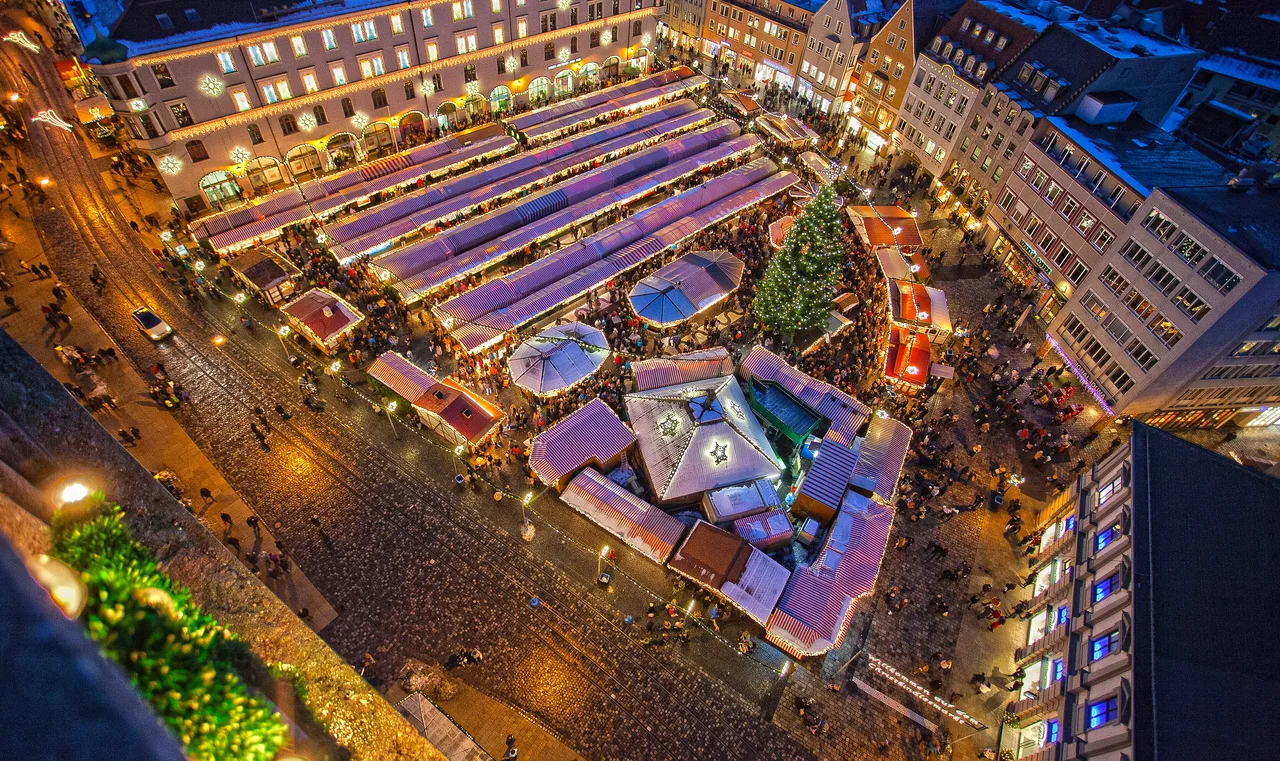
According to its official website, the Augsburger Christkindlesmarkt is one of Germany’s oldest Christmas markets: its roots go back to the 15th century and it has officially carried the name “Christkindlesmarkt” since 1949. The market fills Rathausplatz in front of Elias Holl’s Renaissance Town Hall and the Perlachturm, plus the surrounding streets; a giant Christmas pyramid, a Christmas tree and decorated wooden huts fill the square. Its signature is the Engelesspiel: 23 people dressed as golden-winged angels appear in the windows of the Town Hall façade to music, turning the façade into a living Advent calendar after dark. The tradition has continued since 1977. The official site also presents the Kinderweihnachtsmarkt (children’s Christmas market), the Augsburger Märchenstraße with fairy-tale scenes, the Christkindles-Postamt where letters to the Christ Child are sent, and the large nativity scene (Krippe). Stalls sell Augsburg crafts, Christmas decorations, wooden figures, mulled wine, roasted almonds and Lebkuchen.


| Event | Location | 2026 dates | Note |
|---|---|---|---|
| Augsburger Christkindlesmarkt | Rathausplatz (in front of the Town Hall and Perlachturm) and surroundings | 23 November–24 December 2026 | Opening 23 November 18:00–21:30; Sun–Thu 10:00–20:00, Fri–Sat 10:00–21:30; 23 December 10:00–21:30; 24 December 10:00–14:00. |
| Engelesspiel | Façade windows of the Town Hall | Evening of 23 November; 27–29 November, 4–6 December, 11–13 December, 18–20 December and 23 December | 23 people dressed as angels appear in the windows to music; check performance times on the official site. |
| Kinderweihnachtsmarkt | Within the market area | Throughout the market | Activities and stalls for children; details on the official site. |
| Augsburger Märchenstraße | Fairy-tale lane linked to the market | Throughout the market | Moving fairy-tale scenes; for families with children. |
| Christkindles-Postamt and Krippe | Right next to the nativity scene | Throughout the market | Children can write to the Christ Child; large nativity scene. |
What to try
Glühwein
Spiced mulled wine; contains alcohol, most stalls also offer alcohol-free Kinderpunsch.
Gebrannte Mandeln
Sugar-roasted almonds.
Lebkuchen
Spiced Christmas biscuit, often decorated as a heart.
Bratwurst
Grilled sausage in a roll; usually contains pork.
Schupfnudeln
Potato noodles pan-fried with sauerkraut; may include bacon.
Heiße Maronen
Roasted chestnuts in a paper cone.
Tips for the Augsburger Christkindlesmarkt
- In December it gets dark in Augsburg around 16:30; plan sights by day and the market in the evening.
- The Engelesspiel is only performed on certain days; plan your weekend around them and arrive early, the square fills up.
- On the opening day, 23 November, the market only opens at 18:00.
- The market closes at 14:00 on 24 December.
- A deposit is usually charged on mulled-wine mugs; return them or keep one as a souvenir.
- Weekday afternoons are calmer; Friday and Saturday evenings are the busiest.
- The Golden Hall of the Town Hall is right beside the market; combine a daytime visit with the market.
- The nearest tram stops to Rathausplatz are Rathausplatz or Moritzplatz; check lines on the official sites.
Check before you go: Augsburger Christkindlesmarkt 2026 (official) ↗ · Stadt Augsburg · augsburg.de (official) ↗
Dates and times checked against the official augsburger-christkindlesmarkt.de site on 28 October 2026. Engelesspiel times and the programme may change; check the official site before you go.
When to Go
Augsburg sits on the Bavarian plain north of the Alps, with cold winters and mild summers. Spring and summer are ideal for the fountains, canals and Fuggerei gardens; summer brings water sports to the Eiskanal. 8 August is the Augsburg Peace Festival, a public holiday only in Augsburg. From late November to 24 December the Christkindlesmarkt lights up the centre. January and February are cold and quiet, good for museums.
| Month | Sightseeing | Christmas market | Day trips | Crowds |
|---|---|---|---|---|
| January | Difficult | None | Difficult | Quiet |
| February | Difficult | None | Difficult | Quiet |
| March | Good | None | Good | Quiet |
| April | Very good | None | Very good | Moderate |
| May | Very good | None | Very good | Moderate |
| June | Very good | None | Very good | Moderate |
| July | Very good | None | Very good | Busy |
| August | Very good | None | Very good | Busy |
| September | Very good | None | Very good | Moderate |
| October | Very good | None | Very good | Moderate |
| November | Good | Market season | Good | Moderate |
| December | Good | Market season | Difficult | Busy |
- Winters are cold, often around freezing, and it can snow.
- In December the sun rises around 08:00 and sets around 16:30; plan sightseeing around daylight.
- The Christkindlesmarkt is open from 23 November to 24 December 2026.
- Climbing the Perlachturm is seasonal; check winter opening in advance.
- Some museums close on Mondays; winter hours may differ.
- Old-town hotels fill up fast on Engelesspiel weekends; book early.
Visa and Entry (Turkish citizens)
Turkish citizens holding an ordinary (burgundy) passport need a Schengen visa for tourist travel to Germany. Rules differ for special, service and diplomatic passports; check the current position with the Turkish Ministry of Foreign Affairs.
You apply to the representation of your main destination. If Germany is the main destination, applications go through the German missions in Türkiye; current information on the application process is at tuerkei.diplo.de.
If you combine Augsburg with Austria or Switzerland, apply to the country where you will stay longest; if stays are equal, to the country of first entry.
Under the EU Entry/Exit System (EES), being phased in, your biometric data (facial image and fingerprints) may be taken at first entry; allow extra time at the border.
Visa fees, appointment waiting times and required documents may change; this guide does not quote fees. Use the current lists on the official pages before applying.
Travel medical insurance, proof of accommodation and return are part of the application; details are in the official sources.
Check before you go: T.C. Dışişleri Bakanlığı · Türk vatandaşlarının tabi olduğu vize uygulamaları ↗ · tuerkei.diplo.de ↗ · EES · europa.eu ↗ · Rota Atlası visa guide (TR)
Travel medical insurance
Check the official visa and entry sources above first: they state whether travel medical insurance is required and the minimum cover. Compare any policy’s cover amount, validity dates and countries covered with the official requirement.
Rota Atlası does not currently offer an insurance partnership; there are no paid links in this section. Last updated: 1 November 2026
Getting to Augsburg
- By air: Augsburg has no major airport of its own. The nearest major airport is Munich (MUC); Memmingen (FMM) is another option. Check current flights from Türkiye only on airline and airport websites.
- By train from Munich: frequent regional and long-distance trains run between Munich Hauptbahnhof and Augsburg; from the airport, change in Munich. Check times on bahn.de.
- By train from other cities: Augsburg has direct or connecting trains to Stuttgart, Ulm and Nuremberg; check bahn.de.
- From the station to the old town: Rathausplatz is about 15 minutes on foot from Augsburg Hauptbahnhof; trams also run to the centre.
Getting Around

On foot
The old town is compact; Rathausplatz, the Fuggerei, Maximilianstraße, the Cathedral and St. Ulrich are within walking distance.
Tram and bus
Local transport is run by swa (Stadtwerke Augsburg) under the AVV tariff. Check tickets on avv-augsburg.de.
Regional trains
Regional trains run towards Munich, Ulm and Füssen; check bahn.de.
Bike
Paths along the Lech are flat; in winter they may be wet or icy.
Waterway walk
You can walk along the canals of the UNESCO water system in the Lechviertel.
Day trips
Munich, Neuschwanstein (via Füssen), Ulm and Romantic Road towns make easy day trips.
Things to See
Augsburg’s old town lies on a ridge running from the Cathedral in the north to the Basilica of St. Ulrich and Afra in the south. In the middle are Rathausplatz and the Perlachturm, to the south Maximilianstraße and the Fugger Houses, and to the east the canal-laced Lechviertel and the Fuggerei. The water towers stand at the Rotes Tor; the Eiskanal is in the south-east of the city.
Icon of the Renaissance
Town Hall, Golden Hall and Perlachturm

Built by architect Elias Holl in 1615–1620, Augsburg Town Hall is considered one of the most important Renaissance buildings north of the Alps. The imperial eagle and the city’s symbol, the pine cone (Zirbelnuss), crown its façade. The Golden Hall (Goldener Saal) on the third floor, with its gilded ceiling, murals and grand portals, is the building’s most famous room; destroyed in the Second World War, it was rebuilt and reopened in 1985, the city’s 2,000th anniversary. Next door the Perlachturm, the old watchtower, can be climbed seasonally and offers wide views over the red roofs.
Don’t miss
- The gilded ceiling of the Golden Hall
- The Town Hall façade and the Zirbelnuss
- The Perlachturm
- The Augustus Fountain on Rathausplatz
Tips
- Check Golden Hall visiting hours on augsburg.de; it may close for official events.
- Climbing the Perlachturm is seasonal; check opening days.
- In Advent the Engelesspiel takes place on this façade.

The world’s oldest social housing
Fuggerei

Founded by Jakob Fugger in 1521 for needy Augsburg citizens, the Fuggerei is known as the world’s oldest social housing estate still in use. In this “town within a town”, with its own gates, streets and church, people still live in the yellow terraced houses; the annual rent has been kept at a symbolic level since the foundation, and residents commit to daily prayers for the founders. Visitors can see a museum flat, a historic flat and an exhibition in the Second World War bunker. Information on the Fuggerei and the Fugger foundations is at fugger.de.
Don’t miss
- The yellow lanes of the Fuggerei
- The museum flat
- The wartime bunker exhibition
- Doorbells and bell pulls
Tips
- Entry to the Fuggerei is charged; check hours on fugger.de.
- This is a residential area; respect residents’ privacy and don’t photograph inside homes.
- The gates close in the evening; plan a daytime visit.

Merchant princes
Maximilianstraße, Fugger Houses and Damenhof

Wide Maximilianstraße, running from Rathausplatz to St. Ulrich, is Augsburg’s grandest street; once the site of the medieval wine and meat markets, it is lined with Renaissance and Baroque mansions. The Fugger Houses (Fuggerhäuser), built for Jakob Fugger in the early 16th century, were the family’s home and business headquarters. Inside, the Italian-style Renaissance courtyard known as the Damenhof is considered one of the first Renaissance courtyards in Germany. The Mercury and Hercules fountains on the street are part of the UNESCO water heritage.
Don’t miss
- The Fugger Houses façade
- The Damenhof courtyard
- The mansions of Maximilianstraße
- The monumental fountains on the street
Tips
- The Damenhof is usually accessible during the day; if closed, view the façade.
- The street is lit and atmospheric in the evening.
- St. Ulrich and Afra stands at the southern end of Maximilianstraße.

UNESCO World Heritage
Monumental Fountains: Augustus, Mercury and Hercules

The grandest elements of the Augsburg Water Management System are three monumental bronze fountains from the late 16th and early 17th centuries. The Augustus Fountain (1594) on Rathausplatz is by Hubert Gerhard; the Mercury (1599) and Hercules (1602) fountains on Maximilianstraße are by Adriaen de Vries. The fountains symbolised the city’s pride in its water supply and technology; the river gods on the statues represent Augsburg’s rivers. Some of the original bronzes are kept in the Maximilianmuseum. UNESCO listing ↗
Don’t miss
- The Augustus Fountain and its river gods
- The Mercury Fountain
- The Hercules Fountain
- The original bronzes in the Maximilianmuseum
Tips
- Fountains may be covered in winter for protection.
- All three can be seen on one walk from Rathausplatz along Maximilianstraße.
- Check Maximilianmuseum hours on kunstsammlungen-museen.augsburg.de.


UNESCO World Heritage
Rotes Tor Water Towers, Lechviertel and Eiskanal

Inscribed by UNESCO in 2019, the Augsburg Water Management System comprises 22 components – canals, water towers, fountains and hydropower plants – that have kept drinking water and service water separate since the Middle Ages. The water towers at the Rotes Tor are among the oldest in Germany and supplied the city’s fountains from the 15th century onwards. The Lechviertel east of the old town, with its canals and bridges, was the craftsmen’s quarter. In the south-east of the city, the Eiskanal, built for the canoe slalom of the 1972 Munich Olympics, was the world’s first artificial whitewater course and is still in use. UNESCO listing ↗
Don’t miss
- The Rotes Tor and water towers
- The Lechviertel canals
- The Eiskanal course
- UNESCO water system information points
Tips
- Check visiting options for the water towers on official sites; they are usually seen on guided tours.
- Walking along the Lechviertel canals is free.
- There may be no competitions at the Eiskanal in winter; it can be seen from outside.


Industrial heritage
State Textile and Industry Museum (TIM) and Hydropower Plants

In the 19th century, water power from the canals made Augsburg one of southern Germany’s major textile and industrial centres. Housed in the buildings of a former worsted spinning mill, the State Textile and Industry Museum (TIM) tells this industrial story through looms, fabric patterns and fashion. Historic hydropower plants and machine halls, part of the water management system, show how water powered the city’s economy. UNESCO listing ↗
Don’t miss
- The looms at TIM
- The fabric pattern archive
- A historic machine hall
- Industrial buildings along the canals
Tips
- Check TIM opening hours on its official site.
- Some historic power plants can only be visited on guided tours.
- TIM is easily reached from the centre by tram.

Two denominations side by side
St. Ulrich and Afra and the Moritzkirche

At the southern end of Maximilianstraße, the Basilica of St. Ulrich and Afra is a Late Gothic church holding the tombs of the city’s patron saints Ulrich and Afra; its onion-domed tower is a symbol of the Augsburg skyline. The small Protestant church of St. Ulrich, built right against it, is seen as a symbol of the two denominations living side by side and of the 1555 Peace of Augsburg. At the northern end of the street, the Moritzkirche was rebuilt after the Second World War, and its interior was renewed in the 2010s with a pared-back, light-filled design.
Don’t miss
- The onion-domed tower of St. Ulrich and Afra
- The tombs of the saints
- The Protestant church of St. Ulrich
- The minimalist interior of the Moritzkirche
Tips
- Don’t walk around during services; check opening times.
- Combine both churches by walking Maximilianstraße from north to south.
- Take photos without flash.

Medieval stained glass
Augsburg Cathedral (Mariä Heimsuchung)

Augsburg Cathedral rises in the north of the old town, on the site of the Roman town and the early medieval bishopric. Combining Romanesque and Gothic parts, its most famous treasure is the Prophets’ Windows in the south nave; dating to the 12th century, these figurative windows are counted among the oldest stained-glass windows in the world still in their original place. The cathedral’s bronze door panels and Gothic sculptures are also notable, and Roman remains and diocesan buildings surround it.
Don’t miss
- The Prophets’ Windows
- The bronze door panels
- The Gothic choir
- Roman traces around the cathedral
Tips
- Visits are restricted during services; check bistum-augsburg.de.
- The originals of the bronze doors are shown in the Diözesanmuseum St. Afra next to the cathedral; check hours.
- The cathedral is about 10 minutes on foot from Rathausplatz.
Reformation and Renaissance
St. Anna and the Fugger Chapel

St. Anna is the heart of Augsburg’s Reformation history: when Martin Luther came to the city in 1518 he stayed in its Carmelite monastery, part of which is now a Luther memorial. The Fugger Chapel (1509–1512) at the west end of the church is regarded as one of the first Renaissance buildings in Germany and holds the tombs of the Fugger brothers. The Goldsmiths’ Chapel (Goldschmiedekapelle) is famous for its Gothic wall paintings.
Don’t miss
- The Fugger Chapel
- The Goldschmiedekapelle wall paintings
- The Luther memorial
- The church courtyard
Tips
- Visits are restricted during services and concerts.
- Check the Luther memorial’s opening hours.
- The church is a few minutes’ walk from Rathausplatz.
Rococo and painting
Schaezlerpalais

The Schaezlerpalais on Maximilianstraße is a Rococo palace built in the 18th century for a banking family. Its famous Rococo banqueting hall (Festsaal), with mirrors, gilding and a ceiling fresco, is one of the most beautiful Rococo halls in Germany; according to tradition the young Marie Antoinette danced here in 1770 on her journey to Paris. The palace houses the German Baroque Gallery and the State Gallery; Albrecht Dürer’s portrait of Jakob Fugger is one of the collection’s most famous works.
Don’t miss
- The Rococo banqueting hall
- Dürer’s portrait of Jakob Fugger
- The German Baroque Gallery
- The palace garden
Tips
- Check hours and tickets on kunstsammlungen-museen.augsburg.de.
- It may be closed on Mondays.
- The palace is right next to the Hercules Fountain.
Music and literature
Leopold Mozart House, Brecht, the Puppenkiste and the Synagogue

Leopold Mozart, father of Wolfgang Amadeus Mozart, was born in Augsburg in 1719; his birthplace on Frauentorstraße is now the Leopold-Mozart-Haus museum, telling the story of the Mozart family’s Augsburg ties. Playwright Bertolt Brecht was also born in Augsburg, in 1898; his birthplace can be visited as the Brechthaus. Founded in 1948 in the Heilig-Geist-Spital, the Augsburger Puppenkiste marionette theatre became part of generations of German childhoods through its television productions; the “die Kiste” museum in the same building displays the puppets. The Augsburg Synagogue on Halderstraße (1913–1917) is known as one of Germany’s most beautiful synagogues; the domed Art Nouveau building survived the Second World War and is today home to both the congregation and the Jewish Museum Augsburg Swabia.
Don’t miss
- The Leopold-Mozart-Haus
- The Brechthaus
- The synagogue’s domed prayer hall
- The Jewish Museum’s exhibitions
Tips
- Check museum hours on the official sites.
- There may be security checks at the synagogue; carry ID.
- The Leopold-Mozart-Haus is close to the Cathedral.

Green Augsburg
Botanical Garden, Zoo and Siebentischwald

South of the historic centre, at the edge of the city forest, Augsburg’s best-loved green spaces sit side by side. The Botanical Garden was founded on its present site in 1936 on 1.7 hectares; today it covers about 10 hectares with more than 3,100 plant species and varieties, and in spring more than a million bulbs flower. The Japanese garden of about 4,200 m², created for the 1985 Bavarian State Garden Show, is a pond garden with stone lanterns designed by architect Yoshikuni Araki after models in Kyoto; the rose garden and the glasshouse with tropical plants are among the other highlights. Only a footpath separates the garden from the neighbouring Zoo Augsburg: opened on 12 June 1937 as a park for native animals and expanded with exotic species after the war, the zoo covers about 22 hectares and welcomes more than 650,000 visitors a year. To the south begins the Siebentischwald, a forest of about 660 hectares that holds wells for the city’s drinking water; it takes its name from a popular 19th-century excursion inn said to have had seven tables. Botanical Garden (official) →
Don’t miss
- The Japanese garden: pond, stone lanterns and granite rocks
- The rose garden and the tropical glasshouse
- The animal enclosures of Zoo Augsburg
- A forest walk or bike ride in the Siebentischwald
Tips
- The Botanical Garden and the zoo can be reached by city bus and combine easily on the same day; check sw-augsburg.de for current lines and times.
- Check opening hours and tickets on botanischer-garten-augsburg.de and zoo-augsburg.de before you go.
- The Siebentischwald is a drinking-water protection area; stay on marked paths and follow local rules.

1–3 Day Itineraries, a Christmas Day + a 7-Day Bavaria and Swabia Route
The itineraries keep walking distances short and allow for short winter days. One day is enough for Rathausplatz, the Fuggerei and Maximilianstraße; two days add museums and the water heritage, three a trip to Munich or Neuschwanstein. The 7-day route combines Augsburg with Bavarian highlights. Check opening hours on the official sites in advance.
Day 1: Renaissance Augsburg
- Start at the Town Hall and Golden Hall on Rathausplatz.
- Climb the Perlachturm if it is in season.
- Visit the Fuggerei and its museum flat.
- Walk along Maximilianstraße to the Fugger Houses and the Damenhof.
- End the day at St. Ulrich and Afra.
Day 2: Water heritage and museums
- In the morning see the Cathedral and its Prophets’ Windows.
- Visit the Leopold-Mozart-Haus.
- In the afternoon see the Rococo hall of the Schaezlerpalais.
- Walk along the Lechviertel canals to the Rotes Tor water towers.
- In the evening see a show at the Augsburger Puppenkiste (book ahead).
Day 3: Munich or Neuschwanstein
- Take the train to Munich and explore the old town.
- Alternatively visit Neuschwanstein via Füssen (tickets may need to be booked ahead).
- Or stay in Augsburg for TIM and the Eiskanal.
- Return to Augsburg in the evening.
- Finish the day at the Christkindlesmarkt.
Christmas Day (23 November–24 December 2026)
- In the morning see the Fuggerei in daylight.
- At midday visit the Golden Hall.
- In the afternoon see the Fugger Chapel in St. Anna.
- In the evening stroll through the Christkindlesmarkt on Rathausplatz.
- If it is an Engelesspiel day, watch the angels in the Town Hall windows.
7 Days: Bavaria and Swabia
- Days 1–3: Augsburg – Renaissance, water heritage and museums.
- Day 4: Munich.
- Day 5: Füssen and Neuschwanstein.
- Day 6: Ulm and Ulm Minster.
- Day 7: Depart from Munich.
Augsburg and Swabian Food
Augsburg is where Swabian and Bavarian cooking meet; noodles and dumplings, plum cakes and beer culture stand out. These are traditional dishes, not restaurant recommendations.

Käsespätzle
Swabian egg noodles with cheese and fried onions; a vegetarian classic.
Maultaschen
Large Swabian filled pasta with meat or spinach, served in broth or pan-fried; may contain pork.
Zwetschgendatschi
Plum sheet cake; Augsburg’s nickname “Datschiburg” comes from it.
Schupfnudeln
Potato noodles pan-fried with sauerkraut.
Leberkäse
Baked meat loaf; usually contains pork.
Brezel
The salted pretzel bread of Bavaria and Swabia.
Augsburg beer
The city’s long brewing tradition; contains alcohol.
Glühwein and Lebkuchen
The Christmas market’s mulled wine (alcoholic) and spiced biscuits.
- Many traditional dishes contain pork; ask about ingredients.
- Vegetarian options such as Käsespätzle are common.
- Tap water is of high quality; you need to ask for it specifically.
- Service is included in prices; rounding up by 5–10 per cent is common.
Culture and Etiquette

- “Grüß Gott” is the usual greeting in Bavaria; “Servus” among friends.
- Use the formal “Sie” in formal situations.
- Don’t walk around churches during services or use flash.
- The Fuggerei is a residential area; respect residents’ privacy.
- People queue at bakeries, stalls and stops.
- Small amounts are still often paid in cash at stalls.
- Cyclists use marked lanes; don’t walk in them.
- Sunday is a day of rest; most shops are closed.
- Punctuality is expected for tours and shows.
- Ask before photographing people, especially at markets.
Safety and Health
- Augsburg is generally safe; watch your valuables in market crowds and at the station.
- Cobblestones are slippery when wet or icy; wear non-slip shoes.
- Watch for trams in the centre; they approach quietly.
- Canal edges can be slippery in winter.
- In an emergency call 112, police 110.
- Make sure your travel medical insurance covers the Schengen area.
- Pharmacies display the address of the nearest on-duty pharmacy.
What Your Budget Depends On
This guide does not give prices; prices change with season and year. Your budget depends on these factors:
Travel dates
Engelesspiel weekends push up hotel demand.
Accommodation
The old town is most practical; the station area is an alternative.
Transport
The centre is walkable; AVV tickets cover trams.
Sights and museums
The Fuggerei, Golden Hall and museums each charge separately.
Food and drink
Market snacks and bakeries are affordable; restaurants vary widely.
Day trips
Munich and Neuschwanstein add transport and ticket costs.
Free experiences
The Christkindlesmarkt and Engelesspiel (free entry), the fountains, Maximilianstraße, the Cathedral, St. Ulrich and the Lechviertel are free.
Practical Information
- Money: euro; cards common, carry some cash.
- Language: German; English understood in tourism.
- Sockets: 230 V, type C/F.
- Time: CET (UTC+1) in winter.
- Opening hours: winter hours differ; some museums close Mondays.
- Shops: closed on Sundays; the Christmas market is open.
- Holidays: changed hours on 24–26 and 31 December and 1 January; 8 August is a holiday only in Augsburg.
- Weather: cold in December, roughly -3 to 4 °C.
- Daylight: sunset around 16:30 in December.
- Emergency: 112; police 110.
Frequently Asked Questions
When is the Augsburger Christkindlesmarkt 2026?
According to the official site, from 23 November to 24 December 2026 on Rathausplatz.
What are the opening hours?
Sun–Thu 10:00–20:00, Fri–Sat 10:00–21:30; opening day 23 November 18:00–21:30; 23 December 10:00–21:30; 24 December 10:00–14:00.
What is the Engelesspiel and when can I see it?
A tradition in which 23 people dressed as angels appear to music in the Town Hall windows; on 23 November and set days at Advent weekends. Check times on the official site.
Is there an entry fee for the market?
No; food, drink and gifts are paid for.
Do Turkish citizens need a visa?
Holders of ordinary passports need a Schengen visa. If Germany is the main destination, see tuerkei.diplo.de.
Which airport is closest to Augsburg?
Munich (MUC); Memmingen (FMM) is another option. Check current flights on airport websites.
How many days are enough?
One day for the centre, two with museums and the water heritage, three with a trip to Munich or Neuschwanstein.
What is the Fuggerei?
A quarter founded by Jakob Fugger in 1521, known as the world’s oldest social housing estate still in use.
What does the UNESCO site include?
The Augsburg Water Management System: 22 components including canals, water towers, monumental fountains, hydropower plants and the Eiskanal (2019).
What should I take home from Augsburg?
Crafts from the Christkindlesmarkt, Puppenkiste souvenirs and Swabian treats.
Where to stay
Stay close to the areas where you will spend most time. The areas below are covered in detail in this guide; check public transport links in the getting-around section.
- Icon of the RenaissanceTown Hall, Golden Hall and Perlachturm
- The world’s oldest social housingFuggerei
- Merchant princesMaximilianstraße, Fugger Houses and Damenhof
- UNESCO World HeritageMonumental Fountains: Augustus, Mercury and Hercules
- UNESCO World HeritageRotes Tor Water Towers, Lechviertel and Eiskanal
- Industrial heritageState Textile and Industry Museum (TIM) and Hydropower Plants
- Two denominations side by sideSt. Ulrich and Afra and the Moritzkirche
- Medieval stained glassAugsburg Cathedral (Mariä Heimsuchung)
- Reformation and RenaissanceSt. Anna and the Fugger Chapel
- Rococo and paintingSchaezlerpalais
- Music and literatureLeopold Mozart House, Brecht, the Puppenkiste and the Synagogue
- Green AugsburgBotanical Garden, Zoo and Siebentischwald
Search hotels in these areas (Hotellook) ↗ (affiliate link)Search on Booking.com ↗
Affiliate disclosure: Hotellook, Aviasales, Klook, Airalo, Tiqets and DiscoverCars links are affiliate links; Rota Atlası may earn a commission on bookings made through them, at no extra cost to you. Official and in-guide links are not paid. Last updated: 1 November 2026 · Privacy and affiliates
Transport and connectivity
- Airport transferOptions from the airport to the city are in this guide’s getting there section.
- Mobile data (eSIM)Airalo eSIM ↗ (affiliate link)
- TrainsOfficial rail website ↗
- Car hireYou rarely need a car within the city; see getting around first. Compare car hire on DiscoverCars ↗ (affiliate link)
Affiliate disclosure: Hotellook, Aviasales, Klook, Airalo, Tiqets and DiscoverCars links are affiliate links; Rota Atlası may earn a commission on bookings made through them, at no extra cost to you. Official and in-guide links are not paid. Last updated: 1 November 2026 · Privacy and affiliates
Search flights (affiliate link)
Search flights from any airport in any country. Results open on Aviasales in a new tab, where you book.
This form is an affiliate link: Rota Atlası may earn a commission on bookings made via Aviasales (Travelpayouts), at no extra cost to you. Check price, baggage and terms on the booking site. Airport data: OurAirports (public domain).
Flights, hotels and tours
Find tours and tickets
- Augsburger Christkindlesmarkt
GetYourGuide ↗ · Klook ↗ (affiliate link) - Augsburg Town Hall and Golden Hall (Goldener Saal)
GetYourGuide ↗ · Klook ↗ (affiliate link) - Fuggerei
GetYourGuide ↗ · Klook ↗ (affiliate link) - Augsburg Cathedral (Dom Mariä Heimsuchung)
GetYourGuide ↗ · Klook ↗ (affiliate link)
Hotellook, Aviasales, Klook, Airalo and Tiqets links in this box are affiliate links (Travelpayouts): Rota Atlası may earn a commission on bookings made through them, at no extra cost to you. GetYourGuide links currently carry no affiliate code. Check prices and terms with the provider. Last updated: 1 November 2026 · Privacy and affiliates
Sources
- T.C. Dışişleri Bakanlığı · Türk vatandaşlarının tabi olduğu vize uygulamaları ↗
- Auswärtiges Amt · Deutsche Vertretungen in der Türkei (Visa) ↗
- European Union · Entry/Exit System (EES) ↗
- Regio Augsburg Tourismus · augsburg-tourismus.de (official) ↗
- Stadt Augsburg · augsburg.de (official) ↗
- Fürstlich Fuggersche Stiftungen · Fuggerei (official) ↗
- Kunstsammlungen und Museen Augsburg (official) ↗
- Bistum Augsburg · Dom (official) ↗
- Augsburger Puppenkiste (official) ↗
- Staatliches Textil- und Industriemuseum Augsburg (official) ↗
- Jüdisches Museum Augsburg Schwaben (official) ↗
- Augsburger Wassermanagement-System · UNESCO-Welterbe (official) ↗
- AVV · Augsburger Verkehrs- und Tarifverbund (official) ↗
- Deutsche Bahn ↗
- Munich Airport (official) ↗
- Memmingen Airport (official) ↗
- GOV.UK · Foreign travel advice · Germany ↗
- UNESCO World Heritage Centre · Water Management System of Augsburg ↗
- Augsburger Christkindlesmarkt 2026 (official) ↗
- Stadt Augsburg · augsburg.de (official) ↗
This page is for information only. Dates, hours, entry rules and transport information can change; check the official sources above before travelling. No prices, flights, hotels or restaurants have been invented in this guide.
Photo credits
The photos on this page come from Wikimedia Commons and are used under the stated authors and licences (CC BY, CC BY-SA, CC0 or public domain). Full list of sources
- The Christkindlesmarkt on Augsburg’s Rathausplatz — User:Neitram · CC BY-SA 4.0 · Wikimedia Commons
- A view over the Augsburger Christkindlesmarkt from above — Maximus-fotografie · CC BY-SA 3.0 · Wikimedia Commons
- Christkindlesmarkt huts on the Rathausplatz — -wuppertaler · CC BY 4.0 · Wikimedia Commons
- The Christmas market in front of the Town Hall — Alois Wüst · CC BY-SA 3.0 · Wikimedia Commons
- A decorated stall detail at the Augsburger Christkindlesmarkt — Alois Wüst · CC BY-SA 3.0 · Wikimedia Commons
- The Augsburg Christmas market lit up at night — Maustadt · CC BY-SA 4.0 · Wikimedia Commons
- Handmade nativity figures at the Christmas market — Alois Wüst · CC BY-SA 3.0 · Wikimedia Commons
- Illuminated stars and lanterns at the Christmas market — Alois Wüst · CC BY-SA 3.0 · Wikimedia Commons
- Christmas market stalls on the Fuggerplatz — -wuppertaler · CC BY 4.0 · Wikimedia Commons
- The Renaissance Town Hall and Perlachturm on the Rathausplatz — Mailtosap · CC BY-SA 4.0 · Wikimedia Commons
- The gilded Golden Hall in the Town Hall — Pierre André Leclercq · CC BY-SA 4.0 · Wikimedia Commons
- Maximilianstraße and the Perlachturm — Nikolai Karaneschev · CC BY 3.0 · Wikimedia Commons
- The bronze Augustus Fountain on the Rathausplatz — Reinhardhauke · CC BY-SA 3.0 · Wikimedia Commons
- The Hercules Fountain on Maximilianstraße — Tilman2007 · CC BY-SA 3.0 · Wikimedia Commons
- The Mercury Fountain on Maximilianstraße — Z thomas · CC BY-SA 4.0 · Wikimedia Commons
- Maximilianstraße and the Basilica of St. Ulrich and Afra — Nikolai Karaneschev · CC BY 3.0 · Wikimedia Commons
- The Basilica of St. Ulrich and Afra in afternoon light — Alois Wüst · CC BY-SA 3.0 · Wikimedia Commons
- The Moritzkirche in Augsburg — Jorge Franganillo · CC BY 2.0 · Wikimedia Commons
- A view south over Augsburg’s roofs from the Perlachturm — Muck · CC BY-SA 4.0 · Wikimedia Commons
- The yellow terraced houses of the Fuggerei on a winter day — Allie_Caulfield from Germany · CC BY 2.0 · Wikimedia Commons
- A quiet lane in the Fuggerei — High Contrast · CC BY 3.0 de · Wikimedia Commons
- The Fugger Houses on Maximilianstraße — Alois Wüst · CC BY-SA 3.0 · Wikimedia Commons
- A Renaissance courtyard in the Fugger Houses — GZagatta · CC BY-SA 4.0 · Wikimedia Commons
- The garden of the Schaezlerpalais — Ricardalovesmonuments · CC BY-SA 4.0 · Wikimedia Commons
- The interior of Augsburg Cathedral — Otto Schemmel · CC BY-SA 2.0 de · Wikimedia Commons
- The Augsburger Puppenkiste marionette theatre — Immanuel Giel · Public domain · Wikimedia Commons
- The historic travelling coach in the Leopold-Mozart-Haus — Simonpickel · CC BY-SA 4.0 · Wikimedia Commons
- The domed Augsburg Synagogue on Halderstraße — Kangaroo64 · CC BY-SA 4.0 · Wikimedia Commons
- The water towers at the Rotes Tor, with St. Ulrich on the left — Regio Augsburg Tourismus GmbH, Fotograf: Reinhard Paland · CC BY-SA 3.0 de · Wikimedia Commons
- The historic machine hall of the Hochablass waterworks — Muehlenbernd · CC BY 4.0 · Wikimedia Commons
- The Eiskanal, the 1972 Olympic canoe course — buzzard525 · CC BY 3.0 · Wikimedia Commons
- The Rotes Tor city gate in Augsburg — H.Helmlechner · CC BY-SA 4.0 · Wikimedia Commons
- The building of the State Textile and Industry Museum (TIM) — Ricardalovesmonuments · CC BY-SA 4.0 · Wikimedia Commons
- A tram in Augsburg — Mauritsvink · Public domain · Wikimedia Commons
- The Goldschmiedekapelle in St. Anna’s Church — Mogadir · CC BY-SA 3.0 · Wikimedia Commons
- A stall of sweets and Lebkuchen at the Christkindlesmarkt — Alois Wüst · CC BY-SA 3.0 · Wikimedia Commons
Ulm → · Munich → · Nuremberg → · Regensburg → · Stuttgart → · Rothenburg → · Christmas markets