

Wrocław is a city of about 670,000 people in south-western Poland and the capital of Lower Silesia. It is built on islands formed by the Oder (Odra) River and its branches and, with more than a hundred bridges, is often called a “city of bridges”. Over its history it was ruled by Bohemia, the Habsburgs, Prussia and Germany (its German name is Breslau), and it became part of Poland after 1945; the historic centre, badly damaged in the war, was rebuilt. At its heart lie the Rynek, one of Poland’s largest historic squares, and the Gothic Town Hall. To the north, Ostrów Tumski, the oldest part of the city, has the cathedral and gas lamps that are lit by hand every evening. Hundreds of bronze dwarfs scattered through the streets are the city’s best-loved symbol. In winter the Rynek, Świdnicka and Oławska streets and Plac Solny become one of Poland’s largest Christmas markets. This guide brings together the Christmas market, the districts, day trips, food and practical information, based on official sources.
Content update: 29 October 2026 · Christmas dates checked on the market’s official website and visitwroclaw.eu
Wrocław at a Glance
- Country
- Poland · Lower Silesia (Dolnośląskie) region
- Population
- About 670,000
- Language
- Polish; English widely used in tourism
- Currency
- Polish złoty (PLN); cards widely accepted, keep some cash for stalls
- Time zone
- Central European Time (CET, UTC+1)
- Highlights
- The Rynek, Ostrów Tumski, the Oder islands, the dwarfs
- Must-see
- Gothic Town Hall, Aula Leopoldina, Racławice Panorama, Centennial Hall
- UNESCO
- Centennial Hall (2006); Świdnica Church of Peace nearby
- Christmas
- Christmas market on and around the Rynek 20 November 2026–7 January 2027
- Transport
- Wrocław Główny station; bus 106 from the airport to the city
- Electricity
- 230 V, type C/E sockets
- Emergency
- 112 (general emergency)
Wrocław in Pictures
The Gothic Town Hall on the Rynek, the towers of Ostrów Tumski across the Oder and Max Berg’s Centennial Hall: Wrocław in three frames.


Wrocław Christmas Market 2026
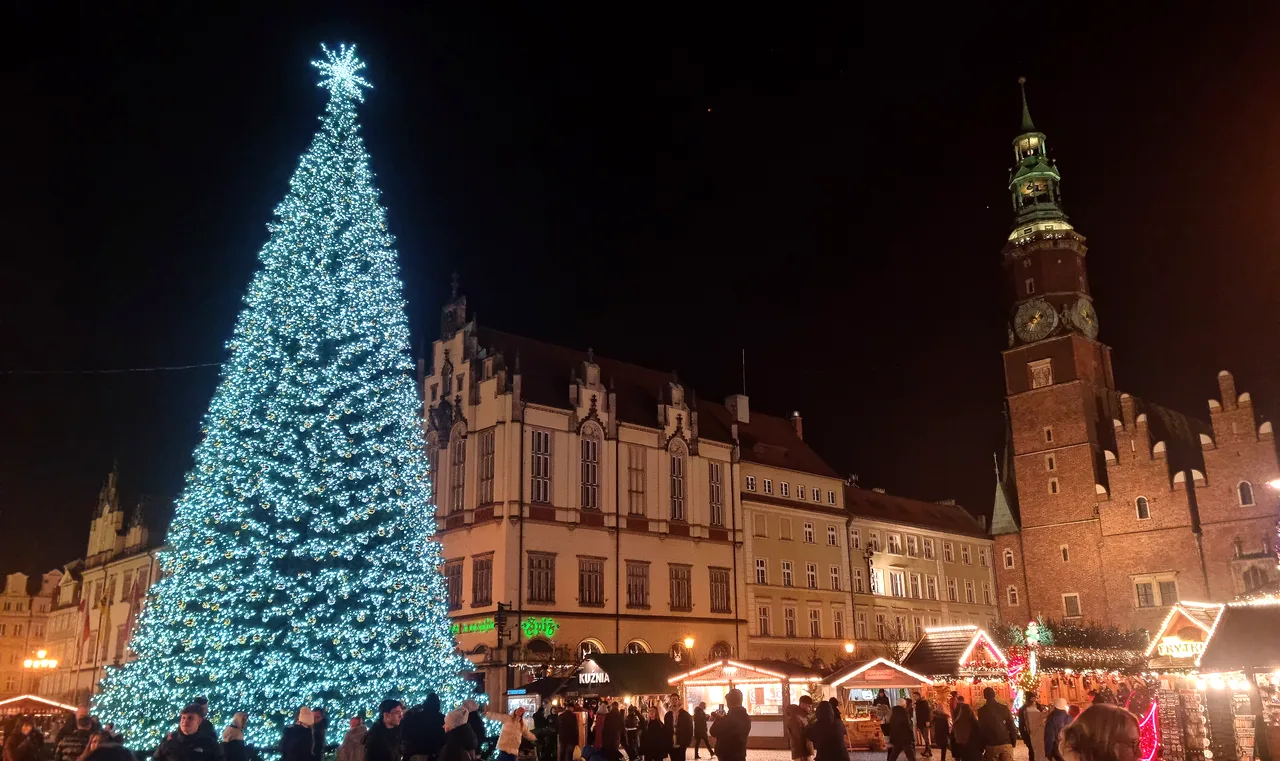
The Wrocław Christmas Market (Jarmark Bożonarodzeniowy) is one of Poland’s largest and best-loved Christmas markets. According to the market’s official website, in 2026 it opens on 20 November and runs until 7 January 2027, with stalls spreading across the whole Rynek, ul. Świdnicka and ul. Oławska and Plac Solny. It is open daily 10:00–21:00; it is closed on 24 and 25 December and 1 January, and opens at 13:00 on 26 December. On 31 December craft stalls close at 17:00 while food stalls stay open until 02:00. The Fairy-tale Forest (Bajkowy Lasek) for children, a lit Christmas windmill and the Christmas-tree-shaped Karuzela Choinka carousel are favourite corners. The “Pod Krasnalem” stall next to the Fredro Monument brings the city’s dwarf tradition to the market, and this is also where you can find the market’s own dwarf, Prezentuś. Large wooden venues such as Karczma pod Łosiem draw crowds with hot drinks and food. Entry to the market is free.


| Event | Location | 2026 dates | Note |
|---|---|---|---|
| Wrocław Christmas Market | Rynek, ul. Świdnicka, ul. Oławska, Plac Solny | 20 November 2026–7 January 2027 | Daily 10:00–21:00; closed 24–25 December and 1 January; from 13:00 on 26 December; free entry. |
| Fairy-tale Forest (Bajkowy Lasek) | Within the Christmas market | During the market | A fairy-tale forest for children; check its exact location on the market map. |
| Karuzela Choinka and the Christmas windmill | Within the Christmas market | During the market | A Christmas-tree carousel and a lit windmill; check operating hours. |
| Pod Krasnalem stall | Next to the Fredro Monument, Rynek | During the market | A stall dedicated to the city’s dwarf tradition. |
| New Year’s Eve | Christmas market | 31 December 2026 | Crafts until 17:00, food stalls until 02:00. |
| Last day of the market | Rynek and surroundings | 7 January 2027 | Check closing times on the official website. |
What to try
Grzaniec
Spiced mulled wine; contains alcohol.
Hot fruit punch or hot chocolate
Alcohol-free options for children and non-drinkers; ask at the stall.
Oscypek
Grilled smoked sheep’s cheese, usually with cranberry jam.
Kiełbasa z grilla
Fire-grilled Polish sausage; usually pork, ask about ingredients.
Pierogi
Dumplings filled with potato and cheese, cabbage and mushroom, or meat.
Pierniki
Spiced gingerbread; decorated hearts as gifts.
Tips for the Wrocław Christmas market
- The market spreads over four areas; start on the Rynek and also walk Świdnicka, Oławska and Plac Solny.
- Weekend evenings are very busy; weekday mornings are calmer.
- The market is closed on 24 and 25 December and 1 January; it opens in the afternoon on 26 December.
- Look out for the bronze dwarfs around the market as you stroll.
- Most stalls take cards; still carry some złoty.
- Hot drinks are sometimes served in deposit mugs; return the mug to get the deposit back.
- Cobblestones can be icy; wear non-slip shoes.
- Carry your bag in front of you in crowds.
Check before you go: Jarmark Bożonarodzeniowy Wrocław 2026 (official) ↗ · Visit Wrocław · events (official) ↗
Dates and hours were checked on 29 October 2026 via the market’s official website (jarmarkbozonarodzeniowy.pl) and visitwroclaw.eu. Programme and hours may change; check the official pages before your visit.
When to Go
Wrocław has a mild continental climate: warm summers and cold winters, though somewhat milder than much of Poland. May to September is best for the Oder banks, the parks and the Japanese Garden. Between late November and early January the Christmas market fills the city. January and February are cold and quiet. Spring and autumn offer a good balance of mild weather and fewer crowds.
| Month | Sightseeing | Christmas market | Outdoors | Crowds |
|---|---|---|---|---|
| January | Good | Market season | Difficult | Quiet |
| February | Good | None | Difficult | Quiet |
| March | Good | None | Good | Quiet |
| April | Very good | None | Good | Moderate |
| May | Very good | None | Very good | Moderate |
| June | Very good | None | Very good | Moderate |
| July | Very good | None | Very good | Busy |
| August | Very good | None | Very good | Busy |
| September | Very good | None | Very good | Moderate |
| October | Very good | None | Good | Moderate |
| November | Good | Market season | Difficult | Moderate |
| December | Good | Market season | Difficult | Busy |
- December days are usually between -2 and 4 °C; snow is possible.
- Christmas market 20 November 2026–7 January 2027; closed 24–25 December and 1 January.
- The Japanese Garden and the multimedia fountain are seasonal; check in winter.
- The Racławice Panorama and museums are open all year.
- Summer is the busiest time.
- Winter days are short; sunset in December is around 15:40.
Visa and Entry (Turkish citizens)
Turkish citizens holding ordinary (burgundy) passports need a Schengen visa for tourist travel to Poland. Special, service and diplomatic passports follow different rules; check the current status on the website of the Turkish Ministry of Foreign Affairs.
Apply to the consulate of your main destination. If Poland is your main destination, the official visa page of the Embassy of Poland in Ankara (gov.pl/web/turcja/wizy) gives up-to-date information on type C (short-stay Schengen) and type D (national) visa applications.
If your trip also includes Germany or Czechia, apply to the country where you will stay longest; if the stays are equal, to the country you enter first.
Under the EU Entry/Exit System (EES), which is being introduced in stages, your biometric data (facial image and fingerprints) may be recorded on first entry; allow extra time at the airport.
Visa fees, appointment waiting times and required documents may change; this guide does not state fees. Use the current lists on the official pages before applying.
Travel medical insurance, accommodation and return documents are part of the application; details are on the official sources.
Check before you go: T.C. Dışişleri Bakanlığı · Türk vatandaşlarının tabi olduğu vize uygulamaları ↗ · gov.pl/web/turcja ↗ · EES · europa.eu ↗ · Rota Atlası visa guide (TR)
Travel medical insurance
Check the official visa and entry sources above first: they state whether travel medical insurance is required and the minimum cover. Compare any policy’s cover amount, validity dates and countries covered with the official requirement.
Rota Atlası does not currently offer an insurance partnership; there are no paid links in this section. Last updated: 1 November 2026
Getting to Wrocław
- By air: Wrocław’s airport is Wrocław Copernicus Airport (WRO), west of the city. Check current flights from Türkiye only on airline and airport websites; this guide does not recommend flights.
- From the airport: bus 106 links the airport with the city centre, with night bus 206 at night. Taxis and ride-hailing apps are also available. Current timetables are on the official websites of the airport and MPK Wrocław.
- By train: Wrocław Główny connects to Kraków, Warsaw, Poznań and Katowice, with links towards Germany. Check current services and journey times on intercity.pl.
- By bus: long-distance buses leave from the bus station behind the train station.
Getting Around

On foot
The Rynek, the University, Ostrów Tumski and Sand Island are within walking distance.
Tram and bus
MPK Wrocław’s tram and bus network reaches Centennial Hall and the zoo; buy tickets from machines or the app and validate them.
Regional train
Regional trains to Świdnica and Wałbrzych (Książ) leave from Wrocław Główny.
Bicycle
Cycle paths run along the Oder; watch for ice in winter.
Taxi
Licensed taxis and ride-hailing apps are common.
Car
Parking in the centre is limited; use car parks.
Things to See
Wrocław’s historic centre lies on the south bank of the Oder, enclosed by the old moat (Fosa Miejska). In the middle are the Rynek and the Town Hall, and to the north the University on the riverbank. Bridges lead to Sand Island and to Ostrów Tumski, the oldest part of the city. To the east are the Racławice Panorama and the National Museum, and further east Centennial Hall, the Japanese Garden and the zoo. Świdnica and Książ are classic day trips to the south-west.
Heart of the city
The Rynek, Town Hall and Plac Solny

Wrocław’s Rynek is one of the largest historic squares in Poland, with a block of buildings in its centre. At the southern end of this block stands the Gothic Town Hall, developed between the 13th and 16th centuries; with its ornate façade, astronomical clock and tower it is considered one of the most impressive Gothic civic buildings in Central Europe. Its cellar, Piwnica Świdnicka, is known as one of the oldest taverns in Europe. Colourful historic houses line the square. At the north-west corner, two small houses joined by an arch are known as “Hansel and Gretel” (Jaś i Małgosia), and just behind them rises St Elizabeth’s Church with its tall tower. Plac Solny at the south-west corner is the former salt market and becomes part of the market at Christmas.
Don’t miss
- The Gothic Town Hall and astronomical clock
- The colourful houses of the Rynek
- The Jaś i Małgosia houses
- The tower of St Elizabeth’s Church
- Plac Solny
Tips
- Check the hours of the city museum in the Town Hall on the official website.
- The viewing terrace of St Elizabeth’s tower may open seasonally; check.
- Cafés on the square can be expensive; look at the menu first.


Dwarf hunting
The Bronze Dwarfs and Jatki

Wrocław’s bronze dwarfs (krasnale) refer to the Orange Alternative movement, which protested against the communist regime with humour in the 1980s. The first official dwarf statue was installed in 2001; today there are hundreds in the city, each with its own name and story. Jatki, right next to the Rynek, is a narrow lane where butchers worked in the Middle Ages; today it is known for artists’ workshops and bronze animal statues erected in memory of slaughtered animals.
Don’t miss
- Hunting for dwarfs around the Rynek
- Jatki lane
- The bronze animal statues
- Prezentuś, the market’s dwarf
Tips
- Dwarf maps may be available at tourist information points.
- The dwarfs are low; take care not to step on them in crowds.
- Dwarf hunting is great fun for children.
Baroque splendour
The University and Aula Leopoldina

The long Baroque main building of the University of Wrocław on the Oder was built by the Jesuits in the 18th century. Inside, the Aula Leopoldina, with its frescoes, sculptures and gilding, is one of the most magnificent Baroque halls in Central Europe. The university museum extends up to the Mathematical Tower, which offers a view over the Rynek and the river.
Don’t miss
- Aula Leopoldina
- The Mathematical Tower
- Oratorium Marianum
- The riverside façade
Tips
- Check the hours and tickets of the university museum on the official website.
- The hall may occasionally be closed for ceremonies.
- The steps and square in front of the building are a good photo spot.

The oldest part of the city
Ostrów Tumski, Tumski Bridge and the Cathedral

Ostrów Tumski (Cathedral Island) is where Wrocław was born, and it keeps its name although it is no longer a true island. With cobbled streets, churches and church buildings, it is a quiet world. Every evening at dusk a lamplighter lights the island’s gas lamps one by one by hand. The green-painted Tumski Bridge leads onto the island. Its symbol is the twin-towered Cathedral of St John the Baptist; a viewing terrace reached by lift in one of the towers offers one of the best views of the city.
Don’t miss
- The Cathedral of St John the Baptist
- The view from the cathedral tower
- Tumski Bridge
- The lighting of the gas lamps at dusk
Tips
- Be on the island at sunset to see the lamplighter.
- Cathedral and tower hours vary with services.
- Look across to the island from the Oder bank under the evening lights.

Islands and river
Sand Island and the Oder Banks

Sand Island (Wyspa Piasek) lies between Ostrów Tumski and the Old Town and is known for the Gothic Church of St Mary on the Sand. The small islands, bridges and riverside paths around it best show Wrocław’s character as a river city. Walking along the Oder you pass bridges from different eras, riverside boulevards and the skyline of towers on the opposite bank.
Don’t miss
- The Church of St Mary on the Sand
- The bridges linking the islands
- A walk along the Oder
- Evening river views
Tips
- The banks can be windy and icy in winter.
- Take photos from the bridges at sunset.
- River boats run in summer; check their status in winter.

A giant painting
The Racławice Panorama and the National Museum

The Racławice Panorama is a giant 15 × 114 metre panoramic painting of the Battle of Racławice in 1794. Completed by Jan Styka and Wojciech Kossak in 1894, it opened to visitors in its own round building in Wrocław on 14 June 1985 after a long post-war interval. Visitors view the painting all around them from a central platform. The nearby National Museum, in its ivy-covered historic building, shows Silesian art and Polish painting collections; the Panorama is part of the National Museum.
Don’t miss
- The Panorama’s 360-degree view
- Silesian art at the National Museum
- The ivy-covered museum building
Tips
- Entry to the Panorama is in groups at set times; check tickets in advance on mnwr.pl.
- An audio guide may be offered in several languages; check the official website.
- Check the weekly closing day of the museum and the Panorama.

Local market
Hala Targowa

Hala Targowa, near the Oder, is a historic market hall built in the early 20th century with reinforced concrete arches. Inside are stalls for fruit and vegetables, meat, cheese, pickles and flowers; it is a lively place where locals do their daily shopping. Its architecture and atmosphere show a different Wrocław from the tourist square.
Don’t miss
- The concrete-arched interior
- Local produce stalls
- Pickle and cheese stalls
Tips
- It may be closed on Sundays and holidays; check the hours.
- Mornings are the liveliest time.
- Cash can be handy at the stalls.
A milestone of modern architecture
Centennial Hall, the Pergola and the Japanese Garden

Centennial Hall (Hala Stulecia) was built in reinforced concrete by the architect Max Berg in 1911–1913 and, with its giant dome, became a pioneering work of modern architecture; it was inscribed on the UNESCO World Heritage List in 2006. Today it is used for concerts and events and has a visitor centre. The semicircular Pergola next to the hall hosts a multimedia fountain in summer. In the adjacent Szczytnicki Park, the Japanese Garden is a tranquil garden that opens seasonally. UNESCO listing ↗
Don’t miss
- The dome of Centennial Hall
- The visitor centre
- The Pergola and fountain
- Szczytnicki Park and the Japanese Garden
Tips
- The multimedia fountain and Japanese Garden are seasonal; check their winter status on official websites.
- You may not see the hall’s interior on event days; check the visitor centre hours.
- Reached by tram from the centre.

Africa on the Oder
Wrocław Zoo and the Afrykarium

Wrocław Zoo, opposite Centennial Hall, is a long-established zoo opened in 1865. Its most famous section is the Afrykarium, which presents Africa’s aquatic ecosystems; with giant aquariums, tunnels and tropical sections it is an indoor world that can also be visited in winter. It is a good option for families on cold days.
Don’t miss
- The Afrykarium aquarium tunnels
- Tropical sections
- The zoo’s outdoor areas
Tips
- Winter hours are shorter; check tickets and times on zoo.wroclaw.pl.
- The Afrykarium can be busy at weekends.
- Combine it with Centennial Hall on the same day.
The central street
Świdnicka Street and the Opera

Ul. Świdnicka, running south from the Rynek, is one of Wrocław’s main streets and becomes part of the market at Christmas. The 19th-century Wrocław Opera stands on it. Around it, the park along the old moat (Fosa Miejska), historic buildings and tram lines show the everyday life of the city.
Don’t miss
- Wrocław Opera
- Świdnicka lit up at Christmas
- Fosa Miejska park
- Historic trams
Tips
- Check the opera programme on the official website.
- The street lights are lovely in the evening at Christmas.
- Trams link the street with the station.

A timber marvel
Świdnica Church of Peace

The Church of Peace in Świdnica, south-west of Wrocław, was built in timber and half-timbering in the 17th century under the limited permission granted to Protestants after the Thirty Years’ War. It is one of the largest timber Baroque churches in Europe and is on the UNESCO World Heritage List together with the Church of Peace in Jawor. The multi-storey wooden galleries and painted decoration inside are striking. UNESCO listing ↗
Don’t miss
- The multi-storey wooden galleries
- The Baroque altar and pulpit
- The churchyard
Tips
- Reached by regional train; check current services.
- Visiting hours vary with services.
- Follow the photography rules inside.
The largest in Silesia
Książ Castle

Książ Castle near Wałbrzych is the largest castle in Silesia and rises above a wooded valley. Grown over centuries in different styles, it can be visited with its halls, terraces and gardens. Tunnels dug beneath the castle during the Second World War are also on show. It can be reached from Wrocław by train and bus as a day trip.
Don’t miss
- The castle halls
- Terraces and gardens
- Valley views
Tips
- Check tickets and hours on the official website.
- Winter hours are shorter.
- A local bus runs from Wałbrzych to the castle.
1–3 Day Itineraries, a Christmas Day + 5-Day Silesia Route
The itineraries keep walking distances short and take short winter days into account. Day one covers the Rynek, the dwarfs and Ostrów Tumski, day two the Panorama, Centennial Hall and the zoo, and day three Świdnica and Książ. The Christmas day is planned around the market, and the 5-day route combines Wrocław with Silesia and Kraków. Check hours on official websites in advance.
Day 1: The Rynek, the dwarfs and Ostrów Tumski
- In the morning see the Town Hall and colourful houses on the Rynek.
- Look for Jatki and the dwarfs around it.
- Visit the Aula Leopoldina at the University.
- Cross via Sand Island to Ostrów Tumski and go up the cathedral tower.
- At sunset watch the lamplighter light the gas lamps.
Day 2: The Panorama, Centennial Hall and the zoo
- In the morning see the Racławice Panorama (tickets in advance).
- Visit the National Museum.
- Take the tram to Centennial Hall.
- In the afternoon explore the zoo and the Afrykarium.
- In the evening return to Hala Targowa or the Rynek.
Day 3: Świdnica and Książ
- In the morning take a regional train to Świdnica and see the Church of Peace.
- In the afternoon continue to Wałbrzych and visit Książ Castle.
- Return to Wrocław in the evening.
A Christmas day
- In the morning browse the stalls at the Christmas market on the Rynek.
- See the Fairy-tale Forest and the Karuzela Choinka.
- Find the Pod Krasnalem stall by the Fredro Monument and the dwarf Prezentuś.
- Walk along the stalls on Świdnicka and Oławska and on to Plac Solny.
- At dusk watch the gas lamps being lit on Ostrów Tumski.
5-day Silesia and Kraków route
- Days 1–2: Wrocław Old Town, Ostrów Tumski, the Panorama and Centennial Hall.
- Day 3: Świdnica and Książ Castle.
- Days 4–5: Take the train to Kraków; Old Town and Wawel.
Food of Wrocław and Silesia
Wrocław’s cuisine combines Polish classics with the hearty dishes of Silesia. These are traditional dishes and products, not restaurant recommendations.


Pierogi
Dumplings filled with potato and cheese, cabbage and mushroom, or meat; boiled or fried.
Żurek
Sour rye soup, often with egg and sausage, sometimes served in a bread bowl.
Kluski śląskie
Silesian potato dumplings with a dimple in the middle, usually served with sauce.
Rolada śląska
Silesian beef roulade, traditionally served with red cabbage; ask about ingredients.
Makowiec
Poppy seed roll, a classic of the Christmas table.
Pierniki
Spiced gingerbread, sold decorated at Christmas.
Barszcz czerwony
Beetroot soup, with small mushroom dumplings called uszka on Christmas Eve.
Oscypek
Smoked sheep’s cheese from the Tatras, sold grilled at markets.
- Pork is common in Polish cuisine; ask about ingredients.
- Pierogi ruskie, mushroom-and-cabbage pierogi and kluski śląskie can be vegetarian; still ask about ingredients.
- On Christmas Eve (Wigilia) meat is traditionally not eaten at home.
- Service is not always included; about 10% is a common tip if you are happy with the service.
Culture and Etiquette

- Greeting with “Dzień dobry” and saying thank you with “Dziękuję” is appreciated.
- Churches are still places of worship; do not walk around during Mass and keep quiet.
- 24 and 25 December are family days; the Christmas market and many shops are closed.
- Remember to validate your ticket on public transport.
- Drinking alcohol in public places is generally prohibited.
- The city’s German and Polish histories are sensitive topics; speak respectfully.
- Giving up your seat to older people and pregnant women on public transport is expected.
- In restaurants you usually ask for the bill.
- You may touch the dwarf statues, but do not climb on them.
- Knowing a few Polish words is always warmly received.
Safety and Health
- Wrocław is generally safe; watch for pickpockets at the busy market, on trams and in nightlife areas.
- In nightlife areas keep your drink in sight and check the bill.
- Pavements and bridges can be icy in winter; wear sturdy shoes.
- Call 112 in an emergency.
- Make sure your travel medical insurance covers the Schengen area.
- Pharmacies (apteka) are common; the duty pharmacy list is posted on their doors.
- Take care walking by the river in the dark.
What Your Budget Depends On
This guide does not give prices; prices change with season and year. Your budget depends on these factors:
Travel dates
Christmas market weekends, New Year and summer increase demand for accommodation.
Accommodation
The Old Town and the Ostrów Tumski area are central; districts further out offer more choice.
Transport
Public transport tickets, the airport bus and train tickets for day trips.
Museums and sights
The Panorama, National Museum, Aula Leopoldina, zoo and Książ are ticketed separately.
Food and drink
There is a big difference between market snacks, Hala Targowa and restaurants.
Day trips
Świdnica and Książ need extra transport and tickets.
Free experiences
The Christmas market, the Rynek, dwarf hunting, the gas lamps of Ostrów Tumski and the Oder banks are free.
Practical Information
- Money: Polish złoty (PLN); cards very common, keep some cash.
- Exchange: compare rates at exchange offices (kantor); airport rates are usually worse.
- Language: Polish; young people and the tourism sector speak English.
- Sockets: 230 V, type C/E.
- Time: CET (UTC+1) in winter, 2 hours behind Türkiye.
- Shops: most shops in Poland are closed on Sundays.
- Holidays: hours change on 24–26 December and 1 January; 6 January is a public holiday.
- Weather: cold in December, around -2 to 4 °C.
- Daylight: sunset around 15:40 in December.
- Emergency: 112.
Frequently Asked Questions
When is the Wrocław Christmas market in 2026?
According to the market’s official website, from 20 November 2026 to 7 January 2027 on the Rynek, ul. Świdnicka, ul. Oławska and Plac Solny.
What are the opening hours?
Daily 10:00–21:00. Closed on 24 and 25 December and 1 January; opens at 13:00 on 26 December; on 31 December crafts until 17:00 and food stalls until 02:00.
Is entry free?
Yes, entry is free.
What are Wrocław’s dwarfs?
Hundreds of small bronze statues across the city, referring to the Orange Alternative movement of the 1980s.
Where and when is the lamplighter?
On Ostrów Tumski the gas lamps are lit by hand every evening at dusk.
How do I get from the airport to the city?
By bus 106 (night bus 206); taxis and ride-hailing apps are also available.
Do Turkish citizens need a visa?
Holders of ordinary passports need a Schengen visa. If Poland is your main destination, see gov.pl/web/turcja/wizy.
Should I book the Racławice Panorama in advance?
Entry is in groups at set times; checking in advance on mnwr.pl is recommended.
How many days do I need?
One day for the Old Town and Ostrów Tumski, two with the Panorama and Centennial Hall, three with Świdnica and Książ.
Can I combine it with Kraków?
Yes, direct trains run between the two cities; check current services on intercity.pl.
Where to stay
Stay close to the areas where you will spend most time. The areas below are covered in detail in this guide; check public transport links in the getting-around section.
- Heart of the cityThe Rynek, Town Hall and Plac Solny
- Dwarf huntingThe Bronze Dwarfs and Jatki
- Baroque splendourThe University and Aula Leopoldina
- The oldest part of the cityOstrów Tumski, Tumski Bridge and the Cathedral
- Islands and riverSand Island and the Oder Banks
- A giant paintingThe Racławice Panorama and the National Museum
- Local marketHala Targowa
- A milestone of modern architectureCentennial Hall, the Pergola and the Japanese Garden
- Africa on the OderWrocław Zoo and the Afrykarium
- The central streetŚwidnicka Street and the Opera
- A timber marvelŚwidnica Church of Peace
- The largest in SilesiaKsiąż Castle
Search hotels in these areas (Hotellook) ↗ (affiliate link)Search on Booking.com ↗
Affiliate disclosure: Hotellook, Aviasales, Klook, Airalo, Tiqets and DiscoverCars links are affiliate links; Rota Atlası may earn a commission on bookings made through them, at no extra cost to you. Official and in-guide links are not paid. Last updated: 1 November 2026 · Privacy and affiliates
Transport and connectivity
- Airport transferOptions from the airport to the city are in this guide’s getting there section.
- Mobile data (eSIM)Airalo eSIM ↗ (affiliate link)
- TrainsOfficial rail website ↗
- Car hireYou rarely need a car within the city; see getting around first. Compare car hire on DiscoverCars ↗ (affiliate link)
Affiliate disclosure: Hotellook, Aviasales, Klook, Airalo, Tiqets and DiscoverCars links are affiliate links; Rota Atlası may earn a commission on bookings made through them, at no extra cost to you. Official and in-guide links are not paid. Last updated: 1 November 2026 · Privacy and affiliates
Search flights (affiliate link)
Search flights from any airport in any country. Results open on Aviasales in a new tab, where you book.
This form is an affiliate link: Rota Atlası may earn a commission on bookings made via Aviasales (Travelpayouts), at no extra cost to you. Check price, baggage and terms on the booking site. Airport data: OurAirports (public domain).
Flights, hotels and tours
Find tours and tickets
- Wrocław Christmas Market
GetYourGuide ↗ · Klook ↗ (affiliate link) - Market Square and Old Town Hall
GetYourGuide ↗ · Klook ↗ (affiliate link) - Ostrów Tumski and the Cathedral
GetYourGuide ↗ · Klook ↗ (affiliate link) - Wrocław dwarfs
GetYourGuide ↗ · Klook ↗ (affiliate link)
Hotellook, Aviasales, Klook, Airalo and Tiqets links in this box are affiliate links (Travelpayouts): Rota Atlası may earn a commission on bookings made through them, at no extra cost to you. GetYourGuide links currently carry no affiliate code. Check prices and terms with the provider. Last updated: 1 November 2026 · Privacy and affiliates
Sources
- T.C. Dışişleri Bakanlığı · Türk vatandaşlarının tabi olduğu vize uygulamaları ↗
- Ambasada RP w Ankarze · Wizy (gov.pl, official) ↗
- European Union · Entry/Exit System (EES) ↗
- Visit Wrocław · visitwroclaw.eu (official tourism) ↗
- Jarmark Bożonarodzeniowy Wrocław · Christmas market (official) ↗
- Wrocław · wroclaw.pl (official city portal) ↗
- Muzeum Narodowe we Wrocławiu · Racławice Panorama (official) ↗
- Hala Stulecia · Centennial Hall (official) ↗
- Zoo Wrocław · Afrykarium (official) ↗
- UNESCO World Heritage Centre · Centennial Hall in Wrocław ↗
- UNESCO World Heritage Centre · Churches of Peace in Jawor and Świdnica ↗
- Wrocław Airport (official) ↗
- MPK Wrocław · public transport (official) ↗
- PKP Intercity · Polish railways ↗
- GOV.UK · Foreign travel advice · Poland ↗
- Jarmark Bożonarodzeniowy Wrocław 2026 (official) ↗
- Visit Wrocław · events (official) ↗
This page is for information only. Dates, hours, entry rules and transport information can change; check the official sources above before travelling. No prices, flights, hotels or restaurants have been invented in this guide.
Photo credits
The photos on this page come from Wikimedia Commons and are used under the stated authors and licences (CC BY, CC BY-SA, CC0 or public domain). Full list of sources
- Evening panorama of the Christmas market and Old Town Hall on Wrocław’s Market Square — Diego Delso · CC BY-SA 4.0 · Wikimedia Commons
- The giant Christmas tree and market on Wrocław’s Market Square, December 2025 — Icodense · CC BY-SA 4.0 · Wikimedia Commons
- Lit stalls at the Wrocław Christmas market — Mksg1 · CC BY-SA 4.0 · Wikimedia Commons
- The Christmas market on Wrocław’s Market Square, December 2025 — Olgierd Rudak · CC BY-SA 4.0 · Wikimedia Commons
- A historic hall decorated with a Christmas tree in Wrocław — Bernard Ladenthin · CC BY 4.0 · Wikimedia Commons
- The Wrocław Christmas market and Old Town Hall at night — Diego Delso · CC BY-SA 4.0 · Wikimedia Commons
- A reindeer and sleigh decoration at the Wrocław Christmas market — Aw58 · CC BY-SA 4.0 · Wikimedia Commons
- The Wrocław Christmas market and Town Hall tower in the evening — Diego Delso · CC BY-SA 4.0 · Wikimedia Commons
- Prezentuś, the gift-wrapping dwarf shown only during the Christmas market — photo: Pnapora, sculpture: Mariusz Gurgul · CC BY-SA 3.0 · Wikimedia Commons
- Wrocław’s Market Square during Advent — Stepet49 · CC BY-SA 4.0 · Wikimedia Commons
- Wrocław’s Gothic Old Town Hall — Szczecinolog · CC BY-SA 4.0 · Wikimedia Commons
- The two little houses Jaś i Małgosia (Hansel and Gretel) at the corner of the Market Square — Fred Romero from Paris, France · CC BY 2.0 · Wikimedia Commons
- Ostrów Tumski (Cathedral Island) across the Oder — Jg44.89 · CC BY 4.0 · Wikimedia Commons
- The interior of the Cathedral of St John the Baptist — Diego Delso · CC BY-SA 4.0 · Wikimedia Commons
- Tumski Bridge on a winter day — Diego Delso · CC BY-SA 4.0 · Wikimedia Commons
- The former University Library and the Church of St Mary on the Sand on Wyspa Piasek — Jar.ciurus · CC BY-SA 3.0 pl · Wikimedia Commons
- Piotr Włostowic Boulevard on the Oder and Ostrów Tumski — Pawlosck · CC BY-SA 4.0 · Wikimedia Commons
- Neptunek, one of Wrocław’s bronze dwarfs — Fallaner · CC BY-SA 4.0 · Wikimedia Commons
- The University of Wrocław on the Oder in morning light — Jar.ciurus · CC BY-SA 3.0 pl · Wikimedia Commons
- The Baroque Aula Leopoldina of the University of Wrocław — Wrocław Official from Wrocław · CC0 · Wikimedia Commons
- The rotunda of the Racławice Panorama — Marta Wojtuś · CC BY-SA 4.0 · Wikimedia Commons
- The UNESCO-listed Centennial Hall (Hala Stulecia) — Jonashtand · CC BY-SA 4.0 · Wikimedia Commons
- The Pergola next to the Centennial Hall — Bybbisch94, Christian Gebhardt · CC BY-SA 4.0 · Wikimedia Commons
- A waterfall in the Japanese Garden in Wrocław — Matti Blume · CC BY-SA 4.0 · Wikimedia Commons
- The large aquarium in the Afrykarium at Wrocław Zoo — Palickap · CC BY 4.0 · Wikimedia Commons
- Wrocław’s historic covered market hall (Hala Targowa) — Janericloebe · Public domain · Wikimedia Commons
- Jatki, the old butchers’ lane — Palickap · CC BY 4.0 · Wikimedia Commons
- The tower of St Elizabeth’s Church on the Wrocław skyline at dusk — Jar.ciurus · CC BY-SA 3.0 pl · Wikimedia Commons
- The National Museum in Wrocław on the Oder at night — Marek Śliwecki · CC BY-SA 4.0 · Wikimedia Commons
- Wrocław Opera House illuminated at night — Diego Delso · CC BY-SA 4.0 · Wikimedia Commons
- Wrocław Główny railway station — Pudelek · CC BY-SA 4.0 · Wikimedia Commons
- A modern tram in Wrocław — Smiley.toerist · CC BY-SA 4.0 · Wikimedia Commons
- Książ Castle in Wałbrzych — Jar.ciurus · CC BY-SA 3.0 pl · Wikimedia Commons
- The UNESCO-listed Church of Peace in Świdnica — Krzysztof Popławski · CC BY 4.0 · Wikimedia Commons
- A plate of pierogi — Diego Delso · CC BY-SA 3.0 · Wikimedia Commons
- Żurek, a sour rye soup — Radosław Drożdżewski (User:Zwiadowca21) · CC BY-SA 4.0 · Wikimedia Commons
Kraków → · Prague → · Dresden → · Berlin → · Leipzig → · Christmas markets