

Gdańsk is Poland’s main port on the Baltic and, with Sopot and Gdynia, forms the Tricity (Trójmiasto) of around a million people; Gdańsk itself has roughly 470,000 inhabitants. For centuries it was one of the richest Hanseatic cities, trading grain down the Vistula to the whole of Europe, and its Main Town (Główne Miasto) of narrow merchant houses, brick churches and city gates reflects that wealth. Between the wars it was the Free City of Danzig; on 1 September 1939 the Second World War began with the attack on Westerplatte, and in 1980 the strikes at the shipyard gave birth to the Solidarity movement that helped end communist rule in Central Europe. Much of the Main Town was destroyed in 1945 and meticulously rebuilt. In winter the Christmas market fills Targ Węglowy and the Royal Route. This guide gathers the market, districts, day trips, food and practical information based on official sources.
Content update: 29 October 2026 · Christmas dates checked on the official Jarmark Bożonarodzeniowy Gdańsk website
Gdańsk at a Glance
- Country
- Poland · Pomeranian Voivodeship
- Population
- Around 470,000 (Tricity about one million)
- Language
- Polish; English widely spoken in tourism
- Currency
- Polish złoty (PLN); cards very common
- Time zone
- Central European Time (CET, UTC+1)
- Highlights
- Main Town, Royal Route, Motława waterfront
- Don’t miss
- Długi Targ, Neptune’s Fountain, St Mary’s Basilica, the Crane
- UNESCO
- Malbork Castle (about 60 km)
- Christmas
- Christmas Market 20 November–23 December 2026
- Getting there
- Gdańsk Lech Wałęsa Airport; Gdańsk Główny station
- Power
- 230 V, type C/E sockets
- Emergency
- 112 (general emergency)
Gdańsk in Pictures
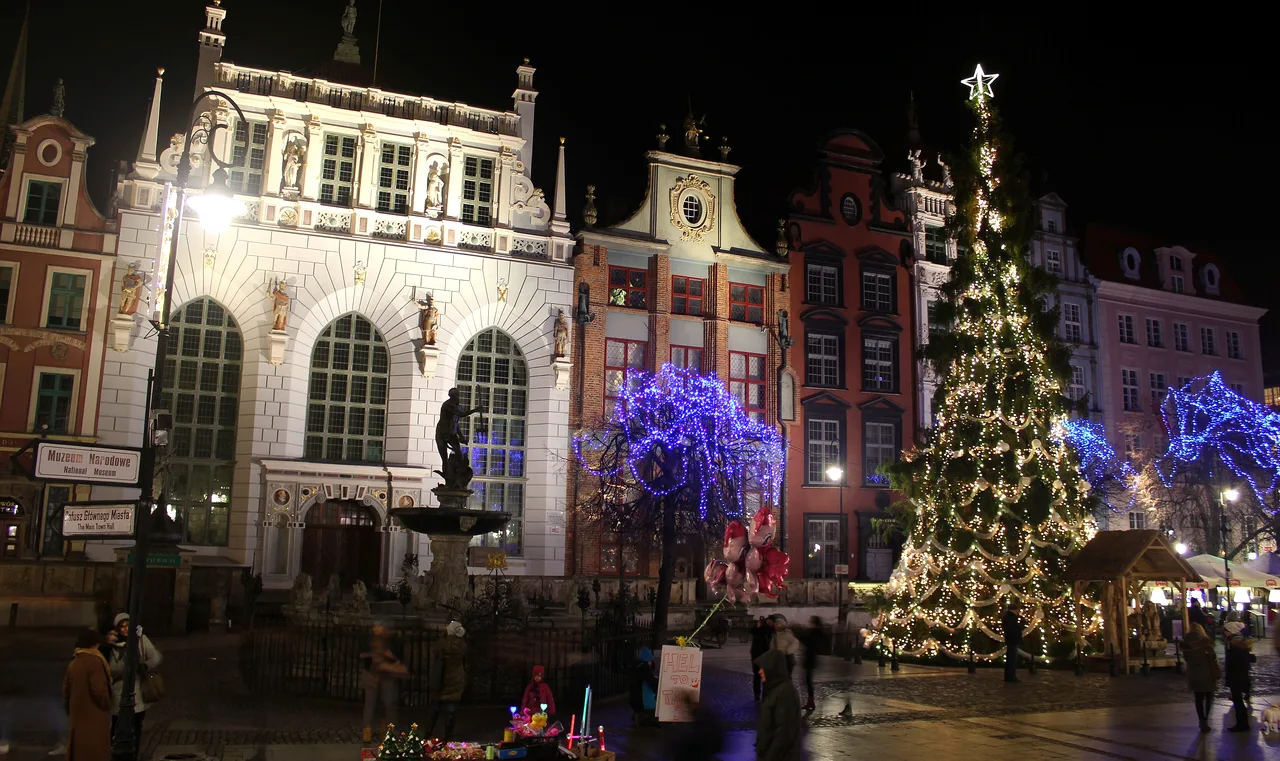
Długi Targ with its gabled houses, the medieval Crane on the Motława and the vast brick bulk of St Mary’s: Gdańsk in three pictures.


Gdańsk Christmas Market 2026
The Gdańsk Christmas Market (Jarmark Bożonarodzeniowy) is organised by AMBEREXPO and, according to the official website, runs from 20 November to 23 December 2026. Opening hours are Sunday–Thursday 12:00–20:00 and Friday–Saturday 12:00–21:00. The heart of the market is Targ Węglowy (the Coal Market) in front of the Great Armoury, and stalls also stretch along the Royal Route and into nearby streets such as Bogusławskiego and Tkacka, with an additional area in the courtyard of the Forum Gdańsk shopping centre. Crafts are shown in and around the Armoury (Zbrojownia). Stalls sell decorations, amber, ceramics, gingerbread, honey and textiles, and above all hot food and drinks. Entry is free, and the official site notes an ATM at the corner by the Prison Tower and Torture House (Katownia). Dogs are allowed. The market closes before Christmas Eve, so plan your visit for the weeks before 24 December.


| Event | Location | 2026 dates | Note |
|---|---|---|---|
| Gdańsk Christmas Market (Jarmark Bożonarodzeniowy) | Targ Węglowy and the Royal Route | 20 November–23 December 2026 | Sun–Thu 12:00–20:00, Fri–Sat 12:00–21:00; free entry. |
| Craft area | Great Armoury (Zbrojownia) | During the market | Handicrafts shown in and around the Armoury; check the programme. |
| Forum Gdańsk area | Forum Gdańsk courtyard | During the market | Additional stalls next to the shopping centre. |
| Side streets | Bogusławskiego and Tkacka | During the market | Stalls continue into the surrounding Main Town streets. |
| Last day | Targ Węglowy | 23 December 2026 | The market closes before Christmas Eve; check closing time on the official site. |
| Christmas Eve and Christmas | Main Town | 24–26 December 2026 | Family holidays in Poland; many shops and restaurants close or open shorter hours. |
What to try
Grzaniec
Mulled wine, sometimes mulled beer; contains alcohol.
Pierniki
Gingerbread in every shape, a Polish Christmas classic.
Oscypek
Smoked highlander sheep’s cheese, grilled and served with cranberry.
Pierogi
Dumplings with potato and cheese, meat, cabbage or fruit.
Kiełbasa
Grilled Polish sausage, usually pork; ask.
Hot chocolate and tea
Non-alcoholic options for children and non-drinkers.
Goldwasser
A historic Gdańsk herbal liqueur with flakes of gold leaf; contains alcohol.
Tips for the Gdańsk Christmas market
- The market opens at noon; early afternoons on weekdays are calmest.
- Fridays and Saturdays stay open until 21:00 and are the busiest.
- Start at Targ Węglowy, then walk through the Golden Gate onto Długa and Długi Targ.
- Most stalls accept cards; there is an ATM near the Katownia corner.
- Baltic wind is cold and damp; dress in warm layers and waterproof shoes.
- The market ends on 23 December; it is not open on Christmas Eve or Christmas Day.
- Keep your bag in front of you in the crowds.
- Combine the market with the lit Main Town after dark.
Check before you go: Jarmark Bożonarodzeniowy Gdańsk 2026 (official, bozonarodzeniowy.pl) ↗ · Visit Gdańsk · events (official) ↗
Dates and opening hours checked on 29 October 2026 on the official website of the Gdańsk Christmas Market (bozonarodzeniowy.pl, organised by AMBEREXPO). Programme and times may change; check the official pages before your visit.
When to Go
Gdańsk has a temperate Baltic climate: mild summers, cool springs and autumns, and cold, damp, windy winters. The Main Town and beaches of Sopot are busiest from June to August, when the St Dominic’s Fair (Jarmark św. Dominika) also takes place. May, June and September combine pleasant weather with fewer crowds. From late November to 23 December the Christmas market fills Targ Węglowy. January and February are cold, quiet and dark.
| Month | Sightseeing | Christmas market | Outdoors | Crowds |
|---|---|---|---|---|
| January | Good | None | Difficult | Quiet |
| February | Good | None | Difficult | Quiet |
| March | Good | None | Difficult | Quiet |
| April | Very good | None | Good | Moderate |
| May | Very good | None | Very good | Moderate |
| June | Very good | None | Very good | Moderate |
| July | Very good | None | Very good | Busy |
| August | Very good | None | Very good | Busy |
| September | Very good | None | Very good | Moderate |
| October | Very good | None | Good | Moderate |
| November | Good | Market season | Difficult | Moderate |
| December | Good | Market season | Difficult | Moderate |
- December temperatures are usually around -2 to 4 °C; wind from the sea makes it feel colder.
- Christmas Market 20 November–23 December 2026; Sun–Thu 12:00–20:00, Fri–Sat 12:00–21:00.
- Main Town Hall tower and some viewpoints are seasonal; check winter opening.
- Museums are open year-round with changing hours; many close on Mondays.
- Summer weekends and the St Dominic’s Fair bring heavy crowds.
- Winter days are short; in December the sun sets around 15:30.
Visa and Entry (Turkish citizens)
Turkish citizens holding an ordinary (burgundy) passport need a Schengen visa for tourist travel to Poland. Special, service and diplomatic passports follow different rules; check the current situation on the website of the Turkish Ministry of Foreign Affairs.
You apply to the representation of your main destination. If Poland is your main destination, the official visa page of the Embassy of the Republic of Poland in Ankara (gov.pl/web/turcja) explains where and how to apply, including the responsible consulate and any external service provider.
If your trip also covers other Schengen countries, apply to the country of your longest stay, or of first entry if stays are equal.
Under the EU Entry/Exit System (EES), being introduced in stages, your biometric data (facial image and fingerprints) may be recorded on first entry; allow extra time at the airport.
Visa fees, appointment waiting times and required documents can change; this guide does not state fees. Use the current lists on the official pages before you apply.
Travel medical insurance, accommodation and return documents are part of the application; details are on the official sources.
Check before you go: T.C. Dışişleri Bakanlığı · Türk vatandaşlarının tabi olduğu vize uygulamaları ↗ · gov.pl/web/turcja ↗ · EES · europa.eu ↗ · Rota Atlası visa guide (TR)
Travel medical insurance
Check the official visa and entry sources above first: they state whether travel medical insurance is required and the minimum cover. Compare any policy’s cover amount, validity dates and countries covered with the official requirement.
Rota Atlası does not currently offer an insurance partnership; there are no paid links in this section. Last updated: 1 November 2026
Getting to Gdańsk
- By air: Gdańsk Lech Wałęsa Airport (GDN) lies west of the city. Check current flights from Türkiye only on airline and airport websites; this guide does not recommend flights.
- From the airport: PKM trains link the airport with Gdańsk Wrzeszcz, where you change to SKM trains to Gdańsk Główny; city buses also run, and taxis and ride-hailing apps are available. Current routes and times are on the official websites of the airport (airport.gdansk.pl) and ZTM Gdańsk.
- By rail: Gdańsk Główny has connections to Warsaw, Kraków, Poznań, Wrocław and Berlin; check current schedules with PKP Intercity.
- Within the Tricity: SKM trains link Gdańsk, Sopot and Gdynia at frequent intervals.
- By car: The Main Town is largely pedestrian and parking is limited; use car parks on the edge of the centre.
Getting Around

On foot
The Main Town, Royal Route, Motława waterfront and Targ Węglowy are all within walking distance.
Tram and bus
ZTM Gdańsk trams and buses reach Wrzeszcz, Oliwa, the shipyard and Westerplatte; buy and validate your ticket at a machine or via app.
SKM
SKM suburban trains run along the Tricity to Oliwa, Sopot and Gdynia.
To Westerplatte
City buses run to Westerplatte; in the warm season, boats also sail from the Motława. Check times with ZTM and operators.
To Malbork
Regional and intercity trains run from Gdańsk Główny to Malbork; check current schedules.
Taxi
Licensed taxis and apps are common; agree a price in the app or use the meter.
Things to See
Gdańsk’s historic core is the Main Town (Główne Miasto) on the west bank of the Motława. Its spine is the Royal Route: from the Upland Gate and the Prison Tower via the Golden Gate along Długa street to Długi Targ, the Green Gate and the river. Just north lie Targ Węglowy with the Christmas market, St Mary’s Basilica and Mariacka street; on the waterfront stands the medieval Crane, and across the river lie Ołowianka and Granary Island. Further north are the Old Town and the shipyard with the European Solidarity Centre; the WWII Museum is by the river and Westerplatte at the harbour mouth. Oliwa, Sopot and Gdynia are along the coast to the north-west, and Malbork Castle is a classic day trip to the south-east.
Through the city gates
Royal Route: Upland Gate, Prison Tower, Golden Gate and Długa

Polish kings entering Gdańsk followed the Royal Route (Droga Królewska), and it is still the best way to begin. It starts at the Upland Gate (Brama Wyżynna), built in 1588 as part of the city fortifications and decorated with the coats of arms of Prussia, Poland and Gdańsk. Behind it stands the Prison Tower and Torture House (Katownia), a Gothic complex that later served as a prison and has housed the Amber Museum. Next comes the Golden Gate (Złota Brama), completed in 1612–14 with statues representing civic virtues. From here Długa (Long Street) runs east, lined with tall, richly decorated merchant houses that were rebuilt after 1945. During the Christmas market, Targ Węglowy opens just beside the Golden Gate.
Don’t miss
- Upland Gate
- Prison Tower and Torture House
- Golden Gate and its statues
- Merchant houses on Długa
- Uphagen House museum on Długa
Tips
- Check the current status and opening of the Amber Museum on the Muzeum Gdańska website.
- The route is best walked from west to east, ending at the river.
- In the evening the façades and gates are lit.


The grand square
Długi Targ, Neptune’s Fountain and Artus Court
Długa widens into Długi Targ (Long Market), Gdańsk’s grand square and the city’s showcase. At its centre stands Neptune’s Fountain, a bronze sea god completed in the 1630s and a symbol of the city’s bond with the sea. Behind it rises the Artus Court (Dwór Artusa), a former meeting hall for merchants and guilds, now a branch of the Museum of Gdańsk; its Great Hall features ship models, paintings and one of the tallest Renaissance tiled stoves in Europe. Next door are the Golden House and the New Jury House. At the east end the Green Gate (Brama Zielona) opens onto the Motława.
Don’t miss
- Neptune’s Fountain
- Great Hall of the Artus Court
- Golden House façade
- Green Gate
Tips
- Artus Court opening hours are on the Muzeum Gdańska website; many museums close on Mondays.
- Neptune is a meeting point; it is crowded in the evenings.
- Look up: gables, sculptures and gilding are the highlight.


The city’s tower
Main Town Hall

The Main Town Hall (Ratusz Głównego Miasta) stands where Długa meets Długi Targ, its slim Gothic-Renaissance tower topped with a gilded figure of King Sigismund Augustus. Inside, the Museum of Gdańsk shows richly decorated rooms, above all the Red Hall (Sala Czerwona) with its painted ceiling, and exhibitions on the city’s history including its destruction in 1945. The tower viewing terrace, open in the warmer season, offers one of the best views over the Main Town. In the evening the tower is lit and dominates the square.
Don’t miss
- Red Hall
- Exhibitions on the history of Gdańsk
- Tower viewpoint (seasonal)
- The lit tower at night
Tips
- The tower viewpoint is seasonal; check winter opening.
- Combined tickets with other Museum of Gdańsk branches may be available; check the official site.
- The square is especially atmospheric after dark.

A brick giant
St Mary’s Basilica
St Mary’s Basilica (Bazylika Mariacka) is one of the largest brick churches in the world, built over more than 150 years from the 14th to the 16th century. Its massive tower and bright, whitewashed interior can hold thousands of people. Highlights include the 15th-century astronomical clock, the Gothic altarpiece and a copy of Hans Memling’s Last Judgement (the original is in the National Museum). Over 400 steps lead up the tower to a viewing platform above the Main Town; opening depends on season and weather.
Don’t miss
- The immense nave
- Astronomical clock
- Last Judgement (copy)
- Tower viewpoint (seasonal)
Tips
- The basilica is a place of worship; check visiting hours outside services.
- The tower climb is long and narrow; check seasonal opening.
- Pair it with Mariacka street right behind it.
Amber and terraces
Mariacka Street

Mariacka (St Mary’s Street) runs from the basilica to the Motława and is often called the most beautiful street in Gdańsk. Its houses have raised stone terraces (przedproża) at the front, decorated with reliefs and gargoyle-like rainspouts, and small shops and workshops sell amber jewellery. At the river end stands St Mary’s Gate, and close by is the Archaeological Museum. The street was carefully rebuilt after the war and is a favourite photo spot.
Don’t miss
- Stone terraces and rainspouts
- Amber workshops
- St Mary’s Gate
- Views back to the basilica
Tips
- Buy amber only where certificates or clear origin information are offered.
- Early morning is quiet and best for photos.
- The cobbles can be slippery when wet.
The river front
Motława Waterfront and the Crane
The Long Embankment (Długie Pobrzeże) follows the Motława past the old water gates of the Main Town. Its landmark is the Crane (Żuraw), a 15th-century port crane with a massive brick tower and wooden lifting structure, once among the largest in medieval Europe and today part of the National Maritime Museum. Along the river new embankments and footbridges link the old town with Granary Island (Wyspa Spichrzów) and the modern waterfront districts, and the canals of the New Motława frame rebuilt warehouses.
Don’t miss
- The Crane
- Long Embankment promenade
- Granary Island
- River views to the water gates
Tips
- Check the Crane’s opening and exhibitions with the National Maritime Museum.
- Winter wind on the river is strong; dress warmly.
- The embankment is beautiful at dusk.

Across the river
Ołowianka and the Maritime Museum

Ołowianka island lies opposite the Crane and is reached by a modern bascule footbridge that opens for boats. The island is home to the Polish Baltic Philharmonic in a former power station and to parts of the National Maritime Museum, including the museum ship SS Sołdek, the first ocean-going ship built in post-war Poland. From here you get the classic view of the Crane and the Main Town skyline.
Don’t miss
- Bascule footbridge
- View of the Crane and Main Town
- SS Sołdek museum ship (seasonal)
- Polish Baltic Philharmonic
Tips
- The footbridge opens at fixed times for river traffic; expect short waits.
- Museum ships are often seasonal; check opening.
- Check the Philharmonic programme for winter concerts.
Where Solidarity was born
Gdańsk Shipyard and the European Solidarity Centre

In August 1980, strikes at the Lenin Shipyard led to the founding of Solidarity (Solidarność), the first independent trade union in the Soviet bloc, led by electrician Lech Wałęsa. Gate No. 2 of the shipyard, the Monument to the Fallen Shipyard Workers of 1970 and the European Solidarity Centre (ECS), opened in 2014 in a rust-coloured building resembling a ship’s hull, tell this story. The permanent exhibition covers the strikes, martial law and the end of communism in 1989. The surrounding post-industrial area is gradually being transformed.
Don’t miss
- Historic Gate No. 2
- Monument to the Fallen Shipyard Workers
- ECS permanent exhibition
- ECS roof garden and library
Tips
- Check ECS opening hours and tickets on the official website.
- Allow at least two hours for the exhibition.
- The shipyard is a short walk north of the Main Town.

Memory of 1939
Museum of the Second World War and Westerplatte

The Museum of the Second World War, opened in 2017 in a striking leaning tower by the Motława, presents the war mainly from the perspective of civilians, with extensive underground exhibitions. At the harbour mouth, Westerplatte is where the war began on 1 September 1939, when the German battleship Schleswig-Holstein opened fire on the Polish military transit depot. The site with its ruins, monument and open-air exhibition is now part of the museum and a place of remembrance.
Don’t miss
- Main exhibition of the WWII Museum
- Westerplatte monument
- Ruins of the guardhouses
- Harbour views
Tips
- Plan at least three hours for the museum; check hours and tickets.
- Westerplatte is reached by city bus, and by boat in the warm season.
- Westerplatte is exposed; wear warm clothing in winter.

Organ and park
Oliwa Cathedral and Park

In the north-western district of Oliwa, the former Cistercian abbey church, now Oliwa Cathedral, is famous for its 18th-century organ with moving figures of angels and stars, with short demonstrations held regularly. Next to it, Oliwa Park is a formal garden with old trees, ponds and a palm house, and the former Abbots’ Palace houses a branch of the National Museum. Oliwa is easy to reach by SKM train or tram.
Don’t miss
- The organ and its moving figures
- Gothic and Baroque interior
- Oliwa Park
- Abbots’ Palace
Tips
- Check organ demonstration times; they may change around services.
- SKM train to Gdańsk Oliwa, then a short walk.
- Combine with Sopot on the same day.
The Tricity coast
Sopot and Gdynia

Sopot, the spa town between Gdańsk and Gdynia, is known for its long wooden pier (molo) stretching into the Gulf of Gdańsk, one of the longest in Europe, its beach and the lively Monte Cassino street with the Crooked House. Further north, Gdynia was built mainly in the 1920s and 1930s as Poland’s new port and is known for its modernist architecture; on the waterfront the tall ship Dar Pomorza and the destroyer Błyskawica are museum ships. SKM trains connect all three cities.
Don’t miss
- Sopot pier
- Monte Cassino street
- Gdynia modernist centre
- Dar Pomorza tall ship (seasonal)
Tips
- Admission may be charged on the Sopot pier in season; check the city site.
- Museum ships often have limited winter opening; check.
- The coastal walk is windy in winter.

A brick fortress
Malbork Castle

About 60 km south-east of Gdańsk, Malbork Castle on the Nogat river was the headquarters of the Teutonic Order from 1309. It is the largest brick castle in the world and, as the Castle of the Teutonic Order in Malbork, a UNESCO World Heritage Site since 1997. The High, Middle and Lower Castles, the Grand Master’s Palace and the Chapter House show medieval brick Gothic at its most monumental; much was restored after severe damage in 1945. Trains from Gdańsk Główny make it a straightforward day trip. UNESCO listing ↗
Don’t miss
- High Castle
- Grand Master’s Palace
- Views from the opposite bank of the Nogat
- Castle Museum exhibitions
Tips
- Check winter opening hours and tickets on the Castle Museum website.
- Allow at least three hours.
- The castle is a short walk from Malbork station.
1–3 Day Itineraries, a Christmas Day + 5-Day Baltic Poland Route
The routes keep walking distances short and allow for short winter days. Day 1 covers the Royal Route and the market, day 2 the river, shipyard and museums, day 3 Oliwa and Sopot or Malbork. The Christmas day plan centres on the market; the 5-day route links Gdańsk with Malbork, Toruń and Warsaw. Check opening hours on official websites in advance.
Day 1: Royal Route and Christmas market
- Start at the Upland Gate and the Prison Tower.
- Walk through the Golden Gate along Długa.
- See Długi Targ, Neptune’s Fountain and the Artus Court.
- Visit the Main Town Hall and the Museum of Gdańsk.
- In the afternoon and evening, visit the market on Targ Węglowy.
Day 2: River, Solidarity and the war
- Morning at St Mary’s Basilica and on Mariacka.
- Walk the Long Embankment past the Crane to Ołowianka.
- Visit the European Solidarity Centre at the shipyard.
- In the afternoon, the Museum of the Second World War.
- Evening walk through the lit Main Town.
Day 3: Oliwa and Sopot or Malbork
- Option A: SKM to Oliwa for the cathedral organ and park, then on to Sopot’s pier.
- Option B: Train to Malbork for a full day at the castle.
- Back in Gdańsk, a final evening on Długi Targ.
A Christmas day
- From noon, explore the stalls on Targ Węglowy.
- Walk the side streets around Bogusławskiego and Tkacka.
- Try pierogi, oscypek and gingerbread.
- At dusk, walk the lit Długa to Długi Targ.
- Finish on the Motława embankment by the Crane.
5-day Baltic Poland route
- Days 1–2: Gdańsk Main Town, market, shipyard and museums.
- Day 3: Malbork Castle.
- Day 4: Train to Toruń, the Gothic gingerbread town.
- Day 5: Continue to Warsaw.
Gdańsk and Polish Cuisine
Gdańsk cuisine combines Polish classics with Baltic fish and Kashubian traditions. These are traditional dishes and products, not restaurant recommendations.


Pierogi
Dumplings; ruskie (potato and curd cheese) are the classic, also with meat, cabbage and mushrooms or fruit.
Śledź
Baltic herring in oil, cream or vinegar with onions; essential at Christmas Eve.
Barszcz z uszkami
Clear beetroot soup with small mushroom dumplings, a Christmas Eve classic.
Żurek
Sour rye soup, often with sausage and egg.
Baltic fish
Cod, flounder and smoked fish along the coast.
Pierniki
Gingerbread, especially at Christmas.
Goldwasser
Historic Gdańsk herbal liqueur with gold flakes; contains alcohol.
Kompot
Home-made fruit drink; a common non-alcoholic option.
- Pork is common in Polish cuisine; ask about ingredients.
- Pierogi ruskie and many Christmas Eve dishes are meat-free; still ask.
- Christmas Eve (Wigilia) traditionally has twelve meat-free dishes at home.
- Service is not always included; around 10% is customary if you are happy.
Culture and Etiquette

- Greeting with “Dzień dobry” and thanking with “Dziękuję” is appreciated.
- Churches are places of worship; don’t walk around during services and keep quiet.
- 24 December (Wigilia) is the main family day; many shops close early.
- Sunday trading is restricted in Poland: most shops are closed on Sundays, with some exceptions before Christmas.
- Validate tickets on trams and buses; inspections are frequent.
- The history of 1939 and 1980 is deeply important here; visit memorials respectfully.
- Toasting with “Na zdrowie” is common.
- In restaurants you usually ask for the bill yourself.
- The Tricity trams and SKM are the easiest way to travel.
- A few words of Polish are always welcome.
Safety and Health
- Gdańsk is generally safe; watch for pickpockets in the crowded market and nightlife areas.
- In nightlife areas keep an eye on your drink and check the bill before paying.
- Use licensed taxis or apps, especially at night.
- Cobbles and embankments can be icy in winter; wear sturdy shoes.
- Call 112 in an emergency.
- Make sure your travel medical insurance covers the Schengen area.
- Pharmacies (apteka) are common; a duty rota is posted on the door.
What Your Budget Depends On
This guide does not give prices; prices change with season and year. Your budget depends on these factors:
Travel dates
Market weekends and summer raise accommodation demand.
Accommodation
The Main Town is most central; Wrzeszcz and areas near the station offer more choice.
Transport
Public transport tickets, airport train and day trips to Malbork or Sopot.
Museums and sights
Museum of Gdańsk branches, the WWII Museum, ECS and Malbork each charge separately.
Food and drink
Large difference between market snacks and restaurants.
Day trips
Malbork, Toruń and Gdynia need extra travel and tickets.
Free experiences
The Christmas market, Royal Route, Motława embankment and Oliwa Park are free.
Practical Information
- Money: Polish złoty (PLN); cards are very common, euros are not generally accepted.
- Language: Polish; younger people and the tourism sector widely speak English.
- Power: 230 V, type C/E.
- Time: CET (UTC+1) in winter, 2 hours behind Türkiye.
- Shops: Most shops are closed on Sundays due to trading restrictions; check exceptions.
- Holidays: 24–26 December, 1 January and 6 January are public holidays; hours change.
- Weather: Cold and damp in December, around -2 to 4 °C.
- Daylight: In December the sun sets around 15:30.
- Water: Tap water is drinkable.
- Emergency: 112.
Frequently Asked Questions
When is the Gdańsk Christmas market 2026?
According to the official website, the Christmas Market runs from 20 November to 23 December 2026 on Targ Węglowy and along the Royal Route.
What are the opening hours?
Sunday–Thursday 12:00–20:00 and Friday–Saturday 12:00–21:00. Check the official page before you go.
Is entry free?
Yes, entry to the market is free.
Is the market open at Christmas?
No, it ends on 23 December, before Christmas Eve.
Who organises the market?
AMBEREXPO, according to the official website bozonarodzeniowy.pl.
How do I get from the airport to the city?
PKM trains run from the airport to Gdańsk Wrzeszcz with a change to SKM; buses, taxis and apps are also available.
Do Turkish citizens need a visa?
Holders of ordinary passports need a Schengen visa. If Poland is your main destination, see the official visa page of the Polish Embassy in Ankara (gov.pl/web/turcja).
Is Malbork worth a day trip?
Yes, the largest brick castle in the world is a UNESCO site about 60 km away and reachable by train.
How many days do I need?
Two days for the Main Town, river and museums; three with Oliwa and Sopot or Malbork.
Are shops open on Sundays?
Most shops are closed on Sundays in Poland, with some exceptions before Christmas; the market itself is open.
Where to stay
Stay close to the areas where you will spend most time. The areas below are covered in detail in this guide; check public transport links in the getting-around section.
- Through the city gatesRoyal Route: Upland Gate, Prison Tower, Golden Gate and Długa
- The grand squareDługi Targ, Neptune’s Fountain and Artus Court
- The city’s towerMain Town Hall
- A brick giantSt Mary’s Basilica
- Amber and terracesMariacka Street
- The river frontMotława Waterfront and the Crane
- Across the riverOłowianka and the Maritime Museum
- Where Solidarity was bornGdańsk Shipyard and the European Solidarity Centre
- Memory of 1939Museum of the Second World War and Westerplatte
- Organ and parkOliwa Cathedral and Park
- The Tricity coastSopot and Gdynia
- A brick fortressMalbork Castle
Search hotels in these areas (Hotellook) ↗ (affiliate link)Search on Booking.com ↗
Affiliate disclosure: Hotellook, Aviasales, Klook, Airalo, Tiqets and DiscoverCars links are affiliate links; Rota Atlası may earn a commission on bookings made through them, at no extra cost to you. Official and in-guide links are not paid. Last updated: 1 November 2026 · Privacy and affiliates
Transport and connectivity
- Airport transferOptions from the airport to the city are in this guide’s getting there section.
- Mobile data (eSIM)Airalo eSIM ↗ (affiliate link)
- TrainsOfficial rail website ↗
- Car hireYou rarely need a car within the city; see getting around first. Compare car hire on DiscoverCars ↗ (affiliate link)
Affiliate disclosure: Hotellook, Aviasales, Klook, Airalo, Tiqets and DiscoverCars links are affiliate links; Rota Atlası may earn a commission on bookings made through them, at no extra cost to you. Official and in-guide links are not paid. Last updated: 1 November 2026 · Privacy and affiliates
Search flights (affiliate link)
Search flights from any airport in any country. Results open on Aviasales in a new tab, where you book.
This form is an affiliate link: Rota Atlası may earn a commission on bookings made via Aviasales (Travelpayouts), at no extra cost to you. Check price, baggage and terms on the booking site. Airport data: OurAirports (public domain).
Flights, hotels and tours
Find tours and tickets
- Gdańsk Christmas Market
GetYourGuide ↗ · Klook ↗ (affiliate link) - Neptune Fountain and Długi Targ
GetYourGuide ↗ · Klook ↗ (affiliate link) - Main Town Hall
GetYourGuide ↗ · Klook ↗ (affiliate link) - St Mary’s Basilica
GetYourGuide ↗ · Klook ↗ (affiliate link)
Hotellook, Aviasales, Klook, Airalo and Tiqets links in this box are affiliate links (Travelpayouts): Rota Atlası may earn a commission on bookings made through them, at no extra cost to you. GetYourGuide links currently carry no affiliate code. Check prices and terms with the provider. Last updated: 1 November 2026 · Privacy and affiliates
Sources
- T.C. Dışişleri Bakanlığı · Türk vatandaşlarının tabi olduğu vize uygulamaları ↗
- Ambasada RP w Ankarze · Wizy (gov.pl, official) ↗
- European Union · Entry/Exit System (EES) ↗
- Visit Gdańsk · visitgdansk.com (official city tourism) ↗
- Jarmark Bożonarodzeniowy Gdańsk 2026 · bozonarodzeniowy.pl (official) ↗
- Muzeum Gdańska · Main Town Hall, Artus Court, Amber Museum (official) ↗
- Bazylika Mariacka w Gdańsku · St Mary’s Basilica (official) ↗
- Europejskie Centrum Solidarności · European Solidarity Centre (official) ↗
- Muzeum II Wojny Światowej · Museum of the Second World War (official) ↗
- Westerplatte · Muzeum Westerplatte i Wojny 1939 (official) ↗
- Muzeum Zamkowe w Malborku · Malbork Castle Museum (official) ↗
- UNESCO World Heritage Centre · Castle of the Teutonic Order in Malbork ↗
- Sopot · sopot.pl (official city portal) ↗
- Gdynia · gdynia.pl (official city portal) ↗
- Gdańsk Lech Wałęsa Airport (official) ↗
- ZTM Gdańsk · public transport (official) ↗
- SKM Trójmiasto · Tricity rail (official) ↗
- PKP Intercity · Polish railways ↗
- GOV.UK · Foreign travel advice · Poland ↗
- Jarmark Bożonarodzeniowy Gdańsk 2026 (official, bozonarodzeniowy.pl) ↗
- Visit Gdańsk · events (official) ↗
This page is for information only. Dates, hours, entry rules and transport information can change; check the official sources above before travelling. No prices, flights, hotels or restaurants have been invented in this guide.
Photo credits
The photos on this page come from Wikimedia Commons and are used under the stated authors and licences (CC BY, CC BY-SA, CC0 or public domain). Full list of sources
- Christmas tree and decorations on Długi Targ, Gdańsk, at night — Andrzej Otrębski · CC BY-SA 4.0 · Wikimedia Commons
- Stalls at the Gdańsk Christmas market — MOs810 · CC BY-SA 4.0 · Wikimedia Commons
- A food stall at the Gdańsk Christmas market — Аимаина хикари · CC0 · Wikimedia Commons
- A pastry at the Gdańsk Christmas market — Аимаина хикари · CC0 · Wikimedia Commons
- Market stalls by the Great Armoury on Targ Węglowy — Аимаина хикари · CC0 · Wikimedia Commons
- Illuminated Gdańsk coat of arms with lions — Andrzej Otrębski · CC BY-SA 4.0 · Wikimedia Commons
- View over the Gdańsk Christmas market from above — Аимаина хикари · CC0 · Wikimedia Commons
- Forum Gdańsk — Аимаина хикари · CC0 · Wikimedia Commons
- Długi Targ square in Gdańsk — Szczecinolog · CC BY-SA 4.0 · Wikimedia Commons
- Długi Targ and the Main Town Hall tower at night — Marcin Białek · CC BY-SA 4.0 · Wikimedia Commons
- Golden Gate seen from Długa street — Avi1111 dr. avishai teicher · CC BY-SA 3.0 · Wikimedia Commons
- Neptune’s Fountain in Gdańsk — Ken Eckert · CC BY-SA 4.0 · Wikimedia Commons
- Artus Court and Neptune’s Fountain — John Samuel · CC BY-SA 4.0 · Wikimedia Commons
- Medieval Żuraw crane on the Motława — DerHexer · CC BY-SA 3.0 · Wikimedia Commons
- St Mary’s Basilica in Gdańsk — Aneta p · CC BY 4.0 · Wikimedia Commons
- Mariacka street in Gdańsk — Silar · CC BY-SA 4.0 · Wikimedia Commons
- Golden Gate in Gdańsk in the evening — Аимаина хикари · CC0 · Wikimedia Commons
- Upland Gate (Brama Wyżynna) in Gdańsk — Artur Andrzej · Public domain · Wikimedia Commons
- Długa street and the town hall in Gdańsk — Diego Delso · CC BY-SA 3.0 · Wikimedia Commons
- Prison Tower and Torture House in Gdańsk — Аимаина хикари · CC0 · Wikimedia Commons
- Nowa Motława canal in Gdańsk — Аимаина хикари · CC0 · Wikimedia Commons
- Bascule footbridge to Ołowianka island — Fallaner · CC BY-SA 4.0 · Wikimedia Commons
- European Solidarity Centre building — Szymon1996 · CC BY-SA 4.0 · Wikimedia Commons
- Gate No. 2 of the Gdańsk Shipyard — Adrian Tync · CC BY-SA 4.0 · Wikimedia Commons
- Museum of the Second World War in Gdańsk — Adrian Grycuk · CC BY 3.0 pl · Wikimedia Commons
- Westerplatte lettering — Gilek 21 · CC BY-SA 4.0 · Wikimedia Commons
- Oliwa Cathedral from the air — Fallaner, revised by Ulamm (talk) · CC BY-SA 3.0 · Wikimedia Commons
- Sopot pier and beach — Diego Delso · CC BY-SA 3.0 · Wikimedia Commons
- Dar Pomorza tall ship in Gdynia — Maximilianvegas · CC BY-SA 4.0 · Wikimedia Commons
- Gdańsk Główny railway station — kallerna · CC BY-SA 4.0 · Wikimedia Commons
- Tram on a winter night in Gdańsk — Artur Andrzej · CC0 · Wikimedia Commons
- A plate of pierogi ruskie — Maksym Kozlenko · CC BY-SA 4.0 · Wikimedia Commons
- A variety of herring salads — Marek Ślusarczyk (Tupungato) Photo portfolio · CC BY 3.0 · Wikimedia Commons
- Panorama of Malbork Castle — DerHexer; derivate work: Carschten · CC BY-SA 3.0 · Wikimedia Commons
Warsaw → · Kraków → · Wrocław → · Riga → · Vilnius → · Berlin → · Christmas markets