

Trier on the Moselle is known as Germany’s oldest city: the Romans founded it around 16 BC as Augusta Treverorum, and in the 3rd and 4th centuries it became one of the imperial residences of the Western Roman Empire. Constantine the Great built a palace here, and the monuments of that era form the most impressive Roman heritage north of the Alps. The colossal blackened sandstone city gate Porta Nigra, Constantine’s throne hall the Basilica of Constantine, the Imperial Baths and Barbara Baths, the Amphitheatre for some 18,000 spectators, the Roman Bridge still carrying traffic and the Igel Column outside town have been UNESCO World Heritage since 1986, together with Trier Cathedral, regarded as Germany’s oldest cathedral, and the Church of Our Lady, one of the country’s earliest Gothic churches. The medieval Hauptmarkt, with the Steipe, the tower of St. Gangolf and the Petrusbrunnen fountain, is the heart of town; the house where Karl Marx was born in 1818 is a few streets away. In Advent the Hauptmarkt and the Domfreihof in front of the cathedral fill with the wooden huts of the Trier Christmas Market, held for the 46th time; Moselle winegrowers’ Glühwein (Winzerglühwein) is a tradition here. This guide brings together the market, the Roman monuments, museums, Trier and Moselle food, and day trips to the Moselle Valley and Luxembourg, with official sources.
Content update: 28 October 2026 · Christmas dates checked against the official trier.de Christmas market page
Trier at a Glance
- Country
- Germany · Rhineland-Palatinate
- Population
- About 110,000; on the Moselle, close to the Luxembourg border
- Language
- German; English is widely understood in tourism, and French is heard thanks to nearby Luxembourg
- Currency
- Euro (EUR); cards are common, but carry some cash for stalls
- Time zone
- Central European Time (CET, UTC+1)
- UNESCO
- Roman Monuments, Cathedral of St Peter and Church of Our Lady in Trier (1986)
- Highlights
- Porta Nigra, Hauptmarkt, Trier Cathedral, Church of Our Lady, Basilica of Constantine, Imperial Baths, Amphitheatre, Roman Bridge
- Nearby
- Igel, Moselle Valley (Bernkastel-Kues, Cochem), Luxembourg, Saar Loop, Saarburg
- Christmas
- Trier Christmas Market 20 November–22 December 2026 (closed 22 November)
- Airport
- No airport in town; nearest major airport is Luxembourg (LUX), plus Frankfurt (FRA) and Frankfurt-Hahn (HHN)
- Electricity
- 230 V, European type C/F sockets
- Emergency
- 112 (ambulance, fire), 110 (police)
Trier in Pictures
The blackened stones of the Porta Nigra, the Moselle Valley from the Petrisberg and the colourful façades of the Hauptmarkt: Trier in three frames.


Trier Christmas Market 2026
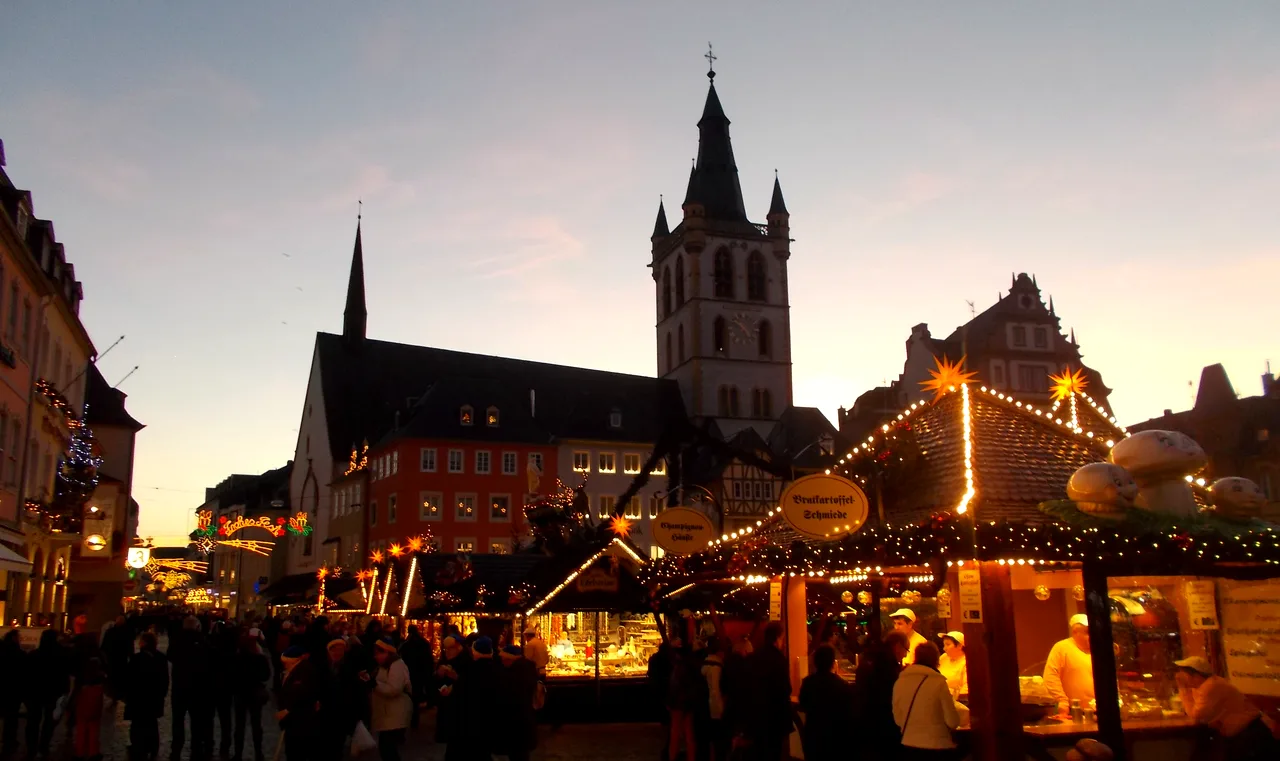
The Trier Christmas Market brings together two historic squares in Germany’s oldest city. According to trier.de it is held for the 46th time in 2026: on the medieval Hauptmarkt, the Steipe, the Red House, the tower of St. Gangolf and the Petrusbrunnen fountain frame small and large wooden huts with their colourful façades, while the second part of the market lies a few steps away on the Domfreihof, in front of the Roman and Romanesque west front of Trier Cathedral. The official page notes that the market draws visitors from around the world every year with specialities such as Moselle winegrowers’ Glühwein (Mosel-Winzerglühwein) and festive crafts. The market is open from 20 November to 22 December 2026 and closed on 22 November, Totensonntag. In the evening the short walk from the Hauptmarkt to the Domfreihof, with the illuminated cathedral front and the Gothic portal of the Church of Our Lady, offers one of the finest winter views in town; the Porta Nigra is only five minutes away. The market’s winter menu includes Moselle wines, hot Viez apple wine and regional favourites such as potato fritters. Wine towns in the Moselle Valley such as Bernkastel-Kues and Traben-Trarbach, as well as Luxembourg, have their own Christmas markets; their dates were not verified for this guide, so check the relevant official sites.


| Event | Location | 2026 dates | Note |
|---|---|---|---|
| Trier Christmas Market · Hauptmarkt | Medieval Hauptmarkt (around the Steipe, St. Gangolf and the Petrusbrunnen) | 20 November–22 December 2026 | Mon–Thu 11:00–20:30, Fri–Sat 11:00–22:00, Sun 11:00–20:00; closed 22 November. |
| Trier Christmas Market · Domfreihof | In front of the west front of Trier Cathedral | 20 November–22 December 2026 | Second part of the market; same hours. |
| Mosel-Winzerglühwein | Market stalls | Throughout the market | Moselle winegrowers’ mulled wine; the speciality highlighted on the official page. |
| Moselle Valley Christmas markets | Bernkastel-Kues, Traben-Trarbach and other wine towns | Advent | Dates not verified for this guide; check the relevant official tourism sites. |
| Luxembourg Christmas markets | Luxembourg City centre | Advent | Dates not verified for this guide; check visitluxembourg.com. |
What to try
Mosel-Winzerglühwein
Spiced hot wine made by Moselle winegrowers from red or white wine – alcoholic; most stalls also sell an alcohol-free children’s punch.
Hot Viez
Trier’s tart apple wine, served spiced and warm in winter; alcoholic.
Reibekuchen
Grated potato fritters fried until crisp, usually with apple sauce.
Gebrannte Mandeln
Sugar-roasted almonds whose scent fills the square.
Lebkuchen and Spekulatius
Spiced Christmas biscuits, often also sold packaged.
Roasted chestnuts
Hot roasted chestnuts in a paper cone.
Trier Christmas market tips
- In December it gets dark in Trier around 16:30; plan Roman monuments and museums for daylight and the market for the evening.
- The market spreads over two squares: the Hauptmarkt and the Domfreihof are only a few minutes apart via Sternstraße.
- The market is closed on 22 November 2026 (Totensonntag); plan around it if you visit that weekend.
- On Fridays and Saturdays the market stays open until 22:00, but these are the busiest evenings; weekday afternoons are calmer.
- Glühwein mugs usually carry a deposit; return them or keep one as a souvenir.
- Many stalls accept cards, but coins are handy for snacks.
- The Hauptmarkt cobbles get slippery when wet; wear sturdy, non-slip shoes.
- The market closes on 22 December; many museums and shops change their hours on 24–26 December.
Check before you go: Stadt Trier · Trierer Weihnachtsmarkt 2026 (official) ↗ · Trier Tourismus und Marketing · trier-info.de (official) ↗
Dates and hours were checked on 28 October 2026 against the City of Trier’s official “Trierer Weihnachtsmarkt” page (trier.de). Dates of markets in the Moselle towns and Luxembourg were not verified; check the official sites before your visit.
When to Go
Trier enjoys a mild climate in the sheltered Moselle Valley, one of Germany’s warm wine regions. Spring and early summer are ideal for the Roman monuments and riverside walks; summer is warm and lively, with events in the Amphitheatre and wine festivals. September–October is harvest time: the vineyards turn golden and the season of Federweißer, young fermenting wine, begins. From late November to 22 December the Christmas market lights up the old town. January and February are cool and quiet – a good time for museums.
| Month | City sightseeing | Christmas market | Moselle and day trips | Crowds |
|---|---|---|---|---|
| January | Difficult | None | Difficult | Quiet |
| February | Difficult | None | Difficult | Quiet |
| March | Good | None | Good | Quiet |
| April | Very good | None | Very good | Moderate |
| May | Very good | None | Very good | Moderate |
| June | Very good | None | Very good | Moderate |
| July | Very good | None | Very good | Busy |
| August | Very good | None | Very good | Busy |
| September | Very good | None | Very good | Moderate |
| October | Very good | None | Very good | Busy |
| November | Good | Market season | Good | Moderate |
| December | Good | Market season | Difficult | Busy |
- Winters are cool and damp, usually just above freezing; morning fog is common in the valley.
- In December the sun rises around 8:20 and sets around 16:30; plan sightseeing for daylight.
- The Christmas market runs from 20 November to 22 December 2026; closed 22 November.
- Moselle boat trips and some castle visits are limited or closed in winter; check before you go.
- Roman monuments have shorter winter hours; some museums close on Mondays.
- Old-town hotels fill up on Advent weekends and during the grape harvest; book early.
Visa and Entry (Turkish citizens)
Turkish citizens holding an ordinary (burgundy) passport need a Schengen visa for tourist travel to Germany. Different rules apply to special, service and diplomatic passports; check the current position with the Turkish Ministry of Foreign Affairs.
You apply to the representation of your main destination. If Germany is your main destination, the German missions in Türkiye are responsible; current information on the application process is at tuerkei.diplo.de.
If you combine Trier with Luxembourg, apply to the country where you will stay longest; if stays are equal, the country of first entry applies. Checks may take place at the Luxembourg border; always carry your passport.
Under the EU Entry/Exit System (EES), which is being phased in, your biometric data (facial image and fingerprints) may be recorded on first entry; allow extra time at the border.
Visa fees, appointment waiting times and required documents may change; this guide gives no fees. Use the current lists on the official sites before applying.
Travel health insurance, accommodation and return details are part of the application; see the official sources for details.
Check before you go: T.C. Dışişleri Bakanlığı · Türk vatandaşlarının tabi olduğu vize uygulamaları ↗ · tuerkei.diplo.de ↗ · EES · europa.eu ↗ · Rota Atlası visa guide (TR)
Travel medical insurance
Check the official visa and entry sources above first: they state whether travel medical insurance is required and the minimum cover. Compare any policy’s cover amount, validity dates and countries covered with the official requirement.
Rota Atlası does not currently offer an insurance partnership; there are no paid links in this section. Last updated: 1 November 2026
Getting to Trier
- By air: Trier has no airport of its own. The nearest major airport, Luxembourg (LUX), is about 45 kilometres away; from there you travel into Luxembourg City and on to Trier by train or bus. Frankfurt (FRA) and Frankfurt-Hahn (HHN) are other options. Check current flights from Türkiye only on airline and airport websites.
- By train from Luxembourg: regional trains link Luxembourg and Trier in about an hour. Check timetables on bahn.de and the Luxembourg railways site.
- By train within Germany: Trier is linked to Koblenz by the Moselle line and to Saarbrücken by the Saar line, with connections from Cologne and Frankfurt. Check timetables on bahn.de.
- From the station to the old town: it is about a 10-minute walk from Trier Hauptbahnhof to the Porta Nigra and 15 minutes to the Hauptmarkt; city buses also run.
Getting Around

On foot
The old town is compact; the Porta Nigra, Hauptmarkt, Cathedral, Basilica of Constantine and Imperial Baths are all within walking distance.
City buses
The bus network is run by Stadtwerke Trier (SWT); tickets follow the VRT tariff. Many lines stop at Porta-Nigra-Platz and Treviris near the Hauptmarkt.
Regional trains
Regional trains on the Moselle and Saar lines go to Koblenz, Cochem, Saarburg and Luxembourg; check tickets on vrt-info.de and bahn.de.
Cycling
The Moselle cycle path along the river is flat and scenic; some stretches can be wet in winter.
Boat
Excursion boats run on the Moselle in summer; winter sailings are limited, so check locally.
Day trips
Igel, Saarburg, Bernkastel-Kues, Cochem and Luxembourg are easy day trips.
Things to See
Trier’s old town lies on the right bank of the Moselle, inside the area once enclosed by the Roman walls. In the north stands the Porta Nigra, in the centre the Hauptmarkt and the Cathedral, in the south-east the Basilica of Constantine, the Electoral Palace, the Imperial Baths and the Amphitheatre; the Barbara Baths and the Roman Bridge are by the river. The Petrisberg and the Mariensäule hill across the river overlook the city. The Igel Column, the Moselle Valley and Luxembourg are a short trip away.
UNESCO World Heritage
Porta Nigra and Simeonstift

The Porta Nigra (“Black Gate”) was the northern city gate of Roman Trier, built around AD 170 without mortar from huge sandstone blocks held together by iron clamps. According to the official tourism site it is the best-preserved Roman city gate north of the Alps. It got its name in the Middle Ages from its darkened stones. The building survived because in the 11th century it was converted into a two-storey church in memory of the hermit Simeon; in 1804 Napoleon ordered the non-Roman additions removed, giving the gate its present appearance. Inside you can climb to the Roman galleries and see traces of the church. The neighbouring former Simeon monastery (Simeonstift) now houses the Stadtmuseum Simeonstift, telling the city’s history and art. UNESCO listing ↗
Don’t miss
- North façade of the Porta Nigra
- Interior galleries and upper floors
- Traces of the church period
- Stadtmuseum Simeonstift
Tips
- Entry to the Porta Nigra is charged; check hours and tickets on zentrum-der-antike.de.
- Come early for photos without crowds; the evening lighting is also impressive.
- Simeonstraße, the main shopping street, runs from here to the Hauptmarkt.

The medieval heart
Hauptmarkt, Steipe and St. Gangolf

Trier’s medieval market square, the Hauptmarkt, was the commercial centre of the post-Roman city. The market cross in the middle was erected in 958 when the town was granted market rights; the Petrusbrunnen fountain of 1595 shows the city’s patron Saint Peter and the four virtues. On the west side stands the Gothic Steipe, built in the 15th century as the town council’s banqueting and representative house, with the Red House (Rotes Haus) beside it; statues of the city’s patron saints adorn the Steipe’s façade. In the south-east corner rises the tower of St. Gangolf, entered through a narrow gateway; for centuries it served as the town’s watchtower and symbolised the citizens’ power against the cathedral’s towers. In Advent the square is the heart of the Christmas market.
Don’t miss
- Market cross of 958
- Petrusbrunnen fountain
- Steipe and Red House
- Tower of St. Gangolf
Tips
- The square is a 5-minute walk from the Porta Nigra along Simeonstraße.
- Afternoon light is best for façade photos.
- Exhibitions are occasionally held on the Steipe’s upper floors; check locally.

UNESCO World Heritage
Trier Cathedral and Church of Our Lady

Trier Cathedral (Hohe Domkirche St. Peter) is regarded as Germany’s oldest cathedral: its core goes back to a large church complex founded in the 4th century under Constantine, and Roman, Romanesque, Gothic and Baroque layers can be seen side by side. Its most famous relic is the Holy Robe (Heiliger Rock), by tradition the seamless garment of Jesus, shown only in special pilgrimage years. Directly adjoining it, the Church of Our Lady (Liebfrauenkirche), built in the 13th century, is one of Germany’s earliest Gothic churches; its cross-shaped central plan with twelve pillars symbolising the twelve apostles shows French Gothic influence. Both have been UNESCO World Heritage since 1986 along with Trier’s Roman monuments. The cathedral treasury and the nearby Museum am Dom display church art as well as fragments of painted ceilings from a Constantinian palace. UNESCO listing ↗
Don’t miss
- West front of the Cathedral
- Romanesque interior and Baroque chapels
- Gothic portal of the Church of Our Lady
- Roman ceiling paintings in the Museum am Dom
Tips
- Visits are restricted during services; check times on dominformation.de.
- In Advent the Domfreihof is the second part of the Christmas market.
- The treasury and museum are charged separately and keep different hours.

Constantine’s throne hall
Basilica of Constantine, Electoral Palace and Palace Garden

The Basilica of Constantine (Aula Palatina) was built around AD 310 as the throne and audience hall of Constantine the Great’s palace in Trier. About 67 metres long and 33 metres high, it is one of the largest single-room structures surviving from Roman times; with its plain brick walls and huge windows it makes you feel tiny inside. Today it serves as a Protestant church and houses a large organ. Adjoining it, the pink Electoral Palace (Kurfürstliches Palais) was built in the 17th–18th centuries for the prince-archbishops of Trier, and its Rococo façade makes it one of the most elegant buildings in town. The French-style Palace Garden (Palastgarten) with its statues stretches in front of it towards the Imperial Baths. UNESCO listing ↗
Don’t miss
- Interior of the Basilica
- Rococo façade of the Electoral Palace
- Statues in the Palace Garden
- Walk through the garden to the Imperial Baths
Tips
- As a church, the Basilica limits visits during services and concerts; check the times.
- See the church’s programme for organ concerts.
- The Electoral Palace is a public building; its interior is usually open only for events.

Roman life
Imperial Baths, Barbara Baths and Amphitheatre

The Imperial Baths (Kaiserthermen), built in the 4th century for the imperial residence, were designed as one of the largest bath complexes of the Roman world – yet they were never used as finished baths. The towering brick and stone walls and the underground service corridors that visitors can walk through are the most impressive parts today. The Barbara Baths (Barbarathermen) near the Moselle date from the 2nd century and were among the largest baths of the empire in their day; the remains are viewed from a visitor footbridge. The Amphitheatre, cut into the slope of the Petrisberg around AD 100, held some 18,000 spectators; the cellars beneath the arena can still be seen. All three are run by the Zentrum der Antike and are part of the UNESCO site. UNESCO listing ↗
Don’t miss
- Underground corridors of the Imperial Baths
- The high walls of the baths
- Amphitheatre arena and cellars
- Barbara Baths visitor bridge
Tips
- Combined tickets for the Roman monuments may be available; check zentrum-der-antike.de.
- Hours are shorter in winter; the underground corridors can be slippery in wet weather.
- The Amphitheatre is about a 10-minute walk from the Imperial Baths.


Roman Trier
Rheinisches Landesmuseum

On the edge of the Palace Garden, the Rheinisches Landesmuseum Trier is one of Germany’s most important archaeological museums, telling the story of Roman Trier through mosaics, funerary monuments, sculptures and everyday objects. Its stars include the Trier Gold Hoard (Trierer Goldschatz), found in 1993 and made up of more than 2,500 gold coins, and the famous Neumagen Wine Ship funerary monument, one of the finest witnesses to Roman winemaking on the Moselle. A model of the city brings the imperial capital of the Roman era to life.
Don’t miss
- Trier Gold Hoard
- Neumagen Wine Ship
- Roman mosaics
- Model of Roman Trier
Tips
- Check hours and tickets on landesmuseum-trier.de; it may be closed on Mondays.
- Visiting the museum before the Roman monuments makes them easier to understand.
- The museum is a few minutes from the Imperial Baths.
History and ideas
Karl Marx House, House of the Three Kings and Frankenturm

The Baroque house at Brückenstraße 10 is where Karl Marx was born on 5 May 1818. Today the Karl Marx House museum, run by the Friedrich-Ebert-Stiftung, presents his life, works and the impact of his ideas on world history. The House of the Three Kings (Dreikönigenhaus) on Simeonstraße is a 13th-century residential tower; for security its entrance is on the first floor and was once reached only by a ladder that could be pulled up. The Frankenturm on Dietrichstraße, a Romanesque residential tower from around 1100, shows how wealthy families lived in medieval Trier.
Don’t miss
- Karl Marx’s birthplace
- The raised door of the House of the Three Kings
- Frankenturm
- Walk from Brückenstraße to the Roman Bridge
Tips
- Check museum hours and exhibitions at fes.de/museum-karl-marx-haus.
- The House of the Three Kings and the Frankenturm are seen from outside.
- Walk along Brückenstraße from the Karl Marx House to the Roman Bridge.


Riverside
Roman Bridge and the Moselle riverside

The Roman Bridge (Römerbrücke) is the oldest bridge in Germany still in use: its basalt and limestone piers date from the 2nd century, while the superstructure was renewed in later centuries. Traffic still crosses over the Roman piers today. Riverside paths lead to the old fishermen’s houses of the Zurlauben quarter and to the historic cranes on the bank; the two cranes, from the 15th and 18th centuries (Alter Krahnen and Zollkran), recall that Trier was a river port. UNESCO listing ↗
Don’t miss
- Piers of the Roman Bridge
- Zurlauben riverside
- Historic cranes
- City view from the bridge
Tips
- The bridge is a few minutes’ walk from the Karl Marx House.
- The riverside can be windy; dress warmly in winter.
- In summer Moselle boat trips depart here; winter sailings are limited.

Pilgrimage and views
St. Matthias Basilica, Petrisberg and Mariensäule

The Benedictine abbey of St. Matthias in the south of town is an important pilgrimage site because it holds the only apostle’s tomb north of the Alps, that of the Apostle Matthias; the Romanesque basilica was consecrated in the 12th century and has a crypt with traces of a Roman cemetery. There are two classic viewpoints over the city: the Petrisberg to the east offers views over the old town and the Moselle Valley from among its vineyards, while the Mariensäule, a column to the Virgin erected in 1866 on the Markusberg west of the river, shows the finest panorama of the city from the opposite bank.
Don’t miss
- Crypt of St. Matthias
- Romanesque basilica
- View from the Petrisberg vineyards
- Mariensäule panorama
Tips
- Respect service times at the abbey; check visiting hours.
- Reach the Petrisberg by bus or on foot uphill from the Amphitheatre.
- The path to the Mariensäule is steep and wooded and can be slippery in winter.

UNESCO World Heritage
Day trip: Igel Column and Saarburg

About 9 kilometres south-west of Trier in the village of Igel stands the Igel Column (Igeler Säule), a funerary monument about 23 metres high erected around AD 250 for the Secundinii, a family of cloth merchants. Its reliefs depict the family’s trade, the transport of cloth and mythological scenes; it is the largest Roman funerary monument still standing in place north of the Alps and part of Trier’s UNESCO site. Igel is easily reached by regional train. In the same direction, Saarburg on the river Saar, with a waterfall running through the town and castle ruins above, makes a small but charming addition. UNESCO listing ↗
Don’t miss
- Reliefs of the Igel Column
- Igel village
- Saarburg waterfall
- Saarburg castle
Tips
- Reach Igel from Trier by regional train or bus; check vrt-info.de.
- The column stands in the open and can be seen free of charge.
- Check train connections in advance if you add Saarburg the same day.
Wine valley
Day trip: Bernkastel-Kues and Cochem

Winding north-east from Trier, the Moselle Valley offers one of Germany’s most romantic river landscapes, with Riesling vineyards on steep slopes, half-timbered houses and castles. Bernkastel-Kues, with its market square ringed by half-timbered houses and the ruins of Landshut castle above, is one of the valley’s best-loved wine towns; across the river is the St. Nikolaus Hospital founded by the thinker Nicholas of Cusa. Further downstream, Cochem with its fairytale Reichsburg castle on a hill is the most photographed view on the Moselle. Cochem can be reached directly from Trier by regional train.
Don’t miss
- Market square of Bernkastel
- Landshut castle
- Cochem Reichsburg
- Vineyard slopes of the Moselle
Tips
- Cochem is about an hour from Trier by regional train; check timetables on bahn.de.
- Bernkastel-Kues is reached by bus or via Wittlich.
- Castle visits and boats are limited in winter; check official sites.

Across the border
Day trip: Luxembourg and the Saar Loop

Luxembourg City is about an hour from Trier by train. Its old town and fortifications rising above deep valleys are UNESCO World Heritage as “City of Luxembourg: its Old Quarters and Fortifications”; the Bock casemates, the Chemin de la Corniche and the Grund quarter are favourite stops. To the south, near Mettlach in Saarland, the river Saar makes an almost complete bend between wooded hills: the Saar Loop (Saarschleife), seen from the Cloef viewpoint and the treetop walk, is one of Germany’s most famous river views. UNESCO listing ↗
Don’t miss
- Luxembourg’s Corniche
- Bock casemates
- Grund quarter
- Saar Loop viewpoint
Tips
- Carry your passport to Luxembourg; there may be checks at the border.
- Public transport in Luxembourg is free nationwide; check current information on official sites.
- Getting to the Saar Loop involves changes; check seasonal connections in advance.

1–3 Day Itineraries, a Christmas Day + a 7-Day Moselle Route
The itineraries keep walking short and allow for short winter days. One day covers the Roman monuments and old town, two days add museums and viewpoints, three days a Moselle Valley or Luxembourg trip. The 7-day route combines Trier with the Moselle Valley, Luxembourg and Koblenz. Check opening hours on official sites in advance.
Day 1: Roman and medieval
- Start at the Porta Nigra and climb to its inner galleries.
- Walk along Simeonstraße to the Hauptmarkt; see the Steipe and the market cross.
- Visit Trier Cathedral and the Church of Our Lady.
- Continue to the Basilica of Constantine and the Electoral Palace.
- End the day at the Imperial Baths via the Palace Garden.
Day 2: Museums and views
- Morning at the Rheinisches Landesmuseum and its Gold Hoard.
- Walk to the Amphitheatre and go down into the arena cellars.
- Look over the old town from the Petrisberg.
- In the afternoon visit the Karl Marx House and the Roman Bridge.
- Walk along the river via the Barbara Baths.
Day 3: Moselle or Luxembourg
- Take the train to Cochem and climb to the Reichsburg.
- Alternatively explore the market square of Bernkastel-Kues.
- Or discover Luxembourg’s old town and the Corniche.
- Return to Trier in the late afternoon.
- Spend the evening on the Hauptmarkt.
Christmas day (20 November–22 December 2026)
- See the Porta Nigra and the Cathedral in daylight.
- At midday visit the Basilica of Constantine and the Imperial Baths.
- In the late afternoon stroll through the Christmas market on the Hauptmarkt.
- Continue via Sternstraße to the second part on the Domfreihof.
- End the day with Mosel-Winzerglühwein in front of the illuminated Cathedral.
7 days: Moselle and Luxembourg
- Days 1–3: Trier – Roman monuments, museums and Igel.
- Day 4: Luxembourg City.
- Day 5: Bernkastel-Kues and the Moselle vineyards.
- Day 6: Cochem and the Reichsburg.
- Day 7: Deutsches Eck in Koblenz, then departure.
Trier and Moselle Food
Trier’s cuisine combines the wine culture of the Moselle with the hearty country cooking of the Eifel and Hunsrück. The items below are traditional dishes, not restaurant recommendations.

Moselle Riesling
Mineral, fruity white wine grown on the Moselle’s steep slate slopes; the region’s most famous product.
Viez
Trier’s tart apple wine, traditionally drunk from white porcelain “Viezporz” mugs; alcoholic.
Federweißer
Young, still-fermenting wine sold at harvest time in autumn, usually eaten with onion tart.
Teerdisch
A Trier home dish of mashed potatoes mixed with sauerkraut, usually served with sausage; may contain pork.
Döppekooche
Baked grated-potato cake, a winter dish of the Eifel and Moselle; usually contains bacon.
Reibekuchen
Crispy potato fritters served with apple sauce; a Christmas market classic.
Moselle fish
Trout and other freshwater fish are served in the riverside towns.
Winzerglühwein
Mulled wine made by Moselle winegrowers at the Christmas market; alcoholic.
- Many traditional dishes contain pork; ask about ingredients.
- If you want to taste wine, check the winter hours of wine estates in the Moselle towns in advance.
- Tap water is of high quality; ask for it explicitly.
- Service is included in prices; rounding up by 5–10 percent is usual.
Culture and Etiquette

- “Guten Tag”, or “Hallo” in the afternoon, is the usual greeting; locals may also say “Moien” (Luxembourgish).
- In formal situations use title and surname until first names are offered.
- Do not walk around churches or use flash during services.
- Do not climb on walls at the Roman monuments, and stay on marked paths.
- People queue at bakeries, stalls and stops.
- Small amounts are still often paid in cash at stalls.
- Cyclists use marked lanes; do not walk in them.
- Sunday is a day of rest; most shops are closed.
- Punctuality is expected for tours and appointments.
- Ask before photographing people, especially at markets.
Safety and Health
- Trier is generally safe; watch your valuables in crowds and around the station.
- Cobbles and the steps of Roman monuments can be slippery in wet or icy weather; wear non-slip shoes.
- Watch out for buses and cyclists in the old town.
- Fog and wet ground by the Moselle can make visibility and walking harder.
- In an emergency call 112; for police, 110.
- Make sure your travel health insurance covers the Schengen area.
- Pharmacies post the address of the nearest one on duty.
What Your Budget Depends On
This guide does not give prices; prices change with season and year. Your budget depends on these factors:
Dates
Advent weekends and the grape harvest raise hotel demand.
Where to stay
The old town is most practical; the station area and the riverside are alternatives.
Transport
City buses are affordable; regional tickets cover trips along the Moselle and Saar.
Roman monuments and museums
Each monument charges separately; check combined tickets.
Food and drink
Market snacks and bakeries are cheap; restaurants vary widely.
Day trips
Trips to Luxembourg, Cochem or Bernkastel-Kues add transport costs.
Free experiences
The Christmas market (free entry), the outside of the Porta Nigra, the Hauptmarkt, the Cathedral, the Palace Garden, the Roman Bridge and the Igel Column are free.
Practical Information
- Money: euro; cards common, but carry some cash.
- Language: German; English understood in tourism.
- Sockets: 230 V, European type C/F.
- Time: CET (UTC+1) in winter.
- Opening hours: Roman monuments have short winter hours; some museums close on Mondays.
- Shops: closed on Sundays; the Christmas market is open.
- Holidays: hours change on 24–26 and 31 December and 1 January.
- Weather: cool and damp in December, about 1–5 °C.
- Daylight: in December the sun sets around 16:30.
- Emergency: 112; police 110.
Frequently Asked Questions
When is the Trier Christmas Market 2026?
According to trier.de, 20 November–22 December 2026; closed 22 November (Totensonntag).
What are the opening hours?
According to the official page, Monday–Thursday 11:00–20:30, Friday–Saturday 11:00–22:00, Sunday 11:00–20:00.
Where is the market held?
On the medieval Hauptmarkt and on the Domfreihof in front of Trier Cathedral.
Is entry to the market free?
Yes; food, drinks and gifts are paid for.
Do Turkish citizens need a visa?
Holders of ordinary passports need a Schengen visa. If Germany is your main destination, see tuerkei.diplo.de.
Which airport is closest to Trier?
Luxembourg (LUX); Frankfurt (FRA) and Frankfurt-Hahn (HHN) are other options. Check current flights on airport websites.
How many days are enough?
One day for the Roman monuments and old town, two with museums, three with a Moselle or Luxembourg trip.
Can you go inside the Porta Nigra?
Yes, with a paid ticket; check hours on zentrum-der-antike.de.
What does the UNESCO site in Trier include?
The Porta Nigra, Basilica of Constantine, Imperial and Barbara Baths, Amphitheatre, Roman Bridge, Igel Column, Cathedral and Church of Our Lady.
What to take home from Trier?
Moselle Riesling, Viez, crafts from the Christmas market or Roman-themed souvenirs.
Where to stay
Stay close to the areas where you will spend most time. The areas below are covered in detail in this guide; check public transport links in the getting-around section.
- UNESCO World HeritagePorta Nigra and Simeonstift
- The medieval heartHauptmarkt, Steipe and St. Gangolf
- UNESCO World HeritageTrier Cathedral and Church of Our Lady
- Constantine’s throne hallBasilica of Constantine, Electoral Palace and Palace Garden
- Roman lifeImperial Baths, Barbara Baths and Amphitheatre
- Roman TrierRheinisches Landesmuseum
- History and ideasKarl Marx House, House of the Three Kings and Frankenturm
- RiversideRoman Bridge and the Moselle riverside
- Pilgrimage and viewsSt. Matthias Basilica, Petrisberg and Mariensäule
- UNESCO World HeritageDay trip: Igel Column and Saarburg
- Wine valleyDay trip: Bernkastel-Kues and Cochem
- Across the borderDay trip: Luxembourg and the Saar Loop
Search hotels in these areas (Hotellook) ↗ (affiliate link)Search on Booking.com ↗
Affiliate disclosure: Hotellook, Aviasales, Klook, Airalo, Tiqets and DiscoverCars links are affiliate links; Rota Atlası may earn a commission on bookings made through them, at no extra cost to you. Official and in-guide links are not paid. Last updated: 1 November 2026 · Privacy and affiliates
Transport and connectivity
- Airport transferOptions from the airport to the city are in this guide’s getting there section.
- Mobile data (eSIM)Airalo eSIM ↗ (affiliate link)
- TrainsOfficial rail website ↗
- Car hireYou rarely need a car within the city; see getting around first. Compare car hire on DiscoverCars ↗ (affiliate link)
Affiliate disclosure: Hotellook, Aviasales, Klook, Airalo, Tiqets and DiscoverCars links are affiliate links; Rota Atlası may earn a commission on bookings made through them, at no extra cost to you. Official and in-guide links are not paid. Last updated: 1 November 2026 · Privacy and affiliates
Search flights (affiliate link)
Search flights from any airport in any country. Results open on Aviasales in a new tab, where you book.
This form is an affiliate link: Rota Atlası may earn a commission on bookings made via Aviasales (Travelpayouts), at no extra cost to you. Check price, baggage and terms on the booking site. Airport data: OurAirports (public domain).
Flights, hotels and tours
Find tours and tickets
- Trier Christmas Market
GetYourGuide ↗ · Klook ↗ (affiliate link) - Porta Nigra
GetYourGuide ↗ · Klook ↗ (affiliate link) - Trier Cathedral (Trierer Dom)
GetYourGuide ↗ · Klook ↗ (affiliate link) - Imperial Baths (Kaiserthermen)
GetYourGuide ↗ · Klook ↗ (affiliate link)
Hotellook, Aviasales, Klook, Airalo and Tiqets links in this box are affiliate links (Travelpayouts): Rota Atlası may earn a commission on bookings made through them, at no extra cost to you. GetYourGuide links currently carry no affiliate code. Check prices and terms with the provider. Last updated: 1 November 2026 · Privacy and affiliates
Sources
- T.C. Dışişleri Bakanlığı · Türk vatandaşlarının tabi olduğu vize uygulamaları ↗
- Auswärtiges Amt · Deutsche Vertretungen in der Türkei (Visa) ↗
- European Union · Entry/Exit System (EES) ↗
- Trier Tourismus und Marketing · trier-info.de (official) ↗
- Stadt Trier · trier.de (official) ↗
- Zentrum der Antike · Römerbauten Trier (GDKE, official) ↗
- Hohe Domkirche Trier · Dom-Information (official) ↗
- Rheinisches Landesmuseum Trier (official) ↗
- Stadtmuseum Simeonstift Trier (official) ↗
- Museum Karl-Marx-Haus · Friedrich-Ebert-Stiftung (official) ↗
- VRT · Verkehrsverbund Region Trier (official) ↗
- Deutsche Bahn ↗
- Luxembourg Airport (official) ↗
- Mosellandtouristik · visitmosel.de (official) ↗
- Visit Luxembourg (official) ↗
- GOV.UK · Foreign travel advice · Germany ↗
- UNESCO World Heritage Centre · Roman Monuments, Cathedral of St Peter and Church of Our Lady in Trier ↗
- Stadt Trier · Trierer Weihnachtsmarkt 2026 (official) ↗
- Trier Tourismus und Marketing · trier-info.de (official) ↗
This page is for information only. Dates, hours, entry rules and transport information can change; check the official sources above before travelling. No prices, flights, hotels or restaurants have been invented in this guide.
Photo credits
The photos on this page come from Wikimedia Commons and are used under the stated authors and licences (CC BY, CC BY-SA, CC0 or public domain). Full list of sources
- The Trier Christmas market on the Hauptmarkt in the evening light — Berthold Werner · CC BY-SA 3.0 · Wikimedia Commons
- Christmas market huts and historic façades on the Trier Hauptmarkt — Leiflive · CC BY-SA 4.0 · Wikimedia Commons
- A decorated wooden stall at the Trier Christmas market — Gerdle Knühl · CC BY-SA 3.0 · Wikimedia Commons
- The Trier Hauptmarkt lit up at night — Helge Klaus Rieder · CC0 · Wikimedia Commons
- Lights, decorations and visitors at the Trier Christmas market — Gerdle Knühl · CC BY-SA 3.0 · Wikimedia Commons
- The Trier Hauptmarkt with its fountain and colourful houses — Kleon3 · CC BY-SA 4.0 · Wikimedia Commons
- The Roman city gate Porta Nigra in the morning light — Thomas Wolf, www.foto-tw.de · CC BY-SA 3.0 de · Wikimedia Commons
- Stone arches and galleries inside the Porta Nigra — Zairon · CC BY-SA 3.0 · Wikimedia Commons
- The Simeonstift courtyard with the Porta Nigra behind — Pudelek (Marcin Szala) · CC BY-SA 3.0 · Wikimedia Commons
- Trier Cathedral and the Liebfrauenkirche seen from above — Berthold Werner · CC BY-SA 4.0 · Wikimedia Commons
- The Romanesque west front of Trier Cathedral — Berthold Werner · CC BY-SA 3.0 · Wikimedia Commons
- The façade of the Gothic Liebfrauenkirche — Dietmar Rabich · CC BY-SA 4.0 · Wikimedia Commons
- The Trier Hauptmarkt square and historic houses — Berthold Werner · CC BY 4.0 · Wikimedia Commons
- The tower of St. Gangolf seen from the Hauptmarkt — Berthold Werner · CC BY-SA 4.0 · Wikimedia Commons
- The Gothic Steipe building on the Hauptmarkt — Berthold Werner · CC BY-SA 3.0 · Wikimedia Commons
- The brick Roman hall of the Basilica of Constantine — Berthold Werner · Public domain · Wikimedia Commons
- The pink façade of the Rococo Electoral Palace — Dietmar Rabich · CC BY-SA 4.0 · Wikimedia Commons
- The Electoral Palace and its palace garden — Thomas Wolf, www.foto-tw.de · CC BY-SA 3.0 de · Wikimedia Commons
- The Roman walls of the Imperial Baths — Berthold Werner · Public domain · Wikimedia Commons
- The Roman remains of the Barbara Baths — Berthold Werner · CC BY-SA 4.0 · Wikimedia Commons
- The arena of the Roman amphitheatre in Trier — Zairon · CC BY-SA 3.0 · Wikimedia Commons
- The Roman Bridge over the Moselle — Agnes Monkelbaan · CC BY-SA 4.0 · Wikimedia Commons
- The Moselle river and its banks in Trier — Agnes Monkelbaan · CC BY-SA 4.0 · Wikimedia Commons
- The building of the Rheinisches Landesmuseum Trier — TimeTravelRome · CC BY 2.0 · Wikimedia Commons
- Karl-Marx-Haus, the house where Karl Marx was born — FrDr · CC BY-SA 4.0 · Wikimedia Commons
- The medieval residential tower Frankenturm — Karlunun · CC BY-SA 4.0 · Wikimedia Commons
- The colourful Dreikönigenhaus on Simeonstraße — Avi1111 dr. avishai teicher · CC BY-SA 4.0 · Wikimedia Commons
- The Mariensäule and cross on the Pulsberg — M_H.DE · CC BY-SA 4.0 · Wikimedia Commons
- The cloister of St. Matthias Abbey — Palauenc05 · CC BY-SA 4.0 · Wikimedia Commons
- The Roman funerary monument Igeler Säule at Igel — Dkvtig · CC BY-SA 4.0 · Wikimedia Commons
- The half-timbered houses of Bernkastel-Kues — Petter Ulleland · CC BY-SA 4.0 · Wikimedia Commons
- Cochem and the Reichsburg above the Moselle — Steffen Schmitz (more photos) · CC BY-SA 3.0 de · Wikimedia Commons
- The famous Saar river bend, the Saarschleife — LoKiLeCh · CC BY-SA 4.0 · Wikimedia Commons
- A view over the old town of Luxembourg City — AwOiSoAk KaOsIoWa · CC BY-SA 3.0 · Wikimedia Commons
- Steep vineyards on the Moselle at Piesport — Dkvtig · CC BY-SA 4.0 · Wikimedia Commons
- A Trier city bus at Porta-Nigra-Platz — Aleksandra Lippert · CC BY 4.0 · Wikimedia Commons
Metz → · Luxembourg → · Cologne → · Mainz → · Aachen → · Strasbourg → · Heidelberg → · Christmas markets