

Rothenburg ob der Tauber stands on a spur high above the winding Tauber valley in the Middle Franconia region of Bavaria. In 1274 it became a Free Imperial City, answerable only to the emperor, and in the 14th and 15th centuries, under mayors such as Heinrich Toppler, it was one of the most powerful towns in Franconia. After the Thirty Years’ War the town lost its importance and hardly changed for centuries; that standstill preserved the almost complete ring of walls, towers, gates and half-timbered houses that visitors admire today. In the 19th century Romantic painters rediscovered Rothenburg, and today it is the best-known stop on the Romantic Road. In March 1945 an air raid destroyed part of the eastern old town; the damaged sections were rebuilt, partly with donations from around the world that are remembered on plaques along the wall-walk. In Advent the town hosts the Reiterlesmarkt, one of Germany’s oldest Christmas markets, around the Marktplatz, and the German Christmas Museum is open all year. This guide brings together the market, the medieval town, museums, Franconian food and trips into the Tauber valley and along the Romantic Road, with official sources.
Content update: 28 October 2026 · Christmas dates checked against the official rothenburg.de page
Rothenburg at a Glance
- Country
- Germany · Bavaria (Middle Franconia)
- Population
- About 11,000; on a spur above the Tauber valley
- Language
- German (Franconian dialect); English widely understood in tourism
- Currency
- Euro (EUR); cards widely accepted, carry some cash for stalls
- Time zone
- Central European Time (CET, UTC+1)
- History
- Free Imperial City from 1274; almost complete medieval walls
- Highlights
- Plönlein, Marktplatz and Town Hall, Town Hall tower, wall-walk, St James’s Church, Burggarten
- Nearby
- Detwang, Tauber valley, Feuchtwangen, Dinkelsbühl, Weikersheim
- Christmas
- Reiterlesmarkt 20 November–23 December 2026 (closed 22 November)
- Airport
- No airport of its own; nearest major airports are Nuremberg (NUE) and Frankfurt (FRA)
- Electricity
- 230 V, type C/F sockets; Turkish plugs fit
- Emergency
- 112 (ambulance, fire), 110 (police)
Rothenburg in Pictures
Rothenburg seen from the west above the Tauber valley, the famous Plönlein and the red roofs seen from the Town Hall tower: the town in three pictures.


Rothenburg Christmas Market 2026 (Reiterlesmarkt)
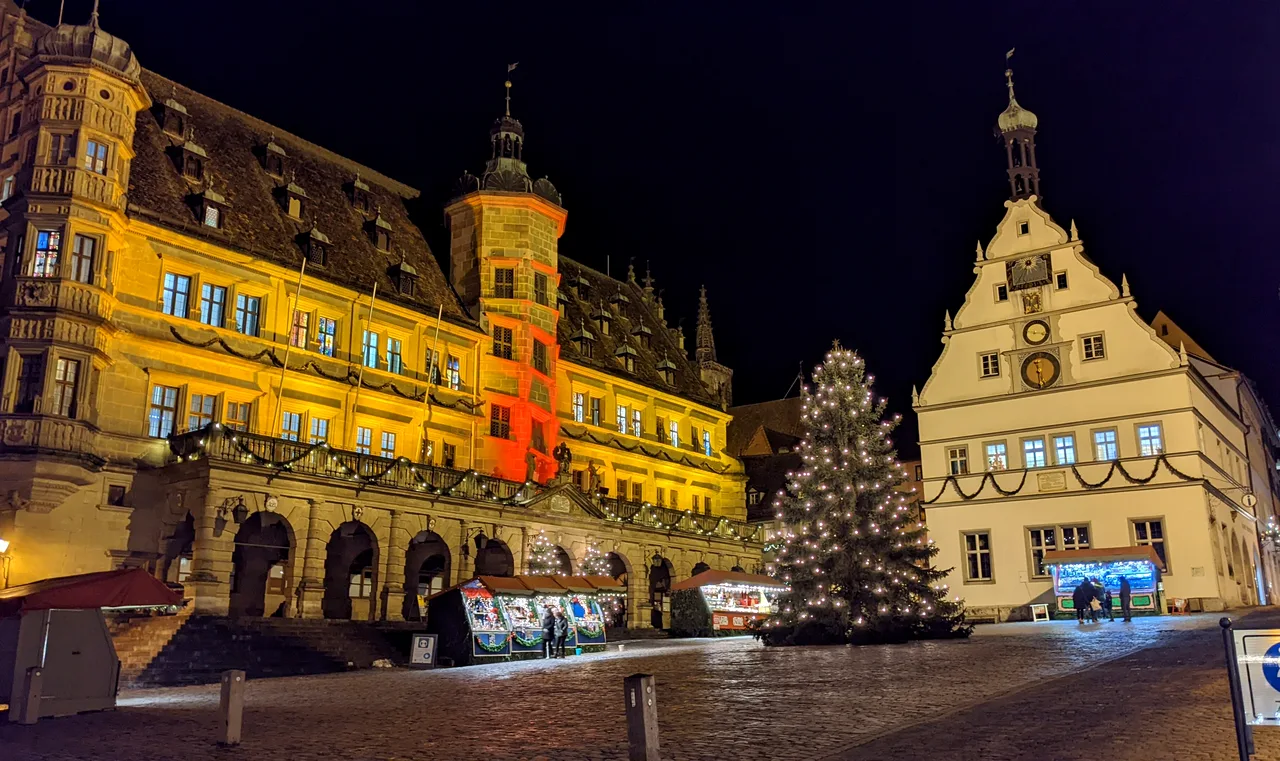
The Rothenburg Reiterlesmarkt is one of the oldest Christmas markets in Germany; its roots go back to the 15th century. It is named after the “Reiterle”, a mysterious rider figure from old regional winter lore who in earlier times was said to travel the skies during the dark weeks of the year. Today the Reiterle opens the market in person: according to the official description, the rider arrives on the Marktplatz, the mayor welcomes visitors and the big Christmas tree is lit. The roughly 61 stalls spread across the Marktplatz, the Grüner Markt, the Kirchplatz by St James’s Church and the Lichthof of the Town Hall, with traditional crafts, Christmas decorations, mulled wine, Franconian sausages and the local pastry, the Schneeball. Every evening an Advent window on the second floor of the Town Hall is opened, like a giant Advent calendar. Against the backdrop of half-timbered gables, the Ratstrinkstube clock and the illuminated Herrngasse, the market is compact and can be explored on foot in an evening. A few steps away on Herrngasse, the German Christmas Museum tells the history of Christmas decorations and is open in other seasons too. Entry to the market is free.


| Event | Location | 2026 dates | Note |
|---|---|---|---|
| Reiterlesmarkt | Marktplatz, Grüner Markt, Kirchplatz and the Town Hall Lichthof | 20 November–23 December 2026 (closed 22 November) | Sun–Thu 11:00–19:00, Fri–Sat 11:00–20:00; about 61 stalls. Free entry. |
| Opening of the Reiterlesmarkt | Marktplatz | 20 November 2026 | The Reiterle arrives, the mayor welcomes visitors and the Christmas tree is lit; check the time on rothenburg.de. |
| Advent window on the Town Hall | Town Hall, second floor (Marktplatz) | Each evening of Advent | A window of the giant Advent calendar is opened every evening; check the time on the official page. |
| German Christmas Museum | Herrngasse 1 (Käthe Wohlfahrt building) | All year, seasonal hours | History of Christmas trees, decorations and Advent customs; check hours and admission on weihnachtsmuseum.de. |
| Reiterlesmarkt 2027 | Marktplatz and surrounding squares | 19 November–23 December 2027 | Date given in advance by the town; check again nearer the time. |
What to try
Schneeballen
Rothenburg’s “snowballs”: strips of shortcrust pastry formed into a ball, fried and dusted with sugar or coated with chocolate.
Fränkische Bratwurst
Grilled Franconian sausages in a bread roll; usually contain pork.
Glühwein
Hot spiced mulled wine, often Franconian red or white wine; alcoholic.
Kinderpunsch
Spiced hot fruit punch for children and non-drinkers.
Lebkuchen
Spiced gingerbread, a speciality of nearby Nuremberg.
Gebrannte Mandeln
Sugar-roasted almonds, a classic of German Christmas markets.
Tips for the Reiterlesmarkt
- In December it gets dark around 16:30; see the walls and the Tauber valley by day and the market in the evening.
- The market is closed on Sunday 22 November 2026 (Totensonntag); plan around this day.
- The market closes at 19:00 Sunday–Thursday and 20:00 on Fridays and Saturdays; it is earlier than many big-city markets.
- Weekends in Advent are very busy, especially when coach groups arrive; weekdays are calmer.
- Glühwein mugs usually carry a deposit; return them or keep them as a souvenir.
- The cobbles are slippery when wet or icy; wear non-slip shoes.
- Day visitors fill the town around midday; staying overnight lets you see the quiet lanes in the evening and early morning.
- After 23 December the market is closed and many shops change hours over 24–26 December.
Check before you go: Stadt Rothenburg · Reiterlesmarkt / Christmas market 2026 (official) ↗ · Deutsches Weihnachtsmuseum (official) ↗
Dates and hours checked on 28 October 2026 against the rothenburg.de “Reiterlesmarkt” page. Times of the opening ceremony and the Advent window can change; check the official page before you visit.
When to Go
Rothenburg has a continental climate with cold winters and warm summers. Spring and autumn are ideal for walking the walls and the Tauber valley; in summer the town is at its busiest with day visitors from the Romantic Road. From late November to 23 December the Reiterlesmarkt and the illuminated lanes create the classic Christmas scene. January and February are cold and quiet, with shorter opening hours.
| Month | Sightseeing | Christmas market | Tauber valley and trips | Crowds |
|---|---|---|---|---|
| January | Difficult | None | Difficult | Quiet |
| February | Difficult | None | Difficult | Quiet |
| March | Good | None | Good | Moderate |
| April | Very good | None | Very good | Moderate |
| May | Very good | None | Very good | Busy |
| June | Very good | None | Very good | Busy |
| July | Very good | None | Very good | Busy |
| August | Very good | None | Very good | Busy |
| September | Very good | None | Very good | Busy |
| October | Very good | None | Very good | Busy |
| November | Good | Market season | Good | Moderate |
| December | Good | Market season | Difficult | Busy |
- Winters are cold and sometimes snowy; plan sightseeing around daylight.
- The Reiterlesmarkt runs from 20 November to 23 December 2026 (closed 22 November).
- Paths in the Tauber valley can be muddy or icy in winter.
- Some museums have shorter hours in winter; check before you go.
- Accommodation inside the walls is limited; book early for Advent weekends.
- The Meistertrunk festival takes place around Whitsun (Pentecost); check the date on the official site.
Visa and Entry (Turkish citizens)
Turkish citizens holding an ordinary (burgundy) passport need a Schengen visa for tourist travel to Germany. Special, service and diplomatic passports follow different rules; check the current position on the Turkish Ministry of Foreign Affairs page.
Apply to the representation of the country that is your main destination. If Germany is the main destination, applications go through the German missions in Türkiye; current information on the application process is at tuerkei.diplo.de.
If you combine Rothenburg with Austria or another Schengen country, apply to the country of your longest stay; if stays are equal, to the country of first entry.
Under the EU Entry/Exit System (EES), being introduced in stages, your biometric data (facial image and fingerprints) may be recorded on first entry; allow extra time at the border.
Visa fees, appointment waiting times and required documents can change; this guide gives no fees. Use the current lists on the official pages before you apply.
Travel medical insurance and proof of accommodation and return are part of the application; details are in the official sources.
Check before you go: T.C. Dışişleri Bakanlığı · Türk vatandaşlarının tabi olduğu vize uygulamaları ↗ · tuerkei.diplo.de ↗ · EES · europa.eu ↗ · Rota Atlası visa guide (TR)
Travel medical insurance
Check the official visa and entry sources above first: they state whether travel medical insurance is required and the minimum cover. Compare any policy’s cover amount, validity dates and countries covered with the official requirement.
Rota Atlası does not currently offer an insurance partnership; there are no paid links in this section. Last updated: 1 November 2026
Getting to Rothenburg
- By air: Rothenburg has no airport. The nearest major airports are Nuremberg (NUE) and Frankfurt (FRA); from both you continue by train. Check current flights from Türkiye only on airline and airport websites.
- By train: Rothenburg ob der Tauber station is at the end of a short branch line; you usually change at Steinach (bei Rothenburg). From Nuremberg and Würzburg there are connections with one or two changes; check timetables on bahn.de.
- From Frankfurt: trains run via Würzburg and Steinach; plan the whole journey on bahn.de and allow time for changes.
- From the station to the old town: Rothenburg station lies just outside the walls; the Rödertor and Marktplatz are a walk of roughly 10–15 minutes.
- By road: Rothenburg lies on the Romantic Road and close to the A7 motorway; the old town has restricted traffic and parking is outside the walls.
Getting Around

On foot
The old town is small; the Marktplatz, Plönlein, Burggarten and wall-walk are all within a short walk.
Wall-walk
A long section of the covered wall-walk can be walked for free; access via stairs at several towers.
Town buses
Local bus links are limited; most visitors walk inside the walls.
Regional trains
Trains via Steinach link Rothenburg with Würzburg, Ansbach and Nuremberg; check bahn.de.
Tauber valley
Footpaths lead down to the Double Bridge, the Topplerschlösschen and Detwang.
Day trips
Dinkelsbühl, Feuchtwangen and Weikersheim are reachable by bus, train or car; check connections in advance.
Things to See
Rothenburg’s old town sits inside its walls on the plateau above the Tauber. The Marktplatz with the Town Hall is the centre; Herrngasse leads west to the Burggarten, the Schmiedgasse south to the Plönlein and the Spital quarter, and St James’s Church stands just north of the Marktplatz. Below the walls the Tauber valley with the Double Bridge, the Topplerschlösschen and Detwang invites walks; Feuchtwangen and Weikersheim are short trips away.
The heart of the town
Marktplatz and the Town Hall

The Marktplatz is the stage of Rothenburg life and, in Advent, of the Reiterlesmarkt. Its west side is formed by the Town Hall, which joins two very different buildings: the older Gothic part with its tall tower dates from the 13th century, while the Renaissance building facing the square was built from 1572 to 1578 after a fire. On the north side stands the Ratstrinkstube, the former councillors’ tavern; its gable clock has small windows in which figures re-enact the legend of the Meistertrunk several times a day. The Georgsbrunnen fountain and the half-timbered houses around the square complete the scene.
Don’t miss
- The Renaissance façade of the Town Hall
- The Meistertrunk figures in the Ratstrinkstube clock
- The Georgsbrunnen fountain
- The square lit up in the evening
Tips
- Check the times of the Meistertrunk figures on the official tourism pages.
- The tourist information office is on the Marktplatz.
- In Advent the square is the centre of the Reiterlesmarkt.

Roofs to the horizon
Town Hall Tower
The tower of the Gothic Town Hall rises to about 60 metres and is one of the best viewpoints in Franconia. A narrow staircase and finally a steep ladder lead to the small viewing platform, from where you look down on the red roofs, the Marktplatz, the towers of St James’s Church and the ring of walls, and out over the Tauber valley. The climb is tight and not suitable for everyone, but the view rewards the effort.
Don’t miss
- The view over the Marktplatz
- The ring of walls and towers
- The Tauber valley in the distance
- The roofs of St James’s Church
Tips
- The climb is steep and narrow; it is not suitable for people with limited mobility or a fear of heights.
- Opening times are shorter in winter; check them on the official website.
- The platform is small; there may be short waits at busy times.
The town’s postcard
Plönlein and Siebersturm

The Plönlein (“little square”) is the most photographed spot in Rothenburg: a crooked yellow half-timbered house with a fountain at the fork of two streets, one climbing to the Siebersturm tower and the other dropping down to the Kobolzell Gate and the Tauber valley. The Siebersturm dates from the 14th century and marked an earlier line of the town’s defences before the walls were extended to the south. In the evening, and especially in Advent, the lit-up corner is a favourite subject for photographers.
Don’t miss
- The classic view of the Plönlein
- The Siebersturm
- The Kobolzell Gate
- The fountain in the evening light
Tips
- Come early in the morning or after dark for photos without crowds.
- The street to the Kobolzell Gate leads down into the Tauber valley.
- Do not block the narrow street while taking photos.

Riemenschneider’s masterpiece
St James’s Church (St. Jakob)

The Protestant St James’s Church was built between the early 14th century and the late 15th century, and its two Gothic towers dominate the old town skyline. Its greatest treasure is the Holy Blood Altarpiece by Tilman Riemenschneider, carved in the early 16th century: the limewood scene of the Last Supper, with Judas at the centre, is considered one of the masterpieces of late Gothic sculpture. The high altar with the Twelve Apostles and the stained glass windows of the choir are also worth seeing. A road runs under the west choir of the church.
Don’t miss
- The Holy Blood Altarpiece
- The Twelve Apostles Altar
- The choir windows
- The road passage under the west choir
Tips
- An admission charge may apply for sightseeing; check on site.
- Do not walk around during services.
- Photography rules may apply; respect the signs.

A walk on the walls
Town walls, Rödertor and Markusturm

Rothenburg’s town walls are among the best preserved in Germany. A long section of the covered wall-walk can be walked, past towers, gates and loopholes, with views over roofs and gardens. On the east side the Rödertor is one of the most impressive gates, with its outer defences and gatehouses. In the centre of town, the Markusturm and the Röderbogen arch belong to the oldest, 12th-century ring of fortifications. Along the wall-walk are many stones and plaques recording donors who helped rebuild the walls after the destruction of 1945.
Don’t miss
- The covered wall-walk
- The Rödertor and its outer gate
- The Markusturm with the Röderbogen
- The donor plaques along the wall
Tips
- The wall-walk is free but narrow and low in places; watch your head.
- It can be slippery in winter; parts may be closed in ice or snow.
- Start at the Rödertor and walk towards the Spital quarter.


Southern fortifications
Spital quarter and Spitalbastei

At the southern tip of the old town, the Spital quarter grew around a medieval hospital. To protect it, the town built the Spitalbastei in the 16th and 17th centuries, a massive bastion with several gates, inner courtyards and a defensive walkway; it is one of the strongest parts of the fortifications. The historic Spital buildings, the Hegereiterhaus and the quiet lanes make this quarter a calmer alternative to the busy centre.
Don’t miss
- The gates and courtyards of the Spitalbastei
- The Hegereiterhaus
- The wall-walk starting point
- Views out over the countryside
Tips
- The quarter is about 10 minutes’ walk south of the Plönlein.
- Fewer visitors come here; it is good for quiet photos.
- In winter darkness falls early; carry a light for the walk back.
Gardens above the valley
Burggarten and views of the Tauber

The Burggarten lies on a spur at the western end of the old town, on the site of the medieval Staufer castle. The castle was destroyed in an earthquake in 1356; today only the St Blaise Chapel and the castle gate remain. The gardens offer some of the finest views over the Tauber valley, the Double Bridge and the southern skyline of Rothenburg, and are a peaceful place away from the busy lanes.
Don’t miss
- The view down into the Tauber valley
- The Burgtor gate
- St Blaise Chapel
- The southern skyline of the town
Tips
- The garden is reached via Herrngasse and the Burgtor.
- Sunset views are especially beautiful.
- Paths can be icy in winter.

Law and justice
Medieval Crime and Justice Museum

The Medieval Crime and Justice Museum (Mittelalterliches Kriminalmuseum) is one of the most important museums of legal history in Europe. Over several floors it shows a thousand years of law and punishment, from documents, seals and legal books to instruments of torture, shame masks and the iron maiden. The exhibition explains how courts worked, what counted as a crime and how punishments changed over time; some exhibits are disturbing for children.
Don’t miss
- Shame masks and pillories
- Historic legal documents
- The exhibitions on witch trials
- The building of the former Johanniter commandery
Tips
- Check opening hours and admission on kriminalmuseum.eu.
- Allow at least one and a half hours.
- Some exhibits may be upsetting for young children.
Christmas all year
German Christmas Museum and Käthe Wohlfahrt

On Herrngasse, just off the Marktplatz, the German Christmas Museum (Deutsches Weihnachtsmuseum) presents the history of Christmas customs: early tree decorations, glass baubles, nativity scenes, Advent calendars, Father Christmas figures and Christmas cards. It is housed in the same complex as the Käthe Wohlfahrt Christmas Village, a large shop selling Christmas decorations all year round. Together they make Rothenburg a Christmas destination even in summer.
Don’t miss
- Historic Christmas tree decorations
- Old Advent calendars and cards
- Father Christmas figures
- The Christmas Village shop
Tips
- Check museum hours and admission on weihnachtsmuseum.de.
- Photography may be restricted in the shop; respect the signs.
- The area is very busy in Advent; come early in the day.

Down in the valley
Tauber valley: Double Bridge, Topplerschlösschen and Detwang

Below the town walls the Tauber winds through meadows and woods. The Double Bridge (Doppelbrücke), a two-tier arched stone bridge from the 14th century, is one of the best-known views of the valley. Nearby stands the Topplerschlösschen, a small tower-like house built in 1388 for Mayor Heinrich Toppler. About two kilometres downstream lies Detwang, older than Rothenburg itself; its Romanesque church of St Peter and Paul holds a Holy Cross altar by Tilman Riemenschneider.
Don’t miss
- The Double Bridge
- The Topplerschlösschen (from outside)
- The Riemenschneider altar in Detwang
- The view up to the town walls
Tips
- The descent from the Kobolzell Gate or the Burggarten is steep; return uphill takes effort.
- The paths can be muddy or icy in winter.
- Check opening of the Detwang church before you go.


On the Romantic Road
Day trip: Feuchtwangen

About 30 kilometres south of Rothenburg, Feuchtwangen is a small town on the Romantic Road with a pretty market square, the collegiate church and the church of St John, and a Romanesque cloister used as a stage for summer theatre. The Franconian Museum shows rural culture and crafts of the region. Feuchtwangen combines well with Dinkelsbühl, another walled town further south.
Don’t miss
- The market square
- The collegiate church and its cloister
- St John’s Church
- The Franconian Museum
Tips
- Public transport connections are limited; check bus times in advance.
- Combine with Dinkelsbühl on the same day.
- Winter hours of museums are shorter.
Renaissance on the Tauber
Day trip: Weikersheim Palace

Downstream on the Tauber, in Baden-Württemberg, Weikersheim Palace was the residence of the Counts of Hohenlohe. It is known for its Renaissance Knights’ Hall with a carved coffered ceiling and life-size animal figures, and for its Baroque garden with statues and an orangery. Weikersheim lies on the “Lovely Tauber valley” route and can be combined with Creglingen.
Don’t miss
- The Knights’ Hall
- The Baroque garden
- The palace courtyard
- The small town centre
Tips
- Check opening times and tours on schloss-weikersheim.de.
- The garden is at its best from spring to autumn.
- Public transport requires changes; check connections in advance.
1–3 Day Itineraries, a Christmas Day + a 7-Day Romantic Road Route
The itineraries keep walking distances short and allow for short winter days. One day is enough for the old town and the walls, two allow museums and the Tauber valley, and three add a Romantic Road trip. The 7-day route combines Rothenburg with other Franconian and Bavarian cities. Check opening hours on the official websites in advance.
Day 1: Marktplatz, tower and walls
- Start on the Marktplatz and watch the Meistertrunk figures in the Ratstrinkstube clock.
- Climb the Town Hall tower for the view.
- See the Holy Blood Altarpiece in St James’s Church.
- Walk to the Plönlein and on to the Spital quarter.
- Return along the covered wall-walk to the Rödertor.
Day 2: Museums and the Tauber valley
- Visit the Medieval Crime and Justice Museum.
- Walk along Herrngasse to the Burggarten for the valley view.
- Descend to the Double Bridge and the Topplerschlösschen.
- Walk on to Detwang and its Riemenschneider altar.
- Return uphill and see the Plönlein lit up in the evening.
Day 3: Along the Romantic Road
- Travel south to Feuchtwangen and its cloister.
- Continue to Dinkelsbühl if time allows.
- Alternatively, visit Weikersheim Palace in the Tauber valley.
- Return to Rothenburg in the afternoon.
- Spend the evening in the old town.
Christmas Day (20 November–23 December 2026)
- In the morning walk the wall-walk while it is quiet.
- Visit the German Christmas Museum on Herrngasse.
- At midday try Schneeballen and a Franconian sausage.
- In the late afternoon stroll the Reiterlesmarkt on the Marktplatz and Kirchplatz.
- In the evening see the Advent window on the Town Hall and the lit Plönlein.
7 Days: Franconia and the Romantic Road
- Days 1–3: Rothenburg – old town, museums, Tauber valley and a Romantic Road trip.
- Day 4: Würzburg and its Residence.
- Day 5: Bamberg.
- Day 6: Nuremberg.
- Day 7: Depart from Nuremberg or Frankfurt.
Rothenburg and Franconian Food
Rothenburg’s cooking is Franconian: hearty roasts, sausages, dumplings and the wines of the Tauber and Main valleys, plus the famous local pastry, the Schneeball. These are traditional dishes, not restaurant recommendations.


Schneeballen
Rothenburg’s signature pastry: strips of dough shaped into a ball, fried and dusted with sugar or coated in chocolate; it is crisp and crumbly.
Fränkische Bratwurst
Grilled Franconian sausages, often served with sauerkraut; usually contain pork.
Schäufele
Roast pork shoulder with crackling and dumplings, a Franconian Sunday dish; contains pork.
Klöße
Potato dumplings served with roasts and gravy.
Saure Zipfel
Sausages poached in a vinegar and onion broth; contain pork.
Krautsalat
Cabbage salad, a classic side dish.
Franconian wine
Wines from the Tauber valley and Franconia, often in the round Bocksbeutel bottle; alcoholic.
Glühwein
Mulled wine at the Reiterlesmarkt; alcoholic.
- Many traditional dishes contain pork; ask about ingredients.
- Vegetarian options (dumplings with mushroom sauce, Käsespätzle) are often available.
- Tap water is of high quality; ask for it specifically.
- Service is included; rounding up by 5–10 per cent is customary.
Culture and Etiquette

- “Grüß Gott” is the usual greeting in Franconia; “Guten Tag” also works.
- Use the formal “Sie” in formal situations.
- Rothenburg is a living town; respect residents’ privacy and do not enter private courtyards.
- Do not walk around churches during services or use flash.
- People queue at bakeries, stalls and the tower stairs.
- Small amounts are often still paid in cash at stalls.
- Sunday is a day of rest; most shops are closed.
- Keep noise down in the lanes at night.
- Punctuality is expected for tours and appointments.
- Ask before photographing people, especially at markets.
Safety and Health
- Rothenburg is very safe; watch your valuables in crowded lanes and at the market.
- Cobbles and the wall-walk are slippery when wet or icy; wear non-slip shoes.
- The wall-walk is low in places; watch your head and do not let children climb.
- The Town Hall tower climb is steep; it is not for those with limited mobility.
- Paths down to the Tauber are steep; take care in the dark.
- In an emergency call 112, police 110.
- Make sure your travel medical insurance covers the Schengen area.
What Your Budget Depends On
This guide does not give prices; prices change with season and year. Your budget depends on these factors:
Travel dates
Advent weekends and summer push up hotel demand.
Accommodation
Rooms inside the walls are limited; outside the walls and nearby towns are alternatives.
Transport
Train connections require changes; a car or regional passes can change the cost.
Sights and museums
Each museum and the tower charge separately.
Food and drink
Bakeries and market snacks are affordable; restaurants vary.
Day trips
Trips along the Romantic Road cost extra.
Free experiences
The Reiterlesmarkt (free entry), the wall-walk, the Plönlein, the Burggarten and the Tauber valley paths are free.
Practical Information
- Money: euro; cards widely accepted, carry some cash.
- Language: German; English understood in tourism.
- Sockets: 230 V, type C/F.
- Time: CET (UTC+1) in winter.
- Opening hours: shorter in winter.
- Shops: closed on Sundays; the Christmas market is open (except 22 November).
- Holidays: changed hours on 24–26 and 31 December and 1 January.
- Weather: cold in December, about -2 to 4 °C.
- Daylight: sunset around 16:30 in December.
- Emergency: 112; police 110.
Frequently Asked Questions
When is the Rothenburg Reiterlesmarkt 2026?
According to rothenburg.de it runs from 20 November to 23 December 2026; it is closed on Sunday 22 November.
What are the opening hours?
Sunday–Thursday 11:00–19:00 and Friday–Saturday 11:00–20:00, according to the official page.
Where is the market?
On the Marktplatz, the Grüner Markt, the Kirchplatz and in the Town Hall Lichthof.
Is entry free?
Yes; food, drink and gifts cost money.
Is the German Christmas Museum open all year?
It is open in other seasons too, with seasonal hours; check weihnachtsmuseum.de.
Do Turkish citizens need a visa?
Holders of ordinary passports need a Schengen visa. If Germany is the main destination, see tuerkei.diplo.de.
Which airport is closest?
Nuremberg (NUE) and Frankfurt (FRA). Check current flights on the airport websites.
How do I get there by train?
Usually with a change at Steinach (bei Rothenburg); check bahn.de.
How many days are enough?
One day for the old town, two with museums and the Tauber valley, three with a Romantic Road trip.
Can you walk on the town walls?
Yes; a long section of the covered wall-walk is open and free.
Where to stay
Stay close to the areas where you will spend most time. The areas below are covered in detail in this guide; check public transport links in the getting-around section.
- The heart of the townMarktplatz and the Town Hall
- Roofs to the horizonTown Hall Tower
- The town’s postcardPlönlein and Siebersturm
- Riemenschneider’s masterpieceSt James’s Church (St. Jakob)
- A walk on the wallsTown walls, Rödertor and Markusturm
- Southern fortificationsSpital quarter and Spitalbastei
- Gardens above the valleyBurggarten and views of the Tauber
- Law and justiceMedieval Crime and Justice Museum
- Christmas all yearGerman Christmas Museum and Käthe Wohlfahrt
- Down in the valleyTauber valley: Double Bridge, Topplerschlösschen and Detwang
- On the Romantic RoadDay trip: Feuchtwangen
- Renaissance on the TauberDay trip: Weikersheim Palace
Search hotels in these areas (Hotellook) ↗ (affiliate link)Search on Booking.com ↗
Affiliate disclosure: Hotellook, Aviasales, Klook, Airalo, Tiqets and DiscoverCars links are affiliate links; Rota Atlası may earn a commission on bookings made through them, at no extra cost to you. Official and in-guide links are not paid. Last updated: 1 November 2026 · Privacy and affiliates
Transport and connectivity
- Airport transferOptions from the airport to the city are in this guide’s getting there section.
- Mobile data (eSIM)Airalo eSIM ↗ (affiliate link)
- TrainsOfficial rail website ↗
- Car hireYou rarely need a car within the city; see getting around first. Compare car hire on DiscoverCars ↗ (affiliate link)
Affiliate disclosure: Hotellook, Aviasales, Klook, Airalo, Tiqets and DiscoverCars links are affiliate links; Rota Atlası may earn a commission on bookings made through them, at no extra cost to you. Official and in-guide links are not paid. Last updated: 1 November 2026 · Privacy and affiliates
Search flights (affiliate link)
Search flights from any airport in any country. Results open on Aviasales in a new tab, where you book.
This form is an affiliate link: Rota Atlası may earn a commission on bookings made via Aviasales (Travelpayouts), at no extra cost to you. Check price, baggage and terms on the booking site. Airport data: OurAirports (public domain).
Flights, hotels and tours
Find tours and tickets
- Reiterlesmarkt (Christmas market)
GetYourGuide ↗ · Klook ↗ (affiliate link) - Town hall and Advent window
GetYourGuide ↗ · Klook ↗ (affiliate link) - Plönlein
GetYourGuide ↗ · Klook ↗ (affiliate link) - Town wall walk
GetYourGuide ↗ · Klook ↗ (affiliate link)
Hotellook, Aviasales, Klook, Airalo and Tiqets links in this box are affiliate links (Travelpayouts): Rota Atlası may earn a commission on bookings made through them, at no extra cost to you. GetYourGuide links currently carry no affiliate code. Check prices and terms with the provider. Last updated: 1 November 2026 · Privacy and affiliates
Sources
- T.C. Dışişleri Bakanlığı · Türk vatandaşlarının tabi olduğu vize uygulamaları ↗
- Auswärtiges Amt · Deutsche Vertretungen in der Türkei (Visa) ↗
- European Union · Entry/Exit System (EES) ↗
- Stadt Rothenburg ob der Tauber · rothenburg.de (official) ↗
- Mittelalterliches Kriminalmuseum Rothenburg (official) ↗
- Deutsches Weihnachtsmuseum Rothenburg (official) ↗
- Romantische Straße · romantischestrasse.de (official) ↗
- Staatliche Schlösser und Gärten Baden-Württemberg · Schloss Weikersheim (official) ↗
- Deutsche Bahn ↗
- Nuremberg Airport (official) ↗
- Frankfurt Airport (official) ↗
- GOV.UK · Foreign travel advice · Germany ↗
- Stadt Rothenburg · Reiterlesmarkt / Christmas market 2026 (official) ↗
- Deutsches Weihnachtsmuseum (official) ↗
This page is for information only. Dates, hours, entry rules and transport information can change; check the official sources above before travelling. No prices, flights, hotels or restaurants have been invented in this guide.
Photo credits
The photos on this page come from Wikimedia Commons and are used under the stated authors and licences (CC BY, CC BY-SA, CC0 or public domain). Full list of sources
- Illuminated Christmas market on the Marktplatz in front of Rothenburg Town Hall — Rosty · CC BY-SA 4.0 · Wikimedia Commons
- Reiterlesmarkt stalls and historic houses on the Marktplatz — Mosquitivy · CC BY-SA 3.0 · Wikimedia Commons
- Christmas decorations and lights on Herrngasse — Rosty · CC BY-SA 4.0 · Wikimedia Commons
- The Herrnbrunnen fountain lit up for Christmas — Rosty · CC BY-SA 4.0 · Wikimedia Commons
- Snow-covered Rothenburg lanes and half-timbered houses — Rosty · CC BY-SA 3.0 · Wikimedia Commons
- The Plönlein and its fountain in December — Tilman2007 · CC BY-SA 4.0 · Wikimedia Commons
- The Spitaltor tower in December — Tilman2007 · CC BY-SA 4.0 · Wikimedia Commons
- A Marktplatz house decorated in December — Tilman2007 · CC BY-SA 4.0 · Wikimedia Commons
- A Rothenburg tower in winter — John Samuel · CC BY-SA 4.0 · Wikimedia Commons
- A display in the German Christmas Museum — Vitold Muratov · CC BY-SA 4.0 · Wikimedia Commons
- The Plönlein: half-timbered house, Siebersturm and Kobolzell Gate — Berthold Werner · Public domain · Wikimedia Commons
- The Plönlein lit up at night — Tilman2007 · CC BY-SA 3.0 · Wikimedia Commons
- The Marktplatz and the clock façade of the Ratstrinkstube — Reinhold Möller Ermell · CC BY-SA 4.0 · Wikimedia Commons
- Gothic and Renaissance wings of Rothenburg Town Hall — Berthold Werner · Public domain · Wikimedia Commons
- View over the red roofs from the Town Hall tower — Tuxyso · CC BY-SA 3.0 · Wikimedia Commons
- Walled Rothenburg above the Tauber valley — Tilman2007 · CC BY-SA 4.0 · Wikimedia Commons
- The Rothenburg skyline from the south — Tilman2007 · CC BY-SA 3.0 · Wikimedia Commons
- The Gothic towers of St James’s Church — Tuxyso · CC BY-SA 3.0 · Wikimedia Commons
- Tilman Riemenschneider’s Holy Blood Altarpiece — Tilman2007 · CC BY-SA 4.0 · Wikimedia Commons
- The covered wall-walk of Rothenburg’s town walls — Reinhold Möller Ermell · CC BY-SA 4.0 · Wikimedia Commons
- The Rödertor gate tower — Reinhold Möller Ermell · CC BY-SA 4.0 · Wikimedia Commons
- The Spitalbastei fortification — Tilman2007 · CC BY-SA 4.0 · Wikimedia Commons
- The Markusturm and Röderbogen arch — Pahcal123 · CC BY-SA 4.0 · Wikimedia Commons
- The Siebersturm and surrounding houses — Tilman2007 · CC BY-SA 4.0 · Wikimedia Commons
- The Burggarten and St Blaise’s Chapel — Palickap · CC BY 4.0 · Wikimedia Commons
- The Medieval Crime and Justice Museum building — Holger Uwe Schmitt · CC BY-SA 4.0 · Wikimedia Commons
- The Käthe Wohlfahrt Christmas Village store — Avi1111 dr. avishai teicher · CC BY-SA 4.0 · Wikimedia Commons
- The Ratstrinkstube and its clock on the Marktplatz — Avi1111 dr. avishai teicher · CC BY-SA 4.0 · Wikimedia Commons
- A Tauber bridge with Rothenburg behind — Rainer Lippert · CC0 · Wikimedia Commons
- The Topplerschlösschen in the Tauber valley — H2k4 · CC BY-SA 3.0 · Wikimedia Commons
- St Peter and Paul’s Church in Detwang — Heinrich Stürzl · CC BY-SA 4.0 · Wikimedia Commons
- St John’s and the collegiate church in Feuchtwangen — Arths-at · CC BY-SA 4.0 · Wikimedia Commons
- Aerial view of Weikersheim Palace and gardens — Carsten Steger · CC BY-SA 4.0 · Wikimedia Commons
- Rothenburg’s traditional Schneeballen pastries — Sonja1982 · CC0 · Wikimedia Commons
- Bratwurst with sauerkraut and potatoes — Dominik Schwind from Lörrach, Germany · CC BY 2.0 · Wikimedia Commons
- Rothenburg ob der Tauber railway station — Tilman2007 · CC BY 3.0 · Wikimedia Commons
Würzburg → · Nuremberg → · Bamberg → · Augsburg → · Heidelberg → · Christmas markets