

Bamberg is an episcopal city of about 78,000 people in Upper Franconia in the German state of Bavaria, on two arms of the River Regnitz close to its confluence with the Main. Emperor Henry II founded a diocese here in 1007 and made the city one of the centres of the empire; because it spreads over seven hills, Bamberg is called the “Franconian Rome”. Its old town escaped major destruction in the Second World War and, with a fabric spanning the Middle Ages to the Baroque, has been on the UNESCO World Heritage List since 1993. The city has three historic parts: the Bergstadt (hill town) with the cathedral and churches, the merchants’ Inselstadt (island town) between the two river arms, and the Gärtnerstadt (market-gardeners’ town) with its vegetable gardens. During Advent a Christmas market stretches from Maxplatz to the Grüner Markt; according to the official tourism website Bamberg has been a “Krippenstadt” (nativity-scene city) for around 400 years, and from Advent to January dozens of nativity scenes (Krippen) are displayed in churches, museums and squares along a route called the “Krippenweg”.
Content update: 28 October 2026 · Christmas market and Krippenweg dates checked against the official website bamberg.info
Bamberg at a Glance
- Country / state
- Germany · Bavaria, Upper Franconia
- Population
- About 78,000
- Language
- German (Franconian dialect)
- Currency
- Euro (EUR)
- Time zone
- Central European Time (CET, UTC+1); in winter 2 hours behind Türkiye
- Famous for
- UNESCO old town, the Old Town Hall in the river, Rauchbier, Krippenstadt
- Landmarks
- Old Town Hall, cathedral and Bamberg Horseman, New Residence, Alte Hofhaltung, Michaelsberg, Little Venice
- Nearby
- Vierzehnheiligen, Banz Abbey, Coburg, Pommersfelden, Nuremberg, Würzburg
- Christmas market
- 24 November–23 December 2026 (Maxplatz, Grüner Markt, Obstmarkt)
- Airport
- Nuremberg (by train via Nuremberg), Frankfurt
- Electricity
- 230 V, plug types C/F
- Emergency
- 112 (ambulance/fire), 110 (police)
Bamberg in Pictures
The fishermen’s houses of Little Venice on the Regnitz, the four-towered cathedral seen from the Geyerswörth tower, and the rose garden of the New Residence above the old-town roofs: Bamberg in three pictures.


Bamberg Christmas Market and Krippenweg 2026
Advent in Bamberg revolves around two traditions: the Christmas market and nativity scenes. The Bamberger Weihnachtsmarkt runs through the island part of the old town, from the New Town Hall on Maxplatz to the Neptune fountain (Gabelmann) on the Grüner Markt and on to the Obstmarkt; it opens on 24 November at 18:00 with the Christkind and lasts until 23 December. According to the official website the market area is step-free (but cobbled), and the tourist information office on Geyerswörthstraße has a “Toilette für alle” (accessible toilet for all). What really sets Bamberg apart is its “Krippenstadt” tradition: from Advent to January local and international nativity scenes are displayed in the cathedral, the Obere Pfarre, churches such as St. Michael and St. Stephan, the nativity museum in the Maternkapelle and in squares, and the official Krippenweg map links them on one walking route. Small, short-lived Advent markets are also held in the Sand quarter and on the Stephansberg. The information below was checked on the official website on 28 October 2026.


| Market / area | Location | 2026 dates | Note |
|---|---|---|---|
| Bamberg Christmas Market (Bamberger Weihnachtsmarkt) | Maxplatz, Grüner Markt and Obstmarkt (Inselstadt) | 24 November–23 December 2026 | Hours published on the official website: Monday–Thursday 9:30–20:00, Friday–Saturday 9:30–21:00, Sunday 11:00–20:00. Opening on 24 November at 18:00 with the Christkind. |
| Adventsmarkt im Sand | Sand quarter, below the cathedral | 27–29 November 2026 | Friday 16:00–20:30, Saturday 11:00–20:30, Sunday 11:00–18:00. A small, short-lived market in the historic Sand lanes. |
| Adventsmarkt am Stephansberg | Stephansberg, around St. Stephan’s church | 12–13 December 2026 | A small two-day market in the hill town; announced as Saturday afternoon–20:00 and Sunday 11:00–19:00, so confirm the hours in the official programme. |
| Bamberger Krippenweg | Churches, museums and squares across the old town | Mostly from 24–29 November 2026 to January 2027 | Examples: cathedral 27 November–5 February; Kunigundenkapelle 27 November–12 January; Obere Pfarre 28 November–21 February; St. Michael 29 November–31 January; St. Stephan 29 November–2 February; Schönleinsplatz 29 November–6 January. The scenes in St. Gangolf, St. Jakob, Maria Hilf and St. Josef in Gaustadt can be seen all year. |
| Nativity museum (Maternkapelle) | Maternkapelle, Sutte | 28 November 2026–6 January 2027 | The nativity exhibition of the Bamberg Krippenfreunde association; check the hours on the official website. |
| Großkrippe der Marktkaufleute | Maxplatz, Christmas market area | 24 November 2026–6 January 2027 | The market traders’ large nativity scene; the scene at the tourist information office is on display from 19 November to 13 January. |
What to try
Glühwein
Spiced mulled wine; fruit-wine and alcohol-free Kinderpunsch versions are also available.
Lebkuchen
Nuremberg’s famous spiced biscuits, sold at every Franconian Christmas market.
Fränkische Bratwurst
Grilled Franconian sausage in a bread roll.
Rauchbier
Bamberg’s famous beer brewed with smoked malt; strong Bockbier styles also appear at Christmas time. Contains alcohol.
Gebrannte Mandeln
Warm sugar-roasted almonds.
Nativity figures
As befits Krippenstadt, wooden nativity figures and decorations are sold at the market and in shops.
Bamberg Christmas market tips
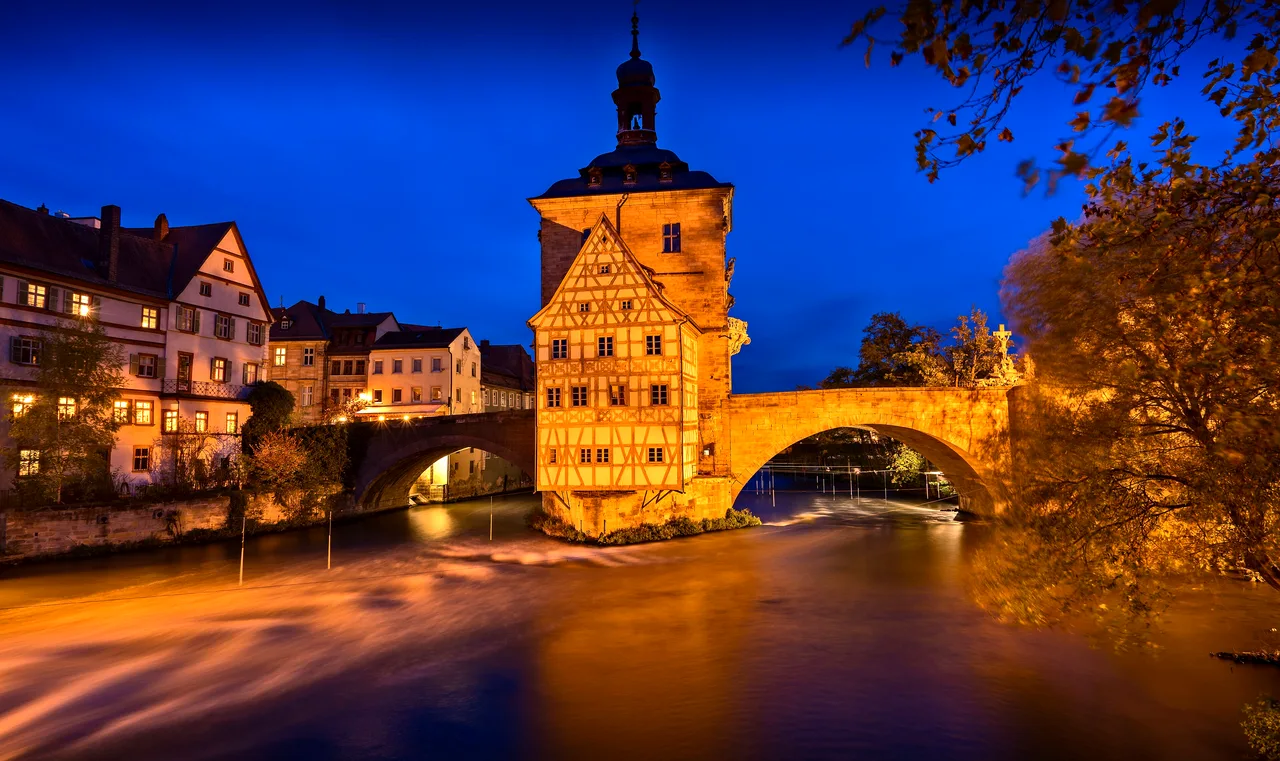
- The market runs from Maxplatz to the Grüner Markt and the Obstmarkt; from the Obstmarkt walk to the Untere Brücke to see the Old Town Hall in the evening lights.
- Pick up the Krippenweg map at the tourist information office (Geyerswörthstraße) or on the official website; most scenes are within walking distance, but the hill-town churches are reached by slopes and stairs.
- Visit the nativity scenes in churches outside service times; opening hours vary by church.
- On Saturdays day visitors arriving by regional train make it busier; for a calmer experience choose a weekday morning.
- The market area is step-free but cobbled; wear shoes with non-slip soles.
- Cash is useful at small stalls.
- Glühwein mugs usually carry a deposit (Pfand).
- In December it starts getting dark around 16:00; Little Venice and the Old Town Hall look their best in the evening lights.
Check before you go: Bamberg Tourismus · Bamberger Weihnachtsmarkt (official) ↗ · Bamberg Tourismus · Weihnachtsmärkte (official) ↗ · Bamberg Tourismus · Bamberger Krippenweg (official) ↗
Dates were checked on the official website bamberg.info (Bamberg Tourismus & Kongress Service) on 28 October 2026. Opening hours, the list of Krippenweg scenes and their display periods may change; for current information see the official website and the tourist information office on Geyerswörthstraße. For guided winter tours see bamberg.info/winterfuehrungen.
When to Go
Bamberg has a mild climate that turns cold in winter. From May to October riverside walks, beer gardens (Keller) and trips into the surrounding area are at their most enjoyable; in August the Sand quarter hosts the big Sandkerwa folk festival. From late November to early January the Christmas market and the Krippenweg fill the city. In winter the weather is often foggy and grey.
| Month | City sightseeing | Christmas market | Franconia trips | Crowds |
|---|---|---|---|---|
| January | Difficult | No market | Difficult | Quiet |
| February | Difficult | No market | Difficult | Quiet |
| March | Good | No market | Good | Moderate |
| April | Very good | No market | Very good | Moderate |
| May | Very good | No market | Very good | Moderate |
| June | Very good | No market | Very good | Busy |
| July | Very good | No market | Very good | Busy |
| August | Very good | No market | Very good | Busy |
| September | Very good | No market | Very good | Moderate |
| October | Very good | No market | Very good | Moderate |
| November | Good | Market season | Good | Moderate |
| December | Good | Market season | Difficult | Busy |
- In December temperatures in Bamberg are usually around freezing; frost and ice are possible and snow does not fall every year.
- The Christmas market is open from 24 November to 23 December 2026; most Krippenweg scenes stay until January 2027 and some until February, so a visit after Christmas is also worthwhile.
- Advent weekends are busy with visitors from the region and from Nuremberg.
- In summer the beer gardens (Keller) on the hills are open; most are closed in winter.
- In December it gets dark around 16:00–16:30; see the hill-town churches before noon and the lights in the evening.
- Spring and autumn are quiet, photogenic seasons for the Regnitz riverside and the rose garden.
Visas and Entry (Turkish citizens)
Turkish citizens holding an ordinary (burgundy) passport need a Schengen visa for tourist travel to Germany. Different rules apply to special, service and diplomatic passports; check the current situation with the Turkish Ministry of Foreign Affairs.
You apply to the mission of your main destination country. If Germany is your main destination, the German missions in Türkiye are responsible; current information is at tuerkei.diplo.de.
Bamberg is usually reached via Nuremberg, Würzburg or Frankfurt; if your whole trip is in Germany you still apply to the German missions. For trips covering several Schengen countries, apply according to where you will stay longest.
Under the EU Entry/Exit System (EES), being introduced in stages, your biometric data (facial image and fingerprints) may be taken on first entry; allow extra time at the border.
Visa fees, appointment waiting times and required documents can change; this guide does not give fees. Use the current list on the official websites before applying.
Travel health insurance and accommodation and return details are part of the application; see the official sources for details.
Check before you go: T.C. Dışişleri Bakanlığı · Türk vatandaşlarının tabi olduğu vize uygulamaları ↗ · tuerkei.diplo.de ↗ · EES · europa.eu ↗ · Rota Atlası visa guide (TR)
Travel medical insurance
Check the official visa and entry sources above first: they state whether travel medical insurance is required and the minimum cover. Compare any policy’s cover amount, validity dates and countries covered with the official requirement.
Rota Atlası does not currently offer an insurance partnership; there are no paid links in this section. Last updated: 1 November 2026
Getting to Bamberg
- By air: The nearest large airport is Nuremberg; take the underground from the airport to Nuremberg Hauptbahnhof and continue to Bamberg by regional train or ICE. Frankfurt Airport also offers train connections with a change. Check current flights only on the official airline and airport websites.
- By train: Bamberg station is on the Berlin–Leipzig/Erfurt–Nuremberg–Munich ICE line, with frequent regional trains from Nuremberg and Würzburg. Times and tickets are on bahn.de.
- By long-distance coach: Some long-distance coaches stop in Bamberg; check operators and times through official channels.
- By car: Bamberg is linked to the region by the A70 and A73 motorways. Traffic is restricted in the old town; use the car parks around the centre.
- By river: River cruises on the Main–Danube Canal call at Bamberg’s port; these are seasonal.
Getting Around

On foot
The Old Town Hall, Little Venice, cathedral, New Residence, Grüner Markt and Christmas market are all within walking distance; the hill town is hilly.
From the station
The station is north of the old town; walk to Maxplatz via Luitpoldstraße in about 15–20 minutes or take a town bus.
Town buses
Stadtwerke Bamberg buses run from the ZOB Promenade interchange to all parts of town; current routes are on the official website.
Tickets
Bamberg is in the VGN fare zone; the Germany-wide Deutschlandticket is valid on town buses and regional trains.
Cycling
Bamberg’s flat parts are bike-friendly and the Regnitz riverside routes are pleasant; take care in the old-town pedestrian zones.
Regional trains
Nuremberg, Würzburg, Coburg and Lichtenfels (for Vierzehnheiligen/Banz) are reached by regional train. Times are on bahn.de.
Things to See
Bamberg’s sights are spread across its three historic parts: the cathedral, New Residence and monasteries in the Bergstadt (hill town); the market squares in the Inselstadt (island town); and the vegetable gardens in the Gärtnerstadt (market-gardeners’ town). The last two sections introduce the “Gottesgarten” in the Main valley and day-trip stops such as Coburg and Pommersfelden.
Landmark
Old Town Hall and the bridges

Bamberg’s most famous view is the Altes Rathaus (Old Town Hall), sitting on an artificial island in the middle of the Regnitz. Legend has it that when the bishop refused to give the citizens land for a town hall, they built it in the middle of the river, so that it stands like a bridge between the bishop’s hill town and the citizens’ island town. The building took on its present appearance through Baroque and Rococo alterations in the 18th century, and its façades are covered with frescoes; a sculpted leg poking out of one of the paintings is a detail that surprises anyone who looks closely. At one end a small half-timbered house, the Rottmeisterhaus, juts out over the river. Both sides of the building can be seen from the Untere and Obere Brücke; the statue of St. John of Nepomuk on the bridge represents the patron saint of bridges. Today the building houses a porcelain collection (Sammlung Ludwig). UNESCO listing ↗
Don’t miss
- The fresco-covered façades and the sculpted leg
- The Rottmeisterhaus seen from the Untere Brücke
- The Ludwig porcelain collection
Tips
- For photos, try both sides of the Untere Brücke and the Obere Brücke.
- Check the museum’s opening hours on museum.bamberg.de.
- The bridges are crowded on Christmas market evenings.


Riverside
Little Venice (Klein Venedig)

The old fishermen’s houses lined up on the left bank of the Regnitz between the Untere Brücke and the Markusbrücke are known as “Klein Venedig” (Little Venice). The small gardens, balconies and boat landings of the mostly half-timbered houses go straight down to the water, making this one of the most photogenic views in the old town. During the Sandkerwa festival in August the traditional fishermen’s jousting (Fischerstechen) takes place on the river. Little Venice is best seen from the Am Leinritt riverside path on the opposite bank or from a boat trip on the Regnitz.
Don’t miss
- The view of Little Venice from the Am Leinritt path
- The houses reflected in the river in the evening lights
- A boat trip in summer
Tips
- The houses are private homes; do not enter the gardens.
- Boat trips are seasonal; check timetables through official channels.
- The riverside can be windy in winter; dress warmly.
UNESCO
Bamberg Cathedral and the Bamberg Horseman

Dominating the skyline with its four towers, Bamberg Cathedral was rebuilt in the 13th century in late Romanesque and early Gothic style on the site of the first cathedral, consecrated under Henry II in 1012. Its most famous work is the 13th-century equestrian statue known as the “Bamberger Reiter” (Bamberg Horseman), whose identity is still debated. The cathedral holds the tomb of Emperor Henry II and his wife Kunigunde by Tilman Riemenschneider, and the tomb of Pope Clement II, the only papal tomb north of the Alps. During Advent the cathedral is one of the most important stops on the Krippenweg. Next door, the Diözesanmuseum displays the cathedral treasury and imperial vestments. UNESCO listing ↗
Don’t miss
- The Bamberg Horseman
- The tomb of Henry II and Kunigunde
- The tomb of Pope Clement II
- The cathedral’s nativity scene in Advent (27 November–5 February)
Tips
- Visits are restricted during services; check visiting hours on bamberger-dom.de.
- The Diözesanmuseum has a separate ticket.
- The cathedral is cold in winter; dress warmly.

Palace
Domplatz, New Residence and Alte Hofhaltung

The Domplatz is often described as one of Europe’s most impressive squares: on one side the cathedral, on another the Alte Hofhaltung, the Renaissance palace of the prince-bishops, and opposite them the Baroque New Residence (Neue Residenz). Completed by Leonhard Dientzenhofer in 1697–1703, the New Residence has magnificent prince-bishops’ state rooms and part of the Bavarian State Painting Collections; the Rosengarten (rose garden) in its courtyard is a viewing terrace over the old-town roofs. The half-timbered courtyard of the Alte Hofhaltung, entered through a Renaissance gate, is now home to the Historical Museum.
Don’t miss
- The prince-bishops’ state rooms in the New Residence
- The view of the old town from the rose garden
- The half-timbered courtyard of the Alte Hofhaltung
Tips
- The New Residence is run by the Bavarian Palace Administration; check hours on schloesser.bayern.de.
- The rose garden may be closed in winter.
- The Historical Museum’s hours are on museum.bamberg.de.


Abbey
Michaelsberg

On top of the Michaelsberg, one of Bamberg’s seven hills, stand the former Benedictine abbey founded in 1015 and the church of St. Michael. The church is known for the ceiling paintings of its “Himmelsgarten” (heavenly garden), depicting hundreds of different plants. The church has been undergoing extensive restoration for a long time; check its visiting status with official sources. The terrace in the abbey courtyard offers a wide view of the old town and the cathedral, and the former abbey buildings house the Franconian Brewery Museum. During Advent St. Michael is also one of the Krippenweg stops.
Don’t miss
- The view of the city from the abbey terrace
- St. Michael’s “heavenly garden” ceiling (if open)
- The Franconian Brewery Museum
Tips
- Check in advance whether the church is open, as restoration is ongoing.
- The hill is steep; it is reached from the Domplatz by paths with steps.
- The Brewery Museum may open seasonally; check the hours.

Hill town
Bergstadt: Obere Pfarre and Stephansberg

Stretching south of the cathedral hill, the Bergstadt is the quiet face of the old town, with narrow slopes, Baroque mansions and churches. The Gothic Obere Pfarre (Church of Our Lady) is one of Bamberg’s most important Gothic buildings and, with its large nativity scene, one of the longest-open Krippenweg stops in Advent (2026–27: 28 November–21 February). St. Stephan on the Stephansberg is one of the most important Protestant churches in Bavaria; on 12–13 December a small Advent market is held around it. The paths up to the beer gardens (Keller), open in summer, also start on the slopes of the Bergstadt.
Don’t miss
- The Gothic choir and nativity scene of the Obere Pfarre
- The nativity scene in St. Stephan
- Adventsmarkt am Stephansberg (12–13 December 2026)
Tips
- The slopes can be slippery; wear non-slip shoes.
- Church opening hours vary; mind service times.
- Confirm the Stephansberg market hours in the official programme.

Quarter
The Sand quarter

At the foot of the cathedral hill on the Regnitz, the Sand is one of Bamberg’s oldest settled areas. Historic houses, small taverns and beer halls line the narrow Untere and Obere Sandstraße, and the quarter is also associated with historic Rauchbier brewers. The Sandkerwa every August is Bamberg’s biggest folk festival. In Advent the short-lived Adventsmarkt im Sand takes place on 27–29 November 2026. From the Sand it is easy to climb the Katzenberg lane up to the Domplatz.
Don’t miss
- The historic houses of the Untere Sandstraße
- Adventsmarkt im Sand (27–29 November 2026)
- The Katzenberg lane from the Sand to the Domplatz
Tips
- It is lively in the evening; respect residents’ peace and quiet.
- The lanes are narrow and cobbled.
- Check the official website for Sandkerwa dates.
Island town
Inselstadt: Grüner Markt and Maxplatz

Between the two arms of the Regnitz, the Inselstadt is historically the merchants’ and craftsmen’s part of the city. Its main street, the Grüner Markt, is lined with Baroque and historic commercial buildings; the Neptune fountain of 1698 in the middle is popularly known as the “Gabelmann” (fork man) because of the trident in his hand. The Baroque St. Martin on the edge of the square is the former Jesuit church. To the north, the New Town Hall stands on Maxplatz; in Advent the Christmas market begins here and stretches via the Grüner Markt to the Obstmarkt. The Inselstadt is also Bamberg’s main shopping area.
Don’t miss
- The Gabelmann fountain
- St. Martin’s church
- The Maxplatz–Grüner Markt Christmas market in Advent
Tips
- It is very crowded on Saturday shopping days.
- A fruit and vegetable market is held on the Grüner Markt in the mornings.
- The tourist information office is nearby, on Geyerswörthstraße.
UNESCO gardens
Gärtnerstadt and St. Gangolf

Bamberg’s third historic part, the Gärtnerstadt (market-gardeners’ town), is unique in Europe for the large vegetable gardens still worked within the city, and is part of the UNESCO site. Its traditional produce includes the Bamberger Zwiebel (onion) and the Bamberger Hörnla potato. The Gärtner- und Häckermuseum tells the story of the gardening families. St. Gangolf at the centre of the quarter is one of Bamberg’s oldest church buildings, going back to the 11th century, and has a nativity scene on the Krippenweg that can be seen all year.
Don’t miss
- St. Gangolf and its nativity scene
- The Gärtner- und Häckermuseum
- The historic vegetable gardens inside the city
Tips
- The gardens are private property; explore only the open areas.
- The museum opens seasonally; check its hours.
- The area is close to the station and away from the old-town crowds.
View
Altenburg

Rising on the highest of Bamberg’s seven hills, south-west of the city, the Altenburg castle is first mentioned in the early 12th century and once served as a refuge for the prince-bishops. Today its courtyard and tower offer one of the widest views over Bamberg’s roofs, the Regnitz valley and the Franconian Jura. You can walk up to the castle from the old town on woodland paths in about an hour.
Don’t miss
- The Bamberg panorama from the castle tower
- The woodland walking paths
- The castle courtyard
Tips
- The path is steep and can be muddy in winter; wear suitable shoes.
- The castle’s opening hours vary.
- You can get closer to the hill by town bus; check the routes.
Day trip
Vierzehnheiligen and Banz Abbey

North of Bamberg, in the part of the Main valley known as the “Gottesgarten am Obermain” (God’s garden), two Baroque monuments face each other from opposite hills. The pilgrimage basilica of Vierzehnheiligen, designed by Balthasar Neumann, was built between 1743 and 1772 and is regarded as a masterpiece of German Baroque and Rococo architecture. Across the valley, Kloster Banz is a former Benedictine abbey now used as an education centre. Both can be reached via Lichtenfels by regional train and bus, or by car.
Don’t miss
- The Rococo interior of the Vierzehnheiligen basilica
- The view of the Main valley from Banz
- Lichtenfels and its basket-weaving tradition
Tips
- The basilica is a pilgrimage site; keep quiet during services.
- Plan public-transport connections in advance.
- The hill roads can be icy in winter.

Day trip
Coburg and Pommersfelden

About an hour from Bamberg by train, Coburg is known for the Veste Coburg, one of Germany’s largest castle complexes, with art collections and the rooms where Martin Luther stayed in 1530. The town’s link with the Saxe-Coburg and Gotha dynasty connects it to many of Europe’s royal families. South of Bamberg, in Pommersfelden, Schloss Weißenstein, built in 1711–1718 for Prince-Bishop Lothar Franz von Schönborn, stands out for its grand Baroque staircase hall; the palace is privately owned and is visited on guided tours.
Don’t miss
- The Veste Coburg and its art collections
- Coburg’s market square
- The staircase hall of Schloss Weißenstein
Tips
- Coburg is reached by regional train; see bahn.de.
- Pommersfelden palace opens seasonally and is visited on guided tours; check the dates.
- Opening hours are shorter at some museums in winter.

1, 2, 3-Day Itineraries + Christmas Day
These itineraries are planned around walking and regional trains. Bamberg’s old town is explored on foot: one day is enough for the Old Town Hall, the cathedral hill and the Christmas market, two days for the museums, the Michaelsberg and the Krippenweg, and three days let you add a day trip to Vierzehnheiligen, Coburg or Nuremberg. Check church and museum hours on the official websites in advance.
1 day: Island town, Old Town Hall and cathedral
- Start in the morning on Maxplatz and the Grüner Markt; see the Gabelmann fountain.
- Photograph both façades of the Old Town Hall from the Obere and Untere Brücke.
- Look across to Little Venice from the Am Leinritt path.
- In the afternoon climb the Katzenberg lane to the Domplatz; see the cathedral and the Bamberg Horseman.
- Look over the city from the rose garden of the New Residence, then return to the island town in the evening.
2 days: Museums, Michaelsberg and the hill town
- Follow the day-1 route.
- On day 2 visit the state rooms of the New Residence or the Historical Museum in the morning.
- Climb the Michaelsberg and enjoy the view from the abbey terrace.
- In the afternoon explore the Obere Pfarre and the Stephansberg in the hill town.
- In the evening stroll through the Sand quarter.
3 days: A day trip in Franconia
- Follow the routes of the first two days.
- On day 3 take the train via Lichtenfels to the Vierzehnheiligen basilica.
- Alternatively take the train to Coburg and visit the Veste Coburg.
- Or go to Nuremberg to see the Christkindlesmarkt (see the Nuremberg guide).
- Return to Bamberg in the evening.
Christmas market day (24 November–23 December 2026)
- In the morning pick up the Krippenweg map at the tourist information office (Geyerswörthstraße).
- Explore the hill town with the nativity scenes in the cathedral, Obere Pfarre and St. Stephan.
- Around midday drop into the nativity museum in the Maternkapelle.
- In the afternoon move on to the Großkrippe and the Christmas market on Maxplatz; try Glühwein and Lebkuchen.
- In the evening see the Old Town Hall and Little Venice lit up.
Franconian Food and Beer Culture
Franconian food is hearty and closely tied to beer culture. With many historic breweries in and around its old town, Bamberg is known as one of Germany’s beer capitals; the most famous local style is Rauchbier, brewed with smoked malt. Below are local specialities, not restaurant recommendations.


Rauchbier
Smoky beer brewed with malt dried over beechwood smoke; the symbol of Bamberg. Contains alcohol.
Bamberger Zwiebel
A large Bamberg onion stuffed with minced meat and cooked in beer sauce; a traditional product of the Gärtnerstadt.
Schäufele
Roast pork shoulder with crispy crackling, usually served with potato dumplings (Kloß).
Fränkische Bratwurst
Franconian sausage with sauerkraut and potatoes, or in a bread roll.
Bamberger Hörnla
The name of both a crescent-shaped buttery pastry and a potato variety unique to Bamberg.
Bockbier
A strong beer style brewed in autumn and winter; contains alcohol.
Lebkuchen
Franconia’s spiced Christmas biscuit, a Christmas-market essential.
Klöße
Potato dumplings, the classic side dish for meat in Franconia.
- Many traditional Franconian dishes contain pork; ask for beef, chicken or vegetarian alternatives.
- Beer and Glühwein contain alcohol; alcohol-free beer and Kinderpunsch are also available.
- Tap water is drinkable.
- In restaurants tipping usually means rounding up or about 5–10 percent.
Culture and Etiquette

- People greet with “Guten Tag”, and in Franconia often with “Grüß Gott”; it is polite to say hello when entering and leaving a shop.
- Punctuality matters; trains and guided tours start on time.
- Keep quiet in churches; do not tour the nativity scenes during services.
- Most shops are closed on Sundays and quiet hours are observed.
- Waste separation is strict; bottles and Glühwein mugs carry a deposit (Pfand).
- In traditional beer halls it is normal to share long tables with others; if there is a free seat, ask “Ist hier frei?”.
- The houses and gardens of Little Venice and the Gärtnerstadt are private property.
- When paying in a restaurant it is common to state the total including the tip.
- The Franconian dialect is spoken; English is understood at tourist sites.
- When taking photos, respect windows and private living spaces.
Safety and Health
- Bamberg is generally calm and safe; watch your belongings in the Christmas market crowds and on trains.
- Cobbles and the slopes of the hill town can be slippery, especially in wet and icy weather.
- Riverside paths can be dark in the evening; stick to lit routes.
- There may be security measures at the Christmas market; follow staff instructions.
- Drink in moderation; beers in the beer halls can be strong.
- In an emergency call 112, or 110 for the police. Travel health insurance is mandatory for a Schengen visa.
- Check official travel advice (e.g. the Turkish Ministry of Foreign Affairs or GOV.UK) before you travel.
What Your Budget Depends On
This guide does not give prices; they change with the season and the year. In Bamberg your budget depends on:
Travel dates
Advent weekends increase demand for accommodation; weekdays can be cheaper and quieter.
Where you stay
Everything in the old town is within walking distance; staying near the station or in Nuremberg and visiting for the day is also an option.
Transport tickets
The Deutschlandticket or VGN day tickets affect your costs; check conditions on the official websites.
Museums
The New Residence, Historical Museum and Diözesanmuseum have separate tickets; check combined-ticket options.
Food and drink
Christmas market stalls and the simple dishes of the beer halls are economical options.
Day trips
Train fares for trips to Coburg, Vierzehnheiligen or Nuremberg affect your budget.
Free experiences
Walking the old town, the views of the Old Town Hall and Little Venice, the Christmas market and most nativity scenes in churches are free (there may be donation boxes).
Practical Information
- Money: The euro is used; cards are common, but cash may be needed at small stalls and some beer halls.
- Language: German (Franconian dialect); English is understood at tourist sites.
- Plugs: 230 V, types C/F.
- Opening hours: Shops are closed on Sundays; many places close early on the afternoon of 24 December, and 25–26 December are public holidays.
- Internet: EU roaming rules do not apply to Turkish SIM cards; check your operator’s roaming packages.
- Tourist information: Bamberg’s tourist information office is on Geyerswörthstraße; current information is on bamberg.info.
- Accessibility: The Christmas market area is step-free but cobbled; the tourist information office has a “Toilette für alle”. The hill town has slopes and steps.
- Photography: The best spots are the Untere Brücke, Am Leinritt, the rose garden and the Michaelsberg terrace.
- UNESCO: Bamberg’s old town has been on the World Heritage List since 1993 (listing no. 624).
- Winter tours: For guided winter and nativity tours see bamberg.info/winterfuehrungen.
Frequently Asked Questions
When is the Bamberg Christmas Market 2026 open?
According to the official website the Bamberger Weihnachtsmarkt is open from 24 November to 23 December 2026 on Maxplatz, Grüner Markt and Obstmarkt. Published hours are Monday–Thursday 9:30–20:00, Friday–Saturday 9:30–21:00 and Sunday 11:00–20:00. Check the official website before your visit.
What is the Krippenweg?
It is a walking route linking the nativity scenes (Krippen) displayed in Bamberg’s churches, museums and squares. Most scenes can be seen from late November to January 2027, some until February; the map is available at the tourist information office and on the official website.
Is there an entry fee for the Christmas market?
Entry to the open-air Christmas market is free. Most nativity scenes in churches are free; museums may charge.
Is it worth going after Christmas?
Yes. The Christmas market closes on 23 December, but most Krippenweg scenes stay open until 6 January and some (e.g. the cathedral and Obere Pfarre) until February.
How many days should I spend in Bamberg?
One day is enough for the old town and the Christmas market; two days for the museums and the Krippenweg, and three if you want to add a day trip.
How do I get to Bamberg?
The nearest large airport is Nuremberg, from where you continue by train. Bamberg is on the Berlin–Munich ICE line. Times are on bahn.de.
Do Turkish citizens need a visa?
Holders of ordinary passports need a Schengen visa. If Germany is the main destination you apply to the German missions in Türkiye; current information is on tuerkei.diplo.de and the website of the Turkish Ministry of Foreign Affairs.
What is Rauchbier?
A beer brewed with smoke-dried malt, with a smoky aroma; it is the symbol of Bamberg. It contains alcohol; alcohol-free beers are also available.
Why is Bamberg a UNESCO World Heritage Site?
It was listed in 1993 for its old town, made up of the Bergstadt, Inselstadt and Gärtnerstadt, which preserves its medieval street plan and Baroque buildings.
What is the weather like in winter?
In December temperatures are usually around freezing; fog, frost and ice are possible. Dress warmly in layers.
Where to stay
Stay close to the areas where you will spend most time. The areas below are covered in detail in this guide; check public transport links in the getting-around section.
- LandmarkOld Town Hall and the bridges
- RiversideLittle Venice (Klein Venedig)
- UNESCOBamberg Cathedral and the Bamberg Horseman
- PalaceDomplatz, New Residence and Alte Hofhaltung
- AbbeyMichaelsberg
- Hill townBergstadt: Obere Pfarre and Stephansberg
- QuarterThe Sand quarter
- Island townInselstadt: Grüner Markt and Maxplatz
- UNESCO gardensGärtnerstadt and St. Gangolf
- ViewAltenburg
Search hotels in these areas (Hotellook) ↗ (affiliate link)Search on Booking.com ↗
Affiliate disclosure: Hotellook, Aviasales, Klook, Airalo, Tiqets and DiscoverCars links are affiliate links; Rota Atlası may earn a commission on bookings made through them, at no extra cost to you. Official and in-guide links are not paid. Last updated: 1 November 2026 · Privacy and affiliates
Transport and connectivity
- Airport transferOptions from the airport to the city are in this guide’s getting there section.
- Mobile data (eSIM)Airalo eSIM ↗ (affiliate link)
- TrainsOfficial rail website ↗
- Car hireYou rarely need a car within the city; see getting around first. Compare car hire on DiscoverCars ↗ (affiliate link)
Affiliate disclosure: Hotellook, Aviasales, Klook, Airalo, Tiqets and DiscoverCars links are affiliate links; Rota Atlası may earn a commission on bookings made through them, at no extra cost to you. Official and in-guide links are not paid. Last updated: 1 November 2026 · Privacy and affiliates
Search flights (affiliate link)
Search flights from any airport in any country. Results open on Aviasales in a new tab, where you book.
This form is an affiliate link: Rota Atlası may earn a commission on bookings made via Aviasales (Travelpayouts), at no extra cost to you. Check price, baggage and terms on the booking site. Airport data: OurAirports (public domain).
Flights, hotels and tours
Find tours and tickets
- Bamberger Weihnachtsmarkt
GetYourGuide ↗ · Klook ↗ (affiliate link) - Altes Rathaus
GetYourGuide ↗ · Klook ↗ (affiliate link) - Little Venice (Klein Venedig)
GetYourGuide ↗ · Klook ↗ (affiliate link) - Bamberg Cathedral
GetYourGuide ↗ · Klook ↗ (affiliate link)
Hotellook, Aviasales, Klook, Airalo and Tiqets links in this box are affiliate links (Travelpayouts): Rota Atlası may earn a commission on bookings made through them, at no extra cost to you. GetYourGuide links currently carry no affiliate code. Check prices and terms with the provider. Last updated: 1 November 2026 · Privacy and affiliates
Sources
- T.C. Dışişleri Bakanlığı · Türk vatandaşlarının tabi olduğu vize uygulamaları ↗
- Auswärtiges Amt · Deutsche Vertretungen in der Türkei (Visa) ↗
- European Union · Entry/Exit System (EES) ↗
- Bamberg Tourismus & Kongress Service · bamberg.info (official) ↗
- Stadt Bamberg · stadt.bamberg.de (official) ↗
- Bamberger Dom (official) ↗
- Museen der Stadt Bamberg (official) ↗
- Bayerische Schlösserverwaltung · Neue Residenz Bamberg (official) ↗
- Basilika Vierzehnheiligen (official) ↗
- Kunstsammlungen der Veste Coburg (official) ↗
- Stadtwerke Bamberg · Stadtbus ↗
- VGN · Verkehrsverbund Großraum Nürnberg ↗
- Albrecht Dürer Airport Nürnberg ↗
- Frankfurt Airport ↗
- Deutsche Bahn ↗
- GOV.UK · Foreign travel advice · Germany ↗
- UNESCO World Heritage Centre · Town of Bamberg ↗
- UNESCO World Heritage Centre · Margravial Opera House Bayreuth ↗
- UNESCO World Heritage Centre · Würzburg Residence with the Court Gardens and Residence Square ↗
- Bamberg Tourismus · Bamberger Weihnachtsmarkt (official) ↗
- Bamberg Tourismus · Weihnachtsmärkte (official) ↗
- Bamberg Tourismus · Bamberger Krippenweg (official) ↗
This page is for information only. Dates, hours, entry rules and transport information may change; check the official sources above before travelling. No prices, flights, hotels or restaurants have been invented in this guide.
Photo credits
The photos on this page are from Wikimedia Commons and are used under the stated authors and licences (CC BY, CC BY-SA, CC0 or public domain). Page with all sources
- Bamberg’s Old Town Hall on the Regnitz river — Palickap · CC BY 4.0 · Wikimedia Commons
- The fishermen’s houses of Klein Venedig on the Regnitz — Reinhold Möller Ermell · CC BY-SA 4.0 · Wikimedia Commons
- The four-towered Bamberg Cathedral seen from the Geyerswörth tower — Ermell · CC BY-SA 4.0 · Wikimedia Commons
- The rose garden of the New Residence above the old town — Gerd Eichmann · CC BY-SA 4.0 · Wikimedia Commons
- A star-decorated stall at the Bamberg Christmas market — Ermell · CC BY-SA 4.0 · Wikimedia Commons
- An illuminated carousel at the Bamberg Christmas market in the evening — Reinhold Möller Ermell · CC BY-SA 4.0 · Wikimedia Commons
- Gift-box decorations at the Bamberg Christmas market — Ermell · CC BY-SA 4.0 · Wikimedia Commons
- An 18th–20th-century nativity scene in Bamberg’s Diocesan Museum — User:Henricus · Public domain · Wikimedia Commons
- The nativity scene in St. Stephan’s church — Gerd Eichmann · CC BY-SA 4.0 · Wikimedia Commons
- Maxplatz and the New Town Hall in Bamberg — Bahnfrend · CC BY-SA 4.0 · Wikimedia Commons
- Bamberg railway station from the air — Ermell · CC BY-SA 4.0 · Wikimedia Commons
- Bamberg’s smoked beer, Rauchbier — JIP · CC BY-SA 3.0 · Wikimedia Commons
- Bamberger Zwiebel, the Bamberg stuffed onion — Benreis · CC BY 3.0 · Wikimedia Commons
- Franconian bratwurst with sauerkraut and potatoes — Dominik Schwind from Lörrach, Germany · CC BY 2.0 · Wikimedia Commons
- Plain and dark-chocolate Nürnberger Lebkuchen — Cnbrb · CC BY-SA 4.0 · Wikimedia Commons
- The Neptune fountain “Gabelmann” on the Grüner Markt — Immanuel Giel · CC BY-SA 4.0 · Wikimedia Commons
- The Altes Rathaus in the middle of the Regnitz with its bridges — Ermell · CC BY-SA 4.0 · Wikimedia Commons
- The Altes Rathaus façade painting with its sculpted leg detail — ermell · CC BY-SA 4.0 · Wikimedia Commons
- The statue of St. John of Nepomuk near the Obere Brücke — NoRud · CC BY-SA 3.0 de · Wikimedia Commons
- A wide panorama of Klein Venedig along the Regnitz — Ermell · CC BY-SA 4.0 · Wikimedia Commons
- The façade of Bamberg Cathedral — Berthold Werner · Public domain · Wikimedia Commons
- The Bamberg Horseman statue in the cathedral — Akiramifune · CC BY-SA 4.0 · Wikimedia Commons
- Domplatz with the cathedral, Alte Hofhaltung and New Residence — Gerd Eichmann · CC BY-SA 4.0 · Wikimedia Commons
- The Baroque wings of Bamberg’s New Residence — Matti Blume · CC BY-SA 4.0 · Wikimedia Commons
- The Renaissance gateway and courtyard of the Alte Hofhaltung — Ermell · CC BY-SA 4.0 · Wikimedia Commons
- Michaelsberg Abbey and St. Michael’s church from the air — Ermell · CC BY-SA 4.0 · Wikimedia Commons
- Inside St. Michael’s church — Berthold Werner · Public domain · Wikimedia Commons
- The Obere Pfarre church and the hill town from the air — Ermell · CC BY-SA 4.0 · Wikimedia Commons
- St. Stephan’s church and the Stephansberg from the air — Ermell · CC BY-SA 4.0 · Wikimedia Commons
- The Untere Sandstraße in the Sand quarter — Tilman2007 · CC BY-SA 3.0 · Wikimedia Commons
- The collegiate church of St. Gangolf in the Theuerstadt — Berthold Werner · CC BY-SA 3.0 · Wikimedia Commons
- Historic commercial buildings on the Grüner Markt — GFreihalter · CC BY-SA 3.0 · Wikimedia Commons
- The Altenburg castle above Bamberg from the air — Ermell · CC BY-SA 4.0 · Wikimedia Commons
- The pilgrimage basilica of Vierzehnheiligen — Ermell · CC BY-SA 4.0 · Wikimedia Commons
- Kloster Banz from the air in winter — Reinhold Möller Ermell · CC BY-SA 4.0 · Wikimedia Commons
- The Veste Coburg fortress from the air — Reinhold Möller Ermell · CC BY-SA 4.0 · Wikimedia Commons
- Schloss Weißenstein in Pommersfelden — Ermell · CC BY-SA 4.0 · Wikimedia Commons
Nuremberg → · Würzburg → · Rothenburg → · Regensburg → · Erfurt → · Christmas markets