

Nuremberg is the largest city in Franconia, in the north of Bavaria, and the state’s second city after Munich. In the Middle Ages it was one of the most important imperial cities of the Holy Roman Empire, and it is still known for the emperors’ castle, the Kaiserburg, its walled old town, its Gothic churches and the house of the painter Albrecht Dürer. The river Pegnitz divides the old town into two halves: Sebald to the north and Lorenz to the south. The historic centre was heavily damaged in the Second World War and carefully rebuilt; red sandstone churches, half-timbered houses and the city walls once again define the skyline. Nuremberg is also an important witness to 20th-century history: the remains of the Nazi Party Rally Grounds and the Palace of Justice, where the Nuremberg Trials were held in 1945–1946, can now be visited as documentation centres. From late November until Christmas Eve, the Christkindlesmarkt on the Hauptmarkt makes the city one of Europe’s best-known Christmas destinations. This guide brings together the Christmas market, the old town highlights, transport, itineraries, food and official sources on one page.
Content updated: 28 October 2026 · Market dates checked on christkindlesmarkt.de
At a glance
- Country / state
- Germany, Bavaria (Franconia region)
- Population
- About 530,000; Bavaria’s second-largest city
- Language
- German, with the Franconian dialect; English is used in tourism
- Currency
- Euro (EUR)
- Time zone
- Central European Time (CET, UTC+1); UTC+2 in summer. Two hours behind Türkiye in winter
- River
- The Pegnitz divides the old town into Sebald (north) and Lorenz (south)
- Landmarks
- Kaiserburg, Hauptmarkt, Schöner Brunnen, Frauenkirche, St. Sebald, St. Lorenz, Dürer’s House
- Christmas market
- Christkindlesmarkt, Hauptmarkt; 27 November–24 December in 2026
- Nearby UNESCO site
- Old town of Bamberg (about 40–60 minutes by train)
- Airport
- Albrecht Dürer Airport Nuremberg (NUE), linked to the centre by U-Bahn line U2
- Electricity
- 230 V, 50 Hz; plug types F/C
- Emergency numbers
- 112 (ambulance, fire), 110 (police)
Nuremberg in pictures
Three views of Nuremberg: the old town roofs from the castle hill, the Sinwell Tower and the half-timbered houses of Weißgerbergasse.


Christkindlesmarkt 2026
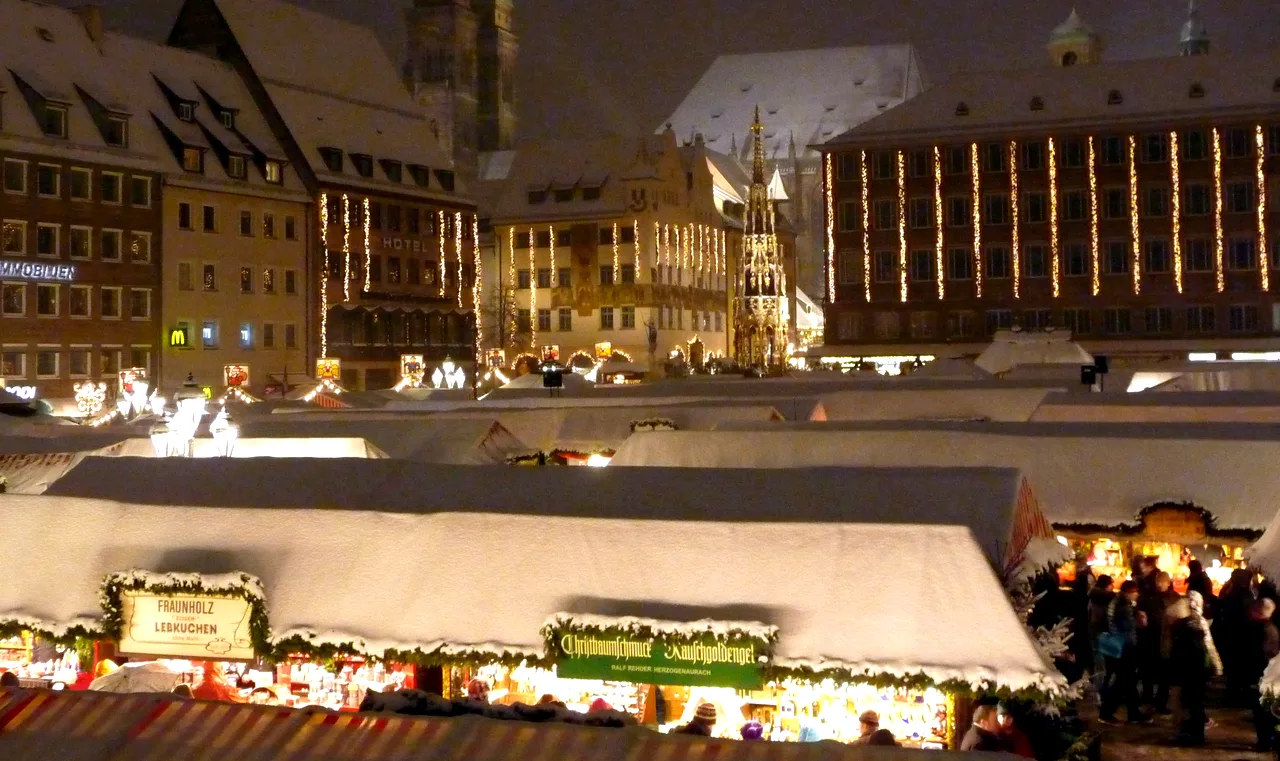
The Nürnberger Christkindlesmarkt is one of Germany’s best-known Christmas markets, with roots going back to the 16th century and records from the 17th. Wooden stalls with red-and-white striped awnings line the Hauptmarkt, selling traditional decorations, handmade toys, Zwetschgenmännle figures made from dried prunes, Lebkuchen and grilled sausages. The market opens with the prologue read by the Christkind (a young person chosen to play the Christmas angel) from the balcony of the Frauenkirche. Alongside the main market there is the Kinderweihnacht for children and the Markt der Partnerstädte, where Nuremberg’s twin cities sell their specialities. The dates below come from the official website; hours and special days may change.


| Market / section | Location | 2026 dates | Note |
|---|---|---|---|
| Christkindlesmarkt (main market) | Hauptmarkt, in front of the Frauenkirche | 27 November–24 December 2026 | Official site lists daily 10:00–21:00; opening on 27 November at 17:30 with the Christkind’s prologue; earlier closing possible on 24 December |
| Kinderweihnacht (Children’s Christmas) | Around Hans-Sachs-Platz | Same period as the main market | Carousel, small train and children’s activities; programme on the official site |
| Markt der Partnerstädte (Twin Cities Market) | Rathausplatz, next to St. Sebald | Same period as the main market | Food and crafts from Nuremberg’s twin cities |
What to taste at the market
Drei im Weggla
Three small Nürnberger Rostbratwürste in a bread roll; the market’s best-known snack.
Nürnberger Lebkuchen
Traditional Christmas gingerbread with honey, spices and nuts; the Elisenlebkuchen on a thin wafer base is especially famous.
Glühwein and Kinderpunsch
Spiced mulled wine; fruity Kinderpunsch is the common alcohol-free option. Many stalls charge a deposit for the mug.
Zwetschgenmännle
Little figures made from dried prunes and walnuts, bought more as a gift than a snack.
Gebrannte Mandeln
Sugar-roasted almonds whose scent fills the market on cold evenings.
Schneeballen and Stollen
Regional pastries and fruit-filled Christmas bread.
Tips for the Christkindlesmarkt
- Weekday mornings are the quietest time; Friday evenings and weekends on the Hauptmarkt are very busy.
- On opening night (27 November 2026) the Hauptmarkt is packed; arrive early if you want to see the prologue, or choose another day if you just want to browse.
- Mugs (Tassen) usually carry a deposit; return the mug to get the deposit back or keep it as a souvenir.
- Some small stalls may accept cash only; carry some euros.
- Wear thick-soled shoes, a hat and gloves; you will be standing outside for hours.
- Keep bags and wallets in front of you in the crowds.
- After the market, walk up towards the Kaiserburg; the lit rooftops and quieter lanes have a different atmosphere.
- Look into accommodation early; demand is high on December weekends.
Check before you go: Christkindlesmarkt Nürnberg (official) ↗
Dates and hours were checked on the official christkindlesmarkt.de website on 28 October 2026. The organiser may change the programme; check the official site again before you travel.
When to go
Nuremberg can be visited all year round, but the Christkindlesmarkt period (late November–24 December) is the busiest and most atmospheric time. Spring and autumn are the most comfortable for walking. The table below is a general guide.
| Month | City walking | Christmas market | Gardens, river and day trips | Crowds |
|---|---|---|---|---|
| January | Challenging | No market | Challenging | Quiet |
| February | Challenging | No market | Challenging | Quiet |
| March | Good | No market | Good | Quiet |
| April | Excellent | No market | Excellent | Moderate |
| May | Excellent | No market | Excellent | Moderate |
| June | Excellent | No market | Excellent | Moderate |
| July | Excellent | No market | Excellent | Busy |
| August | Excellent | No market | Excellent | Busy |
| September | Excellent | No market | Excellent | Moderate |
| October | Excellent | No market | Good | Moderate |
| November | Good | Starts late Nov | Challenging | Moderate |
| December | Good | Market season | Challenging | Busy |
- In winter temperatures are often around 0 °C and there can be frost in the evenings. Dress in layers.
- The Christkindlesmarkt closes on 24 December; 25–26 December are public holidays in Germany and many shops are closed.
- April to October is the best time for the castle gardens, the Pegnitz banks and day trips.
- Large trade fairs (e.g. the Spielwarenmesse toy fair, usually in early February) can push up accommodation demand; check dates on the official fair calendar.
- Open-air events increase in summer; on hot days the rock cellars and museums make a good break.
Visas and entry (Turkish citizens)
Turkish citizens holding an ordinary (burgundy) passport need a Schengen visa for tourist travel to Germany. Different rules apply to special, service and diplomatic passports; check the current situation on the website of the Turkish Ministry of Foreign Affairs.
Under Schengen rules you apply to the country of your main stay. If your trip is mainly to Nuremberg and Germany, you apply to the German missions in Türkiye; the application channel, appointment system and required documents are published on tuerkei.diplo.de.
If you are also visiting Vienna or Strasbourg on the same trip, work out where you will stay longest; with a valid Schengen visa you can travel within the area without border checks, although countries may temporarily reintroduce internal border controls.
Under the EU Entry/Exit System (EES), being phased in at the external borders, your biometric data (fingerprints and facial image) may be recorded on first entry. Details are on the official EU page.
Visa fees, processing times and document lists can change. No fees are given on this page; rely only on official sources before applying.
Check before you go: T.C. Dışişleri Bakanlığı · Türk vatandaşlarının tabi olduğu vize uygulamaları ↗ · tuerkei.diplo.de ↗ · EES · europa.eu ↗ · Rota Atlası visa guide (TR)
Travel medical insurance
Check the official visa and entry sources above first: they state whether travel medical insurance is required and the minimum cover. Compare any policy’s cover amount, validity dates and countries covered with the official requirement.
Rota Atlası does not currently offer an insurance partnership; there are no paid links in this section. Last updated: 1 November 2026
Getting to Nuremberg
- By air: Albrecht Dürer Airport Nuremberg (NUE) is about 5 km from the centre. U-Bahn line U2 runs directly to the Hauptbahnhof (main station) in about 12 minutes. There may be seasonal direct flights from Türkiye; check current routes on the airport website or in the search box below.
- Via Frankfurt or Munich: flying to a large hub and continuing by train is a common option. The ICE takes about 1–1.5 hours from Munich and about 2–2.5 hours from Frankfurt; current times are on bahn.de.
- By train: Nuremberg Hauptbahnhof is one of Germany’s major ICE hubs, with direct services to Berlin, Munich, Frankfurt, Leipzig and Vienna.
- From Vienna: there are direct ICE/Railjet connections between Vienna and Nuremberg, taking around 4–5 hours. Current times are on the ÖBB and Deutsche Bahn websites.
- By coach: long-distance coaches arrive near the Hauptbahnhof; usually slower than the train.
- By car: the city sits at the junction of the A3, A6, A9 and A73 motorways. Much of the old town is pedestrianised; leaving your car at a park-and-ride (P+R) site is practical.
Getting around

On foot
The old town inside the walls is compact; it is about 15 minutes’ walk from the Hauptbahnhof to the Hauptmarkt and about 10 minutes from the Hauptmarkt to the Kaiserburg. The lanes up to the castle hill are steep and cobbled.
U-Bahn
Lines U1, U2 and U3 connect the city; U2 goes to the airport and U1 to Fürth. U2 and U3 are automated driverless lines.
Trams and buses
Tram lines run around the old town and to the Documentation Centre at the Dutzendteich; current route information is on vgn.de.
Tickets
Public transport is run by the VGN (Verkehrsverbund Großraum Nürnberg). Single, day and group tickets are available from machines or the official app. Prices change, so check the VGN website.
S-Bahn and regional trains
S-Bahn and regional trains serve Fürth, Erlangen, Bamberg and Ansbach; ideal for a day trip to Bamberg.
Bikes and taxis
The Pegnitz banks have good cycle paths; taxi ranks are found at the station and main squares. Remember that footpaths can be icy on winter evenings.
Things to see
Most of Nuremberg’s highlights lie inside the walled old town and within walking distance. Below are twelve sections, from the castle hill to the riverbanks, from museums to 20th-century history and day trips.
Heart of the old town
Hauptmarkt, Frauenkirche and Schöner Brunnen

The Hauptmarkt is Nuremberg’s main square and the home of the Christkindlesmarkt. On its eastern side stands the 14th-century Frauenkirche, whose Männleinlaufen mechanical clock comes alive every day at noon with figures of the prince-electors paying homage to the emperor. In the corner of the square, the 19-metre Schöner Brunnen (Beautiful Fountain) rises like a Gothic spire covered in colourful figures. Turning the brass ring in its railing is said to bring good luck.
Don’t miss
- The Frauenkirche facade and the Männleinlaufen at noon
- The figures of the Schöner Brunnen and the “lucky ring” in the railing
- The weekday market stalls (fruit, vegetables and flowers outside the Christmas season)
- The evening lights during the Christkindlesmarkt
Tips
- Be on the square a few minutes before noon for the Männleinlaufen.
- The fountain is very crowded at Christmas; take photos early in the morning.
- From the north of the square, a short walk past Rathausplatz and St. Sebald leads up to the castle hill.
The emperors’ castle
Kaiserburg and Sinwell Tower

The Kaiserburg rises on a sandstone outcrop at the north of the old town and was one of the most important residences of the Holy Roman Emperors in the Middle Ages. The complex includes the imperial palace, the two-storey imperial chapel, the deep well and the Sinwell Tower, which offers wide views over the old town roofs. The castle is run by the Bavarian Palace Administration; opening hours vary by season.
Don’t miss
- The two-storey imperial chapel (Doppelkapelle)
- The view of the old town from the Sinwell Tower
- The Deep Well (Tiefer Brunnen) and its guided demonstration
- The castle gardens and wall walk (seasonal)
Tips
- The climb to the castle is up steep cobbled lanes; wear comfortable shoes.
- Winter hours are shorter; check current times on kaiserburg-nuernberg.de.
- The terraces in front of the castle offer lovely city views at sunset.

Gothic churches
St. Sebald, St. Lorenz and Weißer Turm

Nuremberg’s two great Gothic churches give their names to the two halves of the old town. St. Sebald in the north holds the tomb of the city’s patron saint, Sebaldus; the bronze shrine from Peter Vischer’s workshop is a masterpiece of the German Renaissance. St. Lorenz in the south is known for its twin-towered facade, its rose window and Veit Stoss’s “Annunciation” carving hanging from the vault. West of the Lorenz district, the Ehekarussell fountain in front of the Weißer Turm is a contemporary bronze work based on a poem about marriage by Hans Sachs.
Don’t miss
- The shrine of St. Sebaldus in St. Sebald
- The choir of St. Lorenz and Veit Stoss’s Annunciation
- The rose window on the St. Lorenz facade
- The detailed bronze figures of the Ehekarussell fountain
Tips
- Churches are places of worship; visits may be restricted during services.
- Respect the photography rules and silence inside.
- Concerts may be held in the churches at Christmas; follow the programmes on the church and city websites.


The painter’s quarter
Albrecht Dürer’s House and Tiergärtnertorplatz

Just below the castle hill, the Tiergärtnertorplatz with its half-timbered houses is one of Nuremberg’s most photogenic squares. On its edge stands the house where the Renaissance painter and printmaker Albrecht Dürer (1471–1528) lived and worked for about twenty years. Now a museum, it shows period living rooms, the workshop and exhibits on printmaking techniques. The gate tower and walls opposite can also be explored.
Don’t miss
- The workshop and living rooms of Albrecht Dürer’s House
- The Tiergärtnertor gate tower
- The large bronze hare sculpture on the square (a nod to Dürer’s hare)
- The lively square and wall views on summer evenings
Tips
- The museum belongs to the Museen der Stadt Nürnberg; check hours on museen.nuernberg.de.
- It is easy to combine the Kaiserburg with Dürer’s House; they are a few minutes apart on foot.
- The narrow lanes around the square are ideal for evening photos.
Riverside
Pegnitz bridges, Heilig-Geist-Spital and Weinstadel

The Pegnitz flows through the middle of the old town and is crossed by many bridges. The Heilig-Geist-Spital, founded in the 14th century, is one of the most striking buildings, stretching over the river on arches. To the west, the roofed wooden Henkersteg once led to the tower of the city executioner; beside it stands the long half-timbered Weinstadel. The views from bridges such as the Maxbrücke and Fleischbrücke are especially beautiful in the evening lights.
Don’t miss
- The view of the Heilig-Geist-Spital from the Museumsbrücke
- The Henkersteg bridge and the Henkerhaus (executioner’s house) museum
- The Weinstadel and the Maxbrücke area
- The Trödelmarkt island
Tips
- The riverside is a short walk from the Hauptmarkt and Weißgerbergasse.
- Bridges and embankments can be icy in winter; walk carefully.
- For photos, look from the Maxbrücke towards the Weinstadel and Henkersteg.

Cultural history
Germanisches Nationalmuseum and the Way of Human Rights

The Germanisches Nationalmuseum is one of the largest museums of art and cultural history of the German-speaking world. Its collection ranges from prehistoric finds and medieval sculpture to works by Dürer, scientific instruments, musical instruments and toys. In front of the museum runs the Straße der Menschenrechte (Way of Human Rights) by the Israeli artist Dani Karavan; the articles of the Universal Declaration of Human Rights are inscribed on white columns in different languages.
Don’t miss
- The Dürer and Nuremberg Renaissance sections
- Behaim’s globe, the oldest surviving terrestrial globe
- The medieval sculpture and stained-glass collections
- The columns and inscriptions of the Way of Human Rights
Tips
- The museum is large; pick a few sections instead of trying to see everything.
- Check opening hours and closing days on the museum’s official website.
- From the museum you can walk on to the Lorenz district and the Handwerkerhof.

Walls and crafts
Handwerkerhof and the city walls

At the foot of the Königstor tower opposite the Hauptbahnhof, the Handwerkerhof is a small craftsmen’s courtyard recreated in a medieval style, with handmade goods, Lebkuchen and small restaurants; it is decorated at Christmas. Most of Nuremberg’s roughly five-kilometre city walls survive, with towers, gates and moats encircling the old town.
Don’t miss
- The craft shops of the Handwerkerhof
- The Königstor and the great round towers
- A walk along the moat beside the walls
- The arched wall along Schlotfegergasse
Tips
- If you arrive by train, the Handwerkerhof can be your first stop on entering the old town.
- Shop hours may vary by season.
- In summer the outer moat is a green walking route.
Railway history
DB Museum: where Germany’s railways began

The Adler, the first locomotive used successfully in commercial passenger and freight service in Germany, made its first official run on 7 December 1835 on the Bavarian Ludwig Railway’s 6.05-kilometre line between Nuremberg and Fürth. That heritage is told by the Verkehrsmuseum Nürnberg (DB Museum), Deutsche Bahn’s museum. Its roots go back to a small Bavarian railway museum founded in Munich in 1882; the collection has been in Nuremberg since 1899, the present building on Lessingstraße opened in 1925, and the museum is regarded as the oldest museum of technological history in the German-speaking world. Exhibits include the working Adler replica built in 1935 for the railway centenary, carriage No. 8 of the Ludwig Railway – Germany’s oldest surviving railway vehicle – and the “Nordgau” (1853), the oldest surviving original German steam locomotive. The Adler replica was badly damaged in a depot fire on 17 October 2005, rebuilt using historical drawings and returned to the museum on 23 November 2007. The same building houses the Museum für Kommunikation Nürnberg, and KIBALA (Kinder-Bahnland) explains through play how the railway works. DB Museum (official) →
Don’t miss
- The 1935 Adler replica and its carriages
- Ludwig Railway carriage No. 8 and the “Nordgau” locomotive
- The Museum für Kommunikation in the same building
- KIBALA (Kinder-Bahnland) for children
Tips
- The museum is just south of the old city walls, within walking distance of the Hauptbahnhof; it combines well with the Handwerkerhof on the same day.
- Check opening hours, tickets and guided tours on dbmuseum.de before you go.
- To follow the Adler’s Nuremberg–Fürth route, take the U1 underground to Fürth; check vag.de for current information.

Underground and toys
Rock-cut cellars and the Toy Museum

Carved into the sandstone beneath the castle hill, the Felsengänge are an extensive network of cellars used for centuries to brew and store beer; they also served as air-raid shelters during the war. They can only be visited on guided tours. Nuremberg is historically famous for toy-making too: the Spielzeugmuseum (Toy Museum) appeals to visitors of all ages with a collection ranging from dolls and tin toys to model trains and modern games.
Don’t miss
- A guided tour of the Felsengänge
- The Toy Museum’s model railway
- Historic dolls’ houses and tin toys
- The atmosphere of the toy fair period in early February
Tips
- The cellars are cool all year; bring a jacket.
- Check guided-tour times and languages in advance.
- The Toy Museum is a good choice for families on cold winter days.

20th-century history
Memorium Nuremberg Trials and the Documentation Centre

Nuremberg confronts the darkest chapters of 20th-century history. The history of the Nuremberg Trials, held in 1945–1946 at the Palace of Justice on Fürther Straße, is told at the Memorium Nuremberg Trials. South-east of the city, around the Dutzendteich lake, lie the remains of the vast grounds designed for the Nazi Party rallies; the Documentation Centre Nazi Party Rally Grounds inside the unfinished Congress Hall documents this history. Renovation and exhibition changes may be ongoing, so check the current situation before visiting.
Don’t miss
- The exhibition on Courtroom 600 at the Memorium
- The Documentation Centre and Congress Hall
- The Zeppelin grandstand and the Great Road
- The information panels around the Dutzendteich
Tips
- The Memorium is reached by U1 to Bärenschanze.
- Take the tram to the Documentation Centre; route information is on vgn.de.
- These sites deal with serious historical content; plan visits with children in advance.

A quiet corner
Johannisfriedhof and St. Johannis

In the St. Johannis district west of the old town, the Johannisfriedhof is one of Germany’s best-known historic cemeteries, notable for the bronze epitaphs and coats of arms on its stone graves; Albrecht Dürer and the sculptor Veit Stoss are buried here. It offers a quiet walk away from the busy squares.
Don’t miss
- Albrecht Dürer’s grave
- Historic gravestones with bronze epitaphs
- The St. Johannis chapel
- The quiet streets and gardens of the district
Tips
- This is a cemetery; be quiet and respectful.
- It is about a 15-minute walk from the Tiergärtnertor.
- The autumn colours of the trees add a special beauty.
Day trips
Bamberg and Rothenburg ob der Tauber

Nuremberg is a good base for Franconia’s fairy-tale towns. UNESCO-listed Bamberg is famous for its Old Town Hall built over the river Regnitz, its cathedral and its smoked beer (Rauchbier); the train takes about 40–60 minutes. Walled Rothenburg ob der Tauber, with its medieval skyline, is one of Germany’s most photographed towns and holds its own Reiterlesmarkt at Christmas. Rothenburg is reached by train with a change; current connections are on bahn.de. UNESCO listing ↗ Bamberg guide →
Don’t miss
- Bamberg’s Old Town Hall and Little Venice
- Bamberg Cathedral and the Rose Garden
- The Plönlein and the wall walk in Rothenburg
- Rothenburg’s Christmas market (check the dates)
Tips
- Regional trains to Bamberg are frequent; an easy day trip.
- Rothenburg requires a change; set off early in the morning.
- Small-town markets can be crowded on Christmas weekends.

1, 2 and 3-day itineraries + Christmas day
The itineraries below are planned around walking distances. Check museum and castle hours, and market hours at Christmas, on the official websites.
1 day: The essence of the old town
- In the morning walk from the Hauptbahnhof to the Königstor and Handwerkerhof, then along Königstraße to St. Lorenz.
- Admire the Heilig-Geist-Spital from the Museumsbrücke and see the Frauenkirche’s Männleinlaufen clock on the Hauptmarkt at noon.
- After the Schöner Brunnen, visit St. Sebald and climb Burgstraße to the Kaiserburg.
- In the afternoon, the Sinwell Tower and castle gardens, then the Tiergärtnertorplatz and Albrecht Dürer’s House.
- In the evening, Weißgerbergasse, the Henkersteg and Weinstadel; Rostbratwurst and Franconian food for dinner.
2 days: Museums and the riverside
- Follow the day 1 plan.
- On the morning of day 2, the Germanisches Nationalmuseum and the Way of Human Rights.
- In the afternoon, a guided tour of the rock-cut cellars or the Toy Museum.
- In the late afternoon, a stroll around the Trödelmarkt and Maxbrücke on the Pegnitz, then dinner in the old town.
3 days: History and a day trip
- Follow the first two days.
- On day 3 take an early train to Bamberg: Old Town Hall, Little Venice, the cathedral and the Rose Garden.
- Alternatively, spend the morning at the Memorium Nuremberg Trials and the Documentation Centre and the afternoon on a quiet walk in the Johannisfriedhof.
- Return to Nuremberg in the evening and watch the city lights from the castle hill.
Christmas market day (27 November–24 December 2026)
- Arrive at the Hauptmarkt around 10:00 as the market opens and browse the stalls before the crowds.
- See the products from different countries at the Twin Cities Market, then stop at the Kinderweihnacht.
- Lunch on Drei im Weggla; then climb to the Kaiserburg and warm up with a castle or museum visit.
- In the afternoon, the decorated Handwerkerhof courtyard and the Lebkuchen shops.
- After dark, return to the Hauptmarkt; end the day with the lit stalls, a Glühwein or Kinderpunsch and an evening walk.
Franconian food
Franconian cuisine is hearty and regional: small grilled sausages, pork shoulder with crackling, potato dumplings (Klöße), sauerkraut and the region’s beer and wine culture define the table. At Christmas, Lebkuchen and hot drinks take centre stage. If you do not eat pork, menus may offer vegetable, fish or beef options; do not hesitate to ask about ingredients.


Nürnberger Rostbratwurst
Finger-sized grilled sausages flavoured with marjoram, usually served in sixes, eights or twelves with sauerkraut or potato salad. A protected geographical indication.
Saure Zipfel
A Franconian speciality in which the sausages are cooked in a broth of vinegar, onions and spices.
Schäufele
Oven-roasted pork shoulder with crispy crackling, served with a potato dumpling and gravy.
Nürnberger Lebkuchen
Christmas gingerbread made with honey, spices, almonds and hazelnuts; available year-round in many bakeries.
Franconian beer and wine
The region has many small breweries; Franconian wine is known for its traditional Bocksbeutel bottle.
Alcohol-free options
Kinderpunsch, apple spritzer (Apfelschorle) and hot chocolate are common at Christmas markets.
- Pork dominates many menus; ask if you are looking for halal or pork-free options.
- Service is included in German prices; leaving a small tip when satisfied is customary.
- Most supermarkets close on Sundays; shops at railway stations are the exception.
- Booking popular restaurants for dinner is a good idea at Christmas.
Culture and etiquette

- German and the Franconian dialect are spoken; “Grüß Gott” and “Servus” are common greetings.
- Punctuality matters; arrive on time for guided tours and reservations.
- Shops are usually closed on Sundays and public holidays, and quiet hours are respected.
- Churches are places of worship; avoid sightseeing during services and keep quiet.
- Cycle lanes are not for pedestrians; do not walk on red or marked bike lanes.
- Waste is sorted; most bottles and cans carry a deposit (Pfand).
- Behave respectfully at sites related to 20th-century history; they serve education and remembrance.
- The Christkind is a figure elected every two years to represent the market; the opening prologue is one of the city’s major traditions.
Safety and health
- Nuremberg is generally a safe city, but be alert to pickpockets in the Christmas market crowds.
- Christmas markets may have security measures and bag checks; follow staff instructions.
- Cobbled streets and bridges can be icy in winter; wear non-slip shoes.
- In an emergency call 112 (ambulance, fire) or 110 (police).
- Travel health insurance is required for a Schengen visa; check what your policy covers.
- Mulled wine is alcoholic; avoid overdoing it in crowds and cold weather, and consider alcohol-free options.
- Check official travel advice (e.g. your foreign ministry or GOV.UK) before you go.
What your budget depends on
No prices are given in this guide because accommodation, transport and admission costs change quickly by season. The main factors that shape your budget are:
Travel dates
The Christkindlesmarkt season and major trade-fair weeks noticeably increase accommodation demand; January–March and early November are usually quieter.
Where you stay
Staying inside the old town makes walking easy; the station area and nearby Fürth can be alternatives.
How you travel
Direct flights, a large hub plus train, or coach combinations change both cost and time. Booking train tickets early can pay off.
Museums and tours
The castle, museums and guided tours are charged separately; check city card or combined-ticket options on the official tourism website.
Food and drink
Market snacks, restaurants and cafés suit different budgets; remember the mug deposit.
Day trips
Regional train or day tickets for Bamberg or Rothenburg add extra costs.
Practical information
- Money: the euro is used; card payment is widespread but small stalls may need cash.
- Language: English is spoken at tourist sites; a few German words (Danke, Bitte, Entschuldigung) help.
- Opening hours: shops close on Sundays; many places close early on the afternoon of 24 December, and 25–26 December are public holidays.
- Internet: there are free Wi-Fi hotspots in the city; check roaming charges in advance if you have a non-EU SIM.
- Tourist information: the official tourist information near the Hauptmarkt and tourismus.nuernberg.de provide current information.
- Accessibility: the old town has cobbles and slopes; most U-Bahn stations have lifts.
- Weather: with short winter days it gets dark around 16:30; plan accordingly.
- Photography: the castle hill and Sinwell Tower are ideal for sunset photos.
FAQ
When is the Nuremberg Christkindlesmarkt 2026?
According to the official website, it takes place on the Hauptmarkt from 27 November to 24 December 2026, opening on the evening of 27 November with the Christkind’s prologue. Check hours on christkindlesmarkt.de before you go.
What are the Christkindlesmarkt opening hours?
The official site lists daily 10:00–21:00; there may be earlier closing on special days such as 24 December. The programme can change, so check the official site.
Is there an entry fee for the Christkindlesmarkt?
The market is held on an open square and no entry ticket is needed to browse; food, drinks and goods are paid for separately.
How many days do I need in Nuremberg?
You can see the essence of the old town in one day; 2–3 days are ideal for museums, the riverside and a day trip such as Bamberg.
How do I get from the airport to the city centre?
U-Bahn line U2 links the airport with the Hauptbahnhof in about 12 minutes. Ticket options are on the VGN website.
Do Turkish citizens need a visa for Nuremberg?
Holders of ordinary passports need a Schengen visa. Check tuerkei.diplo.de and the Turkish Ministry of Foreign Affairs for the application channel and documents.
What should I eat in Nuremberg?
Nürnberger Rostbratwurst (“Drei im Weggla” in a roll), Lebkuchen and Schäufele are the best-known specialities. Ask about pork-free options if needed.
Can I combine the market with Vienna or Strasbourg?
Yes. There are direct trains from Nuremberg to Vienna; Strasbourg requires a change. Strasbourg’s market also opens on 27 November, and Vienna’s Rathausplatz market on 13 November.
Is the Kaiserburg open in winter?
Yes, the castle can be visited in winter too, but hours are shorter. Check current times on kaiserburg-nuernberg.de.
Is Nuremberg good for families with children?
Yes. The Kinderweihnacht, the Toy Museum, the Kaiserburg and the DB Museum are good options with children.
Where to stay
Stay close to the areas where you will spend most time. The areas below are covered in detail in this guide; check public transport links in the getting-around section.
- Heart of the old townHauptmarkt, Frauenkirche and Schöner Brunnen
- The emperors’ castleKaiserburg and Sinwell Tower
- Gothic churchesSt. Sebald, St. Lorenz and Weißer Turm
- The painter’s quarterAlbrecht Dürer’s House and Tiergärtnertorplatz
- RiversidePegnitz bridges, Heilig-Geist-Spital and Weinstadel
- Cultural historyGermanisches Nationalmuseum and the Way of Human Rights
- Walls and craftsHandwerkerhof and the city walls
- Railway historyDB Museum: where Germany’s railways began
- Underground and toysRock-cut cellars and the Toy Museum
- 20th-century historyMemorium Nuremberg Trials and the Documentation Centre
- A quiet cornerJohannisfriedhof and St. Johannis
Search hotels in these areas (Hotellook) ↗ (affiliate link)Search on Booking.com ↗
Affiliate disclosure: Hotellook, Aviasales, Klook, Airalo, Tiqets and DiscoverCars links are affiliate links; Rota Atlası may earn a commission on bookings made through them, at no extra cost to you. Official and in-guide links are not paid. Last updated: 1 November 2026 · Privacy and affiliates
Transport and connectivity
- Airport transferOptions from the airport to the city are in this guide’s getting there section.
- Mobile data (eSIM)Airalo eSIM ↗ (affiliate link)
- TrainsOfficial rail website ↗
- Car hireYou rarely need a car within the city; see getting around first. Compare car hire on DiscoverCars ↗ (affiliate link)
Affiliate disclosure: Hotellook, Aviasales, Klook, Airalo, Tiqets and DiscoverCars links are affiliate links; Rota Atlası may earn a commission on bookings made through them, at no extra cost to you. Official and in-guide links are not paid. Last updated: 1 November 2026 · Privacy and affiliates
Search flights (affiliate link)
Search flights from any airport in any country. Results open on Aviasales in a new tab, where you book.
This form is an affiliate link: Rota Atlası may earn a commission on bookings made via Aviasales (Travelpayouts), at no extra cost to you. Check price, baggage and terms on the booking site. Airport data: OurAirports (public domain).
Flights, hotels and tours
Find tours and tickets
- Christkindlesmarkt
GetYourGuide ↗ · Klook ↗ (affiliate link) - Kaiserburg (Imperial Castle)
GetYourGuide ↗ · Klook ↗ (affiliate link) - Hauptmarkt and Schöner Brunnen
GetYourGuide ↗ · Klook ↗ (affiliate link) - St. Lorenz Church
GetYourGuide ↗ · Klook ↗ (affiliate link)
Hotellook, Aviasales, Klook, Airalo and Tiqets links in this box are affiliate links (Travelpayouts): Rota Atlası may earn a commission on bookings made through them, at no extra cost to you. GetYourGuide links currently carry no affiliate code. Check prices and terms with the provider. Last updated: 1 November 2026 · Privacy and affiliates
Sources
- T.C. Dışişleri Bakanlığı · Türk vatandaşlarının tabi olduğu vize uygulamaları ↗
- Auswärtiges Amt · Deutsche Vertretungen in der Türkei (Visa) ↗
- European Union · Entry/Exit System (EES) ↗
- Stadt Nürnberg · Tourismus (official) ↗
- Museen der Stadt Nürnberg (official) ↗
- Bayerische Schlösserverwaltung · Kaiserburg Nürnberg ↗
- VGN · Verkehrsverbund Großraum Nürnberg ↗
- Albrecht Dürer Airport Nürnberg ↗
- Deutsche Bahn ↗
- GOV.UK · Foreign travel advice · Germany ↗
- UNESCO World Heritage Centre · Town of Bamberg ↗
- Christkindlesmarkt Nürnberg (official) ↗
This page is for information only. Dates, hours, entry rules and transport details can change; check the official sources above before travelling. No prices, flights, hotels or restaurant recommendations have been invented in this guide.
Photo credits
The photos on this page come from Wikimedia Commons and are used under the stated author and licence (CC BY, CC BY-SA, CC0 or public domain). All sources page
- Red-and-white striped Christmas market stalls on Nuremberg’s Hauptmarkt with the Frauenkirche — Hubertl · CC BY-SA 4.0 · Wikimedia Commons
- The roofs of Christkindlesmarkt stalls and Hauptmarkt facades in the evening light — Lothar Weber · CC BY-SA 4.0 · Wikimedia Commons
- A decorated stall in the twin-cities section of the Christkindlesmarkt — Escla · CC BY 4.0 · Wikimedia Commons
- A horse-drawn coach touring the Nuremberg Christmas market in the evening — Lothar Weber · CC BY-SA 4.0 · Wikimedia Commons
- The decorated carousel at the Kinderweihnacht children’s market — DALIBRI · CC BY-SA 4.0 · Wikimedia Commons
- Christkindlesmarkt stalls in daylight in front of the Frauenkirche — Hubertl · CC BY-SA 4.0 · Wikimedia Commons
- The colourful Gothic Schöner Brunnen fountain and its iron railing on the Hauptmarkt — Tilman2007 · CC BY-SA 4.0 · Wikimedia Commons
- The courtyard, towers and buildings of the Kaiserburg — AlterVista (German Wikipedia) · CC BY-SA 3.0 · Wikimedia Commons
- The upper level of the Kaiserburg’s double imperial chapel — Uoaei1 · CC BY-SA 4.0 · Wikimedia Commons
- Nuremberg roofs and the Kaiserburg towers seen from the Sinwell Tower — Uoaei1 · CC BY-SA 4.0 · Wikimedia Commons
- Panorama of Nuremberg’s old town looking south from the Sinwell Tower — Uoaei1 · CC BY-SA 4.0 · Wikimedia Commons
- Albrecht Dürer’s House and the Tiergärtnertorplatz in a painting by August Fischer — August Fischer · Public domain · Wikimedia Commons
- Half-timbered houses on the Tiergärtnertorplatz below the castle — Damir-zg · CC BY-SA 4.0 · Wikimedia Commons
- The colourful half-timbered houses of Weißgerbergasse — L0st4k · CC BY-SA 4.0 · Wikimedia Commons
- Stone relief on the south side of St. Sebald’s Church — Tilman2007 · CC BY-SA 4.0 · Wikimedia Commons
- The Gothic choir of St. Lorenz Church — Yair-haklai · CC BY-SA 4.0 · Wikimedia Commons
- The bronze Ehekarussell fountain in front of the Weißer Turm — Robert von Oliva (naruciakk) · CC0 · Wikimedia Commons
- The Heilig-Geist-Spital over the Pegnitz lit up at night — Flocci Nivis · CC BY 4.0 · Wikimedia Commons
- The roofed wooden Henkersteg bridge over the Pegnitz — Schlaier · CC BY-SA 3.0 · Wikimedia Commons
- The half-timbered Weinstadel on the banks of the Pegnitz — Andreas Praefcke · CC BY 3.0 · Wikimedia Commons
- The Germanisches Nationalmuseum entrance and the columns of the Way of Human Rights — Dirk Messberger · CC BY-SA 4.0 · Wikimedia Commons
- The white stone gateway and columns of the Way of Human Rights — Tuxyso · CC BY-SA 3.0 · Wikimedia Commons
- The Handwerkerhof entrance decorated with Christmas trees — DALIBRI · CC BY-SA 4.0 · Wikimedia Commons
- The arched Nuremberg city wall along Schlotfegergasse — Tilman2007 · CC BY-SA 4.0 · Wikimedia Commons
- A lit tunnel in the rock-cut beer cellars of the Felsengänge — Z thomas · CC BY-SA 3.0 · Wikimedia Commons
- The large model railway at the Toy Museum — Achim Raschka · CC BY-SA 4.0 · Wikimedia Commons
- Nuremberg Palace of Justice, home of the Memorium Nuremberg Trials — André Karwath aka Aka · CC BY-SA 2.5 · Wikimedia Commons
- Aerial view of the unfinished Congress Hall by the Dutzendteich — Indigma · CC BY-SA 4.0 · Wikimedia Commons
- Johannisfriedhof cemetery and chapel in autumn — Tilman2007 · CC BY-SA 4.0 · Wikimedia Commons
- Bamberg’s Old Town Hall on the Regnitz river — Ermell · CC BY-SA 4.0 · Wikimedia Commons
- The Plönlein corner and gate towers in Rothenburg ob der Tauber — Diego Delso · CC BY-SA 4.0 · Wikimedia Commons
- A plate of sausages served with sauerkraut and potatoes — Dominik Schwind from Lörrach, Germany · CC BY 2.0 · Wikimedia Commons
- Small Nürnberger Rostbratwürste sausages on the grill — Schlurcher · CC BY 4.0 · Wikimedia Commons
- Nürnberger Lebkuchen displayed in a shop window — charley1965 (Flickr) · CC BY-SA 2.0 · Wikimedia Commons
- Crispy-crackling Schäufele served with a potato dumpling — Jeremy Keith · CC BY 2.0 · Wikimedia Commons
Passau → · Bamberg → · Rothenburg → · Munich → · Vienna → · Strasbourg → · Christmas markets