

Regensburg lies where the Regen meets the Danube, in the Upper Palatinate region of Bavaria. The Romans founded the legionary fortress of Castra Regina here in AD 179, and its north gate, the Porta Praetoria, still stands. In the Middle Ages Regensburg grew rich on Danube trade and became a Free Imperial City and one of the most important cities of the Holy Roman Empire; from 1663 to 1806 the Perpetual Imperial Diet (Immerwährender Reichstag) met in the Old Town Hall. Largely spared by wars, the Old Town is one of the best-preserved medieval city centres in Germany and, together with Stadtamhof, was inscribed on the UNESCO World Heritage List in 2006. The 12th-century Stone Bridge (Steinerne Brücke), the Gothic cathedral, the Italian-style tower houses of wealthy merchant families and the narrow lanes form the heart of that heritage. In Advent the city hosts several Christmas markets: the Regensburger Christkindlmarkt on Neupfarrplatz, whose roots go back to the 18th century; the Romantic Christmas Market in the courtyards of Thurn und Taxis Palace; the Katharinenspital Advent Market at the foot of the Stone Bridge; and the craft-focused Lucrezia Market on Haidplatz. This guide brings together the markets, the medieval heritage, museums, Regensburg and Bavarian food, and trips to Walhalla, Weltenburg and Kelheim, with official sources.
Content update: 28 October 2026 · Christmas dates checked against the official regensburg.de and tourismus.regensburg.de pages
Regensburg at a Glance
- Country
- Germany · Bavaria (Upper Palatinate)
- Population
- About 155,000; where the Regen meets the Danube
- Language
- German (Bavarian dialect); English widely understood in tourism
- Currency
- Euro (EUR); cards widely accepted, carry some cash for stalls
- Time zone
- Central European Time (CET, UTC+1)
- UNESCO
- Old Town of Regensburg with Stadtamhof (2006)
- Highlights
- Stone Bridge, Regensburg Cathedral, Old Town Hall, Porta Praetoria, Neupfarrplatz, Thurn und Taxis Palace
- Nearby
- Walhalla (Donaustauf), Weltenburg Abbey, Danube Gorge, Kelheim Befreiungshalle
- Christmas
- Christkindlmarkt 23 November–23 December 2026; Thurn und Taxis Romantic Market 20 November–23 December (closed 22 November)
- Airport
- No major airport of its own; nearest major airports are Munich (MUC) and Nuremberg (NUE)
- Electricity
- 230 V, type C/F sockets
- Emergency
- 112 (ambulance, fire), 110 (police)
Regensburg in Pictures
The Stone Bridge and cathedral in the evening light, the towered rooftops of the Old Town and the cathedral’s Gothic façade: Regensburg in three pictures.


Regensburg Christmas Markets 2026
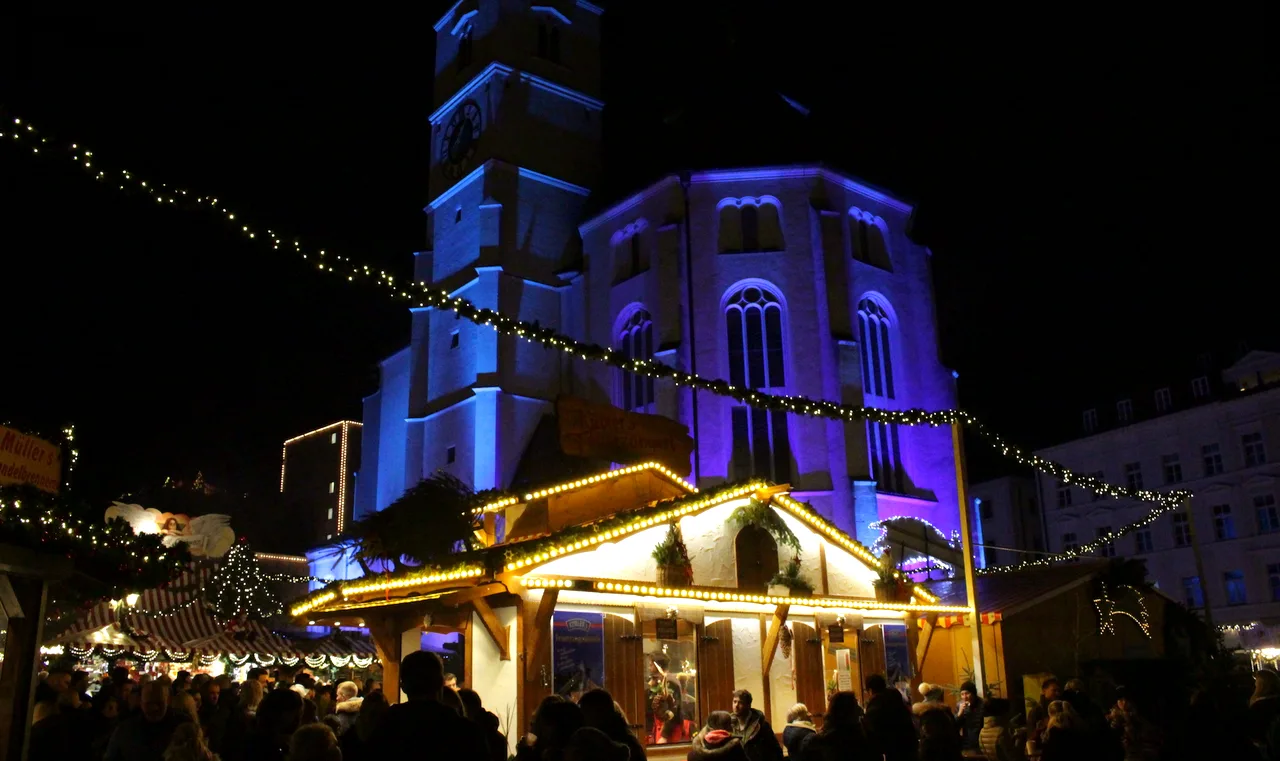
Regensburg has one of the richest selections of Christmas markets in Bavaria, and each has its own character. The largest is the Regensburger Christkindlmarkt organised by the City of Regensburg: according to the official page its origins go back to around 1790, and an independent jury named it one of the ten most beautiful Christmas markets in the German-speaking world. It fills Neupfarrplatz around the Neupfarrkirche, which is illuminated every evening from 18:00. The official page stresses that baked goods, sausages and meat products are exclusively artisan-made; every Wednesday is Children’s Day, when St Nicholas hands out gifts at 14:00 and 16:00. Regensburg Tourism highlights blueberry Glühwein from the Bavarian Forest, apple Glühwein from Upper Palatinate orchards and the famous Regensburg sausages. The Romantic Christmas Market in the courtyards of Thurn und Taxis Palace is known for its open fires and the “Kinderzauberwald” for children, the Katharinenspital Advent Market at the foot of the Stone Bridge for its cathedral view and family atmosphere, and the Lucrezia Market on Haidplatz and Kohlenmarkt for high-quality crafts. Some markets may charge admission; check the conditions on the official pages.


| Event | Location | 2026 dates | Note |
|---|---|---|---|
| Regensburger Christkindlmarkt | Neupfarrplatz (around the Neupfarrkirche) | 23 November–23 December 2026 | Sun–Wed 10:00–20:00, Thu–Sat 10:00–21:00; opening ceremony 23 November at 18:00. Children’s Day every Wednesday. |
| Romantischer Weihnachtsmarkt | Courtyards of Thurn und Taxis Palace (Schloss St. Emmeram) | 20 November–23 December 2026 (closed 22 November) | Mon–Thu 15:00–21:00, Fri 15:00–22:00, Sat 14:00–22:00, Sun 14:00–21:00. Check admission on the official page. |
| Katharinenspital Advent Market | Stadtamhof side, at the north end of the Stone Bridge | 23 November–23 December 2026 | Mon–Fri 16:00–22:00, Sat 11:00–22:00, Sun 11:00–21:00; a family market by the fire with a cathedral view. |
| Lucrezia Market | Haidplatz and Kohlenmarkt | 27 November–23 December 2026 | Sun–Thu 11:00–20:00, Fri–Sat 11:00–21:00; crafts and a cultural programme on two stages. |
| Gräflicher Christkindlmarkt | Around the Rosarium (rose garden) | 19 November–20 December 2026 (closed 22 November) | Thu–Fri 16:00–22:00, Sat 14:00–22:00, Sun 14:00–21:00; live shows at weekends. |
What to try
Heidelbeerglühwein
Mulled wine made with blueberries from the Bavarian Forest; alcoholic.
Apfelglühwein
A hot drink made with apples from Upper Palatinate orchards; alcoholic.
Regensburger Bratwürste
Small grilled sausages highlighted by the official tourism page; usually contain pork.
Kinderpunsch
Spiced hot fruit punch for children and non-drinkers.
Gebrannte Mandeln
Sugar-roasted almonds.
Lebkuchen
Spiced Christmas gingerbread, a classic of the region near Nuremberg.
Tips for Regensburg’s Christmas markets
- In December it gets dark in Regensburg around 16:00; plan sights by day and markets in the evening.
- Neupfarrplatz, Haidplatz and the Stone Bridge are 5–10 minutes apart on foot, so you can see several markets in one evening.
- The Thurn und Taxis market is in the palace courtyards; admission and days differ, so check the official page.
- For families, every Wednesday is Children’s Day at the Christkindlmarkt.
- Glühwein mugs usually carry a deposit; return them or keep them as a souvenir.
- Weekend evenings are crowded; weekday afternoons are calmer.
- The cobbles of the medieval lanes are slippery when wet; wear non-slip shoes.
- Most markets close on 23 December; museum and shop hours change on 24–26 December.
Check before you go: Stadt Regensburg · Regensburger Christkindlmarkt 2026 (official) ↗ · Regensburg Tourismus · Weihnachten (official) ↗
Dates and hours checked on 28 October 2026 against the regensburg.de “Regensburger Christkindlmarkt 2026” page and the tourismus.regensburg.de “Weihnachten” page. Hours and admission of the private markets can change; check the relevant official page before you visit.
When to Go
Regensburg has a continental climate with cold winters and mild, lively summers. Spring and autumn are ideal for walking the Old Town; in summer the Danube banks, beer gardens and boat trips take centre stage. Danube Gorge boat trips run until late October. From late November to 23 December the Christmas markets light up the city. January and February are cold and quiet, good for museums.
| Month | Sightseeing | Christmas market | Danube and trips | Crowds |
|---|---|---|---|---|
| January | Difficult | None | Difficult | Quiet |
| February | Difficult | None | Difficult | Quiet |
| March | Good | None | Difficult | Quiet |
| April | Very good | None | Good | Moderate |
| May | Very good | None | Very good | Moderate |
| June | Very good | None | Very good | Moderate |
| July | Very good | None | Very good | Busy |
| August | Very good | None | Very good | Busy |
| September | Very good | None | Very good | Moderate |
| October | Very good | None | Good | Moderate |
| November | Good | Market season | Difficult | Moderate |
| December | Good | Market season | Difficult | Busy |
- Winters are cold, often around freezing; fog is common along the Danube.
- In December the sun rises around 08:00 and sets around 16:20; plan sightseeing around daylight.
- The Christkindlmarkt runs from 23 November to 23 December 2026.
- Danube Gorge boat trips and Weltenburg visits are limited or suspended in winter; check in advance.
- Some museums close on Mondays; winter hours are shorter.
- Old Town hotels fill up quickly at Advent weekends; book early.
Visa and Entry (Turkish citizens)
Turkish citizens holding an ordinary (burgundy) passport need a Schengen visa for tourist travel to Germany. Special, service and diplomatic passports follow different rules; check the current position on the Turkish Ministry of Foreign Affairs page.
Apply to the representation of the country that is your main destination. If Germany is the main destination, applications go through the German missions in Türkiye; current information on the application process is at tuerkei.diplo.de.
If you combine Regensburg with Austria or Czechia, apply to the country of your longest stay; if stays are equal, to the country of first entry.
Under the EU Entry/Exit System (EES), being introduced in stages, your biometric data (facial image and fingerprints) may be recorded on first entry; allow extra time at the border.
Visa fees, appointment waiting times and required documents can change; this guide gives no fees. Use the current lists on the official pages before you apply.
Travel medical insurance and proof of accommodation and return are part of the application; details are in the official sources.
Check before you go: T.C. Dışişleri Bakanlığı · Türk vatandaşlarının tabi olduğu vize uygulamaları ↗ · tuerkei.diplo.de ↗ · EES · europa.eu ↗ · Rota Atlası visa guide (TR)
Travel medical insurance
Check the official visa and entry sources above first: they state whether travel medical insurance is required and the minimum cover. Compare any policy’s cover amount, validity dates and countries covered with the official requirement.
Rota Atlası does not currently offer an insurance partnership; there are no paid links in this section. Last updated: 1 November 2026
Getting to Regensburg
- By air: Regensburg has no major airport of its own. The nearest major airports are Munich (MUC) and Nuremberg (NUE); from both you continue by train. Check current flights from Türkiye only on airline and airport websites.
- By train from Munich: regional and long-distance trains run from Munich Airport and Munich Central Station to Regensburg; check timetables on bahn.de.
- By train from Nuremberg: regular trains run on the Nuremberg–Regensburg line; check connections and times on bahn.de.
- From the station to the Old Town: from Regensburg Hauptbahnhof it is about a 15-minute walk to the cathedral; city buses also run to the edge of the Old Town.
Getting Around

On foot
The Old Town is compact; the Stone Bridge, cathedral, Old Town Hall, Neupfarrplatz and Haidplatz are within walking distance.
City buses
Public transport uses the RVV (Regensburger Verkehrsverbund) fare system; check tickets on rvv.de.
Regional trains
Check train or bus connections to Kelheim, Donaustauf and nearby towns on rvv.de and bahn.de.
Bicycle
The Danube Cycle Path passes through the city; some sections can be wet or icy in winter.
Boat
In summer boat trips run to Walhalla and the Danube Gorge; in winter they are limited or suspended.
Day trips
Walhalla, Weltenburg Abbey, Kelheim and the Danube Gorge are easy day trips.
Things to See
Regensburg’s Old Town sits on the south bank of the Danube on a core that still traces the Roman legionary camp. The Stone Bridge and Brückturm are to the north, the cathedral and Neupfarrplatz in the centre, Haidplatz and the Old Town Hall to the west, and Thurn und Taxis Palace to the south. Stadtamhof lies at the far end of the bridge. Walhalla, Weltenburg and Kelheim are each a short trip away.
UNESCO World Heritage
Stone Bridge, Brückturm and Salt Store

The Stone Bridge (Steinerne Brücke), built between 1135 and 1146, is a masterpiece of medieval engineering and one of the oldest surviving stone bridges in Germany. About 300 metres long, for centuries it was one of the few solid crossings of the Danube and the foundation of Regensburg’s commercial wealth; it is regarded as a model for other great bridges. At its south end stand the Brückturm (Bridge Tower) with its arched gateway and, right beside it, the Salzstadel, a large steep-roofed building put up in the 17th century to store salt. From the middle of the bridge you get the best view of the cathedral towers and Old Town roofs. UNESCO listing ↗
Don’t miss
- Cathedral view from the middle of the bridge
- The arched gateway of the Brückturm
- The Salzstadel
- The Danube current and bridge piers
Tips
- The bridge is open to pedestrians and especially beautiful in the evening light.
- The Salzstadel houses a visitor centre; check hours on the official websites.
- It feels cold on the bridge on windy days; dress warmly.

Gothic masterpiece
Regensburg Cathedral (Dom St. Peter)

Regensburg Cathedral is one of the most important Gothic buildings in Bavaria. Construction began in the second half of the 13th century and continued for centuries; its two slender spires were only completed in the 19th century under King Ludwig I of Bavaria. Inside, the medieval stained glass, the smiling angel statue and rich furnishings stand out. The world-famous boys’ choir, the Regensburger Domspatzen, sings at cathedral services and also takes part in the official Christkindlmarkt opening. The cathedral treasury and excavations can be visited separately. UNESCO listing ↗
Don’t miss
- The two Gothic spires and west front
- Medieval stained glass
- The smiling angel statue
- Services with the Domspatzen choir
Tips
- Visits are restricted during services; check times on bistum-regensburg.de.
- Follow the Domspatzen’s service schedule on the official websites.
- Guided tours and the treasury have separate hours.

The Imperial Diet
Old Town Hall and Haidplatz

The Old Town Hall (Altes Rathaus) is the heart of Regensburg’s political history. From 1663 to 1806 the Perpetual Imperial Diet of the Holy Roman Empire met here in the magnificent Reichssaal. Today the Reichstagsmuseum presents the hall, its side rooms and the medieval interrogation chambers on guided tours; the tourist information office is in the same building. A few steps away, Haidplatz, where tournaments were held in the Middle Ages, is lined with historic buildings such as the Thon-Dittmer-Palais and the Goliathhaus; the Lucrezia Market sets up here in Advent.
Don’t miss
- The Reichssaal (Imperial Hall)
- A Reichstagsmuseum guided tour
- Haidplatz
- Thon-Dittmer-Palais
Tips
- The Reichstagsmuseum is mostly visited on guided tours; check times on the official websites.
- The tourist information office is at Rathausplatz 4.
- In Advent the Lucrezia Market is on Haidplatz.

Roman and medieval traces
Porta Praetoria and document Neupfarrplatz

The Porta Praetoria is the remnant of the north gate of the Castra Regina legionary fortress founded in AD 179 and ranks among the oldest surviving Roman structures in Germany; its massive stone blocks can be seen built into a later wall. Beneath Neupfarrplatz, the underground museum document Neupfarrplatz shows, on guided tours, remains of Roman officers’ houses, the medieval Jewish quarter and the synagogue destroyed when the Jews were expelled from the city in 1519. The Neupfarrkirche in the middle of the square was built after that destruction; a memorial on the square recalls the synagogue’s ground plan.
Don’t miss
- The stone blocks of the Porta Praetoria
- An underground tour of document Neupfarrplatz
- The Neupfarrkirche
- The synagogue memorial
Tips
- document Neupfarrplatz can only be visited on guided tours; check times on the official tourism website.
- The Porta Praetoria is north of the cathedral, on Unter den Schwibbögen.
- In Advent Neupfarrplatz is home to the Christkindlmarkt.

Medieval skyscrapers
Patrician Towers and the Goldener Turm

In the Middle Ages wealthy Regensburg merchant families added tall towers to their houses, like those in Italian cities. These “Patrizierburgen” were symbols of power and prestige, and many can still be seen in the Old Town. The Goldener Turm on Wahlenstraße is known as the tallest medieval tower house north of the Alps; the Baumburger Turm on Watmarkt also stands out. The narrow lanes and courtyards earn Regensburg its nickname of “Germany’s northernmost Italian city”.
Don’t miss
- The Goldener Turm
- The Baumburger Turm
- Wahlenstraße
- Courtyards and passageways
Tips
- Most towers are private and seen from outside.
- Walk the narrow lanes around the cathedral for rooftop views.
- Morning light is good for photos.
Romanesque and Rococo
Alte Kapelle and Schottenkirche St. Jakob

The Alte Kapelle is one of Regensburg’s oldest churches; the medieval building was refitted in the 18th century with a dazzling Rococo interior and is counted among the finest Rococo interiors in Bavaria. West of the Old Town, the Schottenkirche St. Jakob was founded in the 12th century by Irish Benedictine monks; its Romanesque north portal (Schottenportal), full of enigmatic figures, is one of the most intriguing examples of Romanesque stone carving in Germany.
Don’t miss
- The Rococo interior of the Alte Kapelle
- The figures of the Schottenportal
- Romanesque naves
- The quiet church precincts
Tips
- Do not walk around during services; check the churches’ opening times.
- The Schottenportal is behind protective glass; take time over the details.
- Photograph without flash.

A princely palace
Thurn und Taxis Palace and St. Emmeram

The Thurn und Taxis family is a princely dynasty that ran much of Europe’s postal system for centuries. Since 1812 the family has used the former Benedictine abbey of St. Emmeram as its palace; Schloss St. Emmeram is known as one of the largest still-inhabited palaces in Europe. Some state rooms and the cloister can be seen on guided tours. The adjoining Basilica of St. Emmeram, remodelled by the Asam brothers, has a dazzling Baroque interior. In Advent the Romantic Christmas Market sets up in the palace courtyards.
Don’t miss
- The palace courtyards
- The cloister
- The Baroque interior of St. Emmeram Basilica
- The Romantic Christmas Market in Advent
Tips
- Palace tour times vary by season; check the official website.
- During the Christmas market palace tours may run to a different schedule.
- The basilica is not open to visitors during services.

Across the bridge
Stadtamhof and the Historic Sausage Kitchen

Stadtamhof, at the north end of the Stone Bridge, long remained a separate town belonging to the Duchy of Bavaria; with its colourful houses, quiet main street and the islands between the Danube and the Regen, it is today part of the UNESCO site. The Historic Sausage Kitchen (Historische Wurstkuchl) at the south end of the bridge is a historic building said to descend from a cookshop that fed the bridge builders and is known as one of the oldest continuously operating sausage kitchens in the world. The Katharinenspital is on the Stadtamhof side of the bridge and hosts an Advent market with a cathedral view. UNESCO listing ↗
Don’t miss
- Stadtamhof’s main street
- The Historic Sausage Kitchen building
- The Katharinenspital
- Old Town views from the Danube islands
Tips
- Walk across the Stone Bridge to Stadtamhof.
- The Danube islands are atmospheric on foggy winter mornings.
- The Katharinenspital Advent Market is liveliest in the evening.
History and science
Museum of Bavarian History and Kepler House

Opened in 2019 on the Donaumarkt by the Danube, the Haus der Bayerischen Geschichte – Museum (Museum of Bavarian History) tells Bavaria’s story from the 19th century to the present with interactive exhibitions. The astronomer Johannes Kepler died in Regensburg in 1630; the Kepler-Gedächtnishaus on Keplerstraße is a small memorial museum presenting his life and work.
Don’t miss
- The permanent exhibition of the Museum of Bavarian History
- The museum’s Danube views
- The Kepler-Gedächtnishaus
- Historic houses on Keplerstraße
Tips
- Check the Museum of Bavarian History’s hours on hdbg.de.
- The Kepler house has limited opening days; check in advance.
- Both museums are within walking distance along the Danube.

A temple above the Danube
Day trip: Walhalla

About 10 kilometres east of Regensburg, on a hill above the Danube at Donaustauf, stands Walhalla, a memorial temple built in 1830–1842 by the architect Leo von Klenze for King Ludwig I of Bavaria. Inspired by the Parthenon in Athens, it houses busts and plaques of important figures from German history. The terrace on the hill offers a wide view over the Danube valley.
Don’t miss
- The Parthenon-like façade
- The hall of busts
- Danube valley views
- The stepped approach
Tips
- Walhalla can be reached from Regensburg by bus, and by boat in summer; check rvv.de.
- Winter opening hours are shorter; check the official page.
- The steps can be slippery when wet.
The Danube Gorge
Day trip: Weltenburg Abbey and the Danube Gorge

About 40 kilometres south-west of Regensburg, where the Danube forms a narrow gorge between limestone cliffs, the Benedictine Weltenburg Abbey sits in a bend of the river. Its Baroque abbey church, designed by the Asam brothers, is spectacular, and the abbey’s brewing tradition goes back centuries. The Danube Gorge (Donaudurchbruch) between Weltenburg and Kelheim is a protected nature area, explored by boat in season.
Don’t miss
- The Asam brothers’ Baroque church
- The abbey courtyard by the Danube
- The cliffs of the Danube Gorge
- River views towards Kelheim
Tips
- Danube Gorge boat trips do not run in winter; check the season and times in advance.
- Public transport to Weltenburg is limited; plan via Kelheim.
- Check the abbey church’s winter hours.

Ludwig’s monument
Day trip: Kelheim and the Befreiungshalle

Above the town of Kelheim, where the Altmühl meets the Danube, the Befreiungshalle (Hall of Liberation) rises on the Michelsberg; Ludwig I had it built to commemorate the Wars of Liberation against Napoleon. Completed in the mid-19th century, the cylindrical building is notable for its statues of the goddess of victory and its dome; the outer gallery looks over the Danube and Altmühl valleys. Kelheim’s small old town combines well with a Weltenburg trip.
Don’t miss
- The domed hall of the Befreiungshalle
- Valley views from the outer gallery
- Kelheim old town
- The confluence of the Danube and Altmühl
Tips
- Kelheim is reached from Regensburg by train and bus with a change; check rvv.de and bahn.de.
- Check the Befreiungshalle’s winter hours in advance.
- It can be combined with Weltenburg on the same day.
1–3 Day Itineraries, a Christmas Day + a 7-Day Danube and Bavaria Route
The itineraries keep walking distances short and allow for short winter days. One day is enough for the Old Town and bridge, two for museums and the palace, and three for a trip to Walhalla or Weltenburg. The 7-day route combines Regensburg with other Bavarian cities. Check opening hours on the official websites in advance.
Day 1: Bridge, cathedral and the Diet
- Start on the Stone Bridge with the view.
- Enter the Old Town via the Brückturm and Salzstadel.
- Visit Regensburg Cathedral and its stained glass.
- See the Porta Praetoria and join a Reichstagsmuseum tour in the Old Town Hall.
- Finish the evening on Haidplatz and Neupfarrplatz.
Day 2: Palace and museums
- In the morning visit Thurn und Taxis Palace and St. Emmeram.
- Join a document Neupfarrplatz underground tour.
- See the Rococo interior of the Alte Kapelle.
- In the afternoon visit the Museum of Bavarian History.
- Cross to Stadtamhof and watch the bridge in the evening light.
Day 3: Walhalla or Weltenburg
- Take the bus to Donaustauf and Walhalla.
- Alternatively visit Kelheim and the Befreiungshalle.
- In season, travel through the Danube Gorge to Weltenburg.
- Return to Regensburg in the afternoon.
- Spend the evening at a Christmas market.
Christmas Day (23 November–23 December 2026)
- See the cathedral and Stone Bridge by daylight in the morning.
- At midday browse the crafts of the Lucrezia Market (from 27 November).
- In the afternoon head to the Romantic Market at Thurn und Taxis Palace.
- In the evening stroll the Christkindlmarkt on Neupfarrplatz with the illuminated Neupfarrkirche.
- End the day at the Katharinenspital with the cathedral view.
7 Days: Bavaria and the Danube
- Days 1–3: Regensburg – Old Town, museums and Walhalla.
- Day 4: Kelheim, the Danube Gorge and Weltenburg.
- Day 5: Nuremberg.
- Day 6: Munich.
- Day 7: Depart from Munich.
Regensburg and Bavarian Food
Regensburg’s cuisine draws on the hearty country cooking of Bavaria and the Upper Palatinate, with sausages, dumplings and beer culture to the fore. These are traditional dishes, not restaurant recommendations.

Regensburger
A short, thick, lightly smoked Regensburg sausage; usually contains pork.
Bratwurst mit Kraut
Small grilled sausages with sauerkraut and sweet mustard; may contain pork.
Knödel
Potato or bread dumplings, the classic side dish of Bavarian cooking.
Dampfnudeln
Steamed sweet dough buns served with vanilla sauce.
Obatzda
A Bavarian spread of cheese, butter and spices, usually eaten with a Brezel.
Brezel
Bavaria’s salted pretzel bread.
Bavarian beer
The city and region’s long brewing tradition; alcoholic.
Heidelbeerglühwein
The blueberry mulled wine of the Christmas markets; alcoholic.
- Many traditional dishes contain pork; ask about ingredients.
- Vegetarian options (Käsespätzle, Knödel, Obatzda) are common.
- Tap water is of high quality; ask for it specifically.
- Service is included; rounding up by 5–10 per cent is customary.
Culture and Etiquette

- “Grüß Gott” is the usual greeting in Bavaria; “Servus” is used informally.
- Use the formal “Sie” in formal situations.
- Do not walk around churches during services or use flash.
- People queue at bakeries, stalls and stops.
- Small amounts are often still paid in cash at stalls.
- Cyclists use marked lanes; do not walk in them.
- Sunday is a day of rest; most shops are closed.
- Sharing tables in beer gardens is normal.
- Punctuality is expected for tours and appointments.
- Ask before photographing people, especially at markets.
Safety and Health
- Regensburg is generally safe; watch your valuables in crowded markets and at the station.
- Cobbled lanes are slippery when wet or icy; wear non-slip shoes.
- Watch out for cyclists and buses in the Old Town.
- Fog and wet ground along the Danube can affect visibility and walking.
- In an emergency call 112, police 110.
- Make sure your travel medical insurance covers the Schengen area.
- Pharmacies post the address of the nearest on-duty pharmacy.
What Your Budget Depends On
This guide does not give prices; prices change with season and year. Your budget depends on these factors:
Travel dates
Advent weekends push up hotel demand.
Accommodation
The Old Town is most convenient; the station area and Stadtamhof are alternatives.
Transport
The Old Town is walkable; RVV tickets cover day trips.
Sights and museums
Each museum charges separately; guided tours may cost extra.
Food and drink
Market snacks and bakeries are affordable; restaurants vary widely.
Day trips
Transport to Walhalla, Kelheim and Weltenburg costs extra.
Free experiences
The Christkindlmarkt (free entry), Stone Bridge, cathedral, Porta Praetoria, Haidplatz and Stadtamhof are free.
Practical Information
- Money: euro; cards widely accepted, carry some cash.
- Language: German; English understood in tourism.
- Sockets: 230 V, type C/F.
- Time: CET (UTC+1) in winter.
- Opening hours: shorter in winter; some museums close on Mondays.
- Shops: closed on Sundays; the Christmas markets are open.
- Holidays: changed hours on 24–26 and 31 December and 1 January.
- Weather: cold in December, about -2 to 4 °C.
- Daylight: sunset around 16:20 in December.
- Emergency: 112; police 110.
Frequently Asked Questions
When is the Regensburger Christkindlmarkt 2026?
According to regensburg.de it runs on Neupfarrplatz from 23 November to 23 December 2026.
What are the opening hours?
According to the official page Sunday–Wednesday 10:00–20:00 and Thursday–Saturday 10:00–21:00; the opening ceremony is on 23 November at 18:00.
Which other Christmas markets are there in Regensburg?
The Romantic Christmas Market at Thurn und Taxis Palace, the Katharinenspital Advent Market, the Lucrezia Market and the Gräflicher Christkindlmarkt.
Is entry to the Christkindlmarkt free?
Yes; food, drink and gifts cost money. Check admission for the Thurn und Taxis market on the official page.
Do Turkish citizens need a visa?
Holders of ordinary passports need a Schengen visa. If Germany is the main destination, see tuerkei.diplo.de.
Which airport is closest to Regensburg?
Munich (MUC) and Nuremberg (NUE). Check current flights on the airport websites.
How many days are enough?
One day for the Old Town, two with museums, three with a trip to Walhalla or Weltenburg.
When was the Stone Bridge built?
Between 1135 and 1146; it is one of the oldest surviving stone bridges in Germany.
What does the UNESCO site cover?
The Old Town of Regensburg with Stadtamhof, on the World Heritage List since 2006.
What can you take home from Regensburg?
Crafts from the Christmas markets, Bavarian sausage mustard and local beer.
Where to stay
Stay close to the areas where you will spend most time. The areas below are covered in detail in this guide; check public transport links in the getting-around section.
- UNESCO World HeritageStone Bridge, Brückturm and Salt Store
- Gothic masterpieceRegensburg Cathedral (Dom St. Peter)
- The Imperial DietOld Town Hall and Haidplatz
- Roman and medieval tracesPorta Praetoria and document Neupfarrplatz
- Medieval skyscrapersPatrician Towers and the Goldener Turm
- Romanesque and RococoAlte Kapelle and Schottenkirche St. Jakob
- A princely palaceThurn und Taxis Palace and St. Emmeram
- Across the bridgeStadtamhof and the Historic Sausage Kitchen
- History and scienceMuseum of Bavarian History and Kepler House
- A temple above the DanubeDay trip: Walhalla
- The Danube GorgeDay trip: Weltenburg Abbey and the Danube Gorge
- Ludwig’s monumentDay trip: Kelheim and the Befreiungshalle
Search hotels in these areas (Hotellook) ↗ (affiliate link)Search on Booking.com ↗
Affiliate disclosure: Hotellook, Aviasales, Klook, Airalo, Tiqets and DiscoverCars links are affiliate links; Rota Atlası may earn a commission on bookings made through them, at no extra cost to you. Official and in-guide links are not paid. Last updated: 1 November 2026 · Privacy and affiliates
Transport and connectivity
- Airport transferOptions from the airport to the city are in this guide’s getting there section.
- Mobile data (eSIM)Airalo eSIM ↗ (affiliate link)
- TrainsOfficial rail website ↗
- Car hireYou rarely need a car within the city; see getting around first. Compare car hire on DiscoverCars ↗ (affiliate link)
Affiliate disclosure: Hotellook, Aviasales, Klook, Airalo, Tiqets and DiscoverCars links are affiliate links; Rota Atlası may earn a commission on bookings made through them, at no extra cost to you. Official and in-guide links are not paid. Last updated: 1 November 2026 · Privacy and affiliates
Search flights (affiliate link)
Search flights from any airport in any country. Results open on Aviasales in a new tab, where you book.
This form is an affiliate link: Rota Atlası may earn a commission on bookings made via Aviasales (Travelpayouts), at no extra cost to you. Check price, baggage and terms on the booking site. Airport data: OurAirports (public domain).
Flights, hotels and tours
Find tours and tickets
- Regensburg Christkindlmarkt
GetYourGuide ↗ · Klook ↗ (affiliate link) - Stone Bridge (Steinerne Brücke)
GetYourGuide ↗ · Klook ↗ (affiliate link) - Regensburg Cathedral (Dom St. Peter)
GetYourGuide ↗ · Klook ↗ (affiliate link) - Kassiansplatz · Viktualienmarkt
GetYourGuide ↗ · Klook ↗ (affiliate link)
Hotellook, Aviasales, Klook, Airalo and Tiqets links in this box are affiliate links (Travelpayouts): Rota Atlası may earn a commission on bookings made through them, at no extra cost to you. GetYourGuide links currently carry no affiliate code. Check prices and terms with the provider. Last updated: 1 November 2026 · Privacy and affiliates
Sources
- T.C. Dışişleri Bakanlığı · Türk vatandaşlarının tabi olduğu vize uygulamaları ↗
- Auswärtiges Amt · Deutsche Vertretungen in der Türkei (Visa) ↗
- European Union · Entry/Exit System (EES) ↗
- Regensburg Tourismus · tourismus.regensburg.de (official) ↗
- Stadt Regensburg · regensburg.de (official) ↗
- Bistum Regensburg · Dom St. Peter (official) ↗
- Haus der Bayerischen Geschichte · Museum (official) ↗
- Schloss Thurn und Taxis (official) ↗
- Bayerische Schlösserverwaltung · Walhalla & Befreiungshalle (official) ↗
- Kloster Weltenburg (official) ↗
- RVV · Regensburger Verkehrsverbund (official) ↗
- Deutsche Bahn ↗
- Munich Airport (official) ↗
- Nuremberg Airport (official) ↗
- GOV.UK · Foreign travel advice · Germany ↗
- UNESCO World Heritage Centre · Old Town of Regensburg with Stadtamhof ↗
- Stadt Regensburg · Regensburger Christkindlmarkt 2026 (official) ↗
- Regensburg Tourismus · Weihnachten (official) ↗
This page is for information only. Dates, hours, entry rules and transport information can change; check the official sources above before travelling. No prices, flights, hotels or restaurants have been invented in this guide.
Photo credits
The photos on this page come from Wikimedia Commons and are used under the stated authors and licences (CC BY, CC BY-SA, CC0 or public domain). Full list of sources
- The Neupfarrplatz in Regensburg in the evening — Matthias Ripp · CC BY 2.0 · Wikimedia Commons
- The Christkindlmarkt on the Neupfarrplatz at night — Thephphero · CC BY-SA 4.0 · Wikimedia Commons
- A lit stall at the Regensburger Christkindlmarkt — DALIBRI · CC BY-SA 4.0 · Wikimedia Commons
- Visitors at the Regensburger Christkindlmarkt — DALIBRI · CC BY-SA 4.0 · Wikimedia Commons
- Handmade decorations at the Regensburg Christmas market — DALIBRI · CC BY-SA 4.0 · Wikimedia Commons
- Christkindlmarkt huts and the Neupfarrkirche in Regensburg — DALIBRI · CC BY-SA 4.0 · Wikimedia Commons
- The Christmas tree at the market at Schloss Thurn und Taxis — Usien · CC BY-SA 3.0 · Wikimedia Commons
- The Stone Bridge and the towers of Regensburg Cathedral — Jakub Hałun · CC BY 4.0 · Wikimedia Commons
- The Steinerne Brücke and old town in the evening light — · CC BY-SA 3.0 · Wikimedia Commons
- The Gothic west front of Regensburg Cathedral — Dietmar Rabich · CC BY-SA 4.0 · Wikimedia Commons
- The Gothic interior of Regensburg Cathedral — Helmlechner · CC0 · Wikimedia Commons
- The towered roofscape of Regensburg’s old town — Geschichtsfanatiker · CC BY-SA 4.0 · Wikimedia Commons
- The Haidplatz in Regensburg with historic buildings — Steffen Schmitz · CC BY-SA 4.0 · Wikimedia Commons
- The Old Town Hall on the Rathausplatz — Hpschaefer www.reserv-art.de · CC BY-SA 3.0 · Wikimedia Commons
- The Neupfarrkirche on the Neupfarrplatz — John Samuel · CC BY-SA 4.0 · Wikimedia Commons
- The medieval patrician tower Goldener Turm — Helmlechner · CC0 · Wikimedia Commons
- The façade of Schloss Thurn und Taxis — Bkmd · Public domain · Wikimedia Commons
- The organ and Baroque interior of St. Emmeram Basilica — Cmcmcm1 · CC BY-SA 4.0 · Wikimedia Commons
- The Rococo nave of the Alte Kapelle — Bärwinkel,Klaus · CC BY-SA 4.0 · Wikimedia Commons
- The Historische Wurstkuchl beside the Stone Bridge — Allie_Caulfield · CC BY 2.0 · Wikimedia Commons
- The colourful houses of Stadtamhof — DALIBRI · CC BY-SA 4.0 · Wikimedia Commons
- Porta Praetoria, the north gate of the Roman legionary fortress — Rosa-Maria Rinkl · CC BY-SA 3.0 de · Wikimedia Commons
- The Museum of Bavarian History on the Danube — Burkhard Mücke · CC BY-SA 4.0 · Wikimedia Commons
- The Kepler-Gedächtnishaus on Keplerstraße — Johanning · CC BY-SA 3.0 · Wikimedia Commons
- The Romanesque north portal of the Schottenkirche St. Jakob — Paep56 · CC BY-SA 4.0 · Wikimedia Commons
- The Walhalla above the Danube at Donaustauf — Avda · CC BY-SA 3.0 · Wikimedia Commons
- Weltenburg Abbey in a Danube bend from the air — SimonWaldherr · CC BY-SA 4.0 · Wikimedia Commons
- The Danube Gorge (Donaudurchbruch) near Weltenburg — Guido Radig · CC BY-SA 4.0 · Wikimedia Commons
- The Befreiungshalle at Kelheim — Richard Bartz · CC BY-SA 3.0 · Wikimedia Commons
- The Brückturm at the south end of the Stone Bridge — Dr. Bernd Gross · CC BY-SA 3.0 de · Wikimedia Commons
- The historic salt warehouse Salzstadel — Rigorius · CC BY-SA 4.0 · Wikimedia Commons
- Regensburg main station — rufus46 · CC BY-SA 3.0 · Wikimedia Commons
Passau → · Nuremberg → · Munich → · Bamberg → · Prague → · Augsburg → · Christmas markets