

Erfurt is the capital of Thuringia in central Germany and, with around 215,000 inhabitants, the state’s largest city. Founded on the river Gera, it grew rich in the Middle Ages from its location on the Via Regia trade route and from trade in woad, a plant that yields blue dye. St. Mary’s Cathedral and St. Severus standing side by side on the Domberg, the Krämerbrücke with houses that are still lived in, and a well-preserved old town with hundreds of historic buildings make Erfurt one of Germany’s finest historic centres. Martin Luther studied at the university here and became a monk in the Augustinian monastery. The medieval Jewish heritage, inscribed on the UNESCO World Heritage List in 2023, includes one of the oldest preserved synagogues in Europe. From late November until shortly before Christmas, the Erfurt Christmas market in front of the cathedral steps welcomes more than a million visitors a year, according to its official website.
Content update: 28 October 2026 · Christmas market dates checked against the official erfurt-weihnachtsmarkt.de page
Erfurt at a glance
- Country / state
- Germany · capital of Thuringia
- Population
- About 215,000; Thuringia’s largest city
- Language
- German; English is used at tourist sites
- Currency
- Euro (EUR); cards are common, cash is useful at small stalls
- Time zone
- Central European Time (CET, UTC+1); UTC+2 in summer. Two hours behind Türkiye in winter
- Known for
- Krämerbrücke, the Domberg, Luther’s student and monastic years, Thuringian Rostbratwurst, horticultural tradition
- Landmarks
- St. Mary’s Cathedral, St. Severus, Krämerbrücke, Old Synagogue, Augustinian monastery, Petersberg
- UNESCO
- Jewish-Medieval Heritage of Erfurt (2023); nearby Classical Weimar, the Bauhaus and the Wartburg are also listed
- Christmas market
- Erfurter Weihnachtsmarkt: 24 November–22 December 2026, more than 200 stalls according to the official site
- Airport
- Erfurt-Weimar Airport (ERF); for major international links Leipzig/Halle, Frankfurt or Berlin
- Electricity
- 230 V, 50 Hz; same type C/F sockets as Türkiye, no adapter needed
- Emergency
- 112 (ambulance/fire), 110 (police)
Erfurt in pictures
The cathedral and St. Severus lit up at night, the houses on the Krämerbrücke and the historic façades of Fischmarkt: Erfurt in three photos.


Erfurt Christmas market 2026
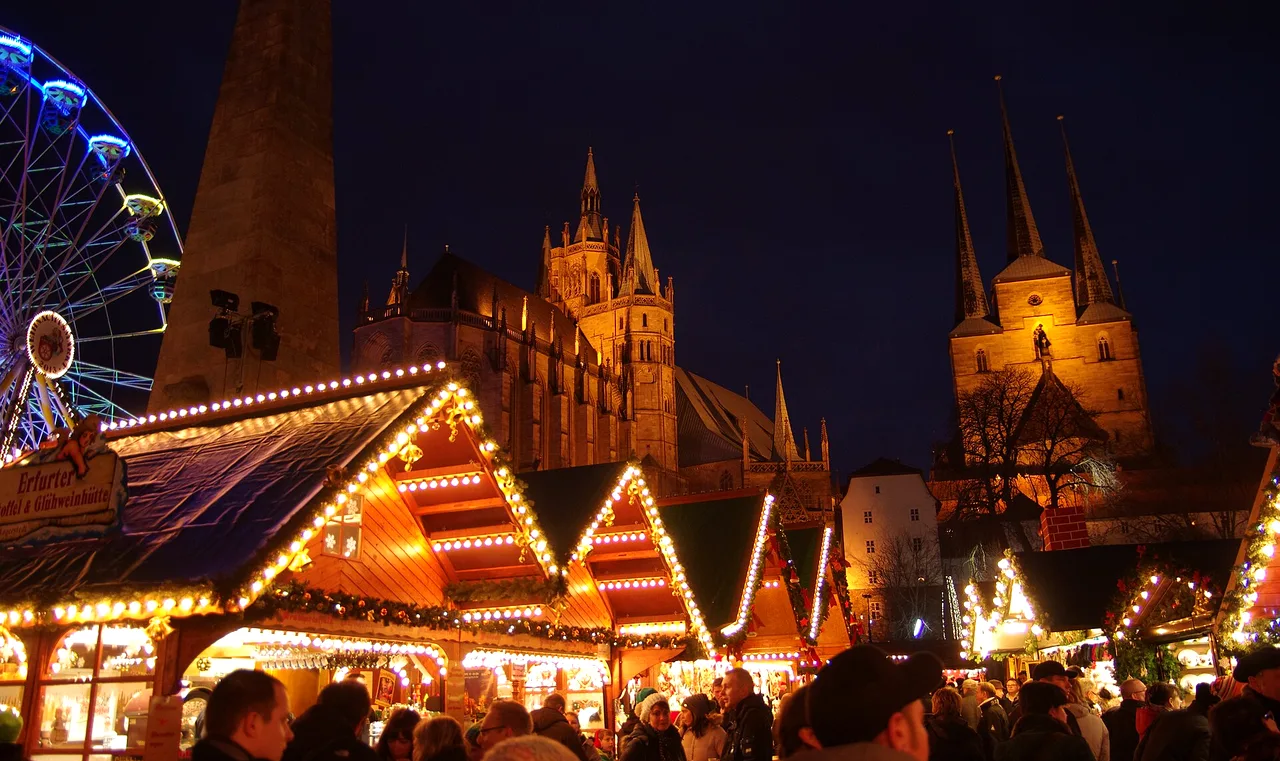
The Erfurt Christmas market (Erfurter Weihnachtsmarkt) is set up on Domplatz, right in front of the broad steps of St. Mary’s Cathedral and St. Severus, the city’s landmarks, and the view of the two illuminated churches makes it one of Germany’s most photogenic Christmas markets. According to the official website, 2026 is the market’s 176th year; from 24 November to 22 December, with more than 200 stalls and over a million visitors a year, it is Thuringia’s largest Christmas event. The large Christmas tree and the wooden Christmas pyramid are the centrepieces of Domplatz, and the market extends from Domplatz into the old town, to Fischmarkt, Schlösserbrücke, Anger and Willy-Brandt-Platz. Stalls sell Thuringian crafts, wooden decorations from the Ore Mountains, mulled wine, Thuringian Rostbratwurst and Erfurt’s traditional Christmas cake, the Schittchen. The information below was checked on the official website on 28 October 2026.


| Market / section | Location | 2026 dates | Note |
|---|---|---|---|
| Erfurter Weihnachtsmarkt (main market) | Domplatz, in front of the cathedral and St. Severus steps | 24 November–22 December 2026 | According to the official site the 176th market; more than 200 stalls, free entry. Hours published on the official site: opening day 10:00–21:00; Sun–Wed 10:00–20:00, Thu 10:00–21:00, Fri–Sat 10:00–22:00. Check the 2026 hours |
| Fischmarkt | Fischmarkt in front of the Rathaus | 24 November–22 December 2026 | The market’s old town section; according to the official site, hours on the other squares are generally 10:00–20:00 |
| Schlösserbrücke | Schlösserbrücke over the Gera | 24 November–22 December 2026 | The link between Fischmarkt and Anger; check hours on the official site |
| Anger | Anger shopping street and square | 24 November–22 December 2026 | The section in the city’s central shopping area, near the Angermuseum |
| Willy-Brandt-Platz | In front of Erfurt Hauptbahnhof | 24 November–22 December 2026 | The section that greets train arrivals; take the tram from here to Domplatz |
| Cathedral steps and Christmas pyramid | Domplatz | Market season | The illuminated view in front of the cathedral steps and the wooden Christmas pyramid; best after dark |
What to taste at the market
Thüringer Rostbratwurst
A thin Thuringian sausage seasoned with marjoram and caraway and grilled over charcoal; eaten in a bread roll with mustard.
Erfurter Schittchen
Erfurt’s traditional Christmas cake; a kind of stollen with raisins and almonds dusted with icing sugar.
Glühwein
Spiced mulled wine, including versions made with Thuringian and Saale-Unstrut wines. Alcohol-free Kinderpunsch is available too.
Thüringer Klöße
Large potato dumplings, usually served with meat and gravy.
Lebkuchen and roasted almonds
Gingerbread and sugar-roasted almonds are classics of German Christmas markets.
Wooden decorations
Wooden pyramids, nutcrackers and incense smokers (Räuchermännchen) from the Ore Mountains tradition are favourite gifts.
Tips for the Erfurt Christmas market
- After dark, cross to the far end of Domplatz to fit the lit cathedral and St. Severus into one frame with the market.
- Weekend evenings are very crowded; weekday mornings and afternoons are calmer.
- From the Hauptbahnhof, Domplatz is a few minutes by tram or a walk of about 20–25 minutes via Anger and Fischmarkt, passing the market’s other sections.
- Combine the market with the Krämerbrücke; the small shops on the bridge are ideal for Christmas gifts.
- Mulled wine mugs may carry a deposit; return the mug or keep it as a souvenir.
- Domplatz is a wide, open square; dress warmly for windy evenings.
- The market ends on 22 December; note that it is not open over Christmas itself.
- Dates and times may change; check the official site again before you go.
Check before you go: Erfurter Weihnachtsmarkt · erfurt-weihnachtsmarkt.de (official) ↗ · Erfurt Tourismus · erfurt-tourismus.de ↗ · Landeshauptstadt Erfurt · erfurt.de ↗
Dates were checked on the official erfurt-weihnachtsmarkt.de page on 28 October 2026. Opening hours, the opening ceremony and programme details may change; follow the official site and Erfurt Tourismus for current information.
When to go
The best time to explore Erfurt is May to September, with long days, outdoor cafés and egapark in bloom. In August the open-air Domstufen-Festspiele festival is held on the cathedral steps. From late November to 22 December it is Christmas market season. Winter is cool and dry; January and February are the quietest months.
| Month | City walks | Christmas market | Gardens and trips | Crowds |
|---|---|---|---|---|
| January | Challenging | No market | Challenging | Quiet |
| February | Challenging | No market | Challenging | Quiet |
| March | Good | No market | Good | Moderate |
| April | Very good | No market | Very good | Moderate |
| May | Very good | No market | Very good | Moderate |
| June | Very good | No market | Very good | Busy |
| July | Very good | No market | Very good | Moderate |
| August | Very good | No market | Very good | Moderate |
| September | Very good | No market | Very good | Moderate |
| October | Good | No market | Good | Moderate |
| November | Good | Market season | Challenging | Moderate |
| December | Good | Market season | Challenging | Busy |
- In December temperatures in Erfurt hover around freezing; snow doesn’t fall every year, but cold winds are common.
- The Christmas market runs from 24 November to 22 December 2026; December weekends are the busiest.
- During the Domstufen-Festspiele (August) part of Domplatz becomes a stage; check dates with official sources.
- egapark is most colourful in spring and summer; the tropical plant house is open all year.
- In December it gets dark around 16:00; plan late afternoon for the Domplatz lights.
- Erfurt’s Christmas market can be combined with other Thuringian markets: Weimar’s Christmas market and the Advent market at the Wartburg in Eisenach are a short train ride away; check their dates on the official websites.
- The Krämerbrückenfest in June and the Domstufen-Festspiele in August are the city’s busiest summer days; book accommodation early for these periods.
Visas and entry (Turkish citizens)
Turkish citizens holding an ordinary (burgundy) passport need a Schengen visa for tourist travel to Germany. Rules differ for special, service and diplomatic passports; check the current situation on the Turkish Ministry of Foreign Affairs website.
You apply to the consulate of the country of your main destination. If your trip is mainly to Germany, you apply to Germany’s representations in Türkiye; current information is at tuerkei.diplo.de.
If you plan to continue to cities such as Leipzig, Dresden or Prague, be clear about where you will spend most time; checks may be carried out at Schengen internal borders, so carry your passport.
Travel health insurance is mandatory for a Schengen visa; the required documents are listed on the official site.
Under the EU Entry/Exit System (EES), being phased in at the external borders, your biometric data (fingerprints and facial image) may be recorded on first entry. Details are on the official EU page.
Visa fees, processing times and document lists may change. No fees are given on this page; rely only on official sources before applying.
Check before you go: T.C. Dışişleri Bakanlığı · Türk vatandaşlarının tabi olduğu vize uygulamaları ↗ · tuerkei.diplo.de ↗ · EES · europa.eu ↗ · Rota Atlası visa guide (TR)
Travel medical insurance
Check the official visa and entry sources above first: they state whether travel medical insurance is required and the minimum cover. Compare any policy’s cover amount, validity dates and countries covered with the official requirement.
Rota Atlası does not currently offer an insurance partnership; there are no paid links in this section. Last updated: 1 November 2026
Getting to Erfurt
- By air: Erfurt-Weimar Airport is small, with limited scheduled services. Travellers from Türkiye usually continue by train via Frankfurt, Leipzig/Halle, Berlin or Munich. Check current flights only on the official airline and airport websites.
- By train: Erfurt Hauptbahnhof is an important hub of Germany’s high-speed rail network, with direct ICE links to Berlin, Munich, Frankfurt, Leipzig and Dresden. Times and tickets on bahn.de.
- By coach: Long-distance coaches stop near the Hauptbahnhof; check operators and times through official channels.
- By car: Erfurt is close to the A4 and A71 motorways. The old town is narrow and largely pedestrianised; use park-and-ride and car parks.
- From Türkiye by train: The most common route is a direct flight to Frankfurt, Berlin or Munich and then an ICE to Erfurt; airport stations have direct or one-change connections, check timetables on bahn.de.
Getting around

Walking
Domplatz, the Krämerbrücke, Fischmarkt and Anger are within walking distance; the old town is compact and mostly flat, though the climb to the Petersberg is steep.
Tram
EVAG’s tram network links the Hauptbahnhof, Anger, Domplatz and egapark. Lines and fares on evag-erfurt.de.
Tickets
Single, day and group tickets are sold at machines and in official apps; the nationwide Deutschlandticket covers regional public transport, check its conditions on official websites.
Cycling
There are cycle paths along the Gera and around the city; watch out for cobbles in the old town.
Regional trains
Thuringian towns such as Weimar, Gotha and Eisenach are easy to reach by regional train; timetables on bahn.de.
Taxi
There are taxi ranks at the Hauptbahnhof and central points; taxis can also be booked by phone.
Places to visit
Erfurt’s sights range from the two churches on the Domberg to the Krämerbrücke, from the medieval Jewish heritage to Luther’s monastery, and from the Petersberg citadel to egapark. The last three sections cover Weimar, the Wartburg and Gotha, all easy to reach by train.
Landmark
The Domberg: St. Mary’s Cathedral and St. Severus

The Domberg is Erfurt’s landmark: St. Mary’s Cathedral and St. Severus stand side by side on the hill and descend to Domplatz by a broad flight of 70 steps. The cathedral, built on Romanesque foundations and extended in Gothic style, houses the Gloriosa bell, cast in 1497 and considered one of the largest free-swinging medieval bells in the world; its stained glass windows and Gothic choir are particularly precious. The five-aisled St. Severus next door, with its three pointed spires, completes the skyline. Martin Luther was ordained a priest here in 1507. The most impressive view of the Domberg is from the eastern end of Domplatz, where both churches appear together above the broad steps. Inside the cathedral are works such as the medieval bronze candlestick figure known as “Wolfram” and a Romanesque Madonna; in St. Severus you can see the stone sarcophagus of St. Severus.
Don’t miss
- The view of Domplatz from the cathedral steps
- The stained glass of the Gothic choir
- The Gloriosa bell (rung only on special occasions)
- The interior of St. Severus
Tips
- Check opening hours and guided tours on dom-erfurt.de; don’t walk around during services.
- The steps can be slippery in winter.
- The night illumination looks best from the opposite side of Domplatz.

Middle Ages
Krämerbrücke

The Krämerbrücke is a stone bridge of about 120 metres over an arm of the river Gera, lined on both sides with half-timbered houses. Rebuilt in stone in 1325, it is known as one of the longest bridges in Europe that has been continuously inhabited. Today more than thirty houses hold craft workshops, small galleries, chocolate and gift shops. From the tower of the Aegidienkirche at the eastern end you can look over the bridge’s roofs. For a side view, go down to the riverbank. The bridge takes its name from the merchants (Krämer) who sold their goods here; in the Middle Ages it was where the Via Regia trade route crossed the Gera, with churches at both ends. Today only the Aegidienkirche at the eastern end survives. One of the houses on the bridge may host a small exhibition on its history.
Don’t miss
- Shops and workshops on the bridge
- The view from the Aegidienkirche tower
- The side view of the bridge from the riverbank
Tips
- The bridge gets very crowded during the Krämerbrückenfest in June; check dates with official sources.
- Many shops may be closed on Sundays.
- Current information on kraemerbruecke.de.

Old town
Fischmarkt, the Rathaus and Wenigemarkt

Fischmarkt is one of the main squares of Erfurt’s old town. The neo-Gothic Rathaus dominating the square was built in the late 19th century, and its halls are decorated with paintings of Thuringian legends and Luther’s life. The Renaissance mansions around the square, especially the Haus zum Breiten Herd and Haus zum Roten Ochsen, bear witness to the wealth Erfurt made from woad. The small Wenigemarkt at the eastern end of the Krämerbrücke is a quiet break with cafés. The Roland statue in the middle of the square symbolises the city’s medieval market and judicial rights. Walking from Fischmarkt along Marktstrasse to Domplatz, you follow one of Erfurt’s oldest trading streets.
Don’t miss
- The Rathaus festival hall (when open)
- The Renaissance façade of the Haus zum Breiten Herd
- Wenigemarkt
Tips
- Check Rathaus visiting hours on erfurt.de.
- At Christmas, Fischmarkt is part of the market.
- The square lies between the Krämerbrücke and Domplatz.
UNESCO World Heritage
Medieval Jewish heritage: Old Synagogue and Mikveh

Erfurt’s medieval Jewish heritage was added to the UNESCO World Heritage List in 2023. The site includes the Old Synagogue, whose oldest parts date back to the late 11th century and which is one of the oldest preserved synagogues in Europe, the 13th-century ritual bath (Mikveh) and the Stone House (Steinernes Haus). The Old Synagogue is now a museum; the Erfurt Treasure, believed to have been hidden during the pogrom of 1349 and found in 1998, is displayed here with gold and silver jewellery, notably a 14th-century Jewish wedding ring. The synagogue survived astonishingly because it was used as a warehouse and storehouse for centuries after the pogrom of 1349, and it was only rediscovered in the late 20th century. The museum tells of the everyday life, trade and manuscripts of the medieval Jewish community. UNESCO listing ↗
Don’t miss
- The Old Synagogue museum
- The Erfurt Treasure and wedding ring
- The Mikveh by the Gera
Tips
- Check hours and Mikveh tours on juedisches-leben.erfurt.de.
- The Mikveh is usually visited on guided tours.
- The site is within walking distance of Fischmarkt.
Luther
Augustinian Monastery (Augustinerkloster)

The Augustinerkloster is the monastery where Martin Luther lived as an Augustinian friar from 1505. Luther described entering the monastery after a fear of death during a thunderstorm while studying at the University of Erfurt. Now belonging to the Protestant church, the monastery has a Gothic church, cloister, an exhibition on Luther’s life and a guest house; the medieval stained glass of the church is particularly precious.
Don’t miss
- The church’s stained glass
- The cloister
- The Luther exhibition
Tips
- Check guided tour times on augustinerkloster.de.
- The monastery is still a religious place; keep quiet.
- It is close to Fischmarkt and the Andreasviertel.
Citadel
Petersberg Citadel

The Petersberg, on the hill just behind the Domberg, is a large Baroque citadel built in the 17th century and considered one of the best-preserved urban fortresses in Central Europe. From its ramparts you get the finest view of the Domberg’s towers and Erfurt’s rooftops. Inside are the Romanesque St. Peter’s Church, underground passages (on guided tours) and, at times, exhibitions. The hill was once home to a Benedictine monastery founded in the 12th century; the Peterskirche is its most important surviving building. The citadel was used militarily in the Prussian and Napoleonic periods and is now one of the city’s finest open-air viewpoints.
Don’t miss
- The view of the cathedral and city from the ramparts
- The Romanesque Peterskirche
- Underground passage tours
Tips
- It is reached from Domplatz by steps and a slope; wear comfortable shoes.
- Check tour times on erfurt-tourismus.de.
- The sunset view is especially lovely.
City centre
Anger and the Angermuseum

Anger is Erfurt’s central shopping street and square, between the Hauptbahnhof and the old town, lined with Baroque, Classical and 19th-century buildings. The Angermuseum, in a former Baroque weighhouse, shows medieval art, paintings and collections such as Thuringian faience. At Christmas Anger hosts part of the market, and it is the meeting point of the tram lines.
Don’t miss
- The Angermuseum collections
- Historic façades on Anger
- The Bartholomäusturm area
Tips
- Check museum hours on erfurt.de; museums are usually closed on Mondays.
- Anger is the hub of the tram network.
- It is a few minutes’ walk from the Hauptbahnhof.

Quiet lanes
Andreasviertel and the Predigerkirche

The Andreasviertel is a small quarter north of the Domberg; with its narrow lanes, half-timbered houses and quiet courtyards it is one of Erfurt’s most romantic corners. From the tower of the Andreaskirche, which gives the quarter its name, you can see the old town roofs. The nearby Predigerkirche is the Gothic church of the Dominican order founded in the 13th century; the medieval mystic Meister Eckhart preached here.
Don’t miss
- The narrow lanes of the Andreasviertel
- The Gothic interior of the Predigerkirche
- The Andreaskirche tower (when open)
Tips
- It is a residential area; keep noise down.
- Church opening hours vary.
- It is a few minutes’ walk from Domplatz.

Gardens
egapark

egapark, in the west of Erfurt, is a large garden and park reflecting the city’s centuries-old tradition of horticulture and seed growing. It has extensive flower beds, a Japanese garden, the German Horticultural Museum and the Danakil desert and jungle house with tropical plants. There is also a large playground. It is ideal for families, especially in spring and summer. The grounds include the Baroque Cyriaksburg fortress, which houses the German Horticultural Museum; from its tower you can see the park and the city.
Don’t miss
- The flower beds
- The Danakil desert and jungle house
- The Japanese garden
- The German Horticultural Museum
Tips
- Check opening hours and seasonal events on egapark-erfurt.de.
- Reach it by tram from the centre.
- Outdoor areas are limited in winter; Danakil is open year-round.
Day trip · UNESCO
Weimar: Classical Weimar and the Bauhaus

Weimar, a short train ride from Erfurt, is a small city that became the centre of German classical literature. Goethe and Schiller lived and wrote here; Goethe’s house, Schiller’s house and the Duchess Anna Amalia Library are on the UNESCO World Heritage List as “Classical Weimar”. The Bauhaus school founded by Walter Gropius in 1919 was also born in Weimar; the Bauhaus sites are separately listed by UNESCO, and the Bauhaus Museum Weimar tells this story. Weimar has its own Christmas market as well. Weimar is also where the constitution of the German Republic was adopted in 1919, a period remembered as the “Weimar Republic”. Thanks to the compact centre, the main sights can be seen on foot in half a day. UNESCO listing ↗
Don’t miss
- The Goethe and Schiller monument
- Goethe’s house
- The Duchess Anna Amalia Library
- Bauhaus Museum Weimar
Tips
- Train times on bahn.de.
- Museum hours and tickets on klassik-stiftung.de; visitor numbers at the Anna Amalia Library may be limited.
- Check the Weimar Christmas market dates on weimar.de.

Day trip · UNESCO
Wartburg Castle (Eisenach)

The Wartburg is a medieval castle on a wooded hill above Eisenach and is on the UNESCO World Heritage List. Martin Luther translated the New Testament into German here while in hiding in 1521–1522; the room where he worked can be visited as the Luther Room. The castle’s Romanesque palace inspired legends of medieval knights and poets. Eisenach is the birthplace of Johann Sebastian Bach. The castle may host a Christmas market on Advent weekends; check dates on the official site. UNESCO listing ↗
Don’t miss
- The Luther Room
- The Romanesque palace
- The view over the Thuringian Forest
Tips
- Take the train from Erfurt to Eisenach; from the station, go up by bus or on a steep walk.
- Hours and guided tours on wartburg.de.
- Castle paths can be slippery in winter.
Day trip
Gotha and Schloss Friedenstein

Gotha is a former residence town between Erfurt and Eisenach. Its landmark is Schloss Friedenstein, built in the 17th century and considered one of Germany’s largest early Baroque palaces. The palace has the Ekhof Theatre, art and natural history collections and a large park. With the old town’s market square and water features, Gotha suits a quiet half-day trip. In the 19th century Gotha was one of the seats of the House of Saxe-Coburg and Gotha, which became linked to many of Europe’s royal families. The Ekhof Theatre in the palace’s west tower is known as one of the oldest Baroque theatres in the world with its original stage machinery.
Don’t miss
- Schloss Friedenstein
- The Ekhof Theatre
- The palace park
- Hauptmarkt
Tips
- It is a short regional train ride from Erfurt; timetables on bahn.de.
- Palace and museum hours on stiftungfriedenstein.de.
- You can combine Gotha and Eisenach in one day.
1, 2 and 3-day itineraries + Christmas day
These itineraries are planned for walking and public transport. Erfurt’s old town is compact: one day covers the essentials, two days add the museums and the Petersberg, and three days include Weimar or the Wartburg. Check church and museum hours on the official websites before you go.
1 day: The Domberg and the Krämerbrücke
- In the morning climb the cathedral steps and visit St. Mary’s Cathedral and St. Severus.
- Walk from Domplatz via Marktstrasse to Fischmarkt and see the Rathaus and Renaissance façades.
- Visit the Old Synagogue and the Erfurt Treasure.
- In the afternoon browse the shops on the Krämerbrücke and look at the bridge from the riverbank.
- At sunset watch the Domberg from the Petersberg ramparts.
2 days: Luther, museums and egapark
- On day two visit the Augustinerkloster in the morning.
- Walk through the narrow lanes of the Andreasviertel to the Predigerkirche.
- In the afternoon see the Angermuseum on Anger.
- In good weather take the tram to egapark; in winter the Danakil house is a good choice.
3 days: Weimar or the Wartburg
- On day three take the train to Weimar for Goethe’s house, the Anna Amalia Library and the Bauhaus Museum.
- Alternatively take the train to Eisenach for Wartburg Castle and the Luther Room.
- On the way back you can stop in Gotha for Schloss Friedenstein.
- For a longer trip, consider the Christmas markets of Leipzig or Dresden by train.
Christmas market day (24 November–22 December 2026)
- Start at Willy-Brandt-Platz by the Hauptbahnhof and walk to the market on Anger.
- Cross Schlösserbrücke to Fischmarkt and browse the stalls in front of the Rathaus.
- Look for Christmas gifts on the Krämerbrücke.
- Reach Domplatz as darkness falls and see the illuminated cathedral and St. Severus, the Christmas tree and the wooden pyramid.
- End the day in front of the cathedral steps with a Thuringian Rostbratwurst and mulled wine.
Thuringian food
Thuringian cooking is hearty and simple: charcoal-grilled sausages, potato dumplings and rich meat dishes for winter. Below are local dishes to try, not restaurant recommendations.


Thüringer Rostbratwurst
A thin sausage seasoned with marjoram, caraway and garlic and grilled over charcoal; Thuringia’s symbol, eaten in a roll with mustard.
Thüringer Klöße
Large dumplings of raw and cooked potato with fried bread inside; usually served with a roast and gravy.
Rostbrätel
Meat marinated in mustard and beer and grilled; Thuringia’s classic barbecue dish.
Mutzbraten
A marjoram-spiced roast cooked over a birch-wood fire; a tradition from eastern Thuringia.
Erfurter Schittchen
Erfurt’s Christmas cake; a stollen with raisins and almonds.
Thüringer Kuchen
Thuringia’s thin sheet cakes, with apple, quark or crumble (Streusel) toppings.
- Rostbratwurst is usually made from pork; ask the vendor about beef or turkey alternatives.
- Tap water is drinkable.
- Some dishes contain pork or alcohol; ask about the ingredients.
- Tipping in restaurants usually means rounding up or adding about 5–10 percent.
Culture and etiquette

- In Germany people greet with “Guten Tag” or “Hallo”; handshakes are usual in formal settings.
- Punctuality matters; trains and appointments start on time.
- Be quiet in churches and don’t walk around during services.
- Most shops are closed on Sundays, and quiet hours are respected.
- Recycling rules are strict; bottles carry a deposit (Pfand).
- At open-air events such as the Domstufen-Festspiele, follow the seating areas on the cathedral steps and staff instructions.
- Cycle lanes are marked; pedestrians should not walk in them.
- When paying in restaurants, tell the server the total including tip.
- Erfurt is also known in Germany as the “city of flowers”; its seed-growing and horticultural tradition has been famous since the 19th century, and egapark showcases this heritage.
- Luther’s heritage matters in Erfurt; places such as the Augustinerkloster and the cathedral are both tourist sights and religious sites, so show respect in dress and behaviour.
Safety and health
- Erfurt is generally a safe city; watch out for pickpockets in Christmas market crowds, on trams and around the Hauptbahnhof.
- In winter the cathedral steps and cobbles can be slippery; wear non-slip shoes.
- Trams are quiet; watch the tracks, especially on Domplatz and Anger.
- Keep valuables out of sight late at night.
- In an emergency call 112, police 110. Travel health insurance is mandatory for a Schengen visa.
- Check official travel advice (e.g. the Turkish Ministry of Foreign Affairs or GOV.UK) before you go.
- There may be security measures and vehicle barriers at the Christmas market; follow staff directions and avoid entering crowds with large bags.
What drives your budget
This guide gives no prices; they change with season and year. In Erfurt your budget depends mostly on:
Travel period
Demand for accommodation rises on Christmas market weekends and during major events; weekdays may be better value.
Where you stay
Staying in the old town lets you walk everywhere; the Hauptbahnhof area is practical for train trips.
Transport tickets
Day tickets and the nationwide Deutschlandticket affect the cost of trips to Weimar, Gotha and Eisenach; check their conditions on official websites.
Museums
Check the official tourism site for combined tickets or a city card (e.g. the ErfurtCard) covering the Old Synagogue, Angermuseum and other museums.
Food and drink
Sausage stands and bakeries are good-value options; restaurants cost more.
Day trips
Trips to Weimar and the Wartburg add train and entry tickets to your budget; plan ahead.
Free experiences
The Domplatz lights, a walk across the Krämerbrücke, the Petersberg ramparts and the lanes of the Andreasviertel are free; entry to most churches is usually free too, though towers and guided tours may be charged.
Practical information
- Money: The euro is used; cards are common, cash is useful at Christmas market stalls.
- Language: German is spoken; English is used at tourist sites.
- Plugs: 230 V, type C/F; the same as in Türkiye.
- Opening hours: Shops are closed on Sundays; many places close early on the afternoon of 24 December, and 25–26 December are public holidays.
- Internet: EU roaming rules don’t apply to Turkish lines; check your operator’s international packages.
- Tourist information: Erfurt Tourismus’s tourist information office is on Benediktsplatz; current details on erfurt-tourismus.de.
- Accessibility: The old town is mostly flat; the cathedral steps and the Petersberg are steep and stepped.
- Photography: The best spots are Domplatz opposite the cathedral steps, the Petersberg ramparts and the riverbank by the Krämerbrücke.
- Historic city: Erfurt’s old town came through the Second World War with relatively little damage, so its medieval street pattern and half-timbered houses are largely preserved. As you walk, notice the names on the façades (Haus zum …); these are house names dating back to the Middle Ages.
- University: The University of Erfurt was founded in the late 14th century, closed in the early 19th century and refounded in 1994; the historic Collegium Maius building where Luther studied is on Michaelisstrasse.
- City tours: Erfurt Tourismus may offer guided tours or audio guides in various languages; check current options on erfurt-tourismus.de.
- With children: egapark’s playground, the Petersberg ramparts and the children’s areas of the Christmas market suit families; follow children’s activities at the market in the official programme.
Frequently asked questions
When is the Erfurt Christmas market open in 2026?
According to the official website, the 176th Erfurt Christmas market runs from 24 November to 22 December 2026. Check daily hours on the official site before you go.
Is there an entry fee for the Erfurt Christmas market?
No, entry is free; food, drinks and some activities are paid separately.
Where is the Erfurt Christmas market held?
The main market is on Domplatz in front of St. Mary’s Cathedral and St. Severus; according to the official site there are also sections on Fischmarkt, Schlösserbrücke, Anger and Willy-Brandt-Platz.
Do Turkish citizens need a visa for Erfurt?
Turkish citizens with an ordinary passport need a Schengen visa. Current information is at tuerkei.diplo.de.
How do I get to Erfurt?
Erfurt Hauptbahnhof is an ICE hub with direct trains from Berlin, Munich, Frankfurt, Leipzig and Dresden. Travellers from Türkiye usually fly to a major German airport and continue by train.
How many days should I spend in Erfurt?
One day for the old town, two days for the museums and the Petersberg, and three days for a trip to Weimar or the Wartburg.
What makes the Krämerbrücke special?
It is one of the longest inhabited bridges in Europe, lined with houses where people still live; it has been a stone bridge since 1325.
What is Erfurt’s UNESCO heritage?
The medieval Jewish heritage, comprising the Old Synagogue, the Mikveh and the Stone House, was added to the UNESCO World Heritage List in 2023.
Which Christmas markets can I reach from Erfurt?
Weimar, Leipzig and Dresden are easy to reach by train; see Rota Atlası’s Leipzig and Dresden guides.
What is Thüringer Rostbratwurst?
A thin Thuringian sausage seasoned with marjoram and caraway and grilled over charcoal; eaten in a roll with mustard.
Where to stay
Stay close to the areas where you will spend most time. The areas below are covered in detail in this guide; check public transport links in the getting-around section.
- LandmarkThe Domberg: St. Mary’s Cathedral and St. Severus
- Middle AgesKrämerbrücke
- Old townFischmarkt, the Rathaus and Wenigemarkt
- UNESCO World HeritageMedieval Jewish heritage: Old Synagogue and Mikveh
- LutherAugustinian Monastery (Augustinerkloster)
- CitadelPetersberg Citadel
- City centreAnger and the Angermuseum
- Quiet lanesAndreasviertel and the Predigerkirche
- Gardensegapark
Search hotels in these areas (Hotellook) ↗ (affiliate link)Search on Booking.com ↗
Affiliate disclosure: Hotellook, Aviasales, Klook, Airalo, Tiqets and DiscoverCars links are affiliate links; Rota Atlası may earn a commission on bookings made through them, at no extra cost to you. Official and in-guide links are not paid. Last updated: 1 November 2026 · Privacy and affiliates
Transport and connectivity
- Airport transferOptions from the airport to the city are in this guide’s getting there section.
- Mobile data (eSIM)Airalo eSIM ↗ (affiliate link)
- TrainsOfficial rail website ↗
- Car hireYou rarely need a car within the city; see getting around first. Compare car hire on DiscoverCars ↗ (affiliate link)
Affiliate disclosure: Hotellook, Aviasales, Klook, Airalo, Tiqets and DiscoverCars links are affiliate links; Rota Atlası may earn a commission on bookings made through them, at no extra cost to you. Official and in-guide links are not paid. Last updated: 1 November 2026 · Privacy and affiliates
Search flights (affiliate link)
Search flights from any airport in any country. Results open on Aviasales in a new tab, where you book.
This form is an affiliate link: Rota Atlası may earn a commission on bookings made via Aviasales (Travelpayouts), at no extra cost to you. Check price, baggage and terms on the booking site. Airport data: OurAirports (public domain).
Flights, hotels and tours
Find tours and tickets
- Erfurt Christmas Market
GetYourGuide ↗ · Klook ↗ (affiliate link) - Fischmarkt, Schlösserbrücke, Anger and Willy-Brandt-Platz
GetYourGuide ↗ · Klook ↗ (affiliate link) - St Mary’s Cathedral and St Severus’ Church
GetYourGuide ↗ · Klook ↗ (affiliate link) - Krämerbrücke
GetYourGuide ↗ · Klook ↗ (affiliate link)
Hotellook, Aviasales, Klook, Airalo and Tiqets links in this box are affiliate links (Travelpayouts): Rota Atlası may earn a commission on bookings made through them, at no extra cost to you. GetYourGuide links currently carry no affiliate code. Check prices and terms with the provider. Last updated: 1 November 2026 · Privacy and affiliates
Sources
- T.C. Dışişleri Bakanlığı · Türk vatandaşlarının tabi olduğu vize uygulamaları ↗
- Auswärtiges Amt · Deutsche Vertretungen in der Türkei (Visa) ↗
- European Union · Entry/Exit System (EES) ↗
- Erfurt Tourismus und Marketing · erfurt-tourismus.de (official) ↗
- Landeshauptstadt Erfurt · erfurt.de (official) ↗
- Dom St. Marien zu Erfurt (official) ↗
- Krämerbrücke Erfurt (official) ↗
- Jüdisches Leben in Erfurt · Alte Synagoge und Mikwe (official) ↗
- Augustinerkloster zu Erfurt (official) ↗
- egapark Erfurt (official) ↗
- EVAG · Erfurter Verkehrsbetriebe ↗
- Flughafen Erfurt-Weimar ↗
- Deutsche Bahn ↗
- Stadt Weimar · weimar.de (official) ↗
- Klassik Stiftung Weimar (official) ↗
- Wartburg-Stiftung · wartburg.de (official) ↗
- Stiftung Schloss Friedenstein Gotha (official) ↗
- GOV.UK · Foreign travel advice · Germany ↗
- UNESCO World Heritage Centre · Jewish-Medieval Heritage of Erfurt ↗
- UNESCO World Heritage Centre · Classical Weimar ↗
- UNESCO World Heritage Centre · Bauhaus and its Sites in Weimar, Dessau and Bernau ↗
- UNESCO World Heritage Centre · Wartburg Castle ↗
- Erfurter Weihnachtsmarkt · erfurt-weihnachtsmarkt.de (official) ↗
- Erfurt Tourismus · erfurt-tourismus.de ↗
- Landeshauptstadt Erfurt · erfurt.de ↗
This page is for information only. Dates, times, entry rules and transport details can change; check the official sources above before travelling. No prices, flights, hotels or restaurants have been invented in this guide.
Photo credits
The photos on this page come from Wikimedia Commons and are used under the stated authors and licences (CC BY, CC BY-SA, CC0 or public domain). All sources page
- Christmas market stalls and historic houses on Erfurt’s Domplatz — Dguendel · CC BY 3.0 · Wikimedia Commons
- Erfurt Cathedral and St Severus floodlit at night — Steffen Prößdorf · CC BY-SA 4.0 · Wikimedia Commons
- Half-timbered houses of the Krämerbrücke over the Gera — Fiver, der Hellseher · CC BY-SA 4.0 · Wikimedia Commons
- Erfurt’s Fischmarkt and the neo-Gothic town hall — Txllxt TxllxT · CC BY-SA 4.0 · Wikimedia Commons
- The Ferris wheel at the Erfurt Christmas market — Berlinschneid · CC BY-SA 4.0 · Wikimedia Commons
- Christmas stalls on Domplatz with the cathedral silhouette — Berlinschneid · CC BY-SA 4.0 · Wikimedia Commons
- Stall roofs at the Erfurt Christmas market at dusk — Berlinschneid · CC BY-SA 4.0 · Wikimedia Commons
- The Domplatz Christmas market and the cathedral in evening light — Z thomas · CC BY-SA 4.0 · Wikimedia Commons
- A bird’s-eye view of the Christmas market on Domplatz — Ansgar Koreng · CC BY 4.0 · Wikimedia Commons
- The Ferris wheel and stalls at the Erfurt Christmas market by day — Goldmull · CC BY-SA 4.0 · Wikimedia Commons
- An Erfurt tram on the Anger — Jøra · CC BY 3.0 · Wikimedia Commons
- A Thuringian Rostbratwurst in a bread roll — Dr. Bernd Gross · CC BY-SA 4.0 · Wikimedia Commons
- Thuringian potato dumplings with red cabbage — Dr. Bernd Gross · CC BY-SA 4.0 · Wikimedia Commons
- A Thuringian Rostbrätel with onions — Dr. Bernd Gross · CC BY-SA 4.0 · Wikimedia Commons
- Mutzbraten served with sauerkraut — Agash C · CC BY-SA 3.0 · Wikimedia Commons
- The cathedral steps of Erfurt in evening light — Michael Sander · CC BY-SA 3.0 · Wikimedia Commons
- The north façades of Erfurt Cathedral and St Severus — Virtual-Pano · CC BY-SA 4.0 · Wikimedia Commons
- A snowy Domplatz and Domberg in Erfurt — TOMMES-WIKI · CC BY-SA 3.0 · Wikimedia Commons
- The Krämerbrücke with the Gera flowing beneath — Bewahrerderwerte · CC BY-SA 4.0 · Wikimedia Commons
- The arched passage beneath the Krämerbrücke — Dr. Bernd Gross · CC BY-SA 4.0 · Wikimedia Commons
- The neo-Gothic façade of Erfurt town hall — Immanuel Giel · CC BY-SA 4.0 · Wikimedia Commons
- The medieval façade of Erfurt’s Old Synagogue — GFreihalter · CC BY-SA 3.0 · Wikimedia Commons
- The Augustinian Monastery and its church in Erfurt — H. Zell · CC BY-SA 3.0 · Wikimedia Commons
- Bastion Leonhard of the Petersberg Citadel — H. Zell · CC BY-SA 3.0 · Wikimedia Commons
- The Anger, Erfurt’s main street — Txllxt TxllxT · CC BY-SA 4.0 · Wikimedia Commons
- Reliefs in the baroque interior of the Angermuseum — Giorno2 · CC BY 4.0 · Wikimedia Commons
- The tiled roofs of the Andreasviertel — Michael Sander · CC BY-SA 3.0 · Wikimedia Commons
- The Gothic interior and organ of the Predigerkirche — Mattis · CC BY-SA 4.0 · Wikimedia Commons
- A tree-lined path in the egapark — Ousw · CC0 · Wikimedia Commons
- The Goethe and Schiller Monument in Weimar — Player0052 · CC BY 4.0 · Wikimedia Commons
- The Bauhaus Museum building in Weimar — Giorno2 · CC BY-SA 4.0 · Wikimedia Commons
- The courtyard of Wartburg Castle in Eisenach — CEphoto, Uwe Aranas · CC BY-SA 3.0 · Wikimedia Commons
- Friedenstein Palace in Gotha — Krzysztof Golik · CC BY-SA 4.0 · Wikimedia Commons
Leipzig → · Dresden → · Quedlinburg → · Bamberg → · Berlin → · Christmas markets