

Basel lies in north-western Switzerland, where the Rhine makes a sharp bend, right on the borders with Germany and France. With around 175,000 inhabitants it is Switzerland’s third-largest city and the capital of the canton of Basel-Stadt. On the left bank, Grossbasel holds the old town with its red sandstone Münster, colourful Rathaus and steep medieval lanes; on the right bank, Kleinbasel is more relaxed, with cafés, riverside steps and long summer evenings. Switzerland’s oldest university, founded in 1460, Erasmus working and being buried here, and an art collection that went public in the 17th century gave Basel its identity as a city of culture; today, with more than forty museums, it is a magnet for lovers of art and design. From late November to 23 December the Basel Christmas market on Barfüsserplatz and Münsterplatz is, according to the official tourism board Basel Tourismus, one of the most beautiful and largest in Switzerland.
Content update: 28 October 2026 · Christmas market dates checked against the official basel.com (Basel Tourismus) and bs.ch (Canton of Basel-Stadt) pages
Basel at a glance
- Country / canton
- Switzerland · canton of Basel-Stadt
- Population
- About 175,000; Switzerland’s third-largest city
- Language
- German (local dialect Baseldytsch); English widely spoken, French often heard
- Currency
- Swiss franc (CHF); euros are not accepted everywhere, card payment is common
- Time zone
- Central European Time (CET, UTC+1); UTC+2 in summer. Two hours behind Türkiye in winter
- Known for
- The Rhine, art museums, Art Basel, Basel Fasnacht (UNESCO intangible heritage), the pharmaceutical and chemical industry
- Landmarks
- Rathaus, Münster and Pfalz terrace, Spalentor, Mittlere Brücke, Kunstmuseum, Museum Tinguely
- Christmas market
- Basler Weihnachtsmarkt: 26 November–23 December 2026, about 150 stalls
- Three countries
- The city borders Germany and France; the three countries meet at the Dreiländereck
- Airport
- EuroAirport Basel-Mulhouse-Freiburg (BSL/MLH); on French soil with a Swiss sector
- Electricity
- 230 V, 50 Hz; Switzerland uses type J sockets. Thick type F plugs from Türkiye do not fit, so you need an adapter
- Emergency
- 112 (general), 117 (police), 144 (ambulance), 118 (fire)
Basel in pictures
The Münster rising behind the Mittlere Brücke, the Rhine waterfront lit up at night and the historic Münsterplatz: Basel in three photos.


Basel Christmas market 2026
The Basel Christmas market (Basler Weihnachtsmarkt) fills two large squares of the old town: Barfüsserplatz in front of the Barfüsserkirche and Münsterplatz in front of the cathedral. According to Basel Tourismus, in 2026 about 150 wooden stalls sell crafts, decorations, Basler Läckerli, waffles, mulled wine, raclette and grilled sausages. The giant tree on Münsterplatz is decorated with ornaments from Johann Wanner, Basel’s famous Christmas decoration specialist, while on Barfüsserplatz the roughly 13-metre Christmas pyramid is the meeting point. Cross the Mittlere Brücke to Kleinbasel for the large alpine hut on Claraplatz and the neighbourhood market “Adväntsgass im Glaibasel” on Rheingasse. In 2026 the new Basler Wienachtsdorf, with around 40 huts stretching from Theaterplatz towards the Elisabethenkirche, stays open into early January. The traditional Basel Wish Book (Wunschbuch) in the Rathaus courtyard is open to everyone. The dates and times below were checked on the official pages of Basel Tourismus and the Canton of Basel-Stadt on 28 October 2026.


| Market / event | Location | 2026 dates | Note |
|---|---|---|---|
| Basler Weihnachtsmarkt | Barfüsserplatz and Münsterplatz | 26 November–23 December 2026 | Daily 11:00–20:30 according to the official page. On 23 December Barfüsserplatz closes at 20:00 and Münsterplatz at 18:00. About 150 stalls; free entry |
| Basler Wienachtsdorf (new) | From Theaterplatz towards the Elisabethenkirche | 26 November 2026–3 January 2027 | According to the official page, daily from 11:00; until 22:00 Mon–Thu, 23:00 Fri–Sat and 21:00 Sun. About 40 huts: design, crafts, winter drinks |
| Claraplatz Christmas market | Claraplatz, Kleinbasel | During the Christmas market | Kleinbasel’s meeting point with a large alpine hut; check opening hours on the official page |
| Adväntsgass im Glaibasel | Rheingasse, Kleinbasel | Advent weeks | According to Basel Tourismus, a neighbourhood market that turns Rheingasse into a “Christmas food street” in the weeks before Christmas; current days on the official page |
| Lit Münster tower staircase | Basel Münster, Martinsturm | Advent season | According to the official page, the tower stairwell is lit Monday–Friday 16:00–18:00 during Advent; last entry 17:30, groups of at least two. Fees and conditions on the official page |
| Basel Wish Book (Wunschbuch) | Rathaus courtyard, Marktplatz | Advent season | A traditional book where visitors can write their Advent wishes; free, during Rathaus opening hours |
What to taste at the market
Basler Läckerli
A thin, glazed Basel biscuit made with honey, almonds, candied peel and spices; the city’s best-known gift.
Brunsli, Mailänderli and Zimtsterne
Classic Swiss Christmas biscuits (Weihnachtsguetzli): chocolate-almond Brunsli, lemony butter Mailänderli and cinnamon stars.
Raclette
The Swiss classic of half-melted cheese scraped from the wheel and served with potatoes; one of the stalls with the longest queues.
Glühwein and Punsch
Spiced mulled wine; alcohol-free Kinderpunsch and hot apple juice are also available. Mugs may carry a deposit.
Waffles and chestnuts
Warm waffles and roasted chestnuts (Marroni) are classics of the winter streets.
Bratwurst
Grilled sausage; in Switzerland veal sausage (Kalbsbratwurst) is common. Ask about the ingredients.
Tips for the Basel Christmas market
- The walk between Barfüsserplatz and Münsterplatz takes about 5–10 minutes; combine both squares via Freie Strasse and Rittergasse.
- Climb to the Pfalz terrace a few steps from Münsterplatz and enjoy your hot drink with views of the Rhine and the city lights.
- Cross the Mittlere Brücke to Claraplatz and Kleinbasel; both banks can be visited in one evening.
- Weekend evenings are very crowded; weekday afternoons are calmer.
- Prices in Switzerland are in francs (CHF); most stalls take cards, but carry a few francs.
- The Johann Wanner shop on Spalenberg is famous for its Christmas decorations; check its opening hours in advance.
- The market ends on 23 December, when Münsterplatz closes at 18:00 and Barfüsserplatz at 20:00. The Wienachtsdorf stays open until 3 January 2027.
- Dates and times may change; check the official page again before you go.
Check before you go: Basel Tourismus · Weihnachtsmarkt in Basel (official) ↗ · Basel Tourism · Christmas market in Basel (official) ↗ · Kanton Basel-Stadt · Basler Weihnachtsmarkt ↗
Dates and times were checked on the official Christmas market pages of Basel Tourismus (basel.com) and the Canton of Basel-Stadt (bs.ch) on 28 October 2026. The event programme and details of Claraplatz and the Adväntsgass may change; follow the official pages for current information.
When to go
The most enjoyable time to explore Basel is May to September; in summer the Rhine banks turn into a place to swim and picnic. During the Art Basel fair in June, demand for accommodation rises sharply. From late November to 23 December it is Christmas market season. In February or March, the three-day Basel Fasnacht, starting on the Monday after Ash Wednesday, is the city’s most special time; check the dates with official sources. The Herbstmesse (autumn fair) in October–November is another city tradition.
| Month | City walks | Christmas market | Rhine and trips | Crowds |
|---|---|---|---|---|
| January | Challenging | No market | Challenging | Quiet |
| February | Challenging | No market | Challenging | Moderate |
| March | Good | No market | Good | Moderate |
| April | Very good | No market | Good | Moderate |
| May | Very good | No market | Very good | Busy |
| June | Very good | No market | Very good | Busy |
| July | Very good | No market | Very good | Moderate |
| August | Very good | No market | Very good | Moderate |
| September | Very good | No market | Very good | Moderate |
| October | Good | No market | Good | Moderate |
| November | Good | Market season | Challenging | Moderate |
| December | Good | Market season | Challenging | Busy |
- Basel is cool and damp in winter; temperatures in December hover around freezing, fog is common and snow does not fall every year.
- The Christmas market runs from 26 November to 23 December 2026; December weekends are the busiest.
- Accommodation capacity is stretched during Art Basel (June) and major fairs; check dates in the official fair calendar.
- Swimming in the Rhine is popular in summer, but the current is strong; only go in under suitable conditions and follow official warnings.
- In December it gets dark around 16:30; Münsterplatz and the Pfalz look their best in the evening lights.
Visas and entry (Turkish citizens)
Turkish citizens holding an ordinary (burgundy) passport need a Schengen visa for tourist travel to Switzerland. Switzerland is not an EU member but is part of the Schengen area. Rules differ for special, service and diplomatic passports; check the current situation on the Turkish Ministry of Foreign Affairs website.
Under Schengen rules you apply to the consulate of the country of your main destination. If your trip is mainly to Basel and Switzerland, you apply to Switzerland’s representations in Türkiye; entry rules and visa information are published on the official website of the State Secretariat for Migration (SEM), sem.admin.ch.
If you plan to continue to neighbouring cities such as Freiburg (Germany) or Colmar and Strasbourg (France), be clear about where you will spend most time. In Basel the border is only a short tram ride away; checks may be carried out at internal borders, so carry your passport.
Switzerland is not part of the EU customs union; customs rules apply to goods and cash at the border. Take note if you have been shopping.
Under the EU Entry/Exit System (EES), being phased in at the external borders, your biometric data (fingerprints and facial image) may be recorded on first entry. Details are on the official EU page.
Visa fees, processing times and document lists may change. No fees are given on this page; rely only on official sources before applying.
Check before you go: T.C. Dışişleri Bakanlığı · Türk vatandaşlarının tabi olduğu vize uygulamaları ↗ · sem.admin.ch ↗ · EES · europa.eu ↗ · Rota Atlası visa guide (TR)
Travel medical insurance
Check the official visa and entry sources above first: they state whether travel medical insurance is required and the minimum cover. Compare any policy’s cover amount, validity dates and countries covered with the official requirement.
Rota Atlası does not currently offer an insurance partnership; there are no paid links in this section. Last updated: 1 November 2026
Getting to Basel
- By air: EuroAirport Basel-Mulhouse-Freiburg lies north-west of the city on French soil and has Swiss and French sectors; buses connect the Swiss sector with Basel SBB station. Direct flights from Türkiye vary by season and airline; check current schedules only on the official airline and airport websites. Zurich Airport is an alternative with direct trains.
- By train: Basel SBB is the main station for Swiss and French trains; connections to Zurich, Bern, Lucerne and Geneva run with SBB, to Strasbourg and Paris with SNCF. Basel Badischer Bahnhof in Kleinbasel is a German Railways (DB) station; ICE trains towards Freiburg, Karlsruhe and Frankfurt also call there. Times and tickets on sbb.ch and bahn.de.
- By coach: Long-distance coaches usually use the area around Basel SBB; check operators and times through official channels.
- By car: Using Swiss motorways requires an annual motorway vignette (e-vignette); details are on official Swiss sources. The old town is narrow and largely car-free, so use car parks.
Getting around

Walking
Grossbasel’s old town, Marktplatz, the Münster and Spalentor are best explored on foot; Kleinbasel is a few minutes away across the Mittlere Brücke. Streets are steep and stepped in places.
Tram and bus
The Basler Verkehrs-Betriebe (BVB) tram network is very dense; green trams link the old town, Basel SBB, Badischer Bahnhof and cross-border Weil am Rhein and Saint-Louis. Current lines on bvb.ch.
Tickets
Tickets are sold under the TNW (Tarifverbund Nordwestschweiz) tariff at machines and in official apps. According to Basel Tourismus, guests staying in Basel receive the BaselCard and a public transport ticket for the length of their stay; check the conditions on basel.com.
Fähri (Rhine ferries)
The four historic ferries crossing the Rhine have no engines; tied to a cable, they move with the current alone. A short, delightful Basel experience.
Cycling
Basel is bike-friendly with paths along the river. Watch out for tram tracks.
Taxi
There are taxi ranks at Basel SBB and central points; taxis can also be booked by phone.
Places to visit
Basel’s sights range from Grossbasel’s medieval squares to the Rhine banks, from Kleinbasel’s river life to world-class museums and the design and Roman heritage just beyond the border. The twelve sections below cover the city’s key stops and easy nearby excursions.
Grossbasel
Marktplatz and the red Rathaus

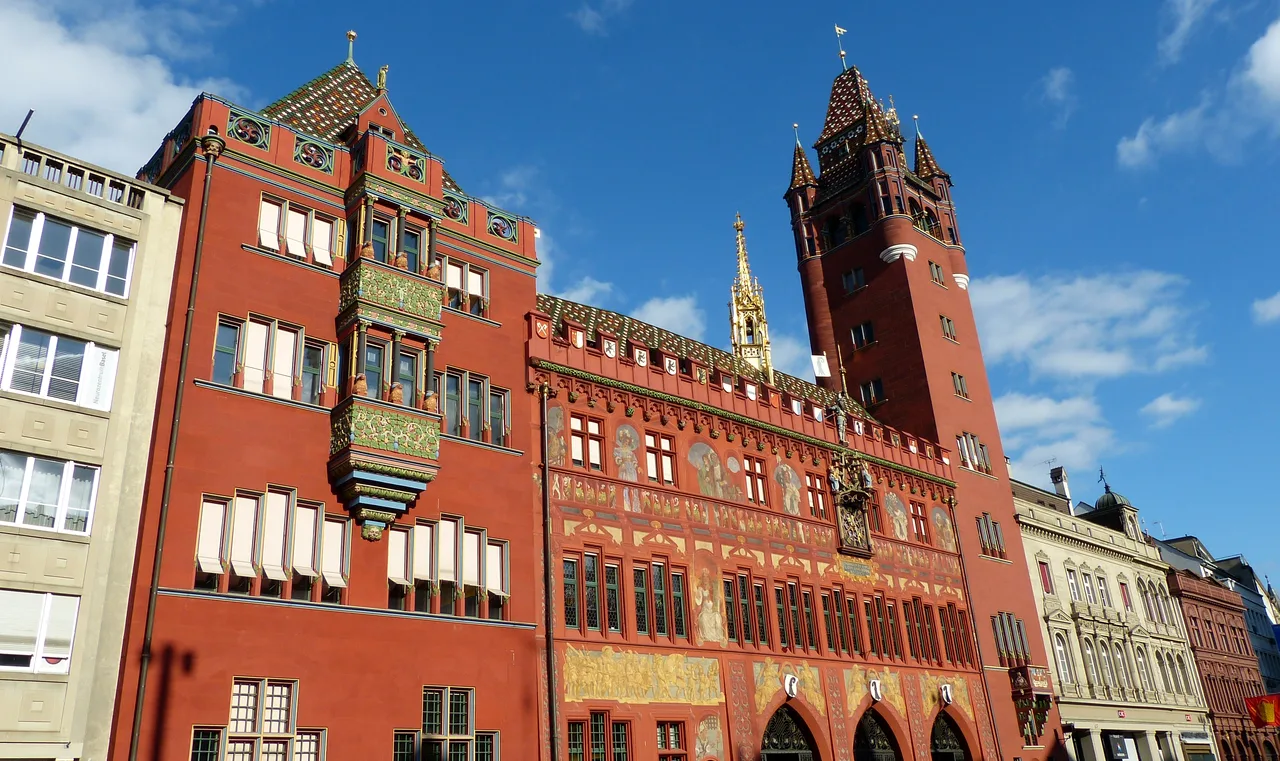
Marktplatz is the heart of Basel’s old town, with a fresh produce market on weekday mornings. Its symbol is the red Rathaus (town hall), built in the early 16th century and extended over later centuries. With its gilded façade, clock and tower, it is Basel’s most photographed building. Pass through the arched entrance into the frescoed inner courtyard; the staircase and murals are usually open to visitors, while the cantonal government and parliament still meet here. During Advent the traditional Basel Wish Book is displayed in the courtyard.
Don’t miss
- The red and gold façade of the Rathaus
- The frescoed courtyard and staircase
- The weekday morning market
- The Wish Book in Advent
Tips
- Check bs.ch and basel.com for guided Rathaus tours.
- Marktplatz is a tram junction; watch the tracks as you cross.
- Morning light shows the façade at its best.


Landmark
Basel Münster and the Pfalz terrace

Basel Münster is a Romanesque and Gothic cathedral of red sandstone on the hill above the Rhine; its coloured tile roof and twin towers define the skyline. Badly damaged in the earthquake of 1356, it was rebuilt in Gothic style. The humanist scholar Erasmus of Rotterdam is buried in the Münster. The Pfalz terrace behind the church is one of the best viewpoints over the Rhine and Kleinbasel, and the large cloisters (Kreuzgang) offer a quiet break. From one of the towers you can see the city, the Black Forest and the Vosges.
Don’t miss
- The red sandstone façade and the Gallus portal
- Erasmus’s tomb
- The Rhine view from the Pfalz terrace
- The cloisters (Kreuzgang)
Tips
- Check opening and tower hours on baslermuenster.ch; don’t walk around during services.
- The tower stairs are narrow and steep.
- The Pfalz is only a few steps from Münsterplatz.

Old town
Spalentor, Spalenberg and old town lanes

Spalentor, built in the late 14th century, is the most impressive of the three surviving gates of Basel’s city walls; with its coloured tile roof and sculptures it greets the road from Alsace. The steep Spalenberg leading down into the centre and the surrounding Heuberg, Nadelberg and Gemsberg lanes, with small shops, fountains and historic houses, are the most atmospheric part of the old town. Spalenberg is also home to the famous Christmas decoration shop Johann Wanner. Basel has more than 200 fountains, most with drinkable water.
Don’t miss
- The outer façade of Spalentor
- The steep Spalenberg
- Heuberg and Gemsberg
- Historic fountains
Tips
- Streets are steep and cobbled; wear comfortable shoes.
- Most fountains provide drinking water; don’t drink from those marked “kein Trinkwasser”.
- Shop hours may be shorter at weekends.

The Rhine
Mittlere Brücke, Fähri and swimming in the Rhine

The Mittlere Brücke is Basel’s oldest bridge crossing of the Rhine; the first bridge was built in the 13th century and today’s stone bridge in the early 20th century. The small chapel in the middle (Käppelijoch) was once the city’s place of judgement and execution. Four historic ferries (Fähri) shuttle between the banks with no engine, powered only by the current. In summer, swimming in the Rhine is Basel’s signature pastime: locals pack their clothes in a waterproof fish-shaped bag (Wickelfisch) and float downstream.
Don’t miss
- Mittlere Brücke and the Käppelijoch
- Crossing with the Münsterfähre
- Sunset on the riverside steps
- Watching Rhine swimmers in summer
Tips
- Ferry hours vary with season and weather.
- Rhine swimming takes experience: the current is strong and there is shipping traffic, so follow official warnings and only swim in summer conditions.
- At night the view of the Münster from the Mittlere Brücke is stunning.


Right bank
Kleinbasel and the Rheinpromenade

Kleinbasel is the district on the right bank of the Rhine, more relaxed and local than Grossbasel. The riverside promenade along the Oberer Rheinweg offers the finest view of the Münster and old town opposite. Claraplatz, Greifengasse and Rheingasse are the lively spots; at Christmas an alpine hut stands on Claraplatz and the Adväntsgass fills Rheingasse. Every January Kleinbasel celebrates Vogel Gryff, the traditional festival of its three honorary societies.
Don’t miss
- The Grossbasel view from the Oberer Rheinweg
- Claraplatz and Greifengasse
- Old houses on Rheingasse
Tips
- In the late afternoon the riverside steps are Basel’s meeting place.
- Badischer Bahnhof is a few minutes from Kleinbasel by tram.
- Check the date of Vogel Gryff with official sources.
Quiet corner
St. Alban-Tal and the paper mill

St. Alban-Tal is a small canal quarter east of the old town on the Rhine, where mills have turned since the Middle Ages. Old mill houses along the canal, surviving sections of the city walls and quiet lanes make for a walk far from the bustle. The Basel Paper Mill (Basler Papiermühle), in a historic mill, tells the story of papermaking, writing and printing; in the 15th and 16th centuries Basel was one of Europe’s major printing centres. From here you can walk along the river to the Münster.
Don’t miss
- Mill houses along the canal
- Remains of the city wall
- The Basel Paper Mill museum
Tips
- Check museum hours on museen-basel.ch.
- From St. Alban-Tal you can cross with the Münsterfähre and return via Kleinbasel.
- It is a quiet residential area; keep noise down.

Art
Kunstmuseum Basel

Kunstmuseum Basel traces its origins to the city’s purchase of the Amerbach collection in 1661, which makes it one of the oldest publicly owned art collections in the world. The collection spans works by the Holbein family and Konrad Witz, from the Middle Ages through the 19th century to modern art, including works by Picasso, Cézanne, Van Gogh and Paul Klee. The museum is spread over three buildings: the main building, the new building opened in 2016 and the Gegenwart for contemporary art.
Don’t miss
- The Holbein collection
- The modern art galleries
- The underground passage between the new and main buildings
Tips
- Check hours and temporary exhibitions on kunstmuseumbasel.ch; museums are usually closed on Mondays.
- Free entry may be available at certain times; check the conditions on the official site.
- On winter days the museum is the best refuge.
Moving art
Museum Tinguely and the Tinguely Fountain

Museum Tinguely shows the moving machine sculptures of the Swiss sculptor Jean Tinguely (1925–1991), a pioneer of kinetic art. The building, designed by Mario Botta and opened in 1996, stands in Solitude Park on the right bank of the Rhine; its glass gallery along the river offers views of the water. Some works start moving at the push of a button. In the city centre, on Theaterplatz, stands Tinguely’s fountain of water-spraying machine sculptures from 1977, also known as the “Fasnachtsbrunnen”.
Don’t miss
- Working machine sculptures
- The glass gallery over the Rhine
- The Tinguely Fountain on Theaterplatz
Tips
- Check hours on tinguely.ch.
- On cold winter days the fountain can freeze into a different look.
- The museum is a walk along the Kleinbasel bank.

Riehen
Fondation Beyeler

Fondation Beyeler is a modern art museum set in a park in Riehen, north-east of Basel. The building by Renzo Piano, opened in 1997, is famous for the natural light from its glass roof and its views onto the garden. Ernst and Hildy Beyeler’s collection ranges from classic modernism to contemporary art, including Monet’s water lilies and works by Cézanne, Picasso, Giacometti and Rothko. Its major temporary exhibitions draw visitors from all over the world.
Don’t miss
- The glass façade reflecting the lily pond
- The classic modern collection
- Major temporary exhibitions
- Berower Park
Tips
- Take the tram from the centre to Riehen; line details on bvb.ch.
- Popular exhibitions may need timed tickets; check fondationbeyeler.ch.
- Weekday mornings are quieter.
Across the border · Germany
Vitra Campus and Vitra Design Museum

Vitra Campus is an architecture and design site just north of Basel in the German town of Weil am Rhein. The Vitra Design Museum, designed by Frank Gehry and opened in 1989, is one of the world’s leading design museums; the campus also has buildings by Zaha Hadid, Tadao Ando, Herzog & de Meuron and Álvaro Siza. For anyone interested in the history of furniture and industrial design, it is one of the most special stops on a Basel trip.
Don’t miss
- Frank Gehry’s museum building
- VitraHaus
- Architecture tours
Tips
- You are crossing into Germany, so carry your passport.
- Reach it from Basel by bus or tram and a short walk; check current connections on bvb.ch and design-museum.de.
- Times and languages of architecture tours are on the official site.
Roman heritage
Augusta Raurica

Augusta Raurica, about 10 kilometres east of Basel in Augst and Kaiseraugst, is a Roman colony and considered one of the best-preserved Roman towns north of the Alps. Founded in the 1st century BC, it has a theatre, temple remains, a reconstructed Roman house and a museum that show everyday Roman life. The late Roman silver treasure on display in the museum is especially famous. The open-air site is large enough for a long walk.
Don’t miss
- The Roman theatre
- The Roman house (Römerhaus)
- The silver treasure
- The animal park and open-air site
Tips
- Reach it from Basel by regional train or bus; check times on sbb.ch.
- The open-air site involves a lot of walking; mind the short daylight in winter.
- Check museum hours on augustaraurica.ch.
Families
Zoo Basel (Zolli)

Zoo Basel, known locally as the “Zolli”, opened in 1874 and is Switzerland’s oldest zoo. It is within walking distance of Basel SBB, right next to the city centre. Elephants, gorillas, penguins and flamingos are among the favourites; the Etoscha house shows animals of Africa’s dry regions and the Vivarium the underwater world. Its tree-lined paths and indoor houses make it worth visiting in winter too.
Don’t miss
- The Vivarium (aquarium)
- The Etoscha house
- Penguins
- The ape house
Tips
- Check hours and current information on zoobasel.ch.
- In winter some animals are kept indoors.
- Basel SBB is a few minutes’ walk from the zoo.
1, 2 and 3-day itineraries + Christmas day
These itineraries are planned for walking and public transport. Basel’s old town is small: one day covers the essentials, two days add the museums and Kleinbasel, and three days include a cross-border or Roman excursion. Check church and museum hours on the official websites before you go.
1 day: Old town and the Rhine
- In the morning, see the Rathaus façade and its frescoed courtyard on Marktplatz.
- Climb Spalenberg to Spalentor and wander the Heuberg and Gemsberg lanes.
- In the afternoon visit the Münster and Erasmus’s tomb, and look out over the Rhine from the Pfalz terrace.
- Cross to Kleinbasel on the Münsterfähre and walk along the Oberer Rheinweg.
- End the evening with the Münster view from the Mittlere Brücke.
2 days: Museums and Kleinbasel
- Add a second morning at the Kunstmuseum Basel.
- In the afternoon see the Tinguely Fountain on Theaterplatz, then take the tram to the Fondation Beyeler in Riehen.
- On the way back, consider Museum Tinguely on the Rhine.
- In the evening stroll around Claraplatz and Rheingasse.
3 days: Across the border or Roman heritage
- On day three, go to Vitra Campus in Weil am Rhein or to Augusta Raurica in Augst.
- If you have time, visit the paper mill in St. Alban-Tal and walk along the river.
- Travelling with children? Spend the afternoon at Zoo Basel.
- For a longer trip, consider the Christmas markets of Freiburg or Colmar by train.
Christmas market day (26 November–23 December 2026)
- Start in the afternoon at the Christmas market on Barfüsserplatz and its 13-metre Christmas pyramid.
- Walk via Freie Strasse and Rittergasse to Münsterplatz and see the giant tree decorated by Johann Wanner.
- As darkness falls, watch the Rhine and the city lights from the Pfalz terrace; on weekdays between 16:00 and 18:00 consider the lit staircase of the Münster tower.
- Head down to Marktplatz and write a wish in the Wish Book in the Rathaus courtyard.
- Cross the Mittlere Brücke and end the day in Kleinbasel at the alpine hut on Claraplatz and the Adväntsgass on Rheingasse. The Wienachtsdorf on Theaterplatz is also open until late.
Basel and Swiss food
Basel food combines Switzerland’s cheese and pastry traditions with flavours from neighbouring Alsace and Baden. Below are local dishes to try, not restaurant recommendations.


Basler Läckerli
A hard, thin biscuit made with honey, almonds, candied orange and lemon peel and spices; Basel’s signature sweet for centuries.
Basler Brunsli
A Christmas biscuit of chocolate, almonds and sugar, usually without flour.
Raclette
Half-melted cheese scraped onto boiled potatoes and served with pickles and onions.
Fondue
Melted cheese for dipping bread into; the classic Swiss winter evening dish.
Basler Mehlsuppe
A thick soup of roasted flour, eaten especially at Fasnacht’s early-morning Morgestraich.
Zwiebel- and Käsewähe
Onion and cheese tarts; traditional Fasnacht fare.
Rösti
Swiss grated potatoes fried until crisp.
- Prices in Switzerland are above the European average; plan your budget ahead.
- Tap water and most fountain water are drinkable.
- Some dishes contain pork or alcohol; ask about the ingredients.
- Service is included in Swiss prices; a small tip is optional.
Culture and etiquette

- In Switzerland people greet with “Grüezi” or, often in Basel, “Hallo”; handshakes are usual in formal settings.
- Punctuality matters; trains and appointments start on time.
- Be quiet in churches and don’t walk around during services.
- Most shops are closed on Sundays, and noise rules are respected.
- Recycling rules are strict; separate your rubbish.
- During Basel Fasnacht, respect the costumed groups (Cliques) and the 04:00 Morgestraich; flash photography and torches are frowned upon during the Morgestraich.
- Cycle lanes are marked; pedestrians should not walk in them.
- Service is included in restaurant prices; rounding up the bill is a common courtesy.
Safety and health
- Basel is generally a safe city; watch out for pickpockets in Christmas market crowds, on trams and at stations.
- Keep valuables out of sight around Basel SBB and late at night.
- Swimming in the Rhine can be dangerous; the current is strong, so keep away from bridge piers and ships.
- In winter pavements and old town steps can be slippery; wear non-slip shoes.
- Trams are frequent and quiet; take care when crossing streets.
- In an emergency call 112, police 117, ambulance 144. Travel health insurance is mandatory for a Schengen visa; healthcare in Switzerland is expensive.
- Check official travel advice (e.g. the Turkish Ministry of Foreign Affairs or GOV.UK) before you go.
What drives your budget
This guide gives no prices; they change quickly with season, exchange rates and year. Switzerland is generally an expensive country. In Basel your budget depends mostly on:
Fair calendar
Demand and prices for accommodation rise sharply during Art Basel (June) and major fairs; choose your dates with the official fair calendar.
Where you stay
Staying in Basel brings public transport benefits; you can also compare options across the border in Weil am Rhein or Saint-Louis, though you may then not receive the Basel guest ticket.
BaselCard and guest ticket
The BaselCard and public transport ticket given to guests staying in Basel can provide transport and museum discounts; check what is covered on basel.com.
Museums
Basel has many museums; if you plan to see several, compare passes such as the Museums-PASS-Musées on official websites.
Food and drink
Market stalls, bakeries and supermarkets suit different budgets; restaurants are above the European average.
Currency
Prices are set in Swiss francs (CHF); even where euros are accepted, change may be given in francs at an unfavourable rate. Check card use and currency fees in advance.
Practical information
- Money: The Swiss franc (CHF) is used; card payment is very common, small stalls may need cash.
- Language: German is spoken; the local dialect is Baseldytsch. English is widely spoken at tourist sites.
- Plugs: Switzerland uses type J sockets; thick type F plugs from Türkiye won’t fit, so bring an adapter.
- Opening hours: Shops are closed on Sundays; many places close early on the afternoon of 24 December, and 25–26 December are public holidays.
- Internet: Switzerland is not in the EU; check roaming charges for Turkish and even EU lines in advance.
- Tourist information: Basel Tourismus has tourist information offices in the city centre; current details on basel.com.
- Accessibility: Some old town lanes are steep and stepped; most trams are low-floor.
- Photography: The best spots are the Münster from the Mittlere Brücke, the Rhine from the Pfalz terrace and the Grossbasel skyline from the Oberer Rheinweg.
Frequently asked questions
When is the Basel Christmas market open in 2026?
According to Basel Tourismus’s official page, it runs from 26 November to 23 December 2026, daily 11:00–20:30. On 23 December Barfüsserplatz closes at 20:00 and Münsterplatz at 18:00. Check the official page before you go.
Is there an entry fee for the Basel Christmas market?
No, entry to the Christmas market is free; food, drinks and some activities are paid separately.
What is the Basler Wienachtsdorf?
It is the new Christmas village opening on Theaterplatz in 2026. According to the official page it is open daily from 11:00 from 26 November 2026 to 3 January 2027 and has about 40 huts.
Do Turkish citizens need a visa for Basel?
Turkish citizens with an ordinary passport need a Schengen visa. Switzerland is in the Schengen area; entry rules are published on sem.admin.ch.
Can I pay with euros in Basel?
The official currency is the Swiss franc (CHF). Some places may accept euros but give change in francs; paying by card is the most practical option.
How do I get from the airport to the city?
Buses run from EuroAirport’s Swiss sector to Basel SBB station. Check the current timetable on euroairport.com and bvb.ch.
How many days should I spend in Basel?
One day for the old town and the Rhine, two days for the museums, and three days for an excursion such as Vitra or Augusta Raurica.
When is Basel Fasnacht?
Basel Fasnacht starts with the Morgestraich at 04:00 on the Monday after Ash Wednesday and lasts exactly 72 hours. It is on UNESCO’s intangible cultural heritage list. Check exact dates with official sources.
Which Christmas markets can I reach from Basel?
Freiburg (Germany) and Colmar (France), each about an hour by train, are popular choices; Strasbourg also works as a day trip. See the related Rota Atlası guides.
Are the plugs in Basel the same as in Türkiye?
No. Switzerland uses type J sockets; thick type F (Schuko) plugs from Türkiye don’t fit. Thin two-pin type C plugs usually fit, but an adapter is recommended.
Where to stay
Stay close to the areas where you will spend most time. The areas below are covered in detail in this guide; check public transport links in the getting-around section.
- GrossbaselMarktplatz and the red Rathaus
- LandmarkBasel Münster and the Pfalz terrace
- Old townSpalentor, Spalenberg and old town lanes
- The RhineMittlere Brücke, Fähri and swimming in the Rhine
- Right bankKleinbasel and the Rheinpromenade
- Quiet cornerSt. Alban-Tal and the paper mill
- ArtKunstmuseum Basel
- Moving artMuseum Tinguely and the Tinguely Fountain
- RiehenFondation Beyeler
- Across the border · GermanyVitra Campus and Vitra Design Museum
- Roman heritageAugusta Raurica
- FamiliesZoo Basel (Zolli)
Search hotels in these areas (Hotellook) ↗ (affiliate link)Search on Booking.com ↗
Affiliate disclosure: Hotellook, Aviasales, Klook, Airalo, Tiqets and DiscoverCars links are affiliate links; Rota Atlası may earn a commission on bookings made through them, at no extra cost to you. Official and in-guide links are not paid. Last updated: 1 November 2026 · Privacy and affiliates
Transport and connectivity
- Airport transferOptions from the airport to the city are in this guide’s getting there section.
- Mobile data (eSIM)Airalo eSIM ↗ (affiliate link)
- TrainsOfficial rail website ↗
- Car hireYou rarely need a car within the city; see getting around first. Compare car hire on DiscoverCars ↗ (affiliate link)
Affiliate disclosure: Hotellook, Aviasales, Klook, Airalo, Tiqets and DiscoverCars links are affiliate links; Rota Atlası may earn a commission on bookings made through them, at no extra cost to you. Official and in-guide links are not paid. Last updated: 1 November 2026 · Privacy and affiliates
Search flights (affiliate link)
Search flights from any airport in any country. Results open on Aviasales in a new tab, where you book.
This form is an affiliate link: Rota Atlası may earn a commission on bookings made via Aviasales (Travelpayouts), at no extra cost to you. Check price, baggage and terms on the booking site. Airport data: OurAirports (public domain).
Flights, hotels and tours
Find tours and tickets
- Basel Christmas Market
GetYourGuide ↗ · Klook ↗ (affiliate link) - Basel Minster
GetYourGuide ↗ · Klook ↗ (affiliate link) - Town hall (Rathaus)
GetYourGuide ↗ · Klook ↗ (affiliate link) - Mittlere Brücke
GetYourGuide ↗ · Klook ↗ (affiliate link)
Hotellook, Aviasales, Klook, Airalo and Tiqets links in this box are affiliate links (Travelpayouts): Rota Atlası may earn a commission on bookings made through them, at no extra cost to you. GetYourGuide links currently carry no affiliate code. Check prices and terms with the provider. Last updated: 1 November 2026 · Privacy and affiliates
Sources
- T.C. Dışişleri Bakanlığı · Türk vatandaşlarının tabi olduğu vize uygulamaları ↗
- Staatssekretariat für Migration SEM · Einreise (Visa) · sem.admin.ch (official) ↗
- European Union · Entry/Exit System (EES) ↗
- Basel Tourismus · basel.com (official) ↗
- Kanton Basel-Stadt · bs.ch (official) ↗
- Basler Münster (official) ↗
- Kunstmuseum Basel (official) ↗
- Museum Tinguely (official) ↗
- Fondation Beyeler (official) ↗
- Vitra Design Museum (official) ↗
- Augusta Raurica (official) ↗
- Zoo Basel (official) ↗
- Museen Basel · museen-basel.ch ↗
- Fasnachts-Comité Basel (official) ↗
- BVB · Basler Verkehrs-Betriebe ↗
- SBB · Schweizerische Bundesbahnen ↗
- EuroAirport Basel Mulhouse Freiburg ↗
- Deutsche Bahn ↗
- UNESCO Intangible Cultural Heritage · Basel Carnival ↗
- GOV.UK · Foreign travel advice · Switzerland ↗
- Basel Tourismus · Weihnachtsmarkt in Basel (official) ↗
- Basel Tourism · Christmas market in Basel (official) ↗
- Kanton Basel-Stadt · Basler Weihnachtsmarkt ↗
This page is for information only. Dates, times, entry rules and transport details can change; check the official sources above before travelling. No prices, flights, hotels or restaurants have been invented in this guide.
Photo credits
The photos on this page come from Wikimedia Commons and are used under the stated authors and licences (CC BY, CC BY-SA, CC0 or public domain). All sources page
- Basel and its illuminated riverbanks on the Rhine at night — Luca-bs · CC BY-SA 3.0 · Wikimedia Commons
- The Mittlere Brücke with the red sandstone Basel Minster behind — Oleksandr Dede · CC BY-SA 4.0 · Wikimedia Commons
- Basel Minster floodlit above the Rhine at night — --Wladyslaw Disk. · CC BY-SA 3.0 · Wikimedia Commons
- Münsterplatz in Basel with its historic buildings — JoachimKohler-HB · CC BY-SA 4.0 · Wikimedia Commons
- A souvenir mug from the Basel Christmas market — Valo139 · CC BY-SA 4.0 · Wikimedia Commons
- Illuminated stalls at the Basel Christmas market during Advent — Pierre Likissas · CC BY 3.0 · Wikimedia Commons
- The large Christmas tree on Münsterplatz in Basel — Valo139 · CC BY-SA 4.0 · Wikimedia Commons
- Christmas ornaments at Johann Wanner’s Christmas shop in Basel — Benutzer:Basilica · CC BY-SA 3.0 · Wikimedia Commons
- Barfüsserplatz and the Barfüsserkirche in Basel — Tilman2007 · CC BY-SA 4.0 · Wikimedia Commons
- Claraplatz in Kleinbasel with a tram — Zwantzig · CC BY-SA 4.0 · Wikimedia Commons
- A green BVB tram in Basel — Olaf Baumann · CC BY-SA 3.0 · Wikimedia Commons
- Basler Läckerli, the spiced honey biscuit of Basel — Velq1958 · CC BY 3.0 · Wikimedia Commons
- Basler Brunsli, chocolate-almond Christmas biscuits — Fanny Schertzer · CC BY-SA 3.0 · Wikimedia Commons
- Swiss raclette scraped from a melted cheese wheel — Ka23 13 · CC BY-SA 4.0 · Wikimedia Commons
- A Fasnacht sign advertising Mehlsuppe, onion and cheese tart — Sparrow (2019) · CC0 · Wikimedia Commons
- A Basel Fasnacht cortège on the Mittlere Brücke — Sparrow (2019) · CC0 · Wikimedia Commons
- Basel Marktplatz and the red Rathaus — Michielverbeek · CC BY-SA 4.0 · Wikimedia Commons
- The frescoed courtyard of Basel City Hall — Raimond Spekking · CC BY-SA 4.0 · Wikimedia Commons
- Details of the red façade of Basel City Hall — Armineaghayan · CC BY-SA 4.0 · Wikimedia Commons
- Basel Minster and the old town seen from the Rhine — Falk2 · CC BY-SA 4.0 · Wikimedia Commons
- The great cloister of Basel Minster — JoachimKohler-HB · CC BY-SA 4.0 · Wikimedia Commons
- The Spalentor, Basel’s medieval city gate — Tilman2007 · CC BY-SA 4.0 · Wikimedia Commons
- The steep, narrow historic lane of Spalenberg — Gerd Eichmann · CC BY-SA 4.0 · Wikimedia Commons
- The Mittlere Brücke over the Rhine in Basel — WikiEuropian · CC BY-SA 4.0 · Wikimedia Commons
- The motorless Münster ferry “Leu” on the Rhine — W. Bulach · CC BY-SA 4.0 · Wikimedia Commons
- A swimmer floating down the Rhine with a Wickelfisch bag — Fridolin freudenfett (Peter Kuley) · CC BY-SA 3.0 · Wikimedia Commons
- The Kleinbasel riverbank and its houses — M. Schwendener · CC BY-SA 4.0 · Wikimedia Commons
- Old mill houses by the canal in St. Alban-Tal — Tilman2007 · CC BY-SA 4.0 · Wikimedia Commons
- A quiet corner of St. Alban-Tal — Tilman2007 · CC BY-SA 4.0 · Wikimedia Commons
- The entrance of Kunstmuseum Basel — Ank Kumar · CC BY-SA 4.0 · Wikimedia Commons
- The Museum Tinguely building on the Rhine — Bolsingk · CC BY-SA 4.0 · Wikimedia Commons
- The Tinguely Fountain (Fasnachtsbrunnen) on Theaterplatz — Anthro-copyleft (talk) · Public domain · Wikimedia Commons
- The Fondation Beyeler museum in Riehen — Bic · CC BY-SA 3.0 · Wikimedia Commons
- The Vitra Design Museum building in Weil am Rhein — Wladyslaw · CC BY-SA 3.0 · Wikimedia Commons
- The Roman theatre at Augusta Raurica — Carole Raddato from FRANKFURT, Germany · CC BY-SA 2.0 · Wikimedia Commons
- A planted enclosure at Zoo Basel — Christian-wittmann-1964 · CC0 · Wikimedia Commons
Geneva → · Konstanz → · Kaysersberg → · Montreux → · Mulhouse → · Freiburg → · Colmar → · Strasbourg → · Zurich → · Heidelberg → · Christmas markets