

Freiburg im Breisgau is a university city of around 230,000 people in south-west Germany, in the state of Baden-Württemberg, on the western edge of the Black Forest (Schwarzwald) and the rim of the Rhine valley. Founded as a market town by the Dukes of Zähringen in 1120, it was part of Habsburg Further Austria (Vorderösterreich) for centuries before passing to Baden in the early 19th century. The Freiburg Minster and its finely carved tower rising above the old town, the red Historisches Kaufhaus on Münsterplatz, the little water channels called Bächle that run along the streets and the medieval gates of Martinstor and Schwabentor are the city’s symbols. Thanks to the Albert-Ludwigs-Universität, founded in 1457, Freiburg has a young and lively atmosphere, and with eco-projects such as the Vauban district it is also known as a “Green City”. Its closeness to Basel, Colmar and Strasbourg and easy access to Black Forest stops like Schauinsland and Titisee make it an ideal base for exploring the region. From late November to Christmas, the Freiburg Christmas Market fills the old town squares with lights and, according to the official website, more than 140 stalls.
Content update: 28 October 2026 · Christmas market dates checked against the official website weihnachtsmarkt.freiburg.de
Freiburg at a Glance
- Country / state
- Germany · Baden-Württemberg, Breisgau region
- Population
- Around 230,000; a major university city
- Language
- German (local Alemannic dialect); English is used at tourist sites
- Currency
- Euro (EUR); cards are widely accepted, cash is useful at small stalls
- Time zone
- Central European Time (CET, UTC+1); UTC+2 in summer. Two hours behind Türkiye in winter
- Known for
- The Minster and its tower, the Bächle channels, the Black Forest, a sunny climate, the university, green urbanism
- Landmarks
- Freiburg Minster, Historisches Kaufhaus, Martinstor, Schwabentor, Altes Rathaus, Schlossberg
- Nearby
- The Black Forest (Schauinsland, Feldberg, Titisee), Kaiserstuhl vineyards, Basel, Colmar and Strasbourg
- Christmas market
- Freiburg Christmas Market: 19 November–23 December 2026, more than 140 stalls according to the official website
- Airport
- EuroAirport Basel-Mulhouse-Freiburg (on French soil); rail links from Frankfurt, Stuttgart and Zurich airports
- Electricity
- 230 V, 50 Hz; the same type C/F sockets as in Türkiye, no adapter needed
- Emergency
- 112 (ambulance/fire), 110 (police)
Freiburg in Pictures
The colourful façades of Münsterplatz, the view from the Schlossberg over the old town and the Minster tower, and the Black Forest hills above the Wiehre district: Freiburg in three pictures.


Freiburg Christmas Market 2026
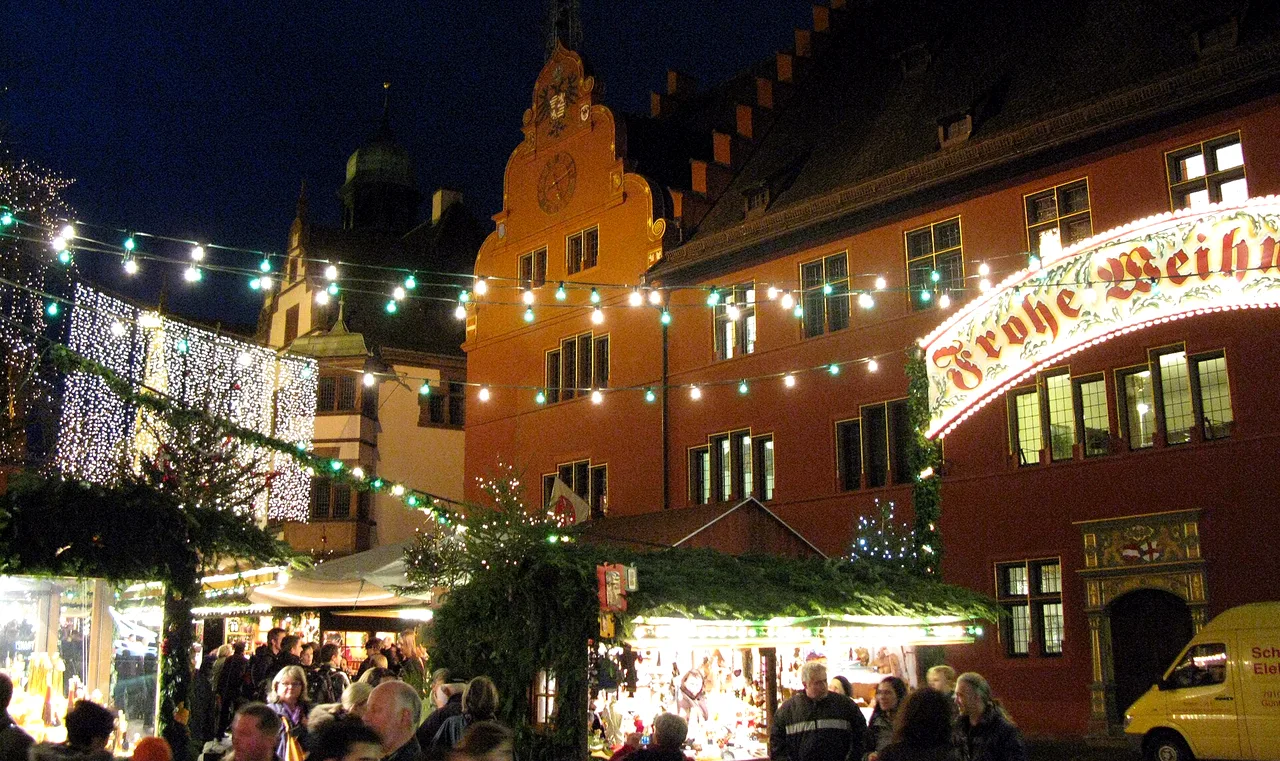
The Freiburg Christmas Market starts at Rathausplatz in the heart of the old town and spreads to squares within walking distance of each other: Kartoffelmarkt, Unterlindenplatz, Franziskanerstrasse, Turmstrasse, the area around the Predigertor and the Rotteckring. According to the official website the market has been held since 1973, and a Christkindlesmarkt is known to have existed on Münsterplatz in the 19th century; today’s market continues this tradition. In 2026 it is open from 19 November to 23 December, and its more than 140 stalls offer Black Forest crafts, wooden toys, candles, ceramics, Glühwein, roasted almonds and regional specialities. The stalls on Rathausplatz, in front of the historic Old and New Town Halls and the Martinskirche, are the most photogenic part of the market in the evening lights. The information below was checked on the official website on 28 October 2026.


| Market / area | Location | 2026 dates | Note |
|---|---|---|---|
| Freiburg Christmas Market (main area) | Rathausplatz, in front of the Old and New Town Halls | 19 November–23 December 2026 | Hours published on the official website: weekdays and Saturdays 10:00–20:30, Sundays 11:30–19:30; opening day 19 November 14:00–20:30; 23 December 10:00–19:30. Closed on 22 November (Totensonntag). Check the 2026 hours |
| Kartoffelmarkt | Small square in the north of the old town | 19 November–23 December 2026 | A quieter corner with food and drink stalls and crafts |
| Unterlindenplatz | Square around the large lime tree | 19 November–23 December 2026 | An intimate section between the tree and historic façades |
| Franziskanerstrasse and Turmstrasse | Streets linking Rathausplatz with the nearby squares | 19 November–23 December 2026 | A walking axis lined with stalls |
| Rotteckring and Predigertor | Western edge of the old town, around the Predigerturm | 19 November–23 December 2026 | A newer, roomier part of the market close to tram stops |
| Entrance gates and lights | Market entrances and old-town streets | During the market | Illuminated entrance gates and decorations in the evening; best after dark |
What to try
Glühwein
Spiced mulled wine, including versions made from Baden wines. Alcohol-free Kinderpunsch is also sold.
Lange Rote
Freiburg’s long, thin red sausage, served in a roll with onions.
Flammkuchen
Thin dough topped with cream, onions and usually bacon; a speciality shared by Baden and Alsace.
Roasted almonds
Sugar-roasted almonds (gebrannte Mandeln), a German market classic.
Lebkuchen and Stollen
Spiced biscuits and Christmas cake, also sold in gift packs.
Black Forest crafts
Wooden toys, cuckoo-clock-themed ornaments and candles are popular gifts.
Freiburg Christmas Market tips
- The market areas are close together in the old town; plan a walk from Rathausplatz via Franziskanerstrasse to Unterlinden and Kartoffelmarkt, then on to the Rotteckring.
- Saturday evenings are very busy; weekday mornings are calmer.
- The market is closed on 22 November (Totensonntag); plan your visit accordingly.
- Glühwein mugs may carry a deposit (Pfand); return the mug or keep it as a souvenir.
- The daily Münstermarkt on Münsterplatz is separate from the Christmas market and is usually held in the mornings except Sundays; you can visit both on the same day.
- Watch out for the Bächle channels in the streets; in crowds and after dark it is easy to step into one.
- The Christmas markets of Basel, Colmar and Strasbourg are a short train ride away; you can plan an Upper Rhine Christmas tour.
- Dates and hours may change; check the official website again before your visit.
Check before you go: Freiburger Weihnachtsmarkt · weihnachtsmarkt.freiburg.de (official, FWTM) ↗ · FWTM · visit.freiburg.de ↗ · Stadt Freiburg · freiburg.de ↗
Dates were checked on the official website weihnachtsmarkt.freiburg.de (FWTM) on 28 October 2026. Opening hours, closed days and programme details may change; for current information consult the official website and the Freiburg tourist office.
When to Go
Freiburg is known as one of Germany’s sunniest and warmest cities. From April to October, pavement cafés, the Münstermarkt and Black Forest hikes are at their best; autumn brings the grape harvest and the season of Zwiebelkuchen with new wine. From late November to 23 December it is Christmas market time. In winter there may be snow on the higher Black Forest slopes, and the Feldberg area hosts winter sports.
| Month | City sightseeing | Christmas market | Black Forest and trips | Crowds |
|---|---|---|---|---|
| January | Difficult | No market | Difficult | Quiet |
| February | Difficult | No market | Good | Quiet |
| March | Good | No market | Good | Moderate |
| April | Very good | No market | Very good | Moderate |
| May | Very good | No market | Very good | Moderate |
| June | Very good | No market | Very good | Busy |
| July | Very good | No market | Very good | Busy |
| August | Very good | No market | Very good | Busy |
| September | Very good | No market | Very good | Moderate |
| October | Very good | No market | Very good | Moderate |
| November | Good | Market season | Good | Moderate |
| December | Good | Market season | Good | Busy |
- In December temperatures in Freiburg are usually a little above freezing; the city does not get snow every year, but snow is common on heights such as Schauinsland and the Feldberg.
- The Christmas market is open from 19 November to 23 December 2026; it is closed on 22 November, and December Saturdays are the busiest days.
- Black Forest cable cars and mountain roads depend on the weather; check the Schauinslandbahn’s maintenance periods and operating hours on its official website.
- In autumn, wine festivals are held in the Kaiserstuhl and Markgräflerland vineyards; check dates on local official websites.
- In December it gets dark around 16:30; save the late afternoon for the lights of the Minster and Rathausplatz.
- In summer Münsterplatz and the Schlossberg are busy; early hours are better for photos.
Visas and Entry (Turkish citizens)
Turkish citizens with an ordinary (burgundy) passport need a Schengen visa for tourist travel to Germany. Different rules apply to special, service and diplomatic passports; check the current situation with the Turkish Ministry of Foreign Affairs.
You apply to the mission of the country that is your main destination. If most of your trip is in Germany, the German missions in Türkiye are responsible; current information is at tuerkei.diplo.de.
Freiburg is very close to the Swiss (Basel) and French (Alsace) borders. Switzerland and France are also in the Schengen area, but apply according to the country where you will stay longest, and carry your passport as there may be checks at border crossings.
EuroAirport is on French soil and has separate Swiss and French exits; pay attention to which exit you use when travelling on to Germany.
Under the EU Entry/Exit System (EES), which is being introduced gradually, your biometric data (fingerprints and facial image) may be recorded on first entry. Details are on the official EU website.
Visa fees, processing times and document lists may change. No fees are given on this page; rely only on official sources before applying.
Check before you go: T.C. Dışişleri Bakanlığı · Türk vatandaşlarının tabi olduğu vize uygulamaları ↗ · tuerkei.diplo.de ↗ · EES · europa.eu ↗ · Rota Atlası visa guide (TR)
Travel medical insurance
Check the official visa and entry sources above first: they state whether travel medical insurance is required and the minimum cover. Compare any policy’s cover amount, validity dates and countries covered with the official requirement.
Rota Atlası does not currently offer an insurance partnership; there are no paid links in this section. Last updated: 1 November 2026
Getting to Freiburg
- By air: The nearest airport is EuroAirport Basel-Mulhouse-Freiburg, on French soil near Basel; there is a bus link from the airport to Freiburg. Frankfurt, Stuttgart and Zurich airports can also be reached by train. Check current flights only on the official websites of airlines and airports.
- By train: Freiburg Hauptbahnhof is on the Frankfurt–Karlsruhe–Basel high-speed line, with direct ICE services from Frankfurt, Cologne, Karlsruhe and Basel. Times and tickets are on bahn.de.
- From Basel: Regional and fast trains run to Freiburg from Basel Badischer Bahnhof or Basel SBB; combine the two cities with our Basel guide.
- By long-distance bus: Long-distance coaches stop in Freiburg; check operators and times through official channels.
- By car: Freiburg is close to the A5 motorway. The old town is largely pedestrianised; use park-and-ride and car parks.
Getting Around

On foot
Münsterplatz, Rathausplatz, Martinstor, Schwabentor and the Bächle streets are within walking distance; the old town is compact and flat, while the Schlossberg is steep.
Tram
VAG Freiburg’s tram network links Hauptbahnhof, Bertoldsbrunnen, Vauban and the city’s districts. Lines and fares are on vag-freiburg.de.
Tickets
Single, day and group tickets are sold at machines and in official apps; the regional RVF fares and the nationwide Deutschlandticket are valid on local transport, check conditions on the official websites.
KONUS guest card
Guests staying at participating accommodation in the Black Forest may receive the KONUS card, which allows use of regional public transport; ask your accommodation and the official Black Forest tourism website.
Bicycle
Freiburg is one of Germany’s most bike-friendly cities, with cycle paths along the Dreisam river. Watch out for cobblestones in the old town.
Regional trains and buses
Titisee (Höllentalbahn), Staufen, Breisach and the Kaiserstuhl are reached by regional trains; the Schauinslandbahn valley station by tram and bus. Timetables are on bahn.de and rvf.de.
Things to See
Freiburg’s sights range from the Minster to the Historisches Kaufhaus, from the Bächle channels to the medieval gates and from the Augustinermuseum to the Schlossberg. The last three sections introduce Black Forest and South Baden stops: Schauinsland, Titisee and the Feldberg, and Staufen, Breisach and the Kaiserstuhl, all easy day trips by public transport.
Landmark
Freiburg Minster

Freiburg Minster (Unserer Lieben Frau) is the city’s cathedral, begun in Romanesque style around 1200 and completed in Gothic style. Its 116-metre west tower is famous for its spire of openwork tracery carved like lace in stone; the historian Jacob Burckhardt is said to have called it “the most beautiful tower in Christendom”. The choir was completed in the early 16th century, and the high altar (Hochaltar) by Hans Baldung Grien became its most precious work. In the 1944 bombing, when much of the old town was destroyed, the Minster survived. Climbing the tower (when open) gives views over the old town, the Schlossberg and the Black Forest. The many gargoyles and figures on the exterior turn a walk around the building into a discovery of its own.
Don’t miss
- The openwork spire of the west tower
- Hans Baldung Grien’s high altar
- Medieval stained-glass windows
- The tower climb (when open)
Tips
- Check visiting and tower hours on freiburgermuenster.info; do not walk around during services.
- The tower stairs are narrow and steep.
- The Minster is under constant restoration; scaffolding may affect the view.


Münsterplatz
Münsterplatz and the Historisches Kaufhaus

Münsterplatz, the square surrounding the cathedral, is the liveliest in the city. On its south side rises the Historisches Kaufhaus, built in the early 16th century, with its red façade, oriel turrets and colourful roof tiles; the statues on its façade depict Habsburg rulers, a reminder of the city’s Habsburg past. Today the Kaufhaus is used for receptions and events. At the Münstermarkt, held on the square every morning except Sundays, regional farmers sell fruit, vegetables, flowers and local produce; tasting Freiburg’s long red sausage, the Lange Rote, here is a tradition. Around the square are buildings such as the Baroque Wentzingerhaus (now the city history museum) and the Kornhaus.
Don’t miss
- The red façade of the Historisches Kaufhaus
- The morning Münstermarkt
- The city history museum in the Wentzingerhaus
Tips
- The Münstermarkt is usually not held on Sundays; check times on official websites.
- The interior of the Kaufhaus can usually only be seen during events.
- The square has its best light in the early morning.
Old town
Rathausplatz and the Old and New Town Halls

Rathausplatz, framed by chestnut trees, is one of the most elegant squares in the old town. The red-fronted Altes Rathaus (Old Town Hall) now houses the tourist information centre; the neighbouring Neues Rathaus (New Town Hall) was formed by joining two Renaissance houses. On the edge of the square stands the Martinskirche, the church of the former Franciscan friary, and the fountain on the square bears a statue of Berthold Schwarz, the monk who, according to legend, discovered gunpowder. At Christmas Rathausplatz is the centre of the market; for the rest of the year it is a quiet stop with café terraces.
Don’t miss
- The façade of the Altes Rathaus
- The plain Gothic interior of the Martinskirche
- The Berthold Schwarz fountain
Tips
- Maps and tour information are available at the tourist information centre; check its hours on visit.freiburg.de.
- The square is very busy during the Christmas season.
- The square is a few minutes’ walk from Münsterplatz.
Middle Ages
Martinstor and Schwabentor

Two large city gates survive from Freiburg’s medieval walls. The Martinstor rises on the west of the old town on the main street, Kaiser-Joseph-Strasse, and dates from the 13th century; it was heightened in the early 20th century, and trams still pass beneath it. The Schwabentor stands on the east of the old town at the start of the road to the Black Forest; it takes its name from the road to Swabia and is known for the paintings on its façade. The area around the Schwabentor is where the paths up the Schlossberg and the Oberlinden square begin.
Don’t miss
- The Martinstor with trams passing beneath
- The Schwabentor and Oberlinden square
- The climb from the Schwabentor to the Schlossberg
Tips
- The Martinstor area is the main shopping street; watch out for traffic and trams.
- Oberlinden, near the Schwabentor, is home to one of the city’s oldest inns.
- You can cross the old town on foot diagonally between the two gates.

The city’s signature
Bächle, Fischerau and Gerberau

The Bächle are the little water channels, fed by the Dreisam river, that run along the edges of the streets in Freiburg’s old town. Used since the Middle Ages for firefighting, watering animals and cleaning the streets, they have become the city’s signature. According to local lore, anyone who accidentally steps into a Bächle will marry someone from Freiburg. The Fischerau and Gerberau lanes along the Gewerbekanal, once home to fishermen and tanners, are the most romantic corners of the old town with their small houses and workshops facing the water. Look out also for the pebble mosaics in the pavements; in front of many shops there are mosaic patterns showing the trade.
Don’t miss
- A walk along the Bächle
- The waterside houses of Fischerau and Gerberau
- The pebble mosaics in the pavements
Tips
- The channels are shallow but easy to step into; walk carefully, especially in the evening.
- In summer children float little boats in the channels, a city tradition.
- Fischerau and Gerberau are right next to the Augustinermuseum.


Museum
Augustinermuseum

The Augustinermuseum, housed in a former Augustinian friary, is the city’s most important art museum. Its collection includes medieval sculpture, original stone figures and gargoyles moved from the Minster for protection, paintings by Upper Rhine masters such as Hans Baldung Grien and Matthias Grünewald, medieval stained glass and 19th-century painting. The former church hall, reorganised in a modern renovation, offers the chance to see the Minster sculptures at eye level.
Don’t miss
- The Minster sculptures in the former friary church
- Paintings by Upper Rhine masters
- Medieval stained glass
Tips
- Check hours and tickets on the Freiburg city museums website (freiburg.de/museen); museums are usually closed on Mondays.
- The museum is a few steps from Fischerau and Gerberau.
- Ask about combined tickets for the city museums.
Views
Schlossberg

The Schlossberg is the wooded hill rising just east of the old town, once crowned by a large fortress. The fortress was strengthened by the French engineer Vauban in the late 17th century and demolished in the 18th century; today the hill has ruins, walking paths and viewpoints. The Schlossbergbahn funicular from the Stadtgarten makes the ascent easy; those who prefer to walk can climb by paths from near the Schwabentor. From the Schlossbergturm lookout tower at the top you can see the Minster, the old town, the Black Forest and, on clear days, the Vosges.
Don’t miss
- Viewpoints overlooking the Minster
- The Schlossbergturm lookout tower
- A walk among the fortress ruins
Tips
- Check the Schlossbergbahn’s operating hours in official sources; it may not run during maintenance.
- Paths can be slippery after rain; wear comfortable shoes.
- The sunset view is especially beautiful.
Museum and park
Colombipark and Colombischlössle

The Colombischlössle is a neo-Gothic villa built in the mid-19th century in Colombipark on the western edge of the old town. Today it houses the Archaeological Museum, displaying regional finds from the Stone Age through the Celtic and Roman periods to the Middle Ages. The small park around the villa is a pleasant stop when walking from the Hauptbahnhof to the old town.
Don’t miss
- The villa’s neo-Gothic entrance hall
- Celtic and Roman finds
- A short walk in Colombipark
Tips
- Check hours on freiburg.de/museen.
- It is close to the Hauptbahnhof and the Rotteckring section of the Christmas market.
- The exhibitions are accessible for families with children.
Green City
The Vauban district

Vauban, in the south of Freiburg, is a world-famous sustainable district built in the 1990s and 2000s on the site of a former French military barracks. Streets with reduced car traffic, a tram link, energy-efficient buildings, shared gardens and architect Rolf Disch’s solar-powered Solarsiedlung have become symbols of Freiburg’s “Green City” identity. The district makes an interesting half-day trip for anyone interested in urban planning and climate.
Don’t miss
- The colourful houses of the Solarsiedlung
- Car-free streets and shared gardens
- A short tram ride to Vauban
Tips
- This is a residential area; do not enter private gardens and keep noise down.
- It is reached by tram from the city centre; check lines on vag-freiburg.de.
- Ask the tourist office about guided Green City tours.
Black Forest
Schauinsland and the Schauinslandbahn

Schauinsland is a Black Forest mountain rising to about 1,284 metres south-east of Freiburg and is known as the city’s “home mountain”. The Schauinslandbahn cable car, opened in 1930, climbs a long route from the valley to the summit; from the lookout tower at the top, on clear days, you can see the Black Forest hills, the Rhine valley, the Vosges and sometimes the Alps. The mountain has hiking trails, a show mine on its old silver mines and sledging in winter.
Don’t miss
- The cable-car ride to the summit
- The lookout tower at the summit
- Black Forest hiking trails
Tips
- Check operating hours and maintenance periods on schauinslandbahn.de.
- The valley station is reached from the city centre by tram and bus.
- It can be much colder at the summit than in the city; dress in layers.
Day trip
Titisee and the Feldberg

Titisee is a lake of glacial origin high in the Black Forest, reached from Freiburg by the Höllentalbahn, which winds through the Höllental valley. The lakeshore has a walking path, boat trips and Black Forest souvenir shops. The nearby Feldberg, at about 1,493 metres, is the highest peak in the Black Forest and the highest mountain in Germany outside the Alps; it is a hiking area in summer and a ski area in winter. On clear days the summit offers a wide panorama reaching as far as the Alps.
Don’t miss
- A walk along the shore of Titisee
- The valley ride on the Höllentalbahn
- The Feldberg summit and its views
Tips
- Train times are on bahn.de; there are bus connections to the Feldberg via Titisee.
- In winter mountain roads may be snowy; check weather and road conditions in official sources.
- The Hochschwarzwald Tourismus website gives current event and lift information.

Day trip
Staufen, Breisach and the Kaiserstuhl

The small towns around Freiburg are ideal for getting to know South Baden on half- or full-day trips. Staufen im Breisgau is known for its colourful houses and the castle ruin above the town; according to legend, Doctor Faust died in the town’s Gasthaus zum Löwen in the 16th century. On the Rhine at the French border, St. Stephansmünster rises above Breisach; the church holds Martin Schongauer’s Last Judgement frescoes and a carved wooden altar. The Kaiserstuhl, with its volcanic hills and terraced vineyards, is one of Germany’s warmest regions and is famous for Baden wines.
Don’t miss
- Staufen’s old town and castle ruin
- St. Stephansmünster in Breisach
- The terraced vineyards of the Kaiserstuhl
Tips
- Staufen, Breisach and the Kaiserstuhl villages are reached by regional train; timetables are on bahn.de and rvf.de.
- From Breisach you can cross the Rhine to Neuf-Brisach in France and on to Colmar.
- Do not enter private land when walking the vineyard paths.


1, 2, 3-Day Itineraries + Christmas Day
These itineraries are planned for walking and public transport. Freiburg’s old town is compact: one day is enough for the main stops, two days add museums and the Schlossberg, and three days add the Black Forest or neighbouring cities such as Basel or Colmar. Check church and museum hours on official websites in advance.
1 day: The Minster and the Bächle
- In the morning, browse the Münstermarkt on Münsterplatz and see inside the Minster; climb the tower if it is open.
- Pass the Historisches Kaufhaus to Rathausplatz and see the Old Town Hall and the Martinskirche.
- Walk along the Bächle to the Martinstor, then visit the Augustinermuseum.
- In the afternoon, wander the waterside lanes of Fischerau and Gerberau.
- At sunset, climb the Schlossberg via the Schwabentor and look down on the Minster.
2 days: Museums, Green City and Schauinsland
- On the second morning, take the tram to the Vauban district.
- Before noon, ride the Schauinslandbahn to the Schauinsland summit for Black Forest views.
- Back in the city, visit Colombipark and the Archaeological Museum.
- In the evening, try Baden cuisine in the Wiehre district or the old town.
3 days: The Black Forest or neighbouring cities
- On the third day, take the Höllentalbahn to Titisee and continue to the Feldberg if you wish.
- Alternatively, make a South Baden tour combining Staufen and Breisach.
- Or take the train to Basel, or to Colmar via Breisach, to see their Christmas markets.
- For a longer trip, add Strasbourg and Gengenbach to build an Upper Rhine Christmas route.
Christmas market day (19 November–23 December 2026, closed 22 November)
- Start in the morning with the Münstermarkt and the Minster.
- At midday, move to the main market area on Rathausplatz.
- Walk via Franziskanerstrasse to Unterlindenplatz and Kartoffelmarkt.
- As darkness falls, reach the illuminated section at the Rotteckring and Predigertor.
- End the day back at Rathausplatz with Glühwein and a Lange Rote.
Baden and Black Forest Food
Influenced by its French and Swiss neighbours, Baden cuisine is considered one of Germany’s richest regional cuisines; Black Forest ham and cakes, Flammkuchen shared with Alsace and the region’s wines take centre stage. Below are local specialities, not restaurant recommendations.


Schwarzwälder Kirschtorte
Black Forest gateau: chocolate sponge, cream, sour cherries and Kirschwasser (cherry brandy); it may contain alcohol.
Schäufele
Cured and smoked pork shoulder; a classic Baden dish usually served with potato salad.
Flammkuchen
Thin dough topped with cream, onions and bacon; a speciality shared by Baden and Alsace, with vegetarian versions too.
Zwiebelkuchen
Onion tart, eaten in autumn with new wine (Neuer Süßer).
Schwarzwälder Schinken
Black Forest ham; cured and smoked, served thinly sliced.
Lange Rote
Freiburg’s long red sausage sold at the Münstermarkt; in a roll with onions.
Badische Schneckensüpple
Baden-style cream-based snail soup; a regional starter.
Baden wines
Wines such as Spätburgunder and Gutedel from the Kaiserstuhl and Markgräflerland are the region’s pride.
- Many Black Forest dishes contain pork; ask about beef or chicken alternatives.
- Kirschtorte usually contains Kirschwasser; ask if you avoid alcohol.
- Tap water is drinkable.
- Tipping in restaurants usually means rounding up or about 5–10 per cent.
Culture and Etiquette

- In Germany people greet with “Guten Tag” or “Hallo”; in Baden you may also hear “Grüß Gott”.
- Punctuality matters; trains and appointments start on time.
- Be quiet in churches and do not walk around during services.
- Most shops are closed on Sundays and quiet hours are observed.
- Waste separation is strict; bottles carry a deposit (Pfand).
- Freiburg is a cycling city; cycle paths are marked, and pedestrians should not walk on them.
- Freiburg is a student city; respect the quiet around university buildings and libraries.
- When paying in a restaurant it is common to state the total including the tip.
- The Alemannic dialect is spoken in the region; standard German and, in most places, English are understood.
- Freiburg is known for its green lifestyle; use the recycling bins and reusable cup systems.
Safety and Health
- Freiburg is generally safe; watch out for pickpockets in the Christmas market crowds, on trams and around the Hauptbahnhof.
- Watch the Bächle channels and cobblestones; twisted ankles can happen, especially after dark and on wet surfaces.
- Trams are quiet; watch the tracks around Bertoldsbrunnen and Kaiser-Joseph-Strasse.
- Weather in the Black Forest can change quickly; on mountain trips take suitable clothing, water and current weather information.
- There may be security measures at the Christmas market; follow staff directions.
- In an emergency call 112, or 110 for the police. Travel health insurance is mandatory for the Schengen visa.
- Check official travel advice (e.g. the Turkish Ministry of Foreign Affairs or GOV.UK) before travelling.
What Your Budget Depends On
This guide does not give prices; they change with the season and the year. In Freiburg your budget depends on:
Time of travel
Demand for accommodation rises on Christmas market weekends, during university events and trade fairs; weekdays may be cheaper.
Where you stay
In the old town everything is within walking distance; the Hauptbahnhof area is practical for train trips. Staying in the Black Forest may give you the KONUS card benefit.
Transport tickets
RVF day tickets and the nationwide Deutschlandticket affect the cost of trips to Titisee, Staufen and Breisach; check conditions on official websites.
Museums and cable car
Check combined tickets for the city museums and current fares for the Schauinslandbahn on official websites; the tourist office may also offer city card options.
Food and drink
Sausage stalls at the Münstermarkt and bakeries are budget options; restaurants cost more.
Day trips
If you go to Basel, bear in mind that prices in Switzerland are usually higher and the currency is the Swiss franc.
Free experiences
A Bächle walk, Münsterplatz, the Schlossberg paths, Vauban and the Christmas market lights are free; entry to the Minster is usually free, though the tower may be charged.
Practical Information
- Money: The euro is used; cards are widely accepted, cash is useful at Christmas market stalls. If you go to Basel, Switzerland uses the Swiss franc, and cards are accepted in many places.
- Language: German is spoken; English is common at tourist sites and around the university.
- Plugs: 230 V, type C/F; the same as in Türkiye.
- Opening hours: Shops are closed on Sundays; many places close early on the afternoon of 24 December, and 25–26 December are public holidays.
- Internet: EU roaming rules do not apply to Turkish lines; check your operator’s international packages. Switzerland is outside the EU, so check separately.
- Tourist information: The Freiburg tourist information centre is in the Old Town Hall on Rathausplatz; current information is on visit.freiburg.de.
- Accessibility: The old town is largely flat, but the Bächle and cobblestones need care; the Schlossberg and the Minster tower involve stairs and slopes.
- Photography: The best spots are the Schlossberg viewing terraces, the south corner of Münsterplatz and the Fischerau waterside.
- University: The Albert-Ludwigs-Universität, founded in 1457, is one of Germany’s oldest universities; the historic Kollegiengebäude I is on the western edge of the old town.
- History: The old town was heavily damaged in the air raid of 27 November 1944; after the war it was rebuilt faithfully to its historic street pattern.
Frequently Asked Questions
When is the Freiburg Christmas Market 2026 open?
According to the official website, the Freiburg Christmas Market is open from 19 November to 23 December 2026; it is closed on 22 November (Totensonntag). Check the daily hours on the official website before you go.
Is there an entry fee for the Freiburg Christmas Market?
No, entry is free; food, drinks and some activities cost extra.
Where is the Freiburg Christmas Market held?
The main area is on Rathausplatz; according to the official website the market also spreads to Kartoffelmarkt, Unterlindenplatz, Franziskanerstrasse, Turmstrasse, the Predigertor and the Rotteckring.
Do Turkish citizens need a visa for Freiburg?
With an ordinary passport, a Schengen visa is required. Current information is at tuerkei.diplo.de.
How do I get to Freiburg?
The nearest airport is EuroAirport Basel-Mulhouse-Freiburg, and Freiburg Hauptbahnhof is on the Frankfurt–Basel high-speed line. Travellers from Türkiye usually arrive via Basel, Frankfurt or Stuttgart.
How many days should I spend in Freiburg?
One day for the old town, two days for museums and Schauinsland, and three days for a trip to Titisee, Staufen or Basel/Colmar.
What are the Bächle?
They are the little water channels that run along the streets of Freiburg’s old town; they have been part of the city since the Middle Ages, and according to local lore anyone who accidentally steps in will marry someone from Freiburg.
Which Christmas markets can be reached from Freiburg?
Basel, Colmar, Strasbourg and Gengenbach are Christmas markets easily reached by train; see Rota Atlası’s Basel, Colmar, Strasbourg and Gengenbach guides.
How do I get up Schauinsland?
Take a tram and bus from the city to the valley station and ride the Schauinslandbahn cable car to the summit; check operating hours on the official website.
What is Black Forest gateau?
Schwarzwälder Kirschtorte: the region’s famous cake made with chocolate sponge, cream, sour cherries and cherry brandy.
Where to stay
Stay close to the areas where you will spend most time. The areas below are covered in detail in this guide; check public transport links in the getting-around section.
- LandmarkFreiburg Minster
- MünsterplatzMünsterplatz and the Historisches Kaufhaus
- Old townRathausplatz and the Old and New Town Halls
- Middle AgesMartinstor and Schwabentor
- The city’s signatureBächle, Fischerau and Gerberau
- MuseumAugustinermuseum
- ViewsSchlossberg
- Museum and parkColombipark and Colombischlössle
- Green CityThe Vauban district
- Black ForestSchauinsland and the Schauinslandbahn
Search hotels in these areas (Hotellook) ↗ (affiliate link)Search on Booking.com ↗
Affiliate disclosure: Hotellook, Aviasales, Klook, Airalo, Tiqets and DiscoverCars links are affiliate links; Rota Atlası may earn a commission on bookings made through them, at no extra cost to you. Official and in-guide links are not paid. Last updated: 1 November 2026 · Privacy and affiliates
Transport and connectivity
- Airport transferOptions from the airport to the city are in this guide’s getting there section.
- Mobile data (eSIM)Airalo eSIM ↗ (affiliate link)
- TrainsOfficial rail website ↗
- Car hireYou rarely need a car within the city; see getting around first. Compare car hire on DiscoverCars ↗ (affiliate link)
Affiliate disclosure: Hotellook, Aviasales, Klook, Airalo, Tiqets and DiscoverCars links are affiliate links; Rota Atlası may earn a commission on bookings made through them, at no extra cost to you. Official and in-guide links are not paid. Last updated: 1 November 2026 · Privacy and affiliates
Search flights (affiliate link)
Search flights from any airport in any country. Results open on Aviasales in a new tab, where you book.
This form is an affiliate link: Rota Atlası may earn a commission on bookings made via Aviasales (Travelpayouts), at no extra cost to you. Check price, baggage and terms on the booking site. Airport data: OurAirports (public domain).
Flights, hotels and tours
Find tours and tickets
- Freiburg Christmas Market
GetYourGuide ↗ · Klook ↗ (affiliate link) - Colombipark photo point
GetYourGuide ↗ · Klook ↗ (affiliate link) - Freiburg Minster
GetYourGuide ↗ · Klook ↗ (affiliate link) - Bächle
GetYourGuide ↗ · Klook ↗ (affiliate link)
Hotellook, Aviasales, Klook, Airalo and Tiqets links in this box are affiliate links (Travelpayouts): Rota Atlası may earn a commission on bookings made through them, at no extra cost to you. GetYourGuide links currently carry no affiliate code. Check prices and terms with the provider. Last updated: 1 November 2026 · Privacy and affiliates
Sources
- T.C. Dışişleri Bakanlığı · Türk vatandaşlarının tabi olduğu vize uygulamaları ↗
- Auswärtiges Amt · Deutsche Vertretungen in der Türkei (Visa) ↗
- European Union · Entry/Exit System (EES) ↗
- FWTM · visit.freiburg.de (official tourism) ↗
- Stadt Freiburg im Breisgau · freiburg.de (official) ↗
- Freiburger Münster · Münsterbauverein (official) ↗
- Städtische Museen Freiburg (official) ↗
- Schauinslandbahn (official) ↗
- Albert-Ludwigs-Universität Freiburg (official) ↗
- VAG Freiburg · Freiburger Verkehrs AG ↗
- RVF · Regio-Verkehrsverbund Freiburg ↗
- Hochschwarzwald Tourismus (official) ↗
- Stadt Titisee-Neustadt (official) ↗
- Stadt Staufen im Breisgau (official) ↗
- Stadt Breisach am Rhein (official) ↗
- EuroAirport Basel Mulhouse Freiburg ↗
- Deutsche Bahn ↗
- GOV.UK · Foreign travel advice · Germany ↗
- Freiburger Weihnachtsmarkt · weihnachtsmarkt.freiburg.de (official, FWTM) ↗
- FWTM · visit.freiburg.de ↗
- Stadt Freiburg · freiburg.de ↗
This page is for information only. Dates, hours, entry rules and transport information may change; check the official sources above before travelling. No prices, flights, hotels or restaurants have been invented in this guide.
Photo credits
The photos on this page are from Wikimedia Commons and are used under the stated authors and licences (CC BY, CC BY-SA, CC0 or public domain). Page with all sources
- The Christmas market on Freiburg’s Rathausplatz seen through an arch — Andreas Schwarzkopf · CC BY-SA 3.0 · Wikimedia Commons
- Freiburg’s Münsterplatz and the Historisches Kaufhaus — Dietmar Rabich · CC BY-SA 4.0 · Wikimedia Commons
- Freiburg Minster and old-town roofs seen from the Schlossberg — Zairon · CC BY-SA 3.0 · Wikimedia Commons
- Minster, Schwabentor and Schlossberg seen from the Wiehre district — Andreas Schwarzkopf · CC BY-SA 3.0 · Wikimedia Commons
- The Christmas market on Unterlindenplatz — Andreas Schwarzkopf · CC BY-SA 3.0 · Wikimedia Commons
- The Christmas market on Franziskanerstraße by St Martin’s — Andreas Schwarzkopf · CC BY-SA 3.0 · Wikimedia Commons
- Christmas market stalls on the Kartoffelmarkt — Andreas Schwarzkopf · CC BY-SA 3.0 · Wikimedia Commons
- The Christmas market on the Rotteckring with the Predigerturm — Andreas Schwarzkopf · CC BY-SA 4.0 · Wikimedia Commons
- The illuminated entrance arch of the Freiburg Christmas market — Wikiolo · CC BY 4.0 · Wikimedia Commons
- Christmas market crowds on Freiburg’s Rathausplatz — Andreas Schwarzkopf · CC BY-SA 3.0 · Wikimedia Commons
- Freiburg trams at the VAG-Zentrum — Grauer Elefant · Public domain · Wikimedia Commons
- A slice of Black Forest gateau — Mikelo · CC BY-SA 2.0 · Wikimedia Commons
- A thin-crust Flammkuchen — Arnaud 25 · CC BY-SA 4.0 · Wikimedia Commons
- Schäufele served with potato dumplings — Burkhard Mücke · CC BY-SA 4.0 · Wikimedia Commons
- A freshly baked onion tart (Zwiebelkuchen) — Shisma · CC BY 4.0 · Wikimedia Commons
- Kollegiengebäude I of the University of Freiburg — Giftzwerg 88 · CC BY-SA 3.0 · Wikimedia Commons
- The lace-like Gothic tower of Freiburg Minster — Dietmar Rabich · CC BY-SA 4.0 · Wikimedia Commons
- The high altar by Hans Baldung Grien in Freiburg Minster — Uoaei1 · CC BY-SA 4.0 · Wikimedia Commons
- Freiburg Minster framed by trees from the Schlossberg — Andreas Schwarzkopf · CC BY-SA 4.0 · Wikimedia Commons
- The red Historisches Kaufhaus on Münsterplatz — JoachimKohler-HB · CC BY-SA 4.0 · Wikimedia Commons
- The Old Town Hall on Freiburg’s Rathausplatz — Dietmar Rabich · CC BY-SA 4.0 · Wikimedia Commons
- Martinstor, Freiburg’s medieval city gate — Rikki Mitterer · CC BY-SA 4.0 · Wikimedia Commons
- The Schwabentor and the historic houses before it — Giftzwerg 88 · CC BY-SA 3.0 · Wikimedia Commons
- Old houses along the canal in the Fischerau — Giftzwerg 88 · CC BY-SA 3.0 · Wikimedia Commons
- Colourful historic houses in the Gerberau — user:joergens.mi · CC BY-SA 3.0 · Wikimedia Commons
- A Bächle, one of Freiburg’s small street channels — user:Joergens.mi · CC BY-SA 3.0 · Wikimedia Commons
- The former monastery building of the Augustinermuseum — Daderot · CC0 · Wikimedia Commons
- Freiburg and vineyards seen from the Schlossberg — Giftzwerg 88 · CC BY-SA 4.0 · Wikimedia Commons
- The Colombischlössle in Colombipark — Giftzwerg 88 · CC BY-SA 3.0 · Wikimedia Commons
- A green-façade building in the Vauban district — Benoit Soubeyran · CC BY-SA 4.0 · Wikimedia Commons
- The Schauinslandbahn cable car and the Black Forest — Michael Schmalenstroer · CC BY-SA 3.0 · Wikimedia Commons
- Black Forest hills towards the Feldberg seen from Schauinsland — Jörg Braukmann · CC BY-SA 4.0 · Wikimedia Commons
- A general view of Lake Titisee — DobryBrat · CC BY-SA 4.0 · Wikimedia Commons
- A street of colourful houses in Staufen im Breisgau — W. Bulach · CC BY-SA 4.0 · Wikimedia Commons
- St Stephen’s Minster above Breisach am Rhein — W. Bulach · CC BY-SA 4.0 · Wikimedia Commons
- Vineyards near Ihringen in the Kaiserstuhl — Philipp Guttmann · CC BY-SA 4.0 · Wikimedia Commons
Konstanz → · Kaysersberg → · Mulhouse → · Basel → · Colmar → · Strasbourg → · Gengenbach → · Stuttgart → · Christmas markets