

Colmar is a town of about 67,000 people in north-eastern France, in the Haut-Rhin department of Alsace, between the foothills of the Vosges and the Rhine plain. It lies about 65 km south of Strasbourg and less than an hour from Basel in Switzerland and Freiburg in Germany. Having changed hands between French and German rule several times, the town still blends both cultures in its architecture, its cooking and the local Alsatian dialect. The old town came through the Second World War largely undamaged and is one of the best-preserved historic centres in Europe, with half-timbered houses, Renaissance mansions and pastel façades lining the Lauch canal. The sculptor Frédéric Auguste Bartholdi, creator of the Statue of Liberty, was born here in 1834, and the Unterlinden Museum houses Matthias Grünewald’s famous Isenheim Altarpiece. Colmar is also known as the “capital of Alsace wines” and sits right in the middle of the Alsace Wine Route. From late November to late December six separate Christmas markets open in the centre, and with its lights and decorations the whole old town turns into a Christmas card.
Content update: 28 October 2026 · Market dates checked against the official noel-colmar.com website
Colmar at a glance
- Country / region
- France, Grand Est region, Alsace, Haut-Rhin department
- Population
- About 67,000; with its surroundings, the third-largest town in Alsace
- Language
- French; older people also speak Alsatian (Elsässisch); English and German are common in tourist areas
- Currency
- Euro (EUR)
- Time zone
- Central European Time (CET, UTC+1); UTC+2 in summer. Two hours behind Türkiye in winter
- River and canals
- The Lauch and its branches; Petite Venise and the Tanners’ Quarter sit on the water
- Landmarks
- Petite Venise, Maison Pfister, Maison des Têtes, Koïfhus, Saint-Martin Church, Unterlinden Museum
- Christmas markets
- Six markets: Dominicains, Ancienne Douane, Koïfhus (indoor), Jeanne d’Arc, Petite Venise and the gourmet village; 2026 dates below
- UNESCO
- None in the town itself; about 65 km north, Strasbourg’s Grande-Île and Neustadt are on the UNESCO list
- Airports
- EuroAirport Basel-Mulhouse-Freiburg about 60 km south; Strasbourg Airport about 70 km north
- Electricity
- 230 V, 50 Hz; type E/F sockets, the same as in Türkiye
- Emergency
- 112 (general), 15 (SAMU, medical), 17 (police), 18 (fire)
Colmar in pictures
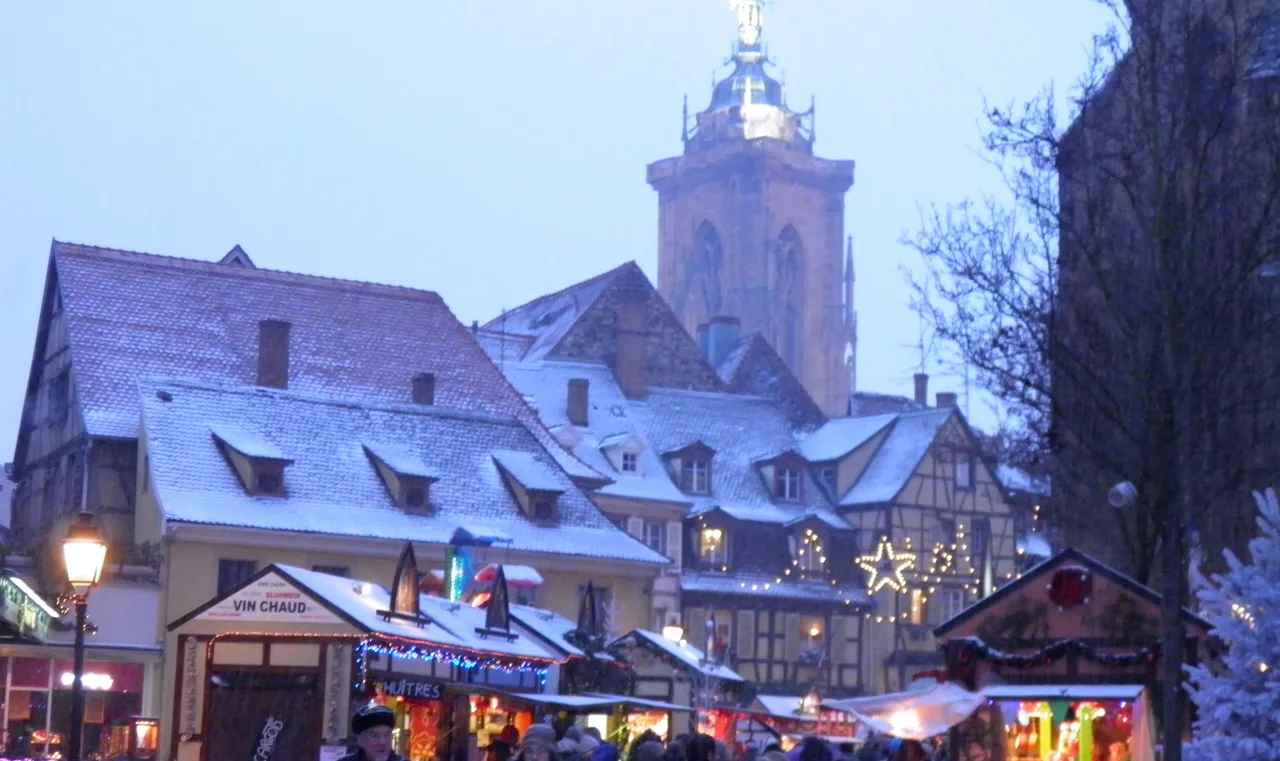
Petite Venise from the Rue des Écoles bridge, glowing façades on a Christmas evening and half-timbered houses dressed for the holidays: Colmar in three pictures.


Colmar Christmas markets 2026
Rather than filling a single square, the Colmar Christmas Market (Marché de Noël de Colmar) is spread across six separate markets in different corners of the old town, which makes it one of the most atmospheric in Europe. According to the official website, the market on Place des Dominicains, in the shadow of the Gothic Dominican church, is the largest with around 60 chalets, while the market on Place de l’Ancienne Douane gathers around 50 chalets around Bartholdi’s Schwendi Fountain. The indoor market inside the historic Koïfhus customs house is devoted to crafts; Place Jeanne d’Arc hosts a regional-produce (terroir) market, and Petite Venise a market for children. The gourmet village (village gourmand) on Rue de la Montagne Verte and its Ferris wheel stay open after the main market closes, into the New Year, and the Noël Féérique area on Place Rapp follows the same extended dates. After dark the old town’s historic buildings, churches and canals are specially illuminated, and much of the centre becomes pedestrian-only during the market. The dates below were checked against the official source on 28 October 2026.


| Market / event | Location | 2026 dates | Note |
|---|---|---|---|
| Colmar Christmas Market (six markets) | Place des Dominicains, Place de l’Ancienne Douane, Koïfhus, Place Jeanne d’Arc, Petite Venise | 23 November–29 December 2026 | Per the official website, Mon–Thu 11:00–19:00, Fri–Sun 10:00–20:00; 24 Dec 11:00–17:00, 25–26 Dec 10:00–20:00. Free entry |
| Gourmet village and Ferris wheel | Rue de la Montagne Verte and surroundings | 23 November 2026–3 January 2027 | Per the official website, open daily 11:00–22:00 until 3 January after the main market closes; until 17:00 on 31 December |
| Noël Féérique | Place Rapp | 23 November 2026–3 January 2027 | Per the official website, same extended dates as the gourmet village; illuminated area for families and children |
| Eguisheim Christmas market | Eguisheim village (about 7 km) | 27 November–30 December 2026 | According to the list of nearby markets on the official Colmar Christmas website; check times with the village |
| Kaysersberg and Riquewihr Christmas markets | Kaysersberg (about 10 km), Riquewihr (about 13 km) | 27 November–20 December 2026 | Per the official list, Kaysersberg Friday–Sunday only, Riquewihr daily; Turckheim market 27 November–30 December |
| Ribeauvillé medieval Christmas market | Ribeauvillé | 5–6 and 12–13 December 2026 | Per the official list, two weekends only; costumed shows and medieval-themed stalls |
What to taste at the market
Vin chaud
Spiced mulled wine; in Alsace it is often made with white wine. Hot apple or grape juice is available for non-drinkers.
Bredele
Alsace’s Christmas biscuits – buttery, aniseed, almond or cinnamon, in dozens of varieties, also baked at home during Advent.
Pain d’épices
Alsatian gingerbread made with honey and spices; decorated hearts and figures make popular gifts.
Kougelhopf
A yeasted ring cake with raisins and almonds, baked in its distinctive mould.
Bretzel and tarte flambée
Warm pretzels and Flammekueche, the thin-crust Alsatian “pizza” – the market’s savoury snacks.
Meisenthal glass baubles
Blown-glass Christmas baubles from Meisenthal in the northern Vosges, listed on the official website among the market’s specialities.
Tips for the Colmar Christmas market
- The six markets are at most a ten-minute walk apart; a route from Dominicains to Ancienne Douane, Koïfhus and down to Petite Venise works well.
- Weekends, especially Saturday afternoons, are very crowded; come on a weekday if you can.
- The lights are at their best after dark – in December it gets dark around 16:45.
- Much of the old town is closed to traffic during the market; if driving, use the car parks and shuttles at the edge of town.
- The surrounding villages can be reached by the official “Navettes de Noël” shuttle buses; check routes and times on the official website.
- Hot drinks are usually served in souvenir mugs with a deposit; keep the mug or return it.
- Accommodation fills up fast at Christmas; if Colmar is full, consider nearby towns with good rail links.
- Dates and times can change; check noel-colmar.com again before you go.
Check before you go: Marché de Noël de Colmar · noel-colmar.com (official) ↗ · Colmar Tourisme · Noël à Colmar ↗ · Ville de Colmar · colmar.fr ↗
Dates and times were checked on 28 October 2026 against noel-colmar.com, the official website of the Colmar Christmas Market. Village market dates are taken from the list on the same website; check opening hours with each village. Organisers may change the programme.
When to go
Colmar is lovely in every season. April to October is ideal for vineyards, flower-decked balconies and canal boats; September and October are harvest time. Late November to late December is the Christmas market season and the busiest time of year.
| Month | City walks | Christmas market | Vineyards and villages | Crowds |
|---|---|---|---|---|
| January | Challenging | No market | Challenging | Quiet |
| February | Challenging | No market | Challenging | Quiet |
| March | Good | No market | Good | Quiet |
| April | Very good | No market | Good | Moderate |
| May | Very good | No market | Very good | Moderate |
| June | Very good | No market | Very good | Moderate |
| July | Very good | No market | Very good | Busy |
| August | Very good | No market | Very good | Busy |
| September | Very good | No market | Very good | Moderate |
| October | Very good | No market | Very good | Busy |
| November | Good | Market season | Challenging | Busy |
| December | Good | Market season | Challenging | Busy |
- Lying in the rain shadow of the Vosges, Colmar is known as one of the driest towns in France, but winters are cold, with fog and frost in the mornings. Pack warm layers.
- Weekends during the market, especially the first three weekends of December, are the busiest; weekdays are more relaxed.
- The villages on the Alsace Wine Route are lively in summer and autumn; the grape harvest is usually in September and October.
- January to March is quiet but grey; some boat trips and seasonal events do not run then.
- 25–26 December and 1 January are public holidays; shops close and museum hours may change. In Alsace, 26 December is a local public holiday.
Visas and entry (Turkish citizens)
Turkish citizens holding ordinary (burgundy) passports need a Schengen visa for tourist entry to France. Different rules apply to special, service and diplomatic passports; check the current situation on the website of the Turkish Ministry of Foreign Affairs.
Under Schengen rules you apply to the country of your main stay. If your trip centres on Colmar and France, apply to France; the procedure, required documents and appointment channels are published on France’s official visa website, france-visas.gouv.fr.
Colmar is very close to the German and Swiss borders. If you plan to cross to Basel or Freiburg or use the Basel-Mulhouse airport, be clear about where you will spend most time; you can travel within the area on a valid Schengen visa, but internal border checks can occur, so carry your passport.
Under the EU Entry/Exit System (EES), gradually introduced at the external borders, your biometric data (fingerprints and facial image) may be recorded on first entry. Details are on the official EU page.
Visa fees, processing times and document lists can change. No fees are quoted on this page; rely only on official sources before applying.
Check before you go: T.C. Dışişleri Bakanlığı · Türk vatandaşlarının tabi olduğu vize uygulamaları ↗ · france-visas.gouv.fr ↗ · EES · europa.eu ↗ · Rota Atlası visa guide (TR)
Travel medical insurance
Check the official visa and entry sources above first: they state whether travel medical insurance is required and the minimum cover. Compare any policy’s cover amount, validity dates and countries covered with the official requirement.
Rota Atlası does not currently offer an insurance partnership; there are no paid links in this section. Last updated: 1 November 2026
Getting to Colmar
- By air: The nearest major airport is EuroAirport Basel-Mulhouse-Freiburg, on French soil and serving France, Switzerland and Germany, about 60 km south of Colmar. From the airport a bus runs to Saint-Louis station, from where regional trains go to Colmar. Strasbourg Airport (about 70 km north) has a rail shuttle to Strasbourg station. Connections vary by season; check current flights only on the official airline and airport websites.
- By train: Colmar station is on the Strasbourg–Mulhouse–Basel line; regional TER trains reach it from Strasbourg in about 30 minutes. There are TGV connections from Paris Gare de l’Est. Times and tickets are on SNCF Connect.
- From Germany: Freiburg im Breisgau is about 50 km from Colmar, with bus and regional connections via Breisach. Check current routes on official transport websites.
- By car: Colmar is on the A35 motorway. During the Christmas market much of the old town is closed to traffic; use car parks and shuttles at the edge of town.
- The historic station building dates from 1907 and reflects the German period; it is a 15–20 minute walk to the old town.
Getting around

On foot
Colmar’s old town is small; Petite Venise, Ancienne Douane, Saint-Martin, Unterlinden and all Christmas markets are within walking distance. Walking is the best way to explore.
Buses
Local and regional buses are run by the Trace network. Current routes and timetables are on trace.fr.
Christmas shuttles
During the market, official Christmas shuttles (Navettes de Noël) run from Colmar to nearby villages such as Eguisheim, Kaysersberg and Riquewihr; check routes and times on noel-colmar.com.
Train
Regional TER trains link Colmar with Strasbourg, Sélestat, Mulhouse and Basel; Sélestat is the transfer point for services to Haut-Kœnigsbourg.
Cycling
Colmar and the Wine Route are good for cycling, with signed routes among the vineyards. Watch the weather in winter.
Canal boats
Small boats tour the Lauch in Petite Venise; winter service may be limited, check on site.
Places to see
Colmar’s sights range from the half-timbered old town and canal-side Petite Venise to the Unterlinden Museum with its world-famous altarpiece and the Alsace Wine Route villages just outside town. The twelve sections below cover the town and the most important day trips.
Historic heart
Old town: Maison Pfister, Maison des Têtes and Rue des Marchands

Colmar’s old town is an open-air museum where Gothic, Renaissance and half-timbered architecture mingle in narrow lanes. Maison Pfister, on the corner of Rue des Marchands and Rue Mercière, was built for a hatter in 1537; with its wooden gallery, corner oriel and exterior frescoes it is the town’s most photographed building. The Maison des Têtes (House of Heads) on Rue des Têtes dates from 1609 and takes its name from the more than one hundred carved faces and masks on its façade. Merchants’ houses line Rue des Marchands, which is also home to the Bartholdi Museum.
Must see
- Maison Pfister’s gallery and frescoes
- The sculpted façade of the Maison des Têtes
- Rue des Marchands and Rue Mercière
- Mansions around Place de l’École and Grand-Rue
Tips
- Photograph Maison Pfister early in the morning before the crowds.
- Most buildings are private and can only be seen from outside.
- At Christmas add an evening walk to see the decorated façades.


By the canal
Petite Venise and Quai de la Poissonnerie

Petite Venise (Little Venice) is the stretch where the Lauch flows through the south of the old town; pastel half-timbered houses leaning over the water, flower-decked balconies and little bridges make it Colmar’s postcard view. Once home to market gardeners and fishermen, it includes the Quai de la Poissonnerie (Fishmongers’ Quay) with the houses of the old fishermen’s guild. The Rue Turenne and Rue de la Poissonnerie bridges are the best viewpoints. At Christmas the canal is illuminated and the children’s Christmas market is held here.
Must see
- The view from the Rue Turenne bridge
- The fishermen’s houses on Quai de la Poissonnerie
- The Rue des Écoles bridge
- The illuminated canal at Christmas
Tips
- Small boat tours run seasonally; check on site in winter.
- Sunset and blue hour are the best times for photos.
- The 19th-century covered market (Marché couvert) next door is a good stop for local produce; check its hours.

Old customs house
Koïfhus and Place de l’Ancienne Douane

The Koïfhus, built in 1480, is the old customs house where goods entering the town were taxed; its colourful glazed-tile roof makes it one of Colmar’s best-known buildings. In the Middle Ages the town council also met here. In front of it, Place de l’Ancienne Douane is graced by Bartholdi’s Schwendi Fountain of 1898, depicting the imperial commander Lazarus von Schwendi, who according to legend brought the Tokay grape to Alsace. At Christmas the square hosts a market of around 50 chalets, with an indoor crafts market inside the Koïfhus.
Must see
- The colourful tiled roof of the Koïfhus
- Bartholdi’s Schwendi Fountain
- The indoor crafts market in the Koïfhus (at Christmas)
Tips
- The interior of the Koïfhus is usually open for exhibitions and events.
- The square is one of the busiest spots on Christmas market evenings.
- Petite Venise is a few minutes’ walk away.

Gothic church
Collegiate Church of Saint-Martin

The Collegiate Church of Saint-Martin, built in the 13th and 14th centuries, rises in the middle of the old town. Locals often call it the “cathedral”, although it is not a bishop’s seat. Built of reddish Vosges sandstone, it is notable for its south portal and patterned tiled roof. The surrounding Place de la Cathédrale is ringed by half-timbered houses, among them the 16th-century Maison Adolph, one of the oldest buildings in town.
Must see
- The sculptures on the south portal
- The Gothic interior and stained glass
- Historic houses on Place de la Cathédrale
Tips
- It is a place of worship; do not walk around during services.
- The church is illuminated at Christmas; include it in an evening walk.
- Visiting hours vary; check on site.
Schongauer’s masterpiece
Dominican Church and Place des Dominicains

The Dominican Church (Église des Dominicains) has the tall, austere Gothic aisles of a 13th-century mendicant order church. Inside hangs “The Virgin in the Rose Bower” (La Vierge au buisson de roses), painted in 1473 by the Colmar painter and engraver Martin Schongauer and an important example of late Gothic painting. Place des Dominicains in front of the church hosts Colmar’s largest Christmas market, with around 60 chalets.
Must see
- Schongauer’s “Virgin in the Rose Bower”
- The medieval stained glass
- The Place des Dominicains Christmas market
Tips
- Opening hours vary by season and entry may be charged; check official sources.
- Visit in the morning before the market crowds.
- The Unterlinden Museum is a few minutes away; combine both in one morning.
Art
Unterlinden Museum and the Isenheim Altarpiece

The Unterlinden Museum occupies a convent of Dominican nuns founded in the 13th century and is one of the most visited museums in provincial France. Its star is the Isenheim Altarpiece, made between 1512 and 1516 by Matthias Grünewald and the sculptor Niclaus of Haguenau for the Antonine monastery at Isenheim; the dramatic Crucifixion makes it one of the masterpieces of European art. In 2015 the museum was extended with a new wing by the Swiss architects Herzog & de Meuron; the cloister, medieval sculpture and modern art sections are also worth seeing.
Must see
- The Isenheim Altarpiece
- The Gothic cloister
- Medieval and Renaissance paintings
- The Herzog & de Meuron wing and modern art
Tips
- The museum is usually closed one day a week; check hours and tickets on musee-unterlinden.com.
- Go at opening time to see the altarpiece in peace.
- Allow at least two hours.

Creator of the Statue of Liberty
Bartholdi Museum

Frédéric Auguste Bartholdi was born in 1834 in this house on Rue des Marchands, now a museum devoted to the sculptor’s life and work. On display are models and drawings for the Statue of Liberty in New York, maquettes of his other works such as the Lion of Belfort, and his personal belongings. Colmar has many works by Bartholdi, including the Schwendi Fountain, the Roesselmann Fountain and the Admiral Bruat Monument on Place Rapp. At a roundabout at the northern entrance to town stands a replica of the Statue of Liberty, about 12 metres tall, erected to mark the centenary of Bartholdi’s death.
Must see
- Models and drawings of the Statue of Liberty
- The rooms of the house where he was born
- Bartholdi’s fountains and monuments around town
Tips
- The museum usually closes one day a week and for a period in winter; check musee-bartholdi.fr.
- The replica statue is at a roundabout outside the centre, best seen by car or bus.
- Combine it with the other houses on Rue des Marchands.
Craftsmen’s quarter
Tanners’ Quarter and Krutenau

The Quartier des Tanneurs (Tanners’ Quarter) is an old craftsmen’s district where leather tanners lived and worked. Its tall, narrow half-timbered houses, with open lofts on the upper floors for drying hides, were saved by an extensive restoration in the 1970s. Krutenau, just to the south, was once a canal-side village of market gardeners; together with Petite Venise it forms Colmar’s most picturesque waterside district.
Must see
- The tall houses of Rue des Tanneurs
- Place des Six-Montagnes-Noires
- The Krutenau canal bank
Tips
- Easily combined with Petite Venise on one walk.
- Look for the open lofts on the upper floors, a legacy of hide drying.
- Respect residents’ private spaces.
Wine village
Eguisheim

About 7 km south-west of Colmar, Eguisheim is a unique medieval village whose lanes grew in concentric rings around its castle. It is a member of the “Most Beautiful Villages of France” association and is regarded as the birthplace of Bruno d’Eguisheim, who became Pope Leo IX in the 11th century. The colourful houses and flowery courtyards along Rue du Rempart are decorated with lights at Christmas, and the village Christmas market runs from 27 November to 30 December 2026.
Must see
- The ring-shaped lanes of Rue du Rempart
- Castle square and Pope Leo IX fountain
- The village Christmas market and lights
Tips
- At Christmas it can be reached from Colmar by the official shuttles; check times.
- The village is small; one or two hours are enough.
- If you plan wine tastings, organise your return transport in advance.
Wine Route
Riquewihr and Kaysersberg

Surrounded by vineyards, with its walls and 13th-century Dolder tower, Riquewihr is one of the best-preserved villages on the Alsace Wine Route. Kaysersberg lies on the Weiss river beneath a hilltop castle ruin; Nobel Peace Prize laureate Albert Schweitzer was born here in 1875. Both villages have Christmas markets: according to the list on the official Colmar Christmas website, Riquewihr’s market runs daily from 27 November to 20 December 2026, and Kaysersberg’s on Fridays to Sundays only over the same dates.
Must see
- Riquewihr’s Dolder tower and main street
- Kaysersberg’s fortified bridge and castle ruin
- The village Christmas markets
- Walking paths through the vineyards
Tips
- Remember that Kaysersberg’s market is open at weekends only.
- Reach them from Colmar by Christmas shuttle or regional bus; check times.
- The narrow lanes can be crowded at weekends; go early.


Mountain castle
Haut-Kœnigsbourg Castle

Haut-Kœnigsbourg Castle stands about 25 km north of Colmar on a Vosges summit of over 700 metres, commanding the Alsace plain. Built in the Middle Ages and burned to a ruin during the Thirty Years’ War, it was rebuilt between 1900 and 1908 at the wish of Emperor Wilhelm II, when the region belonged to the German Empire. Today, with its furnished halls, arms collection and views from the ramparts across the plain, it is one of the most visited monuments in Alsace. About 65 km further north lies Strasbourg, whose Grande-Île is on the UNESCO list. Strasbourg guide →
Must see
- The restored halls and the Emperor’s Hall
- Views of the Alsace plain from the ramparts
- The medieval arms collection
Tips
- The castle is on a summit, so it is cold and windy in winter; dress warmly.
- Public transport varies by season; check shuttles via Sélestat on the official website.
- Times and tickets are on haut-koenigsbourg.fr.
UNESCO fortress town
Neuf-Brisach: Vauban’s octagonal fortress town

About 15 km east of Colmar and a few kilometres from the Rhine stands one of Europe’s most perfectly planned fortress towns. When France lost Breisach on the far bank of the Rhine under the Treaty of Ryswick in 1697, Louis XIV had a brand-new town built on open plain to guard the border: of the three designs Vauban submitted, the king chose the octagonal plan, and work began in 1698. It is Vauban’s last work and the only complete example of his “third system”; after his death in 1707 it was finished by Louis de Cormontaigne. Inside, streets run on a regular grid around the broad Place d’Armes and the royal church of Saint-Louis, built between 1731 and 1736; four large gates lead into town. Outside lie two lines of defence: the bastioned inner wall and the star-shaped earthworks around it. The town was bombarded from 2 to 10 November 1870 and damaged again in the Second World War; on 7 July 2008 it was inscribed on the UNESCO World Heritage List as part of the Fortifications of Vauban. The Musée Vauban, housed in one of the gates, tells the town’s story, and across the Rhine bridge you can see the cathedral hill of Breisach in Germany. Neuf-Brisach (official) →
Must see
- A walk along the walls and earthworks
- The Place d’Armes and the royal church of Saint-Louis
- The Porte de Colmar and the other monumental gates
- The Musée Vauban and the town’s history
Tips
- Reach it from Colmar by regional bus or by car; check fluo.grandest.fr for current lines and times.
- Check museum opening hours and the guided-tour programme on neuf-brisach.fr before you go.
- You can cross the Rhine bridge on foot or by bike and combine the visit with Breisach in Germany on the same day.

1, 2 and 3-day itineraries + Christmas day
These itineraries are planned on foot and by public transport. Colmar is small, so one day is enough for the old town; the second and third days are for museums and Wine Route villages. Check museum and castle hours and closing days on the official websites before you go.
1 day: Old town and Petite Venise
- In the morning see the Isenheim Altarpiece at the Unterlinden Museum.
- See Schongauer’s painting in the Dominican Church and walk to Saint-Martin.
- Explore the Maison des Têtes, Maison Pfister and Rue des Marchands.
- In the afternoon go via the Koïfhus and Ancienne Douane square to the Tanners’ Quarter.
- At sunset enjoy the view from the Rue Turenne bridge in Petite Venise and end the day with Alsatian food.
2 days: Museums and Eguisheim
- In addition to day one, visit the Bartholdi Museum in the morning.
- Browse local produce at the Marché couvert.
- In the afternoon take a bus or shuttle to Eguisheim and walk its ring-shaped lanes.
- Return to Colmar in the evening for a walk through the illuminated old town.
3 days: Wine Route and castle
- On day three see Riquewihr’s Dolder tower and walls.
- In Kaysersberg climb to the castle ruin and view the village from the bridge over the Weiss.
- Alternatively visit Haut-Kœnigsbourg Castle via Sélestat.
- For a longer trip, give Strasbourg a day of its own.
Christmas market day (23 November–29 December 2026)
- Start at Place des Dominicains as the market opens and browse the chalets before the crowds.
- See the indoor crafts market in the Koïfhus and the chalets on Ancienne Douane square.
- At lunchtime taste bredele, pain d’épices and Alsatian cheeses at the regional-produce market on Place Jeanne d’Arc.
- In the afternoon wander the children’s market in Petite Venise and the gourmet village on Rue de la Montagne Verte.
- After dark walk through the illuminated old town and finish with a vin chaud.
Alsatian food
Alsatian cooking marries French finesse with German generosity; cabbage, pork, cheese and white wine are its foundations. Below are local dishes to try, not restaurant recommendations.


Kougelhopf
A yeasted ring cake with raisins and almonds – the emblematic Alsatian cake, baked in its distinctive earthenware mould.
Tarte flambée (Flammekueche)
Thin dough topped with cream, onions and bacon (lardons) and baked in a wood-fired oven; vegetarian versions are common.
Choucroute garnie
Sauerkraut cooked in white wine and topped with sausages and smoked meats – a hearty classic.
Bredele
Small Advent biscuits in dozens of varieties – buttery, aniseed, almond and cinnamon.
Baeckeoffe
A traditional casserole of marinated meats slow-baked with potatoes and vegetables in an earthenware dish.
Munster cheese
A soft, pungent cheese from the nearby Munster valley, often served with cumin seeds.
Alsace wines
Riesling, Gewurztraminer, Pinot Gris and Crémant d’Alsace; the region is best known for its white wines.
- Pork is very common in Alsatian cooking; ask if you need halal or pork-free options.
- Traditional restaurants (winstubs) usually serve at fixed lunch and dinner times; the kitchen may be closed in the afternoon.
- Tap water is drinkable; ask for “une carafe d’eau” for free water in restaurants.
- Popular restaurants book up early at Christmas.
Culture and etiquette

- In France it is polite to say “Bonjour” when entering a shop and “Merci, au revoir” when leaving.
- In Alsace you may hear “Güete Tag” instead of “Bonjour” and “Merci vielmols” for thank you.
- Be quiet in churches and chapels and do not walk around during services.
- Service is normally included in restaurant prices; a small tip is optional.
- Most half-timbered houses are private homes; do not enter courtyards without permission.
- Many shops close on Sundays; the Christmas shopping Sundays are an exception.
- At wine cellars offering tastings, follow tasting etiquette and do not overdo it.
Safety and health
- Colmar is generally safe; watch for pickpockets in the market crowds and narrow lanes.
- There may be security measures and bag checks at the Christmas markets; follow staff instructions.
- Cobbled streets can be wet and slippery in winter; wear comfortable, non-slip shoes.
- Take care along unfenced canal edges, especially with children.
- Do not drive after wine tastings; France enforces strict alcohol limits.
- In an emergency call 112. Travel health insurance is mandatory for a Schengen visa.
- Check official travel advice (e.g. the Turkish Ministry of Foreign Affairs or GOV.UK) before you go.
What drives your budget
This guide quotes no prices; they change quickly by season and year. In Colmar your budget depends mostly on:
Christmas season
Accommodation demand and prices rise noticeably during the market weeks, especially at weekends; stay midweek and book early if you can.
Where you stay
The old town is convenient but in demand; Sélestat, Mulhouse or Strasbourg, all well connected by train, can be alternatives.
Museums
The Unterlinden and Bartholdi museums are ticketed separately; check discounts and combined options on their official websites.
Transport
The old town is walkable; Christmas shuttles and regional buses to the villages can be cheaper than hiring a car.
Food and drink
Market stalls, bakeries and the covered market offer options for different budgets.
Wine tastings
Some cellars offer free tastings, others charge; ask about terms in advance.
Practical information
- Money: The euro is used; cards are widely accepted, but small stalls may need cash.
- Language: French is the official language; English and German are widely spoken in tourist areas. “Bonjour” and “Merci” open every door.
- Opening hours: Many shops close on Sundays; many places close early on the afternoon of 24 December, and 25–26 December are holidays.
- Internet: Check roaming charges before travelling; many cafés offer free Wi-Fi.
- Tourist information: The official tourist office is in the old town; current information is on tourisme-colmar.com.
- Accessibility: The old town is flat, but cobbles can be challenging for wheelchairs and pushchairs.
- Daylight: In December it gets dark around 16:45; the lights are at their best after that.
- Photography: The Rue Turenne bridge for Petite Venise and the morning for Maison Pfister work best.
Frequently asked questions
When does the 2026 Colmar Christmas market open?
According to the official website (noel-colmar.com) the Colmar Christmas Market runs from 23 November to 29 December 2026, with announced hours of 11:00–19:00 Monday to Thursday and 10:00–20:00 Friday to Sunday. Check the official website before you go.
How many Christmas markets are there in Colmar?
According to the official website there are six: Place des Dominicains, Place de l’Ancienne Douane, the Koïfhus (indoor), Place Jeanne d’Arc, Petite Venise and the gourmet village.
Is there an entry fee?
No, the markets are outdoors and free to enter.
Is anything open after Christmas?
The main market closes on 29 December; according to the official website the gourmet village, Ferris wheel and Noël Féérique on Place Rapp stay open until 3 January 2027.
Do Turkish citizens need a visa for Colmar?
Turkish citizens with ordinary passports need a Schengen visa. If France is the main destination, the procedure is published on France’s official visa website, france-visas.gouv.fr.
What is the nearest airport?
EuroAirport Basel-Mulhouse-Freiburg (about 60 km) and Strasbourg Airport (about 70 km), both with rail connections to Colmar.
How many days should I spend in Colmar?
One day is enough for the old town; two days with museums and Eguisheim, three with the Wine Route villages and Haut-Kœnigsbourg.
Can I visit Colmar as a day trip from Strasbourg?
Yes; regional TER trains take about 30 minutes. Check times on SNCF Connect.
When are the village Christmas markets?
According to the official list, Eguisheim and Turckheim run 27 November–30 December, Riquewihr 27 November–20 December, Kaysersberg on Fridays to Sundays over the same dates, and Ribeauvillé’s medieval market on 5–6 and 12–13 December 2026.
What should I eat at the Colmar Christmas market?
Vin chaud, bredele, pain d’épices, Kougelhopf, pretzels and tarte flambée – and Meisenthal glass baubles to take home.
Where to stay
Stay close to the areas where you will spend most time. The areas below are covered in detail in this guide; check public transport links in the getting-around section.
- Historic heartOld town: Maison Pfister, Maison des Têtes and Rue des Marchands
- By the canalPetite Venise and Quai de la Poissonnerie
- Old customs houseKoïfhus and Place de l’Ancienne Douane
- Gothic churchCollegiate Church of Saint-Martin
- Schongauer’s masterpieceDominican Church and Place des Dominicains
- ArtUnterlinden Museum and the Isenheim Altarpiece
- Creator of the Statue of LibertyBartholdi Museum
- Craftsmen’s quarterTanners’ Quarter and Krutenau
- Wine villageEguisheim
- Wine RouteRiquewihr and Kaysersberg
- Mountain castleHaut-Kœnigsbourg Castle
- UNESCO fortress townNeuf-Brisach: Vauban’s octagonal fortress town
Search hotels in these areas (Hotellook) ↗ (affiliate link)Search on Booking.com ↗
Affiliate disclosure: Hotellook, Aviasales, Klook, Airalo, Tiqets and DiscoverCars links are affiliate links; Rota Atlası may earn a commission on bookings made through them, at no extra cost to you. Official and in-guide links are not paid. Last updated: 1 November 2026 · Privacy and affiliates
Transport and connectivity
- Airport transferOptions from the airport to the city are in this guide’s getting there section.
- Mobile data (eSIM)Airalo eSIM ↗ (affiliate link)
- Car hireYou rarely need a car within the city; see getting around first. Compare car hire on DiscoverCars ↗ (affiliate link)
Affiliate disclosure: Hotellook, Aviasales, Klook, Airalo, Tiqets and DiscoverCars links are affiliate links; Rota Atlası may earn a commission on bookings made through them, at no extra cost to you. Official and in-guide links are not paid. Last updated: 1 November 2026 · Privacy and affiliates
Search flights (affiliate link)
Search flights from any airport in any country. Results open on Aviasales in a new tab, where you book.
This form is an affiliate link: Rota Atlası may earn a commission on bookings made via Aviasales (Travelpayouts), at no extra cost to you. Check price, baggage and terms on the booking site. Airport data: OurAirports (public domain).
Flights, hotels and tours
Find tours and tickets
- Colmar Christmas markets
GetYourGuide ↗ · Klook ↗ (affiliate link) - Petite Venise
GetYourGuide ↗ · Klook ↗ (affiliate link) - Koïfhus (Ancienne Douane)
GetYourGuide ↗ · Klook ↗ (affiliate link) - Maison Pfister and Maison des Têtes
GetYourGuide ↗ · Klook ↗ (affiliate link)
Hotellook, Aviasales, Klook, Airalo and Tiqets links in this box are affiliate links (Travelpayouts): Rota Atlası may earn a commission on bookings made through them, at no extra cost to you. GetYourGuide links currently carry no affiliate code. Check prices and terms with the provider. Last updated: 1 November 2026 · Privacy and affiliates
Sources
- T.C. Dışişleri Bakanlığı · Türk vatandaşlarının tabi olduğu vize uygulamaları ↗
- France-Visas · Le site officiel des visas pour la France ↗
- European Union · Entry/Exit System (EES) ↗
- Colmar Tourisme · Office de Tourisme de Colmar et sa région (official) ↗
- Ville de Colmar (official) ↗
- Musée Unterlinden (official) ↗
- Musée Bartholdi (official) ↗
- Château du Haut-Kœnigsbourg (official) ↗
- Trace · Réseau de transport de Colmar Agglomération ↗
- EuroAirport Basel Mulhouse Freiburg ↗
- Aéroport de Strasbourg ↗
- SNCF Connect ↗
- France Diplomatie · Ministère de l’Europe et des Affaires étrangères ↗
- GOV.UK · Foreign travel advice · France ↗
- UNESCO World Heritage Centre · Strasbourg, Grande-Île and Neustadt ↗
- Marché de Noël de Colmar · noel-colmar.com (official) ↗
- Colmar Tourisme · Noël à Colmar ↗
- Ville de Colmar · colmar.fr ↗
This page is for information only. Dates, times, entry rules and transport details can change; check the official sources above before travelling. No prices, flights, hotels or restaurants have been invented in this guide.
Photo credits
Photos on this page come from Wikimedia Commons and are used under the stated authors and licences (CC BY, CC BY-SA, CC0 or public domain). All sources page
- Illuminated half-timbered houses and stalls at the Colmar Christmas market — Arnaud 25 · CC BY-SA 4.0 · Wikimedia Commons
- The Petite Venise canal and colourful houses seen from the Rue des Écoles bridge — Gzen92 · CC BY-SA 4.0 · Wikimedia Commons
- Evening lights and decorated façades at the Colmar Christmas market — Arnaud 25 · CC BY-SA 4.0 · Wikimedia Commons
- Colmar houses dressed in Christmas decorations at night — Tpe.g5.stan · CC0 · Wikimedia Commons
- The Christmas market on Place des Dominicains beside the Dominican church — Gzen92 · CC BY-SA 4.0 · Wikimedia Commons
- Christmas market chalets on Place de l’Ancienne Douane — rene boulay · CC BY-SA 3.0 · Wikimedia Commons
- The regional-produce Christmas market on Place Jeanne d’Arc — Gzen92 · CC BY-SA 4.0 · Wikimedia Commons
- The Petite Venise canal lit up for Christmas — AlineRockstud68 · CC BY-SA 4.0 · Wikimedia Commons
- Wooden chalets and gifts at the Colmar Christmas market — Tangopaso · Public domain · Wikimedia Commons
- The Christmas market on Place des Six-Montagnes-Noires in the evening — Gzen92 · CC BY-SA 4.0 · Wikimedia Commons
- The historic passenger building of Colmar railway station — Flocci Nivis · CC BY 4.0 · Wikimedia Commons
- An Alsatian-style Kougelhopf cake with chestnuts — Roozitaa · CC BY-SA 4.0 · Wikimedia Commons
- A thin-crust Alsatian tarte flambée (Flammekueche) — Lulu Durand · CC BY 2.0 · Wikimedia Commons
- Alsatian choucroute garnie with sausages and meats — Arnaud 25 · CC BY-SA 4.0 · Wikimedia Commons
- A plate of Alsatian Christmas biscuits called bredele — Pethrus · CC BY-SA 4.0 · Wikimedia Commons
- Alsace vineyards around Kaysersberg — JLPC · CC BY-SA 3.0 · Wikimedia Commons
- The 1537 Maison Pfister with its wooden gallery and frescoes — Gzen92 · CC BY-SA 4.0 · Wikimedia Commons
- Carved heads on the façade of the Maison des Têtes — Gzen92 · CC BY-SA 4.0 · Wikimedia Commons
- Rue des Marchands and its half-timbered houses seen from the Koïfhus — Gzen92 · CC BY-SA 4.0 · Wikimedia Commons
- Colourful canal-side houses on the Quai de la Poissonnerie — Krzysztof Golik · CC BY-SA 4.0 · Wikimedia Commons
- View of Petite Venise from the Rue Turenne bridge — Gzen92 · CC BY-SA 4.0 · Wikimedia Commons
- The Koïfhus, Colmar’s old customs house — Ji-Elle · CC BY-SA 3.0 · Wikimedia Commons
- The Koïfhus and Bartholdi’s Schwendi fountain on the Ancienne Douane square — Gzen92 · CC BY-SA 4.0 · Wikimedia Commons
- The Gothic Collegiate Church of Saint-Martin — M.Strīķis · CC BY-SA 3.0 · Wikimedia Commons
- The former Dominican church in Colmar — Russ Bowling from USA · CC BY 2.0 · Wikimedia Commons
- Grünewald’s Isenheim Altarpiece in the Unterlinden Museum — Gzen92 · CC BY-SA 4.0 · Wikimedia Commons
- The former convent cloister of the Unterlinden Museum — Gzen92 · CC BY-SA 4.0 · Wikimedia Commons
- The entrance of the Bartholdi Museum — emmanuel from colmar, France · CC BY 2.0 · Wikimedia Commons
- Tall half-timbered houses in the Tanners’ Quarter — Florival fr · CC BY-SA 3.0 · Wikimedia Commons
- Colourful houses on Rue du Rempart-Sud in Eguisheim — Benreis · CC BY-SA 4.0 · Wikimedia Commons
- Riquewihr village surrounded by vineyards — JopkeB · CC BY-SA 4.0 · Wikimedia Commons
- Kaysersberg’s half-timbered houses and castle ruin — – Wladyslaw [Disk.]. Taxiarchos228 · CC BY-SA 3.0 · Wikimedia Commons
- A Christmas-market street in Kaysersberg in December — Syced · CC0 · Wikimedia Commons
- Haut-Kœnigsbourg Castle on its wooded hill — Gzen92 · CC BY-SA 4.0 · Wikimedia Commons
Kaysersberg → · Montreux → · Mulhouse → · Nancy → · Strasbourg → · Freiburg → · Basel → · Heidelberg → · Zurich → · Christmas markets