

Strasbourg lies in north-eastern France, the heart of the Alsace region, right on the Rhine at the German border. Having passed back and forth between French and German rule over the centuries, the city carries this dual heritage in its architecture, cuisine and language. Grande Île, the historic island between two arms of the River Ill, with its pink-sandstone Gothic Notre-Dame Cathedral, half-timbered houses and canals, is a UNESCO World Heritage Site; in 2017 the Neustadt, built during the German period in the 19th century, was added to the listing. Strasbourg is also home to the European Parliament, the Council of Europe and the European Court of Human Rights, making it one of Europe’s capitals. From late November to Christmas Eve the city lights up as “Strasbourg Capitale de Noël” (Capital of Christmas); according to official sources, the Christkindelsmärik on Place Broglie has been held since 1570, making it one of the oldest Christmas markets in France. This guide brings together the markets, highlights, transport, itineraries, Alsatian food and official sources on a single page.
Content updated: 28 October 2026 · Market dates checked on noel.strasbourg.eu
At a glance
- Country / region
- France, Grand Est region (Alsace), Bas-Rhin
- Population
- About 290,000 (city); the metropolitan area is larger
- Language
- French; Alsatian and German are heard in places, English widely spoken in tourism
- Currency
- Euro (EUR)
- Time zone
- Central European Time (CET, UTC+1); UTC+2 in summer. Two hours behind Türkiye in winter
- Rivers
- The Ill surrounds the historic island; the Rhine forms the German border
- Landmarks
- Notre-Dame Cathedral, astronomical clock, Petite France, Ponts Couverts, European Parliament
- Christmas markets
- “Strasbourg Capitale de Noël”, 27 November–24 December 2026
- UNESCO
- Grande Île and Neustadt (World Heritage)
- Airport
- Strasbourg-Entzheim (SXB); alternatives are EuroAirport Basel-Mulhouse-Freiburg and Frankfurt
- Electricity
- 230 V, 50 Hz; type E/F plugs
- Emergency numbers
- 112 (general), 15 (SAMU ambulance), 17 (police), 18 (fire)
Strasbourg in pictures
The towers of the Ponts Couverts over the Ill, Maison Kammerzell on the cathedral square and a boat tour on the canals: three classic views of Strasbourg.


Strasbourg Christmas markets 2026
The Strasbourg Christmas market, known in Alsatian as Christkindelsmärik (“market of the Christ Child”), has been held since 1570 according to official sources and is among the oldest Christmas markets in France. Today, under the “Strasbourg Capitale de Noël” banner, it spreads across many squares in the city centre: its historic heart is the market on Place Broglie, while the cathedral area, the giant Christmas tree (Grand Sapin) on Place Kléber, Petite France, the local producers’ market and the food-focused Quai des Délices are other stops. Streets and façades are lavishly decorated, especially in the Carré d’Or. The information below comes from the City of Strasbourg’s official Christmas website.


| Market / area | Location | 2026 dates | Note |
|---|---|---|---|
| Christkindelsmärik | Place Broglie | 27 November–24 December 2026 | The city’s oldest and largest Christmas market; held since 1570 according to official sources |
| Cathedral market | Place de la Cathédrale and surroundings | 27 November–24 December 2026 | In front of the cathedral; can be very crowded |
| Grand Sapin (giant Christmas tree) | Place Kléber | 27 November–24 December 2026 | The city’s great Christmas tree and the stalls around it |
| Petite France market | Around Place Benjamin Zix and Saint-Thomas | 27 November–24 December 2026 | Among the half-timbered houses |
| Quai des Délices | Terrasse Rohan / Marché-aux-Poissons | 27 November–24 December 2026 | Food and drink area |
| Irréductibles Petits Producteurs d’Alsace | Square Louise Weiss | 27 November–24 December 2026 | Products from small Alsatian producers |
| Carré d’Or | Streets around the Temple Neuf | 27 November–24 December 2026 | Shopping streets with the most elaborately decorated façades |
| Marché OFF | Place Grimmeissen | 27 November–24 December 2026 | Alternative, solidarity-focused market |
What to try
Vin chaud
Spiced mulled wine, made in Alsace with white or red wine; alcohol-free hot apple or orange juice is also available.
Bredele
Small Alsatian Christmas biscuits in dozens of varieties: anise, cinnamon, almond and more.
Pain d’épices
Alsatian honey-and-spice gingerbread, also sold as decorated hearts.
Bretzel
A salty, knotted pastry, a snack at any time of day.
Flammekueche (tarte flambée)
Thin dough topped with cream, onions and usually bacon; ask for pork-free versions.
Manala
A sweet, person-shaped brioche baked for St Nicholas’ Day on 6 December.
Tips for Strasbourg’s Christmas markets
- During the market period, security measures, bag checks and traffic restrictions may apply on Grande Île; trams and walking are the most practical options.
- Weekends, especially Saturday afternoons, are very crowded; choose weekday mornings.
- Market mugs usually carry a deposit; return them or keep them as a souvenir.
- The cathedral square is one of the busiest areas; for a calmer experience try Petite France and the producers’ market.
- The street decorations and the Grand Sapin lights look their best after dark.
- You can combine Strasbourg with the Christmas markets of Colmar or Alsatian villages; check their dates separately.
- Research accommodation early; demand is very high on December weekends.
- Wear waterproof shoes and layers against the cold, damp weather.
Check before you go: Strasbourg Capitale de Noël (official) ↗
Dates and market locations were checked on 28 October 2026 on noel.strasbourg.eu, the City of Strasbourg’s official website. The city may change the programme, hours and security arrangements; check the official website again before you travel.
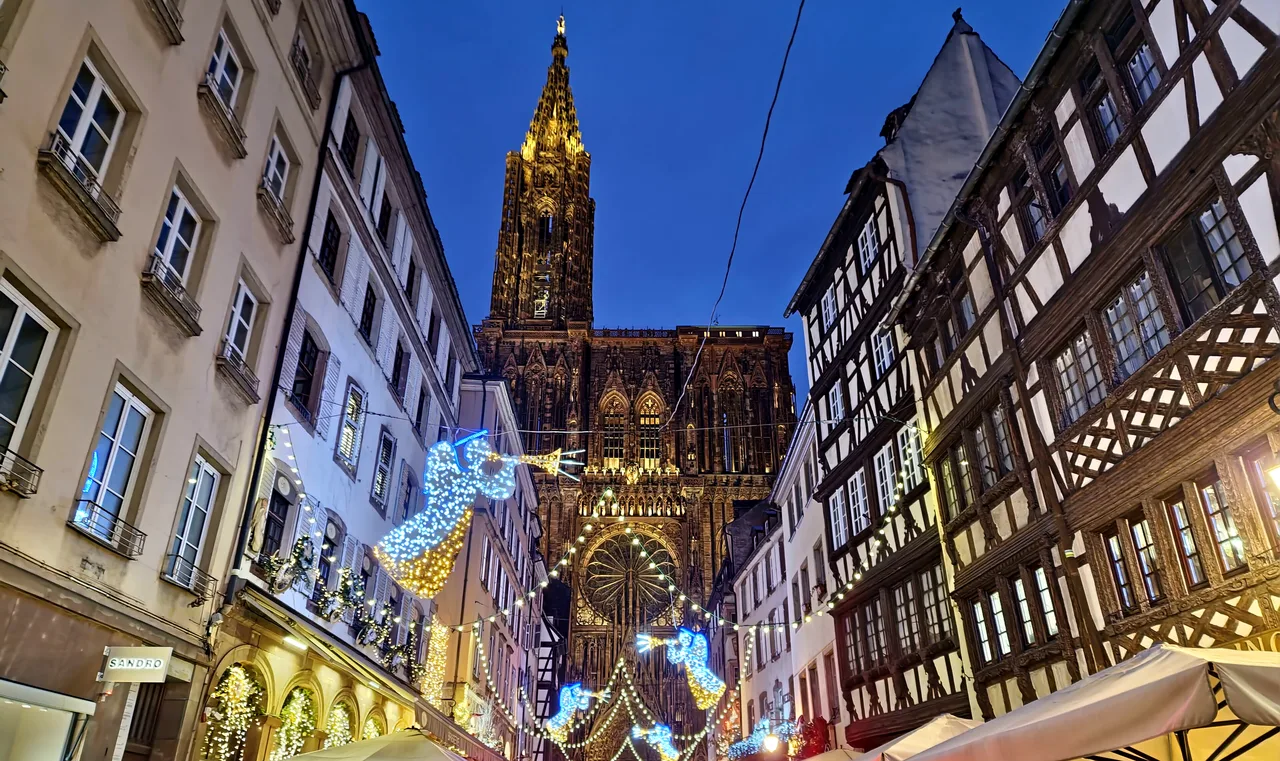
Cover photo: kewl (Flickr) · Wikimedia Commons · CC BY 2.0 · cropped and slightly colour-enhanced. All photo credits
When to go
Strasbourg can be visited in every season. Late November to 24 December is Christmas market time and the busiest period. April–June and September–October are ideal for city walks and the Alsace Wine Route; September–October is also harvest time. The table below is a general guide.
| Month | City walks | Christmas market | Wine route and day trips | Crowds |
|---|---|---|---|---|
| January | Challenging | No market | Challenging | Quiet |
| February | Challenging | No market | Challenging | Quiet |
| March | Good | No market | Good | Quiet |
| April | Very good | No market | Very good | Moderate |
| May | Very good | No market | Very good | Moderate |
| June | Very good | No market | Very good | Moderate |
| July | Good | No market | Very good | Busy |
| August | Good | No market | Very good | Busy |
| September | Very good | No market | Very good | Moderate |
| October | Very good | No market | Very good | Moderate |
| November | Good | From 27 November | Challenging | Moderate |
| December | Good | Market season | Challenging | Busy |
- Winter temperatures are often between 0 and 5 °C and can feel colder because of humidity and fog.
- The Christmas markets close on 24 December; 25 December is a public holiday in France, and 26 December is also a local holiday in Alsace.
- Accommodation demand rises during European Parliament plenary weeks; check the calendar on the Parliament’s website.
- September–October is ideal for the grape harvest and wine festivals.
- In summer the Barrage Vauban terrace and the banks of the Ill are lovely for evening walks.
Visas and entry (Turkish citizens)
Turkish citizens holding an ordinary (burgundy) passport need a Schengen visa for tourist travel to France. Rules differ for special, service and diplomatic passports; check the current position with the Turkish Ministry of Foreign Affairs.
The official gateway for French visa applications is france-visas.gouv.fr; the application form, required documents and the procedure in Türkiye are all set out there.
Under Schengen rules you apply to the country of your main stay. If you make a day trip from Strasbourg to Germany (e.g. Kehl or Freiburg), you still apply to France as long as France is your main stay.
The tram crosses the border between Strasbourg and Kehl; there are normally no passport checks within Schengen, but temporary controls may apply. Carry your passport.
Under the EU Entry/Exit System (EES), your fingerprints and facial image may be recorded on first entry. Visa fees and processing times can change; no fees are given on this page, so rely only on official sources.
Check before you go: T.C. Dışişleri Bakanlığı · Türk vatandaşlarının tabi olduğu vize uygulamaları ↗ · france-visas.gouv.fr ↗ · EES · europa.eu ↗ · Rota Atlası visa guide (TR)
Travel medical insurance
Check the official visa and entry sources above first: they state whether travel medical insurance is required and the minimum cover. Compare any policy’s cover amount, validity dates and countries covered with the official requirement.
Rota Atlası does not currently offer an insurance partnership; there are no paid links in this section. Last updated: 1 November 2026
Getting to Strasbourg
- By air: Strasbourg-Entzheim Airport (SXB) is about 10 km south-west of the city; TER trains from the airport station reach Strasbourg Gare Centrale quickly. Direct flight options from Türkiye to Strasbourg are limited; check current schedules in the search box below.
- Via Frankfurt or Basel: travelling by train from Frankfurt Airport (with a change or on direct ICE/TGV services) or via EuroAirport Basel-Mulhouse-Freiburg is a common option. Current times are on the SNCF and Deutsche Bahn websites.
- By train: Strasbourg Gare Centrale is about 1 hour 50 minutes from Paris by TGV, with connections towards Germany, Switzerland and Luxembourg.
- From Nuremberg and Vienna: there are no direct trains; journeys usually involve a change in Karlsruhe, Stuttgart or Mannheim.
- By car: traffic is restricted on Grande Île, more so during the Christmas period. Park+Ride (P+R) car parks at the city entrances can be combined with the tram.
Getting around

Tram
CTS tram lines A–F cover the city; Homme de Fer and Gare Centrale are the main interchanges. Line D crosses the Rhine to Kehl in Germany.
Tickets
Single, 24-hour and group tickets are sold at machines and in the official CTS app. Validate on boarding; prices change, so check cts-strasbourg.eu.
On foot
Grande Île is a compact island; Gare Centrale to the cathedral is about a 15–20-minute walk.
Bicycle
Strasbourg has one of the most developed cycle networks in France, and the Vélhop bike-share scheme is available.
Boat
Batorama boat tours on the Ill circle Petite France, Grande Île and the European institutions.
Regional train
TER trains run to Colmar, Obernai, Sélestat and other Alsatian towns; wine-route villages may require a bus connection.
Places to visit
Most of Strasbourg’s highlights are within walking distance on and around Grande Île. Below are twelve sections, from the cathedral to the canals, from the Neustadt to the European institutions and the fairy-tale villages of Alsace.
Pink sandstone giant
Notre-Dame Cathedral and the astronomical clock

Strasbourg’s Notre-Dame Cathedral is a Gothic masterpiece built of pink sandstone from the Vosges; with its single spire of about 142 metres it was regarded as the world’s tallest building from the 17th to the 19th century. The lace-like carving of the façade, the stained glass and the astronomical clock inside draw visitors; the clock’s parade of the apostles takes place every day around midday. A platform at about 66 metres is reached by stairs. UNESCO listing ↗
Don’t miss
- The west façade and great rose window
- The astronomical clock and the midday apostle parade
- The view over the Alsace plain and the Black Forest from the platform
- The Pillar of Angels (Pilier des Anges)
Tips
- The cathedral is a place of worship; visits are restricted during services.
- The astronomical clock show and the platform are ticketed separately; check times on cathedrale-strasbourg.fr.
- The cathedral square is very crowded at Christmas; go early in the morning.

Historic island
Grande Île, Place Gutenberg and Saint-Thomas

Grande Île, between two arms of the Ill, is Strasbourg’s historic centre. On Place Gutenberg stands a statue of Johannes Gutenberg, inventor of the printing press, recalling the years he lived in Strasbourg. Place Kléber is the city’s largest square and hosts the giant Christmas tree in season. The Protestant Church of Saint-Thomas is known for its Silbermann organ and the baroque mausoleum of Marshal de Saxe; Mozart is known to have played this organ in 1778.
Don’t miss
- The statue on Place Gutenberg
- Place Kléber and the Aubette building
- Saint-Thomas Church and its Silbermann organ
- Narrow streets such as Rue des Orfèvres and Rue Mercière
Tips
- The island is easy to explore on foot; get off the tram at Homme de Fer.
- Check the concert programme at Saint-Thomas.
- At Christmas take an evening walk to see the street decorations.

Canals and half-timbering
Petite France, Ponts Couverts and Barrage Vauban

At the western tip of Grande Île, Petite France, once home to tanners, millers and fishermen, is Strasbourg’s most photogenic quarter, with half-timbered houses and canals. The Ponts Couverts crossing the arms of the Ill are known for their medieval defensive towers. Just beyond, the 17th-century Barrage Vauban is a defensive dam once designed to protect the city by flooding; its rooftop terrace offers views of Petite France and the cathedral.
Don’t miss
- The half-timbered houses on Rue du Bain-aux-Plantes
- The four towers of the Ponts Couverts
- The view from the Barrage Vauban rooftop terrace
- A Batorama boat tour on the canals
Tips
- Early morning is the quietest time for photos.
- Check the opening hours of the Barrage Vauban terrace.
- The Petite France Christmas market is set up around Place Benjamin Zix.

The German-era city
Neustadt, Place de la République and Saint-Paul

Built under the German Empire between 1871 and 1918, the Neustadt extends north and east of Grande Île with broad boulevards, monumental public buildings and grand apartment blocks; it was added to the UNESCO World Heritage listing in 2017. Around Place de la République, the Palais du Rhin, the National and University Library and the National Theatre are symbols of the era. The neo-Gothic Saint-Paul Church on the Ill, with its twin spires, is particularly striking when lit up in the evening.
Don’t miss
- Place de la République and the Palais du Rhin
- Saint-Paul Church on the Ill
- A walk along Avenue de la Liberté
- The Palais Universitaire
Tips
- You can explore the Neustadt on foot from Grande Île.
- The best photo of Saint-Paul is taken from the opposite bank.
- The district lies on the way to the European institutions.

One of Europe’s capitals
European Parliament, Council of Europe and Court of Human Rights

Strasbourg is the official seat of the European Parliament, where its plenary sessions are held. The same area contains the Palace of Europe of the Council of Europe, with 46 member states, and the building of the European Court of Human Rights, which rules under the European Convention on Human Rights, to which Türkiye is a party. The Parliament’s visitor centre and guided visit options are announced on the official websites.
Don’t miss
- The Louise Weiss building (European Parliament)
- The striking European Court of Human Rights building
- The Palace of Europe (Council of Europe)
- A walk along the Ill and the Marne-Rhine canal
Tips
- Check the institutions’ official websites for visiting conditions and security checks.
- Reach them by tram at the Parlement Européen or Droits de l’Homme stops.
- The Orangerie park is right next door; combine the two.

The city park
Parc de l’Orangerie

The Orangerie, Strasbourg’s oldest and best-loved park, lies opposite the European institutions. With its lake, the Pavillon Joséphine, flower beds and a small animal park, it is ideal for families. Storks, the symbol of Alsace, nest in the park; once almost gone from the region, they returned thanks to conservation programmes.
Don’t miss
- Stork nests and viewing areas
- A walk around the lake
- The Pavillon Joséphine
- Playgrounds for children
Tips
- Spring and summer are the best times to see the storks.
- It fits into the same half-day as a visit to the European institutions.
- The park is quieter in winter; dress warmly.
Both banks of the Rhine
Jardin des Deux Rives and Kehl

Spanning both banks of the Rhine, the Jardin des Deux Rives is a park joining France and Germany; pedestrians and cyclists can cross the border on foot via the Passerelle des Deux Rives. On the far bank, Kehl is a small German town. Tram line D also crosses the Rhine to link Strasbourg with Kehl, so you can see two countries in a single day.
Don’t miss
- The view of the Rhine from the Passerelle des Deux Rives
- A walk through the riverside park
- Kehl’s centre and its own Christmas market (check dates)
- Crossing the border by tram
Tips
- Carry your passport; temporary border checks may apply.
- Shop opening hours in Kehl follow German rules; shops close on Sundays.
- There are lovely cycle routes along the Rhine.
Day trip
Colmar

About 30 minutes south of Strasbourg by TER train, Colmar is one of the most visited towns in Alsace, with colourful half-timbered houses, the canal-lined “Petite Venise” quarter and the Isenheim Altarpiece in the Unterlinden Museum. At Christmas several markets are set up on different squares and the old town is illuminated. Colmar guide →
Don’t miss
- Petite Venise and the Quai de la Poissonnerie
- Maison Pfister and Maison des Têtes
- The Isenheim Altarpiece in the Unterlinden Museum
- The town’s Christmas markets (check dates)
Tips
- Trains run frequently; current times are on the SNCF website.
- Colmar is very busy on Christmas weekends; choose a weekday.
- Check Colmar’s official tourism website for market dates.
Fairy-tale villages
Alsace Wine Route: Riquewihr, Kaysersberg and Obernai

The Alsace Wine Route (Route des Vins d’Alsace) runs north to south through the vineyards at the foot of the Vosges, linking dozens of villages. Walled Riquewihr, Kaysersberg with its castle and bridge over the river, and Obernai with its square ringed by half-timbered houses are among the best-known stops. At Christmas many villages host small, intimate markets.
Don’t miss
- Riquewihr’s main street and the Dolder tower
- Kaysersberg’s castle and bridge
- Obernai’s market square
- A tasting of wine or grape juice in a local cellar
Tips
- Obernai is reachable by TER train; Riquewihr and Kaysersberg require a bus, tour or car.
- Village market dates differ; check each separately.
- Some businesses keep shorter hours in winter.


Mountain castle
Haut-Koenigsbourg Castle

Rising on a ridge of the Vosges at about 750 metres, Haut-Koenigsbourg is a castle of medieval origin overlooking the Alsace plain. It was extensively restored in the early 20th century under the German Emperor Wilhelm II. Inside are collections of arms and furniture, and from the ramparts you can see the Alsace plain, the Black Forest and, on clear days, the Alps.
Don’t miss
- The view over the plain from the ramparts
- The great bastion and artillery garden
- The imperial rooms
- The castle’s medieval kitchen and arms collection
Tips
- Seasonal shuttle buses run from Sélestat station; check winter transport in advance.
- Winter opening hours are short; check the official website.
- It is colder on the mountain than in the city; bring warm clothing.
Alsace’s holy mountain
Mont Sainte-Odile and the Vosges forests

South-west of Strasbourg, Mont Sainte-Odile rises to about 764 metres above Obernai and is a pilgrimage site linked to Saint Odile, the patron saint of Alsace. The hilltop convent (Hohenbourg) and its chapels offer a wide view from the terrace over the Alsace plain and, on clear days, across the Rhine to the Black Forest. In the forests on the mountain, the mysterious “Mur Païen” (Pagan Wall), a stone wall about 10 km long whose date is debated, can be explored on hiking trails. It is an active religious site; visitors are asked to respect the quiet.
Don’t miss
- The view over the Alsace plain from the convent terrace
- The convent church and chapels
- A forest walk along the Mur Païen (Pagan Wall)
- Obernai’s market square on the way back
Tips
- Public transport links are limited; most visitors come by car or on hiking trails from Obernai and the surrounding area.
- For visiting hours and services see the official site mont-sainte-odile.com.
- It can be noticeably cooler at the top than in the city; in winter roads may be snowy.

Spa town across the Rhine
Baden-Baden: Kurhaus, Lichtentaler Allee and the spas

On the German side of the Rhine, at the edge of the Black Forest, Baden-Baden has been one of Europe’s famous spa towns since the 19th century and in 2021 joined the UNESCO World Heritage List as part of the “Great Spa Towns of Europe”. The neoclassical Kurhaus with its casino is the heart of town; from the park in front, Lichtentaler Allee runs along the Oos stream, a celebrated promenade with bridges, old trees and museums (including the Museum Frieder Burda). The historic Friedrichsbad and the modern Caracalla Therme make the town a relaxing day trip. During Advent a Christmas market is held around the Kurhaus. UNESCO listing ↗
Don’t miss
- The Kurhaus and the park in front of it
- A walk along Lichtentaler Allee
- A spa break at Friedrichsbad or Caracalla Therme
- Modern art at the Museum Frieder Burda
Tips
- From Strasbourg the train usually involves a change in Kehl or Offenburg; check current connections on bahn.de.
- Baden-Baden station is outside the town centre; take a bus into town.
- The France–Germany border is inside Schengen, but carry your passport; check spa rules and Christmas market dates on baden-baden.com.

1, 2 and 3-day itineraries + Christmas day
The itineraries below are based on walking and tram distances. Check cathedral, museum and Christmas market hours on the official websites.
1 day: The essence of Grande Île
- In the morning visit the cathedral and, if open, climb to the platform.
- Around midday watch the astronomical clock’s apostle parade (check tickets and times in advance).
- See Maison Kammerzell and the Palais Rohan, then Place Gutenberg and Place Kléber.
- In the afternoon, Petite France, the Ponts Couverts and the Barrage Vauban terrace.
- In the evening, a walk along the Ill and dinner with Alsatian cuisine.
2 days: Europe and the Neustadt
- Follow the day 1 itinerary.
- On the morning of day 2, a Batorama boat tour.
- Take the tram to the European institutions: the European Parliament and Court of Human Rights buildings, then the Orangerie park.
- In the afternoon, the Neustadt: Place de la République and Saint-Paul Church.
- In the evening, visit one of the Palais Rohan museums.
3 days: Colmar and the wine villages
- Follow the first two days.
- On the morning of day 3 take the TER train to Colmar: Petite Venise and the Unterlinden Museum.
- In the afternoon, depending on the season, Riquewihr or Kaysersberg by bus or tour.
- Alternative: take the tram to Kehl and see the Rhine from the Jardin des Deux Rives.
Christmas market day (27 November–24 December 2026)
- Start in the morning with the Christkindelsmärik on Place Broglie and browse the stalls before the crowds build.
- Move on to the cathedral square market and see the cathedral interior.
- Around midday, local specialities at the Quai des Délices, then the Irréductibles Petits Producteurs d’Alsace producers’ market.
- In the afternoon, the Petite France market and the canals; as dusk falls, the decorations in the Carré d’Or streets.
- End the evening under the lights of the Grand Sapin on Place Kléber with vin chaud or hot apple juice.
Alsatian cuisine
Alsatian cuisine is hearty, a meeting point of French and German traditions. Choucroute, flammekueche, baeckeoffe and kougelhopf are the region’s emblems, and white wines such as Riesling and Gewurztraminer are famous. Many traditional dishes contain pork; if you don’t eat pork, ask about fish, vegetable or chicken options. Traditional Alsatian taverns are called “winstub”.


Choucroute garnie
Sauerkraut cooked in wine, topped with sausages and meats; a fish version (choucroute de la mer) also exists.
Flammekueche (tarte flambée)
Thin dough baked in a wood-fired oven with cream, onions and usually bacon. Ask for cheese or vegetable versions.
Baeckeoffe
A slow-cooked casserole of meat, potatoes and vegetables in wine, baked in an earthenware dish.
Kougelhopf
An Alsatian cake with raisins and almonds, recognisable by its distinctive mould.
Bredele
Small Alsatian biscuits typical of Christmas, baked in quantity at home and in pastry shops.
Alsace wines and grape juice
Riesling, Pinot Gris and Gewurztraminer are the region’s famous whites; fresh grape juice is widely available for non-drinkers.
- In France service is included in the bill; leaving a small tip if you are satisfied is optional.
- Restaurants may close their kitchens between lunch and dinner; watch the times.
- Booking ahead at winstubs is recommended at Christmas.
- Many shops close on Sundays, though there may be exceptions during the Christmas period.
Culture and etiquette

- In France, saying “Bonjour” when entering a shop and “Au revoir” when leaving is basic courtesy.
- Alsace has a distinctive identity; Alsatian place names and traditions are common.
- Avoid sightseeing in the cathedral and churches during services.
- The St Nicholas (Saint-Nicolas) tradition on 6 December is important in Alsace; children receive manala.
- Validate your tram ticket; an invalid ticket during an inspection incurs a fine.
- Don’t walk on cycle lanes; Strasbourg has heavy bicycle traffic.
- Follow security rules at the European institutions and carry ID.
- The stork is the symbol of Alsace and appears on many souvenirs.
Safety and health
- Strasbourg is generally safe; watch out for pickpockets at the Christmas markets and on trams.
- During the market period security checks may take place at entrances to Grande Île; avoid large bags and follow staff instructions.
- Pavements and bridges can be slippery in winter; wear non-slip shoes.
- In an emergency call 112 (general), 15 (ambulance), 17 (police) or 18 (fire).
- Travel health insurance is mandatory for a Schengen visa.
- Vin chaud contains alcohol; drink in moderation in the crowds and cold, or choose alcohol-free drinks.
- Check official travel advice before you go.
What drives the budget
This guide gives no prices, because accommodation, transport and admission costs change with the season. The main factors that shape your budget are:
Travel dates
The Christmas market period and European Parliament plenary weeks push up accommodation demand significantly; January–March is usually quieter.
Where you stay
Grande Île is walkable; the station area, the Neustadt and districts on the tram lines are alternatives. Some visitors stay in Kehl.
Transport
With limited direct flights to Strasbourg, train combinations via Frankfurt, Basel or Paris affect costs.
Museums and tours
The cathedral platform, astronomical clock, museums and boat tours are charged separately; check options such as the Strasbourg Pass on the official tourism website.
Food and drink
Market snacks, winstubs and restaurants suit different budgets.
Day trips
Trains, buses or tours to Colmar and the wine route add to costs.
Practical information
- Money: the euro is used; card payment is common, but small stalls may need cash.
- Language: English and German are understood at tourist sites; a few words of French go a long way.
- Opening hours: many shops close on Sundays; 25 and 26 December are holidays in Alsace.
- Internet: there are free Wi-Fi hotspots; with a non-EU SIM, check roaming charges.
- Tourist information: the tourist office on the cathedral square and visitstrasbourg.fr provide current information.
- Accessibility: trams are low-floor; historic streets are cobbled.
- Weather: in winter it gets dark around 16:30, the perfect time for the market lights.
- Photography: the Barrage Vauban terrace and the Ponts Couverts are the classic viewpoints.
Frequently asked questions
When is the Strasbourg Christmas market in 2026?
According to the City of Strasbourg’s official website, “Strasbourg Capitale de Noël” runs from 27 November to 24 December 2026. Check hours on noel.strasbourg.eu.
Where is the Christkindelsmärik held?
The historic market is on Place Broglie; markets are also set up on the cathedral square, Place Kléber (Grand Sapin), Petite France and other squares.
Has the Strasbourg Christmas market really existed since 1570?
Official sources state that the Christkindelsmärik has been held since 1570, placing it among the oldest Christmas markets in France.
Is there an entry fee for the Christmas markets?
The markets are held on open squares and no ticket is needed to browse; food, drink and goods are paid for separately.
How do I get to Strasbourg from Türkiye?
Direct options to Strasbourg-Entzheim are limited; flying to Frankfurt, Basel EuroAirport or Paris and continuing by train is common.
Where do Turkish citizens apply for a French visa?
Ordinary passport holders need a Schengen visa; the official application gateway is france-visas.gouv.fr.
How many days do I need in Strasbourg?
You can see the main sights in 1–2 days; add a day for Colmar or the wine route.
What should I eat in Strasbourg?
Choucroute, flammekueche, baeckeoffe, kougelhopf and, at Christmas, bredele; ask about pork-free options.
Can I combine Strasbourg with the Nuremberg or Vienna markets?
Yes. The Nuremberg market also opens on 27 November, and there are trains with a change between Strasbourg and Nuremberg. Vienna’s Rathausplatz market starts on 13 November.
Is it easy to cross into Germany from Strasbourg?
Yes. You can cross to Kehl on tram line D or the Passerelle des Deux Rives footbridge; carry your passport.
Where to stay
Stay close to the areas where you will spend most time. The areas below are covered in detail in this guide; check public transport links in the getting-around section.
- Pink sandstone giantNotre-Dame Cathedral and the astronomical clock
- Historic islandGrande Île, Place Gutenberg and Saint-Thomas
- Canals and half-timberingPetite France, Ponts Couverts and Barrage Vauban
- The German-era cityNeustadt, Place de la République and Saint-Paul
- One of Europe’s capitalsEuropean Parliament, Council of Europe and Court of Human Rights
- The city parkParc de l’Orangerie
- Both banks of the RhineJardin des Deux Rives and Kehl
- Fairy-tale villagesAlsace Wine Route: Riquewihr, Kaysersberg and Obernai
- Mountain castleHaut-Koenigsbourg Castle
- Alsace’s holy mountainMont Sainte-Odile and the Vosges forests
- Spa town across the RhineBaden-Baden: Kurhaus, Lichtentaler Allee and the spas
Search hotels in these areas (Hotellook) ↗ (affiliate link)Search on Booking.com ↗
Affiliate disclosure: Hotellook, Aviasales, Klook, Airalo, Tiqets and DiscoverCars links are affiliate links; Rota Atlası may earn a commission on bookings made through them, at no extra cost to you. Official and in-guide links are not paid. Last updated: 1 November 2026 · Privacy and affiliates
Transport and connectivity
- Airport transferOptions from the airport to the city are in this guide’s getting there section.
- Mobile data (eSIM)Airalo eSIM ↗ (affiliate link)
- Car hireYou rarely need a car within the city; see getting around first. Compare car hire on DiscoverCars ↗ (affiliate link)
Affiliate disclosure: Hotellook, Aviasales, Klook, Airalo, Tiqets and DiscoverCars links are affiliate links; Rota Atlası may earn a commission on bookings made through them, at no extra cost to you. Official and in-guide links are not paid. Last updated: 1 November 2026 · Privacy and affiliates
Search flights (affiliate link)
Search flights from any airport in any country. Results open on Aviasales in a new tab, where you book.
This form is an affiliate link: Rota Atlası may earn a commission on bookings made via Aviasales (Travelpayouts), at no extra cost to you. Check price, baggage and terms on the booking site. Airport data: OurAirports (public domain).
Flights, hotels and tours
Find tours and tickets
- Chrìstkìndelsmärik (Place Broglie)
GetYourGuide ↗ · Klook ↗ (affiliate link) - Great Christmas Tree (Place Kléber)
GetYourGuide ↗ · Klook ↗ (affiliate link) - Strasbourg Cathedral and astronomical clock
GetYourGuide ↗ · Klook ↗ (affiliate link) - Petite France
GetYourGuide ↗ · Klook ↗ (affiliate link)
Hotellook, Aviasales, Klook, Airalo and Tiqets links in this box are affiliate links (Travelpayouts): Rota Atlası may earn a commission on bookings made through them, at no extra cost to you. GetYourGuide links currently carry no affiliate code. Check prices and terms with the provider. Last updated: 1 November 2026 · Privacy and affiliates
Sources
- T.C. Dışişleri Bakanlığı · Türk vatandaşlarının tabi olduğu vize uygulamaları ↗
- France-Visas · Portail officiel des visas pour la France ↗
- European Union · Entry/Exit System (EES) ↗
- Office de Tourisme de Strasbourg et sa Région (official) ↗
- Cathédrale Notre-Dame de Strasbourg (official) ↗
- CTS · Compagnie des Transports Strasbourgeois ↗
- Aéroport de Strasbourg ↗
- EuroAirport Basel-Mulhouse-Freiburg ↗
- GOV.UK · Foreign travel advice · France ↗
- UNESCO World Heritage Centre · Strasbourg, Grande-Île and Neustadt ↗
- Strasbourg Capitale de Noël (official) ↗
This page is for information only. Dates, opening hours, entry rules and transport details can change; check the official sources above before you travel. No prices, flights, hotels or restaurant recommendations have been invented in this guide.
Photo credits
The photos on this page come from Wikimedia Commons and are used under the stated authors and licences (CC BY, CC BY-SA, CC0 or public domain). Page with all sources
- Evening Christmas market crowds among half-timbered houses in Strasbourg — Jorge Franganillo · CC BY 2.0 · Wikimedia Commons
- The illuminated entrance arch of the Christkindelsmärik on place Broglie — Claude Truong-Ngoc · CC BY-SA 3.0 · Wikimedia Commons
- Christmas market stalls on the cathedral square seen from above — Claude Truong-Ngoc · CC BY-SA 3.0 · Wikimedia Commons
- The Great Christmas Tree (Grand Sapin) on place Kléber — Zéphyrios · CC0 · Wikimedia Commons
- Christmas illuminations on rue Mercière with the cathedral beyond — Claude Truong-Ngoc · CC BY-SA 3.0 · Wikimedia Commons
- A narrow Strasbourg street hung with Christmas decorations — Zéphyrios (Flickr) · CC0 · Wikimedia Commons
- The pink sandstone west front of Strasbourg Cathedral — Txllxt TxllxT · CC BY-SA 4.0 · Wikimedia Commons
- The astronomical clock inside the cathedral — Didier B (Sam67fr) · CC BY-SA 2.5 · Wikimedia Commons
- Maison Kammerzell with its carved timber facade — Kent Wang · CC BY 4.0 · Wikimedia Commons
- The Gutenberg statue and carousel on place Gutenberg — JoachimKohler-HB · CC BY-SA 4.0 · Wikimedia Commons
- Half-timbered houses along the canal in Petite France — Dietmar Rabich · CC BY-SA 4.0 · Wikimedia Commons
- The towers of the Ponts Couverts and the river Ill — DXR · CC BY-SA 4.0 · Wikimedia Commons
- The Barrage Vauban across the Ill — Claude Truong-Ngoc · CC BY-SA 3.0 · Wikimedia Commons
- The facade of the Palais Rohan seen across the Ill — Coyau · CC BY-SA 3.0 · Wikimedia Commons
- The quays along the Ill in the Krutenau district — Kent Wang from Barcelona, Spain · CC BY-SA 2.0 · Wikimedia Commons
- The Palais du Rhin in the Neustadt — Jonathan Martz · CC BY-SA 3.0 · Wikimedia Commons
- The twin-spired Saint-Paul church on the Ill — DXR · CC BY-SA 4.0 · Wikimedia Commons
- The European Parliament plenary chamber (hemicycle) — Gzen92 · CC BY-SA 4.0 · Wikimedia Commons
- The European Court of Human Rights building — Gzen92 · CC BY-SA 4.0 · Wikimedia Commons
- The lake and trees in the Parc de l’Orangerie — Flocci Nivis · CC BY-SA 4.0 · Wikimedia Commons
- The Silbermann organ in the church of Saint-Thomas — John Samuel · CC BY-SA 4.0 · Wikimedia Commons
- The Ill and its boat landing seen from the Pont du Corbeau — Tristan Schmurr · CC BY 2.0 · Wikimedia Commons
- The Little Venice (Petite Venise) canal in Colmar — Krzysztof Golik · CC BY-SA 4.0 · Wikimedia Commons
- A stall full of decorations at the Colmar Christmas market — Arnaud 25 · CC BY-SA 4.0 · Wikimedia Commons
- The town hall of Riquewihr and its flower-decked square — Krzysztof Golik · CC BY-SA 4.0 · Wikimedia Commons
- The town of Kaysersberg among the vineyards — Wladyslaw (Taxiarchos228) · CC BY-SA 3.0 · Wikimedia Commons
- The belfry and market square in Obernai — OTCOM · Public domain · Wikimedia Commons
- The walls and keep of Haut-Kœnigsbourg Castle — Gzen92 · CC BY-SA 4.0 · Wikimedia Commons
- The Deux Rives footbridge over the Rhine linking Strasbourg and Kehl — Flocci Nivis · CC BY 4.0 · Wikimedia Commons
- Choucroute garnie served with meats and sausages — Sebleouf · CC BY-SA 4.0 · Wikimedia Commons
- Thin-crust tarte flambée (Flammekueche) with cream and onions — Lulu Durand · CC BY 2.0 · Wikimedia Commons
- A tray of Alsatian Christmas biscuits (bredele) — Pethrus · CC BY-SA 4.0 · Wikimedia Commons
- Small kougelhopf (Gugelhupf) cakes baked in moulds — Dr. Bernd Gross · CC BY-SA 4.0 · Wikimedia Commons
Lyon → · Kaysersberg → · Montreux → · Mulhouse → · Nancy → · Metz → · Colmar → · Freiburg → · Basel → · Nuremberg → · Vienna → · Christmas markets