

Zurich is Switzerland’s largest city and the capital of the canton of the same name. It sits where the Limmat river flows out of Lake Zurich, and more than 440,000 people live within the city limits. The Roman customs post of Turicum grew in the Middle Ages around its abbeys and guilds, and in 1519 Huldrych Zwingli began the Swiss Reformation from the pulpit of the Grossmünster. Today the city is known for banking and insurance, for world-class universities such as ETH Zurich, and for more than 50 museums. The Altstadt (old town), spread across both banks of the Limmat, is small enough to explore on foot, with narrow lanes, guild houses and church towers. In Advent, Zurich stands out not for one big market but for several spread across the city: Polarzauber in the main station hall, Bellevue Noël on Sechseläutenplatz, the “Dörfli” in the Niederdorf, Münsterhof and the Singing Christmas Tree on Werdmühleplatz. Above Bahnhofstrasse the Christmas lights known as “Lucy” are switched on.
Content update: 28 October 2026 · Christmas market dates checked against the official zuerich.com (Zürich Tourismus) website
Zurich at a Glance
- Country / canton
- Switzerland · Canton of Zurich
- Population
- More than 440,000; Switzerland’s largest city
- Language
- German (local dialect Züritüütsch); English widely spoken
- Currency
- Swiss franc (CHF); card payment is very common
- Time zone
- Central European Time (CET, UTC+1)
- Known for
- The Limmat and the lakefront, Reformation history, banking, ETH Zurich, museums
- Landmarks
- Grossmünster, Fraumünster, St. Peter, Lindenhof, Bahnhofstrasse, Opernhaus, Landesmuseum
- Nearby
- Uetliberg, Rhine Falls, Rapperswil, Lucerne, Winterthur, Einsiedeln
- Christmas markets
- 19 November–23/24 December 2026: Polarzauber (HB), Bellevue Noël, Dörfli, Münsterhof, Werdmühleplatz, Weihnachtsallee
- Airport
- Zurich Airport (ZRH); about 10–15 minutes by train to Zurich HB
- Electricity
- 230 V; Swiss type J sockets. Slim type C plugs fit, thick type F (Schuko) plugs do not, so bring an adapter
- Emergency
- 112 (general), 117 (police), 144 (ambulance), 118 (fire)
Zurich in Pictures
The Limmat, the twin towers of the Grossmünster and the old town from the Quaibrücke, the rooftops of the Niederdorf from the Lindenhof, and the wide horizon of Lake Zurich: Zurich in three photographs.


Zurich Christmas Markets 2026
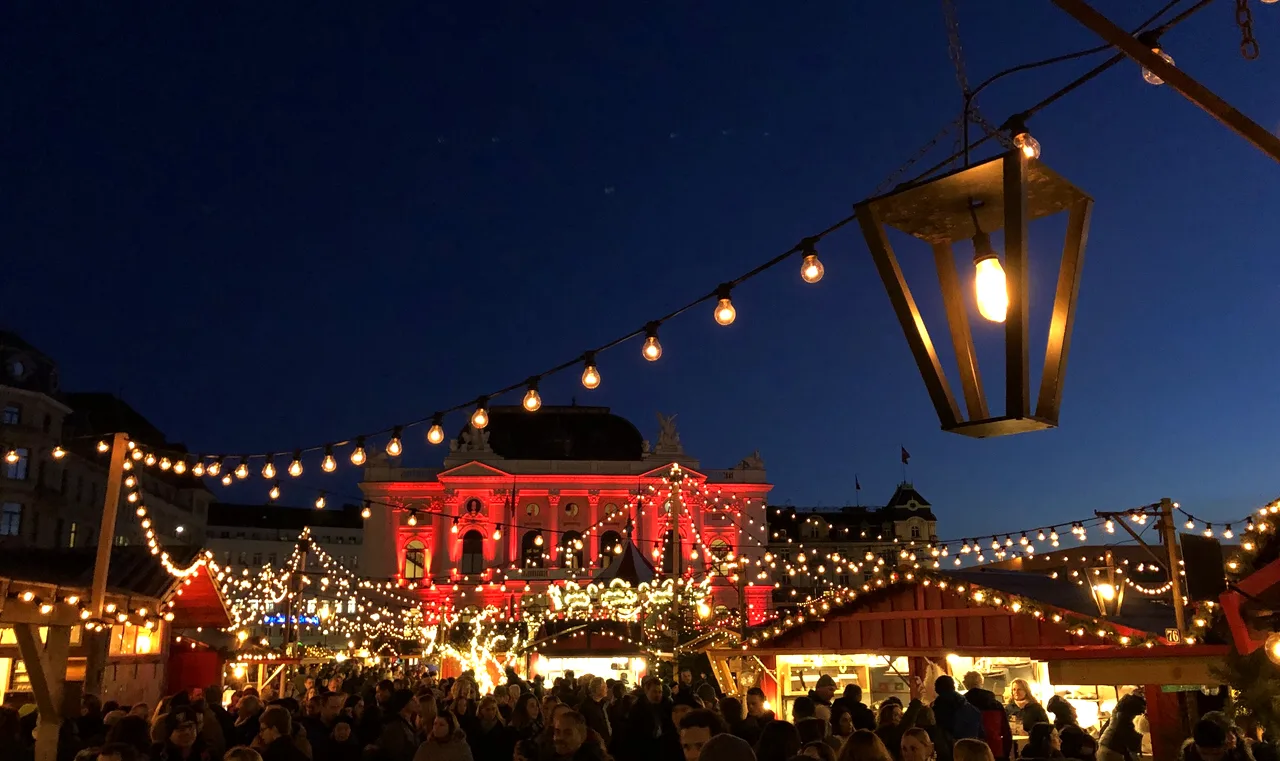
Christmas in Zurich does not fit into a single square. The official Zürich Tourismus website lists six major Christmas markets within walking distance of each other, and almost all of them open on 19 November 2026. The largest is Polarzauber in the historic hall of the main station (Zürich HB): more than 100 stalls, a giant Christmas tree and the “Polarlicht” light show, and because it is indoors it works well on rainy days too. On Sechseläutenplatz by the lake, the market returns in 2026 under the new name Bellevue Noël; according to its official website it has a 50-metre Advent wreath you can walk on and a fondue chalet. In the old town, the Niederdorf “Dörfli” has a village feel, with a children’s ice rink in the Rosenhof. Münsterhof in front of the Fraumünster focuses on local products and Zurich brands, while on Werdmühleplatz choirs perform every day on the “Singing Christmas Tree”. The Zürcher Weihnachtsallee on Europaallee is a more modern alternative with design stalls and food. The details below were checked against official sources on 28 October 2026.


| Market | Location | 2026 dates | Notes |
|---|---|---|---|
| Polarzauber | Zurich HB, main station hall | 19 November–24 December 2026 | More than 100 stalls, a giant Christmas tree and the “Polarlicht” light show; indoors. Published hours: Sunday–Wednesday 11:00–21:00, Thursday–Saturday 11:00–22:00, 24 December 11:00–16:00. |
| Bellevue Noël | Sechseläutenplatz, in front of the Opernhaus | 19 November–23 December 2026 | New name in 2026; a 50 m walkable Advent wreath and a fondue chalet. Published hours: Monday–Saturday 11:00–22:00, Sunday 11:00–20:00. |
| Dörfli (Niederdorf) | Niederdorfstrasse and Rosenhof | 19 November–23 December 2026 | Small stalls with a village atmosphere in the old town; a children’s ice rink in the Rosenhof. |
| Münsterhof | The square in front of the Fraumünster | 19 November–24 December 2026 | Local products and Zurich brands, with views of the Fraumünster and St. Peter. |
| Singing Christmas Tree | Werdmühleplatz | 19 November–23 December 2026 | Daily choir concerts on a tree-shaped stage; local and organic product stalls. |
| Zürcher Weihnachtsallee | Europaallee, behind the main station | 19 November–23 December 2026 | Design stalls, food, a karaoke bar and a fondue chalet. |
What to try
Glühwein
Spiced mulled wine; non-alcoholic Kinderpunsch and hot apple juice (heisser Apfelsaft) are also available.
Käsefondue
Melted cheese for dipping bread; Bellevue Noël and the Weihnachtsallee have fondue chalets.
Raclette
Melted cheese scraped onto potatoes and pickles; a classic hot market dish.
Marroni
Hot roasted chestnuts from street stands; a symbol of the Zurich winter.
Zürcher Tirggel
A thin honey biscuit with embossed pictures; a Christmas sweet unique to Zurich.
Biber and Grittibänz
Gingerbread filled with almond paste (Biber) and a sweet bread man eaten on 6 December (Grittibänz).
Zurich Christmas market tips
- Link the markets on foot, starting at the main station and walking down Bahnhofstrasse towards the lake: Polarzauber → Werdmühleplatz → Münsterhof → Bellevue Noël. Cross to the other bank of the Limmat for the Dörfli.
- Polarzauber is indoors, which makes it the best plan for a rainy day, but it gets very busy in the evenings and at weekends.
- The Lucy lights show Bahnhofstrasse at its best after dark; according to the official website they are switched on at 18:00 on 19 November 2026.
- Singing Christmas Tree concerts are usually in the late afternoon and evening; check the programme on the official website.
- Cards and mobile payment are widespread, but carry a little cash in CHF for small stalls; euros are not guaranteed to be accepted.
- A deposit is usually charged on mulled wine mugs; return the mug to get it back.
- Winterzauber on the Uetliberg (6 November 2026–31 January 2027) and the Illuminarium in the Landesmuseum courtyard (5 November–30 December) are winter events beyond the markets.
- In December it gets dark around 16:30; see the lakefront in daylight and the markets in the evening.
Check before you go: Zürich Tourismus · Weihnachtsmärkte in Zürich (official) ↗ · Zurich Tourism · Christmas in Zurich (official) ↗ · Polarzauber · Weihnachtsmarkt im Zürich HB ↗ · Bellevue Noël · Sechseläutenplatz ↗
Dates were checked on 28 October 2026 on the official zuerich.com (Zürich Tourismus), polarzauber.ch and bellevuenoel.ch websites. The markets are run by different organisers and their hours differ; markets open on 24 December close early. Check opening hours on the official websites again before your visit.
When to Go
Zurich can be visited all year round. May to September is the best time for lakeside walks, boat trips and the view from the Uetliberg; the Sechseläuten spring festival takes place in April and large city festivals in August. From late November to late December the Christmas markets fill the city. January and February can be cold and grey, but they are a quiet time for museums and winter events.
| Month | Sightseeing | Christmas market | Lake and nature | Crowds |
|---|---|---|---|---|
| January | Difficult | No market | Difficult | Quiet |
| February | Difficult | No market | Difficult | Moderate |
| March | Good | No market | Good | Moderate |
| April | Very good | No market | Good | Moderate |
| May | Very good | No market | Very good | Busy |
| June | Very good | No market | Very good | Busy |
| July | Very good | No market | Very good | Moderate |
| August | Very good | No market | Very good | Moderate |
| September | Very good | No market | Very good | Moderate |
| October | Good | No market | Good | Moderate |
| November | Good | Market season | Difficult | Moderate |
| December | Good | Market season | Difficult | Busy |
- In December Zurich is usually between 0 and 5 °C; fog is common and snow falls now and then.
- When the city is under fog, the Uetliberg is often above it with the Alps in view; plan around the forecast.
- Most Christmas markets are open from 19 November to 23 December 2026; Polarzauber and Münsterhof run until 24 December.
- Lake boats run a reduced timetable in winter; check the official timetables.
- In December it gets dark around 16:30; schedule museums and viewpoints for the morning.
- Accommodation demand rises during Sechseläuten (April) and the Street Parade (August).
Visa and Entry (Turkish citizens)
Switzerland is not an EU member but it is part of the Schengen Area, so Schengen entry rules apply. Whether you need a visa depends on your nationality; holders of ordinary Turkish passports, for example, need a Schengen visa for tourist travel.
Under Schengen rules you apply to the consulate of the country that is your main destination. If your trip is mainly to Zurich and Switzerland, apply to the Swiss representation responsible for you; entry and visa information is published by the State Secretariat for Migration (SEM) at sem.admin.ch.
If you plan to continue to neighbouring Germany (Stuttgart, the Black Forest) or Austria, be clear about where you will spend the most time. Checks can take place at internal borders, so carry your passport.
Switzerland is not part of the EU customs union, so customs rules apply to goods and cash at the border. Details are on the website of the Federal Office for Customs and Border Security (BAZG).
Under the EU Entry/Exit System (EES), being phased in at the Schengen external borders, your biometric data (facial image and fingerprints) may be recorded on first entry; allow extra time at the airport.
Visa fees, processing times and document lists can change. This page does not list fees; rely only on official sources before applying.
Check before you go: T.C. Dışişleri Bakanlığı · Türk vatandaşlarının tabi olduğu vize uygulamaları ↗ · sem.admin.ch ↗ · EES · europa.eu ↗ · Rota Atlası visa guide (TR)
Travel medical insurance
Check the official visa and entry sources above first: they state whether travel medical insurance is required and the minimum cover. Compare any policy’s cover amount, validity dates and countries covered with the official requirement.
Rota Atlası does not currently offer an insurance partnership; there are no paid links in this section. Last updated: 1 November 2026
Getting to Zurich
- By air: Zurich Airport (ZRH) is Switzerland’s largest airport, about 10 km north of the city centre. Trains from the airport station reach Zurich HB in about 10–15 minutes. Direct flights vary by season and airline; check current services only on the official airline and airport websites.
- By train: Zurich HB is the hub of the Swiss rail network, with frequent trains to Basel, Bern, Lucerne, Geneva and St. Gallen, and international connections to cities such as Stuttgart, Munich, Frankfurt and Milan. Timetables and tickets are on sbb.ch.
- By coach: Long-distance coaches use the coach terminal near the city centre; check operators and times through official channels.
- By car: A motorway vignette (including the e-vignette) is required on Swiss motorways. Parking in the city centre is limited and expensive; public transport is far more practical.
Getting Around

On foot
Bahnhofstrasse runs about 1.4 km from the main station to the lake; both halves of the old town, the Lindenhof and the Christmas markets are within walking distance.
Tram and bus
The blue-and-white VBZ trams run frequently all over the city; tickets follow the zonal ZVV fare system. Current information is on zvv.ch.
S-Bahn
The Zurich S-Bahn links the city with the suburbs and the airport; the SZU S10 line climbs the Uetliberg.
Funicular and boats
The Polybahn runs from Central up to ETH; Limmat and lake boats are part of the ZVV network too (some lake cruises need a separate ticket).
Tickets
Use ticket machines or the SBB and ZVV apps; fines for travelling without a ticket are high. See zuerich.com for the ZürichCARD option.
Cycling
Cycle lanes are common; watch out for tram tracks.
What to See
Zurich’s sights are concentrated in the old town on both banks of the Limmat: the Niederdorf and Grossmünster on the east bank, the Lindenhof, Fraumünster and Bahnhofstrasse on the west. The lakefront, the museums and the industrial heritage of Zurich West complete the city, and the final sections cover easy day trips to the Uetliberg, the Rhine Falls, Lucerne and Rapperswil.
Old town
Niederdorf and the Rathaus

The part of the old town on the east bank of the Limmat is the Niederdorf, known locally as the “Dörfli” (little village). Running south from Central opposite the main station, Niederdorfstrasse is Zurich’s liveliest walk: a cobbled pedestrian street with guild houses, small hotels, cafés and shops. Side lanes climb up to Neumarkt, Spiegelgasse and Rindermarkt; Spiegelgasse is known for the house where Lenin lived in 1917 and for the Cabaret Voltaire, birthplace of the Dada movement. Standing directly in the Limmat, the Baroque Rathaus (town hall) from the late 17th century is today the meeting place of the cantonal and city parliaments. In Advent the lanes of the Niederdorf fill with the stalls and lights of the “Dörfli” Christmas market.
Don’t miss
- The pedestrian Niederdorfstrasse
- Spiegelgasse and the Cabaret Voltaire
- The Rathaus standing in the Limmat
- The Dörfli Christmas market in Advent
Tips
- Busy with restaurants and bars in the evening; quieter in the morning.
- Side lanes are steep and can be slippery in winter.
- Walk from Central along the Limmatquai to reach the Grossmünster.

Landmark
Grossmünster and Wasserkirche

With its twin towers, the Grossmünster is the emblem of Zurich’s skyline. This Romanesque church was built mostly in the 12th and 13th centuries and, according to legend, stands over the graves of the city’s patron saints Felix and Regula. Huldrych Zwingli began preaching here in 1519 and launched the Swiss Reformation, which makes the church one of the key places in Reformation history. The interior is plain after the Reformation, but the stained glass by Augusto Giacometti and the windows by Sigmar Polke installed in 2009 stand out. You can climb one of the towers for a view over the old town and the lake. Next door on the Limmat, the late Gothic Wasserkirche stands on the former islet where Felix and Regula are said to have been executed; the adjoining Helmhaus is an art space.
Don’t miss
- The twin towers and the tower view
- Giacometti and Polke windows
- The Romanesque crypt
- Wasserkirche and Helmhaus
Tips
- The tower climb has narrow stairs; check opening hours on grossmuenster.ch.
- Visits are restricted during services.
- Cross the Münsterbrücke to the Fraumünster in a few minutes.

Art
Fraumünster, Münsterhof and St. Peter

On the west bank, the Fraumünster began as the church of a convent founded in 853 by King Louis the German for his daughter Hildegard; for centuries its abbesses had a say in governing the city. Its best-known treasure is the set of five coloured choir windows completed by Marc Chagall in 1970; there is also a large stained-glass window by Augusto Giacometti in the north transept. The Münsterhof square in front of it is an old town square lined with guild houses, and it hosts a Christmas market in Advent. A few steps away, the tower of St. Peter carries the largest church clock face in Europe, 8.7 metres in diameter.
Don’t miss
- Chagall’s choir windows
- The Giacometti window
- The giant clock face of St. Peter
- The Münsterhof Christmas market in Advent
Tips
- Check entry and photography rules on fraumuenster.ch; photography inside may be restricted.
- The windows look best in daylight.
- St. Peter is a short walk from the Schipfe or the Lindenhof.
Viewpoint
Lindenhof

Rising above the old town on the west bank, the Lindenhof is a quiet hilltop square shaded by lime trees. A Roman fort and later a Carolingian palace stood here, so this hill is the historic core of Zurich. The view from its edge across the Limmat to the rooftops of the Niederdorf, the Grossmünster and the dome of ETH is one of the city’s favourite viewpoints. Locals playing chess and office workers on their lunch break are part of everyday life here. Narrow steps lead down to the Schipfe, the old craftsmen’s quarter on the Limmat.
Don’t miss
- The view over the Limmat and the Niederdorf
- The lime-tree square on the hilltop
- The steps down to the Schipfe
Tips
- The view is best close to sunset.
- The steps can be slippery in winter.
- It is a few minutes’ walk from Bahnhofstrasse.
Street
Bahnhofstrasse and Paradeplatz

Running about 1.4 kilometres from the main station to Lake Zurich, Bahnhofstrasse is one of the world’s best-known shopping streets; it was laid out in the 19th century over the filled-in moat of the old town. Luxury shops, watchmakers, department stores and banks line the street, which is closed to cars and used only by trams. Paradeplatz, halfway along, is a symbol of the financial world with the headquarters of Switzerland’s big banks; its historic confectioner is famous for Zurich’s Luxemburgerli. In Advent the light installation known as “Lucy” glows above the street, turning Bahnhofstrasse into an illuminated walk linking the Christmas markets.
Don’t miss
- The Lucy Christmas lights in the evening
- Paradeplatz and its historic confectioner
- Bürkliplatz at the lake end of the street
Tips
- Shops are closed on Sundays.
- Trams pass often and quietly; take care.
- Saturdays in Advent are very busy.

Station and museum
Zurich HB and the Landesmuseum

Zurich main station (Hauptbahnhof, HB) is Switzerland’s busiest station; its grand late-19th-century building and vast main hall host the Polarzauber Christmas market in Advent. Right behind the hall, where the Limmat and the Sihl meet, rises the Landesmuseum (Swiss National Museum), whose fairy-tale towers make it look like a castle. Designed by architect Gustav Gull, the building opened in 1898 and was extended with a modern wing in 2016. The museum tells the story of Swiss history, culture and design from prehistory to the present. In Advent the museum courtyard hosts the Illuminarium light event (2026: 5 November–30 December).
Don’t miss
- Polarzauber and the giant Christmas tree in the station hall
- The permanent Swiss history exhibition at the Landesmuseum
- The Illuminarium in the museum courtyard
Tips
- Check museum hours on landesmuseum.ch; it may be closed on Mondays.
- Shops on the station’s lower level are open on Sundays too.
- Polarzauber is very busy in the late afternoon.

Lake
Bellevue, the Opernhaus and the lakefront

Bellevue, where the Limmat leaves the lake, is a lively junction of tram lines. The wide Sechseläutenplatz next to it is where the snowman Böögg is burned every April at the Sechseläuten spring festival; in Advent it hosts the Bellevue Noël Christmas market. At the end of the square, the Opernhaus Zürich was built in 1891 by the Viennese architects Fellner and Helmer and is one of the world’s leading opera houses. The Utoquai to the south of Bellevue and the Mythenquai on the opposite shore offer walks along the lake; on clear days the lake and the distant Alps come into view.
Don’t miss
- Bellevue Noël in Advent
- The façade of the Opernhaus
- A walk along the Utoquai
- The old town view from the Quaibrücke
Tips
- Opera tickets and programmes are on the official website; Advent performances sell out early.
- The lakefront can be windy and cold in the evening.
- Lake boats leave from Bürkliplatz.
Museum
Kunsthaus, ETH and the Polybahn

The Kunsthaus Zürich on Heimplatz is one of Switzerland’s largest art museums. Its collection ranges from the Middle Ages to contemporary art and includes one of the world’s most important groups of works by Alberto Giacometti, as well as Munch and the French Impressionists. It was extended in 2021 with a building designed by David Chipperfield. On the hill above the Kunsthaus stands the main building of ETH Zurich, founded in 1855; the Polyterrasse in front of it offers a wide view over the old town and the lake. The red Polybahn funicular, running since 1889, climbs from Central to the Polyterrasse in a few minutes.
Don’t miss
- The Giacometti collection at the Kunsthaus
- The Chipperfield extension
- The city view from the Polyterrasse
- The red Polybahn funicular
Tips
- Check Kunsthaus hours on kunsthaus.ch.
- The Polybahn is part of the ZVV network; check conditions.
- The ETH main building is a university building; keep quiet.


Modern
Zurich West: Im Viadukt and Freitag

North-west of the old town, Zurich West shows the city’s modern face: a district reborn from former factories and warehouses. Under the arches of a 19th-century railway viaduct, Im Viadukt houses shops, workshops, cafés and an indoor food market. Nearby, the Freitag store is a tower of stacked shipping containers; it is the emblem of the Zurich brand that makes bags from truck tarpaulins, and you can look out over the area from the top. The skyline is dominated by the Prime Tower, completed in 2011. With cultural venues and restaurants in former industrial buildings, Zurich West is especially lively in the evening.
Don’t miss
- The Im Viadukt arches and food market
- The Freitag container tower
- The Prime Tower skyline
Tips
- Hardbrücke station is a few minutes from the main station by S-Bahn.
- Shop opening is limited on Sundays.
- A popular area for dinner and bars.

Mountain
Uetliberg

Rising 869 metres to the west of the city, the Uetliberg is Zurich’s “home mountain”. The SZU S10 line climbs it from the main station in about half an hour, followed by a short uphill walk to the summit. The observation tower at the top gives a wide panorama of the city, the lake and, on clear days, the Alps. In winter the city is often under fog while the Uetliberg sits in the sun, and this “sea of fog” is one of the finest sights of a Zurich winter. From the summit, the Planetenweg to Felsenegg is a popular walk that presents the solar system to scale. In winter 2026–27 the Uetliberg hosts the Winterzauber event (according to the official website 6 November 2026–31 January 2027).
Don’t miss
- The panorama from the summit tower
- The sea of fog in winter
- The Planetenweg walk
Tips
- S10 times are on szu.ch and sbb.ch.
- The summit path can be icy in winter; wear suitable shoes.
- Check the weather and fog forecast in advance.
Day trip
The Rhine Falls (Rheinfall)

About 50 km north of Zurich, at Neuhausen near Schaffhausen, the Rhine Falls are among the largest waterfalls in Europe, about 150 metres wide and 23 metres high. The rock in the middle of the falls and the viewing platforms on both banks let you feel the force of the water up close. Paths from Schloss Laufen on the south bank lead right down beside the falls. The trip from Zurich takes about an hour by train, and the painted façades of Schaffhausen’s old town and the Munot fortress fit into the same day.
Don’t miss
- The viewing platforms at Schloss Laufen
- The rock in the middle of the falls
- Schaffhausen old town and the Munot
Tips
- Boat trips are seasonal and may be limited in winter; check rheinfall.ch.
- Platforms can be wet and slippery.
- Train times are on sbb.ch.
Day trip
Lucerne and Rapperswil

About an hour from Zurich by train, Lucerne on Lake Lucerne offers one of Switzerland’s best-known views: the wooden Kapellbrücke from the 14th century and the octagonal Wasserturm; the bridge was rebuilt after a fire in 1993. Lucerne has its own Christmas markets in Advent; check the dates on the official luzern.com. Rapperswil on the southern shore of Lake Zurich is known as the “town of roses”, with its hilltop castle, old town and long wooden footbridge across the lake. According to the official Zürich Tourismus website, the Christkindlimärt in Rapperswil-Jona takes place from 3 to 20 December 2026. Several prehistoric pile-dwelling sites around Lake Zurich are part of the UNESCO World Heritage site “Prehistoric Pile Dwellings around the Alps”. UNESCO listing ↗
Don’t miss
- The Kapellbrücke and Wasserturm in Lucerne
- Rapperswil castle and old town
- The Christkindlimärt in Rapperswil in Advent
Tips
- Both towns are reached directly by S-Bahn or train; times on sbb.ch.
- Lake boats run a reduced timetable in winter.
- Check Lucerne’s Christmas market dates on the official website.

1, 2, 3-Day Itineraries + Christmas Day
These itineraries are planned around walking, trams and trains. One day covers both banks of the old town; two days add museums, Zurich West and the Uetliberg; with three days you can add the Rhine Falls, Lucerne or Rapperswil. Check museum hours on the official websites in advance.
1 day: Both banks of the old town
- In the morning walk from the main station into Bahnhofstrasse and up to the Lindenhof for the view.
- See the clock face of St. Peter and the Chagall windows in the Fraumünster.
- Cross the Münsterbrücke to the Grossmünster; climb the tower if the weather is clear.
- In the afternoon wander the Niederdorf and Spiegelgasse, and see the Rathaus from the Limmatquai.
- In the evening walk to Bellevue and watch the sunset over the lake.
2 days: Museums, Zurich West and the Uetliberg
- Follow the day 1 itinerary.
- On day 2 visit the Landesmuseum or the Kunsthaus in the morning.
- Ride the Polybahn to the Polyterrasse for the view from ETH.
- In the afternoon take the S-Bahn to Hardbrücke for Im Viadukt and the Freitag tower.
- If it is clear, take the S10 up the Uetliberg for sunset.
3 days: Day trip
- Follow the itineraries for the first two days.
- On day 3 take the train to the Rhine Falls and the Schloss Laufen platforms.
- Explore Schaffhausen old town in the afternoon.
- Alternatively, visit the Kapellbrücke in Lucerne or Rapperswil.
- Return to Zurich in the evening.
Christmas market day (19 November–23 December 2026)
- Explore the old town and the Fraumünster in the morning; start early because winter days are short.
- At midday browse local products at the Münsterhof Christmas market.
- In the afternoon stroll through the Dörfli market in the Niederdorf and see the Rosenhof ice rink.
- In the late afternoon hear the Singing Christmas Tree on Werdmühleplatz, then walk Bahnhofstrasse under the Lucy lights.
- In the evening head to Polarzauber at the main station or the fondue chalet at Bellevue Noël.
Zurich and Swiss Food
Zurich’s cuisine combines Switzerland’s cheese tradition with dishes of its own. In winter fondue and raclette are everywhere, while the true Zurich classic is Zürcher Geschnetzeltes. Below are regional specialities, not restaurant recommendations.


Zürcher Geschnetzeltes
Thinly sliced veal in a creamy mushroom sauce, traditionally served with Rösti.
Rösti
A crispy pan-fried dish of grated potato; a symbol of German-speaking Switzerland.
Käsefondue
Cheese melted with wine, eaten by dipping bread; usually contains white wine.
Raclette
A Valais dish of melted cheese scraped onto boiled potatoes and pickles.
Luxemburgerli
Small, creamy almond meringue biscuits from the historic confectioner on Paradeplatz, in many flavours.
Zürcher Tirggel
A very thin, hard honey biscuit with embossed pictures; a traditional Zurich sweet in Advent.
Biber and Grittibänz
Gingerbread with almond paste, and a sweet bread man eaten on Samichlaus day (6 December).
Glühwein and Marroni
Mulled wine at the Christmas markets (contains alcohol) and roasted chestnuts from street stands.
- Fondue and some sauces contain wine; you can ask for an alcohol-free option.
- Some traditional dishes contain pork or bacon; ask about ingredients.
- Tap water is drinkable, and most of the city’s fountains supply drinking water.
- Service is included in restaurant prices; tipping is optional, usually by rounding up.
Culture and Etiquette

- In Switzerland people greet each other with “Grüezi” (formal) or “Hoi” (informal); greeting when entering a shop is polite.
- Punctuality matters a great deal; trains and trams leave to the minute.
- Quiet is expected on Sundays and after 22:00.
- Keep quiet in churches and do not walk around during services; photography is restricted in some churches.
- Recycling is strict; there are collection points for bottles and cans.
- The local language is Swiss German; standard German and English are widely understood.
- On trams and buses let passengers off first.
- Do not walk in cycle lanes.
- Guild traditions such as Sechseläuten (April) are part of the city’s identity.
- Respect people’s privacy when taking photos.
Safety and Health
- Zurich is generally a very safe city; watch your belongings in Christmas market crowds, at the main station and on trams.
- Take care late at night in nightlife areas such as around Langstrasse.
- Pavements and old town steps can be slippery in winter; wear non-slip shoes.
- Trams are frequent and quiet; watch out for tracks and junctions.
- The lake and the Limmat are very cold in winter; take care on the shore.
- In an emergency call 112, police 117, ambulance 144. Travel health insurance is mandatory for a Schengen visa, and healthcare in Switzerland is expensive.
- Check official travel advice (e.g. GOV.UK or your own foreign ministry) before you travel.
What Drives Your Budget
This guide does not list prices, which change by season and year. Zurich is generally an expensive city; your budget depends on:
Travel dates
Advent weekends and major trade fair and congress periods push up demand for accommodation; midweek can be better value.
Where you stay
Staying in the old town saves walking time; areas such as Zurich West and Oerlikon are practical by tram and S-Bahn.
Transport tickets
ZVV zones, day tickets and tourist card options affect costs; the airport zone has its own fare.
Museums
The Landesmuseum, Kunsthaus and other museums charge separately; check combined and card options.
Food and drink
Bakeries, supermarkets and Christmas market stalls are the budget options; sit-down restaurants are expensive.
Day trips
Train fares to the Rhine Falls, Lucerne or Rapperswil affect the budget.
Free experiences
The old town walk, the Lindenhof, the lakefront, the Christmas markets and most churches are free.
Practical Information
- Money: The Swiss franc (CHF) is used; card and mobile payment are very common, but carry some cash for small stalls. Euros are not accepted everywhere.
- Language: German is spoken; the local dialect is Züritüütsch. English is widely spoken at tourist sites.
- Plugs: Switzerland uses type J sockets; slim type C plugs fit, thick type F (Schuko) plugs do not, so bring an adapter.
- Opening hours: Shops are mostly closed on Sundays (except at the main station and airport); many places close early on the afternoon of 24 December, and 25–26 December are holidays.
- Mobile data: Switzerland is not in the EU, so EU roaming rules may not apply; check your provider’s roaming options in advance.
- Tourist information: Zürich Tourismus has an information point at the main station; current information is on zuerich.com.
- Accessibility: Bahnhofstrasse and the lakefront are flat; some old town lanes are steep. Most trams are low-floor.
- Photography: The Quaibrücke, Lindenhof, Polyterrasse, Münsterbrücke and Uetliberg are the best spots.
- UNESCO: Zurich itself is not listed; some pile-dwelling sites around Lake Zurich (1363) and the Abbey of St Gall (268) are World Heritage sites.
- Motorways: A vignette is mandatory on Swiss motorways.
Frequently Asked Questions
When are the Zurich Christmas markets open in 2026?
According to the official Zürich Tourismus website, most markets open on 19 November 2026. Polarzauber (main station) and Münsterhof run until 24 December; Bellevue Noël, the Dörfli, the Singing Christmas Tree and the Weihnachtsallee until 23 December. Check hours on the official websites.
Which is the biggest Christmas market?
Polarzauber in the main station hall, with more than 100 stalls, is one of Switzerland’s largest indoor Christmas markets, known for its giant tree and light show.
Do the Christmas markets charge admission?
Entry to the outdoor and station Christmas markets is free; food, drink and some activities are paid.
What is the Singing Christmas Tree?
An event on Werdmühleplatz where choirs sing Christmas songs every day on a tree-shaped stage; check the programme on the official website.
How many days should I spend in Zurich?
One day is enough for the old town; two days for museums, Zurich West and the Uetliberg; three days with a trip to the Rhine Falls or Lucerne.
How do I get from the airport to the city?
Trains from Zurich Airport station reach the main station in about 10–15 minutes. Times are on sbb.ch.
Do Turkish citizens need a visa?
Switzerland is in the Schengen Area. Whether you need a visa depends on your nationality; ordinary Turkish passport holders, for example, need a Schengen visa. Check sem.admin.ch and your own government’s official sources.
Can I pay in euros?
The official currency is the Swiss franc (CHF). Some places accept euros but usually give change in francs; card payment is the most practical option.
Will my charger work?
The voltage is 230 V, but Switzerland uses type J sockets; you need an adapter for thick type F plugs.
What is the weather like in winter?
In December temperatures are usually between 0 and 5 °C; fog is common and snow falls occasionally. Dress in waterproof layers.
Where to stay
Stay close to the areas where you will spend most time. The areas below are covered in detail in this guide; check public transport links in the getting-around section.
- Old townNiederdorf and the Rathaus
- LandmarkGrossmünster and Wasserkirche
- ArtFraumünster, Münsterhof and St. Peter
- ViewpointLindenhof
- StreetBahnhofstrasse and Paradeplatz
- Station and museumZurich HB and the Landesmuseum
- LakeBellevue, the Opernhaus and the lakefront
- MuseumKunsthaus, ETH and the Polybahn
- ModernZurich West: Im Viadukt and Freitag
- MountainUetliberg
Search hotels in these areas (Hotellook) ↗ (affiliate link)Search on Booking.com ↗
Where to stay in Zurich → · 3 days in Zurich: ready-made itinerary →
Affiliate disclosure: Hotellook, Aviasales, Klook, Airalo, Tiqets and DiscoverCars links are affiliate links; Rota Atlası may earn a commission on bookings made through them, at no extra cost to you. Official and in-guide links are not paid. Last updated: 1 November 2026 · Privacy and affiliates
Transport and connectivity
- Airport transferOptions from the airport to the city are in this guide’s getting there section.
- Mobile data (eSIM)Airalo eSIM ↗ (affiliate link)
- TrainsOfficial rail website ↗
- Car hireYou rarely need a car within the city; see getting around first. Compare car hire on DiscoverCars ↗ (affiliate link)
Affiliate disclosure: Hotellook, Aviasales, Klook, Airalo, Tiqets and DiscoverCars links are affiliate links; Rota Atlası may earn a commission on bookings made through them, at no extra cost to you. Official and in-guide links are not paid. Last updated: 1 November 2026 · Privacy and affiliates
Search flights (affiliate link)
Search flights from any airport in any country. Results open on Aviasales in a new tab, where you book.
This form is an affiliate link: Rota Atlası may earn a commission on bookings made via Aviasales (Travelpayouts), at no extra cost to you. Check price, baggage and terms on the booking site. Airport data: OurAirports (public domain).
Flights, hotels and tours
Find tours and tickets
- Zurich Christmas markets
GetYourGuide ↗ · Klook ↗ (affiliate link) - Grossmünster
GetYourGuide ↗ · Klook ↗ (affiliate link) - Fraumünster
GetYourGuide ↗ · Klook ↗ (affiliate link) - Lindenhof
GetYourGuide ↗ · Klook ↗ (affiliate link)
Hotellook, Aviasales, Klook, Airalo and Tiqets links in this box are affiliate links (Travelpayouts): Rota Atlası may earn a commission on bookings made through them, at no extra cost to you. GetYourGuide links currently carry no affiliate code. Check prices and terms with the provider. Last updated: 1 November 2026 · Privacy and affiliates
Sources
- T.C. Dışişleri Bakanlığı · Türk vatandaşlarının tabi olduğu vize uygulamaları ↗
- Staatssekretariat für Migration SEM · Einreise (Visa) · sem.admin.ch (official) ↗
- European Union · Entry/Exit System (EES) ↗
- Zürich Tourismus · zuerich.com (official) ↗
- Stadt Zürich · stadt-zuerich.ch (official) ↗
- Grossmünster Zürich (official) ↗
- Fraumünster Zürich (official) ↗
- Landesmuseum Zürich · Schweizerisches Nationalmuseum (official) ↗
- Kunsthaus Zürich (official) ↗
- ZVV · Zürcher Verkehrsverbund ↗
- SZU · Sihltal Zürich Uetliberg Bahn ↗
- SBB · Schweizerische Bundesbahnen ↗
- Flughafen Zürich (official) ↗
- Rheinfall · rheinfall.ch (official) ↗
- Luzern Tourismus · luzern.com (official) ↗
- Rapperswil Zürichsee Tourismus (official) ↗
- BAZG · Bundesamt für Zoll und Grenzsicherheit (official) ↗
- GOV.UK · Foreign travel advice · Switzerland ↗
- UNESCO World Heritage Centre · Prehistoric Pile Dwellings around the Alps ↗
- UNESCO World Heritage Centre · Abbey of St Gall ↗
- Zürich Tourismus · Weihnachtsmärkte in Zürich (official) ↗
- Zurich Tourism · Christmas in Zurich (official) ↗
- Polarzauber · Weihnachtsmarkt im Zürich HB ↗
- Bellevue Noël · Sechseläutenplatz ↗
This page is for information only. Dates, opening hours, entry rules and transport details can change; check the official sources above before you travel. No prices, flights, hotels or restaurants have been invented in this guide.
Photo credits
The photos on this page are from Wikimedia Commons and are used under the stated authors and licences (CC BY, CC BY-SA, CC0 or public domain). All sources page
- Illuminated Christmas market stalls in Zurich’s old town in the evening — Burkhard Mücke · CC BY-SA 4.0 · Wikimedia Commons
- The giant Christmas tree and Christmas market in the main hall of Zurich HB — Albinfo · CC0 · Wikimedia Commons
- The evening Christmas market on Sechseläutenplatz at Bellevue — SwissHiphop · CC BY-SA 4.0 · Wikimedia Commons
- The lights of the “Dörfli” Christmas market in the Niederdorf — Roland zh · CC BY-SA 3.0 · Wikimedia Commons
- The “Lucy” Christmas lights over Bahnhofstrasse in the evening — Roland zh · CC BY-SA 3.0 · Wikimedia Commons
- The Singing Christmas Tree choir stage on Werdmühleplatz — Roland zh · CC BY-SA 3.0 · Wikimedia Commons
- The Christmas market and tree on Münsterhof square — Albinfo · CC0 · Wikimedia Commons
- The Limmat, the Grossmünster and Zurich’s old town from the Quaibrücke — Daniel Kraft · CC BY-SA 3.0 · Wikimedia Commons
- View from the Lindenhof over the Limmat and the Niederdorf — Jakub Hałun · CC BY 4.0 · Wikimedia Commons
- Lake Zurich and the distant hills from the Quaibrücke — Leonhard Lenz · CC0 · Wikimedia Commons
- The cobbled pedestrian street of Niederdorfstrasse — Leonhard Lenz · CC0 · Wikimedia Commons
- Zurich Town Hall on the Limmat with a passing boat — JoachimKohler-HB · CC BY-SA 4.0 · Wikimedia Commons
- The twin-towered Grossmünster and the Limmat river — Jakub Hałun · CC BY 4.0 · Wikimedia Commons
- The Helmhaus and Wasserkirche with the Grossmünster behind — CEphoto, Uwe Aranas · CC BY-SA 3.0 · Wikimedia Commons
- The Münsterbrücke, the Fraumünster and St. Peter church — Jakub Hałun · CC BY 4.0 · Wikimedia Commons
- The Lindenhof hilltop square with its lime trees — Jakub Hałun · CC BY 4.0 · Wikimedia Commons
- Bank buildings and a blue Zurich tram on Paradeplatz — Dietmar Rabich · CC BY-SA 4.0 · Wikimedia Commons
- Bahnhofstrasse shopping street in the evening — Thomas8047 · CC BY 2.0 · Wikimedia Commons
- The great hall of Zurich main station with its ceiling light installation — Josef Moser · CC BY-SA 3.0 · Wikimedia Commons
- The Swiss National Museum (Landesmuseum) on the Limmat — Ɪ · CC BY-SA 4.0 · Wikimedia Commons
- Zurich Opera House on Sechseläutenplatz — Roland zh · CC BY-SA 3.0 · Wikimedia Commons
- The historic building of the Kunsthaus Zürich art museum — Roland zh · CC BY-SA 3.0 · Wikimedia Commons
- The ETH Zurich main building and the Polyterrasse — Leonhard Lenz · CC0 · Wikimedia Commons
- The red Polybahn funicular, Zurich — Leonhard Lenz · CC0 · Wikimedia Commons
- Cafés and shops under the arches of Im Viadukt in Zurich West — Fred Romero from Paris, France · CC BY 2.0 · Wikimedia Commons
- The Freitag store tower built from shipping containers, Zurich West — Fred Romero from Paris, France · CC BY 2.0 · Wikimedia Commons
- A sea of fog and the Alps seen from the Uetliberg in December — albinfo · CC BY 4.0 · Wikimedia Commons
- The Rhine Falls (Rheinfall) near Schaffhausen — Christian David · CC BY-SA 4.0 · Wikimedia Commons
- The Kapellbrücke and Wasserturm in Lucerne — Godot13 · CC BY-SA 4.0 · Wikimedia Commons
- Rapperswil Castle and old town on Lake Zurich — Jakub Hałun · CC BY 4.0 · Wikimedia Commons
- One of Zurich’s blue-and-white trams — CEphoto, Uwe Aranas · CC BY-SA 3.0 · Wikimedia Commons
- Swiss cheese fondue with melted cheese on a fork — Ludo · CC BY-SA 3.0 · Wikimedia Commons
- Zürcher Geschnetzeltes served with Rösti — Xocolatl · CC BY-SA 4.0 · Wikimedia Commons
- Colourful Luxemburgerli at a Zurich confectioner — Roland zh · CC BY-SA 3.0 · Wikimedia Commons
- Embossed Zürich Tirggel biscuits — Sandstein · CC BY 3.0 · Wikimedia Commons
- The snowman Böögg burning at the Sechseläuten festival — Paradise Chronicle · CC BY-SA 4.0 · Wikimedia Commons
Geneva → · Konstanz → · Montreux → · Basel → · Stuttgart → · Gengenbach → · Innsbruck → · Munich → · Christmas markets