

Brussels is the capital of Belgium and the seat of the main institutions of the European Union; the Brussels-Capital Region, made up of 19 municipalities, is home to well over a million people. Officially bilingual in French and Dutch, and in practice a city of dozens of languages, it grew from a medieval trading town on the Senne river into the capital of a kingdom founded in 1830. Its heart is the Grand-Place, rebuilt in a few years after the French bombardment of 1695 and listed by UNESCO in 1998 as one of the most beautiful squares in Europe. Around it lie the covered Galeries Royales Saint-Hubert, the lanes of the Îlot Sacré and the small statue that everyone knows, Manneken Pis. Uphill, the “upper town” has the Royal Palace, the museums of the Mont des Arts and the antique shops of the Sablon; to the east lies the glass-and-steel European Quarter, and in the 19th-century suburbs the Art Nouveau houses of Victor Horta, also on the UNESCO list. In winter the city centre turns into Winter Wonders (Plaisirs d’Hiver): wooden chalets from the Bourse to the Marché aux Poissons, a Ferris wheel, merry-go-rounds, and a giant tree and light show on the Grand-Place. This guide brings together the Christmas market, the historic centre, the upper town, the European Quarter, Art Nouveau, the Atomium and day trips to Leuven, Mechelen and Bruges, with official sources throughout.
Content update: 28 October 2026 · Winter Wonders dates and opening hours checked against the official Plaisirs d’Hiver, City of Brussels and visit.brussels pages
Brussels at a Glance
- Country
- Belgium · capital; seat of the main EU institutions
- Population
- Brussels-Capital Region: over one million people in 19 municipalities
- Languages
- French and Dutch (both official); English widely spoken
- Currency
- Euro (EUR); cards and contactless payment are very common
- Time zone
- Central European Time (CET, UTC+1); two hours behind Türkiye in winter
- Highlights
- UNESCO-listed Grand-Place, Victor Horta’s Art Nouveau houses, Stoclet House, comic strip culture
- Landmarks
- Grand-Place and Town Hall, Galeries Royales Saint-Hubert, Manneken Pis, Atomium, Royal Palace, Cathedral of St Michael and St Gudula
- Nearby
- Leuven, Mechelen, Bruges, Ghent, Antwerp; Amsterdam, Paris and Cologne by high-speed train
- Christmas
- Winter Wonders 27 November 2026–3 January 2027, daily 12:00–22:00 (18:00 on 24 and 31 Dec and 3 Jan)
- Airports
- Brussels Airport (Zaventem, rail link) and Brussels South Charleroi
- Electricity
- 230 V, European type C/E sockets
- Emergency
- 112 (ambulance/fire), 101 (police)
Brussels in Pictures
The guild houses of the Grand-Place, the gardens and skyline of the Mont des Arts, and the glass vault of the Galeries Royales Saint-Hubert: Brussels in three frames.


Winter Wonders Christmas Market 2026
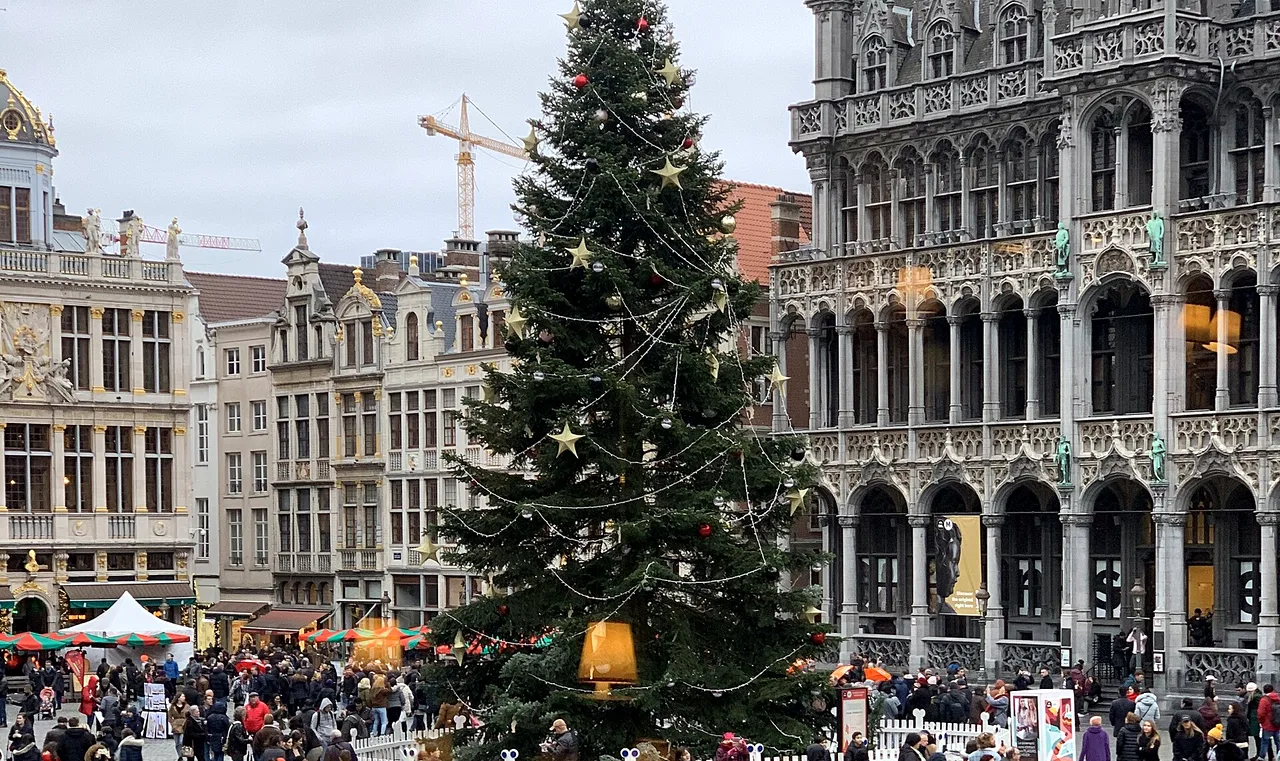
Christmas in Brussels is not a single square but a route through the whole lower town. Winter Wonders – Plaisirs d’Hiver in French, Winterpret in Dutch – strings more than 200 wooden chalets through the historic centre, from the Bourse and Place de la Monnaie past Place De Brouckère to Sainte-Catherine and the long, narrow Marché aux Poissons (Vismet), the old harbour quarter. The chalets sell crafts, decorations, gifts and food from Belgium and beyond. The Grand-Place is the showpiece: a tall Christmas tree stands in front of the Town Hall, and in the evenings the Gothic façade and guild houses become the canvas for a sound-and-light show (not on 24 and 31 December or 3 January). Along the market route there is a Ferris wheel, merry-go-rounds for children and an ice rink with curling. According to visit.brussels, the 2026 edition is the 25th; it also brings activity to the upper town (Place Royale) and to squares such as the Black Tower, the Madeleine and Place Poelaert, and a guest-region village with products from the Béarn, the Pyrenees and the Basque Country is planned near the Bourse. The full programme is due to be published in November 2026. Because everything is on foot and the market route is only a couple of kilometres long, the best plan is to walk it from end to end in the late afternoon, timing your arrival on the Grand-Place for the light show.


| Event | Location | 2026 dates | Note |
|---|---|---|---|
| Winter Wonders / Plaisirs d’Hiver | Grand-Place, Bourse, Place de la Monnaie, Place De Brouckère, Sainte-Catherine, Marché aux Poissons | 27 November 2026–3 January 2027 | Daily 12:00–22:00; closes at 18:00 on 24 and 31 December and on 3 January. More than 200 chalets. |
| Christmas tree and sound-and-light show | Grand-Place | During Winter Wonders | Evening show on the Town Hall and guild houses; no show on 24 and 31 December or 3 January. Check show times on the official page. |
| Ferris wheel, merry-go-rounds and ice rink | Along the market route (Sainte-Catherine / Marché aux Poissons and other squares) | During Winter Wonders | Paid attractions; locations and hours are in the official practical information. |
| Upper town and neighbourhood squares | Place Royale, Black Tower, Madeleine, Place Poelaert | During Winter Wonders | Announced by visit.brussels; the detailed programme is due in November 2026. |
What to try
Vin chaud / glühwein
Hot spiced wine – alcoholic; most chalets also offer hot chocolate or alcohol-free punch.
Croustillons
Small balls of fried dough dusted with icing sugar, a classic Belgian funfair and market treat.
Gaufres
Waffles – the light rectangular Brussels waffle or the denser, caramelised Liège waffle.
Caricoles
Sea snails in a spiced broth, an old Brussels street-food tradition.
Tartiflette and raclette
Melted-cheese dishes from the Alps, very common at the market; some contain bacon.
Speculoos
Spiced caramelised biscuits; around Saint Nicholas’ Day (6 December) they are made in large figure shapes.
Brussels Christmas market tips
- In December it gets dark around 16:30; arrive at the Grand-Place after dusk for the light show.
- Walk the route in one direction: Grand-Place → Bourse → Sainte-Catherine → Marché aux Poissons.
- Weekend evenings are very crowded; weekday afternoons from 12:00 are calmer.
- On 24 and 31 December and 3 January the market closes at 18:00 and there is no light show.
- The lower town has cobblestones and is often wet; waterproof, comfortable shoes help.
- Keep your phone and wallet in front of you in crowds around the Grand-Place and Bourse.
- Combine the evening market with the lit Galeries Royales Saint-Hubert for indoor warmth.
- Check the November programme on plaisirsdhiver.be for concerts and the guest-region village.
Check before you go: Plaisirs d’Hiver – Winter Wonders · practical information (official) ↗ · Ville de Bruxelles · Winter Wonders (official) ↗ · visit.brussels · Winter Wonders (official) ↗
Dates and hours were checked on 28 October 2026 against the official Plaisirs d’Hiver page, the City of Brussels page and visit.brussels. Show times, attractions and the detailed programme (due in November 2026) may change; check the official pages again before you visit.
When to Go
Brussels is a year-round city, but it has two clearly different seasons for visitors. From April to September the days are long, café terraces fill the squares, and in August of even years the Flower Carpet covers the Grand-Place. From late November to early January Winter Wonders lights up the lower town. January to March is grey and damp, but museums are quiet and the city works normally because of the EU institutions.
| Month | City sightseeing | Christmas market | Parks and day trips | Crowds |
|---|---|---|---|---|
| January | Good | Partly | Difficult | Quiet |
| February | Good | None | Difficult | Quiet |
| March | Good | None | Good | Quiet |
| April | Very good | None | Good | Moderate |
| May | Very good | None | Very good | Moderate |
| June | Very good | None | Very good | Moderate |
| July | Very good | None | Very good | Busy |
| August | Very good | None | Very good | Busy |
| September | Very good | None | Very good | Moderate |
| October | Good | None | Good | Moderate |
| November | Good | Market season | Difficult | Moderate |
| December | Good | Market season | Difficult | Busy |
- Brussels has a mild maritime climate: winters are usually just above freezing, but rain and wind are frequent.
- In December the sun rises around 8:40 and sets around 16:40; plan museums for the day and markets for the evening.
- Winter Wonders runs from 27 November 2026 to 3 January 2027; it closes early on 24 and 31 December and on 3 January.
- The Flower Carpet on the Grand-Place takes place in August of even years; check the next edition on official pages.
- The Royal Palace usually opens to the public only in summer (late July to early September); check the dates each year.
- When the European Parliament or summits are in session, hotel demand in the European Quarter rises noticeably.
Visa and Entry (Turkish citizens)
Turkish citizens holding ordinary (burgundy) passports need a Schengen visa for tourist travel to Belgium. Rules differ for special, service and diplomatic passports; check the current situation with the Turkish Ministry of Foreign Affairs.
According to the official visa page of Belgium’s representations in Türkiye, applications are accepted through VFS Global and the application form is completed online in the Visa on Web system. Check the competent post and the current procedure on the official page.
If you combine Brussels with Amsterdam, Cologne or Paris, apply to the country where you will spend the longest; if stays are equal, the country of first entry applies. Checks may take place at internal borders, so carry your passport.
Under the EU Entry/Exit System (EES), which is being introduced in stages, your biometric data (facial image and fingerprints) may be taken on first entry; allow extra time at the border.
Visa fees, appointment times and required documents can change; this guide does not give fees. Use the current lists on the official websites before applying.
Travel medical insurance, accommodation and return details are part of the application; see the official sources for details.
Check before you go: T.C. Dışişleri Bakanlığı · Türk vatandaşlarının tabi olduğu vize uygulamaları ↗ · diplomatie.belgium.be · Türkiye ↗ · EES · europa.eu ↗ · Rota Atlası visa guide (TR)
Travel medical insurance
Check the official visa and entry sources above first: they state whether travel medical insurance is required and the minimum cover. Compare any policy’s cover amount, validity dates and countries covered with the official requirement.
Rota Atlası does not currently offer an insurance partnership; there are no paid links in this section. Last updated: 1 November 2026
Getting to Brussels
- By air: Brussels Airport (BRU) at Zaventem, about 12 km north-east of the centre, is the main airport; Brussels South Charleroi (CRL), about 50 km south, is mainly used by low-cost airlines. Check current flights from Türkiye only on airline and airport websites.
- From Brussels Airport: trains run from the station under the terminal to Brussels-North, Brussels-Central and Brussels-South; there are also STIB buses and taxis. Check timetables on belgiantrain.be and stib-mivb.be.
- From Charleroi: shuttle buses run to Brussels-South, and there is a bus-plus-train connection via Charleroi-South station; check current options on the airport’s official website.
- By train: Brussels-South (Bruxelles-Midi / Brussel-Zuid) is the hub for international high-speed trains to Paris, London, Amsterdam and Cologne; domestic trains reach Bruges, Ghent, Antwerp, Leuven and Mechelen.
Getting Around

On foot
The lower town around the Grand-Place is compact; the upper town (Mont des Arts, Royal Palace, Sablon) is a short uphill walk away.
Metro, tram and bus
STIB-MIVB runs four metro lines, trams and buses; contactless bank cards can be used to pay. Check current tickets on stib-mivb.be.
Trains in the city
The North–South rail link connects Brussels-North, Brussels-Central and Brussels-South; it is useful with luggage and for day trips.
Bike
Shared bikes and scooters are common; traffic in the centre is busy and the old town is hilly and cobbled.
Taxi
Licensed taxis and ride-hailing apps are available; check the fare on the meter or in the app.
Day trips
Leuven, Mechelen, Bruges, Ghent and Antwerp are easy by train from the three main stations.
Things to See
Brussels’ sights fall into a few clusters. The lower town around the Grand-Place holds the medieval core, the Galeries and Sainte-Catherine. The upper town, reached via the Mont des Arts, has the royal quarter, the museums and the Sablon. East of the centre lie the European Quarter and Cinquantenaire Park; south are the Art Nouveau streets of Saint-Gilles and Ixelles; north is the Atomium at Heysel. Plan by cluster to keep walking short on winter days.
UNESCO · Lower town
Grand-Place and the Town Hall

The Grand-Place (Grote Markt) has been the commercial and political centre of Brussels since the Middle Ages. Its Gothic Town Hall was built in the 15th century; the slender tower, almost 100 metres high, is topped by a statue of St Michael slaying the dragon. In August 1695 French troops under Marshal Villeroy bombarded the city and most of the square burned; the guilds rebuilt their houses within a few years, which is why the square has such a unified, richly gilded Baroque look. Opposite the Town Hall stands the Maison du Roi (Broodhuis), now the Brussels City Museum, which also keeps the original Manneken Pis statue. UNESCO listed the square in 1998. In winter it is the stage for the Christmas tree and the sound-and-light show of Winter Wonders. UNESCO listing ↗
Don’t miss
- The Town Hall façade and tower
- The gilded guild houses, each with its own emblem
- The Brussels City Museum in the Maison du Roi
- The evening light show in the Christmas season
Tips
- Visit early in the morning for photos without crowds.
- Town Hall tours depend on the programme; check on brussels.be.
- The Flower Carpet takes place in August of even years.
Îlot Sacré
Galeries Royales Saint-Hubert and Manneken Pis

Opened in 1847 to designs by Jean-Pierre Cluysenaar, the Galeries Royales Saint-Hubert are among the oldest covered shopping arcades in Europe: three sections – the Galerie du Roi, the Galerie de la Reine and the Galerie des Princes – under a single glass vault, lined with chocolatiers, bookshops, cafés and a theatre. Around them lie the narrow lanes of the Îlot Sacré, named after the rue des Bouchers and its restaurants. A few minutes south-west of the Grand-Place is Manneken Pis, the small bronze boy who has become the symbol of the city’s irreverent humour. The figure on the corner is a copy; the 17th-century original by Jérôme Duquesnoy the Elder is in the City Museum. The statue is regularly dressed in costumes, and the GardeRobe MannekenPis museum nearby shows part of his wardrobe of hundreds of outfits.
Don’t miss
- A walk under the glass vault of the Galeries
- Chocolatiers in the arcades
- Manneken Pis and his costume calendar
- GardeRobe MannekenPis
Tips
- The rue des Bouchers has many touts; look at menus and prices before sitting down.
- Manneken Pis is small – expect crowds rather than grandeur.
- The Galeries are a warm, lit shortcut on cold market evenings.
Old harbour
Sainte-Catherine and the Marché aux Poissons

The district of Sainte-Catherine stands on the site of Brussels’ old inner harbour: the basins that once brought boats into the city were filled in during the 19th century, and the long squares of the Marché aux Poissons (Vismet) trace their shape. The neo-Gothic Church of Sainte-Catherine, designed by Joseph Poelaert, closes the view; behind it stands the Black Tower, a fragment of the first city wall. The area is known for seafood and is one of the liveliest parts of Winter Wonders, with the Ferris wheel, merry-go-rounds and many chalets.
Don’t miss
- Sainte-Catherine Church
- The Black Tower (Tour Noire)
- The Marché aux Poissons and the Ferris wheel in winter
- The streets towards Dansaert
Tips
- Evenings are livelier; the Ferris wheel is especially busy at weekends.
- The Black Tower sits awkwardly between modern buildings – look behind the church.
- The area is a good alternative to the Grand-Place for a less crowded evening.
Upper town
Mont des Arts, the Fine Arts Museums and the MIM

The Mont des Arts (Kunstberg) links the lower and upper town with stairs, terraces and formal gardens; from the top there is a classic view down to the Town Hall tower. Around it stand the Royal Library (KBR) and the Royal Museums of Fine Arts of Belgium, whose collections include Flemish masters such as Bruegel and Rubens, the Fin-de-Siècle Museum and the Magritte Museum. Just above, the Old England building of 1899, an Art Nouveau department store of iron and glass, houses the Musical Instruments Museum (MIM), one of the largest collections of its kind; its top-floor café has a wide view over the city.
Don’t miss
- The view from the top of the Mont des Arts
- Bruegel and Rubens in the Old Masters collection
- The Magritte Museum
- The Old England façade and the MIM
Tips
- Museums are often closed on Mondays; check on fine-arts-museum.be and mim.be.
- The gardens are best at sunset for the view.
- Plan at least half a day for the Fine Arts museums.

Royal quarter
Royal Palace, Place Royale and the Parc de Bruxelles

The Royal Palace is the official palace of the King of the Belgians, used for state functions; the royal family lives at Laeken. Its interiors usually open to the public only in summer. Next to it, Place Royale with the equestrian statue of Godfrey of Bouillon and the Church of St Jacques-sur-Coudenberg sits above the remains of the old Coudenberg palace, which can be visited underground. Opposite the palace stretches the Parc de Bruxelles, a formal 18th-century park leading to the Palace of the Nation, seat of the Belgian Parliament.
Don’t miss
- The palace façade and Place Royale
- The Coudenberg archaeological site
- A walk through the Parc de Bruxelles
- The BELvue museum on Belgian history
Tips
- Palace opening dates are announced each year; check before planning.
- Place Royale is part of the Winter Wonders programme in the upper town.
- The park is a quiet connection between the upper town and the European Quarter.

Antiques and chocolate
Sablon, Palais de Justice and the Marolles

The Sablon is the elegant side of the upper town: the Grand Sablon square is lined with antique dealers and chocolatiers and hosts a weekend antiques market, while the late-Gothic Church of Notre-Dame du Sablon is known for its tall stained-glass windows. Across the street the Petit Sablon garden is ringed by small bronze statues representing the old guilds. Further south rises the Palais de Justice, completed in 1883 to designs by Joseph Poelaert and one of the largest buildings of the 19th century; it has been under restoration for many years. A public lift next to it goes down to the Marolles, a traditional working-class quarter with the daily flea market on Place du Jeu de Balle.
Don’t miss
- Notre-Dame du Sablon and its stained glass
- The Petit Sablon garden
- The view from the Palais de Justice terrace
- The Jeu de Balle flea market in the morning
Tips
- The flea market is best in the morning.
- The antiques market on the Grand Sablon takes place at weekends.
- Use the Poelaert lift to avoid the steep walk between the upper and lower town.

Gothic
Cathedral of St Michael and St Gudula

Brussels’ cathedral stands on a slope between the lower and upper town. Built in Brabantine Gothic style from the 13th to the 15th century, it is dedicated to the city’s patron saints, St Michael and St Gudula. The twin-towered white stone façade, the large stained-glass windows of the 16th century and the Baroque pulpit are its highlights. The cathedral is used for national ceremonies, including royal weddings and state funerals, and remains an active church.
Don’t miss
- The twin-tower façade
- The 16th-century stained-glass windows
- The carved Baroque pulpit
- Remains of the earlier Romanesque church (depending on access)
Tips
- Avoid visiting during Mass; check hours on cathedralestmichel.be.
- Concerts are sometimes held in Advent; check the programme.
- It is a few minutes’ walk from Brussels-Central station.

European Quarter
European Quarter and Cinquantenaire

East of the old town lies the European Quarter, home to the European Commission in the cross-shaped Berlaymont building, the Council and the European Parliament. The Parliament can be visited: the Parlamentarium visitor centre explains how the EU works, and the hemicycle is open to visitors on certain days. In nearby Parc Léopold, the House of European History presents the continent’s 20th century. Further east, Cinquantenaire Park, created for the 50th anniversary of Belgian independence, is dominated by a triumphal arch completed in 1905; the wings house the Art & History Museum, Autoworld and the Royal Military Museum.
Don’t miss
- The Parlamentarium and the hemicycle (on visiting days)
- The House of European History
- The Cinquantenaire arch
- The Art & History Museum
Tips
- Check visiting days and security procedures on visiting.europarl.europa.eu.
- Carry ID for EU institution visits.
- The Schuman and Merode metro stations serve the area.


UNESCO · Art Nouveau
Victor Horta’s houses and Stoclet House

Brussels is one of the birthplaces of Art Nouveau. Victor Horta’s town houses of the 1890s, with their iron structures, flowing lines and light-filled stairwells, changed European architecture; four of them – Hôtel Tassel, Hôtel Solvay, Hôtel van Eetvelde and Horta’s own house and studio – were listed by UNESCO in 2000. The house and studio in Saint-Gilles is now the Horta Museum. In the eastern suburbs, Stoclet House, built between 1905 and 1911 by the Viennese architect Josef Hoffmann with a dining-room frieze by Gustav Klimt, has been on the UNESCO list since 2009; it is privately owned and can only be seen from the street. UNESCO listing ↗
Don’t miss
- The Horta Museum (stairwell and glass ceiling)
- Art Nouveau façades in Saint-Gilles and Ixelles
- Stoclet House from the street on avenue de Tervueren
- The Old England building at the Mont des Arts
Tips
- The Horta Museum has limited capacity; book a time slot on hortamuseum.be.
- Interior photography may be restricted.
- Stoclet House is not open to the public; do not enter the property.

Heysel · Laeken
Atomium and the Royal Greenhouses of Laeken

Built for the 1958 World Exhibition (Expo 58), the Atomium represents an iron crystal magnified 165 billion times; it is 102 metres high, and several of its nine spheres can be visited, including a panoramic sphere at the top. Next to it is the Mini-Europe park. In nearby Laeken, the Royal Greenhouses built under King Leopold II by Alphonse Balat – with a young Victor Horta among his collaborators – form a glass city of domes and galleries; they open to the public for only a few weeks each spring.
Don’t miss
- The view from the Atomium’s top sphere
- The Atomium lit up at night
- The Royal Greenhouses (spring opening)
- The Chinese Pavilion and Japanese Tower in Laeken (exterior)
Tips
- Book Atomium tickets on atomium.be at busy times.
- Greenhouse opening dates are announced each year; check before planning.
- Metro line 6 to Heysel serves the area.

Comics
The comic strip route and the Comic Strip Center

Belgium is a great country of comics, and Brussels honours it with a comic strip route: dozens of large murals of characters such as Tintin, Lucky Luke, Gaston, Blake and Mortimer and XIII are painted on walls across the city centre. The Belgian Comic Strip Center is housed in a former textile warehouse designed by Victor Horta in 1906, and presents the history of the art with original drawings and figures from Hergé, Peyo (the Smurfs), Morris (Lucky Luke) and many others.
Don’t miss
- The Tintin mural on rue de l’Étuve
- The XIII and Broussaille murals
- The Comic Strip Center in the Horta building
- Comic bookshops around the Grand-Place
Tips
- Download the mural map from visit.brussels and combine it with a walk through the old town.
- Check the Comic Strip Center’s opening hours on cbbd.be.
- Many murals are on side streets; daylight is best for photos.
Day trips
Leuven, Mechelen and Bruges

Belgium’s dense rail network makes day trips easy. Leuven, a university town since 1425, has one of the most ornate Gothic town halls in Europe on its Grote Markt, the Great Beguinage and a lively student atmosphere. Mechelen, once the capital of the Burgundian Netherlands, is dominated by the tower of St Rumbold’s Cathedral, which can be climbed. Bruges, with its canals, belfry and Christmas markets, is the classic longer day trip; Ghent and Antwerp are also easy by train. Bruges guide → · Antwerp guide →
Don’t miss
- Leuven’s Town Hall and Grote Markt
- St Rumbold’s tower in Mechelen
- The Markt and canals of Bruges
- Ghent’s Gravensteen or Antwerp station (alternatives)
Tips
- Check train times on belgiantrain.be; weekend tickets may differ.
- In winter start early; days are short.
- Leuven and Mechelen can be combined on one line in a single day.

1–3 Day Itineraries, Christmas Day + 7-Day Belgium Route
The itineraries keep walking distances short and take winter daylight into account. One day covers the lower town, two days the upper town and museums, and three days add Art Nouveau, the Atomium or a day trip. The 7-day route links Brussels with Bruges, Ghent and Antwerp by train. Check museum and attraction hours on official websites in advance.
Day 1: The lower town
- In the morning see the Grand-Place and the Town Hall before the crowds arrive.
- Visit the Brussels City Museum in the Maison du Roi.
- Walk through the Galeries Royales Saint-Hubert and the Îlot Sacré to Manneken Pis.
- In the afternoon visit the Cathedral of St Michael and St Gudula.
- In the evening walk to Sainte-Catherine and the Marché aux Poissons.
Day 2: The upper town and museums
- Climb the Mont des Arts and enjoy the view of the Town Hall tower.
- Spend the morning at the Royal Museums of Fine Arts or the Magritte Museum.
- Have a coffee with a view at the MIM in the Old England building.
- In the afternoon see Place Royale, the palace façade and the Parc de Bruxelles.
- End at the Sablon with its chocolatiers and Notre-Dame du Sablon.
Day 3: Art Nouveau, Atomium or a day trip
- In the morning visit the Horta Museum in Saint-Gilles (booked slot).
- Walk past Art Nouveau façades in Saint-Gilles and Ixelles.
- In the afternoon take the metro to the Atomium.
- Alternatively, spend the day in Leuven and Mechelen by train.
- In the evening follow part of the comic strip route.
Christmas market day (27 November 2026–3 January 2027)
- In the morning visit the Mont des Arts and a museum while it is light.
- From 12:00 walk the market from the Bourse to Sainte-Catherine.
- Try croustillons, a waffle or a hot drink at the chalets.
- At dusk ride the Ferris wheel at the Marché aux Poissons.
- Finish on the Grand-Place with the tree and the sound-and-light show (not on 24 and 31 December or 3 January).
7 days: Belgium by train
- Days 1–3: Brussels – lower town, upper town and Art Nouveau.
- Day 4: Bruges – the Markt, the belfry and the canals.
- Day 5: Ghent – Gravensteen and St Bavo’s Cathedral.
- Day 6: Antwerp – Central Station, the Grote Markt and the cathedral.
- Day 7: Leuven or Mechelen, then back to Brussels for departure.
Belgian Food
Belgian cuisine combines French technique with Flemish hearty cooking; chocolate, waffles, fries and a long beer tradition are its best-known exports. Below are regional specialities, not restaurant recommendations.


Gaufres de Bruxelles
The light, crisp, rectangular Brussels waffle, usually served with icing sugar.
Gaufres de Liège
A denser waffle made with pearl sugar that caramelises in the iron.
Frites
Belgian fries, traditionally fried twice and sold in paper cones with sauces.
Moules-frites
Mussels cooked in white wine or broth, served with fries; traditionally a cold-season dish.
Pralines
Filled chocolates; the praline as we know it is associated with the Neuhaus shop in the Galeries Royales.
Carbonade flamande
Beef stewed slowly in beer; the alcohol content of the sauce is reduced but not removed.
Stoemp
Mashed potatoes with vegetables, often served with sausage.
Speculoos
Crunchy spiced caramel biscuits, a Saint Nicholas favourite.
- Many traditional dishes contain pork, beer or wine; ask about ingredients.
- Belgian beer culture is on UNESCO’s intangible heritage list; alcohol-free options are widely available.
- Tap water is drinkable; ask for it explicitly in restaurants.
- Service is usually included in the bill; rounding up is optional.
Culture and Etiquette

- Brussels is bilingual: greet with “Bonjour” in French or “Goeiedag” in Dutch; English is widely accepted.
- Language is a sensitive topic in Belgium; don’t assume everyone speaks French or call Flemish people French.
- Among acquaintances, a single kiss on the cheek is a common greeting; a handshake is standard in business.
- Don’t walk around churches during services and avoid flash photography.
- Saint Nicholas (6 December) is an important children’s holiday in Belgium.
- Comics are a respected art form; murals are part of the city’s heritage.
- Punctuality is expected for appointments and guided tours.
- Queues are respected at bakeries, shops and public transport.
- The EU institutions mean many international visitors; dress and behaviour in the European Quarter are business-like.
- Ask before photographing people, especially at markets and in residential areas.
Safety and Health
- Brussels is generally safe, but pickpocketing is common around the Grand-Place, the Bourse, the metro and the main stations.
- Be especially alert around Brussels-South and Brussels-North stations at night.
- During Winter Wonders, keep bags closed and in front of you in crowds.
- Cobblestones become slippery in rain; wear comfortable, non-slip shoes.
- In an emergency call 112; for police call 101.
- Make sure your travel medical insurance covers the Schengen area.
- Security checks may take place at EU institutions and major events; carry ID.
What Your Budget Depends On
This guide does not give prices; prices change with season and year. Your budget depends on these factors:
Dates
Hotel demand rises during EU summits, Parliament sessions and Winter Wonders weekends.
Where you stay
The lower town is the most convenient; the upper town and the European Quarter are alternatives with different weekday/weekend patterns.
Transport
City transport depends on the ticket type; airport trains carry a station supplement at Brussels Airport.
Museums
Fine Arts, Magritte, Horta, Atomium and the Comic Strip Center are charged separately; some city passes combine entries.
Food and drink
Fries and waffles are budget options; restaurants in the Îlot Sacré can be expensive.
Day trips
Train tickets to Bruges, Ghent or Antwerp add to the budget; weekend tickets may be cheaper.
Free experiences
The Grand-Place, the Galeries, the Mont des Arts, the comic murals, the Parc de Bruxelles and the Winter Wonders market (free entry) cost nothing.
Practical Information
- Money: the euro is used; cards and contactless payment are very common.
- Languages: French and Dutch; English is spoken widely.
- Plugs: 230 V, European type C/E.
- Time: two hours behind Türkiye in winter (CET, UTC+1).
- Opening hours: many museums are closed on Mondays; check before you go.
- Holidays: hours change on 24–26 December and 1 January; Winter Wonders closes early on 24 and 31 December.
- Weather: in December temperatures are usually a few degrees above zero, with frequent rain.
- Daylight: in December the sun sets around 16:40.
- Internet: mobile data and Wi-Fi are widely available.
- Emergency: 112; police 101.
Frequently Asked Questions
When is the Brussels Christmas market in 2026?
According to the official Plaisirs d’Hiver page, Winter Wonders runs from 27 November 2026 to 3 January 2027.
What are the opening hours?
Daily from 12:00 to 22:00; on 24 and 31 December and 3 January the market closes at 18:00.
Where is the market?
In the lower town: the Grand-Place, Bourse, Place de la Monnaie, Place De Brouckère, Sainte-Catherine and the Marché aux Poissons.
Is there a light show on the Grand-Place?
Yes, in the evenings during Winter Wonders, except on 24 and 31 December and 3 January. Check times on the official page.
Is there an entry fee?
Walking around the market is free; attractions such as the Ferris wheel and products are paid for.
Do Turkish citizens need a visa?
Ordinary passport holders need a Schengen visa. According to Belgium’s official page, applications are made through VFS Global; check current conditions on official websites.
How many days are enough for Brussels?
One day for the lower town, two for the upper town and museums, three to add Art Nouveau, the Atomium or a day trip.
How do I get from the airport to the centre?
From Brussels Airport by train to Brussels-Central, North or South, or by STIB bus; from Charleroi by shuttle bus or bus and train.
Can I combine Brussels with Bruges?
Yes, Bruges is easy by train; see the Rota Atlası Bruges guide.
Can I visit the Royal Palace?
The palace usually opens to the public only in summer; check the annual dates on official pages.
Where to stay
Stay close to the areas where you will spend most time. The areas below are covered in detail in this guide; check public transport links in the getting-around section.
- UNESCO · Lower townGrand-Place and the Town Hall
- Îlot SacréGaleries Royales Saint-Hubert and Manneken Pis
- Old harbourSainte-Catherine and the Marché aux Poissons
- Upper townMont des Arts, the Fine Arts Museums and the MIM
- Royal quarterRoyal Palace, Place Royale and the Parc de Bruxelles
- Antiques and chocolateSablon, Palais de Justice and the Marolles
- GothicCathedral of St Michael and St Gudula
- European QuarterEuropean Quarter and Cinquantenaire
- UNESCO · Art NouveauVictor Horta’s houses and Stoclet House
- Heysel · LaekenAtomium and the Royal Greenhouses of Laeken
- ComicsThe comic strip route and the Comic Strip Center
Search hotels in these areas (Hotellook) ↗ (affiliate link)Search on Booking.com ↗
Where to stay in Brussels → · 3 days in Brussels: ready-made itinerary →
Affiliate disclosure: Hotellook, Aviasales, Klook, Airalo, Tiqets and DiscoverCars links are affiliate links; Rota Atlası may earn a commission on bookings made through them, at no extra cost to you. Official and in-guide links are not paid. Last updated: 1 November 2026 · Privacy and affiliates
Transport and connectivity
- Airport transferOptions from the airport to the city are in this guide’s getting there section.
- Mobile data (eSIM)Airalo eSIM ↗ (affiliate link)
- Car hireYou rarely need a car within the city; see getting around first. Compare car hire on DiscoverCars ↗ (affiliate link)
Affiliate disclosure: Hotellook, Aviasales, Klook, Airalo, Tiqets and DiscoverCars links are affiliate links; Rota Atlası may earn a commission on bookings made through them, at no extra cost to you. Official and in-guide links are not paid. Last updated: 1 November 2026 · Privacy and affiliates
Search flights (affiliate link)
Search flights from any airport in any country. Results open on Aviasales in a new tab, where you book.
This form is an affiliate link: Rota Atlası may earn a commission on bookings made via Aviasales (Travelpayouts), at no extra cost to you. Check price, baggage and terms on the booking site. Airport data: OurAirports (public domain).
Flights, hotels and tours
Find tours and tickets
- Winter Wonders (Plaisirs d’Hiver)
GetYourGuide ↗ · Klook ↗ (affiliate link) - Grand-Place
GetYourGuide ↗ · Klook ↗ (affiliate link) - Galeries Royales Saint-Hubert
GetYourGuide ↗ · Klook ↗ (affiliate link) - Manneken Pis
GetYourGuide ↗ · Klook ↗ (affiliate link)
Hotellook, Aviasales, Klook, Airalo and Tiqets links in this box are affiliate links (Travelpayouts): Rota Atlası may earn a commission on bookings made through them, at no extra cost to you. GetYourGuide links currently carry no affiliate code. Check prices and terms with the provider. Last updated: 1 November 2026 · Privacy and affiliates
Sources
- T.C. Dışişleri Bakanlığı · Türk vatandaşlarının tabi olduğu vize uygulamaları ↗
- Embassy of Belgium in Türkiye · Visa for Belgium (official) ↗
- European Union · Entry/Exit System (EES) ↗
- visit.brussels · official tourism agency of Brussels ↗
- Ville de Bruxelles · brussels.be (official) ↗
- Royal Museums of Fine Arts of Belgium (official) ↗
- Musical Instruments Museum · MIM (official) ↗
- Horta Museum (official) ↗
- Atomium (official) ↗
- Cathedral of St Michael and St Gudula (official) ↗
- European Parliament · Visiting (official) ↗
- Belgian Comic Strip Center (official) ↗
- Art & History Museum · Cinquantenaire (official) ↗
- STIB-MIVB · Brussels public transport (official) ↗
- SNCB/NMBS · Belgian Rail ↗
- Brussels Airport (official) ↗
- Brussels South Charleroi Airport (official) ↗
- Visit Leuven (official) ↗
- Visit Mechelen (official) ↗
- GOV.UK · Foreign travel advice · Belgium ↗
- UNESCO World Heritage Centre · La Grand-Place, Brussels ↗
- UNESCO World Heritage Centre · Major Town Houses of the Architect Victor Horta (Brussels) ↗
- UNESCO World Heritage Centre · Stoclet House ↗
- Plaisirs d’Hiver – Winter Wonders · practical information (official) ↗
- Ville de Bruxelles · Winter Wonders (official) ↗
- visit.brussels · Winter Wonders (official) ↗
This page is for information only. Dates, hours, entry rules and transport information can change; check the official sources above before travelling. No prices, flights, hotels or restaurants have been invented in this guide.
Photo credits
The photos on this page come from Wikimedia Commons and are used under the stated authors and licences (CC BY, CC BY-SA, CC0 or public domain). Full list of sources
- Christmas tree and illuminated guild houses on the Grand-Place in Brussels — Ashley Bayles · CC BY 2.0 · Wikimedia Commons
- Winter Wonders Christmas tree on the Grand-Place — Pjposullivan1 · CC BY-SA 2.0 · Wikimedia Commons
- The Town Hall and Christmas tree during the light show on the Grand-Place — Ashley Bayles · CC BY 2.0 · Wikimedia Commons
- Illuminated balloons and Ferris wheel at Winter Wonders — Edison McCullen · CC BY-SA 4.0 · Wikimedia Commons
- Winter Wonders Ferris wheel at the Marché aux Poissons — T. Thielemans · CC BY 3.0 · Wikimedia Commons
- Merry-go-round at the Brussels Christmas market — Bernard Lee · CC0 · Wikimedia Commons
- Market chalets at Winter Wonders in the evening — Bernard Lee · CC0 · Wikimedia Commons
- The guild houses of the Grand-Place — Celuici · CC BY-SA 4.0 · Wikimedia Commons
- Brussels Town Hall (Hôtel de Ville) and its Gothic tower — Paasikivi · CC BY-SA 3.0 · Wikimedia Commons
- The glass-roofed arcade of the Galeries Royales Saint-Hubert — Diego Delso · CC BY-SA 4.0 · Wikimedia Commons
- The Manneken Pis statue — Trougnouf · CC BY 4.0 · Wikimedia Commons
- Sainte-Catherine Church and square — Fred Romero from Paris, France · CC BY 2.0 · Wikimedia Commons
- The Mont des Arts gardens and city view — Trougnouf (Benoit Brummer) · CC BY 4.0 · Wikimedia Commons
- Building of the Royal Museums of Fine Arts of Belgium — iMahesh · CC BY-SA 4.0 · Wikimedia Commons
- Art Nouveau façade detail of the Old England building (Musical Instruments Museum) — Ad Meskens · CC BY-SA 4.0 · Wikimedia Commons
- The Royal Palace of Brussels — Daniel Huet · CC0 · Wikimedia Commons
- Tree-lined path in the Parc de Bruxelles — Q. Keysers · CC BY-SA 3.0 · Wikimedia Commons
- The Church of Notre-Dame du Sablon — Voyager747 · CC BY-SA 4.0 · Wikimedia Commons
- The dome of the Palais de Justice — Jorge Franganillo · CC BY 2.0 · Wikimedia Commons
- Façade of the Cathedral of St Michael and St Gudula — Danny William Wilson · CC BY-SA 4.0 · Wikimedia Commons
- Interior of the Cathedral of St Michael and St Gudula — Diego Delso · CC BY-SA 4.0 · Wikimedia Commons
- The triumphal arch in Cinquantenaire Park — Marc Ryckaert · CC BY 3.0 · Wikimedia Commons
- The plenary chamber of the European Parliament — Ash Crow · CC BY-SA 3.0 · Wikimedia Commons
- The Berlaymont building of the European Commission — Trougnouf (Benoit Brummer) · CC BY 4.0 · Wikimedia Commons
- Glass ceiling and Art Nouveau staircase in the Horta Museum — Oxyman · CC BY 2.5 · Wikimedia Commons
- Stoclet House (Palais Stoclet) — Busoni · CC BY-SA 3.0 · Wikimedia Commons
- The Atomium illuminated at night — Diego Delso · CC BY-SA 4.0 · Wikimedia Commons
- The Royal Greenhouses of Laeken — Michiel Dumon · CC BY-SA 3.0 · Wikimedia Commons
- The XIII mural on the Brussels comic strip route — Ferran Cornellà · CC BY-SA 3.0 · Wikimedia Commons
- The Gothic town hall on the Grote Markt in Leuven — Latinista · CC BY-SA 3.0 · Wikimedia Commons
- The Grote Markt of Mechelen with the tower of St Rumbold’s Cathedral — Jorge Franganillo · CC BY 2.0 · Wikimedia Commons
- A STIB tram at Heysel — Oxyman · CC BY 2.5 · Wikimedia Commons
- A Belgian waffle — Prashanthns (talk) · CC BY-SA 3.0 · Wikimedia Commons
- Belgian fries (frites) — Gpkp · CC BY-SA 4.0 · Wikimedia Commons
- Belgian chocolates and pralines — BrokenSphere · CC BY-SA 3.0 · Wikimedia Commons
- Mussels (moules) with fries — Miguel Discart · CC BY-SA 2.0 · Wikimedia Commons
- Lucky Luke figure at the Belgian Comic Strip Center — Spielvogel · CC BY-SA 3.0 · Wikimedia Commons
Valkenburg → · Liège → · Arras → · Amiens → · Lille → · Luxembourg → · Antwerp → · Bruges → · Amsterdam → · Cologne → · Aachen → · Paris → · Christmas markets