

Aachen lies at Germany’s far western edge in North Rhine-Westphalia, where Germany, Belgium and the Netherlands meet. The Romans already used its hot springs, and around the year 800 Charlemagne made Aachen his favourite residence. His Palatine Chapel, an octagonal domed church inspired by late antique and Byzantine models, became the core of today’s Aachen Cathedral; Charlemagne was buried here in 814, and for six centuries German kings were crowned in Aachen. In 1978 the cathedral became the first German site on the UNESCO World Heritage List. Opposite, the Gothic Town Hall stands on the foundations of Charlemagne’s palace hall; its Coronation Hall hosts the ceremony of the International Charlemagne Prize, awarded since 1950 for services to European unity. Aachen is also a spa city with Central Europe’s hottest springs, a lively university town (RWTH Aachen) and the home of Aachener Printen, the hard spiced Christmas biscuit. Its people speak their own dialect, Öcher Platt – Aachen is “Oche” in it. In Advent the Aachen Christmas Market fills the squares around the cathedral and the Town Hall; in 2026 it is held for the 53rd time and carries the “Excellent European Christmas Market” seal. This guide brings together the market, the cathedral and treasury, the Town Hall, thermal springs, fountains and museums, day trips to the Three-Country Point, Maastricht and Monschau, and practical information – with official sources.
Content updated: 28 October 2026 · Christmas market dates and hours checked on the official pages of the organiser MAC (Märkte und Aktionskreis City e.V.)
Aachen at a Glance
- Country
- Germany · North Rhine-Westphalia; at the border with Belgium and the Netherlands
- Population
- Around 250,000
- Language
- German (and the local Öcher Platt); English widely understood; Dutch and French nearby
- Currency
- Euro (EUR); cards widely accepted, carry some cash for stalls
- Time zone
- Central European Time (CET, UTC+1); in winter 2 hours behind Türkiye
- UNESCO
- Aachen Cathedral, since 1978 – the first German World Heritage Site
- Landmarks
- Cathedral and Palatine Chapel, Cathedral Treasury, Town Hall, Katschhof, Elisenbrunnen, Ponttor, Marschiertor, Lousberg
- Nearby
- Three-Country Point (Vaalserberg), Maastricht, Monschau, Kornelimünster, Cologne, Liège
- Christmas
- Christmas market 20 November–23 December 2026, daily 11:00–21:00 (exceptions)
- Airports
- Cologne Bonn, Düsseldorf; small Maastricht Aachen Airport; Brussels by train
- Electricity
- 230 V, European (C/F) sockets; Turkish plugs fit
- Emergency
- 112 (ambulance/fire), 110 (police)
Aachen in Pictures
The Imperial Cathedral, the Town Hall from the Katschhof and the Elisenbrunnen: Aachen in three pictures.


Aachen Christmas Market 2026
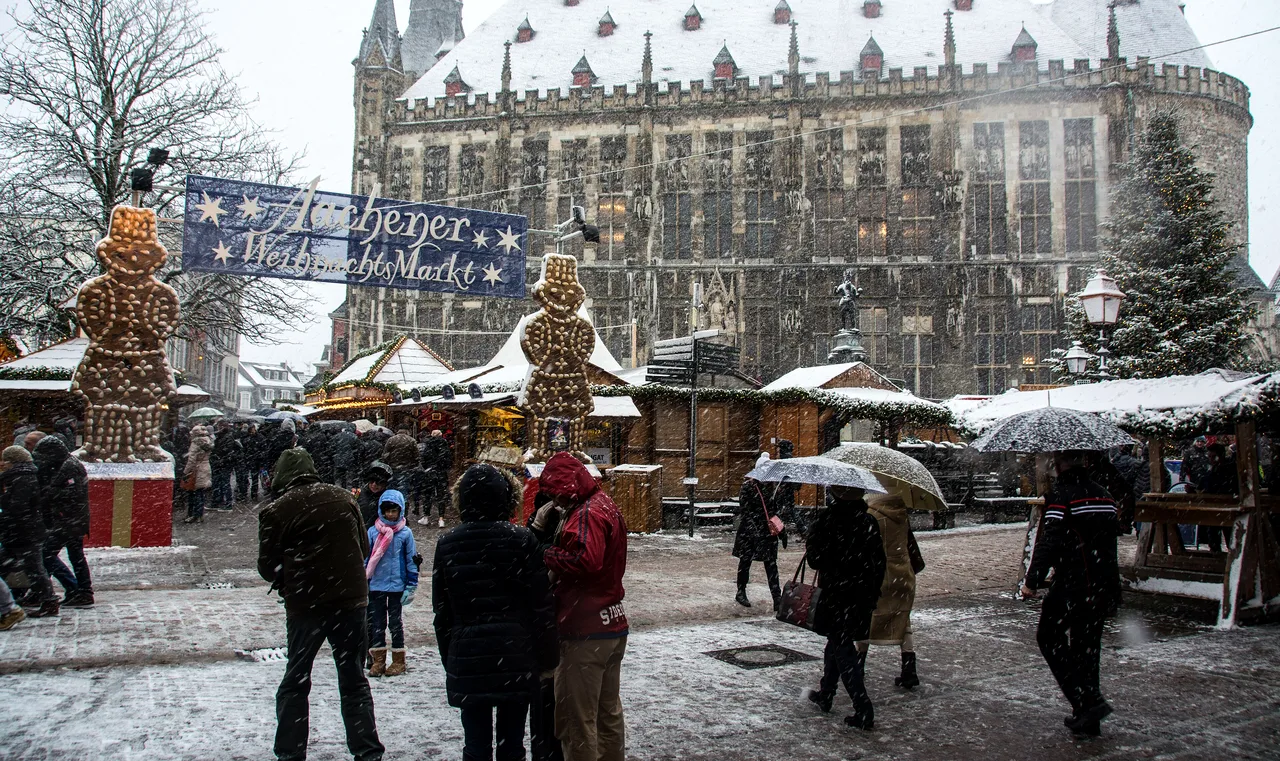
The Aachen Christmas Market is one of the best-known in Germany and spreads across the historic squares at the heart of the old town: the Markt in front of the Town Hall, the Katschhof between the Town Hall and the cathedral, and the lanes around the Münsterplatz and the cathedral. More than 120 traders sell Christmas decorations, crafts, gifts and food in wooden stalls, framed by two of the most important buildings in German history – the Gothic coronation Town Hall and Charlemagne’s cathedral. By tradition the market opens when the large illuminated Printenmann figure stands and the Christmas tree is lit. Printen, the hard spiced biscuits from Aachen, are sold everywhere – plain, with chocolate, with nuts – alongside Öcher Punsch and Glühwein. In the evening the Town Hall façade is lit up, the cathedral’s Gothic choir glows above the stalls and the narrow streets between them fill with visitors from Germany, Belgium and the Netherlands. The organiser MAC offers free WLAN on the market and recommends arriving by public transport or Park and Ride. On Sunday 6 December 2026 shops in the city centre are open from 13:00 to 18:00. In April 2026 the market received the “Excellent European Christmas Market” seal.


| Event | Location | 2026 dates | Note |
|---|---|---|---|
| Aachener Weihnachtsmarkt | Around the cathedral and Town Hall: Markt, Katschhof, Münsterplatz and surrounding lanes | 20 November–23 December 2026 | Daily 11:00–21:00 (official organiser MAC). |
| Totensonntag | Whole market | Sunday 22 November 2026 | Opens only 18:00–21:00. |
| Late Saturday | Whole market | Saturday 12 December 2026 | Open 11:00–22:00. |
| Last day | Whole market | Wednesday 23 December 2026 | Open 11:00–20:00. |
| Shopping Sunday | City-centre shops | Sunday 6 December 2026 | Shops open 13:00–18:00 (verkaufsoffener Sonntag). |
What to try
Aachener Printen
Hard spiced biscuits sweetened with syrup, a protected regional speciality; plain, chocolate-coated or with nuts.
Öcher Punsch
Aachen’s hot punch – alcoholic; ask for children’s punch as an alternative.
Glühwein
Spiced hot wine, served in mugs with a deposit.
Reibekuchen
Crisp potato fritters, often eaten with apple sauce.
Gebrannte Mandeln
Sugar-roasted almonds sold warm in paper cones.
Waffles and crêpes
A reminder that Belgium is only a few kilometres away.
Tips for the Aachen Christmas market
- Visit the cathedral in the morning, before the market crowds; in the evening it is usually closed to visitors.
- Weekends bring many day visitors from Belgium and the Netherlands; weekday afternoons are calmer.
- Arrive by train, bus or Park and Ride as the organiser recommends; parking in the centre is scarce.
- Note the special hours: 22 November only from 18:00, 12 December until 22:00, 23 December until 20:00.
- Printen keep well and make a classic gift; check ingredients if you have allergies.
- Glühwein and punch mugs carry a deposit; return the mug to get it back.
- The cobblestones around the cathedral can be slippery when wet; wear good shoes.
- The market ends on 23 December; check holiday hours of museums separately.
Check before you go: MAC · Aachener Weihnachtsmarkt (official organiser) ↗ · Aachener Weihnachtsmarkt · aachenweihnachtsmarkt.de (official) ↗
Dates and hours were checked on 28 October 2026 on the official pages of the organiser MAC. The programme can change; check the official pages again before your visit.
When to Go
Aachen has a mild, damp climate influenced by the Atlantic. Spring and autumn are pleasant for walks in the old town and on the Lousberg. Summer brings the CHIO international horse show and terraces in the old town. From late November to 23 December the Christmas market fills the squares around the cathedral. January and February are grey and wet but the cathedral and museums are calm; the carnival season peaks in February or March.
| Month | City sightseeing | Christmas market | Day trips | Crowds |
|---|---|---|---|---|
| January | Difficult | None | Difficult | Quiet |
| February | Difficult | None | Difficult | Quiet |
| March | Good | None | Good | Quiet |
| April | Good | None | Very good | Moderate |
| May | Very good | None | Very good | Moderate |
| June | Very good | None | Very good | Moderate |
| July | Very good | None | Very good | Moderate |
| August | Very good | None | Very good | Moderate |
| September | Very good | None | Very good | Moderate |
| October | Good | None | Very good | Moderate |
| November | Good | Market season | Good | Busy |
| December | Good | Market season | Difficult | Busy |
- Winters are mild for Germany, usually just above freezing, often rainy; snow is rare.
- In December the sun sets around 16:30; plan sightseeing for daylight.
- The Christmas market runs from 20 November to 23 December 2026.
- The CHIO horse show takes place in summer; check dates on the official website.
- Cathedral visits are restricted during services; check times on the official cathedral website.
- Advent weekends are busy; book accommodation early.
Visa and Entry (Turkish citizens)
Turkish citizens with an ordinary (burgundy) passport need a Schengen visa for tourist travel to Germany. Different rules apply to special, service and diplomatic passports; check the current status with the Turkish Ministry of Foreign Affairs.
You apply to the consulate of your main destination. If Germany is the main destination, the German missions in Türkiye are responsible; current information on the procedure is at tuerkei.diplo.de.
Aachen trips often include Maastricht (Netherlands) or Belgium. Apply to the country of the longest stay, or the country of first entry if the stays are equal. Checks at internal borders are possible; always carry your passport, even on a short trip across the border.
Under the EU Entry/Exit System (EES), being phased in, biometric data (facial image and fingerprints) may be recorded on first entry; allow extra time at the border.
Visa fees, appointment waiting times and required documents can change; this guide does not give fees. Use the current list on the official websites before you apply.
Travel medical insurance and proof of accommodation and return travel are part of the application; see the official sources for details.
Check before you go: T.C. Dışişleri Bakanlığı · Türk vatandaşlarının tabi olduğu vize uygulamaları ↗ · tuerkei.diplo.de ↗ · EES · europa.eu ↗ · Rota Atlası visa guide (TR)
Travel medical insurance
Check the official visa and entry sources above first: they state whether travel medical insurance is required and the minimum cover. Compare any policy’s cover amount, validity dates and countries covered with the official requirement.
Rota Atlası does not currently offer an insurance partnership; there are no paid links in this section. Last updated: 1 November 2026
Getting to Aachen
- By air: the nearest large airports are Cologne Bonn (CGN) and Düsseldorf (DUS), both connected to Aachen by train via Cologne; Brussels Airport is reachable via Brussels. Maastricht Aachen Airport (MST) is small. Check current flights from Türkiye only on airline and airport websites.
- By train: Aachen Hauptbahnhof is on the line between Cologne and Brussels; ICE and Eurostar trains reach Cologne in around 40 minutes and Brussels in around 1 hour 15 minutes, and regional trains run to Cologne, Düsseldorf and Liège. Check timetables on bahn.de.
- By bus across the border: regional buses connect Aachen with Maastricht, Vaals and Eupen; check timetables on the official public transport websites.
- From the station to the old town: Aachen Hauptbahnhof is south of the old town; the cathedral is around 15 minutes on foot, and many buses run to the Elisenbrunnen and Bushof.
Getting Around

On foot
The old town inside the inner ring is compact; from the Elisenbrunnen to the cathedral and the Town Hall is only a few minutes.
Bus
Aachen has no tram; an extensive bus network (ASEAG) connects the city and suburbs. Tickets follow the AVV tariff; the Deutschlandticket is valid on buses and regional trains.
Across borders
The Euregio ticket is valid on buses and trains in the border region of Germany, Belgium and the Netherlands; check current conditions on official websites.
Bicycle
Aachen is hilly; e-bikes help. The old town has cobblestones and busy streets.
Park and Ride
In Advent the organiser recommends Park and Ride car parks with buses to the centre.
Day trips
The Three-Country Point, Maastricht, Monschau, Kornelimünster and Cologne are easy by bus or train.
Things to See
Aachen’s old town lies inside two rings that follow the medieval walls. At its centre are the cathedral and the Town Hall, linked by the Katschhof; the Elisenbrunnen and the shopping streets lie just to the south-east, the Ponttor to the north and the Marschiertor to the south near the station. The Lousberg rises north of the centre, Burtscheid with its hot springs lies to the south-east, and the Three-Country Point lies on the edge of the city to the south-west.
UNESCO World Heritage
Aachen Cathedral and the Palatine Chapel

The heart of Aachen Cathedral is the Palatine Chapel of Charlemagne, built from around 796 to about 805 by the architect Odo of Metz. Its octagon, crowned by a dome and surrounded by a sixteen-sided ambulatory, was inspired by late antique and Byzantine buildings and was for centuries the largest domed structure north of the Alps. Charlemagne was buried here in 814, and from 936 to 1531 more than thirty German kings were crowned in Aachen. The Barbarossa chandelier hangs in the octagon; the stone throne of Charlemagne stands in the gallery and can only be seen on a guided tour. In the 14th and 15th centuries the Gothic choir hall was added, completed in 1414 – with its tall windows it is called Aachen’s “glass house”. It holds the golden shrines of Charlemagne (completed 1215) and of the Virgin Mary (1239) and the Pala d’oro altar front. In 1978 the cathedral became the first German site on the UNESCO World Heritage List. UNESCO listing ↗
Don’t miss
- The Carolingian octagon and dome
- The Barbarossa chandelier
- The Gothic choir hall with the shrines of Charlemagne and Mary
- The throne of Charlemagne (guided tour only)
Tips
- Opening times are restricted during services; check them on aachenerdom.de.
- A photo permit may be required for photography inside; check the current rules.
- Guided tours including the throne should be booked in advance.


Treasury
The Cathedral Treasury (Domschatzkammer)

The Aachen Cathedral Treasury is one of the most important church treasuries in Northern Europe. Its highlights include the Lothar Cross from around the year 1000, set with gems and an ancient cameo of Emperor Augustus; the silver-gilt bust of Charlemagne from the 14th century, which contains part of his skull; and the Persephone sarcophagus, a Roman marble coffin in which Charlemagne is believed to have been buried at first. Liturgical textiles, ivories and reliquaries complete the collection. Every seven years the Aachen pilgrimage (Heiligtumsfahrt) shows the four great relics to the public.
Don’t miss
- The Lothar Cross
- The bust of Charlemagne
- The Persephone sarcophagus
- Ivories and medieval textiles
Tips
- Check opening times and combination tickets with a cathedral tour on aachenerdom.de.
- The treasury is around the corner from the cathedral cloister.
- Allow at least an hour.
Coronation hall
Town Hall, Markt and the Charlemagne Prize

The Gothic Town Hall was built in the 14th century on the foundations of Charlemagne’s palace hall (aula regia); parts of the Carolingian Granus Tower survive in its east side. On the upper floor the Coronation Hall hosted the banquets after the coronations; today it is decorated with 19th-century frescoes of Charlemagne’s life by Alfred Rethel and holds copies of the imperial regalia. Every year it hosts the ceremony of the International Charlemagne Prize of Aachen, awarded since 1950 to people and institutions who have served European unity. In front of the Town Hall, the Charlemagne Fountain stands in the middle of the Markt – in Advent the centre of the Christmas market.
Don’t miss
- The Coronation Hall and the Rethel frescoes
- Copies of the imperial regalia
- The Charlemagne Fountain on the Markt
- The Town Hall façade with its statues of kings
Tips
- The Town Hall is closed to visitors during events; check opening times on aachen.de.
- An audio guide is usually available; check current options.
- The view of the illuminated Town Hall is best from the Markt in the evening.

Between Town Hall and cathedral
Katschhof and Centre Charlemagne

The Katschhof, the square between the Town Hall and the cathedral, occupies the site of the courtyard of Charlemagne’s palace; from here you see both buildings at once. In Advent it is part of the Christmas market. On the Katschhof the Centre Charlemagne, the city museum opened in 2014, tells the history of Aachen from the Romans and Charlemagne to the present and is the starting point of the “Route Charlemagne”, a route connecting the city’s historic sites.
Don’t miss
- The view of the cathedral and Town Hall from the Katschhof
- The Centre Charlemagne exhibition
- The Christmas market stalls on the Katschhof
- The cathedral choir at dusk
Tips
- Check the museum’s opening times on the official Centre Charlemagne website.
- The museum is a good first stop to understand the city’s history.
- On wet days the Katschhof cobblestones are slippery.


Spa city
Elisenbrunnen and the thermal springs

Aachen’s hot springs gave the city its Roman name, Aquae Granni, and its later fame as a spa. The Elisenbrunnen, a Neoclassical colonnade built in 1822–27 to designs by Johann Peter Cremer with input from Karl Friedrich Schinkel, has two fountains where the warm, sulphurous thermal water runs – you can smell it from a distance. Plaques list famous guests who took the waters. Behind it lies the Elisengarten, where glass windows show archaeological finds. Today the Carolus Thermen spa outside the old town uses the thermal water for pools and saunas.
Don’t miss
- The warm fountains in the Elisenbrunnen
- The plaques of famous spa guests
- The Elisengarten and its archaeological window
- The Carolus Thermen (separate admission)
Tips
- The water is not drinking water for large quantities; the smell is sulphurous.
- Check opening times and rules for the Carolus Thermen on the official website.
- The Elisenbrunnen is a central meeting point and bus stop.
Old town
Fountains and lanes of the old town

Aachen’s old town is full of fountains with figures that tell local stories. The Puppet Fountain (Puppenbrunnen) on Krämerstraße, created in 1975 by Bonifatius Stirnberg, has movable bronze figures representing the city’s life – the market woman, the bishop, the horseman, the professor and others. The Chicken Thief (Hühnerdieb) fountain on the Hühnermarkt shows a thief with a chicken that he has stolen. On the Fischmarkt the Fischpüddelchen fountain shows a fisher boy. Between them, lanes such as Hof, Büchel and Pontstraße offer cafés, old houses and student bars.
Don’t miss
- The movable figures of the Puppenbrunnen
- The Hühnerdieb fountain
- The Fischpüddelchen on the Fischmarkt
- The Hof square with its Roman columns
Tips
- Children may move the figures of the Puppenbrunnen – carefully.
- The fountains are close to the cathedral and the market.
- Pontstraße is lively in the evening, especially with students.


Medieval walls
Ponttor and Marschiertor

Of Aachen’s medieval city walls, built from the 13th century onwards, two great gates survive. The Ponttor at the northern end of Pontstraße was the gate on the road towards Maastricht and has a forecourt with a bastion. The Marschiertor near the station guarded the road to the south; with its massive towers it is one of the largest surviving city gates in Germany. The course of the walls can still be traced in the inner and outer rings.
Don’t miss
- The Ponttor and its bastion
- The Marschiertor near the station
- A walk along Pontstraße
- Traces of the walls on the ring roads
Tips
- The gates are generally viewed from outside; check special openings locally.
- The Marschiertor is a good stop on the way from the station.
- Combine the Ponttor with the Lousberg.

Art and living culture
Couven Museum, Suermondt-Ludwig-Museum and Ludwig Forum

The Couven Museum, in a townhouse on the Hühnermarkt, shows the living culture of Aachen’s bourgeoisie from the Rococo to the Biedermeier period; it is named after the Aachen architects Johann Joseph and Jakob Couven. The Suermondt-Ludwig-Museum in a 19th-century villa has paintings and sculptures from the Middle Ages to the 20th century. The Ludwig Forum für Internationale Kunst, in a former umbrella factory, is dedicated to contemporary art.
Don’t miss
- The period rooms of the Couven Museum
- Medieval sculpture in the Suermondt-Ludwig-Museum
- Contemporary art in the Ludwig Forum
- The Hühnermarkt square
Tips
- Check opening times on the official museum websites; many museums are closed on Mondays.
- Aachen museums sometimes offer combination tickets; check current offers.
- The Couven Museum is very close to the cathedral.

City hill
Lousberg and the devil’s legend

The Lousberg, a wooded hill north of the old town, is Aachen’s favourite park and viewpoint. A legend explains its origin: the devil, cheated by the people of Aachen over the building of the cathedral, wanted to bury the city under a giant bag of sand, but a clever market woman tricked him into dropping it – so the hill was formed. A sculpture of the devil and the market woman stands on the hill. In the cathedral, the bronze wolf at the Wolfstür is linked to another part of the same legend. From the top there is a view over the city and the cathedral.
Don’t miss
- The sculpture of the devil and the market woman
- The view over Aachen and the cathedral
- A walk through the park
- The wolf at the cathedral’s Wolfstür
Tips
- The paths are steep in places and muddy after rain.
- Go in daylight; the park is dark in the evening.
- Combine with the Ponttor on the way back.

Hot springs
Burtscheid

Burtscheid, south-east of the centre, was a separate spa town until 1897 and has some of the hottest springs in Central Europe; the warm water steams in winter at a public fountain. Above the town stand the Baroque church of St Michael and the former abbey church of St John the Baptist, both designed by Johann Joseph Couven. The old spa quarter with its spa park is quieter than the old town.
Don’t miss
- St Michael’s Church
- The abbey church of St John
- The steaming hot-spring fountain
- The spa park
Tips
- Buses connect the centre with Burtscheid; check timetables on the official website.
- Check church opening times locally.
- Pleasant for a quieter half-day.
Three countries
Three-Country Point and Maastricht

On the Vaalserberg south-west of Aachen, at 322 metres the highest point of the continental Netherlands, the borders of Germany, Belgium and the Netherlands meet. Until 1920 there was even a fourth territory here: Neutral Moresnet, a tiny zone of zinc mines. Today there are viewing towers, a labyrinth and cafés. Maastricht, around 30 kilometres away in the Netherlands, has a historic centre on the Meuse, the Sint Servaasbrug bridge, the Vrijthof square and its own Christmas market; it is reached by bus or train. Liège in Belgium and Brussels are further destinations. Brussels guide →
Don’t miss
- The three-country boundary stone
- The view from the towers
- Maastricht’s Vrijthof and Sint Servaasbrug
- The border experience in a few steps
Tips
- Buses run to Vaals and the Vaalserberg; check timetables before you go.
- Carry your passport when crossing borders.
- In winter the Vaalserberg is windy and can be foggy.

Eifel
Monschau and Kornelimünster

Monschau, in the Eifel south of Aachen, is a small town of half-timbered and slate houses along the narrow valley of the Rur, overlooked by a castle. The Red House (Rotes Haus) recalls the cloth merchants who made the town wealthy. In Advent Monschau holds its own Christmas market; check dates on the official town website. Closer to Aachen, Kornelimünster is a picturesque village with a former Benedictine abbey and the provostry church of St Kornelius.
Don’t miss
- The half-timbered houses on the Rur
- The Red House
- The castle view
- Kornelimünster as a shorter trip
Tips
- Monschau is best reached by bus; check timetables in advance.
- Monschau’s market dates are published by the town – check before you go.
- The streets are steep and cobbled; wear good shoes.
1–3 Day Routes, a Christmas Day + 7 Days on the Meuse–Rhine Route
The routes keep walking short and consider the short winter days. One day covers the cathedral, treasury and Town Hall, two days add thermal springs, museums and the Lousberg, three days a day trip across the border. The 7-day route connects Aachen with Maastricht, Liège, Brussels and Cologne. Check opening hours in advance on official websites.
Day 1: Charlemagne’s Aachen
- Start at the cathedral when it opens; book a tour with the throne if possible.
- Visit the Cathedral Treasury.
- Cross the Katschhof to the Centre Charlemagne.
- After lunch visit the Coronation Hall in the Town Hall.
- End at the Markt and the Charlemagne Fountain in the evening.
Day 2: Springs, fountains and museums
- Start at the Elisenbrunnen with its warm water.
- Walk past the Puppenbrunnen and Hühnerdieb.
- Visit the Couven Museum or the Suermondt-Ludwig-Museum.
- In the afternoon walk via the Ponttor up the Lousberg.
- Optionally end the day at the Carolus Thermen.
Day 3: Across the border
- Take the bus to the Three-Country Point on the Vaalserberg.
- Continue to Maastricht by bus or train.
- Walk to the Vrijthof and the Sint Servaasbrug.
- Alternatively spend the day in Monschau in the Eifel.
- Return to Aachen in the evening.
Christmas market day (20 November–23 December 2026)
- Visit the cathedral in the morning, before the crowds.
- See the treasury or the Town Hall around midday.
- Walk round the Christmas market on the Markt and the Katschhof from the afternoon.
- Buy Printen and try Öcher Punsch.
- Stay until dusk to see the illuminated Town Hall and cathedral (market until 21:00, special hours on some days).
7 days: Meuse–Rhine route
- Days 1–3: Aachen – cathedral, Town Hall, springs, Lousberg and the Three-Country Point.
- Day 4: Maastricht – old town on the Meuse.
- Day 5: Liège – a city on the Meuse in Belgium (check trains).
- Day 6: Brussels – Grand-Place and Christmas lights.
- Day 7: Cologne – cathedral and Christmas markets, departure from Cologne Bonn or Düsseldorf.
Printen and Aachen Food
Aachen’s cuisine is Rhineland food with Belgian and Dutch influences – and above all Printen. Below are regional specialities, not restaurant recommendations.


Aachener Printen
Hard spiced biscuits with syrup, a protected regional speciality; plain, with chocolate or nuts.
Öcher Punsch
Aachen’s hot punch, popular at the Christmas market; alcoholic.
Reisfladen
A tart with a rice pudding filling, often with fruit – a local café classic.
Sauerbraten
Marinated braised beef with a sweet and sour sauce, sometimes thickened with Printen.
Reibekuchen
Potato fritters with apple sauce.
Himmel un Ääd
“Heaven and earth”: mashed potatoes and apple with black pudding; contains pork blood.
Aachener Puttes
A local blood sausage; contains pork.
Belgian waffles and fries
Neighbourly influences you will find all over the city.
- Some traditional dishes contain pork or blood sausage; ask about ingredients.
- Printen often contain nuts and gluten; check if you have allergies.
- Tap water is drinkable; ask for it explicitly.
- Service is included; rounding up a little is customary.
Culture and Etiquette

- A simple “Guten Tag” is always appropriate; locals also greet each other in Öcher Platt.
- Aachen is “Oche” in the local dialect, and its people are “Öcher”.
- Respect services and the quiet in the cathedral; do not use flash.
- The carnival season is important; the “Order Against Deadly Seriousness” (Orden wider den tierischen Ernst) is awarded here.
- Aachen is a European and student city; many languages are heard.
- Queues are respected at bakeries, stalls and bus stops.
- Cash is still used for small amounts at stalls.
- Cyclists use marked lanes; do not walk on them.
- Sunday is a day of rest; most shops are closed (except the 6 December shopping Sunday).
- Ask before photographing people, especially at the markets.
Safety and Health
- Aachen is generally safe; watch your valuables in market crowds and on buses and trains.
- Cobblestones and steps around the cathedral can be slippery when wet.
- Look out for buses in the narrow old-town streets.
- Always carry your passport when crossing into Belgium or the Netherlands.
- In an emergency call 112, police 110.
- Make sure your travel medical insurance covers the Schengen area.
- Pharmacies (Apotheke) post the address of the pharmacy on duty at the door.
What Your Budget Depends On
This guide does not give prices; prices change with season and year. Your budget depends on these factors:
Dates
Advent weekends, carnival and the CHIO raise hotel demand.
Where to stay
The old town is most convenient; the station area is an alternative.
Transport
Buses and regional trains are covered by the Deutschlandticket; the Euregio ticket covers the border region.
Sights
The cathedral is free to enter outside guided tours; treasury, Town Hall and museums charge admission.
Food and drink
Printen and market snacks are inexpensive; restaurant prices vary widely.
Day trips
Maastricht, Liège or Monschau add bus or train costs.
Free experiences
The Christmas market (free entry), the cathedral exterior, the Elisenbrunnen, the fountains and the Lousberg cost little or nothing.
Practical Information
- Money: Euro; cards are widely accepted, but carry some cash.
- Language: German; English is understood in tourism.
- Plugs: 230 V, European types C/F.
- Time: in winter 2 hours behind Türkiye (CET, UTC+1).
- Opening hours: many museums are closed on Mondays; check before you go.
- Shops: closed on Sundays except special openings; the market is open.
- Holidays: hours change on 24–26 and 31 December and 1 January.
- Weather: in December mild, wet and grey; snow is rare.
- Daylight: in December the sun sets around 16:30.
- Emergency: 112; police 110.
Frequently Asked Questions
When is the Aachen Christmas market 2026?
According to the official organiser MAC, from 20 November to 23 December 2026 around the cathedral and the Town Hall.
What are the opening hours?
Daily 11:00–21:00; on 22 November only 18:00–21:00, on 12 December until 22:00 and on 23 December until 20:00.
Is entry free?
Yes, walking around the market is free; food and drinks cost money.
Do Turkish citizens need a visa?
Holders of ordinary passports need a Schengen visa. If Germany is the main destination, apply to the German missions in Türkiye; current information is at tuerkei.diplo.de.
Can I visit the cathedral during the market?
Yes, but opening times are limited during services; check aachenerdom.de.
Can I see Charlemagne’s throne?
Only on a guided tour; book in advance on the official cathedral website.
What are Printen?
Hard spiced biscuits from Aachen, sold plain or with chocolate or nuts; a protected regional speciality.
How do I get from Cologne to Aachen?
By ICE, Eurostar or regional train; ICE trains take around 40 minutes. Check bahn.de.
How many days are enough?
One day for the cathedral and Town Hall, two with springs and museums, three with a trip to Maastricht or Monschau.
Can I go to the Netherlands for a day?
Yes, Maastricht and the Three-Country Point are close; carry your passport.
Where to stay
Stay close to the areas where you will spend most time. The areas below are covered in detail in this guide; check public transport links in the getting-around section.
- UNESCO World HeritageAachen Cathedral and the Palatine Chapel
- TreasuryThe Cathedral Treasury (Domschatzkammer)
- Coronation hallTown Hall, Markt and the Charlemagne Prize
- Between Town Hall and cathedralKatschhof and Centre Charlemagne
- Spa cityElisenbrunnen and the thermal springs
- Old townFountains and lanes of the old town
- Medieval wallsPonttor and Marschiertor
- Art and living cultureCouven Museum, Suermondt-Ludwig-Museum and Ludwig Forum
- City hillLousberg and the devil’s legend
- Hot springsBurtscheid
- Three countriesThree-Country Point and Maastricht
- EifelMonschau and Kornelimünster
Search hotels in these areas (Hotellook) ↗ (affiliate link)Search on Booking.com ↗
Affiliate disclosure: Hotellook, Aviasales, Klook, Airalo, Tiqets and DiscoverCars links are affiliate links; Rota Atlası may earn a commission on bookings made through them, at no extra cost to you. Official and in-guide links are not paid. Last updated: 1 November 2026 · Privacy and affiliates
Transport and connectivity
- Airport transferOptions from the airport to the city are in this guide’s getting there section.
- Mobile data (eSIM)Airalo eSIM ↗ (affiliate link)
- TrainsOfficial rail website ↗
- Car hireYou rarely need a car within the city; see getting around first. Compare car hire on DiscoverCars ↗ (affiliate link)
Affiliate disclosure: Hotellook, Aviasales, Klook, Airalo, Tiqets and DiscoverCars links are affiliate links; Rota Atlası may earn a commission on bookings made through them, at no extra cost to you. Official and in-guide links are not paid. Last updated: 1 November 2026 · Privacy and affiliates
Search flights (affiliate link)
Search flights from any airport in any country. Results open on Aviasales in a new tab, where you book.
This form is an affiliate link: Rota Atlası may earn a commission on bookings made via Aviasales (Travelpayouts), at no extra cost to you. Check price, baggage and terms on the booking site. Airport data: OurAirports (public domain).
Flights, hotels and tours
Find tours and tickets
- Aachen Christmas Market
GetYourGuide ↗ · Klook ↗ (affiliate link) - Aachen Cathedral
GetYourGuide ↗ · Klook ↗ (affiliate link) - Town Hall
GetYourGuide ↗ · Klook ↗ (affiliate link) - Katschhof
GetYourGuide ↗ · Klook ↗ (affiliate link)
Hotellook, Aviasales, Klook, Airalo and Tiqets links in this box are affiliate links (Travelpayouts): Rota Atlası may earn a commission on bookings made through them, at no extra cost to you. GetYourGuide links currently carry no affiliate code. Check prices and terms with the provider. Last updated: 1 November 2026 · Privacy and affiliates
Sources
- T.C. Dışişleri Bakanlığı · Türk vatandaşlarının tabi olduğu vize uygulamaları ↗
- Auswärtiges Amt · Deutsche Vertretungen in der Türkei (Visa) ↗
- European Union · Entry/Exit System (EES) ↗
- aachen tourist service · aachen-tourismus.de (official) ↗
- Stadt Aachen · aachen.de (official) ↗
- Aachener Dom und Domschatzkammer (official) ↗
- Rathaus Aachen (official) ↗
- Centre Charlemagne (official) ↗
- Karlspreis · Internationaler Karlspreis zu Aachen (official) ↗
- Suermondt-Ludwig-Museum (official) ↗
- Couven Museum (official) ↗
- Carolus Thermen Bad Aachen (official) ↗
- ASEAG · Aachener Straßenbahn und Energieversorgungs-AG ↗
- Monschau (official) ↗
- Visit Maastricht (official) ↗
- Köln Bonn Airport (official) ↗
- Düsseldorf Airport (official) ↗
- Maastricht Aachen Airport (official) ↗
- Deutsche Bahn ↗
- GOV.UK · Foreign travel advice · Germany ↗
- UNESCO World Heritage Centre · Aachen Cathedral ↗
- MAC · Aachener Weihnachtsmarkt (official organiser) ↗
- Aachener Weihnachtsmarkt · aachenweihnachtsmarkt.de (official) ↗
This page is for information only. Dates, hours, entry rules and transport information can change; check the official sources above before travelling. No prices, flights, hotels or restaurants have been invented in this guide.
Photo credits
The photos on this page come from Wikimedia Commons and are used under the stated authors and licences (CC BY, CC BY-SA, CC0 or public domain). Full list of sources
- Christmas tree and Christmas market in front of Aachen Town Hall — ArthurMcGill · CC BY-SA 4.0 · Wikimedia Commons
- Aachen Christmas market on the Markt — Amel · CC BY-SA 3.0 · Wikimedia Commons
- The entrance sign of the Aachen Christmas market — ArthurMcGill · CC BY-SA 4.0 · Wikimedia Commons
- The illuminated Printenmann figure at the Aachen Christmas market — Thomas Hummel · CC BY-SA 4.0 · Wikimedia Commons
- An Öcher Punsch stall at the Aachen Christmas market — Jorge Franganillo · CC BY 2.0 · Wikimedia Commons
- The Aachen Christmas market in front of the cathedral — Jorge Franganillo · CC BY 2.0 · Wikimedia Commons
- Aachen Town Hall on an Advent evening — Thomas Hummel · CC BY-SA 4.0 · Wikimedia Commons
- The Aachen Christmas market and the city at night from above — Thomas Hummel · CC BY-SA 4.0 · Wikimedia Commons
- Christmas market stalls in front of the Town Hall — Geolina163 · CC BY-SA 3.0 · Wikimedia Commons
- Christmas ornaments at the Aachen Christmas market — Michal Osmenda from Brussels, Belgium · CC BY-SA 2.0 · Wikimedia Commons
- The Aachen Christmas market in December — Nima j72 · CC BY-SA 4.0 · Wikimedia Commons
- Aachen’s Imperial Cathedral — CEphoto, Uwe Aranas · CC BY-SA 3.0 · Wikimedia Commons
- Aachen Cathedral illuminated at night — Arnoldius · CC BY-SA 3.0 · Wikimedia Commons
- Aachen Cathedral seen from the Katschhof — Dietmar Rabich · CC BY-SA 4.0 · Wikimedia Commons
- The dome of the Carolingian Octagon in the cathedral — CaS2000 · CC BY-SA 3.0 · Wikimedia Commons
- The Gothic choir hall with the Pala d’oro and stained glass — CaS2000 · CC BY-SA 3.0 · Wikimedia Commons
- Entrance to the Cathedral Treasury (Domschatzkammer) — Dietmar Rabich · CC BY-SA 4.0 · Wikimedia Commons
- Aachen Town Hall from the Katschhof side — Grunpfnul · CC BY-SA 4.0 · Wikimedia Commons
- The Charlemagne Fountain on the Markt — Carolus Ludovicus (talk) · CC BY-SA 3.0 · Wikimedia Commons
- The Centre Charlemagne city museum — Qwertzu111111 · CC BY-SA 4.0 · Wikimedia Commons
- The Elisenbrunnen — kaʁstn Disk/Cat · CC BY-SA 3.0 de · Wikimedia Commons
- The Ponttor city gate — Carolus Ludovicus (talk) · CC BY-SA 3.0 · Wikimedia Commons
- The Marschiertor city gate — א (Aleph) · CC BY-SA 2.5 · Wikimedia Commons
- The Couven Museum building — Berthold Werner · CC BY-SA 3.0 · Wikimedia Commons
- The Suermondt-Ludwig-Museum — LoKiLeCh · CC BY-SA 4.0 · Wikimedia Commons
- The Devil and the Market Woman sculpture on the Lousberg — Horst J. Meuter · CC BY-SA 4.0 · Wikimedia Commons
- The Puppet Fountain (Puppenbrunnen) on Krämerstraße — Frans Berkelaar · CC BY-SA 2.0 · Wikimedia Commons
- The Chicken Thief (Hühnerdieb) fountain — Grunpfnul · CC BY 4.0 · Wikimedia Commons
- The Fischpüddelchen fountain on the Fischmarkt — CEphoto, Uwe Aranas · CC BY-SA 3.0 · Wikimedia Commons
- St Michael’s Church in Burtscheid — ArthurMcGill · CC BY-SA 4.0 · Wikimedia Commons
- The Carolus Thermen sign — ACBahn · CC BY 3.0 · Wikimedia Commons
- A café at the Three-Country Point in the snow — Ralf Houven · CC BY 3.0 · Wikimedia Commons
- The River Rur and half-timbered houses in Monschau — Janko Hoener from Cologne, Germany · CC BY-SA 4.0 · Wikimedia Commons
- The Sint Servaasbrug bridge in Maastricht — Michielverbeek · CC BY-SA 4.0 · Wikimedia Commons
- Printen in an Aachen bakery window — Gerda Arendt · CC0 · Wikimedia Commons
- Aachen Hauptbahnhof — Sneeuwvlakte · CC BY-SA 4.0 · Wikimedia Commons
- View of Aachen from the Lousberg — Geolina163 · CC BY-SA 3.0 · Wikimedia Commons
Monschau → · Valkenburg → · Liège → · Maastricht → · Cologne → · Brussels → · Bruges → · Düsseldorf → · Trier → · Christmas markets