

Bruges (Brugge in Dutch) is the capital of the Belgian province of West Flanders, a city of about 120,000 people. Linked to the North Sea by canals in the Middle Ages, Bruges was one of the richest trading centres in northern Europe, where Hanseatic merchants, Italian bankers and Flemish cloth traders met. In the 15th century the court of the Dukes of Burgundy shone here, and Flemish masters such as Jan van Eyck and Hans Memling worked in the city. When the Zwin inlet to the sea silted up and trade moved to Antwerp, Bruges became a “sleeping” city for centuries; that stagnation preserved its medieval fabric of brick houses, canals and Gothic buildings to this day. The historic centre has been on the UNESCO World Heritage List since 2000, and the Belfry and the Begijnhof are also part of the listings for the belfries of Belgium and the Flemish béguinages. In winter the magic of Bruges doubles: according to Visit Bruges, the Christmas markets on the Markt and Simon Stevinplein are open from 20 November 2026 to 3 January 2027, the IJsgloed ice rink in Koning Albert I-park runs on the same dates and the Winter Glow festival lights up the city until 31 January 2027. This guide brings together the Christmas markets, the Markt and Burg squares, walks along the canals, the museums of the Flemish masters, the Begijnhof, the windmills and day trips to Damme and Ghent, with official sources throughout.
Content update: 28 October 2026 · Christmas market, IJsgloed and Winter Glow dates checked against the official Visit Bruges pages
Bruges at a Glance
- Country / Province
- Belgium · Flemish Region · capital of West Flanders
- Population
- About 120,000
- Language
- Dutch (Flemish); English and French widely understood in tourist areas
- Currency
- Euro (EUR); cards very common
- Time zone
- Central European Time (CET, UTC+1); two hours behind Türkiye in winter
- Highlights
- UNESCO-listed historic centre, canals, Flemish masters, lace, beer culture, chocolate
- Landmarks
- Belfry, Markt, Burg, Basilica of the Holy Blood, Rozenhoedkaai, Begijnhof, Church of Our Lady
- Nearby
- Damme, Ghent, Brussels, Antwerp, Ostend and the Belgian coast
- Christmas
- Markt and Simon Stevinplein markets 20 November 2026–3 January 2027; IJsgloed ice rink; Winter Glow until 31 January 2027
- Airport
- Brussels Airport (direct rail link) and Brussels South Charleroi
- Electricity
- 230 V, European type C/E sockets
- Emergency
- 112 (ambulance/fire), 101 (police)
Bruges in Pictures
The Belfry from Rozenhoedkaai, the quiet waters of the Groenerei and the banks of the Minnewater: Bruges in three frames.


Bruges Christmas Markets and Winter Glow 2026
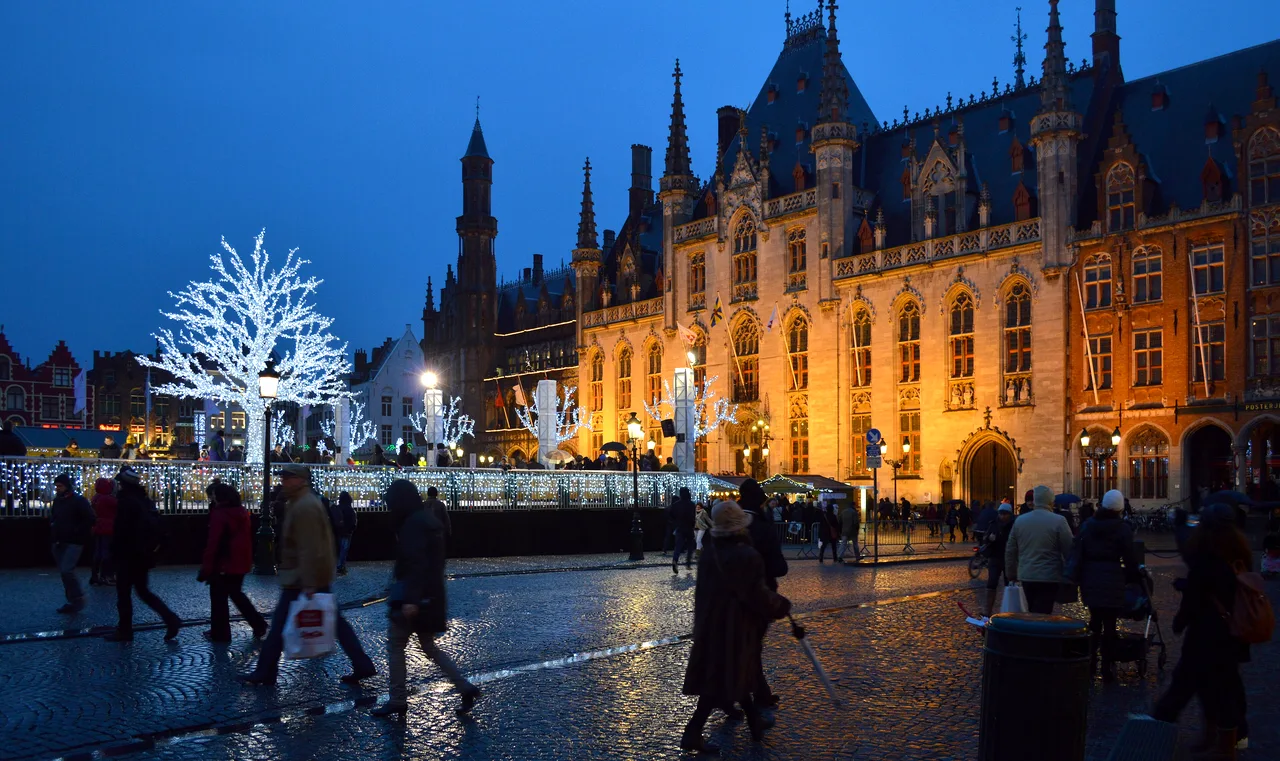
Christmas in Bruges begins on the city’s two big squares. Wooden huts go up on the Markt in front of the Belfry and the neo-Gothic Provinciaal Hof, while the smaller market on Simon Stevinplein, near St Saviour’s Cathedral, is a calmer corner. According to Visit Bruges, the markets are open from 20 November 2026 to 3 January 2027, Sunday–Thursday 11:00–22:00 and Friday–Saturday 11:00–23:30, and until 03:00 on New Year’s Eve. On the same dates an ice rink and winter bar called IJsgloed sets up in Koning Albert I-park. From 18 to 20 December the MAKERSmarkt for designers and makers takes place in the historic Stadshallen beneath the Belfry. All of this is part of Winter Glow (Wintergloed), the city’s winter festival from 20 November 2026 to 31 January 2027, whose programme includes events such as Winterreus and Uitwijken Winter on 26–29 January. According to the official page, De Lijn buses also run at a discounted fare on Saturdays and Sundays from 21 November to 3 January and every day from 21 to 25 December. On short winter days the canal banks and brick façades light up early; an evening walk from the market to Rozenhoedkaai is one of the finest moments of a Bruges winter.


| Event | Location | 2026 dates | Note |
|---|---|---|---|
| Christmas market | Markt | 20 November 2026–3 January 2027 | Sun–Thu 11:00–22:00, Fri–Sat 11:00–23:30; until 03:00 on New Year’s Eve. |
| Christmas market | Simon Stevinplein | 20 November 2026–3 January 2027 | Same hours as the Markt; smaller and calmer. |
| IJsgloed ice rink and winter bar | Koning Albert I-park | 20 November 2026–3 January 2027 | Skating and bar; check current hours on Visit Bruges. |
| MAKERSmarkt | Stadshallen (beneath the Belfry), Markt | 18–20 December 2026 | Products by designers and makers. |
| Winter Glow festival | Various locations in the city | 20 November 2026–31 January 2027 | Events such as Winterreus and Uitwijken Winter (26–29 January 2027). |
What to try
Jenever and mulled wine
Stalls serve Glühwein and fruit jenever; ask for alcohol-free hot drinks too.
Belgian waffle
The sugary Liège type or the light Brussels type – the market’s favourite snack.
Hot chocolate
Hot chocolate made with Belgian chocolate is a treat in winter.
Frites
Thick-cut Belgian fries, usually with mayonnaise.
Speculoos
Cinnamon-spiced caramelised Belgian biscuit, found everywhere at Christmas.
Winter beers
Belgium’s seasonal winter and Christmas beers; alcoholic, drink in moderation.
Bruges Christmas market tips
- In December the sun sets around 16:40; the Markt and Rozenhoedkaai are at their most striking as the lights come on.
- Weekends are very busy with day-trippers; come on a weekday if you can.
- The Simon Stevinplein market is calmer than the Markt; you can see both in one evening.
- If you plan to skate at IJsgloed, bring gloves and check the hours in advance.
- Visit the Stadshallen for the MAKERSmarkt on the weekend of 18–20 December.
- Cobbles and bridges get slippery in the rain; wear waterproof, non-slip shoes.
- On weekends and 21–25 December you can use De Lijn’s discounted bus fare; details are on the official page.
- The market is open until 03:00 on New Year’s Eve; the Markt will be very crowded.
Check before you go: Visit Bruges · Christmas markets (official) ↗ · Visit Bruges · Winter Glow / Wintergloed (official) ↗ · Stad Brugge · brugge.be ↗
Dates and hours were checked on 28 October 2026 against the official Visit Bruges (Bruges tourist office) pages. The Winter Glow programme and IJsgloed hours may change; check the official pages again before you visit.
When to Go
Bruges can be visited all year, but its character changes with the season: from April to September canal tours, outdoor cafés and long days; from late November to January Christmas markets, an ice rink and Winter Glow lights. From January to March the city is quiet and the weather cool and damp. In summer and at weekends the centre gets very crowded with day-trippers.
| Month | City sightseeing | Christmas market | Canal and countryside trips | Crowds |
|---|---|---|---|---|
| January | Difficult | Partly | Difficult | Quiet |
| February | Difficult | None | Difficult | Quiet |
| March | Good | None | Good | Moderate |
| April | Very good | None | Good | Moderate |
| May | Very good | None | Very good | Moderate |
| June | Very good | None | Very good | Busy |
| July | Very good | None | Very good | Busy |
| August | Very good | None | Very good | Busy |
| September | Very good | None | Very good | Moderate |
| October | Good | None | Good | Moderate |
| November | Difficult | Market season | Difficult | Moderate |
| December | Difficult | Market season | Difficult | Busy |
- Winter is mild but damp and windy; temperatures are usually a little above zero and rain is frequent.
- The Christmas markets are open from 20 November 2026 to 3 January 2027; Winter Glow runs until 31 January 2027.
- The Procession of the Holy Blood (Heilig-Bloedprocessie) is held every year on Ascension Day; the city is very busy that day.
- Canal boat tours run for most of the year, but winter trips depend on the weather; check current information.
- July–August and weekends are the busiest times.
- In the evening, when the day-trippers leave, the city calms down; staying one night changes the experience.
Visa and Entry (Turkish citizens)
Turkish citizens holding ordinary (burgundy) passports need a Schengen visa for tourist travel to Belgium. Rules differ for special, service and diplomatic passports; check the current situation with the Turkish Ministry of Foreign Affairs.
According to the official visa page of Belgium’s representations in Türkiye, applications are accepted through VFS Global and the application form is completed online in the Visa on Web system. Check the competent post and the current procedure on the official page.
If you combine Bruges with Amsterdam, Cologne or Paris, apply to the country where you will spend the longest; if stays are equal, the country of first entry applies. Checks may take place at internal borders, so carry your passport.
Under the EU Entry/Exit System (EES), which is being introduced in stages, your biometric data (facial image and fingerprints) may be taken on first entry; allow extra time at the border.
Visa fees, appointment times and required documents can change; this guide does not give fees. Use the current lists on the official websites before applying.
Travel medical insurance, accommodation and return details are part of the application; see the official sources for details.
Check before you go: T.C. Dışişleri Bakanlığı · Türk vatandaşlarının tabi olduğu vize uygulamaları ↗ · diplomatie.belgium.be · Türkiye ↗ · EES · europa.eu ↗ · Rota Atlası visa guide (TR)
Travel medical insurance
Check the official visa and entry sources above first: they state whether travel medical insurance is required and the minimum cover. Compare any policy’s cover amount, validity dates and countries covered with the official requirement.
Rota Atlası does not currently offer an insurance partnership; there are no paid links in this section. Last updated: 1 November 2026
Getting to Bruges
- By air: the most practical entry point is Brussels Airport; from the airport station there are direct trains or trains via Brussels to Bruges. Brussels South Charleroi airport is also used for some flights. Check current flights only on airline and airport websites.
- By train: Bruges is well connected on the Belgian rail network (SNCB/NMBS) to Brussels, Ghent, Antwerp and Ostend on the coast. Times and tickets are on belgiantrain.be.
- From the station to the centre: Bruges station lies south-west of the old town; the Markt is about a 20-minute walk or a few minutes by De Lijn bus.
- By road: traffic in the historic centre is restricted; if you come by car, use the car parks near the station.
Getting Around

On foot
The historic centre is small; the Markt, Burg, Rozenhoedkaai, the Church of Our Lady and the Begijnhof are within walking distance of each other.
Bus
De Lijn buses link the station with the centre; during the Christmas period a discounted fare applies on weekends and 21–25 December.
Canal boat
Canal boat tours are the classic way to see the city from the water; winter trips depend on the weather.
Bike
Bruges and its surroundings are very bike-friendly; a cycle path runs along the canal to Damme.
Train
For day trips to Ghent, Brussels, Antwerp and Ostend the train is the most practical choice.
Horse carriage
Horse carriages leaving from the Markt are a traditional tour; ask the price before you ride.
Things to See
The sights of Bruges are concentrated in a compact area inside the egg-shaped old town ringed by canals. In the centre are the Markt and the Burg; to the south the Dijver, the museums, the Church of Our Lady and the Begijnhof; to the north-east the quiet Sint-Anna quarter and the windmills. As day trips, Damme and Ghent complete the Flemish side of Belgium. The sections below follow a logical walking order, from the central squares southwards to the museums and the Begijnhof, then north-east to the quieter Sint-Anna quarter, so you can read them in sequence while planning your days.
Centre
Markt and the Belfry

The heart of Bruges is the great Markt square, a marketplace since the Middle Ages. Rising on the south side, the Belfry, about 83 metres tall, is the symbol of the city; begun in the 13th century, it was built to protect the city’s charters and treasury. 366 steps lead to the top, from where the red roofs, canals and towers look like a map; the carillon in the tower is played regularly. The Belfry is on the UNESCO list as one of the belfries of Belgium and France. The neo-Gothic Provinciaal Hof lines the east side, and colourful stepped-gable houses the north and west; horse carriages waiting on the square are one of the classic images of Bruges. UNESCO listing ↗
Don’t miss
- Climbing the Belfry and the carillon
- The Provinciaal Hof façade
- Historic stepped-gable houses
- The Christmas market in winter
Tips
- There is an entry fee for the Belfry and the number of visitors inside at once is limited; check hours with Musea Brugge.
- Go up early in the morning to avoid queues.
- The stairs are narrow and steep; not suitable for people with limited mobility.


Centre
Burg, City Hall and the Basilica of the Holy Blood

The Burg square, a few steps east of the Markt, was the city’s political and religious centre. Its most splendid building is the Gothic City Hall (Stadhuis), built between 1376 and 1421; one of the oldest town halls in the Low Countries, it is famous for its Gothic Hall with a wooden vault and murals telling the city’s history. In the corner, the Basilica of the Holy Blood (Heilig-Bloedbasiliek) has two levels: the Romanesque St Basil’s chapel below dates from the 12th century, while the upper chapel keeps a relic believed to contain the blood of Christ. The relic is carried each year on Ascension Day in the Procession of the Holy Blood, which is on UNESCO’s intangible cultural heritage list.
Don’t miss
- The Gothic Hall of the City Hall
- The two chapels of the Basilica of the Holy Blood
- The façade of the Liberty of Bruges (Brugse Vrije)
- Blinde-Ezelstraat from the Burg to the Vismarkt
Tips
- The basilica is a religious site; be respectful during services and dress appropriately.
- The City Hall belongs to Musea Brugge; check hours in advance.
- The Burg in evening light is as impressive as the Christmas market.

Canals and art
Rozenhoedkaai, the Dijver and the Groeningemuseum

The most famous view in Bruges is from Rozenhoedkaai, looking across the canal towards the Belfry. The Dijver canal starts here and leads along a tree-lined bank to the city’s museums. The Groeningemuseum holds one of the most important collections of 15th-century Flemish masters (the Flemish Primitives): Jan van Eyck’s Madonna with Canon van der Paele, works by Hans Memling and Hieronymus Bosch’s Last Judgement triptych are shown here. The collection traces Flemish painting up to the 20th century; the photo on this page shows Jan Provoost’s Crucifixion.
Don’t miss
- The Belfry view from Rozenhoedkaai
- Van Eyck and Memling in the Groeningemuseum
- A walk along the Dijver
Tips
- Rozenhoedkaai is at its best early in the morning and at the evening blue hour.
- Check museum hours and closing days with Musea Brugge.
- The canal boats leave from around here.

Palace
Gruuthusemuseum

The Gruuthuse was the palace of the lords of Gruuthuse, one of the most powerful families in 15th-century Bruges. Their wealth came from the right to tax “gruut”, the herb mixture used in brewing. Reopened in 2019 after a long renovation, the museum tells five centuries of Bruges history through tapestries, furniture, silverware and objects of daily life. The palace’s private chapel, opening onto the neighbouring Church of Our Lady, allowed the family to follow Mass without leaving home.
Don’t miss
- Flemish tapestries
- The oratory overlooking the Church of Our Lady
- The palace courtyard
Tips
- Look at Musea Brugge’s combination tickets on the official website.
- Combine it with the Church of Our Lady.
- Check closing days in advance.
Church
Church of Our Lady and St John’s Hospital

The brick tower of the Church of Our Lady (Onze-Lieve-Vrouwekerk), about 115 metres high, is one of the tallest brick structures in the world. The church’s greatest treasure is Michelangelo’s white marble Madonna and Child of around 1504, regarded as the only sculpture by the artist to leave Italy in his lifetime. The church also holds the tombs of Mary of Burgundy and her father Charles the Bold. Opposite, St John’s Hospital (Sint-Janshospitaal) is one of the oldest hospital buildings in Europe; now a museum, it displays important works by Hans Memling, including the Shrine of St Ursula.
Don’t miss
- Michelangelo’s Madonna
- The tombs of the Burgundian rulers
- Memling’s works in St John’s Hospital
- The old pharmacy (apotheek)
Tips
- The museum section of the church is charged; visits may be restricted during services.
- The Madonna is in the museum section of the church.
- Check St John’s Hospital hours with Musea Brugge.


Tranquillity
Begijnhof and Minnewater

Founded in 1245, the Begijnhof “Ten Wijngaarde” is the most peaceful corner of Bruges. Whitewashed houses line a courtyard surrounded by tall poplars; it was once home to beguines, women who led a religious life without taking nuns’ vows. Today Benedictine sisters live here; the Flemish béguinages are on the UNESCO World Heritage List. Just south of the Begijnhof, the Minnewater (“Lake of Love”) was the city’s inner harbour basin in the Middle Ages; with its swans and lakeside park it is a romantic place for a walk. UNESCO listing ↗
Don’t miss
- The Begijnhof courtyard and white houses
- The beguine’s house museum
- Minnewater and its bridge
- Swans and Minnewaterpark
Tips
- The courtyard is a place of silence; don’t talk loudly.
- The gates close in the evening; check the times.
- Minnewater is loveliest in morning mist.
Cathedral and music
St Saviour’s Cathedral, Simon Stevinplein and the Concertgebouw

St Saviour’s Cathedral (Sint-Salvatorskathedraal) is the oldest parish church in Bruges and has been the bishop’s cathedral since 1834; it is known for its brick tower and Flemish tapestries. A few steps away, Simon Stevinplein takes its name from the Bruges-born mathematician and engineer Simon Stevin, whose statue stands in the middle; at Christmas the square hosts the second Christmas market. To the south, on ’t Zand square, the Concertgebouw is a contemporary concert hall built for Bruges’ year as European Capital of Culture in 2002; its red terracotta façade is a modern answer to the old town’s brick.
Don’t miss
- The cathedral’s tapestries and treasury
- The Simon Stevin statue
- A concert at the Concertgebouw
- ’t Zand square
Tips
- Check the programme on concertgebouw.be.
- The Simon Stevinplein market is calmer than the Markt.
- Cathedral visiting hours may vary with services.


Beer
De Halve Maan brewery

De Halve Maan on Walplein is Bruges’ historic family brewery, where beer has been brewed on the same site since 1856. The brewery runs guided tours, which end with a view of the city’s towers from the roof. Its most unusual feature is an underground beer pipeline of about 3 km, opened in 2016, that carries beer beneath the old town to the bottling plant outside the city. Belgian beer culture is on UNESCO’s intangible cultural heritage list, and Bruges is a good place to get to know it first-hand.
Don’t miss
- A guided brewery tour
- The city view from the roof
- Walplein square
Tips
- Check tour times and booking on halvemaan.be.
- Tours may include an alcoholic tasting; ask if there is an alcohol-free option.
- Walplein is within walking distance of the Begijnhof.
Sint-Anna
Windmills, Jerusalem Church and the Lace Centre

The Sint-Anna quarter in the north-east of the old town shows the everyday side of Bruges, with quiet streets away from the crowds. To the east, windmills stand along the Kruisvest on the line of the old ramparts; the Sint-Janshuismolen of 1770 still works and opens to visitors seasonally. The nearby Jerusalem Church (Jeruzalemkerk) is a private church built in the 15th century by the Adornes family, of Genoese origin, inspired by the Church of the Holy Sepulchre in Jerusalem. Right next door, the Kantcentrum (Lace Centre) presents Bruges’ famous lace tradition and holds lace-making demonstrations.
Don’t miss
- The windmills on the Kruisvest
- The interior of the Jerusalem Church
- A lace demonstration at the Kantcentrum
- The Langerei canal bank
Tips
- The windmills are usually open in the summer season; you may not be able to go inside in winter.
- Check demonstration times at kantcentrum.eu.
- A walk along the ramparts offers a crowd-free circuit of the city.

Canals
Groenerei and the canal banks

Starting just behind the Burg, the Groenerei is one of the most photogenic canals in Bruges. On one side are willows and stone bridges, on the other historic houses and the De Pelikaan almshouse from the early 18th century. The small bridges from the Groenerei to Huidenvettersplein and the Vismarkt (fish market) lead into streets that recall the city’s medieval trade. Walking along the canal, or joining a canal tour in the right season, is the best way to understand why Bruges is called the “Venice of the North”.
Don’t miss
- A walk along the Groenerei
- The canal view from the Peerdenbrug
- Vismarkt and Huidenvettersplein
- A canal boat tour (seasonal)
Tips
- Early in the morning the canals are calm and reflections are clearest.
- In winter canal tours may be cancelled depending on the weather.
- Bridges are slippery when wet.
Day trip
Damme

About 7 km north-east of Bruges, Damme was Bruges’ outer port on the Zwin inlet in the Middle Ages. Today it is a small, quiet town: the Gothic town hall, the tower of the Church of Our Lady and the Schellemolen windmill are worth seeing. Between Bruges and Damme, a flat road runs along the Damse Vaart canal lined with poplars on both sides, ideal for cycling or walking. The town is also associated with Tijl Uilenspiegel, the hero of Flemish literature.
Don’t miss
- The cycle path along the canal
- Damme town hall
- The Schellemolen windmill
Tips
- By bike it is a flat ride of about half an hour.
- Boat trips between Bruges and Damme are seasonal; check current information at visitdamme.be.
- In winter the wind can be harsh on the open canal path.
Day trip
Ghent

Quickly reached from Bruges by train, Ghent is Flanders’ lively university city. The historic guild houses of the Graslei and Korenlei on the River Leie are as impressive as Bruges but with a more urban atmosphere. St Bavo’s Cathedral is home to the Van Eyck brothers’ famous Ghent Altarpiece (Adoration of the Mystic Lamb), and the Gravensteen is a medieval castle in the middle of the city. Ghent’s Belfry is also part of UNESCO’s belfries listing. Ghent has its own winter events at Christmas; check the current programme on visit.gent.be.
Don’t miss
- Graslei and Korenlei
- The Ghent Altarpiece (St Bavo’s Cathedral)
- Gravensteen castle
- Ghent Belfry
Tips
- Check train times on belgiantrain.be.
- A separate ticket is needed to see the Ghent Altarpiece; check the official website.
- The Graslei is very impressive in the evening lights.
1–3 Day Itineraries, Christmas Day + 7-Day Belgium Route
Bruges is a small city: one day covers the main squares, two days the museums and canals, three days a day trip at a relaxed pace. The regional route is a one-week plan linking Belgium’s Flemish cities by train. Check museum hours and closing days on official websites in advance. If you only have half a day, focus on the Markt, the Burg, Rozenhoedkaai, the Church of Our Lady and the Begijnhof, all of which lie on one walkable line through the centre. Staying overnight is strongly recommended: once the day-trippers leave in the late afternoon, the canals, squares and illuminated façades become noticeably calmer, and early mornings are the best time for photos at Rozenhoedkaai and Minnewater. In winter, plan indoor visits such as museums and churches for the middle of the day and keep the late afternoon and evening for the Christmas markets and lights, since it gets dark early. Wear comfortable, waterproof shoes, as almost everything is explored on foot over cobblestones and bridges.
Day 1: The heart of Bruges
- Climb the Belfry early in the morning and see the Markt from above.
- Visit the City Hall and the Basilica of the Holy Blood on the Burg.
- Walk via the Groenerei and the Vismarkt to Rozenhoedkaai.
- In the afternoon see Michelangelo’s Madonna in the Church of Our Lady, then continue to the Begijnhof and Minnewater.
- In the evening return to the Christmas market on the Markt.
Day 2: Flemish masters and quiet quarters
- In the morning see Van Eyck and Memling at the Groeningemuseum.
- Visit the Gruuthusemuseum and St John’s Hospital.
- In the afternoon join a De Halve Maan brewery tour (booking required).
- Late afternoon: the Sint-Anna quarter, the windmills and the Jerusalem Church; visit the Kantcentrum.
Day 3: Damme or Ghent
- If the weather allows, cycle along the canal to Damme.
- Alternatively take the train to Ghent: Graslei, the Ghent Altarpiece and the Gravensteen.
- Back in Bruges in the evening, see the Simon Stevinplein market and the IJsgloed ice rink.
Christmas market day (20 November 2026–3 January 2027)
- Before noon, explore the Burg, the Groenerei and Rozenhoedkaai in daylight.
- Around midday visit a museum.
- Arrive at the Markt around 16:00 and browse the market as the Belfry lights up.
- Walk to the Simon Stevinplein market, then stop by IJsgloed in Koning Albert I-park.
- End the day with the illuminated Belfry seen from Rozenhoedkaai.
7 days: Flemish cities (Brussels–Ghent–Bruges–Antwerp)
- Days 1–2: Brussels; the Grand-Place and Christmas events.
- Day 3: Train to Ghent; Graslei, the Ghent Altarpiece and the Gravensteen.
- Days 4–5: Bruges; Markt, Burg, museums, Begijnhof and the Christmas markets.
- Day 6: From Bruges to Damme or to Ostend and the Belgian coast.
- Day 7: Train to Antwerp; Central Station and the Cathedral; departure.
Flemish and Belgian Food
Belgian cuisine combines French finesse with Flemish generosity: stews cooked with beer, mussels, fries, waffles and world-famous chocolate. Below are regional specialities, not restaurant recommendations.


Stoofvlees
Flemish beef stew slow-cooked with beer, usually served with fries.
Mosselen-friet
Mussels and fries – Belgium’s classic dish.
Frites
Thick-cut, twice-fried Belgian fries, sold at stands called frietkot.
Wafels
Sugary Liège waffles and light Brussels waffles.
Pralines
Filled Belgian chocolates; Bruges has many chocolate shops.
Speculoos
Cinnamon-spiced caramelised biscuit, especially popular at Christmas.
Belgian beer
Trappist, abbey and local beers; Belgian beer culture is on the UNESCO list. Alcoholic.
Waterzooi
A creamy soup-stew from Ghent made with chicken or fish.
- Beer is used in stoofvlees and some sauces; ask if you avoid alcohol.
- Some dishes may contain pork or lard; ask about ingredients.
- Tap water is drinkable; restaurants usually serve bottled water.
- Service is usually included in prices in Belgium; tipping is optional.
Culture and Etiquette

- Greet in Dutch with “Goedendag” or “Hallo”; thank you is “Dank u”.
- Bruges is in Flanders, where Dutch is spoken; starting in English is usually better received than French.
- Don’t walk around churches during services and don’t use flash.
- The Begijnhof is a place of silence; don’t talk loudly.
- Don’t walk on cycle paths; cyclists are fast and have priority.
- The Procession of the Holy Blood is on UNESCO’s intangible heritage list and is respected as a religious ceremony.
- Belgian beer culture is treated almost as an art; each beer has its own glass.
- Bruges lace (kant) is a traditional craft; distinguish handmade lace from machine-made products.
- Queuing and waiting your turn matters.
- Dinner is usually eaten between 18:00 and 21:00; kitchens may close late in the evening.
Safety and Health
- Bruges is a very safe city; watch out for pickpockets on crowded squares and at the Christmas market.
- Cobbles and bridges are slippery in the rain; wear suitable shoes.
- Most canal banks have no railings; be careful, especially in the dark and with children.
- Watch out for cycle paths; cyclists come fast.
- In an emergency call 112; for police 101.
- Make sure your travel medical insurance covers the Schengen area.
- The Markt is very crowded on New Year’s Eve; agree on a meeting point.
What Your Budget Depends On
This guide does not give prices; prices change with season and year. Your budget depends on these factors:
Dates
Demand for accommodation is highest on Christmas market weekends and in New Year week; weekdays may be better value.
Where you stay
The historic centre is the most expensive area; staying near the station or in Ghent and coming for the day are alternatives.
Transport
Train fares vary with date and discounts; De Lijn buses have Christmas-period discounts.
Museums
Musea Brugge museums can be visited with single or combination tickets; the Belfry is charged separately.
Food and drink
Frietkot stands and market stalls are budget options; restaurants in the centre are expensive.
Excursions
Ghent and Antwerp add train costs; canal tours and horse carriages are extra.
Free experiences
Browsing the Christmas markets, the Begijnhof courtyard, Minnewater, canal-side walks and the area around the windmills are free.
Practical Information
- Money: the euro is used; cards are very common.
- Language: Dutch (Flemish); English is spoken well in tourist areas.
- Plugs: 230 V, European type C/E.
- Time: two hours behind Türkiye in winter (CET, UTC+1).
- Opening hours: most Musea Brugge museums are closed on Mondays; check before you go.
- Holidays: many museums and shops may be closed on 25 December and 1 January.
- Weather: winter is mild but damp and windy; bring a raincoat and waterproof shoes.
- Daylight: in December the sun rises around 8:45 and sets around 16:40.
- Internet: mobile data and café Wi-Fi are widely available.
- Emergency: 112; police 101.
Frequently Asked Questions
When is the Bruges Christmas market in 2026?
According to Visit Bruges, the markets on the Markt and Simon Stevinplein are open from 20 November 2026 to 3 January 2027.
What are the opening hours?
Sunday–Thursday 11:00–22:00, Friday–Saturday 11:00–23:30; until 03:00 on New Year’s Eve.
Is there an ice rink?
Yes, the IJsgloed ice rink and winter bar in Koning Albert I-park are open on the same dates.
What is Winter Glow?
Bruges’ winter festival from 20 November 2026 to 31 January 2027, including the Christmas markets, IJsgloed, the MAKERSmarkt and Uitwijken Winter.
Do Turkish citizens need a visa?
Ordinary passport holders need a Schengen visa; according to Belgium’s official visa page, applications are accepted through VFS Global and the form is completed in Visa on Web.
How many days are enough for Bruges?
One day for the main squares, two for the museums and canals, three to add Damme or Ghent.
How do I get from Brussels Airport to Bruges?
By train from the airport station; check current times on belgiantrain.be.
Are there canal tours in winter?
Boat tours run for most of the year, but in winter they depend on the weather; check locally or with official sources.
Is climbing the Belfry hard?
A narrow staircase of 366 steps leads to the top; there is no lift and it requires reasonable fitness.
What is closed in Bruges at Christmas?
Many museums and shops may be closed on 25 December and 1 January; the Christmas markets are open.
Where to stay
Stay close to the areas where you will spend most time. The areas below are covered in detail in this guide; check public transport links in the getting-around section.
- CentreMarkt and the Belfry
- CentreBurg, City Hall and the Basilica of the Holy Blood
- Canals and artRozenhoedkaai, the Dijver and the Groeningemuseum
- PalaceGruuthusemuseum
- ChurchChurch of Our Lady and St John’s Hospital
- TranquillityBegijnhof and Minnewater
- Cathedral and musicSt Saviour’s Cathedral, Simon Stevinplein and the Concertgebouw
- BeerDe Halve Maan brewery
- Sint-AnnaWindmills, Jerusalem Church and the Lace Centre
- CanalsGroenerei and the canal banks
Search hotels in these areas (Hotellook) ↗ (affiliate link)Search on Booking.com ↗
Affiliate disclosure: Hotellook, Aviasales, Klook, Airalo, Tiqets and DiscoverCars links are affiliate links; Rota Atlası may earn a commission on bookings made through them, at no extra cost to you. Official and in-guide links are not paid. Last updated: 1 November 2026 · Privacy and affiliates
Transport and connectivity
- Airport transferOptions from the airport to the city are in this guide’s getting there section.
- Mobile data (eSIM)Airalo eSIM ↗ (affiliate link)
- Car hireYou rarely need a car within the city; see getting around first. Compare car hire on DiscoverCars ↗ (affiliate link)
Affiliate disclosure: Hotellook, Aviasales, Klook, Airalo, Tiqets and DiscoverCars links are affiliate links; Rota Atlası may earn a commission on bookings made through them, at no extra cost to you. Official and in-guide links are not paid. Last updated: 1 November 2026 · Privacy and affiliates
Search flights (affiliate link)
Search flights from any airport in any country. Results open on Aviasales in a new tab, where you book.
This form is an affiliate link: Rota Atlası may earn a commission on bookings made via Aviasales (Travelpayouts), at no extra cost to you. Check price, baggage and terms on the booking site. Airport data: OurAirports (public domain).
Flights, hotels and tours
Find tours and tickets
- Bruges Christmas Market
GetYourGuide ↗ · Klook ↗ (affiliate link) - Simon Stevinplein Christmas market
GetYourGuide ↗ · Klook ↗ (affiliate link) - Ice rink (Koning Albert I-park)
GetYourGuide ↗ · Klook ↗ (affiliate link) - Belfry
GetYourGuide ↗ · Klook ↗ (affiliate link)
Hotellook, Aviasales, Klook, Airalo and Tiqets links in this box are affiliate links (Travelpayouts): Rota Atlası may earn a commission on bookings made through them, at no extra cost to you. GetYourGuide links currently carry no affiliate code. Check prices and terms with the provider. Last updated: 1 November 2026 · Privacy and affiliates
Sources
- T.C. Dışişleri Bakanlığı · Türk vatandaşlarının tabi olduğu vize uygulamaları ↗
- Embassy of Belgium in Türkiye · Visa for Belgium (official) ↗
- European Union · Entry/Exit System (EES) ↗
- Visit Bruges · visitbruges.be (official) ↗
- Stad Brugge · brugge.be (official) ↗
- Musea Brugge (official) ↗
- Basilica of the Holy Blood (official) ↗
- Brouwerij De Halve Maan (official) ↗
- Concertgebouw Brugge (official) ↗
- Kantcentrum Brugge (official) ↗
- Visit Damme (official) ↗
- Visit Gent (official) ↗
- Visit Flanders (official) ↗
- SNCB/NMBS · Belgian Rail ↗
- De Lijn · buses and trams (official) ↗
- Brussels Airport (official) ↗
- Brussels South Charleroi Airport (official) ↗
- GOV.UK · Foreign travel advice · Belgium ↗
- UNESCO World Heritage Centre · Historic Centre of Brugge ↗
- UNESCO World Heritage Centre · Belfries of Belgium and France ↗
- UNESCO World Heritage Centre · Flemish Béguinages ↗
- Visit Bruges · Christmas markets (official) ↗
- Visit Bruges · Winter Glow / Wintergloed (official) ↗
- Stad Brugge · brugge.be ↗
This page is for information only. Dates, hours, entry rules and transport information can change; check the official sources above before travelling. No prices, flights, hotels or restaurants have been invented in this guide.
Photo credits
The photos on this page come from Wikimedia Commons and are used under the stated authors and licences (CC BY, CC BY-SA, CC0 or public domain). Full list of sources
- The Christmas market and ice rink on Bruges’ Markt in front of the Provinciaal Hof — DimiTalen · CC0 · Wikimedia Commons
- The Rozenhoedkaai canal with the Belfry behind — Ank Kumar · CC BY-SA 4.0 · Wikimedia Commons
- The Groenerei canal in Bruges — Dietmar Rabich · CC BY-SA 4.0 · Wikimedia Commons
- Buildings at the old harbour basin of the Minnewater — Falk2 · CC BY-SA 4.0 · Wikimedia Commons
- Stalls of the Bruges winter market — Arthurious · CC BY 4.0 · Wikimedia Commons
- The lit tree and ice rink on the Markt during the 2014 Christmas market — Spotter2 · CC BY-SA 4.0 · Wikimedia Commons
- The Belfry at night during the Christmas market — Mjbpcds · CC BY-SA 4.0 · Wikimedia Commons
- A Bruges canal on a winter night — Marc Ryckaert (MJJR) · CC BY 3.0 · Wikimedia Commons
- Bruges City Hall at night (2019) — Abdou A. A. from Stockholm, Sweden · CC BY-SA 2.0 · Wikimedia Commons
- Flori Van Acker’s painting “The Meebrug in the snow” (1893, Groeningemuseum) — Florimond Van Acker · Public domain · Wikimedia Commons
- The Markt square in Bruges — ktanaka · CC BY 3.0 · Wikimedia Commons
- The Belfry of Bruges seen from the Burg — CEphoto, Uwe Aranas · CC BY-SA 3.0 · Wikimedia Commons
- Horse-drawn carriages waiting on the Markt — Stck w · CC BY-SA 4.0 · Wikimedia Commons
- Burg square in Bruges — Sergey Ashmarin · CC BY-SA 3.0 · Wikimedia Commons
- The Basilica of the Holy Blood and adjacent buildings — Julian Lupyan · CC0 · Wikimedia Commons
- The Dijver canal looking towards the Belfry — Dguendel · CC BY 4.0 · Wikimedia Commons
- Jan Provoost’s Crucifixion in the Groeningemuseum — Jan Provoost · CC0 · Wikimedia Commons
- The Gruuthusemuseum building — Wolfgang Staudt · CC BY 2.0 · Wikimedia Commons
- The Church of Our Lady from the air — Giles Laurent · CC BY-SA 4.0 · Wikimedia Commons
- Michelangelo’s Madonna and Child in the Church of Our Lady — Jean-Pol GRANDMONT · CC BY 3.0 · Wikimedia Commons
- Sint-Janshospitaal (St John’s Hospital) — CEphoto, Uwe Aranas · CC BY-SA 3.0 · Wikimedia Commons
- The Bruges Beguinage — Marc Ryckaert · CC BY-SA 4.0 · Wikimedia Commons
- St Salvator’s Cathedral — Dietmar Rabich · CC BY-SA 4.0 · Wikimedia Commons
- A historic house on the corner of Simon Stevinplein — Marc Ryckaert · CC BY 4.0 · Wikimedia Commons
- The Concertgebouw concert hall in Bruges — CEphoto, Uwe Aranas · CC BY-SA 3.0 · Wikimedia Commons
- The roofs of Bruges seen from De Halve Maan brewery — Michiel Dumon · CC BY-SA 3.0 · Wikimedia Commons
- The Sint-Janshuismolen windmill on the Kruisvest — CEphoto, Uwe Aranas · CC BY-SA 3.0 · Wikimedia Commons
- The altar with skull reliefs inside the Jeruzalemkerk — Donarreiskoffer · CC BY-SA 4.0 · Wikimedia Commons
- Historic houses along the Groenerei canal — Dietmar Rabich · CC BY-SA 4.0 · Wikimedia Commons
- The canal and Schellemolen windmill in Damme — Marc Ryckaert · CC BY 3.0 · Wikimedia Commons
- The Graslei on the Leie in Ghent — Martinvl · CC BY-SA 4.0 · Wikimedia Commons
- Tour boats on the canals of Bruges — Peter K Burian · CC BY-SA 4.0 · Wikimedia Commons
- Belgian waffles cooking in a cast-iron waffle iron — Rivalinb2 · CC BY-SA 3.0 · Wikimedia Commons
- Pralines in a box — fimb · CC BY 2.0 · Wikimedia Commons
- Belgian-style fries with mayonnaise — Berthold Werner · CC BY-SA 3.0 · Wikimedia Commons
- Bottle shelves inside a brewery in Bruges — Bybbisch94, Christian Gebhardt · CC BY-SA 4.0 · Wikimedia Commons
- A “Real Bruges” lace sample (historic publication image) — Samuel L. Goldenberg · Public domain · Wikimedia Commons
Amiens → · Lille → · Antwerp → · Brussels → · Amsterdam → · Cologne → · Aachen → · Riga → · Christmas markets