

Amsterdam, the capital of the Netherlands, grew from a fishing settlement at a dam on the river Amstel in the 13th century into the richest port city in the world in the 17th century, the Dutch Golden Age. The concentric canal ring dug in that period, with its narrow merchants’ houses, bridges and warehouses, has been a UNESCO World Heritage Site since 2010. Today the city has about 930,000 inhabitants and is known for its museums – from Rembrandt’s Night Watch in the Rijksmuseum to the Van Gogh Museum – its tolerant, international atmosphere, and for the bicycle as the main means of transport. In winter the canals become a stage for the Amsterdam Light Festival, whose artworks can be seen from the water or on foot, while Museumplein hosts a Christmas Village. This guide brings together neighbourhoods, sights, events, day trips, food and practical information based on official sources.
Content updated: 29 October 2026 · Event dates and hours checked on the official websites of the Amsterdam Light Festival (amsterdamlightfestival.com) and Christmas Village Amsterdam (icevillage.nl)
Amsterdam at a Glance
- Country
- Netherlands · capital
- Population
- About 930,000
- Language
- Dutch; English is very widely spoken
- Currency
- Euro (EUR)
- Time zone
- Central European Time (CET, UTC+1), 2 hours behind Türkiye in winter
- Highlights
- Canal Ring, Rijksmuseum, Van Gogh Museum, Anne Frank House, Jordaan
- Airport
- Amsterdam Airport Schiphol (AMS), direct trains to Amsterdam Centraal
- Light Festival
- 26 November 2026 – 17 January 2027
Amsterdam in Pictures
Damrak’s gabled houses, the Keizersgracht and the Jordaan: Amsterdam’s canal city in three images. Each photo comes from Wikimedia Commons under a free licence; authors and licences are listed on the sources page.


Amsterdam Light Festival and Christmas 2026
Winter in Amsterdam means short, often grey days – and long evenings full of light. The highlight is the Amsterdam Light Festival, which according to the organiser returns for the 2026–2027 season from 26 November 2026 to 17 January 2027. Artists from around the world create light installations along and over the canals of the city centre; they are switched on every day from 16:30 to 23:00, and on New Year’s Eve until 21:00. You can see them from the water on a cruise of about 75 minutes, or on foot along a walking route of about 4.5 km, with the festival app available from mid-November. The festival’s information point at Amstel 1 is open Thursday to Sunday from 16:30 to 21:00, and daily from 19 December to 3 January (closed on 25 and 31 December). From 3 to 27 December 2026 Museumplein, in front of the Rijksmuseum, hosts the Christmas Village with free entry. The Dutch also celebrate Sinterklaas: the saint traditionally arrives in mid-November, and on the evening of 5 December (pakjesavond) families exchange presents.


| Event | Location | 2026 dates | Note |
|---|---|---|---|
| Amsterdam Light Festival | City centre canals; information point at Amstel 1 | 26 November 2026 – 17 January 2027 | Lit daily 16:30–23:00 (31 Dec until 21:00); walking route free, cruises with a ticket. |
| Christmas Village Amsterdam | Museumplein | 3–27 December 2026 | Daily 12:00–21:00; 25 and 26 Dec 12:00–19:00; 27 Dec 12:00–18:00; free entry. |
| Light Festival information point | Amstel 1 | From the festival opening | Thu–Sun 16:30–21:00; daily 19 Dec – 3 Jan; closed 25 and 31 Dec. |
| Festive season in the city | City centre, I amsterdam calendar | Late November – early January | Concerts and seasonal events vary; check the official festive-season calendar. |
What to try
Oliebollen
Deep-fried dough balls, often with raisins, dusted with icing sugar – the Dutch New Year treat.
Appelflappen
Fried apple turnovers, sold at the same stalls as oliebollen.
Speculaas
Spiced shortcrust biscuits, eaten especially around Sinterklaas.
Pepernoten and kruidnoten
Small spiced biscuits traditional for Sinterklaas.
Chocolate letters
Chocolate initials given on 5 December.
Stroopwafel
Two thin waffles with caramel syrup; best warm.
Erwtensoep (snert)
Thick winter pea soup, often with smoked sausage; ask about ingredients.
Glühwein and warm chocolate
Mulled wine (alcoholic) and hot chocolate at winter events.
Tips for the Light Festival and the festive season
- The artworks are lit from 16:30; on weekday evenings it is quieter than at weekends and in the Christmas holidays.
- Book festival cruises in advance on the official website, especially for weekends and the Christmas holidays.
- The walking route of about 4.5 km is free; use the festival app (available from mid-November) to navigate.
- On 31 December the lights switch off at 21:00.
- Watch out for cyclists when you stop to take photos on bridges and canal edges.
- Combine the Christmas Village on Museumplein with an afternoon at the Rijksmuseum or Van Gogh Museum.
- Shops and many museums have reduced hours on 24, 25, 26 and 31 December and 1 January; check in advance.
Check before you go: Amsterdam Light Festival · Dates and opening hours (official) ↗ · Christmas Village Amsterdam (official) ↗ · I amsterdam · Festive season (official) ↗
Dates, hours and details were checked on 29 October 2026 on the official websites of the Amsterdam Light Festival and Christmas Village Amsterdam. Programmes and hours can change; check the official sites before your visit.
When to Go
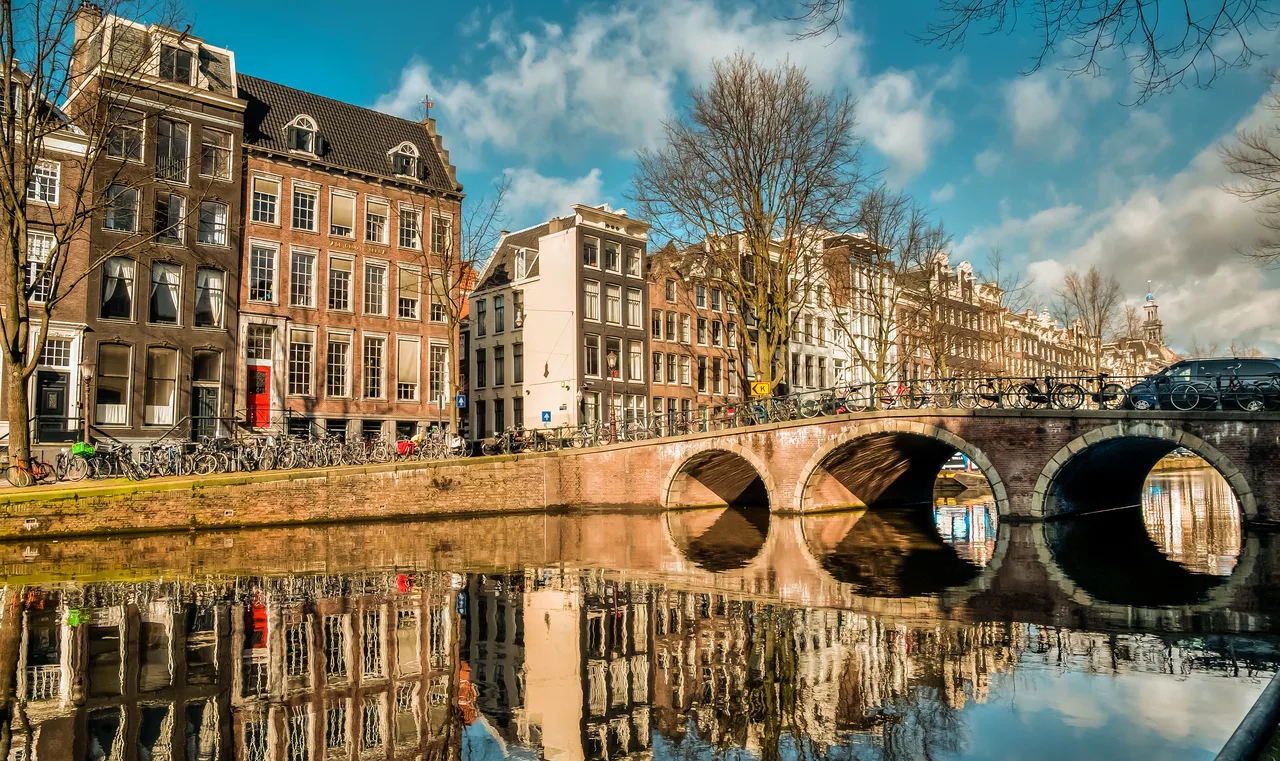
Amsterdam has a mild maritime climate: cool summers, mild but damp and windy winters, and rain spread over the whole year. Spring is the most popular season, when the tulip fields bloom around the city (around late March to May) and King’s Day on 27 April turns the canals orange. Summer brings long days and outdoor festivals. Autumn is calmer; in winter the days are short, but the Light Festival, the Christmas Village and cosy cafés make the city atmospheric. Whatever the season, pack a waterproof jacket and comfortable shoes, and plan indoor alternatives such as museums for rainy hours.
| Month | Sightseeing | Light Festival | Outdoors | Crowds |
|---|---|---|---|---|
| January | Good | Partly | Difficult | Moderate |
| February | Good | None | Difficult | Moderate |
| March | Good | None | Good | Moderate |
| April | Very good | None | Very good | Busy |
| May | Very good | None | Very good | Busy |
| June | Very good | None | Very good | Busy |
| July | Very good | None | Very good | Busy |
| August | Very good | None | Very good | Busy |
| September | Very good | None | Very good | Moderate |
| October | Very good | None | Good | Moderate |
| November | Good | Partly | Difficult | Moderate |
| December | Good | Light Festival | Difficult | Busy |
- In December temperatures are usually between 2 and 7 °C; wind and drizzle are common.
- Light Festival 26 November 2026 – 17 January 2027; Christmas Village 3–27 December 2026.
- King’s Day (27 April) and the tulip season bring the biggest crowds.
- Book popular museums – especially the Anne Frank House and the Van Gogh Museum – online in advance in every season.
Visa and Entry (Turkish citizens)
Turkish citizens with an ordinary (burgundy) passport need a Schengen visa for tourist travel to the Netherlands. Special, service and diplomatic passports have different rules; check the current situation on the website of the Turkish Ministry of Foreign Affairs.
You apply at the consulate of your main destination. If the Netherlands is your main destination, the official NetherlandsWorldwide website explains how and where to apply for a Schengen visa.
If you combine Amsterdam with Belgium, Germany or other Schengen countries, apply to the country where you will spend the longest; if the stays are equal, apply to the country of first entry.
Under the EU Entry/Exit System (EES), being introduced in stages, your biometric data (facial image and fingerprints) may be recorded on your first entry; allow extra time at the airport.
Visa fees, waiting times and required documents may change; this guide does not give fees. Use the current lists on the official websites before you apply.
Travel medical insurance, proof of accommodation and return travel are part of the application; see the official sources for details.
Check before you go: T.C. Dışişleri Bakanlığı · Türk vatandaşlarının tabi olduğu vize uygulamaları ↗ · netherlandsworldwide.nl ↗ · EES · europa.eu ↗ · Rota Atlası visa guide (TR)
Travel medical insurance
Check the official visa and entry sources above first: they state whether travel medical insurance is required and the minimum cover. Compare any policy’s cover amount, validity dates and countries covered with the official requirement.
Rota Atlası does not currently offer an insurance partnership; there are no paid links in this section. Last updated: 1 November 2026
Getting to Amsterdam
- By air: Amsterdam Airport Schiphol (AMS) is about 15 km south-west of the centre. Trains from the station under the terminal run frequently to Amsterdam Centraal. Check current flights from Türkiye only with airlines and airports; this guide does not recommend flights.
- By train: Amsterdam Centraal has international connections to Brussels, Cologne and other European cities as well as frequent domestic trains. Timetables at NS.
- By bus: Long-distance buses arrive mainly at Sloterdijk and Duivendrecht, with metro or train connections to the centre.
- By car: The centre has limited, expensive parking; Park + Ride sites on the edge of the city are better.
Getting Around

On foot
The centre within the canal ring is compact and walkable.
Tram, metro and bus
GVB runs trams, metro and buses; trams are the most convenient way to reach Museumplein and the canal belt.
Tickets
You can tap in and out with a contactless bank card on GVB trams, metro and buses; check current fares and day tickets with GVB.
Ferries
Free GVB ferries from behind Amsterdam Centraal cross the IJ to Noord, including the Eye and NDSM.
Bicycle
Cycling is the local way to get around; ride only if you are confident, follow the rules and lock your bike.
Trains
NS trains go to Haarlem, Zaandam and Schiphol.
Things to See
The historic centre of Amsterdam is ring-shaped: Dam Square and the medieval core, with the Oude Kerk and Nieuwmarkt, lie at the centre, surrounded by the 17th-century canals – Herengracht, Keizersgracht and Prinsengracht. West of them is the Jordaan, to the south Museumplein and Vondelpark, to the east the Plantage. Across the IJ behind Centraal station lies Noord, and Zaanse Schans and Haarlem are short train rides away. The sections below follow this order, from the centre outwards, so that neighbouring areas can be combined on the same day.
UNESCO World Heritage
The Canal Ring (Grachtengordel) and the Magere Brug

In the 17th century Amsterdam expanded with a planned ring of concentric canals – Herengracht, Keizersgracht and Prinsengracht – linked by radial canals. Wealthy merchants built narrow, tall houses with ornate gables here; hoisting beams under the roofs are still used to move furniture. The canal ring was inscribed as a UNESCO World Heritage Site in 2010. On the Amstel, the Magere Brug, a white wooden drawbridge, is especially beautiful when lit at night. UNESCO: Canal Ring of Amsterdam →
Don’t miss
- A canal walk along Herengracht and Keizersgracht
- The Golden Bend on Herengracht
- The Magere Brug on the Amstel
- The Nine Streets (De 9 Straatjes) between the canals
- A canal cruise
Tips
- Watch out for cyclists on the narrow canal streets.
- Canal edges often have no railings; be careful at night and with children.
- In winter the Light Festival artworks are part of the canal scenery.

The heart of the city
Dam Square, Royal Palace and Nieuwe Kerk

Dam Square stands on the site of the original dam in the Amstel that gave the city its name. The Royal Palace on its west side was built in the 17th century as the city hall – a symbol of the confidence of the Golden Age – and is today one of the palaces used by the Dutch royal family; it is open to visitors when not in use. Next to it, the Nieuwe Kerk, where Dutch monarchs are inaugurated, now hosts exhibitions. Opposite stands the National Monument to the victims of the Second World War. Royal Palace Amsterdam (official) →
Don’t miss
- The citizens’ hall of the Royal Palace
- Exhibitions in the Nieuwe Kerk
- The National Monument
- Damrak and its row of gabled houses
Tips
- The palace closes during royal events; check opening days on the official website.
- Dam Square is very busy; watch your belongings.

The medieval core
Oude Kerk, De Wallen and Nieuwmarkt

The Oude Kerk, consecrated in the early 14th century, is Amsterdam’s oldest building; inside it has a wooden vault and today hosts contemporary art. It stands in De Wallen, the old city district that is also known as the red-light district. To the east, Nieuwmarkt is dominated by the Waag, a 15th-century city gate that later served as a weigh house and guild house. Oude Kerk (official) →
Don’t miss
- The wooden vault of the Oude Kerk
- The Waag on Nieuwmarkt
- The canals of the old city
- The Zeedijk and Chinatown
Tips
- Photographing sex workers is prohibited and disrespectful.
- The city restricts group tours and nuisance in De Wallen; behave as a guest in a residential area.

Anne Frank and the Jordaan
Jordaan, Anne Frank House and Westerkerk

The Anne Frank House on Prinsengracht is the building where Anne Frank and her family hid from the Nazis between 1942 and 1944; her diary, written here, is known around the world. The museum is visited only with an online ticket for a specific time slot. Next to it stands the Westerkerk, whose tower is the highest church tower in the city; Rembrandt was buried in this church. West of it lies the Jordaan, a former working-class district of narrow canals, small courtyards (hofjes), galleries and markets. Anne Frank House (official) →
Don’t miss
- The Anne Frank House (time slot booked online)
- The Westerkerk and its tower
- The canals and hofjes of the Jordaan
- The Noordermarkt (on market days)
Tips
- Anne Frank House tickets are sold only online and sell out quickly; book as early as possible.
- The Jordaan’s hofjes are residential; respect the quiet.

World-class museums
Museumplein: Rijksmuseum, Van Gogh Museum and Stedelijk

Museumplein brings together three of the country’s most important museums. The Rijksmuseum, in its 19th-century building by Pierre Cuypers, is the national museum of the Netherlands; its highlight is Rembrandt’s Night Watch, alongside works by Vermeer and other masters of the Golden Age. The Van Gogh Museum holds the world’s largest collection of works by Vincent van Gogh. The Stedelijk Museum is dedicated to modern and contemporary art and design. In December the square hosts the Christmas Village. Rijksmuseum (official) →
Don’t miss
- Rembrandt’s Night Watch
- Vermeer’s works in the Rijksmuseum
- The Van Gogh Museum collection
- The Stedelijk Museum
- The Christmas Village in December
Tips
- The Van Gogh Museum is visited with a time-slot ticket booked online.
- Plan at least half a day for the Rijksmuseum.
- Check current opening hours and any gallery closures on the official websites.

The city’s green lung
Vondelpark

Vondelpark, laid out in the 19th century in the English landscape style and named after the poet Joost van den Vondel, is Amsterdam’s best-known park. Ponds, bridges and long paths make it a popular place for walking, cycling and running; in winter it is quieter and often misty.
Don’t miss
- A walk along the ponds
- The 19th-century pavilion
- The open-air theatre (in summer)
Tips
- Watch out for cyclists on the paths.
- Easy to combine with Museumplein.
Hidden courtyards
Begijnhof and the flower market

Behind an inconspicuous gate near Spui lies the Begijnhof, a medieval courtyard of houses around a garden, once home to the Beguines, a community of religious women. One of its houses is among the oldest wooden houses in the city. Nearby, on the Singel canal, the Bloemenmarkt sells flowers and bulbs from stalls that stand on houseboats.
Don’t miss
- The Begijnhof courtyard and church
- The old wooden house
- The Bloemenmarkt on the Singel
- Spui square and its bookshops
Tips
- The Begijnhof is residential; visit quietly and respect posted rules.
- Check import rules before buying bulbs to take home.

Rembrandt, plants and animals
Plantage: Rembrandt House, Hortus Botanicus and ARTIS

East of Nieuwmarkt, the Rembrandt House Museum is the house where Rembrandt lived and worked for nearly twenty years, with his studio and a collection of his etchings. Further on lies the green Plantage district: the Hortus Botanicus, founded in 1638, is one of the oldest botanical gardens in the world, and ARTIS, founded in 1838, is the oldest zoo in the Netherlands. Rembrandt House (official) →
Don’t miss
- Rembrandt’s studio and etchings
- The palm house and greenhouses of the Hortus
- ARTIS and its historic buildings
- A walk along the canals of the Plantage
Tips
- The Hortus greenhouses are a warm refuge on cold days.
- Check current opening hours on the official websites.


Maritime heritage and science
Oosterdok: Het Scheepvaartmuseum and NEMO

Just east of Amsterdam Centraal, the Oosterdok shows the city’s Golden Age sea power and its modern face side by side. Het Scheepvaartmuseum (the National Maritime Museum) occupies ’s Lands Zeemagazijn, the imposing naval storehouse designed by architect Daniël Stalpaert for the Amsterdam Admiralty in 1656; its inner courtyard is now covered by a glass roof. In front of the museum lies a replica of the Dutch East India Company (VOC) ship Amsterdam, which was wrecked on its maiden voyage in 1749. A walk along the water leads to the NEMO Science Museum, designed by Renzo Piano and opened in 1997; with its green copper-clad body it resembles a ship’s bow, and its sloping roof serves as a terrace with city views. On the Oosterdokseiland opposite, the upper floors of the OBA public library also offer a wide view over the harbour and the historic centre. NEMO (official) →
Don’t miss
- Het Scheepvaartmuseum and its glass-roofed courtyard
- The replica of the VOC ship Amsterdam in front of the museum
- NEMO’s sloping roof terrace and its view
- Harbour views from the upper floors of the OBA library
Tips
- It is about a 10–15 minute walk from Centraal; it combines well with Plantage and ARTIS on the same day.
- Check opening hours, tickets and roof-terrace access on the museums’ official websites before you go.
- NEMO gets busy at weekends and during school holidays; go early.

Across the IJ
Noord: Eye Filmmuseum and NDSM

A free ferry from behind Amsterdam Centraal crosses the IJ in a few minutes to Noord. On the bank stands the striking white building of the Eye Filmmuseum, dedicated to film and the moving image. Further west, the former NDSM shipyard has become a creative area with studios, street art, events and a large flea market on certain weekends. Eye Filmmuseum (official) →
Don’t miss
- The ferry trip across the IJ
- The Eye building and exhibitions
- The NDSM wharf and its street art
- The view back to Centraal station
Tips
- GVB ferries are free for pedestrians and cyclists.
- NDSM is reached by a separate ferry; check timetables with GVB.

Windmills
Zaanse Schans

Zaanse Schans, on the river Zaan north of Amsterdam, is an open-air area with historic windmills, green wooden houses and workshops. It recalls the Zaan region, one of the earliest industrial areas in Europe, where hundreds of windmills once sawed wood, pressed oil and ground spices. Some mills can be visited inside. Zaanse Schans (official) →
Don’t miss
- The windmills along the Zaan
- The green wooden houses
- Craft workshops
- The view across the river
Tips
- Reachable by train to Zaandam or Koog-Zaandijk and a short walk.
- Some mills and museums charge entry and have winter hours; check before you go.
A short trip west
Haarlem

Haarlem, about 15 minutes by train from Amsterdam Centraal, is a charming historic city with a large Grote Markt, the Grote Kerk (St.-Bavokerk) and the Frans Hals Museum. Its quiet canals and courtyards (hofjes) make a relaxing contrast to busy Amsterdam, and the dunes and beach of Zandvoort are nearby. Visit Haarlem (official) →
Don’t miss
- The Grote Markt and Grote Kerk
- The Frans Hals Museum
- The hofjes of Haarlem
- The Spaarne river and the De Adriaan windmill
Tips
- Trains run frequently from Amsterdam Centraal.
- Haarlem also has winter events; check the official city website.
1–3 Day Itineraries, a Light Festival Day + 5-Day Holland Route
The itineraries keep distances short and leave the evenings for the Light Festival. Day 1: Dam, the canal ring and the Jordaan; day 2: Museumplein, Vondelpark and the Christmas Village; day 3: Noord, the Plantage and the old city. The Light Festival day combines a cruise and the walking route; the 5-day route adds Zaanse Schans and Haarlem. Book time-slot tickets for the Anne Frank House and the Van Gogh Museum before fixing the order of the days, and keep a rainy-day alternative in mind.
Day 1: Dam, the canal ring and the Jordaan
- Morning: Dam Square, the Royal Palace and the Nieuwe Kerk.
- Begijnhof, Spui and the Bloemenmarkt.
- Afternoon: walk along Herengracht and Keizersgracht, the Nine Streets.
- Anne Frank House (time slot booked) and Westerkerk.
- Evening: the Jordaan.
Day 2: Museumplein
- Morning: Rijksmuseum.
- Lunch break on Museumplein.
- Afternoon: Van Gogh Museum or Stedelijk.
- Walk in Vondelpark.
- Evening: the Christmas Village (3–27 December).
Day 3: Noord, Plantage and the old city
- Morning: ferry to Noord, the Eye Filmmuseum.
- Rembrandt House Museum.
- Hortus Botanicus or ARTIS.
- Nieuwmarkt, the Waag and the Oude Kerk.
- Evening: the Magere Brug on the Amstel.
Light Festival day
- Late afternoon: canal walk in daylight.
- From 16:30: a Light Festival cruise (booked in advance).
- Then part of the walking route with the festival app.
- Information point at Amstel 1 (check opening days).
- A warm stop for oliebollen or hot chocolate.
5 days: Amsterdam and Holland
- Days 1–3: as above.
- Day 4: Zaanse Schans in the morning, Amsterdam Noord and NDSM in the afternoon.
- Day 5: Haarlem, its Grote Markt and Frans Hals Museum.
- Optional: the dunes at Zandvoort.
- Departure via Schiphol.
Amsterdam and Dutch Cuisine
Dutch cuisine is simple and hearty, with a strong snack and bakery culture. These are traditional dishes and products, not restaurant recommendations.


Stroopwafel
Thin waffles with caramel syrup, best freshly made.
Dutch cheese
Gouda, Edam and Leerdammer-style cheeses, young or aged.
Haring
Raw herring with onions and pickles, a Dutch classic.
Bitterballen
Deep-fried ragout balls served with mustard; ask about ingredients.
Poffertjes
Small fluffy pancakes with butter and powdered sugar.
Stamppot
Mashed potatoes with vegetables such as kale, a winter classic.
Appeltaart
Dutch apple pie, often with whipped cream.
Indonesian rijsttafel
A legacy of colonial history: many small Indonesian dishes with rice.
- Pork is common in Dutch snacks; ask about ingredients.
- Dinner is often eaten early, from about 18:00.
- Service is included in the price; rounding up or about 5–10% for good service is common.
- Many places are card-only; carry a bank card.
Culture and Etiquette

- The Dutch are direct and informal; a “hallo” and “dank je wel” are appreciated.
- Never walk on bike paths (red asphalt) and look out for cyclists.
- Photographing sex workers in De Wallen is prohibited.
- The city has rules against public drunkenness and nuisance in the city centre.
- Churches are places of worship or exhibition spaces; respect posted rules.
- Many museums require time-slot tickets booked online.
Safety and Health
- Amsterdam is generally safe; pickpockets are active at Centraal station, on trams and in crowded areas.
- The biggest danger for visitors is traffic: cyclists, trams and scooters.
- Canal edges have no railings; be careful at night.
- In an emergency call 112.
- Make sure your travel medical insurance is valid in the Netherlands.
- Keep a copy of your passport and visa separately.
What Your Budget Depends On
This guide does not give prices; prices change with season and year. Your budget depends on these factors:
Travel period
Tulip season, King’s Day, summer and the Christmas holidays are the busiest periods.
Accommodation
Amsterdam is one of the more expensive cities in Europe; a city tourist tax applies per night. Options are also available in Haarlem or near train stations outside the centre.
Transport
Trams, metro, buses and free ferries; contactless payment on GVB.
Sights
Museums are paid and often require time-slot tickets; Light Festival cruises are paid, the walking route is free.
Day trips
Train tickets to Zaanse Schans and Haarlem.
Food
Snack bars, markets and restaurants vary widely in price.
Practical Information
- Money: euro (EUR); cards are accepted almost everywhere, some places are card-only.
- Language: Dutch; English is very widely spoken.
- Electricity: 230 V, type C/F.
- Time: CET (UTC+1) in winter, 2 hours behind Türkiye.
- Shops: usually open daily, including Sundays in the centre.
- Holidays: 25 and 26 December and 1 January are public holidays.
- Tap water: safe to drink.
- Emergency: 112.
Frequently Asked Questions
When is the Amsterdam Light Festival 2026–2027?
According to the organiser, from 26 November 2026 to 17 January 2027. The artworks are lit daily from 16:30 to 23:00; on 31 December until 21:00.
Is the Light Festival free?
The walking route can be followed for free; canal cruises require a ticket. Check details on the official website.
How long is the walking route?
About 4.5 km; the festival app, available from mid-November, helps with navigation.
When is the Christmas Village on Museumplein?
From 3 to 27 December 2026, with free entry: daily 12:00–21:00, 25 and 26 December 12:00–19:00, 27 December 12:00–18:00.
How do I get from Schiphol to the centre?
Trains run frequently from the station under the terminal to Amsterdam Centraal. Check current timetables with NS.
Do Turkish citizens need a visa for the Netherlands?
Holders of ordinary passports need a Schengen visa. Check the current rules with the Turkish Ministry of Foreign Affairs and on NetherlandsWorldwide.
Do I need to book the Anne Frank House in advance?
Yes. Tickets are sold only online for a specific time slot and sell out quickly.
How many days do I need in Amsterdam?
Three days for the canals, museums and Noord; five days with Zaanse Schans and Haarlem.
Can I cycle in Amsterdam as a visitor?
Yes, but traffic is busy and fast; ride only if you are confident and follow the rules.
What is the time difference with Türkiye?
In winter Amsterdam is on UTC+1, 2 hours behind Türkiye.
Where to stay
Stay close to the areas where you will spend most time. The areas below are covered in detail in this guide; check public transport links in the getting-around section.
- UNESCO World HeritageThe Canal Ring (Grachtengordel) and the Magere Brug
- The heart of the cityDam Square, Royal Palace and Nieuwe Kerk
- The medieval coreOude Kerk, De Wallen and Nieuwmarkt
- Anne Frank and the JordaanJordaan, Anne Frank House and Westerkerk
- World-class museumsMuseumplein: Rijksmuseum, Van Gogh Museum and Stedelijk
- The city’s green lungVondelpark
- Hidden courtyardsBegijnhof and the flower market
- Rembrandt, plants and animalsPlantage: Rembrandt House, Hortus Botanicus and ARTIS
- Maritime heritage and scienceOosterdok: Het Scheepvaartmuseum and NEMO
- Across the IJNoord: Eye Filmmuseum and NDSM
- WindmillsZaanse Schans
- A short trip westHaarlem
Search hotels in these areas (Hotellook) ↗ (affiliate link)Search on Booking.com ↗
Where to stay in Amsterdam → · 3 days in Amsterdam: ready-made itinerary →
Affiliate disclosure: Hotellook, Aviasales, Klook, Airalo, Tiqets and DiscoverCars links are affiliate links; Rota Atlası may earn a commission on bookings made through them, at no extra cost to you. Official and in-guide links are not paid. Last updated: 1 November 2026 · Privacy and affiliates
Transport and connectivity
- Airport transferOptions from the airport to the city are in this guide’s getting there section.
- Mobile data (eSIM)Airalo eSIM ↗ (affiliate link)
- TrainsOfficial rail website ↗
- Car hireYou rarely need a car within the city; see getting around first. Compare car hire on DiscoverCars ↗ (affiliate link)
Affiliate disclosure: Hotellook, Aviasales, Klook, Airalo, Tiqets and DiscoverCars links are affiliate links; Rota Atlası may earn a commission on bookings made through them, at no extra cost to you. Official and in-guide links are not paid. Last updated: 1 November 2026 · Privacy and affiliates
Search flights (affiliate link)
Search flights from any airport in any country. Results open on Aviasales in a new tab, where you book.
This form is an affiliate link: Rota Atlası may earn a commission on bookings made via Aviasales (Travelpayouts), at no extra cost to you. Check price, baggage and terms on the booking site. Airport data: OurAirports (public domain).
Flights, hotels and tours
Find tours and tickets
- Canal Ring
GetYourGuide ↗ · Klook ↗ (affiliate link) - Jordaan
GetYourGuide ↗ · Klook ↗ (affiliate link) - Vondelpark
GetYourGuide ↗ · Klook ↗ (affiliate link) - Dam Square
GetYourGuide ↗ · Klook ↗ (affiliate link)
Hotellook, Aviasales, Klook, Airalo and Tiqets links in this box are affiliate links (Travelpayouts): Rota Atlası may earn a commission on bookings made through them, at no extra cost to you. GetYourGuide links currently carry no affiliate code. Check prices and terms with the provider. Last updated: 1 November 2026 · Privacy and affiliates
Sources
- T.C. Dışişleri Bakanlığı · Türk vatandaşlarının tabi olduğu vize uygulamaları ↗
- NetherlandsWorldwide · Schengen visa for the Netherlands (official) ↗
- European Union · Entry/Exit System (EES) ↗
- Amsterdam Light Festival · Dates and opening hours (official) ↗
- Amsterdam Light Festival · Walking route (official) ↗
- Amsterdam Light Festival · Cruises (official) ↗
- Christmas Village Amsterdam (official) ↗
- I amsterdam · official city portal ↗
- I amsterdam · Festive season (official) ↗
- UNESCO World Heritage Centre · Seventeenth-Century Canal Ring Area of Amsterdam ↗
- Koninklijk Paleis Amsterdam (official) ↗
- Nieuwe Kerk Amsterdam (official) ↗
- Oude Kerk (official) ↗
- Anne Frank House (official) ↗
- Rijksmuseum (official) ↗
- Van Gogh Museum (official) ↗
- Stedelijk Museum (official) ↗
- Rembrandthuis (official) ↗
- Eye Filmmuseum (official) ↗
- ARTIS (official) ↗
- Hortus Botanicus Amsterdam (official) ↗
- Zaanse Schans (official) ↗
- Visit Haarlem (official) ↗
- GVB · Amsterdam public transport (official) ↗
- NS · Dutch Railways (official) ↗
- Schiphol Airport (official) ↗
- Holland.com (official tourism portal of the Netherlands) ↗
- GOV.UK · Foreign travel advice · Netherlands ↗
This page is for information only. Dates, hours, entry rules and transport information can change; check the official sources above before travelling. No prices, flights, hotels or restaurants have been invented in this guide.
Photo credits
The photos on this page come from Wikimedia Commons and are used under the stated authors and licences (CC BY, CC BY-SA, CC0 or public domain). Full list of sources
- The Herengracht canal at blue hour — Anne Dirkse (www.annedirkse.com) · CC BY-SA 4.0 · Wikimedia Commons
- A colourful light artwork on the Schippersgracht during the Amsterdam Light Festival — Alf van Beem · Public domain · Wikimedia Commons
- Blue light at the Maritime Museum during the Light Festival — Alf van Beem · Public domain · Wikimedia Commons
- An Amsterdam canal in winter with bare trees — Fons Heijnsbroek · CC0 · Wikimedia Commons
- The Royal Palace on Dam Square at night — Diego Delso · CC BY-SA 4.0 · Wikimedia Commons
- The Nieuwe Kerk on Dam Square — C messier · CC BY-SA 4.0 · Wikimedia Commons
- Historic houses along the Damrak — Basile Morin · CC BY-SA 4.0 · Wikimedia Commons
- The Prinsengracht canal — C messier · CC BY-SA 4.0 · Wikimedia Commons
- Bridges on Keizersgracht and Reguliersgracht at night — Massimo Catarinella · CC BY-SA 3.0 · Wikimedia Commons
- Aerial view of the Jordaan — acediscovery · CC BY 4.0 · Wikimedia Commons
- Jan van der Heyden’s painting of the Westerkerk — Jan van der Heyden · Public domain · Wikimedia Commons
- The Anne Frank House façade on the Prinsengracht — Dietmar Rabich · CC BY-SA 4.0 · Wikimedia Commons
- The Rijksmuseum from Museumplein — C messier · CC BY-SA 4.0 · Wikimedia Commons
- The ice rink on Museumplein in front of the Rijksmuseum — C messier · CC BY-SA 4.0 · Wikimedia Commons
- Van Gogh’s Almond Blossom painting — Vincent van Gogh · Public domain · Wikimedia Commons
- The pond in Vondelpark — Dguendel · CC BY 4.0 · Wikimedia Commons
- The tower of the Oude Kerk — John Samuel · CC BY-SA 4.0 · Wikimedia Commons
- The Waag on Nieuwmarkt — Dietmar Rabich · CC BY-SA 4.0 · Wikimedia Commons
- A printing demonstration in the Rembrandt House — Yair Haklai · CC BY-SA 3.0 · Wikimedia Commons
- Amsterdam Centraal station — Dietmar Rabich · CC BY-SA 4.0 · Wikimedia Commons
- The Eye Filmmuseum at night — Gadogado123 · CC BY-SA 4.0 · Wikimedia Commons
- The NDSM wharf — Janericloebe · CC BY 3.0 · Wikimedia Commons
- The Magere Brug over the Amstel — C messier · CC BY-SA 4.0 · Wikimedia Commons
- The Bloemenmarkt flower market on the Singel — Txllxt TxllxT · CC BY-SA 4.0 · Wikimedia Commons
- The quiet courtyard of the Begijnhof — Dietmar Rabich · CC BY-SA 4.0 · Wikimedia Commons
- Windmills at Zaanse Schans — DimiTalen · CC0 · Wikimedia Commons
- Grote Markt in Haarlem — Raast · CC BY-SA 3.0 nl · Wikimedia Commons
- A canal bridge with a bicycle — Sumit Surai · CC BY-SA 4.0 · Wikimedia Commons
- Stroopwafels — Andy Mabbett · CC BY-SA 3.0 · Wikimedia Commons
- Dutch cheeses in a cheese shop — Tobias Niepel · CC BY 2.0 · Wikimedia Commons
- Flamingos at ARTIS zoo — Fons Heijnsbroek · CC0 · Wikimedia Commons
- The glasshouses of the Hortus Botanicus — Agnes Monkelbaan · CC BY-SA 4.0 · Wikimedia Commons
Brussels → · Bruges → · Cologne → · Hamburg → · Copenhagen → · Christmas markets