

Dresden, on the River Elbe, is the capital of the state of Saxony and has around 560,000 inhabitants. In the 18th century, under Augustus the Strong, Elector of Saxony and King of Poland, it became one of Europe’s most splendid Baroque capitals, earning the nickname “Florence on the Elbe”. The bombing of February 1945 destroyed much of the city centre. The Zwinger, Semperoper and Residenzschloss were restored, and the Frauenkirche was rebuilt between 1994 and 2005 using as many original stones as possible. Today Dresden stands out for the museums of the Staatliche Kunstsammlungen, its opera tradition and the lively Neustadt district. The Striezelmarkt on the Altmarkt was first mentioned in 1434 and is considered one of Germany’s oldest Christmas markets; Christstollen and Erzgebirge wooden crafts are its symbols. This guide brings together the markets, sights, transport, itineraries, food and official sources on one page.
Content updated: 28 October 2026 · Market dates checked on the City of Dresden’s official pages
At a glance
- Country / state
- Germany, Saxony (capital)
- Population
- Around 560,000
- Language
- German; English is widely used in tourism
- Currency
- Euro (EUR)
- Time zone
- Central European Time (CET, UTC+1); UTC+2 in summer. In winter 2 hours behind Türkiye
- River
- Elbe; the historic centre (Altstadt) on the south bank, Neustadt on the north bank
- Landmarks
- Frauenkirche, Zwinger, Semperoper, Residenzschloss, Brühl’s Terrace
- Christmas markets
- Striezelmarkt (Altmarkt) plus Neumarkt, Stallhof, Augustusmarkt and others; from 25 November in 2026
- UNESCO
- Nearby the Erzgebirge/Krušnohoří Mining Region; the Dresden Elbe Valley was delisted in 2009
- Airport
- Dresden Airport (DRS); linked to the centre by S-Bahn
- Electricity
- 230 V, 50 Hz; type F/C sockets
- Emergency numbers
- 112 (ambulance, fire), 110 (police)
Dresden in pictures
The Elbe riverfront painted in Canaletto’s famous view, the risen dome of the Frauenkirche and the Baroque courtyard of the Zwinger: three views of Dresden.


Dresden Christmas markets 2026
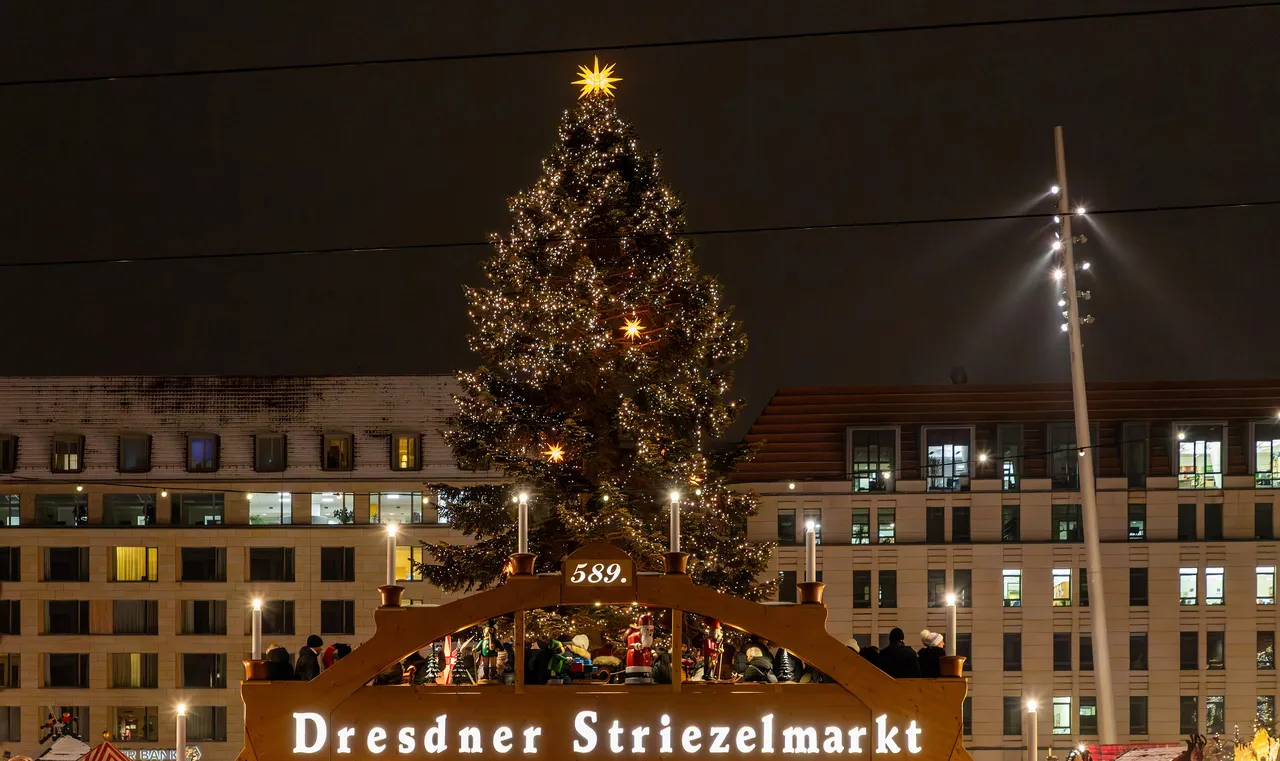
Dresden’s Christmas season is synonymous with the Striezelmarkt on the Altmarkt. Named after “Strietzel”, the old Saxon word for Stollen, the market was first mentioned in 1434 and in 2026 will be held for the 592nd time. At its centre stand a giant tiered Christmas pyramid (Weihnachtspyramide) in the Erzgebirge tradition and an illuminated Schwibbogen (wooden candle arch); stalls sell nutcrackers, smoking men (Räuchermännchen), Herrnhut stars and Pflaumentoffel figures. At the Stollenfest on the first Saturday of December a giant Stollen is paraded through the city and cut with a special knife. The city also has markets of very different character, such as the Neumarkt market around the Frauenkirche, the medieval-themed Stallhof market in the Residenzschloss courtyard and the Augustusmarkt in Neustadt. The dates below come from official sources; hours and special days may change.


| Market | Location | 2026 dates | Note |
|---|---|---|---|
| 592nd Dresdner Striezelmarkt | Altmarkt | 25 November–24 December 2026 | Opening day starts in the afternoon with the opening ceremony (until 21:00); 26 November–23 December daily 10:00–21:00, 24 December 10:00–14:00. Stollenfest on 5 December |
| Advent auf dem Neumarkt | Neumarkt, in front of the Frauenkirche | 25 November–23 December 2026 | According to the official listing also open 27–30 December, on New Year’s Eve and 2–3 January 2027; check hours |
| Weihnachtsmarkt an der Frauenkirche (Münzgasse) | Münzgasse / around the Frauenkirche | 25 November–24 December 2026 | Check hours on the official page |
| Mittelalter-Weihnachtsmarkt im Stallhof | Stallhof of the Residenzschloss | 25 November–23 December 2026 | Medieval theme; according to the official listing also open on the “Rauhnächte” days 27–30 December and 2–6 January 2027; check admission conditions |
| Weihnachtsmarkt am Schloss | Taschenberg, next to the Residenzschloss | 27 November–24 December 2026 | Check hours |
| Augustusmarkt | Hauptstraße, Neustadt | 25 November 2026–3 January 2027 | Closed 24–26 December and 1 January |
| Winterlichter | Prager Straße | 25 November–23 December 2026 | On the shopping street between the main station and the Altmarkt |
What to taste at the market
Dresdner Christstollen
A Christmas loaf made with dried fruit, almonds and butter and thickly dusted with icing sugar; a protected geographical indication.
Pulsnitzer Pfefferkuchen
Spiced gingerbread from the nearby town of Pulsnitz, plain, chocolate-coated or filled.
Glühwein and Kinderpunsch
Spiced mulled wine; alcohol-free fruit Kinderpunsch is available at every market. Mugs usually carry a deposit.
Quarkkeulchen
Small fried Saxon patties of curd cheese and potato served with cinnamon sugar.
Hot chestnuts and roasted almonds
Classic snacks for cold evenings.
Pflaumentoffel
A traditional good-luck figure of a chimney sweep made from prunes; bought more as a gift than to eat.
Tips for Dresden’s Christmas markets
- The Altmarkt, Neumarkt, Stallhof and Taschenberg are a few minutes’ walk apart; you can visit them all in one evening.
- The Striezelmarkt is very crowded at weekends and on Stollenfest day (5 December); weekday mornings are calmer.
- Erzgebirge wooden crafts (pyramids, Schwibbögen, nutcrackers) are valuable and fragile; ask the seller to pack them.
- Mugs carry a deposit; return the mug to get it back or keep it as a souvenir.
- The Striezelmarkt closes at 14:00 on 24 December; 25–26 December are public holidays.
- Some small stalls may accept cash only; carry some euros.
- Keep your bag in front of you in the crowds; there may be security staff and bag checks at the markets.
- Look for accommodation early; demand is very high on December weekends.
Check before you go: Dresdner Striezelmarkt (official, Landeshauptstadt Dresden) ↗ · dresden.de · Weitere Weihnachtsmärkte ↗
Dates and hours were checked on 28 October 2026 on the City of Dresden’s Striezelmarkt page and its “Weitere Weihnachtsmärkte” listing (striezelmarkt.dresden.de, dresden.de). Themed days and event programmes may change; check the official pages again before you go.
When to go
Dresden can be visited in any season; the Christmas market period (25 November–24 December) is the city’s most atmospheric and busiest time. Spring and autumn are best for walks along the Elbe, paddle-steamer trips and nature outings such as Saxon Switzerland. The table below is a general guide.
| Month | City walks | Christmas markets | Elbe and day trips | Crowds |
|---|---|---|---|---|
| January | Challenging | Partly open | Challenging | Quiet |
| February | Challenging | No markets | Challenging | Quiet |
| March | Good | No markets | Good | Quiet |
| April | Very good | No markets | Very good | Moderate |
| May | Very good | No markets | Very good | Moderate |
| June | Very good | No markets | Very good | Moderate |
| July | Very good | No markets | Very good | Busy |
| August | Very good | No markets | Very good | Busy |
| September | Very good | No markets | Very good | Moderate |
| October | Very good | No markets | Good | Moderate |
| November | Good | Partly open | Challenging | Moderate |
| December | Good | Market season | Challenging | Busy |
- Dresden’s winters are colder and drier than those in western Germany; temperatures often fall below zero. Dress in layers and wear non-slip shoes.
- The Striezelmarkt closes on the afternoon of 24 December; the Neumarkt, Stallhof and Augustusmarkt are open on some days after Christmas (see the notes in the table).
- The Semperoper season programme and Christmas concerts can sell out early; follow tickets on the official website.
- Elbe paddle steamers run a limited service in winter; check the timetable on the official website.
- May to September is ideal for the Pillnitz gardens, the Elbe meadows and hiking in Saxon Switzerland.
Visas and entry (Turkish citizens)
Turkish citizens holding ordinary (burgundy) passports need a Schengen visa for tourist entry to Germany. Different rules apply to special, service and diplomatic passports; check the current situation on the website of the Turkish Ministry of Foreign Affairs.
Under Schengen rules you apply to the country of your main destination. If your trip is mainly to Dresden and Germany, you apply to the German missions in Türkiye; the application channel, appointment system and required documents are published on tuerkei.diplo.de.
If you plan to go on from Dresden to Prague, for a day or longer, be clear about where you will stay longest; a valid Schengen visa allows travel within the area, but countries may temporarily reintroduce internal border checks. Identity checks may take place at the German–Czech border, so carry your passport.
Under the Entry/Exit System (EES), being phased in at the EU’s external borders, your biometric data (fingerprints and facial image) may be recorded on first entry. Details are on the official EU page.
Visa fees, processing times and document lists can change. No fees are given on this page; rely only on official sources before applying.
Check before you go: T.C. Dışişleri Bakanlığı · Türk vatandaşlarının tabi olduğu vize uygulamaları ↗ · tuerkei.diplo.de ↗ · EES · europa.eu ↗ · Rota Atlası visa guide (TR)
Travel medical insurance
Check the official visa and entry sources above first: they state whether travel medical insurance is required and the minimum cover. Compare any policy’s cover amount, validity dates and countries covered with the official requirement.
Rota Atlası does not currently offer an insurance partnership; there are no paid links in this section. Last updated: 1 November 2026
Getting to Dresden
- By air: Dresden Airport (DRS) is about 9 km north of the city centre. From the station beneath the terminal the S-Bahn runs to Dresden-Neustadt and Dresden Hauptbahnhof. Depending on the season there may be direct or connecting flights from Türkiye; check current schedules on the airport website or in the search box below.
- Via Berlin, Leipzig or Prague: Berlin Brandenburg (BER) and Leipzig/Halle airports are connected by train; from Prague Airport you first go to Prague main station and then take a EuroCity train along the Elbe valley to Dresden. Current times are on bahn.de and cd.cz.
- By train: Dresden Hauptbahnhof and Dresden-Neustadt are the main stations. There are direct trains to Berlin, Leipzig and Prague; the Prague line is a scenic ride through the Elbe gorge.
- By coach: long-distance coaches stop near the main station; connections to Prague and Berlin are common.
- By car: the city is connected to the A4, A13 and A17 motorways. Parking is limited in the historic centre; park-and-ride (P+R) sites are a practical option.
Getting around

On foot
The Altmarkt, Frauenkirche, Neumarkt, Residenzschloss, Zwinger, Semperoper and Brühl’s Terrace are a few minutes apart. Crossing the Elbe by the Augustusbrücke, you reach Neustadt in 10–15 minutes.
Trams and buses
DVB trams run frequently around the city; Postplatz, Pirnaischer Platz and Albertplatz are major interchanges.
Tickets
Public transport uses the VVO fare system, with single tickets, day tickets and group options, sold at machines or in the official app. Fares can change; check the DVB website.
S-Bahn
S-Bahn lines run to the airport, Meissen and Saxon Switzerland (Kurort Rathen, Bad Schandau); ideal for day trips.
Elbe paddle steamers
Historic paddle steamers sail from the Altstadt riverbank towards Pillnitz, Meissen and Saxon Switzerland; the winter timetable is limited.
Funicular and suspension railway
In Loschwitz the Standseilbahn and the Schwebebahn of 1901 climb the slopes; check maintenance closures on the official website.
Places to visit
Dresden’s Baroque centre is compact and lies on the south bank of the Elbe, while Neustadt shows a different face on the opposite bank. Below you will find twelve sections, from the Frauenkirche to the Zwinger, from Neustadt to the Elbe slopes and day trips.
A reborn symbol
Frauenkirche and Neumarkt

The Frauenkirche is the Protestant church designed by George Bähr and built between 1726 and 1743, whose huge stone dome defines Dresden’s skyline. It collapsed after the bombing of February 1945 and for decades remained a pile of rubble serving as a war memorial. It was rebuilt between 1994 and 2005 with international donations; the dark original stones can still be picked out among the new ones. The surrounding Neumarkt is lined with buildings whose historic facades have been reconstructed, and hosts an Advent market at Christmas.
Must-see
- The interior of the Frauenkirche and the dome viewing platform
- The original stones in the new dome
- The reconstructed historic facades of the Neumarkt
- The Luther monument
Tips
- Visits to the Frauenkirche are restricted during services and concerts; check times on frauenkirche-dresden.de.
- The dome is climbed by stairs and ramps and requires a separate ticket.
- The Neumarkt is at its most beautiful under the evening lights.

Baroque masterpiece
The Zwinger and its museums

The Zwinger is a Baroque complex designed as a festival courtyard, built for Augustus the Strong between 1710 and 1728 by the architect Matthäus Daniel Pöppelmann and the sculptor Balthasar Permoser. The Crown Gate (Kronentor) and the sculpture-adorned Nymphenbad fountain are its most famous corners. The wing designed by Gottfried Semper houses the Gemäldegalerie Alte Meister, whose best-known work is Raphael’s Sistine Madonna. The complex also houses the Porcelain Collection and the Mathematisch-Physikalischer Salon with its historic scientific instruments.
Must-see
- The Kronentor and the galleries around the courtyard
- The Nymphenbad fountain
- The Gemäldegalerie Alte Meister and the Sistine Madonna
- The Porcelain Collection
Tips
- Entry to the courtyard is free; the museums charge separately.
- Some sections may be closed for restoration; check skd.museum.
- The courtyard is quieter early in the morning.

Saxon treasures
Residenzschloss, Green Vault and Procession of Princes

The Residenzschloss, palace of the Saxon rulers, now houses many collections of the Staatliche Kunstsammlungen. The most famous is the Green Vault (Grünes Gewölbe), Augustus the Strong’s treasure chamber: the Historic Green Vault displays jewels and precious objects in Baroque rooms, while the New Green Vault shows masterpieces individually. On Augustusstraße outside the palace, the Fürstenzug (Procession of Princes), a mural of about 100 metres made of Meissen porcelain tiles, depicts the Wettin dynasty that ruled Saxony.
Must-see
- The Historic Green Vault (timed ticket)
- The New Green Vault
- The Turkish Chamber (Türckische Cammer) collection
- The Fürstenzug on Augustusstraße
Tips
- Admission to the Historic Green Vault is limited and timed; buy tickets in advance.
- The palace museums are usually closed on Tuesdays; check days on skd.museum.
- The Fürstenzug is outdoors and can be seen at any time.

Opera and cathedral
Theaterplatz, Semperoper and Hofkirche

Theaterplatz is Dresden’s grandest square. The Semperoper, designed by Gottfried Semper, reopened in 1985 in its second building, completed in 1878, after being destroyed in the war; it is home to the Saxon State Opera and the Staatskapelle Dresden orchestra. On the edge of the square, the Hofkirche (Cathedral of the Holy Trinity) is Saxony’s largest church, and its crypt holds the tombs of Wettin rulers. In the middle of the square stands the equestrian statue of King John.
Must-see
- A performance or guided tour at the Semperoper
- The Hofkirche and its Baroque organ
- The King John statue and the view across the square
- The Semperoper facade under the evening lights
Tips
- Semperoper guided tours depend on the performance schedule; check semperoper.de.
- Performance tickets sell out early on popular dates.
- Keep quiet in the cathedral during services.

The balcony of Europe
Brühl’s Terrace and the Albertinum

Brühl’s Terrace (Brühlsche Terrasse), on the old fortifications above the Elbe, is a promenade nicknamed “the balcony of Europe”. From here you look over the river, the Augustusbrücke and Neustadt on the opposite bank; below is the landing stage of the historic paddle steamers. At the eastern end of the terrace the Albertinum houses the Galerie Neue Meister, with painting and sculpture from Romanticism to the present; works by Caspar David Friedrich are among the most sought-after.
Must-see
- The view of the Elbe and the Augustusbrücke from the terrace
- The glass dome of the Kunstakademie
- The Galerie Neue Meister in the Albertinum
- The fortress remains under the terrace (Festung Dresden)
Tips
- Sunset is the best time for the terrace.
- The wind can be strong in winter; dress warmly.
- The Festung Dresden casemates require a separate ticket; check hours.
Home of the Striezelmarkt
Altmarkt and Kreuzkirche

The Altmarkt is Dresden’s oldest market square and hosts the Striezelmarkt every Christmas. The Kreuzkirche at the corner of the square is the city’s largest church and is famous for the centuries-old boys’ choir, the Dresdner Kreuzchor. Climb its tower for a view over the Altstadt rooftops. Prager Straße, the pedestrian shopping street running south from the Altmarkt, leads to the main station.
Must-see
- The Kreuzkirche and its tower platform
- Kreuzchor concerts (check the programme)
- The Striezelmarkt and its giant pyramid at Christmas
- The Prager Straße pedestrian street
Tips
- The Kreuzchor’s Christmas concerts are in high demand; follow tickets early.
- The tower is climbed by stairs; check opening times.
- The Altmarkt is about a 10–15-minute walk from the main station.
The north bank
Neustadt: Golden Rider, Kunsthofpassage and Pfunds Molkerei

Neustadt, north of the Elbe, has two faces. In the Inner Neustadt, right across the Augustusbrücke, stands the Goldener Reiter, a gilded equestrian statue showing Augustus the Strong as a Roman emperor; from here the tree-lined Hauptstraße, where the Augustusmarkt is held at Christmas, runs to Albertplatz. Beyond Albertplatz, the Outer Neustadt is the city’s alternative quarter, with cafés, independent shops and street art. The colourful courtyards of the Kunsthofpassage are famous for a facade whose drainpipes play music when it rains. Pfunds Molkerei on Bautzner Straße is a historic dairy shop covered in hand-painted Villeroy & Boch tiles.
Must-see
- The Goldener Reiter and Hauptstraße
- The Kunsthofpassage courtyards
- The tiled interior of Pfunds Molkerei
- The cafés and street art of the Outer Neustadt
Tips
- Pfunds Molkerei is a small shop; there may be a queue and photography rules inside.
- The Outer Neustadt is lively in the evenings; go by day for a quieter look round.
- You can walk from the Altstadt to Neustadt across the Augustusbrücke.


Unusual architecture
Yenidze and the Military History Museum (Libeskind’s wedge)

Beyond the Baroque skyline, two buildings show very different sides of Dresden. On the eastern edge of the Friedrichstadt, on Weißeritzstraße, the Yenidze was designed in 1908–1909 by architect Martin Hammitzsch for Hugo Zietz’s “Orientalische Tabak- und Cigarettenfabrik Yenidze”. The company was named after Yenice (Genisea, today near Xanthi in northern Greece, then part of the Ottoman Empire), where its tobacco came from. With its coloured glass dome and a chimney disguised as a minaret, the 62-metre former factory looks like a mosque from outside; today it is an office building, with a restaurant in the dome section and events of the Yenidze Theatre directly beneath the dome. North of the Elbe, in the Albertstadt, the Bundeswehr Military History Museum occupies the former arsenal built in 1873–1876. It reopened in 2011 with a wedge of glass and metal by Daniel Libeskind that pierces the Neoclassical façade; the wedge’s 29-metre viewing platform points towards the area where the air raids of 13–14 February 1945 began. The exhibition traces the development of military technology while focusing on the human side of war. Military History Museum (official) →
Must-see
- The Yenidze’s coloured glass dome and “minaret” chimney
- The oriental-style ornament on the Yenidze’s façade
- Libeskind’s wedge and its 29-metre viewing platform
- The museum’s permanent exhibition on people and war
Tips
- The Yenidze is within walking distance of the Altstadt along the Elbe, close to the Congress Centre; as it is an office building, the interior is only accessible via the restaurant and events.
- The Military History Museum is reached from the centre by tram; check dvb.de for current lines.
- Check the museum’s opening days, hours and tickets on its official website (mhmbw.de) before you go.

River slopes
Blue Wonder, Loschwitz and the Schwebebahn

In the east of the city, the steel bridge linking Blasewitz and Loschwitz opened in 1893 and is known as the “Blaues Wunder” (Blue Wonder) because of its colour. Two historic railways climb the Elbe slopes on the Loschwitz side, covered in villas and vineyards: the Standseilbahn (funicular) and the Schwebebahn, opened in 1901 and one of the world’s oldest suspension railways. The hilltops offer views over the Elbe valley and Dresden.
Must-see
- Walking across the Blue Wonder bridge
- Riding the Schwebebahn up the Loschwitz slope
- Taking the Standseilbahn up to Weißer Hirsch
- A walk in the Elbe meadows
Tips
- The Schwebebahn and Standseilbahn may close periodically for maintenance; check dvb.de.
- Take a tram from the centre to Schillerplatz and walk across the bridge.
- The Elbe Valley was removed from the UNESCO list in 2009; be careful with older sources.

Green Dresden
Großer Garten

South-east of the Altstadt, the Großer Garten was laid out as a Baroque garden in the 17th century and is today a large city park almost two kilometres long. The Palais at its centre is an early example of Baroque garden architecture. The park has ponds, tree-lined avenues, Dresden Zoo and a park railway (Parkeisenbahn) that runs in summer.
Must-see
- The Palais im Großen Garten
- The Carolasee pond and the avenues
- Dresden Zoo
- The Parkeisenbahn in summer
Tips
- The park is quiet and plain in winter; fine for a short walk.
- The Parkeisenbahn only runs in season.
- Take a tram to Straßburger Platz or Großer Garten.
A palace on the Elbe
Pillnitz Palace and Park

Pillnitz, on the Elbe south-east of Dresden, is the summer residence of the Saxon rulers. The Wasserpalais and Bergpalais, with their Chinese-inspired roofs, stand out for the steps leading down to the river. The park has a famous 18th-century camellia protected in winter by a special glasshouse. In summer you can arrive by paddle steamer, and all year round by bus, or by tram combined with the Elbe ferry.
Must-see
- The Wasserpalais and its steps down to the Elbe
- The camellia and its glasshouse (seasonal)
- The palace park and gardens
- Arriving by paddle steamer in summer
Tips
- The palace museums and the camellia house open seasonally; check schloesserland-sachsen.de.
- The park can be visited in winter too, but interiors may be closed.
- Boat services depend on the weather and water levels.
Day trips
Meissen and Moritzburg

Dresden is a good base for Saxony’s culture and nature routes. To the north-west, Meissen is home to Europe’s first hard-paste porcelain manufactory, founded in 1710; the Albrechtsburg castle and the cathedral look down on the Elbe from the hill. It is easily reached by S-Bahn. To the north, Moritzburg is famous for its Baroque hunting lodge in the middle of a lake; the Czech-German fairy-tale film “Three Wishes for Cinderella” (Drei Haselnüsse für Aschenbrödel) was filmed here, and exhibitions about the film may be held in winter. Saxon Switzerland to the south (the Bastei rocks) and the Erzgebirge, home of Christmas crafts and of the UNESCO World Heritage Erzgebirge/Krušnohoří Mining Region, are also popular destinations.
Must-see
- The Meissen porcelain manufactory and museum
- The Albrechtsburg and Meissen Cathedral
- Moritzburg Castle and the lake view
- The Bastei in Saxon Switzerland (weather permitting)
Tips
- Check visiting hours at the Meissen manufactory on its official website.
- Moritzburg can be reached by bus or by the narrow-gauge Lößnitzgrundbahn steam railway; check the timetable.
- Trails in Saxon Switzerland can be icy in winter.

1, 2 and 3-day itineraries + Christmas day
The itineraries are planned around walking distances. Check museum, Green Vault and opera times, and during the Christmas season market hours, on the official websites.
1 day: Baroque Altstadt
- In the morning visit the Frauenkirche and climb the dome, then stroll around the Neumarkt.
- See the Fürstenzug on Augustusstraße and go on to the Residenzschloss; visit the Historic Green Vault with a timed ticket.
- In the afternoon see the Semperoper and Hofkirche on Theaterplatz and walk through the Zwinger courtyard.
- At sunset watch the Elbe from Brühl’s Terrace.
- In the evening cross the Augustusbrücke to Neustadt and see the Goldener Reiter under the lights.
2 days: Museums and Neustadt
- Follow the day 1 itinerary.
- On the morning of day 2 visit the Gemäldegalerie Alte Meister in the Zwinger or the Albertinum.
- In the afternoon head to the Outer Neustadt to see the Kunsthofpassage and Pfunds Molkerei.
- In the evening plan a performance at the Semperoper or a concert at the Kreuzkirche (check the programme and ticket availability).
3 days: The Elbe and a day trip
- Follow the first two days’ itineraries.
- On the morning of day 3 take the S-Bahn to Meissen to visit the porcelain manufactory and the Albrechtsburg.
- Alternatively choose Moritzburg Castle or, weather permitting, the Bastei in Saxon Switzerland.
- Back in Dresden, watch the evening view of the city from the Loschwitz slope via the Blue Wonder and the Schwebebahn.
Christmas market day (25 November–23 December 2026)
- Go to the Striezelmarkt on the Altmarkt when it opens at 10:00 and see the pyramid and Erzgebirge stalls before the crowds.
- Around midday warm up in the Kreuzkirche, then walk to the Neumarkt market in front of the Frauenkirche.
- In the afternoon visit the medieval market in the Stallhof of the Residenzschloss and the castle market on the Taschenberg.
- At sunset cross the Augustusbrücke to Neustadt for the Augustusmarkt on Hauptstraße.
- In the evening return to the Altstadt and end the day under the Striezelmarkt lights with Christstollen and Glühwein or Kinderpunsch. Don’t miss the Stollenfest on 5 December.
Saxon food and Christmas treats
Saxon cooking is hearty, and the coffee-and-cake culture is strong; Dresdeners love local cakes with their afternoon coffee. At Christmas, Christstollen is found in every home and bakery. If you do not eat pork, menus may offer vegetable, fish or beef options; don’t hesitate to ask about ingredients.


Dresdner Christstollen
A Christmas loaf of dried fruit, raisins, almonds and plenty of butter, coated in icing sugar; the name “Dresdner Christstollen” is a protected geographical indication.
Dresdner Eierschecke
A Dresden speciality cake of yeast dough, curd cheese and egg custard layers.
Quarkkeulchen
Small sweet patties of curd cheese and potato, fried and served with cinnamon sugar and apple sauce.
Pulsnitzer Pfefferkuchen
Soft spiced gingerbread made according to the centuries-old tradition of the town of Pulsnitz.
Sauerbraten and Klöße
Meat marinated in vinegar and spices and braised, with potato dumplings (Klöße) and red cabbage; ask about the ingredients.
Saxon wines
The Elbe valley is one of Germany’s northernmost wine regions; alcohol-free apple juice and hot chocolate are common.
- Pork is widely used in restaurants; if you are looking for halal or pork-free options, ask about the menu.
- Bakeries sell Eierschecke and Stollen by the slice; at Christmas whole Stollen also make good gifts.
- Service is included in prices in Germany; leaving a small tip when satisfied is common.
- During the Christmas season it can be hard to get an evening table at popular restaurants.
Culture and etiquette

- Dresdeners are generally reserved and polite; greetings starting with “Guten Tag” and “Danke” are appreciated.
- Erzgebirge Christmas crafts (pyramids, Schwibbögen, nutcrackers) are an important part of local identity; you will see illuminated arches in windows.
- Smart but relaxed dress is common at the opera and concerts; be on time.
- The Frauenkirche is a symbol of remembrance and peace; be respectful and quiet inside.
- Shops are generally closed on Sundays and public holidays.
- Cycle paths are not for pedestrians; do not walk in marked cycle lanes.
- Waste is sorted; many bottles and cans carry a deposit (Pfand).
- Large bags must be left in museum cloakrooms; follow photography rules.
Safety and health
- Dresden is generally safe; watch out for pickpockets around the main station and in Christmas market crowds.
- There may be security measures and bag checks at Christmas markets; follow staff instructions.
- Pavements can be icy in winter; wear non-slip shoes.
- In an emergency call 112 (ambulance, fire) or 110 (police).
- Travel health insurance is mandatory for a Schengen visa; check your policy’s coverage.
- Trails in Saxon Switzerland can be slippery in winter; check the weather and trail conditions.
- Check official travel advice (e.g. the Turkish Ministry of Foreign Affairs or GOV.UK) before you go.
What your budget depends on
No prices are given in this guide, because accommodation, transport and event costs change quickly with the season. The main factors that determine your budget are:
Travel dates
The Christmas market period, especially December weekends and Stollenfest day, noticeably increases demand for accommodation; January–March is usually quieter.
Where you stay
Staying around the Altstadt makes walking easy; Neustadt or districts on a tram line can be alternatives.
How you travel
A direct flight to Dresden or a train combination via Berlin, Leipzig or Prague changes cost and time.
Museums and performances
Tickets for the Staatliche Kunstsammlungen museums, the Green Vault and the Semperoper are separate; check combined ticket options on the official websites.
Food and drink
Market snacks, bakeries and restaurants suit different budgets; remember the mug deposit.
Day trips
S-Bahn, bus or boat tickets to Meissen, Moritzburg or Saxon Switzerland are an extra cost.
Practical information
- Money: the euro is used; card payment is increasingly common, but small stalls may need cash.
- Language: English is spoken at tourist sites; a few German words (Danke, Bitte, Entschuldigung) help.
- Opening hours: shops close on Sundays; many places close early on the afternoon of 24 December, and 25–26 December are public holidays.
- Museum days: closing days of the Staatliche Kunstsammlungen museums vary by museum; check skd.museum.
- Tourist information: the city’s official tourism website and the tourist information points in the centre provide up-to-date information.
- Accessibility: the Altstadt is flat; the Frauenkirche dome and some historic buildings have limited access.
- Weather: in winter it gets dark around 16:00; the Striezelmarkt lights are at their best after that.
- Photography: for the Canaletto view, look at the Altstadt skyline from the Neustadt bank, west of the Augustusbrücke.
Frequently asked questions
When does the Dresden Striezelmarkt open in 2026?
According to the City of Dresden, the 592nd Striezelmarkt will be held on the Altmarkt from 25 November to 24 December 2026. Check the official page again before you go.
What are the Striezelmarkt opening hours?
According to the official announcement, daily 10:00–21:00 from 26 November to 23 December and 10:00–14:00 on 24 December; the opening day starts in the afternoon with the opening ceremony.
When is the Stollenfest?
In 2026 the Stollenfest takes place on Saturday 5 December; check programme details on the official page.
Are any markets open after Christmas?
Yes. According to the official listing the Augustusmarkt runs until 3 January 2027 (except 24–26 December and 1 January), and the Neumarkt and Stallhof markets open on some days between Christmas and New Year.
How many days do I need in Dresden?
You can see the Baroque Altstadt in one day; 2–3 days are ideal for museums, Neustadt and a day trip to Meissen or Moritzburg.
How do I get from the airport to the centre?
From the station at Dresden Airport the S-Bahn runs to Dresden-Neustadt and the Hauptbahnhof. Ticket options are on the DVB/VVO websites.
Do Turkish citizens need a visa for Dresden?
Holders of ordinary passports need a Schengen visa. For the application channel and documents check tuerkei.diplo.de and the Turkish Ministry of Foreign Affairs.
Can I do a day trip from Dresden to Prague?
Yes, there are direct trains and coaches between the two cities. See Rota Atlası’s Prague guide and check the scope of your Schengen visa.
What should I eat in Dresden?
Christstollen, Eierschecke, Quarkkeulchen and Pulsnitzer Pfefferkuchen are the best-known local treats.
Is the Dresden Elbe Valley a UNESCO site?
No. The Dresden Elbe Valley was inscribed in 2004 and removed in 2009. The nearby Erzgebirge/Krušnohoří Mining Region, however, has been a World Heritage Site since 2019.
Where to stay
Stay close to the areas where you will spend most time. The areas below are covered in detail in this guide; check public transport links in the getting-around section.
- A reborn symbolFrauenkirche and Neumarkt
- Baroque masterpieceThe Zwinger and its museums
- Saxon treasuresResidenzschloss, Green Vault and Procession of Princes
- Opera and cathedralTheaterplatz, Semperoper and Hofkirche
- The balcony of EuropeBrühl’s Terrace and the Albertinum
- Home of the StriezelmarktAltmarkt and Kreuzkirche
- The north bankNeustadt: Golden Rider, Kunsthofpassage and Pfunds Molkerei
- Unusual architectureYenidze and the Military History Museum (Libeskind’s wedge)
- River slopesBlue Wonder, Loschwitz and the Schwebebahn
- Green DresdenGroßer Garten
- A palace on the ElbePillnitz Palace and Park
Search hotels in these areas (Hotellook) ↗ (affiliate link)Search on Booking.com ↗
Affiliate disclosure: Hotellook, Aviasales, Klook, Airalo, Tiqets and DiscoverCars links are affiliate links; Rota Atlası may earn a commission on bookings made through them, at no extra cost to you. Official and in-guide links are not paid. Last updated: 1 November 2026 · Privacy and affiliates
Transport and connectivity
- Airport transferOptions from the airport to the city are in this guide’s getting there section.
- Mobile data (eSIM)Airalo eSIM ↗ (affiliate link)
- TrainsOfficial rail website ↗
- Car hireYou rarely need a car within the city; see getting around first. Compare car hire on DiscoverCars ↗ (affiliate link)
Affiliate disclosure: Hotellook, Aviasales, Klook, Airalo, Tiqets and DiscoverCars links are affiliate links; Rota Atlası may earn a commission on bookings made through them, at no extra cost to you. Official and in-guide links are not paid. Last updated: 1 November 2026 · Privacy and affiliates
Search flights (affiliate link)
Search flights from any airport in any country. Results open on Aviasales in a new tab, where you book.
This form is an affiliate link: Rota Atlası may earn a commission on bookings made via Aviasales (Travelpayouts), at no extra cost to you. Check price, baggage and terms on the booking site. Airport data: OurAirports (public domain).
Flights, hotels and tours
Find tours and tickets
- Striezelmarkt
GetYourGuide ↗ · Klook ↗ (affiliate link) - Frauenkirche and Neumarkt
GetYourGuide ↗ · Klook ↗ (affiliate link) - Zwinger
GetYourGuide ↗ · Klook ↗ (affiliate link) - Semperoper
GetYourGuide ↗ · Klook ↗ (affiliate link)
Hotellook, Aviasales, Klook, Airalo and Tiqets links in this box are affiliate links (Travelpayouts): Rota Atlası may earn a commission on bookings made through them, at no extra cost to you. GetYourGuide links currently carry no affiliate code. Check prices and terms with the provider. Last updated: 1 November 2026 · Privacy and affiliates
Sources
- T.C. Dışişleri Bakanlığı · Türk vatandaşlarının tabi olduğu vize uygulamaları ↗
- Auswärtiges Amt · Deutsche Vertretungen in der Türkei (Visa) ↗
- European Union · Entry/Exit System (EES) ↗
- Landeshauptstadt Dresden · Tourismus (official) ↗
- Staatliche Kunstsammlungen Dresden (official) ↗
- Frauenkirche Dresden (official) ↗
- Semperoper Dresden (official) ↗
- Schlösserland Sachsen (official) ↗
- DVB · Dresdner Verkehrsbetriebe ↗
- Flughafen Dresden ↗
- Deutsche Bahn ↗
- GOV.UK · Foreign travel advice · Germany ↗
- UNESCO World Heritage Centre · Erzgebirge/Krušnohoří Mining Region ↗
- Dresdner Striezelmarkt (official, Landeshauptstadt Dresden) ↗
- dresden.de · Weitere Weihnachtsmärkte ↗
This page is for information only. Dates, hours, entry rules and transport details can change; check the official sources above before you travel. No prices, flights, hotels or restaurant recommendations have been invented in this guide.
Photo credits
The photos on this page come from Wikimedia Commons and are used with the stated authors and licences (CC BY, CC BY-SA, CC0 or public domain). All sources page
- The Striezelmarkt entrance and the great Christmas tree on Dresden’s Altmarkt — Dietmar Rabich · CC BY-SA 4.0 · Wikimedia Commons
- The giant illuminated Schwibbogen arch of the Striezelmarkt — VSchagow · CC BY-SA 4.0 · Wikimedia Commons
- The tiered Christmas pyramid and tree at the Striezelmarkt — VSchagow · CC BY 4.0 · Wikimedia Commons
- Illuminated Herrnhut stars hanging over Striezelmarkt stalls — Dietmar Rabich · CC BY-SA 4.0 · Wikimedia Commons
- Replica of the great Stollen knife used at the Dresden Stollen Festival — Paulae · CC BY 3.0 · Wikimedia Commons
- The medieval Christmas market in the Stallhof courtyard of the Residenzschloss — Dr. Bernd Gross · CC BY-SA 4.0 · Wikimedia Commons
- Illuminated stalls of the Augustusmarkt on Hauptstraße — Aagnverglaser · CC BY-SA 4.0 · Wikimedia Commons
- The Dresden skyline seen from the Canaletto viewpoint across the Elbe — Albrecht Voß · CC BY-SA 4.0 · Wikimedia Commons
- The stone dome of the Frauenkirche rising above the Neumarkt — Dietmar Rabich · CC BY-SA 4.0 · Wikimedia Commons
- The Zwinger courtyard and Sophienkirche in a historic colour print — Adam Cuerden · Public domain · Wikimedia Commons
- The historic paddle steamer “Meißen” on the Elbe — Dguendel · CC BY 3.0 · Wikimedia Commons
- Sliced Dresdner Christstollen dusted with icing sugar — Kora27 · CC BY-SA 4.0 · Wikimedia Commons
- A slice of three-layer Dresdner Eierschecke cake — Brücke-Osteuropa · CC0 · Wikimedia Commons
- Quarkkeulchen (curd pancakes) served with apple sauce — Dr. Bernd Gross · CC BY-SA 4.0 · Wikimedia Commons
- Traditional Pfefferkuchen gingerbread from Pulsnitz — Brücke-Osteuropa · CC0 · Wikimedia Commons
- The Semperoper opera house illuminated at night — Sebastian Terfloth User:Sese_Ingolstadt · CC BY-SA 3.0 · Wikimedia Commons
- The dome and painted ceiling inside the Frauenkirche — T meltzer · CC BY-SA 4.0 · Wikimedia Commons
- Exterior of the Frauenkirche on the Neumarkt — CEphoto, Uwe Aranas · CC BY-SA 3.0 · Wikimedia Commons
- The crowned Kronentor gate of the Zwinger and its moat — DIMSFIKAS · CC BY-SA 3.0 · Wikimedia Commons
- The sculpted Nymphenbad fountain in the Zwinger — Hangman'sDeath · CC0 · Wikimedia Commons
- The Dresden Residenzschloss and its Hausmannsturm tower — CEphoto, Uwe Aranas · CC BY-SA 3.0 · Wikimedia Commons
- The Fürstenzug procession of rulers in porcelain tiles on Augustusstraße — CEphoto, Uwe Aranas · CC BY-SA 3.0 · Wikimedia Commons
- The Baroque Hofkirche (cathedral) by the Elbe — Achim Lammerts (Syntaxys) · CC BY-SA 4.0 · Wikimedia Commons
- The Semperoper facade on Theaterplatz by day — CEphoto, Uwe Aranas · CC BY-SA 3.0 · Wikimedia Commons
- The tree-lined promenade of the Brühl Terrace — Txllxt TxllxT · CC BY-SA 4.0 · Wikimedia Commons
- The tower of the Kreuzkirche next to the Altmarkt — Achim Lammerts (Syntaxys) · CC BY-SA 4.0 · Wikimedia Commons
- The gilded Golden Rider statue in the Neustadt — CEphoto, Uwe Aranas · CC BY-SA 3.0 · Wikimedia Commons
- The colourful facade of the Courtyard of Animals in the Kunsthofpassage — Fred Romero from Paris, France · CC BY 2.0 · Wikimedia Commons
- The hand-painted tiled interior of Pfunds Molkerei — Jerzy Strzelecki · CC BY-SA 3.0 · Wikimedia Commons
- The Loschwitz Bridge “Blaues Wunder” over the Elbe — Gerd Eichmann · CC BY-SA 4.0 · Wikimedia Commons
- View from the Loschwitz suspension railway (Schwebebahn) in December — Romzig · CC0 · Wikimedia Commons
- The Baroque palace in the Großer Garten — User:Kolossos · CC BY-SA 3.0 · Wikimedia Commons
- The Bergpalais of Pillnitz Palace on the Elbe — Felix König · CC BY-SA 3.0 de · Wikimedia Commons
- Meissen’s Albrechtsburg and cathedral above the Elbe — Jörg Blobelt · CC BY-SA 4.0 · Wikimedia Commons
- Moritzburg Palace in the middle of its lake — Tilman2007 · CC BY-SA 3.0 · Wikimedia Commons
Leipzig → · Berlin → · Prague → · Nuremberg → · Cologne → · Christmas markets