

Leipzig is the largest city in the German state of Saxony and, with about 620,000 inhabitants, one of the fastest-growing cities in eastern Germany. A trade fair and merchant city since the Middle Ages, Leipzig also stands out for its history of book printing and music: Johann Sebastian Bach worked as cantor at the Thomaskirche from 1723 until his death in 1750, Mendelssohn conducted the Gewandhaus Orchestra, and Wagner was born here. In October 1989 the Monday demonstrations that began at the Nikolaikirche became a symbol of the Peaceful Revolution and of the process that led to the fall of the Berlin Wall. The old town’s Renaissance town hall, its historic shopping arcades and the cultural buildings of Augustusplatz are easy to explore on foot. From late November until 23 December the Leipzig Christmas market fills the squares and streets of the centre with about 300 stalls; according to official sources, the tradition goes back to 1458.
Content update: 28 October 2026 · Christmas market dates checked against the official leipzig.de (Stadt Leipzig) page
Leipzig at a glance
- Country / state
- Germany · Saxony (Sachsen)
- Population
- About 620,000; Saxony’s largest city
- Language
- German; English is common at tourist sites and among younger people
- Currency
- Euro (EUR)
- Time zone
- Central European Time (CET, UTC+1); UTC+2 in summer. Two hours behind Türkiye in winter
- Known for
- Bach and the Thomanerchor, the 1989 Peaceful Revolution, trade fairs and books, historic arcades
- Landmarks
- Old Town Hall, Thomaskirche, Nikolaikirche, Mädler-Passage, Gewandhaus, Völkerschlachtdenkmal
- Christmas market
- Leipziger Weihnachtsmarkt: 24 November–23 December 2026, about 300 stalls
- Nearby UNESCO sites
- Quedlinburg (1994) and the Luther Memorials in Wittenberg (1996)
- Airport
- Leipzig/Halle Airport (LEJ); linked to the Hauptbahnhof by S-Bahn
- Electricity
- 230 V, 50 Hz; type F sockets, the same as in Türkiye
- Emergency
- 112 (ambulance and fire), 110 (police)
Leipzig in pictures
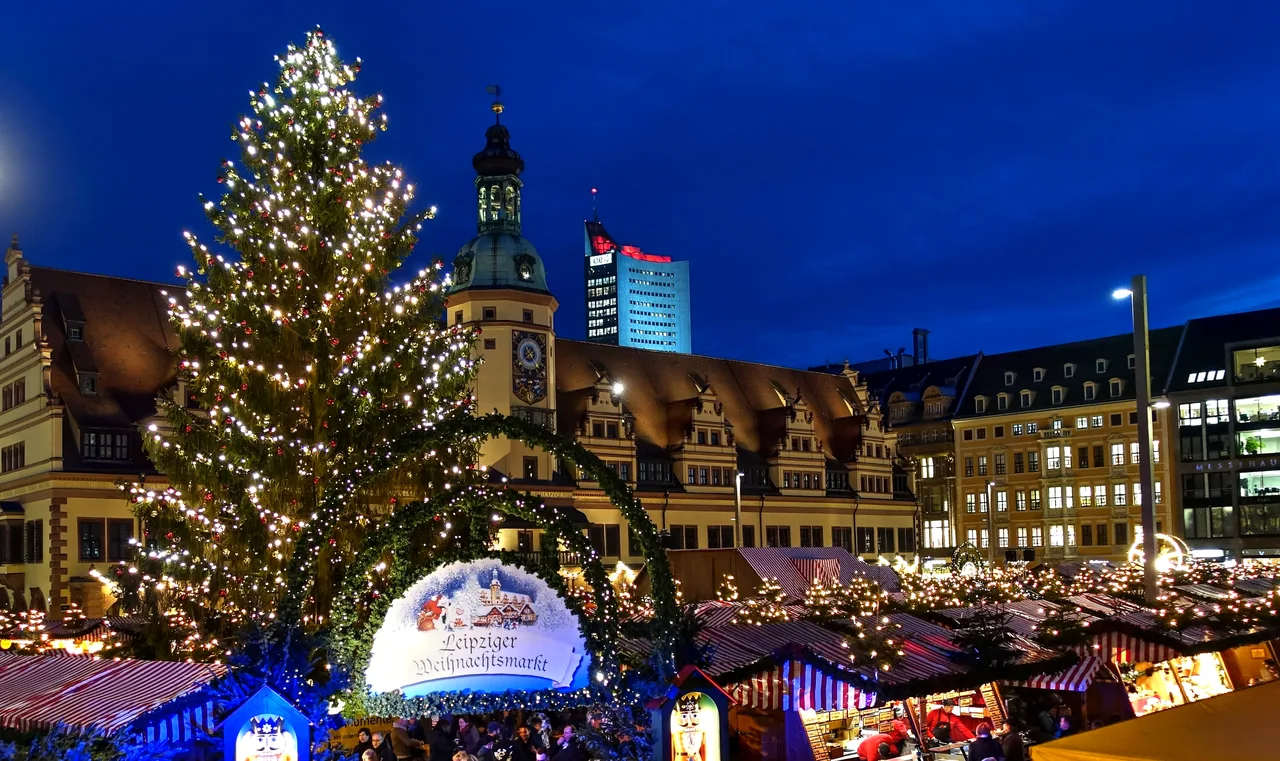
The Christmas market on the Markt in the evening light, the Renaissance Old Town Hall and Augustusplatz at night: Leipzig in three pictures.


Leipzig Christmas market 2026
According to the official Stadt Leipzig page, the Leipzig Christmas market (Leipziger Weihnachtsmarkt), with about 300 stalls, is one of Germany’s big Christmas markets, and its tradition goes back to 1458. It is not confined to a single square: the Markt in front of the Old Town Hall has the giant Christmas tree and the stage programme, the Naschmarkt hosts a medieval-style historic market, Augustusplatz has the Fairy-Tale Forest (Märchenwald), a Ferris wheel, a Finnish village and a South Tyrolean village, and Burgplatz has a Swiss village. The historic multi-storey carousel (Etagenkarussell) at the corner of Reichsstraße and Salzgäßchen is a favourite with children; Nikolaikirchhof, Grimmaische Straße, Petersstraße and Thomaswiese are also part of the market. Wooden crafts from the Erzgebirge, Pulsnitz gingerbread and stollen are the market’s classics. The dates and times below were checked against the official Stadt Leipzig page on 28 October 2026.


| Market / event | Location | 2026 dates | Note |
|---|---|---|---|
| Leipziger Weihnachtsmarkt | Markt, Naschmarkt, Augustusplatz, Nikolaikirchhof, Grimmaische Str., Petersstr., Burgplatz and Thomaswiese | 24 November–23 December 2026 | Per the official page, Sun–Thu 11:00–21:00, Fri–Sat 11:00–22:00; on 24 November the stalls open at 14:00; on 22–23 December until 20:00. Free entry |
| Opening ceremony | Markt | 24 November 2026 | Per the official programme, trombone playing (Posaunenblasen) at 17:00, official opening with Mayor Burkhard Jung and the Thomanerchor at 17:05, Ratspfeifer music at 19:00 |
| Arrival of Father Christmas | Hauptbahnhof (track 6) → Markt | 28 November 2026 | Per the official programme, Father Christmas arrives at the Hauptbahnhof by historic train at about 11:00 and is at the Markt at about 12:00 |
| Great Erzgebirge Bergparade | Richard-Wagner-Str./Nikolaistr. → Richard-Wagner-Platz | 19 December 2026 (Saturday) | Per the official page, about 800 miners’ musicians and participants in traditional costume; starts at 16:00, closing concert on Richard-Wagner-Platz at about 17:00 |
| Augustusplatz and the villages | Augustusplatz, Burgplatz | 24 November–23 December 2026 | Fairy-Tale Forest, Ferris wheel, Finnish village and South Tyrolean village; Swiss village on Burgplatz. Check the official page for times |
| Daily programme | Markt stage | Throughout the market season | Per the official page, a stage programme every day from 16:30; Father Christmas’s “consultation hour” Thu–Sat 16:00–16:45; trombone playing Mon–Thu 18:00, Fri 19:00, Sat–Sun 13:00 and 19:00 |
What to taste at the market
Pulsnitzer Pfefferkuchen
Traditional gingerbread from the Saxon town of Pulsnitz – the classic Leipzig market gift.
Stollen
Saxon Christmas bread with dried fruit and icing sugar. Dresden is famous for it, but you will find it on every corner of the Leipzig market too.
Glühwein
Spiced mulled wine; alcohol-free Kinderpunsch and hot apple juice are also available. Mugs may carry a deposit (Pfand).
Waffeln
Hot waffle stalls at Nikolaikirchhof and elsewhere.
Treats from the Finnish village
Northern specialities such as salmon cooked over a wood fire (Flammlachs) in the Finnish village on Augustusplatz.
Bratwurst and Rostbrätel
Grilled sausage and Thuringian-style grilled meat; usually contains pork, so ask.
Tips for the Leipzig Christmas market
- The market is spread across the centre; start at the Markt and walk via the Naschmarkt and Nikolaikirchhof to Augustusplatz to see it all.
- Weekend evenings are very crowded; go on a weekday afternoon if you can.
- The Bergparade (19 December) and opening day (24 November) are the busiest days; arrive early.
- Mulled wine mugs carry a deposit; return the mug to get it back or keep it as a souvenir.
- Small stalls may need cash; carry some euros.
- The Leipzig Christmas market ends on 23 December; many places close on the afternoon of 24 December.
- According to the official page, the Sunday shopping days (verkaufsoffener Sonntag) during the market are 29 November and 13 December.
- Dates and times can change; check the official page again before you go.
Check before you go: Stadt Leipzig · Leipziger Weihnachtsmarkt (official) ↗ · Stadt Leipzig · Weihnachtsmarkt in der Innenstadt im Überblick ↗ · Leipzig Tourismus · leipzig.travel ↗
Dates and times were checked on 28 October 2026 against Stadt Leipzig’s official Christmas market page (leipzig.de). Some details for 22–23 December and the stage programme may change; follow the current programme on the official page and on leipzig.travel.
When to go
The most comfortable time to explore Leipzig is May to September; in summer the lakes and parks south of the city come alive. Late November to 23 December is Christmas market season. February and March are cold and grey, but museums and concerts run all year. Accommodation demand rises during the Leipzig Book Fair (Leipziger Buchmesse) in March.
| Month | City walks | Christmas market | Day trips and lakes | Crowds |
|---|---|---|---|---|
| January | Challenging | No market | Challenging | Quiet |
| February | Challenging | No market | Challenging | Quiet |
| March | Good | No market | Good | Moderate |
| April | Very good | No market | Good | Moderate |
| May | Very good | No market | Very good | Moderate |
| June | Very good | No market | Very good | Busy |
| July | Very good | No market | Very good | Moderate |
| August | Very good | No market | Very good | Moderate |
| September | Very good | No market | Very good | Moderate |
| October | Good | No market | Good | Moderate |
| November | Good | Market season | Challenging | Moderate |
| December | Good | Market season | Challenging | Busy |
- Leipzig is cold in winter; in December temperatures often drop below freezing and it can snow.
- The Christmas market runs from 24 November to 23 December 2026; December weekends are the busiest.
- During the Bach Festival (Bachfest) in June, demand for concerts and accommodation is high; check dates on the official website.
- In summer the Leipzig lake district (Leipziger Neuseenland) south of the city is popular for swimming and cycling.
- In December it gets dark around 16:00; the market lights are at their best in the evening.
Visas and entry (Turkish citizens)
Turkish citizens holding ordinary (burgundy) passports need a Schengen visa for tourist entry to Germany. Different rules apply to special, service and diplomatic passports; check the current situation on the website of the Turkish Ministry of Foreign Affairs.
Under Schengen rules you apply to the country of your main destination. If your trip is mainly to Leipzig and Germany, you apply to the German missions in Türkiye; the application channel, appointment system and required documents are published on tuerkei.diplo.de.
If you plan to continue from Leipzig to cities in neighbouring countries such as Prague (Czechia), be clear about where you will stay longest; a valid Schengen visa allows travel within the area, but checks may take place at internal borders from time to time, so carry your passport.
Under the Entry/Exit System (EES), being phased in at the EU’s external borders, your biometric data (fingerprints and facial image) may be recorded on first entry. Details are on the official EU page.
Visa fees, processing times and document lists can change. No fees are given on this page; rely only on official sources before applying.
Check before you go: T.C. Dışişleri Bakanlığı · Türk vatandaşlarının tabi olduğu vize uygulamaları ↗ · tuerkei.diplo.de ↗ · EES · europa.eu ↗ · Rota Atlası visa guide (TR)
Travel medical insurance
Check the official visa and entry sources above first: they state whether travel medical insurance is required and the minimum cover. Compare any policy’s cover amount, validity dates and countries covered with the official requirement.
Rota Atlası does not currently offer an insurance partnership; there are no paid links in this section. Last updated: 1 November 2026
Getting to Leipzig
- By air: Leipzig/Halle Airport (LEJ) lies north-west of the city, between Leipzig and Halle, and is linked to Leipzig Hauptbahnhof by S-Bahn. Direct flights from Türkiye vary by season and airline; check current services only on the official airline and airport websites. Berlin Brandenburg Airport (BER) is an alternative with a train connection.
- By train: Leipzig Hauptbahnhof, opened in 1915 and considered one of the largest railway stations in Europe, is a major hub. There are direct ICE/IC connections from Berlin, Dresden, Frankfurt, Munich and Erfurt. Times and tickets on bahn.de.
- By coach: Long-distance coaches use the bus terminal on the east side of the Hauptbahnhof; check operators and times through official channels.
- By car: Leipzig is connected to the A9, A14 and A38 motorways; the old town is largely closed to traffic, so use car parks and Park+Ride.
Getting around

On foot
The old town lies within the inner ring road (Innenstadtring); the Markt, Thomaskirche, Nikolaikirche, the arcades and Augustusplatz are a few minutes’ walk from one another.
Tram and bus
The Leipziger Verkehrsbetriebe (LVB) tram network is extensive; trams serve districts such as the Völkerschlachtdenkmal area, Plagwitz and Gohlis. Current lines on l.de.
S-Bahn and City-Tunnel
Opened in 2013, the City-Tunnel takes S-Bahn trains under the city from the Hauptbahnhof via the Markt and Wilhelm-Leuschner-Platz; the airport and Halle are also served by S-Bahn.
Tickets
Tickets follow the MDV (Mitteldeutscher Verkehrsverbund) tariff and are sold from machines and official apps; day tickets are available. Buy your ticket before boarding and check fares on mdv.de.
Bike
Leipzig is flat and has many cycle paths; bike-sharing schemes are available. Do not walk on cycle lanes.
Taxi
There are taxi ranks at the Hauptbahnhof and central locations; taxis can also be ordered by phone.
Places to visit
Leipzig’s sights range from the historic squares of the old town to its music churches, from arcades to museums and the industrial-heritage districts in the west. The twelve sections below cover the city’s key stops and day trips that are easy to reach by train.
Old town
Markt, Old Town Hall and Naschmarkt

The Markt is the heart of Leipzig’s old town. The Old Town Hall (Altes Rathaus), filling the east side of the square, was built in the Renaissance style by Hieronymus Lotter in 1556–1557 and now houses the Leipzig Museum of City History (Stadtgeschichtliches Museum). On the small Naschmarkt behind it stand the Baroque Alte Handelsbörse (Old Trading Exchange), built in the late 17th century, and a statue of Goethe, who studied in Leipzig. At Christmas the Markt hosts the giant Christmas tree and stage, and the Naschmarkt the historic market.
Must see
- The Old Town Hall façade and Museum of City History
- The Alte Handelsbörse on the Naschmarkt
- The Goethe statue
- The giant Christmas tree on the Markt at Christmas
Tips
- Check museum hours on the Stadtgeschichtliches Museum’s official website.
- The City-Tunnel’s Markt station is right beneath the square.
- The square is at its most photogenic when the evening lights come on.

Bach’s church
Thomaskirche, the Thomanerchor and the Bach Museum

The Thomaskirche (St Thomas Church) is where Johann Sebastian Bach worked as cantor from 1723 until his death in 1750; Bach’s grave is now in the church’s chancel. The world-famous boys’ choir, the Thomanerchor, whose origins go back to 1212, is attached to the church and regularly performs motets and cantatas. A statue of Bach stands in front of the church, and opposite is the Bach Museum run by the Bach-Archiv. The Bachfest in June draws music lovers from all over the world.
Must see
- Bach’s grave
- A Thomanerchor motet or cantata
- The Bach statue
- The Bach Museum
Tips
- Check the concert programme on thomaskirche.org; concerts are in great demand at Christmas.
- Do not walk around the church during services and concerts.
- See bachmuseumleipzig.de for Bach Museum hours.

1989
Nikolaikirche and the Peaceful Revolution

The Nikolaikirche (St Nicholas Church) is one of Leipzig’s oldest and largest churches. The Monday prayers for peace held here in the 1980s became the starting point of the Monday demonstrations in East Germany; the peaceful march of tens of thousands of people around the ring road on 9 October 1989 is considered one of the turning points on the way to the fall of the Berlin Wall. The church’s classicist interior, remodelled in the late 18th century, is unique, with white columns whose capitals resemble palm fronds. A replica column on the Nikolaikirchhof in front of the church commemorates the revolution; at Christmas market stalls are set up here too.
Must see
- The interior with its palm-capital columns
- The Nikolai column on the Nikolaikirchhof
- The story of the Peaceful Revolution
Tips
- Check opening hours and the current schedule of the peace prayers on nikolaikirche.de.
- To learn more about the revolution, consider the nearby Runde Ecke memorial museum and the Zeitgeschichtliches Forum; check hours on their official websites.
- The church is a place of worship; keep quiet.

Shopping arcades
Mädler-Passage, Auerbachs Keller and Specks Hof

Leipzig’s old town is known for its system of historic arcades and courtyards, born of the trade fair tradition. Opened in 1914, the Mädler-Passage is the most famous, with its glass roof and elegant shops. Beneath it, Auerbachs Keller is a historic cellar restaurant that inspired a scene in Goethe’s Faust; the statues of Faust and Mephisto at the entrance are a photo stop. Specks Hof is one of the oldest surviving arcades in the city and stands out for its colourful glass and ceramic work. The arcades make a warm walking route in the winter cold.
Must see
- The Mädler-Passage glass roof
- The Faust statues at the entrance to Auerbachs Keller
- The inner courtyards of Specks Hof
Tips
- The arcades connect with one another; wandering between Grimmaische Straße and Petersstraße without a map is a pleasure.
- Auerbachs Keller is popular; this guide makes no restaurant recommendations, so check its official website for bookings and hours.
- Shops are closed on Sundays.

Cultural square
Augustusplatz: Gewandhaus, Opera and Paulinum

Augustusplatz is one of the largest city squares in Germany. At one end stands the concert hall, opened in 1981, of the Gewandhaus Orchestra – one of the world’s oldest civic symphony orchestras, whose tradition goes back to 1743 – and opposite it is the Leipzig Opera. On one side rises Leipzig University’s Paulinum, a modern design that keeps alive the memory of the University Church (Universitätskirche St. Pauli) demolished in 1968. The Mendebrunnen fountain, lit at night, the Kroch-Hochhaus and the City-Hochhaus are the square’s other landmarks. At Christmas Augustusplatz hosts the Fairy-Tale Forest, Ferris wheel and village markets.
Must see
- A concert at the Gewandhaus
- The Leipzig Opera
- The Paulinum façade
- The Mendebrunnen fountain
Tips
- Check concert and opera programmes on gewandhausorchester.de and oper-leipzig.de; Christmas concert tickets can sell out early.
- The square is wide and windy; wrap up in winter.
- Augustusplatz is a meeting point of tram lines.

Museums
Museum der bildenden Künste and GRASSI Museum

The Museum der bildenden Künste (Museum of Fine Arts), in its glass-cube building opened in 2004, displays European painting and sculpture from the Middle Ages to the present, together with contemporary works of the Leipzig School. The GRASSI Museum brings together three museums in a single Art Deco complex: applied arts, ethnology and Leipzig University’s Museum of Musical Instruments. The museums are ideal for spending time in the city on winter days.
Must see
- The MdbK glass cube and collection
- The GRASSI Museum of Musical Instruments
- The GRASSI inner courtyard
Tips
- Check hours and temporary exhibitions on mdbk.de and grassimuseum.de; museums are usually closed on Mondays.
- There may be reduced or free admission on some days; check the official websites.
- The MdbK is within walking distance of the Hauptbahnhof.

West Leipzig
Plagwitz, the Karl-Heine Canal and the Spinnerei

Plagwitz was an industrial district that grew up along canals in the 19th century; today, with its brick factory buildings, canal-side paths, cafés and workshops, it represents Leipzig’s creative side. Walking and cycling paths run along the Karl-Heine Canal. The Baumwollspinnerei (Spinnerei), once one of the largest cotton-spinning mills in continental Europe, is now a centre for painters of the “New Leipzig School”, with galleries, artists’ studios and exhibition spaces.
Must see
- A walk along the Karl-Heine Canal
- The Spinnerei galleries
- The old industrial buildings
Tips
- Plagwitz is reached by tram; check current lines on l.de.
- The Spinnerei galleries open on limited days; check its official website.
- In summer canoe and boat tours on the canal are popular.

Monument
Völkerschlachtdenkmal (Monument to the Battle of the Nations)

The Völkerschlachtdenkmal was inaugurated in 1913, the centenary of the Battle of the Nations (Völkerschlacht) fought around Leipzig in October 1813 between Napoleon’s army and a coalition of Russia, Prussia, Austria and Sweden. About 91 metres high, it is one of the largest monuments in Europe. The domed hall inside and its giant sculptures are striking, and the viewing terrace at the top offers a view of the city. The museum next to the monument tells the story of the battle.
Must see
- The monument’s inner hall and sculptures
- The viewing terrace
- The “Lake of Tears” in front of the monument
Tips
- It is reached by tram from the centre; check line information on l.de.
- The terrace is reached by hundreds of steps; hours and tickets on voelkerschlachtdenkmal.de.
- Hours may be shorter in winter.
Views
City-Hochhaus and the city panorama

The City-Hochhaus on Augustusplatz, built for Leipzig University in the 1970s, is the tallest building in the city; locals nickname it the “Weisheitszahn” (wisdom tooth) because of its shape. The viewing platform and restaurant floor at the top offer a wide panorama of the old town, Augustusplatz and the Völkerschlachtdenkmal in the distance. The view is especially impressive at sunset and when the Christmas market lights come on.
Must see
- A bird’s-eye view of the old town and Augustusplatz
- The sunset view
Tips
- Opening hours and access to the viewing platform may change; check with official sources before you go.
- For alternative views, consider the Völkerschlachtdenkmal terrace.
- Clear weather gives the sharpest views.
Day trip · UNESCO
Quedlinburg

Quedlinburg in Saxony-Anhalt is on the UNESCO World Heritage List (1994) for its hundreds of timber-framed (Fachwerk) houses, the Collegiate Church (Stiftskirche St. Servatius) on the Schlossberg and its castle. An important residence of German kings in the Middle Ages, the town at the foot of the Harz mountains has a fairy-tale atmosphere. It is also known for its Advent market held in historic courtyards in December; check dates on official websites. UNESCO listing ↗ Quedlinburg guide →
Must see
- The view of the tiled roofs from the Schlossberg
- The Stiftskirche St. Servatius and its treasury
- The old town full of timber-framed houses
Tips
- From Leipzig the train journey usually involves a change; check current connections on bahn.de.
- The day trip can be long; set off early.
- See the Rota Atlası Quedlinburg guide for details.
Day trip · UNESCO
Lutherstadt Wittenberg

Lutherstadt Wittenberg is where Martin Luther published his 95 Theses in 1517, launching the Reformation. The Castle Church (Schlosskirche), the Lutherhaus where Luther lived and Melanchthon’s house are on the UNESCO World Heritage List (1996) together with the Luther memorials in Eisleben. The small old town is easy to explore on foot from the Castle Church to the market square. UNESCO listing ↗
Must see
- The Schlosskirche and the Theses Door
- The Lutherhaus (Reformation museum)
- The market square and Stadtkirche
Tips
- There are direct train connections from Leipzig; check journey times on bahn.de.
- Check museum hours on the official websites.
- Combining it with Halle on the same day can be tiring.
Day trip
Halle (Saale)

Halle (Saale) is the neighbouring city, easily reached from Leipzig by S-Bahn. The composer George Frideric Handel was born here in 1685; his birthplace is now the Händel-Haus museum. The market square is graced by the five towers of the Marktkirche (Market Church) and the Red Tower (Roter Turm). Halle is also known for Halloren, said to be the oldest chocolate factory in Germany.
Must see
- The market square, Marktkirche and Roter Turm
- The Händel-Haus
- The banks of the Saale
Tips
- Reached by S-Bahn and regional trains; check current timetables on bahn.de and mdv.de.
- Halle has its own Christmas market; check dates on its official website.
- Check museum hours in advance.
1, 2 and 3-day itineraries + Christmas day
These itineraries are planned for walking and public transport. Leipzig’s old town is compact: one day covers the main stops, two days add museums and districts, and three allow a day trip. Check church, museum and concert times on the official websites before you go.
1 day: Old town and Bach
- In the morning see the Old Town Hall on the Markt and the Alte Handelsbörse on the Naschmarkt.
- Visit Bach’s grave in the Thomaskirche and go into the Bach Museum opposite.
- In the afternoon wander through the Mädler-Passage and Specks Hof arcades.
- See the columned interior of the Nikolaikirche and learn the story of 1989.
- End the evening on Augustusplatz among the lights of the Gewandhaus and the Opera.
2 days: Museums, Plagwitz and the monument
- In addition to day one, spend the morning of day two at the Museum der bildenden Künste.
- See the musical instruments collection at the GRASSI Museum.
- In the afternoon take the tram to the Völkerschlachtdenkmal and climb to the terrace.
- In the late afternoon walk along the Karl-Heine Canal in Plagwitz.
3 days: A day trip
- On day three take the train to Wittenberg or the S-Bahn to Halle.
- If you have the time and energy, choose the longer journey to the UNESCO-listed town of Quedlinburg.
- Back in Leipzig in the evening, consider the Thomanerchor or Gewandhaus concert programme.
Christmas market day (24 November–23 December 2026)
- Head to the Markt around midday; see the giant Christmas tree and the Old Town Hall.
- Explore the historic market on the Naschmarkt and the multi-storey carousel on Reichsstraße.
- Walk through the arcades to the Nikolaikirchhof, then on to the Fairy-Tale Forest, Finnish village and Ferris wheel on Augustusplatz.
- After 16:30 watch the programme on the Markt stage and listen to the trombone playing (Posaunenblasen).
- Buy Pfefferkuchen and stollen and end the day in the illuminated old town. If you are there on 19 December, do not miss the Bergparade at 16:00.
Leipzig and Saxon food
Leipzig and Saxon cooking feature hearty dishes, coffee culture and pastries. Below are local specialities to try, not restaurant recommendations.


Leipziger Lerche
A lattice-topped shortcrust tart filled with marzipan. It is said to have appeared after lark hunting was banned in 1876, replacing the old bird dish of the same name.
Leipziger Allerlei
A buttery mix of vegetables such as peas, carrots, asparagus and mushrooms; the traditional recipe also includes crayfish.
Stollen
Saxon Christmas bread with dried fruit and icing sugar.
Quarkkeulchen
Saxon pancakes made with quark and potato, usually served with apple sauce.
Räbchen
Stuffed prunes dipped in batter and fried; a local sweet.
Gose
A traditional slightly sour and salty beer style closely associated with Leipzig.
Coffee culture
Leipzig is known for “Zum Arabischen Coffe Baum”, one of Germany’s oldest coffee houses; the coffee and cake (Kaffee und Kuchen) tradition is strong.
- Pork is common in German cooking; ask if you need halal or pork-free options.
- Tap water is drinkable; restaurants usually serve bottled water.
- Popular restaurants fill up early at Christmas.
- Tips are usually given by rounding up or adding a small percentage when paying.
Culture and etiquette

- In Germany people usually greet each other with “Hallo” or “Guten Tag”.
- Punctuality matters; be on time for guided tours, concerts and appointments.
- Keep quiet in churches and do not walk around during services and concerts; the Thomaskirche and Nikolaikirche are active places of worship.
- In restaurants it is common to round up the bill or leave a small tip; the tip is stated when paying.
- Quiet hours are observed on Sundays and shops are closed.
- There is a deposit (Pfand) system on plastic and glass bottles.
- Cycle paths are marked lanes; pedestrians should not walk on them.
- Using Nazi symbols or giving the Hitler salute is a crime in Germany.
Safety and health
- Leipzig is generally a safe city; watch out for pickpockets in the Christmas market crowds and on public transport.
- Take care around the Hauptbahnhof and late at night, and keep valuables out of sight.
- There may be security measures and bag checks at Christmas markets; follow staff instructions.
- Pavements can be icy and slippery in winter; wear non-slip shoes.
- Watch out for tram tracks when cycling or walking; trams can approach quietly.
- In an emergency call 112 (ambulance and fire) or 110 (police). Travel health insurance is mandatory for a Schengen visa.
- Check official travel advice (e.g. the Turkish Ministry of Foreign Affairs or GOV.UK) before you go.
What your budget depends on
This guide gives no prices; they change quickly with the season, exchange rate and year. In Leipzig your budget depends mostly on:
Trade fair and festival calendar
Accommodation demand and prices rise during the Leipzig Book Fair (March), the Bachfest (June) and major trade fairs; choose your dates with the Leipziger Messe and festival calendars in mind.
Where you stay
The old town and the Hauptbahnhof area are practical; districts on tram lines such as Südvorstadt, Gohlis or Plagwitz can be alternatives.
Leipzig Card
The city card, covering public transport and museum discounts, can be good value for a busy programme; check what it includes on leipzig.travel.
Concerts and opera
Thomanerchor motets, Gewandhaus and Opera tickets may come in different categories; compare on the official websites.
Food and drink
Market stalls, bakeries and simple local eateries offer options for different budgets.
Day trips
Halle and Wittenberg are easy to reach by regional train; compare connections with changes for Quedlinburg on bahn.de. Check options such as the Deutschlandticket for regional travel with official sources.
Practical information
- Money: the euro is used; card payment is common, but small stalls may need cash.
- Language: English is common at tourist sites; a few German words (Danke, Bitte) help.
- Opening hours: shops close on Sundays (except official shopping Sundays); many places close early on the afternoon of 24 December, and 25–26 December are public holidays.
- Internet: check roaming charges in advance for non-EU SIM cards; many cafés offer free Wi-Fi.
- Tourist information: there is an official tourist information office in the old town; up-to-date information on leipzig.travel.
- Accessibility: the centre is flat; S-Bahn stations and many trams are accessible.
- Weather: in December it gets dark around 16:00; the Christmas lights are at their best after that.
- Photography: the City-Hochhaus for the old-town panorama, the Naschmarkt corner for the Markt and Augustusplatz at night are the best spots.
Frequently asked questions
When is the Leipzig Christmas market open in 2026?
According to the official Stadt Leipzig page, it is open from 24 November to 23 December 2026; Sun–Thu 11:00–21:00, Fri–Sat 11:00–22:00. Check the official page before you go.
Is there an entry fee?
No, entry to the Leipzig Christmas market is free; rides such as the Ferris wheel and carousel are charged separately.
When is the Erzgebirge Bergparade?
According to the official page, the Great Erzgebirge Bergparade starts at 16:00 on Saturday 19 December 2026, with a closing concert on Richard-Wagner-Platz at about 17:00.
Is the Leipzig Christmas market open on 24 December?
No; the market ends on 23 December. Many places close on the afternoon of 24 December.
Do Turkish citizens need a visa for Leipzig?
Turkish citizens holding ordinary passports need a Schengen visa. If Germany is the main destination, the application channel is published on tuerkei.diplo.de.
How do I get from the airport to the city?
Leipzig/Halle Airport (LEJ) is linked to Leipzig Hauptbahnhof by S-Bahn. Check current timetables on bahn.de and mdv.de.
How many days should I spend in Leipzig?
One day for the old town and Bach, two days for museums and districts, three days to include a day trip.
Where can I hear the Thomanerchor?
The Thomanerchor regularly performs motets and cantatas in the Thomaskirche; check the current programme on thomaskirche.org.
What day trips can I take from Leipzig?
Halle (S-Bahn), Lutherstadt Wittenberg (train) and UNESCO-listed Quedlinburg (train with a change) are popular options. Dresden is also within easy reach by train.
How do I choose between the Leipzig and Dresden Christmas markets?
Leipzig’s market stands out for the many squares it spreads across in the centre and for the Bergparade, while Dresden is known for its historic Striezelmarkt. The two are linked by train; see the Rota Atlası Dresden guide too.
Where to stay
Stay close to the areas where you will spend most time. The areas below are covered in detail in this guide; check public transport links in the getting-around section.
- Old townMarkt, Old Town Hall and Naschmarkt
- Bach’s churchThomaskirche, the Thomanerchor and the Bach Museum
- 1989Nikolaikirche and the Peaceful Revolution
- Shopping arcadesMädler-Passage, Auerbachs Keller and Specks Hof
- Cultural squareAugustusplatz: Gewandhaus, Opera and Paulinum
- MuseumsMuseum der bildenden Künste and GRASSI Museum
- West LeipzigPlagwitz, the Karl-Heine Canal and the Spinnerei
- MonumentVölkerschlachtdenkmal (Monument to the Battle of the Nations)
- ViewsCity-Hochhaus and the city panorama
Search hotels in these areas (Hotellook) ↗ (affiliate link)Search on Booking.com ↗
Affiliate disclosure: Hotellook, Aviasales, Klook, Airalo, Tiqets and DiscoverCars links are affiliate links; Rota Atlası may earn a commission on bookings made through them, at no extra cost to you. Official and in-guide links are not paid. Last updated: 1 November 2026 · Privacy and affiliates
Transport and connectivity
- Airport transferOptions from the airport to the city are in this guide’s getting there section.
- Mobile data (eSIM)Airalo eSIM ↗ (affiliate link)
- TrainsOfficial rail website ↗
- Car hireYou rarely need a car within the city; see getting around first. Compare car hire on DiscoverCars ↗ (affiliate link)
Affiliate disclosure: Hotellook, Aviasales, Klook, Airalo, Tiqets and DiscoverCars links are affiliate links; Rota Atlası may earn a commission on bookings made through them, at no extra cost to you. Official and in-guide links are not paid. Last updated: 1 November 2026 · Privacy and affiliates
Search flights (affiliate link)
Search flights from any airport in any country. Results open on Aviasales in a new tab, where you book.
This form is an affiliate link: Rota Atlası may earn a commission on bookings made via Aviasales (Travelpayouts), at no extra cost to you. Check price, baggage and terms on the booking site. Airport data: OurAirports (public domain).
Flights, hotels and tours
Find tours and tickets
- Leipzig Christmas Market (Markt)
GetYourGuide ↗ · Klook ↗ (affiliate link) - Altes Rathaus
GetYourGuide ↗ · Klook ↗ (affiliate link) - Thomaskirche
GetYourGuide ↗ · Klook ↗ (affiliate link) - Nikolaikirche
GetYourGuide ↗ · Klook ↗ (affiliate link)
Hotellook, Aviasales, Klook, Airalo and Tiqets links in this box are affiliate links (Travelpayouts): Rota Atlası may earn a commission on bookings made through them, at no extra cost to you. GetYourGuide links currently carry no affiliate code. Check prices and terms with the provider. Last updated: 1 November 2026 · Privacy and affiliates
Sources
- T.C. Dışişleri Bakanlığı · Türk vatandaşlarının tabi olduğu vize uygulamaları ↗
- Auswärtiges Amt · Deutsche Vertretungen in der Türkei (Visa) ↗
- European Union · Entry/Exit System (EES) ↗
- Stadt Leipzig · leipzig.de (official) ↗
- Leipzig Tourismus und Marketing · leipzig.travel (official) ↗
- Thomaskirche Leipzig (official) ↗
- Nikolaikirche Leipzig (official) ↗
- Bach-Archiv Leipzig · Bach-Museum (official) ↗
- Gewandhaus zu Leipzig (official) ↗
- Oper Leipzig (official) ↗
- Museum der bildenden Künste Leipzig (official) ↗
- GRASSI Museum Leipzig (official) ↗
- Völkerschlachtdenkmal · Stadtgeschichtliches Museum Leipzig (official) ↗
- Stadtgeschichtliches Museum Leipzig (official) ↗
- Leipziger Verkehrsbetriebe (LVB) ↗
- MDV · Mitteldeutscher Verkehrsverbund ↗
- Flughafen Leipzig/Halle ↗
- Deutsche Bahn ↗
- GOV.UK · Foreign travel advice · Germany ↗
- UNESCO World Heritage Centre · Luther Memorials in Eisleben and Wittenberg ↗
- UNESCO World Heritage Centre · Collegiate Church, Castle and Old Town of Quedlinburg ↗
- Stadt Leipzig · Leipziger Weihnachtsmarkt (official) ↗
- Stadt Leipzig · Weihnachtsmarkt in der Innenstadt im Überblick ↗
- Leipzig Tourismus · leipzig.travel ↗
This page is for information only. Dates, times, entry rules and transport details can change; check the official sources above before travelling. No prices, flights, hotels or restaurants have been invented in this guide.
Photo credits
Photos on this page come from Wikimedia Commons and are used under the stated authors and licences (CC BY, CC BY-SA, CC0 or public domain). All sources page
- The giant Christmas tree and the Old Town Hall at the Leipzig Christmas market — Joachim Köhler · CC BY-SA 4.0 · Wikimedia Commons
- The Christmas market on the Markt square and the Old Town Hall in the evening — Falk2 · CC BY-SA 4.0 · Wikimedia Commons
- Leipzig’s Renaissance Old Town Hall (Altes Rathaus) — Thomas Dahlstrøm Nielsen · CC BY 4.0 · Wikimedia Commons
- Augustusplatz and the Kroch tower at night — Joeb07 · CC BY 3.0 · Wikimedia Commons
- The Christmas market on the Markt with the Old Town Hall — Joachim Köhler · CC BY-SA 4.0 · Wikimedia Commons
- The multi-storey historic carousel on Reichsstraße — Joachim Köhler · CC BY-SA 4.0 · Wikimedia Commons
- The historic Christmas market on the Naschmarkt by the Old Town Hall — Falk2 · CC BY-SA 4.0 · Wikimedia Commons
- A Pulsnitz gingerbread (Pfefferkuchen) stall — Joachim Köhler · CC BY-SA 4.0 · Wikimedia Commons
- A mulled-wine stand and visitors on Reichsstraße — Joachim Köhler · CC BY-SA 4.0 · Wikimedia Commons
- Father Christmas arriving in Leipzig by steam train — Andreas Wolf 01 · CC0 · Wikimedia Commons
- The vast cross-platform hall of Leipzig Hauptbahnhof — Appaloosa · CC BY-SA 3.0 · Wikimedia Commons
- Leipziger Lerche pastries with their lattice tops — Dr. Bernd Gross · CC BY-SA 4.0 · Wikimedia Commons
- Leipziger Allerlei vegetables with sauce — Kemfar · CC BY-SA 4.0 · Wikimedia Commons
- A sliced Christmas stollen dusted with icing sugar — Gürgi · Public domain · Wikimedia Commons
- A waffle stand on the Nikolaikirchhof — Joachim Köhler · CC BY-SA 4.0 · Wikimedia Commons
- Leipzig Opera House and the fountain on Augustusplatz — Ichwarsnur · CC BY-SA 4.0 · Wikimedia Commons
- The Markt square and the tower of the Old Town Hall — Krzysztof Golik · CC BY-SA 4.0 · Wikimedia Commons
- The Baroque Alte Handelsbörse on the Naschmarkt — Jörg Blobelt · CC BY-SA 4.0 · Wikimedia Commons
- St Thomas Church, where Bach served as cantor — Tdn70 · CC BY 4.0 · Wikimedia Commons
- The Johann Sebastian Bach statue in front of St Thomas Church — Romzig · CC0 · Wikimedia Commons
- St Nicholas Church, symbol of the Peaceful Revolution — Appaloosa · CC BY-SA 3.0 · Wikimedia Commons
- The white-columned neoclassical interior of St Nicholas Church — DerHHO · CC BY-SA 3.0 · Wikimedia Commons
- The glass-roofed Mädler-Passage arcade — Flocci Nivis · CC BY 4.0 · Wikimedia Commons
- The colourful glass façade of the Specks Hof arcade — Benjamin Wunderbar · CC BY-SA 4.0 · Wikimedia Commons
- The Gewandhaus and Mende Fountain at night — Ichwarsnur · CC BY-SA 4.0 · Wikimedia Commons
- The Paulinum and Leipzig University on Augustusplatz — Jörg Blobelt · CC BY-SA 4.0 · Wikimedia Commons
- The glass-cube building of the Museum der bildenden Künste — LutzBruno · CC BY 3.0 · Wikimedia Commons
- The inner courtyard of the GRASSI Museum — Onkel Tomm · CC BY-SA 4.0 · Wikimedia Commons
- The Karl-Heine Canal in Plagwitz — Falk2 · CC BY-SA 4.0 · Wikimedia Commons
- The brick buildings of the former Spinnerei cotton mill — Don-kun · CC BY-SA 3.0 · Wikimedia Commons
- The Monument to the Battle of the Nations behind its lake — BonAlex · CC BY-SA 4.0 · Wikimedia Commons
- Panorama of Leipzig from the City-Hochhaus tower — pjt56 --- If you use the picture outside Wikipedia I would appreciate a short e-mail to pjt56@gmx.net · CC BY-SA 3.0 · Wikimedia Commons
- The tiled roofs of Quedlinburg from the Schlossberg — Romzig · CC0 · Wikimedia Commons
- Wittenberg Castle Church and old town in evening light — Toniklemm · CC BY-SA 4.0 · Wikimedia Commons
- The market square of Halle (Saale) and the Marktkirche towers — Tilman2007 · CC BY-SA 4.0 · Wikimedia Commons
Dresden → · Berlin → · Erfurt → · Quedlinburg → · Prague → · Christmas markets