

Edinburgh is the capital of Scotland, one of the four nations of the United Kingdom. The city is built over volcanic hills on the southern shore of the Firth of Forth: the castle stands on Castle Rock, the plug of an extinct volcano, and the medieval Old Town runs down the ridge from it to the Palace of Holyroodhouse. In the late 18th century the Georgian New Town was laid out on a grid north of the valley, and the contrast between the two halves is the reason why the Old and New Towns of Edinburgh were inscribed together on the UNESCO World Heritage List in 1995. Edinburgh was a centre of the Scottish Enlightenment, home to thinkers such as David Hume and Adam Smith and to writers such as Walter Scott and Robert Louis Stevenson. Since 1999 it has been the seat of the Scottish Parliament. About half a million people live in the city, and every August its festivals turn it into one of the world’s largest arts stages. The currency is the pound sterling, the main languages are English with Scots and Scottish Gaelic, and the United Kingdom is not part of the Schengen area. Edinburgh is also a natural base for the Forth Bridge, Stirling, St Andrews and the Highlands. This guide brings together districts, day trips, food, etiquette, safety and entry requirements based on official sources; it does not recommend prices, hotels, restaurants or flights.
Content update: 30 October 2026 · Visa information checked with the Turkish Ministry of Foreign Affairs and GOV.UK, Christmas dates with Edinburgh’s Christmas, the official event website
Edinburgh at a Glance
- Country
- United Kingdom · capital of Scotland
- Population
- About half a million
- Language
- English; Scots and Scottish Gaelic are also recognised languages of Scotland
- Currency
- Pound sterling (GBP); Scottish banks also issue their own banknotes
- Time zone
- Greenwich Mean Time (UTC+0, British Summer Time UTC+1); 3 hours behind Türkiye in winter, 2 hours in summer
- Highlights
- Edinburgh Castle, Royal Mile, Holyroodhouse, Arthur’s Seat, Calton Hill, New Town, Dean Village, Forth Bridge
- Airport
- Edinburgh Airport (EDI), west of the city; tram and bus to the centre
- Christmas
- Edinburgh’s Christmas 14 Nov 2026 – 3 Jan 2027; free-entry market in East Princes Street Gardens
Edinburgh in Pictures
The skyline from Calton Hill at night, a narrow close dropping off the Royal Mile and the castle under snow: three frames from a city of stone and hills. All photos come from Wikimedia Commons under free licences; authors and licences are listed on the sources page.


Christmas in Edinburgh: Princes Street Gardens Market, Big Wheel and Hogmanay
Edinburgh’s winter season is one of the largest in the UK, set in the valley gardens between the castle and the New Town. According to the official Edinburgh’s Christmas website, the 2026 festival runs from 14 November 2026 to 3 January 2027. The heart of it is the Traditional Christmas Market in East Princes Street Gardens, at the foot of the Scott Monument: about 70 wooden stalls sell crafts, gifts, mulled drinks and street food, and entrance is free. The market is usually open from 10:00 to 22:00; it opens at 16:00 on 17 November, closes earlier on 24 and 31 December and on 1 and 3 January, opens at midday on 26 December and 1 January, and is closed on Christmas Day. Next to it stand the Big Wheel and the Star Flyer, and West Princes Street Gardens hosts a funfair; George Street also takes part in the programme. Rides and attractions are ticketed separately. In Scotland the season continues with Hogmanay, the New Year celebrations, for which Edinburgh is famous worldwide: Robert Burns’ “Auld Lang Syne” is sung at midnight, and the tradition of “first-footing”, being the first guest across the threshold in the new year, is still known. The Hogmanay programme and tickets are announced separately; check the official site before you go. St Andrew’s Day, Scotland’s national day, is on 30 November.


| Event | Place | Dates | Note |
|---|---|---|---|
| Traditional Christmas Market (Edinburgh’s Christmas) | East Princes Street Gardens | 14 Nov 2026 – 3 Jan 2027 | Free entry, about 70 stalls; usually 10:00–22:00, closed on 25 December; check special hours on the official site. |
| Big Wheel, Star Flyer and funfair | East and West Princes Street Gardens | 14 Nov 2026 – 3 Jan 2027 | Attractions are ticketed; check opening times and ticket rules on the official site. |
| George Street | George Street, New Town | During the festival | Part of the Edinburgh’s Christmas programme; check what is on. |
| St Andrew’s Day | Across Scotland | 30 November | Scotland’s national day; a bank holiday in Scotland. |
| Christmas and Boxing Day | Churches and homes | 24–26 December | 25 and 26 December are public holidays; the market is closed on 25 December and many attractions close. |
| Hogmanay | City centre | 31 Dec – 1 Jan | Programme and tickets are announced separately; 1 and 2 January are bank holidays in Scotland. Check before you go. |
What to try in winter
Mulled wine and hot drinks
Classics of the Christmas market; non-alcoholic hot chocolate and cider are available too.
Shortbread
The traditional Scottish butter biscuit, a favourite gift at Christmas and Hogmanay.
Mince pies
Small pastries filled with dried fruit and spices, a British Christmas classic.
Cranachan
A dessert of cream, raspberries, toasted oats and honey.
Black bun
A rich fruit cake in pastry, traditionally eaten at Hogmanay.
Tablet
A sweet, crumbly Scottish confection made with sugar, butter and condensed milk.
Winter tips
- Edinburgh is windy and damp in winter; a waterproof jacket, hat and gloves are more useful than an umbrella.
- Daylight is short in December, roughly seven hours; plan outdoor sights for the middle of the day.
- The market is very busy in the evenings and at weekends; weekday mornings are calmer.
- Many streets in the Old Town are steep and cobbled; wear shoes with a good grip.
Check before you go: Edinburgh’s Christmas · Traditional Christmas Markets (official) ↗ · Forever Edinburgh (official) ↗
As of 30 October 2026, the official Edinburgh’s Christmas website lists the festival for 14 November 2026 – 3 January 2027 and the market in East Princes Street Gardens with free entry. Opening hours on special days, ride tickets and the Hogmanay programme may change; check the official site before you go.
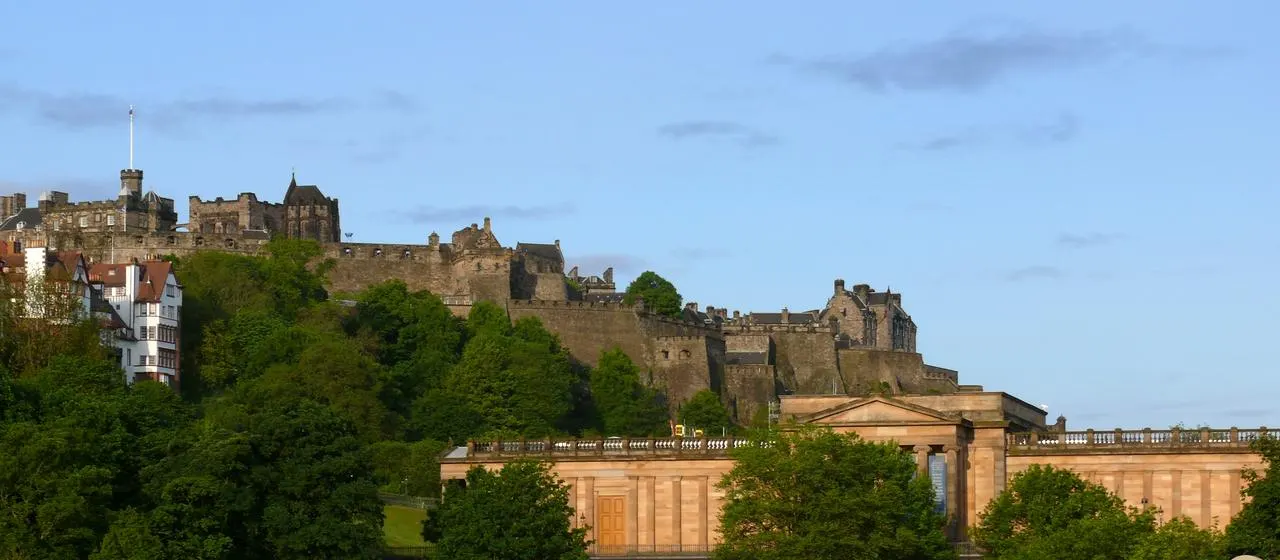
Photo: Ad Meskens · CC BY-SA 3.0 · Wikimedia Commons
When to Go
Edinburgh has a mild maritime climate: summers are cool rather than hot, and winters are rarely very cold, but wind and rain can come in any season and the weather can change several times in one day. May – June has long days, and in midsummer it barely gets dark. August is the festival month, when the city is at its busiest. September – October brings autumn colours and quieter streets. In December the days are short, and the Christmas market, lights and Hogmanay bring crowds back. Snow is occasional in the city, more common in the Highlands, where some roads and attractions may be affected in winter. Outdoor sights such as Arthur’s Seat and Calton Hill are best on clear, dry days.
| Month | Sightseeing | Christmas season | Weather | Crowds |
|---|---|---|---|---|
| January | Good | None | Cold | Quiet |
| February | Good | None | Cold | Quiet |
| March | Good | None | Cold | Quiet |
| April | Good | None | Mild | Moderate |
| May | Very good | None | Mild | Moderate |
| June | Very good | None | Warm | Moderate |
| July | Very good | None | Warm | Moderate |
| August | Very good | None | Warm | Busy |
| September | Very good | None | Mild | Moderate |
| October | Good | None | Mild | Quiet |
| November | Good | Christmas market | Cold | Moderate |
| December | Very good | Christmas market | Cold | Busy |
- April – May: spring flowers in the gardens, longer days and pleasant walks.
- June – August: long days; August is the festival month and the busiest time of the year.
- September – October: autumn colours, fewer visitors and good light for walks.
- November – December: Edinburgh’s Christmas from 14 November 2026; short, cold and windy days.
- January – February: market until 3 January; Burns Night on 25 January; quiet and good for museums.
Visa and Entry (Turkish citizens)
According to the Turkish Ministry of Foreign Affairs, Turkish citizens holding ordinary passports need a visa for tourist travel to the United Kingdom, which includes Scotland.
According to GOV.UK, tourist visits require a Standard Visitor visa. You apply online; biometric information (fingerprints and photo) is given at an authorised visa application centre. Apply early before holiday periods.
According to GOV.UK, the electronic travel authorisation (ETA) is only for nationals who can enter the UK without a visa; for Turkish citizens, who need a visa, an ETA does not replace the visa.
The UK is not in the Schengen area; a Schengen visa is not valid for entry to the UK. Border officers decide on entry at the border.
Rules and fees may change; this guide does not state fees. Check the official site before you go.
Check before you go: T.C. Dışişleri Bakanlığı · Türk vatandaşlarının tabi olduğu vize uygulamaları ↗ · gov.uk/check-uk-visa ↗ · gov.uk/standard-visitor ↗ · gov.uk/eta ↗ · Rota Atlası visa guide (TR)
Travel medical insurance
Check the official visa and entry sources above first: they state whether travel medical insurance is required and the minimum cover. Compare any policy’s cover amount, validity dates and countries covered with the official requirement.
Rota Atlası does not currently offer an insurance partnership; there are no paid links in this section. Last updated: 1 November 2026
Getting to Edinburgh
- By air: Edinburgh Airport (EDI) lies west of the city. The Edinburgh Trams line runs from the airport through the city centre to Leith and Newhaven, and the Airlink bus runs to Waverley station; check timetables on the operators’ official sites. Many travellers from Türkiye fly via London or another hub; this guide does not recommend airlines.
- By train: Edinburgh Waverley, between the Old and New Towns, is the main station; Haymarket is in the west of the centre. Trains run to London, Glasgow, Stirling, Inverness and other Scottish towns; check timetables on ScotRail and National Rail.
- By bus: long-distance coaches arrive at the bus station near St Andrew Square; check timetables with the operators.
- This guide does not recommend flights, coach companies or prices; check official sources again as your travel date approaches.
Getting Around

On foot
The Old and New Towns are compact and walkable, but steep: steps, slopes and cobbles connect the different levels.
Buses
Lothian Buses cover the city; contactless payment and the operator’s app are common. Check current fares and rules on the official site.
Tram
The tram connects the airport, Haymarket, Princes Street, St Andrew Square, Leith and Newhaven.
Trains
ScotRail trains are practical for day trips to North Queensferry, Stirling, Linlithgow or Leuchars (for St Andrews).
Taxis
Black cabs can be hailed on the street or found at ranks; app-based services also operate.
Driving
Traffic drives on the left; the city centre has a low emission zone and limited parking, so a car is mostly useful only for the Highlands.
Things to See
Edinburgh is a city of levels: the castle on its rock, the long spine of the Royal Mile with its narrow closes, the valley gardens and the Georgian terraces of the New Town, with Arthur’s Seat rising over everything. The first nine sections below cover the city and its waterfront, the last three the parts of Scotland you can reach on day or multi-day trips: the Forth bridges and Rosslyn, Stirling and St Andrews, and the Highlands. Each section offers a short history, highlights and practical tips. This guide does not give fixed opening hours or ticket prices; check the official sites before your visit.
On the rock
Edinburgh Castle

Edinburgh Castle stands on Castle Rock, the remains of a volcano that was active some 350 million years ago, and has dominated the city for centuries. There has been a royal fortress here since at least the 12th century; the oldest surviving building, St Margaret’s Chapel, dates from that period. Inside the walls are the Royal Palace with the Honours of Scotland, the Scottish crown jewels, the Great Hall, military museums and the Scottish National War Memorial. The One O’Clock Gun, fired from the Half Moon Battery, is a tradition dating back to the 19th century, when it helped ships in the Firth of Forth set their clocks. The Stone of Destiny, long kept at the castle, has been on display at Perth Museum since 2024. From the ramparts the views reach across the New Town to the Firth of Forth.
Don’t miss
- The Honours of Scotland in the Royal Palace
- St Margaret’s Chapel, the oldest building in Edinburgh
- The views from the Argyle Battery
- The Great Hall and the War Memorial
Tips
- The castle is one of Scotland’s most visited sites; book a timed ticket in advance on the official site.
- The esplanade in front of the castle is exposed to wind; dress warmly in winter.
The spine of the Old Town
Royal Mile and St Giles’ Cathedral

The Royal Mile is the name given to the chain of streets that runs down the ridge from the castle to the Palace of Holyroodhouse: Castlehill, Lawnmarket, High Street and Canongate. Its length is roughly one old Scots mile. Narrow passages called closes and wynds lead off both sides, many named after the people or trades once found there; some open into quiet courtyards, others drop steeply towards the valleys. Halfway down stands St Giles’ Cathedral, the High Kirk of Edinburgh, with its crown-shaped tower. In the 16th century John Knox preached here during the Scottish Reformation; inside, the Thistle Chapel, built in the early 20th century for the Order of the Thistle, is known for its carved woodwork. The heart-shaped mosaic in the paving outside, the Heart of Midlothian, marks the site of the old tolbooth.
Don’t miss
- The crown tower and Thistle Chapel of St Giles’
- A walk down the closes, such as Advocate’s Close or Lady Stair’s Close
- The Writers’ Museum in Lady Stair’s Close
- The Canongate and its historic buildings
Tips
- St Giles’ is a place of worship; follow photography rules and visiting hours.
- The upper Royal Mile is very busy in summer and in December; early mornings are quieter.

Palace, parliament and volcano
Holyroodhouse, the Scottish Parliament and Arthur’s Seat

At the bottom of the Royal Mile stands the Palace of Holyroodhouse, the official residence of the monarch in Scotland. The palace grew next to the 12th-century Holyrood Abbey, whose roofless ruins can still be visited; Mary, Queen of Scots lived here in the 16th century, and her chambers are among the most famous rooms. Opposite the palace is the Scottish Parliament building, designed by the Catalan architect Enric Miralles and opened in 2004; its unusual forms are inspired by the landscape and by boats. Behind them rises Holyrood Park with Arthur’s Seat, another extinct volcano and the highest point in the city. The paths to the summit and along Salisbury Crags offer wide views over the city and the sea.
Don’t miss
- The historic apartments of Holyroodhouse and the abbey ruins
- A visit to the Scottish Parliament building
- The walk up Arthur’s Seat
- The view along Salisbury Crags
Tips
- Holyroodhouse may close when the royal family is in residence; check dates on the Royal Collection Trust site.
- Paths on Arthur’s Seat are steep and can be muddy and windy; avoid the summit in bad weather.


UNESCO · The Old Town
Victoria Street, the Grassmarket and Greyfriars

Victoria Street curves down from George IV Bridge to the Grassmarket in a gentle arc, lined with colourful shopfronts on two levels; it is one of the most photographed streets in the city. The Grassmarket below was for centuries a market place and also a place of public executions; today it is a lively square of pubs and shops with a view up to the castle rock. Nearby, Greyfriars Kirkyard is one of Edinburgh’s most atmospheric burial grounds, with old monuments and the National Covenant history of the 17th century. At its gate stands the statue of Greyfriars Bobby, the Skye terrier said to have guarded his master’s grave for 14 years. Together these streets show the medieval layout of the Old Town, part of the UNESCO World Heritage Site. UNESCO listing ↗
Don’t miss
- The curve and colourful façades of Victoria Street
- The Grassmarket with the castle above
- Greyfriars Kirkyard
- The statue of Greyfriars Bobby
Tips
- Victoria Street is steep and the cobbles can be slippery when wet.
- Greyfriars Kirkyard is a historic burial ground; be quiet and respectful.


The Georgian city
New Town, Princes Street and the Scott Monument

After a design competition in 1766, the New Town was built to a plan by the young architect James Craig: a grid of wide streets with Princes Street, George Street and Queen Street running parallel, closed off by squares at both ends. Later extensions added crescents, circuses and private gardens, creating one of the best-preserved Georgian townscapes in Europe. Princes Street faces the castle across the valley gardens on one side only, so the view is never blocked. In East Princes Street Gardens rises the Scott Monument, completed in 1846 in memory of the writer Sir Walter Scott; it is one of the largest monuments to a writer in the world, and its narrow staircase leads to viewing platforms. Charlotte Square, with its Georgian House museum, shows how a wealthy family lived in the New Town.
Don’t miss
- Princes Street and the castle view across the gardens
- The Scott Monument
- George Street and St Andrew Square
- The Georgian House on Charlotte Square
Tips
- The Scott Monument’s staircase is very narrow and steep; it is not suitable for everyone.
- In December the gardens below Princes Street host the Christmas market and are very busy.

Monuments and views
Calton Hill

Calton Hill, at the east end of Princes Street, is one of the easiest viewpoints in the city to reach. Its monuments are the reason why Edinburgh was once nicknamed the “Athens of the North”: the National Monument, begun in the 1820s in the style of the Parthenon to commemorate the Napoleonic Wars and left unfinished when the money ran out, the Dugald Stewart Monument with its circular colonnade, and the Nelson Monument shaped like a telescope. The City Observatory buildings at the top have been restored and now house an arts centre. From the hill you can see the castle, the Royal Mile, Arthur’s Seat, Leith and the Firth of Forth in one sweep.
Don’t miss
- The columns of the National Monument
- The classic view from the Dugald Stewart Monument
- The Nelson Monument
- Sunset over the castle and the Old Town
Tips
- The climb takes only a few minutes from Princes Street via steps or a path.
- The top is open and windy; avoid it in storms and take care after dark.
Free museums
National Museum of Scotland and Scottish National Gallery

Edinburgh’s national collections are among the most important in Britain. The National Museum of Scotland on Chambers Street brings together natural history, science, world cultures and the history of Scotland; the bright Grand Gallery of the Victorian building is one of the city’s most beautiful interiors, and Dolly the sheep, the first mammal cloned from an adult cell, is on display. From the roof terrace there is a view of the castle. On the Mound, between the Old and New Towns, the Scottish National Gallery shows European paintings from the Renaissance to the late 19th century alongside Scottish art. General admission to the permanent collections of the national museums and galleries is free; special exhibitions may be ticketed.
Don’t miss
- The Grand Gallery of the National Museum
- The Scotland galleries and Dolly the sheep
- The castle view from the museum roof terrace
- Scottish and European masters in the National Gallery
Tips
- Check opening hours and ticketed exhibitions on the official sites.
- Museums are an ideal plan for rainy or dark winter afternoons.

Riverside village
Dean Village, the Water of Leith and Stockbridge

Dean Village lies in a deep valley of the Water of Leith, only a short walk from the West End, and feels like a separate village. For centuries it was a milling centre driven by the river’s water power; the restored stone mill buildings and houses, such as the half-timbered Well Court, now form one of the most picturesque corners of the city. The Water of Leith Walkway follows the river past St Bernard’s Well to Stockbridge, a former village with independent shops and cafés and a Sunday market; nearby, Circus Lane with its small mews houses is a favourite photo spot. Further west the walkway leads to the Scottish National Gallery of Modern Art.
Don’t miss
- The bridge and mill buildings of Dean Village
- The riverside path to Stockbridge
- Circus Lane
- St Bernard’s Well
Tips
- The walkway can be muddy and slippery in winter; wear suitable shoes.
- Dean Village is a residential area; keep noise down and respect privacy.

The port
Leith and the Royal Yacht Britannia

Leith, Edinburgh’s historic port on the Firth of Forth, was an independent town until 1920. The Shore, along the Water of Leith, has old warehouses and quays turned into a waterfront of pubs and restaurants, and the district’s working-class and maritime character can still be felt. At Ocean Terminal is moored the former Royal Yacht Britannia, which carried the royal family on official journeys and holidays from 1954 until it was decommissioned in 1997; the state apartments, the crew’s quarters and the engine room can be visited. Since 2023 the tram has connected Leith and Newhaven directly with the city centre.
Don’t miss
- The Shore and the old warehouses
- The decks and state apartments of Britannia
- The Newhaven harbour and lighthouse
- A tram ride to the waterfront
Tips
- Check Britannia’s opening times and tickets on the official site.
- The waterfront is windy; bring a warm layer even in summer.

UNESCO · Bridges and a chapel
Forth Bridge and Rosslyn Chapel

West of Edinburgh, three bridges cross the Firth of Forth side by side, built in three different centuries. The red cantilever railway bridge, opened in 1890, was a revolutionary engineering achievement in its day and was inscribed on the UNESCO World Heritage List in 2015; trains still cross it. The best view is from the waterfront at South Queensferry, which can be reached from Edinburgh by train via Dalmeny or by bus. South of the city, in the village of Roslin, stands Rosslyn Chapel, founded in the 15th century and famous for the exceptionally rich stone carvings inside; it became even better known after appearing in a popular novel and film. UNESCO listing ↗
Don’t miss
- The Forth Bridge from the South Queensferry waterfront
- Views of the three bridges
- The carved Apprentice Pillar in Rosslyn Chapel
- The Roslin Glen woodland
Tips
- Check Rosslyn Chapel’s opening times and ticket rules in advance; photography inside may be restricted.
- The waterfront is open to the weather; check the forecast before you go.

Kings and a university town
Stirling Castle and St Andrews

Stirling, north-west of Edinburgh and reachable by train, guarded the most important crossing between the Lowlands and the Highlands; whoever held it held Scotland, as the saying goes. Stirling Castle on its rock was a favourite residence of the Stewart kings, and its Royal Palace has been restored to show how it might have looked in the 16th century. Nearby stand the National Wallace Monument and the battlefield of Bannockburn. On the east coast of Fife, St Andrews is home to Scotland’s oldest university, founded in the early 15th century, and to the ruins of the medieval cathedral, once the largest church in Scotland. The town is also known worldwide as the home of golf.
Don’t miss
- The Royal Palace and Great Hall of Stirling Castle
- The view from the National Wallace Monument
- The cathedral ruins in St Andrews
- West Sands beach and the old town
Tips
- There is no railway station in St Andrews; the nearest is Leuchars, with a bus connection.
- Check opening hours of the castles, which may be shorter in winter.

Valleys and lochs
The Highlands: Glencoe and Loch Ness

North and west of Edinburgh begin the Scottish Highlands, a landscape of mountains, deep valleys and long lochs. Glen Coe, carved by glaciers and volcanic activity, is one of the most dramatic valleys in Scotland; it is also remembered for the massacre of 1692 in which members of the MacDonald clan were killed. Loch Ness, a long, deep freshwater loch in the Great Glen, is famous worldwide for the legend of the monster “Nessie”; on its shore stand the ruins of Urquhart Castle. The Highlands can be seen on long day tours from Edinburgh, but it is more comfortable to stay one or more nights near Fort William, Inverness or Pitlochry.
Don’t miss
- The valley views of Glen Coe
- Urquhart Castle on the shore of Loch Ness
- The town of Inverness
- The scenic road through the Great Glen
Tips
- Days are very short in winter and roads in the mountains can be affected by snow and ice; check the weather and road conditions.
- In the Highlands distances are long and mobile coverage may be weak; plan your route in advance.


Edinburgh Itineraries: 2 Days, 7, 10 and 14 Days in Scotland
The itineraries group nearby places, put museums in the mornings or on rainy days and leave room for walks when the sky is clear. Edinburgh is compact, but its hills and steps make walking slower than the map suggests. Winter days are short and the Highlands need more time than a quick look at the map implies. Opening hours vary with the season; check the official sites before your visit. The itineraries are editorial suggestions, not live navigation.
2 days: Edinburgh in brief
- Day 1 morning: Edinburgh Castle with a timed ticket.
- Day 1 afternoon: down the Royal Mile with St Giles’ and the closes; Victoria Street and the Grassmarket.
- Day 1 evening: Princes Street, the gardens and the view from Calton Hill.
- Day 2: the National Museum of Scotland in the morning; Holyroodhouse and Arthur’s Seat in the afternoon; Dean Village or Stockbridge at the end of the day.
Christmas day route
- Morning: an indoor visit to the National Museum or the National Gallery.
- Midday: the market stalls in East Princes Street Gardens.
- Afternoon: Calton Hill or the Scott Monument for the view; the Big Wheel if you want.
- Evening: the lights on Princes Street and George Street; a hot drink at the market.
7 days: Edinburgh and central Scotland
- Days 1–2: the two-day Edinburgh route above.
- Day 3: Leith, Britannia and the Newhaven waterfront.
- Day 4: South Queensferry and the Forth Bridge; Rosslyn Chapel in the afternoon.
- Day 5: Stirling Castle and the Wallace Monument.
- Day 6: St Andrews and the Fife coast.
- Day 7: the New Town, the Georgian House and a final walk.
10 days: Edinburgh and the Highlands
- Days 1–7: the seven-day route above.
- Day 8: travel north to the Highlands via Pitlochry; overnight in or near Inverness.
- Day 9: Loch Ness and Urquhart Castle.
- Day 10: return via Glencoe and the west, or by train to Edinburgh; check road conditions in winter.
14 days: Scotland in depth
- Days 1–10: the ten-day route above.
- Day 11: Glasgow: the Cathedral, the Kelvingrove Art Gallery and Museum and the West End.
- Day 12: Loch Lomond and the Trossachs National Park.
- Day 13: Linlithgow Palace or the Falkirk Wheel and the Kelpies.
- Day 14: back in Edinburgh, a free day and a farewell walk.
Scottish Food: What to Eat
Scottish cooking is based on what the land and sea provide: lamb and beef from the hills, salmon and seafood from the cold waters, oats, root vegetables and berries. Edinburgh has a wide range of eateries, from traditional pubs to international cuisine. This guide does not recommend restaurants; check the menu and opening hours before you go in.


Haggis, neeps and tatties
Scotland’s national dish: haggis made with sheep’s offal, oatmeal and spices, served with mashed swede and potatoes. Vegetarian versions exist.
Cullen skink
A thick soup of smoked haddock, potatoes and onions, originally from the north-east coast.
Scotch pie
A small, round pie with a minced meat filling, popular at football matches.
Scottish salmon
Smoked or fresh, salmon is one of the best-known products of Scotland.
Porridge
Oatmeal porridge, a traditional breakfast, sometimes with salt rather than sugar.
Shortbread
The classic butter biscuit.
Cranachan
A dessert of cream, raspberries, toasted oats, honey and often whisky.
Full Scottish breakfast
Eggs, bacon, sausage, black pudding, tattie scones and beans.
- Haggis and black pudding contain pork or offal in some recipes; ask about ingredients if you are unsure.
- Many pubs serve food during the day; families may be allowed in until a certain hour, check the rules.
- Tap water is drinkable; you can ask for a jug of tap water in restaurants.
- Whisky is Scotland’s best-known drink; the legal drinking age is 18 and you may be asked for ID.
Culture and Etiquette

- Scotland is part of the United Kingdom but has its own identity; calling Scots “English” can cause offence.
- Queues are taken seriously; wait for your turn at bus stops, ticket desks and shops.
- “Cheers” is often used for thank you; people are generally friendly and helpful.
- In pubs you usually order and pay at the bar; table service is less common.
- Tipping is not mandatory; in restaurants a tip is common if service is not included.
- Tartans and kilts are part of Scottish heritage; they are worn especially at weddings, ceremonies and sporting events.
Safety and Health
- The emergency number in the UK is 999 (112 also works); for non-urgent medical advice call NHS 111.
- Edinburgh is generally safe; keep an eye on your bag in crowds on the Royal Mile and at the market.
- Traffic drives on the left; look right first when crossing the road.
- Paths on Arthur’s Seat and Calton Hill are exposed; do not go up in storms or after dark.
- In the Highlands the weather changes quickly; stay on marked paths and carry warm, waterproof clothing.
- Check current travel advice from the Turkish Ministry of Foreign Affairs and GOV.UK.
What Your Budget Depends On
This guide does not give prices; prices change with season and year. Your budget depends on these factors:
Season
August and December are the busiest months; January to March and November are usually quieter.
Location
The Old Town, the New Town and the West End are within walking distance of each other; Leith and other districts are connected by tram and bus.
Transport
The centre is walkable; trams and buses cover the city, and trains are practical for day trips.
Museums
General admission to the national museums and galleries is free; castles and historic sites need tickets, and costs vary with the option.
Visitor levy
The City of Edinburgh Council has introduced a visitor levy on overnight stays; check the rate and conditions on edinburgh.gov.uk.
Money
The pound sterling is used; card and contactless payment are very common.
Practical Information
- UK plugs (type G), 230 V; bring an adapter.
- Mobile data: the UK is not in the EU; check your operator’s roaming packages before you go.
- Many attractions have shorter opening hours in winter; check on the official sites.
- Bank holidays in Scotland include 1 and 2 January, Good Friday, early May, late May, the first Monday in August, 30 November (St Andrew’s Day), and 25 and 26 December.
- Smoking is banned in enclosed public places, including pubs and restaurants.
- Scottish banknotes are widely accepted in Scotland; Bank of England notes are also accepted.
- Water: tap water is drinkable.
- Daylight in December is about seven hours; plan your days accordingly.
Frequently Asked Questions
Do Turkish citizens need a visa for Edinburgh?
Yes. Edinburgh is in the United Kingdom, and according to the Turkish Ministry of Foreign Affairs and GOV.UK Turkish citizens with ordinary passports need a Standard Visitor visa. The ETA does not replace a visa. Rules may change; check the official site before you go.
Is a Schengen visa valid for Edinburgh?
No. The UK is not part of the Schengen area; a Schengen visa is not valid for entry to the UK.
When is the Edinburgh Christmas market?
According to the official Edinburgh’s Christmas website, from 14 November 2026 to 3 January 2027 in East Princes Street Gardens. Entrance to the market is free; it is closed on 25 December.
What currency is used in Edinburgh?
The pound sterling. Scottish banks also issue their own notes; card and contactless payment are very common.
How do I get from the airport to the city centre?
The tram and the Airlink bus connect Edinburgh Airport with the city centre. Check timetables on the operators’ official sites.
How many days are enough for Edinburgh?
Two or three days are enough for the city; a week with Stirling, St Andrews and the Forth Bridge, and 10–14 days with the Highlands.
Is there a time difference with Türkiye?
The UK is 3 hours behind Türkiye in winter and 2 hours in summer.
What is Hogmanay?
Hogmanay is the Scottish name for New Year’s Eve and the New Year celebrations. The programme and tickets are announced separately; check the official site before you go.
Where to stay
Stay close to the areas where you will spend most time. The areas below are covered in detail in this guide; check public transport links in the getting-around section.
- On the rockEdinburgh Castle
- The spine of the Old TownRoyal Mile and St Giles’ Cathedral
- Palace, parliament and volcanoHolyroodhouse, the Scottish Parliament and Arthur’s Seat
- UNESCO · The Old TownVictoria Street, the Grassmarket and Greyfriars
- The Georgian cityNew Town, Princes Street and the Scott Monument
- Monuments and viewsCalton Hill
- Free museumsNational Museum of Scotland and Scottish National Gallery
- Riverside villageDean Village, the Water of Leith and Stockbridge
- The portLeith and the Royal Yacht Britannia
- UNESCO · Bridges and a chapelForth Bridge and Rosslyn Chapel
- Kings and a university townStirling Castle and St Andrews
- Valleys and lochsThe Highlands: Glencoe and Loch Ness
Search hotels in these areas (Hotellook) ↗ (affiliate link)Search on Booking.com ↗
Where to stay in Edinburgh → · 3 days in Edinburgh: ready-made itinerary →
Affiliate disclosure: Hotellook, Aviasales, Klook, Airalo, Tiqets and DiscoverCars links are affiliate links; Rota Atlası may earn a commission on bookings made through them, at no extra cost to you. Official and in-guide links are not paid. Last updated: 1 November 2026 · Privacy and affiliates
Transport and connectivity
- Airport transferOptions from the airport to the city are in this guide’s getting there section.
- Mobile data (eSIM)Airalo eSIM ↗ (affiliate link)
- TrainsOfficial rail website ↗
- Car hireYou rarely need a car within the city; see getting around first. Compare car hire on DiscoverCars ↗ (affiliate link)
Affiliate disclosure: Hotellook, Aviasales, Klook, Airalo, Tiqets and DiscoverCars links are affiliate links; Rota Atlası may earn a commission on bookings made through them, at no extra cost to you. Official and in-guide links are not paid. Last updated: 1 November 2026 · Privacy and affiliates
Search flights (affiliate link)
Search flights from any airport in any country. Results open on Aviasales in a new tab, where you book.
This form is an affiliate link: Rota Atlası may earn a commission on bookings made via Aviasales (Travelpayouts), at no extra cost to you. Check price, baggage and terms on the booking site. Airport data: OurAirports (public domain).
Flights, hotels and tours
Find tours and tickets
- Edinburgh Castle
GetYourGuide ↗ · Klook ↗ (affiliate link) - Royal Mile
GetYourGuide ↗ · Klook ↗ (affiliate link) - Palace of Holyroodhouse
GetYourGuide ↗ · Klook ↗ (affiliate link) - Scottish Highlands
GetYourGuide ↗ · Klook ↗ (affiliate link)
Hotellook, Aviasales, Klook, Airalo and Tiqets links in this box are affiliate links (Travelpayouts): Rota Atlası may earn a commission on bookings made through them, at no extra cost to you. GetYourGuide links currently carry no affiliate code. Check prices and terms with the provider. Last updated: 1 November 2026 · Privacy and affiliates
Sources
- T.C. Dışişleri Bakanlığı · Türk vatandaşlarının tabi olduğu vize uygulamaları ↗
- GOV.UK · Check if you need a UK visa (official) ↗
- GOV.UK · Standard Visitor visa (official) ↗
- GOV.UK · Electronic travel authorisation (ETA) – only for non-visa nationals (official) ↗
- Edinburgh’s Christmas · Traditional Christmas Markets (official) ↗
- Edinburgh’s Christmas · 14 November 2026 – 3 January 2027 (official) ↗
- Forever Edinburgh (official) ↗
- VisitScotland (official) ↗
- The City of Edinburgh Council (official) ↗
- Edinburgh Castle · Historic Environment Scotland (official) ↗
- Historic Environment Scotland (official) ↗
- Royal Collection Trust · Palace of Holyroodhouse (official) ↗
- Scottish Parliament · Visit (official) ↗
- St Giles’ Cathedral (official) ↗
- National Museums Scotland (official) ↗
- National Galleries of Scotland (official) ↗
- The Royal Yacht Britannia (official) ↗
- Stirling Castle · Historic Environment Scotland (official) ↗
- Rosslyn Chapel (official) ↗
- Edinburgh Airport (official) ↗
- Edinburgh Trams (official) ↗
- Lothian Buses (official) ↗
- ScotRail (official) ↗
- National Rail (official) ↗
- UNESCO World Heritage Centre · Old and New Towns of Edinburgh ↗
- UNESCO World Heritage Centre · The Forth Bridge ↗
This page is for information only. Dates, hours, entry rules and transport information can change; check the official sources above before travelling. No prices, flights, hotels or restaurants have been invented in this guide.
Photo credits
The photos on this page come from Wikimedia Commons and are used under the stated authors and licences (CC BY, CC BY-SA, CC0 or public domain). Full list of sources
- Edinburgh Castle seen from Princes Street — Ad Meskens · CC BY-SA 3.0 · Wikimedia Commons
- Edinburgh Castle from the Grassmarket, historic photograph — George Washington Wilson / Adam Cuerden · Public domain · Wikimedia Commons
- The Royal Mile and St Giles’ Cathedral — rboed* · CC BY 2.0 · Wikimedia Commons
- Carved vaulted ceiling inside St Giles’ Cathedral — Carlos Delgado · CC BY-SA 3.0 · Wikimedia Commons
- The Palace of Holyroodhouse and the abbey — Daniel Kraft · CC BY-SA 3.0 · Wikimedia Commons
- The Scottish Parliament building at Holyrood — Darren J. Prior · CC BY 4.0 · Wikimedia Commons
- Edinburgh and the Firth of Forth from Arthur’s Seat — Ermell · CC BY-SA 4.0 · Wikimedia Commons
- Calton Hill seen from Salisbury Crags — Daniel Kraft · CC BY-SA 3.0 · Wikimedia Commons
- The Scott Monument in Princes Street Gardens — Ermell · CC BY-SA 4.0 · Wikimedia Commons
- Colourful shopfronts on Victoria Street — rboed* · CC BY 2.0 · Wikimedia Commons
- Pub fronts on the Grassmarket — Ermell · CC BY-SA 4.0 · Wikimedia Commons
- The Greyfriars Bobby memorial — Daniel Kraft · CC BY-SA 4.0 · Wikimedia Commons
- The New Town seen from Edinburgh Castle — Kim Traynor · CC BY-SA 3.0 · Wikimedia Commons
- Restored buildings in Dean Village — Mainlymazza · CC BY-SA 4.0 · Wikimedia Commons
- Circus Lane in Stockbridge — Ralf Steinberger from Milan, Berlin + Munich, Italy + Germany · CC BY 2.0 · Wikimedia Commons
- The Shore in Leith — Graeme Yuill · CC BY-SA 2.0 · Wikimedia Commons
- The former Royal Yacht Britannia at Leith — John Ferguson · CC BY-SA 2.0 · Wikimedia Commons
- The Grand Gallery of the National Museum of Scotland — Elshad · CC BY-SA 4.0 · Wikimedia Commons
- The Scottish National Gallery from the Mound in the evening — Iain Lees · CC BY-SA 2.0 · Wikimedia Commons
- Edinburgh Christmas market and illuminated big wheel — Alasdair · CC BY 2.0 · Wikimedia Commons
- The Edinburgh Big Wheel at night — Magnus Hagdorn from UK · CC BY-SA 2.0 · Wikimedia Commons
- New Year fireworks over Edinburgh — M J Richardson · CC BY-SA 2.0 · Wikimedia Commons
- The Forth Bridge — Suicasmo · CC BY-SA 4.0 · Wikimedia Commons
- Stirling Castle on its rock — DeFacto · CC BY-SA 4.0 · Wikimedia Commons
- Exterior of Rosslyn Chapel — Anthonyrandell · CC BY-SA 4.0 · Wikimedia Commons
- Rainbow in Glen Coe — Colin · CC BY-SA 4.0 · Wikimedia Commons
- Loch Ness and Urquhart Castle — Eusebius · CC BY 3.0 · Wikimedia Commons
- An Edinburgh tram — Ad Meskens · CC BY-SA 4.0 · Wikimedia Commons
- Haggis, neeps and tatties — Metukkalihis · CC BY-SA 3.0 · Wikimedia Commons
- Home-made Scottish shortbread — Infrogmation · CC BY-SA 4.0 · Wikimedia Commons
- Interior of a traditional Edinburgh pub — Stephencdickson · CC BY-SA 4.0 · Wikimedia Commons
- Edinburgh night panorama from Calton Hill — Farwestern Photo by Gregg M. Erickson · CC BY 3.0 · Wikimedia Commons
- Advocate’s Close in the Old Town — Iain Lees · CC BY-SA 2.0 · Wikimedia Commons
- South side of Edinburgh Castle in the snow — Mike Shaw · CC BY-SA 4.0 · Wikimedia Commons
- St Andrews Cathedral ruins — Colin Smith · CC BY-SA 2.0 · Wikimedia Commons
Dublin → · London → · Amsterdam → · Copenhagen → · Stockholm → · Ljubljana → · All cities