

Ljubljana is the capital and largest city of Slovenia, set in a basin between the Alps and the Karst plateau on both banks of the Ljubljanica river. Settlement here is very old: the prehistoric pile dwellings of the Ljubljana Marshes are part of the UNESCO listing of pile dwellings around the Alps, and the Romans founded a town called Emona on this spot. The medieval town grew at the foot of the castle and for centuries, under Habsburg rule, was known by its German name, Laibach. After the 1895 earthquake large parts of the city were rebuilt in the Vienna Secession style, and between the two world wars the architect Jože Plečnik gave Ljubljana its present identity with bridges, embankments, market colonnades and a library. Plečnik’s works in Ljubljana were inscribed on the UNESCO World Heritage List in 2021 as “human centred urban design”. About 300,000 people live in the city; much of the historic centre is closed to car traffic, and Ljubljana was European Green Capital in 2016. The official language is Slovene, the currency is the euro and Slovenia is a member of the Schengen area. Ljubljana is also a natural base for Lake Bled, the Postojna and Škocjan caves, Triglav National Park and Piran on the Adriatic. This guide brings together districts, day trips, food, etiquette, safety and entry requirements based on official sources; it does not recommend prices, hotels, restaurants or flights.
Content update: 30 October 2026 · Visa information checked with the Turkish Ministry of Foreign Affairs and the European Commission, Christmas dates with Visit Ljubljana, the city’s official tourist board
Ljubljana at a Glance
- Country
- Slovenia · capital and largest city
- Population
- About 300,000
- Language
- Slovene; English is very widely spoken in tourist areas and among younger people
- Currency
- Euro (EUR); Slovenia has used the euro since 2007
- Time zone
- Central European Time (UTC+1, UTC+2 in summer); 2 hours behind Türkiye in winter, 1 hour in summer
- Highlights
- Ljubljana Castle, Triple Bridge, Dragon Bridge, Central Market, Plečnik’s works, Bled, Postojna, Škocjan
- Airport
- Ljubljana Jože Pučnik Airport (LJU), Brnik; about 25 km north of the city
- Christmas
- Christmas markets 27 Nov 2026 – 3 Jan 2027, free entrance (Visit Ljubljana)
Ljubljana in Pictures
A view across red-tiled roofs to the castle, the trees of Congress Square and the café-lined Ljubljanica embankments: three frames from a small but rich capital. All photos come from Wikimedia Commons under free licences; authors and licences are listed on the sources page.


Christmas in Ljubljana: Markets on Seven Squares and Festive December
Ljubljana is often counted among Europe’s most atmospheric Christmas cities, largely because its market is not squeezed into a single square. According to Visit Ljubljana, the 2026 Christmas markets spread from 27 November 2026 to 3 January 2027 along the riverside embankments of Breg and Cankarjevo nabrežje, across Prešeren Square, Congress Square, Stritarjeva Street, Pogačar Square and up to Ljubljana Castle; entrance is free. Wooden huts sell mulled wine, sausages, traditional winter dishes such as žganci and jota, crafts and decorations. The city’s Festive December (Praznični december) programme continues with concerts, shows and children’s events from 27 November 2026 to 14 January 2027. The lights are switched on at a ceremony on Prešeren Square at 17:00 on 27 November 2026; Ljubljana’s street decorations are known for changing artist-designed motifs. In Slovenia December is the season of the “three good men” (dobri možje): St Nicholas (Miklavž) brings presents on 6 December, Božiček at Christmas and Dedek Mraz (Grandfather Frost) at New Year. Families gather at home on Christmas Eve and many go to midnight Mass. Nativity scenes (jaslice) in churches and homes are a long-standing tradition. 26 December is a public holiday in Slovenia as Independence and Unity Day. On New Year’s Eve the squares usually host open-air celebrations; check the programme on the official site.


| Event | Place | Dates | Note |
|---|---|---|---|
| Christmas markets in Ljubljana | Breg, Cankarjevo nabrežje, Prešernov trg, Kongresni trg, Stritarjeva ulica, Pogačarjev trg and Ljubljana Castle | 27 Nov 2026 – 3 Jan 2027 | Free entrance; check stall hours and the daily programme on Visit Ljubljana. |
| Festive December (Praznični december) | City-centre squares | 27 Nov 2026 – 14 Jan 2027 | Concerts, shows and children’s events; follow the programme on the official site. |
| Festive lights switch-on | Prešernov trg (Prešeren Square) | 27 Nov 2026, 17:00–17:30 | Free open-air ceremony (Visit Ljubljana). |
| Miklavž (St Nicholas) | Across the city, homes and churches | 5–6 December | The first of the “three good men”; small presents for children. |
| Christmas and Independence and Unity Day | Churches and homes | 24–26 December | 25 and 26 December are public holidays; some museums and shops may close. |
| New Year | Congress Square and central squares | 31 Dec – 2 Jan | 1 and 2 January are public holidays; check the open-air programme before you go. |
What to try in winter
Kuhano vino
Spiced mulled wine, a fixture of the Christmas markets. Non-alcoholic hot drinks are available too.
Potica
Rolled cake filled with walnuts, tarragon or poppy seeds; the symbol of Christmas and Easter.
Kranjska klobasa
Carniolan sausage, protected by an EU geographical indication, with mustard and bread.
Žganci
A traditional crumbled porridge-like dish made from buckwheat or maize flour.
Jota
A thick winter soup of beans, sauerkraut or soured turnip and potatoes.
Chestnuts
A winter street classic: roasted chestnuts in a paper cone.
Winter tips
- The markets are very busy in the evenings and at weekends; weekday afternoons are calmer.
- The Ljubljana basin can be foggy and damp in winter; dress in layers and wear waterproof shoes.
- The castle funicular can be busy; the footpaths up are short but can be slippery in winter.
- 25–26 December and 1–2 January are public holidays; check museum and shop opening hours.
Check before you go: Visit Ljubljana · Christmas markets (official) ↗ · Visit Ljubljana · Festive December (official) ↗
As of 30 October 2026, Visit Ljubljana lists the Christmas markets for 27 November 2026 – 3 January 2027, the Festive December programme for 27 November 2026 – 14 January 2027 and the lights switch-on for 27 November 2026. Stall hours and the concert programme may change; check the official site before you go.
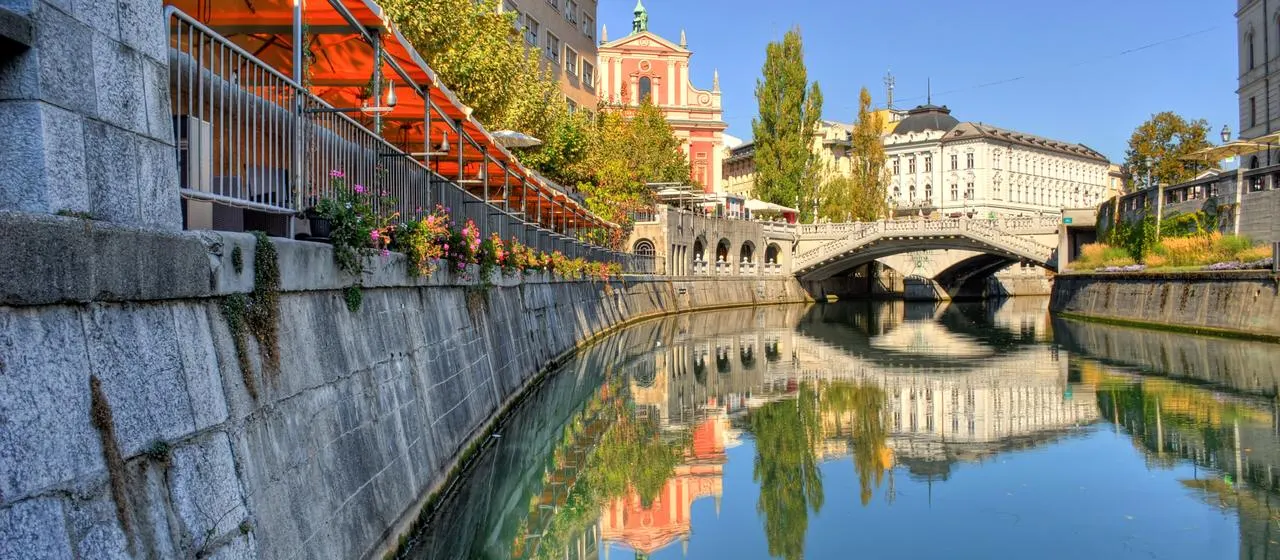
Photo: Mihael Grmek · CC BY-SA 3.0 · Wikimedia Commons
When to Go
Ljubljana’s climate is a transition between continental and Alpine. Summers are warm and at times sultry, with frequent afternoon showers. Winters are cold; because the city lies in a basin, dense fog is common especially in November and December, while snow varies from winter to winter. May – June and September – October are the most comfortable periods for city walks and trips to Bled, Bohinj or Piran. December is the most popular month for the Christmas markets and lights. Hiking trails and some mountain passes in the Alps may close in winter, and natural sites such as Vintgar Gorge have seasonal opening periods. Days are short on winter trips; putting museums and caves in the morning and outdoor walks around midday makes planning easier.
| Month | Sightseeing | Christmas season | Weather | Crowds |
|---|---|---|---|---|
| January | Good | None | Cold | Quiet |
| February | Good | None | Cold | Quiet |
| March | Good | None | Mild | Quiet |
| April | Very good | None | Mild | Moderate |
| May | Very good | None | Mild | Moderate |
| June | Very good | None | Warm | Moderate |
| July | Very good | None | Warm | Busy |
| August | Very good | None | Warm | Busy |
| September | Very good | None | Mild | Moderate |
| October | Very good | None | Mild | Moderate |
| November | Good | Partly | Cold | Quiet |
| December | Very good | Christmas market | Cold | Moderate |
- April – May: the parks turn green and spring walks begin around Bled and Bohinj.
- June – August: warm days; the busiest period for the lakes, the Alps and the Adriatic coast.
- September – October: mild weather, autumn colours and quieter natural sites.
- November – December: Christmas markets and lights from 27 November 2026; foggy, cold days.
- January – February: cold; markets until 3 January, Festive December until 14 January, winter sports in the Alps.
Visa and Entry (Turkish citizens)
Slovenia has been a member of the Schengen area since 2007. According to the Turkish Ministry of Foreign Affairs, Turkish citizens holding ordinary (burgundy) passports need a Schengen visa to travel to Slovenia.
For short stays the Schengen rule of a maximum of 90 days in any 180-day period applies, and days spent in Slovenia count towards this total. A valid Schengen visa issued by another member state can also be used within its conditions.
The EU Entry/Exit System (EES) applies at Schengen external borders: on first entry your fingerprints and facial image are recorded instead of a passport stamp. Allow extra time at the border.
Applications are made via Slovenia’s consular representation or its authorised service provider; check documents, the appointment process and passport validity on the official sites.
Rules may change; this guide does not state fees. Check the official site before you go.
Check before you go: T.C. Dışişleri Bakanlığı · Türk vatandaşlarının tabi olduğu vize uygulamaları ↗ · EES · europa.eu ↗ · Schengen · ec.europa.eu ↗ · Rota Atlası visa guide (TR)
Travel medical insurance
Check the official visa and entry sources above first: they state whether travel medical insurance is required and the minimum cover. Compare any policy’s cover amount, validity dates and countries covered with the official requirement.
Rota Atlası does not currently offer an insurance partnership; there are no paid links in this section. Last updated: 1 November 2026
Getting to Ljubljana
- By air: Ljubljana Jože Pučnik Airport (LJU) is at Brnik, about 25 km north of the city. Buses and shuttles connect it with the central bus station; check timetables on the airport’s official site. Some travellers also use nearby airports such as Zagreb, Venice or Trieste.
- By train: Ljubljana railway station and the bus station are side by side, north of the city centre. Slovenian Railways runs trains to places such as Bled (Lesce-Bled), Postojna, Divača (near Škocjan) and Maribor; check international connections with the rail operators.
- By road: the overland route from Türkiye usually passes through Bulgaria, Serbia and Croatia. Slovenian motorways require an electronic vignette (e-vinjeta); check border crossings and current rules on the official sites.
- This guide does not recommend flights, coach companies or prices; check official sources again as your travel date approaches.
Getting Around


On foot
Much of the historic centre is a car-free pedestrian zone; the foot of the castle, Prešeren Square, the market and Congress Square are a few minutes apart.
City buses
LPP buses connect the city and suburbs; payment is by Urbana card or the official app, cash is not accepted on board. Check current rules on lpp.si.
Kavalir
Small, slow electric vehicles (Kavalir) in the pedestrian zone offer free rides to older and tired visitors.
Funicular
A funicular runs up to Ljubljana Castle from Krekov trg; there are footpaths as well.
Cycling
The city has the BicikeLJ bike-sharing system and an extensive network of cycle paths; check registration rules on the official site.
Regional
Trains or intercity buses reach Bled, Bohinj, Postojna, Škocjan and Piran; some natural sites need a car or a tour, and services may be reduced in winter.
Things to See
Ljubljana is a small city with rich layers: Roman Emona, a medieval castle, Baroque churches, Secession façades that rose after the 1895 earthquake and Plečnik’s bridges and embankments tying it all together. The first seven sections below cover the city itself, the last five the parts of Slovenia you can reach from Ljubljana on day or multi-day trips: Lakes Bled and Bohinj, Vintgar Gorge, the Velika Planina plateau, the Karst caves and Piran on the Adriatic. Each section offers a short history, highlights and practical tips. This guide does not give fixed opening hours or ticket prices; check the official sites before your visit.
Above the city
Ljubljana Castle and funicular

Ljubljana Castle rises on the wooded hill right above the old town and has defined the city’s skyline for centuries. The hill shows traces of settlement since prehistoric times; most of the buildings seen today date from after the 15th century. Over time the castle served as a garrison, a prison and housing; at the end of the 20th century it was thoroughly restored and turned into a centre for culture and events. A funicular from the city carries visitors up to the courtyard in a few minutes. From the outlook tower you see red-tiled roofs, the bends of the river and, on clear days, the Kamnik–Savinja Alps. The castle houses a permanent exhibition on Slovenian history, a chapel and, at Christmas, part of the market.
Don’t miss
- City and Alpine views from the outlook tower
- The courtyard and St George’s Chapel
- The permanent exhibition on Slovenian history
- Walking back down on one of the footpaths
Tips
- The funicular can have queues at busy times; early morning or late afternoon is calmer.
- Check tickets, exhibitions and opening hours on the castle’s official site; access to the courtyard and the exhibitions may require different tickets.

The heart of the city
Prešeren Square, Triple Bridge and Franciscan Church

Prešeren Square is Ljubljana’s meeting point. It is named after the Slovenian national poet France Prešeren; his monument, erected in 1905, looks towards a bust of Julija Primic, the muse of his poems, on a façade across the square. A stanza of Prešeren’s poem “Zdravljica” is Slovenia’s national anthem. The pink-fronted Franciscan Church of the Annunciation on the edge of the square dates from the 17th century. Directly in front of it, the Triple Bridge (Tromostovje) crosses the river: in the 1930s Plečnik added two footbridges on either side of the old stone bridge, so that the bridge works like an extension of the square. The Secession façades around it tell the story of rebuilding after the 1895 earthquake.
Don’t miss
- The Prešeren monument and the Secession buildings around the square
- Plečnik’s Triple Bridge and the river view
- The pink Franciscan Church
- Art Nouveau façades on Miklošičeva Street
Tips
- In December the square is the centre of the lights and the market; evenings are the busiest.
- The church is a place of worship; be quiet during services and follow photography rules.


Dragons and the market
Dragon Bridge and Central Market

The dragon is on Ljubljana’s coat of arms and appears all over the city. According to legend, Jason passed through this area with the Argonauts after stealing the Golden Fleece and slew a dragon in the marshes. Opened in 1901, the Dragon Bridge (Zmajski most) with its four copper dragons is one of the best-known examples of Vienna Secession in Slovenia and one of the region’s first reinforced-concrete bridges. Between it and the Triple Bridge stand Plečnik’s colonnaded market buildings along the river. At the open-air Central Market on Vodnik and Pogačar squares, local producers sell fruit, vegetables, cheese and flowers; fish and meat sellers are in the covered sections. Between the two markets runs the Butchers’ Bridge, decorated with sculptures by the artist Jakov Brdar.
Don’t miss
- The four dragons of the Dragon Bridge
- Plečnik’s market colonnades along the river
- The open-air market on Vodnik Square
- The sculptures on the Butchers’ Bridge
Tips
- The market is closed on Sundays; mornings are the liveliest.
- In the warmer months check the dates of the Friday street-food market on Pogačar Square on the official site.

The Baroque centre
St Nicholas’ Cathedral, Town Hall and the old town

Mestni trg, Stari trg and Gornji trg, stretching along the foot of the castle, are Ljubljana’s three medieval squares. The green-domed St Nicholas’ Cathedral was rebuilt in the Baroque style in the early 18th century; its interior is covered with frescoes. The cathedral’s bronze doors, made for Pope John Paul II’s visit in 1996, carry reliefs on the history of Christianity in Slovenia. In front of the Town Hall (Mestna hiša) stands the Robba Fountain, sculptor Francesco Robba’s work representing the three rivers of Carniola; the original sculptures are kept in the National Gallery and a copy stands on the square. Boutiques, cafés and Baroque mansions line the narrow cobbled streets.
Don’t miss
- The bronze doors and frescoes of St Nicholas’ Cathedral
- The Town Hall and Robba Fountain
- The streets of Stari trg and Gornji trg
- The riverside facing the castle in the late afternoon
Tips
- The cathedral is a place of worship; visiting hours depend on services.
- You can see the original sculptures of the Robba Fountain in the National Gallery.
UNESCO · Plečnik’s Ljubljana
National Library, Križanke and Trnovo

After working in Vienna and Prague, Jože Plečnik (1872–1957) returned to his native Ljubljana and rethought the city as a whole between the two world wars. The UNESCO listing of 2021, “The works of Jože Plečnik in Ljubljana – Human Centred Urban Design”, includes embankments, bridges, the Central Market, the National and University Library (NUK), Žale cemetery, the Trnovo Bridge and church, parks and squares. NUK’s façade of red brick and stone and its grand reading room is Plečnik’s best-known building. Križanke, the former monastery of the Teutonic Knights that he turned into an open-air theatre, hosts the summer festival concerts. The tree-lined bridge in the Trnovo district and the architect’s home (Plečnik House) show visitors his working world. UNESCO listing ↗
Don’t miss
- NUK’s façade and staircase hall
- The courtyards of Križanke
- Trnovo Bridge and Trnovo Church
- The architect’s studio in Plečnik House
Tips
- NUK is a working library; visitor access to the reading room is limited, check the official site.
- Visits to Plečnik House are usually guided and in small groups; book ahead.


Parks and museums
Tivoli Park, National Gallery and museums

Tivoli Park begins just west of the city centre and merges with the forests of Rožnik hill to form Ljubljana’s largest green space. Open-air photo exhibitions are held along the Jakopič Promenade designed by Plečnik; Tivoli Mansion in the park houses the International Centre of Graphic Arts. Near the park, the National Gallery shows Slovenian art from the Middle Ages to the 20th century and European paintings. The nearby National Museum and Natural History Museum, the Museum of Modern Art and the Opera house are all within walking distance. The City Museum of Ljubljana tells the city’s story from Roman Emona to the present.
Don’t miss
- The promenade and open-air exhibitions in Tivoli Park
- Slovenian Impressionists in the National Gallery
- Roman Emona in the City Museum of Ljubljana
- A short forest walk up Rožnik hill
Tips
- Many museums close one day a week; check opening days on the official sites.
- It gets dark early in the park in winter; schedule walks around midday.

Alternative culture
Metelkova and the Museum Quarter

Metelkova is a former Yugoslav People’s Army barracks. After the army left in 1991, artists and activists claimed the site; since 1993 it has been an independent cultural centre with concerts, exhibitions and clubs in buildings covered with graffiti, sculptures and mosaics. Right next to it, in restored buildings of the same barracks, lies the Museum Quarter, home to institutions such as the Metelkova Museum of Contemporary Art and the Slovene Ethnographic Museum. These two faces show Ljubljana’s young and institutional cultural scenes side by side.
Don’t miss
- Street art in the Metelkova courtyard
- The Slovene Ethnographic Museum
- The Metelkova Museum of Contemporary Art
- The site’s different faces by day and by night
Tips
- Metelkova is calm by day and lively at night; remember people live and work there and be respectful.
- Check concert and event programmes in the venues’ own announcements.
Alpine lake
Lake Bled and Bled Castle

Lake Bled, about 55 km north-west of Ljubljana at the foot of the Julian Alps, is Slovenia’s most famous view. On the small island in the middle of the lake stands the Church of the Assumption of Mary; visitors traditionally cross in wooden pletna boats or in hired rowing boats, and ringing the wishing bell in the church is a custom. Bled Castle, on top of a cliff on the north shore, is mentioned in written sources in the early 11th century and is considered one of the oldest castles in Slovenia; its museum and terrace offer views over the lake. The path around the lake is an easy and pleasant walk, and Bled’s cream cake, kremšnita, is famous too.
Don’t miss
- A walk around the lake
- The pletna crossing to the island and the wishing bell
- The terrace of Bled Castle
- One of the viewpoints, Ojstrica or Osojnica
Tips
- Bled is very busy at weekends and in summer; go early in the morning.
- The railway station (Lesce-Bled) is some distance from the lake; check bus connections.

Triglav National Park
Lake Bohinj and Vintgar Gorge

Lake Bohinj, west of Bled, is Slovenia’s largest permanent natural lake and lies inside Triglav National Park, the country’s only national park. The stone bridge and the Church of St John the Baptist on its shore form a quiet scene with the mountains behind. A path climbs from the western end of the lake to the Savica waterfall; the Vogel cable car leads to a ski area in winter and to hiking trails in summer. A few kilometres north of Bled, in Vintgar Gorge, wooden walkways cross the turquoise water in the narrow valley carved by the Radovna river and end at the Šum waterfall.
Don’t miss
- The shore of Lake Bohinj and the stone bridge
- The path to the Savica waterfall
- Vintgar’s wooden walkways
- The lake view from the Vogel cable car
Tips
- Vintgar Gorge is open seasonally and may be closed in winter; check visiting conditions on the official site.
- In Triglav National Park stay on marked trails; mountain weather can change very quickly.

Life on the high pasture
Velika Planina

Velika Planina, above the town of Kamnik, is promoted as one of the largest high-mountain pastures in Europe still in use. In summer herdsmen bring their cattle up here and live in oval wooden huts with shingle roofs reaching almost to the ground, typical of the area. The plateau is reached from the Kamniška Bistrica valley by cable car and then a chairlift, or on hiking trails. In summer you can taste the herdsmen’s cheese and sour milk; in winter the plateau is covered in snow and popular for snowshoe walks and sledging. Midnight Mass on Christmas Eve in the small Chapel of Our Lady of the Snows among the huts is a well-known tradition.
Don’t miss
- The cable car ride up to the plateau
- The traditional herdsmen’s huts
- Local cheese in the summer months
- Views of the Kamnik–Savinja Alps
Tips
- Operating days of the cable car and chairlift vary with season and weather; check in advance.
- The plateau can be windy and cold; bring a warm layer even in summer.
UNESCO · The underground world
Postojna Cave, Predjama Castle and Škocjan Caves

The Karst region south-west of Ljubljana is the limestone landscape that gave its name to the term “karst”. Postojna Cave is one of the most visited caves in Europe; visitors first ride a cave train inside, then walk through halls full of stalactites and stalagmites. The blind cave salamander, the olm (Proteus anguinus), can be seen there in an aquarium. A few kilometres away, Predjama Castle, built into the mouth of a cave, is known for the story of the legendary knight Erazem. Further south, the Škocjan Caves have been on the UNESCO World Heritage List since 1986: the Cerkvenik Bridge, crossing the huge canyon carved underground by the Reka river, is one of the most impressive underground sights. UNESCO listing ↗
Don’t miss
- The cave train and dripstone halls in Postojna
- The olm
- Predjama Castle set into the cliff
- Škocjan’s underground canyon and bridge
Tips
- The caves are cool all year; bring a jacket and wear non-slip shoes.
- Visits are guided tours at set times; check the tours on the official sites in advance.


Adriatic coast
Piran and the Slovenian coast

Piran, on Slovenia’s short Adriatic coast, lies about 120 km south-west of Ljubljana at the tip of a narrow peninsula reaching into the sea. Part of the Republic of Venice for centuries, the town reflects this heritage in its narrow lanes, Venetian Gothic houses and Tartini Square, named after the violin virtuoso and composer Giuseppe Tartini, who was born here. The Church of St George and its bell tower on the hill offer views over the bay and towards Trieste. A walk along the old town walls, the harbour at sunset and the nearby Sečovlje salt pans are highlights of a coastal trip.
Don’t miss
- Tartini Square
- The view over the bay from St George’s Church
- The town walls
- Piran harbour at sunset
Tips
- Piran’s historic centre is closed to traffic; check car parks and bus connections at the town entrance.
- In winter the coast is quiet and windy; some places may close out of season.
Ljubljana Itineraries: 2 Days, 7, 10 and 14 Days in Slovenia
The itineraries group nearby places, put museums and caves in the mornings and walks around midday, and leave room to rest. Slovenia is a small country; many places can be reached from Ljubljana as day trips, but days are short in winter and some natural sites may be closed. Opening hours vary with the season; check the official sites before your visit. The itineraries are editorial suggestions, not live navigation.
2 days: Ljubljana in brief
- Day 1 morning: funicular to Ljubljana Castle, the outlook tower and the exhibition.
- Day 1 afternoon: the old town squares, the cathedral, Central Market and Dragon Bridge.
- Day 1 evening: Prešeren Square, the Triple Bridge and a riverside walk.
- Day 2: in Plečnik’s footsteps to NUK, Križanke and Trnovo; in the afternoon Tivoli Park and the National Gallery, in the evening Metelkova.
Christmas day route
- Morning: a warm indoor visit such as the National Gallery or the City Museum.
- Midday: market stalls on Congress Square and Stritarjeva Street.
- Afternoon: up to the castle and the market section in the castle courtyard; the view at sunset.
- Evening: lights on the Breg and Cankarjevo nabrežje embankments; a break with kuhano vino and chestnuts.
7 days: Ljubljana, the Alps, the caves and the coast
- Days 1–2: the two-day Ljubljana route above.
- Day 3: Lake Bled, the island and the castle; Vintgar Gorge in season.
- Day 4: Lake Bohinj and the Savica waterfall or Vogel.
- Day 5: Postojna Cave and Predjama Castle.
- Day 6: the Škocjan Caves, then on to Piran.
- Day 7: Piran and the coast; back to Ljubljana in the evening.
10 days: Slovenia in depth
- Days 1–7: the seven-day route above.
- Day 8: the Velika Planina plateau and the town of Kamnik.
- Day 9: the Soča Valley and Kobarid; remember that mountain passes may be closed in winter and check the route.
- Day 10: a free day in Ljubljana, the market and last shopping.
14 days: Slovenia and the north-east
- Days 1–10: the ten-day route above.
- Day 11: train to Maribor; the Drava riverside and the Old Vine, known as one of the oldest vines in the world.
- Day 12: Ptuj, one of Slovenia’s oldest towns; the castle and historic centre.
- Day 13: a nature day in the Logar Valley or Kranjska Gora (depending on the season).
- Day 14: back to Ljubljana and a farewell walk.
Slovenian Food: What to Eat
Slovenian cuisine is where Alpine, Mediterranean, Pannonian and Balkan influences meet: hearty soups and dumplings in the mountains, olive oil and fish on the coast, layered cakes in the north-east. The country was named European Region of Gastronomy in 2021. This guide does not recommend restaurants; check the menu and opening hours before you go in.


Kranjska klobasa
Carniolan sausage, protected by an EU geographical indication, usually with mustard, grated horseradish and bread.
Potica
Rolled cake with walnuts, tarragon or poppy seeds; the symbol of festive tables.
Štruklji
Boiled or baked dough rolls filled with cottage cheese, walnuts or tarragon.
Žganci
A traditional porridge-like dish of buckwheat or maize flour, with sour milk or cracklings.
Jota
A thick soup of beans, sauerkraut and potatoes, especially on the coast and in the Karst.
Idrijski žlikrofi
Small potato-filled dumplings, protected as an EU traditional speciality.
Prekmurska gibanica
A north-eastern layered cake of poppy seeds, walnuts, apple and cottage cheese.
Bled kremšnita
Bled’s vanilla cream slice.
- Pork is common in Slovenian cooking; ask about ingredients if you are unsure.
- The Central Market is a good place to see local produce and seasonal fruit.
- At lunchtime many eateries offer a daily menu (dnevno kosilo).
- Ljubljana’s tap water is drinkable, and the city has public drinking fountains.
Culture and Etiquette

- A handshake is the usual greeting; saying “Dober dan” (good day) is appreciated.
- Slovenians care a lot about nature and cleanliness; sort your rubbish and stay on marked paths in natural areas.
- Cover shoulders and knees when visiting churches; do not take photos during services.
- Calling Slovenia “Slovakia” or simply part of former Yugoslavia can be a sensitive point; the country declared independence in 1991.
- Many shops are closed on Sundays; plan your shopping accordingly.
- Tipping is not mandatory; rounding up the bill when you are satisfied is common.
Safety and Health
- The emergency number in Slovenia is 112 (ambulance and fire); 113 is also used for the police.
- Ljubljana is generally a safe city; still, watch your bag at crowded markets and on buses.
- Fog in winter reduces visibility for cyclists and pedestrians; use reflectors or lights.
- Mountain weather can change quickly; do not hike Alpine trails in winter without proper equipment.
- At card terminals choose to pay in euros rather than your home currency.
- Check current travel advice from the Turkish Ministry of Foreign Affairs and the GOV.UK Slovenia page.
What Your Budget Depends On
This guide does not give prices; prices change with season and year. Your budget depends on these factors:
Season
The December market period, summer and long weekends are busier; late January, February and early November are usually calmer.
Location
The historic centre and its surroundings are walkable; the area around the railway station and Bežigrad are connected by bus.
Transport
The city is small and walkable; on regional trips trains and buses reach most places, though some natural sites need a car.
Museums
Many museums close one day a week; some institutions are free on certain days, check the official sites.
Money
The euro is used; card payment is common, keep some cash for market stalls.
Day trips
Bled, Postojna and Piran can be reached by public transport; cave and castle tickets need separate planning, and costs vary with the option.
Practical Information
- European plugs (type C/F), 230 V.
- Mobile data: Slovenia is in the EU; travellers with Turkish SIM cards should check their operator’s roaming packages.
- Many museums close one day a week; check opening days on the official sites.
- Public holidays include 1–2 January, 8 February (Prešeren Day), Easter Monday, 27 April, 1–2 May, 25 June, 15 August, 31 October, 1 November, and 25 and 26 December.
- Smoking is banned in enclosed public spaces, including restaurants and cafés.
- Cash is not accepted on buses; an Urbana card or the official app is needed.
- Water: Ljubljana tap water is drinkable.
- Alongside Slovene signage, English information is common in tourist areas.
Frequently Asked Questions
Do Turkish citizens need a visa for Ljubljana?
Yes. Slovenia is a Schengen member, and according to the Turkish Ministry of Foreign Affairs Turkish citizens with ordinary passports need a Schengen visa. The EES applies at the border. Rules may change; check the official site before you go.
When are the Ljubljana Christmas markets?
According to Visit Ljubljana, from 27 November 2026 to 3 January 2027 at Breg, Cankarjevo nabrežje, Prešeren Square, Congress Square, Stritarjeva Street, Pogačar Square and Ljubljana Castle. Entrance is free.
What currency is used in Ljubljana?
The euro. Card payment is common; on buses an Urbana card or the app is used instead of cash.
How do I get from the airport to the city centre?
Ljubljana Jože Pučnik Airport (LJU) is about 25 km north of the city; buses and shuttles run to the central bus station. Check timetables on the airport’s official site.
How many days are enough for Ljubljana?
Two days are enough for the city; a week with Bled, Postojna, Škocjan and Piran, and 10–14 days to see Slovenia in more depth.
Can you do Bled as a day trip from Ljubljana?
Yes. Bled is about 55 km away, with bus and train (Lesce-Bled station) connections. Check timetables in advance.
Is there a time difference with Türkiye?
Slovenia uses Central European Time: 2 hours behind Türkiye in winter, 1 hour in summer.
Where are Plečnik’s UNESCO-listed works?
They are spread across the city: the Triple Bridge, the Central Market colonnades, the National and University Library, Žale cemetery, Trnovo Bridge, the embankments and parks; most can be seen on foot.
Where to stay
Stay close to the areas where you will spend most time. The areas below are covered in detail in this guide; check public transport links in the getting-around section.
- Above the cityLjubljana Castle and funicular
- The heart of the cityPrešeren Square, Triple Bridge and Franciscan Church
- Dragons and the marketDragon Bridge and Central Market
- The Baroque centreSt Nicholas’ Cathedral, Town Hall and the old town
- UNESCO · Plečnik’s LjubljanaNational Library, Križanke and Trnovo
- Parks and museumsTivoli Park, National Gallery and museums
- Alternative cultureMetelkova and the Museum Quarter
- Alpine lakeLake Bled and Bled Castle
- Triglav National ParkLake Bohinj and Vintgar Gorge
- Life on the high pastureVelika Planina
- UNESCO · The underground worldPostojna Cave, Predjama Castle and Škocjan Caves
- Adriatic coastPiran and the Slovenian coast
Search hotels in these areas (Hotellook) ↗ (affiliate link)Search on Booking.com ↗
Affiliate disclosure: Hotellook, Aviasales, Klook, Airalo, Tiqets and DiscoverCars links are affiliate links; Rota Atlası may earn a commission on bookings made through them, at no extra cost to you. Official and in-guide links are not paid. Last updated: 1 November 2026 · Privacy and affiliates
Transport and connectivity
- Airport transferOptions from the airport to the city are in this guide’s getting there section.
- Mobile data (eSIM)Airalo eSIM ↗ (affiliate link)
- Car hireYou rarely need a car within the city; see getting around first. Compare car hire on DiscoverCars ↗ (affiliate link)
Affiliate disclosure: Hotellook, Aviasales, Klook, Airalo, Tiqets and DiscoverCars links are affiliate links; Rota Atlası may earn a commission on bookings made through them, at no extra cost to you. Official and in-guide links are not paid. Last updated: 1 November 2026 · Privacy and affiliates
Search flights (affiliate link)
Search flights from any airport in any country. Results open on Aviasales in a new tab, where you book.
This form is an affiliate link: Rota Atlası may earn a commission on bookings made via Aviasales (Travelpayouts), at no extra cost to you. Check price, baggage and terms on the booking site. Airport data: OurAirports (public domain).
Flights, hotels and tours
Find tours and tickets
- Ljubljana Castle
GetYourGuide ↗ · Klook ↗ (affiliate link) - Triple Bridge and Prešeren Square
GetYourGuide ↗ · Klook ↗ (affiliate link) - Lake Bled
GetYourGuide ↗ · Klook ↗ (affiliate link) - Postojna Cave
GetYourGuide ↗ · Klook ↗ (affiliate link)
Hotellook, Aviasales, Klook, Airalo and Tiqets links in this box are affiliate links (Travelpayouts): Rota Atlası may earn a commission on bookings made through them, at no extra cost to you. GetYourGuide links currently carry no affiliate code. Check prices and terms with the provider. Last updated: 1 November 2026 · Privacy and affiliates
Sources
- T.C. Dışişleri Bakanlığı · Türk vatandaşlarının tabi olduğu vize uygulamaları ↗
- European Union · Entry/Exit System (EES) ↗
- European Commission · Schengen visa policy (official) ↗
- Visit Ljubljana · Christmas markets (official) ↗
- Visit Ljubljana · Festive December (official) ↗
- Visit Ljubljana · Festive lights switch-on, 27 Nov 2026, Prešernov trg (official) ↗
- Visit Ljubljana · official visitor guide ↗
- Mestna občina Ljubljana · City of Ljubljana (official) ↗
- I feel Slovenia · Slovenian Tourist Board (official) ↗
- Ljubljanski grad · Ljubljana Castle and funicular (official) ↗
- Narodna galerija · National Gallery of Slovenia (official) ↗
- MGML · Museum and Galleries of Ljubljana (official) ↗
- Postojnska jama · Postojna Cave and Predjama Castle (official) ↗
- Park Škocjanske jame · Škocjan Caves Regional Park (official) ↗
- Bled · official tourist information ↗
- Triglavski narodni park · Triglav National Park (official) ↗
- Ljubljana Airport · Fraport Slovenija (official) ↗
- LPP · Ljubljana Passenger Transport (official) ↗
- Slovenske železnice · Slovenian Railways (official) ↗
- UNESCO World Heritage Centre · The works of Jože Plečnik in Ljubljana – Human Centred Urban Design ↗
- UNESCO World Heritage Centre · Škocjan Caves ↗
- UNESCO World Heritage Centre · Prehistoric Pile Dwellings around the Alps ↗
- GOV.UK · Foreign travel advice · Slovenia ↗
This page is for information only. Dates, hours, entry rules and transport information can change; check the official sources above before travelling. No prices, flights, hotels or restaurants have been invented in this guide.
Photo credits
The photos on this page come from Wikimedia Commons and are used under the stated authors and licences (CC BY, CC BY-SA, CC0 or public domain). Full list of sources
- The Ljubljanica river and riverside houses in Ljubljana — Mihael Grmek · CC BY-SA 3.0 · Wikimedia Commons
- Ljubljana Castle seen from Kongresni trg — Antimuonium · CC BY-SA 4.0 · Wikimedia Commons
- Funicular station at Ljubljana Castle — David Jones from Isle of Wight, United Kingdom · CC BY 2.0 · Wikimedia Commons
- Triple Bridge and Prešeren Square from the Ljubljanica — Valerio2468 · CC BY-SA 4.0 · Wikimedia Commons
- Prešeren Square in Ljubljana — This Photo was taken by Wolfgang Moroder. Feel free to use my photos, but please mention me as the author and send me a message. This image is not in the public domain. Please respect the copyright protection. It may only be used according to the rules mentioned here. This specifically excludes use in social media, if applicable terms of the licenses listed here are not appropriate. Please do not upload an updated image here without consultation with the Author. The author would like to make corrections only at his own source. This ensures that the changes are preserved.Please if you think that any changes should be required, please inform the author.Otherwise you can upload a new image with a new name. Please use one of the templates derivative or extract. · CC BY-SA 3.0 · Wikimedia Commons
- The pink Franciscan Church of the Annunciation — Robert Jahoda · CC BY-SA 4.0 · Wikimedia Commons
- Dragon Bridge in Ljubljana — Thomas Ledl · CC BY-SA 4.0 · Wikimedia Commons
- Stalls at Ljubljana Central Market — Jorge Franganillo · CC BY 2.0 · Wikimedia Commons
- Baroque ceiling frescoes in Ljubljana Cathedral — Petar Milošević · CC BY-SA 4.0 · Wikimedia Commons
- Horse-head door handle at Plečnik’s National and University Library — Andrew Moore from Johannesburg, South Africa · CC BY-SA 2.0 · Wikimedia Commons
- The Church of the Teutonic Knights at Križanke — Ljuba brank at Slovenian Wikipedia · CC BY-SA 3.0 · Wikimedia Commons
- Plečnik’s Trnovo Bridge — Thomas Ledl · CC BY-SA 4.0 · Wikimedia Commons
- Jakopič Promenade with an open-air exhibition in Tivoli Park — Dedo70 · CC BY-SA 4.0 · Wikimedia Commons
- The National Gallery of Slovenia in Ljubljana at night — Leonhard Lenz · CC0 · Wikimedia Commons
- Colourful street art at Metelkova — Rok · CC BY-SA 2.0 · Wikimedia Commons
- Bled Island and its church on Lake Bled — Jakub Hałun · CC BY 4.0 · Wikimedia Commons
- Bled Castle in front of snowy mountains — Mihael Grmek · CC BY-SA 3.0 · Wikimedia Commons
- Lake Bohinj on a snowy morning — Smihael · CC BY-SA 3.0 · Wikimedia Commons
- Waterfall in Vintgar Gorge — Luke Price from Rotterdam, Netherlands · CC BY 2.0 · Wikimedia Commons
- Herders’ huts on Velika Planina — Reuben Dalke from D.C., U.S. · CC BY 2.0 · Wikimedia Commons
- The Concert Hall in Postojna Cave — Shesmax · CC BY-SA 4.0 · Wikimedia Commons
- Predjama Castle built into the cliff — Marco Almbauer · CC0 · Wikimedia Commons
- The Reka river gorge at Škocjan Caves — Jakub Hałun · CC BY 4.0 · Wikimedia Commons
- Piran and Tartini Square from the cathedral — Isiwal · CC BY-SA 4.0 · Wikimedia Commons
- Christmas lights along the Ljubljanica — Oleg Brovko from Trieste, Italy · CC BY-SA 2.0 · Wikimedia Commons
- Christmas market huts along the Ljubljanica — U.S. Air Force photo/Staff Sgt. R.J. Biermann · Public domain · Wikimedia Commons
- Snowy Mestni trg and the Robba Fountain — Husond · CC BY-SA 4.0 · Wikimedia Commons
- Old town rooftops from Ljubljana Castle — Adam Jones from Kelowna, BC, Canada · CC BY 2.0 · Wikimedia Commons
- Kongresni trg and Ljubljana Castle — Selena N. B. H. from Fayetteville, USA · CC BY 2.0 · Wikimedia Commons
- Café umbrellas on the Ljubljanica embankment — Vid Gajšek · Public domain · Wikimedia Commons
- LPP city bus in Ljubljana — VidicK01 · CC0 · Wikimedia Commons
- A slice of Slovenian walnut potica — Michael R Perry · CC BY 2.0 · Wikimedia Commons
- Kranjska klobasa with bread and grated horseradish — ModriDirkac · CC BY-SA 4.0 · Wikimedia Commons
- Excursion boat on the Ljubljanica and riverside cafés — Petar Milošević · CC BY-SA 4.0 · Wikimedia Commons
Regional guide: Balkans → · Split → · Zagreb → · Vienna → · Salzburg → · Budapest → · Edinburgh → · All cities