

Salzburg is the capital of the Austrian state of the same name and, with around 155,000 inhabitants, the country’s fourth-largest city. Its name means “salt castle”; for centuries its wealth came from the salt mines and salt trade of the surrounding region. Its history begins with St Peter’s Abbey, founded around 696 by St Rupert, and peaked under the prince-archbishops, who ruled the city as an independent ecclesiastical principality until 1803; most of the Baroque domes, squares and palaces we see today are their work. The city finally became part of Austria in 1816. The historic centre of Salzburg has been on the UNESCO World Heritage List since 1996. Wolfgang Amadeus Mozart was born here in 1756, and the Salzburg Festival, founded in 1920, turns the city into one of the world’s music capitals every summer. Winter, however, is Salzburg’s most magical season: the Christkindlmarkt in front of the cathedral has roots going back centuries, the carol “Silent Night” (Stille Nacht) was first performed in 1818 in Oberndorf just north of the city, and the snowy peaks of the Alps form the backdrop of the old town.
Content update: 28 October 2026 · Market dates checked on christkindlmarkt.co.at, salzburg.info and the markets’ official websites
At a glance
- Country / state
- Austria, State of Salzburg (state capital)
- Population
- About 155,000; Austria’s fourth-largest city
- Language
- German (Austrian German); English is widely used in tourism
- Currency
- Euro (EUR)
- Time zone
- Central European Time (CET, UTC+1); UTC+2 in summer. In winter 2 hours behind Türkiye
- River
- Salzach; the old town (Altstadt) is on the left bank, Mirabell and Linzer Gasse on the right bank
- Landmarks
- Hohensalzburg Fortress, Salzburg Cathedral, Mozart’s Birthplace, Mirabell Palace, Getreidegasse
- Christmas markets
- Christkindlmarkt on Domplatz and Residenzplatz, Hellbrunner Adventzauber, Sternadvent, Festungsadvent, Mirabellplatz; 2026 dates below
- UNESCO
- Historic Centre of the City of Salzburg (1996); nearby the Hallstatt-Dachstein / Salzkammergut Cultural Landscape
- Airport
- Salzburg Airport W. A. Mozart (SZG), a few kilometres west of the centre; trolleybus connections
- Electricity
- 230 V, 50 Hz; type F/C sockets, the same as in Türkiye
- Emergency numbers
- 112 (general emergency), 133 (police), 144 (ambulance), 122 (fire)
Salzburg in pictures
The old town and fortress in golden light from the Salzach, the river lit up at night and Leopoldskron Palace in winter: Salzburg in three frames.


Salzburg Christmas markets 2026
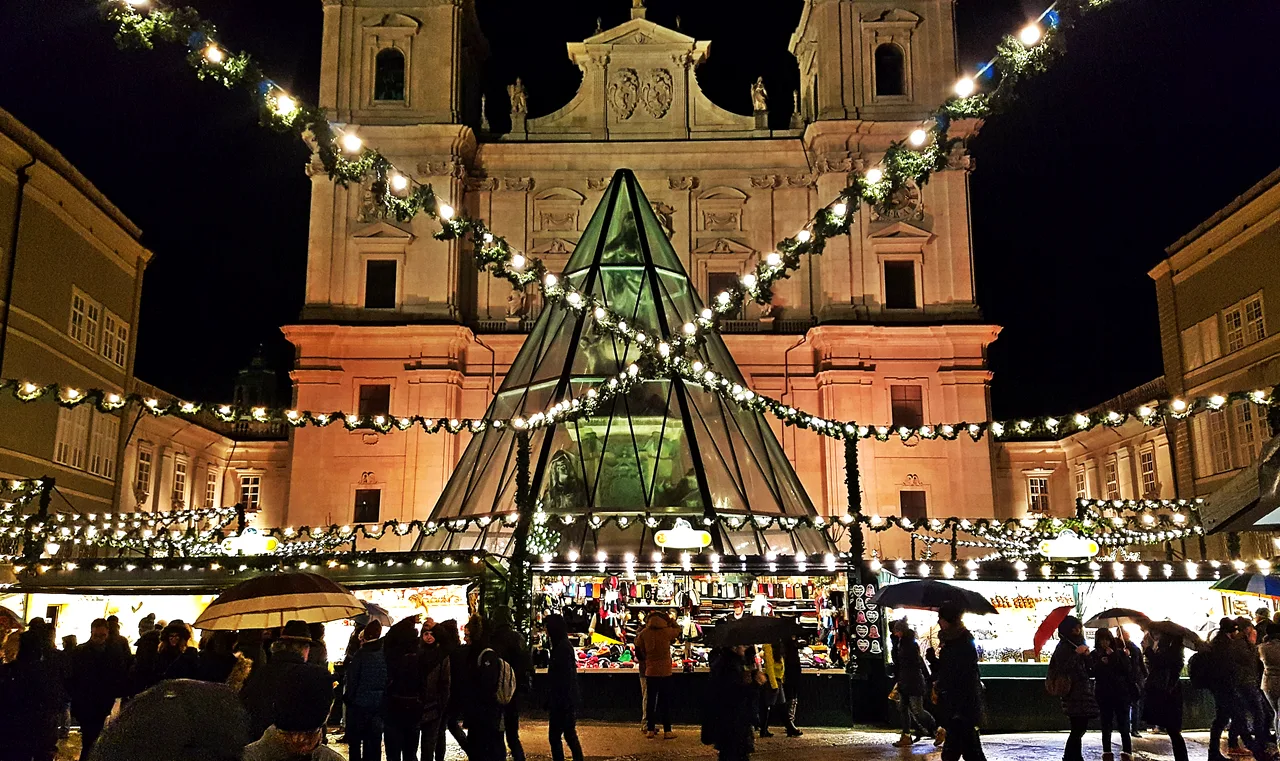
Salzburg’s main Christmas market, the Salzburger Christkindlmarkt, is held on Domplatz in front of the Baroque Salzburg Cathedral and on the adjacent Residenzplatz. According to the official website the market has existed in its current form since 1974 and welcomes around one million visitors a year; the “starry sky” (Sternenhimmel) lighting stretched over the squares is its symbol. Wooden stalls lined up between the Residenz Fountain and the cathedral façade sell handmade decorations, candles, wooden toys and Advent food, and choirs and brass groups perform from time to time. Smaller markets are scattered around the old town: the Sternadvent in the Sternbräu courtyard on Getreidegasse, the Festungsadvent held only on certain days in the courtyard of Hohensalzburg Fortress, the Mirabellplatz market in front of Mirabell Palace, and the Hellbrunner Adventzauber south of the city, which decorates the courtyard of Hellbrunn Palace with lanterns hanging in the trees. The dates below were checked against official sources on 28 October 2026.


| Market | Location | 2026 dates | Note |
|---|---|---|---|
| Salzburger Christkindlmarkt | Domplatz and Residenzplatz | 19 November 2026–1 January 2027 | The city’s main and most historic market, with its “Sternenhimmel” lighting. Daily opening hours are published on the official website; check before you go |
| Altstadtsilvester | Kapitelplatz | 31 December 2026–1 January 2027 | Announced on the official website as the New Year extension of the Christkindlmarkt; see the official website for the programme |
| Hellbrunner Adventzauber | Courtyard of Hellbrunn Palace (Fürstenweg 37) | 19 November–24 December 2026 | According to the official website closed on Mondays (except 21 December). Lanterns in the trees and a family programme; hours on the official website |
| Sternadvent | Sternbräu courtyard, Getreidegasse 34 | 19 November 2026–6 January 2027 | A market inside the old town that stays open after Christmas; hours on the official website |
| Festungsadvent | Courtyard of Hohensalzburg Fortress | 27 November–20 December 2026 | According to salzburg.info only Friday–Sunday and on 7–8 December, 11:00–19:00. Reach the fortress by funicular or on foot |
| Mirabellplatz Christmas market | Mirabellplatz, in front of Mirabell Palace | 19 November–31 December 2026 | According to salzburg.info’s Advent listing; a quieter market on the right bank. Check official sources for hours |
What to taste at the market
Glühwein and Punsch
Spiced mulled wine and hot fruit punch; there is also an alcohol-free children’s punch (Kinderpunsch). Drinks usually come in mugs with a deposit.
Heiße Maroni
Chestnuts roasted over charcoal, sold hot in paper cones.
Bosna
A Salzburg speciality snack: a thin sausage in a hot roll with onions and curry spice.
Lebkuchen and Kletzenbrot
Honey-and-spice Christmas biscuits and a dense Christmas bread made with dried pears and fruit.
Bratapfel and Krapfen
Baked apples and jam-filled doughnuts.
Mozartkugel
Salzburg’s iconic confection of pistachio marzipan and nougat coated in chocolate, found at markets and shops around the city.
Tips for Salzburg’s Christmas markets
- Domplatz and Residenzplatz are next to each other, so you can see them in one walk; from there you can walk to the Sternadvent on Getreidegasse and across the Salzach to Mirabellplatz.
- The Festungsadvent is only open on certain days (Friday–Sunday and 7–8 December); time your visit to the fortress accordingly.
- The Hellbrunn market is reached by bus from the city centre; remember that it is closed on Mondays (except 21 December).
- Salzburg is very crowded during Advent; choose weekday mornings over weekend evenings.
- 8 December (Immaculate Conception) is a public holiday in Austria; some institutions may be closed, but the markets are usually open.
- A deposit is charged for mugs; keep the mug as a souvenir or return it.
- Lanes and squares can be icy in winter; wear non-slip shoes.
- Hours change on Christmas Eve (24 December) and afterwards; check the official websites again before you go.
Check before you go: Salzburger Christkindlmarkt (official) ↗ · Hellbrunner Adventzauber (official) ↗ · Sternadvent Salzburg (official) ↗ · salzburg.info · Advent in Salzburg ↗ · salzburg.info · Festungsadvent ↗
Dates were checked on 28 October 2026 on christkindlmarkt.co.at, hellbrunneradventzauber.at, sternadvent.at and salzburg.info (Advent and Festungsadvent pages). The Christkindlmarkt’s daily hours had not yet been published on the official website on that date. Organisers may change their programmes; check the official websites again before you go.
When to go
Salzburg can be visited in any season. Summer is ideal for the Salzburg Festival and lake trips, while Advent turns the city into a postcard. March–April and October to early November are the quietest months.
| Month | City walks | Christmas markets | Lakes and mountains | Crowds |
|---|---|---|---|---|
| January | Challenging | Partly open | Challenging | Moderate |
| February | Challenging | No markets | Challenging | Quiet |
| March | Good | No markets | Good | Quiet |
| April | Very good | No markets | Very good | Moderate |
| May | Very good | No markets | Very good | Moderate |
| June | Very good | No markets | Very good | Moderate |
| July | Very good | No markets | Very good | Busy |
| August | Very good | No markets | Very good | Busy |
| September | Very good | No markets | Very good | Moderate |
| October | Very good | No markets | Good | Moderate |
| November | Good | Market season | Challenging | Moderate |
| December | Good | Market season | Challenging | Busy |
- Salzburg’s winters are cold and often snowy; because the city lies on the northern edge of the Alps it also gets a lot of rain and snow. Bring a waterproof coat, an umbrella and non-slip shoes.
- The Salzburg Festival takes place every summer in July and August; demand for accommodation is very high then. See the festival’s official website for the programme.
- Because the Christkindlmarkt runs until New Year, the market atmosphere continues between Christmas and New Year; the Sternadvent is open until 6 January.
- The Hellbrunn trick fountains (Wasserspiele) and some mountain cable cars operate seasonally and may be closed in winter.
- January and February are ski season; trains and roads to ski resorts in the State of Salzburg can be busy.
Visas and entry (Turkish citizens)
Turkish citizens holding an ordinary (burgundy) passport need a Schengen visa for tourist travel to Austria. Rules differ for special, service and diplomatic passports; check the current position with the Turkish Ministry of Foreign Affairs.
According to the Austrian Foreign Ministry (BMEIA), visa applications from Türkiye are decided by the Austrian Consulate General in Istanbul and are submitted through VFS Global application centres in several Turkish cities. Check bmeia.gv.at for the current procedure and document list.
Under Schengen rules you apply to the country of your main stay. If the same trip includes Munich and Bavaria, base the application on the country where you will spend the longest; internal border checks may take place at the German–Austrian border, so carry your passport.
Under the EU Entry/Exit System (EES), being phased in at the external borders, your fingerprints and facial image may be recorded on first entry. Details are on the official EU page.
Visa fees, processing times and document lists can change. No fees are given on this page; rely only on official sources before applying.
Check before you go: T.C. Dışişleri Bakanlığı · Türk vatandaşlarının tabi olduğu vize uygulamaları ↗ · bmeia.gv.at · GK Istanbul ↗ · EES · europa.eu ↗ · Rota Atlası visa guide (TR)
Travel medical insurance
Check the official visa and entry sources above first: they state whether travel medical insurance is required and the minimum cover. Compare any policy’s cover amount, validity dates and countries covered with the official requirement.
Rota Atlası does not currently offer an insurance partnership; there are no paid links in this section. Last updated: 1 November 2026
Getting to Salzburg
- By air: Salzburg Airport W. A. Mozart (SZG) is a few kilometres west of the city centre; trolleybus lines connect it with the centre and the Hauptbahnhof. Connections from Türkiye vary by season; check current flights only on the official websites of airlines and the airport.
- Via Munich: flying into Munich Airport and continuing to Salzburg by train is a common option. The train from München Hauptbahnhof to Salzburg takes about 1.5–2 hours. Times on bahn.de and oebb.at.
- By train: Salzburg Hauptbahnhof is on the Vienna–Munich main line. Vienna is about 2.5 hours away by Railjet, Innsbruck about 2 hours. Times and tickets on oebb.at.
- By coach: long-distance coaches stop near the Hauptbahnhof; check current stops on the coach companies’ official websites.
- By car: a vignette (Vignette) is required on Austrian motorways; buy it digitally or as a sticker through official sales channels. The old town is largely closed to traffic; use the car parks built into the mountain or P+R sites.
- From the Hauptbahnhof the old town is about 20–25 minutes on foot or a few stops by trolleybus.
Getting around

On foot
The old town is small and largely pedestrianised; Domplatz, Getreidegasse, Mozartplatz and Mirabell Palace are within walking distance of each other. You cross the Salzach on footbridges.
Trolleybus (Obus) and bus
Salzburg has one of Austria’s largest trolleybus networks, linking the Hauptbahnhof, the old town, the airport and Hellbrunn. Current lines on salzburg-verkehr.at.
Tickets
Tickets are sold from machines and the official app; day tickets are available. The Salzburg Card, offered by the tourist board, covers many museums and public transport; contents and conditions on salzburg.info.
Festungsbahn and Mönchsberg lift
The Festungsbahn funicular has climbed to the fortress since 1892; the MönchsbergAufzug lift on Gstättengasse goes up the Mönchsberg.
Bike
The cycle paths along the Salzach are flat and the city is bike-friendly; watch out for ice in winter.
Taxi
Taxis are found at ranks or ordered by phone. Most of the old town is closed to cars.
Places to visit
Salzburg’s sights extend from the old town on the left bank of the Salzach up to the fortress, across to Mirabell and the Kapuzinerberg on the right bank, and out to palaces and lakes beyond the city. The twelve sections below cover the city and the most important day trips.
The Baroque heart
Salzburg Cathedral, Residenz and DomQuartier

Salzburg Cathedral (Dom) is the centre of the city’s Baroque identity. After an earlier cathedral was damaged by fire, it was rebuilt to plans by the Italian architect Santino Solari and consecrated in 1628; its white marble twin-towered façade faces Domplatz. Mozart was baptised here in 1756, and the font is still in the cathedral. The Residenz around the cathedral was the palace of the prince-archbishops; the magnificent Residenz Fountain on Residenzplatz is described as one of the largest Baroque fountains north of the Alps. The DomQuartier combines the Residenz state rooms, the Residenz Gallery, the cathedral museum and the museum of St Peter’s Abbey in a single route. In the tower of the New Residenz on the east side of Residenzplatz, the Glockenspiel bells ring at set times. UNESCO listing ↗
Must-see
- The cathedral interior and the font where Mozart was baptised
- The DomQuartier route and the Residenz state rooms
- The Residenz Fountain
- The Glockenspiel bells of the New Residenz
Tips
- Check DomQuartier opening hours and closing days on domquartier.at.
- The cathedral is a place of worship; do not walk around during services.
- During Advent the area in front of the cathedral is a market; visiting the interior early in the morning is more relaxed.

The city’s crown
Hohensalzburg Fortress

Hohensalzburg Fortress on the Festungsberg was begun in 1077 under Archbishop Gebhard and enlarged over the following centuries; it is presented as one of the largest fully preserved medieval castles in Central Europe. Inside you will find the Gothic Golden Hall (Goldene Stube), the fortress museum and a panoramic view of Salzburg and the Alps. The Festungsbahn funicular, running since 1892, takes a few minutes to the top, or you can walk up from Festungsgasse. On Advent weekends the small, atmospheric Festungsadvent market is held in the fortress courtyard.
Must-see
- The view of the old town and the Alps from the ramparts
- The Golden Hall and the princely chambers
- The fortress museum
- The Festungsbahn funicular
Tips
- Check hours and combined ticket options for the fortress and funicular on salzburg-burgen.at.
- The walk up is steep but short; the path may be icy in winter.
- To watch the city lights come on from the ramparts at sunset, find out the closing time in advance.

Mozart’s street
Getreidegasse and Mozart’s Birthplace

Getreidegasse is the old town’s most famous street, known for its tall, narrow houses, passageway courtyards (Durchhäuser) and the wrought-iron signs hanging in front of every shop. The yellow building at No. 9 is the house where Wolfgang Amadeus Mozart was born on 27 January 1756; today it is run as a museum by the International Mozarteum Foundation, and the rooms where the family lived display Mozart’s childhood violin, portraits and documents. The Mozart Residence (Mozart-Wohnhaus), to which the family later moved, is on Makartplatz across the Salzach.
Must-see
- Getreidegasse 9: Mozart’s Birthplace
- Wrought-iron shop signs and passage courtyards
- The Mozart Residence on Makartplatz
- The Blasiuskirche at the western end of the street
Tips
- Getreidegasse is very crowded at midday; walk it early in the morning or in the evening.
- Check combined ticket options for the Mozart museums on mozarteum.at.
- The Durchhäuser passages lead to quiet courtyards and parallel streets.

Squares
Mozartplatz and Kapitelplatz

Mozartplatz got its present name when the Mozart statue designed by Ludwig Schwanthaler was unveiled in 1842; the New Residenz and the Salzburg Museum stand on the north side. The tourist information office is also on this square. On Kapitelplatz, south of the cathedral, a sculpture of a man standing on a giant golden sphere (Sphaera) and the horse pond (Kapitelschwemme) catch the eye; the path up to the fortress starts here. At New Year the Altstadtsilvester extension of the Christkindlmarkt is set up on Kapitelplatz.
Must-see
- The Mozart statue
- Salzburg Museum
- The Sphaera sculpture on Kapitelplatz
- The Kapitelschwemme
Tips
- The tourist information office on Mozartplatz has the current Advent programme and Salzburg Card information.
- Kapitelplatz is the starting point of the footpath to the fortress.
- The squares are very photogenic in the evening lighting.
Monasteries
St Peter’s Abbey, Cemetery and Nonnberg

St Peter’s Abbey, founded around 696 by St Rupert, is one of the oldest continuously active monasteries in the German-speaking world. St Peter’s Cemetery (Petersfriedhof), set against the rocky slope of the Mönchsberg, with its wrought-iron crosses, family burial arcades and rock-cut “catacomb” chambers, is the most peaceful corner of the city. Nonnberg Abbey, on the eastern slope of the fortress hill, was founded around 714 and is known as the oldest continuously existing nunnery in the German-speaking world; Maria von Trapp was a postulant here.
Must-see
- Petersfriedhof and the rock-cut catacombs
- St Peter’s Abbey Church
- Nonnberg Abbey and its church
- The fortress view from the cemetery
Tips
- The cemetery and monasteries are religious sites; keep quiet and do not speak loudly among the graves.
- Catacomb opening hours may vary by season; check on site or on the official pages.
- Nonnberg is reached on foot via Kaigasse or the fortress path.

Views and festival
Mönchsberg, Festival Halls and Kollegienkirche

The Mönchsberg, rising west of the old town, is known for its wooded paths and some of the city’s most famous viewpoints; a lift on Gstättengasse goes up, and the Museum der Moderne stands on top. At the foot of the hill, the Festival Halls carved into the rock (Großes Festspielhaus, Haus für Mozart and Felsenreitschule) are the stages of the Salzburg Festival. Nearby, the Kollegienkirche (University Church) is Johann Bernhard Fischer von Erlach’s masterpiece, completed in 1707, and is considered an important example of Austrian Baroque. The nearby Pferdeschwemme is a frescoed horse trough built for the prince-archbishops’ horses.
Must-see
- The view of the old town and fortress from the Mönchsberg
- Museum der Moderne
- The façade of the Festival Halls
- Kollegienkirche
- Pferdeschwemme
Tips
- The Festival Halls can only be visited on guided tours or with a performance ticket; check the programme on the official website.
- The Mönchsberg paths can be slippery in winter.
- Check the lift’s operating hours in advance.

The right bank
Mirabell Palace and Gardens

Mirabell Palace was built in 1606 by Prince-Archbishop Wolf Dietrich and later remodelled in the Baroque style; today it houses the city administration, and its Marble Hall (Marmorsaal) is famous as a wedding and concert venue. The geometric gardens in front of the palace, with the Pegasus Fountain, the dwarf garden and the rose garden, offer one of Salzburg’s best-loved views, with the fortress and cathedral domes in a single frame. The gardens are also known from scenes in “The Sound of Music”. On your way back to the old town you can cross one of the footbridges over the Salzach; the Makartsteg is known for its love locks.
Must-see
- The fortress view from the Mirabell Gardens
- The Pegasus Fountain
- The Marble Hall
- The footbridges over the Salzach
Tips
- The gardens are plain but peaceful in winter; combine them with the Mirabellplatz market during Advent.
- The Marble Hall may be closed to visitors during wedding ceremonies.
- Morning light is best for photos of the fortress.

The quiet hill
Kapuzinerberg and Linzer Gasse

The Kapuzinerberg on the right bank is a wooded hill reached by stone steps starting from Linzer Gasse. The path leads to the Capuchin monastery and viewpoints overlooking the old town; the writer Stefan Zweig lived in the Paschinger Schlössl on this hill from 1919 to 1934. Linzer Gasse is the quieter right-bank counterpart of Getreidegasse. In the cemetery of St Sebastian’s Church on the street are the tomb of the physician Paracelsus and the grave where Mozart’s father Leopold and his wife Constanze are buried.
Must-see
- The old town and fortress from the Kapuzinerberg viewpoints
- The Capuchin monastery
- Linzer Gasse
- St Sebastian’s Cemetery
Tips
- The steps are steep and can be slippery in winter; wear suitable shoes.
- The hill is ideal for escaping the crowded old town.
- From Linzer Gasse it is a few minutes’ walk to Makartplatz and the Mozart Residence.

South of the city
Hellbrunn Palace

Hellbrunn Palace, south of the city, was built as a summer residence by Prince-Archbishop Markus Sittikus between 1612 and 1615. It is famous for its trick fountains (Wasserspiele), which soak visitors at unexpected moments, and its water theatres with mechanical figures. The large park also contains corners such as the gazebo from The Sound of Music and the Stone Theatre (Steintheater). During Advent the palace courtyard becomes the lantern-lit Hellbrunner Adventzauber market.
Must-see
- The trick fountains (in season)
- The frescoed rooms of the palace apartments
- Hellbrunn Park
- The Hellbrunner Adventzauber during Advent
Tips
- The Wasserspiele and palace apartments are open seasonally and may be closed in winter; check hellbrunn.at.
- Easy to reach by bus from the centre.
- Allow a few hours for a walk in the park.
Day trips
Hallstatt, Wolfgangsee, Königssee and Hohenwerfen

Salzburg is the gateway to the Salzkammergut lakes and the Alps. Hallstatt, the jewel of the UNESCO-listed Hallstatt-Dachstein / Salzkammergut Cultural Landscape, is famous for its houses clinging to the lakeshore and its thousands of years of salt-mining history; by public transport it is reached by train and bus or with a boat connection. The village of St. Wolfgang on the Wolfgangsee and its lake cruises are a nearby alternative. Just across the border, on the Königssee in Germany’s Berchtesgaden region, boats run to the church of St. Bartholomä. To the south, Hohenwerfen Castle above the Salzach valley is known for its falconry displays; take the train to Werfen. UNESCO listing ↗ Hallstatt guide →
Must-see
- Hallstatt village and lake views
- St. Wolfgang and the Wolfgangsee
- By boat to St. Bartholomä on the Königssee
- Hohenwerfen Castle
Tips
- Boats, mountain railways and cable cars may run on a limited schedule in winter; check operating days on the official websites.
- Hallstatt can be very crowded; go early and respect local rules (drone ban, private property notices).
- The Königssee is in Germany; carry your passport.


Christmas heritage
Oberndorf Silent Night Chapel and Untersberg

One of the world’s best-known carols, “Stille Nacht! Heilige Nacht!” (Silent Night), with words by Joseph Mohr and music by Franz Xaver Gruber, was first performed on 24 December 1818 in the church of St. Nikolaus in Oberndorf, north of Salzburg. On the site of the church there is now the small Silent Night Chapel (Stille-Nacht-Kapelle) with a museum next to it; Oberndorf is reached from Salzburg by local train. South of the city, a cable car climbs the Untersberg; legend says Charlemagne sleeps inside the mountain, and the summit offers views over the Salzburg basin. Munich, 1.5–2 hours away by train, is also suitable for a day trip or a combined itinerary. Munich guide →
Must-see
- The Silent Night Chapel and museum in Oberndorf
- The commemoration on 24 December (programme on the official website)
- The Untersberg cable car and summit view
- Other Silent Night places such as Arnsdorf and Hallein
Tips
- The chapel area is very crowded on Christmas Eve; check the programme and transport on stillenacht.com.
- The Untersberg cable car may be closed during maintenance periods; check the official website.
- Weather on the mountain changes quickly; dress warmly.

Salt and the Celts
Hallein: the Dürrnberg salt mine and the Celtic Museum

About 15 km south of Salzburg on the Salzach, Hallein is the second-largest town in the state of Salzburg and takes its name from salt: “Hall-” names point to salt production. Above the town, the Dürrnberg holds one of the oldest mines in the world. Salt springs were already used in the Stone Age; the Celts began underground mining here around 600 BC, and the wealth from the salt trade made the Dürrnberg one of the most important archaeological sites of Iron Age Central Europe. Salt production in Hallein is documented from 1191. Most of the deposit lies on the Bavarian side towards Berchtesgaden; the 1829 Salinenkonvention between Bavaria and Austria is regarded as the oldest state treaty still in force in Europe. Commercial production ended in the late 20th century, and the mine is now run as a show mine by Salzwelten. In the town centre, on the Pflegerplatz by the Salzach, the Keltenmuseum occupies the former salt administration building of 1654 and holds an important collection of Celtic art and salt-mining history; it has belonged to the Salzburg Museum since 2012, and its upper-floor Prince’s Rooms display 73 scenes of the saltworks painted in 1757. Franz Xaver Gruber, composer of “Silent Night”, lived in Hallein from 1833 until his death in 1863; his grave is beside the parish church, and his former home houses the Stille-Nacht-Museum. Salzwelten (official) →
Must-see
- The galleries of the Dürrnberg salt mine (guided tour)
- The Keltenmuseum’s Celtic art collection and Prince’s Rooms
- Franz Xaver Gruber’s grave and the Stille-Nacht-Museum
- Old-town lanes along the Salzach and the Barmsteine skyline
Tips
- Hallein is easy to reach from Salzburg by S-Bahn; check current connections up to the Dürrnberg at salzburg-verkehr.at.
- It is cool inside the mine all year round, so bring a jacket. See the official Salzwelten site for tour times and tickets.
- The Keltenmuseum is part of the Salzburg Museum; check its opening days at salzburgmuseum.at.

1, 2 and 3-day itineraries + Christmas day
The itineraries below are planned on foot and by public transport. Check opening hours and seasonal closures of museums, palaces and cable cars on the official websites before you go.
1 day: Old town and fortress
- In the morning visit Mozart’s Birthplace and walk along Getreidegasse before the crowds.
- Tour the cathedral and DomQuartier; pass through Residenzplatz and Mozartplatz.
- In the afternoon go from St Peter’s Cemetery to the Festungsbahn and up to Hohensalzburg Fortress.
- Towards sunset cross the Salzach and admire the fortress view from the Mirabell Gardens.
- End the evening with local Austrian dishes.
2 days: Views and Mozart’s footsteps
- In addition to day 1, take the lift up the Mönchsberg in the morning and enjoy the view from the Museum der Moderne terrace.
- See the Festival Halls, the Kollegienkirche and the Pferdeschwemme.
- In the afternoon visit the Mozart Residence on Makartplatz, then Linzer Gasse and St Sebastian’s Cemetery.
- In the late afternoon climb the Kapuzinerberg steps and watch the city lights.
3 days: Lakes or Silent Night
- On the third day head into the Salzkammergut: Hallstatt or the Wolfgangsee (check winter timetables in advance).
- Alternatively take the boat to St. Bartholomä on the Königssee.
- For a shorter programme, combine Hellbrunn Palace and the Untersberg cable car in the afternoon.
- During Advent go to the Silent Night Chapel in Oberndorf in the evening.
Christmas market day (19 November–24 December 2026)
- In the morning explore the Christkindlmarkt on Domplatz and Residenzplatz before the crowds, then go into the cathedral.
- Towards midday stop at the Sternadvent in the Sternbräu courtyard on Getreidegasse.
- If it is Friday–Sunday or 7–8 December, take the Festungsbahn up to the fortress for the Festungsadvent.
- In the afternoon (if it is not Monday) take the bus to the Hellbrunner Adventzauber and watch the lanterns light up.
- In the evening return to the old town and end the day with hot punch under the Christkindlmarkt’s “Sternenhimmel” lights.
Salzburg and Austrian food
Salzburg’s cuisine shares the characteristics of Austrian and Alpine cooking: dough dishes, cheese dishes, meat and pastries take centre stage. Its coffee-house culture is as deep-rooted as Vienna’s. Below are local specialities to try, not restaurant recommendations.


Salzburger Nockerl
The city’s signature dessert: a light soufflé that rises in the oven and is served in peaks symbolising the three hills around the city.
Mozartkugel
A ball of pistachio marzipan and nougat coated in chocolate; first made in 1890 by the Salzburg confectioner Paul Fürst.
Kaiserschmarrn
A thick, shredded pancake dusted with icing sugar, usually eaten with plum compote or apple purée.
Beer tradition
Salzburg has a long monastic brewing tradition; historic beer halls such as the Augustiner Bräu in Mülln are part of local culture.
Kasnocken
Small cheese dumplings served with fried onions, a hearty Alpine dish.
Wiener Schnitzel and Tafelspitz
Classics of Austrian cuisine: a thin breaded veal escalope and boiled beef.
- Pork is common in Austrian cuisine; if you are looking for halal or pork-free options, ask about the menu.
- In coffee houses (Kaffeehaus) it is traditional to serve a glass of water with coffee.
- Tap water comes from Alpine springs and is drinkable.
- Supermarkets are closed on Sundays and public holidays; some shops at the Hauptbahnhof may be an exception.
Culture and etiquette

- In Austria people usually greet each other with “Grüß Gott” or, informally, “Servus”.
- Dressing smartly is customary at the Salzburg Festival and classical concerts.
- In churches and monasteries avoid bare shoulders and do not walk around during services.
- In restaurants it is common to round up the bill or leave a small tip; the tip is stated when paying.
- Quiet hours are observed on Sundays.
- There is a deposit system for plastic bottles and cans; you can return them to machines in supermarkets.
- Although “The Sound of Music” is world-famous, it is less well known among Austrians; film tours are popular with tourists.
- Using Nazi symbols is a crime in Austria.
Safety and health
- Salzburg is generally a safe city; watch out for pickpockets in Christmas market crowds and on Getreidegasse.
- There may be security measures and bag checks at Christmas markets; follow staff instructions.
- Pavements, steps and the fortress path can be icy in winter; wear non-slip shoes.
- Weather can change quickly on mountain and lake trips; cable cars and mountain roads may be closed.
- The Salzach has a strong current; do not go into the river.
- In an emergency call 112 (general), 133 (police), 144 (ambulance) or 122 (fire). Travel health insurance is mandatory for a Schengen visa.
- Check official travel advice (e.g. the Turkish Ministry of Foreign Affairs or GOV.UK) before you go.
What your budget depends on
This guide gives no prices, because they change quickly with season and year. Salzburg is small but very touristy, so your budget depends mostly on these factors:
Travel dates
The Salzburg Festival (July–August) and Advent weekends clearly increase demand for accommodation; late January to March and early November are generally calmer.
Where you stay
The old town is the most practical but most in-demand area; the Hauptbahnhof area and districts on trolleybus lines can be alternatives.
Salzburg Card
The Salzburg Card, covering many museums and public transport, can be good value for a busy programme; check contents and price on salzburg.info.
Museums and fortress
There may be combined tickets for the DomQuartier, the fortress and the Mozart museums; compare on the official websites.
Food and drink
Market stalls and street snacks (such as Bosna) offer more flexible options than sit-down restaurants.
Day trips
Trips to Hallstatt, the Königssee and Hohenwerfen require planning train, bus or boat and admission together; check prices and times on the official websites.
Practical information
- Money: the euro is used; card payment is common, but small stalls may need cash.
- Language: English is spoken at tourist sites; a few German words (Danke, Bitte, Grüß Gott) help.
- Opening hours: shops close on Sundays; 8, 25 and 26 December and 1 and 6 January are public holidays in Austria.
- Internet: there are free Wi-Fi hotspots in the city; check roaming charges in advance for non-EU SIM cards.
- Tourist information: there is an official tourist information office on Mozartplatz; up-to-date information on salzburg.info.
- Accessibility: the old town is flat but cobbled; the fortress is reached by funicular and the Mönchsberg by lift.
- Weather: in winter it gets dark around 16:30; the Advent lights are at their best after that.
- Photography: the Mirabell Gardens and the Makartsteg are the best spots for fortress views, the Kapuzinerberg and Mönchsberg for city panoramas.
Frequently asked questions
When does the Salzburg Christmas market open in 2026?
According to the official website (christkindlmarkt.co.at), the Salzburger Christkindlmarkt is held on Domplatz and Residenzplatz from 19 November 2026 to 1 January 2027. Check daily hours on the official website before you go.
Is there an entrance fee for the Christkindlmarkt?
No, the market on Domplatz and Residenzplatz is held in the open air and entry is free; food, drinks and goods are paid for.
When is the Hellbrunner Adventzauber open?
According to the official website it is open from 19 November to 24 December 2026 and closed on Mondays (except 21 December). Hours on the official website.
On which days is the Festungsadvent held?
According to salzburg.info, between 27 November and 20 December 2026 it is only open Friday–Sunday and on 7–8 December, 11:00–19:00.
Do Turkish citizens need a visa for Salzburg?
Turkish citizens with ordinary passports need a Schengen visa. According to BMEIA, applications are decided by the Austrian Consulate General in Istanbul and submitted through VFS Global centres; current information on bmeia.gv.at.
How do I get from Munich to Salzburg?
The train from München Hauptbahnhof takes about 1.5–2 hours; current services on bahn.de and oebb.at.
How many days should I spend in Salzburg?
One full day is enough for the old town and fortress; two days with viewpoints and museums, and three are ideal if you add a day trip such as Hallstatt.
Where is the Silent Night Chapel?
In Oberndorf, about 20 km north of Salzburg, on the site of the St. Nikolaus church where the carol was first performed in 1818. Information on stillenacht.com.
Can I visit Hallstatt in winter?
Yes, but trains, buses and boats may run less frequently in winter. Check times on oebb.at and the official tourism websites before you go.
Where is Mozart’s Birthplace?
At Getreidegasse 9; it is run as a museum by the International Mozarteum Foundation. Hours on mozarteum.at.
Where to stay
Stay close to the areas where you will spend most time. The areas below are covered in detail in this guide; check public transport links in the getting-around section.
- The Baroque heartSalzburg Cathedral, Residenz and DomQuartier
- The city’s crownHohensalzburg Fortress
- Mozart’s streetGetreidegasse and Mozart’s Birthplace
- SquaresMozartplatz and Kapitelplatz
- MonasteriesSt Peter’s Abbey, Cemetery and Nonnberg
- Views and festivalMönchsberg, Festival Halls and Kollegienkirche
- The right bankMirabell Palace and Gardens
- The quiet hillKapuzinerberg and Linzer Gasse
- South of the cityHellbrunn Palace
- Christmas heritageOberndorf Silent Night Chapel and Untersberg
- Salt and the CeltsHallein: the Dürrnberg salt mine and the Celtic Museum
Search hotels in these areas (Hotellook) ↗ (affiliate link)Search on Booking.com ↗
Where to stay in Salzburg → · 3 days in Salzburg: ready-made itinerary →
Affiliate disclosure: Hotellook, Aviasales, Klook, Airalo, Tiqets and DiscoverCars links are affiliate links; Rota Atlası may earn a commission on bookings made through them, at no extra cost to you. Official and in-guide links are not paid. Last updated: 1 November 2026 · Privacy and affiliates
Transport and connectivity
- Airport transferOptions from the airport to the city are in this guide’s getting there section.
- Mobile data (eSIM)Airalo eSIM ↗ (affiliate link)
- TrainsOfficial rail website ↗
- Car hireYou rarely need a car within the city; see getting around first. Compare car hire on DiscoverCars ↗ (affiliate link)
Affiliate disclosure: Hotellook, Aviasales, Klook, Airalo, Tiqets and DiscoverCars links are affiliate links; Rota Atlası may earn a commission on bookings made through them, at no extra cost to you. Official and in-guide links are not paid. Last updated: 1 November 2026 · Privacy and affiliates
Search flights (affiliate link)
Search flights from any airport in any country. Results open on Aviasales in a new tab, where you book.
This form is an affiliate link: Rota Atlası may earn a commission on bookings made via Aviasales (Travelpayouts), at no extra cost to you. Check price, baggage and terms on the booking site. Airport data: OurAirports (public domain).
Flights, hotels and tours
Find tours and tickets
- Salzburg Christkindlmarkt
GetYourGuide ↗ · Klook ↗ (affiliate link) - Hohensalzburg Fortress
GetYourGuide ↗ · Klook ↗ (affiliate link) - Salzburg Cathedral and DomQuartier
GetYourGuide ↗ · Klook ↗ (affiliate link) - Getreidegasse
GetYourGuide ↗ · Klook ↗ (affiliate link)
Hotellook, Aviasales, Klook, Airalo and Tiqets links in this box are affiliate links (Travelpayouts): Rota Atlası may earn a commission on bookings made through them, at no extra cost to you. GetYourGuide links currently carry no affiliate code. Check prices and terms with the provider. Last updated: 1 November 2026 · Privacy and affiliates
Sources
- T.C. Dışişleri Bakanlığı · Türk vatandaşlarının tabi olduğu vize uygulamaları ↗
- BMEIA · Österreichisches Generalkonsulat Istanbul · Visaantrag ↗
- European Union · Entry/Exit System (EES) ↗
- Tourismus Salzburg · salzburg.info (official) ↗
- DomQuartier Salzburg (official) ↗
- Internationale Stiftung Mozarteum (official) ↗
- Salzburger Burgen & Schlösser · Festung Hohensalzburg (official) ↗
- Schloss Hellbrunn (official) ↗
- Stille Nacht Gesellschaft (official) ↗
- Salzburg Verkehr ↗
- Salzburg Airport W. A. Mozart ↗
- ÖBB · Österreichische Bundesbahnen ↗
- GOV.UK · Foreign travel advice · Austria ↗
- UNESCO World Heritage Centre · Historic Centre of the City of Salzburg ↗
- UNESCO World Heritage Centre · Hallstatt-Dachstein / Salzkammergut Cultural Landscape ↗
- Salzburger Christkindlmarkt (official) ↗
- Hellbrunner Adventzauber (official) ↗
- Sternadvent Salzburg (official) ↗
- salzburg.info · Advent in Salzburg ↗
- salzburg.info · Festungsadvent ↗
This page is for information only. Dates, hours, entry rules and transport details can change; check the official sources above before you travel. No prices, flights, hotels or restaurant recommendations have been invented in this guide.
Photo credits
The photos on this page come from Wikimedia Commons and are used with the stated authors and licences (CC BY, CC BY-SA, CC0 or public domain). All sources page
- Night lights of the Christmas market in front of Salzburg Cathedral — Salzburger Nockerl · CC BY-SA 4.0 · Wikimedia Commons
- Christkindlmarkt stalls and the Residenz Fountain on Residenzplatz — Eweht · CC BY-SA 4.0 · Wikimedia Commons
- A decorated stall at the Christmas market on Domplatz — Eweht · CC BY-SA 4.0 · Wikimedia Commons
- The Adventzauber market in the courtyard of Hellbrunn Palace — User:MatthiasKabel · CC BY-SA 3.0 · Wikimedia Commons
- A roasted-chestnut (Heiße Maroni) stall at the Mirabellplatz Christmas market — Eweht · CC BY-SA 3.0 · Wikimedia Commons
- A wooden stall at the Salzburg Christkindlmarkt — Usien · CC BY-SA 3.0 · Wikimedia Commons
- Lanterns hanging in the trees at the Hellbrunner Adventzauber — Werner100359 · CC BY-SA 4.0 · Wikimedia Commons
- Panorama of Salzburg’s Altstadt and Hohensalzburg Fortress in golden light from the Salzach — Uoaei1 · CC BY-SA 4.0 · Wikimedia Commons
- The Salzach river and the illuminated old town at night — Max Dawncat · CC BY 2.0 · Wikimedia Commons
- Leopoldskron Palace and its pond in winter — Gerhard mauracher · CC BY-SA 4.0 · Wikimedia Commons
- The Baroque façade of Salzburg Cathedral — Flocci Nivis · CC BY 4.0 · Wikimedia Commons
- The Baroque Residenz Fountain on Residenzplatz — Ank Kumar · CC BY-SA 4.0 · Wikimedia Commons
- Hohensalzburg Fortress seen from the north-east — Andreas Stiasny · CC BY-SA 4.0 · Wikimedia Commons
- The Festungsbahn funicular climbing to Hohensalzburg Fortress — Herbert Ortner · CC BY 3.0 · Wikimedia Commons
- Getreidegasse with its wrought-iron shop signs — Leonhard Lenz · CC0 · Wikimedia Commons
- The yellow façade of Mozart’s Birthplace at Getreidegasse 9 — Diego Delso · CC BY-SA 4.0 · Wikimedia Commons
- Mozartplatz and the Mozart statue at night — Leonhard Lenz · CC0 · Wikimedia Commons
- The wrought-iron crosses and rock-cut tombs of St Peter’s Cemetery — Isiwal · CC BY-SA 4.0 · Wikimedia Commons
- Nonnberg Abbey on the slope of the Festungsberg — Manfred Werner - Tsui · CC BY-SA 3.0 · Wikimedia Commons
- View of the Mönchsberg and the old town from the Kapuzinerberg — Isiwal · CC BY-SA 4.0 · Wikimedia Commons
- Fischer von Erlach’s Baroque Kollegienkirche — © 1971markus · CC BY-SA 4.0 · Wikimedia Commons
- Mirabell Palace and its flower garden — Isiwal · CC BY-SA 4.0 · Wikimedia Commons
- A footbridge over the Salzach and the old-town riverbank — Flocci Nivis · CC BY 4.0 · Wikimedia Commons
- Looking over Salzburg from the Kapuzinerberg — Jorge Franganillo · CC BY 2.0 · Wikimedia Commons
- Linzer Gasse, the shopping street on the right bank — Maksym Kozlenko · CC BY-SA 4.0 · Wikimedia Commons
- A palace building by the pond at Hellbrunn — Jakub Hałun · CC BY 4.0 · Wikimedia Commons
- The village of Hallstatt on the Hallstätter See — C.Stadler/Bwag · CC BY-SA 4.0 · Wikimedia Commons
- St. Wolfgang on the shore of the Wolfgangsee — Dmitry A. Mottl · CC BY-SA 4.0 · Wikimedia Commons
- The church of St. Bartholomä on the Königssee — Martin Falbisoner · CC BY-SA 4.0 · Wikimedia Commons
- Hohenwerfen Castle above the Salzach valley — Arne Müseler · CC BY-SA 3.0 de · Wikimedia Commons
- The Silent Night Chapel (Stille-Nacht-Kapelle) in Oberndorf — High Contrast · CC BY 3.0 de · Wikimedia Commons
- The Untersberg massif and its cable car — · CC BY-SA 3.0 · Wikimedia Commons
- A freshly baked Salzburger Nockerl — Dr. Bernd Gross · CC BY-SA 4.0 · Wikimedia Commons
- Mozartkugel chocolate pralines — JH1880 · CC0 · Wikimedia Commons
- Kaiserschmarrn dusted with icing sugar — Geolina163 · CC BY-SA 4.0 · Wikimedia Commons
- The Augustiner Bräu beer hall in Mülln — C.Stadler/Bwag · CC BY-SA 4.0 · Wikimedia Commons
- A Salzburg trolleybus (Obus) — Alexander-93 · CC BY-SA 4.0 · Wikimedia Commons
- The Großes Festspielhaus (Great Festival Hall) at night — Leonhard Lenz · CC0 · Wikimedia Commons
Passau → · Munich → · Hallstatt → · Vienna → · Innsbruck → · Linz → · Christmas markets