

Innsbruck, the capital of the Austrian state of Tyrol, lies in the wide valley of the Inn, framed to the north by the limestone wall of the Nordkette and to the south by the Patscherkofel and the Stubai peaks. Its name comes from the bridge over the Inn (“Innbrücke”) around which a market town grew in the Middle Ages; it received its town charter in the 13th century. Under Emperor Maximilian I, around 1500, Innsbruck became one of the centres of the Habsburg empire, a time recalled by the Golden Roof and the Hofkirche with its bronze statues; later Archduke Ferdinand II and Empress Maria Theresa left their mark with Ambras Castle and the remodelled Hofburg. The city hosted the Winter Olympics in 1964 and 1976, and the Bergisel ski jump is part of the Four Hills Tournament. Few cities combine a medieval old town with high mountains so closely: the Hungerburgbahn takes you from the centre to the Nordkette cable cars. In Advent, seven Christmas markets, from the Old Town below the Golden Roof to the Hungerburg above the city, fill Innsbruck with lights. This guide brings together the markets, the imperial city, museums, mountains, Tyrolean food and trips to Hall, Wattens and Igls, with official sources.
Content update: 28 October 2026 · Christmas dates checked against the official innsbruck.info page
Innsbruck at a Glance
- Country
- Austria · Tyrol (state capital)
- Population
- About 130,000; at about 575 m in the Inn valley
- Language
- German (Tyrolean dialect); English widely understood
- Currency
- Euro (EUR); cards widely accepted, carry some cash for stalls
- Time zone
- Central European Time (CET, UTC+1)
- History
- Habsburg residence under Maximilian I; Winter Olympics 1964 and 1976
- Highlights
- Golden Roof, Hofburg, Hofkirche, Cathedral of St. James, Nordkette, Bergisel, Ambras Castle
- Nearby
- Hall in Tirol, Swarovski Crystal Worlds (Wattens), Igls, Patscherkofel
- Christmas
- Old Town market 13 November–23 December 2026; Maria-Theresien-Straße until 6 January 2027
- Airport
- Innsbruck Airport (INN), west of the city
- Electricity
- 230 V, type C/F sockets; Turkish plugs fit
- Emergency
- 112; police 133, ambulance 144, mountain rescue 140
Innsbruck in Pictures
The Inn and the colourful houses of Mariahilf, the Nordkette above the city and Innsbruck’s lights at night from the Seegrube: the alpine capital in three pictures.


Innsbruck Christmas Markets 2026
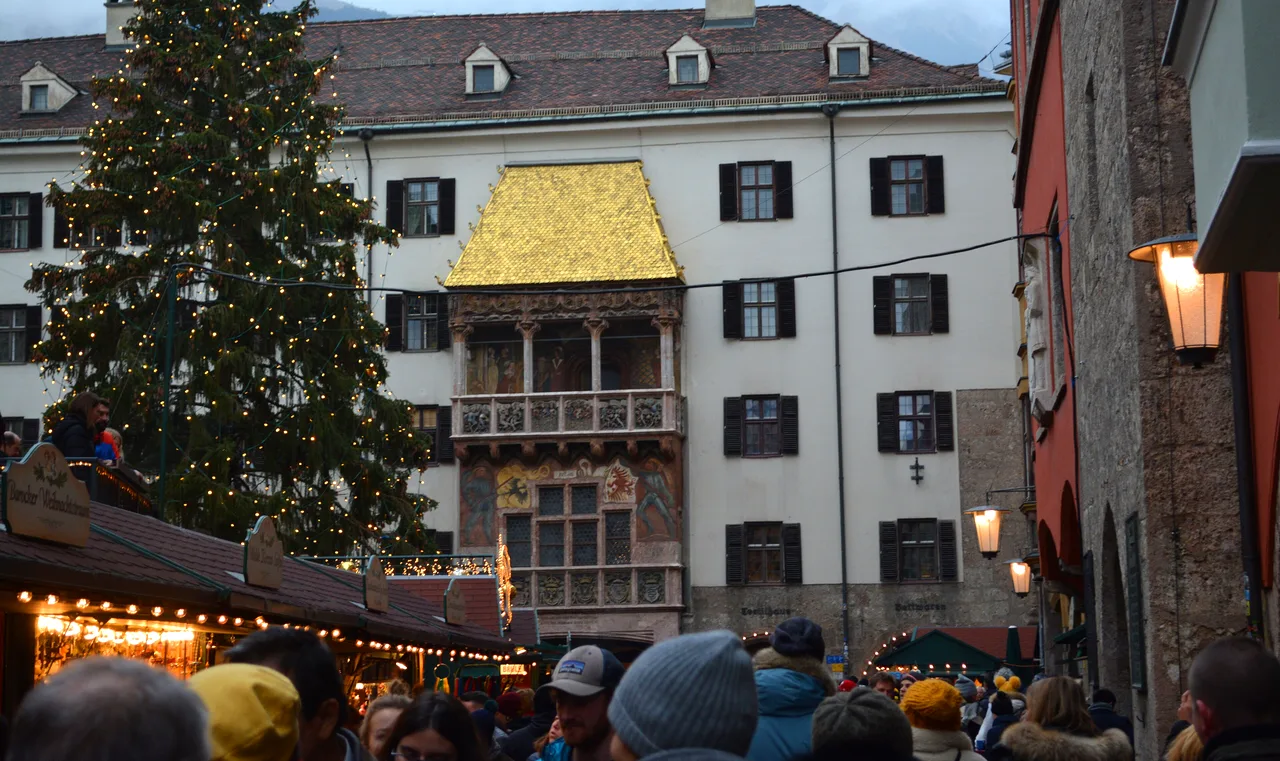
Innsbruck celebrates Advent with seven Christmas markets, each with its own character, listed by Innsbruck Tourism. The best known is the Old Town Christmas market, whose stalls line Herzog-Friedrich-Straße up to the Golden Roof, among late Gothic arcades and painted façades; at its centre stands a large Christmas tree. On Maria-Theresien-Straße, with the Nordkette as a backdrop and St. Anne’s Column in view, a modern market with designed stalls stays open until Epiphany. On the Marktplatz by the Inn, the family market has a large crystal tree, a carousel and a puppet theatre for children. Above the city, the Hungerburg market, reached by the Hungerburgbahn, offers a view over the lights of the valley. At Bergisel, the Kaiserweihnacht at the foot of the ski jump opens at weekends, and the small neighbourhood markets in St. Nikolaus and on the Wiltener Platzl open in the late afternoon and evening. Innsbruck Tourism also describes a “Walk to Explore” route of about 7 km linking several markets. Alongside mulled wine and Jagatee, the stalls serve Tyrolean specialities such as Kiachl. Entry to the markets is free.


| Event | Location | 2026 dates | Note |
|---|---|---|---|
| Old Town Christmas market | Herzog-Friedrich-Straße, below the Golden Roof | 13 November–23 December 2026 | Daily 11:00–21:00; Christmas tree and arcaded façades. Free entry. |
| Maria-Theresien-Straße | Maria-Theresien-Straße, by St. Anne’s Column | 25 November 2026–6 January 2027 | Daily 11:00–21:00; modern stalls with the Nordkette as a backdrop. |
| Marktplatz family market | Marktplatz by the Inn | 13 November–23 December 2026 | Daily 11:00–21:00; crystal Christmas tree, carousel and puppet theatre. |
| Hungerburg | Hungerburg (via the Hungerburgbahn) | 20 November 2026–6 January 2027 | Mon–Fri 13:00–19:00, Sat–Sun 12:00–19:00; view over the city. |
| Kaiserweihnacht at Bergisel | At the foot of the Bergisel ski jump | 13 November–20 December 2026 | Fri 14:00–20:00, Sat–Sun 11:00–20:00; 7 Dec 14:00–20:00, 8 Dec 11:00–20:00. |
| St. Nikolaus | Hans-Brenner-Platz, St. Nikolaus | 20 November–23 December 2026 | Daily 16:00–21:00; small neighbourhood market across the Inn. |
| Wiltener Platzl | Wiltener Platzl, Wilten | 20 November–23 December 2026 | Daily 16:00–20:00; neighbourhood market near the basilica. |
What to try
Kiachl
Tyrolean fried yeast dough, served with cranberries or with sauerkraut.
Glühwein
Hot spiced mulled wine; alcoholic.
Jagatee
Tyrolean “hunter’s tea” of black tea with rum or schnapps; strongly alcoholic.
Kinderpunsch
Spiced hot fruit punch for children and non-drinkers.
Maroni
Roasted chestnuts, a winter classic.
Speckbrot
Bread with Tyrolean smoked ham (Speck); contains pork.
Tips for Innsbruck’s Christmas markets
- The Old Town and Marktplatz markets end on 23 December; Maria-Theresien-Straße and Hungerburg stay open until 6 January.
- The Hungerburg and Bergisel markets have shorter hours; check them before you set off.
- The Old Town market is very crowded in the evening and at weekends; come in the late morning for a calmer visit.
- Follow the official “Walk to Explore” route to see several markets in one day.
- Glühwein mugs usually carry a deposit; return them or keep them as a souvenir.
- Innsbruck is cold in December; dress in layers and wear warm shoes.
- Combine a ride up to the Hungerburg with the market and the view at dusk.
- Many shops have changed hours on 24–26 December and 1 January.
Check before you go: Innsbruck Tourismus · Christkindlmärkte Innsbruck 2026 (official) ↗ · IVB · public transport Innsbruck (official) ↗
Dates and hours checked on 28 October 2026 against the innsbruck.info Christmas markets page. Hours of individual markets and on public holidays may change; check the official page before you visit.
When to Go
Innsbruck has an alpine climate with cold, often snowy winters and warm summers. Winter (December to March) is ski and Christmas season; the Nordkette, Patscherkofel and surrounding ski areas are close by. Spring and autumn are good for walking in the city and lower mountains, and summer is ideal for hiking. From mid-November to Epiphany the Christmas markets light up the city. The föhn wind can bring sudden warm, dry days.
| Month | Sightseeing | Christmas market | Mountains and cable cars | Crowds |
|---|---|---|---|---|
| January | Good | None | Very good | Moderate |
| February | Good | None | Very good | Busy |
| March | Good | None | Good | Moderate |
| April | Very good | None | Difficult | Moderate |
| May | Very good | None | Good | Moderate |
| June | Very good | None | Very good | Busy |
| July | Very good | None | Very good | Busy |
| August | Very good | None | Very good | Busy |
| September | Very good | None | Very good | Moderate |
| October | Very good | None | Good | Moderate |
| November | Good | Market season | Difficult | Moderate |
| December | Good | Market season | Good | Busy |
- Winters are cold and snowy; dress in layers.
- The Old Town market runs from 13 November to 23 December 2026; Maria-Theresien-Straße until 6 January 2027.
- Cable cars may close for maintenance in autumn or in bad weather; check nordkette.com.
- The Four Hills ski jump at Bergisel is held around New Year; the city is busy then.
- Ski holidays fill hotels in late December and February.
- Museums are open year-round; some have reduced winter hours.
Visa and Entry (Turkish citizens)
Turkish citizens holding an ordinary (burgundy) passport need a Schengen visa for tourist travel to Austria. Different rules apply to special, service and diplomatic passports; check the current situation with the Turkish Ministry of Foreign Affairs.
Apply to the mission of your main destination. If Austria is your main destination, information on the application is published by the Austrian Consulate General in Istanbul on the BMEIA website (bmeia.gv.at); check there which office is responsible for your place of residence and how appointments are made.
If you combine Innsbruck with Munich (Germany) or South Tyrol (Italy), apply to the country where you will stay longest; if stays are equal, the country of first entry applies. Checks may take place at internal borders; carry your passport.
Under the EU Entry/Exit System (EES), being phased in, your biometric data (facial image and fingerprints) may be taken on first entry; allow extra time at the border.
Visa fees, appointment waiting times and required documents can change; this guide gives no fees. Use the current list on the official sites before applying.
Travel medical insurance and accommodation and return details are part of the application; see the official sources for details.
Check before you go: T.C. Dışişleri Bakanlığı · Türk vatandaşlarının tabi olduğu vize uygulamaları ↗ · bmeia.gv.at · GK Istanbul ↗ · EES · europa.eu ↗ · Rota Atlası visa guide (TR)
Travel medical insurance
Check the official visa and entry sources above first: they state whether travel medical insurance is required and the minimum cover. Compare any policy’s cover amount, validity dates and countries covered with the official requirement.
Rota Atlası does not currently offer an insurance partnership; there are no paid links in this section. Last updated: 1 November 2026
Getting to Innsbruck
- By air: Innsbruck Airport (INN) lies just west of the city. Larger airports with more connections include Munich (MUC). Check current flights from Türkiye only on airline and airport websites.
- From the airport: city bus line F connects the airport with the centre and the main station; check timetables on ivb.at.
- By train: Innsbruck Hauptbahnhof lies on ÖBB lines to Munich, Salzburg, Vienna and over the Brenner to Italy; check timetables on oebb.at.
- From the Hauptbahnhof to the Old Town: about 10–15 minutes on foot via Maria-Theresien-Straße, or by tram and bus.
Getting Around

Trams and buses
IVB runs trams and buses in the city; check routes and tickets on ivb.at.
On foot
The Old Town, Hofburg, Hofkirche, Maria-Theresien-Straße and the Inn bank are close together.
Hungerburgbahn
The funicular runs from the Congress station near the Old Town up to the Hungerburg.
Nordkette cable cars
From the Hungerburg, cable cars continue to the Seegrube and Hafelekar.
Tram 6 and buses
Tram line 6 and buses run to Igls; check ivb.at.
Innsbruck Card
The city card covers many sights and transport; check what is included on innsbruck.info.
Things to See
Innsbruck’s Old Town lies on the right bank of the Inn, centred on Herzog-Friedrich-Straße and the Golden Roof; the Hofburg, Hofkirche and the Cathedral of St. James are just to the east and north. To the south Maria-Theresien-Straße leads to the Triumphal Arch and on to Wilten. Across the Inn the Hungerburgbahn climbs to the Nordkette, and Bergisel rises at the southern edge of the city. Ambras Castle, Hall, Wattens and Igls are in easy reach.
The symbol of the city
Golden Roof and Herzog-Friedrich-Straße

The Golden Roof (Goldenes Dachl) is Innsbruck’s best-known landmark: a late Gothic oriel built around 1500 for Emperor Maximilian I, from which he watched festivities in the square below. Its roof is covered with about 2,657 gilded copper tiles, and its balustrades are decorated with reliefs and coats of arms. A small museum inside tells the story of Maximilian. Herzog-Friedrich-Straße, lined with arcades and painted houses such as the Helblinghaus with its stucco façade, leads to the Golden Roof; nearby, the Stadtturm offers views over the Old Town.
Don’t miss
- The gilded tiles of the Golden Roof
- The Helblinghaus façade
- The arcades of Herzog-Friedrich-Straße
- The view from the Stadtturm
Tips
- Check opening times of the Golden Roof museum and Stadtturm in advance.
- In Advent the Old Town market fills the street; come early for photos.
- Watch your step on cobblestones when it is icy.

The Habsburg palace
Hofburg and Hofkirche

The Hofburg, the imperial palace of Innsbruck, dates from the 15th century and was remodelled in the 18th century under Empress Maria Theresa in late Baroque and Rococo style. Its state rooms include the Giant’s Hall with its ceiling fresco and portraits of the imperial family. Next door, the Hofkirche holds the cenotaph of Emperor Maximilian I, surrounded by 28 larger-than-life bronze statues of his ancestors and relatives, known as the “black men”. The church also contains the grave of Andreas Hofer, leader of the Tyrolean uprising of 1809.
Don’t miss
- The Giant’s Hall in the Hofburg
- Maximilian’s cenotaph
- The 28 bronze statues of the Hofkirche
- Andreas Hofer’s grave
Tips
- Check opening times and tickets on burghauptmannschaft.at and tiroler-landesmuseen.at.
- The Hofkirche can be combined with the Folk Art Museum next door.
- Allow at least an hour for each.

Colourful houses on the river
Inn bank, Mariahilf and the Cathedral of St. James

The Inn bridge gave the city its name, and the view from the Old Town across the river to the colourful houses of Mariahilf and St. Nikolaus, with the Nordkette behind them, is one of Innsbruck’s classic pictures. A short walk from the river, the Cathedral of St. James (Dom St. Jakob) is a Baroque church rebuilt in the early 18th century; its high altar holds the Mariahilf image of the Virgin by Lucas Cranach the Elder, one of the most venerated Marian images in the Alps.
Don’t miss
- The colourful houses of Mariahilf
- The view of the Nordkette over the Inn
- The Cathedral of St. James
- Cranach’s Mariahilf image
Tips
- The best view is from the Old Town side of the Inn bridge.
- Do not walk around the cathedral during services.
- The Inn bank is windy and cold in winter.
The city boulevard
Maria-Theresien-Straße, St. Anne’s Column and the Triumphal Arch

Maria-Theresien-Straße, south of the Old Town, is Innsbruck’s main boulevard, with Baroque palaces and the Nordkette as a dramatic backdrop. In its centre stands St. Anne’s Column (Annasäule), erected in 1706 to commemorate the withdrawal of Bavarian troops during the War of the Spanish Succession. At its southern end, the Triumphal Arch (Triumphpforte) was built in 1765 for the wedding of Maria Theresa’s son Leopold; because her husband died during the festivities, one side shows joyful and the other mournful scenes.
Don’t miss
- St. Anne’s Column with the Nordkette
- The Triumphal Arch
- Baroque palaces along the street
- The Advent market on the boulevard
Tips
- The boulevard is pedestrianised in its northern section.
- In Advent the market here stays open until 6 January.
- The Hauptbahnhof is a short walk away.
Tyrol’s art and history
Tyrolean State Museum Ferdinandeum

The Ferdinandeum is the main museum of the Tyrolean State Museums. Its collections span prehistory, Romanesque and Gothic art, the Baroque and modern art from Tyrol, as well as music history. Together with the Hofkirche, the Folk Art Museum, the Tirol Panorama and the Armoury, it forms a network of museums that can be visited with a combined ticket.
Don’t miss
- Gothic altarpieces
- Baroque painting
- Modern Tyrolean art
- The museum’s architecture
Tips
- Check opening times and combined tickets on tiroler-landesmuseen.at.
- Many museums close on Mondays; check in advance.
- Allow at least two hours.
A green oasis
Hofgarten

The Hofgarten, the former court garden of the Habsburgs, lies just east of the Hofburg. Its lawns, old trees, ponds and pavilions make it a quiet place close to the Old Town; there is also a large outdoor chessboard and a palm house. In winter the park is calm and often snow-covered.
Don’t miss
- The old trees and ponds
- The palm house
- The outdoor chessboard
- The view of the Nordkette
Tips
- The park is free.
- Opening hours may be shorter in winter.
- Paths can be icy.
A Renaissance castle
Ambras Castle

Above the eastern edge of the city, Ambras Castle was transformed in the 16th century by Archduke Ferdinand II into a Renaissance residence for his wife Philippine Welser. He gathered one of the earliest museum collections here, a “cabinet of art and curiosities” together with armour and portraits. The highlight is the Spanish Hall, a long Renaissance hall with a wooden coffered ceiling and portraits of Tyrolean rulers. The castle is surrounded by a park.
Don’t miss
- The Spanish Hall
- The cabinet of art and curiosities
- The armoury collections
- The Habsburg portrait gallery
Tips
- Check winter opening on schlossambras-innsbruck.at; it may close for part of the season.
- The castle can be reached by bus; check ivb.at.
- Allow at least two hours.

From the city to the summit
Nordkette: Hungerburgbahn, Seegrube and Hafelekar

The Nordkette rises directly above Innsbruck and is part of the Karwendel Nature Park. The Hungerburgbahn funicular, with stations designed by Zaha Hadid and opened in 2007, runs from the edge of the Old Town to the Hungerburg. From there cable cars continue to the Seegrube at about 1,905 metres and on to the Hafelekar at about 2,256 metres, from where the view stretches over the Inn valley to the Alps. In winter the Seegrube is also a ski area.
Don’t miss
- The Hadid stations of the Hungerburgbahn
- The view from the Seegrube
- The Hafelekar summit area
- Innsbruck’s lights at dusk
Tips
- Check operating times and weather on nordkette.com before you go.
- It is much colder at the top; take warm clothes.
- Only go on mountain trails with proper equipment; in winter they may be closed.


Olympic history
Bergisel ski jump

The Bergisel ski jump on the southern edge of the city was rebuilt to a design by Zaha Hadid and opened in 2002; its tower with a café and viewing platform rises above the city. Bergisel was the venue for the ski jumping events of the 1964 and 1976 Winter Olympics and is part of the Four Hills Tournament held around New Year. Nearby, the Tirol Panorama museum shows a giant circular painting of the 1809 Battle of Bergisel.
Don’t miss
- The view from the jump tower
- The Hadid architecture
- The Tirol Panorama
- The Kaiserweihnacht in Advent
Tips
- Check opening times on bergisel.info.
- The site can be reached by tram or bus; check ivb.at.
- During competitions access may be restricted.
Alpine animals
Alpenzoo

The Alpenzoo on the slopes below the Hungerburg is regarded as the highest zoo in Europe. It focuses on animals of the Alps, including ibex, chamois, bears, wolves, lynx, golden eagles and bearded vultures, and supports breeding programmes for endangered species.
Don’t miss
- Ibex and chamois
- Bearded vultures
- Bears and wolves
- The view over the city
Tips
- The zoo is near the Alpenzoo stop of the Hungerburgbahn.
- Paths are steep and can be icy in winter.
- Check opening times on alpenzoo.at.
Rococo splendour
Wilten Basilica and Wilten Abbey

In the Wilten district south of the centre stand two remarkable churches. The Wilten Basilica is one of the finest Rococo churches in Tyrol, with a pale façade, stucco and ceiling frescoes. Opposite, Wilten Abbey is a Premonstratensian monastery with an abbey church in Baroque style. In Advent a small Christmas market is held on the nearby Wiltener Platzl.
Don’t miss
- The Rococo interior of the basilica
- The abbey church
- The Wiltener Platzl
- The Advent market
Tips
- Do not walk around during services.
- Wilten is reached by tram from the centre; check ivb.at.
- Combine it with Bergisel.
Salt, silver and crystal
Day trip: Hall in Tirol and Swarovski Crystal Worlds

About 10 km east of Innsbruck, Hall in Tirol has one of the largest old towns in western Austria, which grew rich on salt mining. In 1486 the Hall mint struck the Guldiner, an early large silver coin, which is regarded as a forerunner of the Taler; the mint museum is in Hasegg Castle. A little further east, in Wattens, Swarovski Crystal Worlds, opened in 1995, presents crystal art in chambers beneath a giant head covered in grass.
Don’t miss
- Hall’s Upper Town
- The Hall Mint at Hasegg Castle
- The Crystal Worlds chambers
- The garden in Wattens
Tips
- Hall can be reached by regional train or bus; check oebb.at and ivb.at.
- Check opening times and tickets for Crystal Worlds on the official site.
- Both can be combined in a day.

Village above the city
Igls and Patscherkofel

On a terrace south of Innsbruck lies Igls, a village known as a health resort. Above it rises the Patscherkofel, Innsbruck’s home mountain, reached by cable car; in winter it is a ski area, and in summer it offers hiking with views over the Inn valley. Tram line 6 runs through forest from Innsbruck to Igls.
Don’t miss
- The view from the Patscherkofel
- The village of Igls
- The tram through the forest
- Winter walks
Tips
- Check cable car operating times on the official site.
- It is colder at the top; dress warmly.
- Check tram 6 and buses on ivb.at.

1–3 Day Itineraries, a Christmas Day + a 7-Day Tyrol and Alps Route
The itineraries keep distances short and allow for short winter days. One day is enough for the Old Town and Hofburg, two allow the Nordkette and museums, and three add Ambras, Hall or Wattens. The 7-day route combines Innsbruck with other cities in the Alps. Check opening hours on the official websites in advance.
Day 1: Old Town and the imperial city
- Start at the Golden Roof and walk along Herzog-Friedrich-Straße.
- Climb the Stadtturm for the view.
- Visit the Hofburg and the Hofkirche.
- See the Cathedral of St. James and the Inn bank with Mariahilf.
- In the evening walk along Maria-Theresien-Straße to the Triumphal Arch.
Day 2: Nordkette and museums
- Take the Hungerburgbahn to the Hungerburg in the morning.
- Continue by cable car to the Seegrube and Hafelekar, if the weather allows.
- Visit the Alpenzoo on the way down.
- In the afternoon see the Ferdinandeum.
- End the day in the Hofgarten or the Old Town.
Day 3: Ambras, Bergisel and Wilten
- Visit Ambras Castle and the Spanish Hall in the morning.
- Go to the Bergisel ski jump and the Tirol Panorama.
- See Wilten Basilica and the abbey.
- Alternatively take a trip to Hall in Tirol and Wattens.
- Return to the Old Town in the evening.
Christmas Day (13 November–23 December 2026)
- In the morning visit the Golden Roof and the Hofkirche.
- At midday walk through the family market on the Marktplatz.
- In the afternoon take the Hungerburgbahn up to the Hungerburg market.
- At dusk come down to the Old Town market below the Golden Roof.
- End with the market on Maria-Theresien-Straße and St. Anne’s Column.
7 Days: Tyrol and the Alps
- Days 1–3: Innsbruck – Old Town, Nordkette, Ambras and Bergisel.
- Day 4: Hall in Tirol and Wattens.
- Day 5: Salzburg.
- Day 6: Munich or Bolzano.
- Day 7: Depart from Innsbruck or Munich.
Innsbruck and Tyrolean Food
Tyrolean food is mountain cooking: dumplings, smoked ham, cheese and hearty pan dishes, with Viennese-style desserts. These are traditional dishes, not restaurant recommendations.


Tiroler Speckknödel
Bread dumplings with Tyrolean smoked ham, in broth or with sauerkraut; contain pork.
Kaspressknödel
Flattened cheese dumplings, fried and served in soup or with salad; vegetarian.
Tiroler Gröstl
Fried potatoes with meat and onions, often topped with a fried egg; usually contains pork.
Schlutzkrapfen
Tyrolean half-moon pasta filled with spinach and curd cheese, with butter and parmesan.
Kaiserschmarrn
Shredded fluffy pancake with plum compote and powdered sugar.
Apfelstrudel
Thin pastry filled with apples and raisins.
Tiroler Speck
Cured smoked ham, a regional speciality; pork.
Kiachl
Fried yeast dough with cranberries or sauerkraut, a market classic.
- Many traditional dishes contain pork; ask about ingredients.
- Vegetarian options (Kaspressknödel, Schlutzkrapfen, Kaiserschmarrn) are easy to find.
- Tap water is of excellent quality.
- Service is included; rounding up by 5–10 per cent is customary.
Culture and Etiquette

- “Grüß Gott” or “Servus” are common greetings in Tyrol.
- Use the formal “Sie” in formal situations.
- Tyroleans are proud of their traditions; costume (Tracht) is worn at festivals.
- Do not walk around churches during services or use flash.
- People queue at stalls, bakeries and cable car stations.
- Sunday is a day of rest; most shops are closed.
- In the mountains, greet other walkers.
- Keep quiet in the narrow Old Town lanes at night.
- The Folk Art Museum shows Tyrolean nativity scenes, a living Advent tradition.
- Ask before photographing people, especially at markets.
Safety and Health
- Innsbruck is generally safe; watch your valuables in Advent crowds and on trams.
- Cobblestones are slippery when wet or icy; wear non-slip shoes.
- Mountain weather changes quickly; check forecasts and avalanche warnings before going up.
- Only go on mountain trails with proper equipment; respect closures.
- In an emergency call 112; police 133, ambulance 144, mountain rescue 140.
- Make sure your travel medical insurance covers the Schengen area and mountain activities.
- Pharmacies (Apotheke) post the address of the emergency pharmacy on duty.
What Your Budget Depends On
This guide does not give prices; prices change with season and year. Your budget depends on these factors:
Travel dates
Advent weekends, New Year and ski holidays push up hotel demand.
Accommodation
The Old Town, station area and villages around Innsbruck differ widely.
Transport
City tickets, the Innsbruck Card and regional trains change costs.
Sights and museums
Each museum and cable car charges separately unless covered by a card.
Food and drink
Market snacks are affordable; restaurants vary widely.
Day trips
Trips to Hall, Wattens and Salzburg cost extra.
Free experiences
The Christmas markets (free entry), the Old Town, Maria-Theresien-Straße, the Inn bank and the Hofgarten are free.
Practical Information
- Money: euro; cards widely accepted, carry some cash.
- Language: German; English widely understood.
- Sockets: 230 V, type C/F.
- Time: CET (UTC+1) in winter.
- Opening hours: some museums close on Mondays.
- Shops: closed on Sundays; the Christmas markets are open.
- Holidays: 8 December (Immaculate Conception) is a holiday in Austria; changed hours on 24–26 and 31 December and 1 January.
- Weather: cold in December, about -5 to 4 °C.
- Daylight: sunset around 16:30 in December.
- Emergency: 112; police 133, ambulance 144, mountain rescue 140.
Frequently Asked Questions
When are the Innsbruck Christmas markets 2026?
According to innsbruck.info, the Old Town market runs from 13 November to 23 December 2026; Maria-Theresien-Straße from 25 November 2026 to 6 January 2027.
What are the opening hours?
The Old Town, Marktplatz and Maria-Theresien-Straße markets are open daily 11:00–21:00.
Which markets stay open after Christmas?
Maria-Theresien-Straße and Hungerburg, until 6 January 2027.
Is entry free?
Yes; food, drink and gifts cost money.
How do I get to the Hungerburg market?
By the Hungerburgbahn funicular from the Congress station near the Old Town.
Do Turkish citizens need a visa?
Holders of ordinary passports need a Schengen visa. If Austria is the main destination, see bmeia.gv.at (Consulate General Istanbul).
Which airport serves Innsbruck?
Innsbruck Airport (INN); Munich (MUC) is a larger alternative. Check current flights on the airport websites.
How many days are enough?
One day for the Old Town, two with the Nordkette and museums, three with Ambras, Hall or Wattens.
Can I go up the mountains in winter?
Yes, the Nordkette cable cars usually run in winter, depending on weather; check nordkette.com.
Can I combine Innsbruck with Munich or Salzburg?
Yes; both are reachable by ÖBB trains. Check oebb.at.
Where to stay
Stay close to the areas where you will spend most time. The areas below are covered in detail in this guide; check public transport links in the getting-around section.
- The symbol of the cityGolden Roof and Herzog-Friedrich-Straße
- The Habsburg palaceHofburg and Hofkirche
- Colourful houses on the riverInn bank, Mariahilf and the Cathedral of St. James
- The city boulevardMaria-Theresien-Straße, St. Anne’s Column and the Triumphal Arch
- Tyrol’s art and historyTyrolean State Museum Ferdinandeum
- A green oasisHofgarten
- A Renaissance castleAmbras Castle
- From the city to the summitNordkette: Hungerburgbahn, Seegrube and Hafelekar
- Olympic historyBergisel ski jump
- Alpine animalsAlpenzoo
- Rococo splendourWilten Basilica and Wilten Abbey
- Salt, silver and crystalDay trip: Hall in Tirol and Swarovski Crystal Worlds
- Village above the cityIgls and Patscherkofel
Search hotels in these areas (Hotellook) ↗ (affiliate link)Search on Booking.com ↗
Affiliate disclosure: Hotellook, Aviasales, Klook, Airalo, Tiqets and DiscoverCars links are affiliate links; Rota Atlası may earn a commission on bookings made through them, at no extra cost to you. Official and in-guide links are not paid. Last updated: 1 November 2026 · Privacy and affiliates
Transport and connectivity
- Airport transferOptions from the airport to the city are in this guide’s getting there section.
- Mobile data (eSIM)Airalo eSIM ↗ (affiliate link)
- TrainsOfficial rail website ↗
- Car hireYou rarely need a car within the city; see getting around first. Compare car hire on DiscoverCars ↗ (affiliate link)
Affiliate disclosure: Hotellook, Aviasales, Klook, Airalo, Tiqets and DiscoverCars links are affiliate links; Rota Atlası may earn a commission on bookings made through them, at no extra cost to you. Official and in-guide links are not paid. Last updated: 1 November 2026 · Privacy and affiliates
Search flights (affiliate link)
Search flights from any airport in any country. Results open on Aviasales in a new tab, where you book.
This form is an affiliate link: Rota Atlası may earn a commission on bookings made via Aviasales (Travelpayouts), at no extra cost to you. Check price, baggage and terms on the booking site. Airport data: OurAirports (public domain).
Flights, hotels and tours
Find tours and tickets
- Old Town Christmas Market
GetYourGuide ↗ · Klook ↗ (affiliate link) - Maria-Theresien-Straße
GetYourGuide ↗ · Klook ↗ (affiliate link) - Marktplatz
GetYourGuide ↗ · Klook ↗ (affiliate link) - Hungerburg
GetYourGuide ↗ · Klook ↗ (affiliate link)
Hotellook, Aviasales, Klook, Airalo and Tiqets links in this box are affiliate links (Travelpayouts): Rota Atlası may earn a commission on bookings made through them, at no extra cost to you. GetYourGuide links currently carry no affiliate code. Check prices and terms with the provider. Last updated: 1 November 2026 · Privacy and affiliates
Sources
- T.C. Dışişleri Bakanlığı · Türk vatandaşlarının tabi olduğu vize uygulamaları ↗
- BMEIA · Österreichisches Generalkonsulat Istanbul · Einreise und Aufenthalt (Visum) ↗
- European Union · Entry/Exit System (EES) ↗
- Innsbruck Tourismus · innsbruck.info (official) ↗
- Stadt Innsbruck · innsbruck.gv.at (official) ↗
- IVB · Innsbrucker Verkehrsbetriebe (official) ↗
- Innsbruck Airport (official) ↗
- ÖBB · Österreichische Bundesbahnen ↗
- Innsbrucker Nordkettenbahnen (official) ↗
- Tiroler Landesmuseen (official) ↗
- Burghauptmannschaft Österreich · Hofburg Innsbruck (official) ↗
- KHM-Museumsverband · Schloss Ambras Innsbruck (official) ↗
- Alpenzoo Innsbruck (official) ↗
- Bergisel Sprungschanze (official) ↗
- Tirol Werbung · tirol.at (official) ↗
- GOV.UK · Foreign travel advice · Austria ↗
- Innsbruck Tourismus · Christkindlmärkte Innsbruck 2026 (official) ↗
- IVB · public transport Innsbruck (official) ↗
This page is for information only. Dates, hours, entry rules and transport information can change; check the official sources above before travelling. No prices, flights, hotels or restaurants have been invented in this guide.
Photo credits
The photos on this page come from Wikimedia Commons and are used under the stated authors and licences (CC BY, CC BY-SA, CC0 or public domain). Full list of sources
- Christmas market in front of the Golden Roof (Goldenes Dachl) — Arquus · CC BY-SA 4.0 · Wikimedia Commons
- Stalls of the Innsbruck Old Town Christmas market — Simon Legner (User:simon04) · CC BY-SA 4.0 · Wikimedia Commons
- Tyrolean Kiachl fried dough at a Christmas market — Simon Legner (User:simon04) · CC BY-SA 4.0 · Wikimedia Commons
- The Hungerburg Christmas market with the city view — Simon Legner (User:simon04) · CC BY-SA 4.0 · Wikimedia Commons
- The Christmas market at Bergisel — Simon Legner (User:simon04) · CC BY-SA 4.0 · Wikimedia Commons
- The family Christmas market on the Marktplatz — Simon Legner (User:simon04) · CC BY-SA 4.0 · Wikimedia Commons
- Christmas market in Wilten — Simon Legner (User:simon04) · CC BY-SA 4.0 · Wikimedia Commons
- Christmas market on Maria-Theresien-Straße — Simon Legner (User:simon04) · CC BY-SA 4.0 · Wikimedia Commons
- Christmas market by the Stiftskeller in the Old Town — Simon Legner (User:simon04) · CC BY-SA 4.0 · Wikimedia Commons
- Christmas lights and visitors in the Old Town — Simon Legner (User:simon04) · CC BY-SA 4.0 · Wikimedia Commons
- The Golden Roof (Goldenes Dachl) oriel — Wilfredor · CC0 · Wikimedia Commons
- Herzog-Friedrich-Straße and its historic houses — Wilfredor · CC0 · Wikimedia Commons
- Colourful houses on the Inn and the city tower — Michielverbeek · CC BY-SA 4.0 · Wikimedia Commons
- Innsbruck Imperial Palace (Hofburg) — Leonhard Lenz · CC0 · Wikimedia Commons
- Emperor Maximilian I’s cenotaph and bronze statues in the Hofkirche — Erich Schmid · CC BY-SA 3.0 at · Wikimedia Commons
- The Triumphpforte (Triumphal Arch) — Arquus · CC BY-SA 4.0 · Wikimedia Commons
- Ambras Castle — Wilfredor · CC0 · Wikimedia Commons
- The Spanish Hall at Ambras Castle — Wilfredor · CC0 · Wikimedia Commons
- The Nordkette range above Innsbruck — böhringer friedrich · CC BY-SA 2.5 · Wikimedia Commons
- Seegrube top station and the Karwendel peaks — Asurnipal · CC BY-SA 4.0 · Wikimedia Commons
- Cable car at Hafelekar station — Wilfredor · CC0 · Wikimedia Commons
- A Hungerburgbahn station — Andrew Bone from Weymouth, England · CC BY 2.0 · Wikimedia Commons
- The Bergisel ski jump — Leonhard Lenz · CC0 · Wikimedia Commons
- The Inn and Mariahilfstraße seen from the Marktplatz — Leonhard Lenz · CC0 · Wikimedia Commons
- Innsbruck at night from Seegrube — Hermann Hammer (User:Haneburger) · CC0 · Wikimedia Commons
- A bearded vulture at the Alpenzoo — Wilfredor · CC0 · Wikimedia Commons
- The Tyrolean State Museum Ferdinandeum — Simon Legner (User:simon04) · CC BY-SA 4.0 · Wikimedia Commons
- The “Work and Festivals” display at the Folk Art Museum — Burkhard Mücke · CC BY-SA 4.0 · Wikimedia Commons
- Rococo interior of Wilten Basilica — Leonhard Lenz · CC0 · Wikimedia Commons
- The Innsbruck Hofgarten park — Flocci Nivis · CC BY 4.0 · Wikimedia Commons
- Schmiedgasse in Hall in Tirol — -wuppertaler · CC BY-SA 4.0 · Wikimedia Commons
- The Swarovski Kristallwelten park — Zairon · CC BY-SA 3.0 · Wikimedia Commons
- The village of Igls and the mountains — Smiley.toerist · CC BY-SA 4.0 · Wikimedia Commons
- The Patscherkofel mountain — Asurnipal · CC BY-SA 4.0 · Wikimedia Commons
- An Innsbruck tram — Smiley.toerist · CC BY-SA 4.0 · Wikimedia Commons
- Kaiserschmarrn — Ich · CC BY-SA 4.0 · Wikimedia Commons
- Tyrolean dumplings with sauerkraut — Haeferl · CC BY-SA 3.0 · Wikimedia Commons
Trento → · Salzburg → · Munich → · Bolzano → · Merano → · Vienna → · Christmas markets