

Zagreb is the capital and largest city of Croatia, home to roughly 770,000 people on the slopes between the Medvednica mountain and the Sava river. It grew from two rival medieval settlements on neighbouring hills – the church town of Kaptol around the cathedral and the free royal town of Gradec – which were united as one city only in 1850. Today the hilltop Upper Town (Gornji grad), with its gas lamps, St Mark’s Church and its tiled roof, Stone Gate and Lotrščak Tower, looks down on the Lower Town (Donji grad), a 19th-century Habsburg grid of squares and parks laid out as the “Green Horseshoe”. Between them lies Ban Jelačić Square, the city’s meeting point, and Dolac, the open-air market under red umbrellas. Zagreb is a city of cafés, of small and unusual museums such as the Museum of Broken Relationships, and of green escapes from Maksimir Park to the forests of Medvednica. In Advent it becomes one of Europe’s best-known Christmas cities: Advent Zagreb spreads stalls, lights, concerts and an ice rink across parks, promenades and squares. This guide brings together the Christmas markets, the Upper Town and Kaptol, the Lower Town, the museums, Mirogoj, nature and day trips to Samobor, Varaždin and Plitvice, with official sources.
Content update: 28 October 2026 · Advent Zagreb dates checked against the official adventzagreb.com and Zagreb Tourist Board pages
Zagreb at a Glance
- Country
- Croatia · capital and largest city
- Population
- About 770,000 in the city
- Language
- Croatian; English widely spoken by younger people and in tourism
- Currency
- Euro (EUR) since 1 January 2023; cards widely accepted
- Time zone
- Central European Time (CET, UTC+1); 2 hours behind Türkiye in winter
- UNESCO
- Plitvice Lakes National Park (day trip); licitar gingerbread craft of northern Croatia (intangible heritage)
- Landmarks
- Cathedral, Stone Gate, St Mark’s Church, Lotrščak Tower, funicular, Ban Jelačić Square, Dolac, Mirogoj
- Nearby
- Samobor, Varaždin, Plitvice, Ljubljana; by road or rail also Graz and Vienna
- Christmas
- Advent Zagreb 28 November 2026–7 January 2027; hours vary by location
- Airport
- Zagreb Franjo Tuđman Airport, about 17 km south-east of the centre
- Electricity
- 230 V, European (C/F) sockets; Turkish plugs fit
- Emergency
- 112 (general), 192 (police)
Zagreb in Pictures
The Upper Town above the roofs of the Lower Town, the patterned roof of St Mark’s Church and the café life of Tkalčićeva Street: Zagreb in three images.


Advent Zagreb Christmas Market 2026
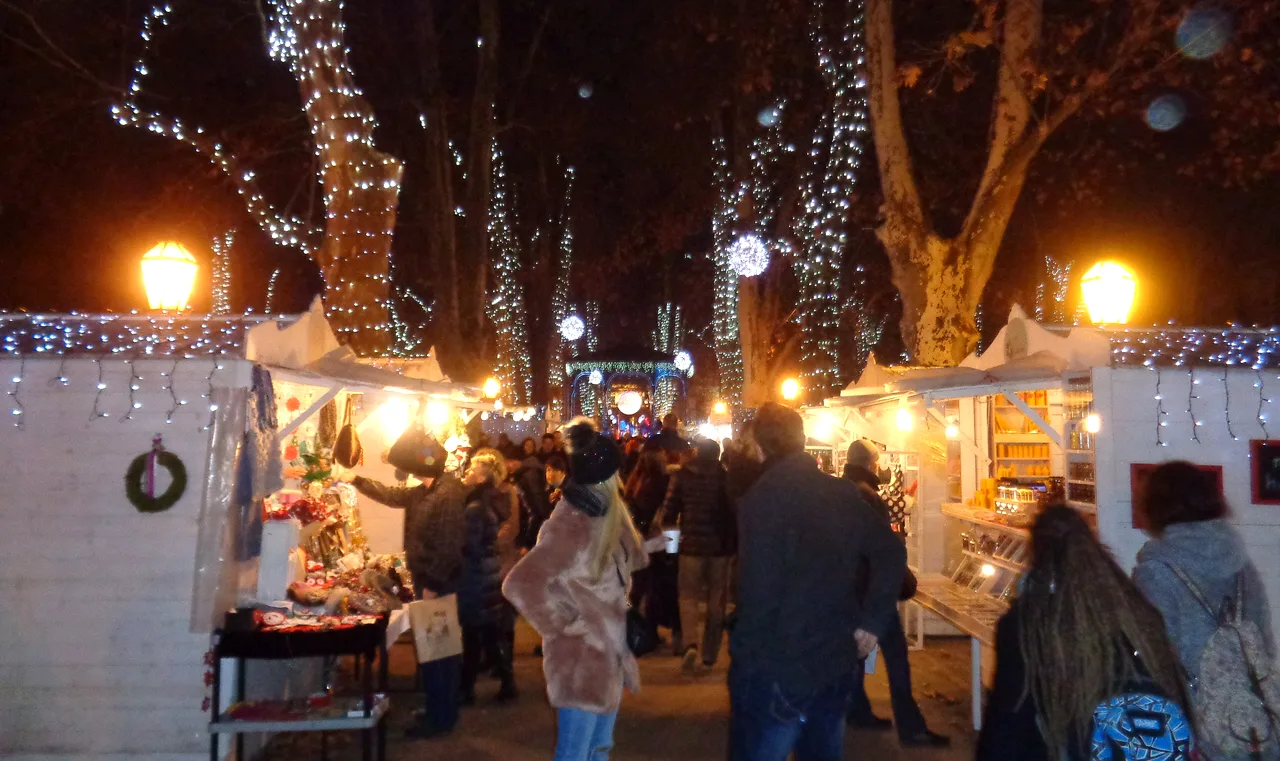
Advent in Zagreb is not one market but a whole season that takes over the city centre. For around six weeks, wooden stalls, lights, music stages and food corners appear in parks, on promenades, in squares and on pedestrian streets of both the Lower and Upper Town. The traditional heart is Zrinjevac, the first park of the Green Horseshoe, where the plane trees are hung with lights, the music pavilion hosts concerts and stalls line the paths. On Ban Jelačić Square a large Advent wreath is set up and its candles are lit on the Sundays of Advent. In past editions the programme also included the Upper Town with its promenade views over the lit-up Lower Town, an ice rink in front of the Art Pavilion on King Tomislav Square, and smaller markets in other squares and courtyards. The stalls sell mulled wine, sausages, fritule, štrukli and traditional Christmas sweets, along with handmade gifts and red licitar gingerbread hearts – the decorated honey-dough craft of northern Croatia is on UNESCO’s intangible heritage list. Advent Zagreb was voted best Christmas market in Europe three years in a row (2016–2018) in the European Best Destinations poll. Distances are short, so the classic evening is a walk from Ban Jelačić Square along Zrinjevac to King Tomislav Square, followed by a funicular ride up to the Upper Town.


| Event | Location | 2026 dates | Note |
|---|---|---|---|
| Advent Zagreb | City centre: Zrinjevac, Ban Jelačić Square, Upper Town and other locations | 28 November 2026–7 January 2027 | Organised by the City of Zagreb and the Zagreb Tourist Board; hours differ by location – check the official programme. |
| Zrinjevac | Nikola Šubić Zrinski Square (Lower Town) | During Advent Zagreb | The traditional heart of Advent: lit plane trees, concerts at the music pavilion and stalls along the paths. |
| Advent wreath | Ban Jelačić Square | During Advent | Candles are lit on the Sundays of Advent; check the dates in the official programme. |
| Upper Town and ice rink | Upper Town promenades; King Tomislav Square (in past editions) | During Advent Zagreb | Locations and opening hours of the 2026 programme to be checked on adventzagreb.com. |
What to try
Kuhano vino
Mulled wine – alcoholic; hot chocolate, tea and non-alcoholic punch are also widely available.
Fritule
Small fried dough balls dusted with sugar, often flavoured with citrus or rum; a Christmas classic of Croatia.
Kobasice
Grilled sausages served with bread and mustard; usually pork – ask about the ingredients.
Štrukli
Dough filled with fresh cheese, boiled or baked with cream; Zagreb’s best-known dish.
Paprenjaci
Peppered honey biscuits with a long Zagreb tradition; a favourite edible souvenir.
Licitar hearts
Red decorated gingerbread hearts – more often a decoration and gift than a snack.
Advent Zagreb tips
- In December it gets dark around 16:15; plan the lit-up parks for the evening and the museums for the day.
- Walk the Green Horseshoe from Ban Jelačić Square to King Tomislav Square, then go up to the Upper Town.
- Weekend evenings are very busy; weekday afternoons are calmer.
- Each location has its own opening hours; check the official programme before you go.
- Evenings in December can be close to or below freezing; dress warmly and wear non-slip shoes.
- Keep your phone and wallet in front of you in crowded spots.
- The funicular is the easiest way up to the Upper Town; the stairs are slippery in frost.
- Buy licitar hearts and paprenjaci from craft stalls rather than mass-produced souvenir shops.
Check before you go: Advent Zagreb · adventzagreb.com (official) ↗ · Zagreb Tourist Board · infozagreb.hr (official) ↗
The dates were checked on 28 October 2026 against the official Advent Zagreb site and the Zagreb Tourist Board. Individual locations, opening hours and the concert programme are announced shortly before the start and may change; check the official pages again before you go.
When to Go
Zagreb has a continental climate with warm summers and cold winters. Spring and early autumn are ideal for walking the Upper Town and parks. Summer is warm and many locals go to the coast, so the city is quieter but lively with outdoor events. From late November to early January Advent turns the city into a big Christmas market – the most atmospheric time to visit. January and February are cold and grey, but museums and cafés are calm.
| Month | Sightseeing | Christmas market | Nature and day trips | Crowds |
|---|---|---|---|---|
| January | Good | Market season | Difficult | Quiet |
| February | Good | None | Difficult | Quiet |
| March | Good | None | Good | Quiet |
| April | Very good | None | Very good | Moderate |
| May | Very good | None | Very good | Moderate |
| June | Very good | None | Very good | Moderate |
| July | Good | None | Very good | Moderate |
| August | Good | None | Very good | Moderate |
| September | Very good | None | Very good | Moderate |
| October | Very good | None | Very good | Moderate |
| November | Good | Market season | Good | Moderate |
| December | Good | Market season | Difficult | Busy |
- Zagreb’s winters are cold and often foggy; snow is possible, especially on Medvednica.
- In December the sun rises around 7:30 and sets around 16:15.
- Advent Zagreb runs from 28 November 2026 to 7 January 2027.
- Plitvice is at its most popular in summer; in winter some paths may be closed – check the park’s official website.
- In August many locals are on holiday, and some smaller shops and restaurants close.
- Museums often close on Mondays; check before you go.
- Spring (April–May) and autumn (September–October) bring mild days, ideal for Medvednica walks and day trips to Samobor and Varaždin.
Visa and Entry (Turkish citizens)
Turkish citizens holding ordinary (burgundy) passports need a Schengen visa for tourist travel to Croatia. Rules differ for special, service and diplomatic passports; check the current position with the Ministry of Foreign Affairs.
Croatia has been a full member of the Schengen area since 1 January 2023, so a Schengen visa issued by Croatia is valid for the whole area under the usual rules.
According to the Croatian Ministry of Foreign and European Affairs, applications are submitted through the competent Croatian mission or its external service provider; in Türkiye this is VFS Global. Check the competent office and the current procedure on the official pages.
The ministry states that an application can be lodged no more than six months and in principle no later than 15 days before the trip.
Under the EU Entry/Exit System (EES), being phased in, your biometric data (facial image and fingerprints) may be taken on first entry; allow extra time at the border.
Visa fees, appointment times and required documents can change; this guide gives no fees. Use the current list on the official sites before applying.
Check before you go: T.C. Dışişleri Bakanlığı · Türk vatandaşlarının tabi olduğu vize uygulamaları ↗ · mvep.gov.hr · visa requirements ↗ · EES · europa.eu ↗ · mvep.gov.hr · Schengen visa ↗ · Rota Atlası visa guide (TR)
Travel medical insurance
Check the official visa and entry sources above first: they state whether travel medical insurance is required and the minimum cover. Compare any policy’s cover amount, validity dates and countries covered with the official requirement.
Rota Atlası does not currently offer an insurance partnership; there are no paid links in this section. Last updated: 1 November 2026
Getting to Zagreb
- Air: Zagreb Franjo Tuđman Airport (ZAG) is about 17 km south-east of the centre. Check current flights from Türkiye only on the websites of airlines and the airport.
- From the airport: an airport shuttle bus runs to the main bus station, and taxis and ride-hailing apps are available; check current options on the airport’s official site.
- Rail: Zagreb Glavni kolodvor (main station) is on the edge of the Lower Town; HŽPP trains connect to Croatian cities, and international trains run to Ljubljana and other neighbouring countries – check current routes on hzpp.hr.
- Bus: Zagreb’s main bus station has frequent coaches to Plitvice, the coast and neighbouring countries.
Getting Around

On foot
The Lower Town, Ban Jelačić Square, Kaptol and the Upper Town are all within walking distance; the Upper Town involves stairs and slopes.
Tram
ZET’s blue trams cover the city centre and suburbs; check tickets and night lines on zet.hr.
Funicular
The short funicular links Ilica with the Upper Town by Lotrščak Tower.
Bus
ZET buses serve the outer districts and the route towards Medvednica.
Taxi and apps
Taxis and ride-hailing apps are common; agree or check the fare in the app.
Day trips
Samobor and Varaždin can be reached by bus or train, Plitvice by coach from the main bus station.
Things to See
Zagreb’s sights fall into clear groups. The Upper Town (Gradec) and Kaptol are the historic hills; between them lie Ban Jelačić Square, Dolac and Tkalčićeva Street. South of the square, the Lower Town spreads out in a Habsburg grid with the Green Horseshoe of parks, the main station, the National Theatre and the big museums. Mirogoj cemetery and Maksimir Park lie to the north and east, Medvednica above the city.
Centre
Ban Jelačić Square

Ban Jelačić Square (Trg bana Josipa Jelačića) is the heart of Zagreb and the point where the Upper Town, Kaptol and the Lower Town meet. The equestrian statue of Ban Josip Jelačić, a 19th-century governor of Croatia, was set up in 1866, removed in 1947 and returned to the square in 1990. Around it stand buildings from several periods, from Biedermeier to modernism, and most tram lines pass through. The Manduševac fountain recalls the legend of how the city got its name. In Advent the square holds the large Advent wreath and is the starting point of most walks.
Don’t miss
- Statue of Ban Jelačić
- Manduševac fountain
- Façades around the square
- Advent wreath in December
Tips
- Locals arrange to meet “under the clock” on the square.
- The square is the main tram hub; good for orientation.
- Dolac market is just a few steps north.
Market and cafés
Dolac Market and Tkalčićeva Street

Dolac, opened in 1930 on a terrace just above Ban Jelačić Square, is Zagreb’s main open-air market: red umbrellas cover stalls of fruit, vegetables, flowers and fresh cheese and cream from nearby farms, while a lower hall sells meat and dairy products. Next to it runs Tkalčićeva Street, built over a former stream between Kaptol and Gradec, today lined with cafés and bars and lively day and night.
Don’t miss
- Morning at Dolac under the red umbrellas
- Fresh cheese and cream stalls
- Coffee on Tkalčićeva Street
- Statue of the peasant woman (kumica) at the market
Tips
- The market is busiest and best in the morning; it closes around midday on weekdays.
- Saturday mornings are lively – a classic Zagreb ritual.
- Tkalčićeva is popular at night; reservations are not usually needed for coffee.
Kaptol
Zagreb Cathedral

The Cathedral of the Assumption of the Blessed Virgin Mary stands on the hill of Kaptol, the medieval church town. A cathedral has stood here since the late 11th century; after the earthquake of 1880 it was rebuilt by the architect Hermann Bollé in neo-Gothic style, with the two slender towers that dominate the skyline. The 2020 earthquake damaged the building again, and restoration work and scaffolding are still part of the scene. In front stands a column with a golden statue of the Virgin Mary surrounded by angels.
Don’t miss
- The twin neo-Gothic towers
- The Marian column in front of the cathedral
- Kaptol walls and towers
- View towards the cathedral from Dolac
Tips
- Because of the restoration, access to the interior may be limited; check the archdiocese’s official site.
- Dress modestly; avoid walking around during Mass.
- Combine with Dolac, which lies right next to it.

Upper Town
Stone Gate (Kamenita vrata)

Stone Gate is the only surviving gate of the medieval walls of Gradec. According to tradition, in the great fire of 1731 a painting of the Virgin Mary inside it survived undamaged; since then the gate has been a shrine, and candles burn in front of the painting behind its baroque railing. Locals stop to pray, and plaques of thanks cover the walls. The gate links Radićeva Street with the Upper Town.
Don’t miss
- The painting of the Virgin Mary behind the railing
- Thanksgiving plaques
- Radićeva Street climbing up from the centre
- Statue of St George nearby
Tips
- It is a place of prayer; be quiet and do not use flash.
- Walking up through the gate is a pleasant way into the Upper Town.
- Early evening candlelight is especially atmospheric.
Upper Town
St Mark’s Square

St Mark’s Church is Zagreb’s most photographed building. Its roof, laid in coloured tiles in the late 19th century, shows the coat of arms of the medieval Triune Kingdom of Croatia, Slavonia and Dalmatia on one side and the coat of arms of Zagreb on the other. Around the square stand the Croatian Parliament (Sabor), the Government in the Banski dvori and the Constitutional Court, so the square is the political centre of the country. Because of the institutions, access to the square may be restricted.
Don’t miss
- The tiled roof with coats of arms
- Gothic south portal of the church
- Parliament and Banski dvori façades
- The quiet streets of Gradec
Tips
- Access to the square can be limited for security reasons; follow the instructions of the police.
- Photograph the roof from the corner of the square for the full view.
- Combine with Lotrščak Tower and the funicular.
Upper Town
Lotrščak Tower, funicular and Strossmayer Promenade

Lotrščak Tower, built in the 13th century to guard the southern gate of Gradec, is known for the Grič cannon, which has been fired every day at noon since the late 19th century. Below it the funicular, opened in 1890, links Ilica with the Upper Town – a ride of under a minute on one of the shortest public funiculars in the world. Strossmayer Promenade runs along the old walls with a wide view of the Lower Town’s roofs; in Advent it is traditionally one of the most atmospheric spots.
Don’t miss
- The noon cannon of Lotrščak
- Ride on the funicular
- View from Strossmayer Promenade
- Statue of the poet Antun Gustav Matoš on a bench
Tips
- Be at the tower just before 12:00 to hear the cannon.
- The funicular is part of the public transport network; check tickets on zet.hr.
- The promenade is lovely at sunset and in Advent evenings.


Lower Town
The Green Horseshoe: Zrinjevac, King Tomislav Square and the Botanical Garden

In the late 19th century the Lower Town was laid out as a U-shaped series of squares and parks known as the Green Horseshoe, or Lenuci Horseshoe after the urban planner Milan Lenuci. It starts at Zrinjevac, with plane trees, a music pavilion and a meteorological column, and continues through Strossmayer Square to King Tomislav Square, where the yellow Art Pavilion stands opposite the main station (Glavni kolodvor, 1892). The Art Pavilion’s iron structure was first used at the Budapest Millennium Exhibition of 1896 and then brought to Zagreb. The western arm includes the Botanical Garden and the Marulić and Mažuranić squares.
Don’t miss
- Zrinjevac and its music pavilion
- The Art Pavilion on King Tomislav Square
- The main railway station façade
- The Botanical Garden (seasonal opening)
Tips
- The Botanical Garden is generally closed in winter; check the opening times.
- In Advent Zrinjevac is the heart of the Christmas market.
- The park route is flat and easy to walk.


Museums
Museum of Broken Relationships, Naïve Art and Mimara

Zagreb is known for small, unusual museums. The Museum of Broken Relationships in the Upper Town displays everyday objects donated by people from around the world, each with the story of a relationship that ended; it began as a travelling exhibition and received the European Museum Forum’s Kenneth Hudson Award in 2011. Nearby, the Croatian Museum of Naïve Art shows paintings by self-taught artists of the Hlebine school and others. In the Lower Town, the Mimara Museum displays a large art collection donated by the collector Ante Topić Mimara, in a neo-Renaissance former school building. The Croatian National Theatre (1895) nearby is one of the city’s finest buildings.
Don’t miss
- Museum of Broken Relationships
- Croatian Museum of Naïve Art
- Mimara Museum
- Croatian National Theatre façade
Tips
- Check opening times on the museums’ official websites; many close on Mondays.
- The Upper Town museums are combined easily with St Mark’s Square.
- For performances at the National Theatre, check the programme on hnk.hr.
Architecture and memory
Mirogoj Cemetery

Mirogoj, opened in 1876, is one of the most beautiful cemeteries in Europe. Its long arcades with green domes, designed by Hermann Bollé, enclose a park of graves of people of different faiths, and many notable Croatians are buried here. It is also a place of walking and quiet reflection. Around All Saints’ Day (1 November) thousands of candles are lit.
Don’t miss
- The arcades and domes at the entrance
- Graves of notable Croatians
- Paths in the park
- Candles around 1 November
Tips
- It is an active cemetery; behave respectfully and be discreet with photos.
- Reachable by bus from Kaptol or on foot in about 20–25 minutes.
- Check the opening times on the official website.
Green Zagreb
Maksimir Park and Medvednica

Maksimir, opened to the public in 1794, is one of the oldest public parks in Europe: lakes, oak woods, meadows and pavilions in the style of an English landscape park, with the city zoo at its edge. To the north rises Medvednica, a forested mountain and nature park whose highest point, Sljeme, is just over 1,000 metres. It is popular for walks and in winter, when there is snow, for sledging. The medieval fortress of Medvedgrad stands on its southern slope.
Don’t miss
- Lakes and paths of Maksimir
- Belvedere pavilion in Maksimir
- Forest walks on Medvednica
- Medvedgrad fortress
Tips
- Maksimir is reached by tram from the centre.
- Access to Sljeme depends on the season and weather; check the nature park’s official site.
- Wear proper shoes on Medvednica in winter.

The city’s lake
Lake Jarun and the Sava riverside

South-west of the city centre, beside the Sava River, Lake Jarun is one of the favourite outdoor spaces of Zagreb’s residents. Shaped from an old bed of the Sava and former gravel pits, the lake was landscaped for the 1987 Summer Universiade, gaining a long regatta course suitable for international rowing and canoe races, small islands and pebble beaches. Walking, running and cycling paths around the lake, with views reaching Medvednica mountain on clear days, offer a break from the bustle of the city. In summer, swimming, rowing and open-air festivals bring the lake to life; in autumn and winter it is ideal for quiet walks and sunsets. The embankments along the Sava also allow long bike rides.
Don’t miss
- A walk or bike ride around the lake
- The regatta course and rowing grandstand
- The lake view towards Medvednica
- The lakeshore at sunset
Tips
- It is reached from the centre by ZET tram; check zet.hr for current lines and timetables.
- Swimming is only suitable in the summer season and in marked areas; follow local notices.
- Summer festival dates change every year; check Zagreb’s official tourism website (infozagreb.hr) before you go.

Day trips
Samobor, Varaždin and Plitvice

Samobor, a small town west of Zagreb, has a charming square and is famous for its kremšnita custard cream slice. Varaždin, north-east of the capital, is a baroque town that briefly served as the capital of Croatia in the 18th century, with a castle and well-preserved palaces. Plitvice Lakes National Park, a UNESCO World Heritage Site since 1979, has 16 terraced lakes connected by waterfalls; it is a long but rewarding day trip, and in winter some routes may be closed. UNESCO listing ↗
Don’t miss
- Kremšnita and the square in Samobor
- Varaždin Castle and the baroque old town
- Lakes and waterfalls of Plitvice
- Walk on the Plitvice boardwalks
Tips
- Check bus schedules from the main bus station.
- In winter, check the open routes and tickets on the Plitvice official site.
- Varaždin can be combined with Trakošćan Castle by car.


1–3 Day Itineraries, Christmas Day + 7-Day Croatia Route
The itineraries keep distances short and take winter daylight into account. One day covers the historic hills, two add the Lower Town and museums, three include Mirogoj, Maksimir or Medvednica. The 7-day route links Zagreb with Plitvice, the coast or Ljubljana. Check museum and event times on official sites before you go.
Day 1: Upper Town and Kaptol
- Morning at Ban Jelačić Square and Dolac market.
- Visit the cathedral area on Kaptol and Tkalčićeva Street.
- Go up through Stone Gate to St Mark’s Square.
- Visit the Museum of Broken Relationships.
- Hear the noon cannon at Lotrščak Tower and walk Strossmayer Promenade.
Day 2: Lower Town and museums
- Walk the Green Horseshoe from Zrinjevac to King Tomislav Square.
- Visit the Mimara Museum or the Croatian Museum of Naïve Art.
- See the façade of the Croatian National Theatre.
- Lunch with štrukli.
- In the evening take in a performance or a café on Tkalčićeva.
Day 3: Mirogoj and nature
- Morning walk through the arcades of Mirogoj.
- Take the tram to Maksimir Park.
- Alternatively go up to Medvednica in good weather.
- Return to the centre in the afternoon.
- Final evening on Strossmayer Promenade.
Christmas market day (28 November 2026–7 January 2027)
- Morning in the Upper Town and at a museum while it is light.
- Afternoon at Dolac and Ban Jelačić Square with the Advent wreath.
- At dusk walk Zrinjevac among the lit-up plane trees.
- Try fritule, kuhano vino or štrukli at the stalls.
- End the evening at King Tomislav Square and by funicular in the Upper Town.
7 days: Zagreb and Croatia
- Days 1–3: Zagreb – Upper Town, Lower Town, Mirogoj and Maksimir.
- Day 4: Samobor and Varaždin day trip.
- Day 5: Plitvice Lakes National Park (check winter routes).
- Day 6: Ljubljana by train or bus, or the coast in summer.
- Day 7: Return to Zagreb and departure.
Croatian and Zagreb Food
Zagreb’s cuisine combines continental Croatian and Central European traditions: fresh cheese and cream, hearty stews, pastries and Christmas biscuits. The following are regional specialities, not restaurant recommendations.


Štrukli
Dough filled with fresh cheese, boiled or baked; the city’s signature dish.
Purica s mlincima
Roast turkey with mlinci, thin baked pasta sheets soaked in the roasting juices – a festive classic.
Sarma
Cabbage leaves stuffed with minced meat and rice; a winter and Christmas dish, usually with pork.
Kremšnita
Custard cream slice, famous in Samobor.
Makovnjača and orehnjača
Poppy-seed and walnut rolls of Advent baking.
Vanilin kiflice
Small vanilla crescent biscuits of Christmas.
Paprenjaci
Peppered honey biscuits, a Zagreb tradition.
Sir i vrhnje
Fresh cheese and cream, bought at Dolac from farmers of the surrounding area.
Zagrebački odrezak
Breaded veal or pork escalope stuffed with ham and cheese; ask which meat is used.
Bučnica
Pastry filled with pumpkin and fresh cheese, a northern Croatian speciality.
- Many traditional dishes contain pork; ask about ingredients.
- Mulled wine and many sweets contain alcohol; non-alcoholic options are available.
- Tap water is drinkable.
- Tipping around 10% is common in restaurants if service is good.
Culture and Etiquette

- Greet with “Dobar dan” (good day); “Hvala” means thank you.
- Coffee culture is important – a coffee can last an hour, and nobody will rush you.
- Saturday morning “špica” is the ritual of meeting for coffee in the centre.
- In churches, dress modestly and do not walk around during Mass.
- Advent and Christmas are important family and religious occasions.
- Christmas Eve (Badnjak) is often a fasting day with a fish dinner, followed by Christmas Day with family.
- Do not photograph people without asking, especially at the market.
- Punctuality is expected for appointments and tours.
- Croatians are proud of their history and language; be sensitive in conversations about the 1990s.
- Smoking is restricted indoors; terraces may allow it.
- On 6 December St Nicholas (Sveti Nikola) brings small gifts to children; on 13 December St Lucy’s wheat is sown, to be green by Christmas.
Safety and Health
- Zagreb is generally safe; pickpocketing can occur in crowded places such as the Advent markets, trams and the main station.
- In winter, stairs and streets in the Upper Town can be icy.
- Keep your bag closed in crowds.
- In case of emergency call 112, police 192.
- Make sure your travel insurance covers the Schengen area.
- After earthquake damage in 2020 some buildings are still under restoration; respect fences and signs.
What Your Budget Depends On
This guide does not give prices; prices change with season and year. Your budget depends on these factors:
Dates
During Advent weekends hotel demand rises noticeably.
Location
The Lower Town and the area around Ban Jelačić Square are the most convenient.
Transport
ZET tickets depend on the type and duration.
Museums
Each museum is paid separately; some city cards combine entries.
Food
Bakeries and markets are economical options.
Day trips
Bus tickets and park entrance fees for Plitvice add to the budget.
Free experiences
Walking the Upper Town, Stone Gate, Strossmayer Promenade, the Green Horseshoe, Mirogoj, Maksimir and strolling the Advent markets are free.
Practical Information
- Money: Euro; cards accepted widely, keep a little cash for markets.
- Language: Croatian; English widely spoken.
- Sockets: 230 V, European (C/F).
- Time: 2 hours behind Türkiye in winter (CET, UTC+1).
- Opening hours: Many museums are closed on Mondays.
- Holidays: Christmas (25–26 December) and New Year affect opening hours.
- Weather: In December, temperatures are around or below 0 °C at night.
- Daylight: In December, the sun sets around 16:15.
- Internet: Mobile data and Wi-Fi are widely available.
- Emergency: 112; police 192.
Frequently Asked Questions
When is Advent Zagreb 2026?
According to the official site, from 28 November 2026 to 7 January 2027.
Where are the Christmas markets?
Across the centre: Zrinjevac, Ban Jelačić Square, the Upper Town and other locations; check the 2026 programme.
What are the opening hours?
They differ by location; check the official programme on adventzagreb.com.
Is entry free?
Walking around the markets is free; food, drinks and some attractions are paid.
Do Turkish citizens need a visa?
Holders of ordinary passports need a Schengen visa; in Türkiye applications are made through VFS Global. Check current conditions on official sites.
How many days do I need for Zagreb?
One for the historic hills, two with the Lower Town and museums, three with Mirogoj and nature.
How do I get from the airport to the centre?
By airport shuttle bus to the main bus station, by taxi or by app.
Can I visit Plitvice from Zagreb in winter?
Yes, by coach, but some routes may be closed; check the official park site.
What is the Grič cannon?
A cannon fired every day at noon from Lotrščak Tower.
What should I buy as a souvenir?
Licitar hearts, paprenjaci or local craft products.
Is the Upper Town hard to walk?
It involves stairs and slopes, but distances are short; the funicular from Ilica saves the steepest climb.
Can I combine Zagreb with Ljubljana, Graz or Vienna?
Yes, all are reachable overland; check current train and bus connections on official operator sites. See the Rota Atlası Graz and Vienna guides.
Is Zagreb good for a winter city break?
Yes – Advent, museums, cafés and short distances make it ideal for a 2–4 day winter trip.
Where to stay
Stay close to the areas where you will spend most time. The areas below are covered in detail in this guide; check public transport links in the getting-around section.
- CentreBan Jelačić Square
- Market and cafésDolac Market and Tkalčićeva Street
- KaptolZagreb Cathedral
- Upper TownStone Gate (Kamenita vrata)
- Upper TownSt Mark’s Square
- Upper TownLotrščak Tower, funicular and Strossmayer Promenade
- Lower TownThe Green Horseshoe: Zrinjevac, King Tomislav Square and the Botanical Garden
- MuseumsMuseum of Broken Relationships, Naïve Art and Mimara
- Architecture and memoryMirogoj Cemetery
- Green ZagrebMaksimir Park and Medvednica
- The city’s lakeLake Jarun and the Sava riverside
Search hotels in these areas (Hotellook) ↗ (affiliate link)Search on Booking.com ↗
Affiliate disclosure: Hotellook, Aviasales, Klook, Airalo, Tiqets and DiscoverCars links are affiliate links; Rota Atlası may earn a commission on bookings made through them, at no extra cost to you. Official and in-guide links are not paid. Last updated: 1 November 2026 · Privacy and affiliates
Transport and connectivity
- Airport transferOptions from the airport to the city are in this guide’s getting there section.
- Mobile data (eSIM)Airalo eSIM ↗ (affiliate link)
- TrainsOfficial rail website ↗
- Car hireYou rarely need a car within the city; see getting around first. Compare car hire on DiscoverCars ↗ (affiliate link)
Affiliate disclosure: Hotellook, Aviasales, Klook, Airalo, Tiqets and DiscoverCars links are affiliate links; Rota Atlası may earn a commission on bookings made through them, at no extra cost to you. Official and in-guide links are not paid. Last updated: 1 November 2026 · Privacy and affiliates
Search flights (affiliate link)
Search flights from any airport in any country. Results open on Aviasales in a new tab, where you book.
This form is an affiliate link: Rota Atlası may earn a commission on bookings made via Aviasales (Travelpayouts), at no extra cost to you. Check price, baggage and terms on the booking site. Airport data: OurAirports (public domain).
Flights, hotels and tours
Find tours and tickets
- Advent Zagreb
GetYourGuide ↗ · Klook ↗ (affiliate link) - Zrinjevac Park
GetYourGuide ↗ · Klook ↗ (affiliate link) - Ban Jelačić Square
GetYourGuide ↗ · Klook ↗ (affiliate link) - Upper Town and Strossmayer promenade
GetYourGuide ↗ · Klook ↗ (affiliate link)
Hotellook, Aviasales, Klook, Airalo and Tiqets links in this box are affiliate links (Travelpayouts): Rota Atlası may earn a commission on bookings made through them, at no extra cost to you. GetYourGuide links currently carry no affiliate code. Check prices and terms with the provider. Last updated: 1 November 2026 · Privacy and affiliates
Sources
- T.C. Dışişleri Bakanlığı · Türk vatandaşlarının tabi olduğu vize uygulamaları ↗
- Ministry of Foreign and European Affairs of Croatia · Visa requirements overview (official) ↗
- European Union · Entry/Exit System (EES) ↗
- Ministry of Foreign and European Affairs of Croatia · Applying for a Schengen visa (official) ↗
- Zagreb Tourist Board · infozagreb.hr (official) ↗
- Croatian National Tourist Board · croatia.hr (official) ↗
- Archdiocese of Zagreb · Zagreb Cathedral (official) ↗
- Museum of Broken Relationships (official) ↗
- Croatian Museum of Naïve Art (official) ↗
- Mimara Museum (official) ↗
- Croatian National Theatre in Zagreb (official) ↗
- Gradska groblja · Mirogoj (official) ↗
- Maksimir Park (official) ↗
- Medvednica Nature Park (official) ↗
- Plitvice Lakes National Park (official) ↗
- Varaždin Tourist Board (official) ↗
- ZET · Zagreb public transport (official) ↗
- Zagreb Airport (official) ↗
- HŽPP · Croatian Railways (official) ↗
- GOV.UK · Foreign travel advice · Croatia ↗
- UNESCO World Heritage Centre · Plitvice Lakes National Park ↗
- UNESCO Intangible Cultural Heritage · Gingerbread craft from Northern Croatia ↗
- Advent Zagreb · adventzagreb.com (official) ↗
- Zagreb Tourist Board · infozagreb.hr (official) ↗
This page is for information only. Dates, hours, entry rules and transport information can change; check the official sources above before travelling. No prices, flights, hotels or restaurants have been invented in this guide.
Photo credits
The photos on this page come from Wikimedia Commons and are used under the stated authors and licences (CC BY, CC BY-SA, CC0 or public domain). Full list of sources
- A Christmas-decorated tram in Zagreb — Matjaž Mirt from Krško, Slovenia · CC BY 2.0 · Wikimedia Commons
- The Zrinjevac fountain lit up at night during Advent — Silverije · CC BY-SA 4.0 · Wikimedia Commons
- Ban Jelačić Square during Advent — Silverije · CC BY-SA 4.0 · Wikimedia Commons
- The Manduševac fountain decorated with lights — Silverije · CC BY-SA 4.0 · Wikimedia Commons
- Advent lights in the streets of Zagreb — Branko Radovanović · CC BY-SA 4.0 · Wikimedia Commons
- Market stalls at Advent Zagreb — Croq · CC BY-SA 4.0 · Wikimedia Commons
- Green Advent lights in Zagreb — ModriDirkac · CC BY-SA 4.0 · Wikimedia Commons
- Ban Jelačić Square and the equestrian statue — Vojtěch Dočkal · CC BY-SA 4.0 · Wikimedia Commons
- The red umbrellas of Dolac market — Sharon Hahn Darlin · CC BY 2.0 · Wikimedia Commons
- Interior of Zagreb Cathedral — 99LJH · CC BY-SA 4.0 · Wikimedia Commons
- The colourful houses of Tkalčićeva Street — Jorge Franganillo · CC BY 2.0 · Wikimedia Commons
- The Stone Gate (Kamenita vrata) — Adam Harangozó · CC BY-SA 4.0 · Wikimedia Commons
- St Mark’s Church with its tiled roof and coats of arms — Gveret Tered · CC BY-SA 4.0 · Wikimedia Commons
- The Lotrščak Tower — Fred Romero from Paris, France · CC BY 2.0 · Wikimedia Commons
- The Zagreb funicular — Jorge Láscar from Australia · CC BY 2.0 · Wikimedia Commons
- The Strossmayer promenade in the evening — Jorge Láscar from Australia · CC BY 2.0 · Wikimedia Commons
- View of Gornji grad (Upper Town) with the cathedral — Vojtěch Dočkal · CC BY-SA 4.0 · Wikimedia Commons
- Zrinjevac Park and its music pavilion — Sharon Hahn Darlin · CC BY 2.0 · Wikimedia Commons
- The Croatian National Theatre (HNK) building — Bernard Gagnon · CC BY-SA 4.0 · Wikimedia Commons
- The Art Pavilion (Umjetnički paviljon) — Ex13 · CC BY-SA 3.0 · Wikimedia Commons
- The Mimara Museum building — Bernard Gagnon · CC BY-SA 4.0 · Wikimedia Commons
- The arcades and domes of Mirogoj Cemetery — Runolist · CC BY-SA 4.0 · Wikimedia Commons
- Maksimir Park — Branko Radovanović · CC BY-SA 4.0 · Wikimedia Commons
- Panorama from Medvednica mountain — Frane Lovošević · CC BY-SA 3.0 · Wikimedia Commons
- The main square of Samobor — Danijela Stefanac · CC BY-SA 4.0 · Wikimedia Commons
- Varaždin Castle — Ptrnc7965 · CC0 · Wikimedia Commons
- Zagreb Main Railway Station (Glavni kolodvor) — Miroslav.vajdic · CC BY-SA 4.0 · Wikimedia Commons
- The pond in Zagreb Botanical Garden — Gveret Tered · CC BY-SA 4.0 · Wikimedia Commons
- A blue ZET tram in Zagreb — Ex13 · CC BY-SA 3.0 · Wikimedia Commons
- Zagorski štrukli — Hibasi · CC BY-SA 4.0 · Wikimedia Commons
- Kremšnita (cream slice) — Croq · CC BY-SA 3.0 · Wikimedia Commons
- Croatian sarma (stuffed cabbage rolls) — Виолетова · CC BY-SA 4.0 · Wikimedia Commons
- The coat-of-arms roof tiles of St Mark’s Church — Paula Borkovic · CC BY-SA 4.0 · Wikimedia Commons
- The Veliki slap waterfall at Plitvice — MarioMagdic · CC0 · Wikimedia Commons
- The towers of Zagreb Cathedral (with restoration scaffolding) — Bernard Gagnon · CC BY-SA 4.0 · Wikimedia Commons
Regional guide: Balkans → · Split → · Dubrovnik → · Novi Sad → · Mostar → · Sarajevo → · Graz → · Vienna → · Budapest → · Salzburg → · Munich → · Christmas markets