

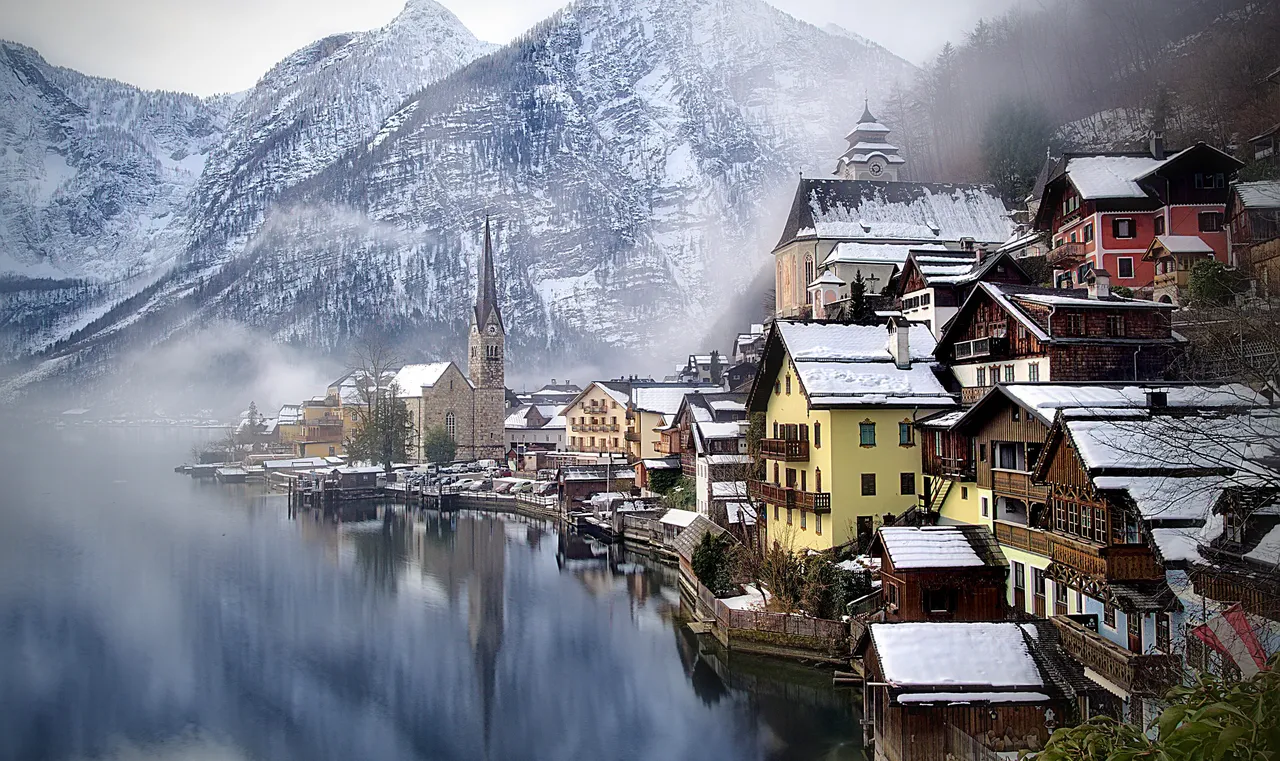
Hallstatt is a small market town on the western shore of the Hallstätter See in the Salzkammergut in Upper Austria, with fewer than a thousand inhabitants. Wooden and stone houses cling to the narrow strip between the lake and the steep slopes of the Dachstein massif, and the twin church towers reflected in the water make it one of the most photographed places in the Alps. Its wealth came from salt: mining in the mountain above the village goes back thousands of years, and the rich finds from its prehistoric cemetery gave their name to the “Hallstatt culture” of the early Iron Age. Since 1997 Hallstatt has been at the heart of the UNESCO World Heritage Site Hallstatt-Dachstein/Salzkammergut Cultural Landscape. In winter the village is quieter, and on 8 December a one-day Advent market takes place on the Marktplatz. This guide gathers the market, sights, day trips, food and practical information based on official sources.
Content update: 29 October 2026 · Advent date checked on the official website of the Marktgemeinde Hallstatt
Hallstatt at a Glance
- Country
- Austria · Upper Austria, Salzkammergut
- Population
- Fewer than 1,000
- Language
- German; English widely spoken in tourism
- Currency
- Euro (EUR); bring cash for the Advent market
- Time zone
- Central European Time (CET, UTC+1)
- Highlights
- Lakeshore village, salt mine, Dachstein
- Don’t miss
- Marktplatz, Beinhaus, Skywalk, lake views
- UNESCO
- Hallstatt-Dachstein/Salzkammergut Cultural Landscape (1997)
- Advent
- Advent market on 8 December 2026, 10:00–18:00
- Getting there
- Hallstatt station with ferry; buses via Bad Ischl
- Power
- 230 V, type C/F sockets
- Emergency
- 112 (general emergency)
Hallstatt in Pictures
The waterfront with its two church towers, the Marktplatz with its painted houses and the funicular climbing above the lake: Hallstatt in three pictures.


Hallstatt Advent Market 2026
Hallstatt does not have a Christmas market lasting several weeks. Instead, according to the official website of the Marktgemeinde Hallstatt, the Hallstatt Advent Market (Hallstätter Adventmarkt) takes place on a single day, Tuesday 8 December 2026 (the Feast of the Immaculate Conception, a public holiday in Austria), from 10:00 to 18:00 on the Marktplatz. Local associations and makers sell crafts, decorations and seasonal food and drinks; the municipality mentions a 3D nativity scene made by students of the local technical college (HTBLA Hallstatt) and an illuminated Christmas tree. Entry is free and payment at the stalls is in cash. For a longer Advent season, combine Hallstatt with the markets of the wider Salzkammergut, such as Bad Ischl, or with Salzburg, and check those dates on official websites. Note that the photos in this section show Hallstatt in winter rather than the market itself.


| Event | Location | 2026 dates | Note |
|---|---|---|---|
| Hallstatt Advent Market (Hallstätter Adventmarkt) | Marktplatz, Hallstatt | 8 December 2026 | 10:00–18:00; free entry; cash payment at the stalls. |
| 3D nativity scene | Marktplatz | 8 December 2026 | Created by students of HTBLA Hallstatt, according to the municipality. |
| Illuminated Christmas tree | Marktplatz | Advent season | Part of the village’s Advent decorations. |
| Feast of the Immaculate Conception | Whole of Austria | 8 December 2026 | Public holiday; many shops are open, but check opening hours. |
| Advent in the Salzkammergut | Bad Ischl and other towns | Advent 2026 | Other markets in the region; check dates on official websites. |
| Christmas and New Year | Hallstatt | 24 December 2026–6 January 2027 | Quiet holiday season; check winter opening of sights and transport. |
What to try
Glühwein
Mulled wine; contains alcohol.
Punsch
Hot punch, with or without alcohol; ask at the stall.
Kinderpunsch
Non-alcoholic fruit punch for children and non-drinkers.
Lebkuchen
Gingerbread, a classic of Austrian Advent.
Kekse
Austrian Christmas biscuits such as Vanillekipferl.
Bratwürstel
Grilled sausage, usually pork; ask.
Maroni
Roasted chestnuts, often sold in winter.
Tips for the Hallstatt Advent market
- The market is on one day only: 8 December 2026, 10:00–18:00.
- Bring cash; payment at the stalls is in cash.
- Arrive by public transport if possible; parking is outside the village and limited.
- The Marktplatz is small; mornings are calmer.
- In December the mountains keep much of the village in shade; dress warmly.
- Paths along the lake can be icy; wear shoes with good grip.
- Combine the market with the Beinhaus and the lakeshore walk.
- Check winter opening of the salt mine and funicular before planning the same day.
Check before you go: Marktgemeinde Hallstatt · Adventmarkt 8 December 2026 (official) ↗ · Salzkammergut · Advent in the region (official) ↗
Date, times and details checked on 29 October 2026 on the official website of the Marktgemeinde Hallstatt (hallstatt.ooe.gv.at). Programme and times may change; check the official pages before your visit.
When to Go
Hallstatt has a mountain climate with cool summers and cold, often snowy winters. Summer, especially July and August, is busiest, with day visitors arriving by bus and train; mornings and evenings are calmer. Spring and autumn offer quieter paths and good light. In winter the village is peaceful and atmospheric with snow, but the steep mountains limit direct sunlight, and some attractions are closed or have reduced hours. The Advent market is on 8 December.
| Month | Sightseeing | Advent market | Outdoors | Crowds |
|---|---|---|---|---|
| January | Good | None | Good | Quiet |
| February | Good | None | Good | Quiet |
| March | Good | None | Difficult | Quiet |
| April | Very good | None | Good | Moderate |
| May | Very good | None | Very good | Moderate |
| June | Very good | None | Very good | Busy |
| July | Very good | None | Very good | Busy |
| August | Very good | None | Very good | Busy |
| September | Very good | None | Very good | Busy |
| October | Very good | None | Very good | Moderate |
| November | Good | None | Difficult | Quiet |
| December | Good | Market season | Good | Moderate |
- In December temperatures are usually between -5 and 3 °C; snow is common.
- Advent market on 8 December 2026, 10:00–18:00, Marktplatz.
- The salt mine, Skywalk and Dachstein cable car are seasonal; check winter opening.
- The Dachstein Giant Ice Cave is usually open only in the warmer season; check.
- Summer days bring very large numbers of day visitors.
- Winter days are short and the village lies in mountain shade for much of the day.
Visa and Entry (Turkish citizens)
Turkish citizens holding an ordinary (burgundy) passport need a Schengen visa for tourist travel to Austria. Special, service and diplomatic passports follow different rules; check the current situation on the website of the Turkish Ministry of Foreign Affairs.
You apply to the representation of your main destination. If Austria is your main destination, the official page of the Austrian Consulate General in Istanbul on the Austrian Foreign Ministry website (bmeia.gv.at) explains how and where to apply.
If your trip also covers Germany or other Schengen countries, apply to the country of your longest stay, or of first entry if stays are equal.
Under the EU Entry/Exit System (EES), being introduced in stages, your biometric data (facial image and fingerprints) may be recorded on first entry; allow extra time at the airport.
Visa fees, appointment waiting times and required documents can change; this guide does not state fees. Use the current lists on the official pages before you apply.
Travel medical insurance, accommodation and return documents are part of the application; details are on the official sources.
Check before you go: T.C. Dışişleri Bakanlığı · Türk vatandaşlarının tabi olduğu vize uygulamaları ↗ · bmeia.gv.at · GK Istanbul ↗ · EES · europa.eu ↗ · Rota Atlası visa guide (TR)
Travel medical insurance
Check the official visa and entry sources above first: they state whether travel medical insurance is required and the minimum cover. Compare any policy’s cover amount, validity dates and countries covered with the official requirement.
Rota Atlası does not currently offer an insurance partnership; there are no paid links in this section. Last updated: 1 November 2026
Getting to Hallstatt
- By air: The nearest airports are Salzburg (SZG) and Linz (LNZ); Vienna (VIE) and Munich (MUC) are further away. Check current flights from Türkiye only on airline and airport websites; this guide does not recommend flights.
- By train: The Salzkammergut railway runs via Attnang-Puchheim and Bad Ischl to Hallstatt station, which is on the opposite shore; a ferry crosses the lake to the village and is timed to the trains. Check current schedules with ÖBB and Hallstatt Schifffahrt.
- By bus: From Salzburg, buses run to Bad Ischl, with connections on to Hallstatt; check current timetables on official transport websites.
- By car: The historic centre is closed to through traffic; use the official car parks outside the village. Winter tyres are required in wintry conditions in Austria.
- Note: Visitor numbers are managed; coaches and parking follow local rules. Check the municipality and tourism websites.
Getting Around

On foot
The whole village, from the Marktplatz to the churches, lakeshore and funicular, is walkable.
Funicular
The Salzbergbahn climbs to the salt mine and Skywalk; seasonal, check opening.
Ferry
The lake ferry links Hallstatt station with the village; in winter the schedule may be reduced.
Bus
Regional buses link Hallstatt with Obertraun, Gosau, Bad Goisern and Bad Ischl; check timetables.
To the Dachstein
The Krippenstein cable car starts in Obertraun; seasonal operation, check.
Car
Not needed in the village; parking outside the centre.
Things to See
Hallstatt occupies a narrow strip on the western shore of the Hallstätter See. At its centre is the Marktplatz; just above it on a terrace stand the Catholic parish church and the Beinhaus, and on the shore below is the Protestant church with its slender spire. The classic viewpoint lies north of the village along the lakeshore road. From the southern district of Lahn, the funicular climbs to the salt mine high above, and the Echerntal valley leads west to the Waldbachstrub waterfall. Across the lake are Obertraun and the Krippenstein cable car to the Dachstein, while Gosau, Bad Goisern and Bad Ischl lie within the wider Salzkammergut.
The heart of the village
Marktplatz and the Old Village
The Marktplatz is Hallstatt’s small central square and the setting for the Advent market. It is framed by colourful houses with wooden balconies and flower boxes, many rebuilt after a fire in 1750. In the middle stands the Baroque Holy Trinity Column. Narrow lanes and steps climb from here between houses built tightly against the rock, and the main street runs north and south along the lake. Because space is so limited, the village has grown upward and along the shore; boathouses and small gardens line the water. Remember that people live here: keep to public paths and respect private property.
Don’t miss
- Marktplatz and its houses
- Holy Trinity Column
- Lanes and steps up the slope
- Boathouses along the lake
Tips
- Visit early in the morning or in the evening for quieter streets.
- Do not enter private gardens or courtyards; drones are restricted.
- In winter, steps can be icy.

Two churches and a charnel house
Churches and the Beinhaus

The slender spire of the Protestant church on the shore and the Catholic parish church of the Assumption on the terrace above give Hallstatt its famous silhouette. The Catholic church contains late Gothic winged altars. In its small, sloping churchyard stands St Michael’s Chapel with the Beinhaus (charnel house): because there was little space for graves, bones were exhumed after some years and stored here. According to the parish, more than 1,200 skulls are kept, over 600 of them painted with names, dates and decorations such as flowers and ivy – a unique tradition that continued into the 20th century.
Don’t miss
- Protestant church on the shore
- Late Gothic altars in the parish church
- Beinhaus with its painted skulls
- View over the lake from the churchyard
Tips
- The churches are places of worship; be quiet and respect services.
- The Beinhaus has limited winter hours and an entry fee; check.
- The steps up to the parish church are steep.


The famous view
Lakeshore and the Classic Viewpoint
The view of Hallstatt from the north – houses stacked above the water, the Protestant church spire and mountains behind – is among the most photographed scenes in Austria. The viewpoint lies on the lakeshore road just north of the village. A walk along the shore also leads past small piers, the old boathouses and the ferry landing. From the water, on a ferry crossing or a boat trip, the village and its churches form a single panorama.
Don’t miss
- Classic viewpoint north of the village
- Lakeshore walk
- Ferry landing
- Panorama from the water
Tips
- The viewpoint is busy in summer; come early.
- Stay on the pavement; the road is narrow.
- Winter mornings can bring mist on the lake.


Seven thousand years of salt
Salt Mine, Funicular and Skywalk
Above the village, the Salzwelten Hallstatt salt mine presents itself as the oldest salt mine in the world. The Salzbergbahn funicular climbs from Lahn to the high valley, where the Skywalk viewing platform juts out about 360 metres above the village with views over the lake to the Dachstein. Guided tours inside the mountain include miners’ slides, an underground salt lake and the story of prehistoric miners; temperatures underground are around 8–10 °C. Nearby, the high valley is also where the prehistoric cemetery that gave the Hallstatt culture its name was found.
Don’t miss
- Salzbergbahn funicular
- Skywalk viewing platform
- Guided salt mine tour
- High valley with the prehistoric cemetery
Tips
- The salt mine and funicular are seasonal; check winter opening and tickets on salzwelten.at.
- Bring a warm layer for the mine tour.
- A path also climbs on foot, but it is steep and can be icy in winter.


The story of the place
Welterbemuseum and Lahn

The Welterbemuseum Hallstatt (World Heritage Museum) tells the story of the region from prehistoric salt mining and the Hallstatt culture to Roman times, the salt trade and village life. It sits near the centre, a short walk from the Marktplatz. To the south, the district of Lahn is the starting point of the funicular and of the path up to the salt mountain, and has the bus stop and parking connections. The Gletschergarten (Glacier Garden) nearby shows rock shaped by the Ice Age.
Don’t miss
- Exhibitions on the Hallstatt culture
- Salt trade history
- Lahn and the Salzbergweg
- Gletschergarten
Tips
- Check the museum’s winter opening hours on its official website.
- Lahn is a 10–15 minute walk from the Marktplatz along the lake.
- Combine the museum with the salt mine on the same day.


A wild valley
Echerntal and Waldbachstrub

West of Lahn, the Echerntal is a narrow valley between steep rock walls. A forest path follows the stream to the Waldbachstrub, a waterfall that tumbles in several steps; along the way there are glacial potholes and viewpoints. The valley offers a quiet contrast to the busy village and is a classic short hike.
Don’t miss
- Waldbachstrub waterfall
- Glacial potholes
- Forest path through the valley
Tips
- In winter the path can be icy or partly closed; check conditions locally.
- Wear sturdy shoes.
- Allow about two hours for the round trip from Lahn.
Lake and the other shore
Hallstätter See and Obertraun
The Hallstätter See is about 8 km long and lies deep between the mountains. In winter the water is often calm and mirrored, and swans gather near the shore. On the south-eastern shore lies Obertraun, a small village with a flat lakeside meadow and the valley station of the Krippenstein cable car. A lakeside path links Hallstatt with Obertraun, passing the area near Hallstatt station on the opposite shore.
Don’t miss
- Lake views in winter
- Swans by the shore
- Obertraun lakeside
- Lakeside path to Obertraun
Tips
- Please do not feed the swans.
- The lakeside path can be icy in winter.
- Boats and ferries run reduced schedules in winter; check.


High above the lake
Dachstein Krippenstein

The Dachstein Krippenstein cable car climbs from Obertraun to the high plateau of the Dachstein massif. At the top are viewing platforms such as the 5fingers platform above the abyss and the Welterbespirale, with views over the Hallstätter See and the World Heritage landscape. In winter the Krippenstein is a destination for freeriders and snowshoe walkers; operation depends on the season and the weather.
Don’t miss
- Krippenstein cable car
- 5fingers viewing platform
- Welterbespirale and Welterbeblick
- Dachstein panorama
Tips
- Check seasonal operation and tickets on the official Dachstein website.
- Weather changes quickly at altitude; dress for the mountains.
- Do not leave marked paths in winter.


Ice in the mountain
Dachstein Giant Ice Cave

The Dachstein Giant Ice Cave (Rieseneishöhle) is reached from the first section of the Krippenstein cable car. Its halls of ice, such as the Parzival Dome, are lit during guided tours. The cave is usually open only in the warmer season; check opening dates before planning a visit. Nearby is the Mammoth Cave with its long passages.
Don’t miss
- Ice formations
- Parzival Dome
- Guided tour
- Mammoth Cave nearby
Tips
- Opening is seasonal; check the official Dachstein website.
- Inside it is below freezing; bring warm clothing.
- The approach involves many steps.
A mirror lake
Gosau and the Gosausee

West of Hallstatt, the village of Gosau lies in a wide valley beneath the jagged Gosaukamm ridge. At the end of the valley the Vorderer Gosausee reflects the Dachstein glacier – one of the classic views of the Salzkammergut. A path circles the lake. In winter Gosau is a ski area, part of Dachstein West.
Don’t miss
- Vorderer Gosausee
- View of the Dachstein
- Gosaukamm ridge
- Lake circuit path
Tips
- Buses run from Hallstatt via Gosaumühle; check timetables.
- The lake path can be snowy in winter.
- Check the condition of the road to the lake in winter.

The emperor’s spa town
Bad Ischl and Bad Goisern

Bad Ischl, about 20 km north, was the summer residence of Emperor Franz Joseph I; the Kaiservilla, the Trinkhalle (pump room) and spa buildings recall its imperial past. In 2024 Bad Ischl and the Salzkammergut were European Capital of Culture. The town has its own Advent events. On the way lies Bad Goisern, a spa and crafts village in the Traun valley.
Don’t miss
- Kaiservilla
- Trinkhalle
- Esplanade on the Traun
- Bad Goisern
Tips
- Check Advent events in Bad Ischl on official websites.
- The Kaiservilla has seasonal opening.
- Bad Ischl is the main transport hub for the area.

World Heritage landscape
Hallstatt-Dachstein/Salzkammergut

In 1997 UNESCO inscribed the Hallstatt-Dachstein/Salzkammergut Cultural Landscape on the World Heritage List. It recognises a landscape shaped by thousands of years of salt production, linking the mountains, lakes and settlements of the region. Beyond Hallstatt, the Salzkammergut includes lakes such as the Traunsee, Wolfgangsee and Attersee, and towns such as Gmunden and St Wolfgang. UNESCO listing ↗
Don’t miss
- Lakes of the Salzkammergut
- Salt history across the region
- Mountain and lake landscape
Tips
- Use regional buses and trains; check current timetables.
- In winter some lake ferries do not run.
- Combine with Salzburg for a longer trip.
1–3 Day Itineraries, an Advent Day + 5-Day Salzkammergut Route
The routes keep walking distances short and allow for short, shady winter days. Day 1 covers the village, churches and lakeshore, day 2 the salt mine or Echerntal and the museum, day 3 the Dachstein or Gosau. The Advent day is planned around 8 December; the 5-day route links Hallstatt with Salzburg and Bad Ischl. Check winter opening on official websites in advance.
Day 1: Village, churches and lakeshore
- Arrive by ferry from Hallstatt station.
- Explore the Marktplatz and the lanes above it.
- Visit the parish church and the Beinhaus.
- Walk to the classic viewpoint north of the village.
- Evening stroll along the quiet lakeshore.
Day 2: Salt mine or Echerntal
- Morning: If open, ride the funicular to the Skywalk and the salt mine.
- Alternative: Hike the Echerntal to the Waldbachstrub.
- Afternoon at the Welterbemuseum.
- Walk along the lake to Lahn.
- Evening on the Marktplatz.
Day 3: Dachstein or Gosau
- Option A: Bus to Obertraun and, if running, the Krippenstein cable car.
- Option B: Bus to Gosau and walk around the Vorderer Gosausee.
- Return via Bad Goisern.
Advent day: 8 December
- Arrive early by train and ferry.
- From 10:00, browse the stalls on the Marktplatz.
- See the 3D nativity scene and the illuminated tree.
- Bring cash for punch, biscuits and crafts.
- At dusk, walk the lakeshore to the viewpoint.
5-day Salzkammergut route
- Day 1: Salzburg, then by bus or train into the Salzkammergut.
- Days 2–3: Hallstatt, salt mine, Echerntal and the Dachstein.
- Day 4: Bad Ischl and its Advent events.
- Day 5: St Wolfgang or Gmunden, then back to Salzburg.
Hallstatt and Salzkammergut Cuisine
Salzkammergut cuisine combines Austrian classics with lake fish and Alpine dishes. These are traditional dishes and products, not restaurant recommendations.

Kaiserschmarrn
Torn, caramelised pancake with icing sugar, served with apple sauce or plum compote.
Reinanke
Whitefish from the Salzkammergut lakes, often fried or smoked.
Saibling
Char from the cold lakes, often grilled or smoked.
Kasnocken
Cheese dumplings with fried onions, an Alpine favourite.
Wiener Schnitzel
Breaded veal escalope; other versions with pork or chicken.
Germknödel
Yeast dumpling with plum jam, poppy seeds and butter.
Lebkuchen and Kekse
Gingerbread and Christmas biscuits in Advent.
Almdudler
Austrian herbal lemonade; a common non-alcoholic option.
- Pork is common in Austrian cuisine; ask about ingredients.
- Kaiserschmarrn, Kasnocken and Germknödel are vegetarian; still ask.
- Many places in Hallstatt have reduced winter hours; check.
- Service is included, but rounding up or around 5–10% is customary.
Culture and Etiquette

- Greeting with “Grüß Gott” and thanking with “Danke” is appreciated.
- Hallstatt is a home for its residents: keep quiet in the evenings and do not enter private property.
- Drones are restricted; follow local rules.
- Churches and the Beinhaus are places of worship and remembrance; behave respectfully.
- 8 December is a public holiday in Austria.
- On 24 December many businesses close early.
- Toasting with “Prost” is common.
- In restaurants you usually ask for the bill yourself.
- Do not feed the swans on the lake.
- A few words of German are always welcome.
Safety and Health
- Hallstatt is very safe; the main risks are ice and mountain weather.
- Paths, steps and the lakeshore can be icy in winter; wear shoes with good grip.
- In the mountains, check weather and avalanche information and stay on marked paths.
- Call 112 in an emergency; the mountain rescue number in Austria is 140.
- Make sure your travel medical insurance covers the Schengen area.
- Pharmacies (Apotheke) are found in larger nearby towns such as Bad Goisern and Bad Ischl.
- Keep valuables safe in crowds at the viewpoint.
What Your Budget Depends On
This guide does not give prices; prices change with season and year. Your budget depends on these factors:
Travel dates
Summer and the Advent market day bring the most visitors.
Accommodation
Hallstatt has few beds; Obertraun, Bad Goisern and Bad Ischl offer more choice.
Transport
Train and ferry, regional buses and cable car tickets.
Sights
The salt mine with funicular, Beinhaus, museum and Krippenstein each charge separately.
Food and drink
Market snacks are cheaper than restaurants; many places have reduced winter hours.
Day trips
Salzburg, Bad Ischl and Gosau need extra travel.
Free experiences
The Advent market, lakeshore walk, viewpoint and Echerntal are free.
Practical Information
- Money: Euro (EUR); bring cash for the Advent market.
- Language: German; English widely spoken in tourism.
- Power: 230 V, type C/F.
- Time: CET (UTC+1) in winter, 2 hours behind Türkiye.
- Shops: Small village shops; limited opening on Sundays and holidays.
- Holidays: 8 December, 24–26 December, 1 January and 6 January; hours change.
- Weather: Cold in December, around -5 to 3 °C, often with snow.
- Daylight: Short days and mountain shade in winter.
- Water: Tap water is drinkable.
- Emergency: 112; mountain rescue 140.
Frequently Asked Questions
When is the Hallstatt Advent market 2026?
According to the Marktgemeinde Hallstatt, on Tuesday 8 December 2026 from 10:00 to 18:00 on the Marktplatz.
Is there a Christmas market in Hallstatt every day in December?
No, the Advent market takes place on one day only; for more markets, combine with Bad Ischl or Salzburg.
Is entry free?
Yes, entry is free; payment at the stalls is in cash.
Is the salt mine open in winter?
Opening is seasonal; check the current winter schedule on salzwelten.at.
What is the Beinhaus?
A charnel house in the Catholic churchyard with more than 1,200 skulls, over 600 of them painted.
How do I get to Hallstatt by train?
Take the Salzkammergut railway to Hallstatt station and cross the lake by ferry; check ÖBB and ferry timetables.
Do Turkish citizens need a visa?
Holders of ordinary passports need a Schengen visa. If Austria is your main destination, see the official page of the Austrian Consulate General in Istanbul on bmeia.gv.at.
Is the Dachstein Ice Cave open in December?
The ice cave is usually open only in the warmer season; check the official Dachstein website.
How many days do I need?
One day for the village; two to three with the salt mine, Echerntal and Dachstein or Gosau.
Can I drive into Hallstatt?
The centre is closed to through traffic; use the car parks outside the village.
Where to stay
Stay close to the areas where you will spend most time. The areas below are covered in detail in this guide; check public transport links in the getting-around section.
- The heart of the villageMarktplatz and the Old Village
- Two churches and a charnel houseChurches and the Beinhaus
- The famous viewLakeshore and the Classic Viewpoint
- Seven thousand years of saltSalt Mine, Funicular and Skywalk
- The story of the placeWelterbemuseum and Lahn
- A wild valleyEcherntal and Waldbachstrub
- Lake and the other shoreHallstätter See and Obertraun
- High above the lakeDachstein Krippenstein
- Ice in the mountainDachstein Giant Ice Cave
- A mirror lakeGosau and the Gosausee
- The emperor’s spa townBad Ischl and Bad Goisern
- World Heritage landscapeHallstatt-Dachstein/Salzkammergut
Search hotels in these areas (Hotellook) ↗ (affiliate link)Search on Booking.com ↗
Affiliate disclosure: Hotellook, Aviasales, Klook, Airalo, Tiqets and DiscoverCars links are affiliate links; Rota Atlası may earn a commission on bookings made through them, at no extra cost to you. Official and in-guide links are not paid. Last updated: 1 November 2026 · Privacy and affiliates
Transport and connectivity
- Airport transferOptions from the airport to the city are in this guide’s getting there section.
- Mobile data (eSIM)Airalo eSIM ↗ (affiliate link)
- TrainsOfficial rail website ↗
- Car hireYou rarely need a car within the city; see getting around first. Compare car hire on DiscoverCars ↗ (affiliate link)
Affiliate disclosure: Hotellook, Aviasales, Klook, Airalo, Tiqets and DiscoverCars links are affiliate links; Rota Atlası may earn a commission on bookings made through them, at no extra cost to you. Official and in-guide links are not paid. Last updated: 1 November 2026 · Privacy and affiliates
Search flights (affiliate link)
Search flights from any airport in any country. Results open on Aviasales in a new tab, where you book.
This form is an affiliate link: Rota Atlası may earn a commission on bookings made via Aviasales (Travelpayouts), at no extra cost to you. Check price, baggage and terms on the booking site. Airport data: OurAirports (public domain).
Flights, hotels and tours
Find tours and tickets
- Marktplatz (Market Square)
GetYourGuide ↗ · Klook ↗ (affiliate link) - Lakeshore and postcard view
GetYourGuide ↗ · Klook ↗ (affiliate link) - Hallstatt Salt Mine (Salzwelten)
GetYourGuide ↗ · Klook ↗ (affiliate link) - World Heritage View Skywalk
GetYourGuide ↗ · Klook ↗ (affiliate link)
Hotellook, Aviasales, Klook, Airalo and Tiqets links in this box are affiliate links (Travelpayouts): Rota Atlası may earn a commission on bookings made through them, at no extra cost to you. GetYourGuide links currently carry no affiliate code. Check prices and terms with the provider. Last updated: 1 November 2026 · Privacy and affiliates
Sources
- T.C. Dışişleri Bakanlığı · Türk vatandaşlarının tabi olduğu vize uygulamaları ↗
- BMEIA · Österreichisches Generalkonsulat Istanbul · Einreise und Aufenthalt (Visum) ↗
- European Union · Entry/Exit System (EES) ↗
- Marktgemeinde Hallstatt · hallstatt.ooe.gv.at (official municipality) ↗
- Hallstatt · hallstatt.net (official tourism information) ↗
- Salzkammergut · salzkammergut.at (official regional tourism) ↗
- Salzwelten Hallstatt · salt mine, Salzbergbahn and Skywalk (official) ↗
- Welterbemuseum Hallstatt (official) ↗
- Dachstein Krippenstein · Dachstein Salzkammergut (official) ↗
- UNESCO World Heritage Centre · Hallstatt-Dachstein / Salzkammergut Cultural Landscape ↗
- Hallstatt Schifffahrt · lake ferry (official) ↗
- ÖBB · Austrian Federal Railways (official) ↗
- Austria.info (official tourism portal of Austria) ↗
- GOV.UK · Foreign travel advice · Austria ↗
- Marktgemeinde Hallstatt · Adventmarkt 8 December 2026 (official) ↗
- Salzkammergut · Advent in the region (official) ↗
This page is for information only. Dates, hours, entry rules and transport information can change; check the official sources above before travelling. No prices, flights, hotels or restaurants have been invented in this guide.
Photo credits
The photos on this page come from Wikimedia Commons and are used under the stated authors and licences (CC BY, CC BY-SA, CC0 or public domain). Full list of sources
- Hallstatt on the lakeshore in winter — Thomas Fabian · CC BY-SA 2.0 · Wikimedia Commons
- Hallstatt and the lake under a blue sky with snowy peaks — Ioan Sendroiu · CC0 · Wikimedia Commons
- Hallstätter See over the rooftops with snowy mountains — Alisa Anton alisaanton · CC0 · Wikimedia Commons
- Houses on Hallstatt Marktplatz — Werner100359 · CC BY-SA 4.0 · Wikimedia Commons
- Hallstatt Marktplatz — Liberaler Humanist · CC BY-SA 3.0 · Wikimedia Commons
- Holy Trinity Column on the Marktplatz — Jitka Erbenová (cheva) · CC BY-SA 3.0 · Wikimedia Commons
- Protestant church and lake in Hallstatt — H. Helmlechner · CC BY-SA 4.0 · Wikimedia Commons
- Catholic parish church of Hallstatt — C.Stadler/Bwag · CC BY-SA 4.0 · Wikimedia Commons
- Painted skulls in the Beinhaus — Wolfgang Sauber · CC BY-SA 4.0 · Wikimedia Commons
- Tunnel entrance at the Hallstatt salt mine — Balou46 · CC BY-SA 4.0 · Wikimedia Commons
- Entrance to the Hallstatt salt mine — Andrew Bossi · CC BY-SA 3.0 · Wikimedia Commons
- Hallstatt funicular above the lake — Oleksandr Dede · CC BY-SA 4.0 · Wikimedia Commons
- Lake view from the salt mountain towards Obertraun — Balou46 · CC BY-SA 4.0 · Wikimedia Commons
- Hallstatt Museum building — Gunnar Richter Namenlos.net · CC BY 3.0 · Wikimedia Commons
- Waldbachstrub waterfall in the Echerntal — Arquus · CC BY-SA 4.0 · Wikimedia Commons
- Hallstätter See in winter — Uoaei1 · CC BY-SA 4.0 · Wikimedia Commons
- Swan on the lakeshore in Hallstatt — Uoaei1 · CC BY-SA 4.0 · Wikimedia Commons
- Hallstatt seen from the north — C.Stadler/Bwag · CC BY-SA 4.0 · Wikimedia Commons
- Salzbergweg path up to the salt mountain — Andrew Bossi · CC BY-SA 3.0 · Wikimedia Commons
- Vorderer Gosausee with the Dachstein — Dimitry Anikin · CC0 · Wikimedia Commons
- Gosau and the Gosaukamm in winter — Herzi Pinki · CC BY-SA 3.0 · Wikimedia Commons
- Dachstein panorama from the Krippenstein — Draceane · CC BY-SA 3.0 · Wikimedia Commons
- Welterbeblick viewpoint on the Krippenstein — Geisler Martin · CC BY-SA 3.0 · Wikimedia Commons
- Dachstein Krippenstein cable car — Dimitry Anikin · CC0 · Wikimedia Commons
- Parzival Dome in the Dachstein Giant Ice Cave — Tigerente · CC BY-SA 4.0 · Wikimedia Commons
- Obertraun and Hallstätter See — C.Stadler/Bwag · CC BY-SA 4.0 · Wikimedia Commons
- Trinkhalle in Bad Ischl — P e z i · CC BY-SA 3.0 · Wikimedia Commons
- View of Bad Goisern — C.Stadler/Bwag · CC BY-SA 4.0 · Wikimedia Commons
- Hallstatt railway station boat stop — Robot8A · CC BY-SA 4.0 · Wikimedia Commons
- Kaiserschmarrn with apple sauce — Ich · CC BY-SA 4.0 · Wikimedia Commons
- Salzkammergut landscape — acediscovery · CC BY 4.0 · Wikimedia Commons
- Panorama of Hallstatt village and shoreline — David Kernan · CC BY 4.0 · Wikimedia Commons
- Hallstatt waterfront and churches — David Kernan · CC BY 4.0 · Wikimedia Commons
- A flower-lined street in Hallstatt — Ghirlandajo · CC BY-SA 4.0 · Wikimedia Commons
- Hallstatt centre and Marktplatz — Rizka · CC BY-SA 4.0 · Wikimedia Commons
Salzburg → · Linz → · Innsbruck → · Vienna → · Munich → · Christmas markets