

Quedlinburg is a small town of about 23,000 people in the Harz district of Saxony-Anhalt, in central Germany, on the River Bode at the northern edge of the Harz mountains. First recorded in 922, it became one of the most important centres of the Ottonians, the first ruling dynasty of the East Frankish–German kingdom: King Henry I was buried here in 936 in the church on the castle hill, and his widow Mathilde founded a foundation for noblewomen (Damenstift) that lasted on the hill for some 870 years. Today the Collegiate Church of St. Servatius, the castle and the old town have been on the UNESCO World Heritage List since 1994. According to the town, the old town has more than 2,000 half-timbered houses spanning six centuries of building styles, making it one of the best-preserved medieval townscapes in Germany. From late November until Christmas Quedlinburg markets itself as the “Adventsstadt” (Advent town): a Christmas market fills the Marktplatz, on three weekends courtyards that are usually closed open to visitors for “Advent in den Höfen”, and every evening a new door of a living Advent calendar opens at the Finkenherd.
Content update: 28 October 2026 · Christmas market dates checked against the official website adventsstadt.quedlinburg-info.de
Quedlinburg at a Glance
- Country / state
- Germany · Saxony-Anhalt, Harz district
- Population
- About 23,000
- Language
- German
- Currency
- Euro (EUR)
- Time zone
- Central European Time (CET, UTC+1); in winter 2 hours behind Türkiye
- Famous for
- UNESCO-listed medieval old town, 2,000+ half-timbered houses, Ottonian heritage
- Landmarks
- Collegiate Church of St. Servatius, castle, town hall, Ständerbau, Münzenberg, St. Wiperti
- Nearby
- Gernrode, Thale and the Bode gorge, Wernigerode, the Brocken, Halberstadt, Goslar
- Christmas market
- 25 November–22 December 2026 (Marktplatz); Advent in den Höfen on three weekends
- Airport
- No nearby airport; by train from Hanover, Berlin (BER) or Leipzig/Halle
- Electricity
- 230 V, plug types C/F
- Emergency
- 112 (ambulance/fire), 110 (police)
Quedlinburg in Pictures
The Marktplatz with the town hall and the towers of St. Benedikti, the colourful half-timbered façades around the square, and the rooftop view from the castle hill to St. Blasii and the Market Church: Quedlinburg in three pictures.


Quedlinburg Christmas Market 2026
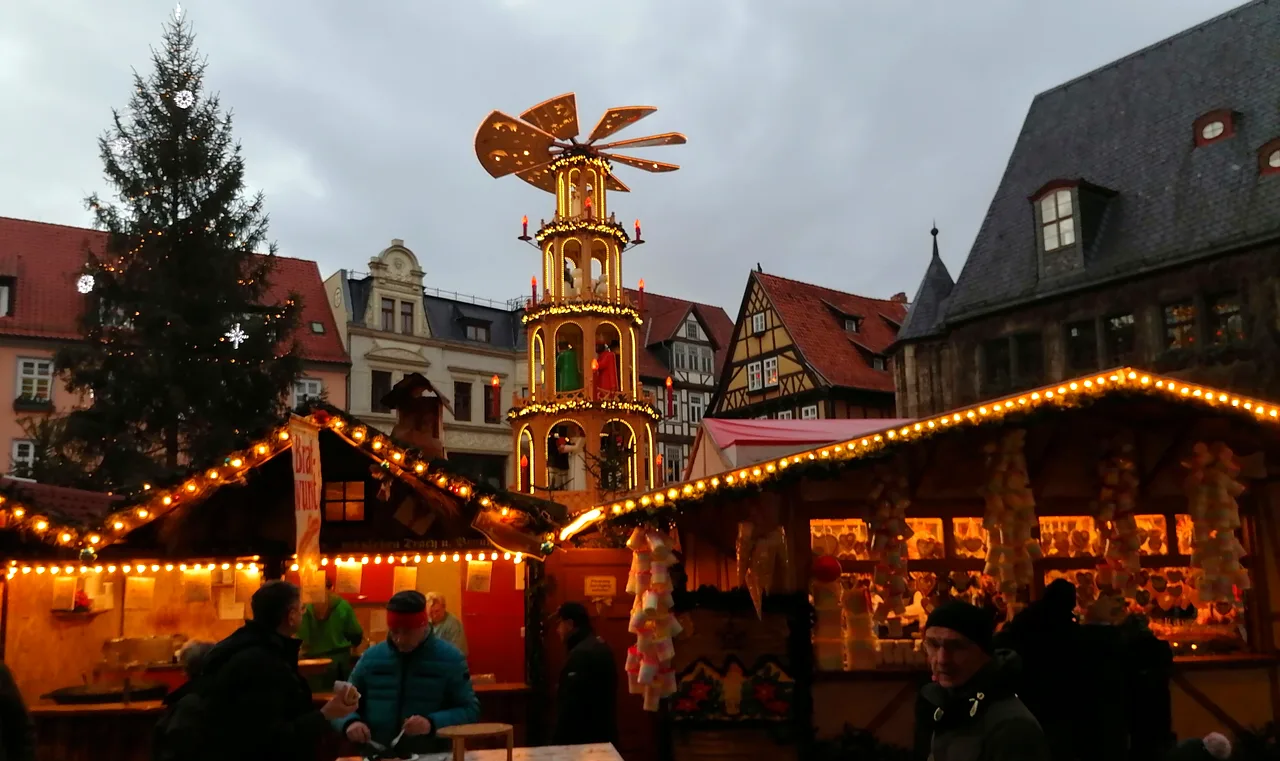
Advent in Quedlinburg is more than a single market; the official tourism organisation, Quedlinburg-Tourismus-Marketing, promotes the town during this season as “Adventsstadt Quedlinburg”. In the centre, in front of the town hall, the Marktplatz hosts a Christmas market with more than 50 stalls; it opens on 25 November at 17:00 and runs until 22 December. According to the official website the market carries the “Excellent European Christmas Market” seal, and the large Christmas pyramid on the square stays until 6 January. The tradition that sets Quedlinburg apart, however, is “Advent in den Höfen”: on three Advent weekends historic courtyards and inner gardens that are normally closed open their gates, and craftspeople, potters and local producers set up stalls inside. At the Finkenherd the “Lebendiger Adventskalender” (living Advent calendar) opens a new door every day, and a light installation is set up at the Mathildenbrunnen. The information below was checked on the official website on 28 October 2026.


| Market / area | Location | 2026 dates | Note |
|---|---|---|---|
| Quedlinburg Christmas Market (Weihnachtsmarkt) | Marktplatz, in front of the town hall | 25 November–22 December 2026 | Hours published on the official website: Sunday–Thursday 11:00–20:00, Friday 11:00–22:00, Saturday 10:00–22:00. Opening on 25 November at 17:00. More than 50 stalls; the Christmas pyramid stays until 6 January. |
| Advent in den Höfen | Historic courtyards and inner gardens of the old town | 28–29 November, 5–6 December, 12–13 December 2026 | Saturday and Sunday 11:00–19:00. Crafts, ceramics and local products in courtyards that are normally closed; the list of courtyards is published on the official website. |
| Lebendiger Adventskalender | Finkenherd, at the foot of the castle hill | 1–23 December 2026 daily at 16:30; 24 December at 13:00 | A new “door” opens every day with a short performance and surprises; a popular meeting point for families. |
| Mathildenbrunnen light installation | Mathildenbrunnen, Neustadt | 27 November–21 December 2026 | A light installation on the fountain square, at its best in the evening. |
| Advent im Stiftshof Gernrode | Gernrode, courtyard of the Collegiate Church of St. Cyriakus | 12–13 December 2026 | An Advent event in the courtyard of the Ottonian church in nearby Gernrode; check the hours in the official programme. |
| Grubenlichtermarkt Bad Suderode | Bad Suderode (part of Quedlinburg) | 28 November 2026 | A small one-day Advent market known for its miners’ lamps; check the hours in the official programme. |
What to try
Glühwein
Spiced mulled wine; fruit-wine and alcohol-free versions (Kinderpunsch) are also sold.
Stollen
The German Christmas loaf with dried fruit and icing sugar, sold in bakeries and at stalls throughout Advent.
Baumkuchen
Layered “tree cake” with ring patterns; Salzwedel in Saxony-Anhalt is known for it.
Gebrannte Mandeln
Warm sugar-roasted almonds, the classic scent of every German Christmas market.
Bratwurst
Grilled sausage in a bread roll; Thuringian-style sausages are common in the Harz too.
Crafts
Handmade gifts in the Advent in den Höfen courtyards: ceramics, wooden toys, candles and woollens.
Quedlinburg Christmas market tips
- The Marktplatz, the Finkenherd and the Mathildenbrunnen are within walking distance; start at the market in the afternoon, walk to the Finkenherd for 16:30 and on to the Mathildenbrunnen in the evening.
- Advent in den Höfen is only open on three weekends; the list and map of courtyards are published on the official website, so consider timing your trip for one of them.
- Day visitors arrive at weekends; for a calmer experience choose a weekday afternoon.
- The old town is cobbled and the castle hill is steep; wear shoes with non-slip soles.
- Some courtyards are entered through narrow gates and steps; access with pushchairs or wheelchairs may be limited.
- Cash is useful at small stalls; not every stall accepts cards.
- Glühwein mugs usually carry a deposit (Pfand); return the mug to get it back or keep it as a souvenir.
- In December it starts getting dark around 16:00; the lights of the Marktplatz and the half-timbered façades look their best in the evening.
Check before you go: Adventsstadt Quedlinburg · adventsstadt.quedlinburg-info.de (official, QTM) ↗ · Adventsstadt Quedlinburg · adventsstadt.de ↗ · Quedlinburg-Tourismus-Marketing · quedlinburg-info.de ↗
Dates were checked on the official website adventsstadt.quedlinburg-info.de (Quedlinburg-Tourismus-Marketing) on 28 October 2026. Opening hours, the list of courtyards and programme details may change; for current information see the official website and the Quedlinburg tourist information office at Markt 4.
When to Go
Quedlinburg, at the northern edge of the Harz, has a mild climate that turns cold in winter. From May to October old-town walks, nature trips in the Harz and steam-train rides are at their most enjoyable. From late November until Christmas it is “Adventsstadt” season; the Advent in den Höfen weekends are the liveliest days of the year. In winter snow is frequent on the high points of the Harz such as the Brocken.
| Month | City sightseeing | Christmas market | Harz trips | Crowds |
|---|---|---|---|---|
| January | Difficult | No market | Difficult | Quiet |
| February | Difficult | No market | Difficult | Quiet |
| March | Good | No market | Good | Moderate |
| April | Very good | No market | Very good | Moderate |
| May | Very good | No market | Very good | Moderate |
| June | Very good | No market | Very good | Busy |
| July | Very good | No market | Very good | Busy |
| August | Very good | No market | Very good | Busy |
| September | Very good | No market | Very good | Moderate |
| October | Very good | No market | Very good | Moderate |
| November | Good | Market season | Good | Moderate |
| December | Good | Market season | Difficult | Busy |
- In December temperatures in Quedlinburg are usually around freezing; frost and ice are possible and snow does not fall every year. Snow and harsh weather are more likely in the higher Harz (the Brocken).
- The Christmas market is open from 25 November to 22 December 2026; the three Advent in den Höfen weekends (28–29 November, 5–6 and 12–13 December) are the busiest days.
- Winter timetables and maintenance periods of the HSB narrow-gauge trains and the Thale cable cars can change; check the official websites.
- In summer there are open-air concerts in the old town and music in the Collegiate Church; check dates on quedlinburg-info.de.
- In December it gets dark around 16:00–16:30; plan courtyard visits for the afternoon and the lights for the evening.
- Spring and autumn are quiet, photogenic seasons for walks in the Bode gorge and views from the castle hill.
Visas and Entry (Turkish citizens)
Turkish citizens holding an ordinary (burgundy) passport need a Schengen visa for tourist travel to Germany. Different rules apply to special, service and diplomatic passports; check the current situation with the Turkish Ministry of Foreign Affairs.
You apply to the mission of your main destination country. If Germany is your main destination, the German missions in Türkiye are responsible; current information is at tuerkei.diplo.de.
Quedlinburg is usually reached via Berlin, Leipzig or Hanover; if your whole trip is in Germany you still apply to the German missions. For trips covering several Schengen countries, apply according to where you will stay longest.
Under the EU Entry/Exit System (EES), being introduced in stages, your biometric data (facial image and fingerprints) may be taken on first entry; allow extra time at the border.
Visa fees, appointment waiting times and required documents can change; this guide does not give fees. Use the current list on the official websites before applying.
Travel health insurance and accommodation and return details are part of the application; see the official sources for details.
Check before you go: T.C. Dışişleri Bakanlığı · Türk vatandaşlarının tabi olduğu vize uygulamaları ↗ · tuerkei.diplo.de ↗ · EES · europa.eu ↗ · Rota Atlası visa guide (TR)
Travel medical insurance
Check the official visa and entry sources above first: they state whether travel medical insurance is required and the minimum cover. Compare any policy’s cover amount, validity dates and countries covered with the official requirement.
Rota Atlası does not currently offer an insurance partnership; there are no paid links in this section. Last updated: 1 November 2026
Getting to Quedlinburg
- By air: There is no large airport near Quedlinburg. The most practical options are Hanover, Berlin Brandenburg (BER) and Leipzig/Halle airports, from where you continue by train via Magdeburg or Halberstadt. Check current flights only on the official airline and airport websites.
- By train: Quedlinburg station is on the regional Magdeburg–Halberstadt–Thale line. From Berlin, Leipzig and Hanover you change in Magdeburg or Halberstadt. Times and tickets are on bahn.de.
- Harz narrow-gauge railway (HSB): Quedlinburg is linked by the Selketalbahn line of the Harzer Schmalspurbahnen to Gernrode and the heart of the Harz; timetables are on hsb-wr.de.
- By long-distance coach: Some long-distance coaches serve the region; check operators and times through official channels.
- By car: Quedlinburg is linked to the Harz region via the B6 road. The old town has narrow streets and is partly pedestrianised; use the car parks around the centre.
Getting Around

On foot
The Marktplatz, castle hill, Finkenherd, Münzenberg, Wordgasse and Neustadt are all within walking distance; the old town is compact, but the castle hill and the Münzenberg are steep.
From the station
The station is on the western edge of the old town; you can walk to the Marktplatz.
Town buses
Bus lines serve the town and surrounding villages; check current routes and times through official channels.
Tickets
The Germany-wide Deutschlandticket is valid on regional trains; the HSB narrow-gauge trains have their own fares, so check conditions on the official websites.
Cycling
The Bode valley and the villages at the foot of the Harz can be explored by bike; watch out for the cobbles in the old town.
Regional trains
Thale, Halberstadt and Wernigerode are reached by regional train, Gernrode by the HSB Selketalbahn. Timetables are on bahn.de and hsb-wr.de.
Things to See
Quedlinburg’s sights range from the Ottonian castle hill to the Renaissance town hall, and from one of Germany’s oldest half-timbered houses to the little houses of the Münzenberg. The last three sections introduce Harz destinations such as Gernrode, the Bode gorge at Thale, and Wernigerode, the Brocken and Halberstadt; all can be visited as day trips by train.
Landmark
Castle Hill, Collegiate Church and Treasury

The sandstone hill above the old town, the Schlossberg, is where Quedlinburg began. In the 10th century it held a royal palace and, from 936, the foundation for noblewomen established by Queen Mathilde. Today’s Collegiate Church of St. Servatius is a Romanesque basilica consecrated in 1129; its crypt contains the tombs of King Henry I and Mathilde. The Quedlinburg cathedral treasury (Domschatz), displayed in the church’s treasure chambers, is one of Germany’s major church treasuries, with medieval manuscripts, ivory work, reliquaries and textiles; part of it was stolen in 1945 and returned to Quedlinburg in the 1990s. On the other side of the hill stands the castle, the Renaissance and Baroque palace of the foundation’s abbesses, with the castle museum inside. The church, treasury and museum are run by the Kulturstiftung Sachsen-Anhalt. UNESCO listing ↗
Don’t miss
- The crypt of the Collegiate Church and the tomb of Henry I
- Medieval manuscripts and the coat-of-arms casket of 1209 in the treasury
- The Blue Hall in the castle museum
- The view over the old town from the castle terrace
Tips
- Check opening hours and winter closures on kulturstiftung-st.de; tickets are required for the church and treasury.
- The hill is reached by a steep cobbled lane; wear non-slip shoes.
- Do not walk around the church during services or concerts.


Square
Marktplatz and Town Hall

The Marktplatz is the heart of Quedlinburg’s merchant town and the setting of the Christmas market. On the north side stands the town hall, dating from the 14th century and given its Renaissance façade in 1616; its ivy-clad front and portal are among the most photographed sights in town. The Roland statue at the corner of the building symbolised the town’s market rights and liberties in the Middle Ages. The half-timbered and Baroque façades around the square bear the traces of different centuries, and small passages lead from the back streets towards the towers of the Market Church of St. Benedikti and the castle hill. The Quedlinburg tourist information office is also on the square, at Markt 4; during Advent you can pick up courtyard maps and the programme there.
Don’t miss
- The Renaissance portal of the town hall and the Roland statue
- The Christmas market and pyramid in the evening lights
- The colourful façades around the square
Tips
- The tourist information office is at Markt 4; ask there about town tours and the Advent programme.
- The square is busy during Advent; try early morning for photos.
- The interior of the town hall is not always open to visitors; check the official website.
Half-timbering
Wordgasse, the Ständerbau and half-timbered lanes

One of the main reasons Quedlinburg is a World Heritage Site is its half-timbered (Fachwerk) architecture spanning six centuries. The Ständerbau at Wordgasse 3 dates from the 14th century and is considered one of Germany’s oldest half-timbered houses; it shows the early technique in which vertical timber posts (Ständer) rise uninterrupted to the roof, and today it houses the Fachwerkmuseum. In the surrounding streets you can follow the development of half-timbering step by step, from the plain frames of the Gothic period to the carved beams of the Renaissance and the broad façades of the Baroque. Lanes such as Schmale Straße, Hölle, Pölle and Breite Straße invite a slow walk with their crooked roofs, wooden doors and carved inscriptions.
Don’t miss
- The Ständerbau at Wordgasse 3 (Fachwerkmuseum)
- Carved inscriptions and rosettes on the beams
- Schmale Straße and the Hölle lane
Tips
- The Fachwerkmuseum’s opening days vary by season; check official sources.
- Most houses are private homes; do not enter doors or courtyards without permission.
- Guided town tours help you understand half-timbering techniques.

Legend
Finkenherd and Münzenberg

The small Finkenherd square at the foot of the castle hill is the setting of Quedlinburg’s best-known legend: Duke Henry of Saxony is said to have been catching finches here in 919 when he received the news that he had been offered the royal crown, which is why he is remembered as “Heinrich der Vogler” (Henry the Fowler). During Advent the square is the meeting point of the living Advent calendar. Opposite, on the Münzenberg hill, small houses built over the following centuries by craftsmen, musicians and day labourers stand on the remains of a Benedictine convent founded in the 10th century. Narrow stairways, crooked lanes and houses leaning against the convent walls make the Münzenberg one of the quietest and most characterful corners of the old town.
Don’t miss
- The living Advent calendar at the Finkenherd (December)
- The narrow stairways and small houses of the Münzenberg
- The view of the castle hill from the Münzenberg
Tips
- The Münzenberg is reached by stairs; access is steep and the lanes are narrow.
- Respect the privacy of the residents.
- After dark the illuminated silhouette of the castle hill is well seen from the Münzenberg.

Ottonian
St. Wiperti and its crypt

South of the castle hill, a little away from the centre, St. Wiperti contains some of Quedlinburg’s oldest building layers. The crypt beneath the church dates from the 10th century and is one of the rare examples of Ottonian architecture in Germany, notable for its plain columns and vaults. The area is associated with the period when the Ottonian kings had a palace (Pfalz) and estate here. Used over the centuries as a monastery, a farm and even a storehouse, the building has been restored as a church. The view of the castle hill from the Wiperti cemetery is a photo spot away from the crowds.
Don’t miss
- The Ottonian crypt
- The church’s Romanesque portal
- The view of the castle hill from the Wiperti cemetery
Tips
- The church may not be open every day; check visiting times with official sources.
- It is a walk of about 15–20 minutes from the Marktplatz.
- Opening hours are more limited in winter.
Quarter
Neustadt, St. Nikolai and the Mathildenbrunnen

Quedlinburg’s “new town”, the Neustadt, was actually founded in the 12th century and merged with the old town in the 14th. The twin-towered St. Nikolai church is the symbol of the quarter; with its Gothic interior and tall towers it acts as a counterweight to the castle hill in the town’s skyline. Large, ornate half-timbered houses and historic inns line the Steinweg and nearby streets. The Mathildenbrunnen is a small square with a fountain named after Mathilde, the first abbess of the Quedlinburg foundation; during Advent a light installation is set up here and a small Christmas market corner forms. The Neustadt is ideal for a walk a little away from the bustle of the old town.
Don’t miss
- The twin-towered St. Nikolai church
- The large half-timbered houses on the Steinweg
- The Mathildenbrunnen light installation in Advent (27 November–21 December 2026)
Tips
- St. Nikolai’s opening hours vary by season.
- The Mathildenbrunnen lights look best after dark.
- The walk from the Neustadt to the Marktplatz takes only a few minutes.


Art
Lyonel Feininger Gallery and Klopstockhaus

At the foot of the castle hill, entered through the gateway of a former Kürassierhof, the Lyonel Feininger Gallery holds an important collection of graphic works by the German-American Bauhaus master Lyonel Feininger (1871–1956). The collection is linked to Hermann Klumpp of Quedlinburg, who protected Feininger’s works during the Nazi era. The gallery also hosts changing exhibitions of classical modern art. Nearby, the Klopstockhaus is the Renaissance house where the poet Friedrich Gottlieb Klopstock was born in 1724; it is now a museum devoted to his life. Together, the two museums round off a visit to the castle hill with art and literature.
Don’t miss
- Feininger’s etchings and lithographs
- The Renaissance interiors of the Klopstockhaus
- The Kürassierhof gateway
Tips
- The museums are run by the Kulturstiftung Sachsen-Anhalt and the town; check hours on the official websites.
- Many museums are closed on Mondays.
- Exhibitions change, so check the current programme.
Church
Market Church of St. Benedikti and St. Blasii

Rising just behind the Marktplatz, the Market Church of St. Benedikti is the main church of Quedlinburg’s merchant town. The two towers of the Gothic hall church are defining features of the old-town skyline; inside, the Baroque altar and the historic organ stand out. The churches host concerts and services during Advent. Nearby St. Blasii has kept its Romanesque towers and is now used for cultural events. Seen from the castle hill, the towers of these two churches above the half-timbered roofs form the most recognisable view of the old town.
Don’t miss
- St. Benedikti’s organ and Baroque altar
- Advent concerts (depending on the programme)
- The towers of St. Benedikti and St. Blasii from the castle hill
Tips
- Check concert and service programmes in local church announcements.
- Keep quiet in churches and follow photography rules.
- Churches can be cold in winter; dress warmly.
Day trip
Gernrode and the Selketalbahn

South of Quedlinburg at the foot of the Harz, Gernrode is known for the Collegiate Church of St. Cyriakus, the church of a women’s foundation established in 959. It is considered one of the most important largely preserved examples of Ottonian architecture and contains one of the oldest replicas of the Holy Sepulchre in Germany. Gernrode can be reached from Quedlinburg by narrow-gauge train on the Selketalbahn line of the Harzer Schmalspurbahnen, which continues from here along the Selke valley into the Harz. During Advent an “Advent im Stiftshof” event is held in the church courtyard (2026: 12–13 December).
Don’t miss
- The Collegiate Church of St. Cyriakus and its Holy Sepulchre
- A narrow-gauge train ride on the Selketalbahn
- Advent im Stiftshof (12–13 December 2026)
Tips
- Check the church’s opening hours on stiftskirche-gernrode.de.
- HSB timetables vary by season; check steam and diesel services on hsb-wr.de.
- Gernrode can be seen in half a day from Quedlinburg.
Nature
Thale, the Bode gorge and the Hexentanzplatz

A short train ride from Quedlinburg, Thale lies at the entrance to the Bode gorge, one of the most impressive valleys in the Harz. Here the River Bode cuts a deep gorge between granite cliffs, and two rocky plateaus steeped in legend rise on either side: the Hexentanzplatz (witches’ dance floor) and the Roßtrappe. According to folk legend witches gather on the Hexentanzplatz on Walpurgis Night, while the mark in the rock at the Roßtrappe is said to be the hoofprint of a princess’s horse. The plateaus can be reached on foot or by cable car and chairlift. The trail along the Bode gorge is one of the best-known nature walks in the Harz.
Don’t miss
- The view of the Bode gorge from the Hexentanzplatz
- The Roßtrappe and its legendary “hoofprint”
- A walk along the Bode gorge
Tips
- Check winter operating hours and maintenance periods of the cable cars with official sources.
- Trails in the gorge can be slippery and rocky; wear suitable shoes.
- Thale is the terminus of the regional line from Quedlinburg; times are on bahn.de.

Day trip
Wernigerode and the Brocken

Promoted as the “colourful town” of the Harz, Wernigerode is known for its turreted half-timbered town hall and for Schloss Wernigerode, which rises above the town and took on its present romantic appearance in the 19th century. The town is also the hub of the Harzer Schmalspurbahnen: from here the Brockenbahn steam trains climb to the 1,141-metre summit of the Brocken, the highest point in the Harz. The Brocken entered literature through the Walpurgis Night scene in Goethe’s Faust and was a closed military zone during the Cold War. Wernigerode also holds a Christmas market in Advent; check the dates on the local official website.
Don’t miss
- Wernigerode town hall and old town
- Schloss Wernigerode
- The Brockenbahn to the Brocken summit
Tips
- The weather on the Brocken summit can be much colder and windier than in town; dress warmly.
- Check Brockenbahn timetables and winter services on hsb-wr.de.
- From Quedlinburg you reach Wernigerode by train via Halberstadt.

Day trip
Halberstadt

North-west of Quedlinburg, Halberstadt is known for its Gothic Cathedral of St. Stephen and St. Sixtus and for the cathedral treasury, considered one of the richest medieval church treasuries in Europe. Another unusual stop is the Burchardikirche, where John Cage’s “ORGAN²/ASLSP” is being performed in a version planned to last 639 years, with chord changes only every few years. Heavily damaged in the Second World War, the town has partly kept its historic fabric around the cathedral square. Halberstadt is also the change point for train journeys from Quedlinburg to Wernigerode and the Harz.
Don’t miss
- Halberstadt Cathedral and its treasury
- The John Cage organ project in the Burchardikirche
- The cathedral square (Domplatz)
Tips
- Check cathedral and treasury hours with official sources.
- You can combine Halberstadt with a trip to Wernigerode on the same day.
- Regional train times are on bahn.de.
1, 2, 3-Day Itineraries + Christmas Day
These itineraries are planned around walking and regional trains. Quedlinburg’s old town is compact: one day is enough for the main sights, two days add the castle-hill museums and the Münzenberg, and three days add Harz destinations such as Thale, Gernrode or Wernigerode. Check church and museum hours on the official websites in advance.
1 day: Castle hill and the half-timbered old town
- In the morning climb the castle hill; visit the Collegiate Church, its crypt and the treasury.
- Look over the old town from the castle terrace, then walk down to the Finkenherd.
- Explore the Ständerbau on the Wordgasse and the half-timbered lanes around it.
- In the afternoon see the Marktplatz and town hall and drop into St. Benedikti.
- In the evening enjoy the lights of the Marktplatz and a walk around the square.
2 days: Museums, Münzenberg and Neustadt
- Follow the day-1 route.
- On day 2 climb the stairways of the Münzenberg in the morning.
- Visit the Lyonel Feininger Gallery and the Klopstockhaus.
- In the afternoon walk to St. Wiperti and its crypt.
- In the evening stroll around St. Nikolai and the Mathildenbrunnen in the Neustadt.
3 days: A day trip into the Harz
- Follow the routes of the first two days.
- On day 3 take the train to Thale; walk in the Bode gorge and go up to the Hexentanzplatz.
- Alternatively take the HSB Selketalbahn to Gernrode and see the Collegiate Church of St. Cyriakus.
- Or travel via Halberstadt to Wernigerode and, time and weather permitting, ride the Brockenbahn up the Brocken.
- Return to Quedlinburg in the evening.
Christmas market day (25 November–22 December 2026)
- If it is a weekend, pick up the Advent in den Höfen courtyard map at the tourist office (Markt 4) in the morning.
- Until midday explore the courtyards and craftspeople (Saturday–Sunday 11:00–19:00).
- In the afternoon move on to the Christmas market on the Marktplatz and try Glühwein and Stollen.
- At 16:30 watch the door of the living Advent calendar open at the Finkenherd.
- In the evening walk to the light installation at the Mathildenbrunnen, then return to the illuminated Marktplatz.
Harz and Saxony-Anhalt Food
The food of the Harz and Saxony-Anhalt is hearty, simple and seasonal: Harz sour-milk cheeses, Baumkuchen from Salzwedel, cabbage dishes in winter and soups inherited from East German cooking stand out. Historically Quedlinburg was also known for seed breeding and horticulture. Below are local specialities, not restaurant recommendations.


Harzer Käse
The Harz region’s sour-milk cheese, low in fat and sharp in flavour; served with caraway and sometimes with a vinegar-and-onion dressing (“mit Musik”).
Salzwedeler Baumkuchen
The famous “tree cake” from Salzwedel in Saxony-Anhalt, baked layer by layer on a rotating spit; a popular Christmas gift.
Stollen
The buttery Christmas loaf with dried fruit and icing sugar, sold in bakeries throughout Advent.
Halberstädter Würstchen
The famous thin sausages from nearby Halberstadt; the town is known as one of the pioneers of selling sausages in tins.
Soljanka
A sour, spicy meat or vegetable soup much loved in eastern Germany, often found on winter days.
Grünkohl
Kale cooked in winter, usually served with sausage or smoked meat.
Schierker Feuerstein
A herbal liqueur associated with Schierke in the Harz; contains alcohol.
Gebrannte Mandeln and Lebkuchen
Warm roasted almonds and spiced Lebkuchen biscuits at the Christmas market.
- Many traditional Harz dishes contain pork; ask for beef, chicken or vegetarian alternatives.
- Glühwein and liqueurs contain alcohol; you can ask for alcohol-free Kinderpunsch.
- Tap water is drinkable.
- In restaurants tipping usually means rounding up or about 5–10 percent.
Culture and Etiquette

- In Germany people greet with “Guten Tag” or “Hallo”; it is polite to say hello when entering and leaving a shop.
- Punctuality matters; trains and guided tours start on time.
- Keep quiet in churches and do not walk around during services.
- Most shops are closed on Sundays and quiet hours are observed.
- Waste separation is strict; bottles and Glühwein mugs carry a deposit (Pfand).
- Most of Quedlinburg’s half-timbered houses are private homes; enter courtyards only on open days such as Advent in den Höfen.
- It is a small town; keep noise down late in the evening.
- When paying in a restaurant it is common to state the total including the tip.
- Standard German is spoken; English is understood at tourist sites, but a few words of German help in small businesses.
- When taking photos, respect windows and private living spaces.
Safety and Health
- Quedlinburg is generally calm and safe; watch your belongings in the Christmas market crowds and on trains.
- Cobbles and slopes can be slippery, especially in wet and icy weather; take care on the stairways of the castle hill and the Münzenberg.
- Weather in the Harz can change quickly; on trips to the Brocken and the Bode gorge bring suitable clothing, water and an up-to-date forecast.
- There may be security measures at the Christmas market; follow staff instructions.
- Some lanes are dark and quiet in the evening; stick to lit main streets.
- In an emergency call 112, or 110 for the police. Travel health insurance is mandatory for a Schengen visa.
- Check official travel advice (e.g. the Turkish Ministry of Foreign Affairs or GOV.UK) before you travel.
What Your Budget Depends On
This guide does not give prices; they change with the season and the year. In Quedlinburg your budget depends on:
Travel dates
The Advent in den Höfen weekends increase demand for accommodation; weekdays can be cheaper and quieter.
Where you stay
Everything in the old town is within walking distance; as a small town it has limited options, so plan early for Advent.
Transport tickets
The Deutschlandticket on regional trains and the separate fares of the HSB narrow-gauge trains affect your costs; check conditions on the official websites.
Museums
Check combined-ticket options for the Collegiate Church, treasury, castle museum and Feininger Gallery on the official websites.
Food and drink
Christmas market stalls and bakeries are economical options; sit-down restaurants cost more.
Day trips
Fares for the Thale cable cars, the Brockenbahn and the Selketalbahn can noticeably affect your budget.
Free experiences
Walking the old town, the Marktplatz, the living Advent calendar at the Finkenherd, the Mathildenbrunnen lights and the castle terrace are free.
Practical Information
- Money: The euro is used; cards are widely accepted, but cash is useful at small stalls.
- Language: German is spoken; English is understood at tourist sites.
- Plugs: 230 V, types C/F.
- Opening hours: Shops are closed on Sundays; many places close early on the afternoon of 24 December, and 25–26 December are public holidays.
- Internet: EU roaming rules do not apply to Turkish SIM cards; check your operator’s roaming packages.
- Tourist information: The Quedlinburg tourist information office is at Markt 4; current information is on quedlinburg-info.de.
- Accessibility: The area around the Marktplatz is relatively flat, but cobbles, the castle hill and the Münzenberg involve slopes and stairs; some courtyards are entered by steps.
- Photography: The best spots are the castle terrace, the Münzenberg, the Wiperti cemetery and the Marktplatz in the evening lights.
- UNESCO: The Collegiate Church, castle and old town have been on the World Heritage List since 1994 (listing no. 535).
- History: Because Quedlinburg escaped major destruction in the Second World War, it has largely kept its medieval street pattern and half-timbered houses.
Frequently Asked Questions
When is the Quedlinburg Christmas Market 2026 open?
According to the official website the Quedlinburg Christmas Market is open on the Marktplatz from 25 November to 22 December 2026. Published hours are Sunday–Thursday 11:00–20:00, Friday 11:00–22:00 and Saturday 10:00–22:00. Check the official website before your visit.
What is Advent in den Höfen and when is it?
It is the event in which historic courtyards that are normally closed open to visitors on three Advent weekends and craftspeople set up stalls. In 2026 it takes place on 28–29 November, 5–6 December and 12–13 December, Saturday and Sunday 11:00–19:00.
Where is the living Advent calendar?
The Lebendiger Adventskalender meets at the Finkenherd at the foot of the castle hill; from 1 to 23 December 2026 a new door opens every day at 16:30, and on 24 December at 13:00.
Is there an entry fee for the Christmas market?
Entry to the open-air Christmas market on the Marktplatz is free. Museums, the church and some events may charge; check the official websites.
How many days should I spend in Quedlinburg?
One day is enough for the old town and the castle hill; two days for the museums and the Münzenberg, and three days if you add a trip to Thale, Gernrode or Wernigerode.
How do I get to Quedlinburg?
There is no large airport nearby. From Hanover, Berlin or Leipzig/Halle airports you travel by train, usually changing in Magdeburg or Halberstadt. Times are on bahn.de.
Do Turkish citizens need a visa?
Holders of ordinary passports need a Schengen visa. If Germany is the main destination you apply to the German missions in Türkiye; current information is on tuerkei.diplo.de and the website of the Turkish Ministry of Foreign Affairs.
Why is Quedlinburg a UNESCO World Heritage Site?
It was listed in 1994 for the Ottonian Collegiate Church and castle hill and for its well-preserved medieval old town, with more than 2,000 half-timbered houses spanning six centuries.
Can I make day trips into the Harz?
Yes. Thale (the Bode gorge and Hexentanzplatz) is reached by regional train, Gernrode by the HSB Selketalbahn, and Wernigerode and the Brocken by train via Halberstadt.
What is the weather like in winter?
In December temperatures are usually around freezing, with frost and ice possible. Snow is more likely in the higher Harz; dress warmly in layers.
Where to stay
Stay close to the areas where you will spend most time. The areas below are covered in detail in this guide; check public transport links in the getting-around section.
- LandmarkCastle Hill, Collegiate Church and Treasury
- SquareMarktplatz and Town Hall
- Half-timberingWordgasse, the Ständerbau and half-timbered lanes
- LegendFinkenherd and Münzenberg
- OttonianSt. Wiperti and its crypt
- QuarterNeustadt, St. Nikolai and the Mathildenbrunnen
- ArtLyonel Feininger Gallery and Klopstockhaus
- ChurchMarket Church of St. Benedikti and St. Blasii
- NatureThale, the Bode gorge and the Hexentanzplatz
Search hotels in these areas (Hotellook) ↗ (affiliate link)Search on Booking.com ↗
Affiliate disclosure: Hotellook, Aviasales, Klook, Airalo, Tiqets and DiscoverCars links are affiliate links; Rota Atlası may earn a commission on bookings made through them, at no extra cost to you. Official and in-guide links are not paid. Last updated: 1 November 2026 · Privacy and affiliates
Transport and connectivity
- Airport transferOptions from the airport to the city are in this guide’s getting there section.
- Mobile data (eSIM)Airalo eSIM ↗ (affiliate link)
- TrainsOfficial rail website ↗
- Car hireYou rarely need a car within the city; see getting around first. Compare car hire on DiscoverCars ↗ (affiliate link)
Affiliate disclosure: Hotellook, Aviasales, Klook, Airalo, Tiqets and DiscoverCars links are affiliate links; Rota Atlası may earn a commission on bookings made through them, at no extra cost to you. Official and in-guide links are not paid. Last updated: 1 November 2026 · Privacy and affiliates
Search flights (affiliate link)
Search flights from any airport in any country. Results open on Aviasales in a new tab, where you book.
This form is an affiliate link: Rota Atlası may earn a commission on bookings made via Aviasales (Travelpayouts), at no extra cost to you. Check price, baggage and terms on the booking site. Airport data: OurAirports (public domain).
Flights, hotels and tours
Find tours and tickets
- Quedlinburg Christmas Market
GetYourGuide ↗ · Klook ↗ (affiliate link) - Advent in den Höfen
GetYourGuide ↗ · Klook ↗ (affiliate link) - Stiftskirche St. Servatii
GetYourGuide ↗ · Klook ↗ (affiliate link) - Town Hall and Roland
GetYourGuide ↗ · Klook ↗ (affiliate link)
Hotellook, Aviasales, Klook, Airalo and Tiqets links in this box are affiliate links (Travelpayouts): Rota Atlası may earn a commission on bookings made through them, at no extra cost to you. GetYourGuide links currently carry no affiliate code. Check prices and terms with the provider. Last updated: 1 November 2026 · Privacy and affiliates
Sources
- T.C. Dışişleri Bakanlığı · Türk vatandaşlarının tabi olduğu vize uygulamaları ↗
- Auswärtiges Amt · Deutsche Vertretungen in der Türkei (Visa) ↗
- European Union · Entry/Exit System (EES) ↗
- Quedlinburg-Tourismus-Marketing · quedlinburg-info.de (official) ↗
- Welterbestadt Quedlinburg · quedlinburg.de (official) ↗
- Kulturstiftung Sachsen-Anhalt · Stiftskirche, Domschatz, Schlossmuseum, Lyonel-Feininger-Galerie (official) ↗
- Domschatz Quedlinburg (official) ↗
- Stiftskirche St. Cyriakus Gernrode (official) ↗
- HSB · Harzer Schmalspurbahnen (official) ↗
- Harzer Tourismusverband · harzinfo.de (official) ↗
- Wernigerode Tourismus (official) ↗
- Schloss Wernigerode (official) ↗
- Stadt Halberstadt · halberstadt.de (official) ↗
- Hannover Airport ↗
- Flughafen Berlin Brandenburg (BER) ↗
- Deutsche Bahn ↗
- GOV.UK · Foreign travel advice · Germany ↗
- UNESCO World Heritage Centre · Collegiate Church, Castle and Old Town of Quedlinburg ↗
- UNESCO World Heritage Centre · Mines of Rammelsberg, Historic Town of Goslar and Upper Harz Water Management System ↗
- Adventsstadt Quedlinburg · adventsstadt.quedlinburg-info.de (official, QTM) ↗
- Adventsstadt Quedlinburg · adventsstadt.de ↗
- Quedlinburg-Tourismus-Marketing · quedlinburg-info.de ↗
This page is for information only. Dates, hours, entry rules and transport information may change; check the official sources above before travelling. No prices, flights, hotels or restaurants have been invented in this guide.
Photo credits
The photos on this page are from Wikimedia Commons and are used under the stated authors and licences (CC BY, CC BY-SA, CC0 or public domain). Page with all sources
- The Quedlinburg Christmas market in the evening with its light tree and large Christmas pyramid — Wilhelm Zimmerling PAR · CC BY-SA 4.0 · Wikimedia Commons
- Quedlinburg’s Marktplatz with the town hall and the towers of St. Benedikti — Joachim Köhler · CC BY-SA 4.0 · Wikimedia Commons
- Colourful half-timbered houses on Quedlinburg’s Marktplatz — Franzfoto · CC BY-SA 3.0 · Wikimedia Commons
- View from the castle hill to St. Blasii and the Market Church of St. Benedikti — Romzig · CC0 · Wikimedia Commons
- The Christmas market on Quedlinburg’s Marktplatz during Advent — Dguendel · CC BY 3.0 · Wikimedia Commons
- The small Christmas market at the Mathildenbrunnen in the evening — Wilhelm Zimmerling PAR · CC BY-SA 4.0 · Wikimedia Commons
- A courtyard framed by half-timbered houses during Advent in den Höfen — Wilhelm Zimmerling PAR · CC BY-SA 4.0 · Wikimedia Commons
- The house at Gilde 10 decorated for Advent, Quedlinburg — Wilhelm Zimmerling PAR · CC BY-SA 4.0 · Wikimedia Commons
- A historic house decorated during Advent in den Höfen — Hajotthu 17:30, 14. Sep. 2009 (CEST) · CC BY-SA 3.0 · Wikimedia Commons
- A ceramics and crafts stall at Advent in den Höfen — Hajotthu 17:36, 14. Sep. 2009 (CEST) · CC BY-SA 3.0 · Wikimedia Commons
- A Harz narrow-gauge railway (HSB) railcar at Quedlinburg station — Ymblanter · CC BY-SA 4.0 · Wikimedia Commons
- Harzer Käse and Korbkäse, the Harz region’s sour-milk cheeses — Elke Wetzig · CC BY-SA 4.0 · Wikimedia Commons
- Baumkuchen, the German layered “tree cake” — katorisi · CC BY-SA 3.0 · Wikimedia Commons
- Freshly baked Stollen, the German Christmas loaf — ChristianSW · CC BY-SA 3.0 · Wikimedia Commons
- The Ständerbau in the Wordgasse, one of Germany’s oldest half-timbered houses — Z thomas · CC BY-SA 3.0 · Wikimedia Commons
- The Romanesque collegiate church of St. Servatius on the castle hill — Bärwinkel,Klaus · CC BY 3.0 · Wikimedia Commons
- The Blue Hall in the Quedlinburg castle museum — Thomas Wozniak · CC BY-SA 4.0 · Wikimedia Commons
- The coat-of-arms casket of 1209 from the Quedlinburg cathedral treasury — Roswitha Dreysse · CC BY-SA 4.0 · Wikimedia Commons
- Quedlinburg town hall and Marktplatz — Guido Radig · CC BY-SA 4.0 · Wikimedia Commons
- The Wordgasse and the Ständerbau from another angle — Fingalo Christian Bickel · CC BY-SA 2.0 de · Wikimedia Commons
- Detail of half-timbered façades on the Marktplatz — Franzfoto · CC BY-SA 3.0 · Wikimedia Commons
- The Finkenherd square at the foot of the castle hill — Chainwit. · CC BY-SA 4.0 · Wikimedia Commons
- Small houses and a narrow lane on the Münzenberg — Olaf Meister · CC BY-SA 3.0 · Wikimedia Commons
- The south-west front of St. Wiperti church — Hoger · CC BY 3.0 · Wikimedia Commons
- The twin-towered St. Nikolai church in the Neustadt — ErwinMeier · CC BY-SA 4.0 · Wikimedia Commons
- The Mathildenbrunnen fountain and square from the west — Ymblanter · CC BY-SA 4.0 · Wikimedia Commons
- A historic half-timbered house on the Steinweg — Christian Bickel · CC BY-SA 2.0 de · Wikimedia Commons
- The former Kürassierhof with its gateway to the Lyonel Feininger Gallery on the castle hill — Fingalo Christian Bickel · CC BY-SA 2.0 de · Wikimedia Commons
- The organ of the Market Church of St. Benedikti — Hajotthu · CC BY-SA 3.0 · Wikimedia Commons
- A Selketalbahn train at Gernrode station — Migebert · CC BY-SA 3.0 · Wikimedia Commons
- The Bode valley near Thale with a view to the Hexentanzplatz — Gottfried Hoffmann -… · CC BY 3.0 · Wikimedia Commons
- View from the Hexentanzplatz across the Bode gorge to the Roßtrappe — Gottfried Hoffmann -… · CC BY 3.0 · Wikimedia Commons
- Wernigerode’s turreted half-timbered town hall — Klugschnacker · CC BY-SA 3.0 · Wikimedia Commons
- A Brockenbahn steam train at Schierke station — NearEMPTiness · CC BY-SA 4.0 · Wikimedia Commons
- Halberstadt Cathedral of St. Stephen and St. Sixtus — marsupium photography · CC BY-SA 2.0 · Wikimedia Commons
Goslar → · Erfurt → · Leipzig → · Dresden → · Berlin → · Christmas markets