

Merano (German: Meran) is the second-largest town in the autonomous province of South Tyrol (Alto Adige/Südtirol) in northern Italy after Bolzano, with about 41,000 inhabitants. It lies where the Passer (Passirio) river opens into the Adige valley, in a sheltered basin ringed by mountains, so its climate is mild and sunny for the Alps: palm trees, cypresses and olive trees appear in the same frame as snow-covered summits. In the Middle Ages the town was the capital of the County of Tyrol, and in the 19th century it became one of Europe’s best-known spa towns; Empress Elisabeth (Sisi) stayed here too. Today Merano is known for its Art Nouveau Kurhaus, the promenades along the Passer, the 400-metre arcaded Lauben, the Gothic St Nicholas Church and the Tappeinerweg high above the town. German and Italian are spoken side by side, and the cuisine is a bridge between Tyrol and the Mediterranean. In Advent the Meraner Weihnacht on the banks of the Passer is one of South Tyrol’s best-loved Christmas markets. This guide brings together the market, sights, day trips, food and practical information based on official sources.
Content update: 29 October 2026 · Market dates and hours checked on the official website of the Merano Tourist Board (Kurverwaltung Meran, merano-suedtirol.it)
Merano at a Glance
- Country
- Italy · autonomous province of South Tyrol (Alto Adige)
- Population
- About 41,000
- Language
- German and Italian (both official)
- Currency
- Euro (EUR)
- Time zone
- Central European Time (CET, UTC+1)
- Highlights
- Kurpromenade, Kurhaus, Lauben, St Nicholas
- Don’t miss
- Tappeinerweg, Therme Meran, Trauttmansdorff Gardens
- Climate
- Mild, sunny basin sheltered by mountains
- Christmas market
- Meraner Weihnacht: 26 November 2026 – 6 January 2027
- Getting there
- Regional train from Bolzano
- Electricity
- 230 V, type C/F/L sockets
- Emergency
- 112 (general emergency)
Merano in Pictures
The town spreading across the valley as seen from Vellau, the arcaded Lauben and the terraced gardens of Trauttmansdorff Castle: Merano in three frames.


Meraner Weihnacht 2026: Merano Christmas Market
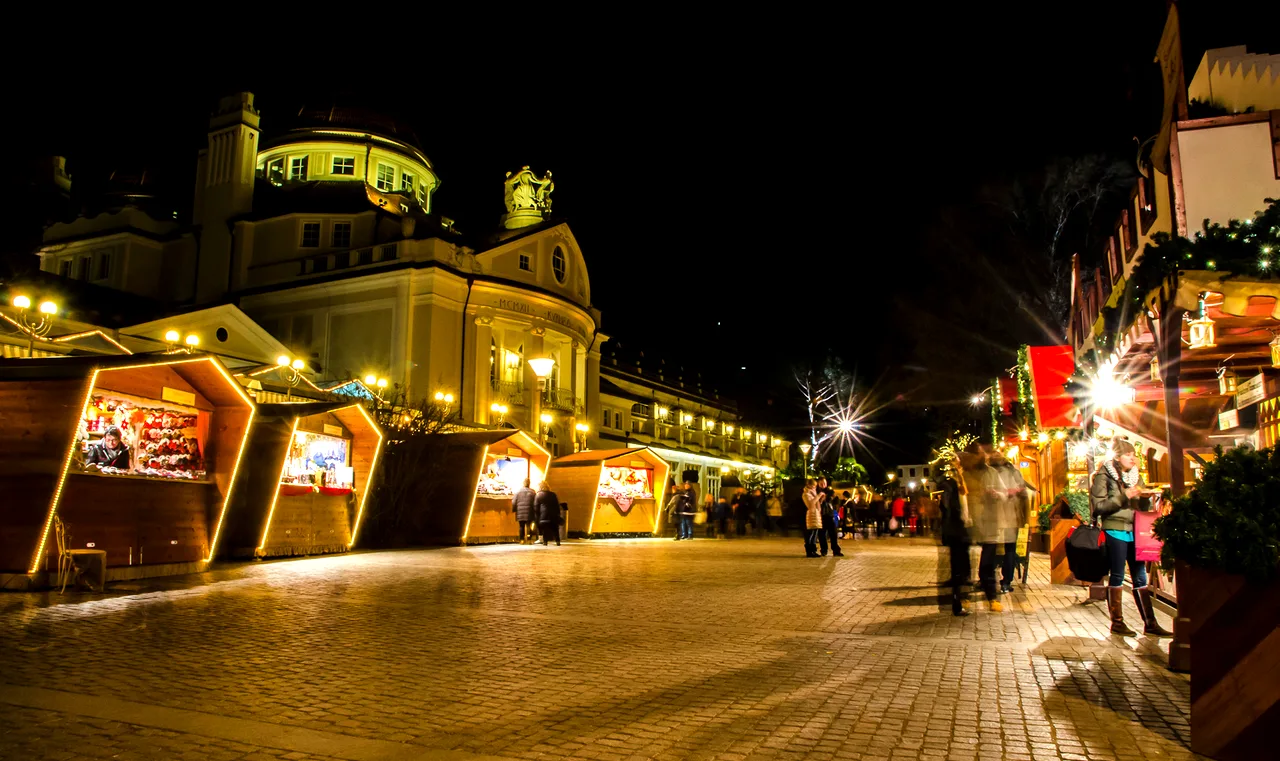
Merano’s Advent market, the Meraner Weihnacht, is set up on the Kurpromenade along the Passer river in front of the Art Nouveau Kurhaus. According to the official website of the Merano Tourist Board it runs from 26 November 2026 to 6 January 2027, opening on 26 November at 17:00. The official site makes clear that the market is not limited to one square: alongside the main market on the Kurpromenade, the programme includes an ice rink on Thermenplatz (Piazza Terme), a Christmas village (Weihnachtsdorf) on Sandplatz and decorated squares between Pfarrplatz and Kornplatz. Trade stalls are open Monday to Thursday and Sunday 10:00–19:00, and Friday, Saturday and public holidays 10:00–20:00. Food and drink stalls stay open longer: Monday to Thursday and Sunday 10:00–21:00, Friday and Saturday 10:00–22:30. On 24 and 31 December trade stalls open 10:00–15:30 and food stalls 10:00–17:00; on 25 December the market is closed, and on 6 January it opens 10:00–18:00. The market is known for South Tyrolean crafts, wood carvings, wool and felt goods, local sweets and hot drinks. According to the official site, a Lumagica light trail is also planned from 19 November 2026; check the official page for its location and hours. The official site notes that some stalls may not accept cards, so carry some cash. The programme may change; check the official page before you go.


| Event | Location | 2026 dates | Note |
|---|---|---|---|
| Meraner Weihnacht (main market) | Kurpromenade, banks of the Passer, in front of the Kurhaus | 26 November 2026 – 6 January 2027 | Trade stalls Mon–Thu and Sun 10:00–19:00, Fri, Sat and holidays 10:00–20:00; free entry. |
| Food and drink stalls | Kurpromenade | 26 November 2026 – 6 January 2027 | Mon–Thu and Sun 10:00–21:00, Fri–Sat 10:00–22:30. |
| Special days | Whole market area | 24, 25, 31 December and 6 January | 24 and 31 December: stalls 10:00–15:30, food 10:00–17:00; closed 25 December; 6 January 10:00–18:00. |
| Ice rink | Thermenplatz (Piazza Terme) | During the market | Part of the official programme; check the hours. |
| Christmas village (Weihnachtsdorf) | Sandplatz | During the market | Part of the official programme; check the details. |
| Lumagica light trail | Location as stated on the official site | From 19 November 2026 | Check the official page for location, hours and admission. |
What to try
Glühwein
Mulled wine; contains alcohol.
Apfelglühmix
Hot drink made with South Tyrolean apples; ask at the stall for the alcohol-free version.
Kinderpunsch
Alcohol-free hot fruit punch.
Zelten
South Tyrol’s traditional Christmas bread with dried fruit and nuts.
Apfelstrudel
Thin-pastry apple strudel, a regional classic.
Krapfen
Fried doughnuts filled with jam or poppy seed.
Chestnuts
Roasted chestnuts, a symbol of autumn in South Tyrol.
Speckbrot
Bread with Speck; Speck is pork, so ask.
Tips for the Meraner Weihnacht
- Trade stalls close at 19:00 on weekdays; do your shopping before dinner.
- Food stalls stay open until 22:30 on Fridays and Saturdays.
- The market is closed on 25 December and closes early on 24 and 31 December.
- Some stalls may not accept cards; carry cash.
- Come by train from Bolzano; from the station walk to the Kurpromenade or take buses 1, 1A, 1B, 3 or 4.
- Weekend afternoons are the busiest; weekday mornings are calmer.
- 8 December is a public holiday in Italy; shop hours may change.
- At dusk the lights of the Kurhaus and the Passer banks are at their best.
Check before you go: Kurverwaltung Meran · Meraner Weihnacht 2026 (official) ↗
Dates, hours and details were checked on 29 October 2026 on the official website of the Merano Tourist Board (merano-suedtirol.it). Programmes and hours may change; check the official pages before your visit.
When to Go
Thanks to the surrounding mountains that block the north winds, Merano has a mild and sunny climate for the Alps. Spring (March–May) is when the gardens and fruit trees blossom; the Trauttmansdorff Gardens are usually open from spring to autumn. Summer is warm, and hikers head higher up. Autumn, with the grape harvest and the Törggelen tradition, is the most popular season; the Traubenfest (Grape Festival) is held in October. From late November to 6 January there is the Christmas market, and the winter sports season begins at Meran 2000.
| Month | Sightseeing | Christmas market | Outdoors | Crowds |
|---|---|---|---|---|
| January | Good | Partly | Difficult | Quiet |
| February | Good | None | Difficult | Quiet |
| March | Very good | None | Good | Moderate |
| April | Very good | None | Very good | Moderate |
| May | Very good | None | Very good | Moderate |
| June | Very good | None | Very good | Moderate |
| July | Very good | None | Very good | Busy |
| August | Very good | None | Very good | Busy |
| September | Very good | None | Very good | Moderate |
| October | Very good | None | Very good | Busy |
| November | Good | Market season | Good | Moderate |
| December | Good | Market season | Difficult | Busy |
- In December temperatures are usually between -2 and 8 °C; sunny by day, cold at night.
- Meraner Weihnacht: 26 November 2026 – 6 January 2027.
- The Trauttmansdorff Gardens and Tirol Castle are closed in winter; check season dates on the official websites.
- The winter sports season at Meran 2000 depends on snow; check.
- The Traubenfest is usually held in October; check the dates on the official site.
- Winter days are short; choose midday for mountain views.
Visa and Entry (Turkish citizens)
Turkish citizens with an ordinary (burgundy) passport need a Schengen visa for tourist travel to Italy. Rules differ for special, service and diplomatic passports; check the current situation on the website of the Turkish Ministry of Foreign Affairs.
You apply to the mission of your main destination. If Italy is your main destination, the official visa page of the Consulate General of Italy in Istanbul (consistanbul.esteri.it) and the Italian Foreign Ministry’s “Il Visto per l’Italia” site (vistoperitalia.esteri.it) explain the application process and required documents.
If you combine Merano with Austria or Germany (for example via Innsbruck or Munich), apply to the country where you will stay longest, or to the country of first entry if the stays are equal.
Under the EU Entry/Exit System (EES), being introduced in stages, your biometric data (facial image and fingerprints) may be recorded on first entry; allow extra time at the airport.
Visa fees, appointment waiting times and required documents can change; this guide does not state fees. Use the current lists on the official pages before applying.
Travel health insurance, accommodation and return documents are part of the application; details are in the official sources.
Check before you go: T.C. Dışişleri Bakanlığı · Türk vatandaşlarının tabi olduğu vize uygulamaları ↗ · esteri.it · İstanbul / vistoperitalia ↗ · EES · europa.eu ↗ · Rota Atlası visa guide (TR)
Travel medical insurance
Check the official visa and entry sources above first: they state whether travel medical insurance is required and the minimum cover. Compare any policy’s cover amount, validity dates and countries covered with the official requirement.
Rota Atlası does not currently offer an insurance partnership; there are no paid links in this section. Last updated: 1 November 2026
Getting to Merano
- By air: The nearest airport is Bolzano (BZO), but scheduled flights are limited. For more options use Verona (VRN), Innsbruck (INN) and Munich (MUC), then continue by train to Bolzano and on to Merano. Check current flights from Türkiye only on airline and airport websites; this guide does not recommend flights.
- By train: Merano is linked to Bolzano by a regional line, and the journey is short. According to official information there are trains every half hour on weekdays and hourly on Sundays. Bolzano lies on the Brenner line to Innsbruck, Munich and Verona. Check current times with Südtirolmobil and Trenitalia.
- Vinschgau line: A regional train runs west from Merano through the Vinschgau (Val Venosta) valley to Mals.
- By bus: South Tyrol’s regional buses link Merano with nearby villages and valleys; check timetables with Südtirolmobil.
- By car: The MeBo expressway links Bolzano and Merano. Traffic is restricted in the historic centre; use the car parks. In winter, mountain roads may require winter tyres or chains.
Getting Around

On foot
The Kurpromenade, Lauben, St Nicholas, Landesfürstliche Burg and the Therme are within walking distance.
City buses
Merano’s city buses link the station with the centre and Trauttmansdorff; for the market use lines 1, 1A, 1B, 3 and 4.
Regional trains
Trains to Bolzano and the Vinschgau; connections towards Algund and Lana.
Cable cars
Cable car and bus links to Dorf Tirol, Schenna and Meran 2000; check winter hours.
Mobilcard
South Tyrol offers multi-day public transport passes; check the conditions with Südtirolmobil.
Cycling
The Adige valley cycle path passes through Merano; in winter paths can be wet and icy.
Things to See
Merano’s historic centre lies on the north bank of the Passer river. The Kurpromenade and Kurhaus run along the river; behind them the Lauben arcades continue to St Nicholas Church on Pfarrplatz. Near the church stands the Landesfürstliche Burg, and on the Küchelberg slope above the town are the Pulverturm and the Tappeinerweg. On the south bank are Therme Meran and Thermenplatz, with the Trauttmansdorff Gardens to the east. Dorf Tirol and Tirol Castle to the north, Schenna and Meran 2000 to the east, Algund and the Vinschgau to the west, and Lana, the Ultental and Bolzano to the south make easy day trips.
Heart of the spa town
Kurpromenade, Kurhaus and the Passer

Merano’s spa history lives on in the promenades along the Passer river. The Kurpromenade on the north bank, running from the Kurhaus to the Theaterbrücke with its cafés and palm trees, is the town’s living room. The Kurhaus is an Art Nouveau building that opened in 1874 and was extended in the early 20th century; its grand hall is used today for concerts, balls and congresses. The Winterpromenade on the north bank faces the sun and offers a mild walk even in winter, while the Sommerpromenade on the opposite bank lies in the shade of trees for summer. In Advent the wooden huts of the Meraner Weihnacht line up in front of the Kurhaus and along the river.
Don’t miss
- Art Nouveau façade of the Kurhaus
- Winterpromenade along the Passer
- Sommerpromenade on the opposite bank
- Christmas market on the Kurpromenade in Advent
Tips
- The Kurhaus interior is usually closed outside events; check the concert programme.
- In winter choose the sunny north bank of the river in daylight.
- During the market the promenade is very busy at weekends.
400 metres of arcades
Lauben (Laubengasse) and Town Hall

According to the Merano Tourist Board, the Lauben (Italian: Via Portici) were laid out in the 13th century and, at around 400 metres long, are the town’s most important shopping street. The arcaded passages of the narrow, deep houses on both sides let you shop sheltered from rain and sun; in the Middle Ages the north side was called the “Berglauben” (mountain side) and the south side the “Wasserlauben” (water side). Today the arcades are lined with boutiques, bookshops, cafés and traditional shops, and narrow corridors leading into courtyards preserve the old town fabric. The Town Hall (Rathaus) stands in the middle of the street. At its western end the Lauben open onto Pfarrplatz and St Nicholas Church.
Don’t miss
- Walk under the Laubengasse arcades
- The Berglauben and Wasserlauben sides
- Narrow passages into courtyards
- Town Hall
Tips
- Some shops may be closed on Sundays and at lunchtime.
- In rainy weather you can walk comfortably under the arcades.
- Continue from the Lauben to Pfarrplatz to see the church.

A Gothic landmark
St Nicholas Church and Pfarrplatz

St Nicholas on Pfarrplatz is Merano’s main church and the symbol of the town. Built in the 14th and 15th centuries, the Gothic church has a tower of about 80 metres that can be seen from all over town. The large fresco of St Nicholas on the south façade and the stonework stand out; inside are Gothic vaults and stained-glass windows. The small octagonal St Barbara Chapel behind the church was once the cemetery chapel. Pfarrplatz lies between the Lauben and the Steinach quarter; according to the official programme, the area between Pfarrplatz and Kornplatz is also decorated for Christmas in Advent.
Don’t miss
- Church tower and south façade
- Fresco of St Nicholas
- Gothic interior
- St Barbara Chapel
Tips
- The church is a place of worship; be quiet during services.
- For photos, view the tower from the Passer banks or the Tappeinerweg.
- It is cool inside in winter.

Town house of the princes of Tyrol
Landesfürstliche Burg

According to the Merano Tourist Board, the Landesfürstliche Burg (Princely Castle) was built in the 15th century as the town residence of the rulers of Tyrol. Merano was then the capital of the County of Tyrol, and when the rulers came to town they stayed in this small, well-preserved late Gothic building. Today the castle is a museum, with period furniture, wood-panelled rooms, a frescoed chapel and a collection of historic musical instruments. It stands just behind the Lauben, a few minutes from St Nicholas; behind it start the chairlift and footpaths up to the Küchelberg.
Don’t miss
- Late Gothic courtyard
- Wood-panelled rooms
- Frescoed chapel
- Historic musical instruments
Tips
- Check the museum’s opening days and winter hours on the official site.
- Combine the visit with the Lauben and St Nicholas.
- The interior is small; there may be queues on busy days.
Mediterranean plants above the town
Tappeinerweg and Pulverturm

According to the Merano Tourist Board, the Tappeinerweg is Merano’s most famous promenade, running for several kilometres along the Küchelberg slope above the town. It is named after the physician Franz Tappeiner, who had the path built at his own expense in the late 19th century. Mediterranean plants such as palms, cacti, agaves and olive trees grow along the way, with the town, the Passer valley and snowy peaks in view. Above the path rises the Pulverturm (Powder Tower), the only remaining tower of Ortenstein Castle and one of the best viewpoints in town. The path is almost level, and you can descend to the centre from many points.
Don’t miss
- Mediterranean plants along the Tappeinerweg
- Pulverturm and the view
- St Nicholas tower seen from above
- Valley views at sunset
Tips
- You can reach the path from behind St Nicholas or from the Gilfpromenade.
- It is open in winter too, but there may be ice in the shade.
- Bring water and comfortable shoes; some sections are sloped.

Two banks of the river
Passer bridges, Gilfpromenade and Steinach

The Passer river divides Merano in two, and its bridges shape the town’s routes. The Postbrücke (Post Bridge), in front of the Kurhaus, is the main crossing between the two banks; in Advent the market huts spread out on either side. Further upstream, the Steinerner Steg is the town’s oldest bridge. The Gilfpromenade starts at the Gilf, the narrow gorge where the river enters the town, and climbs past waterfalls and plants to the Tappeinerweg. Near the Steinerner Steg, Steinach is Merano’s oldest quarter, a corner away from the tourist crowds with narrow lanes, old gates and small squares.
Don’t miss
- Postbrücke and river views
- Steinerner Steg
- Gilf gorge and Gilfpromenade
- Narrow lanes of the Steinach quarter
Tips
- Watch for flood and high-water warnings on the Passer banks.
- The Gilfpromenade is shaded in winter and can be slippery.
- See Steinach on a short walk from St Nicholas.
A spa in a glass cube
Therme Meran and Thermenplatz

Merano’s spa tradition takes on a modern face at Therme Meran on the south bank of the river. Opened in 2005, the complex bears the signature of designer Matteo Thun among others; its cube-shaped building of glass and steel houses indoor and outdoor pools, a sauna area and health facilities. The outdoor pools look out over a park towards the mountains. According to the official programme, Thermenplatz in front of the building hosts the Meraner Weihnacht ice rink in Advent. The Therme is a few minutes’ walk from the Postbrücke and the Kurhaus.
Don’t miss
- Indoor and outdoor pools
- Thermal park with mountain views
- Sauna area
- Ice rink on Thermenplatz in Advent
Tips
- Check ticket types and opening hours on the official site; this guide gives no prices.
- It can be busy at weekends and on holidays.
- Read the sauna area rules in advance.
Sisi’s gardens
Gardens of Trauttmansdorff Castle and Touriseum
On the slope east of the town, the Gardens of Trauttmansdorff Castle are a botanical park laid out in terraces with plants from around the world. According to the official website, the gardens bring together more than 80 garden landscapes, with Mediterranean plants, forests, water gardens, South Tyrol’s native vegetation and viewpoints. Empress Elisabeth (Sisi) stayed at the castle in the 19th century; inside, the Touriseum is a museum on the history of tourism in Tyrol. The gardens are seasonal and closed in winter.
Don’t miss
- Terraced garden landscapes
- Sisi’s terrace and viewpoints
- Touriseum museum
- Water and lake gardens
Tips
- The gardens are closed in winter; check the opening season on the official site.
- Reach them by bus from the centre; check times with Südtirolmobil.
- The slope involves walking; wear comfortable shoes.

The castle that named Tyrol
Tirol Castle and Dorf Tirol

On the hills north of Merano, the village of Dorf Tirol and nearby Tirol Castle are the region’s historical origin. The castle gave its name to the County of Tyrol and to the whole region; today it houses the South Tyrol Museum of Cultural and Provincial History. Romanesque portal carvings, the castle chapel and exhibitions tell the region’s medieval history. Dorf Tirol is a village among vineyards and apple orchards overlooking the Merano valley; a cable car leads from the village to higher hiking areas. From Merano you reach Dorf Tirol by bus or on foot via the Tappeinerweg.
Don’t miss
- Romanesque portals of Tirol Castle
- Castle chapel
- Castle museum
- Valley views from Dorf Tirol
Tips
- Tirol Castle is closed in winter; check the opening season on the official site.
- The walk from the village to the castle takes about half an hour.
- Cable car hours vary by season; check.

Mountain village and ski area
Schenna and Meran 2000

East of Merano on the slopes of the Passer valley, Schenna (Scena) is a popular resort village known for its castle, church and valley views; in the village centre the church, town hall and tourist office stand together. Higher up, just east of the town, Meran 2000 is a mountain area for skiing and sledging in winter and hiking in summer. According to the official website it is reached by a cable car from the valley station in the Naif valley, and it is known for family-friendly slopes and mountain huts. Season dates vary with snow and weather.
Don’t miss
- Schenna village centre and church
- Valley views
- Meran 2000 cable car
- Sledging and skiing in winter
Tips
- Check Meran 2000 season dates and cable car hours on the official site.
- It is much colder on the mountain than in town; dress in layers.
- Take a bus from town to the cable car valley station.

Paths along water channels
Algund, the Waalwege and the Vinschgau railway

West of Merano, Algund (Lagundo) is a town surrounded by apple orchards and vineyards and one of the starting points for the Waalwege. The Waalwege are level paths that run beside water channels (Waale) cut into the slopes centuries ago to irrigate the fields. The Marlinger Waalweg offers a long walk on the opposite side of the valley with views of Merano. The Vinschgau railway, heading west from Merano into the Vinschgau (Val Venosta) valley, also passes through Algund; the line runs through apple orchards to Mals and is an easy way to explore the valley’s villages.
Don’t miss
- Algund’s apple orchards
- Walk on the Marlinger Waalweg
- Level paths along the water channels
- Valley trip on the Vinschgau railway
Tips
- In winter the Waalwege can be partly shaded and icy; check conditions.
- On long walks, find out bus or train times for the return in advance.
- Check Vinschgau railway times with Südtirolmobil.


Day trips
Lana, the Ultental and Bolzano

South of Merano, Lana lies at the heart of one of South Tyrol’s largest apple-growing areas; the town’s old church is known for its late Gothic art. West of Lana, the Ultental (Val d’Ultimo) is a traditional mountain valley with lakes, wooden farmhouses and quiet villages. Bolzano (Bozen), the capital of South Tyrol, is a short train ride from Merano; with the Christmas market on Waltherplatz, its Lauben and the South Tyrol Museum of Archaeology, where Ötzi is displayed, it is a destination in its own right. Rota Atlası’s Bolzano guide has the details.
Don’t miss
- Lana’s old church
- Lakes and villages of the Ultental
- Waltherplatz and the Christmas market in Bolzano
- South Tyrol Museum of Archaeology (Ötzi)
Tips
- Go to Bolzano by train; check the times.
- The Ultental is reached by bus; services may be fewer in winter.
- Check the Bolzano Christmas market dates on the official site.


1–3 Day Itineraries, a Market Day + 5-Day South Tyrol Route
The itineraries keep walking distances short and allow for the short winter days. Day 1 covers the Kurpromenade, Lauben, St Nicholas and the Landesfürstliche Burg; day 2 the Tappeinerweg, Steinach and the Therme; day 3 Dorf Tirol or Bolzano. The market day combines the different areas of the Meraner Weihnacht; the 5-day route links Merano with South Tyrol’s valleys and Bolzano. Check winter hours on the official websites in advance.
Day 1: Kurpromenade, Lauben and the castle
- Morning walk on the Winterpromenade along the Passer and the Kurhaus.
- The arcades of the Lauben and the Town Hall.
- St Nicholas Church and St Barbara Chapel on Pfarrplatz.
- Afternoon at the Landesfürstliche Burg.
- Evening at the Meraner Weihnacht on the Kurpromenade.
Day 2: Tappeinerweg, Steinach and the Therme
- Morning climb from the Gilfpromenade to the Tappeinerweg.
- Town view from the Pulverturm.
- Steinerner Steg and the Steinach quarter.
- Afternoon at Therme Meran.
- Evening at the Thermenplatz ice rink and the market lights.
Day 3: Dorf Tirol or Bolzano
- Option A: Bus to Dorf Tirol, and Tirol Castle if open.
- Option B: Train to Bolzano, the Christmas market on Waltherplatz and the Museum of Archaeology.
- Back in Merano, the Christmas village on Sandplatz.
Market day: the Meraner Weihnacht
- Around midday, crafts at the huts on the Kurpromenade (Sunday 10:00–19:00).
- Cross the Postbrücke to the ice rink on Thermenplatz.
- The Christmas village on Sandplatz.
- The decorations on Pfarrplatz and Kornplatz.
- In the evening, Glühwein or an alcohol-free hot drink at the food stalls (until 21:00).
5-day South Tyrol route
- Days 1–2: Merano, the Kurpromenade, Lauben, Tappeinerweg and Therme.
- Day 3: Dorf Tirol and Schenna.
- Day 4: Valley trip on the Vinschgau railway, or Lana and the Ultental.
- Day 5: Bolzano, then on via the Brenner line towards Innsbruck or Verona.
Merano and South Tyrolean Cuisine
South Tyrolean cuisine combines the hearty mountain dishes of Tyrol with Italian pasta, cheese and wine. These are traditional dishes and products, not restaurant recommendations.


Südtiroler Speck
Lightly smoked, spiced cured ham; it is pork.
Knödel
Bread dumplings; Speckknödel contain pork, while cheese (Käseknödel) or spinach versions are available.
Schlutzkrapfen
Half-moon pasta filled with spinach and curd cheese; usually vegetarian.
Apfelstrudel
Thin-pastry apple strudel made with South Tyrolean apples.
Schüttelbrot
Thin, crisp rye bread that keeps for a long time.
Zelten
Traditional Christmas bread with dried fruit and nuts.
South Tyrolean cheeses
Cow’s and goat’s cheeses from mountain farms.
South Tyrolean wine
Vernatsch, Lagrein and white wines; contain alcohol, and alcohol-free apple juice is common.
- Pork and Speck are very common in South Tyrolean cuisine; ask about ingredients.
- Käseknödel and Schlutzkrapfen are good vegetarian options.
- Restaurants in Italy may charge a “coperto” (cover charge); it is shown on the menu.
- Tipping is not obligatory; rounding up for good service is common.
Culture and Etiquette
- Greeting with German “Grüß Gott” or Italian “Buongiorno” is appreciated.
- Merano is bilingual; signs are in German and Italian.
- Churches are places of worship; do not tour them during services.
- Some shops may close at lunchtime.
- Most shops are closed on Sundays.
- 8 December is a public holiday in Italy.
- Many businesses close early on 24 December; the market is closed on 25 December.
- Greeting other walkers on mountain paths is common.
- In restaurants you usually ask for the bill yourself.
- A few words of German or Italian are always welcome.
Safety and Health
- Merano is a safe town; watch your valuables in the crowded market.
- In winter shaded paths and bridges can ice over; wear non-slip shoes.
- On mountain walks, allow for the weather and daylight hours.
- In an emergency call 112.
- Make sure your travel health insurance covers the Schengen area.
- Pharmacies (Apotheke/Farmacia) are common; find the duty pharmacy on the list at the door.
- Glühwein contains alcohol; take care, especially in the cold.
What Your Budget Depends On
This guide does not give prices; prices change with season and year. Your budget depends on these factors:
Travel dates
Advent weekends, the period between Christmas and New Year and the October grape harvest bring the most visitors.
Accommodation
The centre, the Kurpromenade area and surrounding villages offer different options.
Transport
Train from Bolzano, city buses, cable cars and regional buses.
Sights
The Therme, gardens, castle and museums are charged separately.
Food and drink
Market snacks are cheaper than restaurants; allow for the coperto.
Day trips
Bolzano, the Vinschgau and the mountain areas require extra travel.
Free experiences
The Christmas market, Kurpromenade, Lauben, Tappeinerweg and St Nicholas are free.
Practical Information
- Money: Euro (EUR); cards are widely accepted, carry cash for some stalls.
- Language: German and Italian; English is common in tourism.
- Electricity: 230 V, type C/F/L.
- Time: CET (UTC+1) in winter, 2 hours behind Türkiye.
- Shops: Open weekdays and Saturdays, sometimes with a lunch break; mostly closed on Sundays.
- Holidays: 8 December, 25–26 December, 1 January and 6 January; hours change.
- Weather: Mild by day and cold at night in December; about -2 to 8 °C.
- Transport: Südtirolmobil buses and trains; buy and validate tickets in advance.
- Water: Tap water is drinkable.
- Emergency: 112.
Frequently Asked Questions
When is the Meraner Weihnacht 2026?
According to the Merano Tourist Board, from 26 November 2026 to 6 January 2027 on the Kurpromenade, opening on 26 November at 17:00.
What are the market hours?
Trade stalls Mon–Thu and Sun 10:00–19:00, Fri, Sat and holidays 10:00–20:00; food stalls close later.
Is the market open at Christmas?
It opens with shorter hours on 24 and 31 December and is closed on 25 December; on 6 January it opens 10:00–18:00.
Is there an entry fee?
No, entry to the Meraner Weihnacht is free.
How do I get to Merano?
Usually by regional train via Bolzano; Bolzano is reached on the Brenner line from Innsbruck, Munich and Verona.
What language is spoken in Merano?
German and Italian are used side by side; English is also common in tourism.
Do Turkish citizens need a visa?
Holders of ordinary passports need a Schengen visa. If Italy is your main destination, see the official pages of the Consulate General of Italy in Istanbul and vistoperitalia.esteri.it.
Are the Trauttmansdorff Gardens open in winter?
No, the gardens are seasonal and closed in winter; check the season dates on the official site.
How many days do I need?
Two days for the town; three are ideal with Dorf Tirol, Bolzano or the Vinschgau.
What should I eat in Merano?
Speck, Knödel, Schlutzkrapfen, Apfelstrudel and, at Christmas, Zelten; Speck and Speckknödel contain pork.
Where to stay
Stay close to the areas where you will spend most time. The areas below are covered in detail in this guide; check public transport links in the getting-around section.
- Heart of the spa townKurpromenade, Kurhaus and the Passer
- 400 metres of arcadesLauben (Laubengasse) and Town Hall
- A Gothic landmarkSt Nicholas Church and Pfarrplatz
- Town house of the princes of TyrolLandesfürstliche Burg
- Mediterranean plants above the townTappeinerweg and Pulverturm
- Two banks of the riverPasser bridges, Gilfpromenade and Steinach
- A spa in a glass cubeTherme Meran and Thermenplatz
- Sisi’s gardensGardens of Trauttmansdorff Castle and Touriseum
- The castle that named TyrolTirol Castle and Dorf Tirol
- Mountain village and ski areaSchenna and Meran 2000
- Paths along water channelsAlgund, the Waalwege and the Vinschgau railway
Search hotels in these areas (Hotellook) ↗ (affiliate link)Search on Booking.com ↗
Affiliate disclosure: Hotellook, Aviasales, Klook, Airalo, Tiqets and DiscoverCars links are affiliate links; Rota Atlası may earn a commission on bookings made through them, at no extra cost to you. Official and in-guide links are not paid. Last updated: 1 November 2026 · Privacy and affiliates
Transport and connectivity
- Airport transferOptions from the airport to the city are in this guide’s getting there section.
- Mobile data (eSIM)Airalo eSIM ↗ (affiliate link)
- TrainsOfficial rail website ↗
- Car hireYou rarely need a car within the city; see getting around first. Compare car hire on DiscoverCars ↗ (affiliate link)
Affiliate disclosure: Hotellook, Aviasales, Klook, Airalo, Tiqets and DiscoverCars links are affiliate links; Rota Atlası may earn a commission on bookings made through them, at no extra cost to you. Official and in-guide links are not paid. Last updated: 1 November 2026 · Privacy and affiliates
Search flights (affiliate link)
Search flights from any airport in any country. Results open on Aviasales in a new tab, where you book.
This form is an affiliate link: Rota Atlası may earn a commission on bookings made via Aviasales (Travelpayouts), at no extra cost to you. Check price, baggage and terms on the booking site. Airport data: OurAirports (public domain).
Flights, hotels and tours
Find tours and tickets
- Meraner Weihnacht
GetYourGuide ↗ · Klook ↗ (affiliate link) - Meraner Lauben
GetYourGuide ↗ · Klook ↗ (affiliate link) - Pulverturm and Tappeinerweg
GetYourGuide ↗ · Klook ↗ (affiliate link) - Therme Meran
GetYourGuide ↗ · Klook ↗ (affiliate link)
Hotellook, Aviasales, Klook, Airalo and Tiqets links in this box are affiliate links (Travelpayouts): Rota Atlası may earn a commission on bookings made through them, at no extra cost to you. GetYourGuide links currently carry no affiliate code. Check prices and terms with the provider. Last updated: 1 November 2026 · Privacy and affiliates
Sources
- T.C. Dışişleri Bakanlığı · Türk vatandaşlarının tabi olduğu vize uygulamaları ↗
- Consolato Generale d’Italia a Istanbul · Visti (official) ↗
- Ministero degli Affari Esteri · Il Visto per l’Italia (official) ↗
- European Union · Entry/Exit System (EES) ↗
- Kurverwaltung Meran · merano-suedtirol.it (official tourism) ↗
- Meraner Weihnacht 2026 (official) ↗
- Kurverwaltung Meran · Meraner Lauben (official) ↗
- Kurverwaltung Meran · Landesfürstliche Burg (official) ↗
- Kurverwaltung Meran · Tappeinerweg (official) ↗
- Kurverwaltung Meran · Museen und Kulturzentren (official) ↗
- Terme Merano · Therme Meran (official) ↗
- Gärten von Schloss Trauttmansdorff (official) ↗
- Schloss Tirol · Landesmuseum für Kultur- und Landesgeschichte (official) ↗
- Meran 2000 (official) ↗
- Südtirolmobil · public transport South Tyrol (official) ↗
- Trenitalia (official) ↗
- Bolzano Airport (official) ↗
- Innsbruck Airport (official) ↗
- Südtirol · suedtirol.info (official regional tourism) ↗
- GOV.UK · Foreign travel advice · Italy ↗
- Kurverwaltung Meran · Meraner Weihnacht 2026 (official) ↗
This page is for information only. Dates, hours, entry rules and transport information can change; check the official sources above before travelling. No prices, flights, hotels or restaurants have been invented in this guide.
Photo credits
The photos on this page come from Wikimedia Commons and are used under the stated authors and licences (CC BY, CC BY-SA, CC0 or public domain). Full list of sources
- Panorama of Merano and the valley from the Pulverturm — Rolf Kranz · CC BY-SA 4.0 · Wikimedia Commons
- Meraner Weihnacht Christmas market on the banks of the Passer — Kurverwaltung Meran · CC BY-SA 2.0 · Wikimedia Commons
- “Meraner Advent” light sign in Merano (2011) — Felix König · CC BY 3.0 · Wikimedia Commons
- View of Merano spreading across the valley from Vellau — Syrio · CC BY-SA 4.0 · Wikimedia Commons
- Art Nouveau façade of the Kurhaus in Merano — Rolf Kranz · CC BY-SA 4.0 · Wikimedia Commons
- Panorama of the Kurhaus and the Passer bank — böhringer friedrich · CC BY-SA 2.5 · Wikimedia Commons
- Historic buildings on the Passerpromenade in Merano — ManfredK · CC BY-SA 4.0 · Wikimedia Commons
- Arcades on the Laubengasse in Merano — Zairon · CC BY-SA 4.0 · Wikimedia Commons
- Façades on Via Portici (Lauben) — Dietmar Rabich · CC BY-SA 4.0 · Wikimedia Commons
- Merano Town Hall (Rathaus) — Dietmar Rabich · CC BY-SA 4.0 · Wikimedia Commons
- St Nicholas Church and its tower — Tilman2007 · CC BY-SA 4.0 · Wikimedia Commons
- South façade of St Nicholas Church — Dietmar Rabich · CC BY-SA 4.0 · Wikimedia Commons
- Landesfürstliche Burg in Merano — ManfredK · CC BY-SA 4.0 · Wikimedia Commons
- Pulverturm above the vineyards — NorbertNagel · CC BY-SA 4.0 · Wikimedia Commons
- Entrance to the Tappeinerweg promenade — Greenheart.love · CC BY-SA 4.0 · Wikimedia Commons
- Postbrücke over the Passer — Superchilum · CC BY 4.0 · Wikimedia Commons
- Glass cube building of Therme Meran — Foto Fitti · CC BY-SA 3.0 · Wikimedia Commons
- Gardens of Trauttmansdorff Castle — Thomas Hummel · CC BY-SA 4.0 · Wikimedia Commons
- Trauttmansdorff Castle — Steinsplitter · CC BY-SA 3.0 · Wikimedia Commons
- Tirol Castle among the vineyards — Rolf Kranz · CC BY-SA 4.0 · Wikimedia Commons
- Dorf Tirol seen from the cable car — Stefan Oemisch · CC BY-SA 4.0 · Wikimedia Commons
- Schenna village centre with church, town hall and tourist office — Tuxyso · CC BY-SA 3.0 · Wikimedia Commons
- Meran 2000 mountain area — Edelmauswaldgeist · CC0 · Wikimedia Commons
- Algund and its orchards from above — Thesurvived99 · CC BY-SA 3.0 · Wikimedia Commons
- Water channel along the Marlinger Waalweg — Benreis · CC BY-SA 4.0 · Wikimedia Commons
- Church in Lana in evening light — Daniel Reust · CC BY-SA 4.0 · Wikimedia Commons
- Fischersee lake in the Ultental — Uwelino · CC BY-SA 4.0 · Wikimedia Commons
- Aerial view of Waltherplatz in Bolzano — Aciarium · CC BY-SA 4.0 · Wikimedia Commons
- Südtiroler Speck in Merano — Stefan Oemisch · CC BY-SA 4.0 · Wikimedia Commons
- Speckknödel in broth — Benreis · CC BY 3.0 · Wikimedia Commons
- Apfelstrudel with whipped cream — FakirNL · CC BY-SA 4.0 · Wikimedia Commons
- Merano railway station — Armin Kübelbeck --Kuebi 14:16, 31 July 2007 (UTC) · CC BY-SA 3.0 · Wikimedia Commons
- Vinschgau railway train at Merano station — Kuebi · CC BY-SA 3.0 · Wikimedia Commons
Trento → · Bolzano → · Innsbruck → · Munich → · Salzburg → · Lindau → · Christmas markets