

Bolzano (Bozen in German), a city of about 107,000 people, is the capital of South Tyrol, Italy’s northernmost province. It lies in a wide basin where the Talfer and Eisack rivers meet, surrounded by vineyards and mountains, with the Dolomites in sight. For centuries Bolzano was a market town on the route over the Brenner Pass between the German-speaking lands and Italy; it belonged to Tyrol until 1919, when it became part of Italy. Today German and Italian are both official languages, street signs are bilingual, and the city mixes Tyrolean arcades and dumplings with Italian piazzas and espresso. Its compact old town, the colourful roof of its Gothic cathedral and the arcaded Laubengasse are easily explored on foot, while the South Tyrol Museum of Archaeology is home to Ötzi, the famous Iceman. In 1991 Bolzano held Italy’s first Christkindlmarkt; every Advent it fills Waltherplatz and the surrounding squares. This guide brings together the market, the sights, mountain excursions, food and practical information, based on official sources.
Content update: 29 October 2026 · Christmas dates checked against the official mercatinodinatalebz.it site
Bolzano at a Glance
- Country
- Italy · South Tyrol (Alto Adige / Südtirol)
- Population
- About 107,000
- Language
- German and Italian (both official); English common in tourism
- Currency
- Euro (EUR); cards widely accepted
- Time zone
- Central European Time (CET, UTC+1)
- Highlights
- Waltherplatz, cathedral, Laubengasse, Ötzi, castles
- Must-sees
- Bolzano Cathedral, Laubengasse, Obstmarkt, Archaeology Museum, Runkelstein
- Setting
- Alpine basin at the gateway to the Dolomites
- Christmas
- Christkindlmarkt 26 November 2026–6 January 2027
- Railway
- Bolzano/Bozen station, a short walk from Waltherplatz
- Electricity
- 230 V, type C/F/L sockets
- Emergency
- 112 (single European emergency number)
Bolzano in Pictures
Waltherplatz from above, the cathedral at night and the Obstmarkt stalls: Bolzano in three frames.


Bolzano Christkindlmarkt 2026
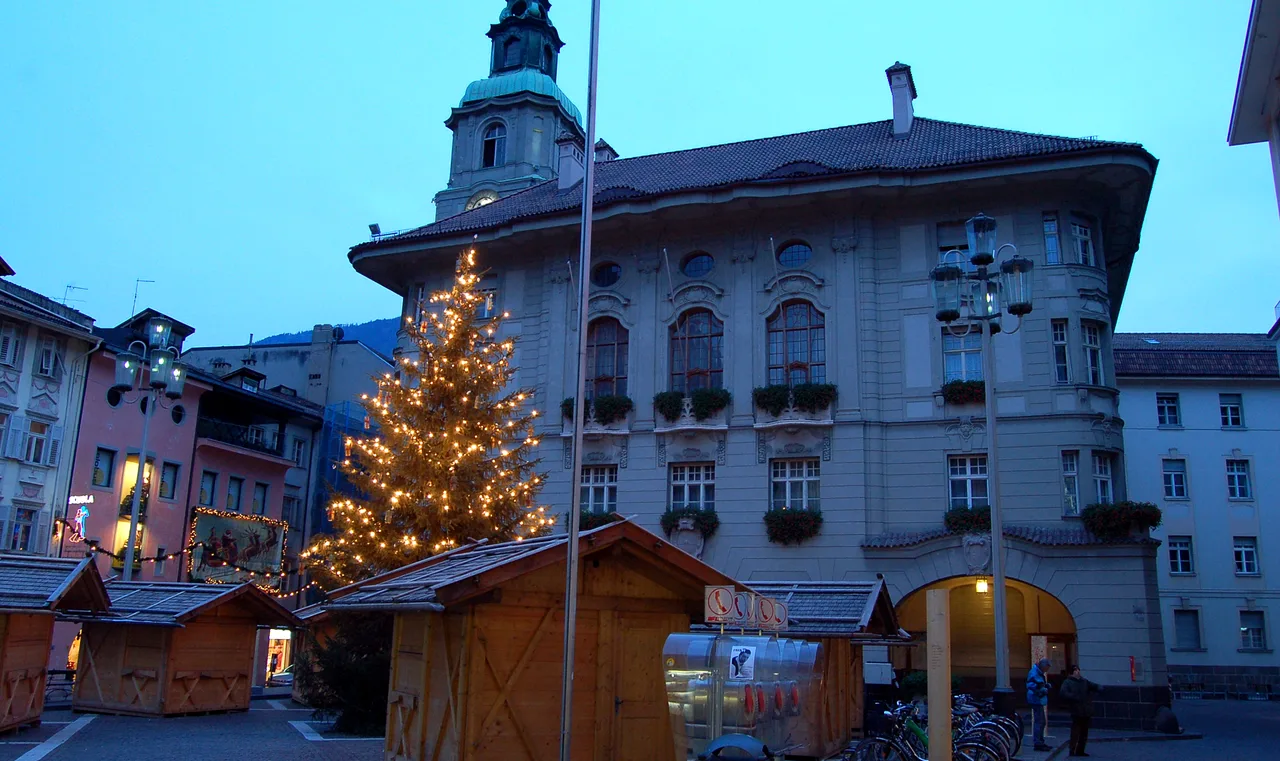
Bolzano held Italy’s first Christkindlmarkt in 1991, and it remains one of the best known in the Alps. The market fills Waltherplatz, the city’s main square, as well as the Pfarrplatz and Domplatz around the cathedral, and continues with craft stalls along the way towards the Kapuzinerpark. According to the official organisers, around 112 exhibitors take part, with a focus on South Tyrolean crafts and products, and the market attracts around one million visitors each season. It is run as a certified Green Event, with reusable crockery and attention to sustainability. The 2026 market opens on 26 November at 17:00 and runs until 6 January 2027, longer than most German markets, open daily 10:00–19:00 from 27 November. Special hours apply on 24 December (10:00–16:00), 31 December (10:00–18:00) and 1 January (11:00–19:00); the market is closed on 25 December. Look out for the miniature Christmas village, the illuminated tree and the stalls of wood carvings, glass ornaments, felt and local food. The infopoint is at Kornplatz 11 (mercatinodinatalebz.it).


| Event | Location | 2026 dates | Note |
|---|---|---|---|
| Bolzano Christkindlmarkt | Waltherplatz, Pfarrplatz and Domplatz | 26 November 2026–6 January 2027 | Opening 26 Nov 17:00; daily 10:00–19:00; 24 Dec 10:00–16:00; closed 25 Dec; 31 Dec 10:00–18:00; 1 Jan 11:00–19:00; free entry. |
| Craft stalls | Towards the Kapuzinerpark | During the market | Crafts and products from South Tyrol; check the map on the official site. |
| Christmas village | Within the market | During the market | A miniature Christmas village, popular with children. |
| Infopoint | Kornplatz 11 | During the market | Information on programme, map and services (mercatinodinatalebz.it). |
What to try
Glühwein / Vin brulé
Spiced hot wine; contains alcohol.
Kinderpunsch
Hot fruit punch for children and non-drinkers.
Zelten
A South Tyrolean Christmas bread packed with dried fruit and nuts.
Strauben
Fried spirals of batter dusted with sugar, often served with cranberry jam.
Kiachl
Fried dough rings served with jam or sauerkraut.
Roasted chestnuts
Warm chestnuts sold in paper bags.
Tips for the Bolzano Christkindlmarkt
- Weekday mornings are calmest; weekends, especially Saturdays, are very busy.
- The market runs until 6 January, so you can visit after Christmas too.
- It is closed on 25 December; plan around this.
- The station is only a few minutes from Waltherplatz; arrive by train.
- Reusable mugs and plates carry a deposit as part of the Green Event concept.
- Bolzano can be cold in the shade; dress warmly, though days are often sunny.
- Combine the market with a visit to Ötzi at the Archaeology Museum.
- The infopoint at Kornplatz 11 has maps and programme details.
Check before you go: Bozner Christkindlmarkt 2026 (official) ↗ · Südtirolmobil · timetable (official) ↗
Dates and hours were checked against the official mercatinodinatalebz.it and bolzano-bozen.it sites on 29 October 2026. Individual stalls may keep different hours; check the official pages before your visit.
When to Go
Bolzano has a relatively warm, sunny climate for the Alps, with hot summers and cold but often clear winters. Spring and autumn are ideal for walking, vineyards and the Törggelen season of new wine and chestnuts. From late November to 6 January the Christkindlmarkt fills the centre. January to March is ski season in the nearby Dolomites. Most museums are open all year, often closed on Mondays.
| Month | Sightseeing | Christmas market | Mountains and outdoors | Crowds |
|---|---|---|---|---|
| January | Good | Partly | Very good | Moderate |
| February | Good | None | Very good | Quiet |
| March | Good | None | Good | Quiet |
| April | Very good | None | Good | Moderate |
| May | Very good | None | Very good | Moderate |
| June | Very good | None | Very good | Moderate |
| July | Very good | None | Very good | Busy |
| August | Very good | None | Very good | Busy |
| September | Very good | None | Very good | Moderate |
| October | Very good | None | Very good | Moderate |
| November | Good | Market season | Good | Moderate |
| December | Good | Market season | Very good | Busy |
- December days are usually around −2 to 7 °C, often sunny but cold in the shade.
- The Christkindlmarkt runs 26 November 2026–6 January 2027 (closed 25 December).
- Advent weekends are very busy in the old town.
- The Dolomites have ski season from December to spring.
- Summer is hot in the basin; mornings and evenings are best.
- Autumn brings grape harvest and Törggelen.
Visa and Entry (Turkish citizens)
Turkish citizens holding an ordinary (burgundy) passport need a Schengen visa for tourist travel to Italy. Special, service and diplomatic passports follow different rules; check the current status on the Turkish Ministry of Foreign Affairs website.
Apply to the representation of your main destination. If Italy is your main destination, applications are handled by the Italian missions in Türkiye (the Embassy in Ankara and the Consulates General, according to your place of residence); current information is on the Consulate General in Istanbul’s visa page (consistanbul.esteri.it) and the Italian Foreign Ministry portal vistoperitalia.esteri.it.
Many travellers reach Bolzano via Munich or Innsbruck. If you will stay longer in Germany or Austria, apply to that country instead; if stays are equal, apply to the country of first entry.
Under the EU Entry/Exit System (EES), being rolled out in stages, your biometric data (facial image and fingerprints) may be recorded at first entry; allow extra time at the border.
Visa fees, appointment waiting times and required documents may change; this guide does not state fees. Use the current lists on the official pages before applying.
Travel medical insurance and accommodation and return documents are part of the application; details are in the official sources.
Check before you go: T.C. Dışişleri Bakanlığı · Türk vatandaşlarının tabi olduğu vize uygulamaları ↗ · consistanbul.esteri.it ↗ · EES · europa.eu ↗ · Rota Atlası visa guide (TR)
Travel medical insurance
Check the official visa and entry sources above first: they state whether travel medical insurance is required and the minimum cover. Compare any policy’s cover amount, validity dates and countries covered with the official requirement.
Rota Atlası does not currently offer an insurance partnership; there are no paid links in this section. Last updated: 1 November 2026
Getting to Bolzano
- By air: Bolzano Airport (BZO) is about 6 km from the centre, 15–20 minutes by taxi (bolzanoairport.it). Larger airports include Verona (VRN), Innsbruck (INN), Munich (MUC) and Milan Bergamo (BGY). Südtirol Bus transfer services link Munich, Verona, Bergamo and Milan airports with South Tyrol. Check current flights only on airline and airport websites.
- By train: Bolzano station is about two minutes’ walk from Waltherplatz. EuroCity trains from Munich via Innsbruck and the Brenner Pass stop here, as do Italian trains from Verona, Bologna and beyond. Use trenitalia.com and bahn.de for connections.
- In South Tyrol: Regional trains and buses (suedtirolmobil.info) connect Bolzano with Merano, Brixen and the Dolomite valleys.
- Luggage: Base Camp Dolomites at the station (platform 1) offers luggage storage, open 8:30–18:30; check current information before you travel.
Getting Around

On foot
The old town is compact: station, Waltherplatz, the cathedral, Laubengasse and the Obstmarkt are a few minutes apart.
City buses
SASA city buses cover the city; tickets and timetables at suedtirolmobil.info.
Cable cars
The Ritten cable car leaves from near the station; other cable cars climb to nearby plateaus.
Regional trains
Trains to Merano, Brixen and the Brenner; check suedtirolmobil.info and trenitalia.com.
By bike
Bolzano is very bike-friendly, with paths along the Talfer and Eisack.
Parking
Limited traffic zones apply in the old town; use car parks on the edge.
Things to See
Bolzano’s old town lies between the station and the Talfer river. Waltherplatz, with its statue, is the main square; the cathedral stands just south of it. North of the square, the arcaded Laubengasse leads to the Obstmarkt; around them stand the Franciscan and Dominican churches. To the west are the Archaeology Museum and Museion by the Talfer, while castles such as Runkelstein and Maretsch, the Gries district, the Ritten plateau, the Dolomites and Merano lie beyond.
The city’s living room
Waltherplatz

Waltherplatz is the heart of Bolzano and the main site of the Christkindlmarkt. In the centre stands the statue of Walther von der Vogelweide, the medieval minnesinger, erected in 1889; around it, pastel façades, cafés and hotels frame the square, with the cathedral tower rising at its southern edge. It is the natural starting point for any walk through the city.
Don’t miss
- The statue of Walther von der Vogelweide
- Pastel façades around the square
- View of the cathedral tower
- The Christkindlmarkt in Advent
Tips
- The square is a few minutes from the station.
- Come early morning for photos without crowds.
- The tourist office is nearby; check bolzano-bozen.it.
Gothic splendour
Bolzano Cathedral (Cathedral of the Assumption)

Bolzano Cathedral, dedicated to the Assumption of Mary, is a Gothic church with a striking roof of coloured glazed tiles. Its openwork tower, about 65 metres high, was built by the Swabian master Hans Lutz von Schussenried between 1501 and 1519. Inside, the high Gothic nave, frescoes and a fine stone pulpit reward a visit. The Pfarrplatz and Domplatz around it are part of the Christmas market.
Don’t miss
- The coloured tile roof
- The openwork tower
- Gothic nave and frescoes
- The stone pulpit
Tips
- Do not visit during services.
- Photography without flash, where permitted.
- The south side shows the roof best.

Arcades of merchants
Laubengasse and the Obstmarkt

The Laubengasse (Via dei Portici) is Bolzano’s historic shopping street, lined with arcades under tall, narrow merchants’ houses that recall the city’s role as a trading town between north and south. At its western end opens the Obstmarkt, a lively square with fruit and vegetable stalls around the Neptune fountain, known locally as the “Gabelwirt”. Goethe stayed at the Sonnenwirt inn here on his journey to Italy in 1786.
Don’t miss
- The arcades of the Laubengasse
- Merchants’ houses and courtyards
- Stalls on the Obstmarkt
- The Neptune fountain
Tips
- Most shops close on Sundays and some at lunchtime.
- The Obstmarkt is busiest in the morning.
- Look into the narrow courtyards behind the arcades.
A quiet cloister
Franciscan Friary

Just north of the Laubengasse, the Franciscan friary has a Gothic church and one of the most beautiful cloisters in the city, with medieval frescoes along its walls. The church contains a carved winged altar. It is a peaceful stop away from the busy streets.
Don’t miss
- The Gothic cloister
- Medieval frescoes
- The carved altar
- The quiet courtyard
Tips
- Respect the friars’ religious life; keep quiet.
- Check opening times locally.
- Combine with the Laubengasse.

Frescoes of the Giotto school
Dominican Church

The Dominican Church, south-west of Waltherplatz, is one of Bolzano’s most important medieval monuments. In the St John’s Chapel, 14th-century frescoes in the style of the Giotto school show the early influence of Italian painting north of the Alps. The adjoining cloister also has medieval murals.
Don’t miss
- Frescoes in St John’s Chapel
- The Gothic nave
- The cloister
- The adjoining square
Tips
- Check opening hours locally.
- Do not visit during services.
- Bring binoculars or a zoom for the frescoes.

A man from the Copper Age
South Tyrol Museum of Archaeology (Ötzi)

The South Tyrol Museum of Archaeology is home to Ötzi, the Iceman, whose naturally mummified body was found in 1991 in a glacier in the Ötztal Alps. More than 5,300 years old, he is shown in a special cold chamber, together with his clothing, tools and copper axe, and the museum explains how scientists have reconstructed his life and death (iceman.it).
Don’t miss
- Ötzi in his cold chamber
- Clothes and equipment
- Copper axe
- Reconstruction of the Iceman
Tips
- Book online or come early; queues are common in season.
- Check opening days on iceman.it; often closed on Mondays.
- Allow about two hours.
Modern art by the river
Museion and the Talfer Meadows

Museion, Bolzano’s museum of modern and contemporary art, occupies a glass cube by the Talfer river, linked to the other bank by two bridges. Beside it, the Talfer meadows form a long green ribbon along the river, with paths for walking and cycling and views of the mountains. In winter the meadows are quiet, often frosty and bathed in sunshine.
Don’t miss
- Museion’s glass façade
- Contemporary exhibitions
- Walk along the Talfer meadows
- Mountain views
Tips
- Check the exhibition programme at museion.it.
- The riverside paths are ideal for a morning walk.
- Continue north on foot towards Runkelstein Castle.

A castle of pictures
Runkelstein Castle

Runkelstein Castle, built in 1237 on a rock above the Talfer gorge north of the city, is famous for having the largest surviving cycle of secular medieval frescoes. Painted around 1400, they show courtly life, tournaments, hunting and scenes from legends such as Tristan and Isolde (runkelstein.info).
Don’t miss
- Secular medieval frescoes
- The castle on its rock
- Talfer gorge views
- Courtyard of the castle
Tips
- Check opening days and winter closures on runkelstein.info.
- Reach it on foot along the Talfer or by city bus.
- The path can be icy in winter.

Among the vineyards
Maretsch Castle

Maretsch Castle stands among vineyards close to the old town, its towers framed by vines and mountains. Today it is used as a venue for conferences and events, but its exterior and setting can be admired on a short walk from Waltherplatz towards the Talfer.
Don’t miss
- Castle towers among vines
- View of the mountains
- Walk from the centre
- Photos in winter light
Tips
- The interior is used for events; check access locally.
- Combine with Museion and the Talfer meadows.
- The path is a short walk from the centre.
Across the river
Gries and the Victory Monument

West of the Talfer lies the district of Gries, once a separate spa village. Its old parish church holds a carved altar by Michael Pacher, one of the masters of late-Gothic art. On the way, the Victory Monument, built under the fascist regime, is a controversial monument; a permanent documentation exhibition in its crypt explains the history of the city between 1918 and 1945.
Don’t miss
- Old parish church in Gries
- Michael Pacher’s carved altar
- Documentation exhibition at the Victory Monument
- Walk across the Talfer bridge
Tips
- Check opening times of the exhibition and church locally.
- Approach the monument as a place of history and reflection.
- Gries is reached on foot or by city bus.

Above the city
Ritten Plateau: Cable Car, Rittner Bahn and Earth Pyramids

The Ritten (Renon) plateau rises above Bolzano to the north-east. A cable car climbs from near the station to Oberbozen, where the historic narrow-gauge Rittner Bahn tram continues across meadows and forests with views of the Dolomites. Near Lengmoos, the famous earth pyramids, columns of clay topped with stones, stand in a ravine (ritten.com).
Don’t miss
- Cable car ride over the vineyards
- The historic Rittner Bahn
- Earth pyramids
- Dolomite views
Tips
- Check timetables at ritten.com and suedtirolmobil.info.
- Paths can be snowy in winter; wear suitable shoes.
- Allow half a day.


Mountains and spa town
The Dolomites and Merano

From Bolzano the Dolomites, a UNESCO World Heritage Site since 2009, are close: the Rosengarten (Catinaccio) massif glows red at sunset on the eastern horizon. To the north-west, the spa town of Merano, with its Kurhaus on the Passer river and promenades, has its own Christmas market and is easily reached by train. UNESCO listing ↗ Merano guide →
Don’t miss
- The Rosengarten at sunset
- Dolomite valleys
- Merano’s Kurhaus and promenades
- Merano Christmas market
Tips
- Check mountain weather and road conditions in winter.
- Merano is a short regional train ride away.
- See our Merano guide for details.

1–2 Day Routes, a Christmas Day + 5-Day South Tyrol Route
The routes keep distances short and allow for short winter days. Day one covers the old town and the cathedral, day two Ötzi, Museion and Runkelstein. The Christmas day combines the market with the Ritten plateau. The 5-day route adds Merano and the Dolomites. Check opening times and timetables on official websites in advance.
Day 1: Old town and cathedral
- In the morning start on Waltherplatz.
- Visit the cathedral and the Dominican Church.
- Walk through the Laubengasse to the Obstmarkt.
- In the afternoon see the Franciscan friary.
- At dusk enjoy the lights on Waltherplatz.
Day 2: Ötzi, Museion and Runkelstein
- In the morning visit Ötzi at the Archaeology Museum (book ahead).
- See Museion and walk along the Talfer meadows.
- Continue north to Runkelstein Castle (check opening).
- Return via Maretsch Castle.
- In the evening walk to Gries and the Victory Monument exhibition, if open.
A Christmas day
- Start at 10:00 at the Christkindlmarkt on Waltherplatz.
- Visit the cathedral and the Domplatz stalls.
- In the early afternoon take the Ritten cable car and Rittner Bahn.
- Return before dark and enjoy the market at dusk.
- Try Strauben or Zelten; the market is closed on 25 December.
5-day South Tyrol route
- Days 1–2: Bolzano.
- Day 3: Ritten plateau and earth pyramids.
- Day 4: Merano and its Christmas market.
- Day 5: A Dolomite valley (weather permitting) and departure via Verona, Innsbruck or Munich.
Bolzano and South Tyrol Cuisine
Bolzano’s cuisine combines Tyrolean and Italian traditions: dumplings, Speck and strudel alongside pasta, polenta and espresso. These are traditional dishes, not restaurant recommendations.


Speck Alto Adige
Smoked, cured ham with protected geographical indication (PGI); a South Tyrolean speciality made from pork.
Knödel
Bread dumplings with Speck, cheese or spinach, served in broth or with butter.
Schlutzkrapfen
Half-moon pasta filled with spinach and cheese, served with butter and Parmesan.
Schüttelbrot
A crisp, spiced rye flatbread.
Apfelstrudel
Apple strudel, made with local apples.
Lagrein and St. Magdalener
Red wines from the vineyards around Bolzano.
Zelten
A Christmas fruit bread full of dried fruit and nuts.
Polenta
Cornmeal served with cheese or stews, a link to Italian cooking.
- Speck and many Knödel contain pork; vegetarian versions (cheese, spinach) are common.
- A cover charge (coperto) may appear on restaurant bills in Italy.
- Lunch is usually around 12:00–14:00; kitchens may close in the afternoon.
- Tipping is not obligatory; rounding up is appreciated.
Culture and Etiquette

- Greet in German (“Grüß Gott”) or Italian (“Buongiorno”); both are fine.
- Respect both language communities; signs and names are bilingual.
- Do not walk around churches during services or use flash.
- Sunday is a day of rest; most shops are closed.
- Coffee is often drunk standing at the bar.
- Separate your rubbish according to local rules.
- Keep noise down in residential areas at night.
- Do not walk on cycle paths.
- Approach the Victory Monument as a historical site.
- Dress warmly for the mountains; weather can change.
Safety and Health
- Bolzano is generally safe; watch out for pickpockets at the busy market.
- Pavements and mountain paths can be icy in winter.
- In the mountains, check weather and avalanche bulletins before hiking.
- In an emergency call 112.
- Make sure your travel medical insurance covers the Schengen area.
- Pharmacies (Apotheke/Farmacia) post the address of the nearest on-duty pharmacy.
- Keep your passport with you; ID checks are possible.
What Your Budget Depends On
This guide does not give prices; prices change with season and year. Your budget depends on these factors:
Travel dates
Advent weekends and the ski season raise hotel demand.
Accommodation
The old town is convenient; the Ritten and nearby villages offer alternatives.
Transport
Buses, trains and cable cars; look into local guest cards and passes on official pages.
Sights and museums
The Archaeology Museum, Runkelstein and Museion charge separately.
Food and drink
There is a big difference between market snacks and restaurants; a cover charge may apply.
Day trips
Trips to Merano, the Ritten or the Dolomites are an extra cost.
Free experiences
The Christkindlmarkt (free entry), Waltherplatz, the cathedral, the Laubengasse and the Talfer meadows are free.
Practical Information
- Money: euro; cards common, carry some cash.
- Language: German and Italian; English common in tourism.
- Sockets: 230 V, type C/F/L.
- Time: CET (UTC+1) in winter.
- Opening hours: many museums are closed on Mondays.
- Shops: closed on Sundays, some at lunchtime; the market is open daily except 25 December.
- Holidays: 8 December (Immaculate Conception) is a public holiday in Italy; hours change on 24–26 and 31 December and 1 and 6 January.
- Weather: cold in December, about −2 to 7 °C, often sunny.
- Daylight: sunset around 16:40 in December.
- Emergency: 112.
Frequently Asked Questions
When is the Bolzano Christkindlmarkt 2026?
According to the official site, 26 November 2026 (opening 17:00) to 6 January 2027, daily 10:00–19:00.
Is the market open at Christmas?
On 24 December 10:00–16:00; it is closed on 25 December; 31 December 10:00–18:00; 1 January 11:00–19:00.
Is entry free?
Yes, entry to the Christkindlmarkt is free.
Is Bolzano’s market really Italy’s first?
Yes, it was held for the first time in 1991, according to the organisers.
Where can I see Ötzi?
At the South Tyrol Museum of Archaeology; check opening days on iceman.it.
Do people speak German or Italian?
Both; they are both official languages, and English is common in tourism.
Do Turkish citizens need a visa?
Holders of ordinary passports need a Schengen visa. If Italy is the main destination, see consistanbul.esteri.it and vistoperitalia.esteri.it.
How do I get there from Munich?
By direct EuroCity trains via Innsbruck and the Brenner, or by Südtirol Bus airport transfers.
How many days are enough?
One day for the old town, two with Ötzi and Runkelstein, four to five for a South Tyrol tour.
Which day trips can I take?
The Ritten plateau, Merano and the Dolomites.
Where to stay
Stay close to the areas where you will spend most time. The areas below are covered in detail in this guide; check public transport links in the getting-around section.
- The city’s living roomWaltherplatz
- Gothic splendourBolzano Cathedral (Cathedral of the Assumption)
- Arcades of merchantsLaubengasse and the Obstmarkt
- A quiet cloisterFranciscan Friary
- Frescoes of the Giotto schoolDominican Church
- A man from the Copper AgeSouth Tyrol Museum of Archaeology (Ötzi)
- Modern art by the riverMuseion and the Talfer Meadows
- A castle of picturesRunkelstein Castle
- Among the vineyardsMaretsch Castle
- Across the riverGries and the Victory Monument
- Above the cityRitten Plateau: Cable Car, Rittner Bahn and Earth Pyramids
- Mountains and spa townThe Dolomites and Merano
Search hotels in these areas (Hotellook) ↗ (affiliate link)Search on Booking.com ↗
Affiliate disclosure: Hotellook, Aviasales, Klook, Airalo, Tiqets and DiscoverCars links are affiliate links; Rota Atlası may earn a commission on bookings made through them, at no extra cost to you. Official and in-guide links are not paid. Last updated: 1 November 2026 · Privacy and affiliates
Transport and connectivity
- Airport transferOptions from the airport to the city are in this guide’s getting there section.
- Mobile data (eSIM)Airalo eSIM ↗ (affiliate link)
- TrainsOfficial rail website ↗
- Car hireYou rarely need a car within the city; see getting around first. Compare car hire on DiscoverCars ↗ (affiliate link)
Affiliate disclosure: Hotellook, Aviasales, Klook, Airalo, Tiqets and DiscoverCars links are affiliate links; Rota Atlası may earn a commission on bookings made through them, at no extra cost to you. Official and in-guide links are not paid. Last updated: 1 November 2026 · Privacy and affiliates
Search flights (affiliate link)
Search flights from any airport in any country. Results open on Aviasales in a new tab, where you book.
This form is an affiliate link: Rota Atlası may earn a commission on bookings made via Aviasales (Travelpayouts), at no extra cost to you. Check price, baggage and terms on the booking site. Airport data: OurAirports (public domain).
Flights, hotels and tours
Find tours and tickets
- Bolzano Christkindlmarkt
GetYourGuide ↗ · Klook ↗ (affiliate link) - Cathedral of the Assumption (Dom Maria Himmelfahrt)
GetYourGuide ↗ · Klook ↗ (affiliate link) - Laubengasse and Obstmarkt
GetYourGuide ↗ · Klook ↗ (affiliate link) - Runkelstein Castle
GetYourGuide ↗ · Klook ↗ (affiliate link)
Hotellook, Aviasales, Klook, Airalo and Tiqets links in this box are affiliate links (Travelpayouts): Rota Atlası may earn a commission on bookings made through them, at no extra cost to you. GetYourGuide links currently carry no affiliate code. Check prices and terms with the provider. Last updated: 1 November 2026 · Privacy and affiliates
Sources
- T.C. Dışişleri Bakanlığı · Türk vatandaşlarının tabi olduğu vize uygulamaları ↗
- Consolato Generale d’Italia a Istanbul · Visti (official) ↗
- European Union · Entry/Exit System (EES) ↗
- Ministero degli Affari Esteri · Il Visto per l’Italia (official) ↗
- Bozen-Bolzano Tourismus · bolzano-bozen.it (official) ↗
- Bozner Christkindlmarkt · Mercatino di Natale di Bolzano (official) ↗
- South Tyrol Museum of Archaeology · Ötzi (official) ↗
- Museion · Museum of modern and contemporary art (official) ↗
- Schloss Runkelstein (official) ↗
- Ritten Tourism · ritten.com (official) ↗
- Südtirolmobil · public transport South Tyrol (official) ↗
- Bolzano Airport (official) ↗
- UNESCO World Heritage Centre · The Dolomites ↗
- Trenitalia ↗
- Deutsche Bahn ↗
- GOV.UK · Foreign travel advice · Italy ↗
- Bozner Christkindlmarkt 2026 (official) ↗
- Südtirolmobil · timetable (official) ↗
This page is for information only. Dates, hours, entry rules and transport information can change; check the official sources above before travelling. No prices, flights, hotels or restaurants have been invented in this guide.
Photo credits
The photos on this page come from Wikimedia Commons and are used under the stated authors and licences (CC BY, CC BY-SA, CC0 or public domain). Full list of sources
- The Christmas tree and market huts in Bolzano at dusk — Michael Paraskevas · CC BY-SA 3.0 · Wikimedia Commons
- Night at the Christmas market on Waltherplatz in Bolzano — No machine-readable author provided. Skafa~commonswiki assumed (based on copyright claims). · CC BY-SA 2.5 · Wikimedia Commons
- Red-roofed stalls at the Bolzano Christmas market — Picture by Skafa No machine-readable author provided. Skafa~commonswiki assumed (based on copyright claims). · CC BY-SA 2.5 · Wikimedia Commons
- A lit decorations stall at the Bolzano Christmas market — No machine-readable author provided. Skafa~commonswiki assumed (based on copyright claims). · CC BY-SA 2.5 · Wikimedia Commons
- Wooden huts by day at the Bolzano Christmas market — No machine-readable author provided. Skafa~commonswiki assumed (based on copyright claims). · CC BY-SA 2.5 · Wikimedia Commons
- A miniature Christmas village at the Bolzano market — Losi Rosalio · CC BY-SA 4.0 · Wikimedia Commons
- Christmas market stalls and the Walther statue on Waltherplatz at night — No machine-readable author provided. Skafa~commonswiki assumed (based on copyright claims). · CC BY-SA 2.5 · Wikimedia Commons
- A lit palace and market huts in Bolzano at dusk — Michael Paraskevas · CC BY-SA 3.0 · Wikimedia Commons
- Aerial view of Waltherplatz in Bolzano — Aciarium · CC BY-SA 4.0 · Wikimedia Commons
- Bolzano Cathedral and the Walther statue from Waltherplatz at night — Triplec85 · CC BY-SA 4.0 · Wikimedia Commons
- Colourful façades on Waltherplatz in Bolzano — Tuxyso · CC BY-SA 3.0 · Wikimedia Commons
- The Gothic interior of Bolzano’s Cathedral of the Assumption — Rolf Kranz · CC BY-SA 4.0 · Wikimedia Commons
- The coloured tile roof and tower of Bolzano Cathedral — Hiroki Ogawa · CC BY 3.0 · Wikimedia Commons
- Laubengasse, Bolzano’s arcaded shopping street — Hiroki Ogawa · CC BY 3.0 · Wikimedia Commons
- Fruit and vegetable stalls on the Obstmarkt in Bolzano — Holger Uwe Schmitt · CC BY-SA 4.0 · Wikimedia Commons
- The courtyard of Bolzano’s Franciscan friary — Rolf Kranz · CC BY-SA 4.0 · Wikimedia Commons
- The Gothic cloister of Bolzano’s Franciscan friary — Rolf Kranz · CC BY-SA 4.0 · Wikimedia Commons
- The exterior of Bolzano’s Dominican Church — Buchhändler · CC BY-SA 3.0 · Wikimedia Commons
- The interior of Bolzano’s Dominican Church — Buchhändler · CC BY-SA 3.0 · Wikimedia Commons
- The South Tyrol Museum of Archaeology building, home of Ötzi — Thomas Ledl · CC BY 4.0 · Wikimedia Commons
- The Museion and the bridges over the Talfer in Bolzano — Aciarium · CC BY-SA 4.0 · Wikimedia Commons
- The Talfer meadows in winter with mountains behind — Bartleby08 · CC BY 4.0 · Wikimedia Commons
- Runkelstein Castle on its rock near Bolzano — Aisano · CC BY-SA 4.0 · Wikimedia Commons
- Medieval frescoes in Runkelstein Castle — DKrieger · CC BY-SA 3.0 · Wikimedia Commons
- Maretsch Castle on a snowy December day — Zintosch7 · CC BY-SA 4.0 · Wikimedia Commons
- The old parish church in Gries, Bolzano — Vollmond11 · CC BY-SA 3.0 · Wikimedia Commons
- The Victory Monument in Bolzano — This Photo was taken by Wolfgang Moroder. Feel free to use my photos, but please mention me as the author and send me a message. This image is not in the public domain. Please respect the copyright protection. It may only be used according to the rules mentioned here. This specifically excludes use in social media, if applicable terms of the licenses listed here are not appropriate. Please do not upload an updated image here without consultation with the Author. The author would like to make corrections only at his own source. This ensures that the changes are preserved.Please if you think that any changes should be required, please inform the author.Otherwise you can upload a new image with a new name. Please use one of the templates derivative or extract. · Public domain · Wikimedia Commons
- The Ritten cable car station in Bolzano — Silesia711 · CC BY-SA 4.0 · Wikimedia Commons
- The Rittner Bahn train on the Ritten plateau in autumn — Frank Nowotny · CC BY-SA 4.0 · Wikimedia Commons
- The Lengmoos earth pyramids on the Ritten — Stefan Oemisch · CC BY-SA 4.0 · Wikimedia Commons
- The Kurhaus on the Passer river in Merano — Rolf Kranz · CC BY-SA 4.0 · Wikimedia Commons
- The Rosengarten (Catinaccio) Dolomites seen from near Tiers — Giorgio Galeotti · CC BY 4.0 · Wikimedia Commons
- Bolzano railway station and tracks from above — User:Mattes · Public domain · Wikimedia Commons
- Speckknödel (Tyrolean bread dumplings) in broth — Benreis · CC BY 3.0 · Wikimedia Commons
- South Tyrolean Speck in a Bolzano shop — MOs810 · CC BY-SA 4.0 · Wikimedia Commons
- A bilingual street sign in Bolzano: Via dei Portici – Laubengasse — User:Mattes · Public domain · Wikimedia Commons
Verona → · Venice → · Florence → · Trento → · Merano → · Innsbruck → · Munich → · Salzburg → · Vienna → · Christmas markets