

Riga is the capital of Latvia and the largest city in the Baltic states, home to around 600,000 people. Founded in 1201 by Bishop Albert where the Daugava River meets the Gulf of Riga, it became one of the important ports of the Hanseatic League in the Middle Ages. Over the following centuries it was ruled by Sweden, the Russian Empire and the Soviet Union; since 1991 it has been the capital of independent Latvia. Its historic centre has been on the UNESCO World Heritage List since 1997: on one side Old Riga (Vecrīga) with churches, guild halls and narrow cobbled lanes, on the other 19th-century boulevards and one of the densest collections of Art Nouveau (Jugendstil) architecture in Europe. What makes Riga special in winter is Christmas: the city remembers a tree decorated by the Brotherhood of Blackheads in 1510 as “one of the first Christmas trees”, and every year from late November to early January the market on Doma laukums fills the heart of Old Riga with wooden huts, hot drinks and choir singing. This guide brings together the Christmas market, the landmarks of Old Riga, the Art Nouveau district, the Central Market, the far bank of the Daugava and day trips to Jūrmala, Sigulda and Rundāle, with official sources throughout.
Content update: 28 October 2026 · Christmas market dates and opening hours checked against the official LiveRiga (Riga Investment and Tourism Agency) pages
Riga at a Glance
- Country
- Latvia · capital
- Population
- About 600,000 (largest city in the Baltic states)
- Language
- Latvian; Russian widely spoken, English in tourist areas
- Currency
- Euro (EUR); cards very common, a little cash helps at small stalls
- Time zone
- Eastern European Time (EET, UTC+2); one hour behind Türkiye in winter
- Highlights
- UNESCO-listed historic centre, Art Nouveau architecture, Central Market, Song and Dance Festival tradition
- Landmarks
- House of the Blackheads, Riga Cathedral, St Peter’s Church, Three Brothers, Freedom Monument, Cat House
- Nearby
- Jūrmala, Sigulda and Gauja National Park, Rundāle Palace, Tallinn, Vilnius
- Christmas
- Doma laukums market 27 November 2026–3 January 2027, free entry; Christmas tree on Rātslaukums
- Airport
- Riga International Airport (RIX), about 10 km from the centre
- Electricity
- 230 V, European type C/F sockets
- Emergency
- 112 (single emergency number)
Riga in Pictures
The spires of the Cathedral and St Peter’s seen from the TV tower, the skyline along the Daugava and the rooftops of Old Riga: Riga in three frames.


Riga Christmas Market 2026
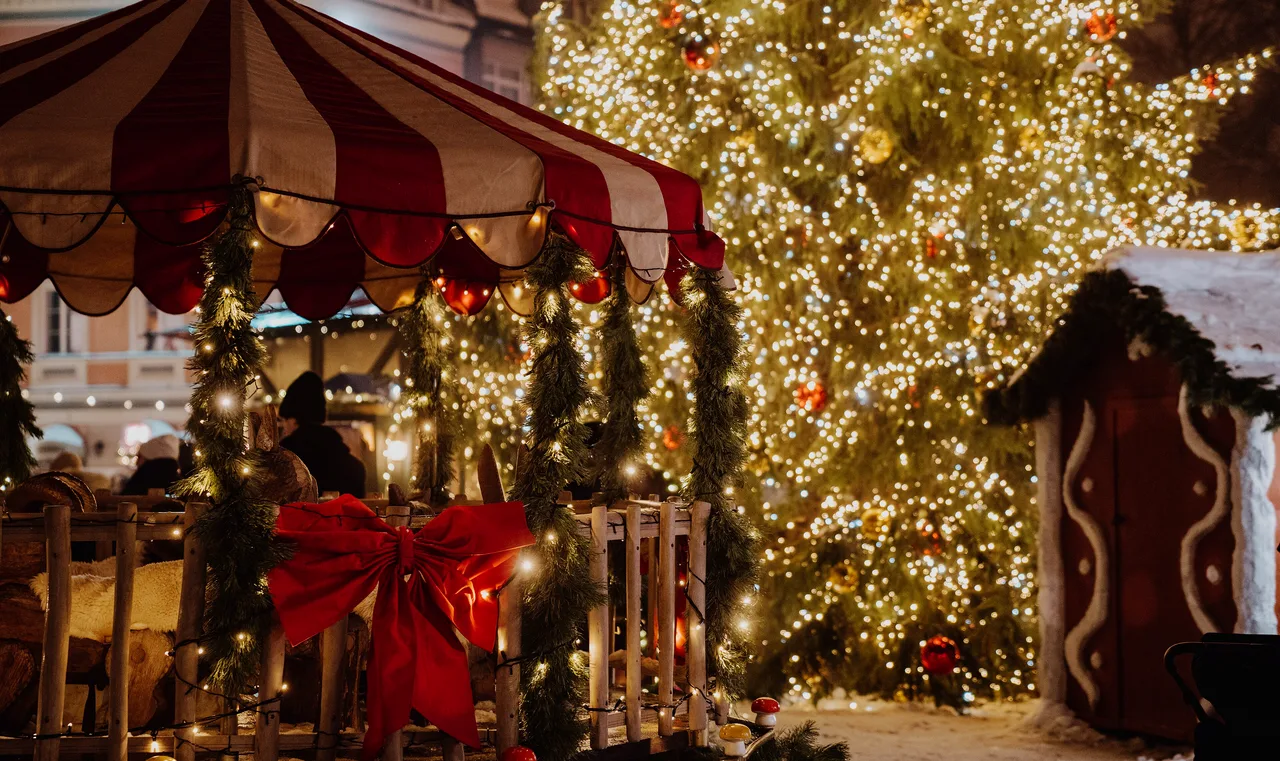
Christmas in Riga revolves around two squares in Old Riga. The main market sets up on the broad Doma laukums in front of Riga Cathedral: wooden huts sell local craftspeople’s beeswax candles, woollen socks and mittens, gingerbread and handmade decorations, while food stalls serve traditional Latvian dishes, street food and hot drinks. According to the official LiveRiga page, DJs play on Friday evenings, choirs and music groups perform on Saturdays and folk music fills Sundays; Santa’s house for children is part of the market too. A few minutes away on Rātslaukums (Town Hall Square), the Christmas tree set up in front of the House of the Blackheads is the city’s favourite photo spot: a plaque on the square commemorates the tradition that the Brotherhood of Blackheads decorated a tree here in 1510 and then burned it. This is the source of Riga’s claim to “one of the first decorated Christmas trees”; Tallinn makes a similar claim, so it is best read as a legend the two cities share rather than a proven historical “first”. On the second weekend of December a large indoor Christmas fair is also held at the Ķīpsala exhibition hall, a good option when the weather is harsh. Because the two squares are only a few minutes apart through the lanes of Old Riga, an evening walk from the Cathedral past St Peter’s to the Blackheads tree easily becomes part of the Christmas experience.


| Event | Location | 2026 dates | Note |
|---|---|---|---|
| Riga Christmas Market | Doma laukums (Cathedral Square), Old Riga | 27 November 2026–3 January 2027 | Free entry. Mon–Thu 11–21, Fri–Sat 10–22, Sun 10–21; 24 Dec 10–20, 25 Dec 10–21, 26 Dec 10–22, 1 Jan 12–20. |
| New Year’s Eve at the market | Doma laukums | 31 December 2026 | According to the official hours the market is open from 10:00 to 02:00 on 31 December. |
| Christmas tree and 1510 plaque | Rātslaukums (Town Hall Square), in front of the House of the Blackheads | Christmas season | The plaque recalling the city’s Christmas tree legend is on the square; the tree is lit in the evenings. |
| Ķīpsala Christmas fair (indoor) | Ķīpsala exhibition centre, Ķīpsalas iela 8 | 11–13 December 2026 | According to LiveRiga: Fri 12–20, Sat 9–20, Sun 9–19; local producers and gifts. |
What to try
Karstvīns
Latvian mulled wine; stalls also offer alcohol-free hot fruit drinks.
Hot Black Balsam
Riga Black Balsam mixed with hot blackcurrant juice – a Riga winter classic, alcoholic.
Piparkūkas
Thin, spiced Latvian gingerbread biscuits; decorated ones are sold as gifts.
Pelēkie zirņi
Grey peas with bacon – the traditional dish of the Latvian Christmas table.
Pīrāgi
Small buns filled with bacon and onion, perfect for eating on the go.
Grilled sausage and sauerkraut
A common street food at the market; usually pork, so ask about ingredients.
Riga Christmas market tips
- In December the sun sets around 15:30–16:00; late afternoon is the best time for the lit huts and the illuminated Cathedral.
- Friday and Saturday evenings are the busiest; come on a weekday morning for quieter shopping.
- Saturdays bring choirs and Sundays folk music; check the current stage programme on LiveRiga.
- Doma laukums and Rātslaukums are five minutes apart on foot – see both in one evening.
- Cobblestones can be icy; non-slip waterproof shoes and thick socks are essential.
- Local crafts (beeswax candles, woollen mittens, wooden toys) make the best souvenirs.
- Riga Cathedral’s famous organ is heard in Advent concerts; check the programme on doms.lv.
- The market stays open until 3 January 2027; the week after Christmas is noticeably calmer.
Check before you go: LiveRiga · Riga Christmas Market (official) ↗ · LiveRiga · Christmas in Riga (official) ↗
Dates and hours were checked on 28 October 2026 against the official LiveRiga (Riga Investment and Tourism Agency) pages. The stage programme, Santa’s house hours and Ķīpsala fair details may change; check the official pages again before you visit.
When to Go
Riga has two faces: from May to September long days, outdoor cafés, Jūrmala’s beaches and the Jāņi midsummer festival at the end of June; from late November to early January the Christmas market, a glowing Old Riga and short but atmospheric winter days. January to March is cold and dark, but the city is calm and demand for accommodation is low.
| Month | City sightseeing | Christmas market | Jūrmala and nature | Crowds |
|---|---|---|---|---|
| January | Difficult | Partly | Difficult | Quiet |
| February | Difficult | None | Difficult | Quiet |
| March | Difficult | None | Difficult | Quiet |
| April | Good | None | Good | Moderate |
| May | Very good | None | Very good | Moderate |
| June | Very good | None | Very good | Busy |
| July | Very good | None | Very good | Busy |
| August | Very good | None | Very good | Busy |
| September | Good | None | Good | Moderate |
| October | Good | None | Good | Moderate |
| November | Difficult | Market season | Difficult | Quiet |
| December | Difficult | Market season | Difficult | Moderate |
- From December to February temperatures are mostly below zero; snow and ice are common, and wind off the Daugava makes it feel colder.
- In December there are only about seven hours of daylight; plan museums and indoor sights for the day and markets for the evening.
- The Christmas market is open from 27 November 2026 to 3 January 2027; on 1 January it opens at 12:00.
- Jāņi (Līgo), the midsummer festival at the end of June, is the country’s biggest folk holiday; many places may close.
- Summer (July–August) is the busiest season, with cruise passengers adding to the crowds in Old Riga.
- Spring and autumn (May, September) offer balanced weather and quieter streets for sightseeing.
Visa and Entry (Turkish citizens)
Turkish citizens holding ordinary (burgundy) passports need a Schengen visa for tourist travel to Latvia. Rules differ for special, service and diplomatic passports; check the current situation with the Turkish Ministry of Foreign Affairs.
According to the consular page of the Embassy of Latvia for Türkiye, visa applications are accepted through VFS Global; you should apply no earlier than six months and no later than 15 days before travel.
If you combine Riga with Tallinn and Vilnius, apply to the country where you will spend the longest; if stays are equal, the country of first entry applies. Checks may take place at internal borders, so carry your passport.
Under the EU Entry/Exit System (EES), which is being introduced in stages, your biometric data (facial image and fingerprints) may be taken on first entry; allow extra time at the border.
Visa fees, appointment times and required documents can change; this guide does not give fees. Use the current lists on the official websites before applying.
The visa page of Latvia’s Office of Citizenship and Migration Affairs (PMLP) explains entry rules in detail; travel medical insurance and accommodation details are part of the application.
Check before you go: T.C. Dışişleri Bakanlığı · Türk vatandaşlarının tabi olduğu vize uygulamaları ↗ · mfa.gov.lv · Türkiye ↗ · EES · europa.eu ↗ · Rota Atlası visa guide (TR)
Travel medical insurance
Check the official visa and entry sources above first: they state whether travel medical insurance is required and the minimum cover. Compare any policy’s cover amount, validity dates and countries covered with the official requirement.
Rota Atlası does not currently offer an insurance partnership; there are no paid links in this section. Last updated: 1 November 2026
Getting to Riga
- By air: Riga International Airport (RIX) is the largest airport in the Baltic region, about 10 km from the city centre. Depending on the season there may be direct or connecting flights from Türkiye; check current flights only on airline and airport websites.
- From the airport: Rīgas satiksme bus route 22 links the airport with the centre; taxis and ride-hailing apps are also available. Check current routes and tickets on rigassatiksme.lv.
- By road and bus: Riga is linked to Tallinn and Vilnius by international bus routes; Riga International Bus Station is in the centre next to the Central Market. Rail links are limited, and the Rail Baltica line is still under construction.
- By sea: regular ferries sail from the port of Riga to Stockholm; check timetables on the ferry companies’ official websites.
Getting Around

On foot
Old Riga is compact and largely pedestrianised; the Cathedral, St Peter’s, the Three Brothers and the Freedom Monument are all minutes apart.
Tram and trolleybus
Rīgas satiksme runs the tram, trolleybus and bus network, with e-talons cards and short-term tickets. Check current ticket types on the official website.
Suburban train
Pasažieru vilciens (vivi.lv) trains go to Jūrmala, Sigulda and other towns; the Central Station (Centrālā stacija) is just south of Old Riga.
Bike and scooter
Shared bikes and scooters are common in summer; in winter, ice and snow make them inadvisable.
Taxi
Licensed taxis and apps are available; check the fare in the app or on the meter before you ride.
Day trips
Public transport to Rundāle Palace is poor; an organised tour or a hire car is more practical.
Things to See
Riga’s sights form two rings: inside, Old Riga, enclosed by the city canal and Bastejkalns park; outside, the 19th-century boulevards and the Art Nouveau district that begin at the Freedom Monument. The Central Market and Spīķeri sit by the Daugava, with the National Library on the opposite bank. Winter days are short, so plan indoor sights for the daytime and squares for the evening.
Old Riga
Doma laukums and Riga Cathedral

Doma laukums, the largest square in Old Riga, takes its name from Riga Cathedral (Doms) on its north side. Founded by Bishop Albert in 1211, the cathedral is one of the largest medieval churches in the Baltic region and combines Romanesque, Gothic and Baroque elements. Its Walcker organ of 1884 was among the largest in the world when it was built and can still be heard in concerts. The cross-shaped cloister and the cathedral museum are the building’s quiet corners. In summer the square fills with outdoor cafés; from late November to early January it hosts the wooden huts of the Riga Christmas Market. UNESCO listing ↗
Don’t miss
- The cathedral interior and Walcker organ
- An organ concert (depending on the programme)
- The cloister
- The Christmas market (27 November–3 January)
Tips
- There is an entry fee for the cathedral; check hours and concerts on doms.lv.
- The square is a good starting point for exploring the lanes of Old Riga.
- The lit façade looks best from the south corner of the square in the evening.
Old Riga
Rātslaukums and the House of the Blackheads

Town Hall Square (Rātslaukums) is Riga’s most photographed corner. The House of the Blackheads, with its showy Dutch Renaissance façade, was first built in the 14th century and became the meeting house of the Blackheads, a brotherhood of unmarried foreign merchants. It was destroyed in the war in 1941 and its ruins were cleared in the Soviet era; the present building was faithfully reconstructed in the late 1990s and completed in 2000. In the middle of the square stands the statue of Roland, the city’s protective figure. At Christmas the tree in front of the House of the Blackheads and the plaque recalling the 1510 tradition make the square the city’s Christmas heart.
Don’t miss
- The House of the Blackheads façade
- The Roland statue
- The 1510 Christmas tree plaque
- The square lit up at night
Tips
- The House of the Blackheads may sometimes close for official events; check visiting information beforehand.
- The plaque is set into the ground of the square; look for it near the Christmas tree.
- St Peter’s Church is a one-minute walk from the square.
Views
St Peter’s Church and tower

The highest point of Old Riga’s skyline is the bell tower of St Peter’s Church (Sv. Pētera baznīca). Founded in the 13th century, the church was rebuilt several times; its wooden spire burned in 1941 and was reconstructed after the war on a metal frame. Today a lift takes visitors to a viewing platform from which the red roofs of Old Riga, the Cathedral, the Daugava and its bridges, the National Library and the Academy of Sciences can be seen at a glance. The interior is also used for exhibitions and concerts.
Don’t miss
- The 360-degree view from the tower platform
- Views over the Daugava and its bridges
- The Gothic interior
Tips
- There is an entry fee for the tower and church; hours vary by season, so check before you go.
- On clear days go up before sunset; in winter it gets dark very early.
- On windy days the platform is very cold.
Medieval houses
The Three Brothers and the Swedish Gate

The three houses standing side by side on Mazā Pils iela, known as the Three Brothers (Trīs brāļi), are among Riga’s oldest dwellings; the oldest dates from the 15th century. Each shows the architecture of a different period, and together they house the Latvian Museum of Architecture. A few streets away, the Swedish Gate (Zviedru vārti), cut through the city wall in 1698 during Swedish rule, is the only surviving gate in the walls. The Jacob’s Barracks and the Ramer tower around it are a good starting point for following the line of Old Riga’s fortifications.
Don’t miss
- The façades of the Three Brothers
- The Swedish Gate
- The remains of the wall along the Jacob’s Barracks
- The area around the Saeima (parliament) building
Tips
- Check the Museum of Architecture’s hours in advance.
- Early in the morning the lanes are empty and ideal for photos.
- St James’s Cathedral nearby is also worth a look.

Old Riga
Līvu laukums, the Cat House and the Guild halls

Līvu laukums is one of Old Riga’s liveliest squares, lined with colourful façades, cafés and restaurants. Facing it, the Cat House (Kaķu nams) was designed by architect Friedrich Scheffel in 1909; the arch-backed cat statues on its turrets go back to a guild story told in the city. Right next to it, the Great Guild (Lielā ģilde) and the Small Guild (Mazā ģilde) were the meeting places of merchant and craft guilds in the Hanseatic era; the Great Guild is now the concert hall of the Latvian National Symphony Orchestra.
Don’t miss
- The cats on the Cat House roof
- The Great and Small Guild façades
- Cafés on Līvu laukums
- A short walk to the Powder Tower
Tips
- View the cat statues from the opposite side of the square.
- If there is a concert in the Great Guild you can see the interior too; check the programme in advance.
- The square is lively in the evening and decorated with lights at Christmas.


Symbol
Freedom Monument and Bastejkalns

Rising where Old Riga meets the newer city, the Freedom Monument (Brīvības piemineklis) was erected in 1935 with public donations. The female figure on top holding three stars is popularly called “Milda”; the monument is the symbol of Latvian independence, and an honour guard stands before it during the day. On either side stretch the city canal and Bastejkalns park, laid out on the former moat after the walls were demolished in the 19th century; this green belt separates Old Riga from the ring of boulevards. The canal banks are lovely with boats in summer and snow-covered bridges in winter.
Don’t miss
- The Freedom Monument and honour guard
- Bastejkalns hill and the canal bridges
- The park walk to the National Opera
Tips
- The monument is a place of respect; avoid noise and inappropriate poses around it.
- The guard changes at regular intervals during the day.
- Paths along the canal can be slippery in winter.

Art Nouveau
Alberta iela and the Art Nouveau district

Riga has one of the densest concentrations of Art Nouveau (Jugendstil) architecture in Europe: roughly a third of the buildings in the centre are in this style, and this heritage is an important part of the UNESCO listing. The most famous examples are on Alberta iela and Elizabetes iela, where the façades of architect Mikhail Eisenstein (Mihails Eizenšteins), full of faces, masks, lions and geometric ornament, turn the street into an open-air museum. The Riga Art Nouveau Centre at Alberta iela 12 shows a period apartment with its interior. After the medieval fabric of Old Riga, this district is essential to understand the city’s wealth around 1900.
Don’t miss
- The façades of Alberta iela
- Eisenstein’s buildings on Elizabetes iela
- The Riga Art Nouveau Centre (museum)
- The area around Strēlnieku iela
Tips
- Look up: the richest decoration is on the upper floors.
- Details are much clearer in daylight; in winter choose the middle of the day.
- Check the museum’s hours before visiting.

Market
Central Market and Spīķeri

Riga Central Market (Centrāltirgus) is one of the largest covered markets in Europe. Its five large pavilions were built using the steel frames of German zeppelin hangars from the First World War and opened in 1930; the market is among the historic structures included in the UNESCO listing. The pavilions are divided into meat, fish, dairy and fruit and vegetables; smoked fish, rye bread, honey and seasonal produce offer the liveliest picture of local life. Right next door, Spīķeri is a cultural and lifestyle quarter created from renovated 19th-century brick warehouses.
Don’t miss
- The fish pavilion and smoked fish
- Rye bread and honey stalls
- The brick warehouses of Spīķeri
- The open-air stalls around the market
Tips
- Mornings bring the freshest produce and the liveliest atmosphere.
- Watch your valuables in the crowds.
- Check market hours on the official centraltirgus.lv website.

Maskavas forštate
Academy of Sciences and the Moscow Suburb

Rising behind the Central Market, the Latvian Academy of Sciences building is the Baltic example of the Stalin-era “Seven Sisters” style, built in the 1950s; locals jokingly call it “Stalin’s birthday cake”. A viewing terrace on its upper floors opens to visitors seasonally and offers a different angle on Old Riga. The surrounding Maskavas forštate (Moscow Suburb), with its wooden houses, traces of the former Jewish quarter and Holocaust memorials, is a lesser-known but historically important side of the city.
Don’t miss
- The Academy of Sciences façade
- The viewing terrace (seasonal)
- Wooden houses of the Moscow Suburb
- The Great Choral Synagogue memorial
Tips
- Check in advance in which months and at what times the terrace is open.
- Be respectful when visiting the area’s memorials.
- Combine it with the Central Market.
Arts
National Opera and National Museum of Art

The white neoclassical building on the edge of Bastejkalns park is the home of the Latvian National Opera and Ballet; in the winter season opera and ballet performances are one of the finest ways to spend an evening in Riga. A little to the north, next to Esplanāde park, the Latvian National Museum of Art shows the most comprehensive collection of Latvian and Baltic art in its historic building, opened in 1905 and reopened in 2016 after a thorough renovation. The nearby Orthodox Nativity Cathedral with its golden domes is another landmark of the park.
Don’t miss
- A performance at the National Opera
- The Latvian painting collection of the National Museum of Art
- Esplanāde park and the Nativity Cathedral
Tips
- Opera tickets can sell out quickly in December; check the programme on opera.lv in advance.
- Check museum hours and closing days on lnmm.gov.lv.
- Modest dress and quiet are expected in the Orthodox cathedral.

Across the river
National Library and Pārdaugava

Rising on the left bank of the Daugava opposite Old Riga, the National Library of Latvia is a striking building designed by architect Gunnar Birkerts and opened in 2014; its form, inspired by the glass mountain of Latvian folk tales, has earned it the name “Castle of Light”. The library’s public areas and exhibitions are open to visitors, and from the upper floors you can see the Old Riga skyline across the river. It is reached on foot over the Stone Bridge (Akmens tilts). Pārdaugava also includes Āgenskalns with its wooden houses and the island of Ķīpsala.
Don’t miss
- The library interior and exhibitions
- The Old Riga skyline from Akmens tilts
- The wooden houses of Ķīpsala
Tips
- Check the library’s public opening hours on lnb.lv.
- Sunset is the best time for skyline photos from the bridge.
- The wind on the bridge is strong in winter; dress warmly.
Day trips
Jūrmala, Sigulda and Rundāle Palace

There are three classic day trips from Riga. Jūrmala, quickly reached by suburban train, is a seaside resort famous for its long sandy beach and wooden summer villas; in winter it offers a quiet walk by the sea. Sigulda is the gateway to Gauja National Park, known for the medieval Sigulda castle, the red-brick Turaida castle across the valley and winter sports; it is reached by train. Rundāle Palace is the Baroque palace designed for the Dukes of Courland by Bartolomeo Rastrelli, architect of the Winter Palace in St Petersburg; it lies south of Riga near Bauska and is hard to reach by public transport.
Don’t miss
- Jomas iela and the beach in Jūrmala
- Sigulda castle and Turaida castle
- The Baroque halls of Rundāle Palace
Tips
- Check train times on vivi.lv; services may be reduced in winter.
- For Rundāle an organised tour or hire car is more practical; check palace hours on rundale.net.
- Days are short in winter; start day trips early in the morning.

1–3 Day Itineraries, Christmas Day + 7-Day Baltic Route
The itineraries take walking distances and short winter days into account. Old Riga can be seen in a day; two days cover Art Nouveau and the markets, and three days allow a day trip. The regional route is the classic Baltic trio linking Tallinn and Vilnius by bus. Check museum and concert times on official websites in advance.
Day 1: Old Riga
- In the morning visit Riga Cathedral and its cloister.
- Walk past the Three Brothers, the Swedish Gate and the remains of the walls.
- Around midday go up St Peter’s tower to see the city from above.
- In the afternoon explore Līvu laukums, the Cat House and the Guild halls.
- In the evening see the House of the Blackheads on Rātslaukums and the Christmas market on Doma laukums.
Day 2: Art Nouveau and the arts
- In the morning walk past the Freedom Monument and through Bastejkalns park.
- See the Art Nouveau façades of Alberta iela and Elizabetes iela and visit the Art Nouveau Centre.
- In the afternoon visit the National Museum of Art.
- In the evening see a performance at the National Opera (depending on the programme).
Day 3: Market, river and a day trip
- In the morning explore the Central Market and Spīķeri; see the Academy of Sciences from outside.
- Walk over Akmens tilts to the National Library.
- Alternatively, spend the day in Sigulda (Gauja valley and Turaida) or Jūrmala by train.
- Back in Old Riga, end the day with a hot Black Balsam.
Christmas market day (27 November 2026–3 January 2027)
- Before noon, explore the Cathedral and the lanes of Old Riga in daylight.
- For lunch try grey peas with bacon and pīrāgi.
- Around 15:30 watch the lights come on from St Peter’s tower (if open).
- In the evening browse the huts at the Doma laukums market; listen to the choirs on a Saturday or folk music on a Sunday.
- Finish at the Christmas tree and the 1510 plaque on Rātslaukums.
7 days: The Baltic trio (Tallinn–Riga–Vilnius)
- Days 1–2: Tallinn Old Town, Toompea and the Raekoja plats Christmas market.
- Day 3: Bus to Riga; evening at the Doma laukums market.
- Day 4: Old Riga and St Peter’s tower.
- Day 5: The Art Nouveau district and Central Market; optional Sigulda.
- Day 6: Bus to Vilnius; the Christmas tree on Cathedral Square.
- Day 7: Vilnius Old Town and Gediminas Tower; departure.
Latvian Food
Latvian cuisine is built on rye, peas, potatoes, dairy, smoked fish and seasonal fruit; the Christmas table is known for grey peas, sauerkraut and spiced biscuits. Below are regional specialities, not restaurant recommendations.


Pelēkie zirņi ar speķi
Grey peas with bacon – the traditional Christmas and New Year dish. The bacon is pork.
Rupjmaize
Dark, slightly sour Latvian rye bread; markets sell many varieties.
Piparkūkas
Thin Christmas biscuits made with black pepper, ginger and cinnamon.
Rīgas Melnais balzams
A herbal liqueur said to have been made since 1752; drunk neat or with hot blackcurrant juice, alcoholic.
Šprotes
Smoked sprats – on bread or tinned, a Baltic symbol.
Sklandrausis
A sweet rye-pastry tart filled with potato and carrot, typical of the Kurzeme region.
Pīrāgi
Crescent-shaped buns filled with bacon and onion.
Kvass
A lightly fermented, refreshing drink made from rye bread.
- Many traditional dishes contain pork or bacon; ask about ingredients.
- Black Balsam and mulled wine are alcoholic; ask stalls for alcohol-free options.
- Tap water is generally drinkable; choose bottled water if unsure.
- Service is sometimes added to the bill in restaurants; if not, tipping is optional.
Culture and Etiquette

- Greet with “Labdien” (good day) or “Sveiki” (hello); thank you is “Paldies”.
- Latvians are generally calm and reserved; warmth comes with time rather than at first meeting.
- The Freedom Monument and war memorials are places of respect; don’t make noise around them.
- Don’t walk around churches during services and avoid flash photography.
- Latvian is the official language; although Russian is widespread, it is polite to start in Latvian or English.
- The Song and Dance Festival tradition is central to national identity and is on UNESCO’s intangible cultural heritage list.
- At Jāņi at the end of June, wreaths, bonfires and caraway cheese (Jāņu siers) are traditional.
- Giving up your seat to older people and pregnant women on public transport is expected.
- Taking off your shoes when visiting homes is common.
- When giving flowers, odd numbers are preferred; even numbers are for funerals.
Safety and Health
- Riga is generally safe; be alert to pickpockets in the crowds at the Christmas market and the Central Market.
- There have been complaints about inflated bills aimed at tourists in some bars in Old Riga; ask prices in advance and see the menu.
- In winter pavements and cobbled lanes become icy; wear non-slip shoes.
- In extreme cold (–10 °C and below) a hat, gloves and layers are essential.
- In an emergency call 112.
- Make sure your travel medical insurance covers the Schengen area.
- Avoid unlicensed taxis; use apps or official taxi ranks.
What Your Budget Depends On
This guide does not give prices; prices change with season and year. Your budget depends on these factors:
Dates
Demand for accommodation rises on Christmas market weekends and in New Year week; late November and early January are calmer.
Where you stay
Old Riga is the most expensive area; the central boulevards and the Art Nouveau district are alternatives.
Transport
City transport depends on ticket type; the difference between the airport bus and a taxi is large.
Museums and towers
The Cathedral, St Peter’s tower, museums and the opera are charged separately.
Food and drink
The Central Market and canteens are budget options; restaurants in Old Riga are pricier.
Excursions
Sigulda and Jūrmala add train costs; Rundāle adds a tour or car-hire cost.
Free experiences
The Christmas market (free entry), walking in Old Riga, the Art Nouveau façades, Bastejkalns park and browsing the Central Market are free.
Practical Information
- Money: the euro is used; cards are very common, keep a little cash for small stalls.
- Language: Latvian is official; Russian is widespread, and English is spoken well by young people and in tourist areas.
- Plugs: 230 V, European type C/F.
- Time: one hour behind Türkiye in winter (EET, UTC+2).
- Opening hours: many museums may be closed on Mondays; check before you go.
- Holidays: hours of shops and museums change on 24–26 December and 1 January; the Christmas market has special hours.
- Weather: in December temperatures are usually around or below zero; wind and humidity make it feel colder.
- Daylight: in December the sun rises around 9:00 and sets around 15:30–16:00.
- Internet: mobile data and café Wi-Fi are widely available.
- Emergency: 112.
Frequently Asked Questions
When is the Riga Christmas market in 2026?
According to the official LiveRiga page, the market on Doma laukums is open from 27 November 2026 to 3 January 2027.
What are the opening hours?
Monday–Thursday 11:00–21:00, Friday–Saturday 10:00–22:00, Sunday 10:00–21:00. Special days: 24 December 10–20, 25 December 10–21, 26 December 10–22, 31 December 10–02, 1 January 12–20.
Is there an entry fee?
No, according to LiveRiga entry is free; products and food are paid for.
Was the first Christmas tree really decorated in Riga?
The plaque on Rātslaukums commemorates the tradition that the Brotherhood of Blackheads decorated a tree in 1510. Tallinn makes a similar claim; it should be read as a legend and a shared tradition.
Do Turkish citizens need a visa?
Ordinary passport holders need a Schengen visa. According to the Embassy of Latvia, applications are accepted through VFS Global; check current conditions on official websites.
How many days are enough for Riga?
One day for Old Riga, two for Art Nouveau and the markets, three to add a day trip.
How do I get from the airport to the centre?
By Rīgas satiksme bus route 22, taxi or ride-hailing app; check current information on the official website.
How do I travel from Riga to Tallinn and Vilnius?
International bus routes are the most common option; check timetables with the bus companies.
What should I wear in winter?
Dress in layers; a waterproof coat, hat, gloves, scarf and non-slip boots are essential.
What is closed in Riga at Christmas?
Many shops and museums change hours or close on 24–26 December and 1 January; the Christmas market has special hours.
Where to stay
Stay close to the areas where you will spend most time. The areas below are covered in detail in this guide; check public transport links in the getting-around section.
- Old RigaDoma laukums and Riga Cathedral
- Old RigaRātslaukums and the House of the Blackheads
- ViewsSt Peter’s Church and tower
- Medieval housesThe Three Brothers and the Swedish Gate
- Old RigaLīvu laukums, the Cat House and the Guild halls
- SymbolFreedom Monument and Bastejkalns
- Art NouveauAlberta iela and the Art Nouveau district
- MarketCentral Market and Spīķeri
- Maskavas forštateAcademy of Sciences and the Moscow Suburb
- ArtsNational Opera and National Museum of Art
- Across the riverNational Library and Pārdaugava
Search hotels in these areas (Hotellook) ↗ (affiliate link)Search on Booking.com ↗
Affiliate disclosure: Hotellook, Aviasales, Klook, Airalo, Tiqets and DiscoverCars links are affiliate links; Rota Atlası may earn a commission on bookings made through them, at no extra cost to you. Official and in-guide links are not paid. Last updated: 1 November 2026 · Privacy and affiliates
Transport and connectivity
- Airport transferOptions from the airport to the city are in this guide’s getting there section.
- Mobile data (eSIM)Airalo eSIM ↗ (affiliate link)
- Car hireYou rarely need a car within the city; see getting around first. Compare car hire on DiscoverCars ↗ (affiliate link)
Affiliate disclosure: Hotellook, Aviasales, Klook, Airalo, Tiqets and DiscoverCars links are affiliate links; Rota Atlası may earn a commission on bookings made through them, at no extra cost to you. Official and in-guide links are not paid. Last updated: 1 November 2026 · Privacy and affiliates
Search flights (affiliate link)
Search flights from any airport in any country. Results open on Aviasales in a new tab, where you book.
This form is an affiliate link: Rota Atlası may earn a commission on bookings made via Aviasales (Travelpayouts), at no extra cost to you. Check price, baggage and terms on the booking site. Airport data: OurAirports (public domain).
Flights, hotels and tours
Find tours and tickets
- Riga Christmas Market
GetYourGuide ↗ · Klook ↗ (affiliate link) - House of the Blackheads
GetYourGuide ↗ · Klook ↗ (affiliate link) - Riga Cathedral
GetYourGuide ↗ · Klook ↗ (affiliate link) - St Peter’s Church
GetYourGuide ↗ · Klook ↗ (affiliate link)
Hotellook, Aviasales, Klook, Airalo and Tiqets links in this box are affiliate links (Travelpayouts): Rota Atlası may earn a commission on bookings made through them, at no extra cost to you. GetYourGuide links currently carry no affiliate code. Check prices and terms with the provider. Last updated: 1 November 2026 · Privacy and affiliates
Sources
- T.C. Dışişleri Bakanlığı · Türk vatandaşlarının tabi olduğu vize uygulamaları ↗
- Embassy of Latvia in Türkiye · Consular information (official) ↗
- European Union · Entry/Exit System (EES) ↗
- Office of Citizenship and Migration Affairs of Latvia · Visa requirements (official) ↗
- LiveRiga · Riga Investment and Tourism Agency (official) ↗
- Latvia Travel · latvia.travel (official) ↗
- Riga Cathedral · doms.lv (official) ↗
- Latvian National Museum of Art (official) ↗
- Latvian National Opera and Ballet (official) ↗
- Riga Central Market (official) ↗
- National Library of Latvia (official) ↗
- Rundāle Palace Museum (official) ↗
- Rīgas satiksme · public transport (official) ↗
- Riga International Airport (official) ↗
- Pasažieru vilciens · vivi.lv (Latvian passenger trains) ↗
- GOV.UK · Foreign travel advice · Latvia ↗
- UNESCO World Heritage Centre · Historic Centre of Riga ↗
- UNESCO World Heritage Centre · Struve Geodetic Arc ↗
- UNESCO Intangible Cultural Heritage · Baltic song and dance celebrations ↗
- LiveRiga · Riga Christmas Market (official) ↗
- LiveRiga · Christmas in Riga (official) ↗
This page is for information only. Dates, hours, entry rules and transport information can change; check the official sources above before travelling. No prices, flights, hotels or restaurants have been invented in this guide.
Photo credits
The photos on this page come from Wikimedia Commons and are used under the stated authors and licences (CC BY, CC BY-SA, CC0 or public domain). Full list of sources
- The decorated Christmas tree at the Riga Christmas Market — Rīgas pašvaldības aģentūra “Rīgas investīciju un tūrisma aģentūra” · CC BY 2.0 · Wikimedia Commons
- Central Riga from the TV Tower: the Cathedral on the left, St Peter’s Church on the right — Zairon · CC BY-SA 4.0 · Wikimedia Commons
- A view from Old Riga south-east along the Daugava River — Benjamin Snyder · Public domain · Wikimedia Commons
- The roofs and spires of Old Riga, panorama — Kārlis Kalviškis · CC BY-SA 4.0 · Wikimedia Commons
- The Riga Christmas market on Doma laukums in December — Rakoon · CC0 · Wikimedia Commons
- Wooden stalls at the Riga Christmas Market — Rīgas pašvaldības aģentūra “Rīgas investīciju un tūrisma aģentūra” · CC BY 2.0 · Wikimedia Commons
- The Riga Christmas market in December 2024 — AleWi · CC BY-SA 4.0 · Wikimedia Commons
- Rātslaukums (Town Hall Square) on a Christmas and New Year evening — Владимир Королёв · CC BY-SA 4.0 · Wikimedia Commons
- A Christmas tree in front of the House of the Blackheads on a snowy Rātslaukums — Dmitrijs Purgalvis · CC BY 3.0 · Wikimedia Commons
- A Christmas ornament on the Town Hall Square tree and the House of the Blackheads — Rīgas pašvaldības aģentūra “Rīgas investīciju un tūrisma aģentūra” · CC BY 2.0 · Wikimedia Commons
- Riga Cathedral (Doms) in November — acediscovery · CC BY 4.0 · Wikimedia Commons
- The House of the Blackheads and St Peter’s Church tower at dusk — Diliff · CC BY-SA 3.0 · Wikimedia Commons
- The Daugava and the railway bridge seen from St Peter’s Church tower — Diego Delso · CC BY-SA 3.0 · Wikimedia Commons
- The Three Brothers houses in Old Riga — Ken Eckert · CC BY-SA 4.0 · Wikimedia Commons
- The Swedish Gate in Riga — Nenea hartia · CC BY-SA 4.0 · Wikimedia Commons
- Līvu Square in Riga — Nikater · CC BY-SA 3.0 · Wikimedia Commons
- The Cat House on Meistaru iela (1909) — Alma Pater · CC BY-SA 3.0 · Wikimedia Commons
- The Great Guild building in Riga — Nenea hartia · CC BY-SA 4.0 · Wikimedia Commons
- The Freedom Monument in Riga — Scotch Mist · CC BY-SA 4.0 · Wikimedia Commons
- Bastejkalns park and the city canal — Vasyatka1 · CC BY-SA 4.0 · Wikimedia Commons
- An ornate façade in Riga’s Art Nouveau district — Scotch Mist · CC BY-SA 4.0 · Wikimedia Commons
- An Art Nouveau façade detail in Riga — Scotch Mist · CC BY-SA 4.0 · Wikimedia Commons
- The zeppelin-hangar pavilions of Riga Central Market — Nenea hartia · CC BY-SA 4.0 · Wikimedia Commons
- A historic brick warehouse building on Maskavas iela — Olaf Meister · CC BY-SA 4.0 · Wikimedia Commons
- A view of Riga from the Latvian Academy of Sciences building — Ralf Roletschek · CC BY-SA 3.0 at · Wikimedia Commons
- The Latvian National Opera building — Virtual-Pano · CC BY-SA 4.0 · Wikimedia Commons
- The Latvian National Museum of Art seen from the park — Jaakko Luttinen · CC BY-SA 4.0 · Wikimedia Commons
- The National Library of Latvia and the Vanšu bridge from the Daugava — Bengt Oberger · CC BY-SA 4.0 · Wikimedia Commons
- Rundāle Palace — Scotch Mist · CC BY-SA 4.0 · Wikimedia Commons
- Sigulda castle with Turaida castle in the background — Pibwl · CC BY-SA 4.0 · Wikimedia Commons
- A Škoda 15T tram in Riga — Svetlov Artem · CC0 · Wikimedia Commons
- Latvian grey peas with bacon at a restaurant in Riga — JIP · CC BY-SA 4.0 · Wikimedia Commons
- Ginger biscuits (generic example image) — Veganbaking.net from USA · CC BY-SA 2.0 · Wikimedia Commons
- Bottles of Riga Black Balsam — Turaids · CC BY-SA 4.0 · Wikimedia Commons
- Bread on sale at a market in Riga — Ken Eckert · CC BY-SA 4.0 · Wikimedia Commons
- A choir at the 2010 Latvian Song Festival — Guntars Mednis · CC BY-SA 3.0 · Wikimedia Commons
Tallinn → · Vilnius → · Gdańsk → · Copenhagen → · Bruges → · Christmas markets