

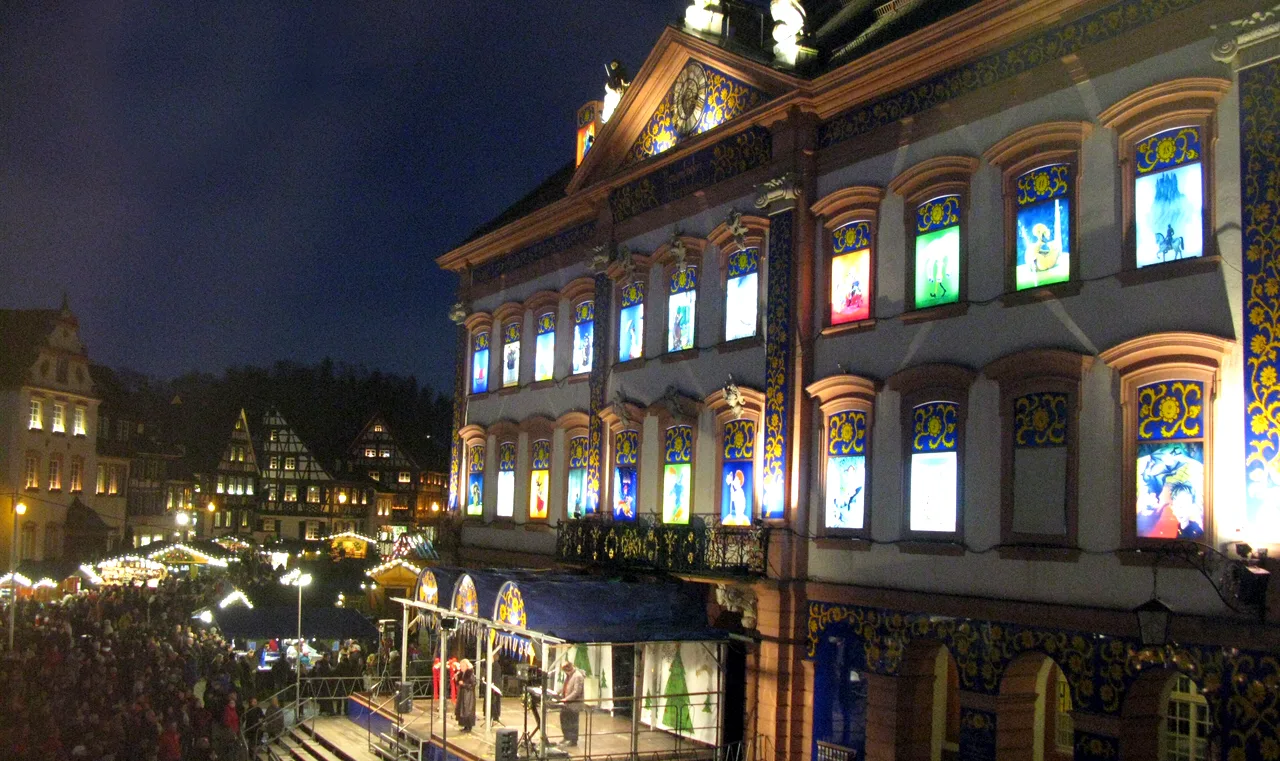
Gengenbach is a small town of about 11,000 people in Baden-Württemberg, south-west Germany, set at the mouth of the Kinzig valley on the western edge of the Black Forest. From 1366 to 1803 it was a Free Imperial City (Reichsstadt); in 1689, during the Nine Years’ War, it was largely burned and then rebuilt. Today its gates, towers, flower-decked half-timbered houses and narrow lanes make it one of the best-preserved old towns of the Black Forest region. Its real fame, though, comes in Advent: for more than 20 years the early classicist town hall (Rathaus) of 1784 has been turned each December into the “world’s largest Advent calendar house”, with 24 windows. One window opens every evening, while a small, friendly Advent market fills the Marktplatz in front. Around 10 km from Offenburg, Gengenbach combines easily with trips to Strasbourg, Freiburg and deeper into the Black Forest.
Content update: 28 October 2026 · Advent calendar and market dates checked against the official gengenbach.info (Kultur und Tourismus GmbH Gengenbach)
Gengenbach at a Glance
- Country / State
- Germany · Baden-Württemberg · Ortenau district
- Population
- About 11,000
- Language
- German (local Alemannic dialect); some English in tourist spots
- Currency
- Euro (EUR); cards widely accepted, cash useful for small stalls
- Time zone
- Central European Time (CET, UTC+1); 2 hours behind Türkiye in winter
- Known for
- World’s largest Advent calendar house, half-timbered old town, Fasend carnival, Kinzig valley
- Landmarks
- Rathaus, Marktbrunnen, Engelgasse, Kinzigtor, Obertor, Niggelturm, St. Marien
- Nearby
- Offenburg, Durbach, Zell am Harmersbach, Vogtsbauernhof, Triberg, Strasbourg
- Christmas
- Advent calendar 30 November–23 December 2026, every evening at 6 pm (visible until 6 January 2027); Advent market 27 November–23 December
- Airport
- Closest: Baden-Airpark (Karlsruhe/Baden-Baden), Strasbourg and EuroAirport Basel; for more flights, Frankfurt or Stuttgart
- Electricity
- 230 V, European type C/F sockets
- Emergency
- 112 (ambulance/fire), 110 (police)
Gengenbach in Pictures
Red roofs and the Hauptstraße from the Niggelturm, an old town full of half-timbered houses, and the Kinzig valley framed by Black Forest hills: Gengenbach in three pictures.


Gengenbach Advent Calendar and Market 2026
Christmas in Gengenbach revolves less around a big market than around a single building. For more than 20 years the early classicist town hall, built in 1784, has been turned every Advent into the “world’s largest Advent calendar house” with its 24 windows. According to the official gengenbach.info, the 2026 theme is “Verhüllt. Verwandelt. Erleuchtet.”: the façade is veiled and reproduced, and from 30 November to 23 December one window opens every evening at 6 pm. The motifs are by the artist Olaf Hajek, known for his “Paradiese” (Paradises) works. A short stage programme in front of the town hall accompanies the window openings. On the Marktplatz in front, an Advent market of around 60 stalls sets up. In the Baroque mansion Haus Löwenberg, photographer Tom Hegen’s exhibition “TERRA EXTRACT” is on show during Advent. The details below were checked against official sources on 28 October 2026.


| Event | Location | 2026 dates | Note |
|---|---|---|---|
| Advent calendar house | Rathaus, Marktplatz | 30 November–23 December 2026 (visible until 6 January 2027) | 24 windows; one opens every evening at 6 pm. Theme “Verhüllt. Verwandelt. Erleuchtet.”, motifs by Olaf Hajek. |
| Advent market | Marktplatz, in front of the town hall | 27 November–23 December 2026 | Around 60 stalls. Published hours: Mon–Fri 2–8 pm, Sat and Sun 11:30 am–8 pm. |
| Window-opening programme | Stage in front of the town hall | Every evening in Advent | Short stage programme around the window opening; details on the official website. |
| TERRA EXTRACT exhibition | Haus Löwenberg | Advent season | Exhibition by photographer Tom Hegen; check dates and hours on the official website. |
What to try
Glühwein
Spiced hot wine; the Ortenau wine culture shows here too. Alcohol-free Kinderpunsch is available.
Black Forest gateau
Schwarzwälder Kirschtorte with cherries, cream and chocolate; a café classic in town.
Flammkuchen
Thin base with cream, onion and bacon; the warm snack of a region bordering Alsace.
Roasted almonds
Hot sugar-roasted almonds (gebrannte Mandeln); the smell of the market.
Bratwurst
Grilled sausage in a bun; usually pork, so ask.
Springerle and Christmas biscuits
Embossed anise biscuits of Baden and Württemberg, plus assorted Christmas cookies.
Gengenbach Advent tips
- The window opens every evening at 6 pm; arrive 15–20 minutes early for a good spot on the Marktplatz, especially at weekends.
- The market opens at 2 pm on weekdays; explore the old town by day and move to the market in the afternoon.
- The calendar stays lit until 6 January 2027, so visitors after Christmas can see all the windows.
- Parking is limited at weekends; arriving by train on the Black Forest Railway is easier.
- A deposit is usually charged for mulled-wine mugs and refunded on return.
- Card payment is spreading, but carry some cash in euros for small stalls.
- By train you can combine Gengenbach with Offenburg, Strasbourg or Freiburg on the same day.
- In December it gets dark around 4:30 pm; see the Kinzig riverside and the Bergle in daylight.
Check before you go: Gengenbach · Adventskalender „Verhüllt. Verwandelt. Erleuchtet.“ (official) ↗ · Kultur und Tourismus GmbH Gengenbach · gengenbach.info ↗ · Schwarzwald Tourismus · schwarzwald-tourismus.info ↗
Dates were checked on 28 October 2026 on the official gengenbach.info (Kultur und Tourismus GmbH Gengenbach). The event programme, stage shows and exhibition hours at Haus Löwenberg may change; check the official website again before your visit.
When to Go
Advent is Gengenbach’s busiest season: late November and December, when the town hall becomes a calendar, bring the most visitors. May to October is best for hiking, vineyards and Black Forest trips; September and October are grape-harvest season. January and February are quiet, though the town comes alive again during carnival (Fasend) week.
| Month | Old-town walks | Advent calendar | Black Forest and vineyards | Crowds |
|---|---|---|---|---|
| January | Difficult | None | Difficult | Quiet |
| February | Difficult | None | Difficult | Quiet |
| March | Good | None | Good | Moderate |
| April | Very good | None | Very good | Moderate |
| May | Very good | None | Very good | Moderate |
| June | Very good | None | Very good | Busy |
| July | Very good | None | Very good | Busy |
| August | Very good | None | Very good | Busy |
| September | Very good | None | Very good | Moderate |
| October | Very good | None | Very good | Moderate |
| November | Good | Calendar season | Good | Moderate |
| December | Good | Calendar season | Difficult | Busy |
- In December Gengenbach is usually 0–6 °C; rain is frequent and snow occasional, more likely at higher elevations.
- The Advent calendar windows open every evening at 6 pm from 30 November to 23 December 2026 and can be seen until 6 January 2027.
- The Advent market runs from 27 November to 23 December 2026 and opens at 2 pm on weekdays.
- Some Black Forest museums, such as the Vogtsbauernhof open-air museum, close in winter; check season dates on official websites.
- Fasend (carnival) is celebrated in the days before Ash Wednesday; the dates change every year.
- Rooms in town fill quickly on Advent weekends; staying in Offenburg is an alternative.
Visa and Entry (Turkish citizens)
Turkish citizens holding an ordinary (burgundy) passport need a Schengen visa for tourist travel to Germany. Different rules apply to special, service and diplomatic passports; check the current situation with the Turkish Ministry of Foreign Affairs.
You apply to the mission of your main destination country. If Germany is the main destination, the German missions in Türkiye are responsible; current information is at tuerkei.diplo.de.
If you combine Gengenbach with Strasbourg and Colmar (France) or Basel (Switzerland), apply according to where you will spend the longest. Checks may take place at internal borders; carry your passport.
Under the EU Entry/Exit System (EES), being introduced in stages, your biometric data (facial image and fingerprints) may be taken on first entry; allow extra time at the border.
Visa fees, appointment waiting times and required documents may change; this guide gives no fees. Use the current list on official websites before applying.
Travel medical insurance plus accommodation and return details are part of the application; see the official sources for details.
Check before you go: T.C. Dışişleri Bakanlığı · Türk vatandaşlarının tabi olduğu vize uygulamaları ↗ · tuerkei.diplo.de ↗ · EES · europa.eu ↗ · Rota Atlası visa guide (TR)
Travel medical insurance
Check the official visa and entry sources above first: they state whether travel medical insurance is required and the minimum cover. Compare any policy’s cover amount, validity dates and countries covered with the official requirement.
Rota Atlası does not currently offer an insurance partnership; there are no paid links in this section. Last updated: 1 November 2026
Getting to Gengenbach
- By air: The closest airports are Baden-Airpark (Karlsruhe/Baden-Baden), Strasbourg and EuroAirport Basel-Mulhouse-Freiburg; for more flight options, fly into Frankfurt or Stuttgart and continue by train. Check current flights only on official airline and airport websites.
- By train: Gengenbach is on the Black Forest Railway (Schwarzwaldbahn), which climbs from Offenburg into the Black Forest. Offenburg is an ICE/IC stop on the Karlsruhe–Basel main line; from there a regional train takes a few minutes. Timetables and tickets at bahn.de.
- From Strasbourg: Regional trains run between Strasbourg and Offenburg; change in Offenburg for Gengenbach.
- By road: From the A5 motorway exit Offenburg, take the B33 into the Kinzig valley. Parking is limited on Advent weekends; the train is more practical.
Getting Around

On foot
The old town is small; it takes a few minutes to walk along the Hauptstraße from Kinzigtor to Obertor. All sights are within walking distance.
Train
The Black Forest Railway links Offenburg and Black Forest towns (Hausach, Hornberg, Triberg).
Bus
Regional buses serve Zell am Harmersbach and surrounding villages; fares via TGO (Ortenau fare association).
Guest card
Some accommodation in the region may issue a guest card covering local transport; ask your host and check the official website.
Car
A car gives flexibility for small Black Forest villages and wine villages such as Durbach.
Bike
The Kinzig valley cycle path (Kinzigtal-Radweg) follows the valley; limited in winter.
Things to See
Gengenbach’s sights are packed into the compact old town between two gates: the Marktplatz and town hall at the centre, the flowery lanes of Engelgasse to the north, Kinzigtor and Niggelturm to the west and Obertor to the east. Then come the abbey church, the Bergle hill and the Kinzig riverside; the last sections cover easy trips to Offenburg, Durbach, the Black Forest and Strasbourg.
Centre
Marktplatz, Rathaus and Marktbrunnen

The heart of Gengenbach is the triangular Marktplatz in the middle of the old town. At its head stands the early classicist town hall designed by Viktor Kretz and completed in 1784; this elegant building, a statement of the free imperial city’s standing, becomes a giant calendar with 24 windows in Advent. On top of the Marktbrunnen fountain in the middle of the square stands an armoured knight, symbolising the town’s imperial freedom. The figure in place today is a 1975 copy; the 1582 original was removed for its protection. Baroque and half-timbered houses, cafés and small shops line the square.
Don’t miss
- The town hall as an Advent calendar
- The Marktbrunnen with its knight
- View from the square to the Obertor
- The window opening in Advent (6 pm)
Tips
- The square is lively on weekly market days.
- The best spot for evening-light photos is beside the fountain.
- It gets very crowded before 6 pm on Advent weekends.


Lane
Engelgasse and Höllengasse

North of the Marktplatz runs Engelgasse, the most photogenic corner of the old town: a narrow cobbled lane of half-timbered houses with flower boxes and eaves leaning towards each other. Its name means “Angel Lane”, a pleasing contrast with nearby Höllengasse, “Hell Lane”. The narrow passages and small courtyards of Höllengasse preserve the town’s medieval fabric, and the lane is also home to the Narrenbrunnen fountain decorated with carnival figures. These lanes give the best sense of the scale of the town rebuilt after the fire of 1689.
Don’t miss
- The flower-decked half-timbered houses of Engelgasse
- The narrow passages of Höllengasse
- The Narrenbrunnen with carnival figures
Tips
- The houses are private homes; stay out of courtyards and keep noise down.
- Mornings are the quietest time for photos.
- Cobbles are slippery when wet.

Town gate
Kinzigtor

On the west side of the old town, facing the Kinzig river, rises the Kinzigtor. One of the surviving gates of the medieval walls, the tower is a symbol of the town’s defences in its imperial era. The road through the gate leads along the Hauptstraße to the Marktplatz and on to the Obertor. Traces of the walls and towers can be seen around the gate; the view from Kinzigtor to the Niggelturm is one of the town’s classic postcard shots.
Don’t miss
- The outer face of the gate
- View from Kinzigtor to the Niggelturm
- A short walk along the line of the walls
Tips
- It is the natural entry point when walking from the station.
- The gate looks different under evening lights.
- Check on the official website whether tower interiors are open.
Town gate
Obertor and Hauptstraße

The Hauptstraße is the main street running right through the old town between Kinzigtor and Obertor. Baroque mansions, old inn buildings and half-timbered houses line it, most with cafés, bakeries and shops on the ground floor. At the eastern end rises the Obertor (Upper Gate), one of Gengenbach’s best-known towers; seen from the Marktplatz it closes off the end of the street and marks the edge of the old town.
Don’t miss
- The façade of the Obertor tower
- The historic façades of the Hauptstraße
- The perspective from the Marktplatz to the Obertor
Tips
- The street gives priority to pedestrians; still walk carefully.
- Shops are usually closed on Sundays.
- From the Obertor you can walk on towards the Bergle.

Museum
Niggelturm and Narrenmuseum

The roughly 36-metre Niggelturm is one of the town’s old defensive towers and today houses the Narrenmuseum (Fools’ Museum), devoted to Gengenbach’s carnival, Fasend. Carnival masks, costumes and traditional figures are displayed over the tower’s floors; this is the place to meet Gengenbach’s “Hexe” (witch) and “Spättlehansel” figures up close. The town’s carnival guild, the Narrenzunft, is traditionally traced back to 1499. The upper floors look out over the town’s roofs and the Hauptstraße.
Don’t miss
- Carnival masks in the Narrenmuseum
- The Hexe and Spättlehansel figures
- Rooftop views from the tower
Tips
- Museum opening days vary by season; check the official website.
- The stairs are narrow and steep.
- If you cannot come during Fasend, this is the best way to discover the carnival culture.

Church
St. Marien Church and the former abbey

The town grew up around a Benedictine abbey traditionally said to have been founded in the 8th century. The abbey church of St. Marien is today the town’s parish church (Stadtkirche). Built on a Romanesque basilica plan, the church was altered many times over the centuries, and its present interior shows these historical layers together. The former abbey buildings beside it are now used for education and institutional purposes. The abbey quarter is a few minutes’ walk from the Marktplatz and a quiet corner away from the crowds.
Don’t miss
- The Romanesque plan of St. Marien
- The former abbey buildings
- The quiet surroundings of the abbey courtyard
Tips
- Visits are limited during services; keep quiet.
- Some abbey buildings are in use; stick to the open areas.
- Church opening times may vary.

Old town
Haus Löwenberg and the half-timbered houses

Gengenbach’s old town, rebuilt after the fire of 1689, presents a coherent picture of half-timbered (Fachwerk) houses and Baroque mansions. One of these mansions, Haus Löwenberg, now hosts art and photography exhibitions; during Advent it shows photographer Tom Hegen’s “TERRA EXTRACT”. In the small squares and lanes of the old town, fountains, flower-filled windows and door inscriptions catch the eye. Historic fountains in front of half-timbered houses make some of the town’s favourite photographs.
Don’t miss
- The exhibition at Haus Löwenberg
- Half-timbered houses and fountains
- Door inscriptions and historic signs
Tips
- Check exhibition hours on the official website.
- Most houses are private homes.
- Turn off behind the Marktplatz for quieter lanes.
Viewpoint
Bergle and Jakobuskapelle

On top of the vine-covered Bergle hill north of town stands the small Jakobuskapelle (St. James’s Chapel). A path climbs through the vineyards from the old town in about half an hour. From the top there is a wide panorama of Gengenbach’s roofs, the Kinzig valley and the first hills of the Black Forest, reaching to the Rhine plain on clear days. The slopes of the Bergle show the wine culture of the Ortenau right next to town.
Don’t miss
- Town panorama from the Jakobuskapelle
- The path through the vineyards
- View of the Kinzig valley
Tips
- The path can be muddy and slippery after rain; wear suitable shoes.
- It gets dark early in winter, so go up before noon.
- The vineyards are private property; stay on the path.
River
Kinzig riverside and rafting heritage

The Kinzig river, flowing just west of Gengenbach, was for centuries the route of the raftsmen (Flößer) who carried Black Forest timber to the Rhine. Huge rafts made from tree trunks travelled from the Kinzig to the Rhine and on as far as the Netherlands. The town’s Flößerei- und Verkehrsmuseum (Rafting and Transport Museum) tells this story and the region’s transport history. Today the riverside is a quiet place for walking and cycling, with the Kinzigtal-Radweg running along the valley.
Don’t miss
- A walk along the Kinzig
- The Flößerei- und Verkehrsmuseum
- Views of the Kinzig valley
Tips
- The museum has limited opening days; check the official website.
- The riverside is cold and windy in winter.
- The station is close to the river.
Day trip
Offenburg and Durbach

A few minutes away by train, Offenburg is the centre of the Ortenau region, with a Baroque town hall, an old town and its own Christmas market, good for a half-day trip (check dates on offenburg.de). North-east of Offenburg, Durbach is one of the best-known wine villages of the Ortenau: vineyards on steep slopes and Schloss Staufenberg above them are the area’s emblem. During Advent, decorated trees in the vineyards around Durbach and local events may be seen; see the Durbach municipality’s official website for details.
Don’t miss
- Schloss Staufenberg and the vineyard views
- Offenburg old town
- Ortenau wine culture
Tips
- Public transport to Durbach is limited; a car or taxi is more practical.
- Do not drive after wine tasting.
- Check Offenburg Christmas market dates on the official website.
Day trip
Vogtsbauernhof and Triberg

The Black Forest Railway climbs from Gengenbach into the Black Forest. In Gutach near Hausach, the Black Forest Open-Air Museum Vogtsbauernhof shows traditional Black Forest farmhouses, mills and village life; it is closed in winter, with season dates on its official website. Further along the line, Triberg is known for the Triberg Waterfalls, considered among the highest in Germany, and for the cuckoo-clock tradition. The Black Forest Railway itself is a scenic journey full of tunnels and viaducts.
Don’t miss
- Vogtsbauernhof farmhouses (in season)
- Triberg Waterfalls
- The Black Forest Railway scenery
Tips
- Check Vogtsbauernhof’s winter closure dates in advance.
- Waterfall paths can be icy in winter.
- Check train times at bahn.de.

Day trip
Zell am Harmersbach and Strasbourg

In the Harmersbach valley south-east of Gengenbach, Zell am Harmersbach was also once a small free imperial city; with historic water wheels, towers and a ceramics tradition it makes a quiet side trip. To the west, across the Rhine in the French region of Alsace, lies Strasbourg: its Notre-Dame Cathedral and the old town known as the “Grande-Île” are on the UNESCO World Heritage List. Strasbourg’s “Christkindelsmärik” Christmas market is considered one of the oldest in Europe, and it can be combined with Gengenbach on the same day by train via Offenburg. Check dates and times with strasbourg.eu and the Strasbourg tourist office. UNESCO listing ↗
Don’t miss
- Strasbourg Cathedral and the Grande-Île
- Strasbourg Christmas market
- Zell am Harmersbach old town
Tips
- Carry your passport when crossing into France; internal border checks are possible.
- Strasbourg is very crowded in Advent; go early.
- See also the Rota Atlası Strasbourg guide.

1, 2 and 3-Day Itineraries + Christmas Day
The itineraries are planned around walking and train links. Gengenbach’s old town can be seen in half a day; one day covers the town and the Advent calendar, two days the Black Forest, three days a trip to Strasbourg or Freiburg. Check museum and exhibition hours on official websites in advance.
1 day: Old town and the calendar
- In the morning walk from the station to the Kinzigtor and see the Niggelturm; visit the Narrenmuseum if open.
- Continue along the Hauptstraße to the Marktplatz; look at the town hall and the Marktbrunnen.
- Wander the half-timbered houses of Engelgasse and Höllengasse.
- In the afternoon stop at St. Marien church, then climb the Bergle.
- In the evening watch the day’s window open on the Marktplatz (6 pm in Advent).
2 days: Into the Black Forest
- Follow the day-1 route.
- On day 2 take the Black Forest Railway into the Black Forest.
- Visit the Vogtsbauernhof open-air museum if in season.
- See the Triberg Waterfalls and the cuckoo-clock shops.
- Return to Gengenbach in the evening.
3 days: Strasbourg or Freiburg
- Follow the routes of the first two days.
- On day 3 take the train via Offenburg to Strasbourg.
- Explore the cathedral and the Grande-Île.
- In Advent, wander the Christkindelsmärik.
- Alternatively visit Freiburg.
Advent day (27 November–23 December 2026)
- In the morning explore the old town and Engelgasse in daylight.
- Around midday stop at a café for Black Forest gateau.
- In the afternoon visit the exhibition at Haus Löwenberg.
- When the market opens (2 pm on weekdays) browse the stalls and try Glühwein.
- At 6 pm watch the day’s window open in front of the town hall.
Black Forest and Baden Food
Gengenbach lies between the Black Forest and the Rhine plain; its food brings together Baden’s rich culinary culture, Black Forest produce and Alsatian influence. The Ortenau is also a wine region. Below are regional specialities, not restaurant recommendations.


Black Forest gateau
Schwarzwälder Kirschtorte made with chocolate sponge, cream, cherries and Kirschwasser (cherry brandy); may contain alcohol.
Black Forest ham
Smoked and cured Schwarzwälder Schinken; made from pork.
Zwiebelkuchen
Onion and cream tart, usually eaten in autumn with new wine; most versions contain bacon.
Flammkuchen
Thin base with cream, onion and bacon; shared by Alsace and Baden.
Schäufele
Baden-style smoked pork shoulder; a traditional Sunday dish.
Brägele
Baden-style fried potatoes.
Ortenau wines
The region’s Spätburgunder and Riesling (locally called Klingelberger).
Kirschwasser
Black Forest cherry brandy; contains alcohol.
- Many regional dishes contain pork or bacon; ask about ingredients.
- Black Forest gateau and some desserts may contain alcohol.
- Tap water is safe to drink.
- Service is included in prices; tipping is optional, usually by rounding up.
Culture and Etiquette

- Greet with “Guten Tag” or “Hallo”; saying hello when entering a shop is polite.
- Quiet is expected on Sundays and after 10 pm; shops are closed on Sundays.
- Be quiet in churches and do not walk around during services.
- Recycling is taken seriously; bottles and cans carry a deposit (Pfand).
- The local dialect is Alemannic; standard German is understood.
- Fasend (carnival) is one of Gengenbach’s most important traditions; respect the costumed figures.
- Most half-timbered houses are private homes; stay out of courtyards.
- At the Advent window opening, do not block the view of those behind you.
- Vineyards are private property; stay on paths.
- Respect people’s privacy when taking photos.
Safety and Health
- Gengenbach is generally a very safe town; watch your valuables in the Advent evening crowds.
- Cobbled lanes and stairs can be slippery in winter; wear non-slip shoes.
- Paths on the Bergle and in the Black Forest can be dangerous after rain or ice.
- Weather in the Black Forest can change quickly; snow and fog are possible at altitude.
- Traffic is light, but watch for vehicles in narrow lanes.
- In an emergency call 112, police 110. Travel medical insurance is mandatory for a Schengen visa.
- Check official travel advice (e.g. the Turkish Ministry of Foreign Affairs or GOV.UK) before you travel.
What Your Budget Depends On
This guide gives no prices, as they change by season and year. Your budget depends on:
Dates
Demand for rooms rises on Advent weekends; weekdays may be cheaper.
Where you stay
Gengenbach has a limited number of rooms; Offenburg or nearby villages are alternatives.
Transport
Trains belong to the regional fare association; day tickets and guest cards affect costs.
Museums
The Narrenmuseum, rafting museum and Vogtsbauernhof each charge separately.
Food and drink
Bakeries and market stalls are budget options; restaurants cost more.
Day trips
Trips to Strasbourg, Freiburg or the Black Forest add train costs.
Free experiences
Old-town walks, the Advent window opening, the market, the Bergle and the Kinzig riverside are free.
Practical Information
- Money: The euro is used; cards are widely accepted but carry cash for small stalls.
- Language: German is spoken; English may be limited outside tourist spots.
- Plugs: 230 V, European type C/F.
- Opening hours: Shops are closed on Sundays; most close early on the afternoon of 24 December, and 25–26 December are public holidays.
- Mobile data: EU roaming rules do not apply to non-EU SIM cards; check your provider’s roaming plans.
- Tourist office: Current information from Kultur und Tourismus GmbH Gengenbach is on gengenbach.info.
- Accessibility: Old-town lanes are cobbled and sometimes sloping; wheelchair access may be limited.
- Photography: The Marktplatz, Engelgasse, Kinzigtor and the Bergle are the best spots.
- UNESCO: Gengenbach is not listed; nearby Strasbourg Grande-Île and Neustadt (495) and the Monastic Island of Reichenau (974) are World Heritage sites.
- Daylight: In December it gets dark around 4:30 pm.
Frequently Asked Questions
When is the Gengenbach Advent calendar in 2026?
According to the official gengenbach.info, a town-hall window opens every evening at 6 pm from 30 November to 23 December 2026; the calendar can be seen until 6 January 2027.
What is the 2026 theme?
“Verhüllt. Verwandelt. Erleuchtet.” (Veiled. Transformed. Illuminated.). The window motifs are by the artist Olaf Hajek.
When is the Advent market open?
27 November–23 December 2026; published hours Mon–Fri 2–8 pm, Sat and Sun 11:30 am–8 pm. Check times on the official website.
Why is it called the “world’s largest Advent calendar house”?
The 24 windows of the 1784 town hall are turned into an Advent calendar every Advent; Gengenbach promotes it as the world’s largest Advent calendar house.
Is there an entry fee?
The window opening and the Advent market are free; food, drink and exhibitions cost extra.
How many days should I spend in Gengenbach?
One day is enough for the town and the Advent calendar; 2–3 days are ideal with trips to the Black Forest or Strasbourg.
How do I get to Gengenbach?
Take the train to Offenburg, then a regional train on the Black Forest Railway for a few minutes. Times at bahn.de.
Do Turkish citizens need a visa?
Holders of ordinary passports need a Schengen visa. If Germany is the main destination, apply to the German missions in Türkiye; current information at tuerkei.diplo.de.
Can I visit Strasbourg on the same day?
Yes, by train via Offenburg. Strasbourg is very crowded in Advent, so start early.
What is the weather like in winter?
In December temperatures are usually 0–6 °C; rain is frequent and snow occasional. Wear waterproof layers.
Where to stay
Stay close to the areas where you will spend most time. The areas below are covered in detail in this guide; check public transport links in the getting-around section.
- CentreMarktplatz, Rathaus and Marktbrunnen
- LaneEngelgasse and Höllengasse
- Town gateKinzigtor
- Town gateObertor and Hauptstraße
- MuseumNiggelturm and Narrenmuseum
- ChurchSt. Marien Church and the former abbey
- Old townHaus Löwenberg and the half-timbered houses
- ViewpointBergle and Jakobuskapelle
- RiverKinzig riverside and rafting heritage
Search hotels in these areas (Hotellook) ↗ (affiliate link)Search on Booking.com ↗
Affiliate disclosure: Hotellook, Aviasales, Klook, Airalo, Tiqets and DiscoverCars links are affiliate links; Rota Atlası may earn a commission on bookings made through them, at no extra cost to you. Official and in-guide links are not paid. Last updated: 1 November 2026 · Privacy and affiliates
Transport and connectivity
- Airport transferOptions from the airport to the city are in this guide’s getting there section.
- Mobile data (eSIM)Airalo eSIM ↗ (affiliate link)
- TrainsOfficial rail website ↗
- Car hireYou rarely need a car within the city; see getting around first. Compare car hire on DiscoverCars ↗ (affiliate link)
Affiliate disclosure: Hotellook, Aviasales, Klook, Airalo, Tiqets and DiscoverCars links are affiliate links; Rota Atlası may earn a commission on bookings made through them, at no extra cost to you. Official and in-guide links are not paid. Last updated: 1 November 2026 · Privacy and affiliates
Search flights (affiliate link)
Search flights from any airport in any country. Results open on Aviasales in a new tab, where you book.
This form is an affiliate link: Rota Atlası may earn a commission on bookings made via Aviasales (Travelpayouts), at no extra cost to you. Check price, baggage and terms on the booking site. Airport data: OurAirports (public domain).
Flights, hotels and tours
Find tours and tickets
- Gengenbach Advent Calendar and Advent Market
GetYourGuide ↗ · Klook ↗ (affiliate link) - Marktplatz and Town Hall
GetYourGuide ↗ · Klook ↗ (affiliate link) - Old town: towers, gates and lanes
GetYourGuide ↗ · Klook ↗ (affiliate link) - Former Benedictine Abbey
GetYourGuide ↗ · Klook ↗ (affiliate link)
Hotellook, Aviasales, Klook, Airalo and Tiqets links in this box are affiliate links (Travelpayouts): Rota Atlası may earn a commission on bookings made through them, at no extra cost to you. GetYourGuide links currently carry no affiliate code. Check prices and terms with the provider. Last updated: 1 November 2026 · Privacy and affiliates
Sources
- T.C. Dışişleri Bakanlığı · Türk vatandaşlarının tabi olduğu vize uygulamaları ↗
- Auswärtiges Amt · Deutsche Vertretungen in der Türkei (Visa) ↗
- European Union · Entry/Exit System (EES) ↗
- Kultur und Tourismus GmbH Gengenbach · gengenbach.info (official) ↗
- Gengenbach · Adventskalender (official) ↗
- Schwarzwald Tourismus · schwarzwald-tourismus.info (official) ↗
- Schwarzwälder Freilichtmuseum Vogtsbauernhof (official) ↗
- Stadt Triberg · triberg.de (official) ↗
- Stadt Offenburg · offenburg.de (official) ↗
- Gemeinde Durbach · durbach.de (official) ↗
- Baden-Airpark · Flughafen Karlsruhe/Baden-Baden ↗
- EuroAirport Basel Mulhouse Freiburg ↗
- Deutsche Bahn ↗
- GOV.UK · Foreign travel advice · Germany ↗
- UNESCO World Heritage Centre · Strasbourg, Grande-Île and Neustadt ↗
- UNESCO World Heritage Centre · Monastic Island of Reichenau ↗
- Gengenbach · Adventskalender „Verhüllt. Verwandelt. Erleuchtet.“ (official) ↗
- Kultur und Tourismus GmbH Gengenbach · gengenbach.info ↗
- Schwarzwald Tourismus · schwarzwald-tourismus.info ↗
This page is for information only. Dates, opening hours, entry rules and transport details may change; check the official sources above before you travel. No prices, flights, hotels or restaurants have been invented in this guide.
Photo credits
The photos on this page come from Wikimedia Commons and are used under the stated authors and licences (CC BY, CC BY-SA, CC0 or public domain). List of all sources
- The gable of Gengenbach town hall reading “Adventskalender” with lit windows — Gerd Eichmann · CC BY 4.0 · Wikimedia Commons
- The lit Advent calendar windows of Gengenbach town hall — Gerd Eichmann · CC BY 4.0 · Wikimedia Commons
- Gengenbach town hall decorated as the Advent calendar house — RudolfSimon · CC BY-SA 3.0 · Wikimedia Commons
- The Advent calendar house and Marktplatz in the evening — Andreas Schwarzkopf · CC BY-SA 3.0 · Wikimedia Commons
- The Gengenbach Advent market in front of the town hall — Gerd Eichmann · CC BY 4.0 · Wikimedia Commons
- Advent market stalls and visitors on the Marktplatz — Gerd Eichmann · CC BY 4.0 · Wikimedia Commons
- Decorated Christmas trees in the vineyards near Durbach — Gerd Eichmann · CC BY 4.0 · Wikimedia Commons
- Gengenbach’s rooftops and Hauptstrasse from the Niggelturm — Gerd Eichmann · CC BY 4.0 · Wikimedia Commons
- Half-timbered houses in Gengenbach’s old town — Baden de · CC BY 3.0 · Wikimedia Commons
- The Kinzig valley and Black Forest hills near Gengenbach — Moleskine · CC BY-SA 4.0 · Wikimedia Commons
- Gengenbach’s early neoclassical town hall of 1784 — GFHund · CC BY-SA 4.0 · Wikimedia Commons
- The Marktbrunnen with its knight figure and the town hall — Gerd Eichmann · CC BY 4.0 · Wikimedia Commons
- View across the Marktplatz to the Obertor gate tower — FlexLoge · CC BY-SA 4.0 · Wikimedia Commons
- The half-timbered houses of Engelgasse — Gerd Eichmann · CC BY 4.0 · Wikimedia Commons
- The narrow Höllengasse lane in Gengenbach — Baden de · CC BY 3.0 · Wikimedia Commons
- The Kinzigtor gate tower, Gengenbach — Peter Poschadel · CC BY-SA 4.0 · Wikimedia Commons
- The Obertor gate tower at the end of Hauptstrasse — Gerd Eichmann · CC BY 4.0 · Wikimedia Commons
- Historic façades on Hauptstrasse, Gengenbach — Gerd Eichmann · CC BY 4.0 · Wikimedia Commons
- View from the Kinzigtor to the Niggelturm tower — Peter Poschadel · CC BY-SA 4.0 · Wikimedia Commons
- Carnival costumes in the Narrenmuseum in the Niggelturm — Peter Poschadel · CC BY-SA 4.0 · Wikimedia Commons
- The former Benedictine abbey church of St. Marien from the south-east — Pierre Poschadel · CC BY-SA 4.0 · Wikimedia Commons
- The Stadtkirche and former abbey buildings in Gengenbach — Holger Uwe Schmitt · CC BY-SA 4.0 · Wikimedia Commons
- A fountain in front of half-timbered houses in Gengenbach — Gerd Eichmann · CC BY 4.0 · Wikimedia Commons
- The Bergle hill and the Jakobuskapelle among the vineyards — Elfriede Birkenmayer · CC0 · Wikimedia Commons
- The banks of the Kinzig river at Gengenbach — Roland Knobloch · CC0 · Wikimedia Commons
- Vineyards seen from Staufenberg Castle in Durbach — Gerd Eichmann · CC BY 4.0 · Wikimedia Commons
- A Black Forest farmhouse at the Vogtsbauernhof open-air museum in Gutach — H. Zell · CC BY-SA 3.0 · Wikimedia Commons
- The Triberg waterfalls in the Black Forest — Uoaei1 · CC BY-SA 4.0 · Wikimedia Commons
- A historic water wheel in Zell am Harmersbach — H. Zell · CC BY-SA 3.0 · Wikimedia Commons
- Strasbourg’s Notre-Dame Cathedral — Tom à la rue · CC BY-SA 2.0 · Wikimedia Commons
- A platform of Gengenbach station on the Black Forest Railway — Coaster J · CC BY-SA 4.0 · Wikimedia Commons
- A slice of Black Forest gateau with cream and cherries — Silar · CC BY-SA 4.0 · Wikimedia Commons
- Packaged Schwarzwälder Schinken (Black Forest ham) — Pohled 111 · CC BY-SA 4.0 · Wikimedia Commons
- Freshly baked Zwiebelkuchen (onion tart) — Shisma · CC BY 4.0 · Wikimedia Commons
- Thin-crust Flammkuchen with cream and bacon — Brücke-Osteuropa · CC0 · Wikimedia Commons
- The Narrenbrunnen carnival fountain in Höllengasse — Gerd Eichmann · CC BY 4.0 · Wikimedia Commons
Freiburg → · Strasbourg → · Colmar → · Stuttgart → · Basel → · Christmas markets