

Düsseldorf, the capital of the state of North Rhine-Westphalia, lies on the right bank of the Rhine and takes its name from the small Düssel stream that flows into the river here. It received its town charter in 1288 and later became the residence of the Dukes of Berg and the Electors Palatine; Elector Johann Wilhelm, known as Jan Wellem, made it a centre of art and culture around 1700. Today Düsseldorf is a city of fashion, trade, art and advertising, with one of the largest Japanese communities in Europe. Its compact Altstadt, packed with traditional brewhouses serving the local Altbier, is often called “the longest bar in the world”; the Rhine promenade links it with the Rheinturm and the striking architecture of the MedienHafen. The Königsallee, or “Kö”, is one of Germany’s best-known shopping streets, and the K20 and K21 museums and the Kunstpalast hold major art collections. In Advent several Christmas markets fill the Altstadt and city centre with lights, from the Marktplatz in front of the Town Hall to Königsallee. This guide brings together the markets, the Altstadt and Rhine, art, parks and palaces, Rhineland food and trips to Kaiserswerth, Benrath and Cologne, with official sources.
Content update: 28 October 2026 · Christmas dates checked against the official visitduesseldorf.de page
Düsseldorf at a Glance
- Country
- Germany · North Rhine-Westphalia (state capital)
- Population
- About 630,000; on the right bank of the Rhine
- Language
- German (Rhineland dialect); English widely understood
- Currency
- Euro (EUR); cards widely accepted, carry some cash for stalls
- Time zone
- Central European Time (CET, UTC+1)
- Known for
- Altstadt and Altbier, Königsallee, art museums, MedienHafen, carnival
- Highlights
- Altstadt, Rhine promenade, Rheinturm, MedienHafen, Königsallee, K20/K21, Kunstpalast, Hofgarten
- Nearby
- Benrath Palace, Kaiserswerth, Cologne, Aachen
- Christmas
- Christmas markets 19 November–30 December 2026 (closed 22 November and 25 December)
- Airport
- Düsseldorf Airport (DUS), north of the city
- Electricity
- 230 V, type C/F sockets; Turkish plugs fit
- Emergency
- 112 (ambulance, fire), 110 (police)
Düsseldorf in Pictures
The skyline from the Oberkassel Bridge, the Gehry buildings of the Neuer Zollhof at blue hour and the Jan Wellem statue on the Marktplatz: Düsseldorf in three pictures.


Düsseldorf Christmas Markets 2026
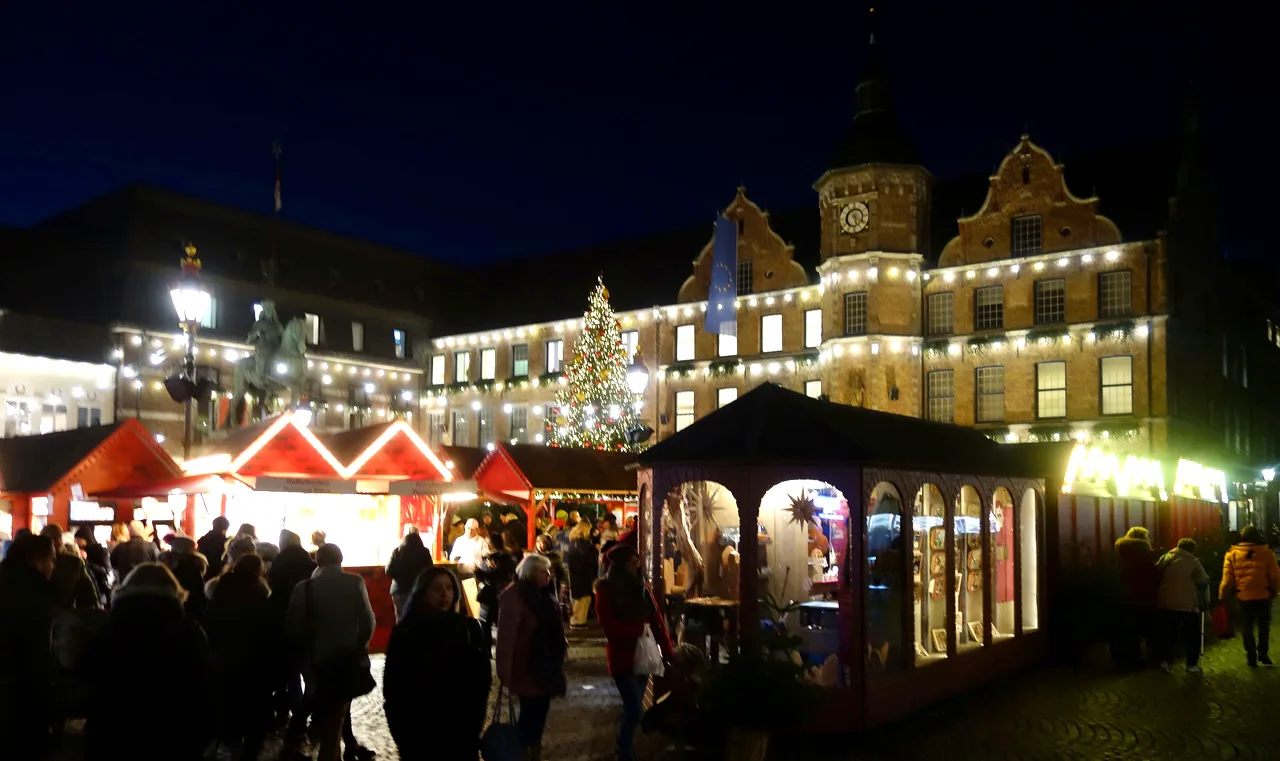
In Advent Düsseldorf turns into a city of lights. Rather than one single market, Düsseldorf Tourism describes several Christmas markets spread across the city centre, each with its own theme and design, so that a walk from the Altstadt through Schadowstraße and Flinger Straße to the Königsallee links one market with the next. The best-known setting is the Marktplatz in front of the Renaissance Town Hall, where stalls with gabled roofs stand around the Jan Wellem statue; the official page also mentions hundreds of fir trees and a “Lichterdom” (cathedral of lights) that decorate the city. In the courtyard of the Wilhelm-Marx-Haus, near Heinrich-Heine-Allee, the Sternchen market is known for its starry decoration and craft stalls. On Corneliusplatz at the southern end of the Königsallee, Kö on Ice offers skating with stalls around the rink from 6 November, and on the Burgplatz by the Rhine the 55-metre “Wheel of Vision” Ferris wheel gives views over the Rhine and the Altstadt rooftops. Alongside mulled wine, the markets serve Rhineland specialities such as potato pancakes (Reibekuchen). Entry to the markets is free.


| Event | Location | 2026 dates | Note |
|---|---|---|---|
| Christmas markets in the Altstadt and city centre | Marktplatz, Altstadt, Schadowstraße, Flinger Straße and surrounding streets | 19 November–30 December 2026 | Sun–Thu 11:00–20:00, Fri–Sat 11:00–21:00 (some vendors until 22:00); 24 Dec 11:00–15:00, 26 Dec 14:00–21:00; closed 22 Nov and 25 Dec. |
| Marktplatz Christmas market | Marktplatz, in front of the Town Hall | 19 November–30 December 2026 | Gabled stalls around the Jan Wellem statue; part of the city-centre markets. |
| Sternchen market | Courtyard of the Wilhelm-Marx-Haus (near Heinrich-Heine-Allee) | In the city-centre market period | Star-themed decoration and crafts; check individual hours on visitduesseldorf.de. |
| Kö on Ice | Corneliusplatz, southern end of the Königsallee | From 6 November 2026 | Ice rink with stalls; check closing date, hours and skating conditions on the official page. |
| Wheel of Vision | Burgplatz by the Rhine | In the Christmas season | 55-metre Ferris wheel with views over the Rhine; check operating dates on the official page. |
What to try
Reibekuchen
Crisp fried potato pancakes, often served with apple sauce; a Rhineland market classic.
Glühwein
Hot spiced mulled wine; alcoholic.
Kinderpunsch
Spiced hot fruit punch for children and non-drinkers.
Gebrannte Mandeln
Sugar-roasted almonds.
Printen
Spiced gingerbread biscuits from nearby Aachen.
Bratwurst
Grilled sausages in a bread roll; usually contain pork.
Tips for Düsseldorf’s Christmas markets
- The markets close on 22 November (Totensonntag) and 25 December; 24 and 26 December have shorter hours.
- U-Bahn station Heinrich-Heine-Allee is the most convenient stop for the Altstadt and Königsallee markets.
- Weekends and late-opening Fridays and Saturdays are crowded; weekday afternoons are calmer.
- Walk the route Altstadt – Schadowstraße – Königsallee to see several markets in one evening.
- Glühwein mugs usually carry a deposit; return them or keep them as a souvenir.
- The Rhine promenade is windy and cold in December; dress warmly.
- If you come by car, Düsseldorf Tourism points to park-and-ride options; check them on the official page.
- The markets run until 30 December, so you can combine them with a trip between Christmas and New Year.
Check before you go: Düsseldorf Tourismus · Weihnachten in Düsseldorf 2026 (official) ↗ · Rheinbahn · timetable and tickets (official) ↗
Dates and hours checked on 28 October 2026 against the visitduesseldorf.de “Weihnachten in Düsseldorf” page. Individual markets, the ice rink and the Ferris wheel may have different hours; check the official page before you visit.
When to Go
Düsseldorf has a mild, maritime-influenced climate: winters are cool and often damp rather than very cold, and summers are pleasantly warm. Spring and early autumn are ideal for the Rhine promenade and the parks. Carnival opens on 11 November at 11:11 and culminates around Rose Monday in February. From late November to 30 December the Christmas markets light up the centre. January and February are quiet and good for museums.
| Month | Sightseeing | Christmas market | Rhine and parks | Crowds |
|---|---|---|---|---|
| January | Difficult | None | Difficult | Moderate |
| February | Good | None | Difficult | Busy |
| March | Good | None | Good | Moderate |
| April | Very good | None | Very good | Moderate |
| May | Very good | None | Very good | Moderate |
| June | Very good | None | Very good | Moderate |
| July | Very good | None | Very good | Moderate |
| August | Very good | None | Very good | Moderate |
| September | Very good | None | Very good | Moderate |
| October | Very good | None | Good | Moderate |
| November | Good | Market season | Good | Busy |
| December | Good | Market season | Difficult | Busy |
- Winters are usually cool and damp; bring rain gear.
- The Christmas markets run from 19 November to 30 December 2026.
- Carnival begins on 11 November at 11:11; the Altstadt is very lively then.
- Rose Monday (February) brings the big carnival parade and very full streets.
- Trade fairs can fill hotels quickly; check the trade fair calendar before booking.
- Museums open year-round; some close on Mondays.
Visa and Entry (Turkish citizens)
Turkish citizens holding an ordinary (burgundy) passport need a Schengen visa for tourist travel to Germany. Special, service and diplomatic passports follow different rules; check the current position on the Turkish Ministry of Foreign Affairs page.
Apply to the representation of the country that is your main destination. If Germany is the main destination, applications go through the German missions in Türkiye; current information on the application process is at tuerkei.diplo.de.
If you combine Düsseldorf with the Netherlands or Belgium, apply to the country of your longest stay; if stays are equal, to the country of first entry.
Under the EU Entry/Exit System (EES), being introduced in stages, your biometric data (facial image and fingerprints) may be recorded on first entry; allow extra time at the border.
Visa fees, appointment waiting times and required documents can change; this guide gives no fees. Use the current lists on the official pages before you apply.
Travel medical insurance and proof of accommodation and return are part of the application; details are in the official sources.
Check before you go: T.C. Dışişleri Bakanlığı · Türk vatandaşlarının tabi olduğu vize uygulamaları ↗ · tuerkei.diplo.de ↗ · EES · europa.eu ↗ · Rota Atlası visa guide (TR)
Travel medical insurance
Check the official visa and entry sources above first: they state whether travel medical insurance is required and the minimum cover. Compare any policy’s cover amount, validity dates and countries covered with the official requirement.
Rota Atlası does not currently offer an insurance partnership; there are no paid links in this section. Last updated: 1 November 2026
Getting to Düsseldorf
- By air: Düsseldorf Airport (DUS) lies north of the city and is one of Germany’s larger airports. Check current flights from Türkiye only on airline and airport websites.
- From the airport: S-Bahn and regional trains from the airport station (reached by the SkyTrain) and from the terminal station run to Düsseldorf Hauptbahnhof; check timetables on rheinbahn.de, vrr.de and bahn.de.
- By train: Düsseldorf Hauptbahnhof is a major long-distance hub with ICE connections to Cologne, Frankfurt, Berlin, Amsterdam and other cities; check on bahn.de.
- From the Hauptbahnhof to the Altstadt: several U-Bahn lines run to Heinrich-Heine-Allee; on foot it is roughly 20–25 minutes via the Königsallee.
Getting Around

U-Bahn and trams
Rheinbahn runs U-Bahn, tram and bus lines; tickets follow the VRR fare system. Check on rheinbahn.de and vrr.de.
On foot
The Altstadt, Rhine promenade, Königsallee and Hofgarten are close together.
Rhine promenade
A walkway along the river links the Altstadt with the Rheinturm and the MedienHafen.
S-Bahn
S-Bahn lines link the centre with Benrath, the airport and neighbouring cities.
Bicycle
Bike lanes and the Rhine paths are popular; the paths can be wet in winter.
Day trips
Cologne, Aachen and Kaiserswerth are easy to reach by train or tram.
Things to See
Düsseldorf’s Altstadt lies on the Rhine between the Burgplatz and the Carlsplatz market; to the south the Rhine promenade leads to the Rheinturm, the state parliament and the MedienHafen. East of the Altstadt the Königsallee runs along its canal, with the Hofgarten and the Kö-Bogen to the north. The K20 and K21 museums are on the edge of the Altstadt; Benrath lies to the south and Kaiserswerth to the north.
The longest bar in the world
Altstadt, Bolkerstraße and the Town Hall

Düsseldorf’s Altstadt covers less than one square kilometre but is packed with pubs, brewhouses, restaurants and bars, which is why it is called “the longest bar in the world”. Bolkerstraße is its liveliest street; the poet Heinrich Heine was born here in 1797, and a plaque marks his birthplace. The Marktplatz is framed by the Town Hall, whose oldest part, in Renaissance style, dates from the 16th century, and the equestrian statue of Elector Jan Wellem cast by Gabriel de Grupello stands in front. Traditional brewhouses serve Altbier, the city’s top-fermented dark beer.
Don’t miss
- Bolkerstraße and Heine’s birthplace
- The Town Hall on the Marktplatz
- The Jan Wellem equestrian statue
- A traditional Altbier brewhouse
Tips
- The Altstadt is very lively at weekends and in the evening; it is calmer in the morning.
- Altbier is served in small glasses and refilled until you put a beer mat on top.
- In Advent the Marktplatz hosts one of the main Christmas markets.

The twisted spire
Burgplatz, Schlossturm and St Lambertus

The Burgplatz on the Rhine was the site of the former Düsseldorf castle; only the Schlossturm remains, today home to the SchifffahrtMuseum (shipping museum). Behind it rises the Basilica of St Lambertus, a Gothic church from the 14th century famous for its twisted spire. Inside are the tomb of Duke William V of Jülich-Cleves-Berg and a rich late Gothic tabernacle. The Radschläger fountain on the square recalls the city’s cartwheeling boys, a symbol of Düsseldorf.
Don’t miss
- The twisted spire of St Lambertus
- The Schlossturm
- The Radschläger fountain
- The steps down to the Rhine
Tips
- Check opening times of the SchifffahrtMuseum before you go.
- Do not walk around during services in St Lambertus.
- In Advent the Ferris wheel stands on the Burgplatz.

On the river
Rhine promenade and Rheinturm

Since the 1990s, when traffic was moved into a tunnel, the Rhine promenade has been one of Düsseldorf’s favourite places to stroll, with steps down to the river and views of the bridges. At its southern end rises the Rheinturm, a 240.5-metre telecommunications tower completed in the early 1980s. Its shaft carries the “Lichtzeitpegel”, a light sculpture that works as a giant clock, and the viewing platform offers views over the Rhine, the city and, on clear days, as far as Cologne. The state parliament of North Rhine-Westphalia stands at its foot.
Don’t miss
- A walk along the promenade
- The view from the Rheinturm
- The Lichtzeitpegel light clock
- The state parliament building
Tips
- Check opening times and tickets for the Rheinturm on the official site.
- The promenade is windy in winter; dress warmly.
- The light clock is best seen after dark.
Architecture on the water
MedienHafen and Neuer Zollhof

The MedienHafen is a former Rhine port transformed into a district of media, design and architecture. Its best-known landmark is the Neuer Zollhof, a group of three curving buildings by Frank Gehry completed at the end of the 1990s, one clad in white plaster, one in brick and one in reflective steel. Around them old warehouses, cranes and modern office buildings line the harbour basins, with walkways and bridges for exploring.
Don’t miss
- The three Gehry buildings of the Neuer Zollhof
- The harbour basins and old cranes
- The view back to the Rheinturm
- Modern architecture along the quays
Tips
- It is a 10–15 minute walk from the Rheinturm.
- Evening light and blue hour are best for photos.
- Most buildings are offices; view them from outside.
Germany’s elegant boulevard
Königsallee and Kö-Bogen

The Königsallee, called “Kö” by locals, runs for about one kilometre along a tree-lined canal, the Kö-Graben, with the Triton fountain at its northern end. The east side is lined with luxury shops and arcades, the west side with banks and offices. At its northern end the Kö-Bogen by Daniel Libeskind marks the transition to the Hofgarten, and the neighbouring Kö-Bogen II is known for its façade covered with hedges. In Advent the Kö is decorated with lights, and Kö on Ice opens on Corneliusplatz.
Don’t miss
- The Kö-Graben and Triton fountain
- The Kö-Bogen
- The green façade of Kö-Bogen II
- The Advent lights on the Kö
Tips
- Shops are closed on Sundays; the boulevard itself is pleasant to stroll.
- Heinrich-Heine-Allee and Steinstraße/Königsallee stations are nearby.
- In Advent the Kö is very busy at weekends.

Modern and contemporary art
K20 and K21 (Kunstsammlung NRW)

The Kunstsammlung Nordrhein-Westfalen, the state art collection, has two main sites. K20 on Grabbeplatz, behind a curved façade of black granite, shows classic modern art of the 20th century, including a large group of works by Paul Klee. K21 in the historic Ständehaus, the former state parliament building by a pond, is devoted to contemporary art; under its glass dome hangs the net installation “in orbit” by Tomás Saraceno, which visitors can climb.
Don’t miss
- The Paul Klee works at K20
- The black granite façade on Grabbeplatz
- The Ständehaus building of K21
- “in orbit” under the dome of K21
Tips
- Check opening times, tickets and access rules for “in orbit” on kunstsammlung.de.
- Many museums close on Mondays.
- K20 is in the Altstadt; K21 is about 15 minutes south on foot.

From old masters to the present
Kunstpalast at the Ehrenhof

The Kunstpalast stands in the Ehrenhof complex near the Rhine, built in the 1920s. Its collection spans paintings, sculpture, graphic art and design from the Middle Ages to the present, including works by Rubens and by artists of the Düsseldorf School of painting, as well as a major glass collection. Changing exhibitions are held throughout the year.
Don’t miss
- The Düsseldorf School paintings
- The glass collection
- The Ehrenhof architecture
- Changing exhibitions
Tips
- Check opening times and exhibitions on kunstpalast.de.
- The museum is a short walk north of the Altstadt along the Rhine.
- Allow at least two hours.
Green heart of the city
Hofgarten and Jägerhof Palace

The Hofgarten, laid out from 1769, is regarded as one of the first public parks in Germany. Its lawns, ponds, avenues and monuments stretch from the Altstadt to the Kö-Bogen and the Rhine. At its eastern end stands Jägerhof Palace, a Baroque hunting lodge which today houses the Goethe Museum Düsseldorf, with manuscripts, books and pictures relating to Johann Wolfgang von Goethe.
Don’t miss
- The avenues and ponds of the Hofgarten
- Jägerhof Palace
- The Goethe Museum
- Monuments in the park
Tips
- The park is free and open all year.
- Check the Goethe Museum’s opening times in advance.
- Paths can be wet and muddy in winter.

Japan on the Rhine
Japanese Düsseldorf: Immermannstraße, EKŌ-Haus and Japan Day

Düsseldorf is home to one of the largest Japanese communities in Europe, and that heritage can be felt in many parts of the city. Immermannstraße and the streets around it, between the main station and the Hofgarten, are known as “Little Tokyo”, with Japanese bookshops, bakeries, grocery stores and shops. On the left bank of the Rhine, in Niederkassel, the EKŌ-Haus der Japanischen Kultur brings together one of the first Buddhist temples built by Japanese people in Europe, a traditional Japanese house and a carefully designed garden. Japan Day Düsseldorf/NRW, usually held each year in May or June, devotes the Rhine promenade to Japanese culture all day and ends in the evening with a large fireworks display over the Rhine. The Japanese garden in the Nordpark can be added to this route too. EKŌ-Haus (official) →
Don’t miss
- Japanese shops and bookshops around Immermannstraße
- The temple, Japanese house and garden at the EKŌ-Haus
- The Rhine promenade on Japan Day and the evening fireworks
- The Japanese garden in the Nordpark
Tips
- The EKŌ-Haus is closed on Sundays, Mondays and public holidays; booking ahead is recommended for the interiors. Check current hours and closures on eko-haus.de.
- The date of Japan Day changes every year; check visitduesseldorf.de for current information.
- Keep quiet in the temple and follow the photography rules indoors.

A pleasure palace
Benrath Palace and Park

In the southern district of Benrath, Elector Carl Theodor had a pink pleasure palace built in the second half of the 18th century by the architect Nicolas de Pigage. The palace, its pond and the extensive park with long axes form one of the finest late Baroque ensembles in the Rhineland. The palace houses the corps de logis with its state rooms and museums of garden art and natural history. Benrath also has its own small Christmas market in Advent.
Don’t miss
- The pink façade reflected in the pond
- The state rooms
- The park’s long avenues
- The Museum of European Garden Art
Tips
- Benrath is reached by S-Bahn or tram from the centre; check rheinbahn.de.
- Check tours and opening times on schloss-benrath.de.
- Check the dates of the Benrath Christmas market on the official city pages.

Barbarossa’s palace on the Rhine
Kaiserswerth

In the north of the city, Kaiserswerth is one of Düsseldorf’s oldest districts. On the Rhine stand the ruins of the Kaiserpfalz, an imperial palace extended under Emperor Frederick Barbarossa in the 12th century. The village-like centre has Baroque houses and the Basilica of St Suitbertus with a precious shrine. Kaiserswerth is also known for the deaconess institution founded by Theodor Fliedner in the 19th century, where Florence Nightingale trained.
Don’t miss
- The ruins of the Kaiserpfalz
- The Basilica of St Suitbertus
- The Baroque houses on the Stiftsplatz
- The Rhine bank
Tips
- Kaiserswerth is reached by tram from the centre; check rheinbahn.de.
- The Rhine bank can be windy; dress warmly.
- Combine it with a walk along the river.
The cathedral city
Day trip: Cologne

Cologne, about 40 kilometres up the Rhine, can be reached from Düsseldorf by frequent trains. Its Gothic cathedral, a UNESCO World Heritage Site, is one of the largest churches in the world, and in Advent the city hosts several famous Christmas markets. A friendly rivalry between Düsseldorf and Cologne is part of Rhineland culture, from beer (Altbier against Kölsch) to carnival. Cologne guide →
Don’t miss
- Cologne Cathedral
- The Hohenzollern Bridge
- The Old Town on the Rhine
- The Cologne Christmas markets
Tips
- Check frequent connections on bahn.de and vrr.de.
- The trip takes well under an hour by regional train.
- See our Cologne guide for details.
1–3 Day Itineraries, a Christmas Day + a 7-Day Rhineland Route
The itineraries keep distances short and allow for short winter days. One day is enough for the Altstadt, Rhine and Kö, two allow museums and parks, and three add Benrath, Kaiserswerth or Cologne. The 7-day route combines Düsseldorf with other Rhineland cities. Check opening hours on the official websites in advance.
Day 1: Altstadt, Rhine and Kö
- Start on the Marktplatz with the Town Hall and Jan Wellem.
- Walk along Bolkerstraße past Heine’s birthplace.
- See St Lambertus and the Schlossturm on the Burgplatz.
- Walk the Rhine promenade to the Rheinturm and the MedienHafen.
- In the evening stroll along the Königsallee.
Day 2: Art and parks
- Visit K20 on Grabbeplatz in the morning.
- Walk through the Hofgarten to Jägerhof Palace.
- Visit the Kunstpalast at the Ehrenhof.
- In the afternoon see K21 in the Ständehaus.
- End the day in an Altstadt brewhouse.
Day 3: Benrath and Kaiserswerth
- Take the S-Bahn or tram to Benrath Palace in the morning.
- Walk the palace park.
- In the afternoon take the tram to Kaiserswerth.
- See the Kaiserpfalz ruins by the Rhine.
- Return to the centre in the evening.
Christmas Day (19 November–30 December 2026)
- In the morning walk the Rhine promenade by daylight.
- At midday visit K20 or the Kunstpalast.
- In the late afternoon start at the Marktplatz market in front of the Town Hall.
- Continue via the Sternchen market to the Königsallee and its lights.
- End with a ride on the Ferris wheel on the Burgplatz or skating at Kö on Ice.
7 Days: Rhineland
- Days 1–3: Düsseldorf – Altstadt, museums, Benrath and Kaiserswerth.
- Day 4: Cologne.
- Day 5: Aachen.
- Day 6: Münster or Amsterdam.
- Day 7: Depart from Düsseldorf.
Düsseldorf and Rhineland Food
Düsseldorf’s food is Rhineland cooking: hearty, simple dishes that go with the local Altbier, plus the city’s famous mustard. These are traditional dishes, not restaurant recommendations.


Altbier
Düsseldorf’s top-fermented dark beer, brewed in Altstadt house breweries and served in small glasses; alcoholic.
Düsseldorfer Senf
Spicy brown Düsseldorf mustard, a local tradition used in many dishes.
Rheinischer Sauerbraten
Marinated braised beef in a sweet-and-sour sauce, often with raisins and potato dumplings.
Halve Hahn
Despite the name (“half a chicken”), a rye roll with aged Gouda, mustard and onions.
Himmel un Ääd
“Heaven and earth”: mashed potatoes and apples with fried black pudding; contains pork blood.
Reibekuchen
Fried potato pancakes with apple sauce, popular at Christmas markets.
Senfrostbraten
A steak with a mustard crust, a Düsseldorf speciality.
Muscheln rheinische Art
Mussels cooked in wine and vegetables, traditionally in months with an “r”.
- Some traditional dishes contain pork or pork blood; ask about ingredients.
- Vegetarian options (Halve Hahn, Reibekuchen) are easy to find.
- In brewhouses the waiter (“Köbes”) keeps bringing beer until you cover the glass with a beer mat.
- Service is included; rounding up by 5–10 per cent is customary.
Culture and Etiquette

- “Guten Tag” or “Hallo” are usual greetings; Rhinelanders are known as open and chatty.
- Use the formal “Sie” in formal situations.
- Carnival is very important: the season opens on 11 November at 11:11.
- In brewhouses, waiters (Köbes) are traditionally blunt; it is part of the charm.
- Do not walk around churches during services or use flash.
- People queue at bakeries, stalls and stops.
- Cyclists use marked lanes; do not walk in them.
- Sunday is a day of rest; most shops are closed.
- A friendly rivalry with Cologne is common; take jokes in good humour.
- Ask before photographing people, especially at markets.
Safety and Health
- Düsseldorf is generally safe; watch your valuables in the crowded Altstadt, at markets and at the Hauptbahnhof.
- The Altstadt is very lively late at night at weekends; stay alert.
- Watch out for cyclists and trams in the city centre.
- The Rhine banks can flood after heavy rain; respect closures.
- In an emergency call 112, police 110.
- Make sure your travel medical insurance covers the Schengen area.
- Pharmacies post the address of the nearest on-duty pharmacy.
What Your Budget Depends On
This guide does not give prices; prices change with season and year. Your budget depends on these factors:
Travel dates
Trade fairs and Advent weekends push up hotel demand.
Accommodation
Areas around the Hauptbahnhof, Altstadt and Königsallee differ widely.
Transport
VRR tickets cover the city, Benrath, Kaiserswerth and trips to Cologne.
Sights and museums
Each museum and the Rheinturm charge separately.
Food and drink
Market snacks and brewhouse dishes vary; restaurants vary widely.
Day trips
Trips to Cologne and Aachen cost extra.
Free experiences
The Christmas markets (free entry), Rhine promenade, Altstadt, Königsallee, Hofgarten and MedienHafen are free.
Practical Information
- Money: euro; cards widely accepted, carry some cash.
- Language: German; English widely understood.
- Sockets: 230 V, type C/F.
- Time: CET (UTC+1) in winter.
- Opening hours: some museums close on Mondays.
- Shops: closed on Sundays; the Christmas markets are open.
- Holidays: changed hours on 24–26 and 31 December and 1 January.
- Weather: cool and damp in December, about 2 to 7 °C.
- Daylight: sunset around 16:30 in December.
- Emergency: 112; police 110.
Frequently Asked Questions
When are the Düsseldorf Christmas markets 2026?
According to visitduesseldorf.de, from 19 November to 30 December 2026.
What are the opening hours?
Sunday–Thursday 11:00–20:00 and Friday–Saturday 11:00–21:00; 24 December 11:00–15:00, 26 December 14:00–21:00.
On which days are the markets closed?
On 22 November (Totensonntag) and 25 December.
Is entry free?
Yes; food, drink and gifts cost money. Skating and the Ferris wheel are paid.
When does Kö on Ice open?
According to the official page, on 6 November 2026 on Corneliusplatz.
Do Turkish citizens need a visa?
Holders of ordinary passports need a Schengen visa. If Germany is the main destination, see tuerkei.diplo.de.
Which airport serves Düsseldorf?
Düsseldorf Airport (DUS). Check current flights on the airport website.
How many days are enough?
One day for the Altstadt and Rhine, two with museums, three with Benrath, Kaiserswerth or Cologne.
What is Altbier?
A top-fermented dark beer brewed in Düsseldorf; alcoholic.
Can I combine Düsseldorf with Cologne?
Yes; Cologne is easy to reach by train for a day trip.
Where to stay
Stay close to the areas where you will spend most time. The areas below are covered in detail in this guide; check public transport links in the getting-around section.
- The longest bar in the worldAltstadt, Bolkerstraße and the Town Hall
- The twisted spireBurgplatz, Schlossturm and St Lambertus
- On the riverRhine promenade and Rheinturm
- Architecture on the waterMedienHafen and Neuer Zollhof
- Germany’s elegant boulevardKönigsallee and Kö-Bogen
- Modern and contemporary artK20 and K21 (Kunstsammlung NRW)
- From old masters to the presentKunstpalast at the Ehrenhof
- Green heart of the cityHofgarten and Jägerhof Palace
- Japan on the RhineJapanese Düsseldorf: Immermannstraße, EKŌ-Haus and Japan Day
- A pleasure palaceBenrath Palace and Park
- Barbarossa’s palace on the RhineKaiserswerth
- The cathedral cityDay trip: Cologne
Search hotels in these areas (Hotellook) ↗ (affiliate link)Search on Booking.com ↗
Affiliate disclosure: Hotellook, Aviasales, Klook, Airalo, Tiqets and DiscoverCars links are affiliate links; Rota Atlası may earn a commission on bookings made through them, at no extra cost to you. Official and in-guide links are not paid. Last updated: 1 November 2026 · Privacy and affiliates
Transport and connectivity
- Airport transferOptions from the airport to the city are in this guide’s getting there section.
- Mobile data (eSIM)Airalo eSIM ↗ (affiliate link)
- TrainsOfficial rail website ↗
- Car hireYou rarely need a car within the city; see getting around first. Compare car hire on DiscoverCars ↗ (affiliate link)
Affiliate disclosure: Hotellook, Aviasales, Klook, Airalo, Tiqets and DiscoverCars links are affiliate links; Rota Atlası may earn a commission on bookings made through them, at no extra cost to you. Official and in-guide links are not paid. Last updated: 1 November 2026 · Privacy and affiliates
Search flights (affiliate link)
Search flights from any airport in any country. Results open on Aviasales in a new tab, where you book.
This form is an affiliate link: Rota Atlası may earn a commission on bookings made via Aviasales (Travelpayouts), at no extra cost to you. Check price, baggage and terms on the booking site. Airport data: OurAirports (public domain).
Flights, hotels and tours
Find tours and tickets
- Düsseldorf Christmas Market
GetYourGuide ↗ · Klook ↗ (affiliate link) - Altstadt (Old Town)
GetYourGuide ↗ · Klook ↗ (affiliate link) - Rheinturm
GetYourGuide ↗ · Klook ↗ (affiliate link) - Königsallee
GetYourGuide ↗ · Klook ↗ (affiliate link)
Hotellook, Aviasales, Klook, Airalo and Tiqets links in this box are affiliate links (Travelpayouts): Rota Atlası may earn a commission on bookings made through them, at no extra cost to you. GetYourGuide links currently carry no affiliate code. Check prices and terms with the provider. Last updated: 1 November 2026 · Privacy and affiliates
Sources
- T.C. Dışişleri Bakanlığı · Türk vatandaşlarının tabi olduğu vize uygulamaları ↗
- Auswärtiges Amt · Deutsche Vertretungen in der Türkei (Visa) ↗
- European Union · Entry/Exit System (EES) ↗
- Düsseldorf Tourismus · visitduesseldorf.de (official) ↗
- Landeshauptstadt Düsseldorf · duesseldorf.de (official) ↗
- Rheinbahn · public transport Düsseldorf (official) ↗
- VRR · Verkehrsverbund Rhein-Ruhr (official) ↗
- Düsseldorf Airport (official) ↗
- Kunstsammlung Nordrhein-Westfalen · K20/K21 (official) ↗
- Kunstpalast Düsseldorf (official) ↗
- Stiftung Schloss und Park Benrath (official) ↗
- Deutsche Bahn ↗
- GOV.UK · Foreign travel advice · Germany ↗
- Düsseldorf Tourismus · Weihnachten in Düsseldorf 2026 (official) ↗
- Rheinbahn · timetable and tickets (official) ↗
This page is for information only. Dates, hours, entry rules and transport information can change; check the official sources above before travelling. No prices, flights, hotels or restaurants have been invented in this guide.
Photo credits
The photos on this page come from Wikimedia Commons and are used under the stated authors and licences (CC BY, CC BY-SA, CC0 or public domain). Full list of sources
- Christmas market on the Marktplatz in Düsseldorf — Supercarwaar · CC BY-SA 4.0 · Wikimedia Commons
- Illuminated Christmas stalls in Düsseldorf’s Altstadt — Supercarwaar · CC BY-SA 4.0 · Wikimedia Commons
- The Town Hall and a Christmas tree — Supercarwaar · CC BY-SA 4.0 · Wikimedia Commons
- Decorated huts at a Düsseldorf Christmas market — Supercarwaar · CC BY-SA 4.0 · Wikimedia Commons
- Christmas market at the ice rink on the Königsallee — Kürschner · CC0 · Wikimedia Commons
- Ferris wheel and Christmas lights at Burgplatz — Supercarwaar · CC BY-SA 4.0 · Wikimedia Commons
- The Sternchenmarkt Christmas market — Kürschner · CC0 · Wikimedia Commons
- Visitors at a Düsseldorf Christmas market in the evening — Kürschner · CC0 · Wikimedia Commons
- Wooden stalls at a Düsseldorf Christmas market — Kürschner · CC0 · Wikimedia Commons
- The Christmas tree in front of the Town Hall — Kürschner · CC0 · Wikimedia Commons
- Christmas lights in the lanes of the Altstadt — Noebse · CC BY-SA 3.0 · Wikimedia Commons
- Advent lights on the Königsallee — Kürschner · Public domain · Wikimedia Commons
- Christmas market in Benrath — Noebse · CC BY 3.0 · Wikimedia Commons
- The Rheinturm and the state parliament building — Anil Öztas · CC BY-SA 4.0 · Wikimedia Commons
- The Düsseldorf skyline from the Oberkassel Bridge — Anil Öztas · CC BY-SA 4.0 · Wikimedia Commons
- Façade of a Gehry building in the MedienHafen — Basotxerri · CC BY-SA 4.0 · Wikimedia Commons
- The Neuer Zollhof buildings at blue hour — Martin Falbisoner · CC BY-SA 3.0 · Wikimedia Commons
- The Rhine embankment promenade — Joschi71 · CC BY-SA 4.0 · Wikimedia Commons
- Bolkerstraße in the Altstadt — Marek Gehrmann · CC BY-SA 3.0 · Wikimedia Commons
- Düsseldorf Town Hall in the evening — Supercarwaar · CC BY-SA 4.0 · Wikimedia Commons
- The Jan Wellem equestrian statue on the Marktplatz — Anıl Öztaş · CC BY-SA 4.0 · Wikimedia Commons
- St Lambertus Basilica with its twisted spire — Till.niermann · CC BY-SA 3.0 · Wikimedia Commons
- The Schlossturm on Burgplatz — Dietmar Rabich · CC BY-SA 4.0 · Wikimedia Commons
- The Königsallee and the Kö-Graben canal — Kürschner · CC0 · Wikimedia Commons
- The Kö-Bogen building at the edge of the Hofgarten — Choinowski · CC BY-SA 4.0 · Wikimedia Commons
- The K20 art museum on Grabbeplatz — Jula2812 · CC BY-SA 4.0 · Wikimedia Commons
- The K21 art museum in the Ständehaus — Fred Romero from Paris, France · CC BY 2.0 · Wikimedia Commons
- The Kunstpalast museum at the Ehrenhof — Raimond Spekking · CC BY-SA 4.0 · Wikimedia Commons
- The Hofgarten park — Remi Mathis · CC BY-SA 3.0 · Wikimedia Commons
- Jägerhof Palace (Goethe Museum) — LotharHakelberg · CC BY-SA 4.0 · Wikimedia Commons
- Benrath Palace and its pond — A.Savin · CC BY-SA 3.0 · Wikimedia Commons
- Ruins of the imperial palace at Kaiserswerth — Tuxyso · CC BY-SA 3.0 · Wikimedia Commons
- The Japanese garden in the Nordpark — Im Fokus · CC BY-SA 4.0 · Wikimedia Commons
- A traditional Altbier brewhouse in the Altstadt — Kürschner · CC0 · Wikimedia Commons
- Düsseldorf mustard (Löwensenf) — Alice Wiegand · CC BY-SA 3.0 · Wikimedia Commons
- Cologne Cathedral and the Hohenzollern Bridge at dusk — Raimond Spekking · CC BY-SA 4.0 · Wikimedia Commons
Cologne → · Aachen → · Münster → · Amsterdam → · Brussels → · Christmas markets