

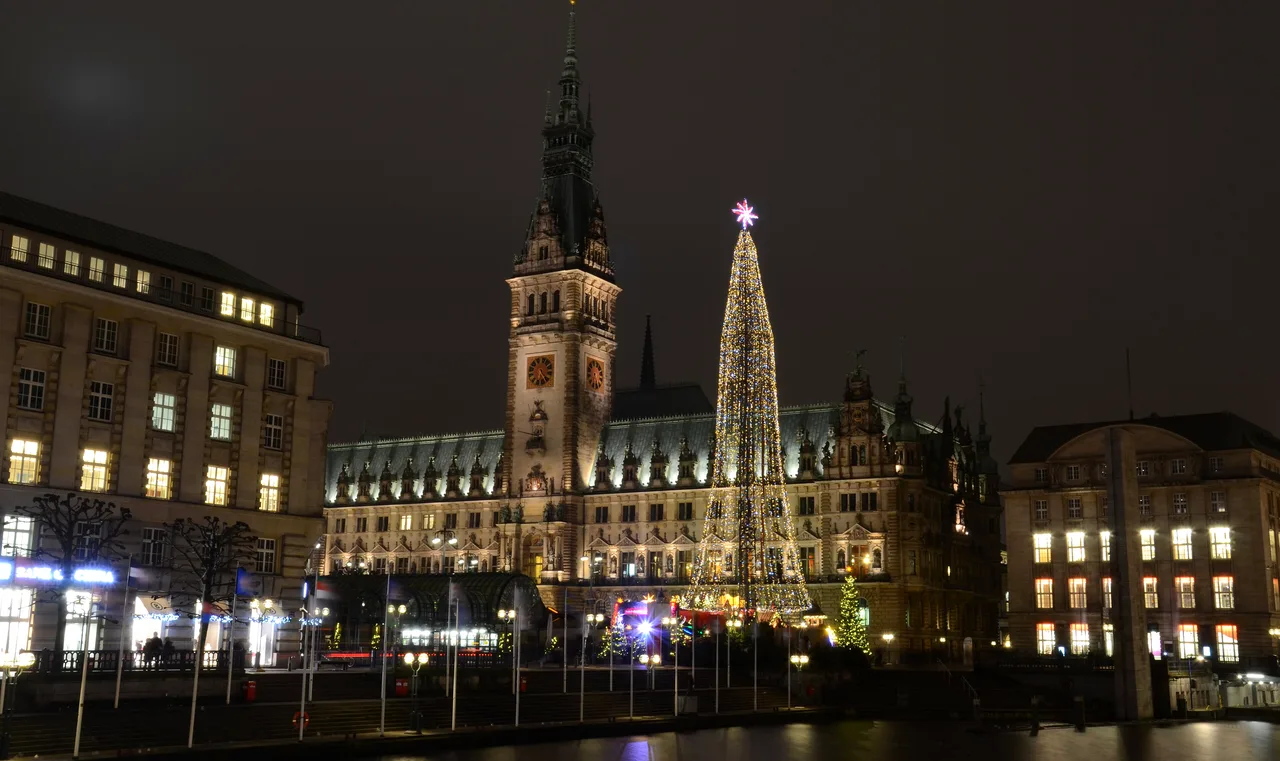
Hamburg, with about 1.9 million people, is Germany’s second-largest city and a free Hanseatic city that is a federal state in its own right. Set on the Elbe about 100 kilometres inland from the sea, its port is one of the largest in Europe. At the heart of the city lie the two basins of the Alster lake and countless canals (Fleete); Hamburg is often said to have more bridges than Venice and Amsterdam. The neo-Renaissance City Hall, the UNESCO World Heritage Speicherstadt with its brick warehouses and the Chilehaus, the Elbphilharmonie with its wave-shaped glass, the Landungsbrücken piers and the tower of the Michel are the city’s emblems. In winter Hamburg is wrapped in lights: the Historic Christmas Market in front of City Hall, an illuminated tree on the Alster and the markets around the Inner Alster combine with the misty harbour to create a unique Advent mood. This guide brings together the Christmas markets, the city’s districts, harbour and Alster experiences, northern German food and practical information, based on official sources.
Content update: 29 October 2026 · Christmas dates checked against the official hamburg.de page
Hamburg at a Glance
- Country
- Germany · Hamburg (city-state)
- Population
- About 1.9 million
- Language
- German; English widely spoken
- Currency
- Euro (EUR); cards widely accepted, carry some cash for stalls
- Time zone
- Central European Time (CET, UTC+1)
- Highlights
- Harbour, Alster, Speicherstadt, Elbphilharmonie, Christmas markets
- Must-sees
- City Hall, Speicherstadt, Miniatur Wunderland, Elbphilharmonie, Landungsbrücken, Michel
- UNESCO
- Speicherstadt and Kontorhaus District with Chilehaus
- Christmas
- Historic Christmas Market 23 November–23 December 2026
- Airport
- Hamburg Airport (HAM), linked to the centre by S-Bahn
- Electricity
- 230 V, type C/F sockets
- Emergency
- 112 (ambulance, fire), 110 (police)
Hamburg in Pictures
The Wasserschloss on the canal in the Speicherstadt, the glass waves of the Elbphilharmonie and the harbour front at the Landungsbrücken: Hamburg in three frames.


Hamburg Christmas Markets 2026
The heart of Hamburg’s Christmas season is the Historic Christmas Market on Rathausmarkt in front of City Hall. Organised by Circus Roncalli, the market follows a motto of “art instead of commerce” (Kunst statt Kommerz), favouring crafts and traditional stalls; it has about 80 stalls, a toy lane where toymakers gather and a historic carousel. Its signature is Father Christmas “flying” over the market on his sleigh every day at 16:00, 18:00 and 20:00. On Advent Saturdays at 14:00 and 17:00 a Christmas parade runs along Mönckebergstraße. In all, Hamburg has more than twenty Christmas markets: WeißerZauber on Jungfernstieg by the Inner Alster, the market on the shopping street Spitalerstraße, the colourful Santa Pauli near the Reeperbahn, Gänsemarkt, Fleetinsel and neighbourhood markets. Some stay open after Christmas. As dates vary by market, check the list on hamburg.de before your visit.


| Event | Location | 2026 dates | Note |
|---|---|---|---|
| Historic Christmas Market | Rathausmarkt (in front of City Hall) | 23 November–23 December 2026 | Roncalli; about 80 stalls, toy lane, historic carousel. Daily 11:00–21:00; “flying Father Christmas” at 16:00, 18:00 and 20:00. |
| Christmas parade | Mönckebergstraße | Advent Saturdays | At 14:00 and 17:00; check the route on the official page. |
| WeißerZauber | Jungfernstieg (Inner Alster bank) | Until 29 December 2026 | Market with white tents by the Alster; opening date on hamburg.de. |
| Spitalerstraße Christmas market | Spitalerstraße | Until 27 December 2026 | Stalls along the shopping street. |
| Santa Pauli | St. Pauli (near the Reeperbahn) | From 9 November 2026 | Colourful, playful market aimed at adults; check the closing date on the official page. |
| Gänsemarkt and Fleetinsel | Gänsemarkt · Fleetinsel | Advent season | Smaller, calmer markets; check dates at hamburg.de. |
What to try
Glühwein
Spiced hot wine; contains alcohol.
Kinderpunsch
Spiced hot fruit punch for children and non-drinkers.
Lumumba
Hot chocolate with rum; popular in northern Germany, contains alcohol.
Gebrannte Mandeln
Warm sugar-roasted almonds.
Schmalzkuchen
Small pieces of fried dough dusted with icing sugar.
Fischbrötchen
A herring or salmon roll; a Hamburg classic also often found at markets.
Tips for Hamburg’s Christmas markets
- The Rathausmarkt market closes on 23 December; some markets stay open after Christmas.
- To see the flying Father Christmas, be on the square shortly before 16:00, 18:00 or 20:00.
- On Advent Saturdays, especially during the parade, the city centre is very crowded.
- The central markets are within walking distance of Rathaus and Jungfernstieg U-Bahn stations.
- A deposit is usually charged on hot-drink mugs.
- Hamburg winters are windy and damp; bring a waterproof coat and a hat.
- Santa Pauli may include adult-oriented shows; check the programme before going with children.
- Combine the market tour with an evening walk around the Alster.
Check before you go: hamburg.de · Historischer Weihnachtsmarkt Rathausmarkt 2026 (official) ↗ · hamburg.de · Weihnachtsmärkte in Hamburg 2026 (official) ↗ · Hamburger Weihnachtsmarkt · Roncalli (organiser) ↗ · HVV · timetable and tickets (official) ↗
Dates and hours were checked against the hamburg.de pages “Historischer Weihnachtsmarkt Rathausmarkt” and “Weihnachtsmärkte in Hamburg” on 29 October 2026. Individual stalls and other markets may keep different hours; check the official pages before your visit.
When to Go
Hamburg has a mild maritime climate: summers are mild, winters cool, windy and often rainy. May to September is the best time for Alster boat trips, the harbour front and the parks. From late November to the end of December the Christmas markets fill the city. January and February are quiet and suit museums, the Elbphilharmonie and Miniatur Wunderland.
| Month | Sightseeing | Christmas market | Alster and harbour | Crowds |
|---|---|---|---|---|
| January | Difficult | None | Difficult | Moderate |
| February | Difficult | None | Difficult | Moderate |
| March | Good | None | Difficult | Moderate |
| April | Very good | None | Good | Moderate |
| May | Very good | None | Very good | Busy |
| June | Very good | None | Very good | Busy |
| July | Very good | None | Very good | Busy |
| August | Very good | None | Very good | Busy |
| September | Very good | None | Good | Moderate |
| October | Good | None | Difficult | Moderate |
| November | Good | Market season | Difficult | Busy |
| December | Good | Market season | Difficult | Busy |
- Winters are cool and windy; December is usually around 1–5 °C.
- The Historic Christmas Market runs 23 November–23 December 2026.
- May–September is ideal for Alster and harbour boat trips.
- In summer the city is lively with events and festivals.
- Advent weekends are the busiest time.
- Some museums are closed on Mondays.
Visa and Entry (Turkish citizens)
Turkish citizens holding an ordinary (burgundy) passport need a Schengen visa for tourist travel to Germany. Special, service and diplomatic passports follow different rules; check the current status on the Turkish Ministry of Foreign Affairs website.
Apply to the representation of your main destination. If Germany is your main destination, applications go through the German missions in Türkiye; current information on the process is at tuerkei.diplo.de.
If you combine Hamburg with Denmark or the Netherlands, apply to the country where you will stay longest, or, if the stays are equal, to the country of first entry.
Under the EU Entry/Exit System (EES), being rolled out in stages, your biometric data (facial image and fingerprints) may be recorded at first entry; allow extra time at the border.
Visa fees, appointment waiting times and required documents may change; this guide does not state fees. Use the current lists on the official pages before applying.
Travel medical insurance and accommodation and return documents are part of the application; details are in the official sources.
Check before you go: T.C. Dışişleri Bakanlığı · Türk vatandaşlarının tabi olduğu vize uygulamaları ↗ · tuerkei.diplo.de ↗ · EES · europa.eu ↗ · Rota Atlası visa guide (TR)
Travel medical insurance
Check the official visa and entry sources above first: they state whether travel medical insurance is required and the minimum cover. Compare any policy’s cover amount, validity dates and countries covered with the official requirement.
Rota Atlası does not currently offer an insurance partnership; there are no paid links in this section. Last updated: 1 November 2026
Getting to Hamburg
- By air: Hamburg Airport (HAM) lies north of the city. Check current flights from Türkiye only on airline and airport websites.
- From the airport: S-Bahn line S1 links the airport with Hamburg Hauptbahnhof and the city centre. Check current timetables at hvv.de.
- By train: Hamburg Hauptbahnhof is a major stop for long-distance trains from Berlin, Bremen, Lübeck, Copenhagen and other German cities. Use bahn.de for connections.
- From the station to the centre: From the Hauptbahnhof it is about a 10–15 minute walk via Mönckebergstraße to Rathausmarkt; by U-Bahn it is a few stops.
Getting Around

U-Bahn and S-Bahn
The HVV network covers the whole city; line U3 offers harbour views at Landungsbrücken. Check tickets at hvv.de or in the HVV app.
Ferry
HADAG ferries are part of the HVV network; line 62 runs from Landungsbrücken along the Elbe to Finkenwerder.
Bus
Day and night buses complement the U-Bahn network.
On foot
City Hall, the Alster, Speicherstadt and HafenCity are within walking distance of each other.
Alster boats
Tour boats on the Alster run by season; check the winter schedule on the official website.
Bike
There is a city bike-share system and cycle paths around the Alster.
Things to See
Hamburg’s centre stretches between the two Alster basins in the north and the Elbe harbour in the south. City Hall and Jungfernstieg lie near the Inner Alster; to the south are the canal-laced Speicherstadt and Kontorhaus District, and beyond them the new HafenCity and the Elbphilharmonie. To the west are the Landungsbrücken, the Michel and St. Pauli’s Reeperbahn, and further west Blankenese on the banks of the Elbe.
The city’s living room
City Hall and the Alster Arcades

Hamburg City Hall (Rathaus) was built in 1886–1897 in neo-Renaissance style; with 647 rooms it houses both the city-state’s parliament and its senate. With its tall clock tower and richly decorated façade it dominates Rathausmarkt; the Hygieia fountain in its inner courtyard is also striking. Right next to it, along the canal bank rebuilt after the Great Fire of 1842, run the white Alster Arcades (Alsterarkaden).
Don’t miss
- City Hall façade and tower
- Hygieia fountain in the courtyard
- Alster Arcades
- Christmas market on Rathausmarkt
Tips
- Check times of guided City Hall tours at hamburg.de.
- The Alster Arcades are lovely in the evening lights.
- The nearest stations are Rathaus and Jungfernstieg.

A lake in the middle of the city
Inner and Outer Alster

The Alster river forms two basins in the middle of the city: the small Inner Alster (Binnenalster) in front of Jungfernstieg and the wide Outer Alster (Außenalster) beyond the Lombardsbrücke. The roughly 7-kilometre path around the Outer Alster, with sailing boats, rowing boats and villas, is one of Hamburg residents’ favourite walks. In winter an illuminated Christmas tree rises on the Inner Alster.
Don’t miss
- Inner Alster view from Jungfernstieg
- Walk around the Outer Alster
- Alster boat trip (seasonal)
- View of the Heinrich-Hertz-Turm
Tips
- Check the winter schedule of Alster boat trips on the official website.
- Allow 2 hours for the walk around the Alster.
- The view from the Lombardsbrücke is lovely at sunset.

UNESCO World Heritage
Speicherstadt and the Kontorhaus District

The Speicherstadt is a district of brick warehouses built on oak piles between 1883 and 1927 and known as the world’s largest historic warehouse complex. Its neo-Gothic warehouses over the canals, bridges and the Wasserschloss at a canal junction offer some of the city’s most photogenic views. The Kontorhaus District just north is a symbol of 20th-century brick expressionism with the Chilehaus, designed in 1922–1924 by Fritz Höger in the shape of a ship’s bow. The Speicherstadt and the Kontorhaus District with Chilehaus were added to the UNESCO World Heritage List in 2015. UNESCO listing ↗
Don’t miss
- Wasserschloss and Poggenmühlen bridge
- Warehouses along the canals
- The bow corner of the Chilehaus
- Evening illumination
Tips
- The Speicherstadt is at its best with the evening lighting.
- Check the hours of the district’s museums on their official websites.
- The Chilehaus “bow” is best seen from Burchardplatz.


A world in miniature
Miniatur Wunderland

Miniatur Wunderland, inside a warehouse in the Speicherstadt, is one of the world’s largest model railway exhibitions. In detailed miniature scenes representing regions such as Hamburg, the Alps, Scandinavia, America and Italy, trains, ships and even planes taking off and landing move about. The exhibition changes with a day and night cycle; it is one of Hamburg’s most popular stops for visitors of all ages.
Don’t miss
- Miniature Hamburg and harbour
- Miniature airport
- Night cycle
- Detailed small scenes
Tips
- It is very popular; book timed tickets in advance on the official website.
- Allow at least 2–3 hours.
- Weekday mornings are calmer.
A new city and a concert hall
Elbphilharmonie and HafenCity

Designed by Herzog & de Meuron on top of an old harbour warehouse, the Elbphilharmonie opened in January 2017; with its wave-shaped glass façade it is Hamburg’s new emblem. The public Plaza terrace in the middle of the building offers 360-degree views over the harbour and the city. Around it, HafenCity, rising on former port land, is one of Europe’s largest inner-city redevelopment projects; explore it via the historic Ericushöft quay, modern buildings and waterside squares.
Don’t miss
- Elbphilharmonie Plaza terrace
- Views over the harbour
- HafenCity quays
- Magellan and Marco Polo terraces
Tips
- See elbphilharmonie.de for Plaza and concert tickets.
- Concert tickets can sell out very early.
- HafenCity has stations on line U4.

Gateway to the harbour
Landungsbrücken and harbour tours

The St. Pauli Landungsbrücken, with floating pontoons and a domed, towered building from the early 20th century on the Elbe bank, are the showcase of Hamburg’s harbour. Harbour tour boats and HADAG ferries, which are part of the HVV network, depart from here. Ferry line 62 runs along the Elbe to the beach at Övelgönne and on to Finkenwerder, offering harbour views on a regular public-transport ticket.
Don’t miss
- Floating pontoons
- Landungsbrücken building and tower
- HADAG ferry 62
- Harbour views from the Elbe
Tips
- HADAG ferries use HVV tickets; check the timetable at hvv.de.
- The open deck is very cold in winter.
- The U3 Landungsbrücken station overlooks the harbour.

Under the river
Old Elbe Tunnel and the container port

Opened in 1911, the Old Elbe Tunnel (St. Pauli-Elbtunnel) is a tiled tunnel about 426 metres long that runs from the Landungsbrücken under the Elbe to the opposite bank. Pedestrians and cyclists descend in large lifts in the domed entrance building. The far bank offers one of the best panoramas of the Hamburg skyline and the Landungsbrücken. On the south side of the Elbe stretch the giant container terminals of one of Europe’s largest ports.
Don’t miss
- Tiled tunnel
- Historic lifts
- City panorama from the far bank
- Container port views
Tips
- Renovation work may be under way; check which sections are open on official pages.
- The container port is best seen from a harbour tour boat.
- Be ready for wind on the far bank.

Hamburg’s emblem
St. Michaelis (Michel)

St. Michaelis, known to locals as the “Michel”, is the city’s best-known church. The Baroque church was rebuilt several times over the centuries after fires; its tower, about 132 metres tall, has long served as a landmark for ships entering the Elbe. From the tower’s viewing platform you can see the harbour, the Elbphilharmonie and the city. Its white-and-gold interior is bright and majestic.
Don’t miss
- Baroque interior
- Tower viewing platform
- Michel skyline from the harbour
- The crypt beneath the church
Tips
- Check tower and crypt hours at st-michaelis.de.
- Visits may be restricted during services.
- Concerts are held in Advent; check the programme.
Memory of war
St. Nikolai Memorial

The neo-Gothic tower of St. Nikolai, about 147 metres tall, was once among the tallest buildings in the world. The church was destroyed in the air raids of 1943; its ruins and surviving tower are now a memorial to the victims of war and tyranny. A documentation centre lies beneath the ruins, and a glass lift takes visitors up the tower to a viewing platform.
Don’t miss
- Tower of the ruined church
- Viewing platform by glass lift
- Documentation exhibition in the crypt
- Tower view from the Elbphilharmonie
Tips
- Check opening times at mahnmal-st-nikolai.de.
- Be respectful at the memorial site.
- It is within walking distance of the Speicherstadt.

Late nights and early mornings
Reeperbahn and the Fish Market

The Reeperbahn in St. Pauli is Hamburg’s famous entertainment street, home to theatres, music clubs and bars. In the early 1960s an important part of the Beatles’ career unfolded in clubs in this district; Beatles-Platz recalls that era. On the nearby Elbe bank, around the historic Fish Auction Hall, the Fischmarkt, held very early on Sunday mornings, is one of Hamburg’s oldest traditions.
Don’t miss
- Reeperbahn and Spielbudenplatz
- Beatles-Platz
- Sunday morning Fish Market
- Fish Auction Hall
Tips
- The Fish Market is held only early on Sunday mornings; check hours at hamburg.de.
- Around the Reeperbahn adult entertainment dominates at night; visit by day with children.
- Watch your valuables in the crowds.

A great art museum
Hamburger Kunsthalle

Right next to the Hauptbahnhof, the Hamburger Kunsthalle is one of Germany’s largest art museums. Its collection spans from the Middle Ages to the present and includes masterpieces of German Romanticism such as Caspar David Friedrich’s “Wanderer above the Sea of Fog”. The contemporary art section is in a separate building.
Don’t miss
- Works by Caspar David Friedrich
- Old Masters collection
- Contemporary art gallery
- Historic building
Tips
- Check hours and special exhibitions at hamburger-kunsthalle.de.
- It is usually closed on Mondays.
- Being next to the station, it suits arrival or departure days.
The city’s green belt
Planten un Blomen

Laid out where the old city walls once stood, Planten un Blomen park forms the city’s green belt with tropical greenhouses, lakes, a Japanese garden and a rose garden. In summer water-light-music shows are held on the lake. Quieter in winter, its greenhouses and paths still make a good breather in the centre.
Don’t miss
- Tropical greenhouses
- Japanese garden
- Lakeside walk
- Summer water-light shows
Tips
- Check the greenhouses’ winter hours on official pages.
- The summer show schedule varies by season.
- The park is close to Dammtor station.
A village feel on the Elbe
Blankenese and Övelgönne

In the west of the city, on the high bank of the Elbe, Blankenese is a former fishing and sea captains’ village. Its Treppenviertel (Stairs Quarter), where houses on the steep slope are linked by narrow stairways and paths, is one of Hamburg’s most romantic corners. Below, footpaths and beaches line the Elbe; from the beach at Övelgönne you can watch giant container ships pass by.
Don’t miss
- Treppenviertel stairways
- Walk along the Elbe
- Övelgönne beach
- Passing ships
Tips
- Blankenese is reached by S-Bahn; check the timetable at hvv.de.
- The stairs are steep; wear comfortable shoes.
- Check the timetable if you want to return by HADAG ferry.
1–3 Day Routes, a Christmas Day + 7-Day Northern Germany Route
The routes keep distances short and allow for short winter days. Day one is for the centre and the Alster, day two for the Speicherstadt, HafenCity and harbour, day three for St. Pauli, the Michel and Blankenese. The 7-day route combines Hamburg with Lübeck, Bremen and Copenhagen. Check opening times on official websites in advance.
Day 1: Centre and Alster
- In the morning see City Hall and its courtyard.
- Walk along the Alster Arcades to Jungfernstieg.
- Cross by the Inner Alster and the Lombardsbrücke.
- In the afternoon visit the Kunsthalle.
- In the evening watch the flying Father Christmas at the Rathausmarkt Christmas market.
Day 2: Speicherstadt, HafenCity and harbour
- In the morning walk the Speicherstadt canals.
- See the Chilehaus.
- Visit Miniatur Wunderland (tickets in advance).
- Go up to the Elbphilharmonie Plaza.
- In the evening admire the illuminated Speicherstadt.
Day 3: Harbour, Michel and Blankenese
- Descend into the Old Elbe Tunnel from the Landungsbrücken.
- Climb the tower of the Michel.
- Take HADAG ferry 62 to Övelgönne.
- Walk along the Elbe to Blankenese or take the S-Bahn.
- In the evening look in on the Santa Pauli market in St. Pauli.
A Christmas day
- Start at 11:00 at the Historic Christmas Market on Rathausmarkt.
- On an Advent Saturday, watch the 14:00 Christmas parade on Mönckebergstraße.
- Pass through the Spitalerstraße market.
- At sunset head to WeißerZauber on Jungfernstieg and the lit tree on the Inner Alster.
- At 18:00 watch the flying Father Christmas on Rathausmarkt.
- End the evening in the illuminated Speicherstadt.
7-day northern Germany route
- Days 1–3: Hamburg.
- Day 4: Day trip to Lübeck.
- Day 5: Transfer to Bremen.
- Day 6: Bremen old town and Christmas market.
- Day 7: Return to Hamburg and fly home; alternatively continue to Copenhagen.
Hamburg Cuisine
Hamburg’s cuisine is that of a port city: fish, potatoes and sweet-and-sour flavours. The Fischbrötchen is the emblem of street food, the Franzbrötchen of the bakeries. These are traditional dishes, not restaurant recommendations.


Fischbrötchen
A roll filled with herring, mackerel, salmon or shrimps; a classic at the Landungsbrücken and the Fish Market.
Franzbrötchen
Flaky, buttery cinnamon pastry; the signature of Hamburg bakeries.
Labskaus
A sailors’ dish of mashed corned beef, potato and beetroot; usually served with egg and pickled herring.
Pannfisch
Pan-fried fish with mustard sauce and fried potatoes.
Birnen, Bohnen und Speck
Pears, beans and bacon; a late-summer dish, contains pork.
Grünkohl
Kale; usually with sausage and bacon, may contain pork.
Rote Grütze
A dessert of red berries served with vanilla sauce or cream.
Aalsuppe
A traditional sweet-and-sour Hamburg soup; recipes vary, ask about ingredients.
- Labskaus, Grünkohl and Birnen Bohnen und Speck may contain pork; ask about ingredients.
- A Fischbrötchen or Franzbrötchen makes a quick, inexpensive meal.
- Fish dishes are common near the harbour.
- Service is included; rounding up 5–10 per cent is common.
Culture and Etiquette

- In Hamburg people greet each other with “Moin” at any time of day.
- Use the formal “Sie” in formal situations.
- Hamburg people are known as reserved but polite; warmth comes with time.
- Do not walk around churches during services or use flash.
- Sunday is a day of rest; most shops are closed.
- Do not walk on cycle paths; cyclists are fast.
- The Alster swans are a city symbol; in winter they are kept in a special shelter—do not feed them.
- Separate your rubbish; return deposit bottles.
- Buy your public transport ticket in advance; inspections take place.
- Respect people’s privacy when taking photos in St. Pauli.
Safety and Health
- Hamburg is generally safe; watch out for pickpockets at crowded markets and stations.
- Take care around the Hauptbahnhof and the Reeperbahn at night.
- Quays and pontoons can be wet and slippery.
- The Elbe’s water level changes with the tide; take care on the beaches.
- In an emergency call 112, police 110.
- Make sure your travel medical insurance covers the Schengen area.
- Pharmacies post the address of the nearest on-duty pharmacy.
What Your Budget Depends On
This guide does not give prices; prices change with season and year. Your budget depends on these factors:
Travel dates
Advent weekends and major events raise hotel demand.
Accommodation
The centre, St. Georg, HafenCity and Altona offer different options.
Transport
HVV day tickets and ferries; look into tourist cards such as the Hamburg CARD on official pages.
Sights and museums
Miniatur Wunderland, museums and tower platforms are charged separately.
Food and drink
There is a big difference between a Fischbrötchen and restaurants.
Day trips
Trips to Lübeck and Bremen are an extra cost.
Free experiences
The Christmas markets (free entry), the walk around the Alster, the Speicherstadt, the Old Elbe Tunnel and the harbour front are free.
Practical Information
- Money: euro; cards common, carry some cash.
- Language: German; English widely spoken.
- Sockets: 230 V, type C/F.
- Time: CET (UTC+1) in winter.
- Opening hours: some museums are closed on Mondays.
- Shops: closed on Sundays; Christmas markets are open.
- Holidays: hours change on 24–26 and 31 December and 1 January.
- Weather: cool and windy in December, about 1–5 °C.
- Daylight: sunset around 16:00 in December.
- Emergency: 112; police 110.
Frequently Asked Questions
When is the Hamburg Rathausmarkt Christmas Market 2026?
According to hamburg.de, 23 November–23 December 2026, daily 11:00–21:00.
When can I see the flying Father Christmas?
Every day at 16:00, 18:00 and 20:00 on Rathausmarkt.
How many Christmas markets does Hamburg have?
More than twenty; dates vary by market.
Are any markets open after Christmas?
Yes; for example Spitalerstraße until 27 December and WeißerZauber until 29 December 2026.
How do I get from the airport to the centre?
By S-Bahn line S1.
Do Turkish citizens need a visa?
Holders of ordinary passports need a Schengen visa. If Germany is the main destination, see tuerkei.diplo.de.
Can I see the Elbphilharmonie without a concert ticket?
The Plaza terrace can be visited with a separate ticket; check conditions at elbphilharmonie.de.
Do I need to book Miniatur Wunderland?
It is very popular, so booking timed tickets in advance is recommended.
How many days are enough?
One day for the centre and markets, two with the harbour and Speicherstadt, three with Blankenese and St. Pauli.
Which day trips can I take from Hamburg?
Lübeck and Bremen; you can also continue to Copenhagen.
Where to stay
Stay close to the areas where you will spend most time. The areas below are covered in detail in this guide; check public transport links in the getting-around section.
- The city’s living roomCity Hall and the Alster Arcades
- A lake in the middle of the cityInner and Outer Alster
- UNESCO World HeritageSpeicherstadt and the Kontorhaus District
- A world in miniatureMiniatur Wunderland
- A new city and a concert hallElbphilharmonie and HafenCity
- Gateway to the harbourLandungsbrücken and harbour tours
- Under the riverOld Elbe Tunnel and the container port
- Hamburg’s emblemSt. Michaelis (Michel)
- Memory of warSt. Nikolai Memorial
- Late nights and early morningsReeperbahn and the Fish Market
- A great art museumHamburger Kunsthalle
- The city’s green beltPlanten un Blomen
- A village feel on the ElbeBlankenese and Övelgönne
Search hotels in these areas (Hotellook) ↗ (affiliate link)Search on Booking.com ↗
Affiliate disclosure: Hotellook, Aviasales, Klook, Airalo, Tiqets and DiscoverCars links are affiliate links; Rota Atlası may earn a commission on bookings made through them, at no extra cost to you. Official and in-guide links are not paid. Last updated: 1 November 2026 · Privacy and affiliates
Transport and connectivity
- Airport transferOptions from the airport to the city are in this guide’s getting there section.
- Mobile data (eSIM)Airalo eSIM ↗ (affiliate link)
- TrainsOfficial rail website ↗
- Car hireYou rarely need a car within the city; see getting around first. Compare car hire on DiscoverCars ↗ (affiliate link)
Affiliate disclosure: Hotellook, Aviasales, Klook, Airalo, Tiqets and DiscoverCars links are affiliate links; Rota Atlası may earn a commission on bookings made through them, at no extra cost to you. Official and in-guide links are not paid. Last updated: 1 November 2026 · Privacy and affiliates
Search flights (affiliate link)
Search flights from any airport in any country. Results open on Aviasales in a new tab, where you book.
This form is an affiliate link: Rota Atlası may earn a commission on bookings made via Aviasales (Travelpayouts), at no extra cost to you. Check price, baggage and terms on the booking site. Airport data: OurAirports (public domain).
Flights, hotels and tours
Find tours and tickets
- Historic Christmas Market (Rathausmarkt)
GetYourGuide ↗ · Klook ↗ (affiliate link) - Hamburg Rathaus
GetYourGuide ↗ · Klook ↗ (affiliate link) - Jungfernstieg and Binnenalster
GetYourGuide ↗ · Klook ↗ (affiliate link) - Speicherstadt
GetYourGuide ↗ · Klook ↗ (affiliate link)
Hotellook, Aviasales, Klook, Airalo and Tiqets links in this box are affiliate links (Travelpayouts): Rota Atlası may earn a commission on bookings made through them, at no extra cost to you. GetYourGuide links currently carry no affiliate code. Check prices and terms with the provider. Last updated: 1 November 2026 · Privacy and affiliates
Sources
- T.C. Dışişleri Bakanlığı · Türk vatandaşlarının tabi olduğu vize uygulamaları ↗
- Auswärtiges Amt · Deutsche Vertretungen in der Türkei (Visa) ↗
- European Union · Entry/Exit System (EES) ↗
- Hamburg Tourismus · hamburg-travel.com (official) ↗
- Freie und Hansestadt Hamburg · hamburg.de (official) ↗
- HVV · Hamburger Verkehrsverbund (official) ↗
- Hamburg Airport (official) ↗
- Elbphilharmonie Hamburg (official) ↗
- Hamburger Kunsthalle (official) ↗
- Miniatur Wunderland (official) ↗
- Hauptkirche St. Michaelis (official) ↗
- UNESCO World Heritage Centre · Speicherstadt and Kontorhaus District with Chilehaus ↗
- Deutsche Bahn ↗
- GOV.UK · Foreign travel advice · Germany ↗
- hamburg.de · Historischer Weihnachtsmarkt Rathausmarkt 2026 (official) ↗
- hamburg.de · Weihnachtsmärkte in Hamburg 2026 (official) ↗
- Hamburger Weihnachtsmarkt · Roncalli (organiser) ↗
- HVV · timetable and tickets (official) ↗
This page is for information only. Dates, hours, entry rules and transport information can change; check the official sources above before travelling. No prices, flights, hotels or restaurants have been invented in this guide.
Photo credits
The photos on this page come from Wikimedia Commons and are used under the stated authors and licences (CC BY, CC BY-SA, CC0 or public domain). Full list of sources
- Hamburg City Hall illuminated on a Christmas evening — Soluvo · CC BY-SA 4.0 · Wikimedia Commons
- Stalls at the Christmas market on Rathausmarkt — Z thomas · CC BY-SA 4.0 · Wikimedia Commons
- Rathausmarkt Christmas market and City Hall — Charlotte heineccius · CC0 · Wikimedia Commons
- The Christmas market on Spitalerstraße — Z thomas · CC BY-SA 4.0 · Wikimedia Commons
- Barkhof Christmas market near Mönckebergstraße — Dguendel · CC BY 3.0 · Wikimedia Commons
- A stall at a Hamburg Christmas market — Dguendel · CC BY 3.0 · Wikimedia Commons
- City Hall and the Alster Arcades at Christmas — Soluvo · CC BY-SA 4.0 · Wikimedia Commons
- The Santa Pauli Christmas market in St. Pauli — C.Suthorn · CC BY-SA 4.0 · Wikimedia Commons
- The Christmas market on Gänsemarkt — Pauli-Pirat · CC BY-SA 4.0 · Wikimedia Commons
- The small Christmas market on the Fleetinsel — Pauli-Pirat · CC BY-SA 4.0 · Wikimedia Commons
- The Wasserschloss in the Speicherstadt at night — Dietmar Rabich · CC BY-SA 4.0 · Wikimedia Commons
- The Elbphilharmonie with Sandtorkai and Magellan Terraces — Axel Tschentscher · CC BY-SA 4.0 · Wikimedia Commons
- Landungsbrücken U-Bahn station and the harbour front — Dietmar Rabich · CC BY-SA 4.0 · Wikimedia Commons
- Hamburg City Hall and its tower — Daniel Åhs Karlsson · CC BY 3.0 · Wikimedia Commons
- Panorama of the Alster Arcades along the canal — Daniel Schwen · CC BY-SA 2.5 · Wikimedia Commons
- Boats on the Binnenalster — Dietmar Rabich · CC BY-SA 4.0 · Wikimedia Commons
- The Außenalster and the Heinrich-Hertz-Turm — Flocci Nivis · CC BY 4.0 · Wikimedia Commons
- The Wasserschloss on the Holländischbrookfleet — Dietmar Rabich · CC BY-SA 4.0 · Wikimedia Commons
- The Chilehaus in the Kontorhaus District — Flocci Nivis · CC BY 4.0 · Wikimedia Commons
- A model scene at Miniatur Wunderland — Steven Lek · CC BY-SA 4.0 · Wikimedia Commons
- Canal and brick warehouses in the Speicherstadt — Dietmar Rabich · CC BY-SA 4.0 · Wikimedia Commons
- The wave-shaped glass façade of the Elbphilharmonie — Dietmar Rabich · CC BY-SA 4.0 · Wikimedia Commons
- The historic Ericushöft quay in HafenCity — Ajepbah · CC BY-SA 3.0 de · Wikimedia Commons
- The St. Pauli Landungsbrücken on the Elbe — Dietmar Rabich · CC BY-SA 4.0 · Wikimedia Commons
- The tiled tube of the Old Elbe Tunnel — GZagatta · CC BY-SA 4.0 · Wikimedia Commons
- A container terminal in the port of Hamburg — Matti Blume · CC BY-SA 4.0 · Wikimedia Commons
- St. Michaelis seen from the Elbphilharmonie Plaza — Dietmar Rabich · CC BY-SA 4.0 · Wikimedia Commons
- The Reeperbahn at dawn — Florian Timm · CC BY-SA 2.0 · Wikimedia Commons
- The Fish Auction Hall at the St. Pauli Fischmarkt — Dietmar Rabich · CC BY-SA 4.0 · Wikimedia Commons
- The Hamburger Kunsthalle building — www.fleno.de · CC BY-SA 3.0 · Wikimedia Commons
- The Gothic tower of the St. Nikolai memorial — Fred Romero from Paris, France · CC BY 2.0 · Wikimedia Commons
- St. Nikolai tower seen from the Elbphilharmonie Plaza — Dietmar Rabich · CC BY-SA 4.0 · Wikimedia Commons
- Lake and greenhouses in Planten un Blomen park — Dirtsc · CC BY-SA 4.0 · Wikimedia Commons
- The stepped Treppenviertel quarter of Blankenese — Olga Ernst · CC BY-SA 4.0 · Wikimedia Commons
- A HADAG ferry at the Landungsbrücken — Oxfordian Kissuth · CC BY-SA 3.0 · Wikimedia Commons
- Landungsbrücken station with the Elbphilharmonie in the distance — Dietmar Rabich · CC BY-SA 4.0 · Wikimedia Commons
- A Fischbrötchen with pickled herring — Frank C. Müller, Baden-Baden · CC BY-SA 2.0 de · Wikimedia Commons
- A cinnamon Franzbrötchen from Hamburg — Ben Meyer · CC BY-SA 4.0 · Wikimedia Commons
- Swans and ducks on the Außenalster — Rosa-Maria Rinkl · CC BY-SA 4.0 · Wikimedia Commons
Lübeck → · Bremen → · Berlin → · Copenhagen → · Münster → · Christmas markets