

Bremen, on the river Weser about 60 kilometres from the North Sea, is one of Germany’s oldest trading cities and, together with Bremerhaven at the mouth of the river, forms the smallest of the sixteen federal states – the Free Hanseatic City of Bremen. Founded as a bishop’s seat in the late 8th century and later a member of the Hanseatic League, the city has guarded its independence for centuries, and its symbols tell that story: the stone Roland of 1404 on the market square, the shield of the city’s liberties facing the cathedral, and the Gothic Town Hall with its Weser Renaissance façade, which UNESCO listed together with the Roland as World Heritage in 2004. Next to them stand the Town Musicians – the donkey, dog, cat and rooster from the Brothers Grimm fairy tale – in Gerhard Marcks’ bronze. A few steps away, the Böttcherstraße is an Expressionist dream street of the 1920s, the Schnoor is a maze of tiny houses from the 15th to 18th centuries, and the Schlachte promenade follows the old river harbour. In Advent the market square and Domshof fill with more than 170 decorated stalls under the Town Hall, and an illuminated path leads down to the Weser, where the Schlachte-Zauber recreates a medieval market with craftspeople, taverns and historic ships. This guide brings together the markets, sights, museums, Bremen food and day trips to Bremerhaven, Worpswede and Vegesack, with official sources throughout.
Content update: 28 October 2026 · Christmas dates checked against the official bremen.de tourism page for the Christmas market and Schlachte-Zauber
Bremen at a Glance
- Country
- Germany · Free Hanseatic City of Bremen (city-state with Bremerhaven)
- Population
- Around 570,000; the largest city in north-western Germany after Hamburg
- Language
- German; English is widely understood in tourism
- Currency
- Euro (EUR); cards widely accepted, but carry some cash for stalls
- Time zone
- Central European Time (CET, UTC+1); two hours behind Türkiye in winter
- UNESCO
- Town Hall and Roland on the Marketplace of Bremen (2004)
- Landmarks
- Town Hall, Roland, Town Musicians, St. Peter’s Cathedral, Böttcherstraße, Schnoor, Schlachte, Viertel, Kunsthalle
- Nearby
- Bremerhaven, Worpswede, Vegesack, Oldenburg, Hamburg, Lüneburg
- Christmas
- Christmas market and Schlachte-Zauber 23 November–23 December 2026
- Airport
- Bremen Airport (BRE), linked to the centre by tram; Hamburg Airport (HAM) as a larger gateway
- Electricity
- 230 V, European type C/F sockets; Turkish plugs fit
- Emergency
- 112 (ambulance, fire), 110 (police)
Bremen in Pictures
The Town Hall, the market square with its gabled houses and the lanes of the Schnoor: Bremen in three frames.


Bremen Christmas Markets 2026
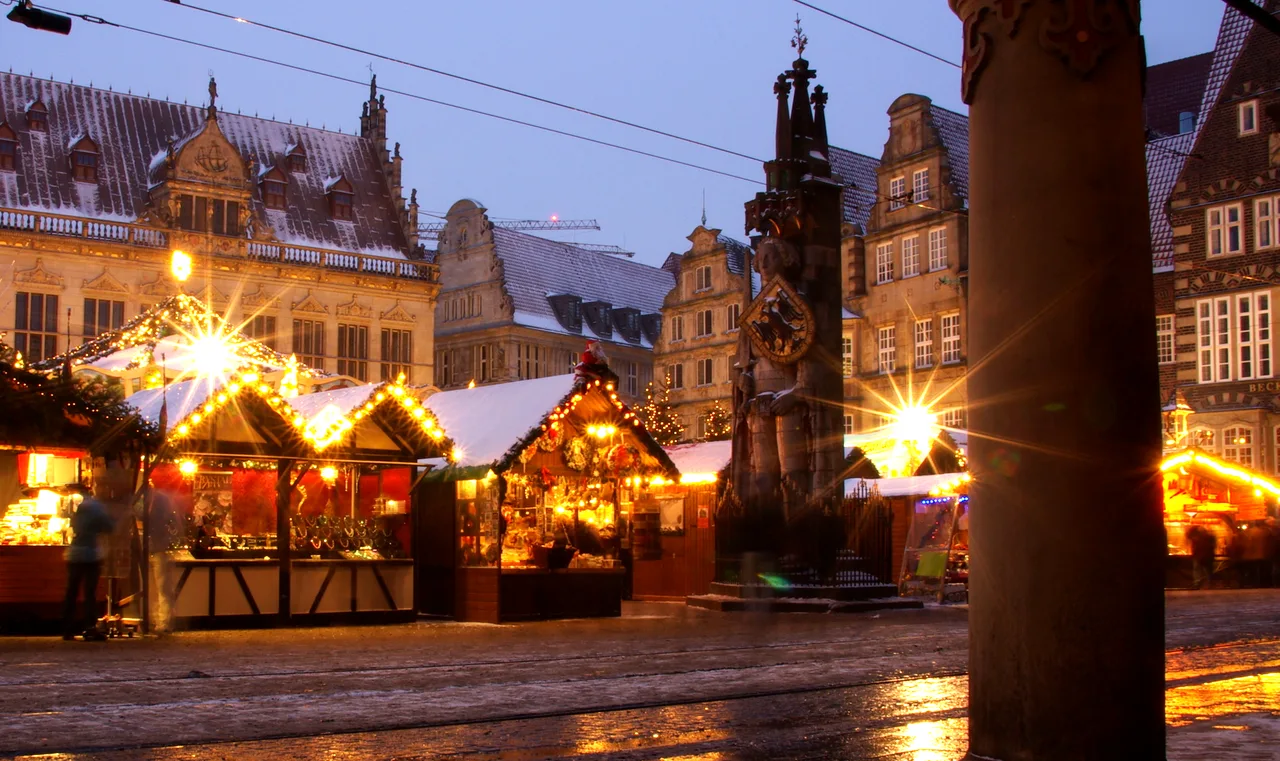
Bremen’s Christmas market is one of the most atmospheric in northern Germany because of its setting. From 23 November to 23 December 2026, according to bremen.de, more than 170 decorated stalls fill the historic market square around the UNESCO-listed Town Hall and the Roland, spreading across Domshof and the shopping passages, with the Town Musicians in sight. There are crafts and Bremen specialities, Christmas guided tours, stilt walkers and a children’s carousel. An illuminated path leads from the market square through the Böttcherstraße down to the Weser, where the Schlachte-Zauber spreads along the river promenade: a historical, wintry and maritime market where the ships along the quay glitter in blue light. In the Freibeuterdorf, the “village of the Fogelvreien”, a spice merchant, a smith, potters, felters, wood turners and scribes work at their crafts, and taverns serve mead, fruit wine and hot drinks while minstrels sing; the market opens on 23 November at 18:30 with fireworks over the Weser. In the city centre, streets are lit, shopping passages decorated, and the Ansgari Quarter has a Winterwald. Neighbourhood markets add more, such as the Findorffer Winterdorf in the Findorff district, from early November. Bremen also has its own Christmas treats: Klaben, a rich fruit stollen, Kluten, peppermint sticks dipped in chocolate, and Bremer Punsch.


| Event | Location | 2026 dates | Note |
|---|---|---|---|
| Bremen Christmas Market | Marktplatz, Domshof and around the Town Hall | 23 November–23 December 2026 | More than 170 stalls; Sun–Thu 11:00–20:30, Fri–Sat 11:00–21:30. |
| Schlachte-Zauber | Schlachte promenade on the Weser | 23 November–23 December 2026 | Medieval and maritime market with the Freibeuterdorf; opening fireworks 23 November at 18:30. |
| Böttcherstraße | Between Marktplatz and Schlachte | During the markets | The illuminated connecting path between the two markets. |
| Winterwald im Ansgari Quartier | Ansgari Quarter, city centre | Advent season | A winter forest in the shopping district; check dates on bremen.de. |
| Findorffer Winterdorf | Findorff district | From early November 2026 | Neighbourhood winter village; check dates with the organisers. |
| Christmas guided tours | Old town | Advent season | Bookable tours on bremen.de/tourismus. |
What to try
Glühwein and Bremer Punsch
Hot spiced wine and punch – alcoholic; most stalls also sell alcohol-free Kinderpunsch or hot apple juice.
Gebrannte Mandeln
Roasted, sugar-coated almonds, whose smell fills the market square.
Bremer Klaben
A heavy, fruit-filled Christmas loaf, Bremen’s answer to stollen.
Bremer Kluten
Peppermint fondant sticks half dipped in dark chocolate, a local classic.
Schmalzkuchen
Small deep-fried dough pieces dusted with powdered sugar, sold hot in paper bags.
Smoked fish and fresh bread
At the Schlachte-Zauber the smell of smoked fish and freshly baked bread hangs over the river.
Bremen Christmas market tips
- In December it is dark in Bremen by about 16:00; plan the Town Hall tour, museums and the Schnoor for daylight and the markets for the evening.
- Follow the illuminated path from the market square through the Böttcherstraße to the Schlachte-Zauber on the Weser.
- The official page recommends weekdays as the best time; weekend evenings are crowded.
- The Schlachte-Zauber opens on 23 November at 18:30 with fireworks over the Weser.
- Mugs for Glühwein usually carry a deposit; return it or keep the mug as a souvenir.
- Many stalls accept cards, but small change is useful for snacks.
- The wind from the river makes evenings on the Schlachte feel cold; bring warm, waterproof clothing.
- Both markets close on 23 December; on 24–26 December many museums and shops change their hours.
Check before you go: Bremen · Weihnachtsmarkt & Schlachte-Zauber 2026 (official) ↗ · M3B · Schlachte-Zauber 2026 (official organiser) ↗
Dates and hours were checked on 28 October 2026 against the official bremen.de tourism page “Weihnachtsmarkt & Schlachte-Zauber”. Dates of neighbourhood markets were not all confirmed on official pages; check bremen.de and the organisers before your visit.
When to Go
Bremen has a mild, maritime climate with frequent wind and rain and few extremes. Spring and early summer are pleasant for walks along the Weser and through the Wallanlagen; summer brings festivals and beer gardens on the Schlachte. Autumn is mild, and the Freimarkt fair in October is one of the oldest in Germany. From late November to 23 December the Christmas market and Schlachte-Zauber light up the old town. January and February are grey and quiet – good for museums.
| Month | City sightseeing | Christmas markets | Day trips and coast | Crowds |
|---|---|---|---|---|
| January | Difficult | None | Difficult | Quiet |
| February | Difficult | None | Difficult | Quiet |
| March | Good | None | Good | Quiet |
| April | Good | None | Good | Moderate |
| May | Very good | None | Very good | Moderate |
| June | Very good | None | Very good | Moderate |
| July | Very good | None | Very good | Moderate |
| August | Very good | None | Very good | Moderate |
| September | Very good | None | Very good | Moderate |
| October | Good | None | Good | Busy |
| November | Difficult | Market season | Good | Moderate |
| December | Good | Market season | Difficult | Busy |
- Winters are cool and damp, usually just above freezing; snow is possible but rarely lasts.
- In December the sun rises around 8:30 and sets around 16:00; plan sightseeing for daylight.
- The Christmas market and Schlachte-Zauber run from 23 November to 23 December 2026.
- The North Sea coast at Bremerhaven is windy in winter; check museum winter hours.
- Many museums close on Mondays and have reduced hours over the holidays; check before you go.
- Hotels in the old town fill on Advent weekends and during the Freimarkt; book early.
Visa and Entry (Turkish citizens)
Turkish citizens holding an ordinary (burgundy) passport need a Schengen visa for tourist travel to Germany. Different rules apply to special, service and diplomatic passports; check the current situation with the Turkish Ministry of Foreign Affairs.
Apply to the mission of your main destination. If Germany is your main destination, the German missions in Türkiye are responsible; current information on the application procedure is at tuerkei.diplo.de.
If you combine Bremen with Amsterdam (Netherlands) or Copenhagen (Denmark), apply to the country where you will stay longest; if stays are equal, the country of first entry applies. Checks may take place at internal borders; carry your passport.
Under the EU Entry/Exit System (EES), being phased in, your biometric data (facial image and fingerprints) may be taken on first entry; allow extra time at the border.
Visa fees, appointment waiting times and required documents can change; this guide gives no fees. Use the current list on the official sites before applying.
Travel medical insurance and accommodation and return details are part of the application; see the official sources for details.
Check before you go: T.C. Dışişleri Bakanlığı · Türk vatandaşlarının tabi olduğu vize uygulamaları ↗ · tuerkei.diplo.de ↗ · EES · europa.eu ↗ · Rota Atlası visa guide (TR)
Travel medical insurance
Check the official visa and entry sources above first: they state whether travel medical insurance is required and the minimum cover. Compare any policy’s cover amount, validity dates and countries covered with the official requirement.
Rota Atlası does not currently offer an insurance partnership; there are no paid links in this section. Last updated: 1 November 2026
Getting to Bremen
- By air: Bremen Airport (BRE) lies just south of the city; tram line 6 links it with the centre and the Hauptbahnhof. Larger gateways are Hamburg (HAM) and other German hubs, with onward trains. Check current flights from Türkiye only on airline and airport websites.
- By train from Hamburg: regional and long-distance trains link Hamburg Hauptbahnhof and Bremen Hauptbahnhof in about an hour. Check timetables on bahn.de.
- By train from elsewhere: Bremen has direct long-distance connections to cities such as Hanover, Cologne and Berlin, and regional trains to Bremerhaven and Oldenburg.
- From the station to the old town: Bremen Hauptbahnhof is about a 10–15-minute walk from the market square across the Wallanlagen; trams also run there.
Getting Around

On foot
The old town between the Wallanlagen and the Weser is compact; the market square, Böttcherstraße, Schnoor and Schlachte are minutes apart.
Tram and bus
BSAG runs the tram and bus network; Domsheide, Obernstraße and Am Brill are central stops. Check tickets on bsag.de and vbn.de.
Regional trains
Regional trains run to Bremerhaven and Vegesack; tickets follow the VBN tariff.
Bike
Bremen is flat and very bike-friendly, with many cycle paths along the Weser.
Boat
In season, boats run on the Weser and to Vegesack and Bremerhaven; check operating times locally.
Day trips
Bremerhaven, Worpswede, Vegesack, Oldenburg and Hamburg are easy day trips.
Things to See
Bremen’s old town lies on the right bank of the Weser, enclosed by the star-shaped Wallanlagen park on the line of the old fortifications. The market square with the Town Hall, Roland and Cathedral is the centre; the Böttcherstraße leads down to the Schlachte on the river, and the Schnoor quarter lies to the south-east. East of the Wallanlagen, the Viertel (Ostertor and Steintor) is the lively district with the Kunsthalle. Bremerhaven, Worpswede and Vegesack are short trips away.
UNESCO World Heritage
Bremen Town Hall and Ratskeller

Bremen Town Hall was built as a Gothic hall building between 1405 and 1410 and received its magnificent Weser Renaissance façade at the beginning of the 17th century, with gables, figures and reliefs that show the self-confidence of a free trading city. Inside, the Upper Hall, used for receptions and festivities, is hung with model ships and paintings, among them a large painting of a whale, and the Golden Chamber is richly decorated. Below the Town Hall lies the Ratskeller, one of the oldest wine cellars in Germany, which holds a large collection of German wines. UNESCO listed the Town Hall and the Roland as World Heritage in 2004, as an outstanding testimony to civic autonomy in the Holy Roman Empire. UNESCO listing ↗
Don’t miss
- The Weser Renaissance façade
- The Upper Hall with its model ships
- The Golden Chamber
- The vaults of the Ratskeller
Tips
- The interior can only be seen on guided tours; check times on bremen.de/tourismus.
- Tours may be cancelled during official events.
- The Town Musicians stand on the west side of the building.

Symbols of freedom
Roland, Schütting and Church of Our Lady

The stone Roland, erected in 1404, stands on the market square as a symbol of the city’s rights and freedoms; his shield faces the cathedral as a sign to the archbishop, and legend says Bremen will stay free as long as the Roland stands. Opposite the Town Hall is the Schütting, the 16th-century house of the merchants’ guild, today seat of the Chamber of Commerce. Around the square, narrow gabled houses frame the view. Just behind the Town Hall stands the Church of Our Lady (Unser Lieben Frauen), the oldest parish church in the city, with modern stained-glass windows by the French artist Alfred Manessier. On the west side of the Town Hall, Gerhard Marcks’ bronze Town Musicians of 1953 have become the city’s most popular motif; touching the donkey’s front legs is said to bring luck.
Don’t miss
- The Roland and the shield facing the cathedral
- The Schütting façade
- The windows of the Church of Our Lady
- The Town Musicians statue
Tips
- In Advent the square is the heart of the Christmas market.
- Early morning is the best time for photos without crowds.
- Look for the Bremer Spucke, a stone cross in the pavement near the cathedral, marking a historic execution site.


Over 1,200 years
St. Peter’s Cathedral

St. Peter’s Cathedral (St. Petri Dom) on the east side of the market square goes back to the bishopric founded in the late 8th century; the present church, with its two west towers, was built mainly from the 11th to the 13th century and later rebuilt. Inside are Romanesque crypts and a Baroque pulpit, and the Dom Museum displays finds from archbishops’ graves. The cathedral’s curiosity is the Bleikeller, a room where bodies found in the 17th century are naturally mummified. Visitors can climb the south tower for a view over the roofs of the old town.
Don’t miss
- The Romanesque crypts
- The Dom Museum
- The mummies of the Bleikeller
- The view from the south tower
Tips
- Opening hours of the tower, museum and Bleikeller differ and are reduced in winter; check stpetridom.de.
- Services and concerts may restrict visits.
- Advent concerts are often held here; see the programme.
1920s dream street
Böttcherstraße, Glockenspiel and Paula Modersohn-Becker Museum

The Böttcherstraße, a narrow lane of only about a hundred metres between the market square and the Weser, was rebuilt between 1922 and 1931 on the initiative of the coffee merchant Ludwig Roselius, the inventor of decaffeinated coffee, as an Expressionist and Art Deco ensemble, much of it by the sculptor Bernhard Hoetger. The golden relief “The Bringer of Light” marks its entrance. Between two gables hangs a Glockenspiel of Meissen porcelain bells, and several times a day a tower beside it turns to show panels honouring ocean crossers. The Paula Modersohn-Becker Museum, opened in 1927, was the first museum in the world dedicated to the work of a woman painter, and together with the Ludwig Roselius Museum it forms the Museen Böttcherstraße.
Don’t miss
- The golden relief at the entrance
- The Glockenspiel and its rotating panels
- The Paula Modersohn-Becker Museum
- The Haus Atlantis staircase
Tips
- The Glockenspiel plays at set times; check bremen.de or ask locally.
- Museum opening hours on museen-boettcherstrasse.de.
- In Advent this lane is the illuminated path between the two Christmas markets.


Oldest quarter
The Schnoor quarter

The Schnoor, south-east of the cathedral, is the oldest surviving quarter of Bremen. Its name comes from the word for string – the narrow lanes run like threads, and the trades of ropemakers and fishermen lined them. Tiny houses from the 15th to the 18th centuries, some barely a few metres wide, now house small shops, galleries, cafés and craft workshops. In Advent the lanes are decorated and the shops sell Christmas ornaments and gifts.
Don’t miss
- A walk through the narrowest lanes
- The small craft and Christmas shops
- The view from the lanes to the cathedral
- The old houses near the Weser
Tips
- The Schnoor is residential; keep noise down in the evening.
- Lanes are cobbled and uneven; wear sturdy shoes.
- Combine with the Schlachte, a few minutes’ walk away.
The river front
Schlachte and the Weser

The Schlachte, the promenade along the right bank of the Weser, was for centuries Bremen’s harbour, where ships moored and goods were unloaded. Today it is a lively waterfront with restaurant ships, historic sailing vessels and beer gardens. In Advent it is the stage of the Schlachte-Zauber, the medieval and maritime market. Across the river lies the Teerhof peninsula with its museums, and from the bridges you can see the old town skyline over the water.
Don’t miss
- The Schlachte-Zauber in Advent
- The historic ships at the quay
- The view from the Wilhelm Kaisen Bridge
- An evening walk by the water
Tips
- It is windy by the river; bring warm clothing.
- The market opens on 23 November at 18:30 with fireworks.
- In summer boat tours start here; winter schedules are limited.


Lively district
The Viertel (Ostertor and Steintor)

East of the old town, beyond the Wallanlagen, lies “das Viertel”, the Ostertor and Steintor districts. Rows of 19th-century townhouses, known as the Bremer Haus, line its streets, and the Ostertorsteinweg is full of independent shops, cafés, cinemas and bars. It is the city’s alternative and cultural quarter, with theatres and music venues, and a good place to see everyday Bremen.
Don’t miss
- The Bremer Häuser along the side streets
- The Ostertorsteinweg
- Independent shops and cafés
- The theatre at Goetheplatz
Tips
- Trams run along the main street.
- The district is lively at night; watch your belongings.
- The Kunsthalle is at the start of the district.
Art and greenery
Kunsthalle Bremen and the Wallanlagen

The Wallanlagen, a park laid out from the early 19th century on the old fortifications, curves around the old town in a zigzag along the moat. Its landmark is the Mühle am Wall, a windmill that still turns, with a restaurant inside. At the eastern edge of the park, the Kunsthalle Bremen, run by the Kunstverein in Bremen since the 19th century, holds a major collection of European art from the Middle Ages to the present, with strong French and German works of the 19th and 20th centuries.
Don’t miss
- The collections of the Kunsthalle
- The windmill in the Wallanlagen
- A walk along the moat
- The sculptures in the park
Tips
- Check Kunsthalle opening hours and exhibitions on kunsthalle-bremen.de.
- The park is lovely in daylight; paths can be wet in winter.
- The windmill is a good photo stop between station and old town.

Arrival
Hauptbahnhof and Übersee-Museum

Bremen Hauptbahnhof, a historicist station building of the late 19th century, is the starting point for most visitors. Right next to it stands the Übersee-Museum, opened in 1896, one of the oldest museums of its kind in Germany, with exhibitions on nature, culture and trade from all continents and a visible storage depot. From the station it is a short walk across the Wallanlagen to the old town.
Don’t miss
- The station façade
- The Übersee-Museum
- The walk across the Wallanlagen
- The windmill on the way to the old town
Tips
- Check Übersee-Museum opening hours on uebersee-museum.de.
- The tram stop in front of the station connects to the airport and the old town.
- Lockers at the station are useful on arrival and departure days.
Science
Universum Bremen

The Universum Bremen, a science centre near the university, is housed in a silver building shaped like a whale or a mussel. Its hands-on exhibitions on technology, people and nature invite visitors to experiment, which makes it a good choice for families and rainy days. The surrounding science park is part of the university district.
Don’t miss
- The silver building
- The hands-on exhibitions
- The outdoor area
- The science park around it
Tips
- Check opening hours and tickets on universum-bremen.de.
- Trams run from the city centre.
- Plan half a day with children.
North Sea
Day trip: Bremerhaven

Bremerhaven, Bremen’s port city at the mouth of the Weser, about 60 kilometres north, was founded in 1827 to give Bremen access to the sea. Millions of emigrants left Europe for the New World from here, a story told by the German Emigration Center. At the Havenwelten waterfront are the Klimahaus Bremerhaven 8° Ost, which takes visitors on a journey along the 8th degree of longitude, and the German Maritime Museum. The Atlantic Hotel Sail City and the old and new harbours mark the skyline.
Don’t miss
- The German Emigration Center
- The Klimahaus 8° Ost
- The German Maritime Museum
- The Havenwelten waterfront
Tips
- Regional trains take around 40 minutes from Bremen; check bahn.de.
- Check museum opening hours on bremerhaven.de.
- It is very windy by the sea in winter.
Artists’ village
Day trip: Worpswede and Vegesack

Worpswede, in the moorland north-east of Bremen, became an artists’ colony at the end of the 19th century, home to painters such as Paula Modersohn-Becker, Otto Modersohn and Heinrich Vogeler. Today its museums, galleries and Jugendstil houses, among them Vogeler’s Barkenhoff, recall that era. Vegesack, in the north of Bremen on the Weser, is an old harbour town with one of Germany’s oldest artificial harbours, maritime traditions and historic ships such as the lugger BV 2 Vegesack.
Don’t miss
- The museums of Worpswede
- The Barkenhoff
- The Weyerberg and the moor
- The harbour and ships of Vegesack
Tips
- Buses run from Bremen to Worpswede; check worpswede-touristik.de and vbn.de.
- Vegesack can be reached by regional train.
- Winter hours of museums may be reduced.

1–3 Day Itineraries, Christmas Day + 7-Day Northern Germany Route
The itineraries keep walking short and take the short winter days into account. One day covers the old town, two days add museums and the Viertel, three days a day trip. The 7-day route links Bremen with Hamburg, Lübeck and the coast. Check opening hours in advance on official websites.
Day 1: Old town
- Start at the market square with the Town Hall, Roland and Town Musicians.
- Visit St. Peter’s Cathedral and climb the tower.
- Walk through the Böttcherstraße and hear the Glockenspiel.
- Explore the Schnoor quarter.
- In the evening, walk along the Schlachte.
Day 2: Museums and the Viertel
- Take a Town Hall tour in the morning.
- Visit the Paula Modersohn-Becker Museum.
- Walk through the Wallanlagen past the windmill to the Kunsthalle.
- Explore the Viertel in the afternoon.
- Visit the Übersee-Museum near the station.
Day 3: Day trip
- Take the train to Bremerhaven for the Emigration Center and the Klimahaus.
- Alternatively, go to Worpswede and its museums.
- Or visit Vegesack and its harbour.
- Return to Bremen by late afternoon.
- Finish the day in the old town.
Christmas day (23 November–23 December 2026)
- Visit the Cathedral and the Schnoor in daylight.
- Take a Town Hall tour.
- At dusk, stroll through the Christmas market around the Town Hall.
- Follow the lit path through the Böttcherstraße to the Schlachte-Zauber.
- Finish with Glühwein or punch by the river.
7 days: Northern Germany
- Days 1–3: Bremen – old town, museums and a day trip.
- Day 4: Bremerhaven and the North Sea coast.
- Day 5: Train to Hamburg – Rathausmarkt and the harbour.
- Day 6: Lübeck – the “Christmas City of the North”.
- Day 7: Lüneburg or departure from Hamburg.
Bremen and Northern German Food
Bremen’s cuisine reflects its North Sea and Hanseatic heritage: hearty winter dishes, fish and coffee and chocolate traditions. Below are traditional specialities, not restaurant recommendations.


Grünkohl mit Pinkel
Kale stewed for hours, served with Pinkel sausage, smoked pork and potatoes – the Bremen winter dish; it contains pork.
Knipp
A fried mixture of oat groats and meat, a Bremen breakfast speciality; it contains pork.
Labskaus
A sailor’s dish of corned beef, potatoes and beetroot with fried egg and pickled herring.
Bremer Klaben
A rich Christmas fruit loaf.
Bremer Kluten
Peppermint sticks dipped in dark chocolate.
Matjes and smoked fish
Fish from the North Sea, often in bread rolls.
Kaffee
Bremen has a long coffee trading history; coffee houses are a local tradition.
Bremer Punsch
A traditional punch, sold at the Christmas market; alcoholic.
- Many traditional dishes contain pork; ask about ingredients.
- Kohlfahrten, winter kale outings, are a local tradition from November; restaurants serve Grünkohl all winter.
- Tap water is of good quality; ask for it explicitly.
- Service is included in prices; rounding up by 5–10 per cent is usual.
Culture and Etiquette

- “Moin” is the typical greeting in northern Germany, at any time of day.
- In formal situations use titles and surnames until first names are offered.
- Don’t walk around churches during services and avoid flash photography.
- Queues at bakeries, stalls and stops are respected.
- Small amounts at stalls are still often paid in cash.
- Cyclists use marked lanes; don’t walk on them.
- Sunday is a day of rest; most shops are closed.
- Punctuality is expected for tours and appointments.
- People in Bremen are considered reserved but friendly.
- Ask before photographing people, especially at markets.
Safety and Health
- Bremen is generally safe; watch your valuables in crowds and around the station.
- Cobblestones and steps can be slippery in wet or icy weather; wear non-slip shoes.
- Watch out for trams and cyclists in the old town.
- The wind by the river and the coast can be strong; dress warmly.
- In an emergency call 112; police 110.
- Make sure your travel medical insurance covers the Schengen area.
- Pharmacies post the address of the nearest emergency pharmacy.
What Your Budget Depends On
This guide does not give prices; prices change with season and year. Your budget depends on these factors:
Dates
Advent weekends and the Freimarkt increase hotel demand.
Where you stay
The old town is most convenient; the Viertel and station area are alternatives.
Transport
Trams and buses are inexpensive; regional tickets cover day trips.
Museums
Entry is charged separately; check combined offers.
Food and drink
Market snacks and bakeries are cheap; restaurants vary widely.
Day trips
Trains to Bremerhaven or buses to Worpswede add transport costs.
Free experiences
The Christmas markets (free entry), the market square, the Schnoor, the Schlachte and the Wallanlagen cost nothing.
Practical Information
- Money: euro; cards widely accepted, but carry some cash.
- Language: German; English understood in tourism.
- Plugs: 230 V, European type C/F.
- Time: two hours behind Türkiye in winter (CET, UTC+1).
- Opening hours: many museums close on Mondays; check before you go.
- Shops: closed on Sundays; Christmas markets open.
- Holidays: hours change on 24–26 and 31 December and 1 January.
- Weather: in December cool and damp, around 2–5 °C.
- Daylight: in December the sun sets around 16:00.
- Emergency: 112; police 110.
Frequently Asked Questions
When is the Bremen Christmas market 2026?
According to bremen.de, from 23 November to 23 December 2026, together with the Schlachte-Zauber.
What are the opening hours?
Sunday–Thursday 11:00–20:30 and Friday–Saturday 11:00–21:30, according to the official page.
Is entry to the markets free?
Yes; food, drinks and rides cost money.
Do Turkish citizens need a visa?
Ordinary passport holders need a Schengen visa. If Germany is the main destination, see tuerkei.diplo.de.
How do I get from Hamburg to Bremen?
By train from Hamburg Hauptbahnhof in about an hour; check bahn.de.
How many days are enough?
One day for the old town, two for museums and the Viertel, three with a day trip.
Can I see inside the Town Hall?
Yes, on guided tours; check times on bremen.de/tourismus.
What is the Schlachte-Zauber?
A medieval and maritime Christmas market on the Weser promenade, with the Freibeuterdorf and historic ships.
Where are the Town Musicians?
On the west side of the Town Hall, by the market square.
What should I take home from Bremen?
Bremer Kluten, Klaben, coffee or crafts from the Christmas market.
Where to stay
Stay close to the areas where you will spend most time. The areas below are covered in detail in this guide; check public transport links in the getting-around section.
- UNESCO World HeritageBremen Town Hall and Ratskeller
- Symbols of freedomRoland, Schütting and Church of Our Lady
- Over 1,200 yearsSt. Peter’s Cathedral
- 1920s dream streetBöttcherstraße, Glockenspiel and Paula Modersohn-Becker Museum
- Oldest quarterThe Schnoor quarter
- The river frontSchlachte and the Weser
- Lively districtThe Viertel (Ostertor and Steintor)
- Art and greeneryKunsthalle Bremen and the Wallanlagen
- ArrivalHauptbahnhof and Übersee-Museum
- ScienceUniversum Bremen
- North SeaDay trip: Bremerhaven
- Artists’ villageDay trip: Worpswede and Vegesack
Search hotels in these areas (Hotellook) ↗ (affiliate link)Search on Booking.com ↗
Affiliate disclosure: Hotellook, Aviasales, Klook, Airalo, Tiqets and DiscoverCars links are affiliate links; Rota Atlası may earn a commission on bookings made through them, at no extra cost to you. Official and in-guide links are not paid. Last updated: 1 November 2026 · Privacy and affiliates
Transport and connectivity
- Airport transferOptions from the airport to the city are in this guide’s getting there section.
- Mobile data (eSIM)Airalo eSIM ↗ (affiliate link)
- TrainsOfficial rail website ↗
- Car hireYou rarely need a car within the city; see getting around first. Compare car hire on DiscoverCars ↗ (affiliate link)
Affiliate disclosure: Hotellook, Aviasales, Klook, Airalo, Tiqets and DiscoverCars links are affiliate links; Rota Atlası may earn a commission on bookings made through them, at no extra cost to you. Official and in-guide links are not paid. Last updated: 1 November 2026 · Privacy and affiliates
Search flights (affiliate link)
Search flights from any airport in any country. Results open on Aviasales in a new tab, where you book.
This form is an affiliate link: Rota Atlası may earn a commission on bookings made via Aviasales (Travelpayouts), at no extra cost to you. Check price, baggage and terms on the booking site. Airport data: OurAirports (public domain).
Flights, hotels and tours
Find tours and tickets
- Bremen Christmas Market
GetYourGuide ↗ · Klook ↗ (affiliate link) - Schlachte-Zauber
GetYourGuide ↗ · Klook ↗ (affiliate link) - Town Hall and Roland
GetYourGuide ↗ · Klook ↗ (affiliate link) - Böttcherstraße
GetYourGuide ↗ · Klook ↗ (affiliate link)
Hotellook, Aviasales, Klook, Airalo and Tiqets links in this box are affiliate links (Travelpayouts): Rota Atlası may earn a commission on bookings made through them, at no extra cost to you. GetYourGuide links currently carry no affiliate code. Check prices and terms with the provider. Last updated: 1 November 2026 · Privacy and affiliates
Sources
- T.C. Dışişleri Bakanlığı · Türk vatandaşlarının tabi olduğu vize uygulamaları ↗
- Auswärtiges Amt · Deutsche Vertretungen in der Türkei (Visa) ↗
- European Union · Entry/Exit System (EES) ↗
- Bremen Tourismus · bremen.de/tourismus (official) ↗
- Freie Hansestadt Bremen · bremen.de (official) ↗
- St. Petri Dom Bremen (official) ↗
- Böttcherstraße Bremen (official) ↗
- Museen Böttcherstraße · Paula Modersohn-Becker Museum (official) ↗
- Kunsthalle Bremen (official) ↗
- Übersee-Museum Bremen (official) ↗
- Universum Bremen (official) ↗
- BSAG · Bremer Straßenbahn AG (official) ↗
- VBN · Verkehrsverbund Bremen/Niedersachsen ↗
- Bremen Airport (official) ↗
- Deutsche Bahn ↗
- Erlebnis Bremerhaven (official) ↗
- Worpswede Touristik (official) ↗
- GOV.UK · Foreign travel advice · Germany ↗
- UNESCO World Heritage Centre · Town Hall and Roland on the Marketplace of Bremen ↗
- Bremen · Weihnachtsmarkt & Schlachte-Zauber 2026 (official) ↗
- M3B · Schlachte-Zauber 2026 (official organiser) ↗
This page is for information only. Dates, hours, entry rules and transport information can change; check the official sources above before travelling. No prices, flights, hotels or restaurants have been invented in this guide.
Photo credits
The photos on this page come from Wikimedia Commons and are used under the stated authors and licences (CC BY, CC BY-SA, CC0 or public domain). Full list of sources
- Bremen’s Marktplatz and Town Hall illuminated at night — Garitzko · Public domain · Wikimedia Commons
- Lit stalls and visitors at the Bremen Christmas market — Jürgen Howaldt · CC BY-SA 3.0 de · Wikimedia Commons
- A decorated stall at the Bremen Christmas market — Jürgen Howaldt · CC BY-SA 3.0 de · Wikimedia Commons
- Bremen Town Hall lit up at night — Garitzko · Public domain · Wikimedia Commons
- Christmas stalls on the Weser at the Schlachte-Zauber — Corradox · CC BY-SA 3.0 · Wikimedia Commons
- The Schlachte promenade during Advent — Corradox · CC BY-SA 3.0 · Wikimedia Commons
- A lit stall on Bremen’s Marktplatz on an Advent evening — Corradox · CC BY-SA 4.0 · Wikimedia Commons
- The Übersee-Museum Bremen at Christmas time — JoachimKohler-HB · CC BY-SA 4.0 · Wikimedia Commons
- The Weser Renaissance façade of Bremen’s UNESCO-listed Town Hall — Dietmar Rabich · CC BY-SA 4.0 · Wikimedia Commons
- Sculptures and ornament on the Bremen Town Hall façade — Dietmar Rabich · CC BY-SA 4.0 · Wikimedia Commons
- The Bremen Roland statue in front of the Town Hall — Dietmar Rabich · CC BY-SA 4.0 · Wikimedia Commons
- Bremen’s Marktplatz and its historic buildings — Tim Rademacher · CC BY-SA 4.0 · Wikimedia Commons
- Gerhard Marcks’s bronze of the Town Musicians of Bremen — Enter · CC BY-SA 4.0 · Wikimedia Commons
- The twin-towered St. Petri Dom (Bremen Cathedral) — [[User:Ad Meskens|Ad Meskens You are free to use this picture for any purpose as long as you credit its author, Ad Meskens. Example: © Ad Meskens / Wikimedia Commons If you use this work outside of the Wikimedia projects, a message or a copy is very much appreciated. This image is not in the public domain. A statement such as "From Wikimedia Commons" or similar is not by itself sufficient. If you do not provide clear attribution to the author you do not comply with the terms of the file's license and you may not use this file. If you are unable or unwilling to provide attribution you should contact Ad Meskens to negotiate a different license. ]] · CC BY-SA 4.0 · Wikimedia Commons
- The Church of Our Lady (Unser Lieben Frauen), one of Bremen’s oldest — Dietmar Rabich · CC BY-SA 4.0 · Wikimedia Commons
- The Schütting, the merchants’ guild house on the Marktplatz — Dr. Bernd Gross · CC BY-SA 3.0 · Wikimedia Commons
- The porcelain-bell Glockenspiel in the Böttcherstraße — Dietmar Rabich · CC BY-SA 4.0 · Wikimedia Commons
- The Haus des Glockenspiels and brick façades in the Böttcherstraße — Z thomas · CC BY-SA 4.0 · Wikimedia Commons
- A narrow lane and small houses in the Schnoor quarter — Dietmar Rabich · CC BY-SA 4.0 · Wikimedia Commons
- Colourful historic houses in the Schnoor — Dietmar Rabich · CC BY-SA 4.0 · Wikimedia Commons
- The Schlachte promenade on the Weser with a boat — Jaimrsilva · CC BY-SA 4.0 · Wikimedia Commons
- The Schlachte at night with reflections in the Weser — Hartwig · CC BY-SA 3.0 · Wikimedia Commons
- The River Weser in Bremen on a summer day — Rami Tarawneh · CC BY-SA 2.5 · Wikimedia Commons
- The Kunsthalle Bremen by the old ramparts — Verograph (talk) · CC BY-SA 3.0 · Wikimedia Commons
- Historic townhouses in the Ostertorviertel (“Das Viertel”) — Gerd Eichmann · CC BY-SA 4.0 · Wikimedia Commons
- The windmill Mühle am Wall in the Wallanlagen park — Aaron Zhu · CC BY-SA 3.0 · Wikimedia Commons
- The whale-shaped building of the Universum Bremen science centre — User:Matthias Süßen · CC BY-SA 3.0 · Wikimedia Commons
- A Bremen tram at Domsheide — Clic · CC BY 4.0 · Wikimedia Commons
- The historic façade of Bremen Hauptbahnhof — en:User:Doco, wiki+spam@eindruckschinderdomain.de · CC BY-SA 2.0 de · Wikimedia Commons
- The Havenwelten harbour district in Bremerhaven — H. Zell · CC BY-SA 3.0 · Wikimedia Commons
- The Bergstraße in the artists’ village of Worpswede — AHK · CC0 · Wikimedia Commons
- The historic herring lugger BV 2 Vegesack under sail on the Weser — JoachimKohler-HB · CC BY-SA 4.0 · Wikimedia Commons
- Bremen-style kale with Pinkel sausage and boiled potatoes — Oliver Hallmann · CC BY 2.0 · Wikimedia Commons
- Bremer Kluten, peppermint sweets coated in dark chocolate — Reise Reise · CC BY-SA 3.0 · Wikimedia Commons
- Bremer Klaben, the traditional raisin Christmas loaf — Till Westermayer from Freiburg, Germany · CC BY-SA 2.0 · Wikimedia Commons
- The terrace of the Paula Modersohn-Becker Museum, Böttcherstraße — Godewind (talk) · CC BY-SA 4.0 · Wikimedia Commons
- The large whale painting inside Bremen Town Hall — Franz Wulfhagen, Foto: Jürgen Howaldt · CC BY-SA 3.0 de · Wikimedia Commons
Hamburg → · Lübeck → · Münster → · Amsterdam → · Copenhagen → · Christmas markets