

Lübeck, in the state of Schleswig-Holstein about 60 kilometres north-east of Hamburg, was for centuries the leading city of the Hanseatic League, the medieval trading network that linked the North Sea and the Baltic. Its old town sits on an oval island ringed by the River Trave and the Elbe–Lübeck Canal, and its skyline of seven green church spires on five main churches is visible from far away. Brick was the stone of the north, and Lübeck turned it into an architecture of its own: St. Mary’s Church became the model for dozens of brick-Gothic churches around the Baltic, the Holstentor became a national symbol, and the salt warehouses on the Trave recall the trade in “white gold” from Lüneburg. Behind the street fronts lie the city’s famous passages and courtyards, tiny lanes where craftsmen and the poor once lived. UNESCO listed the Hanseatic City of Lübeck as World Heritage in 1987. The city is also linked to three Nobel Prize winners – Thomas Mann, Günter Grass and Willy Brandt – and to marzipan, which has been made here for generations. In Advent Lübeck calls itself the “Christmas City of the North”: the Christmas market around the Town Hall, the Historic Christmas Market at St. Mary’s, the Maritime Christmas Market on the Koberg, craft markets in St. Peter’s and the Holy Spirit Hospital, and light installations across the island. This guide brings together all of them, the main sights, the museums, Travemünde on the Baltic and day trips, with official sources throughout.
Content update: 28 October 2026 · Christmas market dates checked against the official Lübeck tourism (Lübeck und Travemünde Marketing) page
Lübeck at a Glance
- Country
- Germany · Schleswig-Holstein; Hanseatic city on the Trave
- Population
- Around 220,000 inhabitants
- Language
- German; English is widely understood in tourism
- Currency
- Euro (EUR); cards are widely accepted, but carry some cash for market stalls
- Time zone
- Central European Time (CET, UTC+1); two hours behind Türkiye in winter
- UNESCO
- Hanseatic City of Lübeck, World Heritage since 1987
- Landmarks
- Holstentor, Salzspeicher, St. Mary’s, Town Hall, Holy Spirit Hospital, Burgtor, Cathedral, St. Peter’s tower
- Nearby
- Travemünde on the Baltic, Hamburg, Wismar, Schwerin, Ratzeburg, Mölln
- Christmas
- “Christmas City of the North”: Christmas market 23 November–30 December 2026 and ten more Christmas worlds
- Airports
- Hamburg Airport (main international airport); small Lübeck Airport
- Electricity
- 230 V, European type C/F sockets; Turkish plugs fit
- Emergency
- 112 (ambulance/fire), 110 (police)
Lübeck in Pictures
The Holstentor, the green spires seen from St. Peter’s tower, and the merchants’ houses along the Obertrave: Lübeck in three frames.


Lübeck Christmas Markets 2026
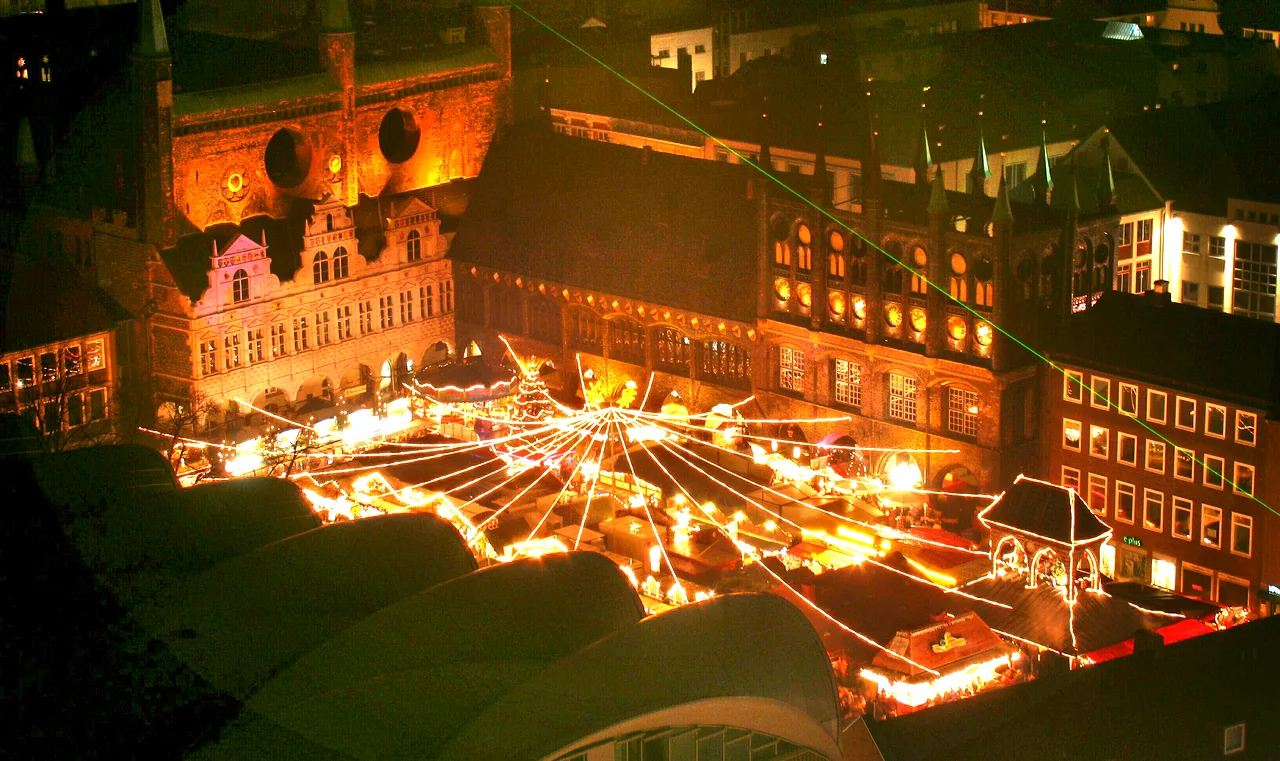
Lübeck does not have one Christmas market but a whole Christmas island. The main Lübeck Christmas Market fills the Markt in front of the Town Hall and the surrounding streets with wooden stalls selling decorations, crafts and food, while the Gothic façade of the Town Hall is dressed in garlands. A few steps away, the Historic Christmas Market at St. Mary’s Church recreates a medieval market with traders in period costume, and the Märchenwald (fairy-tale forest) at St. Mary’s shows scenes from well-known fairy tales for children. On the Klingenberg the Sternenwald (forest of stars) adds a forest of decorated fir trees, and at the northern end of the old town the Maritime Christmas Market on the Koberg, between St. James’s Church – the seafarers’ church – and the Holy Spirit Hospital, has a Ferris wheel and a nautical theme. Inside St. Peter’s Church and in the medieval hall of the Holy Spirit Hospital, craft markets present the work of artisans; the Lübsche Wiehnacht craft market is held on two weekends in November. By the harbour, Hafenglühen at the Drehbrückenplatz brings stalls to the waterfront, and Niederegger’s Christmas bazaar sells marzipan figures and seasonal sweets. In the evenings the whole island is lit: illuminated gates, stars over the streets and church towers reflected in the Trave. Because the old town is only about two kilometres long, you can walk from market to market in a single afternoon and evening.


| Event | Location | 2026 dates | Note |
|---|---|---|---|
| Lübecker Weihnachtsmarkt | Markt at the Town Hall and the surrounding old-town streets | 23 November–30 December 2026 | The main market; check daily opening hours and holiday hours on the official page. |
| Historischer Weihnachtsmarkt | At St. Mary’s Church | 23 November–23 December 2026 | Medieval-style market with traders in period costume. |
| Märchenwald an der Marienkirche | At St. Mary’s Church | 23 November–30 December 2026 | Fairy-tale scenes for children. |
| Sternenwald am Klingenberg | Klingenberg | 23 November–30 December 2026 | A forest of decorated fir trees with stalls. |
| Maritimer Weihnachtsmarkt | Koberg, between St. James’s Church and the Holy Spirit Hospital | 23 November–29 December 2026 | Nautical theme and Ferris wheel. |
| Kunsthandwerkermarkt St. Petri | Inside St. Peter’s Church | 24 November–20 December 2026 | Craft market; combine with the tower viewing platform. |
| Kunsthandwerkermarkt Heiligen-Geist-Hospital | Medieval hall of the Holy Spirit Hospital | 27 November–6 December 2026 | Crafts in one of Europe’s oldest social institutions. |
| Kunsthandwerkermarkt Lübsche Wiehnacht | See the official page for the venue | 21/22 and 28/29 November 2026 | Craft market on two weekends only. |
| Hafenglühen am Drehbrückenplatz | Drehbrückenplatz by the harbour | 23 November–29 December 2026 | Stalls on the waterfront. |
| Wichtelwunderland | See the official page for the venue | 23 November–29 December 2026 | Christmas world for children. |
| Niederegger Weihnachtsbasar | Niederegger, Breite Straße | 23 November–24 December 2026 | Marzipan and seasonal sweets. |
What to try
Glühwein
Hot spiced wine – alcoholic; most stalls also sell alcohol-free punch (Kinderpunsch) or hot chocolate.
Marzipan
Lübeck’s signature sweet; in Advent it comes as figures, loaves, stollen fillings and Christmas pralines.
Gebrannte Mandeln
Roasted, sugar-coated almonds, sold warm in paper cones.
Lebkuchen and Pfeffernüsse
Spiced Christmas biscuits and gingerbread found across Germany.
Grünkohl
Kale stewed for hours, the northern German winter dish; traditionally served with sausage and pork, so ask if you avoid pork.
Fischbrötchen
A bread roll with herring, smoked fish or fried fish – a good warm-up alternative to sausages.
Lübeck Christmas market tips
- In December it gets dark before 16:00 in Lübeck; plan the Holstentor, museums and the St. Peter’s tower for daylight and the markets for the evening.
- Walk the island from south to north: Holstentor → Markt and Town Hall → St. Mary’s → Breite Straße → Koberg and Burgtor.
- Weekends in Advent bring many day visitors from Hamburg and Scandinavia; weekday afternoons are calmer.
- Go up the St. Peter’s tower at dusk to see the lit old town from above; check opening times first.
- Many stalls take cards, but small cash is useful for drinks and snacks.
- The wind from the Baltic makes it feel colder than the thermometer says; bring a hat, gloves and waterproof shoes.
- Glühwein mugs usually require a deposit (Pfand); return the mug to get it back or keep it as a souvenir.
- Opening hours on 24–26 and 31 December differ; check the official page for each market.
Check before you go: Lübeck · Weihnachtsmärkte 2026 (official) ↗ · Lübeck · Weihnachtsstadt des Nordens (official) ↗
Dates were checked on 28 October 2026 against the official “Christmas markets” page of Lübeck und Travemünde Marketing. Daily opening hours, holiday hours and the programme are not given here because they had not been published in full; check the official pages again before you visit.
When to Go
Lübeck has a cool maritime climate. From May to September the long northern days, café terraces along the Trave and the Baltic beaches of Travemünde make it a summer city. From late November to the end of December the Christmas markets fill the island. January to March is grey, damp and windy, but museums are quiet. Spring and autumn are good for walking the old town without crowds.
| Month | City sightseeing | Christmas market | Baltic and day trips | Crowds |
|---|---|---|---|---|
| January | Difficult | None | Difficult | Quiet |
| February | Difficult | None | Difficult | Quiet |
| March | Good | None | Good | Quiet |
| April | Good | None | Good | Moderate |
| May | Very good | None | Very good | Moderate |
| June | Very good | None | Very good | Moderate |
| July | Very good | None | Very good | Busy |
| August | Very good | None | Very good | Busy |
| September | Very good | None | Very good | Moderate |
| October | Good | None | Good | Moderate |
| November | Good | Market season | Difficult | Moderate |
| December | Good | Market season | Difficult | Busy |
- Winters are usually around freezing, often wet and windy; snow is possible but not reliable.
- In December the sun rises around 8:30 and sets before 16:00; plan sightseeing for the short daylight hours.
- The Christmas market runs from 23 November to 30 December 2026; other markets have slightly different dates.
- Travemünde is at its liveliest in summer, especially during the Travemünder Woche sailing regatta; check dates each year.
- Many museums close on Mondays or have reduced winter hours; check the official websites.
- On Advent weekends hotels in the old town fill quickly; book early.
Visa and Entry (Turkish citizens)
Turkish citizens holding an ordinary (burgundy) passport need a Schengen visa for tourist travel to Germany. Different rules apply to special, service and diplomatic passports; check the current situation with the Turkish Ministry of Foreign Affairs.
Apply to the mission of your main destination. If Germany is your main destination, the German missions in Türkiye are responsible; current information on the application procedure is at tuerkei.diplo.de.
If you combine Lübeck with Copenhagen (Denmark), apply to the country where you will stay longest; if stays are equal, the country of first entry applies. Checks may take place at internal borders; carry your passport.
Under the EU Entry/Exit System (EES), being phased in, your biometric data (facial image and fingerprints) may be taken on first entry; allow extra time at the border.
Visa fees, appointment waiting times and required documents can change; this guide gives no fees. Use the current list on the official sites before applying.
Travel medical insurance and accommodation and return details are part of the application; see the official sources for details.
Check before you go: T.C. Dışişleri Bakanlığı · Türk vatandaşlarının tabi olduğu vize uygulamaları ↗ · tuerkei.diplo.de ↗ · EES · europa.eu ↗ · Rota Atlası visa guide (TR)
Travel medical insurance
Check the official visa and entry sources above first: they state whether travel medical insurance is required and the minimum cover. Compare any policy’s cover amount, validity dates and countries covered with the official requirement.
Rota Atlası does not currently offer an insurance partnership; there are no paid links in this section. Last updated: 1 November 2026
Getting to Lübeck
- By air: the usual gateway is Hamburg Airport (HAM); from there S-Bahn trains run to Hamburg Hauptbahnhof, where regional trains to Lübeck depart regularly. Lübeck Airport (LBC) is small and has few scheduled connections. Check current flights from Türkiye only on airline and airport websites.
- By train from Hamburg: regional express trains link Hamburg Hauptbahnhof and Lübeck Hauptbahnhof in well under an hour; the Deutschlandticket is valid on regional trains. Check timetables on bahn.de.
- By train from elsewhere: Lübeck has connections to Kiel, Schwerin, Rostock and Copenhagen (with changes); long-distance trains often require a change in Hamburg.
- From the station to the old town: Lübeck Hauptbahnhof is west of the old town; the Holstentor is about a 10-minute walk away, and city buses run to the island.
Getting Around

On foot
The old town island is compact – about two kilometres from the Holstentor to the Burgtor – and best explored on foot.
Bus
City buses connect the station, the old town and the suburbs; tickets follow the Schleswig-Holstein tariff. Check current tickets on nah.sh.
Train to Travemünde
Regional trains run from Lübeck Hauptbahnhof to Travemünde (Hafen and Strand stations); buses also go there.
Boat
In season, harbour and river cruises go round the old town island; check operating times locally.
Bike
Lübeck is flat and bike-friendly; the old town has cobbles and narrow lanes, so walk your bike in crowds.
Day trips
Hamburg, Travemünde, Wismar, Schwerin, Ratzeburg and Mölln are easy day trips by train or bus.
Things to See
Lübeck’s sights are almost all on the old town island. The Holstentor and the salt warehouses mark the western entrance; the Markt, the Town Hall and St. Mary’s are in the centre; to the north lie the Koberg, the Holy Spirit Hospital, the Hansemuseum and the Burgtor; to the south the Cathedral. Between them, hidden behind the street fronts, are the passages and courtyards. Travemünde, on the Baltic, is part of the city but about 20 kilometres away.
Symbol of the city
Holstentor and the Salzspeicher

The Holstentor, completed in 1478, was the western land gate of the medieval city and is today the symbol of Lübeck. Its two round towers lean slightly, because the soft ground gave way during construction; the inscription “Concordia domi foris pax” (harmony within, peace without) is written over the city-side arch. Inside, the Holstentor Museum tells the story of Lübeck’s trade and the Hanseatic League. Right next to it, along the Trave, stand the Salzspeicher, six brick warehouses from the 16th to the 18th century in which salt from Lüneburg was stored before being shipped across the Baltic. Together they form the classic view of Lübeck from the Holstenbrücke. UNESCO listing ↗
Don’t miss
- The Holstentor from the field side and from the city side
- The Holstentor Museum
- The Salzspeicher seen from across the Trave
- The evening view with the lit gate
Tips
- The best photos of both sides are from the Holstentorplatz in the morning.
- Check museum hours and winter closing days on museum-holstentor.de.
- From the station it is a short walk; it is the natural starting point of any visit.
Brick Gothic
St. Mary’s Church (Marienkirche)

St. Mary’s, the church of Lübeck’s merchants and city council, was built in the 13th and 14th centuries next to the Town Hall as a demonstration of civic pride. It became the model for brick-Gothic churches throughout the Baltic region, and its central nave has one of the highest brick vaults in the world. In the air raid on Palm Sunday night in March 1942 the church burned, and the bells fell from the south tower; their shattered remains have been left where they landed as a memorial. The composer Dieterich Buxtehude was organist here, and in 1705 the young Johann Sebastian Bach travelled from central Germany to hear him. The astronomical clock and the Danse Macabre memorial chapel are further highlights. In Advent the Historic Christmas Market and the Märchenwald are held around the church.
Don’t miss
- The nave and the high brick vault
- The fallen bells memorial in the south tower chapel
- The astronomical clock
- The little devil sculpture outside, subject of a local legend
Tips
- Check visiting hours and services on st-marien-luebeck.de.
- Organ concerts are held regularly; Advent programmes are announced in autumn.
- The church is directly behind the Town Hall and the Christmas market.
Seat of the Hanseatic council
Town Hall and the Markt

Lübeck Town Hall is one of the oldest town halls in Germany still in use and has been extended over the centuries since the 13th century. Its showpiece is the dark glazed brick façade with tall decorative walls and round openings that let the wind through; the Renaissance staircase on Breite Straße and the arcades on the Markt were added later. Inside, the Hanseatic councils once met; today the city council sits here, and guided tours show historic rooms when there are no meetings. In Advent the Markt in front of it is the heart of the Lübeck Christmas Market.
Don’t miss
- The glazed-brick façade on the Markt
- The Renaissance staircase on Breite Straße
- A guided tour of the historic rooms (when offered)
- The Christmas market on the Markt
Tips
- Tour times depend on council business; check on luebeck.de or with the tourist information.
- The arcades are a sheltered spot on rainy days.
- St. Mary’s is directly behind the Town Hall.

Viewpoint
St. Peter’s Church (St. Petri) and its tower

St. Peter’s is one of the five main churches of the old town, but it no longer has a parish: after being restored following war damage, it became a venue for exhibitions, concerts and events. Its main attraction for visitors is the viewing platform in the tower, reached by lift, which offers the best panorama of the old town island, the Holstentor, the Salzspeicher and St. Mary’s – and, on clear days, the landscape towards the Baltic. In Advent the bright, white interior hosts the St. Petri craft market.
Don’t miss
- The panorama from the tower platform
- The view down onto St. Mary’s and the Town Hall
- The St. Petri craft market in Advent
- Exhibitions in the church interior
Tips
- The platform is exposed to the wind; it is much colder at the top.
- Go at dusk in Advent to see the lights come on.
- Check tower hours on st-petri-luebeck.de.

North of the old town
Holy Spirit Hospital and the Koberg

The Holy Spirit Hospital (Heiligen-Geist-Hospital), founded in the late 13th century, is one of the oldest social institutions in Europe still in existence. Behind its gabled façade on the Koberg lies a medieval church hall with wall paintings and the long hall in which small wooden “cabins” were built in the 19th century for elderly residents. It is still a care home for the elderly today, and parts of the historic building can be visited. In Advent the medieval hall hosts a much-loved craft market, and the Koberg square in front of it is home to the Maritime Christmas Market with its Ferris wheel. Next door, St. James’s Church (Jakobikirche) is the church of seafarers and keeps a lifeboat of the sailing ship Pamir as a memorial.
Don’t miss
- The church hall and medieval wall paintings
- The “cabins” in the long hall
- The Maritime Christmas Market on the Koberg
- The seafarers’ memorial in St. James’s Church
Tips
- It is a care home: keep your voice down and respect residents’ privacy.
- The craft market is only held from 27 November to 6 December 2026.
- From the Koberg it is a short walk to the Burgtor and the Hansemuseum.

Museum
European Hansemuseum and the Burgtor

The European Hansemuseum, opened in 2015 at the northern end of the old town, is the largest museum dedicated to the history of the Hanseatic League. With reconstructed scenes – from a medieval trading post in Novgorod to the Bruges market and a Lübeck council meeting – it explains how merchants from many cities built a trading network that lasted for centuries. The museum includes the medieval Burgkloster, a former Dominican friary. Just beyond it stands the Burgtor, the northern city gate, rebuilt in its present form in the 15th century; in winter it is beautifully lit.
Don’t miss
- The reconstructed scenes of the Hanseatic world
- The medieval Burgkloster
- The Burgtor and its winter lighting
- The view over the harbour from the museum terrace
Tips
- Allow at least two to three hours; the museum is large.
- Check opening hours and ticket options on hansemuseum.eu.
- Combine with the Koberg and the Holy Spirit Hospital.


Hidden Lübeck
The passages and courtyards (Gänge und Höfe)

Behind the grand street fronts of the old town lie Lübeck’s passages and courtyards: narrow lanes, often entered through a low doorway in a house, leading to rows of tiny houses built in the back gardens for craftsmen, workers and the poor. Dozens of them survive. Some are foundations (Stiftshöfe) created by wealthy merchants for widows of merchants and sailors – the Füchtingshof on Glockengießerstraße, founded in the 17th century, is the best known, with its whitewashed houses around a quiet courtyard. Walking through them is one of the most memorable experiences in Lübeck.
Don’t miss
- The Füchtingshof on Glockengießerstraße
- Glandorps Gang and Glandorps Hof
- The courtyards around Hundestraße and Engelsgrube
- The Schwanshof passage
Tips
- People live here: walk quietly, don’t look into windows and don’t enter private doors.
- Many passages are open only during the day; respect signs and closed gates.
- The tourist information offers guided tours of the courtyards.

Founded by Henry the Lion
Lübeck Cathedral (Dom)

Lübeck Cathedral, at the southern end of the old town, was founded in 1173 by Duke Henry the Lion and is one of the oldest brick churches in the region. Its long nave was later extended with a Gothic hall choir. The great Triumphal Cross by Bernt Notke, created in 1477, hangs at the crossing; the cathedral also has notable medieval altars and epitaphs. The walk there from the Markt along Mühlenstraße or the Obertrave passes some of the most beautiful merchant houses in the city.
Don’t miss
- Bernt Notke’s Triumphal Cross
- The long brick nave
- Medieval altars and epitaphs
- The walk along the Obertrave
Tips
- Check opening hours and services on domzuluebeck.de.
- The Mühlenteich pond next to the cathedral is a quiet spot.
- The cathedral is about 15 minutes’ walk from the Markt.
Three Nobel Prize winners
Buddenbrookhaus, Günter Grass-Haus and Willy-Brandt-Haus

Lübeck is linked to three Nobel Prize winners. Thomas Mann was born here in 1875 and made the city the setting of his novel “Buddenbrooks”; the Buddenbrookhaus on Mengstraße, his grandparents’ house, is dedicated to him and his brother Heinrich and is being renovated and extended – check the official site for the current situation and temporary exhibitions. Günter Grass, Nobel laureate in literature in 1999, lived near Lübeck; the Günter Grass-Haus shows his work as writer, artist and sculptor. Willy Brandt, born in Lübeck in 1913 and Nobel Peace Prize laureate in 1971, is remembered in the Willy-Brandt-Haus on Königstraße.
Don’t miss
- The Günter Grass-Haus and its sculpture garden
- The Willy-Brandt-Haus exhibition
- The Buddenbrookhaus façade on Mengstraße
- The Behnhaus Drägerhaus museum on Königstraße
Tips
- Check the Buddenbrookhaus status on buddenbrookhaus.de before planning.
- The three houses are within a short walk of each other.
- The Lübeck museums sometimes offer combined tickets; see luebecker-museen.de.

Art and seafarers
St. Annen Museum and the Schiffergesellschaft

The St. Annen Museum, in a former convent, holds one of the most important collections of medieval church art in northern Germany, including the Passion Altar painted by Hans Memling in 1491, and rooms showing Lübeck’s domestic life. It is part of a museum quarter with a modern exhibition building. In the north of the old town, the house of the Schiffergesellschaft – the historic association of Lübeck sea captains – dates from the 16th century; its interior, with ship models and long wooden benches, is used as a restaurant today and shows how seafarers once met.
Don’t miss
- Memling’s Passion Altar
- The medieval altars of the St. Annen Museum
- The façade of the Schiffergesellschaft on Breite Straße
- St. James’s Church opposite
Tips
- Check museum hours on st-annen-museum.de; many museums close on Mondays.
- The St. Annen Museum is near the Cathedral; combine them.
- Breite Straße connects the Schiffergesellschaft with the Markt.

Sweet Lübeck
Niederegger, Breite Straße and the shopping streets

Lübeck marzipan is a protected geographical indication in the European Union. The best-known maker, Niederegger, was founded in 1806, and its main shop opposite the Town Hall has a café and a small marzipan exhibition. In Advent the windows are decorated, and the Niederegger Christmas bazaar runs from 23 November to 24 December 2026. Breite Straße and Königstraße, the main shopping streets, connect the Markt with the north of the old town and are lit with stars in December.
Don’t miss
- The Niederegger shop and its marzipan exhibition
- Seasonal marzipan figures in Advent
- Breite Straße under the Christmas lights
- Small shops in Hüxstraße and Fleischhauerstraße
Tips
- The shop is very busy on Advent Saturdays; go early.
- Marzipan travels well and is a classic souvenir.
- Check for allergens: marzipan is made from almonds.
On the Baltic
Travemünde and the Passat

Travemünde, at the mouth of the Trave, has belonged to Lübeck since the 14th century and has been a seaside resort since the 19th century. It has a long sandy beach, a promenade, an old fishing quarter and one of the busiest ferry ports on the Baltic, with ships to Scandinavia and the Baltic states. Moored on the Priwall peninsula opposite is the Passat, a four-masted steel barque launched in 1911 that sailed around Cape Horn many times and is now a museum ship. A small ferry crosses to the Priwall. In winter Travemünde is quiet, windy and atmospheric.
Don’t miss
- The Passat on the Priwall
- The beach promenade
- The old fishing quarter (Vorderreihe)
- Ferries passing at the mouth of the Trave
Tips
- Regional trains from Lübeck take less than half an hour; check bahn.de.
- The Passat has seasonal opening times; check before visiting.
- In winter it is very windy on the beach; dress warmly.

1–3 Day Itineraries, Christmas Day + 7-Day Northern Germany Route
The itineraries keep walking short and take the short northern winter days into account. One day covers the core of the island, two days add museums and the north of the old town, and three days add Travemünde or Hamburg. The 7-day route links Lübeck with Wismar, Schwerin and Hamburg. Check museum and attraction hours on official websites in advance.
Day 1: The heart of the island
- Start at the Holstentor and the Salzspeicher in the morning light.
- Walk across to St. Peter’s and take the lift up the tower for the view.
- See the Markt and the Town Hall, then visit St. Mary’s.
- After lunch walk along Breite Straße to the Niederegger shop.
- In the evening stroll along the Obertrave or through the Christmas market.
Day 2: Museums and hidden courtyards
- Spend the morning at the European Hansemuseum.
- See the Burgtor and the Koberg with the Holy Spirit Hospital.
- Walk through the Füchtingshof and other passages (quietly).
- In the afternoon visit the Günter Grass-Haus or the Willy-Brandt-Haus.
- End the day at the Cathedral and the St. Annen Museum.
Day 3: Travemünde or Hamburg
- Take a regional train to Travemünde in the morning.
- Walk along the beach promenade and the Vorderreihe.
- Cross to the Priwall and see the Passat (check opening times).
- Alternatively, spend the day in Hamburg, under an hour by train.
- Return to Lübeck for an evening on the island.
Christmas market day (23 November–30 December 2026)
- In daylight visit the Holstentor and St. Mary’s.
- Browse the craft market in St. Peter’s Church (until 20 December) and go up the tower at dusk.
- Walk through the Lübeck Christmas Market at the Town Hall and the Historic Christmas Market at St. Mary’s (until 23 December).
- Continue along Breite Straße to the Maritime Christmas Market on the Koberg and the Ferris wheel.
- Finish at the lit Burgtor or by the harbour at Hafenglühen.
7 days: Northern Germany
- Days 1–3: Lübeck – the island, the museums and Travemünde.
- Day 4: Wismar – the UNESCO-listed Hanseatic old town and harbour.
- Day 5: Schwerin – the castle on the lake and the old town.
- Day 6: Hamburg – the Speicherstadt, the Elbphilharmonie and the harbour.
- Day 7: Hamburg – the Rathausmarkt Christmas market and departure from Hamburg Airport.
Lübeck and North German Food
Lübeck’s cuisine is northern German: fish from the Baltic, hearty winter dishes and, above all, marzipan. Below are regional specialities, not restaurant recommendations.


Lübecker Marzipan
Almond paste with sugar, protected as a regional speciality; eaten plain, chocolate-coated or in cakes.
Marzipantorte
Layered cake with marzipan, a café classic in Lübeck.
Fischbrötchen
A roll with herring, smoked mackerel or fried fish – the snack of the north.
Grünkohl
Kale stewed in winter, usually with sausage and smoked pork.
Labskaus
The sailors’ dish of mashed potatoes, beetroot and corned beef, often with fried egg and herring.
Matjes
Young, mildly salted herring, served with onions and potatoes.
Rotspon
Red wine shipped from Bordeaux and matured in Lübeck cellars – a Hanseatic tradition.
Rote Grütze
Red berry pudding, served with cream or vanilla sauce.
- Many traditional dishes contain pork; ask about ingredients.
- Marzipan contains almonds; check if you have nut allergies.
- Tap water is drinkable; ask for it explicitly in restaurants.
- Service is included in prices; rounding up by a small amount is customary.
Culture and Etiquette

- A simple “Moin” is the typical northern greeting at any time of day; “Guten Tag” is also fine.
- Northern Germans are known for being reserved; directness is not rudeness.
- Respect the privacy of residents in the passages and courtyards; they are homes, not museums.
- Don’t walk around churches during services and avoid flash photography.
- Queues are respected at bakeries, stalls and bus stops.
- Cash is still used for small amounts at stalls, although cards are widespread.
- Cyclists use marked bike lanes; don’t walk in them.
- Sunday is a day of rest; most shops are closed, apart from special Sunday openings.
- Punctuality is expected for guided tours and appointments.
- Ask before photographing people, especially at markets.
Safety and Health
- Lübeck is generally safe; watch your valuables in Christmas market crowds and on trains.
- Cobblestones and steps are slippery when wet or icy; wear non-slip shoes.
- The wind on the Baltic and on the St. Peter’s tower can be strong; dress warmly.
- Look out for cyclists, especially when crossing bike lanes.
- In an emergency call 112; for police call 110.
- Make sure your travel medical insurance covers the Schengen area.
- Pharmacies (Apotheke) post the address of the emergency pharmacy on duty.
What Your Budget Depends On
This guide does not give prices; prices change with season and year. Your budget depends on these factors:
Dates
Advent weekends and summer in Travemünde increase hotel demand.
Where you stay
The old town island is the most convenient; the area around the station and Travemünde are alternatives.
Transport
Regional trains are covered by the Deutschlandticket; city buses follow the Schleswig-Holstein tariff.
Museums
The Hansemuseum, the Holstentor Museum and the literature houses charge separately; some combined tickets exist.
Food and drink
Fish rolls and market snacks are budget options; sit-down meals in the old town vary widely.
Day trips
Trips to Hamburg, Wismar or Schwerin add rail costs; regional tickets can be good value.
Free experiences
The Christmas markets (free entry), the Holstentor exterior, the courtyards, the churches (some charge) and the Trave promenades cost little or nothing.
Practical Information
- Money: the euro is used; cards are widely accepted, but carry some cash.
- Language: German; English is understood in tourism.
- Plugs: 230 V, European type C/F.
- Time: two hours behind Türkiye in winter (CET, UTC+1).
- Opening hours: many museums close on Mondays; check before you go.
- Shops: closed on Sundays except special openings; Christmas markets are open.
- Holidays: hours change on 24–26 and 31 December and 1 January.
- Weather: in December temperatures hover around freezing, often with wind and rain.
- Daylight: in December the sun sets before 16:00.
- Emergency: 112; police 110.
Frequently Asked Questions
When is the Lübeck Christmas market in 2026?
According to the official Lübeck tourism page, the Lübeck Christmas Market runs from 23 November to 30 December 2026.
Are there other Christmas markets in Lübeck?
Yes: the Historic Christmas Market at St. Mary’s (23 November–23 December), the Maritime Christmas Market on the Koberg (23 November–29 December), craft markets in St. Peter’s and the Holy Spirit Hospital, and more.
What are the opening hours?
Hours vary by market and are published on the official Lübeck tourism page; check before you go.
Is entry to the markets free?
Walking through the markets is free; food, drinks and attractions such as the Ferris wheel are paid.
Do Turkish citizens need a visa?
Ordinary passport holders need a Schengen visa. If Germany is the main destination, apply to the German missions in Türkiye; current information is at tuerkei.diplo.de.
How do I get to Lübeck from Hamburg Airport?
By S-Bahn to Hamburg Hauptbahnhof, then by regional train to Lübeck Hauptbahnhof; check bahn.de.
How many days are enough?
One day for the island, two for the museums and courtyards, three to add Travemünde or Hamburg.
Can I visit the passages and courtyards?
Many are open during the day; walk quietly and respect residents’ privacy.
Where can I buy Lübeck marzipan?
In many shops in the old town; the best known is the Niederegger main shop opposite the Town Hall.
Is Travemünde worth visiting in winter?
Yes, for a windy beach walk and the Passat; some attractions have seasonal hours.
Where to stay
Stay close to the areas where you will spend most time. The areas below are covered in detail in this guide; check public transport links in the getting-around section.
- Symbol of the cityHolstentor and the Salzspeicher
- Brick GothicSt. Mary’s Church (Marienkirche)
- Seat of the Hanseatic councilTown Hall and the Markt
- ViewpointSt. Peter’s Church (St. Petri) and its tower
- North of the old townHoly Spirit Hospital and the Koberg
- MuseumEuropean Hansemuseum and the Burgtor
- Hidden LübeckThe passages and courtyards (Gänge und Höfe)
- Founded by Henry the LionLübeck Cathedral (Dom)
- Three Nobel Prize winnersBuddenbrookhaus, Günter Grass-Haus and Willy-Brandt-Haus
- Art and seafarersSt. Annen Museum and the Schiffergesellschaft
- Sweet LübeckNiederegger, Breite Straße and the shopping streets
- On the BalticTravemünde and the Passat
Search hotels in these areas (Hotellook) ↗ (affiliate link)Search on Booking.com ↗
Affiliate disclosure: Hotellook, Aviasales, Klook, Airalo, Tiqets and DiscoverCars links are affiliate links; Rota Atlası may earn a commission on bookings made through them, at no extra cost to you. Official and in-guide links are not paid. Last updated: 1 November 2026 · Privacy and affiliates
Transport and connectivity
- Airport transferOptions from the airport to the city are in this guide’s getting there section.
- Mobile data (eSIM)Airalo eSIM ↗ (affiliate link)
- TrainsOfficial rail website ↗
- Car hireYou rarely need a car within the city; see getting around first. Compare car hire on DiscoverCars ↗ (affiliate link)
Affiliate disclosure: Hotellook, Aviasales, Klook, Airalo, Tiqets and DiscoverCars links are affiliate links; Rota Atlası may earn a commission on bookings made through them, at no extra cost to you. Official and in-guide links are not paid. Last updated: 1 November 2026 · Privacy and affiliates
Search flights (affiliate link)
Search flights from any airport in any country. Results open on Aviasales in a new tab, where you book.
This form is an affiliate link: Rota Atlası may earn a commission on bookings made via Aviasales (Travelpayouts), at no extra cost to you. Check price, baggage and terms on the booking site. Airport data: OurAirports (public domain).
Flights, hotels and tours
Find tours and tickets
- Lübeck Christmas Market
GetYourGuide ↗ · Klook ↗ (affiliate link) - Historic Christmas Market
GetYourGuide ↗ · Klook ↗ (affiliate link) - Maritime Christmas Market
GetYourGuide ↗ · Klook ↗ (affiliate link) - Crafts market in the Heiligen-Geist-Hospital
GetYourGuide ↗ · Klook ↗ (affiliate link)
Hotellook, Aviasales, Klook, Airalo and Tiqets links in this box are affiliate links (Travelpayouts): Rota Atlası may earn a commission on bookings made through them, at no extra cost to you. GetYourGuide links currently carry no affiliate code. Check prices and terms with the provider. Last updated: 1 November 2026 · Privacy and affiliates
Sources
- T.C. Dışişleri Bakanlığı · Türk vatandaşlarının tabi olduğu vize uygulamaları ↗
- Auswärtiges Amt · Deutsche Vertretungen in der Türkei (Visa) ↗
- European Union · Entry/Exit System (EES) ↗
- Lübeck und Travemünde Marketing · luebeck-tourismus.de (official) ↗
- Hansestadt Lübeck · luebeck.de (official) ↗
- Europäisches Hansemuseum (official) ↗
- Museum Holstentor (official) ↗
- St. Marien zu Lübeck (official) ↗
- Dom zu Lübeck (official) ↗
- St. Petri zu Lübeck (official) ↗
- Die Lübecker Museen (official) ↗
- St. Annen Museum (official) ↗
- Buddenbrookhaus (official) ↗
- Günter Grass-Haus (official) ↗
- Willy-Brandt-Haus Lübeck (official) ↗
- Niederegger (official) ↗
- Travemünde Tourismus (official) ↗
- NAH.SH · Nahverkehr Schleswig-Holstein ↗
- Flughafen Lübeck (official) ↗
- Deutsche Bahn ↗
- GOV.UK · Foreign travel advice · Germany ↗
- UNESCO World Heritage Centre · Hanseatic City of Lübeck ↗
- Lübeck · Weihnachtsmärkte 2026 (official) ↗
- Lübeck · Weihnachtsstadt des Nordens (official) ↗
This page is for information only. Dates, hours, entry rules and transport information can change; check the official sources above before travelling. No prices, flights, hotels or restaurants have been invented in this guide.
Photo credits
The photos on this page come from Wikimedia Commons and are used under the stated authors and licences (CC BY, CC BY-SA, CC0 or public domain). Full list of sources
- The Holstentor in Lübeck illuminated at night — Matthias Süßen · CC BY-SA 4.0 · Wikimedia Commons
- Evening stalls and lights at the Lübeck Christmas market — Robert Barten (NvG) · Public domain · Wikimedia Commons
- Christmas decorations under the arcades of Lübeck Town Hall — Traumrune · CC BY-SA 3.0 · Wikimedia Commons
- The Gothic façade of Lübeck Town Hall decorated with Christmas garlands — Traumrune · CC BY-SA 3.0 · Wikimedia Commons
- Ferris wheel at night at the Maritime Christmas Market on the Koberg — Traumrune · CC BY-SA 3.0 · Wikimedia Commons
- A snowy Christmas market evening with Ferris wheel in Lübeck — Charlotte S H Jensen from København, Danmark · CC BY-SA 2.0 · Wikimedia Commons
- Lübeck’s salt warehouses (Salzspeicher) in the evening light — Pedro from Maia (Porto), Portugal · CC BY 2.0 · Wikimedia Commons
- The Burgtor with winter illuminations on Große Burgstraße — Andreas Geick · CC BY-SA 3.0 · Wikimedia Commons
- Night lights of Lübeck’s old town reflected in the River Trave — Maurizio Moro5153 · CC BY-SA 4.0 · Wikimedia Commons
- The bright interior of St. Peter’s Church (St. Petri) — Agnete · CC BY-SA 4.0 · Wikimedia Commons
- Illuminated stalls at the Lübeck Christmas market — Charlotte S H Jensen from København, Danmark · CC BY-SA 2.0 · Wikimedia Commons
- The Niederegger shopfront decorated before Christmas — Roland.h.bueb · CC BY 3.0 · Wikimedia Commons
- The Holstentor, symbol of Lübeck — Christian Wolf (www.c-w-design.de) · CC BY-SA 3.0 de · Wikimedia Commons
- The historic salt warehouses on the Trave — JoachimKohler-HB · CC BY-SA 4.0 · Wikimedia Commons
- View of Lübeck’s old town from the tower of St. Peter’s Church — Dietmar Rabich · CC BY-SA 4.0 · Wikimedia Commons
- Aerial view of St. Mary’s Church from the west — Carsten Steger · CC BY-SA 4.0 · Wikimedia Commons
- Lübeck Town Hall and the market square — Dietmar Rabich · CC BY-SA 4.0 · Wikimedia Commons
- The façade of the Holy Spirit Hospital (Heiligen-Geist-Hospital) — Dietmar Rabich · CC BY-SA 4.0 · Wikimedia Commons
- The European Hansemuseum — BS Hochschulstadtteil (Diskussion) 20:27, 11. Jun. 2015 (CEST) · CC BY 4.0 · Wikimedia Commons
- The Burgtor gate seen from the north — DXR · CC BY-SA 4.0 · Wikimedia Commons
- The Schwanshof passage courtyard in Lübeck — Nemracc · CC BY-SA 4.0 · Wikimedia Commons
- The Füchtingshof courtyard — Frankentroll · CC BY-SA 3.0 · Wikimedia Commons
- Lübeck Cathedral — Dietmar Rabich · CC BY-SA 4.0 · Wikimedia Commons
- Lübeck skyline with the Holstentor, St. Mary’s and St. Peter’s — Ввласенко · CC BY-SA 3.0 · Wikimedia Commons
- The Buddenbrookhaus on Mengstraße — Dietmar Rabich · CC BY-SA 4.0 · Wikimedia Commons
- The Schiffergesellschaft building — Fred Romero from Paris, France · CC BY 2.0 · Wikimedia Commons
- The St. Annen museum quarter — Gisbert K · CC BY-SA 4.0 · Wikimedia Commons
- Evening view of Travemünde from the Priwall — Gerd Fahrenhorst · CC BY 4.0 · Wikimedia Commons
- The four-masted barque Passat in Travemünde — qwesy qwesy · CC BY 3.0 · Wikimedia Commons
- Historic houses on the Obertrave — Peter Haas · CC BY-SA 3.0 · Wikimedia Commons
- Lübeck marzipan cake with walnuts — Bin im Garten · CC BY-SA 3.0 · Wikimedia Commons
- Inside the Niederegger Arkadencafé — Jorge Franganillo · CC BY 2.0 · Wikimedia Commons
- A fish roll (Fischbrötchen) — Joachim Müllerchen · CC BY-SA 2.0 de · Wikimedia Commons
- Regional trains at Lübeck Hauptbahnhof — JoachimKohler-HB · CC BY-SA 4.0 · Wikimedia Commons
- Königstraße in Lübeck — qwesy qwesy · CC BY 3.0 · Wikimedia Commons
- The sculpture garden of the Günter Grass-Haus — Thorsten Wulff · CC BY 3.0 · Wikimedia Commons
Hamburg → · Bremen → · Copenhagen → · Berlin → · Riga → · Christmas markets