

Münster, in the Münsterland region of North Rhine-Westphalia, is a university and cathedral city of about 320,000 people. It takes its name from the monastery (Latin monasterium) founded by the missionary Liudger around 793 on the banks of the river Aa. In 1648 the negotiations for the Peace of Westphalia, which ended the Thirty Years’ War, were held in Münster and Osnabrück; the Peace of Münster between Spain and the Dutch Republic was sworn in the Historic Town Hall, in the room known today as the Hall of Peace. Largely destroyed in the Second World War, the old town – above all the Prinzipalmarkt with its arcaded merchant houses – was rebuilt faithful to its historic form. Today Münster is home to one of Germany’s largest universities and is known as the “bicycle capital”: the tree-lined Promenade that runs around the old town on the line of the former walls is closed to cars and belongs to cyclists and pedestrians. In Advent six Christmas markets, each with its own character, fill the squares and courtyards of the old town, all within walking distance of each other. This guide brings together the markets, the old town, the museums, the Aasee and the Promenade, Westphalian food and trips to the castles of the Münsterland, with official sources.
Content update: 29 October 2026 · Christmas dates checked against the official stadt-muenster.de page
Münster at a Glance
- Country
- Germany · North Rhine-Westphalia (Münsterland)
- Population
- About 320,000; a major university city
- Language
- German; English widely spoken, especially by younger people
- Currency
- Euro (EUR); cards common, carry some cash for stalls
- Time zone
- Central European Time (CET, UTC+1)
- Known for
- Prinzipalmarkt, Peace of Westphalia, cycling culture, Skulptur Projekte
- Sights
- Town Hall and Hall of Peace, St. Lamberti, Cathedral, LWL Museum, Picasso Museum, Palace, Aasee
- Nearby
- Burg Hülshoff, Haus Rüschhaus, Münsterland castles, Osnabrück
- Christmas
- Six Christmas markets 23 November–23 December 2026
- Airport
- Münster/Osnabrück Airport (FMO), north of the city
- Electricity
- 230 V, type C/F sockets; Turkish plugs fit
- Emergency
- 112 (ambulance, fire), 110 (police)
Münster in Pictures
The gabled merchant houses of the Prinzipalmarkt, its arcades in the evening light and an old-town skyline dominated by the towers of St. Lamberti and the Cathedral: Münster in three frames.


Münster Christmas Markets 2026
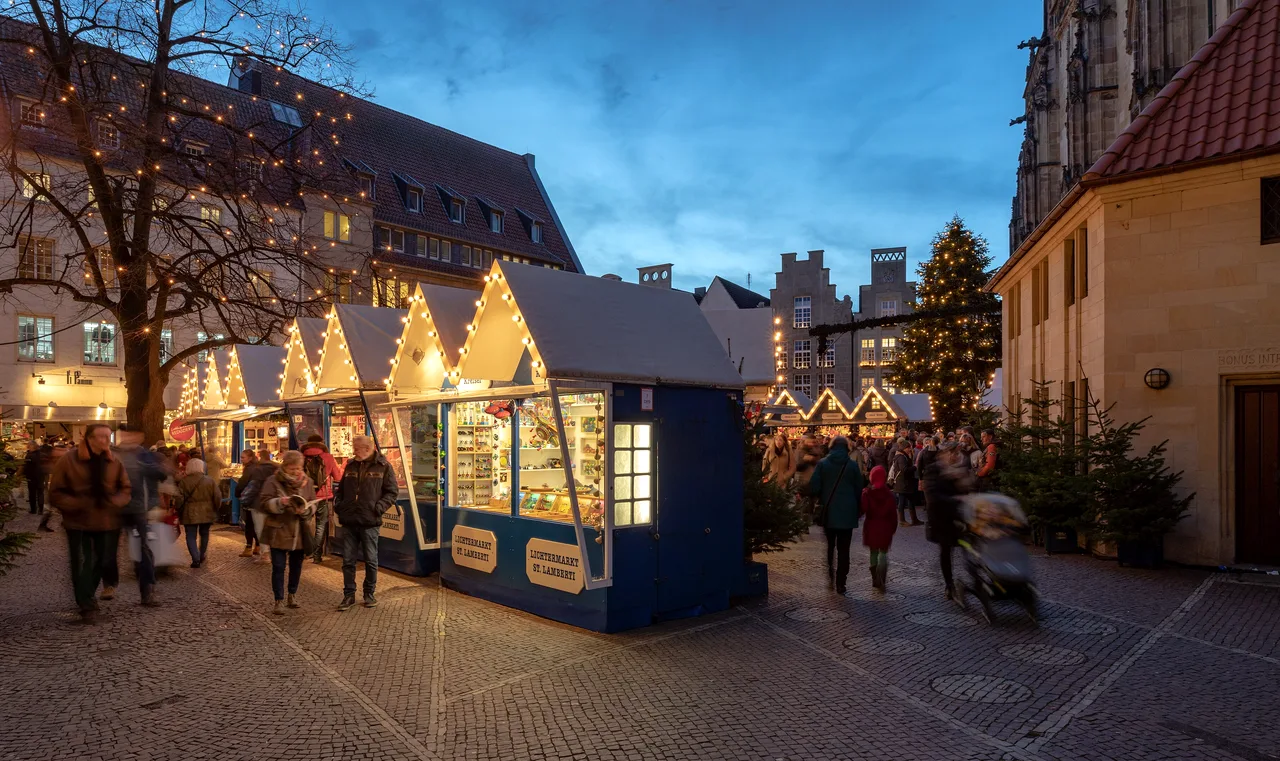
Münster’s Christmas markets are not on one big square but spread across six venues in the heart of the old town, all linked by a few minutes’ walk. The largest and oldest is the market in the Rathausinnenhof and on Platz des Westfälischen Friedens behind the Historic Town Hall, with a “sky of lights” above the stalls and a children’s carousel. The Lichtermarkt in front of St. Lamberti is known for its blue pointed-roof huts and the city’s largest Christmas tree. The market in the courtyard of the Aegidiimarkt has a large wooden pyramid that rings its bells every half hour and a large nativity scene. The Giebelhüüskesmarkt beside the Liebfrauen-Überwasserkirche stands out for its little gabled huts, its view of the Cathedral towers and its student atmosphere. The market around the Kiepenkerl monument offers Westphalian specialities between historic houses, while X-MS on Harsewinkelplatz is dedicated to local, regional and sustainable products. The city also announces the free sing-along “Münster singt” on Domplatz on Sunday 6 December. Entry to the markets is free.


| Event | Location | 2026 dates | Note |
|---|---|---|---|
| Town Hall Christmas market | Rathausinnenhof and Platz des Westfälischen Friedens (behind the Town Hall) | 23 November–23 December 2026 | The largest and oldest market; sky of lights and children’s carousel. Sun–Thu 11:00–20:00, Fri–Sat 11:00–21:00. |
| Lamberti Lichtermarkt | In front of St. Lamberti (Lambertikirchplatz) | 23 November–22 December 2026 | Blue pointed-roof huts and Münster’s largest Christmas tree. |
| Aegidiimarkt Christmas market | Courtyard of the Aegidiimarkt | 23 November–23 December 2026 | Wooden pyramid with bells every half hour and a large nativity scene. |
| Giebelhüüskesmarkt | Beside the Liebfrauen-Überwasserkirche | 23 November–22 December 2026 | Little gabled huts, views of the Cathedral towers, student atmosphere. |
| Kiepenkerl Christmas market | Around the Kiepenkerl monument and Spiekerhof | 23 November–23 December 2026 | Westphalian specialities among historic houses. |
| X-MS | Harsewinkelplatz (by Thomas Schütte’s “Kirschensäule” sculpture) | 23 November–23 December 2026 | Local, regional and sustainable products. |
What to try
Glühwein
Spiced hot wine; alcoholic. White and fruit-wine versions are also available.
Kinderpunsch
Spiced hot fruit punch for children and anyone avoiding alcohol.
Reibekuchen
Crisp fried potato pancakes served with apple sauce.
Gebrannte Mandeln
Warm almonds roasted in sugar.
Mutzen
Small fried dough balls dusted with icing sugar.
Grünkohl
A favourite winter kale dish, usually served with sausage and pork.
Tips for Münster’s Christmas markets
- The six markets are very close together; starting at the Prinzipalmarkt you can walk Lamberti, Town Hall, Kiepenkerl, Überwasser and Aegidii in a single evening.
- The Lamberti and Giebelhüüskes markets close on 22 December, the others on 23 December.
- Friday and Saturday evenings, especially Advent weekends, are very busy; weekday afternoons are calmer.
- The city announces a mobile information bicycle touring the centre on Advent Saturdays 11:00–15:30; Münster Information is also at Heinrich-Brüning-Straße 7 and in the Historic Town Hall (Prinzipalmarkt 10).
- Many visitors come from the region, so trains and car parks fill up at weekends; use public transport or a bicycle.
- A deposit is usually charged on hot-drink mugs; return them or keep them as a souvenir.
- Add the free “Münster singt” sing-along on Domplatz on Sunday 6 December, 16:30–17:30, to your plans.
- Münster is famous for its rain; pack a waterproof jacket and comfortable shoes.
Check before you go: Stadt Münster · Weihnachten in Münster 2026 (official) ↗ · Stadtwerke Münster · buses and tickets (official) ↗
Dates and hours were checked on 29 October 2026 against the stadt-muenster.de “Weihnachten in Münster” page. Hours of individual stalls and events may differ; check the official page before your visit.
When to Go
Münster has a mild, damp climate; rain is possible all year and locals joke about it. Spring and summer are the best seasons for the Aasee, the Promenade and the Münsterland castles. Münster’s big funfair, the “Send”, takes place three times a year on Schlossplatz in front of the palace. From late November to the last week of December six Christmas markets light up the old town. January and February are quiet and good for museums.
| Month | Sightseeing | Christmas market | Cycling and parks | Crowds |
|---|---|---|---|---|
| January | Difficult | None | Difficult | Busy |
| February | Difficult | None | Difficult | Busy |
| March | Good | None | Good | Moderate |
| April | Very good | None | Very good | Moderate |
| May | Very good | None | Very good | Moderate |
| June | Very good | None | Very good | Moderate |
| July | Very good | None | Very good | Moderate |
| August | Very good | None | Very good | Moderate |
| September | Very good | None | Very good | Moderate |
| October | Good | None | Good | Moderate |
| November | Good | Market season | Difficult | Moderate |
| December | Good | Market season | Difficult | Busy |
- Winters are cool and wet, usually 1–6 °C.
- The Christmas markets run from 23 November to 23 December 2026.
- May to September is ideal for cycling, the Aasee and castle trips.
- The Send funfair is held on Schlossplatz in spring, summer and autumn; check dates on stadt-muenster.de.
- The city is lively during university terms and quieter in exam and holiday periods.
- Museums are open all year; some close on Mondays.
Visa and Entry (Turkish citizens)
Turkish citizens holding an ordinary (burgundy) passport need a Schengen visa for tourist travel to Germany. Special, service and diplomatic passports follow different rules; check the current position on the Turkish Ministry of Foreign Affairs page.
Apply to the representation of the country that is your main destination. If Germany is the main destination, applications go through the German missions in Türkiye; current information on the application process is at tuerkei.diplo.de.
If you combine Münster with the Netherlands, apply to the country of your longest stay; if stays are equal, to the country of first entry.
Under the EU Entry/Exit System (EES), being introduced in stages, your biometric data (facial image and fingerprints) may be recorded on first entry; allow extra time at the border.
Visa fees, appointment waiting times and required documents can change; this guide gives no fees. Use the current lists on the official pages before you apply.
Travel medical insurance and proof of accommodation and return are part of the application; details are in the official sources.
Check before you go: T.C. Dışişleri Bakanlığı · Türk vatandaşlarının tabi olduğu vize uygulamaları ↗ · tuerkei.diplo.de ↗ · EES · europa.eu ↗ · Rota Atlası visa guide (TR)
Travel medical insurance
Check the official visa and entry sources above first: they state whether travel medical insurance is required and the minimum cover. Compare any policy’s cover amount, validity dates and countries covered with the official requirement.
Rota Atlası does not currently offer an insurance partnership; there are no paid links in this section. Last updated: 1 November 2026
Getting to Münster
- By air: Münster/Osnabrück Airport (FMO) lies about 25 kilometres north of the city, near Greven. Düsseldorf (DUS) and Dortmund (DTM) airports can also be used for more international connections. Check current flights from Türkiye only on airline and airport websites.
- From the airport: express and regional buses run between FMO and Münster Hauptbahnhof; check current routes and timetables at stadtwerke-muenster.de and fmo.de.
- By train: Münster Hauptbahnhof is on the IC/ICE network, with direct services to Düsseldorf, Cologne, Dortmund, Hamburg and Bremen. It can also be reached by train from Düsseldorf Airport; check bahn.de.
- From the Hauptbahnhof to the old town: the Prinzipalmarkt is about a 10–15 minute walk; many bus routes also serve the centre.
Getting Around

Bus
Stadtwerke Münster runs the city buses; Münster has no tram or metro. Check tickets and routes at stadtwerke-muenster.de.
On foot
The old town is compact; the Prinzipalmarkt, Cathedral, museums and Christmas markets are minutes apart.
Bicycle
Münster’s symbol: the large bicycle station at the Hauptbahnhof offers parking and rental. Follow the rules; red lights and cycle lanes are strictly enforced.
Promenade
A tree-lined ring of about 4.5 kilometres on the line of the old walls circles the old town on a car-free path.
Regional trains
Regional trains and buses serve Münsterland towns, Osnabrück and the Ruhr.
Day trips
Burg Hülshoff, Haus Rüschhaus and the Münsterland castles are within reach by bicycle or bus.
Things to See
Münster’s old town lies inside the ring of the Promenade. Its heart is the Prinzipalmarkt, with St. Lamberti at its northern end and the Historic Town Hall in the middle; to the west rise Domplatz and St Paul’s Cathedral. The Kiepenkerl and Spiekerhof are to the north-west, the Überwasser quarter across the river Aa. The palace and Botanical Garden are to the west, the Aasee to the south-west, and the Kreativkai harbour district east of the Hauptbahnhof.
The city’s parlour
Prinzipalmarkt and the Historic Town Hall

The Prinzipalmarkt is Münster’s most famous street and the city’s “best room”. The gabled houses of the merchants line up side by side, and the arcades on their ground floors let you walk dry even in the rain. The pointed Gothic gable of the Historic Town Hall in the middle dates back to the 14th century. Heavily damaged in the war, the street and the Town Hall were rebuilt in the 1950s true to their historic appearance. Today the Prinzipalmarkt is the old town’s meeting place for shopping, cafés and Christmas lights.
Don’t miss
- A walk under the arcades
- The Gothic gable of the Town Hall
- The evening illuminations
- The view of St. Lamberti from the Prinzipalmarkt
Tips
- The Prinzipalmarkt is pedestrian, but cyclists pass through; take care.
- Under the arcades you can window-shop sheltered from the rain.
- A branch of Münster Information is in the Historic Town Hall.

A stage of European history
Hall of Peace (Friedenssaal)

The wood-panelled hall inside the Town Hall is the symbol of the 1648 Peace of Westphalia. On 15 May 1648 the Peace of Münster between Spain and the Dutch Republic was sworn here, recognising Dutch independence. The carved wooden panelling, portraits of the envoys and historic objects were taken to safety during the war and preserved. The Peace of Westphalia is regarded as one of the most important examples of peace achieved through negotiation in Europe.
Don’t miss
- Gothic wood panelling and carvings
- Portraits of the peace envoys
- The golden cockerel goblet (a historic memento)
- The gabled façade of the Town Hall
Tips
- Opening hours may change because of official events; check stadt-muenster.de.
- Take photos quietly and without flash.
- Combine the visit with a walk along the Prinzipalmarkt.
Cages and a tower watchman
St. Lamberti Church

St. Lamberti, at the northern end of the Prinzipalmarkt, is an important late-Gothic Westphalian hall church, known as the church of the city’s merchant citizens. The three iron cages hanging from its tower recall the suppression of the Anabaptist movement that seized Münster in 1534–1535: the bodies of its leaders were displayed in these cages in 1536. St. Lamberti is also one of the few churches in Europe where a tower watchman still serves; in the evenings the watchman sounds a horn from the tower at set intervals.
Don’t miss
- The three iron cages on the tower
- The Gothic decoration of the west portal
- The tower watchman’s horn in the evening
- The Lichtermarkt in front of the church
Tips
- Check current information on the tower watchman tradition at st-lamberti.de or on the city’s pages.
- Do not walk around the church during services.
- In Advent the tree in front of the church is Münster’s largest Christmas tree.

Heart of the cathedral city
St Paul’s Cathedral and Domplatz

St Paul’s Cathedral rises on Domplatz, the starting point of Münster’s foundation. The present building was erected in the 13th century in late Romanesque and early Gothic styles and consecrated in 1264. Inside is an astronomical clock from 1540 showing the positions of the planets and the calendar; at midday it has a figure play accompanied by bells. The cathedral treasury displays precious church objects. On Wednesday and Saturday mornings Münster’s large weekly market is held on Domplatz.
Don’t miss
- The astronomical clock
- The giant statue of St Christopher
- The cathedral treasury
- The weekly market on Domplatz
Tips
- Check clock times and guided tours at paulusdom.de.
- The weekly market is on Wednesday and Saturday mornings; stalls pack up in the afternoon.
- In Advent a sing-along is announced on Domplatz on 6 December.

Westphalia’s travelling pedlar
Kiepenkerl, Spiekerhof and old-town lanes

The Kiepenkerl, the pedlar who carried goods from the villages to town in a basket (Kiepe) on his back, is one of the emblematic figures of the Münsterland. His bronze monument stands in a small square surrounded by restaurants and historic houses; the original was erected in 1896 and recast after being lost in the war. The surrounding lanes – Spiekerhof, Bogenstraße and Roggenmarkt – are among the old town’s most charming corners. In Advent the Kiepenkerl Christmas market fills these lanes.
Don’t miss
- The Kiepenkerl monument
- Spiekerhof lane
- The arches of Bogenstraße
- The Kiepenkerl Christmas market
Tips
- The area is full of restaurants; we only name traditional dishes and do not recommend restaurants.
- It is a few minutes’ walk from the Prinzipalmarkt.
- The square is very photogenic at dusk when the lights come on.

Across the Aa
Überwasser quarter and Liebfrauen-Überwasserkirche

The Überwasser (“beyond the water”) quarter on the west bank of the river Aa is named after the 14th-century Gothic hall church of Liebfrauen-Überwasser. Its elegant tower is one of the finest in the old town. The area is lively with university institutes and student life. In Advent the Giebelhüüskesmarkt beside the church, with its little huts and view of the Cathedral towers, is a favourite meeting place for students.
Don’t miss
- The tower of the Liebfrauen-Überwasserkirche
- A walk along the Aa
- The Giebelhüüskesmarkt
- The view of the Cathedral
Tips
- Walk south along the Aa to reach the Aasee.
- Church opening hours may vary.
- The quarter is only minutes from Domplatz.
From the Middle Ages to Picasso
LWL Museum of Art and Culture and Picasso Museum

The LWL-Museum für Kunst und Kultur on Domplatz is the great art museum of the Westphalia region; its new building, opened in 2014, houses a collection ranging from medieval sculpture and altarpieces to modern and contemporary art. The museum is also a partner of the famous open-air sculpture exhibition “Skulptur Projekte Münster”, held every ten years. A few streets away the Kunstmuseum Pablo Picasso Münster focuses on Picasso’s prints and graphic work and holds changing exhibitions.
Don’t miss
- The LWL Museum’s medieval collection
- The modern and contemporary art galleries
- Picasso’s graphic work
- Changing exhibitions
Tips
- Check opening hours and exhibitions at lwl-museum-kunst-kultur.de and kunstmuseum-picasso-muenster.de.
- Allow at least two hours for each.
- An ideal programme for a rainy day.

Palace of the prince-bishops
Münster Palace and Botanical Garden

The Baroque palace west of the old town was built for the last prince-bishops of Münster between 1767 and 1787. It was designed by Johann Conrad Schlaun, the great architect of Westphalian Baroque; after his death in 1773 other architects completed it. Today the palace is the university’s main building. Behind it, the Botanical Garden, founded in 1803, offers a quiet break with its glasshouses, while the wide Schlossplatz in front hosts the Send funfair three times a year.
Don’t miss
- The palace’s red-brick and sandstone façade
- The palace garden
- The Botanical Garden and its glasshouses
- Schlossplatz
Tips
- As a university building, the palace interior is usually not open to visitors.
- The Botanical Garden’s hours vary by season; check the university website.
- The garden closes early in winter.

A lake in the city
Aasee and the Giant Pool Balls

South-west of the old town, the Aasee is a long lake loved by walkers, runners, sailors and students. On its shore, Claes Oldenburg’s three giant concrete spheres, the “Giant Pool Balls” made for the first Skulptur Projekte in 1977, are among the city’s best-loved artworks. On the southern shore are the Allwetterzoo and the LWL Museum of Natural History with its planetarium. The walk of about 7 kilometres around the lake is one of the city’s finest strolls.
Don’t miss
- The Giant Pool Balls
- A walk around the lake
- The pier at sunset
- The LWL Museum of Natural History and planetarium
Tips
- It is a 15–20 minute walk from the old town along the Aa.
- The lakeshore can be windy in winter.
- Check opening hours of the zoo and the museum on their official websites.

A green ring on the old walls
Promenade, Buddenturm and Zwinger

Laid out on the site of the 17th- and 18th-century fortifications after they were demolished, the Promenade circles the old town in a tree-lined ring of about 4.5 kilometres. It is closed to cars and has separate lanes for cyclists and pedestrians. On the ring stand the round Buddenturm, a remnant of the medieval walls, and the Zwinger, a strong 16th-century defensive tower. Because the Zwinger was used as a prison and place of execution in the Nazi era, it is today a memorial.
Don’t miss
- A bike ride around the Promenade
- The Buddenturm
- The Zwinger memorial
- Tree-lined paths in autumn
Tips
- Do not walk in the cycle lane on the Promenade; use the marked footpath.
- You can rent a bicycle at the bicycle station at the Hauptbahnhof.
- Visiting times at the Zwinger are limited; check the Stadtmuseum website.

From old port to creative quarter
Harbour and Kreativkai

East of the Hauptbahnhof, the old city harbour on the Dortmund-Ems Canal has in recent years become a creative quarter. Former warehouses and silos house offices, agencies, theatres and cafés; the quay known as the “Kreativkai” is especially lively on summer evenings. The reflections in the harbour basin and the evening lights show a side of Münster very different from the old town.
Don’t miss
- The Kreativkai quay
- Converted warehouse buildings
- Evening reflections
- A walk along the canal
Tips
- It is about 15 minutes on foot or a short bus ride from the Hauptbahnhof.
- It is quieter in winter.
- A cycle path runs along the quay.
Schlaun’s city
Erbdrostenhof and Clemenskirche

Johann Conrad Schlaun gave Münster the finest buildings of Westphalian Baroque. The Erbdrostenhof on Salzstraße, built in 1753–1757 for a noble family, is a town palace with a curved façade opening onto an angled courtyard; its ceremonial hall hosts concerts. The nearby Clemenskirche, built in 1745–1753 as a hospital church, has a small but striking Baroque interior under its dome.
Don’t miss
- The curved façade of the Erbdrostenhof
- The dome of the Clemenskirche
- A walk along Salzstraße
- Baroque façades in the evening light
Tips
- The interior of the Erbdrostenhof is usually only open for concerts and events.
- The Clemenskirche may have limited opening hours.
- Salzstraße is a few minutes from the Prinzipalmarkt.

The poet’s world
Burg Hülshoff and Haus Rüschhaus

West of Münster, near Havixbeck, the moated castle of Burg Hülshoff is the birthplace (1797) of Annette von Droste-Hülshoff, one of the most important poets in German literature; today it is a centre for literature with events and exhibitions. Closer to the city, in Nienberge, Haus Rüschhaus is the country house Johann Conrad Schlaun built for himself in the 1740s, where the poet later lived for many years. The two houses are a fine introduction to the Münsterland landscape of moated castles and parks.
Don’t miss
- The moats of Burg Hülshoff
- Exhibitions at the literature centre
- Schlaun’s Haus Rüschhaus
- Münsterland scenery
Tips
- Check opening hours and winter closures at burg-huelshoff.de.
- Rüschhaus can be reached by bicycle from Münster; check bus connections for Hülshoff.
- Some parts may be closed in winter.

1–3 Day Itineraries, a Christmas Day + a 7-Day Westphalia Route
The itineraries keep distances short and allow for short winter days. One day is enough for the Prinzipalmarkt, Hall of Peace, St. Lamberti and the Cathedral; two days add the museums, palace and Aasee, and three days leave room for the Promenade, the harbour and the castles. The 7-day route combines Münster with Westphalia and the Rhineland. Check opening hours in advance on official websites.
Day 1: Prinzipalmarkt and old town
- In the morning, walk under the arcades of the Prinzipalmarkt.
- Visit the Hall of Peace in the Town Hall.
- Look up at the cages on the tower of St. Lamberti.
- See the Cathedral and its astronomical clock on Domplatz.
- In the evening, stroll the Kiepenkerl and Spiekerhof lanes.
Day 2: Art, palace and Aasee
- Start the day at the LWL Museum of Art and Culture.
- See the graphic work at the Picasso Museum.
- Walk to the palace and the Botanical Garden.
- In the afternoon, walk around the Aasee and find the Giant Pool Balls.
- End the day in the Überwasser quarter.
Day 3: Bicycle and castles
- Rent a bicycle at the bicycle station at the Hauptbahnhof.
- Ride the Promenade ring with the Buddenturm and the Zwinger.
- Cycle to Haus Rüschhaus.
- Visit Burg Hülshoff if weather and opening hours allow.
- In the evening, explore the Kreativkai at the harbour.
A Christmas day
- Before noon, visit the Cathedral and Domplatz.
- Start at the Town Hall Christmas market, which opens at 11:00.
- See the big Christmas tree at the Lamberti Lichtermarkt.
- Try Westphalian specialities at the Kiepenkerl market.
- Round off the evening at the Giebelhüüskesmarkt and the bell pyramid at the Aegidiimarkt.
- If time allows, look for local handmade gifts at X-MS.
7-day Westphalia and Rhineland route
- Days 1–2: Münster old town, museums and Aasee.
- Day 3: By bicycle to the Promenade, Rüschhaus and Hülshoff.
- Day 4: Day trip by train to Osnabrück (the other city of the Peace of Westphalia).
- Day 5: Train to Düsseldorf.
- Day 6: Cologne Cathedral and the Rhine.
- Day 7: Aachen Cathedral, or depart from Düsseldorf.
Münster and Westphalian Food
The cuisine of Münster and the Münsterland is hearty Westphalian cooking: dark rye breads baked for a long time, smoked ham, vegetable stews and winter dishes. These are traditional dishes, not restaurant recommendations.


Westfälischer Schinken
Westphalian ham, cured and smoked for a long time; pork.
Pumpernickel
Dark, slightly sweet rye bread baked for a very long time at low heat.
Münsterländer Töttchen
Traditional veal ragout cooked in a tangy sauce, served with bread and mustard.
Westfälisches Blindhuhn
One-pot dish of beans, vegetables, potatoes and apples, usually with bacon.
Struwen
Yeast pancakes with raisins, traditionally eaten on Good Friday.
Grünkohl
A favourite winter kale dish served with sausage and smoked meat.
Münsterländer Altbier
The city’s top-fermented beer tradition; alcoholic.
Westfälische Quarkspeise
A light dessert of quark and fruit.
- Many traditional dishes contain pork; ask about ingredients.
- The weekly market on Domplatz is a good place for local bread, cheese and fruit.
- Vegetarian options are common in cafés and student venues.
- Service is included; rounding up by 5–10 per cent is common.
Culture and Etiquette

- “Guten Tag” or “Hallo” are common greetings; Westphalians are known as reserved at first and warm later.
- Use the formal “Sie” in formal situations.
- Cycling culture is very strong: do not walk in cycle lanes and give way to cyclists.
- In the local slang, Masematte, a bicycle is called a “Leeze”.
- A well-known Münster saying: “Either it rains or the bells ring; if both happen, it’s Sunday.”
- Do not walk around churches during services and do not use flash.
- Sunday is a day of rest; most shops are closed.
- Most of the Skulptur Projekte works are in public spaces; looking for them is a way to explore the city.
- People queue at bakeries, stalls and stops.
- Ask before photographing people, especially at markets.
Safety and Health
- Münster is generally safe; watch your valuables in crowded markets and around the Hauptbahnhof.
- The biggest everyday risk is bicycle traffic; look both ways when crossing.
- If you rent a bicycle, use a good lock; bicycle theft is common.
- The Aasee and canal banks can be slippery in winter.
- In an emergency call 112, police 110.
- Make sure your travel medical insurance covers the Schengen area.
- Pharmacies post the address of the nearest pharmacy on duty.
What Your Budget Depends On
This guide does not give prices; prices change with season and year. Your budget depends on these factors:
Travel dates
Advent weekends and university events raise hotel demand.
Accommodation
The old town, the area around the Hauptbahnhof and the harbour district differ from each other.
Transport
The old town is walkable; bus tickets and bicycle rental are separate costs.
Sights and museums
Museums and some historic halls charge separately.
Food and drink
Market snacks and student cafés differ greatly from restaurants.
Day trips
Trips to Osnabrück, Düsseldorf or the castles are extra costs.
Free experiences
The Christmas markets (free entry), Prinzipalmarkt, Cathedral, Promenade, Aasee and public sculptures are free.
Practical Information
- Money: euro; cards common, carry some cash.
- Language: German; English widely understood.
- Sockets: 230 V, type C/F.
- Time: CET (UTC+1) in winter.
- Opening hours: some museums close on Mondays.
- Shops: closed on Sunday; Christmas markets are open.
- Holidays: hours change on 24–26 and 31 December and 1 January.
- Weather: cool and wet in December, around 1–6 °C.
- Daylight: sunset around 16:15 in December.
- Emergency: 112; police 110.
Frequently Asked Questions
When are the Münster Christmas markets 2026?
According to stadt-muenster.de, 23 November–23 December 2026; the Lamberti and Giebelhüüskes markets until 22 December.
What are the opening hours?
Sunday–Thursday 11:00–20:00, Friday–Saturday 11:00–21:00.
How many Christmas markets are there?
Six: Town Hall, Lamberti, Aegidii, Giebelhüüskes, Kiepenkerl and X-MS.
Is entry free?
Yes; food, drinks and gifts are paid for.
Why is the Hall of Peace important?
The Peace of Münster between Spain and the Dutch Republic was sworn here in 1648; it symbolises the Peace of Westphalia.
Do Turkish citizens need a visa?
Holders of ordinary passports need a Schengen visa. If Germany is the main destination, see tuerkei.diplo.de.
Which airport serves Münster?
Münster/Osnabrück (FMO); Düsseldorf (DUS) and Dortmund (DTM) can also be used.
Is it easy to rent a bicycle in Münster?
Yes; there is the bicycle station at the Hauptbahnhof and rental services in the city.
How many days are enough?
1–2 days for the old town and markets, 3 days with the Aasee, museums and castles.
Which cities make good day trips from Münster?
Osnabrück, Düsseldorf, Cologne and the Münsterland castles.
Where to stay
Stay close to the areas where you will spend most time. The areas below are covered in detail in this guide; check public transport links in the getting-around section.
- The city’s parlourPrinzipalmarkt and the Historic Town Hall
- A stage of European historyHall of Peace (Friedenssaal)
- Cages and a tower watchmanSt. Lamberti Church
- Heart of the cathedral citySt Paul’s Cathedral and Domplatz
- Westphalia’s travelling pedlarKiepenkerl, Spiekerhof and old-town lanes
- Across the AaÜberwasser quarter and Liebfrauen-Überwasserkirche
- From the Middle Ages to PicassoLWL Museum of Art and Culture and Picasso Museum
- Palace of the prince-bishopsMünster Palace and Botanical Garden
- A lake in the cityAasee and the Giant Pool Balls
- A green ring on the old wallsPromenade, Buddenturm and Zwinger
- From old port to creative quarterHarbour and Kreativkai
- Schlaun’s cityErbdrostenhof and Clemenskirche
- The poet’s worldBurg Hülshoff and Haus Rüschhaus
Search hotels in these areas (Hotellook) ↗ (affiliate link)Search on Booking.com ↗
Affiliate disclosure: Hotellook, Aviasales, Klook, Airalo, Tiqets and DiscoverCars links are affiliate links; Rota Atlası may earn a commission on bookings made through them, at no extra cost to you. Official and in-guide links are not paid. Last updated: 1 November 2026 · Privacy and affiliates
Transport and connectivity
- Airport transferOptions from the airport to the city are in this guide’s getting there section.
- Mobile data (eSIM)Airalo eSIM ↗ (affiliate link)
- TrainsOfficial rail website ↗
- Car hireYou rarely need a car within the city; see getting around first. Compare car hire on DiscoverCars ↗ (affiliate link)
Affiliate disclosure: Hotellook, Aviasales, Klook, Airalo, Tiqets and DiscoverCars links are affiliate links; Rota Atlası may earn a commission on bookings made through them, at no extra cost to you. Official and in-guide links are not paid. Last updated: 1 November 2026 · Privacy and affiliates
Search flights (affiliate link)
Search flights from any airport in any country. Results open on Aviasales in a new tab, where you book.
This form is an affiliate link: Rota Atlası may earn a commission on bookings made via Aviasales (Travelpayouts), at no extra cost to you. Check price, baggage and terms on the booking site. Airport data: OurAirports (public domain).
Flights, hotels and tours
Find tours and tickets
- Town Hall Christmas Market
GetYourGuide ↗ · Klook ↗ (affiliate link) - Lamberti Lichtermarkt
GetYourGuide ↗ · Klook ↗ (affiliate link) - Aegidii, Giebelhüüskes, Kiepenkerl and X-MS markets
GetYourGuide ↗ · Klook ↗ (affiliate link) - Prinzipalmarkt and Historic Town Hall
GetYourGuide ↗ · Klook ↗ (affiliate link)
Hotellook, Aviasales, Klook, Airalo and Tiqets links in this box are affiliate links (Travelpayouts): Rota Atlası may earn a commission on bookings made through them, at no extra cost to you. GetYourGuide links currently carry no affiliate code. Check prices and terms with the provider. Last updated: 1 November 2026 · Privacy and affiliates
Sources
- T.C. Dışişleri Bakanlığı · Türk vatandaşlarının tabi olduğu vize uygulamaları ↗
- Auswärtiges Amt · Deutsche Vertretungen in der Türkei (Visa) ↗
- European Union · Entry/Exit System (EES) ↗
- Stadt Münster · Münster Marketing · tourism (official) ↗
- Stadt Münster · stadt-muenster.de (official) ↗
- Stadtwerke Münster · buses (official) ↗
- Flughafen Münster/Osnabrück FMO (official) ↗
- LWL-Museum für Kunst und Kultur (official) ↗
- Kunstmuseum Pablo Picasso Münster (official) ↗
- St.-Paulus-Dom Münster (official) ↗
- Burg Hülshoff · Center for Literature (official) ↗
- Deutsche Bahn ↗
- GOV.UK · Foreign travel advice · Germany ↗
- Stadt Münster · Weihnachten in Münster 2026 (official) ↗
- Stadtwerke Münster · buses and tickets (official) ↗
This page is for information only. Dates, hours, entry rules and transport information can change; check the official sources above before travelling. No prices, flights, hotels or restaurants have been invented in this guide.
Photo credits
The photos on this page come from Wikimedia Commons and are used under the stated authors and licences (CC BY, CC BY-SA, CC0 or public domain). Full list of sources
- Evening Christmas market on Lambertikirchplatz in Münster — Dietmar Rabich · CC BY-SA 4.0 · Wikimedia Commons
- Decorated hut at the Town Hall Christmas market on Platz des Westfälischen Friedens — Dietmar Rabich · CC BY-SA 4.0 · Wikimedia Commons
- Lights at the Christmas market by the Town Hall — Dietmar Rabich · CC BY-SA 4.0 · Wikimedia Commons
- St. Lamberti Church on an Advent evening — Dietmar Rabich · CC BY-SA 4.0 · Wikimedia Commons
- Stalls of the Lichtermarkt in front of St. Lamberti — Dietmar Rabich · CC BY-SA 4.0 · Wikimedia Commons
- Kiepenkerl Christmas market on Spiekerhof — Dietmar Rabich · CC BY-SA 4.0 · Wikimedia Commons
- The Giebelhüüskesmarkt beside the Überwasserkirche — Dietmar Rabich · CC BY-SA 4.0 · Wikimedia Commons
- The Überwasserkirche with its Christmas market — Dietmar Rabich · CC BY-SA 4.0 · Wikimedia Commons
- A colourful stall at the Überwasser Christmas market — Rainer Halama · CC BY-SA 4.0 · Wikimedia Commons
- Footpath at the Torminbrücke over the Aasee on a snowy day — Dietmar Rabich · CC BY-SA 4.0 · Wikimedia Commons
- The gabled merchant houses of the Prinzipalmarkt — Dietmar Rabich · CC BY-SA 4.0 · Wikimedia Commons
- The Prinzipalmarkt in the evening lights — Dietmar Rabich · CC BY-SA 4.0 · Wikimedia Commons
- Münster old town with the Prince-Bishop’s Palace and St Paul’s Cathedral — Dietmar Rabich · CC BY-SA 4.0 · Wikimedia Commons
- Münster’s Historic Town Hall with its Gothic gable — Dietmar Rabich · CC BY-SA 4.0 · Wikimedia Commons
- The arcades of the Prinzipalmarkt — Dietmar Rabich · CC BY-SA 4.0 · Wikimedia Commons
- The wood-panelled Hall of Peace in the Historic Town Hall — Günter Seggebäing, Coesfeld · CC BY-SA 3.0 · Wikimedia Commons
- The tower of St. Lamberti above the old-town roofs — Dietmar Rabich · CC BY-SA 4.0 · Wikimedia Commons
- The Gothic west portal of St. Lamberti Church — Dietmar Rabich · CC BY-SA 4.0 · Wikimedia Commons
- St Paul’s Cathedral in the light of the rising sun — Dietmar Rabich · CC BY-SA 4.0 · Wikimedia Commons
- Interior and altar island of St Paul’s Cathedral — Dietmar Rabich · CC BY-SA 4.0 · Wikimedia Commons
- The Kiepenkerl monument and historic houses at Spiekerhof — Dietmar Rabich · CC BY-SA 4.0 · Wikimedia Commons
- The bronze Kiepenkerl figure with his basket — Dietmar Rabich · CC BY-SA 4.0 · Wikimedia Commons
- The Liebfrauen-Überwasserkirche and its tower — Dietmar Rabich · CC BY-SA 4.0 · Wikimedia Commons
- The new building of the LWL Museum of Art and Culture — Dietmar Rabich · CC BY-SA 4.0 · Wikimedia Commons
- The Kunstmuseum Pablo Picasso Münster — DerStruffel · CC BY 4.0 · Wikimedia Commons
- The Baroque Prince-Bishop’s Palace in Münster — Dietmar Rabich · CC BY-SA 4.0 · Wikimedia Commons
- The Botanical Garden behind the palace — Dietmar Rabich · CC BY-SA 4.0 · Wikimedia Commons
- The “Pier” sculpture on the Aasee shore — Dietmar Rabich · CC BY-SA 4.0 · Wikimedia Commons
- The Giant Pool Balls sculpture by the Aasee — Dietmar Rabich · CC BY-SA 4.0 · Wikimedia Commons
- The medieval Buddenturm on the Promenade — Dietmar Rabich · CC BY-SA 4.0 · Wikimedia Commons
- The Zwinger defensive tower on the Promenade — Dietmar Rabich · CC BY-SA 4.0 · Wikimedia Commons
- The Kreativkai at Münster harbour by night — Florian Adler · CC BY-SA 3.0 · Wikimedia Commons
- Schlaun’s Baroque Erbdrostenhof palace — Günter Seggebäing, Coesfeld · CC BY-SA 3.0 · Wikimedia Commons
- The Baroque Clemenskirche and Maria-Euthymia-Platz — Dietmar Rabich · CC BY-SA 4.0 · Wikimedia Commons
- The moated castle of Burg Hülshoff — Günter Seggebäing · CC BY-SA 3.0 · Wikimedia Commons
- Haus Rüschhaus seen from the garden — kaʁstn Disk/Cat · CC BY-SA 3.0 de · Wikimedia Commons
- The bicycle station at Münster Hauptbahnhof — Rüdiger Wölk · CC BY-SA 2.5 · Wikimedia Commons
- Ferris wheel at the Send funfair on Schlossplatz — Dietmar Rabich · CC BY-SA 4.0 · Wikimedia Commons
- Honey jars at the Domplatz weekly market — Dietmar Rabich · CC BY-SA 4.0 · Wikimedia Commons
- Dark rye bread and German sausage — Unknown author · Public domain · Wikimedia Commons
Düsseldorf → · Cologne → · Aachen → · Bremen → · Amsterdam → · Christmas markets