

Goslar, a town of about 50,000 people in Lower Saxony, lies on the northern edge of the Harz mountains. Its wealth came from the Rammelsberg, a mountain just south of the town where silver, copper and lead were mined for more than a thousand years. That wealth drew the Salian emperors, who built the Kaiserpfalz here in the 11th century, and later made Goslar a rich Free Imperial City and member of the Hanseatic League. Because the town declined after the 16th century and was largely spared in the Second World War, its old centre survived remarkably intact: around 1,500 half-timbered houses, guild halls, Romanesque churches and stretches of town walls. In 1992 the Rammelsberg mines and the historic town of Goslar were inscribed together as a UNESCO World Heritage Site. In Advent the Marktplatz and Schuhhof fill with one of northern Germany’s best-loved Christmas markets, and next to it the Weihnachtswald, a forest of illuminated fir trees. This guide brings together the market, the sights, Harz excursions, food and practical information, based on official sources.
Content update: 29 October 2026 · Christmas dates checked against official goslar.de and meingoslar.de pages
Goslar at a Glance
- Country
- Germany · Lower Saxony
- Population
- About 50,000
- Language
- German; English common in tourism
- Currency
- Euro (EUR); cards accepted, carry some cash for stalls
- Time zone
- Central European Time (CET, UTC+1)
- Highlights
- Half-timbered old town, Kaiserpfalz, Rammelsberg mine
- UNESCO
- Mines of Rammelsberg, Historic Town of Goslar (1992)
- Setting
- Northern edge of the Harz mountains
- Christmas
- Christmas market and Weihnachtswald 25 November–30 December 2026
- Railway
- Goslar station at the edge of the old town
- Electricity
- 230 V, type C/F sockets
- Emergency
- 112 (ambulance, fire), 110 (police)
Goslar in Pictures
The Marktplatz with its fountain and guild halls, the Kaiserpfalz on its lawn and the half-timbered lanes: Goslar in three frames.


Goslar Christmas Market and Christmas Forest 2026
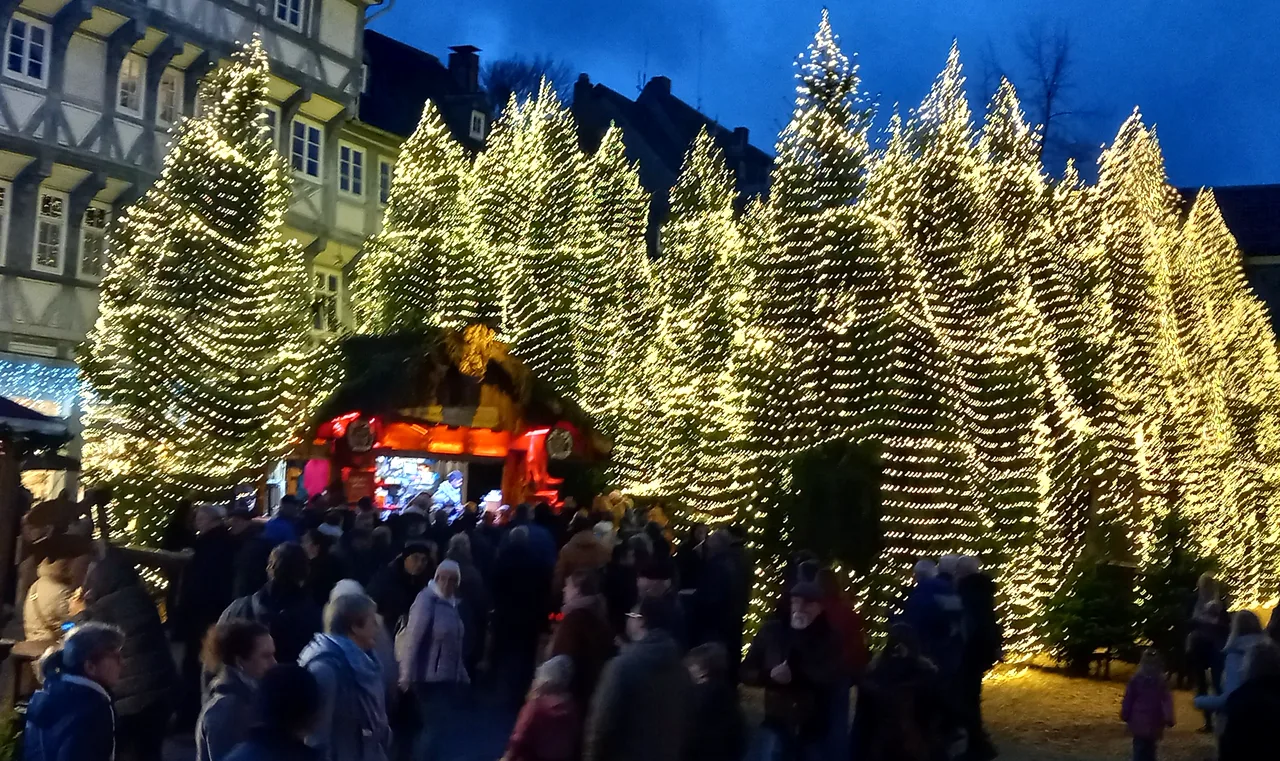
Goslar’s Christmas market is one of the most atmospheric in northern Germany. Around 70 stalls fill the Marktplatz in front of the Town Hall and the Kaiserworth and the neighbouring Schuhhof, surrounded by half-timbered houses. The highlight is the Weihnachtswald (Christmas forest): around 60 fir trees, lit by more than 160,000 lights, create a small illuminated forest in the middle of the old town (weihnachtswald.de). In 2025 the market was named an “Excellent European Christmas Market”. According to official sources, the 2026 market runs from 25 November to 30 December, open daily 11:00–20:00, with the forest staying open until 22:00. Shorter hours apply on 24 December (11:00–14:00), 25 and 26 December (12:00–19:00) and 30 December (11:00–18:00). The town’s tourist office also offers guided town walks with Glühwein in Advent; check dates on meingoslar.de. A nativity scene, a decorated fountain and a Ferris wheel complete the picture, and the Glockenspiel on the Marktplatz plays its mining figures several times a day.


| Event | Location | 2026 dates | Note |
|---|---|---|---|
| Goslar Christmas market | Marktplatz and Schuhhof | 25 November–30 December 2026 | About 70 stalls; daily 11:00–20:00; 24 Dec 11:00–14:00; 25–26 Dec 12:00–19:00; 30 Dec 11:00–18:00; free entry. |
| Weihnachtswald (Christmas forest) | Next to the Christmas market | 25 November–30 December 2026 | About 60 fir trees with 160,000+ lights; open until 22:00 on regular days. |
| Glockenspiel on the Marktplatz | Kämmereigebäude, Marktplatz | Daily, all year | Carillon and figure play on mining history at 9:00, 12:00, 15:00 and 18:00. |
| Town walk with Glühwein | Old town | In Advent | Guided walks by the tourist office; check dates and booking on meingoslar.de. |
What to try
Glühwein
Spiced hot wine; contains alcohol.
Kinderpunsch
Spiced hot fruit punch for children and non-drinkers.
Bratwurst
Grilled sausage in a bread roll; usually pork, ask about other options.
Gebrannte Mandeln
Warm sugar-roasted almonds.
Schmalzkuchen
Small fried dough pieces dusted with icing sugar.
Lebkuchen
Spiced gingerbread, sold by the piece or in tins.
Tips for the Goslar Christmas market
- The Weihnachtswald is most magical after dark; it stays open until 22:00.
- Weekday afternoons are calmer than weekend evenings.
- Plan to be on the Marktplatz at 15:00 or 18:00 for the Glockenspiel.
- Hours are shorter on 24, 25, 26 and 30 December.
- A deposit is usually charged on hot-drink mugs.
- Cobbles can be icy; wear shoes with good grip.
- The station is a short walk from the market; you can arrive by train.
- Book Advent town walks early on meingoslar.de.
Check before you go: Goslarer Weihnachtsmarkt & Weihnachtswald 2026 (official) ↗ · meingoslar.de · Christmas in Goslar (official) ↗
Dates and hours were checked against official goslar.de, meingoslar.de and weihnachtswald.de pages on 29 October 2026. Individual stalls may keep different hours; check the official pages before your visit.
When to Go
Goslar can be visited all year. Spring to autumn is ideal for walking in the Harz, the Oker valley and the Brocken railway. Late November and December bring the Christmas market and Weihnachtswald. January and February are cold, sometimes snowy, and quiet; the Harz is then a winter sports area. Museums and the Rammelsberg are open all year, with seasonal hours.
| Month | Sightseeing | Christmas market | Harz and outdoors | Crowds |
|---|---|---|---|---|
| January | Difficult | None | Difficult | Quiet |
| February | Difficult | None | Difficult | Quiet |
| March | Good | None | Good | Quiet |
| April | Very good | None | Good | Moderate |
| May | Very good | None | Very good | Moderate |
| June | Very good | None | Very good | Moderate |
| July | Very good | None | Very good | Busy |
| August | Very good | None | Very good | Busy |
| September | Very good | None | Very good | Moderate |
| October | Very good | None | Very good | Moderate |
| November | Good | Market season | Good | Moderate |
| December | Good | Market season | Difficult | Busy |
- December days are usually around −2 to 4 °C; snow is possible.
- The Christmas market runs 25 November–30 December 2026.
- Advent weekends are the busiest time in the old town.
- The Rammelsberg and museums are open all year; check seasonal hours.
- The Harz uplands are colder and snowier than the town.
- Summer brings hikers and day trippers.
Visa and Entry (Turkish citizens)
Turkish citizens holding an ordinary (burgundy) passport need a Schengen visa for tourist travel to Germany. Special, service and diplomatic passports follow different rules; check the current status on the Turkish Ministry of Foreign Affairs website.
Apply to the representation of your main destination. If Germany is your main destination, applications go through the German missions in Türkiye; current information on the process is at tuerkei.diplo.de.
If you combine Goslar with other Schengen countries, apply to the country of your main stay or, if stays are equal, to the country of first entry.
Under the EU Entry/Exit System (EES), being rolled out in stages, your biometric data (facial image and fingerprints) may be recorded at first entry; allow extra time at the border.
Visa fees, appointment waiting times and required documents may change; this guide does not state fees. Use the current lists on the official pages before applying.
Travel medical insurance and accommodation and return documents are part of the application; details are in the official sources.
Check before you go: T.C. Dışişleri Bakanlığı · Türk vatandaşlarının tabi olduğu vize uygulamaları ↗ · tuerkei.diplo.de ↗ · EES · europa.eu ↗ · Rota Atlası visa guide (TR)
Travel medical insurance
Check the official visa and entry sources above first: they state whether travel medical insurance is required and the minimum cover. Compare any policy’s cover amount, validity dates and countries covered with the official requirement.
Rota Atlası does not currently offer an insurance partnership; there are no paid links in this section. Last updated: 1 November 2026
Getting to Goslar
- By air: The nearest major airport is Hannover (HAJ); Berlin (BER) and Hamburg (HAM) are further away. Check current flights from Türkiye only on airline and airport websites.
- By train: Goslar station lies at the edge of the old town on the line Hannover–Hildesheim–Goslar–Bad Harzburg; there are also regional connections towards Braunschweig. Use bahn.de for connections.
- In the Harz: Regional trains and buses link Goslar with Bad Harzburg, Wernigerode and Quedlinburg; the Harz narrow-gauge railways (HSB) start in Wernigerode.
- By car: Goslar lies close to the A7 motorway; parking is available around the old town, which is best explored on foot.
Getting Around

On foot
The old town is compact: Marktplatz, Kaiserpfalz and the main churches are all within a short walk.
City buses
Local buses link the station, old town and the Rammelsberg.
Regional trains
Trains reach Bad Harzburg, Hildesheim, Braunschweig and Hannover; check bahn.de.
Harz narrow gauge
The HSB steam trains to the Brocken start in Wernigerode; check timetables at hsb-wr.de.
By bike
Cycle routes lead into the Harz foothills; hills are steep.
Parking
Use the car parks around the old town; many streets are pedestrianised.
Things to See
Goslar’s old town lies in a bowl at the foot of the Harz. At its centre is the Marktplatz with the Town Hall, the Kaiserworth and the Marktkirche. To the south, on a large lawn, stands the Kaiserpfalz with St. Ulrich’s Chapel and the Domvorhalle opposite. The Rammelsberg mine rises just south of the town. Half-timbered lanes, the Abzucht stream and the old walls with the Breites Tor and the Zwinger frame the centre, while the Harz, Wernigerode and Quedlinburg make easy excursions.
The heart of the town
Marktplatz, Market Fountain and Glockenspiel

Goslar’s Marktplatz is one of the most beautiful squares in northern Germany. In the middle stands the market fountain, its bronze basins crowned by a gilded imperial eagle, a symbol of the Free Imperial City. Around it rise the Town Hall, the Kaiserworth guild hall and slate-hung and half-timbered houses. On the roof of the Kämmereigebäude, a carillon and figure play tells the story of mining on the Rammelsberg; it plays daily at 9:00, 12:00, 15:00 and 18:00 (goslar.de). In Advent the square becomes the centre of the Christmas market.
Don’t miss
- The market fountain and gilded eagle
- The Glockenspiel and figure play
- Slate-hung façades around the square
- The Christmas market in Advent
Tips
- Be on the square a few minutes before the hour for the Glockenspiel.
- The light on the square is best in the morning.
- The tourist office is on the Marktplatz.

Painted council hall
Town Hall, Huldigungssaal and Kaiserworth

The Gothic Town Hall with its arcaded ground floor dominates the eastern side of the Marktplatz. Inside, the Huldigungssaal (Hall of Homage), painted around 1505–1520, is one of the most important late-medieval interiors in Germany, with every surface covered in religious and secular scenes; since summer 2024 a multimedia table explains the paintings (goslar.de). Opposite, the Kaiserworth, built in 1494 as the guild hall of the cloth merchants, is decorated with statues of emperors and is today a hotel.
Don’t miss
- The painted Huldigungssaal
- Arcades of the Town Hall
- Emperor statues on the Kaiserworth
- View across the square
Tips
- Check opening times and tickets for the Huldigungssaal on the official site.
- The Kaiserworth is admired from outside.
- Combine with the Marktkirche next door.

Twin towers and carved beams
Marktkirche and the Brusttuch

Behind the Town Hall rise the two unequal towers of the Marktkirche St. Cosmas und Damian, Goslar’s main Protestant church, with Romanesque origins and medieval stained glass. On the square beside it stands the Brusttuch, a striking half-timbered house of 1526 whose upper storeys are covered with carved figures and scenes, among them the famous “Butterhanne”. Next to it, the Bäckergildehaus and other guild houses show the town’s wealth.
Don’t miss
- The Marktkirche towers
- Medieval stained glass
- Carvings on the Brusttuch
- Guild houses around the church
Tips
- Ask locally whether the tower can be climbed and when.
- Do not walk around during services.
- The carvings are best seen in daylight.

Seat of emperors
Kaiserpfalz and St. Ulrich’s Chapel

The Kaiserpfalz, the imperial palace, was built around 1040–1050 under Emperor Henry III and is one of the largest secular buildings of its time in Germany (goslar.de). Restored in the 19th century, its Imperial Hall is decorated with monumental history paintings by Hermann Wislicenus. In front of the palace stand equestrian statues of Barbarossa and Wilhelm I and Henry Moore’s sculpture “Goslarer Krieger”. Beside it, the double chapel of St. Ulrich holds the tomb monument with the heart of Henry III.
Don’t miss
- The Imperial Hall and Wislicenus paintings
- Equestrian statues on the lawn
- St. Ulrich’s double chapel
- Henry Moore’s “Goslarer Krieger”
Tips
- Check opening times and tickets on goslar.de.
- Allow about an hour inside.
- The lawn in front gives the best overall view.


All that remains
Domvorhalle

Opposite the Kaiserpfalz, a small Romanesque building is all that remains of the collegiate church of St. Simon and St. Jude, Goslar’s “cathedral”, demolished in the 19th century. The Domvorhalle (cathedral porch) preserves the former north entrance with its sculptures and shows how important the imperial church once was. It is a quick but meaningful stop on the way to or from the palace.
Don’t miss
- The Romanesque porch
- Medieval sculptures
- The site of the former cathedral
- View to the Kaiserpfalz
Tips
- Check opening times locally.
- Combine with the Kaiserpfalz.
- A short stop of 15–20 minutes is enough.
A thousand years of mining
Rammelsberg Mine (UNESCO)

The Rammelsberg, just south of the old town, was mined for more than 1,000 years until 1988; today it is a museum and visitor mine and, together with the old town, a UNESCO World Heritage Site (whc.unesco.org). Guided tours lead into the medieval Roeder adit with its water wheels or take visitors by mine train into the 20th-century workings; children can join from the age of 4 (rammelsberg.de). The surface buildings, terraced into the hillside, are themselves a monument of industrial architecture. UNESCO listing ↗
Don’t miss
- Underground tour of the Roeder adit
- Mine train ride
- Industrial buildings on the slope
- Exhibitions on mining history
Tips
- Book tours in advance on rammelsberg.de, especially at weekends.
- It is cool underground; bring a warm layer.
- Reach it by city bus or a walk uphill.

1,500 half-timbered houses
Half-Timbered Lanes and Guild Houses

Around 1,500 half-timbered houses survive in Goslar, many of them from the 16th and 17th centuries. Streets such as Bäckerstraße, Schreiberstraße and the lanes around the Marktkirche are lined with carved beams, slate-clad fronts and guild houses like the Bäckergildehaus. Wandering here, especially in the evening lights of Advent, is one of the great pleasures of Goslar.
Don’t miss
- Bäckergildehaus
- Carved beams and inscriptions
- Slate-clad façades
- Evening walk in Advent
Tips
- Look up: many beams carry inscriptions and dates.
- Respect residents’ privacy.
- Wear shoes for uneven cobbles.
The town’s defences
Breites Tor, Zwinger and Town Walls

Goslar’s medieval defences included walls, gates and towers, several of which survive. The Breites Tor in the east is one of the most massive town gates in Germany. In the south, the Zwinger, a 16th-century artillery tower with very thick walls, stands in a park along the old walls. A walk along the former ramparts links these monuments.
Don’t miss
- The massive Breites Tor
- The Zwinger tower
- Walk along the ramparts
- Remains of the town wall
Tips
- Check whether the Zwinger is open in winter.
- Paths can be muddy or icy.
- Combine with the Neuwerkkirche nearby.

Romanesque treasures
Neuwerkkirche and Frankenberger Kirche

Goslar has an unusual number of medieval churches. The Neuwerkkirche, a Romanesque church of a former convent from the late 12th and early 13th centuries, has rich sculptural decoration and medieval wall paintings. The Frankenberger Kirche stands in the old miners’ quarter of Frankenberg, a quiet area of small houses where miners once lived.
Don’t miss
- Neuwerkkirche portal and murals
- The Frankenberger Kirche
- The old miners’ quarter
- Quiet lanes away from the market
Tips
- Opening hours are limited in winter; check locally.
- Do not visit during services.
- Frankenberg is a 10-minute walk from the Marktplatz.

Water and art
The Abzucht and the Mönchehaus Museum

The Abzucht stream flows through the old town past mills and half-timbered houses, a reminder of the water once needed for mining and crafts. Nearby, the Mönchehaus Museum of Modern Art occupies a half-timbered house and is linked to the Goslar Kaiserring, an internationally known art prize awarded by the town; Henry Moore was one of its winners.
Don’t miss
- Walk along the Abzucht
- Old mill buildings
- Mönchehaus Museum
- Sculpture garden
Tips
- Check museum opening times on the official site.
- The stream path is narrow in places.
- Combine with the Frankenberg quarter.

Into the mountains
Oker Valley and Wernigerode

Goslar is a gateway to the Harz. Just south-east, the Oker valley winds between granite cliffs and forests, with walking trails and a reservoir. Further east, Wernigerode is a colourful half-timbered town with a fairy-tale castle on the hill; from here the Harz narrow-gauge railway (HSB) climbs by steam train to the Brocken, the highest peak of northern Germany (hsb-wr.de).
Don’t miss
- Oker valley cliffs
- Wernigerode Town Hall and castle
- Steam train to the Brocken
- Harz forests
Tips
- Check winter weather and trails before walking.
- HSB trains can be busy; check timetables and tickets at hsb-wr.de.
- Reach Wernigerode by regional train or bus.

Another UNESCO town
Quedlinburg

Quedlinburg, east of the Harz, is another UNESCO World Heritage town, with more than a thousand half-timbered houses below its castle hill and collegiate church. It also has a well-known Advent market in the courtyards of its old houses. It makes an excellent day trip or overnight stop on a Harz tour. Quedlinburg guide →
Don’t miss
- Castle hill and collegiate church
- Half-timbered old town
- Marktplatz and Town Hall
- Advent courtyards
Tips
- Reach it by regional train or bus via the Harz.
- Allow a full day.
- See our Quedlinburg guide for details.
1–2 Day Routes, a Christmas Day + 5-Day Harz Route
The routes keep distances short and allow for short winter days. Day one covers the Marktplatz, the Kaiserpfalz and the old town, day two the Rammelsberg and the walls. The Christmas day combines the market and the Weihnachtswald. The 5-day route adds the Harz and Quedlinburg. Check opening times and tour bookings on official websites in advance.
Day 1: Marktplatz, Kaiserpfalz and old town
- In the morning see the Marktplatz and the market fountain.
- Visit the Town Hall and the Huldigungssaal.
- Walk to the Kaiserpfalz, St. Ulrich’s Chapel and the Domvorhalle.
- In the afternoon stroll through the half-timbered lanes and see the Brusttuch.
- Be on the Marktplatz for the Glockenspiel at 15:00 or 18:00.
Day 2: Rammelsberg and the walls
- In the morning take a guided tour at the Rammelsberg (book ahead).
- Walk back via the Zwinger and the old walls.
- See the Breites Tor and the Neuwerkkirche.
- In the afternoon follow the Abzucht and visit the Mönchehaus Museum.
- End in the Frankenberg miners’ quarter.
A Christmas day
- Start at 11:00 at the Christmas market on the Marktplatz.
- Visit the Kaiserpfalz in the early afternoon.
- Watch the Glockenspiel at 15:00.
- Join a town walk with Glühwein if available (check meingoslar.de).
- After dark, walk through the illuminated Weihnachtswald (open until 22:00).
5-day Harz route
- Days 1–2: Goslar.
- Day 3: Oker valley and Bad Harzburg.
- Day 4: Wernigerode and the steam train to the Brocken.
- Day 5: Quedlinburg and departure via Hannover or Braunschweig.
Goslar and Harz Cuisine
Goslar’s cuisine is the hearty food of the Harz: game, trout from mountain streams, sour-milk cheese and, uniquely, Gose, a beer named after the river that flows through the town. These are traditional dishes, not restaurant recommendations.


Gose
A top-fermented, slightly sour and salty beer named after the Gose river; it originated in Goslar.
Harzer Käse
A small, strong-smelling sour-milk cheese, low in fat; often served with onions.
Harz trout
Trout from the mountain streams, often smoked or pan-fried.
Game
Venison and wild boar from the Harz forests, especially in autumn and winter.
Grünkohl
Kale stewed with sausage, a classic winter dish in Lower Saxony; ask about pork.
Harzer Schmorwurst
A regional sausage; recipes vary, ask about ingredients.
Kräuterlikör
Herbal liqueurs from the Harz, served as a digestif; contain alcohol.
Baked goods
Christmas Stollen and spiced biscuits from local bakeries in Advent.
- Many traditional dishes contain pork; ask about ingredients.
- Vegetarian options are available in most restaurants.
- Gose and herbal liqueurs contain alcohol; non-alcoholic drinks are always available.
- Service is included; rounding up 5–10 per cent is common.
Culture and Etiquette

- A simple “Guten Tag” or “Moin” is the usual greeting.
- Use the formal “Sie” in formal situations.
- Do not walk around churches during services or use flash.
- Sunday is a day of rest; most shops are closed.
- Do not walk on cycle paths.
- Separate your rubbish; return deposit bottles.
- Respect residents’ privacy in the half-timbered lanes.
- Keep noise down at night.
- Book Rammelsberg tours ahead and be on time.
- Respect the memorial character of historic sites.
Safety and Health
- Goslar is generally safe; watch out for pickpockets at the market at weekends.
- Cobbles and steps can be icy in winter.
- In the Harz, weather can change quickly; check conditions before walking.
- Dress warmly underground at the Rammelsberg.
- In an emergency call 112, police 110.
- Make sure your travel medical insurance covers the Schengen area.
- Pharmacies post the address of the nearest on-duty pharmacy.
What Your Budget Depends On
This guide does not give prices; prices change with season and year. Your budget depends on these factors:
Travel dates
Advent weekends raise hotel demand in the old town.
Accommodation
The old town is convenient; Bad Harzburg and the Harz offer more options.
Transport
Regional trains and buses; check regional tickets on official pages.
Sights and museums
The Kaiserpfalz, Rammelsberg, Huldigungssaal and museums are charged separately.
Food and drink
There is a big difference between market snacks and restaurants.
Day trips
Trips to Wernigerode, the Brocken railway or Quedlinburg are an extra cost.
Free experiences
The Christmas market and Weihnachtswald (free entry), the Glockenspiel, the old town lanes and the walls are free.
Practical Information
- Money: euro; cards common, carry some cash.
- Language: German; English common in tourism.
- Sockets: 230 V, type C/F.
- Time: CET (UTC+1) in winter.
- Opening hours: some museums are closed on Mondays.
- Shops: closed on Sundays; the Christmas market is open daily.
- Holidays: hours change on 24–26 and 30–31 December and 1 January.
- Weather: cold in December, about −2 to 4 °C; snow possible.
- Daylight: sunset around 16:00 in December.
- Emergency: 112; police 110.
Frequently Asked Questions
When is the Goslar Christmas market 2026?
According to official sources, 25 November–30 December 2026, daily 11:00–20:00; the Weihnachtswald until 22:00.
What is the Weihnachtswald?
A forest of about 60 fir trees with more than 160,000 lights next to the Christmas market.
Is the market open at Christmas?
On 24 December 11:00–14:00, on 25 and 26 December 12:00–19:00 and on 30 December 11:00–18:00.
Is entry free?
Yes, entry to the market and the Weihnachtswald is free.
When does the Glockenspiel play?
Daily at 9:00, 12:00, 15:00 and 18:00 on the Marktplatz.
Can I visit the Rammelsberg in winter?
Yes, the mine is open all year; book guided tours on rammelsberg.de.
Why is Goslar a UNESCO site?
The Rammelsberg mines and the historic town were inscribed together in 1992.
Do Turkish citizens need a visa?
Holders of ordinary passports need a Schengen visa. If Germany is the main destination, see tuerkei.diplo.de.
How many days are enough?
One day for the old town, two with the Rammelsberg, four to five for a Harz tour.
Which day trips can I take?
The Oker valley, Wernigerode with the Brocken railway and Quedlinburg.
Where to stay
Stay close to the areas where you will spend most time. The areas below are covered in detail in this guide; check public transport links in the getting-around section.
- The heart of the townMarktplatz, Market Fountain and Glockenspiel
- Painted council hallTown Hall, Huldigungssaal and Kaiserworth
- Twin towers and carved beamsMarktkirche and the Brusttuch
- Seat of emperorsKaiserpfalz and St. Ulrich’s Chapel
- All that remainsDomvorhalle
- A thousand years of miningRammelsberg Mine (UNESCO)
- 1,500 half-timbered housesHalf-Timbered Lanes and Guild Houses
- The town’s defencesBreites Tor, Zwinger and Town Walls
- Romanesque treasuresNeuwerkkirche and Frankenberger Kirche
- Water and artThe Abzucht and the Mönchehaus Museum
- Into the mountainsOker Valley and Wernigerode
- Another UNESCO townQuedlinburg
Search hotels in these areas (Hotellook) ↗ (affiliate link)Search on Booking.com ↗
Affiliate disclosure: Hotellook, Aviasales, Klook, Airalo, Tiqets and DiscoverCars links are affiliate links; Rota Atlası may earn a commission on bookings made through them, at no extra cost to you. Official and in-guide links are not paid. Last updated: 1 November 2026 · Privacy and affiliates
Transport and connectivity
- Airport transferOptions from the airport to the city are in this guide’s getting there section.
- Mobile data (eSIM)Airalo eSIM ↗ (affiliate link)
- TrainsOfficial rail website ↗
- Car hireYou rarely need a car within the city; see getting around first. Compare car hire on DiscoverCars ↗ (affiliate link)
Affiliate disclosure: Hotellook, Aviasales, Klook, Airalo, Tiqets and DiscoverCars links are affiliate links; Rota Atlası may earn a commission on bookings made through them, at no extra cost to you. Official and in-guide links are not paid. Last updated: 1 November 2026 · Privacy and affiliates
Search flights (affiliate link)
Search flights from any airport in any country. Results open on Aviasales in a new tab, where you book.
This form is an affiliate link: Rota Atlası may earn a commission on bookings made via Aviasales (Travelpayouts), at no extra cost to you. Check price, baggage and terms on the booking site. Airport data: OurAirports (public domain).
Flights, hotels and tours
Find tours and tickets
- Goslar Christmas Market and Christmas Forest (Weihnachtswald)
GetYourGuide ↗ · Klook ↗ (affiliate link) - Kaiserpfalz
GetYourGuide ↗ · Klook ↗ (affiliate link) - Old town and Glockenspiel
GetYourGuide ↗ · Klook ↗ (affiliate link) - Huldigungssaal
GetYourGuide ↗ · Klook ↗ (affiliate link)
Hotellook, Aviasales, Klook, Airalo and Tiqets links in this box are affiliate links (Travelpayouts): Rota Atlası may earn a commission on bookings made through them, at no extra cost to you. GetYourGuide links currently carry no affiliate code. Check prices and terms with the provider. Last updated: 1 November 2026 · Privacy and affiliates
Sources
- T.C. Dışişleri Bakanlığı · Türk vatandaşlarının tabi olduğu vize uygulamaları ↗
- Auswärtiges Amt · Deutsche Vertretungen in der Türkei (Visa) ↗
- European Union · Entry/Exit System (EES) ↗
- GOSLAR marketing gmbh · meingoslar.de (official tourism) ↗
- Stadt Goslar · goslar.de (official) ↗
- Goslarer Weihnachtsmarkt & Weihnachtswald (official) ↗
- Weltkulturerbe Rammelsberg · Museum & Besucherbergwerk (official) ↗
- UNESCO World Heritage Centre · Mines of Rammelsberg, Historic Town of Goslar and Upper Harz Water Management System ↗
- Harzer Schmalspurbahnen (official) ↗
- Deutsche Bahn ↗
- GOV.UK · Foreign travel advice · Germany ↗
- Goslarer Weihnachtsmarkt & Weihnachtswald 2026 (official) ↗
- meingoslar.de · Christmas in Goslar (official) ↗
This page is for information only. Dates, hours, entry rules and transport information can change; check the official sources above before travelling. No prices, flights, hotels or restaurants have been invented in this guide.
Photo credits
The photos on this page come from Wikimedia Commons and are used under the stated authors and licences (CC BY, CC BY-SA, CC0 or public domain). Full list of sources
- The Goslar Christmas market from above: decorated stalls and historic houses — Ramessos · Public domain · Wikimedia Commons
- Christmas market stalls in front of Goslar Town Hall — Corradox · CC BY 4.0 · Wikimedia Commons
- Lit conifers in the Goslar Weihnachtswald (Christmas Forest) — Corradox · CC BY 4.0 · Wikimedia Commons
- Trees and a lookout platform in the Weihnachtswald on the Schuhhof — Corradox · CC BY 4.0 · Wikimedia Commons
- A nativity scene among the trees of the Goslar Weihnachtswald — Corradox · CC BY 4.0 · Wikimedia Commons
- Figures of the large nativity scene at the Goslar Christmas market — Corradox · CC BY 4.0 · Wikimedia Commons
- The Goslar market fountain and its eagle with Christmas decorations — Corradox · CC BY 4.0 · Wikimedia Commons
- The Ferris wheel at the Goslar Christmas market — Corradox · CC BY 4.0 · Wikimedia Commons
- Goslar’s Marktplatz with the Kaiserworth and Town Hall — Benjamin Smith · CC BY-SA 4.0 · Wikimedia Commons
- The Goslar Kaiserpfalz and its equestrian statues of emperors — Dietmar Rabich · CC BY-SA 4.0 · Wikimedia Commons
- Goslar’s Marktplatz with the market fountain — Martin Kraft · CC BY-SA 4.0 · Wikimedia Commons
- The Kaiserworth guild house on Goslar’s Marktplatz — Pedelecs · CC BY-SA 3.0 · Wikimedia Commons
- The carillon and figure play on Goslar’s Marktplatz — Pedelecs · CC BY-SA 3.0 · Wikimedia Commons
- The arcaded façade of Goslar Town Hall — Clemensfranz · CC BY-SA 4.0 · Wikimedia Commons
- Interior of Goslar’s Marktkirche St. Cosmas und Damian — Martin Kraft · CC BY-SA 4.0 · Wikimedia Commons
- The Brusttuch house and the towers of the Marktkirche in Goslar — Fr4mes · CC0 · Wikimedia Commons
- St. Ulrich’s Chapel beside the Goslar Kaiserpfalz — Aagnverglaser · CC BY-SA 4.0 · Wikimedia Commons
- Equestrian statues of Barbarossa and Wilhelm I in front of the Kaiserpfalz — Hajotthu · CC BY-SA 3.0 · Wikimedia Commons
- A history painting by Wislicenus in the Kaiserpfalz imperial hall — Z thomas · CC BY-SA 4.0 · Wikimedia Commons
- The Domvorhalle, the surviving porch of Goslar’s demolished cathedral — Goldmull · CC BY-SA 4.0 · Wikimedia Commons
- The Rammelsberg mine buildings, Goslar — Axel Hindemith · CC BY 3.0 · Wikimedia Commons
- The World Heritage Rammelsberg mine and the Harz slopes — ErwinMeier · CC BY-SA 3.0 · Wikimedia Commons
- Half-timbered houses in Goslar’s old town — Ellafranziska · CC BY-SA 4.0 · Wikimedia Commons
- The half-timbered Bäckergildehaus (Bakers’ Guild House) in Goslar — Michael aus Halle · CC BY-SA 3.0 · Wikimedia Commons
- The Goslar Zwinger artillery tower in winter — Anaconda74 · CC0 · Wikimedia Commons
- The Breites Tor gate in Goslar’s town walls — Tilman2007 · CC BY-SA 4.0 · Wikimedia Commons
- The Romanesque portal of Goslar’s Neuwerkkirche — Ymblanter · CC BY-SA 4.0 · Wikimedia Commons
- Goslar’s Frankenberger Kirche and its garden — Tilman2007 · CC BY-SA 4.0 · Wikimedia Commons
- The green path along the Abzucht stream in Goslar — Goldmull · CC BY 4.0 · Wikimedia Commons
- The Mönchehaus Museum of Modern Art in Goslar — Michael aus Halle · CC BY-SA 3.0 · Wikimedia Commons
- River and forest in the Oker valley in the Harz — Duesentrieb bs · CC BY-SA 4.0 · Wikimedia Commons
- Wernigerode Town Hall in Christmas lights — JesterWr · CC BY-SA 3.0 · Wikimedia Commons
- Quedlinburg’s market square and town hall — Ymblanter · CC BY-SA 4.0 · Wikimedia Commons
- The Goslar railway station building — Ymblanter · CC BY-SA 4.0 · Wikimedia Commons
- Slices of Harzer cheese — Elke Wetzig · CC BY-SA 4.0 · Wikimedia Commons
- Bottles of Gose, Goslar’s traditional beer — StuckInLagToad · CC BY-SA 4.0 · Wikimedia Commons
- Miner figures and the eagle of the Goslar figure play — Holger Uwe Schmitt · CC BY-SA 4.0 · Wikimedia Commons
Quedlinburg → · Bremen → · Hamburg → · Berlin → · Münster → · Christmas markets